Bank of Baroda: The State-Owned Bank Betting It Can Double
I. Introduction & Episode Roadmap
On the morning of July 24, 2026, Bank of Baroda published a set of quarterly results that read like two entirely different companies stapled together. On one page: global advances up 17.4% year-on-year, gross non-performing assets down to 1.99%, provision coverage at 93.28%, and credit costs running at 0.29% — numbers that would flatter almost any bank in the world.1 On the next page: net profit of ₹1,278 crore, down 71.9% from a year earlier, gutted by a single $600 million out-of-court settlement of a piece of litigation whose origin story began with a hospital group in Abu Dhabi collapsing six years earlier.2
That is Bank of Baroda in one quarter. A very large, currently well-run lending machine, periodically ambushed by things it did years ago.
The bank sits on roughly ₹30.5 lakh crore of global business — deposits plus advances — making it the third-largest lender in India by that measure.1 It earned a record ₹19,581 crore in FY2025, up about 10% over the prior year.3 It has around 5.5% of India's loan market and its managing director has said publicly he wants 6%.4 And yet, as of early August 2026, the market assigned it a capitalisation of roughly ₹1.28 lakh crore — call it $15 billion.5 HDFC Bank, which does not have a meaningfully larger loan book, was worth something on the order of ₹11 lakh crore. ICICI Bank was in the same neighbourhood. State Bank of India, the incumbent giant, crossed ICICI in market value in January 2026 at roughly ₹9.6 lakh crore.6
So a bank with a balance sheet in the same weight class as India's most valuable private lenders trades at roughly one-eighth of their market value. That gap is the question this story exists to answer. Is it a mispricing waiting to close, or an accurate reading of what it means to be 63.97% owned by the Government of India?7
Here is the honest version of the setup. In January 2025, MD & CEO Debadatta Chand told reporters that Bank of Baroda intended to double its balance sheet within five years, gain loan market share, and hold costs down.4 He repeated the ambition in May 2026.8 It is a genuinely bold statement from an institution that, within living investor memory, posted the largest quarterly loss in Indian banking history, was raided by the Central Bureau of Investigation over a ₹6,000 crore illegal remittance operation running out of a single Delhi branch, was ordered by the Reserve Bank of India to stop signing up new customers on its own mobile app, and disclosed in July 2026 that an employee's compromised email account had led to unauthorised access to bank data.91011
An investor's job is not to decide whether that ambition is inspiring. It is to work out whether the machinery underneath it can plausibly deliver, and what would prove it cannot.
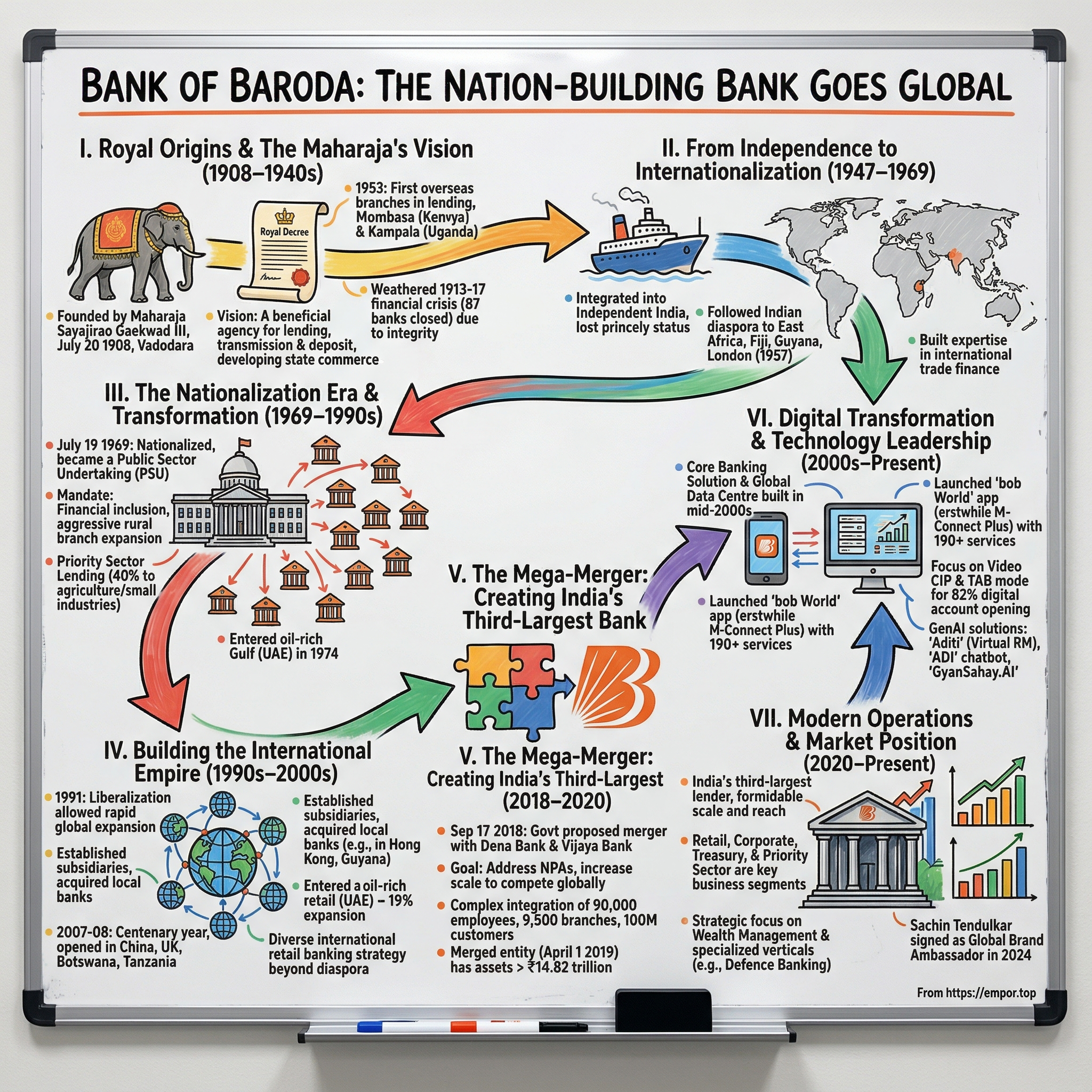
The story runs in five movements.
- The nation-building bank. A princely state's development instrument in 1908, an unusually early exporter of Indian banking to Africa and London, and then — in one legislative stroke in 1969 — a policy instrument of the Republic of India. The founding mythology matters less than the two things it left behind: a diaspora franchise most public-sector peers never built, and a controlling shareholder that is also a government.
- The reckoning. The 2015–2018 stretch when the RBI forced Indian banks to admit what was actually on their books, and when Bank of Baroda simultaneously discovered that one of its own branches had been laundering money at industrial scale. This is where the credibility bar gets set.
- The merger. The first three-way amalgamation of Indian public-sector banks, effective April 1, 2019 — and the five uncomfortable years afterwards when the market said it had been a mistake.12
- The current machine. How the bank actually earns money today, who it is losing to, and where its margin is being squeezed from both ends.
- The tail. The bob World scandal, the NMC Health settlement, the expected-credit-loss transition, and the recurring question of whether an organisation this large and this distributed can grow fast without something breaking.
Along the way there is a live test of management credibility, because Chand has been unusually willing to put numbers on the record — and unusually willing to lower them.
Let us start with a maharaja who wanted his subjects to have somewhere to put their money.
 Subscribe on LinkedIn
II. Origins: From a Maharaja's Bank to a Nationalized Utility (1908–1969)
Picture Baroda in the first decade of the twentieth century: a princely state in western India roughly the size of Wales, ruled by a man who had been plucked from a farming family as a child, adopted into the Gaekwad dynasty, and educated into one of the more remarkable reformist administrators of the era. Sayajirao Gaekwad III made primary education compulsory and free in his state decades before British India managed it. He built libraries. He legislated against child marriage. And on July 20, 1908, he set up a bank at Baroda.13
The point is what the bank was for. It was not a merchant's private treasury or a colonial trading house's credit desk. It was infrastructure — a piece of state capacity, created because a ruler concluded that his subjects could not build farms, textile mills, or trading businesses without somewhere to deposit savings and someone to underwrite risk. The bank existed to develop an economy, and it was owned by the entity responsible for that economy.
Hold that sentence, because it describes Bank of Baroda in 2026 almost as accurately as it described the bank in 1908. The identity of the controlling shareholder changed. The logic did not.
The early decades were a slow, physical grind of putting up branches where commerce was: Bombay in 1918, Calcutta in 1937, Delhi in 1949.13 India in this period was a graveyard for banks — the sector went through repeated waves of failure as thinly capitalised institutions lent against collateral they had not really examined. Surviving was the achievement. Bank of Baroda's modern marketing still leans on that heritage of prudence, and it is fair to note the survival while being sceptical of the inference: an institution that lived through one crisis a century ago tells you very little about the risk controls it runs today. As later sections show, the bank has failed control tests twice in the last eleven years.
The genuinely differentiating decision came in 1953, and it had nothing to do with India. Bank of Baroda opened branches in Mombasa, Kenya and Kampala, Uganda.13 Four years later it opened in London.13 Read that in context: in the 1950s, an Indian bank planting flags in East Africa and the City of London was not chasing global capital markets. It was following people. Gujarati traders had been moving along the Indian Ocean rim for generations, and the East African Indian community needed remittance channels, trade finance, and a bank that would actually talk to them. London was where that money eventually wanted to be.
This is the origin of what Bank of Baroda still calls, without irony, its "India's International Bank" positioning. It is the most durable non-obvious asset in the story. Most Indian public-sector banks are domestic utilities with a token overseas presence. Bank of Baroda built a real one, seventy years ago, on the back of a diaspora rather than a strategy deck. As we will see, that book is both a genuine competitive differentiator and a persistent, mechanical drag on the bank's reported margins — an asset and an accounting nuisance at the same time.
Then, on July 19, 1969, everything changed by decree. Prime Minister Indira Gandhi nationalised fourteen major commercial banks, Bank of Baroda among them. "The Bank of Baroda Ltd." became "Bank of Baroda" — the dropped suffix is a small linguistic artefact of an enormous shift.13
Nationalisation is usually taught as a story about credit access, and on that count it worked: bank branches spread into rural India at a pace private capital would never have funded. But for anyone holding the shares seventy years later, the more important consequence was to the incentive structure. Before 1969, the bank's promoter wanted the bank to develop the regional economy and to be a sound business. After 1969, the bank's owner wanted it to execute national policy — agricultural lending targets, priority-sector quotas, financial-inclusion drives, branch presence in places no profit-maximising bank would go — and to be a sound business, in roughly that order.
That ordering has never been reversed. Every subsequent chapter of this story, including the current one, is a variation on a single tension: a commercially ambitious management team operating inside an ownership structure whose objectives are broader than shareholder return. The next four decades were about how large that structure could get.
III. Building Scale Under State Ownership (1969–2015)
If the nationalised era had a defining sound, it was the scrape of a metal shutter going up on a new branch in a district town at nine in the morning.
The economics of Indian public-sector banking from 1969 to the early 1990s were simple to the point of being uninteresting: gather deposits from households who had essentially no alternative, lend a mandated proportion into agriculture and small industry, park a large slice in government securities, and let the interest-rate spread do the rest. Competition was administered. Pricing was administered. Growth came from geography — more branches, more deposits, more of the same loan.
The interesting break came in 1996, when Bank of Baroda became one of the first nationalised banks to tap the capital markets through a public issue of equity shares.13 This is the moment the modern shareholder structure was born, and it is worth being precise about what it did and did not do. It introduced private capital, listed equity, quarterly disclosure, analyst scrutiny, and a share price. It did not introduce private control. The Government of India remained the majority owner, and thirty years later it still holds 63.97% of the equity.7
That hybrid is the single most important structural fact about this investment. Minority shareholders in Bank of Baroda get the reporting obligations, the market pricing, and the upside participation of a listed bank, alongside a controlling shareholder who appoints the chief executive, decides when and whether the bank can raise capital, and has policy objectives that are not primarily financial. It is a real structure with real consequences — not a governance abstraction — and we will come back to it when we look at capital allocation.
Through the liberalisation decades, the bank kept extending its overseas network opportunistically, adding presence across Africa, the Gulf, East Asia, and the developed-market financial centres where Indian trade and Indian families had gone. By the 2000s Bank of Baroda operated across more than twenty countries — a footprint no other Indian public-sector bank came close to matching, and one built mostly around trade finance, remittances, and lending to Indian corporates' overseas subsidiaries rather than any attempt at genuine local retail banking.
Here is where the analysis has to get less romantic. The international franchise is differentiated, but differentiation is not the same as profitability. Overseas lending is dominated by trade finance and corporate credit priced off global benchmarks, competing against banks with cheaper wholesale funding. The result is a book that runs at structurally thinner spreads than domestic Indian lending. In the June 2026 quarter, for example, the bank's global net interest margin came in at 2.77% while the domestic margin was 2.93% — the gap is the international book pulling the average down.1 International deposits of ₹2.52 lakh crore, growing 8.9% year-on-year, are a meaningful chunk of a ₹16-plus lakh crore deposit base, and every rupee of it dilutes the blended margin.1
So the honest framing is this: the overseas network is a source of scale, currency diversification, fee flow, and genuine customer stickiness among diaspora and trade clients — and it is also the reason Bank of Baroda's headline margin will always look worse than a purely domestic peer's, before you have said anything at all about how well the bank is run. Management has to explain that arithmetic on essentially every earnings call, and analysts have to remember it every time they compare margins across Indian banks.
By roughly 2014, then, the picture was of a large, diversified, moderately profitable public-sector bank with an unusual international wing, growing steadily, reporting respectable asset quality, and attracting no particular controversy.
The problem was that the reported asset quality was fiction. Not Bank of Baroda's fiction specifically — the entire Indian banking system's. And in 2015 the central bank decided to end it.
IV. The Reckoning: Asset Quality Review and a Forex Scandal (2015–2018)
There is a particular kind of institutional silence that follows a regulator's letter arriving. In 2015, Indian bank boardrooms got two of them.
The first was systemic. Under Governor Raghuram Rajan, the Reserve Bank of India ran an Asset Quality Review — a forced, standardised re-examination of large corporate exposures across the banking system, with instructions to classify honestly. The context was an infrastructure and commodities lending boom that had gone bad years earlier and been papered over through restructuring schemes that let banks keep calling dead loans "standard." The AQR was, in effect, the RBI telling the system: stop pretending.
Bank of Baroda's response was more aggressive than most, and that decision defines the era. Rather than smear the recognition across several quarters, management front-loaded essentially all of it into the December 2015 quarter. The results, reported in February 2016, were brutal: a net loss of ₹3,342 crore — at the time the largest quarterly loss ever posted by an Indian bank — as bad-loan provisions rose nearly five-fold to ₹6,474 crore. Gross NPAs jumped to 9.68% from 3.85% a year earlier, on fresh slippages of ₹15,603 crore in that single quarter.9
Pause on what that means. A bank that had been telling the market fewer than four rupees in every hundred lent were in trouble discovered that nearly ten were. And this was not primarily new deterioration; it was recognition of deterioration that already existed. The AQR did not create India's bad-loan problem. It made the problem legible.
The clean-up took years and got worse before it got better: another loss of roughly ₹3,230 crore in the March 2016 quarter, and a further ₹3,102 crore loss in the March 2018 quarter as recognition continued to grind through the book.14 By mid-2018, gross NPAs were still in double digits.
There is a genuinely creditable read here. Front-loading pain is what a management team does when it wants the cycle over rather than managed. Investors who reward smooth earnings punish it; investors who want to know what they own do not. But there is a second, less comfortable read that the first should not be allowed to obscure: an external regulator, not the bank's own credit function, is what surfaced the scale of the problem. That distinction matters, and it recurs.
Which brings us to the second letter — and this one was not systemic at all. It was Bank of Baroda's alone.
In October 2015, the Central Bureau of Investigation raided a Bank of Baroda branch in Ashok Vihar, Delhi, over foreign-exchange violations reported at roughly ₹6,000 crore.10 The mechanics were almost insultingly crude. Current accounts were opened at the branch, largely for entities that barely existed. Money was then remitted out of India to Hong Kong and Dubai, documented as advance payments for imports — cashews, pulses, rice — that were never shipped. The branch had obtained an authorised-dealer forex licence relatively recently, and its outward remittance volumes had exploded to a scale wildly disproportionate to a single suburban Delhi branch's plausible trade business.
Three features of this episode deserve emphasis, because they are the ones that generalise.
First, the failure was in controls, not in credit judgment. No one made a bad lending call. Systems and supervision simply did not flag a branch whose forex throughput had gone vertical, on transactions with no shipping documents behind them.
Second, the detection came from outside. The Financial Intelligence Unit later imposed a ₹9 crore penalty on the bank, finding failures across multiple counts, including inadequate customer due diligence on 73 accounts and thousands of delayed electronic-funds-transfer reports — the maximum ₹1 lakh per instance permitted under the Prevention of Money Laundering Act, applied repeatedly.11 The RBI separately imposed a ₹5 crore penalty in 2016.15 The fines were rounding errors against the bank's earnings. The signal was not.
Third, and most usefully for anyone assessing the bank today: the incentive geometry. A branch chasing volume, a licence recently granted, and a monitoring function that did not scale with the activity it was supposed to monitor. Remember that shape. It reappears in 2023 wearing a mobile app.
For investors, this two-year stretch is where the credibility bar gets set. Bank of Baroda has demonstrated that it can take pain honestly once forced. It has not yet demonstrated, across a full cycle, that it detects its own problems before someone else does. Every claim management makes today about growth, digital acquisition, or balance-sheet doubling has to be read against that record — not dismissed because of it, but not granted on trust either.
By the middle of 2018 the bank was cleaner than it had been but still wounded, still under-earning, and still carrying double-digit gross NPAs. It was also, from the government's point of view, about to become the solution to two other banks' problems.
V. The Mega-Merger: Creating a Three-Bank PSU Champion (2018–2020)
On September 17, 2018, the Finance Ministry did something that had never been done in Indian banking: it proposed folding two public-sector banks into a third, simultaneously.
Vijaya Bank was the healthy one — a Bengaluru-headquartered lender with a solid southern franchise, decent asset quality, and a loyal deposit base. Dena Bank was the opposite: a Mumbai-based bank in such poor shape that the RBI had placed it under Prompt Corrective Action, a supervisory regime that restricts a weak bank's lending and expansion until it repairs itself. Bank of Baroda was the vessel. The Union Cabinet approved the scheme on January 2, 2019, and the RBI confirmed that all Vijaya Bank and Dena Bank branches would function as Bank of Baroda branches from April 1, 2019.1617
The combined entity had total business of more than ₹14.82 lakh crore, making it the country's third-largest lender.16 It was the first tripartite amalgamation in Indian public-sector banking history.13
The terms, and why the usual M&A questions half-apply
Vijaya Bank shareholders received 402 Bank of Baroda shares of ₹2 face value for every 1,000 shares held; Dena Bank shareholders received 110.18 No cash changed hands. The market's immediate reaction told you what it thought: analysts read the ratio as roughly a 27% discount for Dena and about a 6% discount for Vijaya against then-prevailing prices, and both stocks fell on the announcement while Bank of Baroda rose.19
The standard acquisition question — did the buyer overpay? — does not fully apply here, and it is worth being precise about why. This was not a negotiated transaction between willing parties with competing bidders and a fairness opinion that anyone could walk away from. It was a government-directed consolidation of three entities the government already controlled, with swap ratios determined inside that structure. Nobody was going to lose an auction.
That makes a different question the useful one: did Bank of Baroda inherit more problems than it gained in capability?
On the problem side, Dena Bank was under PCA for a reason. Absorbing it meant importing a stressed loan book, a weaker credit culture, and an operational estate that needed fixing rather than integrating. On the capability side, Vijaya Bank brought a genuinely complementary southern franchise into a bank historically strongest in the west, plus a deposit base and branch network with real value.
And then there is the third party to the transaction. Around closing, the government injected ₹5,042 crore of fresh capital into Bank of Baroda by way of preferential allotment.20 Strip away the language and the structure is clear: taxpayer capital underwrote the integration risk of a policy-directed merger. This is the defining feature of public-sector-bank "M&A" in India, and it cuts both ways for a minority shareholder. It means the downside of a badly integrated merger is partly socialised. It also means the decision to merge at all was never yours, and the same shareholder who backstops you can dilute you.
The unglamorous part: eighteen months of plumbing
Bank mergers are not really financial transactions. They are systems migrations wearing a financial transaction's clothing.
Three banks meant three core banking systems, three chart-of-accounts structures, three sets of credit-approval delegations, three human-resources hierarchies with incompatible seniority ladders, and — the part customers actually notice — three sets of account numbers, IFSC codes, debit cards, cheque books, and net-banking logins. More than five crore customer accounts had to be moved onto one platform without losing anyone's money or, harder, anyone's trust.
The migration ran in tranches through 2020: Vijaya Bank's branches were folded in by September 2020, Dena Bank's by December 2020. Alongside it came the physical rationalisation — thousands of branches consolidated where the three networks overlapped, heavily concentrated in Gujarat, where Bank of Baroda and Dena Bank had been competing on the same streets for decades. The FY2018-19 annual report set out the scale of the integration task and the bank's stated intent to extract cost synergies over a multi-year horizon.21
An underappreciated output of all this: Bank of Baroda became the system's reference implementation. Ahead of the government's much larger 2020 round of public-sector bank mergers, it briefed other public-sector banks on what it had learned. That is a real organisational capability, and it is invisible in any financial statement. It is also the kind of asset that decays — institutional knowledge of a 2019–2020 migration is worth progressively less as the people who did it retire.
Five years of being told you were wrong
Here is the part of the merger story that investors should actually study, because it is the part that generalises.
By November 2019 — seven months after closing — the consensus verdict was that the deal had been a mistake. Gross NPAs remained above 10%, slippages were still running high, the promised scale benefits were nowhere in the numbers, and coverage was openly describing the merger as "more a bane than a boon" for Bank of Baroda.12 That was not an unfair reading of the evidence available at the time. It was the correct reading of the evidence available at the time.
And it stayed the correct-looking reading for years. The market did not re-rate Bank of Baroda in 2020, or 2021, or really 2022. Integration costs were real and immediate; integration benefits were diffuse and deferred. Then COVID arrived less than a year after closing, which is roughly the worst possible environment in which to be simultaneously migrating five crore accounts and managing a stressed corporate book.
By FY2025, the picture had changed completely: a record ₹19,581 crore net profit and gross NPAs down to 2.26%.322 The temptation is to draw a straight line from the 2019 merger to the 2025 result and call it vindication.
Resist it, or at least discount it heavily. The same period saw every large Indian public-sector bank's profitability and asset quality improve dramatically, driven by forces that had nothing to do with Bank of Baroda's integration: the Insolvency and Bankruptcy Code finally delivering recoveries on legacy corporate defaults, a decade of provisioning working through the system, benign credit conditions, and a post-COVID credit upcycle. Punjab National Bank, Canara Bank, and Union Bank of India all got substantially better over the same window, and none of them absorbed two banks.
The intellectually honest attribution is that the merger gave Bank of Baroda more scale and a broader deposit franchise to deploy into a favourable cycle, and that the cycle did most of the heavy lifting on the earnings recovery. Both statements are true. Neither alone is.
The genuine lesson is about time horizons. Integration-heavy consolidation cannot be judged on a 12-to-24-month clock, and a market that tries to will usually be wrong in both directions — too harsh early, too generous late. Investors who sold in 2019 on the "bane not boon" thesis were reading real data. They were just reading it on the wrong timescale.
What emerged from the other side was a much bigger bank with a genuine question to answer: now that you have the scale, what exactly do you do with it?
VI. The Core Business Today: Segments, Competitors, and How BoB Actually Wins or Loses
Strip away the history and the branding and a bank is a spread business with a risk function bolted on. It borrows at one price, lends at another, keeps the difference, and loses some of it to loans that do not come back. Everything else — apps, branches, brand campaigns, cross-sell — exists to make one of those three numbers better.
So let us look at Bank of Baroda's three numbers.
The shape of the machine
As of the June 2026 quarter, global business stood at roughly ₹30.5 lakh crore, with advances growing 17.4% and deposits 13.8% year-on-year.1 Domestic deposits were ₹13.82 lakh crore, up 14.7%; international deposits ₹2.52 lakh crore.1 For FY2025, global advances were around ₹12.3 lakh crore with domestic advances up 13.7%, comfortably ahead of the bank's own guidance for the year.322
The bank reports along the segment lines the RBI prescribes — Treasury, Corporate and Wholesale Banking, Retail Banking, and Other Banking Operations — with the international book cutting across them. Reading behind that structure, three distinct businesses are doing three different things.
Retail, agriculture, and MSME are the growth engine. In the June 2026 quarter, retail advances grew 18.4%, agriculture 18.7%, and MSME lending 20.3%.1 This is not accidental drift; it is the deliberate execution of the private-bank playbook — granular, secured, higher-yielding loans to millions of customers rather than lumpy loans to a few hundred corporates. The strategic logic is sound: granular books diversify risk, price better, and are far less prone to the concentrated corporate blow-ups that nearly destroyed the bank's earnings a decade ago.
The caution is that every Indian lender discovered this playbook at the same time. Retail growth above 18% in a market where a dozen well-capitalised banks and several hundred non-bank lenders are chasing the same salaried borrowers, the same gold-loan customers, and the same small-business ledgers is growth that has to be underwritten unusually well to be worth having. Fast retail growth in a competitive market is not evidence of an advantage. It is evidence of appetite. Whether it was good appetite becomes visible two to three years later, in the slippage numbers.
Corporate and wholesale is the legacy scale business, growing more slowly — 15.3% year-on-year in the June quarter, but down about 7% sequentially, which tells you how lumpy and price-competitive that market has become.1 Large-corporate lending in India today is a market where the best borrowers can access bond markets directly and force banks to compete on price for the privilege of lending to them. Growth here is available; profitable growth is harder.
Treasury is not a business, it is weather. It produces large positive swings when rate cycles cooperate and large negative ones when they do not. Any model that projects treasury income forward as a growth line is a model that will be wrong. Investors should treat it as noise around the operating result, not part of it.
Then there is the funding side, which is where the real pressure is. CASA deposits — current and savings accounts, the cheap money that funds a bank's spread — grew 10% to ₹5.21 lakh crore domestically in the June 2026 quarter, against domestic deposits up 14.7%.1 Read those two rates against each other and you have the whole margin story: the cheap deposits are growing more slowly than the expensive ones, so the mix is deteriorating even as the total grows. Cost of deposits came in at 4.66%, down 12 basis points sequentially, which is genuine relief.1 But the structural direction is clear, and it is the reason the margin conversation dominates every call.
The competitive field, honestly assessed
Bank of Baroda operates in four overlapping fights at once.
Against State Bank of India, it is not really a fight. SBI is in a different weight class — larger by every measure, with a branch network and deposit franchise that no Indian bank will replicate. SBI's implicit sovereign backing is, if anything, more absolute than Bank of Baroda's. There is no realistic path by which Bank of Baroda displaces it.
Against Punjab National Bank, Canara Bank, and Union Bank of India, it is a fight over the same square metre. These are the peers competing for identical customers: government department accounts, public-sector employee salary relationships, priority-sector lending targets, pension disbursement mandates, and small-business lending in the same district towns. Differentiation is thin. Whoever prices deposits most aggressively wins share and damages their own margin doing it. This is close to a commodity market with four large sellers and one enormous one.
Against HDFC Bank, ICICI Bank, and Axis Bank, it is a fight it is structurally losing on the axes that matter most to valuation. Private banks generate higher fee income per customer, underwrite faster, run better digital experiences, and — critically — attract stickier low-cost transaction deposits from urban affluent customers. The evidence is in the valuation gap already described: comparable loan books, roughly one-eighth the market capitalisation.56 Markets are not always right, but a gap that persistent is usually pricing something real. What it is pricing is a combination of lower return on equity, higher perceived governance risk, and the belief that Bank of Baroda's earnings quality is more cyclical and its strategic freedom more constrained.
Against fintechs and non-bank lenders, it is a fight over the customer interface. UPI turned payments into a commodity utility layer that sits on top of any bank account, which quietly destroyed one of the great historical advantages of large branch networks: the friction of leaving. A customer who banks through a third-party payments app barely notices whose ledger their money sits on.
Five Forces, applied properly
Michael Porter's framework is often deployed as a checklist. Used honestly on an Indian public-sector bank, it produces a genuinely uncomfortable picture.
Rivalry: intense and structurally so. Deposits are the raw material, they are functionally identical across providers, and price is the primary lever. Twelve public-sector banks, a dozen large private banks, and a long tail of small-finance banks compete for them.
Buyer power: rising fast. Not because any individual depositor has leverage, but because switching costs collapsed. Account portability, UPI, digital onboarding, and rate-comparison apps mean a retail customer can move savings in an afternoon. The historical stickiness of a public-sector bank relationship — inertia, branch proximity, the passbook — is eroding generationally.
Supplier power: low, with one exception. Depositors as a class have limited individual power, but the RBI is effectively a supplier of the regulatory permission to operate, and its power is close to absolute, as the bob World episode demonstrated.
Threat of new entrants: negligible at this scale. Nobody is going to assemble a ₹16 lakh crore deposit base from a standing start. Bank licences in India are scarce and capital requirements are punishing. This is Bank of Baroda's most reliable protection, and it protects every incumbent equally.
Threat of substitution: real and growing. Not substitution of banking, but of the profitable parts of banking. Non-bank lenders and fintechs are attacking exactly the segments Bank of Baroda is growing into — unsecured retail, MSME working capital, consumer durables — often with faster decisions and better data. Payment apps have already substituted away much of the customer relationship.
Four of five forces are unfavourable, and the favourable one confers no relative advantage.
Seven Powers, and the awkward conclusion
Hamilton Helmer's framework asks what, specifically, allows a company to sustain returns above its cost of capital. Run Bank of Baroda through the seven candidates and most of them fail on inspection.
Scale economies exist in banking — a large deposit base spreads technology and compliance cost — but Bank of Baroda is not the scale leader, SBI is, and being the third-largest player in a scale-driven industry is a difficult place to earn excess returns. Network economies essentially do not apply; a bank account does not get more valuable because other people have one, and UPI has made even the payments network a shared public utility rather than a proprietary asset. Switching costs used to be the great public-sector-bank moat and are the thing UPI-era portability has most directly damaged. Counter-positioning would require a business model incumbents cannot copy without damaging themselves — arguably a description of what private banks did to public-sector banks, not the reverse. Cornered resource and process power are hard to argue: the bank's people, systems, and underwriting processes are good but not demonstrably superior to peers'. Branding has value — a 118-year-old institution carries trust, particularly in semi-urban India — but trust that translates into cheaper deposits rather than premium pricing.
What Bank of Baroda actually has is something Helmer's framework does not name, because it is not a competitive advantage in the market sense at all: majority ownership by a sovereign government. Depositors believe, correctly, that the Government of India will not let Bank of Baroda fail. That belief lowers the deposit rate the bank must offer to attract money, which is a genuine funding-cost advantage worth real basis points.
But look closely at that advantage and three uncomfortable features appear. It is shared — every public-sector bank has it, so it confers no edge against the peers Bank of Baroda most directly competes with. It is granted, not earned — no management action created it and no management action can strengthen it. And it is reversible by the same authority that granted it — a policy shift toward privatisation, or a change in how implicit guarantees are perceived, would remove it without the bank doing anything wrong.
That is the analytical heart of the matter. Bank of Baroda's most powerful advantage is also the reason for its valuation discount, because the entity providing the advantage is the same entity constraining the returns. The government makes the bank safe and makes it slow.
Which raises the obvious question: who is trying to change that, and how credible are they?
VII. Current Management, Ownership, and Capital Allocation
Chief executives of Indian public-sector banks do not get their jobs the way chief executives usually do. There is no search firm, no competing offer, no board negotiation over equity. There is a government order.
Debadatta Chand took charge as Managing Director and Chief Executive Officer of Bank of Baroda in July 2023, following nearly three decades in commercial and development-finance banking.23 He was not an outside hire. He had been the bank's Executive Director since 2021, with responsibility for corporate and institutional credit, treasury, and trade and forex — which is to say, he ran the wholesale side of the balance sheet before he ran the bank. His predecessor, Sanjiv Chadha, had his tenure extended by five months in January 2023 before handing over, a small detail that captures how public-sector succession actually works: terms are set and adjusted by the Department of Financial Services, not by the board.24
Internal promotion has a clear trade-off. Continuity is real: Chand inherited a strategy he had helped build and did not need eighteen months to learn where the problems were. But the "fresh eyes" argument is unavailable. A leader promoted from within the credit and treasury functions is unlikely to arrive with a fundamentally different view of the bank's risk culture, and the bob World failures he had to manage in his first quarter originated during his tenure as an executive director.
Ownership: the thing that has not changed
The Government of India holds 63.97% of Bank of Baroda. Mutual funds hold around 10%, foreign institutional investors just under 10%, insurers around 7%, and retail investors roughly 7%.7
That promoter stake is essentially where it was after the 2019 merger. Despite years of commentary about public-sector bank privatisation, disinvestment programmes, and free-float expansion, no meaningful dilution of government control has occurred at Bank of Baroda. Anyone whose thesis depends on privatisation should note that this is now a multi-year record of nothing happening, not a pending catalyst.
Capital allocation: a long pause, then a plan
The bank's last major public equity raise was a ₹4,500 crore qualified institutional placement completed in early March 2021, priced at ₹81.70 per share, taking in Life Insurance Corporation, SBI Life, ICICI Prudential, Nippon Life, Societe Generale, BNP Paribas Arbitrage, and Aditya Birla Sun Life.25 For a bank that has grown its balance sheet substantially since, that is a long time to go without touching equity markets — funded instead by retained earnings and debt instruments, including a ₹7,500 crore debt-raising authorisation in 2024.26
That changes now. Management has disclosed plans to raise ₹8,500 crore of fresh equity over the medium term, through March 2028, while stating on the June 2026 quarter call that there is no immediate capital need given a capital adequacy ratio of 16.30% and CET1 of 13.9%.1
Both halves of that statement deserve attention. A 16.30% capital ratio genuinely does not require an emergency raise. But a bank targeting 12–14% annual credit growth while facing a quantified regulatory capital headwind — more on that shortly — will need capital eventually, and the sequencing matters enormously to existing shareholders. Raising equity from a position of strength at a reasonable multiple of book is good capital allocation. Raising it under regulatory pressure at a depressed multiple is value destruction. The disclosed plan is a positive signal precisely because it is early. Whether the execution matches will be visible in the pricing.
Credibility test one: does the guidance hold?
Chand's management has been notably willing to publish specific numerical guidance — credit growth ranges, deposit growth ranges, margin bands, credit cost bands, return on equity targets. That is a real discipline; plenty of managements avoid it precisely because it creates accountability.
On volumes, they have delivered. FY2025 domestic advances growth surpassed guidance.22 The June 2026 quarter's 17.4% global advances growth ran well above the 12–14% guided range, and Chand described the growth rates as "possibly one of the strongest" in the industry.1 On asset quality, delivery has been better still: gross NPAs at 1.99%, net NPAs at 0.50%, credit cost at 0.29% against a guided band of 1.00–1.25%.1 Coming in dramatically under a credit-cost guide is unusual and, on its face, a good sign.
On margin, the record is different, and it matters more.
The FY2026 net interest margin guidance band was 2.85–3.00%. Actual performance landed at the low end. FY2027 guidance was then set lower still, at 2.75–2.95%, and the June 2026 quarter came in at 2.77% — inside the band, but again near its floor.1 Meanwhile the December 2025 quarter had already shown margin compressing to 2.79% from 3.04% a year earlier.27
That is a pattern, and it should be named as one: guidance revised downward in successive years, with actuals clustering at the bottom of each successively lower range. Management's explanation — deposit repricing lags, competitive deposit pricing, the international book's mix effect — is mechanically accurate. But an explanation that is accurate can still describe a deteriorating business. Guidance that keeps moving to meet reality is guidance that was not conservative to begin with, and investors are entitled to apply a discount to the next margin range on that basis.
Credibility test two: how do they explain a miss?
The June 2026 quarter offered a live test. Faced with a reported profit down 71.9%, management pointed to an adjusted figure of ₹5,528 crore excluding the settlement, characterised the settlement as resolving all claims "without admission of liability or wrongdoings," and emphasised that the bank's underlying financial strength and balance-sheet growth "remain among the strongest."12
Is that fair or is it spin? Genuinely, mostly the former. The settlement is a discrete, non-recurring cash cost relating to an exposure from 2020. Excluding it to understand run-rate earnings is exactly what an analyst would do independently. The bank also disclosed the settlement clearly and promptly rather than burying it.
But two things in the framing warrant scepticism. First, "no admission of liability" is a legal formulation, not a factual exoneration; a bank that pays $600 million to end litigation has made a commercial judgment that the alternative was worse, and that judgment carries information about the strength of the claims. Second, the habit of adjusting matters more than any single adjustment. An institution with a politically visible earnings number has structural incentive to normalise every bad quarter, and the discipline investors should apply is to reconstruct headline numbers themselves — permanently, not selectively.
Notably, management did not adjust away everything. It flagged that full-year return on assets may fall short of its own above-1% target because of the settlement, while guiding to above 1% for the remaining three quarters.1 Proactively lowering a headline expectation is more credible behaviour than waiting to be caught out, and it should be counted in management's favour.
Credibility test three: the doubling claim
Which brings us to the target that hangs over everything. Double the balance sheet in five years, from a January 2025 base, with loan market share moving from 5.5% toward 6% and roughly 500 new branches aimed at "micro markets" to gather the deposits to fund it.4
Do the arithmetic. Compounding at the guided 12–14% credit growth, a book doubles in roughly five to six years. So the target is not fantasy; it is the mechanical result of hitting guidance every single year for five consecutive years. That is the problem. There is no cushion in it — for a growth slowdown, for further margin compression that limits internal capital generation, for a credit cycle turning, or for a capital constraint arriving early. And no detailed roadmap has been disclosed distinguishing organic growth from any other path.
The most useful way to hold the claim is as a statement of intent rather than a plan, and to watch whether it survives contact with a bad year. Chand repeated it in May 2026, sixteen months after first making it, which is at least evidence of narrative consistency rather than a one-off soundbite.8
The permanent activist in the room
Investors sometimes ask what an activist would demand at Bank of Baroda: portfolio simplification, a governance overhaul, capital returns, accountability for control failures. It is a reasonable list, and it is also mostly moot, because the activist seat is already occupied.
With 63.97% of the equity, the Government of India is a permanent controlling shareholder whose objectives include fiscal revenue, employment, financial inclusion, priority-sector credit flow, and the political optics of a large public bank's performance. Those objectives overlap substantially with minority shareholders' interest in returns. They do not coincide with it. When a financial-inclusion mandate requires branches in unprofitable geographies, or when priority-sector targets require lending at administered pricing, the cost is borne by all shareholders and the policy benefit accrues to the controlling one.
No external activist can dislodge that. Which means the governance question at Bank of Baroda is not "will someone force change?" but "does the controlling shareholder's current preference happen to align with commercial performance?" Right now, with the government wanting strong, well-capitalised public-sector banks and a healthy market valuation ahead of any eventual stake sale, the answer is largely yes. That alignment is a condition, not a guarantee.
And the clearest recent test of whether this management can govern its own operations came not from the government, but from the regulator.
VIII. The bob World Crisis: A Case Study in Digital-Banking Execution Risk (2019–2024)
On October 10, 2023, the Reserve Bank of India did something to Bank of Baroda that it rarely does to a bank of that size: it switched off a growth engine.
The order directed the bank to immediately stop onboarding any new customers onto bob World, its mobile banking application, citing material supervisory concerns.28 Existing customers could keep using the app. New ones could not be added. For a bank whose entire post-merger retail strategy was premised on digital customer acquisition, this was the equivalent of being told the front door was locked but the building was fine.
What actually happened
The origin was not a hack, a system failure, or a vendor error. It was an incentive scheme.
Bank of Baroda had launched bob World in September 2021 and pushed hard on app registrations, with branch staff carrying onboarding targets. Reporting by Al Jazeera in July 2023 — followed by a second investigation in October — described what branch employees did to hit those targets: where a customer's account had no registered mobile number, staff linked other mobile numbers to it, so that the one-time password needed to complete app registration would arrive somewhere they controlled. The numbers used reportedly belonged to bank staff, managers, security guards, sanitation workers, their relatives, and bank agents in remote areas.2930
Explain it without jargon. Signing up for a mobile banking app requires proving you control the phone number attached to the account. If a customer has no number on file, that proof cannot be produced. So the account was attached to a phone number belonging to someone else entirely — usually an employee — the OTP arrived on that employee's phone, and the registration was completed. The customer, in many cases, had no idea they now had a mobile banking app registered in their name, controlled by someone else's handset.
The follow-up reporting went further, describing instances of agents accessing funds in accounts.30 The bank suspended more than sixty employees, including eleven assistant general managers, and ordered an audit whose findings it said were still being compiled in late November 2023.3132
The cost
The restriction ran for about seven months, lifted on May 8, 2024.3334 The timing was close to maximally bad: the 2023–2024 window was precisely when Indian banks were scaling app-based and UPI-driven retail acquisition hardest. Bank of Baroda spent that window unable to add a single new digital customer while every competitor added millions. Analysts at the time flagged that the action would weigh on growth and raise costs.35 The bank's Chief Digital Officer departed in the aftermath.
The financial cost is impossible to quantify precisely, which is part of the point. It shows up not as a line item but as customers acquired by someone else and never available again.
The recovery, and what remains unproven
Since the restriction lifted, the bank has rebuilt aggressively. bob World was relaunched with a substantially broader service catalogue. At the Indian Banks' Association's 21st Annual Banking Technology Awards, announced in January 2026, Bank of Baroda won four categories among large banks — Best AI & ML Adoption, Best Fintech & DPI Adoption, Best IT Risk Management, and Best Tech Talent — and received a Special Mention in the Best Technology Bank category.36 In April 2026 it partnered with Reliance Jio to launch bob World Lite, a banking app built for feature phones on the JioPhone Prima 4G, offering UPI, transfers, and bill payments on keypad devices over slow connections, open to customers of other banks as well through self-onboarding.37
Two observations, one favourable and one not.
The favourable one: bob World Lite is a genuinely well-conceived product for the customer base a public-sector bank actually has. Hundreds of millions of Indians use feature phones, and building for them rather than for the smartphone-owning urban customer that every private bank fights over plays to Bank of Baroda's distribution and its financial-inclusion mandate simultaneously. It is the rare case where the policy obligation and the commercial opportunity point the same way. Distribution through Jio's device base is meaningful reach.
The unfavourable one: there is no verifiable way to assess whether the digital funnel has actually recovered, because the bank does not disclose the metrics that would show it. Monthly active users, app activation rates, digitally-sourced account openings, digital share of transactions — the numbers a private-sector peer routinely publishes in an investor presentation — are absent from public disclosure for the 2024–2026 period. An awards citation is not an operating metric. A partnership announcement is not an activation number.
This is a transparency gap and it should be treated as one. When a bank's growth narrative depends heavily on a digital acquisition engine, and that engine was demonstrably broken by the bank's own conduct, the burden of proof sits with the bank. Absent disclosure, the "digital comeback" remains a claim rather than a demonstrated fact.
What this episode is actually evidence of
Set the 2015 forex episode and the 2023 app episode side by side and the same structure appears twice, eight years apart. Aggressive volume targets, pushed to a distributed frontline, without monitoring that scaled at the same rate. In 2015 the volume was outward remittances. In 2023 it was app registrations. Both times, staff found the shortest path to the target. Both times, an outside party — the CBI, then journalists and the regulator — surfaced it before the bank's own controls did.
That is not two unrelated accidents. It is a recurring organisational vulnerability, and it is the single most legitimate reason for scepticism about a management team promising to double a balance sheet. Doubling means pushing growth targets harder, to more people, in more places. The bank's own history says that is exactly when its controls fail.
Management's response to bob World was, to be fair, reasonably decisive: suspensions, an audit, senior accountability, a rebuilt product, and eventual regulatory clearance. What has not been demonstrated is the thing that would actually settle the question — a growth push executed at scale without a control failure. That test is running right now.
IX. Subsidiaries and Optionality: Sized to Their Actual Weight
Every large bank has a collection of subsidiaries, and every investor presentation makes them sound like a portfolio of hidden gems. Proportion matters here: Bank of Baroda's consolidated profit runs above ₹20,000 crore a year, while its subsidiaries' revenues sit in the tens to low hundreds of crores. None of them is individually material to consolidated earnings. This section is about optionality and about what management's handling of these assets reveals, not about a hidden growth story.
IndiaFirst Life Insurance is the one holding with genuine optionality. Bank of Baroda owns roughly 65%, and a listing has been on the table for years — SEBI approved the IPO back in March 2023.38 It never happened. It was deferred, and then deferred again. Instead, in July 2026, Warburg Pincus agreed to sell its roughly 26% stake to BNP Paribas Cardif, leaving post-transaction ownership at approximately 65% Bank of Baroda, 26% BNP Paribas Cardif, and 9% Union Bank of India. Chand, who chairs IndiaFirst Life, described the transaction as reflecting reinforced shareholder commitment.39
Read the substance. A financial sponsor that had been waiting for a listing exit took a trade sale instead. That is a rational outcome for Warburg and arguably an upgrade for IndiaFirst, which gains a global insurance operator as a strategic shareholder rather than a fund with a clock running. But the sequence — approved IPO, twice deferred, sponsor exits privately — is a data point about how this management sequences capital-markets execution. Bancassurance cross-sell into a network of thousands of branches is a real long-term opportunity, and a future listing would crystallise value. Neither is in hand.
Baroda BNP Paribas Mutual Fund, a joint venture in which Bank of Baroda holds a majority stake alongside BNP Paribas Asset Management, is the fee-income diversification play. With assets under management in the tens of thousands of crores, it is a rounding error against a lending book measured in lakhs of crores. Indian asset management is a genuinely attractive, capital-light business with structural tailwinds from household financialisation. The problem is that Bank of Baroda's joint venture is a small player in a market dominated by SBI, ICICI Prudential, HDFC, and Nippon. Scale in asset management is close to destiny.
BOB Financial Solutions (credit cards) and BOB Capital Markets (investment banking and broking) are niche fee businesses. Neither is disclosed with segment-level profitability detail sufficient for independent assessment, which is itself worth noting: they are small enough not to matter and disclosed thinly enough that an investor could not tell if they started to.
Nainital Bank is the most revealing item on the list, precisely because it is the smallest. Bank of Baroda holds 98.57% of this small Uttarakhand-focused lender. In December 2022 the board approved divesting the majority stake.40 Through 2023 and 2024, Premji Invest, Zerodha, and others were reported to be in talks, with a term sheet signed and diligence completed, implying a valuation around ₹800 crore.4142 Then it stopped. Rather than sell, Bank of Baroda reportedly injected around ₹169 crore into the subsidiary during the second quarter of FY2026, appointed a chief-general-manager-rank official as its managing director, and reframed strengthening the subsidiary as a core strategy — a reversal reported to have followed a regulatory shift on overlapping bank and group-entity businesses that removed the original reason to exit.43
A ₹169 crore infusion into a bank earning ₹20,000 crore a year is not a capital allocation decision worth arguing about on its merits. What makes it worth a paragraph is the pattern it completes. A board-approved divestment, four years of process, a term sheet, and then a decision to keep and recapitalise instead — with the stated rationale changing along the way. For investors trying to gauge management's appetite for portfolio simplification, the honest read is that the appetite is limited and the direction reversible. If a ₹800 crore disposal takes four years and then does not happen, expectations for bolder structural moves should be calibrated accordingly.
None of this changes the investment case, which rests almost entirely on the core lending book. Which is exactly where the current pressure is.
X. The Current Inflection: Margin Squeeze and a $600 Million Surprise (2025–2026)
The first week of February 2026 was when the market's patience with Bank of Baroda's margin story ran out.
The bank had reported December-quarter results showing net profit up 4.5% year-on-year to ₹5,055 crore, helped by lower provisioning.27 On the face of it, fine. Underneath it, not fine at all: net interest margin had compressed to 2.79% from 3.04% a year earlier and from 2.96% the prior quarter, and net interest income had gone flat despite advances growing around 15%.27
That combination is the one bank investors dread. Volume growing, revenue not. It means every new rupee lent is earning so much less than the existing book that growth is running on a treadmill. The stock fell as much as 7% on February 2, 2026, and slid further the following session, with brokerages downgrading on hardening deposit costs and shrinking treasury and recovery income.44
The bank's own explanation was straightforward and largely correct: when the RBI cuts policy rates, floating-rate loans linked to external benchmarks reprice down almost immediately, while term deposits reprice only as they mature over subsequent quarters. The asset side falls first; the liability side follows with a lag. That lag is the compression. It is arithmetic, not mismanagement.
What makes it more than arithmetic is that it is not the whole explanation. The lower-yielding international book keeps growing. The cheap-deposit mix keeps deteriorating. Deposit competition among Indian banks chasing the same funding remains intense. Take those together and the compression looks less like a temporary rate-cycle artefact and more like a structural narrowing that a rate-cycle recovery will only partly reverse. Management's own guidance revisions are consistent with the structural reading, not the temporary one.
Then the tail arrived
Six months later, on July 24, 2026, came the other kind of shock — the kind you cannot see coming from the operating numbers.
NMC Healthcare was an Abu Dhabi-based hospital operator that collapsed in 2020 after undisclosed borrowings surfaced, wiping out lenders across the Gulf, the UK, and India. Bank of Baroda had exposure. Six years of litigation across Abu Dhabi and London courts followed. In the June 2026 quarter, the bank settled out of court for roughly ₹5,680 crore — about $600 million — paid on July 1, 2026, resolving all claims without admission of liability, while noting that claims against individuals continue in multiple jurisdictions.12
Reported net profit for the quarter came to ₹1,278 crore, down 71.9%. Operating profit was ₹8,127 crore, and the ex-settlement figure ₹5,528 crore.1
The analytically important point is not the size of the number. It is what the number is evidence of. Bank of Baroda's operating performance in that quarter was strong on almost every metric that management controls — growth, asset quality, provision coverage, credit cost. And none of it mattered to the headline, because a decision made about a Gulf healthcare borrower before this management team took over crystallised into cash six years later.
That is the nature of tail risk in banking. It is not in the current numbers, it is not in guidance, and it is not modellable from outside. What an investor can conclude is narrower but still useful: a bank with a genuinely international corporate book carries exposures of a kind that a purely domestic retail lender does not, and the cost of those exposures arrives lumpily and late. The international franchise that differentiates Bank of Baroda is the same franchise that produced this.
And a second, quieter incident
Four days later, on July 28, 2026, the bank confirmed a cybersecurity incident: an employee's email account had been compromised, leading to unauthorised access to certain data. The bank said the intrusion was identified and contained immediately and that core banking systems were not accessed and remained secure. A threat actor advertised data for sale on darknet marketplaces, claiming customer information, corporate banking records, internal emails, loan documents, and audit files — claims the bank did not confirm and whose authenticity could not be independently verified. An investigation was ongoing.45
On the disclosed facts, this is not a solvency or a core-systems event. But it is the third instance in this story of a control perimeter being breached through the human layer rather than the technical one — first branch staff routing illegal remittances, then branch staff falsifying app registrations, now an employee credential opening a door. Operational risk disclosure, not just credit risk, is now part of what an investor in this bank is underwriting.
The known headwind nobody has fully priced
There is one more item, and unlike the others it is fully visible in advance.
India is moving its banks from the old incurred-loss provisioning model to an Expected Credit Loss framework. The distinction sounds technical and is actually simple. Under the old approach, a bank provisions once a loan shows signs of going bad — you set money aside after the trouble appears. Under ECL, a bank must provision at origination for the losses it statistically expects across the life of every loan, updated continuously. Think of it as moving from paying for the damage after the accident to funding an insurance reserve on the day you hand over the keys.
The transition is economically sounder and it is expensive, because a bank must build a lifetime-expected-loss reserve against a loan book it already holds. Management has quantified the impact: roughly ₹12,000 crore in absolute terms, about 110 basis points of capital adequacy, spread over time, buffered by an existing floating provision of ₹2,500 crore, with an ongoing run-rate drag of 20–22 basis points annually on capital ratios and 15–20 basis points on credit cost.1
Two things follow. The disclosure itself is a credit to management — quantifying a future regulatory hit precisely, well before it lands, is the behaviour of a team that would rather be believed than flattered. And the magnitude connects directly to the ₹8,500 crore equity plan: a bank absorbing 110 basis points of capital while growing 12–14% a year has a mathematical need for capital that a comfortable current ratio does not eliminate. Investors modelling FY2028 and FY2029 on current capital generation and current credit costs are modelling a bank that will not exist by then.
Against all of this, management reaffirmed FY2027 guidance: credit growth 12–14%, deposit growth 10–12%, net interest margin 2.75–2.95%, credit cost 1.00–1.25%, return on equity 15–16%, with return on assets above 1% for the remaining three quarters even if the full year falls short.1 Reaffirming guidance in a quarter that included a $600 million cash settlement is a statement of confidence in the underlying machine. Whether that confidence is warranted is precisely what the next four quarters of margin prints will reveal.
XI. Playbook: Business & Investing Lessons
Strip Bank of Baroda's 118 years down to transferable lessons and five survive.
Government ownership is simultaneously a moat and a ceiling, and you cannot buy one without the other. The implicit sovereign guarantee is worth real basis points on funding cost and it makes catastrophic failure close to unthinkable. It also means the controlling shareholder's objectives are policy objectives, executive appointments are administrative decisions, capital raises need political and fiscal alignment, and the market applies a persistent discount for all of it. The valuation gap against private peers is not irrationality; it is the price of the guarantee, paid by minority shareholders. Any investor in a state-controlled enterprise anywhere should internalise the trade: safety is purchased with upside, and the exchange rate is set by someone else.
Integration-heavy consolidation cannot be judged on a two-year clock. For roughly five years after the three-bank amalgamation, the informed consensus was that it had been a mistake, and that consensus was consistent with the data available at the time. Integration costs are immediate and legible; integration benefits are deferred and entangled with the cycle. The corollary is uncomfortable for both sides: bears reading real data on the wrong timescale were wrong, and bulls now attributing the FY2025 record profit primarily to the merger are also wrong, because a sector-wide asset-quality recovery was doing much of the work. When a company and its industry improve together, honest attribution requires separating them.
Growth targets pushed to a distributed frontline without matching controls fail the same way every time. The 2015 forex episode and the 2023 app-registration episode share a structure, not a subject matter. In both, an ambitious volume objective reached thousands of employees faster than the monitoring built to supervise it, and in both, external parties found the problem first. This is the single most durable lesson in the story and it is not specific to banking. Any organisation that sets targets it can measure and controls it cannot should expect its people to optimise for the measurable one.
Legacy tail risk does not disappear; it sits in a drawer and discounts. A hospital operator's 2020 collapse in Abu Dhabi determined the shape of a June 2026 quarter in Mumbai. No amount of current operating excellence prevented it, and no external analyst could have modelled the timing or the amount. The practical implication is not to avoid banks with international books; it is to hold a wider distribution of outcomes for them, and to be sceptical of any valuation framework that treats a clean recent credit record as evidence that the drawer is empty.
"Adjusted profit" is a management tool, not a fact. Excluding a genuinely one-off settlement to understand run-rate earnings is legitimate analysis. The risk is not any single adjustment; it is the habit. An institution with a politically visible earnings number has permanent incentive to normalise every bad quarter, and the only defence is to reconstruct headline numbers independently, every time, including when the adjustment is obviously reasonable. Discipline that is applied selectively is not discipline.
Those five lessons, taken together, are also a decent map of where the bull and bear cases actually diverge.
XII. Analysis: Bull vs. Bear Case, and the Risk Radar
The disagreement about Bank of Baroda is unusual in that both sides largely accept the same facts. They differ on which facts are durable.
The bull case
Scale plus a differentiated franchise. Third-largest Indian bank by global business, with an international network built over seven decades that no other public-sector peer approaches.113 Scale in banking is not a trivial asset: it spreads technology, compliance, and risk-management cost across a larger base, and it provides funding stability that smaller lenders lack.
Credit growth that has beaten its own guidance. Advances growing 17.4% against a 12–14% guide, with retail, agriculture, and MSME all growing at or above 18%, indicates real demand and real distribution reach rather than a management team talking about growth it cannot find.1
Asset quality that has improved dramatically and, so far, durably. From double-digit gross NPAs in 2018 to 2.26% in FY2025 and 1.99% by mid-2026, with net NPAs at 0.50%, provision coverage at 93.28%, and credit costs at 0.29% — well inside guidance.13 Provision coverage above 90% means the bad loans on the books are almost fully reserved; the residual risk is in loans not yet identified as bad.
Balance-sheet resilience validated externally. Capital adequacy of 16.30% and CET1 of 13.9% after absorbing a $600 million cash settlement is genuine strength.1 Moody's upgraded the bank's Baseline Credit Assessment to ba1 from ba2 in November 2025 while affirming deposit ratings at Baa3, citing improved asset quality and stronger capitalisation.46 Fitch upgraded the Viability Rating to 'bb' from 'bb-' on February 25, 2026, affirming Long-Term Issuer Default Ratings at 'BBB-' with a Stable Outlook.47 Two independent agencies moving the standalone assessment up — the part of the rating that excludes government support — is the most credible external evidence in the bull case, because it is precisely the component that is not a sovereign gift.
A valuation gap with a plausible closing mechanism. Roughly one-eighth of HDFC Bank's or ICICI Bank's market capitalisation on a comparable loan book leaves substantial room for re-rating if returns on equity hold in the mid-teens and no new control failure emerges.56
The bear case
The margin trend is real deterioration, not optics. Guidance revised down in successive years, actuals landing at the low end of each lower band, net interest income going flat while advances grew 15%.127 Net interest margin is the core economics of a bank; a structural narrowing driven partly by a permanently lower-margin international book and partly by an eroding cheap-deposit mix is not a cyclical wobble that reverses on the next rate cut.
Governance is constrained by design, and it is not going to change. A 63.97% government stake unchanged since 2019, chief executive appointment by government order, and capital-raising decisions requiring alignment with fiscal priorities.7 The bull case's re-rating thesis implicitly requires the market to reduce the discount it applies to state control. Nothing in the last seven years suggests it will.
Control failures are a pattern, not a series of accidents. Two structurally identical incentive-and-oversight failures eight years apart, both surfaced externally, in an organisation now being asked to grow harder and faster than it has in a decade.1029 A bank promising to double its balance sheet is a bank promising to increase exactly the pressure that has twice broken its controls.
The ECL transition is a quantified, multi-year headwind. About ₹12,000 crore, roughly 110 basis points of capital, with ongoing annual drags on both capital and credit cost — arriving in a period when the bank also plans to raise ₹8,500 crore and grow 12–14% a year.1 Near-term guidance does not embed the full effect.
Event risk keeps materialising. A $600 million settlement from a 2020 exposure and a cybersecurity incident four days later, both in a single quarter.245 Neither was foreseeable from disclosed data. That is the definition of an exposure investors cannot price.
Digital-engagement disclosure is thin enough to be a red flag. No published activation, monthly-active-user, or digital-sourcing metrics for the 2024–2026 period, despite the digital funnel being central to the growth pitch and despite it having been shut down by the regulator. Awards and partnership announcements are not substitutes. The claim cannot currently be independently verified.
Risk radar: what actually matters here
Most macro risk lists are noise. Four items genuinely bear on this business.
Interest-rate and deposit-cost risk is the dominant one, and it is not really a risk so much as the core mechanism already described: policy rate cuts reprice loans faster than deposits, and competition for deposits keeps the funding side sticky.
Regulatory and political risk operates on two levels. The ECL transition is the known, quantified version. The unknown version is everything a controlling government shareholder can require — inclusion mandates, priority-sector targets, loan waivers in agricultural distress, or a change in the perceived sovereign backstop.
Cybersecurity and operational risk has moved from theoretical to demonstrated, and matters more for a bank than for most businesses because banking is an accounting of trust. The relevant question is not whether an incident occurs but whether the human perimeter is being hardened at the same rate the digital footprint expands.
Execution risk in the growth push is the one that ties everything together. Doubling a balance sheet requires simultaneously accelerating credit growth, gathering deposits in competitive markets, absorbing a regulatory capital hit, raising equity on reasonable terms, and doing it all without a control failure. Each is individually plausible. All five at once, for five consecutive years, is the actual bet.
Notably absent from this list: AI disruption as an existential threat. Technology is reshaping how banking is distributed and underwritten, and Bank of Baroda is behind private peers on that curve — a competitive disadvantage, and one it is spending to close. But it is not a substitution threat to the balance sheet itself. A bank's product is regulated credit intermediation, and deposit-taking remains a licensed activity. The disruption risk here is margin and share erosion at the interface, not disintermediation of the institution.
The three numbers that matter
Everything above reduces to three things worth tracking quarter by quarter.
One: net interest margin against the 2.75–2.95% FY2027 band. This is the single cleanest real-time read on whether deposit repricing has genuinely completed or whether the compression is structural. Watch not just the level but where inside the band it lands, and watch whether the band itself moves again. A third consecutive downward revision would be considerably more informative than any individual quarter's print.
Two: gross and net NPAs together with credit cost, through the ECL transition. Asset quality is currently the strongest part of the story, and it is being tested twice at once — by a fast-growing retail and MSME book whose vintage losses have not yet emerged, and by an accounting change that alters how losses are recognised. The pairing matters: rising NPAs with stable credit cost would suggest under-provisioning; stable NPAs with rising credit cost would suggest ECL doing its job.
Three: loan market share against management's own 5.5%-to-6% target. This is the report card on the doubling ambition, and it has the useful property of being management's own metric, publicly stated. Share gains prove the growth is coming from competitors rather than from a rising tide. If this number stalls while credit growth guidance is met, the growth is cyclical rather than competitive — and the doubling target quietly becomes arithmetic that no longer works.
None of this produces a verdict, and it should not. It produces a scorecard.
XIII. Epilogue: What to Watch From Here
There is a version of the next five years in which Bank of Baroda becomes the case study that changes how investors think about Indian public-sector banks. Margin stabilises near the bottom of guidance and then improves as deposits finish repricing. The ₹8,500 crore equity raise gets done from strength, at a multiple that does not punish existing holders, funding growth rather than plugging a regulatory hole. The ECL transition absorbs cleanly against the floating provision and retained earnings. The rebuilt digital funnel starts producing disclosed activation numbers that stand up to comparison. Market share grinds from 5.5% toward 6%. The balance sheet compounds toward doubling. And the discount narrows, not because the government sold down, but because the market concludes that state ownership at this bank has stopped being a reason to discount.
There is another version in which margin keeps eroding because the deposit competition never eases and the international book keeps growing, the capital raise happens later and cheaper than planned, ECL bites harder than 110 basis points, the doubling target is quietly dropped from the talking points around FY2029, and a growth push at scale produces a third control failure in the same shape as the first two.
The useful discipline is not to pick between those stories but to identify what distinguishes them early. Five things will do most of that work.
The equity raise, and its price. ₹8,500 crore by March 2028 is disclosed intent.1 What matters is timing and terms — whether it is executed from a position of strength or under regulatory pressure, and what multiple of book the market demands.
Margin, and whether the band moves again. Two consecutive downward revisions have already happened.1 A stabilisation inside 2.75–2.95% would be meaningful evidence that the compression was cyclical. A third revision would settle the argument the other way.
Digital disclosure, not digital awards. The measure of whether the bob World funnel recovered is activation and engagement data the bank has not yet published. Starting to publish it would itself be a signal; continuing not to, while citing awards and partnerships, is also a signal.
IndiaFirst Life. Twice-deferred, now with a new strategic shareholder in place of a financial one.3839 Whether a listing eventually happens is worth watching less for the proceeds — immaterial against a ₹20,000 crore consolidated profit — than for what it says about a management team's willingness to complete capital-markets processes it starts.
The doubling target itself. Repeated in January 2025 and again in May 2026.48 Watch whether it survives a bad year. Targets that get quietly retired after a difficult quarter tell you the target was communication. Targets that get restated with a revised path, and an explanation of what changed, tell you it was a plan.
Step back and the through-line from 1908 is remarkably intact. A bank created as an instrument of economic development, owned by the authority responsible for that development, run by managers who are commercially ambitious inside constraints they did not set. The maharaja became a ministry. The diaspora branches in Mombasa and London became a ₹2.5 lakh crore international deposit book that both differentiates the franchise and drags its margin. The nation-building mandate became priority-sector lending targets and a feature-phone banking app.
What is genuinely new is the ambition. For most of the last fifty years, no one seriously suggested that a large Indian public-sector bank should be run like a compounder. Bank of Baroda's current management has said, on the record, twice, that it intends to double. The interesting question is not whether that is achievable in principle — the arithmetic works if guidance is met every year — but whether an institution whose controls have twice failed under growth pressure, whose margin is narrowing, and whose controlling shareholder has objectives broader than returns, can execute five clean consecutive years.
That is a genuinely open question, and it will be answered in the numbers rather than the narrative.
XIV. Recent News
Reserved for developments after August 2026.
XV. Links & Resources
Reserved for curated further reading.
References
-
Earnings call transcript: Bank of Baroda Q1 FY27 profit hit by settlement — Investing.com, 2026-07 ↩↩↩↩↩↩↩↩↩↩↩↩↩↩↩↩↩↩↩↩↩↩↩↩↩↩↩↩
-
BoB's $600 million NMC Health settlement drags Q1 net profit down 72% — Business Standard, 2026-07-24 ↩↩↩↩
-
Bank of Baroda Q4 FY25 Results Press Release — Bank of Baroda, 2025-05 ↩↩↩↩
-
Bank of Baroda aims to double balance sheet in 5 years: CEO Debadatta Chand — Business Standard, 2025-01-31 ↩↩↩↩
-
Bank of Baroda — share price, market capitalisation and key insights, Screener.in ↩↩↩
-
SBI stock up 6% in Jan, pips ICICI Bank in market cap ranking after 6 years — Business Standard, 2026-01-27 ↩↩↩
-
Shareholding Pattern — Bank of Baroda Investor Relations ↩↩↩↩
-
India's Second-Biggest State Bank Aims to Double Size in 5 Years — Bloomberg, 2026-05-14 ↩↩↩
-
Bank of Baroda posts record Rs 3,342.04 crore loss in Q3 — Business Standard, 2016-02-13 ↩↩
-
CBI raids Bank of Baroda branch for Rs 6,000 crore forex violations — Business Standard, 2015-10-10 ↩↩↩
-
Bank of Baroda Rs 6,000 cr forex remittance scam: FIU slaps Rs 9 cr fine — Zee Business ↩↩
-
Merger with Vijaya, Dena more a bane than a boon for Bank of Baroda — Business Standard, 2019-11-13 ↩↩
-
Bank of Baroda posts Q4 net loss at Rs 3,102.34 cr — Business Standard, 2018-05-25 ↩
-
RBI imposes penalty of Rs 5 crore on Bank of Baroda — Business Standard, 2016-07-25 ↩
-
Cabinet gives nod to Vijaya, Dena Bank merger with Bank of Baroda — Business Standard, 2019-01-02 ↩↩
-
All branches of Vijaya Bank and Dena Bank to function as Bank of Baroda branches from April 1, 2019 — Reserve Bank of India, 2019-03-30 ↩
-
BoB finalises share swap ratio for merger of Vijaya Bank, Dena Bank — Business Standard, 2019-01-02 ↩
-
Bank merger: Swap ratio fair for Dena, not for Vijaya Bank, say analysts — Business Standard, 2019-01-03 ↩
-
BoB-Vijaya-Dena Bank merger: Govt to infuse Rs 5,042 crore into Bank of Baroda — Business Today, 2019-03-28 ↩
-
Bank of Baroda Q4 results: Profit marginally rises 3.3% to Rs 5,048 crore — Business Standard, 2025-05-06 ↩↩↩
-
Debadatta Chand takes charge as Managing Director & Chief Executive Officer of Bank of Baroda — PR Newswire, 2023-07 ↩
-
Govt extends tenure of Bank of Baroda MD Sanjiv Chadha by 5 months — Business Standard, 2023-01-15 ↩
-
Bank of Baroda raises Rs 4,500 cr through Qualified Institutional Placement — Business Standard, 2021-03-03 ↩
-
Bank of Baroda domestic advances grow 8% YoY in Q1, to raise Rs 7,500 cr via debt instruments — Business Standard, 2024-07-08 ↩
-
Bank of Baroda Q3 net profit up 4.5% on lower provisioning, margin pressure — Business Standard, 2026-01-30 ↩↩↩↩
-
RBI suspends onboarding of new customers into Bank of Baroda's mobile app — Business Standard, 2023-10-10 ↩
-
India's Bank of Baroda tampered with accounts to flog app — Al Jazeera, 2023-07-11 ↩↩
-
India's Bank of Baroda expose worsens: Agents steal money from accounts — Al Jazeera, 2023-10-12 ↩↩
-
Bank of Baroda suspends employees amid bob World app irregularities — Investing.com, 2023 ↩
-
Audit report of 'bob World' is in progress; RBI decision to impact capital — Business Standard, 2023-11-23 ↩
-
RBI lifts curb on boarding of new customers on bob World app after 6 months — Business Standard, 2024-05-08 ↩
-
Why did RBI lift ban on Bank of Baroda's mobile app and what does it mean — Business Standard, 2024-05-09 ↩
-
RBI action may weigh on growth, increase costs for Bank of Baroda — Business Standard, 2023-10-11 ↩
-
Bank of Baroda Wins Five Awards at IBA Banking Technology Awards 2025 — PSU Connect ↩
-
Bank of Baroda and Reliance Jio Partner to Launch 'bob World Lite' for Feature Phones — The Statesman, 2026 ↩
-
IndiaFirst Life Insurance gets SEBI's approval to launch its IPO — Business Today, 2023-03-21 ↩↩
-
BNP Paribas Cardif to acquire ~26% stake in IndiaFirst Life from Warburg Pincus — Warburg Pincus, 2026-07-24 ↩↩
-
Bank of Baroda board OKs divestment of majority stake in Nainital Bank — Business Standard, 2022-12-14 ↩
-
Zerodha, Premji Invest In Talks With Bank Of Baroda To Acquire A Stake In Nainital Bank — Inc42, 2023-10 ↩
-
Premji Invest inches closer to majority stake acquisition in Nainital Bank — Business Standard, 2024-05-03 ↩
-
Will Bank of Baroda not sell its stake in Nainital Bank? BoB infuses Rs 169 crore in Nainital Bank — Hello Banker, 2025 ↩
-
Bank of Baroda shares fall as analysts downgrade stock after Q3 results — Business Standard, 2026-02-02 ↩
-
India's Bank of Baroda confirms cyber incident after hackers claim data theft — The Record, 2026-07-28 ↩↩
-
Moody's affirms Bank of Baroda's ratings; upgrades BCA to ba1 from ba2 — Moody's Ratings, 2025-11 ↩
-
Fitch Affirms Bank of Baroda's IDRs at 'BBB-'; Upgrades Viability Rating to 'bb' — NSE corporate filing, 2026-02-25 ↩
 LinkedIn
 WhatsApp
 Reddit
 Hacker News
 Email
Email Kindle
 RSS Feed
 Spotify
 Apple Podcasts
 Amazon Music
 Audible
 YouTube