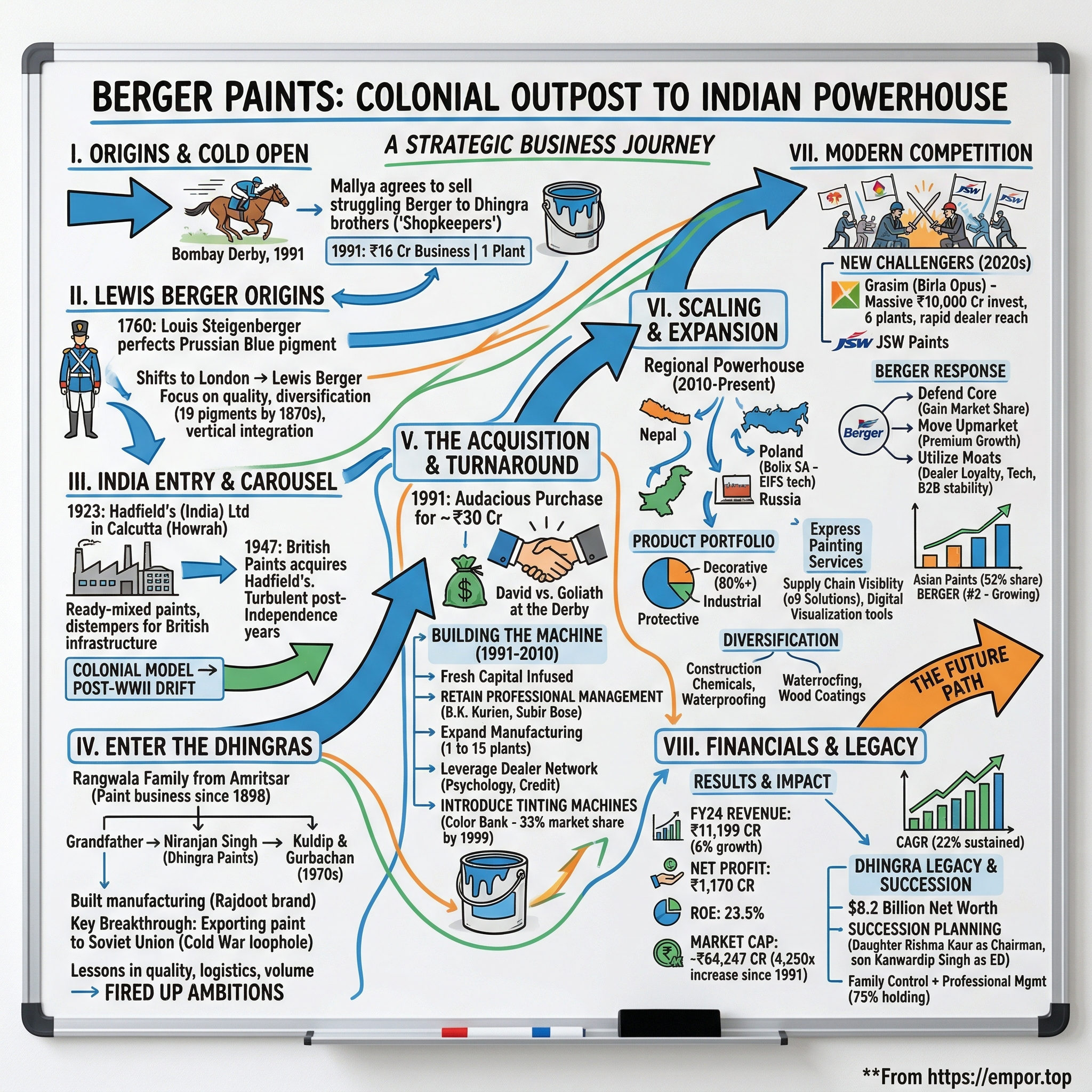
Berger Paints India: The Strong Number Two Meets the New Disruptors
I. Introduction & Cold Open
On February 22, 2024, Kumar Mangalam Birla did something no Indian industrialist had ever done in the paint business. In a single day, he inaugurated three paint factories.
Not one plant with a ribbon and a press release. Three, simultaneously, as the opening move of a business that did not yet have a single customer. The brand was Birla Opus. The parent was Grasim Industries, the Aditya Birla Group's flagship chemicals and textiles arm. And the capital behind it was a stated ₹10,000 crore of capex — a number that, on its own, was roughly equal to the entire annual revenue of India's second-largest paint company at the time.12
Birla's own framing was not subtle. "No paints company has ever started with factories, operations, products and services at this scale," he said.3 The plan added roughly 40% to India's installed paint capacity in one stroke. It was not an entry. It was an artillery barrage.
Somewhere in Kolkata, at the headquarters of Berger Paints India, the reaction was more complicated than panic. Berger had spent three decades building the thing Birla was now trying to buy: a distribution network of tens of thousands of paint shops, each anchored by a tinting machine that turns a can of white base into any of thousands of shades while the customer waits. That network was supposed to be the moat. It was the reason everyone — analysts, management, the market — had assumed the Indian paint industry was structurally immune to new entrants, no matter how rich.
What followed tested that assumption harder than anything in the industry's modern history. Within twelve months, market leader Asian Paints saw its share of the decorative paint market fall from roughly 59% to 52%, according to Elara Securities data reported by Reuters, with Birla Opus taking about 6.8% almost from a standing start.4 Asian Paints' fourth-quarter profit for FY25 dropped 45%, and its management described the demand environment as the worst in decades.5 For Berger, the damage arrived more slowly but no less clearly: after years of metronomic growth, quarterly profits began swinging in double digits in both directions, and FY26 delivered the company's first down profit year in a long time.
Rewind the tape, though, and the more interesting question is how Berger got into a position to be attacked at all. Because the company that Birla Opus went after was not, historically, a champion. It was a fading colonial paint business — a hundred-year-old brand that had been passed between British holding companies, an American chemicals conglomerate, and finally Vijay Mallya's UB Group, before being bought in 1991 by two brothers from Amritsar whom the industry dismissed as shopkeepers.6
Those shopkeepers built the second-largest paint company in India. Today Berger operates 15 manufacturing plants domestically, holds roughly a fifth of the decorative paint market, leads the country in protective coatings, and ranks fourth-largest in Asia and seventh-largest globally among decorative paint companies.78 Consolidated revenue from operations reached ₹11,880 crore in FY26.9 Its market capitalisation sits around ₹62,400 crore, and the founding family and its trusts still own just under 75% of the equity.10
That last number matters. Berger is not a widely held professional company that happens to have a founder on the board. It is a family enterprise with a professional operator running it, and the family's capital is almost entirely concentrated in this one asset.
This is a story about four things. First, how a distribution moat in a physically undifferentiated product actually works — why a can of paint is sold not to a consumer but to a shopkeeper, and why the machine in the corner of that shop is the real competitive asset. Second, the specific economics of being a durable number two: what you give up, what you gain, and why it worked for thirty years. Third, what happens when an oligopoly gets attacked simultaneously from two directions — Birla Opus from below on price, and JSW Paints from above via the largest acquisition in Indian coatings history. And fourth, the live investment question that follows: whether the playbook that built Berger since 1991 still works in a four-player market.
To answer that, we have to start with a business that spent most of its first century being owned by people who did not particularly want it.
 Subscribe on LinkedIn
II. Origins — Colonial Paint Trade to a Company for Sale (1760–1991)
The Berger name comes from a German chemist named Lewis Berger who moved to London in the 1760s and built a business making Prussian blue pigment. That is the founding legend, and like most founding legends it does more work as branding than as strategy. What matters for this story is the model that came after: paint follows the flag.
British paint companies expanded into the empire because paint is heavy, cheap per kilogram, and expensive to ship. You cannot economically export finished paint from Liverpool to Calcutta. You have to make it where it is sold. That single physical fact — paint's terrible weight-to-value ratio — has shaped the industry's structure for two centuries, and it still shapes it today. It is why paint markets are national rather than global, why local distribution beats global brand, and why the eventual Indian winners were Indian.
On December 17, 1923, an Englishman named Hadfield set up a small paint company in Howrah, near Calcutta, called Hadfield's (India) Ltd. It produced a few hundred tonnes a year of ready-mixed paints, varnishes and distempers — the kind of operation that could be run out of a shed.7
Then began the ownership carousel. In 1947, the year India became independent, British Paints (Holdings) Limited acquired the business and rebranded it British Paints (India) Ltd. In 1965, the American chemicals group Celanese Corporation bought the parent, taking indirect control. In 1969, Berger, Jenson & Nicholson of the UK acquired it, finally bringing the Berger name to India. The Foreign Exchange Regulation Act of 1973 — India's forced-dilution regime for multinationals — pushed foreign ownership down and opened the door to Indian shareholders, and by the early 1980s Vijay Mallya's UB Group had become the controlling domestic partner. The company took the name Berger Paints India Limited under this succession of owners.7
Read that list again and notice what is missing: an owner who cared. Over sixty years, the business passed through four sets of hands, none of whom treated Indian decorative paint as a strategic priority. Celanese wanted a chemicals footprint. UB Group's centre of gravity was liquor and aviation. The result was an underinvested, sub-scale operation that by the late 1980s was the smallest of India's meaningful paint companies. Capital allocation neglect is a slow-acting poison in a business where scale in manufacturing and density in distribution are the entire game.
Meanwhile, a second thread was developing eight hundred miles to the northwest.
In Amritsar, the Dhingra family had been in the paint trade since 1898 — three generations of merchants who sold other people's paint and eventually manufactured their own under the Rajdoot brand.7 The family's story includes the kind of setback that tends to produce unusually determined operators: Kuldip Singh Dhingra and his younger brother Gurbachan lost their father young, left Delhi, and rebuilt in Amritsar from a base of two paint shops and a small factory.
What transformed them from regional traders into buyers of a national company was, of all things, the Soviet Union. Starting around 1977–78, Kuldip Singh Dhingra won large paint export orders to the USSR, and by 1989–90 that business had grown substantially.11 The Soviet trade was a peculiar corner of Indian export economics — rupee-rouble clearing arrangements that let Indian manufacturers sell into a captive, price-insensitive market — and the Dhingras became the largest Indian paint exporters into it.7
That export cash flow was the war chest. By 1990 Kuldip Singh Dhingra had spent roughly twenty-four years in the paint industry, knew exactly how paint moved from factory to shop shelf, and was sitting on capital earned outside India's licence-permit system.11
So the setup by 1990 was this: a good brand and a real manufacturing base, starved of attention by owners who had other priorities, sitting in front of a buyer who understood the product intimately and had cash. This is one of the oldest patterns in Indian corporate history — the governance arbitrage, where the asset is worth far more to a committed owner than to a distracted one. It happened to be available at the exact moment India's economy was about to be deregulated.
III. The Acquisition and the Turnaround (1991–2010)
In 1990–91, the Dhingra brothers bought control of Berger Paints India from Vijay Mallya's UB Group.11
The reaction from the industry was, by all accounts, condescending. Here were two men from Amritsar whose business was retail paint shops and export orders, acquiring a company with a British name and a multinational lineage. The word used, more than once, was shopkeepers.6 Berger was at that point the smallest paint maker of consequence in India.
It is worth pausing on why the deal made sense, because the logic is instructive and it recurs.
First, the price. A neglected asset from a seller who wanted out is cheap almost by definition, and 1990–91 was the nadir of India's balance-of-payments crisis — hardly a seller's market. Second, the brand had residual equity: decades of colonial-era distribution meant Indian painters and contractors knew the name even if the company had lost its way. Third, and most importantly, the buyer brought the one capability the asset lacked. The Dhingras did not need to learn distribution. They were distribution. Their entire commercial life had been spent on the shopkeeper's side of the counter, understanding what makes a paint dealer stock one brand over another — credit terms, margin, delivery reliability, whether the company's salesman shows up.
Then the timing turned. The Soviet Union dissolved in 1991, and the rupee-rouble export trade that had funded the acquisition evaporated within a couple of years. Had the Dhingras waited, the war chest would have been gone. Had they not diversified into a domestic manufacturing asset, the family business would have been left holding a distribution operation with no growth engine. It is difficult to disentangle foresight from luck here, and honest analysis should not try too hard. What is verifiable is that the capital was redeployed into a domestic asset immediately before the export channel that generated it disappeared, and that the redeployment worked.
The rebuild ran on three tracks.
The first was capital. A company that had been starved of investment got fresh money — plant expansion, product development, and eventually a manufacturing footprint that grew from a single meaningful facility toward the multi-site network Berger runs today.
The second was the tinting machine. Berger rolled out its Colour Bank tinting system, which let a dealer mix thousands of shades on the spot from a small set of bases and colourants, giving customers access to a range of over 5,000 shades from a shop that could physically stock perhaps a few dozen SKUs. We will return to why this innovation is the hinge of the entire industry, because it is. For now, note the strategic effect: it let a small challenger compete on customisation and service rather than on price, which is the only game a sub-scale player can win.
The third was disciplined bolt-on M&A, and this is where a pattern emerges that runs through Berger's entire subsequent history.
In 2001, Berger formed a 50:50 joint venture with ICI for automotive and industrial coatings. In 2002, it bought out ICI's half. In 2005, it acquired ICI India's Motors & Industrial paints business outright. Three transactions over four years, each modest in size, each adding a specific capability adjacent to what Berger already did, each in industrial and protective coatings rather than in the core decorative category.
That last point is the tell. Berger never tried to buy its way to scale in decorative paint. It built decorative organically, dealer by dealer, and used acquisitions only for adjacencies where a technology or customer relationship could be purchased more cheaply than built. It is a philosophy of capital allocation that looks unglamorous for years and then looks either very wise or very timid depending on what the industry does next — a tension that becomes the central question of Section VII.
By the mid-2000s, the result was visible. Berger had climbed from the bottom of the industry's second tier to a clear number two behind Asian Paints, and it held that position without interruption for the next two decades. In protective coatings, it went further and became the market leader, with roughly 30% share of that segment.7
The turnaround worked because the new owners fixed the thing the old owners had ignored: they treated distribution as the product. But a strong number two is still a number two, and the next phase of the story is about what Berger did with the position once it had it.
IV. Building the Modern Machine: Scale and the STP Bet (2010–2019)
By the 2010s Berger had a problem that most companies would love to have: it was growing faster than the market leader, but the market leader was more than twice its size and had better margins. The strategic question was where to put the incremental rupee.
Management's answer had three components: build capacity ahead of demand, go abroad where Asian Paints wasn't, and buy small adjacencies close to the existing network.
The capacity build is the least interesting to read about and the most consequential to the business. Berger now operates 15 manufacturing plants in India with roughly 1.50 million kilolitres of production capacity, spread across Jammu, Uttar Pradesh, West Bengal, Assam, Puducherry, Andhra Pradesh, Goa, Maharashtra and elsewhere.7 The largest is at Sandila in Uttar Pradesh, with capacity of about 32,800 kilolitres a month built on an investment of roughly ₹1,036 crore.7 Because paint cannot be shipped economically over long distances, plant location is not a cost-optimisation exercise — it is a market-access decision. A plant in Sandila is not a factory; it is the north Indian market.
The international footprint is genuinely unusual for an Indian paint company. Berger has a production unit in Nepal, a manufacturing facility in Russia, and owns Bolix SA in Poland, a maker of exterior insulation and finishing systems. In total the group runs 14 subsidiary units across India, Nepal, Poland and Russia.8 Management's framing is that these markets are less contested by Asian Paints and, more recently, entirely untouched by the new domestic entrants.
That framing deserves scepticism as much as credit. International operations have been a source of volatility as often as diversification: Nepal's business was hit by political instability and elections during FY26, and the UK-facing Bolix operations were described as subdued in the June 2026 quarter even after corrective measures improved profitability.1213 A hedge that swings with Nepali politics and European construction cycles is a real hedge, but it is not a reliably counter-cyclical one, and it remains a modest share of consolidated revenue.
The most instructive move of the decade was the smallest.
In October 2019, Berger's board approved the acquisition of a 95.53% stake in STP Ltd — an unlisted Kolkata company making waterproofing products, construction chemicals, sealants and protective coatings — for ₹167.5 crore in cash.14 STP had six manufacturing facilities and had generated revenue of about ₹174 crore in FY19. The stake was acquired with effect from November 1, 2019, with the residual 3.59% picked up shortly afterwards.14
Do the arithmetic and the price is striking: Berger paid roughly one times trailing sales, in cash, for a business with six plants. That is distressed-adjacent pricing. And the strategic logic was tight. Waterproofing and construction chemicals grow structurally faster than base decorative paint — Berger has since described construction chemicals as a segment growing around 25% a year — and, critically, they sell through substantially the same channel.7 The same hardware shop that sells emulsion sells waterproofing compound. The same contractor who paints an exterior wall is asked to fix the leak behind it. Berger was not buying a new business; it was buying more things to push through a network it had already paid for.
That is what distinguishes a genuine adjacency from diversification-by-another-name. The test is whether the acquisition uses the acquirer's existing distribution asset more intensively. STP passes that test cleanly.
It has not, however, been an unqualified success. On the FY26 fourth-quarter call, management noted STP's subdued profitability and flagged muted annual value growth from construction chemicals alongside discounting in the economic segment.12 Seven years in, the adjacency is strategically sound and financially unremarkable — real but still a small percentage of consolidated revenue. The honest reading is that Berger bought a good option cheaply and has not yet fully exercised it.
Underneath all of this, the number that mattered most kept climbing: the dealer count. Through the 2010s Berger's distribution network expanded past 25,000 outlets and kept going. That network, and the machines inside it, is where the company's value actually lives — and it is time to explain exactly how it works.
V. How the Paint Business Actually Works — Industry Structure and the Moat
Walk into a paint shop in a Tier-3 Indian town. It is probably eight feet by twelve. The shelves hold cans of white and off-white base paint, a few pre-mixed colours, brushes, putty, thinner. In the corner, taking up a meaningful fraction of the floor, sits a squat machine with a rotating carousel of colourant canisters and a clamp that grips a paint tin.
That machine is the entire industry in one object.
Here is the problem it solves. A consumer wants a specific shade — not "blue," but the particular dusty blue on the card. If the manufacturer had to pre-mix and ship every shade, it would need thousands of SKUs, each of which would sit in a warehouse and on a shop shelf tying up working capital, and most of which would never sell in any given town. Physically impossible for the dealer, economically ruinous for the manufacturer.
The tinting machine inverts this. The factory ships a handful of base whites and a set of concentrated colourants. The machine doses the colourant into the base according to a formula, shakes it, and produces the exact shade in about four minutes. Berger's Colour Bank system gives a dealer access to over 5,000 shades from a footprint of a few base products.7
Now think about what that does to competitive dynamics.
The machine costs money — traditionally on the order of ₹1.5–2 lakh per unit — and it is typically placed with the dealer by the paint company.3 Once it is in, several things become true at once. The dealer's shop floor is committed. The dealer's staff are trained on that company's software and formulations. The dealer's inventory is that company's bases. And the dealer's customers now expect that shade card. Switching means giving up floor space, retraining, writing off inventory, and disappointing repeat customers.
This is a switching cost, in Hamilton Helmer's sense of the term — but note precisely where it sits. It is not a consumer switching cost. A homeowner repaints every five to seven years and has essentially no loyalty. The switching cost lives at the dealer, and it is reinforced by a second relationship: the painter.
In India, the great majority of decorative paint purchase decisions are influenced or made by the contractor or painter, not the homeowner. Paint companies therefore run enormous influencer programmes — loyalty points, insurance schemes, training, family benefits — aimed at a workforce of hundreds of thousands of individual painters. Advertising builds the brand that makes the homeowner comfortable; the painter programme and the dealer relationship determine which can actually gets opened.
Layer scale economics on top. A company with 50,000 tinting machines placed in the market has an enormous fixed asset base deployed in third-party premises. Berger has roughly 50,000 tinting machines installed, having added about 8,000 in FY25 alone, serving around 50,000 effective dealers, and management targets 10–12% annual growth in that dealer base.7 Each incremental machine has declining marginal cost of support because the depot, logistics and service infrastructure already exist in that region. A new entrant placing its first thousand machines has none of that leverage.
Now run Porter's five forces over the industry as it stood before 2024.
Buyer power: low. Retail buyers are atomised and infrequent. There is no Walmart of Indian paint that can squeeze the manufacturer. Even large institutional buyers — builders, infrastructure contractors — buy at project scale, not at national-account scale.
Supplier power: moderate and rising. Between 40% and 60% of paint raw material cost is petroleum-derived: monomers, resins, solvents, and titanium dioxide as the major pigment. Paint companies are, in a real sense, leveraged plays on the crude oil price, with a lag. They have no meaningful ability to negotiate the price of a global commodity.
Threat of substitutes: low. Nothing replaces paint on a wall.
Rivalry: historically restrained. For three decades the industry behaved like a disciplined oligopoly — Asian Paints as dominant leader, Berger as strong number two, Kansai Nerolac third with a strong industrial franchise, Akzo Nobel India selling Dulux in the premium tier, and a tail of regional players.
Threat of new entry: assumed to be near-zero. This was the consensus, and it rested on exactly the mechanisms above. To enter, you needed plants near every major market, thousands of dealers willing to reallocate floor space, tens of thousands of machines, painter relationships built over years, and the patience to lose money the entire time.
Against that structure, Berger's advantage in the 7 Powers framework was fairly specific. Counter-positioning was weak to absent — Berger competed head-on with Asian Paints using an identical business model, and there was nothing about Berger's approach that Asian Paints could not copy without cannibalising itself. Branding was real but second-tier. Cornered resource did not apply. What Berger genuinely had were scale economies in distribution and switching costs at the dealer and painter level — and those were the two powers most exposed to an attack by someone with more capital.
The evidence that Berger's position was working is verifiable rather than rhetorical. On the FY23 fourth-quarter call in May 2023, management reported decorative volume growth above 14.5% for the quarter, overall company volume growth of 11.1%, and a three-year compounded volume growth rate of 19.4%.15 Gross margins had recovered to 39.6% in that quarter from 33.8% the quarter before, and management guided to a stable 38–40% range. It reported roughly 0.4 percentage points of market share gain in FY23 and expected to grow fastest among listed peers.15 This was a company taking share from the leader, consistently.
And then there is the quote that frames everything that follows. Asked on that same call about new entrants expected within the year, Berger's managing director said: "I don't see any reason to be worried about in terms of delivering on the EBITDA margins."15 Management characterised the competitive landscape as "much more normalized" and guided to sustainable consolidated EBITDA margins of 16–17%.
That was May 2023. Nine months later, Kumar Mangalam Birla opened three factories in a day.
VI. The Earthquake: Birla Opus and the End of the Oligopoly (2024–2026)
The thing that made Birla Opus dangerous was not the money. It was that whoever designed the entry had clearly read the same analysis of the moat that everyone else had — and then written a plan to buy each component of it, in cash, all at once.
Start with capacity. Birla Opus built out roughly 1,332 million litres of annual installed capacity across six plants, representing about 24% of India's total industry capacity — making it the second-largest paint producer in the country by capacity while still a fraction of the market by revenue.1617 Roughly 80% of the ₹10,000 crore capex went into production facilities.3 Three of the six plants were operational on day one, an industry first.
Then the machines. Within a year of launch, Birla Opus had distributed about 45,000 tinting machines across some 50,000 dealer outlets — a base that, in twelve months, approached what incumbents had accumulated over decades, against roughly 75,000 for Asian Paints.3 Two design choices made this work. The machines were built about 40% smaller than competitors', specifically so a cramped small-town dealer could fit one in without giving up the shelf space he already had. And they were given away free, against a traditional cost of ₹1.5–2 lakh per unit.3
Read that carefully, because it is the crux of the whole story. The switching cost that protected incumbents was, at bottom, the dealer's cost of surrendering floor space and working capital. Birla Opus paid that cost on the dealer's behalf and made the machine physically smaller so the dealer did not have to choose.
Then the terms. Birla Opus offered dealer credit of about 20 days against Asian Paints' roughly 5, dealer margins of 12–16% against roughly 4%, and an extra 10% of paint at the same price.3 It reached 8,000 towns with 137 depots — the second-largest depot network in the country — inside a year, later expanding past 11,500 towns with more than 50,000 dealers, 146 depots and about 37,000 active tinting machines by the March 2026 quarter.316 It priced roughly 5% below incumbents at launch, and with discounts and extra grammage the effective gap ran 12–18% through the FY26 third quarter.17 And it hired mid-level managers directly out of Asian Paints and built factories near its rival's units.4
The damage to the market leader was fast and public. Beyond the seven-point share loss over the twelve months to March 2025 and the 45% fourth-quarter profit drop, Asian Paints' revenue declined roughly 4% for the year.45 Birla Opus doubled its revenue in FY26 versus FY25 and grew 52% year-on-year in the March 2026 quarter, expanding its revenue market share by more than 300 basis points to cross 10% of the decorative market and take the number-three position.16
For the industry as a whole, the arithmetic was brutal in a way that headline growth figures concealed. Industry growth slowed to roughly 3–4% by the September 2025 quarter — and stripping out Birla Opus's own contribution, incumbent-only growth turned negative.17 The new entrant was not merely taking share of a growing pie. For a period, it was the growth.
How this hit Berger was less dramatic than the leader's experience and, in its way, more revealing.
Berger's exposure to the attack was structurally lower than Asian Paints' for two reasons. Its margin structure was already thinner, so it had less premium to defend. And Birla Opus concentrated its assault on the mass and economy segments, where incumbents found competing "hugely dilutive to margin and profitability," while the premium tiers stayed comparatively protected.17 Geographically, South India saw the sharpest disruption and East India — Berger's home turf, with its Kolkata base and eastern plants — saw the least.17
But lower exposure is not immunity. The FY26 September quarter told the story most plainly: consolidated net profit of ₹206 crore, down 23.5% year-on-year, on revenue up just 1.9%, with EBITDA down nearly 19%.18 Management attributed the shortfall to unfavourable product mix, negative scale effects and an extended monsoon that hurt exterior paint demand.18 Weather is a genuine factor in Indian paint. It is also the kind of explanation that invites scrutiny when it arrives in the middle of a share war.
Management's stated posture through this period has been consistent and worth examining on its own terms. Abhijit Roy has said explicitly that Berger would prioritise defending market share over protecting near-term margins if competitive pressure intensified.[^19] He has also flagged an asymmetry in the fight: the new entrant's "share of voice is much higher compared to their market share," while Berger's advertising spend sat slightly below its market share.[^19] Translated: Birla Opus is outspending its position on advertising, and Berger is choosing not to match it rupee for rupee.
Is that discipline or under-investment? The evidence cuts both ways. Berger's own claim — that it continued to gain market share among major listed players in the April–September 2025 period versus FY25 — is a management assertion made on a results call, not an independently audited statistic, and it is measured against a peer set that excludes the unlisted entrant doing the damage.18 Investors should treat "we gained share among listed players" as a narrower claim than it sounds.
By late 2025 the picture began to change, and the change came from Birla Opus's side of the board.
Roy described the shift in careful, non-triumphant language: "By stabilization, I mean, the sales figure is not jumping upwards, as was happening in the past few quarters. The numeric reach is not expanding at a very fast clip. It's improving, but at a normal pace, as would happen for any industry player."[^19] That is a materially more useful answer than a claim of victory. It describes an observable mechanism — the rate of change in numeric distribution — rather than an outcome.
The dealer economics that powered the land grab were also eroding. As Berger's leadership put it, once network expansion accelerated and inter-dealer competition rose, "that margin of profit has reduced considerably."17 The 12–16% dealer margin that made Birla Opus irresistible in year one becomes less compelling when the shop down the road also stocks it. Several companies reported dealers returning through targeted win-back programmes.17
Then came a genuine market shock of a different kind. Birla Opus's chief executive resigned with effect from November 1, 2025. Grasim's shares fell 6% on the news; Asian Paints rallied nearly 6% and Berger about 2%.5 It is difficult to imagine a cleaner market verdict on how much of the disruption thesis rested on one individual's execution — and equally difficult to build an investment case on it, since Grasim has restated its commitment repeatedly. On its FY26 fourth-quarter call, Grasim's management laid out a priority sequence that leaves little ambiguity: become the number-two decorative paints player, then reach ₹10,000 crore of revenue, "then achieve profitability."16 Quarterly pre-tax losses of approximately ₹300 crore are expected to decline through FY27, with a target of 15,000 towns by year-end and confidence in high double-digit growth.16
That sequencing — share first, scale second, profit third — is the single most important fact for anyone modelling Berger's future. It means the pricing pressure is a policy, not a phase, and it has a stated multi-year runway.
One more front opened in 2025. On July 1, the Competition Commission of India ordered its Director General to investigate Asian Paints for alleged abuse of dominance in the decorative paints market, on a complaint by Grasim's Birla Paints division.19 The allegations, as recorded in the order, describe exclusivity pressure on dealers, threatened credit-limit reductions, discounts and foreign trips for exclusive dealers, penalties for those stocking both brands, and pressure on raw material suppliers, transporters and warehousing agents. Berger is not a party. But the case establishes two things that matter to every incumbent: regulators are now actively examining conduct in this industry, and the new entrant is willing to litigate as an instrument of market entry.
Which raises the obvious question the bear case turns on. If Birla Opus structurally caps industry volume growth and permanently compresses the price umbrella, does the strong-number-two playbook still work? And Berger was about to find out that Birla Opus was not the only new name it would have to worry about.
VII. The Second Shock: Consolidation via JSW-Dulux (2025–2026)
Sixteen months after Birla Opus opened its factories, on June 27, 2025, AkzoNobel announced it was selling its Indian liquid paints business to the JSW Group.20
If Birla Opus was an assault from below on price, this was a flanking manoeuvre from a completely different direction. Akzo Nobel India was not a challenger. It was the incumbent premium brand — Dulux, one of the most recognised paint names in the world, along with International and Sikkens in the industrial and specialty lines.20 The Dutch parent was, in effect, conceding that it could not win the Indian market from Amsterdam and was better off selling to someone who could.
The numbers were unprecedented for the sector. The transaction was struck on an enterprise value of approximately €1.4 billion at an EV/EBITDA multiple of 22 times — around $1.64 billion, or roughly ₹14,036 crore including debt.20 JSW Paints agreed to acquire up to 75% of the shares, with about $1.05 billion for a 74.76% stake and an open offer for the balance.20 AkzoNobel retained the India powder coatings business and its international research centre, and expected net cash proceeds of roughly €900 million, of which €500 million was earmarked for debt reduction and €400 million for buybacks.20
The deal completed on December 10, 2025, with JSW Paints taking 60.76% from Akzo Nobel N.V. and its affiliates, and a further 0.44% from public shareholders through the open offer, for a total of 61.2%.21 On March 11, 2026, the Ministry of Corporate Affairs issued a fresh certificate of incorporation renaming Akzo Nobel India Limited as JSW Dulux Limited. Parth Jindal, JSW Paints' managing director, called it "one of the largest acquisitions in India's paints and coatings market" and said the ambition was to "build the paint company of the future."21
There was a quieter signal inside this transaction that is easy to miss. On July 9, 2025 — after the JSW deal was announced but before it closed — Asian Paints divested its entire minority stake in Akzo Nobel India for ₹734 crore.22 The market leader, facing a share war on its mass-market flank, chose to monetise a legacy holding in a premium competitor rather than contest ownership of it. Whatever else that says, it is a company conserving ammunition and simplifying its balance sheet under pressure, not a company expanding its front.
Now put the two capital allocation decisions side by side, because the contrast is the point.
In 2019, Berger paid ₹167.5 crore in cash — roughly one times sales — for a six-plant waterproofing business that sold through its existing dealers. In 2025, JSW paid roughly $1.64 billion at 22 times EBITDA for a premium paint franchise a fraction of Berger's revenue scale. One is a bolt-on funded from operating cash flow. The other is a strategic land grab at a full price, motivated by the fact that in a market where distribution takes decades to build, buying an established brand and network may be the only way to enter the top tier quickly.
Which approach is right? The honest answer is that it depends on whether the industry's returns on capital hold up. If decorative paint reverts to something like its historic profitability once the land-grab phase ends, 22 times EBITDA for the Dulux franchise will look like a reasonable price for permanent access. If the four-player structure permanently compresses margins, JSW will have paid an oligopoly multiple for a commodity business.
There is a third reading, and it is the uncomfortable one for Berger shareholders. Berger's own shares trade at roughly 50.8 times trailing earnings.10 The market, in other words, has not obviously repriced Berger for the new competitive reality either. It is difficult to argue that JSW overpaid at 22 times EBITDA for a paint business while simultaneously holding that 50 times earnings is a fair multiple for a paint business facing the same competitive environment. Both can be defended individually; together they imply the market still believes the sector's structural economics survive.
The net effect on industry structure is unambiguous and, for Berger, historic. The comfortable two-player race that defined Indian decorative paint since the 1990s became a genuine four-way contest inside twenty-four months: Asian Paints diminished but dominant, Berger holding second, Birla Opus at over 10% share and explicitly targeting second place, and JSW Dulux now backed by a steel-and-infrastructure conglomerate with stated ambitions to reach the top three and then the top two.1621
Arguably no structural change since the 1991 acquisition itself has mattered more to this company. The question is what it did to the financials.
VIII. Riding the Shock: The FY25–FY27 Financial Whiplash
There is a particular kind of financial year that tells you more about a business than five good ones. FY26 was Berger's.
Set the baseline first. FY25, the year to March 2025, was the calm before impact: consolidated revenue from operations of ₹11,544.70 crore and consolidated net profit of ₹1,182.81 crore, with the March 2025 quarter delivering profit of ₹262.91 crore, up 18% year-on-year.7239 Birla Opus was in the market but had not yet reached full national distribution. From the outside, Berger looked untouched.
The unravelling was sequential rather than sudden.
The June 2025 quarter reported consolidated net profit of ₹314.63 crore, down 11.01%, on total income up 3.26% to ₹3,229.22 crore.24 Revenue was growing; profit was not. That gap — value growth without profit growth — is the signature of competitive discounting, and it is the first thing to look for when an oligopoly is under attack.
The September quarter, discussed earlier, was the trough on a year-on-year basis. The December quarter brought consolidated net profit of ₹271 crore, down 8.3%, on revenue essentially flat at ₹2,984 crore — but 31.5% higher sequentially, and with gross margin at a 15-quarter high of around 41.2%.13 Profitability was still down year-on-year, weighed by higher employee benefit provisions including a ₹53 crore exceptional charge tied to new labour code regulations.13 For the nine months to December 2025, consolidated revenue rose 1.9% to ₹9,012 crore while net profit fell 13.8% to ₹793 crore and EBITDA fell 5.4%.13
Note what was happening beneath the surface: gross margin was recovering even as reported profit fell. The pressure had moved from the raw-material line to the operating line — brand investment, dealer support, network expansion, employee costs. That is what defending share actually looks like in an income statement. It is a deliberate choice, and it is expensive.
Two exogenous forces then hit the business in opposite directions.
The first was a gift. At its 56th meeting on September 3, 2025, the GST Council abolished the 28% slab and moved paints and varnishes to 18%, effective September 22, 2025 — a ten-percentage-point reduction landing precisely at the start of the festive season.25 For an industry where a repaint is a discretionary, deferrable purchase tied to festivals and weddings, this was a demand stimulus of unusual precision. Investors should hold this firmly in mind when reading the recovery that followed: a meaningful part of it was policy, not execution.
The second was a blow. On February 28, 2026, US and Israeli strikes on Iran triggered the effective closure of the Strait of Hormuz, through which roughly a fifth of the world's oil normally transits.26 Brent spiked violently — jumping around 13% intraday, then more than 10% to about $94 a barrel, the highest since November 2022, with dated Brent benchmarks reaching past $140 at the extreme — and remained elevated in the $108–111 range through May 2026 before easing toward $72 by July.2627 For a manufacturer whose input basket is 40–60% petroleum-derived, this was the second uncorrelated pressure point of the cycle: a price war on the revenue line and a commodity shock on the cost line, at the same time.
Berger's response was to take price, repeatedly and deliberately. It implemented a calibrated price increase of over 11% starting from end-March 2026, with cumulative hikes running around 11–12%.12 By late May 2026, management's public position was that price increases had nearly neutralised the rise in raw material prices.23 On the June-quarter call, Roy clarified an important nuance that is easy to misread: announced dealer price hikes of 12–13% translated to only about 5% actual revenue impact in the quarter, because of product mix and the delayed implementation of increases in the industrial business.28 Headline price hikes and realised price are not the same number, and the gap between them is a real source of margin lag.
Against that backdrop, the March 2026 quarter was a genuine surprise. Volume growth of 11.8%, value growth of 6.7%, gross margin at a 12-quarter high of 42.3%, operating margin at a 10-quarter high of 18.3%, operating profit up 17.8%, and consolidated net profit up 27.52% to ₹335.25 crore.1229 The company's net cash position improved to ₹1,198 crore. Retail footprint grew to 1,900 stores with more than 700 added, and tinting machine installations surpassed 10,000 units for the year with over 2,600 deployed in the quarter alone.12
Even so, the full year could not be rescued. FY26 closed with consolidated revenue from operations of ₹11,880 crore, up about 2.9%, and consolidated net profit of ₹1,128.02 crore, down 4.63%.929 Consolidated return on equity was 17.23%, free cash flow rose to ₹1,022 crore, and the board recommended a dividend of ₹4 per share.9 There was also a ₹36.81 crore exceptional loss from a fire at the Barasat warehouse, partly offset by insurance.30
A down profit year is the cleanest single data point in this entire story. It is the moment the disruption stopped being a competitor's problem and became Berger's.
The June 2026 quarter, the freshest print available, was strong. Consolidated revenue rose 12% to ₹3,583.75 crore and consolidated net profit rose 28.6% to ₹405.01 crore, with EBITDA up 15% to ₹607 crore and EBITDA margin at 16.94% against 16.49%.31 Standalone volume growth was 8.4% and decorative value growth 13.5%, with the decorative segment delivering nearly 20% operating profit growth.28 Cash strengthened to ₹1,424 crore.
But read the texture, not just the headline. Gross margin moderated to 39.3%, because the full benefit of price increases had not flowed through the industrial business.28 Protective and powder coatings underperformed. And on competitive intensity, management's language remained pointed: challenger brands were intensifying through higher dealer rebates and 10% free-material schemes, even as overall intensity had come off peak levels.28 Roy's own summary of the risk environment was blunt: "Forex volatility, geopolitical uncertainty continue to pose near-term margin risks on both supply disruptions and raw material inflation."31
Two consecutive good quarters after four difficult ones is a change in direction, not yet a change in trend. FY26 demonstrated exactly how quickly this business can swing.
Which is why the tracking discipline for this company is narrower than it looks. Three numbers do most of the work.
Gross margin, quarter by quarter. The FY25–FY26 range ran from the low-to-mid thirties up to 42.3% and back down to 39.3%. It is the fastest-updating gauge available of the net effect of competitive discounting and input cost, and it moves before the profit line does.
Decorative volume growth relative to peers. Volume, not value, because value can be flattered by price hikes and inflation. And relative, not absolute, because the whole question is whether Berger is holding share while paying for it.
Revenue market share against a shifting base. Asian Paints' post-disruption base of roughly 52% and Birla Opus's climb past 10% are the reference points. Whether Berger's roughly one-fifth of the decorative market holds, grows or slips is the single scoreboard that resolves the bull and bear cases.
Numbers, though, are the output of decisions. The decisions are being made by a specific and unusual group of people.
IX. Current Management: The Dhingra Family and Abhijit Roy's Berger
"To be not in operations," Kuldip Singh Dhingra said of stepping back from the company he had bought, "was a huge change for me."11
That sentence is worth more than most governance disclosures. The man who acquired a failing paint company at forty-something and spent three decades turning it into a national franchise is describing the hardest transition a founder makes: from doing to overseeing. What is notable is that he made it deliberately, and early, and on record. "For me and my brother succession was never an event — it was a long, thoughtful process," he has said, adding a formulation that captures the company's actual governance design: "Family brings continuity of purpose, professionals bring executional depth."11
The structure today reflects exactly that. Rishma Kaur, Kuldip Singh Dhingra's daughter, serves as Chairman. Kanwardip Singh Dhingra, son of Gurbachan Singh Dhingra, is Vice-Chairman. Kuldip Singh Dhingra is Chairman Emeritus and Gurbachan Singh Dhingra Vice-Chairman Emeritus, both continuing as non-executive directors.87 The handover was formalised in 2024, moving the second generation into the top board roles while keeping the founders present but not executive.7
Kaur's preparation was, by her father's account, methodical rather than ceremonial — exposure to plants, distribution, dealer relationships and formulation before any strategic role.11 Her own framing of the company's recent posture is telling: "Those strategic risks have now become our growth engines, strengthening capacity, capability and resilience."11 It is the language of someone defending investment made into a downturn, which is precisely what the FY26 numbers show the company did.
The more consequential figure for investors, though, is not a Dhingra.
Abhijit Roy has been Managing Director and CEO since 2012.29 Fourteen years in the chair means one operating leader owns essentially the entire modern record: the capacity build-out, the international expansion, the STP acquisition, the share gains of the late 2010s, the FY23 guidance, and now the response to Birla Opus. That is an unusually clean continuity test — there is no predecessor to blame and no honeymoon period to discount.
Roy's operating philosophy shows up most clearly in a shift he has described in the product organisation: Berger moved from copying competitors' launches to developing proprietary products, citing lines like WeatherCoat and Easy Clean.7 For a company that spent its early decades as a fast follower, that is a real change in self-conception, though product differentiation in decorative paint remains modest in absolute terms and should not be oversold.
On May 12, 2026 — the same day it reported FY26's profit decline — the board approved Roy's reappointment as Managing Director and CEO for a fresh four-year term running July 1, 2027 to June 30, 2031, subject to shareholder approval.29 Deciding to extend a chief executive's mandate through 2031 on the day you disclose a down year is a choice, and it can be read two ways. The generous reading is that the board judged FY26's decline to be the cost of a deliberate share-defence strategy it had endorsed, and wanted to signal continuity into the fight. The sceptical reading is that in a company where the promoter family holds effective control, a CEO reappointment is not a contested decision, and the timing simply reflects the calendar. The specific compensation and performance-linked terms attached to the new term were not disclosed in the announcements reviewed for this article; investors wanting to test alignment should go to the remuneration section of the FY26 annual report and the AGM notice directly.
Which brings up the ownership structure. The promoter group holds 74.98% of the equity, with foreign institutional investors at 4.82% and domestic institutions at 11.78%.10 That is an extraordinary concentration. It has two clear consequences and one ambiguity.
The clear positives: the family's wealth is the stock, which aligns them with long-term value rather than quarterly optics, and Berger has consistently operated close to debt-free — borrowings of about ₹635 crore against strong cash generation and net cash of ₹1,424 crore as of June 2026.1028 The clear constraint: a free float under 25% means the stock is thinly held relative to its market capitalisation, and public shareholders have essentially no mechanism to force change if they disagree with the board.
The ambiguity is what happens next. An orderly transition to the second generation has been executed. The third generation is a longer-horizon question, and family businesses have a well-documented tendency for the second handover to be harder than the first.
Now interrogate the capital allocation record on its merits.
The bolt-on discipline is genuine and consistent across twenty-five years, and Berger has never funded an acquisition with the kind of leverage that would put the balance sheet at risk. On the other side of the ledger, the international capex has been less tidy — the Bangladesh third-factory investment has been revised upward more than once, which is a mild but real signal about cost control on foreign projects. Domestically, the pipeline is substantial: roughly ₹2,000 crore across two greenfield plants in eastern India expected to add 25–30% to installed capacity, comprising a ₹600 crore facility at Panagarh in West Bengal and a ₹1,458 crore plant in Odisha targeted for December 2028.7 FY27 capex is guided at ₹600–800 crore, principally for the Panagarh launch at the end of the fiscal year.28
And then there is the target. "With these expansions, we aim to double our revenue to ₹20,000 crore by 2030," Roy has said.7
Test that against the starting point. FY26 revenue grew about 2.9%. Doubling from roughly ₹11,900 crore to ₹20,000 crore by 2030 requires a compound growth rate in the mid-teens sustained for four years, in a market where industry growth ran 3–4% at the depth of the disruption and where two well-funded competitors are explicitly buying share. Achieving it organically would require either a sharp and durable industry re-acceleration, share gains against three rivals simultaneously, or a materially larger contribution from construction chemicals and international operations than either currently provides. Any of those is possible. All of them at once, from a 2.9% base, is a demanding ask.
This is where management credibility has to be assessed on behaviour rather than intent. The FY23 guidance of sustained 16–17% EBITDA margins and the accompanying assurance about new entrants did not survive contact with reality. That is not, by itself, a credibility failure — no one modelled a ₹10,000 crore competitor appearing at scale in a single year, and management said what it believed on the evidence available.
What matters is what happened afterwards, and here the record is reasonably good. Management has not denied the competitive shift, has described it as a structural feature rather than a passing squall, has been explicit about choosing volume over margin, has quantified the gap between announced and realised price increases rather than letting the larger number stand, and has described Birla Opus's slowdown in terms of an observable mechanism rather than declaring victory. Those are the habits of a team giving grounded answers.
The watch item is the recovery narrative. Two strong quarters and a ₹20,000 crore target are a combination that invites over-promising. The specific thing to listen for on coming calls is whether margin guidance stays inside the 15–17% operating band management has been citing, or whether the story starts drifting upward faster than the evidence.28
X. Playbook: Durable Lessons from the Paint Wars
Every industry has a story it tells itself about why it is safe. Indian paint's story was that distribution takes thirty years to build, so nobody can buy their way in. That story was true for thirty years and then it wasn't, and understanding precisely why is the most transferable lesson here.
A distribution moat is a cost, not a law of physics. The barrier protecting Indian paint was never that a new entrant couldn't place tinting machines and sign dealers. It was that doing so would cost billions of rupees and years of losses, and no rational entrant would accept that. Birla Opus simply accepted it — 80% of a ₹10,000 crore programme into plants, machines given away free, dealer margins at three to four times the incumbent standard, and a stated willingness to postpone profitability until after both share and revenue targets are met. Any moat that reduces to "it would be irrational to attack this" is only as strong as the rationality of the richest possible attacker.
But the attack has to be sustained to convert. The dealer economics that made Birla Opus irresistible in year one degraded once its own network densified and inter-dealer competition rose. Incumbents ran win-back programmes and got dealers returning. The moat wasn't a wall; it was friction. Friction doesn't stop a determined attacker, but it does raise the cost of every metre of ground, and eventually the attacker's own economics have to close.
In a technically undifferentiated category, the ecosystem is the product. Nobody can tell two premium emulsions apart on a wall. What differentiates is the shade-matching system, the machine's uptime, the dealer's ability to deliver by evening, the painter's loyalty points, and the warranty someone will actually honour. This is why paint companies spend on influencer programmes and service infrastructure rather than on chemistry — and it explains why the premium tier held up better than the mass tier during the price war. Premium buyers are buying confidence, and confidence is the one thing a new brand cannot discount into existence.
The economics of a durable number two are better than they look — until the structure changes. For three decades Berger's position was quietly excellent: it grew faster than the leader, avoided the leader's obligation to defend a dominant share, invested less in category-building advertising, and let Asian Paints do the expensive work of expanding the market. Being number two in a stable duopoly is a legitimately attractive place to sit. The catch is that it is a positional advantage, not a structural one. It depends on the industry having exactly two serious players. Add two more and the number-two slot stops being a comfortable perch and becomes contested ground.
Bolt-ons versus blockbusters is a bet on where returns settle. Berger's approach — small, adjacent, cash-funded, distribution-leveraging — compounds quietly and never threatens the balance sheet. JSW's approach buys a decade of network-building in a single transaction at a full multiple. Neither is obviously right. What is observable is that Berger's method has left it debt-free and cash-generative going into a price war, which is a genuinely valuable position when your competitors are burning ₹300 crore a quarter to take share.16 Optionality has a way of being worth most exactly when it is cheapest to have.
In a working-capital-heavy manufacturing business, return on capital is the honest scoreboard. Berger's FY26 ROCE of 21.6% and ROE of 17.3% were achieved in the worst competitive year in its modern history.10 The reason to watch returns rather than revenue is that in a price war, revenue growth can be bought — with dealer credit, with discounts, with free goods. Return on capital cannot. It is the number that reveals whether growth was purchased or earned.
Finally, geography is a hedge in a business where paint cannot travel. Nepal, Bangladesh, Russia and Poland are not adjacencies chosen for glamour. They are markets where the domestic price war does not reach. The honest assessment is that this remains a small hedge with its own volatility, not a second engine — but in an industry defined by the impossibility of shipping product across long distances, having plants in markets your competitors have not entered is a real, if modest, form of insurance.
Those lessons frame the argument. The argument itself has two sides.
XI. Bull Case vs. Bear Case
The Bear Case
The oligopoly that generated the margins is gone, and it isn't coming back. This is the argument that subsumes all the others. Berger's entire financial history was earned inside a market structure with two serious players and restrained rivalry. That structure ended in twenty-four months. Grasim's stated sequence — share, then scale, then profit — means the pressure has a multi-year runway by design.16 JSW Dulux is a second well-funded entrant with top-two ambitions. In Porter's terms, the force that changed is rivalry, and it changed permanently.
FY26 proved the cost is real and lands on the income statement. A down profit year on positive revenue growth, with the pain migrating from gross margin to operating expense as the company chose to spend on brand, dealers and network to hold position. Berger did not merely absorb the shock; it paid for the privilege of absorbing it.
Pricing control is weaker than the FY23 guidance implied. Gross margins swung from the low thirties to 42.3% and back to 39.3% within a handful of quarters. Some of that is crude. But management's own explanation that a 12–13% announced dealer price hike delivered roughly 5% realised revenue impact tells you how much slippage sits between a stated price increase and a collected one.28
Input costs are a second, uncorrelated risk. The 2026 Hormuz shock demonstrated that Berger can face maximum competitive pressure and maximum commodity pressure simultaneously. Margin defence now depends partly on a variable no one at Berger controls.
Valuation has not obviously repriced. At roughly 50.8 times trailing earnings and about 9 times book, the market is paying a quality-compounder multiple for a company that just reported declining profits in a structurally more competitive industry.10 The skeptical question is not whether Berger is a good business — it plainly is — but whether the multiple reflects the pre-2024 industry or the post-2024 one.
The 7 Powers audit is unflattering where it matters. Take the powers one by one against the new evidence. Scale economies in distribution: real, but Birla Opus reached 50,000-plus dealers and 146 depots in roughly two years, which caps how much protection scale confers.16 Switching costs at the dealer: demonstrably purchasable, as the free-machine strategy proved. Branding: intact in premium, eroded in mass. Counter-positioning: absent, and this is the structural weakness — Berger has no business model that competitors would find painful to copy. Cornered resource, network economies, process power: not meaningfully present. The powers Berger has are the two that were attacked most directly, and the power that would have protected it is the one it never had.
An activist would find specific things to press on. The free float below 25% and the family's effective control mean public shareholders have limited leverage. The ₹20,000 crore-by-2030 target is asserted against a 2.9% growth base without a publicly detailed bridge. STP's subdued profitability seven years after acquisition invites the question of whether the adjacency is being managed with the same intensity as the core. Bangladesh capex has been revised upward more than once. And a CEO reappointment through 2031 approved on the day of a profit decline is exactly the kind of governance item an activist would ask the board to explain — not because it is wrong, but because the process behind it has not been made visible.
Antitrust cuts unpredictably. The CCI investigation into Asian Paints signals both that the new entrant will use regulation as a competitive tool and that the regulator considers this industry worth examining. Berger is not a target today. It is also the second-largest player in the market being examined.
The Bull Case
Berger had less margin to lose, which turns out to be an advantage. Going into the disruption, Asian Paints ran gross margins above 40% and enjoyed the pricing umbrella of a dominant share; Berger operated on a thinner structure with mid-teens operating margins. A price war compresses the premium, and Berger had less premium to compress. The relative outcomes are consistent with this: Asian Paints lost seven points of share and 45% of a quarter's profit, while Berger's worst quarter was a 23.5% profit decline and its worst year a 4.6% decline.45189
The FY26 fourth quarter is real evidence of operating capability, with a caveat. Volume up 11.8% while gross margin hit a 12-quarter high of 42.3% is the specific combination that matters — it means the company took volume and price simultaneously rather than buying one with the other.12 The caveat is that the September 2025 GST cut from 28% to 18% provided a demand stimulus into that period, so the quarter cannot be read as pure execution.25 The June 2026 quarter, well past the GST effect, delivering 8.4% volume growth and 28.6% profit growth, is the cleaner data point.2831
The balance sheet is a competitive weapon in a war of attrition. Essentially debt-free, net cash of ₹1,424 crore, FY26 free cash flow of ₹1,022 crore, ROCE of 21.6%.28910 Berger can fund ₹600–800 crore of capex, hold dealer credit terms, invest in brand, and pay a dividend without raising capital. A competitor losing roughly ₹300 crore a quarter pre-tax is running the same race on borrowed time.16
Ownership alignment is unusually strong. A promoter group holding 74.98% with the family's wealth concentrated in this single asset has structurally different incentives from dispersed ownership.10 It supports investing through a downturn — which is observably what happened in FY26 — rather than protecting a quarterly print.
Adjacencies and geography provide uncorrelated optionality. Construction chemicals growing around 25% annually, protective coatings where Berger holds roughly 30% share and market leadership, and international operations in four countries the domestic war has not reached.7 Each is small. Collectively they are a genuine second axis, and Berger's leadership in protective coatings in particular is a segment position no new entrant can discount its way into quickly, because industrial and infrastructure specification decisions are approval-driven and slow to change.
Distribution momentum did not stop. 1,900 retail stores with over 700 added in FY26, more than 10,000 tinting machines installed in the year, and roughly 10,000 more planned for FY27 focused on under-indexed markets.1228 Berger kept building the asset while under attack, which is the opposite of a company harvesting a declining position.
The market itself is the ultimate tailwind. India's per-capita paint consumption remains low by developed-market standards, the repainting cycle shortens as incomes rise, and construction volume grows with urbanisation. Whether four players or two share it, the pie grows. This is the weakest argument in the bull case — a rising market does not guarantee any single participant's returns — but it is the reason the disruption is a fight over share of growth rather than a fight over a shrinking market.
On the remaining forces, Berger's position is intact. Buyer power stays low. Substitute threat stays negligible. Supplier power is a shared industry burden that hurts the low-margin new entrants at least as much. The one force that changed is rivalry — which is why the entire investment case reduces to a single question: where does competitive intensity settle, and at what margin?
XII. Current Risk Radar
The margin war is the risk that matters, and it has a stated timetable. The mechanism is precise. Birla Opus and JSW Dulux both need share to justify capital already deployed, and Grasim has publicly sequenced profitability behind both share and revenue targets.16 Berger has stated it will sacrifice margin before volume.[^19] Those two positions, held simultaneously, mathematically compress industry margins for as long as both sides hold them. The observable early-warning signal is the announced-versus-realised price gap: when realised pricing starts converging on announced pricing, discounting is easing.
Input costs stack on top of, not instead of, competitive pressure. With 40–60% of the raw material basket petroleum-derived, the 2026 crude shock demonstrated the compounding case. The specific vulnerability is timing: price increases go to dealers on a schedule, raw material costs move daily, and the lag between them is where margin disappears. The industrial business, where price increases implement more slowly than in decorative, is the exposed flank.28
Execution risk on a large capex programme during a spending war. Roughly ₹2,000 crore committed across Panagarh and Odisha, with FY27 capex guided at ₹600–800 crore and the Odisha plant targeted for December 2028.728 The Bangladesh precedent of upward revisions is the reason to watch this rather than assume it. Capex overruns are ordinary in isolation; they are more serious when they land in a period of elevated competitive spending and compressed margins, because the two draw on the same cash flow.
Regulatory and antitrust exposure is indirect but rising. The CCI's Director General investigation into Asian Paints establishes that the regulator will examine dealer exclusivity arrangements, credit-limit practices and supplier pressure in this specific industry.19 Any remedy that constrains incumbent dealer arrangements would apply to the industry's conduct norms broadly, not just to one company. Berger should be monitored on this even as a non-party.
Concentration and succession. A 74.98% promoter holding with the family's fortune in one asset produces excellent alignment and minimal external accountability from the same fact. The second-generation transition has been executed in an orderly way. The next one is a decade-plus watch item rather than a live risk — but in a company where control is absolute, the identity and capability of whoever holds it is a first-order variable, not a governance footnote.
What is not a material risk here. Technology disruption of the product itself is negligible; nobody is inventing a substitute for paint on a wall. Refinancing risk is near-zero given the debt-free balance sheet. Cybersecurity and data privacy exist as operational hygiene items but do not sit near the core of the investment case. Listing them would be padding.
XIII. Epilogue: What Would You Do?
Sit in Abhijit Roy's chair in August 2026 and the choice on the table is unavoidably binary at the margin.
Keep defending share at a margin cost, and you preserve the dealer network, the machine base and the painter relationships that took thirty-five years to build — but you accept a lower-return business for as long as Birla Opus is willing to lose ₹300 crore a quarter and JSW is willing to earn back a 22-times-EBITDA purchase price. Or accept a smaller share at better margins, harvest the premium tiers where brand still protects, and let the challengers fight over the economy segment they have already made unprofitable. The first path bets that competitive intensity is temporary. The second bets it is permanent. Management has chosen the first, explicitly and on the record, and the FY26 income statement is the receipt.
Then there is the target. Doubling revenue to ₹20,000 crore by 2030 from a base that grew 2.9% in FY26 requires something to change. The candidates are limited: a genuine industry re-acceleration; sustained share gains against three rivals at once; construction chemicals and protective coatings growing into a materially larger share of the mix; or acquisition. That last option is the one worth watching most carefully, because it would represent a break from the discipline that has defined this company's capital allocation for twenty-five years. A management team that has consistently bought small, adjacent and cheap, reaching for something large to close a growth gap, would be a meaningful signal — and not a reassuring one.
The international question is narrower but genuine. Nepal, Bangladesh, Russia and Poland have been described as diversification for years while behaving mostly like a rounding error with its own weather. The test is specific and observable: does the international contribution grow faster than the domestic base over the next three or four years, or does it keep absorbing capex — the repeatedly revised Bangladesh factory being the case in point — without earning a place in the story?
And then the largest question, the one this entire history has been building toward.
In 1991, two brothers from Amritsar bought a neglected colonial paint company because they understood something the previous four owners did not: that in a business where the product cannot travel and the customer cannot tell the brands apart, the shop counter is the asset. They spent three decades proving it, and built a durable second place in one of India's best-structured industries.
That structure no longer exists. The market now has four serious participants, two of them with deeper pockets than the Dhingra family and explicit ambitions to occupy the exact position Berger holds. Abhijit Roy's mandate runs to 2031, which means one operating leader will own both the era in which the old playbook worked and the era in which it is being tested. Rishma Kaur and Kanwardip Singh Dhingra inherited a company at the precise moment its founding logic came under pressure.
The question is not whether Berger Paints is a good business — thirty-five years of evidence and a 21.6% return on capital earned in its worst competitive year settle that. The question is whether being a strong number two, a position that was quietly excellent when the industry had two players, remains a coherent strategy when it has four. Berger's answer so far has been to spend to hold its ground and wait for the challengers' economics to bite. Over the next several years, the gross margin line and the volume line will say whether that was patience or denial.
References
-
Aditya Birla Group set to disrupt paint industry with 40 percent addition to industry capacity — Birla Opus — Grasim Industries ↩
-
Grasim eyes a paint industry coup with Birla Opus, sets Rs 10,000 cr target for next 3 years — Business Today, 2024-02-22 ↩
-
How Birla Opus broke into India's paints industry with scale, capital and 45,000 tinting machines — Outlook Business ↩↩↩↩↩↩↩
-
Exclusive: Birla's big paints bet rattles Asian Paints' India reign — Reuters (via MarketScreener) ↩↩↩↩
-
Relief rally in paint stocks after Birla Opus CEO exit; here is what changed in paint sector in 2025 — Upstox ↩↩↩↩
-
How Kuldip Singh Dhingra, a 'shopkeeper' from Amritsar, bought Berger Paints from Vijay Mallya — Scroll.in ↩↩
-
Berger Paints: Redefining industry benchmark — Business India ↩↩↩↩↩↩↩↩↩↩↩↩↩↩↩↩↩↩↩
-
Berger Paints Q4 FY26 Results: Net Profit Up 27 Percent — Univest ↩↩↩↩↩↩
-
Berger Paints India Ltd — Screener.in consolidated financials ↩↩↩↩↩↩↩↩
-
The Barons of Berger: Kuldip Singh Dhingra & Rishma Kaur — Entrepreneur India ↩↩↩↩↩↩↩
-
Berger Paints India Ltd (BOM:509480) Q4 2026 Earnings Call Highlights — Yahoo Finance / GuruFocus ↩↩↩↩↩↩↩
-
Berger Paints consolidated profit slips to ₹271 crore in Q3 FY26, revenue steady at ₹2,984 crore — Free Press Journal ↩↩↩↩
-
Board of Berger Paints India approves acquisition of 95.53% stake in STP — Business Standard, 2019-10-18 ↩↩
-
Berger Paints India Ltd (BERGEPAINT) Q4 FY23 Earnings Concall Transcript — AlphaStreet, 2023-05-15 ↩↩↩
-
Grasim Q4 FY26 Earnings Call: Paints Market Share Crosses 10% — Cofacto ↩↩↩↩↩↩↩↩↩↩↩
-
Are paint companies facing the Birla Opus heat? — The Chatter, Zerodha ↩↩↩↩↩↩↩
-
Berger Paints Q2 FY26 earnings: net profit falls 23% amid weak exterior sales and higher expenses — Angel One ↩↩↩↩
-
CCI orders probe against Asian Paints on Grasim's complaint — Bar & Bench, 2025-07-01 ↩↩
-
AkzoNobel to sell Akzo Nobel India to JSW Group — AkzoNobel, 2025-06-27 ↩↩↩↩↩
-
JSW Paints completes the acquisition process of Akzo Nobel India — JSW Group ↩↩↩
-
Asian Paints divests entire stake in Akzo Nobel India for ₹734 crore — Business Standard, 2025-07-09 ↩
-
Price hikes nearly neutralise rise in raw material prices: Berger MD — Business Standard, 2026-05-28 ↩↩
-
Berger Paints India declines on reporting 11% fall in Q1 consolidated net profit — Investment Guru India ↩
-
GST Council approves rate cuts, simplifies tax structure to two tiers — 5% and 18% — News on AIR, 2025-09-04 ↩↩
-
Oil prices surge as violence flares in Strait of Hormuz — Al Jazeera, 2026-05-05 ↩↩
-
Oil prices, stocks surge as Hormuz closure drags on — Al Jazeera, 2026-08-10 ↩
-
Berger Paints India Ltd (BOM:509480) Q1 FY27 Earnings Call Highlights — Yahoo Finance / GuruFocus ↩↩↩↩↩↩↩↩↩↩↩↩↩
-
Berger Paints Q4 profit jumps 27%, but FY26 profit declines; Abhijit Roy reappointed MD & CEO till 2031 — Storyboard18 ↩↩↩↩
-
Berger Paints Q4 profit jumps 39%; FY26 consolidated profit falls 4.6% — Whalesbook ↩
-
Berger Paints Q1 FY27 results: net profit rises 28% YoY, gross margin moderated amid raw material inflation — Upstox ↩↩↩
 LinkedIn
 WhatsApp
 Reddit
 Hacker News
 Email
Email Kindle
 RSS Feed
 Spotify
 Apple Podcasts
 Amazon Music
 Audible
 YouTube