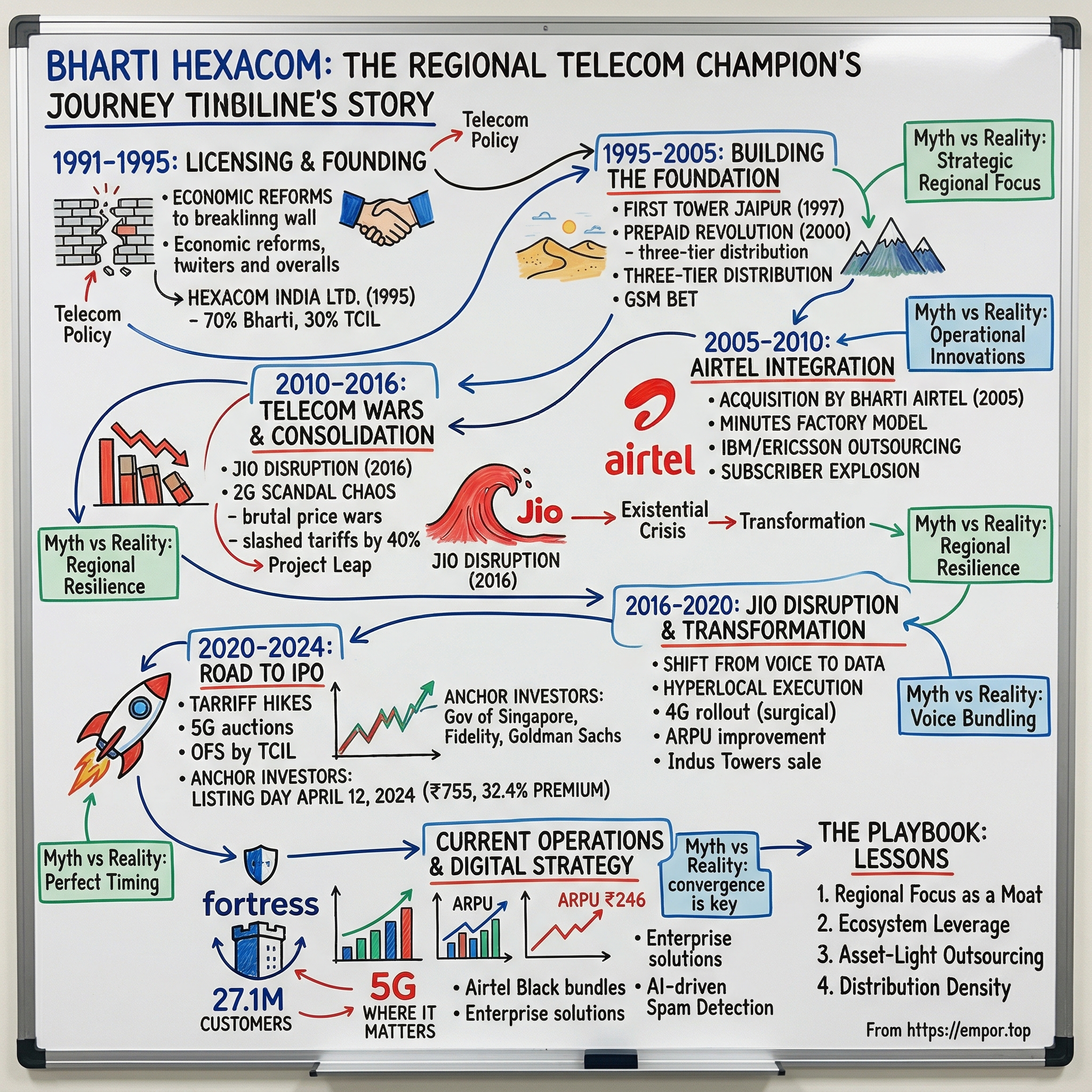
Bharti Hexacom: The Regional Fortress in India's Telecom Duopoly
I. Introduction & Episode Roadmap
There is a particular kind of company that hides in plain sight on a stock exchange. It is large enough that index funds must own it, boring enough that generalist analysts skip it, and structurally odd enough that even specialists struggle to fit it into a model. Bharti Hexacom is that company.
Picture the map of India that every Indian telecom executive has memorized: not the political map of states, but the licensing map of twenty-two "circles" — the administrative geography that the Indian government drew in the mid-1990s to parcel out mobile spectrum. Bharti Hexacom operates in exactly two of them. One is Rajasthan, India's largest state by area, a place of enormous distances and thin population density where laying fiber means crossing desert. The other is the North East — seven states plus Sikkim, stitched to the rest of India by a corridor barely twenty kilometers wide at its narrowest, with terrain that makes tower construction genuinely hard.
Two circles out of twenty-two. Roughly 6% of India's GDP and about 7% of its population.4 And yet, as of August 2026, this company carries a market capitalization of roughly ₹75,500 crore and trades at a price-to-earnings multiple north of 40 times — richer than most of the Indian telecom complex, and richer than the parent that owns 70% of it.1
That parent is Bharti Airtel, India's largest integrated communications provider and one of the two operators that survived the most violent price war in the history of global telecommunications. Hexacom is not a competitor to Airtel; it is Airtel, in two circles, wearing the same brand, running on the same procurement contracts, selling the same plans. What makes it a separate listed equity at all is an accident of history: a state-owned enterprise called Telecommunications Consultants India Limited — TCIL — was the original joint venture partner in 1995, and the Government of India has spent the last two years methodically selling that stake into the public market.5
That structure is the whole story, and it cuts both ways. The bull case writes itself: pure exposure to the two highest-growth pieces of Airtel's business — India wireless and home broadband — inside circles that are less penetrated than the national average, run by a management team that inherits best-in-class operating discipline without having to earn it. The bear case is the same sentence read backwards: a company with no strategic agency, a total addressable market fixed by a licensing decision made three decades ago, minority shareholders who periodically discover that the controlling shareholder also owns the counterparty on the other side of the table, and a valuation that already assumes the good news.
The central question of this piece: is being a regional subsidiary of India's best-run telecom operator a durable moat — or a structural ceiling on what this stock can be?
To answer it, this article walks through the circle system that created Hexacom, the Jio shock that made it profitable, the offer-for-sale that made it public, the unit economics that make it interesting, the related-party fight over 3,400 towers that made it briefly uncomfortable, and the valuation debate that makes it contested today. Along the way, it tests management's claims against what the filings and the earnings calls actually show — because the most common analytical error with a company like this is to mistake the parent's excellence for the subsidiary's edge.
Start with the map.
 Subscribe on LinkedIn
II. India's Telecom Circle System & Why Two Circles Matter
In 1994, India's telecom policy makers faced a problem that would look strange to anyone building a network today: they did not trust that a single national operator could be regulated, and they did not believe any private company had the capital to cover the country. So they cut India into pieces.
The National Telecom Policy of 1994 and the licensing rounds that followed divided the country into service areas — "circles" — graded A, B and C by revenue potential. Metro circles like Mumbai and Delhi were the prizes. Category A circles like Maharashtra and Tamil Nadu were the serious money. Category B and C circles — Rajasthan, Assam, the North East — were where the licensing math got thin. Operators bid circle by circle, built circle by circle, and for years reported results circle by circle. The consequence was that Indian telecom grew up as a federation of regional businesses that later had to be welded into national brands.
Into that structure stepped Hexacom India Limited, incorporated in 1995 as a joint venture assembled around TCIL, the state-owned engineering and consultancy arm of India's Department of Telecommunications, alongside private partners.5 This was a common entry model at the time: a public-sector entity provided political legitimacy and licensing comfort; private partners provided the operating hunger. The circles Hexacom drew were not the glamorous ones. They were Rajasthan and the North East — geographically enormous, commercially unproven, and expensive to cover.
For the better part of a decade, that looked like a poor hand. Rajasthan's population is spread across a landmass roughly the size of Germany, which means the cost per subscriber of building coverage is structurally higher than in a dense circle. The North East's terrain, security situation, and fragmented settlement patterns made it the sort of market where national operators deployed capital last and least.
But the same characteristics that made these circles unattractive to build also made them unattractive to attack. A telecom circle is a capital-intensity puzzle: to compete, a challenger must replicate coverage across the whole footprint, not just the profitable pockets, because customers churn on the basis of where their phone stops working. In dense urban circles, a competitor can achieve credible coverage with relatively concentrated spending. In Rajasthan, credible coverage requires crossing a lot of empty ground. In the North East, it requires crossing a lot of difficult ground. The first mover who absorbs that cost creates a coverage asset that is expensive and slow to duplicate.
There was a second, subtler advantage. Both circles started from below-average telecom penetration. Teledensity in Hexacom's circles has run several percentage points beneath the pan-India figure for years, and internet penetration — both mobile and fixed — has lagged as well.4 Under-penetration is a double-edged fact. It signals a poorer, harder market. But it also means the runway for growth is longer: there are more non-data subscribers left to upgrade to data, more households with no fixed broadband connection at all, and more headroom for average revenue per user to climb toward the national level rather than having to exceed it.
In 2004, Bharti Airtel acquired a majority equity interest in Hexacom, and the company was renamed Bharti Hexacom Limited.5 This was one node in a much larger consolidation. Sunil Bharti Mittal's group spent the late 1990s and 2000s assembling circle licences into something that could be marketed as a single national brand, and Hexacom became the Airtel presence in Rajasthan and the North East — same logo, same tariff architecture, same network vendors, same procurement contracts. TCIL retained 30%, and the Government of India therefore retained an economic interest in a company that, operationally, had become indistinguishable from a division of Airtel.
That is the essential setup, and it is worth stating plainly before moving on: from 2004 onward, Bharti Hexacom stopped being a strategic actor and became an operating unit with a separate legal wrapper. Everything that follows — the cost structure, the margin profile, the governance friction, the valuation debate — flows from that single fact.
One more feature of the circle system deserves explanation, because it becomes central later. Licences and spectrum in India are granted per circle, and they are paid for per circle. When the Department of Telecommunications auctions 5G spectrum, an operator bids separately for each service area, and the resulting liability is booked against the licensee in that geography. This is why Bharti Hexacom carries its own spectrum obligations, its own licence-fee exposure, and its own litigation history with the DoT despite being operationally inseparable from Airtel. It is also why a court ruling about spectrum charges in Rajasthan and the North East lands on Hexacom's balance sheet specifically rather than being absorbed somewhere in a parent's consolidated notes. Legal separateness in Indian telecom is not a formality — it is where the money and the liabilities actually sit.
The next two decades would test whether a wrapper like that could survive an industry that was about to lose most of its participants.
III. Becoming the Airtel Ecosystem's Regional Engine (2000s–2016)
The most consequential decision in Indian telecom history was not a spectrum bid. It was an outsourcing contract.
In the early 2000s, Bharti Airtel did something that telecom operators in developed markets considered close to heresy: it handed the building and management of its network to its equipment vendors, and agreed to pay them based on capacity used rather than boxes bought. Ericsson and its peers built, ran and maintained the radio network; Airtel paid, in effect, by the minute. IBM took the IT stack on a revenue-share basis. What had been an enormous fixed-cost, capital-heavy operation became something closer to a variable-cost utility purchase.
The strategic logic was ruthless and, in hindsight, obviously correct for the market Airtel was in. If your customers pay a few rupees a month, you cannot afford a cost structure designed for customers who pay fifty dollars a month. By converting network cost into something that scaled with usage, Airtel could profitably serve subscribers at price points that Western operators would have regarded as rounding errors. The industry gave this model a name: the "minutes factory." Volume, not price, was the engine.
Hexacom inherited this wholesale. It never had to negotiate its own vendor terms, design its own IT architecture, or build its own procurement function. It plugged into a system built for national scale and applied it in two circles. That is the first and most durable of Hexacom's advantages, and it is worth being precise about what it is and is not. It is not a proprietary technology edge. It is a cost-position advantage derived from buying at group scale — real, measurable, and entirely borrowed.
The prepaid revolution amplified it. India's mobile market went prepaid almost immediately and almost entirely, which meant no credit risk, no billing infrastructure for the vast majority of customers, and cash collected before service was delivered. In circles like Rajasthan and the North East, where formal credit histories were scarce, this was not a preference — it was the only workable model. It also produced a distribution problem that Airtel solved with density: tens of thousands of tiny recharge outlets, each earning a small margin, forming a retail network that a challenger could not replicate with capital alone because it depended on local relationships.
Then came the chaos. The period from roughly 2008 to 2016 was, for Indian telecom, a sustained exercise in value destruction. The 2008 spectrum allocations under a first-come-first-served regime — later cancelled by the Supreme Court in 2012 as part of what became known as the 2G scam — briefly flooded the market with more than a dozen operators. Price wars compressed tariffs to some of the lowest levels in the world. Several new entrants, including foreign-backed ventures, spent billions building national footprints and then exited, licences void.
Hexacom's regional concentration protected it from the worst of this in a specific, mechanical way. The operators that bled most were those that had committed capital across many circles simultaneously, chasing national scale before establishing profitability anywhere. Hexacom had no such option and therefore made no such mistake. Its capital was concentrated in two circles it already understood, defended by a parent whose national brand did the marketing work.
That is the honest read on this era, and it should temper any romantic account of regional focus as strategic genius. Hexacom did not choose discipline; discipline was the only available option. But the habit was formed. By the time the industry's real reckoning arrived, Hexacom was a business that had spent a decade optimizing a narrow footprint rather than defending a sprawling one — and its balance sheet reflected that.
There is one more inheritance from this era worth naming, because it shapes the balance sheet an investor looks at today: the passive infrastructure model. Indian operators learned early that owning towers was a poor use of capital. A tower is a piece of steel with power and cooling attached; its value comes from how many operators hang antennas on it, not from who holds the title. So the industry spun towers into shared entities — Indus Towers being the largest — and converted a capital cost into a rental cost. This is why EBITDA and EBITDA-after-lease-expenses diverge meaningfully for Indian telcos, and why the second number is the one that reflects true operating economics. In Hexacom's most recent quarter the gap between the two was roughly six and a half percentage points of margin.2 Anyone comparing Indian telecom margins to global peers without making that adjustment is comparing the wrong things.
The reckoning arrived in September 2016, and it did not come from any of the incumbents.
IV. The Jio Shock and the Remaking of the Industry (2016–2022)
On September 5, 2016, Reliance Industries launched Jio, and the Indian telecom industry stopped being an industry with normal economics.
The offer was, on its face, absurd: free voice calls forever, and free data for months. Behind it sat a greenfield, all-IP, 4G-only network built at a scale that no incumbent could match and funded by the cash flows of one of India's largest conglomerates. Jio was not trying to win share at the margin. It was trying to reset the price of connectivity in India to something near zero and then rebuild an industry around itself.
It worked. Average revenue per user across the industry collapsed. Operators that had been marginally profitable became structurally unprofitable. Consolidation followed at speed: Vodafone India and Idea Cellular merged in 2018 into what became Vodafone Idea; Reliance Communications, Aircel, Telenor India and Tata Teleservices' consumer business either folded, sold, or entered insolvency. A market with more than a dozen operators became, in effect, a market with three private players and a state-owned laggard.
Then came the second blow. In October 2019, the Supreme Court of India upheld the government's expansive definition of Adjusted Gross Revenue — the base on which operators pay licence fees and spectrum charges — and applied it retrospectively. The AGR ruling generated liabilities running into hundreds of thousands of crores across the industry. It nearly ended Vodafone Idea, which has spent the years since in a state of managed survival dependent on government forbearance and equity conversion.
For Bharti Hexacom, this sequence was transformative, and it is the single most important thing to understand about the company's current profitability. The reason Hexacom earns EBITDA margins in the low-to-mid fifties today is not primarily that it executes better than everyone else. It is that in its two circles, the competitive field emptied out.
The numbers make the point. Vodafone Idea's cash constraints forced it to de-prioritize spending in the North East, and by the time Motilal Oswal initiated coverage in March 2025, the top two operators in that circle accounted for roughly 84% of subscriber market share and about 92% of access revenue market share — an effective duopoly.4 Across Hexacom's two circles combined, the top two held roughly 77% of subscribers and about 88% of revenue, against pan-India figures of roughly 73% and 81% respectively.4 Hexacom's circles are, measurably, more consolidated than India as a whole.
Inside that consolidating market, Hexacom took share rather than merely holding it. In the North East it became the undisputed leader, with revenue market share around 57% and roughly 500 basis points of subscriber share gained over three years — against roughly 100 basis points for Jio over the same period.4 In Rajasthan, revenue market share climbed roughly 13 percentage points over five years, and subscriber share rose about 210 basis points to 35.5%, again outpacing Jio's roughly 140 basis points.4 For context on where those figures started: in Fiscal 2021, Hexacom's revenue market share was 32.7% in Rajasthan and 42.0% in the North East; by the nine months ended December 2023 it had reached 40.4% and 52.7%.5
Read the aggregate: over the five years to September 2024, Hexacom's adjusted gross revenue grew roughly 3.5 times, against roughly 2 times for Jio and about 45% for Vodafone Idea.4 The gap between Hexacom and Jio on revenue market share narrowed to roughly 20 basis points — compared with a roughly 300 basis point gap between Airtel and Jio nationally.4 On the visitor location register measure, which counts genuinely active subscribers rather than registered SIMs, Hexacom trailed Jio by about 70 basis points, versus roughly 600 basis points pan-India.4
This is the analytically important result. Hexacom is not just a smaller Airtel. In its two circles it is closer to parity with Jio than Airtel is anywhere else in India. Whether that reflects genuine local advantage — distribution density, rural network reach, brand incumbency in markets Jio entered later — or simply reflects that Jio prioritized higher-value circles first is a question the data cannot fully settle. Both are probably true. What can be said with confidence is that the outcome is real and has persisted across multiple years, which is more than can be said for most claimed telecom moats.
There is a less comfortable corollary. When the top two players already hold roughly 88% of revenue in your circles, the arithmetic of further share gains gets hard. Motilal Oswal made exactly this point: higher consolidation gives better pricing power and lower customer acquisition cost, but the scope for further subscriber-share gains is correspondingly smaller.4 The tailwind that made Hexacom what it is has largely finished blowing.
Which raises the obvious question about a company that spent twenty-nine years as a wholly controlled subsidiary: why list it at all?
V. The IPO: Governance Unlock, Not Growth Capital
The most revealing fact about the Bharti Hexacom IPO is the one most easily missed: the company did not receive a single rupee.
The offering was structured entirely as an Offer for Sale. Every share on offer was an existing share, sold by TCIL, and every rupee of proceeds flowed to TCIL and therefore to the Government of India.5 Bharti Hexacom's balance sheet on the day after listing was identical to the day before, minus the issue expenses it bore. This was not a fundraise. It was a government divestment executed through the primary market.
That structure tells you what the transaction was for. India's Department of Investment and Public Asset Management had been looking for ways to monetize legacy public-sector holdings for years, and a 30% stake in a profitable, professionally run telecom subsidiary was an unusually clean asset to sell — no restructuring required, no turnaround needed, no political sensitivity about layoffs. TCIL was not exiting a failing investment. It was cashing in a successful one.
The draft red herring prospectus was filed in January 2024, proposing a sale of up to 100 million shares by TCIL.6 The final offer was sized at 75 million shares at a price band of ₹542 to ₹570, raising ₹4,275 crore at the upper end and implying an equity value of roughly ₹28,500 crore.5 That represented half of TCIL's 30% holding — a deliberate choice to sell in stages rather than in one block.
The book was not an instant blowout. Subscription on the first day of the offer sat at just 34%, a sign that domestic retail and institutional investors were unsure what to make of a two-circle telecom operator with no growth-capital story and a parent that already owned the same assets in listed form.7 By the close, the issue was covered comfortably, and on April 12, 2024, the shares listed at ₹755 against the ₹570 issue price — a debut premium of roughly 32%.8
What happened next was more interesting than the listing pop. Over the following eleven months, the stock roughly tripled from its issue price.4 Motilal Oswal's post-mortem was blunt about why: the IPO had been priced cheaply. At the offer price, Hexacom was valued at around 7 times forward EV/EBITDA at a time when comparable Indian telecom assets traded at 9 to 10 times.4 Add an industry-wide tariff increase, continued market-share gains, and margin expansion, and the re-rating had all the ingredients it needed.
The uncomfortable reading of that sequence is that the Government of India left money on the table on the first tranche — which is precisely the argument that has since shaped how it plans to sell the rest.
What did the listing actually change about the business? Less than the share price move implies, and more than nothing.
It did not change strategy. Hexacom does not set its own tariff architecture, choose its own vendors, or decide its own capital allocation independent of the Bharti Airtel group. It did not change capital access; the company was never capital-constrained, and its funding has always been available through the parent's balance sheet and rating.
What it did change was visibility and accountability. Before April 2024, Bharti Hexacom was a consolidated line item — its economics visible only through the parent's segment disclosure and its own statutory filings, which few people read. After listing, it published quarterly results, held earnings calls, filed related-party transaction disclosures, and submitted resolutions to a shareholder vote that included a state-owned minority holder with its own institutional incentives. The market gained the ability to argue about what these two circles were worth on a standalone basis, and it argued vigorously.
It also created a governance mechanism where none had existed. TCIL as a 30% unlisted JV partner had limited practical recourse. TCIL as a 15% minority shareholder in a listed company, operating under SEBI's related-party transaction rules and DIPAM's divestment guidelines, had considerably more.
There is one further consequence worth flagging, and it is structural rather than governance-related. A separately listed subsidiary of a listed parent creates a permanent arbitrage question for investors: buy the parent, or buy the piece? The parent offers diversification across India wireless, Africa, enterprise, towers, payments and data centers, and the optionality that comes with a larger balance sheet. The subsidiary offers concentration in the two fastest-compounding lines with none of the distraction. Different investors will answer that differently, but the existence of the choice is itself a product of the IPO — and it is why the relative multiple between Hexacom and Airtel's India business has become the most-argued number in this story.
That mechanism would be tested within a year. But first, the business itself.
VI. Current State of the Business: Segments, KPIs, and Unit Economics
There is a temptation, when analyzing a telecom operator, to build an elaborate segment model. Resist it here. Bharti Hexacom is a single-business company with a small, fast-growing appendage, and pretending otherwise obscures more than it reveals.
The overwhelming majority of revenue and effectively all of the profit comes from mobile services: prepaid and postpaid wireless connectivity sold to consumers and small businesses across Rajasthan and the North East. Alongside it sits a homes business — fixed broadband delivered over fiber and fixed wireless access, plus IPTV — that is growing fast from a very small base. There is no hidden division, no financial services arm, no data center venture inside this entity. Whatever complexity exists in the Bharti group, Hexacom itself is close to a pure play on Indian wireless plus rural home broadband.
The financial trajectory. Revenue moved from ₹6,579 crore in FY23 to ₹7,089 crore in FY24, then to ₹8,548 crore in FY25 and ₹9,354 crore in FY26.1 Net profit followed a more dramatic curve: ₹549 crore, then ₹504 crore, then ₹1,494 crore, then ₹1,733 crore.1 The step change between FY24 and FY25 is the industry tariff increase of mid-2024 flowing through a cost base that barely moved — the definition of operating leverage in a network business.
FY26 closed with an EBITDA margin around 53%, roughly 350 basis points wider than the prior year, and profit growth of about 16%.9 The fourth quarter of FY26 was softer at the profit line, with PAT declining year-on-year even as revenue grew — a function of tax normalization and levies rather than operational deterioration.9 That distinction matters for anyone reading headline numbers: a tax-rate reset is not a demand signal.
The most recent quarter. For the June 2026 quarter — Q1 FY27, reported on August 4, 2026 — revenue reached ₹2,510 crore, up 10.9% year-on-year and 4.0% sequentially.2 EBITDA rose about 13% to ₹1,375 crore, lifting the margin 99 basis points to 54.8%.2 After lease expenses, which for a tower-dependent operator are a meaningful adjustment, EBITDA was ₹1,211 crore at a 48.2% margin.2 Net income before exceptional items was ₹482 crore, up 23.2%.3
Capital expenditure for the quarter was ₹382 crore.2 Set that against ₹1,375 crore of EBITDA and the shape of the business becomes clear: on a quarterly run-rate basis, this is currently a strongly cash-generative operation. Borrowings stood at ₹6,137 crore as of March 2026, down from ₹9,204 crore three years earlier.1 Deleveraging has been real, not rhetorical.
The three KPIs that actually matter.
First, ARPU. Average revenue per user reached ₹259 in Q1 FY27, up from ₹246 a year earlier.2 This is the single most important number in the entire business, because in a market where subscriber growth is slow and cost per additional user is close to zero, almost every incremental rupee of ARPU falls to EBITDA. Incremental margins in Indian wireless run around 75%.4 Worth noting for context: Airtel's pan-India mobile ARPU in the same quarter was ₹264 — Hexacom sits marginally below the parent, which is what you would expect in lower-income circles, and the gap has been narrowing.10
Second, revenue market share in the two circles. This is the scoreboard for whether the competitive position is holding. It is published by TRAI on an adjusted-gross-revenue basis and is not something an investor should have to model — it is reported.
Third, smartphone data customer penetration. As of Q1 FY27, smartphone data customers represented 80% of Hexacom's mobile base, up from roughly 76% by the first nine months of FY25 and about 56% in FY21.24 Over the past year the company added 1.3 million such customers, a 6.0% increase.2 This metric is the ARPU engine: a customer moving from a feature phone to a smartphone data plan is a customer whose monthly spend can double or better, without the company having to acquire anyone new.
The three are related in a simple chain worth stating in plain terms: penetration drives ARPU, ARPU drives margin, and market share determines whether the ARPU is defensible. If penetration stalls while market share slips, the ARPU story ends regardless of what management says on the call.
Data consumption and the network. Mobile data traffic in Q1 FY27 reached 2,381 petabytes, up 30.5% year-on-year.3 To make that concrete: a petabyte is a million gigabytes; 2,381 petabytes across a quarter in two circles reflects consumption behavior that would have been unimaginable at these price points a decade ago. Airtel group-wide reported data consumption of 34.4 GB per customer per month in the same quarter.10 Rising traffic is not automatically good news — it consumes capacity and eventually forces capex — but when it accompanies rising ARPU, it means customers are buying more expensive plans rather than simply using more of a flat-priced one.
Network expansion has been deliberate rather than aggressive. Hexacom deployed 399 towers over the twelve months to June 2026.3 At the group FY26 results webinar, management described a "fiber-first" deployment philosophy — fiber where possible, fixed wireless access second, and unlicensed-band radio last — explicitly citing rising FWA chipset costs as a reason to favor fiber, and pointed to roughly 11,000 5G sites added with population coverage approaching three-quarters.11 Hexacom does not break out a circle-level 5G site count in its own quarterly disclosures, which is a genuine gap: an investor cannot independently verify 5G deployment intensity in Rajasthan or the North East from the company's own filings.
Convergence and the homes business. The fastest-growing line item is the smallest. Revenue from homes, offices and other services jumped 61.4% year-on-year in Q1 FY27, with 416,000 customers added over the year to reach a base of roughly 900,000.3 That is genuine momentum, and it is the clearest evidence available for the Airtel Black convergence pitch — the argument that bundling mobile, broadband and television into one bill raises household spend and cuts churn.
But assess the pitch honestly. A base of 900,000 homes against a mobile base in the high twenty-millions means convergence is, today, a rounding error in revenue terms. The 61% growth rate is impressive precisely because the base is small. What the data does support is that in circles with very low fixed-broadband penetration, there is a real, under-served market and Hexacom is the operator best positioned to serve it.4 What the data does not yet support is a claim that convergence is currently driving the ARPU line — the mobile premiumization story is doing that work, and the two should not be conflated.
Capital intensity, the swing factor. Management has consistently described capex intensity as elevated near-term and set to unwind as major rural rollout programs conclude.11 This is the most important forward-looking claim management makes, and it is also the least verifiable. Free cash flow in a telecom business is EBITDA minus capex minus spectrum payments; the first term is compounding nicely, and the second is the swing factor. If capex intensity genuinely unwinds while revenue grows at low double digits, cash generation inflects sharply. If 5G densification, fiber build and home-pass expansion keep capex elevated for another two or three years, the cash story is deferred even as the P&L looks excellent.
A note on what is not disclosed. Several things a rigorous investor would want are simply unavailable at the Hexacom level. There is no published split of revenue between Rajasthan and the North East, which means the concentration risk within the concentration cannot be sized. There is no separate disclosure of postpaid versus prepaid subscriber mix or ARPU, even though the group has made postpaid growth a centerpiece of its national narrative.10 There is no circle-level 5G coverage or capacity data. And there is no standalone free cash flow bridge in the quarterly release. None of these are unusual for an Indian telecom subsidiary, but their absence means that much of the analytical work here has to be done using group-level proxies — and proxies are exactly where errors hide.
Which brings the analysis to the question every competitor in India is now asking: how long does this hold?
VII. Competitive Landscape & Why It Wins (or Doesn't)
War-game the two circles properly and the picture is less comfortable than the margin profile suggests.
Start with the structure. Porter's framework applied to Indian telecom in 2026 produces an unusually lopsided result. Barriers to entry are close to absolute: spectrum is auctioned at prices that run into tens of thousands of crores nationally, licence obligations require coverage commitments, and the AGR precedent means any new entrant inherits a regulatory framework capable of generating retrospective liabilities. Nobody is entering Indian telecom as a fourth national player. Supplier power is modest — Ericsson, Nokia, Samsung and their peers compete hard for Indian volume, and the managed-services model deliberately shifted risk toward vendors. Buyer power is where it gets interesting: individual consumers have essentially no negotiating power but very low switching costs, since mobile number portability makes changing operators a same-day exercise. What restrains switching is not contractual lock-in but network quality and, increasingly, bundling. Substitutes barely exist for connectivity itself; over-the-top messaging cannibalized voice and SMS revenue years ago, and that damage is done. Rivalry is the swing variable, and it has been unusually benign since 2021.
Named competitors, honestly assessed.
Reliance Jio is the primary threat in both circles and it is not close. Jio has the larger balance sheet, national scale, an all-IP network built for data from day one, and a demonstrated willingness to price aggressively when it wants share. Its fixed wireless access product has been the most aggressive FWA push in the world by subscriber count, and FWA is precisely the technology best suited to attacking under-served home broadband markets like Rajasthan without laying fiber. That Hexacom currently sits within roughly 20 basis points of Jio on revenue market share in its circles is a genuine achievement.4 It is not a guarantee.
Vodafone Idea is the wounded third player. Its retreat from the North East is a substantial part of why that circle became a duopoly.4 The strategic question is not whether Vodafone Idea will regain leadership — it will not — but whether a recapitalization or further AGR relief could restore enough capacity for it to compete on price at the margin. Even a partially revived third player changes tariff dynamics, because rational pricing in a three-player market requires all three to be rational.
BSNL, the state-owned operator, is a subscale laggard whose main relevance is as a price floor and as a politically protected rural presence. It has periodically received government support and spectrum allocations. It is not a share threat; it is a reminder that telecom pricing in India is never purely a commercial matter.
Now apply Helmer's 7 Powers, which is the more discriminating test. Of the seven — scale economies, network economies, counter-positioning, switching costs, branding, cornered resource, process power — Hexacom can credibly claim two and a half.
Scale economies: yes, but borrowed. Hexacom buys equipment, negotiates managed-services contracts, and licenses brand and IT at Bharti Airtel group scale while operating at two-circle scale. This is a real cost advantage and it is the single most important economic mechanism in the business. It is also not Hexacom's own; it exists at the parent's discretion.
Cornered resource: partially. Spectrum in two circles is a licensed, finite resource, and the tower and fiber footprint built across difficult geography over two decades is genuinely hard to replicate quickly. The company has cited population coverage above 96% in its circles.4 That is an asset, though Jio has demonstrated it can build coverage when it chooses to.
Branding: partially. Airtel is one of India's strongest consumer brands, and in circles where network reliability is the purchase criterion, brand functions as a proxy for expected quality. Again — borrowed.
What Hexacom does not have: switching costs of any meaningful kind (number portability sees to that), network economies in the classic sense (a telecom network's value to a user does not rise with other users on the same network, since interconnection is mandated), counter-positioning (it is the incumbent, not the insurgent), or process power that differs from the parent's.
So why does it win from here — and what falsifies that?
The affirmative case rests on three evidenced mechanisms. Distribution density in circles where retail relationships are hyper-local and were built over twenty years. A cost position derived from group procurement that no regional competitor can match. And a coverage footprint in geography that is expensive to duplicate. The evidence that these are working is the share data: gaining subscriber share faster than Jio in both circles over a three-year window is not something a company does by accident.4
The falsification tests are equally concrete, and an investor should watch for them specifically. If Hexacom's revenue market share in either circle plateaus or reverses for two or more consecutive TRAI reporting periods while ARPU growth stalls, the share-gain mechanism has exhausted itself. If Jio's FWA push in Rajasthan begins converting households faster than Hexacom's fiber-first build, the home broadband opportunity — the one genuinely new growth vector — goes to the competitor. If a recapitalized Vodafone Idea reintroduces price competition, the incremental-margin math that makes ARPU increases so powerful runs in reverse.
And there is a structural limitation no amount of execution fixes: the total addressable market is fixed by licence geography. Hexacom cannot buy its way into Gujarat. Airtel is already there. The only way Hexacom's addressable market grows is if the people of Rajasthan and the North East get richer and use more data — which they are doing, but at a rate set by the Indian economy rather than by anything management controls.
Myth versus reality, on three consensus narratives.
Myth: Hexacom is a "rural telecom" story. Reality: Rajasthan contains Jaipur, Jodhpur, Udaipur and Kota — substantial urban markets with tourism, industry and education economies. The company serves customers across 486 census towns.5 The rural component is real and it is the coverage-cost driver, but the revenue mix is not a rural-only story, and framing it that way understates both the competitive intensity and the ARPU potential.
Myth: the two circles are a backwater the big players ignore. Reality: Jio holds roughly comparable subscriber share in Rajasthan and has contested the circle actively; Hexacom's advantage there is a few hundred basis points of share momentum, not absence of a competitor.4 The North East is genuinely less contested, but it is also the smaller of the two markets. Investors sometimes generalize the North East duopoly across the whole business. It does not generalize.
Myth: the premium to Bharti Airtel reflects superior business quality. Reality: on the sell-side analysis that has examined this most carefully, the premium is justified primarily on capital-allocation grounds — Hexacom cannot make a large overseas acquisition, so its cash returns to shareholders — rather than on superior returns or growth from operations.4 That is a legitimate argument, but it is an argument about optionality being absent, which is an unusual foundation for a premium multiple and one worth holding at arm's length.
Capital allocation is where a constrained operator either creates value or quietly destroys it. Hexacom's record on that front is short, but it is already contested.
VIII. Capital Allocation, M&A, and Related-Party Scrutiny
In February 2025, Bharti Hexacom circulated a postal ballot notice proposing to sell 3,400 telecom towers to Indus Towers Limited for ₹1,134 crore.12 It looked routine. Indus is India's largest tower company. Operators have been selling passive infrastructure to tower companies for two decades — it converts a capital-heavy asset into an operating lease, releases cash, and lets a specialist manage the steel.
There was one complication. Bharti Airtel holds a substantial stake in Indus Towers. Which meant Hexacom's controlling shareholder was, in economic substance, on both sides of the transaction.
TCIL noticed.
The tower dispute, in detail. The valuation had been performed by Grant Thornton and pegged the towers at roughly ₹33 lakh each.13 TCIL — holder of 15% of Hexacom, and answerable to the Government of India — objected on two grounds. The first was the number itself. The second, and more damaging, was process: TCIL had not been consulted during the initial valuation and approval exercise.13 For a minority shareholder that is also a state entity subject to DIPAM's divestment guidelines, being presented with a completed valuation of a related-party sale is not a comfortable position.
On April 9, 2025, the company disclosed that TCIL had asked for the process to be started afresh, and Bharti agreed to place the existing proposal in abeyance.14 The stock rose about 5% on the news — an unusual market reaction that is worth pausing on.14 Investors did not read the delay as a problem. They read it as evidence that minority protection actually functioned. In a market where conglomerate-controlled subsidiaries are routinely suspected of subsidizing the parent group, a demonstration that a 15% holder could stop a related-party transaction was, on balance, reassuring.
A fresh process followed, conducted with reference to DIPAM guidelines and SEBI regulations, with TCIL formally involved in valuation and decision-making this time.13 At the company's 30th annual general meeting in August 2025, the reworked resolution passed with 88.28% of votes in favor.15 TCIL opposed it, along with roughly 2.5% of public non-institutional shareholders.12 The Hexacom towers formed part of a larger transaction under which Indus agreed to acquire 16,100 towers in total — 12,700 from Bharti Airtel and 3,400 from Hexacom — for a combined figure of roughly ₹3,309 crore.15
What this episode actually proves. An activist investor would read it three ways, and all three are defensible.
The charitable reading: the system worked. An objection was raised, the process was reopened, an independent valuation regime was applied, and the transaction ultimately received overwhelming approval. That is functional governance.
The skeptical reading: the transaction went through anyway. TCIL's objection produced process, not outcome. The controlling shareholder got what it wanted on a second attempt with better paperwork, and a 15% holder cannot outvote a 70% holder no matter how legitimate its concerns.
The structural reading, which is the most useful for a long-term investor: this will happen again. Hexacom sits inside a group containing a tower company, an African operator, a payments bank, a data center business and a digital services arm. Any asset transfer, service agreement, or brand licence between Hexacom and a group entity is a related-party transaction. The Indus episode is not an anomaly; it is a preview of a recurring category of decision in which minority economics and group economics can diverge. Motilal Oswal listed among its risks the possibility of a merger with Airtel at an unfavorable swap ratio — a low-probability but high-impact version of exactly this concern.4
Spectrum, not M&A, is the real deal activity. On April 22, 2025, Bharti Airtel and Bharti Hexacom announced an agreement to acquire 400 MHz of spectrum in the 26 GHz band from Adani Data Networks Limited, covering six circles including 50 MHz in Rajasthan.[^16] Financial terms were not disclosed.[^16]
This deserves to be understood correctly, because it is not an acquisition in any conventional sense. The 26 GHz band is millimeter wave spectrum — very high frequency, enormous capacity, very short range and poor building penetration. In layman's terms: a millimeter wave cell is like a floodlight with a powerful beam and a short reach. It is useless for covering rural Rajasthan and potentially excellent for dense capacity pockets, fixed wireless access, and enterprise or industrial deployments. Adani had acquired this spectrum in the 2022 auction for private-network purposes and evidently found no commercial path forward.
The right analytical frame is build-versus-buy on a capacity input. Airtel and Hexacom could wait for a future auction and bid against Jio, or acquire an idle holding from a seller with no alternative use. The second is almost certainly cheaper. That the price was not disclosed is a mild disclosure negative, but spectrum trading agreements in India frequently omit terms. The market reaction was enthusiastic — Hexacom hit an all-time high the following day.16 Enthusiasm about mmWave spectrum whose monetization path remains speculative is, on the evidence, more sentiment than analysis.
Liability management is where the clearest value has been created. In March 2025, Bharti Airtel and Hexacom together prepaid an additional ₹5,985 crore of spectrum liabilities carrying an 8.65% interest rate, fully settling obligations from the 2024 auction roughly seven years ahead of average residual maturity.[^18] Then, on June 8, 2026, the Bombay High Court set aside a Department of Telecommunications one-time spectrum charge demand of ₹473.7 crore relating to Hexacom's Rajasthan and North East circles — a demand originally raised in January 2013 and subsequently revised upward.17
Both events reduce balance-sheet overhang, and the second is a genuine positive surprise: a decade-old contingent liability removed by judicial decision rather than negotiation. Investors should note the asymmetry, though. Indian telecom's regulatory history runs in both directions, and the AGR precedent established that adverse rulings can be retrospective and enormous. One favorable High Court decision does not neutralize that category of risk; appeals remain a possibility in Indian tax and telecom litigation.
The dividend signal. For FY26, the board recommended a final dividend of ₹18 per share, the company's highest to date and roughly double the prior year's payout.18 Read alongside the FY26 EBITDA margin and the reduced debt, this is consistent with a business generating more cash than it needs. Read alongside management's own description of elevated near-term capex, it raises a fair question: is this genuine capital discipline, or is a controlling shareholder pulling cash out ahead of an investment cycle? The honest answer is that the evidence currently favors the first interpretation — quarterly capex of ₹382 crore against ₹1,375 crore of EBITDA leaves substantial room — but the question should be revisited if capex intensity rises rather than unwinds.2
The TCIL overhang. The Government of India, through TCIL, has been preparing to sell its remaining 15%, with reports indicating a multi-tranche approach — possibly three chunks of 5% each — designed to maximize proceeds rather than accepting a single-block discount.19 The first tranche having been sold cheaply at IPO, this is a rational correction of approach.
For investors it cuts two ways. In the near term, each tranche is a supply event that can weigh on the price, though it also increases free float and improves index eligibility. In the longer term, TCIL's exit removes the very governance mechanism that produced the Indus Towers pushback. A cleaner cap table is also a quieter one. Whether that is good or bad depends on whether one believes the remaining institutional shareholders would raise the same objections a state entity did.
That question ultimately lands on management — and on how much agency management actually has.
IX. Current Management: Incentives, Credibility, and Communication Discipline
Assessing management at Bharti Hexacom requires abandoning the framework that works for most companies. There is no founder here, no visionary with a contrarian bet, no capital allocator whose personal judgment sets the trajectory. Marut Dilawari has served as Chief Executive Officer since November 12, 2022, operating within Bharti Airtel group governance.20 The strategy he executes is set at group level. The tariff architecture is set at group level. The vendor contracts, the brand, the network standards, the technology roadmap — all group level.
So the credibility test has to be different. The right questions are: does this management team deliver what it says it will deliver, does the narrative stay consistent across quarters, and does it explain misses without deflection?
On delivery, the record is good. The margin trajectory over FY25 and FY26 was not a one-quarter event. In the September 2025 quarter, EBITDA margin expanded from 49.9% a year earlier to 54.2%, EBITDA rose 20.1% to ₹1,256 crore, revenue grew 10.5% to ₹2,317 crore, and net income before exceptional items rose 66.4% to ₹421 crore.21 ARPU reached ₹251, up from ₹228.21 That pattern — high single-digit to low double-digit revenue growth converting into margin expansion and much faster profit growth — has repeated for eight consecutive quarters and continued into Q1 FY27. This is what operating leverage looks like when it is real rather than promised.
On narrative consistency, the group's language has been notably stable. Across FY26 earnings calls, management repeated the same three themes: premiumization of the customer mix rather than blanket price increases, a fiber-first approach to home broadband, and capex intensity that would unwind as rural rollout concluded.11 There was no strategy pivot, no quiet abandonment of a prior target, no reframing of a metric after it stopped working.
The August 2026 call was a useful stress test of that consistency. Asked directly whether the company needed a tariff increase given how healthy growth already looked, Bharti Airtel Executive Vice Chairman Gopal Vittal declined the framing. What the group wanted, he argued, was not a blanket hike but a "sensible price architecture" — the observation being that very low-priced plans currently bundle unlimited data, which structurally caps ARPU, and that heavier data users should pay more.2223 That is a specific, falsifiable position rather than a hopeful one, and it is consistent with what the group has said for several quarters. It is also a claim investors can test: if plan structures change and ARPU responds, the thesis holds; if the industry cannot make the change stick, it does not.
On the Q2 FY26 episode, there is a genuinely instructive case study. The September 2025 quarter delivered a 4.3 percentage point margin expansion and a 66% profit increase — the kind of result that normally sends a stock higher. Instead, the shares fell more than 3%, with commentary attributing the decline to valuation and expectations rather than execution.2425
The lesson generalizes well beyond this company. A stock trading at a premium multiple does not reward good results; it reprices on the gap between results and expectations. Hexacom's operating delivery in that quarter was strong by any absolute standard. It was not strong enough relative to what the multiple assumed. Investors evaluating management should separate the two questions cleanly: management is accountable for the first and has no control over the second.
On board oversight, the Indus vote is the only real evidence available, and it is ambiguous. The board includes independent directors and TCIL-nominated members, and the sequence — proposal, minority objection, abeyance, fresh process, approval — shows a board that responded to pressure rather than one that anticipated the conflict. A board fully alert to related-party sensitivity would have involved the 15% state shareholder in the valuation from the outset rather than after a public objection.
Where the evidence is genuinely thin, and this should be stated plainly: Bharti Hexacom does not hold standalone investor days, publishes limited management commentary independent of the Bharti Airtel group calls, and its executives give few public interviews. Its quarterly earnings calls are conducted jointly with the parent, which means analyst questions naturally gravitate toward Airtel's consolidated story — Africa, data centers, payments — rather than the specifics of Rajasthan and the North East. An investor wanting to hear management defend a circle-level capital allocation decision, or explain a share loss in a specific market, will find little material. That is a disclosure gap, not a scandal, but it limits how confidently anyone can assess this management team on its own terms.
On incentives, the structure is worth stating plainly. Management here does not control promoter economics. Bharti Airtel holds 70% and sets the direction; the CEO and his team are professional operators executing a group playbook.1 This removes one common failure mode — the founder-CEO who bets the company on a personal conviction — and introduces another: a management team whose primary internal customer is the parent, not the minority shareholder. In practice these interests align almost all the time, because both want ARPU up and costs down. They diverge precisely at the moments that matter most, which are asset transfers, service agreements, and any question about how much cash leaves the subsidiary versus stays in it. The Indus episode is the only public instance so far. It will not be the last.
Which makes it all the more important to be precise about what could go wrong.
X. Risk Radar
The risks here are not exotic. They are structural, and most of them are visible in the company's own disclosures. What follows is limited to what is material and mechanically connected to the business.
Circle concentration is a design feature, not a bug that can be fixed. Bharti Hexacom's addressable market is two licence areas representing roughly 7% of India's population.4 There is no acquisition, no product launch and no strategic pivot that changes this, because the rest of India is already served by the parent. Growth must come from more customers, higher spend per customer, or new services sold to the same customers — and the first of those is largely exhausted given how consolidated the circles already are. The practical consequence is that a single-market shock has nowhere to be diversified against: a drought year in Rajasthan, a security disruption in the North East, or a state-level regulatory change lands directly on the P&L.
Competitive and price-war risk is the largest swing factor. The economics that produce a 54.8% EBITDA margin depend on tariff rationality persisting.2 They are not the product of a cost advantage so large that price competition cannot touch it. Incremental margins near 75% mean the operating leverage runs in both directions with equal force.4 Two specific triggers deserve monitoring: a Vodafone Idea recapitalization or further AGR relief that restores a third competitor's ability to price aggressively, and an escalation of Jio's fixed wireless access push into Rajasthan's under-served home broadband market before Hexacom's fiber build reaches those households.
Capital intensity and the spectrum payment cycle are recurring cash calls. Telecom is a business where the capital never stops. 5G densification, fiber trenching and home-pass expansion all continue regardless of the revenue cycle, and spectrum obligations arrive on a schedule set by auctions rather than by cash flow. Management's guidance that capex intensity will unwind is plausible and consistent, but it remains a forward claim.11 The prepayment of high-cost spectrum liabilities and the reduction in borrowings materially improved this picture; they did not eliminate the structural requirement.[^18]1
Regulatory and political risk is idiosyncratic to Indian telecom and cannot be modeled. The AGR ruling demonstrated that the definition of taxable revenue can be reinterpreted retrospectively with industry-wide consequences running into thousands of crores. Spectrum auction pricing is a policy choice, not a market outcome. Licence fee structures, universal service obligations, and the treatment of a state-owned competitor are all political variables. The June 2026 Bombay High Court decision setting aside the ₹473.7 crore one-time spectrum charge was a favorable outcome in exactly this category — evidence that the risk is two-sided, not that it has gone away.17
Governance and related-party risk is documented, not hypothetical. The tower transaction established that minority and controlling shareholder interests can diverge and that the resolution mechanism produces process changes rather than outcome changes.1312 As TCIL exits, the most institutionally motivated objector leaves the register.19
Valuation risk is distinct from operating risk and should be assessed separately. At Motilal Oswal's March 2025 assessment, Hexacom traded at roughly 14.4 times one-year forward EV/EBITDA, representing about a 15% premium to the implied valuation of Bharti Airtel's India business after adjusting for Airtel's stakes in Airtel Africa and Indus Towers.4 As of August 2026, the shares changed hands around ₹1,515 for a market capitalization near ₹75,500 crore, on a trailing P/E above 40 times.1 That is roughly 2.7 times the ₹570 IPO price of April 2024 — but it also sits well below the record highs the stock reached during 2025.16
The mechanism of valuation risk is simple and worth stating directly: when a company's earnings growth is driven by margin expansion off a tariff reset rather than by volume growth, and when the multiple assumes that expansion continues, multiple compression can produce negative returns even if operations perform exactly as expected. The Q2 FY26 sell-off on a strong quarter was a small demonstration of this.24
One quieter signal worth flagging. Foreign institutional ownership stood at 3.58% as of June 2026, against roughly 5.0% in December 2024, while domestic institutions rose to 10.64% over a comparable period.14 Foreign investors have been net reducers while domestic institutions have been net buyers. That is not a verdict on the business, but it is a data point about who is setting the marginal price — and domestic institutional flows in Indian mid-caps have been unusually strong, which is a market-structure fact rather than a company one.
Step back from the risks, and the case yields a set of transferable lessons that extend well beyond one telecom operator.
XI. Playbook: Business & Investing Lessons
Regional concentration can be a moat rather than a constraint — but only under specific conditions. The conventional view treats limited geography as an unambiguous negative: smaller market, less diversification, lower ceiling. Hexacom complicates that. In an industry where national expansion destroyed more capital than it created between 2008 and 2020, the operator that could not expand was spared the temptation. The conditions that made concentration work here are identifiable and worth generalizing: high capital intensity that punishes overreach, a market structure that consolidated rather than fragmented, and a parent whose scale supplied the benefits of size without requiring the risks of expansion. Remove any of those three and regional focus reverts to being simply a small business.
Subsidiary status delivers real, measurable advantages and a real, structural cost. The advantages here are not soft: group procurement, a national brand, managed-services contracts negotiated at national volume, and a technology roadmap developed once and deployed twice. These show up directly in the margin line. The cost is that strategic optionality belongs to someone else, and that every transaction with a group entity is a potential conflict. The Indus Towers episode priced that cost explicitly for the first time. The lesson for anyone analyzing a conglomerate-controlled subsidiary anywhere: enumerate the transactions that could occur between the subsidiary and the group, and ask what protects minority economics in each one. The answer is usually "a vote the controlling shareholder wins."
Understand what an offer-for-sale IPO does and does not change. No capital reached this company. No strategy changed. What changed was disclosure obligation, related-party scrutiny, and the existence of a standalone price that the market could argue about. The re-rating from ₹570 to multiples of that figure was not a reward for anything the company did after listing — it reflected an initial mispricing at roughly 7 times forward EV/EBITDA against peers at 9 to 10 times, plus an industry tariff increase, plus continued share gains.4 The general principle: when a government or a controlling shareholder sells rather than the company raising, ask why they are selling and what the buyer is actually getting. Sometimes, as here, the answer is a good asset priced conservatively for political reasons. Sometimes it is not.
Industry consolidation is a multi-year tailwind for disciplined survivors — and it has a finite duration. Hexacom's profitability today is substantially a consequence of competitors leaving. That was a genuine and powerful tailwind. But when the top two operators already command around 88% of revenue in your circles, the consolidation trade is largely complete.4 The subsequent driver has to be ARPU, and ARPU growth depends on tariff decisions that are industry-wide rather than company-specific. The bar for what "winning from here" means has risen: it now requires premiumization to work, convergence to scale, and pricing rationality to persist — three things, rather than one thing that happened to everyone.
Watch minority-shareholder friction as an early governance signal. The most informative moment in Bharti Hexacom's short public history was not an earnings beat. It was a state-owned shareholder saying, in effect, "you did not consult us on the valuation of an asset you are selling to your own affiliate." That single objection revealed more about how decisions get made inside this structure than a year of investor presentations. In conglomerate-controlled companies generally, the first related-party dispute is the highest-information event available — and when the objector eventually exits the register, that information source disappears with them.
Which sets up the argument that any investor in this name must actually resolve.
XII. Bear vs. Bull Case
The bull case.
Start with market structure, because it is the foundation everything else rests on. In two circles, Bharti Hexacom operates in something close to a duopoly with Jio, and in the North East it is the leader outright.4 The top two players' combined revenue share in these circles exceeds the national figure by roughly seven percentage points, and in the North East specifically it approaches the low nineties.4 Market structures this concentrated support pricing power and low customer acquisition costs — and the margin data confirms it in practice, not just theory.
Layer on the growth mechanism. Smartphone data penetration at 80% of the base implies a remaining fifth of customers who can still be upgraded, each upgrade landing at roughly 75% incremental margin.24 Circles with below-average internet penetration mean the runway is longer here than in mature Indian markets.4 The homes business, growing 61% year-on-year off a base under a million households in circles where fixed broadband is scarce, represents a genuinely new revenue pool rather than a reallocation of an existing one.3
The financial evidence supports the mechanism working. Margins expanded roughly 350 basis points in FY26 and continued expanding in Q1 FY27.92 Borrowings fell by roughly a third over three years.1 High-cost spectrum liabilities were prepaid years early.[^18] A decade-old regulatory demand was extinguished in court.17 The dividend doubled.18 These are not projections; they are completed events.
And the TCIL exit, when it finishes, removes a periodic supply overhang and a source of transactional friction, while increasing free float.19
The bear case.
The valuation is the entire argument, and it is a serious one. A business whose addressable market is capped by licence geography, whose strategy is set by its parent, and whose recent earnings growth came predominantly from an industry tariff reset trades at a premium to the parent's own India operations.4 The Q2 FY26 reaction demonstrated the mechanical consequence: a quarter with 4.3 points of margin expansion and 66% profit growth produced a falling share price, because the multiple had already discounted it.2124 When results that good cannot move a stock up, the risk-reward has become asymmetric.
The addressable-market ceiling is absolute. No amount of execution creates a third circle.
The capex cycle is unfinished. 5G densification, fiber build and home-pass expansion continue, and management's claim that intensity will unwind remains unverified.11 Free cash flow, not reported profit, is what ultimately funds dividends and deleveraging.
Governance friction is documented rather than theoretical, and the mechanism that surfaced it is scheduled to disappear.1319
And the competitive risk is real in both directions. Jio out-invests everyone nationally and has the strongest FWA proposition in the market. A stabilized Vodafone Idea reopens tariff competition. Neither is a prediction; both are live possibilities that the current multiple does not appear to weight heavily.
Synthesizing through the frameworks.
Porter's test says the industry structure is unusually attractive — near-insurmountable entry barriers, weak supplier power, minimal substitutes — with the entire risk concentrated in the rivalry dimension. That is an industry worth owning if and only if rivalry stays rational, which is a policy-and-balance-sheet question rather than a strategy question.
Helmer's test is where the case gets more sober. Of the seven powers, Hexacom's strongest claims — scale economies and branding — are inherited from a parent rather than owned. Cornered resource applies partially, through spectrum and hard-to-replicate coverage. It has essentially no switching costs, no network economies, no counter-positioning, and no distinctive process power. A company whose most powerful advantages are borrowed is not without a moat, but the moat belongs to someone else, and the price paid for the subsidiary should logically reflect that — which is precisely what makes a premium to the parent's India business difficult to defend on first principles.
The activist stress test sharpens the point further. A skeptical investor would ask: why should a captive two-circle subsidiary with no independent capital allocation authority, joint earnings calls with its parent, limited standalone disclosure, and a demonstrated related-party conflict trade above the diversified entity that controls it? The strongest counter-argument — and it is a real one — is capital misallocation risk. Airtel has the option to make large overseas acquisitions and has a mixed record there; Africa took nearly a decade to turn around, and South Asian forays did not scale.4 Hexacom has no such option, so its free cash flow has nowhere to go but deleveraging and shareholder returns.4 That is a genuine argument for a premium. Whether it is worth 15%, 25%, or nothing is the debate, and it is a debate about capital allocation preference rather than about business quality.
The honest conclusion is that bulls and bears here are not disagreeing about facts. They agree the business is excellent, the market structure is favorable, and the execution has been strong. They disagree about how much of that is already in the price, and about whether a company whose moat is leased rather than owned deserves to be valued as though it owned it.
That disagreement will be settled by a small number of observable developments.
XIII. What to Watch Next
The tower transaction's final terms and any successor deals. The Indus sale received shareholder approval in August 2025 over TCIL's objection.1512 What matters going forward is not this one transaction but whether subsequent group-related dealings follow the reformed process — independent valuation, minority involvement from the outset — or revert to the original pattern. This is the cleanest available read on governance quality inside the structure.
The pace and structure of TCIL's remaining stake sale. Reports have indicated a multi-tranche approach, possibly in three 5% blocks.19 Each tranche is a near-term supply event and a longer-term float and index-inclusion improvement. Watch the pricing discount applied to each block — it is a direct market verdict on how the buy side values the asset when forced to absorb real size.
ARPU trajectory and the shape of tariff repair. ARPU at ₹259 is the number that determines almost everything downstream.2 The specific thing to watch is not the level but the mechanism: management has argued for restructuring low-priced unlimited-data plans rather than raising prices across the board.2223 If plan architecture changes and ARPU responds, the premiumization thesis is validated. If the industry cannot make that change stick, ARPU growth reverts to depending on periodic blanket hikes, which are politically sensitive and unpredictable.
Capex normalization against management's own guidance. Quarterly capex ran at ₹382 crore in Q1 FY27 against EBITDA of ₹1,375 crore.2 Management has said intensity will unwind as rural rollout concludes.11 Track the ratio, not the absolute number. A rising ratio alongside continued fiber and 5G investment would contradict the stated plan and would push free cash flow generation further out.
Home broadband subscriber additions and the fiber-versus-FWA race. The homes base stood near 900,000 with 416,000 added over the prior year.3 This is the one genuinely new growth vector, and it is directly contested by Jio's fixed wireless access product. Net additions are the scoreboard.
Any Vodafone Idea capital raise, AGR relief, or tariff repositioning. A third competitor with restored spending capacity changes the arithmetic that produces mid-fifties EBITDA margins in two circles. This is the single external development with the largest potential impact on the operating case, and it is entirely outside management's control.
References
-
Bharti Hexacom Ltd — Screener.in (financials, shareholding, ratios) ↩↩↩↩↩↩↩↩↩
-
Bharti Hexacom posts over 23% YoY increase in Q1 PAT; clocks ARPU of Rs 259 — Business Standard, 2026-08-06 ↩↩↩↩↩↩↩↩↩↩↩↩↩↩
-
Bharti Hexacom Q1 Results: Profit jumps 23% YoY to ₹482 crore, revenue rises 11% — Upstox, 2026-08 ↩↩↩↩↩↩
-
Bharti Hexacom — Initiating Coverage, Motilal Oswal Financial Services, 2025-03-07 ↩↩↩↩↩↩↩↩↩↩↩↩↩↩↩↩↩↩↩↩↩↩↩↩↩↩↩↩↩↩↩↩↩↩↩
-
Bharti Hexacom Limited — IPO Note, FundsIndia Equity Research Desk, 2024 ↩↩↩↩↩↩↩
-
Bharti Hexacom files DRHP for IPO; TCIL to sell up to 100 million shares — Business Standard, 2024-01-20 ↩
-
Bharti Hexacom IPO subscribed 34% — Business Standard, 2024-04-03 ↩
-
Bharti Hexacom makes strong debut; stock lists 32% over its issue price — Business Standard, 2024-04-12 ↩
-
Bharti Hexacom Ends FY26 on a Strong Note With 53% EBITDA Margin And ₹1,733 Cr PAT — Trade Brains, 2026 ↩↩↩
-
Bharti Airtel Limited — Media Release, Q1 FY27 Results, 2026-08-04 ↩↩↩
-
Bharti Airtel and Bharti Hexacom FY2026 Earnings Webinar Highlights — InvestyWise, 2026 ↩↩↩↩↩↩
-
Bharti Hexacom shareholders approve ₹1,134 cr tower sale to sister concern — Business Standard, 2025-08-20 ↩↩↩↩
-
TCIL kept out of Bharti Hexacom tower valuation; new deal in works — Business Standard, 2025-05-06 ↩↩↩↩↩
-
Bharti Hexacom up 5% after TCIL asks to start fresh process for tower sale — Business Standard, 2025-04-11 ↩↩
-
Bharti Hexacom shareholders approve tower sale to Indus — RCR Wireless News, 2025-08-22 ↩↩↩
-
Bharti Hexacom hits all-time high after 400 MHz deal with Adani firm — Business Standard, 2025-04-23 ↩↩
-
Bharti Hexacom Wins Relief as Bombay HC Sets Aside Rs. 473.7 Cr OTSC Demand — ScanX, 2026-06 ↩↩↩
-
Bharti Hexacom Limited recommends final dividend of Rs. 18 — EquityBulls, 2026 ↩↩
-
TCIL plans multi-tranche sale of Bharti Hexacom shares — India Infoline ↩↩↩↩↩
-
Bharti Hexacom Limited (BHARTIHEXA) Leadership & Management Team Analysis — Simply Wall St ↩
-
Bharti Hexacom — Q2 FY26 results — Communications Today, 2025-11 ↩↩↩
-
Airtel sees tariff hike scope in plans providing unlimited data at low cost — Business Standard, 2026-08-05 ↩↩
-
Higher data users should pay more, says Bharti Airtel's Gopal Vittal — Business Standard, 2026-08-05 ↩↩
-
Bharti Hexacom shares drop over 3% on Q2 results miss; should you buy the dip? — Business Standard, 2025-11-06 ↩↩↩
-
Bharti Hexacom Q2 FY26: Margin Expansion Drives 66% Profit Surge Despite Premium Valuation Concerns — MarketsMojo ↩
 LinkedIn
 WhatsApp
 Reddit
 Hacker News
 Email
Email Kindle
 RSS Feed
 Spotify
 Apple Podcasts
 Amazon Music
 Audible
 YouTube