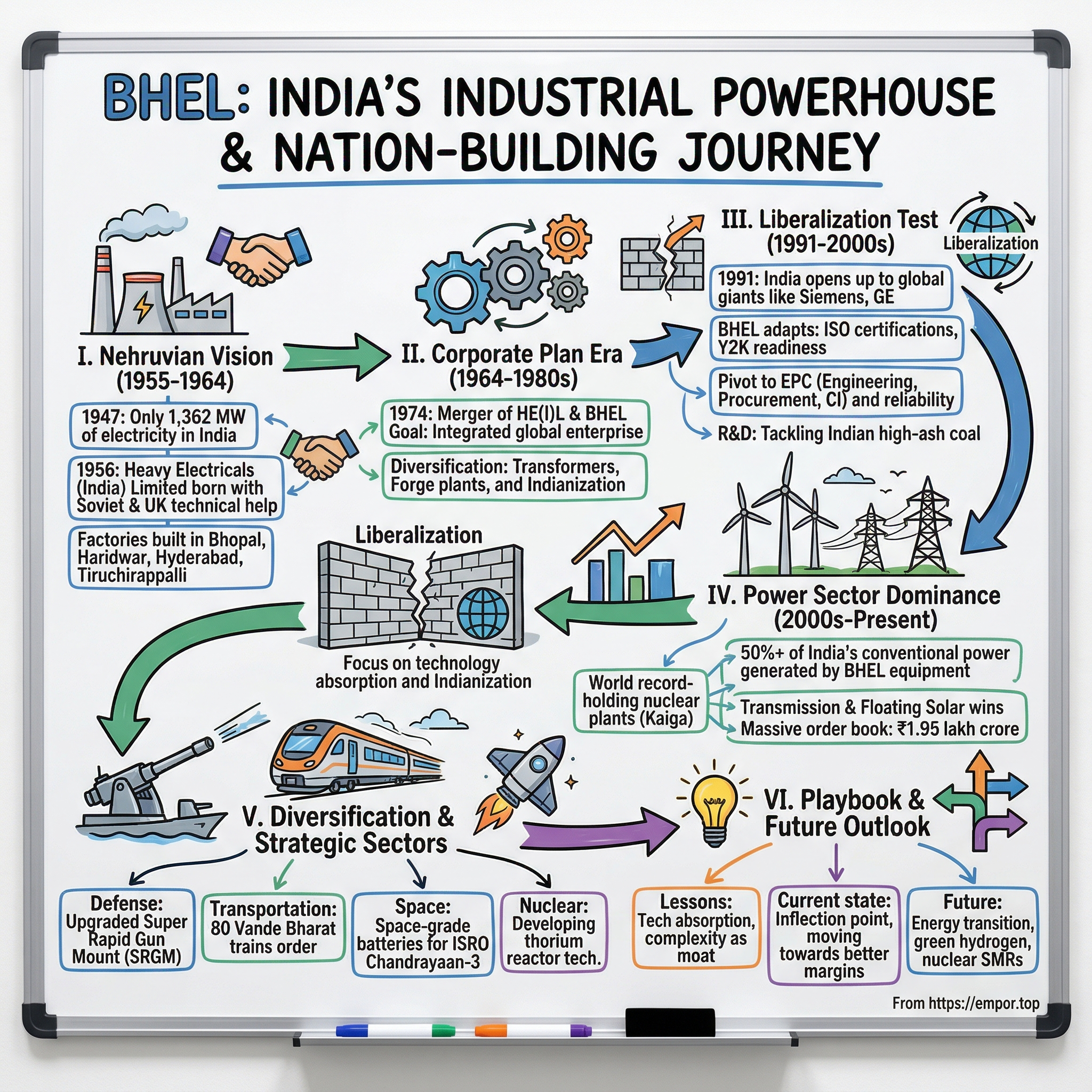
BHEL: How India's Written-Off Power Monopoly Became a Supercycle Trade
I. Introduction & Cold Open
On the morning of 11 February 2026, a bureaucrat in the Department of Investment and Public Asset Management pressed send on a filing that would knock six percent off one of the year's best-performing Indian stocks. The Government of India was selling up to five percent of Bharat Heavy Electricals Limited at a floor price of ₹254 a share — a roughly eight percent discount to the prior close — in an offer for sale that could raise about ₹4,422 crore for the exchequer.1
There is a certain poetry in that transaction. Five years earlier, almost nobody would have bought BHEL at any price. The company had just posted two consecutive years of losses. Revenue had nearly halved from its boom-era peak. The order book was stagnant. India's official energy narrative was that coal was finished, that the future was 500 GW of renewables, and that a state-owned boiler-and-turbine manufacturer with fifteen sprawling factories and a workforce priced for a different era was a stranded asset with a stock ticker.
By August 2026, BHEL trades near ₹403 a share with a market capitalisation of roughly ₹1.40 lakh crore — more than a hundred percent above the 52-week low of ₹205 it touched less than a year ago, and multiples above the levels of 2020–21.2 The government's own stake sale was oversubscribed 2.35 times, with institutional buyers clearing at ₹260.80 against a base offer of 10.44 crore shares.3 The state, in other words, found no shortage of people willing to take the other side of a bet it had once been unable to give away.
So what changed? The short answer is that India ran out of electricity faster than it could build renewables and storage, and the government quietly reopened the coal tap. The National Electricity Plan now calls for a minimum of 80 GW of additional coal-based capacity by 2031–32, requiring installed coal and lignite capacity of roughly 283 GW against about 217.5 GW at the time of planning.4 BHEL is the only Indian company that manufactures the complete boiler-turbine-generator island at scale. When the tender flow restarted, it was standing exactly where the money landed.
The evidence of that is not subtle. BHEL's order book stood at ₹2,60,255 crore at the end of the June 2026 quarter, up 27 percent year-on-year and roughly eight times its FY26 revenue.5 Revenue itself grew 19 percent in FY26 to ₹33,782 crore, and profit after tax roughly tripled to ₹1,578 crore.6 CARE Ratings upgraded the company's long-term bank facilities to AA from AA- in June 2026, citing revival in thermal capex, improved execution and a net cash position.7
And yet. This is where the story stops being a straightforward turnaround and becomes something more interesting. Return on equity for the last reported year was about 6.2 percent — respectable only against the 3.2 percent three-year average that precedes it, and thin for a business whose customers pay slowly and whose contracts run four to six years.2 The company's fresh order intake actually fell in FY26, to ₹75,916 crore from a record ₹92,534 crore the year before.68 The gap between what analysts think this equity is worth spans from ₹150 to ₹537.9 And in June 2026, the Cabinet Secretariat put BHEL on a one-year notice that it may lose its Maharatna status because it does not meet the ₹5,000 crore three-year average profit threshold that the designation requires.10
That is the puzzle worth six hours of anyone's attention. A company the market left for dead is now priced as a beneficiary of a decade-long industrial buildout, while its own government simultaneously sells its shares and questions whether it is big enough to keep its top-tier autonomy. To understand whether today's price is early, fair, or a story that has run ahead of its arithmetic, you have to understand why the last decade was lost — because the answer determines whether the next one is found.
 Subscribe on LinkedIn
II. Origins in Brief: Building a Nation's Industrial Base (1956–1991)
In August 1956, in a country nine years old and desperately short of almost everything, the Government of India registered a company called Heavy Electricals (India) Limited and put its first plant in Bhopal, built with technical collaboration from Associated Electrical Industries of the United Kingdom.[^11] The logic was not commercial. It was strategic in the way that only a newly independent, capital-starved economy can be strategic: if India was going to electrify, it could not spend scarce foreign exchange importing every turbine and boiler. It had to make them.
What followed over the next decade was one of the more remarkable technology-acquisition programmes of the Cold War era, conducted by a country that had deliberately chosen not to pick a side. Three more plants followed the Bhopal facility. Tiruchirappalli in Tamil Nadu was set up for high-pressure boilers and Hyderabad for steam turbo-generators and high-pressure pumps and compressors, both with Czechoslovak collaboration. Haridwar in Uttarakhand came up with Soviet assistance for large steam turbo-generating sets, motors, and hydro generating equipment.[^11] Bharat Heavy Electricals Limited was formally incorporated on 13 November 1964, and the various plants were eventually consolidated under it.11
Read that list again and notice what it represents: British, Czechoslovak, and Soviet engineering, absorbed in parallel, in four different Indian cities, within roughly eight years. BHEL did not invent boiler or turbine technology. It systematically ingested it. That distinction matters enormously for the modern investment case, and we will return to it, because "we learned to build this from someone else sixty years ago and have iterated since" is a very different competitive position from "we invented this and keep inventing."
The License Raj framework that governed the next three decades treated BHEL less as a business than as national infrastructure. Domestic power-equipment manufacturing was a precondition for industrialisation, not an activity that had to clear a cost of capital. Orders came from state electricity boards and, after 1975, from the National Thermal Power Corporation. Pricing was negotiated rather than competed for. Capacity was added because the Plan said so. For roughly thirty-five years, BHEL was the only scaled Indian manufacturer of the boiler-turbine-generator package — a monopoly created by policy, not won in a market.
The upside of that arrangement is visible in the physical plant BHEL still operates. Fifteen manufacturing units and a presence across more than 150 project sites in India and abroad give it a footprint no domestic competitor has ever attempted to replicate.7 Equipment supplied by BHEL accounts for roughly 214 GW of installed power generating capacity in India and overseas, with more than a thousand utility sets commissioned, and the company claims a 59 percent share of the domestic nuclear market and 43 percent of hydro.6 Those are not marketing numbers so much as archaeology: they describe six decades of being the default answer.
The downside is equally structural and rather less discussed. An organisation built to execute a plan does not develop the reflexes of an organisation built to win a bid. Cost-plus economics teach you to deliver, not to price risk. A guaranteed customer base teaches you to schedule, not to sell. And a government-set wage and human-resources framework builds a labour structure you cannot flex when volumes collapse — a point NITI Aayog reportedly made explicitly in 2026 when it identified human resource policies as a major constraint on BHEL's growth.10
None of this was a scandal. It was the design. But it left BHEL entering the 1990s as an institution optimised for a world that was about to be dismantled — enormously capable at making things, structurally unpractised at the two disciplines that would determine survival in the next era: pricing contracts correctly and collecting cash. Both of those weaknesses would take three decades to fully show up on the balance sheet, and both are still visible in the numbers today.
III. The Lost Decade: Liberalization, Overcapacity, and Near-Death (1991–2021)
The end of the monopoly did not arrive with a bang. It arrived as a joint venture press release.
In November 2007, 三菱重工業 Mitsubishi Heavy Industries announced it would establish a steam turbine and generator manufacturing and selling joint venture in India with Larsen & Toubro, following an earlier tie-up for supercritical boilers.12 By January 2011, those plants at Hazira in Gujarat had launched full-scale operations producing supercritical boilers and steam turbines and generators.13 Around the same period, joint ventures backing 東芝 Toshiba and General Electric technology set up shop, and Chinese suppliers — 上海电气 Shanghai Electric, 东方电气 Dongfang Electric and 哈尔滨电气 Harbin Electric — began winning Indian orders on price and, more painfully for BHEL, on delivery schedule.
The competitive irony was sharp. India's private power developers were not defecting from BHEL primarily on price. They were defecting because BHEL, sitting on a swollen order book during the 2007–2012 boom, was chronically late. The company was then a specialist in subcritical technology and was under constant pressure for failing to meet delivery schedules despite a backlog running into billions of dollars. Competitors arrived offering supercritical technology and a credible date.
Then came the second blow, and it was far worse than competition. India overbuilt. The Ultra Mega Power Project era and the private-sector thermal rush of 2007–2012 added coal capacity faster than demand absorbed it. By the mid-2010s the country had a genuine coal power glut, plant load factors sagged, stressed thermal assets piled up on bank balance sheets, and the policy consensus swung decisively toward renewables. New thermal ordering did not slow. It very nearly stopped.
For a company whose Power segment is the overwhelming majority of its business, this was an extinction-level demand shock — and, critically, it had nothing to do with BHEL losing a competitive contest. The market itself disappeared. Revenue that had exceeded ₹45,000 crore in the peak years fell to ₹21,463 crore in FY20 and ₹17,308 crore in FY21.214 The losses that followed were not marginal: a profit before tax of negative ₹3,612 crore and a loss after tax of ₹2,717 crore in FY21, on top of a loss the year before.14
Here is where the story gets genuinely important for anyone underwriting BHEL today, because the most consequential damage of this period was not the losses. It was the contracts.
When a project-based manufacturer's order flow collapses, management faces a brutal choice. Idle the factories, carry the fixed cost, and watch the vendor ecosystem die — or bid aggressively to keep the lines running, accepting margins that barely cover cost. BHEL, like most such companies in most such downturns, chose to keep the lines running. It won large fixed-price engineering-procurement-construction contracts at thin-to-negative economics. The two that analysts would still be discussing a decade later were the Patratu Super Thermal Power Station expansion in Jharkhand — a 3x800 MW EPC package worth about ₹11,700 crore awarded in March 2018 by Patratu Vidyut Utpadan Nigam, an NTPC joint venture — and the Ennore project in Tamil Nadu.15
Why do fixed-price contracts signed in 2018 still matter in 2026? Because of how project accounting works, and because of what happened to commodity prices. On a fixed-price contract with no price-variation clause, the contractor absorbs every rupee of input-cost inflation between signing and delivery. BHEL signed at 2018 steel and copper prices, then executed through a pandemic, a supply-chain rupture, and a global commodity spike. Revenue is recognised over the multi-year life of the contract as work is completed, which means a badly priced 2018 order keeps flowing through the income statement at bad margins for as long as it takes to finish — and these projects take four to six years even when nothing goes wrong.7 Patratu Unit 2 reached full load only in the March 2026 quarter and recorded its formal capacity addition in the June 2026 quarter.56 Eight years after signing.
The trough itself passed in FY22. BHEL returned to profit with ₹410 crore after tax on revenue of ₹21,211 crore, up 24 percent, and declared a 20 percent dividend after a three-year gap.14 Management framed it as the fruit of "strong focus on speeding up execution, cost control, prudent resource management" — the language of a company that had stopped bleeding rather than one that had started winning.14 It was, in fairness, an honest description. The order book at 31 March 2022 stood at ₹1,02,542 crore, with only ₹23,693 crore of fresh orders booked in the year.14 That is a book being slowly drained, not filled.
The analytical takeaway from this period is the single most useful thing an investor can carry into the rest of this story. BHEL's lost decade was caused by a policy-driven collapse in demand for its core product, compounded by self-inflicted damage in how it responded. The first part was cyclical and reversible. The second part — contracts underpriced to survive — created a multi-year earnings drag that would persist well after the cycle turned, and it stands as a live test of whether the company has actually changed how it prices risk. Anyone who understood that distinction in 2021 had the framework to underwrite what came next. Almost nobody did, which is why the stock traded where it traded.
IV. The Reopening of Coal & the Order Book Supercycle (2021–Present)
The turn did not begin in a boardroom. It began with air conditioners.
Indian peak electricity demand kept setting records through the mid-2020s as incomes rose, summers lengthened, and manufacturing capacity came online. Solar and wind were being added at genuine scale — but solar generates when the sun shines, and India's evening peak arrives after it sets. Grid-scale storage was expanding from a small base and could not yet cover a multi-hour national shortfall. Planners faced an unglamorous arithmetic problem: something had to run at 10 p.m. in May, and it had to be dispatchable.
The policy answer was a reversal. Against an installed coal and lignite base of roughly 217.5 GW, the National Electricity Plan concluded India would need about 283 GW by 2032 — a minimum of 80 GW of new coal capacity by 2031–32, at an estimated capital cost of roughly ₹8.34 crore per MW.4 For a company that had spent a decade being told its core product was obsolete, this was less a tailwind than a resurrection.
BHEL's chairman laid out the mechanics of it on the Q4 FY24 earnings call in May 2024, and the passage is worth revisiting because it is one of the few places management put a checkable number on the opportunity. Asked when the 80-plus GW would be awarded, K. Sadashiv Murthy said around 10 GW had already been tendered, 27 GW was under construction, and roughly 40 GW more remained to be tendered — implying "around 10-12 GW ordering" every year for several years, with capacity installation complete by 2032.16 On the same call he confirmed BHEL's own annual execution capability at "around 10 GW every year," noting the company had demonstrated up to 12 GW in a previous year.16
Those two numbers — roughly 10 GW of annual national ordering, roughly 10 GW of annual BHEL execution capacity — are the load-bearing assumptions of the entire bull case, and they deserve to be held up against what has actually printed.
On order intake, the delivery was extraordinary and then, notably, decelerated. FY25 produced the highest order inflow in BHEL's history: ₹92,534 crore, of which ₹81,349 crore came from the Power sector and ₹11,185 crore from Industry, lifting the closing order book to ₹1,95,922 crore.8 FY26 delivered ₹75,916 crore — a very large number in absolute terms, and an 18 percent decline from the prior year.6 The Power segment took in ₹59,256 crore, including main plant packages for the 3x800 MW Telangana Stage-II supercritical project, EPC for MPPGCL's Amarkantak-6 and Satpura-12, and an EPC package for NTPC Darlipali Stage-II. Industry contributed ₹16,451 crore, up about 50 percent, headlined by an ±800 kV, 6,000 MW high-voltage direct current link between Bhadla in Rajasthan and Fatehpur in Uttar Pradesh.6
That composition tells you something the headline does not. Power ordering slipped, and Industry — transmission, defence, transportation, process industries — grew half again in a single year. The diversification management has been promising since at least 2024 started showing up in the intake mix before it showed up anywhere else.
The June 2026 quarter then reversed the deceleration sharply. Order inflow nearly doubled year-on-year to ₹26,745 crore, of which ₹22,625 crore was Power, ₹1,767 crore Industry, and ₹2,353 crore exports — the last figure representing eight gas turbine generator packages for a petroleum refinery and polypropylene plant, described by the company as its largest-ever single export order on a supply and supervision basis for gas turbine generators.5 Domestically, the quarter brought the EPC package for the 3x800 MW Meja supercritical project, a contract reported at over ₹21,000 crore, and the 1x800 MW main plant package for DVC Durgapur.517
The outstanding book at 30 June 2026 reached ₹2,60,255 crore, 81 percent Power, 17 percent Industry, 2 percent exports.5 Buried in that total is the more interesting disclosure: roughly ₹12,000 crore of nuclear work, ₹14,000 crore transmission, ₹15,000 crore transportation, ₹8,000 crore coal gasification, ₹7,000 crore defence, ₹5,500 crore hydro and ₹4,000 crore spares and services.5 Non-thermal work now runs to something like a quarter of the book.
The profit response has been genuine and it has been late. FY26 revenue of ₹33,782 crore came with EBITDA of ₹3,189 crore against ₹1,745 crore, and profit after tax of ₹1,578 crore against ₹513 crore.6 CARE calculated the operating margin — profit before interest, lease rentals, depreciation and tax — at 9.2 percent for FY26 against 4.5 percent in FY25.7 The March 2026 quarter alone delivered ₹1,283 crore of after-tax profit on ₹12,310 crore of revenue.6 And the June 2026 quarter, historically BHEL's weakest, broke a run of loss-making first quarters: revenue up 40 percent to ₹7,698 crore, EBITDA of ₹735 crore against a ₹352 crore loss, and profit after tax of ₹382 crore against a ₹455 crore loss.5
Here is the tension the numbers do not resolve. Through FY26, brokerage commentary consistently attributed capped margins to the legacy Patratu and Ennore contracts; Nuvama told clients in January 2026 to expect the third quarter to "see the lingering impact of legacy low margin projects" and looked for newer projects to enter revenue recognition from Q4 FY26 onward.18 CARE, writing in June 2026, described the improvement as partly driven by "majority completion of legacy low-margin projects" and referred to "minimal residual low-margin, fixed price legacy orders."7 The direction of travel is clear and the evidence supports it.
What remains unproven is the destination. A 9.2 percent operating margin is a long way from the 27 to 28 percent EBITDA figure management has pointed toward, and the difference between those two numbers is most of the equity story.19 The correct posture is neither dismissal nor faith: the legacy drag is demonstrably rolling off, the new orders carry better payment terms and more price-variation protection, and the margin has moved. Whether it moves another eighteen percentage points, and on what timetable, is not yet a fact. It is a forecast — and BHEL's own execution history is the reason to hold that forecast loosely.
V. Inside the Core Business: Power Segment Economics
Walk into the Tiruchirappalli boiler plant and you are looking at something closer to a shipyard than a factory. A single 800 MW supercritical boiler is a steel structure ten to fifteen storeys tall, containing hundreds of kilometres of high-alloy tubing that must contain water heated past its critical point — above roughly 374°C and 221 bar, where the distinction between liquid and steam ceases to exist. The physics is unforgiving: at those temperatures and pressures, metallurgy that is merely good fails.
That is the moat, such as it is, and it is worth explaining in plain terms. A thermal power plant's "main plant" is the boiler-turbine-generator island — the boiler that turns water into supercritical steam, the turbine the steam spins, and the generator the turbine drives. Around it sits the balance of plant: coal handling, ash handling, water treatment, cooling. BHEL manufactures the BTG island in-house. The balance of plant, as Director (Power) Tajinder Gupta acknowledged directly on the FY24 call, is largely outsourced — "the systems like DM plant, AHP, CHP, we are dependent still on the other OEMs."16 Flue gas desulphurisation, selective catalytic reduction and electrostatic precipitators are BHEL's own.16
Power accounts for roughly 81 percent of the outstanding order book and is the dominant driver of both revenue and profit; Industry — transportation, transmission, defence, industrial products and renewables — makes up most of the rest.5 Any honest discussion of BHEL's economics has to start there, because the Industry segment's growth, real as it is, cannot yet move the consolidated needle.
Why BHEL wins at home. Four mechanisms, in descending order of durability.
The first is genuine and hard to replicate: BHEL is the only Indian company that can supply the complete BTG island at utility scale, at roughly 10 GW a year, from domestic factories.16 Building that capability from scratch would require capital, a decade, and a customer willing to be the guinea pig on a ₹10,000 crore asset.
The second is the installed base. Equipment underpinning some 214 GW of capacity generates a permanent stream of spares, overhauls and renovation work — the order book carries roughly ₹4,000 crore of spares and services at any time — and, more subtly, it means every utility engineer in India has spent a career around BHEL drawings.56 Switching to an unfamiliar OEM on a 25-year asset carries operational risk that has nothing to do with price.
The third is policy. Make in India and Atmanirbhar Bharat tender preferences for indigenous content directly advantage BHEL in central and state utility bids. This is a real advantage. It is also, definitionally, a granted advantage that a future government could narrow, and it should not be confused with a competitive one.
The fourth is customer credit quality, and it is improving. Central public sector undertakings and high-credit-quality private players rose to 67 percent of the order book in FY26 from 62 percent in FY25.7 That shift matters more than it sounds, for reasons that become clear in a moment.
Where BHEL does not win. The contested ground is substantial and BHEL's position on it ranges from decent to marginal. In gas turbines and flexible generation, global majors hold the technology. In transmission and distribution, BHEL is a smaller player alongside Siemens Energy India, Hitachi Energy, GE Vernova T&D and CG Power, with high-voltage technology largely residing with the multinationals — a reality visible in BHEL's own approach to HVDC. Director (Industrial Systems & Products) Bani Varma told analysts in 2024 that for the first two HVDC projects BHEL bid, "we have already tied up with an international partner, with an OEM."16 That is a company bidding into a growth market on someone else's technology.
And in large coal-fired EPC, L&T remains the most credible domestic threat, with a supercritical manufacturing base at Hazira built for 4,000 MW a year.13
The customer problem. BHEL's buyers are NTPC, state generating companies and, increasingly, large private developers. They are creditworthy in the sense that they do not default. They are also concentrated, procedurally slow, and historically among the slowest payers in Indian industry — and this is the direct mechanical link between a magnificent order book and a mediocre cash return.
Look at how it shows up. BHEL's gross current asset days stood at 582 as of 31 March 2026 — an improvement from 682 the year before, but still meaning the company effectively finances roughly nineteen months of operations.7 Non-current receivables including contract assets were ₹16,624 crore, equal to 65 percent of tangible net worth.7 CARE flags "timely collection of receivables and contract assets, particularly from legacy projects" as a key rating monitorable, and notes the power sector's structural impediments — land acquisition delays, environmental and statutory clearances, and the weak financial health of several state utilities — as a sector risk BHEL cannot escape.7
Put simply: BHEL does not primarily have a demand problem or a manufacturing problem. It has a working-capital problem that is a direct function of who its customers are.
Has the risk pricing actually changed? This is the question that decides whether the Patratu experience was a one-off or a pattern. The available evidence is mildly encouraging and incomplete. Murthy told analysts in 2024 that on large NTPC bulk orders, "we are seeing the change of payment terms. What we are getting now is with the changed payment terms and all with the variation clause."16 CARE confirms that price variation clauses are present in the majority of the outstanding order book, which materially mitigates commodity-cost risk — and notes this specifically in the context of raw material inflation driven by the ongoing West-Asia conflict.7 The rating agency also credits "significant reduction in backend payments for new contracts as articulated by the management" as the reason it expects gross current asset days to improve materially.7
But when analysts pushed for the split between fixed-price and variable-price work in the backlog, management twice said the data was not readily available and offered to share it offline.16 For a company whose central historical wound is fixed-price exposure, that is a disclosure gap, not a rounding error.
Nuclear as a smaller strategic line. BHEL has been a turbine-generator supplier across India's pressurised heavy water reactor fleet for decades and claims a 59 percent share of the domestic nuclear market.6 The order book carries roughly ₹12,000 crore of nuclear work, and the June quarter added overhauling and commissioning of the turbine-generator package for the 500 MW Prototype Fast Breeder Reactor at Kalpakkam.5 Looking forward, the FY25 Union Budget created a Nuclear Energy Mission with a ₹20,000 crore allocation to operationalise at least five indigenously designed small modular reactors by 2033, with BARC developing a 200 MWe BSMR-200, a 55 MWe SMR-55, and a 5 MWt high-temperature gas-cooled reactor.2021 The SHANTI Act passed in December 2025 opened reactor ownership to private entities, and EDF and BHEL have been exploring collaboration on the NUWARD SMR design.21
This is real optionality attached to a target of 100 GW of nuclear capacity by 2047 against roughly 8.78 GW today.21 It is also pre-revenue at scale, dependent on a fuel supply chain India does not yet control, and subject to land acquisition timelines that have historically exceeded four years.21 It belongs in the valuation as a call option, not a cash flow.
The core business, then, is a genuine near-monopoly in one specific product, a follower in most adjacent ones, selling into a customer base that pays late. That combination sets up the natural question of what BHEL has built outside the boiler island — and whether any of it is big enough to matter.
VI. Diversification: Sized to What's Actually Material
On 12 April 2023, BHEL announced that a consortium it led with Titagarh Wagons had been awarded the contract for 80 Vande Bharat trainsets — the sleek blue-and-white semi-high-speed trains that had become the most visible symbol of Indian Railways' modernisation. The order exceeded ₹23,000 crore excluding taxes, of which ₹9,600 crore covered the trainsets themselves and the balance covered 35 years of maintenance. The consortium was, as BHEL noted pointedly, "the only fully homegrown Indian bidder amongst the five bidders."22
Strip away the flag-waving and there is a genuinely good piece of business here, and it is worth understanding why. BHEL supplies the propulsion system — traction converters, auxiliary converters, train control systems, motors, transformers and mechanical bogies, manufactured at Bengaluru, Bhopal and Jhansi — while Titagarh handles coach building, with joint integration and commissioning.22 The trains are designed for 176 kmph and operate at 160.22
The 35-year maintenance tail is the part that deserves attention. A manufacturer with a lumpy, tender-driven order book has just attached three and a half decades of contracted service revenue to a single award. Service revenue in rolling stock is typically higher-margin and vastly more predictable than equipment supply. If BHEL executes, this converts a chunk of its Industry segment from project economics to annuity economics — precisely the transformation that would justify a higher multiple over time.
The caution is timing. Murthy told analysts in May 2024 that the first prototype was around 24 months out and contractual delivery would begin from June 2025.16 The order book at June 2026 carries roughly ₹15,000 crore of transportation work.5 Recognition of the bulk of this contract is a multi-year, back-loaded affair, and rail manufacturing is not a business BHEL has previously executed at this scale.
Defence: small, real, and growing faster than anything else. On 28 November 2023, the Ministry of Defence signed a contract with BHEL's Haridwar plant for 16 Upgraded Super Rapid Gun Mounts and associated equipment for the Indian Navy at a total cost of ₹2,956.89 crore under the Buy (Indian) category.23 The SRGM is a medium-calibre anti-missile, anti-aircraft point-defence weapon — the gun that sits on a frigate's foredeck and shoots down incoming missiles and fast attack craft. BHEL had earlier been awarded a Goa Shipyard order for upgraded SRGMs and accessories for Triput-class frigates.24
The growth rate here is the striking part, and Bani Varma quantified it on the FY24 call in a line that reframes the segment entirely: "in 30 years we got orders for 44 guns, and in 1.5 years we've got orders for 38 guns."16 That is not incremental. That is a step change in a business BHEL has quietly been in for five decades.
Varma also described the adjacent pipeline: a bid submitted for air defence guns for the Army with a European OEM partner and a prototype in preparation, marine gas turbines for the Navy with another European partner, 83 compact heat exchangers ordered by HAL for the LCA Tejas Mk1A with another 93 expected, and unspecified "strategic equipment" for the Navy being developed entirely in-house.16 Defence sits at roughly ₹7,000 crore of the order book, and the June 2026 quarter added a major overhaul of ten SRGMs plus spares.5
The honest framing: defence is a few percent of revenue, likely accretive to margin, strategically valuable because roughly 75 percent of India's capital acquisition budget is reserved for domestic industry, and growing off a base small enough that a doubling changes the segment without changing the company.5
Space: a credibility marker, not a P&L line. BHEL signed a technology transfer agreement with ISRO in 2018 to manufacture space-grade lithium-ion cells, and its Electronics Division in Bengaluru supplied the batteries for Chandrayaan-3's Vikram lander and propulsion module, along with titanium-alloy propellant tanks.25 Nobody should build a valuation on this. But it is meaningful evidence that a company best known for building objects the size of buildings can also hold tolerances that satisfy a space agency — which is relevant when assessing whether the defence and nuclear ambitions are plausible.
Green hydrogen and coal gasification: two different flavours of optionality. On 7 July 2026, BHEL signed a strategic tie-up with thyssenkrupp nucera India for phased indigenisation and local manufacturing of alkaline electrolyser systems, positioned as supporting the National Green Hydrogen Mission and its 5 million tonne per annum target by 2030.26 This is pre-commercial and depends on subsidy economics that have not yet been proven anywhere at scale — a sentence of optionality, not a business.
Coal gasification is further along and, oddly, less discussed. BHEL's joint venture with Coal India for a 2,000 tonnes-per-day coal-to-ammonium nitrate plant has moved from agreement to construction; the President and Prime Minister laid the foundation stone at Lakhanpur, Odisha, on 20 June 2026, and BHEL secured the coal gasification, raw syngas cleaning and syngas purification packages for the Jharsuguda project.56 Roughly ₹8,000 crore of the order book is coal gasification work.5 Against a national mission target of about 100 MT of gasification capacity by 2030, this is a plausible new order category — and one with a certain irony, given it monetises the same fossil resource whose decline is supposed to be BHEL's long-term threat.5
The discipline point is worth stating plainly. Add rail, defence, nuclear, hydrogen and gasification together and you have roughly a quarter of the order book and a much smaller share of near-term revenue. They diversify BHEL's future. They do not yet drive its present. Anyone buying the stock is buying thermal power equipment execution with a portfolio of options attached — and the quality of that execution depends heavily on who is running the place.
VII. Management, Governance & Capital Allocation Under State Ownership
K. Sadashiv Murthy took charge as Chairman and Managing Director of BHEL on 1 November 2023, aged 56. He had joined the company in 1989 at the Jhansi unit — a transformer and locomotive plant — and spent 34 years moving through Hyderabad, Bhopal, Jhansi and Varanasi before reaching the corporate office. He holds an electrical engineering degree from Bhopal University and an MBA in finance. Immediately before the top job he was Executive Director of Corporate Operations Management, and simultaneously held additional charge as CMD of Bharat Pumps and Compressors.27
Read that biography carefully and you see something specific: a lifer who came up through the factories, not through Delhi. That is the profile of someone who understands why a boiler slips schedule. It is not obviously the profile of someone trained to price contract risk against a hostile commodity cycle — which happens to be BHEL's central historical failure.
It also, unusually for a public-sector chief executive, brackets the inflection almost exactly. Murthy arrived after the trough and before the surge. FY24, FY25 and FY26 are his. That makes him a fair subject for the only management assessment that means anything: what did he say he would do, and what happened?
Where the record is good. On the May 2024 call, pressed on FY25 execution, Murthy declined to give formal revenue guidance but said BHEL was "targeting some 12% to 15% of CAGR year-on-year."16 FY25 revenue grew about 19 percent and FY26 grew 19 percent again.68 Guidance beaten, twice.
Asked whether seven straight years of declining gross margin represented a new normal, he answered in four words: "This trajectory is going to turn," then explained the mechanism — commodity normalisation, vendor rehabilitation, and execution improvement.16 Operating margin went from 4.5 percent in FY25 to 9.2 percent in FY26.7 The direction was right and the reasoning was specific rather than promotional.
On execution capacity he claimed roughly 10 GW a year. BHEL commissioned or synchronised 8.1 GW in FY25 and about 8.9 GW in FY26.68 Short of the claim, but close, and rising.
Where the record is not good, and it matters. The working capital promises did not land on schedule. In May 2024, Nuvama's analyst asked when older NTPC dues would clear. Murthy replied that "whatever earlier NTPC projects we were having, we are targeting that their execution will be finished by next financial year." Asked to confirm — by end of FY25, by March? — he said, "Very true, very true." Asked whether cash flows and working capital would therefore be better by March, he said, "100% true."16
They were not. Trade receivables plus contract assets stood at ₹38,375 crore at 31 March 2025 and ₹38,613 crore at 31 March 2026 — essentially flat across two years, on a revenue base that grew nearly 40 percent over the same period.6 Gross current asset days did improve, from 682 to 582, which is a real operational gain.7 But the absolute stock of capital tied up in customers did not shrink at all, and the confident "100% true" of May 2024 turned out to be an aspiration rather than a forecast.
Similarly, asked in 2024 how much legacy order book remained and when it would clear, Murthy said "around 50,000 crores order book is still there which was earlier to this financial year… which we will be finishing by next financial year," excluding defence, nuclear and Vande Bharat.16 Yet in January 2026, analysts were still writing about Patratu and Ennore capping margins, and Patratu Unit 2 only achieved full load in the March 2026 quarter.518
The generous reading is that these were operational slips in a business with genuinely long tails, and that the direction of everything Murthy predicted has proven correct even where the timing has not. The less generous reading is that BHEL's management has a consistent habit of answering timing questions with more confidence than the underlying processes support — and that when analysts push for the underlying data (the fixed-price versus price-variation split, the EBITDA-to-cash-conversion ratio), the answer is frequently that the number is not available or cannot be shared.16 On cash conversion specifically, Director (E,R&D) Jai Prakash Srivastava told a Jefferies analyst that "BHEL is a very complex organization with lot of products, so it cannot be ascertained like this," and Murthy added, "There cannot be a straight answer or simple answer to your question."16 That may be true. It is also exactly what a company with poor cash conversion would say.
Why "incentive alignment" means something different here. BHEL is a Central Public Sector Enterprise under the Ministry of Heavy Industries. The CMD and board are government-appointed on government pay scales. There is no meaningful equity-linked compensation. Performance is assessed substantially against a Memorandum of Understanding negotiated annually with the Department of Public Enterprises — a framework Murthy referenced on the FY24 call when he noted the FY25 MoU was still under discussion with DPE in May.16 A management team whose scorecard is an inter-departmental document and whose upside is not tied to the share price will optimise for different things than a founder-operator would. That is not a moral judgment. It is a structural fact investors should price.
The board composition sharpens the point. As of 31 March 2026, CARE recorded BHEL's board as comprising two government nominee directors and one independent director.7 For a listed company of this scale, a single independent director is a genuine governance weakness — it thins the check on management that minority shareholders would otherwise rely on. It is also a common CPSE affliction, driven by delays in government appointments rather than by design. Common does not mean immaterial.
Two capital allocators, one company. This is the structural feature that most distinguishes BHEL from a private industrial. Operating capital allocation — working capital, contract selection, R&D at about 2.4 percent of revenue, capex guided at ₹1,200 crore — sits with management.619 But the majority shareholder is the Government of India at 58.17 percent, and it treats its holding partly as a fiscal asset.7
The February 2026 offer for sale is the clean illustration. The government offered a base 3 percent with a 2 percent green shoe at a ₹254 floor — roughly an 8 percent discount to the pre-announcement close — potentially raising ₹4,422 crore.1 The institutional tranche was oversubscribed 2.35 times, over 22 crore bids against a 10.44 crore base, clearing at ₹260.80, and the government exercised the green shoe.3 The retail cut-off was set at ₹256.3
Every rupee of that went to the exchequer. None went to BHEL. The transaction was executed at a discount that a company raising primary capital would have used to fund factories, and it landed while BHEL was carrying ₹38,613 crore of receivables and contract assets on its balance sheet.6 The company was net cash by then — ₹3,680 crore net cash at 31 March 2026, with ₹11,897 crore of cash and bank balances and nil long-term borrowings — so this was not a missed funding opportunity in any acute sense.7 But it establishes the principle clearly: the controlling shareholder will monetise its stake on its own fiscal calendar, and minority holders are along for that ride. CARE lists "reduction in GoI shareholding below 51%" as a negative rating factor, which quantifies exactly how much of BHEL's credit standing is borrowed from its owner.7
The Maharatna overhang. In June 2026, a committee headed by Cabinet Secretary T.V. Somanathan placed BHEL and SAIL on a one-year review of their Maharatna status. The two are the only ones among India's fourteen Maharatna companies that fail the requirement of averaging more than ₹5,000 crore in annual profit after tax over the preceding three years. A downgrade to Navratna would cut the board's independent equity investment authority from ₹5,000 crore to ₹1,000 crore. NITI Aayog reportedly identified human resource policies as a major constraint on BHEL's growth, and the Ministry of Heavy Industries said a performance improvement plan was already in place.10
The practical impact of a downgrade would be modest given BHEL's capex plans. The signalling value is not. It is the majority owner stating, in the same year it sold shares at a discount into a rallying market, that the company's profitability remains below the standard expected of its peer group. Both facts are true simultaneously, and holding them together is the right way to think about state ownership here.
Dividends. With no buyback mechanism and no shareholder route to influence capital allocation, dividends are effectively the only channel through which minority holders receive cash. The board recommended a final dividend of ₹1.40 per ₹2 share for FY26 — 70 percent of paid-up capital and the largest payout in seven years, against a roughly 30 percent payout ratio.228 At current prices the yield is around 0.35 percent.2 It is a signal of confidence. It is not, at this level, a return.
VIII. The Financial Picture: What's Actually Improving vs. What Isn't
There is a moment in every turnaround where the income statement starts telling a different story than the balance sheet, and the investor's whole job becomes deciding which one is lying. BHEL is squarely in that moment.
What is unambiguously improving. Revenue has broken out of a decade of stagnation. From FY22's ₹21,211 crore the company reached ₹23,893 crore in FY24 — a mere 2 percent increase that year — then ₹28,339 crore in FY25 and ₹33,782 crore in FY26.61416 Two consecutive years of roughly 19 percent growth after years of low single digits is the clearest evidence that the order book is genuinely converting into work performed, not merely sitting in a press release.
Operating leverage is doing what operating leverage does. Because a heavy engineering business carries substantial fixed costs — fifteen plants, an engineering workforce of 9,000-plus engineers, and R&D running near 2.4 percent of revenue — incremental revenue drops through at high contribution margins once the fixed base is covered.6 That is the mechanical reason EBITDA more than doubled between FY25 and FY26 on 19 percent revenue growth. It is also why the March 2026 quarter posted a 14.2 percent EBITDA margin against 9.2 percent a year earlier: Q4 is BHEL's heaviest execution quarter, and the leverage is most visible there.19
The financial risk profile has strengthened materially. Interest coverage improved to 4.22 times in FY26 from 1.40 times in FY25. Net debt excluding mobilisation advances and including cash to operating profit improved to 2.58 times from 7.15 times. Adjusted total outside liabilities net of cash to tangible net worth sat at a comfortable 1.44 times.7 These are the metrics a credit analyst watches, and all three moved in the same direction at once. CARE's upgrade to CARE AA; Stable from CARE AA-; Stable on 16 June 2026 — the first change after three consecutive years at AA- — is the external validation.7
Collections have started moving too. Total customer collections in the June 2026 quarter reached ₹11,004 crore against ₹8,191 crore, up 34 percent.5 Gross current asset days fell 100 days year-on-year.7
What is not improving fast enough. Start with returns. Return on equity for the last reported year was roughly 6.2 percent, against a three-year average of 3.2 percent and a return on capital employed near 9.1 percent.2 For context: this is a company with a book of business eight times its annual revenue, and it earns a return on shareholder capital that a fixed deposit would find unremarkable. The order book is not the problem. The conversion of that order book into profit on employed capital is the problem, and it remains unsolved.
Then the receivables. The flat absolute stock of trade receivables plus contract assets has already been established. What deserves emphasis is the composition: ₹16,624 crore of that is non-current — money the company itself does not expect within twelve months — equal to 65 percent of tangible net worth.7 Two-thirds of BHEL's equity base is, functionally, an unsecured multi-year loan to its customers. The improvement in day-count came from growing the denominator faster than the numerator, not from shrinking the numerator.
Contingent liabilities warrant a mention. CARE recorded these at ₹6,308 crore in FY25, or 26 percent of net worth, down from ₹7,945 crore in FY24, with liquidated damages claims of ₹2,942 crore forming the largest component.7 Liquidated damages are penalties for late delivery. A ₹2,942 crore stock of such claims is a quantified measure of BHEL's historical schedule performance, and the agency explicitly names "crystallisation of large contingent liabilities impacting the credit profile" as a negative rating trigger.7
An accounting judgment worth watching. BHEL's reported profit is meaningfully affected by movements in provisions, and the direction reversed in FY26. Net provisions were a charge of ₹158 crore in FY25 and a write-back of ₹177 crore in FY26 — a swing of ₹335 crore in favour of reported profit, against FY26 profit before tax of ₹2,116 crore.6 That is roughly a sixth of the year's pre-tax profit arising from provision movement rather than trading. For scale, the equivalent net provision creation was ₹1,037 crore in FY24, and an accounting change to expected credit loss provisioning had a ₹1,093 crore impact that year.16 CARE flags "continuous creation and reversal of provisioning towards debtors pertaining to legacy orders" as a constraint on the ratings.7
None of this suggests anything improper. Provision write-backs when disputed receivables are collected are entirely legitimate. But an investor extrapolating FY26's earnings should understand that a portion of the improvement reflects the release of prior conservatism, not incremental operating profit — and that this particular lever runs out.
The bridge between the two stories. Here is the causality, stated plainly. The order book is real, the revenue conversion is real, and the margin recovery from 4.5 to 9.2 percent is real and largely explained by legacy contract completion plus operating leverage. What has not yet happened is the conversion of that profit into free cash and a respectable return on capital, because the customers who generate the order book are the same customers who pay in eighteen months. Until gross current asset days fall substantially further — CARE expects material improvement from reduced backend payment terms on new contracts — BHEL will keep looking like a company whose income statement is inflecting while its balance sheet stands still.7
Which brings us to the question the market is actually arguing about.
IX. The Valuation Disconnect & Investor Debate
Start with a small lesson in the fragility of trailing multiples.
Earlier in 2026, headlines about BHEL routinely quoted a trailing price-to-earnings ratio well north of 100 — a number that, taken at face value, made the stock look like a speculative bubble in industrial clothing. As of today, the trailing multiple on the twelve months to June 2026 is roughly 57.6 times, on a market capitalisation of ₹1.40 lakh crore and a share price of ₹403.2
The company did not become half as expensive through any change in the business. What happened is that the loss-making June 2025 quarter rolled out of the trailing window and a profitable June 2026 quarter rolled in.5 When a company's earnings are inflecting off a near-zero base, the trailing P/E is not a valuation measure. It is an artefact of which quarters happen to be in the window. Anyone anchoring on it — in either direction — is measuring the wrong thing.
Which is precisely why the sell side has abandoned it. Look at how the actual arguments are constructed. Nuvama valued the stock at 45 times FY28 estimated earnings in May 2026, cutting its target to ₹485 from ₹525 while trimming FY27 and FY28 EPS by 7 percent to align execution assumptions with management's guidance of about 2.7 times FY26 sales.19 By July it had raised the target to ₹530 on 38 times FY28 EPS.29 Dolat Capital applies 35 times FY28 estimated EPS; Antique uses 32 times H1 FY29 earnings.9 Every one of these is a bet on earnings two to three years out, discounted back through a multiple that is itself well above the market.
The resulting dispersion is the widest this analyst would expect to find on a ₹1.4 lakh crore company. On the bullish side after the June quarter: 360 ONE Capital at ₹537, ICICIDirect at ₹575, Antique at ₹527, Dolat at ₹525, ICICI Securities at ₹520, IIFL at ₹502, Phillip Capital at ₹500, JM Financial at ₹481.929 On the bearish side: Kotak Institutional Equities at ₹150, JP Morgan at ₹220, Axis Capital at ₹255, CLSA at ₹306 with a Reduce, Macquarie at ₹315 with an Underperform, PL Capital at ₹368. Morgan Stanley sits Overweight at ₹444 and UBS Neutral at ₹460.929
A range from ₹150 to ₹575 on the same company, in the same month, from institutions with access to the same filings, is not analytical sloppiness. It is a genuine disagreement about a single variable: what steady-state margin this business earns, and when.
The bull arithmetic. BHEL executes its ₹2.6 lakh crore book at accelerating pace, operating margin continues its climb toward the high-20s management has pointed at, and by FY28 the company earns several times its FY26 profit — at which point today's price is 30-something times a normal year, which is a full but not absurd multiple for a structurally advantaged supplier into a decade-long national capex programme. IIFL's framing captures the mechanism: as a larger share of newer, higher-margin private projects enters revenue recognition, the turnaround becomes more evident from the second half of FY27.29
The bear arithmetic. JP Morgan's objection is the cleanest. The best of the ordering upside is already captured — evidenced by FY26 order inflow falling 19 percent — and BHEL is a cyclical business being valued as a compounder near the peak of its cycle, with renewables posing a structural long-term threat to coal-based generation demand.9 The 67 percent six-month rally, on this view, offered a good exit rather than an entry.29 Kotak's ₹150 implies something more severe still: that the margin normalisation simply does not arrive at anything like the guided level, leaving an investor paying a large multiple for a mid-single-digit-return utility supplier.
The activist stress test. BHEL faces no activist campaign, and structurally it cannot. With 58.17 percent held by a single owner who appoints the board, no external shareholder can force a change. But it is worth articulating what a skeptical long/short investor would put in a short thesis, because those points are the analytical monitorables whether or not anyone ever presents them in a deck.
They would begin with the ₹16,624 crore of non-current receivables at 65 percent of tangible net worth, and ask what portion is genuinely collectable versus perpetually renegotiated.7 They would point to the pattern of provision creation and reversal and argue that reported profit contains a discretionary component.7 They would note that a single independent director on the board is a thin check on those judgments.7 They would highlight that management could not, when asked directly, provide the fixed-price versus price-variation split of the backlog or any view on EBITDA-to-cash conversion.16 They would observe that the majority shareholder sold stock at a discount in February and questioned the company's profitability standard in June.110 And they would flag that the same management that said working capital would be better by March 2025 — "100% true" — presided over receivables that did not fall.616
None of those points invalidates the recovery. Collectively they describe a company where the gap between reported improvement and cash improvement is wide enough to drive a valuation debate through, which is exactly what the ₹150-to-₹575 spread represents.
The discipline for an investor is to identify what would actually settle the argument. It is not the order book, which both sides agree is large. It is not revenue growth, which both sides agree is happening. It is whether operating margin keeps climbing while gross current asset days keep falling — simultaneously. Margin without cash means the profit is accounting. Cash without margin means the business is a low-return contractor. The bull case requires both, and one printed quarter of both is not yet a trend.
X. Industry Structure & Durable Position
Run BHEL through Porter's framework and something unusual happens: the forces point in opposite directions depending on which product you are looking at. That is the single most important structural fact about this company, and averaging it into one verdict destroys the information.
Threat of new entry: genuinely low, in one place. Building a domestic BTG manufacturing capability at 10 GW a year requires several thousand crore of specialised plant, metallurgy expertise, decades of localisation, and — the binding constraint — a first customer willing to accept an unproven supplier on a multi-thousand-crore asset with a 25-year life. BHEL's 214 GW installed base and 1,000-plus commissioned utility sets constitute a reference list no new entrant can construct.6 In large coal-fired BTG for Indian utilities, this barrier is real and durable.
Outside that product, the barrier largely evaporates. In transmission equipment, electrolysers, rail propulsion and defence electronics, the incumbents are established global players and BHEL is the entrant.
Buyer power: high, and it is the binding constraint on returns. NTPC, state generating companies and a handful of large private developers constitute a concentrated buyer set that runs formal tenders, sets payment terms, and levies liquidated damages for delay — the ₹2,942 crore claim stock being the arithmetic of that leverage.7 The improvement in customer mix toward higher-credit-quality CPSUs and private players at 67 percent of the book helps, but it does not change the structure.7
Rivalry: segment-specific and honestly assessed. In large coal-fired BTG for domestic utilities, rivalry is muted — BHEL is the near-sole domestic full-scope supplier, protected additionally by indigenisation preferences. In gas turbines, flexible generation and select thermal packages, global majors compete hard. In high-voltage transmission and distribution, BHEL is a minority player next to Siemens Energy India, Hitachi Energy, GE Vernova T&D and CG Power, and its own HVDC bids have relied on international OEM partners.16 Across power EPC broadly, L&T is the most credible domestic threat, with a supercritical manufacturing base at Hazira built for 4,000 MW annually.13
Substitutes: a long-horizon threat, not a near-term one. Solar plus storage substitutes for coal at the margin today and increasingly over time. But India's grid needs dispatchable baseload through the 2030s, which is why the National Electricity Plan calls for 80 GW of additional coal capacity in the first place.4 The realistic risk is not that thermal ordering stops in 2028; it is that the post-2032 ordering pipeline — the terminal value in any BHEL model — proves far thinner than today's run-rate. That is precisely JP Morgan's structural concern.9
Supplier power: an unusual and underrated risk. BHEL outsources the balance of plant, and its vendor ecosystem was hollowed out during the lost decade. An analyst raised this directly in 2024: many balance-of-plant and coal-handling players had exited the space entirely. Murthy's answer described relaxing pre-qualification requirements, applying in consortia, making terms "a bit lucrative to ensure that financial cash flow is better than earlier," and setting up a central procurement cell at Noida to bring vendors back.16 Rebuilding a supply chain you spent a decade starving is a real execution risk on a book this size — and one that comes with a margin cost, since "a bit lucrative" means paying vendors more.
Now the harder question: which of the 7 Powers does BHEL actually hold?
Scale economies — partially. BHEL is the largest domestic player with fifteen plants, but heavy engineering has weaker scale curves than most industries, and there is no evidence BHEL's unit costs beat those of Chinese or Korean majors.
Switching costs — yes, and this is the most credible power. A utility running BHEL equipment for twenty-five years has BHEL-trained engineers, BHEL spares inventory, and BHEL drawings. Changing OEM mid-fleet imposes real operational cost. This is what generates the recurring spares and services stream.
Cornered resource — partially, via policy rather than ownership. Indigenous-content preference in government tenders is a cornered position BHEL did not earn and does not control.
Counter-positioning — no. BHEL is the incumbent. Counter-positioning is what disrupts incumbents.
Network economies — no. Boilers do not get more valuable as more people own them.
Process power — this is where honesty is required. Process power means an organisation has developed operational capabilities competitors cannot copy quickly. BHEL's record of schedule delays, liquidated damages claims, seven consecutive years of gross margin decline through FY24, and mispriced fixed-price contracts is evidence of process weakness, not power.716 The current execution improvement is encouraging, and it is two years old.
Branding — limited, and in the relevant direction. BHEL's brand carries reliability and national significance, not premium pricing.
The conclusion is narrower than the bull case usually implies. BHEL holds one durable power (switching costs on an enormous installed base), one granted advantage (policy preference), and one structural position (sole domestic full-scope BTG manufacturer) that is real but confined to a single product line whose long-term demand is politically determined. It does not hold cost leadership, technology leadership, or demonstrated process excellence. Investors should say that plainly rather than infer a moat from the fact that the company is large and old.
XI. Playbook: Investing & Business Lessons
Every good business story leaves behind a few transferable ideas. BHEL leaves four, and they generalise well beyond Indian heavy engineering.
Distinguish policy-driven demand collapse from competitive failure — the two look identical in the numbers and are opposite in what they imply. Between FY13 and FY21, BHEL's revenue fell by more than half and it swung to nine-figure losses. Read only the financials and you would conclude the company had been out-competed and was in terminal decline. Read the policy record and you would see something entirely different: India had overbuilt coal capacity and stopped ordering. BHEL's competitive position in domestic BTG was largely intact throughout; there was simply no market. Those two diagnoses lead to opposite decisions. The first says the business is impaired and the multiple should compress permanently. The second says the business is dormant and will reanimate when policy reverses. Almost nobody made the second call in 2021 — which is exactly why the returns since were what they were. The generalisable rule: when a cyclical company collapses, spend your diligence budget establishing why customers stopped buying, not on modelling the trough.
Contracts signed to survive a downturn impair the recovery. This is the Patratu lesson, and it is the most expensive one here. A project business that bids at negative margin to keep its factories warm does not merely lose money in the downturn. It embeds those economics into revenue recognition for the entire life of the contract — which, in heavy engineering, means four to six years and sometimes eight.7 BHEL's order book was surging in FY24 and FY25 while its margins were still being set by decisions made in 2018. Any investor examining a capital-intensive, project-based business emerging from a cycle should ask a specific question before modelling the recovery: what is the vintage composition of the backlog, and at what pricing? The order book number alone tells you nothing about that.
State ownership rewrites the definitions of "good management" and "good capital allocation." In a private industrial, an aligned founder-operator has equity upside, controls capital allocation, and answers to a board that shareholders elect. In a CPSE, none of that holds. The chief executive is appointed by a ministry on government pay with no equity leverage, performance is measured against a DPE Memorandum of Understanding, board independence is thin, and the majority shareholder allocates capital on a fiscal calendar that has nothing to do with the company's own needs. The February 2026 offer for sale is the cleanest example available: a discounted equity sale from which the company received nothing.1 None of this makes a CPSE uninvestable. It does mean that transplanting a private-sector governance checklist onto one produces a nonsense answer, and that minority holders should assume they have no lever other than exit.
Order book is a necessary condition, never a sufficient one. The most seductive number in project-based investing is backlog, because it is large, specific, and forward-looking. It is also the number that requires the most conditions to become cash: the work must be executed on schedule, at the contracted margin, with customers who pay. BHEL currently carries a book at roughly eight times annual revenue and earns a return on equity near 6 percent.25 Those two facts sit comfortably together, and understanding why they do — average execution periods of four to six years, gross current asset days of 582, non-current receivables at 65 percent of tangible net worth — is the whole analysis.7 The useful discipline is to convert every backlog into an implied annual revenue run-rate, then ask what margin and what cash conversion the company has historically achieved on comparable work. If the answers are "unknown" and "not disclosed," the backlog is a story, not a forecast.
There is a fifth lesson, more uncomfortable and worth stating anyway: the market's re-rating of a company can precede the operating evidence by years and still be right. BHEL's stock began climbing well before margins recovered, on the correct anticipation that policy had turned. The risk in that pattern is symmetrical. Prices that move ahead of evidence can also move ahead of evidence that never arrives.
XII. Bear vs. Bull: The Investment Case
The bull case, stated at its strongest.
India has committed to a minimum of 80 GW of new coal capacity by 2031–32, and BHEL is the only domestic company that can build the core of it at scale.4 The ordering pipeline management described — roughly 10 to 12 GW annually until the programme completes — has so far materialised in a form recognisable from the original description.16 The order book of ₹2,60,255 crore at roughly eight times annual revenue provides visibility no private industrial of comparable size in India can match.5
The margin recovery is underway and mechanically explicable, not hoped for: legacy fixed-price contracts are substantially complete, price variation clauses now cover the majority of the outstanding book, payment terms on new contracts carry significantly reduced backend loading, and operating leverage on a heavy fixed-cost base amplifies every incremental rupee of revenue.7 Operating margin has already moved from 4.5 to 9.2 percent, and the March 2026 quarter printed 14.2 percent.719
The balance sheet has genuinely strengthened — net cash of ₹3,680 crore, nil long-term borrowings, interest coverage at 4.22 times, an unsolicited credit upgrade — which means the recovery is being funded internally rather than levered.7
Diversification is no longer theoretical. Non-thermal work — nuclear, transmission, transportation, coal gasification, defence, hydro — now accounts for roughly a quarter of the order book, with the Vande Bharat contract carrying 35 years of maintenance revenue and defence order intake having grown by nearly as many gun mounts in eighteen months as in the prior thirty years.51622
And policy is a persistent tailwind: indigenisation preference in tendering, about 75 percent of the defence capital acquisition budget reserved for domestic industry, a ₹20,000 crore Nuclear Energy Mission, and a green hydrogen mission targeting 5 MMTPA by 2030.520
The bear case, stated at its strongest.
The valuation already discounts a margin normalisation that has not happened. At roughly 57.6 times trailing earnings, the price requires the high-20s EBITDA margin management points toward — a level BHEL has not earned in the modern era.219 If steady-state margins settle at, say, 13 to 15 percent rather than 27 percent, most of the analytical distance between ₹150 and ₹575 resolves toward the lower end.
Return on equity near 6 percent, against a three-year average near 3 percent, is the single most damning statistic in the file.2 A record order book that produces a mid-single-digit return on shareholder capital is not yet a good business; it is a large business.
Working capital remains unresolved. Receivables plus contract assets were flat in absolute terms across FY25 and FY26 despite a 40 percent revenue increase, and non-current receivables equal 65 percent of tangible net worth.67 The rating agency explicitly names timely collection from legacy projects as a key monitorable.7
Execution risk is structural rather than incidental. Average order execution runs four to six years, a large proportion of the book is at an early stage, the vendor ecosystem is being rebuilt after a decade of atrophy, and the company carries ₹2,942 crore of liquidated damages claims as documented evidence of past schedule performance.716
Order inflow has already turned down once, falling 19 percent in FY26 from the FY25 record — which is consistent with a cyclical peak in ordering, and is the empirical basis for JP Morgan's view that the best of the upside is captured.689
Long-run energy transition pressure is a genuine ceiling. The 80 GW programme is scheduled to complete by 2032. What follows is unknown, and any terminal value in a BHEL model rests on assumptions about post-2032 thermal ordering that nobody can currently support.
And there is no equity-aligned operator. The controlling shareholder monetises its stake on its own schedule, board independence is minimal, and management's forward statements on working capital timing have a track record of arriving late.1716
How to hold both. The most useful synthesis is not to split the difference but to identify what the two cases actually disagree about, which is narrower than it appears. Both accept the order book. Both accept revenue growth. Both accept that legacy contracts are largely done. The disagreement is entirely about the terminal margin and the cash conversion — whether BHEL is a structurally low-return contractor that is currently enjoying a cyclical upswing, or a structurally advantaged manufacturer that spent a decade underearning and is now reverting. The FY26 and Q1 FY27 results are the first data points that genuinely discriminate between those hypotheses, and two data points are not a series.
XIII. What to Watch: KPIs & Risk Radar
If an investor tracked only three numbers on BHEL and ignored everything else, these are the three. Each maps directly to one link in the chain that turns a tender into cash.
One: quarterly order inflow, against a roughly ₹75,000–90,000 crore annual band. This tests whether the demand cycle is still running. The relevant context is that FY25 delivered ₹92,534 crore and FY26 delivered ₹75,916 crore, so the trend has already turned once.68 Management's framework — roughly 10 to 12 GW of national thermal ordering annually until the 80 GW programme completes — implies inflow should be sustainable in this band for several more years.16 Sustained quarters materially below it would mean the peak has passed and the terminal-value debate arrives early. Watch the Power–Industry mix too: Industry inflow rose about 50 percent in FY26 while Power fell, and continued Industry growth is what would make the diversification case real rather than aspirational.6
Two: EBITDA margin trajectory, quarter by quarter, against the high-20s management has pointed toward. This tests whether the order book converts to profit. The baseline is 4.5 percent in FY25, 9.2 percent in FY26, and 14.2 percent in the March 2026 quarter, with the June 2026 quarter at 6.5 percent on a seasonally light revenue base.71929 The specific thing to watch is not the headline but the seasonal pattern: BHEL has historically loaded margin into Q4, and Murthy acknowledged in 2024 that the company was "trying to even it out."16 A rising full-year margin with a flattening seasonal profile would be strong evidence of structural improvement. A rising Q4 with weak first-halves would suggest the improvement is accounting timing.
Three: gross current asset days, or receivables and contract assets in absolute rupees. This tests whether profit becomes cash, and it is where the bull and bear cases will actually be settled. The number stood at 582 days at 31 March 2026, down from 682, while the absolute stock of receivables plus contract assets was essentially flat at ₹38,613 crore.67 CARE expects material improvement from reduced backend payment terms on new contracts.7 If day-count keeps falling and the absolute figure starts declining while revenue grows, the recovery is real in the only sense that matters. If day-count improves purely because revenue is growing faster than receivables, BHEL is running to stand still.
The risk radar, limited to what is mechanically material here.
Execution risk on long-dated fixed-price contracts is the dominant company-specific risk, given a book with average execution of four to six years, a large early-stage proportion, and a vendor base still being reconstituted.716
Customer concentration and payment cycles with NTPC and state utilities remain the direct channel into working capital, moderated but not removed by the shift to 67 percent high-credit-quality counterparties.7
Input cost inflation in steel and copper is now substantially mitigated by price variation clauses across the majority of the book — CARE specifically notes this in the context of the ongoing West-Asia conflict — but the mitigation is contractual, not complete, and residual fixed-price exposure has not been quantified publicly.716
Energy transition risk is a genuine long-horizon ceiling on new coal ordering after 2032, and the correct way to hold it is as a terminal-value question rather than a near-term earnings risk.
Valuation risk is arguably the largest of all, and it is not a business risk. At a multiple that embeds substantial margin expansion, disappointment does not require deterioration — merely slower improvement than the price assumes.
Governance and political risk rounds out the list: further government stake sales at the state's discretion, a board with a single independent director, and the live Maharatna review whose resolution will signal how the majority owner assesses its own asset.1710
Two risks that get cited in generic coverage and do not belong here: AI disruption, which has no mechanism to displace a boiler manufacturer, and refinancing risk, which is inapplicable to a company with nil long-term borrowings and ₹11,897 crore of cash.7
XIV. Recent News
The three months to August 2026 delivered the clearest single quarter of evidence in BHEL's recovery, and one reminder of who is in charge.
On 16 July 2026, BHEL reported first-quarter FY27 results that broke a multi-year pattern. Revenue rose 40 percent to ₹7,698 crore, EBITDA swung to ₹735 crore from a ₹352 crore loss, profit before tax reached ₹513 crore against a ₹607 crore loss, and profit after tax came in at ₹382 crore on a standalone basis — ₹377 crore consolidated — against a ₹455 crore loss.59 The June quarter had been loss-making for years; this was the first in recent memory in the black. Order inflow nearly doubled to ₹26,745 crore, and the outstanding book reached ₹2,60,255 crore, up 27 percent and equivalent to about 7.7 times FY26 sales.529 Total customer collections rose 34 percent to ₹11,004 crore.5 Operationally, the quarter recorded capacity addition at Patratu Unit 2 and Yadadri Unit 3, full load at Udangudi Unit 1, and coal firing at NALCO's Damanjodi captive plant.5
The company retitled its investor deck "BHEL at inflection point," which is either a fair description or a marketing decision, depending on whether the margin holds.5
The May results had set it up. On 4 May 2026, BHEL reported FY26 revenue of ₹33,782 crore, up 19 percent, with profit after tax of ₹1,578 crore and a March-quarter profit of ₹1,283 crore.6 The board recommended a final dividend of ₹1.40 per ₹2 share — 70 percent of paid-up capital and the largest payout in seven years.28 Nuvama trimmed its target to ₹485 from ₹525 despite the beat, cutting FY27 and FY28 EPS by 7 percent to align execution assumptions with management's guidance, before raising it to ₹530 after the June quarter.1929
In between came the reminder. The government's February offer for sale — base 3 percent plus a 2 percent green shoe at a ₹254 floor — knocked roughly 6 percent off the stock on announcement, then cleared comfortably: institutional bids of over 22 crore shares against a 10.44 crore base, settling at ₹260.80, with the retail tranche the following day at a ₹256 cut-off.13 The demand was there. The proceeds went to the exchequer.
On 6 June 2026, a Cabinet Secretariat committee placed BHEL under a one-year review of its Maharatna status for failing the ₹5,000 crore three-year average profit threshold.10 Ten days later, CARE Ratings upgraded the company's long-term bank facilities to AA from AA-.7 Two arms of the same broad apparatus reached opposite-signed conclusions about BHEL in the same fortnight — one measuring absolute scale of profit, the other measuring direction of travel. Both were correct.
The July newsflow rounded out the strategic picture. On 7 July, BHEL signed the tie-up with thyssenkrupp nucera India for phased indigenisation of alkaline electrolyser systems.26 Coal gasification advanced from paper to concrete on 20 June with the foundation stone for the Coal India joint venture's coal-to-ammonium nitrate project at Lakhanpur, Odisha.5 And on the nuclear front, the policy scaffolding continued assembling around a programme in which BHEL is the incumbent domestic turbine-generator supplier — Tarapur in Maharashtra proposed for the lead BSMR-200 and SMR-55 units, and BARC's Vizag campus for the high-temperature gas-cooled reactor.20
What the quarter collectively demonstrated is that the operating inflection is real. What it did not demonstrate — because a single quarter cannot — is that it is durable at the level the share price requires.
XV. Links & Resources
- BHEL Investor Relations: https://www.bhel.com/investor-relations
- BHEL Annual Reports Archive: https://www.bhel.com/annual-reports
- BHEL Annual Report 2024-25: https://bhel.com/sites/default/files/BHEL%20Annual%20Report%202024-25.pdf
- BHEL Quarterly Results — Supplementary Information: https://www.bhel.com/conferences-calls-transcripts-supplementary-information
- BHEL Earnings Call Recordings & Transcripts: https://www.bhel.com/audio-or-video-recording-and-transcripts-post-earningsquarterly-calls-0
- BHEL Un-audited Quarterly Results: https://www.bhel.com/un-audited-quarterly-results
- BHEL Shareholding Pattern: https://www.bhel.com/shareholding-pattern
- BHEL Company History: https://www.bhel.com/history-bhel
- CARE Ratings — BHEL rating rationale (June 2026): https://www.careratings.com/upload/CompanyFiles/PR/202606140646_Bharat_Heavy_Electricals_Limited.pdf
- Screener.in — BHEL consolidated financials: https://www.screener.in/company/BHEL/consolidated/
References
-
BHEL tumbles after Government launches OFS to pare up to 5% stake — Business Standard, 2026-02-11 ↩↩↩↩↩↩↩
-
Bharat Heavy Electricals Ltd — Screener.in (consolidated financials) ↩↩↩↩↩↩↩↩↩↩
-
BHEL OFS Set to Open Today February 12 for Retail Investors — Angel One, 2026-02-12 ↩↩↩↩
-
India proposes to add at least 80 GW coal-fired power capacity by 2031-2032 — Enerdata ↩↩↩↩
-
BHEL Q1 FY 2026-27 Results — Supplementary Information — BHEL, 2026-07-16 ↩↩↩↩↩↩↩↩↩↩↩↩↩↩↩↩↩↩↩↩↩↩↩↩↩↩↩↩↩
-
BHEL Q4 FY 2025-26 Results — Supplementary Information — BHEL, 2026-05-04 ↩↩↩↩↩↩↩↩↩↩↩↩↩↩↩↩↩↩↩↩↩↩↩↩↩↩↩
-
Bharat Heavy Electricals Limited — rating rationale — CARE Ratings, 2026-06-16 ↩↩↩↩↩↩↩↩↩↩↩↩↩↩↩↩↩↩↩↩↩↩↩↩↩↩↩↩↩↩↩↩↩↩↩↩↩↩↩↩↩↩↩↩↩↩↩↩↩
-
BHEL Achieves Strong Revenue Growth and Record Order Inflows in FY 2024–25 — BHEL ↩↩↩↩↩↩
-
BHEL shares: This multibagger PSU headed for 40% rally or 63% crash? Check price targets — Business Today, 2026-07-23 ↩↩↩↩↩↩↩↩
-
BHEL, SAIL Put on Notice over Maharatna Status; Downgrade to Navratna Possible — Outlook Business, 2026-06-06 ↩↩↩↩↩↩
-
MHI to Establish Steam Turbine and Generator Manufacturing and Selling JV in India with Larsen & Toubro — Mitsubishi Heavy Industries, 2007-11-06 ↩
-
New Plants of MHI's JVs in India Launch Full-scale Operation, Producing Supercritical-pressure Boilers and Steam Turbines/Generators — Mitsubishi Heavy Industries, 2011-01-11 ↩↩↩
-
BHEL back in the black in FY 21-22; posts profit after two years of losses — BHEL ↩↩↩↩↩↩
-
BHEL wins Rs.11,700 Crore order for 3x800 MW Supercritical Power Plant in Jharkhand — BHEL ↩
-
Bharat Heavy Electricals Limited Q4 FY'24 Earnings Conference Call transcript — BHEL, 2024-05-21 ↩↩↩↩↩↩↩↩↩↩↩↩↩↩↩↩↩↩↩↩↩↩↩↩↩↩↩↩↩↩↩↩↩
-
BHEL bags over Rs 21,000 crore EPC contract for thermal power project in UP — PSU Watch ↩
-
BHEL Q3 results preview: Sharp rise in PAT, EBITDA likely; legacy projects may cap margins — Business Today, 2026-01-19 ↩↩
-
BHEL gets a price target cut from Nuvama despite stellar Q4 earnings show; here's why — Business Today, 2026-05-21 ↩↩↩↩↩↩↩↩
-
Maharashtra and Andhra Pradesh proposed for first Indian SMRs — World Nuclear News ↩↩↩
-
Big Aspirations for Small Modular Reactors: Understanding India's Strategy on SMRs — Observer Research Foundation ↩↩↩↩
-
BHEL-led consortium awarded order for 80 nos. Vande Bharat Trains — BHEL, 2023-04-12 ↩↩↩↩
-
India procures 16 Upgraded Super Rapid Naval Gun Systems for Indian Navy — Naval News, 2023-11 ↩
-
BHEL Committed to Aatmanirbhar Bharat — awarded order for Upgraded Main Gun for frontline ships — BHEL ↩
-
BHEL signs Technology Transfer Agreement with ISRO for manufacture of Space Grade Lithium-ion cells — BHEL ↩
-
BHEL enters into Strategic Tie-up with thyssenkrupp nucera India for Alkaline Electrolyser Systems — BHEL, 2026-07-07 ↩↩
-
Mr. Koppu Sadashiv Murthy appointed Chairman and Managing Director, BHEL — BHEL, 2023-11-01 ↩
-
BHEL Board Clears FY26 Results and Proposes 70% Final Dividend — TipRanks ↩↩
-
BHEL shares at Rs 300 or Rs 540? Targets by CLSA, Macquarie, Morgan Stanley, UBS, others — Business Today, 2026-07-17 ↩↩↩↩↩↩↩↩
 LinkedIn
 WhatsApp
 Reddit
 Hacker News
 Email
Email Kindle
 RSS Feed
 Spotify
 Apple Podcasts
 Amazon Music
 Audible
 YouTube