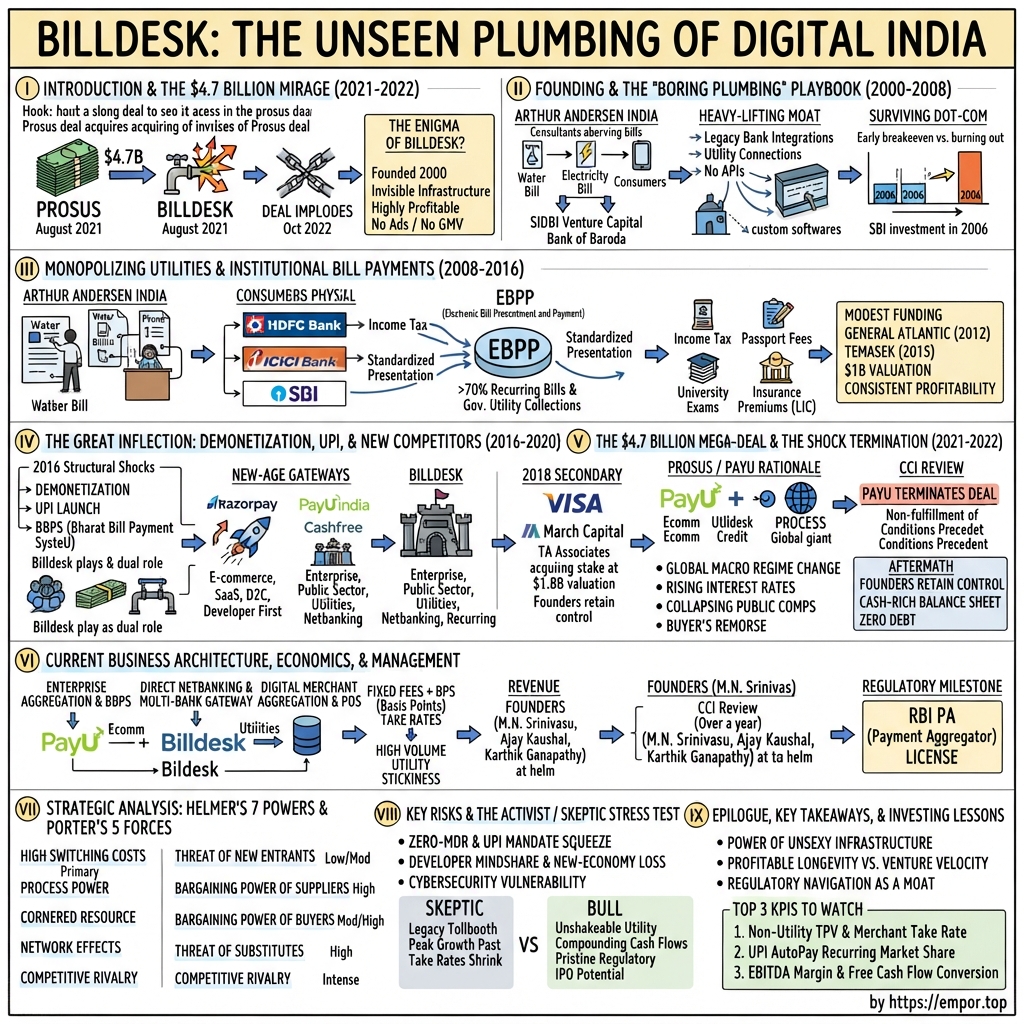
Billdesk: The Unseen Plumbing of Digital India
I. Introduction & The $4.7 Billion Mirage (00:00 – 12:00 / 12 mins)
On 31 August 2021, Prosus announced that its payments subsidiary, PayU, had agreed to acquire BillDesk from its shareholders for US$4.7 billion in cash.1 At the time, the deal stood as the second-largest internet acquisition in Indian corporate history, trailing only Walmart's takeover of Flipkart, and came at the peak of the global fintech valuation cycle.
Fourteen months later, on 3 October 2022, Prosus announced that "certain conditions precedent were not fulfilled by the 30 September 2022 long stop date, and the agreement has terminated automatically in accordance with its terms."2 The announcement gave no details on which conditions had lapsed. India's Competition Commission had already cleared the transaction on 5 September 2022.3 The buyer walked away in the twenty-five days between regulatory clearance and the contractual deadline.
The Hook
That abrupt reversal is the central point in any assessment of BillDesk, but not for the obvious reasons. The crucial metric is not the headline $4.7 billion figure, but what that valuation implied about the underlying fundamentals.
Secondary accounts of the transaction estimated that BillDesk handled roughly US$100 billion in annual total payment volume, generating approximately US$253 million in revenue and US$42 million in EBITDA at the time of the agreement.4 While these figures were never confirmed in an audited public filing and should be viewed as directional rather than definitive, they indicate that Prosus agreed to pay around eighteen times revenue and more than one hundred times EBITDA. That multiple was committed for a payments processor operating in a market where the dominant payment rail was systematically made free by regulatory mandate.
A transaction price reflects one buyer's willingness to pay at a specific moment, under particular financing conditions, and for specific strategic aims. The buyer's subsequent decision to let the agreement lapse offers strong evidence that the price had decoupled from intrinsic value.
The Enigma of BillDesk
BillDesk was founded in 2000 by M.N. Srinivasu, Ajay Kaushal, and Karthik Ganapathy, three colleagues from the Indian practice of Arthur Andersen.5 The underlying legal entity is IndiaIdeas.com Limited, with BillDesk operating as the commercial brand.5
For two decades, the company followed an understated operating model. It avoided consumer advertising campaigns and refrained from subsidizing gross merchandise volume. Instead, it developed backend software connectors between Indian banks and institutional billers—such as electricity distribution companies, telecom providers, insurers, mutual funds, tax authorities, and universities—collecting a fee for each transaction processed across its pipes.
By the time of the Prosus deal, BillDesk had operated profitably since roughly 2008 and was estimated to handle about 60% of India's online bill payment flows, with an estimated blended take rate near 0.3% of payment volume.4 These figures remain industry estimates; BillDesk has never issued a public annual report, hosted an earnings call, or registered a formal offering prospectus.
What this story is actually about
The common narrative portrays BillDesk as the quiet, profitable infrastructure builder that outlasted cash-burning venture competitors. While grounded in historical fact, that narrative is incomplete.
Public statutory filings reveal a business whose top-line growth peaked and subsequently contracted. Revenue from operations dropped from ₹2,678 crore in FY23 to ₹2,334 crore in FY24, a decline of approximately 12.8%, while profit after tax fell from ₹142 crore to ₹121 crore.6 By comparison, in FY21 the company posted revenue of ₹2,124 crore and net income of ₹245 crore.5 Over that three-year span, cumulative top-line growth was roughly 10%, while net profit fell by half.
This highlights the central tension: while BillDesk's deep operational integration into the institutional payment system remains durable, its underlying unit economics have faced sharp compression.
Episode roadmap and core themes
This analysis examines four central dimensions of the business.
First, how an enterprise B2B integration provider established formidable switching costs outside public view, and why those switching costs proved necessary but insufficient to protect its earnings profile.
Second, the evolution of Indian digital payment rails—progressing from bespoke netbanking integrations in the 2000s, through the Bharat Bill Payment System, to the Unified Payments Interface—and why government policy enforcing zero merchant discount rates on primary retail rails fundamentally reshaped the company's addressable economics.
Third, the mechanics behind the cancelled $4.7 billion buyout, evaluating what the buyer's internal diligence and subsequent retreat signaled once broader macroeconomic conditions shifted.
Fourth, the baseline valuation of the enterprise for prospective public-market investors. This requires decoupling private transaction benchmarks—$1 billion in 2015, $1.8 billion in 2018, and the $4.7 billion offer in 2021—from intrinsic valuation models based on revenue trajectory, margin sustainability, reinvestment demands, and tax structure. The divergence between these historical private marks and fundamental metrics forms the core underwriting challenge.
A note on data availability: BillDesk is examined here at an unlisted corporate lifecycle stage. It has filed no Draft Red Herring Prospectus, S-1, or equivalent registration statement. Consequently, share counts, liquidation preference structures, employee option pools, audited business segments, and formal management commentary are not publicly reported. The following analysis relies exclusively on corporate registry filings, counterparty statements, regulatory documentation, and verified reporting, noting where data gaps remain in the public record.
 Subscribe on LinkedIn
II. Founding & The "Boring Plumbing" Playbook (2000–2008) (12:00 – 30:00 / 18 mins)
In 1999, while the initial dot-com wave chased consumer web portals, e-commerce, and digital content, three Arthur Andersen consultants in Mumbai focused on a far more mundane friction point: how an Indian household paid its utility bills.
At the time, bill settlement meant standing in physical queues. Consumers handed cash or cheques across municipal or utility counters during restricted business hours, receiving a stamped paper receipt as their only proof of payment. Multiplied across hundreds of millions of recurring monthly obligations—electricity, water, landline telephone, insurance premiums, and property taxes—the systemic friction and operational drag on the economy were immense.
Founding IndiaIdeas.com Ltd. (2000)
When the founders incorporated the business as IndiaIdeas.com Limited in 2000,5 its earliest reported institutional backing came via a seed investment of roughly US$500,000 from SIDBI Venture Capital and Bank of Baroda.7 The nature of these early backers signaled the venture's strategic trajectory: rather than raising consumer-tech risk capital, it secured backing from a development finance institution and a state-owned commercial bank to construct foundational banking infrastructure.
The core thesis diverged sharply from prevailing internet business models. BillDesk opted not to spend capital building a consumer-facing brand. Instead, it positioned itself as invisible middleware—integrating directly into bank netbanking portals and institutional billing systems—and collected a fee on each cleared transaction.
While this approach appears logical in retrospect, at the turn of the century it meant deliberately bypassing the consumer internet hype cycle that attracted venture capital. High-profile consumer portals commanded speculative valuations; backend middleware did not.
The heavy-lifting moat
The infrastructure BillDesk built during its first decade was technically cumbersome rather than architecturally elegant. It assembled an extensive network of custom, point-to-point connections.
On the banking side sat Indian financial institutions operating on core banking platforms—such as Infosys Finacle, TCS BaNCS, and various legacy proprietary systems—none of which offered standardized application programming interfaces (APIs) or structured mechanisms for third-party debit initiation. On the institutional side sat billers: state electricity boards, municipal corporations, telecom operators, and insurance companies. Each counterparty maintained distinct database architectures, proprietary bill-identifier formats, unique settlement cycles, and varying error tolerances.
Bridging these disconnected silos required engineering bespoke software adapters for each bank and biller, followed by day-to-day operational management. Data files had to be formatted and exchanged at scheduled intervals, failed payments identified, matched, and reversed, and multi-party settlement balances reconciled to the exact rupee across disparate daily cut-off times.
This unglamorous backend plumbing generated substantial switching costs. Once a utility's collections infrastructure and a bank's netbanking interface were linked through a single intermediary—and once that intermediary had internalized a decade of operational edge cases and reconciliation exceptions—dislodging the vendor ceased to be a simple procurement choice and became an unacceptable operational risk.
This structural entrenchment explains how BillDesk protected its core volume against well-funded entrants for years. Yet this moat had a fundamental limit that proved critical over the long run: high switching costs protect transaction volume and customer retention, but they do not defend pricing power. A locked-in enterprise customer can still demand lower processing fees over time, and regulatory authorities can unilaterally reset interchange or processing rates across the entire system.
Surviving the dot-com crash
When the dot-com bubble collapsed in 2000–2001, most early internet startups folded. BillDesk survived by relying on transaction revenue rather than external equity financing. Collecting cash fees on commercial transaction flow and custom integration contracts enabled the company to achieve sustained profitability around 2008 and maintain it thereafter.4
During this formative phase, the company raised modest growth capital—including approximately US$7 million from Clearstone Venture Partners in 2006—while cementing distribution relationships across India's largest commercial banks.7
For institutional investors evaluating this operating history, BillDesk's formative era illustrates a distinct operational trade-off:
On one hand, achieving self-funding discipline early insulated the company from external capital cycles. BillDesk weathered the dot-com crash of 2001, the global financial crisis of 2008, and the 2022 fintech market downturn without facing existential liquidity risk.
On the other hand, an operating model honed exclusively for survival in a low-competition, legacy-banking environment calcified organizational habits. The attributes that ensured BillDesk's resilience in 2005—custom enterprise integrations, protracted institutional sales cycles, and minimal investment in modern developer tooling—eventually hindered its ability to capture the fast-moving merchant payment wave that emerged after 2015.
III. Monopolizing Utilities & Institutional Bill Payments (2008–2016) (30:00 – 48:00 / 18 mins)
Between 2008 and 2016, BillDesk entered its primary compounding phase, driven by a deliberate product strategy: capturing the bill presentment layer rather than merely processing payment transfers.
The rise of electronic bill presentment and payment
Online bill settlement involves two distinct workflows: payment routing and bill presentment. While initiating a fund transfer is relatively straightforward, presentment is technically complex. It requires querying the biller's database in real time for an outstanding balance tied to a specific consumer identifier, rendering that amount accurately within an interface, and transmitting immediate settlement confirmation back to the biller's ledger once paid.
BillDesk standardized this entire Electronic Bill Presentment and Payment (EBPP) cycle and embedded it directly within consumer netbanking portals. When retail customers of India's major commercial banks logged in to pay their monthly utility bills, the underlying fetch, display, payment, and reconciliation workflow was powered by BillDesk's white-labeled middleware.
Industry estimates placed the company's peak market share at approximately 50% to 60% of India's online bill payment volume, backed by a network of more than 20,000 connected billers.8 While derived from third-party aggregators rather than audited filings, this directional scale was later corroborated by regulatory filings during the Competition Commission of India's review of the proposed PayU transaction.
Expanding beyond utilities
From electricity and telecommunications, BillDesk expanded into structurally durable, high-friction institutional payment flows: direct tax challans, passport and visa fees, university examination charges, mutual fund subscriptions, and insurance premium collections for state and private underwriters.
These institutional verticals shared three defining economic attributes:
First, high ticket sizes. Direct tax payments and mutual fund allocations carried transaction values substantially higher than standard retail e-commerce checkouts, allowing BillDesk to sustain fixed per-transaction processing fees rather than relying purely on thin ad valorem basis points.
Second, non-discretionary volume. Obligations such as income taxes, electricity bills, and insurance premiums must be settled regardless of macroeconomic cycles, insulating transaction throughput from consumer discretionary spending trends.
Third, institutional procurement barriers. Contracts were awarded through formal, multi-year institutional tenders by government departments, public utilities, and regulated financial entities with rigorous compliance, security, and uptime mandates that early-stage competitors could not satisfy.
In aggregate, these characteristics created an economic profile that mirrored recurring subscription revenue, despite each payment technically executing as an episodic transaction. Consumers repeatedly paid the same institutions through the same banking rails every billing cycle, locking in predictable, long-term processing volumes.
Financial profile and capital discipline
Throughout this expansion, BillDesk maintained unusual capital efficiency. Following its initial seed funding and the 2006 Clearstone investment, TA Associates acquired a minority stake around 2011–2012, followed in 2015–2016 by a reported US$200 million investment from General Atlantic and Temasek at a headline valuation of approximately US$1 billion.7
This transaction represents the first of three major private valuation benchmarks in BillDesk's corporate history.
A US$200 million commitment against a US$1 billion post-money valuation mathematically implied a 20% equity stake. However, the exact capital structure remained private. Public records do not disclose the split between primary capital injected into the balance sheet and secondary liquidity provided to early shareholders. Nor did disclosures clarify whether the investors acquired ordinary shares or convertible preferred instruments equipped with liquidation preferences, participation rights, anti-dilution provisions, or governance vetos.
These contractual terms fundamentally dictate economic value. If late-stage investors held a standard 1x non-participating preference, the headline figure approximates true equity value in any successful exit scenario. If structured with participating preferences or valuation ratchets, the true common-equity value at the time would have been materially lower than the headline $1 billion mark. Without access to the underlying shareholder agreements, that headline valuation must be treated as directional rather than an exact measure of common-equity value.
Operationally, the business demonstrated sustained capital efficiency. BillDesk expanded profitably while consuming minimal equity capital. Payment middleware of this nature requires limited capital expenditure outside software development, enterprise integration maintenance, server infrastructure, and temporary settlement float. Return on equity remained exceptionally high during this era, driven by a lean equity base—a testament to operational discipline, though one that becomes progressively harder to sustain as the balance sheet expands.
IV. The Great Inflection: Demonetization, UPI, & New Competitors (2016–2020) (48:00 – 1:10:00 / 22 mins)
The structural shifts that reshaped BillDesk's economic model after 2020 were set in motion during an eighteen-month window between April 2016 and late 2017.
The structural shocks of 2016
In April 2016, the National Payments Corporation of India (NPCI) launched the Unified Payments Interface (UPI). Seven months later, in November 2016, the Indian government abruptly demonetised 86% of the country's currency by value. Around the same time, the Reserve Bank of India conceptualized the Bharat Bill Payment System (BBPS), rolling it out as a standardized, interoperable network for recurring bill payments.
While market observers initially viewed each development as an unalloyed tailwind for digital payments volume, the ultimate impact on an intermediary's revenue per transaction proved far more complex.
UPI was the most consequential. It provided India with a real-time, mobile-first, bank-to-bank rail built around a unified addressing architecture. Engineered for rapid scale, UPI expanded dramatically: by July 2026, the network processed 23.66 billion transactions worth ₹29.88 lakh crore in a single month—up roughly 22% year-on-year by volume, or an average of 763 million transactions per day.9
Yet the pivotal disruption was economic rather than technical. UPI was mandated as free at the point of use for consumers, while policymakers codified a zero merchant discount rate (MDR) on person-to-merchant transactions into law. An entire class of electronic payments that historically generated ad valorem processing fees was converted, by statute, into an unpriced public rail.
BBPS introduced an analogous structural shift to the utility and recurring bill payment vertical. By centralizing biller-to-bank connections under a shared utility managed by NPCI Bharat BillPay, it converted bespoke, proprietary integrations into an open network accessible to any authorized operating unit. While BillDesk participated as a Bharat Bill Payment Operating Unit, it no longer held exclusive control over the underlying billing pipes.
This transition illustrates the vulnerability of an infrastructure incumbent facing public standardization. BillDesk's historical moat relied on the high friction of maintaining point-to-point connections across hundreds of disparate billers. BBPS simplified that connectivity into a standard network onboarding process. Although legacy direct integrations, high-touch settlement operations, and institutional relationships endured, the asset's replacement cost fell sharply—and replacement cost fundamentally anchors commercial pricing power.
The rise of modern payment gateways
Concurrently, a new generation of merchant aggregators emerged to capture retail digital commerce.
Competitors such as Razorpay, Cashfree, Instamojo, and a revitalized PayU India targeted a demographic BillDesk had largely bypassed: software developers and venture-backed startups seeking immediate payment integration. Their core offering centered on comprehensive developer documentation, instant sandbox access, modern management dashboards, and merchant onboarding cycles measured in hours rather than quarters.
The magnitude of the market share ceded by BillDesk is evident in comparative top-line performance. Razorpay posted operating revenue of ₹3,783 crore in FY25, reflecting a 65% year-on-year increase.10 In contrast, BillDesk reported FY24 operating revenue of ₹2,334 crore amid a contracting trajectory.6 A competitor founded fifteen years later surpassed the incumbent in total revenue while expanding at an accelerated pace.
The strategic bifurcation
By 2020, India's merchant payments landscape had split into two distinct segments.
Modern payment gateways captured digital-native checkouts, direct-to-consumer brands, software-as-a-service billing, and online marketplaces—verticals where developers drove procurement. Although these fast-growing categories operated on thin or negative margins—Cashfree, for example, recorded ₹640 crore in FY25 operating revenue alongside a net loss of ₹154 crore11—they secured the vast majority of incremental transaction volume.
Conversely, BillDesk retained its dominance across legacy enterprise accounts, public-sector undertakings, municipal utilities, recurring insurance premiums, direct tax settlements, and core netbanking pipes. These verticals delivered consistent profitability, but lacked top-line expansion.
This divergence reflected a structural realignment rather than technological displacement on BillDesk's core terrain. While BillDesk preserved its operational reputation for executing complex, high-value institutional settlements, it remained largely detached from the digital economy's highest-velocity growth channels, thereby surrendering compounding volume.
The 2018 secondary liquidity event
In November 2018, Visa acquired a minority interest in BillDesk. Contemporaneous reporting valued the overall transaction at approximately US$300 million—comprising roughly US$200 million in primary capital and US$80 million to US$100 million in secondary share purchases from existing holders—at an implied corporate valuation of US$1.8 billion.1213
This benchmark warrants careful analytical context rather than straightforward extrapolation.
First, approximately one-third of the capital represented secondary share repurchases from founders and early backers. A transaction driven significantly by secondary liquidity reflects the price at which selling shareholders are willing to exit, offering distinct valuation signals compared to a purely growth-focused primary capitalization.
Second, the capital originated from a strategic corporate buyer rather than a pure-play financial investor. Visa's investment in a domestic Indian processor—at a time when UPI was increasingly displacing card rails—reflected strategic positioning, distribution access, and defensive optionality that private financial underwriters might not support on stand-alone unit economics. Consequently, strategic marks serve as less reliable proxies for standalone enterprise value than competitive institutional financing rounds.
Third, the governing security class remains undisclosed. Public disclosures do not detail whether Visa received common equity or preferred instruments equipped with special governance rights, liquidation preferences, rights of first refusal, or co-sale provisions—contractual terms that materially shape the economic rights of prospective public-market equity holders.
Third-party compilations of BillDesk's cap table estimated shareholdings at approximately 14.2% for General Atlantic, 12.6% for Visa, 10.9% for Srinivasu, 10.2% for Kaushal, 8.5% each for Ganapathy and Temasek, 5.4% for March Capital, and 3.9% allocated to an employee stock ownership plan.8 Derived from aggregator databases synthesizing registry records and media reporting, these figures provide useful directional context regarding ownership distribution, though they do not constitute an audited capitalization table.
V. The $4.7 Billion Mega-Deal & The Shock Termination (2021–2022) (1:10:00 – 1:35:00 / 25 mins)
By mid-2021, global capital had pushed payments infrastructure valuations to historical peaks. Adyen traded at extraordinary multiples of net revenue, Stripe carried a $95 billion private mark, and Block agreed to acquire Afterpay for $29 billion. Within that environment, Prosus made its move.
The Prosus / PayU rationale
On paper, the strategic logic was straightforward. PayU India maintained strength in digital-native merchant checkout and consumer credit, whereas BillDesk dominated recurring bill settlement, netbanking integrations, and institutional collections. A combined entity was projected to process total payment volume of approximately US$147 billion across four billion transactions annually—roughly quadruple PayU's standalone Indian volume at the time.1
Prosus highlighted fintech as a core operating segment and identified India as its primary investment destination, with the transaction pushing the group's cumulative Indian capital commitments beyond US$10 billion.1 Srinivasu publicly framed the acquisition as external validation of the long-term scale of India's digital payments opportunity.1
What the price implied
Stripped of strategic rhetoric, the underlying transaction arithmetic was aggressive. Against the target's estimated financial baseline—roughly US$253 million in revenue and US$42 million in EBITDA4—the US$4.7 billion headline price represented approximately 18.6 times revenue and 112 times EBITDA. Because the transaction structure and the target's cash and debt balances at closing were never publicly disclosed, these multiples reflect equity-purchase-price ratios rather than enterprise value benchmarks, precluding direct comparison with listed payment processor multiples.
Even with that structural caveat, underwriting such a valuation required an aggressive set of forward operating assumptions: sustained double-digit revenue growth, meaningful expansion beyond a mid-teens EBITDA margin, and regulatory stability around transaction pricing. While low interest rates made those assumptions financeable in 2021, shifting macroeconomic and regulatory conditions quickly undermined all three within twelve months.
The regulatory gauntlet
Regulatory scrutiny delayed execution. The Competition Commission of India scrutinized the transaction, issuing a show-cause notice in late July 2022 regarding potential adverse effects on competition and questioning whether a Phase II investigation was warranted.14
The antitrust review focused on market concentration across online payment aggregation and gateway services. Market share data submitted during the review placed PayU at 15% to 20% and BillDesk at 20% to 25% of the relevant market, pointing to a combined entity controlling 35% to 45% of processing flows.14 Although the CCI ultimately granted unconditional clearance on 5 September 2022—making it the largest fintech transaction approved by the regulator3—the approval arrived after a thirteen-month review. That protracted timeline coincided with an abrupt global repricing of growth assets.
The October 2022 implosion
Between the August 2021 signing and the 30 September 2022 long-stop date, market fundamentals shifted. Global central banks raised benchmark rates, public fintech multiples compressed, and Prosus's own share price and net asset value declined.
On 3 October 2022, Prosus announced that the agreement had terminated automatically because certain conditions precedent were not satisfied prior to the long-stop deadline.2 The announcement did not specify which conditions had lapsed. Contemporaneous reporting indicated the sudden termination surprised both BillDesk's founders and its institutional backers.15
From an investment perspective, two distinct interpretations emerge:
The narrow contractual view mirrors Prosus's public statement: specified conditions precedent were not satisfied before the long-stop date, causing the agreement to lapse under its own terms.
The broader commercial view considers the buyer's incentives. A strategic acquirer with continuous diligence access throughout a twelve-month market downturn chose not to extend the contractual deadline for an asset valued at eighteen times revenue. Extending long-stop dates is standard corporate practice when both counterparties remain committed to a transaction; allowing a deadline to expire indicates a shift in capital allocation priorities.
Neither interpretation can be definitively confirmed from the public record. The acquisition agreement was never made public, and no subsequent litigation surfaced to clarify which conditions lapsed. That lack of disclosure represents a key diligence item for prospective public-market underwriters, who would require formal clarification on whether post-termination claims were waived, settled, or remain outstanding.
The aftermath
In the wake of the termination, BillDesk's ownership structure remained unchanged. The founders and institutional shareholders retained their equity, and the company continued independent operations. By FY24, the balance sheet recorded ₹930 crore in cash and bank balances alongside no material disclosed borrowings.6
This balance-sheet liquidity underscores the company's baseline operational stability. Absorbing the cancellation of a $4.7 billion buyout without raising emergency capital, executing deep headcount reductions, or initiating distressed asset sales indicates structural durability. Headcount remained stable near 800 employees.16
However, statutory filings during this period also reveal weakening earnings power. In FY21, prior to the transaction announcement, BillDesk generated ₹245 crore in net profit on ₹2,124 crore in revenue, representing an 11.5% net margin.5 By FY24, net profit had fallen to ₹121 crore on ₹2,334 crore in revenue, compressing the net margin to 5.2%.6 Over that three-year period, top-line revenue expanded by roughly 10% while net profit declined by half.
Whatever specific closing conditions lapsed, the operational trajectory reflected in the company's statutory filings did not support an expanding enterprise valuation.
Capital structure: what can and cannot be established
Evaluating BillDesk's intrinsic valuation requires distinguishing verifiable balance-sheet items from unconfirmed private-company structures:
- Share count: The total issued share count across distinct share classes is not publicly disclosed, preventing precise per-share calculations.
- Share class distinctions: Public filings do not indicate whether holdings held by General Atlantic, Temasek, TA Associates, March Capital, and Visa consist of ordinary equity or preferred instruments, nor do they clarify conversion ratios.
- Liquidation preferences: Terms governing liquidation seniority, participation rights, and accrued dividend preferences among successive investment rounds are private. Across roughly $500 million in cumulative reported capital infusions, standard institutional preferences would take seniority over common equity in an exit.
- Anti-dilution protections: The presence of full-ratchet or broad-based weighted-average anti-dilution mechanisms across historical funding rounds is undisclosed, which directly affects potential founder and common-shareholder dilution in a down-round or lower-valuation listing.
- Employee equity pool: While an employee stock ownership plan of roughly 3.9% is cited in third-party cap-table compilations,8 the underlying vesting schedules, strike prices, and split between issued and unallocated options remain unverified.
- Convertible instruments: The existence of outstanding convertible notes, warrants, or Simple Agreements for Future Equity is not documented in available corporate registry records.
- Governance and voting rights: Board voting thresholds, minority veto powers, related-party transaction oversight, and executive remuneration packages remain undisclosed.
- Gross obligations: While cash and liquid bank balances of ₹930 crore are established,6 gross debt, working-capital lines, and long-term lease liabilities are not broken out in standard public filings.
Consequently, an exact enterprise-value bridge cannot be constructed from public disclosures alone. Cash balances are documented, but offsetting debt-like obligations and primary capital requirements remain undefined. The valuation framework that follows therefore models equity value on a whole-company basis, benchmarked against comparable equity-level market metrics.
This analytical separation is critical: comparing an unlisted entity's implied equity valuation directly to listed enterprise-value multiples creates an inconsistent baseline. These disclosure gaps highlight the specific data points that a formal Draft Red Herring Prospectus would be required to establish.
VI. Current Business Architecture, Economics, & Management (1:35:00 – 1:55:00 / 20 mins)
Four years after the Prosus transaction collapsed, BillDesk in August 2026 presents an altered operational profile: operating across the same foundational rails, but with compressed unit economics and an evolving corporate strategy.
Core segments and revenue mechanics
The business generates revenue across three primary operating channels:
Enterprise bill aggregation and BBPS. Operating as a Bharat Bill Payment Operating Unit, BillDesk links institutional billers with consumer-facing payment channels across the NPCI-administered network, collecting fixed processing fees and basis-point commissions on recurring utility, telecommunication, and insurance collections. The broader network context reflects substantial scale: Bharat Connect processed approximately 3.05 billion payments valued at roughly ₹14.84 trillion during calendar year 2025 across more than 25 categories and 22,000 billers.17 Within that ecosystem, BillDesk functions as one operating unit among numerous competing intermediaries.
Direct netbanking and multi-bank gateway services. BillDesk earns processing fees on high-value, mission-critical institutional transactions, including direct tax payments, mutual fund allocations, insurance premium remittances, and public-sector collections. This constitutes the company's highest-quality revenue stream, characterized by elevated ticket sizes, low price elasticity, deep enterprise integration, and historical fixed per-transaction fee structures rather than purely ad valorem rates.
Merchant aggregation and offline acquiring. The company provides online payment aggregation across more than 150 payment methods for commercial merchants,18 operating under formal Reserve Bank of India authorization, alongside newly acquired physical acquiring infrastructure.
The Worldline acquisition: a strategy change worth taking seriously
On 25 February 2026, European payments group Worldline announced the sale of its Indian payment activities to BillDesk for an equity value of approximately €60 million and an enterprise value of approximately €37 million, covering operations that contributed roughly €90 million in annual revenue and €8 million in adjusted EBITDA to Worldline.19 Worldline confirmed the transaction's completion on 3 August 2026.20 Indian media reporting placed Worldline India's standalone FY25 revenue at ₹694 crore alongside a net loss of ₹22.5 crore.6
This transaction provides three critical operational insights:
First, valuation discipline. An enterprise value of roughly €37 million against approximately €90 million in revenue and €8 million in adjusted EBITDA reflects transaction multiples of approximately 0.4 times revenue and under five times EBITDA. This distressed-adjacent multiple demonstrates what an arm's-length, competitive bidding process yielded for a licensed Indian payments enterprise with physical acquiring infrastructure in 2026—a stark departure from the eighteen-times-revenue multiple agreed upon in 2021.
Second, strategic diversification. Historically, BillDesk operated exclusively as an online processor. The Worldline India acquisition adds point-of-sale hardware, QR code acceptance networks, and physical merchant acquiring, marking BillDesk's entry into offline payment acceptance and its first major corporate acquisition. The transaction also includes a long-term technology and software licensing agreement under which BillDesk will continue utilizing Worldline's core processing software.19
Third, managerial capital allocation. A company confident that its core online bill-payment franchise would sustain compounding growth would rarely deploy capital into capital-intensive offline acquiring at market lows. While the transaction represents a pragmatic use of the company's ₹930 crore cash balance—securing distribution assets at a low entry multiple—it also reflects an implicit acknowledgment that organic expansion across its legacy online bill-payment base had stalled.
Financial performance: what the numbers actually show
The statutory financial record diverges meaningfully from the narrative of an uninterrupted compounding engine.
Operating revenue fell from ₹2,678 crore in FY23 to ₹2,334 crore in FY24, representing a year-on-year contraction of approximately 12.8%.6 On a total-income basis, registry filings compiled by Inc42 show revenue declining from ₹2,765.4 crore to ₹2,446.2 crore, yielding FY24 EBITDA of ₹225.7 crore and profit after tax of ₹121.2 crore.16
That FY24 EBITDA performance translates to an operating margin of approximately 9.2% on total income, while net profit after tax reflects a net margin of roughly 5.0%. Compared to FY21—when the business recorded ₹2,124 crore in revenue and ₹245 crore in net income, delivering an 11.5% net margin5—the five-year trend demonstrates stagnant top-line expansion alongside a halved net margin profile. Public filings do not support assertions of sustained 20%-plus operating profitability.
A necessary caveat on the revenue line
A critical accounting consideration affects the interpretation of these operating multiples.
Public disclosures do not establish whether BillDesk reports revenue on a gross or net basis relative to interchange fees and network processing costs paid out to partner banks. Given an estimated blended take rate of roughly 0.3% of total payment volume,4 the reported top line resembles a gross transaction fee model, where substantial pass-through expenses are recognized within operating costs. If presented on a gross basis, BillDesk's revenue multiple cannot be directly compared to peers reporting on a net revenue basis.
An EBITDA margin near 9% on ₹2,400 crore of total income is consistent with a gross accounting convention. Without an audited segment-level cost-of-service breakdown, this structural distinction remains unresolved, representing an essential diligence requirement for institutional underwriters.
FY25 and FY26: the most important missing data
As of 18 August 2026, BillDesk's most recent publicly accessible financial disclosures correspond to FY24; statutory filings for FY25 and FY26 have not yet appeared in corporate registry databases.6 For an unlisted enterprise whose last disclosed fiscal years reflected contracting top-line revenue and margin compression—and which subsequently closed a cross-border acquisition—this constitutes a significant analytical limitation.
Consequently, forward-looking valuation models must rely on extrapolating FY24 actuals under stated operating assumptions rather than verified recent performance.
Leadership and governance
Co-founder M.N. Srinivasu serves as board chairman and the company's primary external representative, describing the Worldline transaction as "a forward-looking investment in India's payments ecosystem."21 Srinivasu was also elected chairman of the Internet and Mobile Association of India for the 2025–2027 term.8
Regarding the cancelled Prosus transaction, Srinivasu noted publicly that the founders had initially explored an initial public offering before engaging with Prosus, ultimately accepting the acquisition offer to secure growth capital and provide "the right exit for shareholders who have been there for long."22 This statement offers direct acknowledgment that early institutional liquidity drove transaction timing.
Evaluating corporate governance based on observable actions reveals both operational strengths and governance gaps:
Operationally, the management team has maintained twenty-six years of continuous execution, preserving profitability through three market downturns since 20084 while raising less than $1 billion in total external capital. The company avoided aggressive customer-acquisition subsidies and growth-at-any-cost strategies common across the fintech sector, while retaining balance-sheet resilience through the termination of the 2021 buyout.
Conversely, formal governance disclosures remain sparse. Public filings do not detail board committee independence, executive remuneration structures, equity incentive vesting terms, related-party transactions, or the current operational responsibilities of co-founders Ajay Kaushal and Karthik Ganapathy. Furthermore, executive leadership has not publicly addressed the FY23–FY24 top-line contraction or multi-year margin compression through investor communications or formal strategic disclosures beyond the Worldline transaction.
While standard for closely held private companies, this lack of disclosure would require comprehensive resolution in a public listing context.
Regulatory standing
BillDesk's regulatory positioning represents an established structural barrier to entry.
IndiaIdeas.com Limited holds formal authorization on the Reserve Bank of India's registry of permitted online payment aggregators, published in February 2023 under the central bank's March 2020 regulatory framework.232425 In July 2024, the company secured authorization as a cross-border payment aggregator covering both export and import trade flows, representing one of the initial cohort of recipients.26 By January 2026, the RBI had authorized 19 entities under the cross-border framework.26
The regulatory framework mandates a minimum net worth of ₹15 crore at initial application, increasing to ₹25 crore following March 2026, along with Financial Intelligence Unit registration, mandatory escrow mechanisms, cybersecurity audits, and governance standards.26 While easily satisfied by BillDesk's ₹930 crore liquid balance sheet, these capital and compliance hurdles impose substantial friction on prospective entrants, reinforcing institutional incumbency.
VII. Strategic Analysis: Helmer’s 7 Powers & Porter’s Five Forces (1:55:00 – 2:12:00 / 17 mins)
Strategy frameworks are valuable only when they explain empirical financial performance rather than substitute for it. In BillDesk's case, the central question these frameworks must resolve is how an enterprise possessing deep structural moats saw its net margin compress from roughly 11.5% to approximately 5% across a three-year period.56
Switching costs: real, and mispriced by their owner
Switching costs represent BillDesk's primary structural power, demonstrable through observed operational behavior rather than corporate claims. Enterprise integration timelines span eight to twelve weeks from initial technical engagement to live transaction processing, with no self-serve onboarding.18 What is operationally demanding to deploy is equally hazardous to displace.
For a state distribution utility or a public-sector bank, replacing the incumbent intermediary requires re-architecting bill identifiers, rewriting reconciliation logic, validating custom settlement batch files, and accepting elevated failure risks on payment flows that citizens depend upon daily. Institutional counterparties rarely migrate critical payment plumbing simply to shave a few basis points.
Yet the preceding five years highlighted a vital economic asymmetry: switching costs make transaction volume difficult to lose, but they do not prevent processing fees from being renegotiated downward. A locked-in customer who cannot easily defect can still exert significant pricing pressure at contract renewal—particularly during competitive tenders where modern payment aggregators quote aggressively lower processing rates.
This asymmetry provides the most direct explanation for BillDesk's financial trajectory: customer retention remained high and processing volumes endured, but realization per transaction contracted. The enterprise retained the accounts, but surrendered unit pricing.
Process power: strong, and the most durable thing here
Process power, in Hamilton Helmer's framework, represents an operational advantage embedded directly within company workflows that competitors cannot easily replicate because it accumulates through protracted operational experience.
BillDesk's process power is fundamentally operational: two-and-a-half decades spent resolving reconciliation exceptions, managing chargeback and dispute workflows across dozens of banks, translating institution-specific batch settlement formats, and maintaining high uptime on critical payment rails where a brief outage during a direct-tax deadline becomes a national headline. The platform processes a reported ~150 million API requests daily.8
This operational capability represents the company's least visible yet most durable asset. Crucially, however, process power cannot readily command a pricing premium in enterprise payment processing. Enterprise clients reward operational reliability with account longevity rather than higher fee tolerances. Process power effectively defends the installed volume base, but does not expand operating margins.
Cornered resource: moderate, and eroding at the edges
Decades-long relationships with public-sector banks, state utilities, and government departments represent tangible enterprise assets that newer competitors cannot easily replicate in short order.
However, these institutional relationships are structurally less exclusive than in prior decades. The rollout of BBPS standardized biller onboarding onto a unified central network, allowing any authorized operating unit to establish connectivity.17 Competitors such as Razorpay actively publish technical guides facilitating government and utility BBPS integration.27 What previously functioned as a relationship monopoly has evolved into a relational incumbency advantage inside contestable public procurement tenders.
Network effects: present but attenuated
The traditional two-sided payment network effect—where billers integrate where consumers bank, and banks connect where billers aggregate—served as BillDesk's primary growth engine prior to 2016. That network effect has since been substantially diluted by public policy.
BBPS now serves as the central network layer. Operated by NPCI Bharat BillPay, the system spans more than 25 categories and over 22,000 billers.17 When a public utility assumes ownership of the network layer, a private intermediary that historically operated as the network is relegated to an authorized participant within it. BillDesk's high concentration of billers within BBPS constitutes an advantageous volume share, but no longer functions as a proprietary network moat.
Scale economies and counter-positioning: largely absent
Neither scale economies nor counter-positioning provides BillDesk with a sustainable structural edge. While payment processing entails fixed expenditures in security, compliance, and infrastructure, BillDesk's FY24 operating performance—generating an EBITDA margin of roughly 9% on total income16—does not demonstrate the margin expansion characteristic of a classic scale-cost advantage.
Conversely, counter-positioning favored newer entrants: venture-backed platforms like Razorpay and Cashfree adopted developer-centric, self-serve, low-touch distribution models that BillDesk could not replicate without cannibalizing its high-touch enterprise sales organization.
Porter's five forces, read through the economics
Threat of new entrants: low to moderate, and lower than it was. The RBI's regulatory regime imposes meaningful structural barriers, including mandatory payment aggregator authorization, a minimum net worth of ₹15 crore scaling to ₹25 crore after March 2026, Financial Intelligence Unit registration, escrow account governance, and cybersecurity audits.2624 While these mandates deter informal operators, they have not prevented well-capitalized competition: 54 entities received permission to operate as online payment aggregators on the February 2023 regulatory list, and 19 held cross-border authorization as of January 2026.2326 A regulatory hurdle that dozens of well-funded competitors successfully navigate filters out undercapitalized startups, but does not protect against institutional capital.
Bargaining power of suppliers: high. Commercial banks and card networks dictate the underlying unit economics of the payment rails BillDesk resells. In netbanking, commercial banks control the account relationship and access terms; in card acquiring, interchange rates are established upstream by networks; and in UPI, the NPCI and government authorities set transaction pricing by regulatory fiat. An intermediary dependent on upstream entities for its core input costs operates with structurally capped gross margins.
Bargaining power of buyers: moderate to high, and rising. Public-sector undertakings and government entities award processing contracts through competitive multi-vendor bidding. Enterprise merchants continuously benchmark acquiring costs. Reported commercial rates range from ₹1 to ₹15 per bill payment transaction and 1.5% to 2.5% on online checkout,18 with standard checkout flows facing steady commoditization.
Threat of substitutes: high, and this is the binding constraint. UPI AutoPay enables institutional billers to establish recurring debit mandates directly against customer bank accounts, while NPCI's consumer-facing interfaces diminish the necessity of proprietary third-party presentment layers. In this segment, the primary substitute is not an alternative private vendor, but public financial infrastructure provided at zero merchant discount rate.
Competitive rivalry: intense. The competitive arena features well-capitalized players spanning distinct segments: Razorpay generated ₹3,783 crore in FY25 operating revenue with 65% year-on-year growth,10 PayU India reached US$781 million in FY26 revenue alongside its first operating profit,28 while Cashfree, Pine Labs, Infibeam Avenues' CCAvenue, Juspay in payment orchestration, and Paytm maintain active market presence.
Synthesizing these strategic frameworks points to a consistent economic conclusion: BillDesk's primary moats are fundamentally defensive, serving to protect its installed processing volume, while external competitive and regulatory forces exert downward pressure on realization rates. This dynamic explains the company's statutory financial trajectory: durable transaction volumes paired with compressing operating profitability.
VIII. Key Risks & The Activist / Skeptic Stress Test (2:12:00 – 2:25:00 / 13 mins)
On 4 August 2026, the Indian government introduced the Taxation and Other Laws (Amendment) Bill in the Lok Sabha, amending Section 10A of the Payment and Settlement Systems Act, 2007—the statutory provision that had prohibited merchant discount rates (MDR) on UPI and RuPay debit transactions since 2020.29 Parliament passed the bill, legally permitting transaction fees on India's dominant payment rail for the first time in six years.
That single legislative change represents the most significant variable shaping BillDesk's forward operating outlook. However, enabling legislation does not yet constitute operational revenue.
The zero-MDR squeeze and the potential policy reversal
The operating environment of the preceding six years compressed intermediary unit economics. Under the zero-MDR mandate, person-to-merchant UPI transactions carried no commercial processing fees. While government subsidy schemes offered partial offset—providing a 0.15% incentive on transactions up to ₹2,000 with zero compensation above that threshold30—the Parliamentary Standing Committee on Finance reported in March 2026 that cumulative budgetary support of roughly ₹8,730 crore from FY22 to FY25 had covered only about 11% of aggregate industry operating costs, deeming the subsidised model unsustainable.31
Meanwhile, payment volume shifted decisively toward unpriced rails. By July 2026, UPI processed 23.66 billion monthly transactions, expanding 22% year-on-year.9 As UPI transactions substituted for netbanking debits and commercial card payments, high-margin, priced processing flows were steadily replaced by unpriced public volume.
The 2026 statutory amendment creates the legal framework for pricing restoration. Industry discussions indicate that MDR may apply only above specific annual merchant turnover thresholds—such as ₹50 crore or ₹1 crore to ₹1.5 crore—while peer-to-peer transfers and retail consumers remain uncharged, with commercial rates set substantially below traditional credit card fees.3129
Crucially, while the statutory authority has been enacted, formal administrative notifications have not yet been issued. Specific fee schedules, merchant turnover exemptions, implementation timelines, and revenue-sharing splits among acquiring banks, network operators, and payment aggregators remain unnotified. Prospective underwriters can assign probabilistic value to this policy shift, but it cannot yet be underwritten as recurring contractual cash flow.
NPCI disintermediation and platform risk
A structural operational risk centers on the central network operator expanding up the technology stack. The National Payments Corporation of India already manages centralized biller onboarding through BBPS and provides recurring debit infrastructure directly via UPI AutoPay. Each functional expansion reduces the middleware surface area that requires a private commercial intermediary. Because NPCI operates as an industry utility rather than a profit-maximizing enterprise, it has no mandate to preserve aggregator margins.
Erosion of new-economy market share
BillDesk's minimal penetration among digital-native merchants represents an established operational reality. The company's enterprise-led sales cycles, lack of self-serve onboarding, and eight-to-twelve-week deployment timelines18 remain incompatible with venture-backed startups, software-as-a-service platforms, and direct-to-consumer brands requiring same-day sandbox integration.
The cross-border payment aggregator authorization secured in July 202426 represents a targeted strategic effort to access high-take-rate export collections for Indian software and cross-border merchants. However, this vertical remains early in deployment, unverified at scale within disclosed financial statements, and contested by established processors including Cashfree, Adyen, Amazon Pay, and seventeen other authorized peers.26
Customer concentration and operational resilience
BillDesk's revenue base remains concentrated among large institutional counterparties: major commercial banks, state electricity boards, municipal utilities, insurance underwriters, and government departments. The exact share of revenue generated by top-ten clients is not publicly reported—a critical disclosure item that a formal listing prospectus would need to quantify to assess contract renewal exposure.
Operational resilience represents an analogous diligence requirement. Operating as core settlement plumbing for sovereign direct-tax collections and state utility payments concentrates systemic risk. While no major security breach or platform outage appears in the public record, an unlisted company operates without mandatory public incident disclosure obligations.
Valuation: grounding expectations in operational evidence
Without a registered Draft Red Herring Prospectus, formal price band, or institutional bookbuild, any public listing figure represents market speculation. Assessing baseline valuation requires bounding equity value through established operating actuals and comparable metrics.
Intrinsic valuation framework. Baseline figures begin with FY24 statutory results: operating revenue of ₹2,334 crore, EBITDA of ₹225.7 crore on total income, net profit of ₹121.2 crore, and ₹930 crore in cash and liquid balances.616 Incorporating the Worldline India acquisition—completed in August 2026 for approximately €60 million in equity value, adding roughly €90 million in revenue and €8 million in adjusted EBITDA1920—yields a pro-forma revenue baseline near ₹3,100 crore to ₹3,300 crore and EBITDA near ₹300 crore, alongside cash reduced by the purchase consideration.
Under a base-case scenario where pro-forma revenue compounds at mid-single-digit rates through FY30 (reaching roughly ₹3,750 crore) and EBITDA margins recover moderately to 11% to 12% (yielding approximately ₹430 crore in EBITDA and ₹305 crore in EBIT), applying India's 25.17% corporate tax rate yields net operating profit after tax near ₹230 crore. Because capital expenditure requirements in software middleware remain low, free cash flow closely tracks net operating profit. Capitalizing this cash flow at 12 to 14 times, discounting back over four years at an estimated 13.5% cost of equity, and adding interim free cash generation and surplus net cash yields an implied whole-company equity valuation range of ₹2,500 crore to ₹3,200 crore.
Under a bear-case scenario featuring continued take-rate erosion, low-single-digit revenue contraction, and operating margins stabilizing near 7%, implied equity value compresses toward ₹1,300 crore to ₹1,800 crore.
Conversely, a bull-case scenario—predicated on notified UPI MDR above commercial thresholds, scaling cross-border volumes, and net profit margins recovering toward FY21 levels (~11.5%) on a ₹3,200 crore revenue base—generates net profit near ₹370 crore. Capitalized at 22 to 25 times earnings, this scenario yields an equity valuation of ₹8,000 crore to ₹9,000 crore.
Sensitivity modeling demonstrates that valuation is predominantly driven by operating margin sustainability rather than top-line growth: a 300-basis-point swing in EBITDA margin exerts greater impact on enterprise equity value than a 200-basis-point variation in revenue expansion. Crucially, the primary driver of that margin swing remains upstream regulatory policy.
Comparable peer analysis. Peer multiples must account for divergent accounting standards across Indian payment processors:
Pine Labs serves as the primary domestic listed comparable. The company listed on 14 November 2025 at ₹221 per share, representing a market capitalization near ₹32,000 crore.32 By mid-August 2026, Pine Labs traded near ₹162 with an equity market capitalization of approximately ₹18,675 crore, on trailing twelve-month revenue of ₹2,832 crore and net profit of ₹127 crore—implying multiples of roughly 6.6 times sales and 144 times trailing earnings.33 Pine Labs generated 20% year-on-year revenue growth in the June 2026 quarter alongside an adjusted EBITDA margin of 17.1%.34
AvenuesAI (formerly Infibeam Avenues, operator of CCAvenue) provides an established secondary listed peer, carrying a market capitalization near ₹5,260 crore on trailing revenue of ₹9,516 crore and net profit of ₹321 crore, representing a price-to-earnings multiple near 17.7 times and an operating margin of 4.0%.35 Because AvenuesAI reports on a gross revenue basis with substantial pass-through costs, its revenue multiple is economically distorted, whereas its price-to-earnings multiple provides a standardized valuation anchor.
Razorpay represents the primary private market benchmark, having filed a confidential Draft Red Herring Prospectus on 12 June 2026 targeting an estimated valuation of ₹50,000 crore to ₹60,000 crore against FY25 operating revenue of ₹3,783 crore (reflecting 65% year-on-year growth).3610
Paytm is excluded as a direct valuation peer, as its ₹1,00,232 crore market capitalization on trailing sales of ₹8,967 crore and net profit of ₹649 crore (of which ₹625 crore stems from other non-operating income) reflects a consumer platform and credit distribution model rather than dedicated B2B payment infrastructure.37
Applying these benchmarks: BillDesk warrants a substantial discount to Pine Labs' sales multiple due to its contracting top line and lower margin profile. At 1.5 to 2.5 times pro-forma revenue, implied valuation ranges from ₹3,500 crore to ₹5,800 crore. Applying AvenuesAI's 17.7 times price-to-earnings multiple to BillDesk's FY24 net profit of ₹121 crore implies roughly ₹2,100 crore before accounting for balance-sheet cash. The comparable valuation range spans ₹2,100 crore to ₹5,800 crore.
Valuation synthesis. Fundamental cash-flow modeling and comparable peer metrics intersect within an equity valuation band of ₹2,500 crore to ₹5,500 crore (approximately US$0.3 billion to US$0.65 billion), with a bull-case ceiling near ₹8,000 crore to ₹9,000 crore dependent on significant margin restoration.
This baseline represents between 5% and 20% of the $4.7 billion valuation agreed to by Prosus in 2021, and sits materially below Visa's $1.8 billion valuation mark in 2018. Underwriting an equity valuation at the upper boundary requires five simultaneous operational developments: top-line revenue returning to high-single-digit growth, EBITDA margins expanding by 300 to 500 basis points, stabilization of netbanking processing take rates, successful integration of newly acquired offline acquiring operations, and a highly favorable regulatory notification on UPI MDR.
Listing dynamics versus fundamental value
Public offering pricing frequently diverges from discounted cash-flow models based on capital market technicals. In public listings, scarcity value, institutional demand, and narrative framing influence initial clearing prices.
A business offering a twenty-six-year operating history, continuous statutory profitability, comprehensive regulatory licenses, and the corporate pedigree of a prior $4.7 billion acquisition offer presents an appealing listing narrative. Furthermore, a limited public float—common when long-term institutional shareholders seek phased liquidity—can mechanically support elevated initial trading multiples.
Recent market precedents highlight the distinction between listing enthusiasm and long-term trading performance: Pine Labs listed at a 9.5% premium to its issue price, trading up 29% intraday.32 However, having priced its initial offering at roughly $2.9 billion against a prior $5 billion private valuation,38 the company saw its market capitalization adjust from ₹32,000 crore at listing to approximately ₹18,675 crore nine months later.33
The institutional skeptic's thesis
The critical assessment views BillDesk as a legacy toll-collector on financial infrastructure that public policy has systematically unpriced. Operating revenue peaked in FY23 and declined 12.8% in FY24,6 while net margin more than halved relative to FY21 levels.56 The company surrendered the digital economy's high-velocity merchant segments to modern aggregators. Furthermore, acquiring a loss-making physical acquiring network from a retreating European parent at a distressed transaction multiple signals an effort to offset maturing online bill-payment growth through capital-intensive offline operations. Unaudited FY25 and FY26 financials leave recent operational performance unverified, while historical private valuation benchmarks remain distorted by undisclosed preferred share terms.
The fundamental bull thesis
The supportive assessment emphasizes BillDesk's entrenched position within sovereign and institutional banking workflows, backed by two-and-a-half decades of proprietary reconciliation logic, a lean operational footprint of approximately 800 employees, zero material funded debt, and balance-sheet liquidity that funded a strategic corporate acquisition entirely from internal cash.616 The company holds both domestic and cross-border payment aggregator authorizations from the Reserve Bank of India as regulatory compliance hurdles escalate.2526 Furthermore, legislative amendments permitting UPI MDR introduce the structural catalyst required to re-establish unit pricing on primary retail transaction flows.29 Combined with Worldline India's assets, the business possesses end-to-end omnichannel processing capabilities, entering the public market at an earnings multiple anchored to cyclical margin troughs rather than peak valuations.
Both perspectives rest on verifiable operational facts. The fundamental underwriting question is whether BillDesk's five-year margin compression represents a temporary, policy-driven trough that legislative reform will reverse, or an enduring structural realignment of domestic payment economics. Resolving that question requires the audited financial disclosures of FY25 and FY26.
IX. Epilogue, Key Takeaways, & Investing Lessons (2:25:00 – 2:38:00 / 13 mins)
In February 2026, twenty-six years after three consultants left Arthur Andersen to build software enabling consumers to settle utility bills without queuing at municipal counters, BillDesk agreed to acquire European payments group Worldline's Indian operations for approximately €60 million.19 The transaction closed in August 2026.20 The domestic incumbent acted as buyer while the foreign conglomerate retreated. Crucially, the transaction cleared at less than one-seventieth of the valuation BillDesk had been offered five years prior.
That single transaction encapsulates the company's full corporate arc, offering several fundamental investing lessons.
The power of unglamorous infrastructure—and its structural limits
BillDesk's foundational premise proved both accurate and durable: enterprise value concentrates at points of operational friction. The friction separating fragmented biller databases from legacy core-banking architectures represented one of the most lucrative middleware opportunities in digital India. Twenty-six years of continuous operations, sustained profitability since roughly 2008, and resilience through three macroeconomic downturns4 were the direct dividends of that architectural choice.
However, the cautionary insight is equally critical. Middleware assets command enterprise value because point-to-point integration is complex and expensive. When that friction is resolved through standardized public infrastructure—BBPS for institutional biller aggregation and UPI for real-time fund settlement—economic value shifts from private intermediaries to the underlying public rail. BillDesk was not displaced by technological obsolescence or execution failure; rather, the underlying infrastructure was standardized by sovereign policy, leaving the incumbent with durable transaction volume but diminished pricing leverage.
Profitable longevity versus venture-backed velocity
Operational and capital discipline delivered tangible protection. A company that raised well under $1 billion across more than two decades possessed the balance-sheet resilience to absorb the termination of a $4.7 billion acquisition without executing distressed share sales, accepting punitive down-rounds, or initiating broad workforce reductions.616
Yet downside protection does not guarantee long-term compounding. Razorpay, founded fourteen years later, surpassed BillDesk in operating revenue and initiated preparations for a public listing targeting ₹50,000 crore to ₹60,000 crore.3610 While a portion of that revenue expansion was funded by venture-backed merchant acquisition subsidies, the fundamental divergence stems from strategic focus: BillDesk largely bypassed the fast-growing digital-native merchant ecosystem. Capital discipline successfully protected the enterprise downside, but it constrained participation in incremental market expansion.
Regulatory compliance as a barrier—and as a ceiling
Regulatory authorization represents a tangible competitive moat. Payment aggregator licenses, escalating net-worth thresholds, escrow account governance, and rigorous security audits effectively filter out undercapitalized entrants.2426
However, the regulatory authority that establishes entry barriers also governs transaction economics. In India's domestic payment system, policymakers maintained a zero merchant discount rate on the primary retail rail for six consecutive years. Consequently, an economic moat constructed around regulatory authorization remains fundamentally exposed to sovereign policy decisions.
Sizing the addressable market
Headline market projections require rigorous contextualization. India's payment gateway market is projected at approximately US$2.31 billion in 2026, compounding at 11.7% annually to reach roughly US$4.01 billion by 2031.39 That figure encompasses the aggregate industry revenue pool across all domestic gateways and aggregators.
While BillDesk's FY24 operating revenue of ₹2,334 crore represents a significant share of that industry baseline on the surface, its revenue reporting likely reflects a gross transaction fee convention incorporating pass-through banking expenses. Because standard industry size estimates measure net revenue pools, direct comparisons distort true market share.
Furthermore, BillDesk's realistic addressable segment remains circumscribed. Given an enterprise sales model, eight-to-twelve-week implementation timelines, and the absence of self-serve onboarding,18 the company effectively competes for institutional bill settlement, banking and insurance collections, government tenders, large enterprise checkouts, cross-border flows, and newly acquired offline acquiring accounts. It remains largely absent from the fast-moving direct-to-consumer and startup segments anchored by modern aggregators.
Future growth must therefore originate from expanding share within legacy institutional accounts, scaling cross-border merchant collections, extracting operating efficiencies from the Worldline offline infrastructure, or capturing upside from notified UPI pricing. Each of these channels faces well-capitalized competitors: Razorpay and PayU in enterprise checkout, Pine Labs and domestic merchant acquirers in physical point-of-sale acceptance, and Cashfree alongside Adyen in cross-border settlements.
Three core metrics that define the investment case
For prospective public-market underwriters, three specific disclosures in a formal offering prospectus would definitively test the underlying investment thesis:
First, net revenue and multi-year take-rate trajectory. The essential disclosure is a clear breakdown between retained revenue and pass-through network costs, detailing the company's blended take rate per unit of payment volume over a five-year horizon. If net take rates have remained stable while top-line fluctuations reflected transaction mix shifts, the core earnings power remains intact. Conversely, if net take rates have compressed continuously, top-line volume growth cannot offset structural margin degradation.
Second, operating margins and free cash flow conversion. The central financial metric is the trajectory between FY24's ~9% EBITDA margin16 and FY21's ~11.5% net profit margin.5 A recovery toward low-to-mid teens EBITDA on expanding volume would indicate that recent compression was cyclical. Continued margin deterioration—particularly as Worldline India's historically thin-margin operations are consolidated—would indicate structural impairment. Furthermore, explicit disclosure separating operational cash flows from temporary customer settlement float is essential to evaluate true free cash flow conversion.
Third, recurring mandate migration. The structural transition from legacy netbanking debits to UPI AutoPay directly drove intermediary realization downward. If BillDesk demonstrates that it is migrating enterprise recurring mandates onto UPI rails while preserving per-transaction processing fees, the franchise successfully bridges the architectural transition. If enterprise billers establish direct UPI AutoPay connections bypassing intermediaries, the core presentment franchise faces incremental disintermediation.
Catalysts and market benchmarks
Three upcoming developments will clarify the company's baseline valuation.
First, formal administrative notifications from the Reserve Bank of India and the central government establishing specific MDR schedules and merchant turnover thresholds under amended Section 10A represent the primary operational catalyst for industry-wide repricing.2931
Second, the disclosure of FY25 and FY26 statutory filings will resolve the data vacuum surrounding post-FY24 operational performance, margin stabilization, and the initial integration of Worldline India's assets.
Third, Razorpay's targeted public listing, expected around late 2026,36 will establish a live market benchmark for Indian payment aggregation assets under normalized capital-market conditions rather than 2021 liquidity peaks.
Conclusion
In a public listing, initial trading performance often reflects liquidity dynamics, institutional allocation demand, and narrative framing surrounding historical corporate benchmarks. Pine Labs demonstrated that dynamic within nine months: a 29% opening-day surge followed by a roughly 40% market capitalization contraction from issue levels.3233
Over a fundamental investment horizon, enterprise value converges on operational reality: whether a private intermediary can sustain pricing power while facilitating access to payment rails that sovereign policy has standardized and made universally accessible. That question was neither validated by the $4.7 billion buyout offer nor resolved by its termination. It will be decided by the durability of the company's underlying take rate.
References
-
Prosus Reaches $4.7B Deal For India's BillDesk — PYMNTS, 2021-08-31 ↩↩↩↩
-
Prosus N.V. Termination of Agreement to Acquire BillDesk — Business Wire, 2022-10-03 ↩↩
-
CCI clears Prosus-backed PayU's $4.7-bn acquisition of BillDesk — Business Standard, 2022-09-05 ↩↩
-
Inside BillDesk's 20 Year Build for the Next Innings — A Junior VC ↩↩↩↩↩↩↩
-
BillDesk to acquire Worldline's India payment biz for $70.8 Mn — Entrackr, 2026-02-25 ↩↩↩↩↩↩↩↩↩↩↩↩↩↩
-
BillDesk Funding 2026 — Total Funding, Rounds & Investors — Inc42 ↩↩↩
-
BillDesk Statistics By Financial, Users And Employee (2026) — Bayelsa Watch ↩↩↩↩↩
-
UPI hits highest ever monthly volume with 23.66 Bn transactions in July — Entrackr, 2026-08-01 ↩↩
-
Razorpay posts 65% revenue jump in FY25 as IPO preparations advance — PL Capital ↩↩↩↩
-
Cashfree posts Rs 640 Cr revenue in FY25, losses rise 14% — Entrackr, 2025-10-06 ↩
-
BillDesk itemises $300m Visa investment — Global Venturing ↩
-
Visa takes minority stake in Billdesk, valuation hits $1.8 billion — AZB & Partners ↩
-
In a biggest fintech takeover, CCI approves PayU's acquisition of BillDesk — Communications Today, 2022-09 ↩↩
-
PayU calls off $4.7 billion BillDesk acquisition deal — TechCrunch, 2022-10-03 ↩
-
BillDesk Financials 2026 — Revenue, P&L & Cash Flow — Inc42 ↩↩↩↩↩↩↩
-
Bharat Connect ecosystem statistics — Bharat BillPay, NPCI ↩↩↩
-
BillDesk Payments Aggregator for India — Product Growth ↩↩↩↩↩
-
Worldline announces strategic sale of its Indian payment activities to BillDesk — Worldline, 2026-02-25 ↩↩↩↩
-
Worldline announces the finalisation of the sale of its Indian payment activities to BillDesk — GlobeNewswire, 2026-08-03 ↩↩↩
-
BillDesk to Acquire Worldline India's Payment Biz for $70 Million, Expanding Offline Presence — MediaNama, 2026-02 ↩
-
BillDesk — Founder, Funding, Team, Investors, Business & Revenue Model, Financials — Samnivesh ↩
-
Full list: Who is and isn't allowed to operate as a payment aggregator in India — MediaNama, 2023-02 ↩↩
-
Guidelines on Regulation of Payment Aggregators and Payment Gateways — Reserve Bank of India, 2020-03-17 ↩↩↩
-
List of Authorised Payment System Operators and Payment Aggregators — Reserve Bank of India ↩↩
-
BillDesk, Amazon Pay & Adyen Get Cross-Border Payment Aggregator Licence From RBI — Inc42, 2024 ↩↩↩↩↩↩↩↩↩
-
BBPS Payment Gateway Integration for Government Bodies & Utilities in India: A Complete Guide (2026) — Razorpay ↩
-
PayU India Turns Adjusted EBITDA Profitable In FY26, Revenue Zooms 13% YoY — Inc42, 2026 ↩
-
India Opens Door to UPI Merchant Fees as Parliament Amends Six-Year Zero-MDR Law — Tech Times, 2026-08-04 ↩↩↩↩
-
Advancing Cashless India — Press Information Bureau, Government of India ↩
-
UPI stays free for citizens; merchant MDR may return above a turnover threshold — EcoNiti Daily Brief, 2026-08-09 ↩↩↩
-
Pine Labs IPO Listing: 9.5% Premium Debut & 29% Surge — PL Capital, 2025-11-14 ↩↩↩
-
Pine Labs Ltd — share price, market cap and financials — Screener.in ↩↩↩
-
Pine Labs Q1 net profit jumps 4X, revenue up 20% — YourStory, 2026-07 ↩
-
AvenuesAI Ltd — share price, market cap and financials — Screener.in ↩
-
Razorpay IPO 2026: Fintech Firm Files Confidential DRHP — Bajaj Broking, 2026 ↩↩↩
-
One 97 Communications Ltd (Paytm) — share price, market cap and financials — Screener.in ↩
-
Indian fintech firm Pine Labs eyes $2.9 billion valuation in reduced IPO — Reuters via TradingView, 2025 ↩
-
India Payment Gateway Market — Share & Industry Statistics — Mordor Intelligence ↩
 LinkedIn
 WhatsApp
 Reddit
 Hacker News
 Email
Email Kindle
 RSS Feed
 Spotify
 Apple Podcasts
 Amazon Music
 Audible
 YouTube