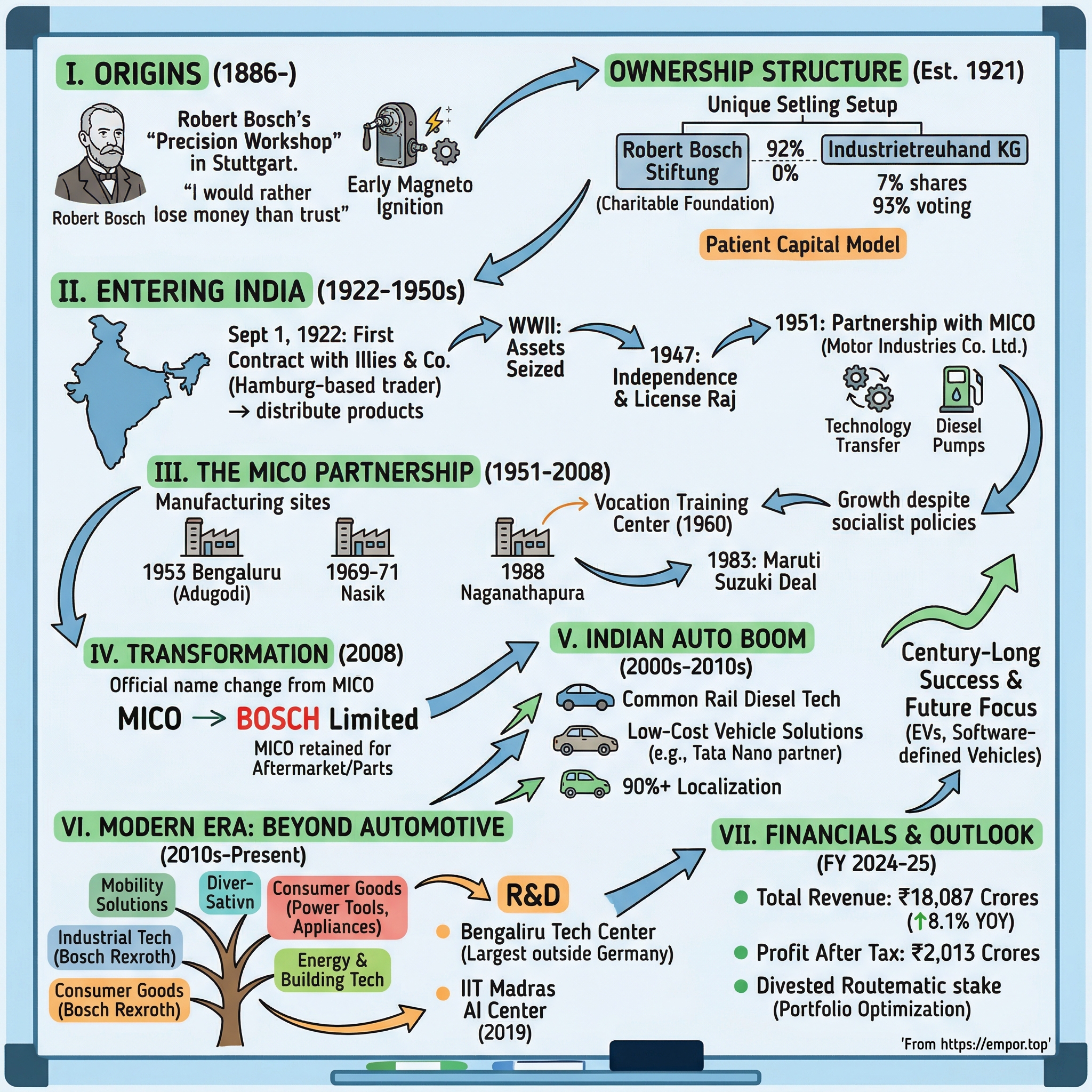
Bosch Limited: The Foundation-Owned Giant's Fight Against Its Own Disruption
I. Cold Open & Episode Thesis
On July 1, 2026, a company operating in India since before national independence quietly completed the largest acquisition in its history.
There was no auction, no competing bidder, and no investment bank shopping the asset to strategic buyers. Bosch Limited — the Bengaluru-headquartered, NSE-listed subsidiary of Germany's Robert Bosch GmbH — bought 100% of Bosch Chassis Systems India Private Limited from two entities owned by its controlling parent. The price tag stood at ₹9,068.68 crore, settled partly in cash and partly through freshly issued Bosch Limited shares returned straight to the seller.12
In a single transaction, Bosch Limited expanded its revenue base by roughly 22%, secured a product category immune to electric vehicle displacement, and further concentrated ownership with a parent that already held about 70% of the company.13
This transaction highlights a central paradox. In financial year 2025–26, Bosch Limited generated ₹20,035 crore in operating revenue, up 10.8% year on year, and earned ₹2,770 crore in net profit after tax.4 Equity markets have valued the company near ₹1.39 lakh crore — trading at a trailing price-to-earnings multiple of around 59, a valuation typically reserved for high-growth software firms rather than a legacy manufacturer of fuel pumps and injectors.3 Yet beneath these strong headline figures lies an existential vulnerability: the fuel injection systems that built its Indian franchise are entirely absent from battery-electric vehicles.
Electric powertrains do not require fewer fuel injectors; they eliminate them completely.
This dynamic sets Bosch Limited apart from typical industrial compounders facing routine cyclical downturns or margin compression. Its core product line faces permanent category elimination on a timeline dictated by vehicle electrification. Every percentage point shift in Indian passenger and commercial vehicle production toward electric powertrains permanently reduces the addressable market for its legacy component portfolio.
Management has recognized this transition for over a decade. Its multi-year strategic response — executed through joint ventures, minority equity stakes, localized power-electronics manufacturing, semiconductor rollouts, and now this massive intercompany acquisition — forms the core focus of this analysis.
Understanding the company's execution strategy requires examining its unique global ownership structure. German parent entity Robert Bosch GmbH operates outside conventional public-market incentives: roughly 94% of its share capital belongs to a charitable foundation, Robert Bosch Stiftung GmbH, which holds virtually no voting rights. Governance and voting control reside with an industrial trust, Robert Bosch Industrietreuhand KG, which holds roughly 93% of voting power, while the Bosch family retains approximately 5% of capital and 7% of votes.5 Unencumbered by quarterly earnings targets or public shareholder activism, the global enterprise — which recorded €91.0 billion in 2025 sales with 412,800 employees worldwide — answers solely to a corporate trust and a philanthropic foundation.6
This governance framework explains how the parent can reallocate assets like the chassis-systems business into a public subsidiary on its own schedule and valuation terms. It also explains how the group spent seven decades patiently building an Indian automotive monopoly that it must now restructure.
The central question for investors is clear and testable: can a foundation-backed, long-term German engineering group successfully navigate the rapid disruption of its core products inside India's cost-sensitive vehicle market — and will public minority shareholders owning roughly 7% of the free float participate in the value creation, or simply finance the transition?
To evaluate this trajectory, the story begins in Stuttgart, in a precision mechanics workshop, in 1886.
 Subscribe on LinkedIn
II. Origins: Robert Bosch, Stuttgart, and the Foundation-Owned Model
Robert Bosch opened his "Workshop for Precision Mechanics and Electrical Engineering" in Stuttgart in 1886 with two employees and no established product line.7 Rather than focusing on finished consumer goods, he established a strategy centered on high-precision engineering standards designed to outmatch regional competitors.
The company's initial commercial breakthrough came with the magneto ignition system, which solved a primary reliability challenge in early internal combustion engines by delivering precisely timed electrical sparks in high-vibration engine bays. By securing control over a critical, highly specialized component essential to automobile operation, Bosch established an operational template focused on indispensable niche systems.
This technical approach was reinforced by a corporate governance model designed to protect the firm's independence and longevity.
The structure that explains everything
The foundation-owned governance architecture stems from Robert Bosch's dual objective: ensuring corporate continuity and providing perpetual funding for philanthropic commitments. Under this framework, economic rights and management control are strictly separated. The charitable foundation, Robert Bosch Stiftung GmbH, holds roughly 94% of the share capital and receives dividend flows to support its philanthropic work, but exercises virtually no voting authority. Primary voting control rests with an industrial trust, Robert Bosch Industreuhand KG, which holds approximately 93% of the voting power without a direct financial stake. The Bosch family retains roughly 5% of capital and about 7% of votes; Robert Bosch GmbH itself holds roughly 1%.5
This mechanism separates economic beneficiaries from operational managers. The dividend recipient cannot force asset liquidations for short-term payouts, and the governing trust cannot sell assets for personal enrichment. Consequently, the enterprise operates under an extended investment horizon uncommon among conventional publicly listed industrials. Global management can fund long-term research and development across multi-year loss cycles, maintain divisions through industry downturns, and reallocate business units among corporate entities based on strategic alignment rather than public market timing.
This governance model directly enabled the July 2026 acquisition of Bosch Chassis Systems India. Conceived, valued, approved, and closed within roughly twelve weeks, the intercompany transfer required alignment between two entities answering to the same central leadership in Stuttgart.
For public shareholders in the Indian subsidiary, this governance structure creates a clear trade-off. Investors gain access to global engineering resources and research programs that a regional entity could not fund independently, backed by a parent entity unaffected by quarterly public market pressures. Conversely, minority shareholders occupy a passive position within a subsidiary whose capital allocation, asset transfers, and transaction pricing remain determined by its controlling parent.
Getting to India
Before establishing an operational presence in India, Bosch expanded through international commercial networks typical of early twentieth-century German industrial firms. Following the opening of a London branch in 1898, the company established trading partnerships across global markets by 1909. Bosch initially avoided building direct overseas subsidiaries, choosing instead to appoint regional agents and trading houses that absorbed local commercial risk.
The company applied this indirect agency model to the Indian subcontinent, though the strategy generated little commercial progress for nearly three decades.
III. From Trading House to MICO to Bosch Limited (1922–2008)
In 1922, Bosch signed an agreement with Hamburg trading house Illies & Co. to sell its products in India.8 On paper, the arrangement represented an international expansion; in practice, it generated negligible revenue.
By the late 1930s, Indian sales totaled roughly 150,000 reichsmarks — less than 0.1% of total company revenue.8 British and American component suppliers, including Lucas, Delco-Remy, and Auto-Lite, dominated the Indian market through established relationships with vehicle manufacturers. Selling through a third-party agent left Bosch without direct access to original equipment manufacturers, and the outbreak of World War II subsequently closed its sales offices entirely.
The postwar restart established an operational template that Bosch would repeat throughout its Indian expansion: prioritizing technology transfer and local partnership before acquiring majority equity control.
Partnership, not ownership
In 1951, Bosch partnered with Motor Industries Co. Ltd. (MICO), a subsidiary of Ghaziabad Engineering Corporation, securing a licensing agreement to manufacture spark plugs and diesel injection pumps in India.8 Bosch traces its direct Indian manufacturing operations to that year.9 Rather than purchasing immediate operational control, Bosch initially acquired a 9% equity stake in 1954 and built its holding steadily over subsequent decades.8
This phased entry aligned with India's post-independence trade policies. By 1953, Bosch management concluded that restrictive import licensing was a permanent feature of the Indian market, making domestic production essential for long-term commercial access.8 Import substitution protected localized manufacturers, allowing companies operating behind domestic trade barriers to capture market share. By 2008, when MICO was renamed Bosch Limited, the German parent held roughly 70% of the company's equity — an ownership position accumulated over half a century rather than acquired in a single transaction.8
The company's initial commercial traction came from non-automotive applications. Bosch supplied diesel injection systems for stationary irrigation engines, supporting agricultural water pumping under India's first five-year plan. This early diversification established an off-highway, tractor, and agricultural footprint that continues to generate revenue alongside passenger vehicle components.
The compounding of a manufacturing footprint
Following its initial plant at Adugodi in Bengaluru, Bosch expanded its manufacturing footprint to Nashik, Naganathapura, and Jaipur, which opened in 1999 as its fourth Indian plant. As of March 31, 2025, the Bosch Group in India operated 18 manufacturing sites and seven development and application centers, employing 38,655 associates.9
When MICO was rebranded as Bosch Limited in 2008, the company retained the MICO brand for its automotive aftermarket division.8 Independent mechanics across India had relied on MICO components for decades, giving the legacy brand stronger market recognition at the repair-shop level than the corporate identity. Retaining the product brand avoided disrupting established retail distribution channels.
The full circle
The original Adugodi manufacturing site in Bengaluru was redeveloped into Spark.NXT, a smart campus inaugurated on June 30, 2022. Bosch invested ₹800 crore over five years across the 76-acre site, building capacity for roughly 10,000 associates focused on artificial intelligence, connected mobility, and software engineering rather than mechanical components.10
The campus opening coincided with the centenary of Bosch's commercial presence in India. While the facility reflects the enterprise's strategic shift toward software and digital technologies, legacy mechanical fuel injection systems continue to generate the cash flow funding that transition.
IV. The Core Franchise: Auto Components, Common Rail, and the Diesel Decade
Understanding Bosch Limited’s premium valuation over the past two decades requires examining the engineering and manufacturing complexity of a modern fuel injector.
The hardest simple product in the car
A modern common-rail diesel injector sprays fuel into a combustion chamber at pressures exceeding 2,000 bar — roughly 1,000 times the pressure of a standard car tire. It performs this cycle multiple times per combustion event, opening and closing nozzle holes measured in microns within fractions of a millisecond. It must maintain identical performance across millions of units over a decade of operation inside a high-temperature, high-vibration engine environment.
The process resembles a fire hose delivering an exact teaspoon of water five separate times in a fraction of a second through an opening narrower than a human hair, without clogging, over ten years of continuous operation — duplicated across millions of mass-produced units holding sub-micron tolerances.
That manufacturing tolerance forms the primary barrier to entry. Rather than relying solely on patent protection for public physical principles, Bosch relies on process power built over decades of accumulated metallurgy expertise, precision grinding techniques, strict cleanliness standards, and proprietary testing protocols. Competitors fail not from an inability to read product specifications, but from an inability to replicate those tolerances at commercial scale and cost.
This technical barrier is reinforced by the automotive qualification cycle. Vehicle manufacturers select injection component suppliers years before commercial vehicle production begins, validating suppliers through thousands of hours of durability testing, emissions certification, and factory audits. Once qualified, switching suppliers mid-program requires re-certifying the entire powertrain, a costly procedure OEMs avoid unless severe component failure occurs.
Under Hamilton Helmer’s 7 Powers framework, this dynamic establishes high switching costs that Bosch has maintained globally and in India for decades. This advantage is strengthened by scale economies — as massive fixed R&D expenses are amortized across global production volumes — and by process power, which resides in accumulated organizational practice rather than documented designs.
However, that competitive advantage faces a fundamental structural challenge as the automotive industry transitions toward electric powertrains.
The diesel decade
Bosch’s fuel injection franchise compounded most rapidly during the 2000s, driven by the adoption of common-rail technology.
Earlier diesel engines relied on mechanical injection pumps where fuel delivery pressure and timing were tied to engine speed. Common-rail architecture decoupled these variables by pressurizing fuel inside a shared reservoir — the rail — allowing electronically controlled injectors to fire at precise intervals dictated by the engine control unit. The system delivered higher power, lower noise levels, and reduced emissions, helping automakers meet tightening Indian environmental regulations.
Bosch localized the technology aggressively. Having manufactured components at its Nashik facility since 2006, Bosch began local production of common-rail injectors there on August 24, 2007. The Nashik expansion formed part of a $135 million investment within a broader $440 million Indian capital expenditure program between 2005 and 2008. The production line targeted an initial 100,000 injectors in 2007, scaling toward 3.5 million units annually by 2010, aligned with projections that diesel’s share of Indian passenger vehicle production would expand from roughly 30% to 40% by 2010.11
That commercial thesis proved accurate. Indian diesel vehicle adoption accelerated through the decade as favorable fuel-price differentials and common-rail refinement eliminated the noise and performance drawbacks of older diesel engines. Bosch supplied the enabling technology across the domestic automotive market.
Analytical evaluation shows that Bosch Limited’s core strategic strength in India has consistently rested on localizing established global technologies precisely when domestic regulatory shifts and consumer economics drive market demand. The underlying technology development costs were absorbed by the Stuttgart parent, while the Indian entity executed local deployment.
The competitive set, then and now
On a global level, Bosch competes in mobility components against tier-one suppliers including Denso, Continental, Hitachi Astemo, Marelli, and BorgWarner’s spun-off fuel-systems business, PHINIA.
Domestically, equity investors evaluate Bosch Limited against listed Indian auto-component manufacturers such as Samvardhana Motherson, Sona BLW Precision Forgings, and Uno Minda. That comparison highlights Bosch’s superior engineering depth, but favors domestic peers on revenue growth. Indian peers have expanded faster off smaller initial bases and developed clearer electric-vehicle component narratives, largely because they carried less legacy internal-combustion revenue to defend.
The segment structure, and what it hides
Bosch Limited reports financial results through two primary segments: Mobility — encompassing Power Solutions, the Two-Wheeler business, and Mobility Aftermarket — and Beyond Mobility. This structure differs from the parent company's four global operational sectors of Mobility, Industrial Technology, Consumer Goods, and Energy and Building Technology.5
The Mobility segment generates the vast majority of company performance. In FY2025–26, Mobility product sales rose 16.9% year-on-year, driven by a 17.6% increase in Power Solutions and a 69.1% surge in the Two-Wheeler unit, whereas Beyond Mobility revenue dropped 13.6% following a business divestiture.4 By the quarter ended September 2025, Mobility accounted for approximately 88% of total revenue.12
This reporting structure presents a key analytical limitation: Bosch Limited does not disclose the breakdown of Mobility revenue between diesel fuel injection, gasoline systems, and electric vehicle components. Consequently, the proportion of company profit tied to components subject to category elimination under battery-electric vehicle adoption remains unquantified in public disclosures, forcing market participants to rely on external estimates.
Porter, applied honestly
Applying Michael Porter’s five forces framework to Bosch Limited’s operational model in 2026 reveals four manageable competitive factors and one unmanageable structural threat.
Supplier power has intensified as dependency on semiconductors turned a fragmented supplier base into concentrated supply chain chokepoints. Buyer power remains substantial yet constrained: while major Indian original equipment manufacturers like Maruti Suzuki, Tata Motors, Mahindra & Mahindra, and Hyundai negotiate annual price concessions, mid-program supplier switching costs limit their leverage. Rivalry among global tier-one component suppliers remains disciplined, with players avoiding predatory pricing. Threat of new entrants in high-precision fuel injection stays negligible due to steep capital and process barriers.
The critical vulnerability lies in the fifth force: substitutes.
The primary threat is not a lower-cost injector or a competing tier-one product, but the replacement of the internal-combustion powertrain architecture itself, which eliminates the fuel injection category from the vehicle's bill of materials.
This shift undermines traditional competitive moats. Qualification-based switching costs protect a supplier only as long as the component remains part of the vehicle design. A battery-electric vehicle does not require a qualified fuel injector supplier; it eliminates the component entirely. Rather than breaching the company's competitive moat, technological disruption renders the underlying product category obsolete.
Addressing this structural shift defines Bosch Limited’s strategic mandate.
V. The Existential Question: Electrification and the Diesel Disruption
The threat to Bosch Limited's core business is direct and structural.
Fuel injection systems — the product line that built the company's Indian franchise — do not exist in a battery-electric vehicle. Spark plugs, fuel pumps, and secondary combustion components are similarly eliminated. Unlike traditional cyclical downturns or market share losses to low-cost competitors, vehicle electrification represents category elimination. Revenue lost to electric powertrains does not migrate to competing component suppliers; it disappears from the addressable market entirely.
Incumbent manufacturers facing technological shifts often position themselves as technology-agnostic suppliers. During a recent quarterly analyst call, Managing Director Guruprasad Mudlapur framed the company's posture by stating, "We are a technology company, and we will support whatever technology the market demands."13
While that positioning aligns with broader corporate messaging, evaluating the enterprise's trajectory requires examining the assets and operational capabilities established to date.
The pieces, assembled
The Tata AutoComp joint venture. On March 23, 2026, following board approval on March 18, Bosch Limited and Tata AutoComp announced a 50:50 joint venture to manufacture eAxle systems and electric traction motors in India. Bosch provides global EV powertrain engineering, while Tata AutoComp contributes domestic manufacturing, procurement, and supply chain infrastructure. Registered in Pune with equal initial paid-up capital totaling ₹10 lakh, the venture planned to scale equity to ₹94 crore over time. Operations were scheduled to begin around mid-2026, subject to regulatory approvals, backed by a five-year lock-in period on share transfers.14
An eAxle integrates an electric motor, transmission, and power electronics into a single assembly driving the vehicle's wheels. Outside of the battery pack, it represents the single highest-value system in an electric powertrain. Replacing lost fuel-injection content requires capturing significant market share in this category.
SUN Mobility. In September 2020, Bosch acquired a 26% equity stake in SUN Mobility, a Bengaluru-based battery-swapping enterprise.15 Founded in April 2017 as a joint venture between the Maini Group and SUN Group, SUN Mobility operates an open-architecture energy network comprising smart batteries and Quick Interchange Stations targeting commercial fleets, including electric three-wheelers and buses. Battery swapping — replacing a depleted pack with a fully charged unit within minutes — offers an alternative to fixed charging infrastructure, particularly in commercial segments where fleet uptime is critical.
Localized power electronics. In December 2025, Bosch inaugurated a CharCon assembly line at its Naganathapura plant near Bengaluru, establishing domestic manufacturing capacity for electric-vehicle power electronics and supporting local OEM platforms, including Mahindra's electric vehicle portfolio.12
Silicon carbide semiconductors. On June 10, 2026, Bosch introduced its third-generation silicon carbide (SiC) microchips in India, citing roughly 20% higher performance over prior generations and noting global deliveries exceeding 60 million units.16
In an electric powertrain, the inverter converts direct current from the battery into alternating current for the electric motor. Silicon carbide semiconductors reduce thermal energy loss during this conversion compared to standard silicon chips. Reduced heat loss improves battery efficiency, allowing vehicle manufacturers to either extend driving range on a given battery capacity or reduce battery size and vehicle cost — a key consideration in India's price-sensitive vehicle market.
Across its global operations, parent group Robert Bosch GmbH has committed over €6 billion to e-mobility research and development.14
Myth vs. reality
Evaluating Bosch Limited's transition requires testing two common market narratives against empirical evidence.
Myth: "Bosch India is a diesel company that will be wiped out by EVs." Reality: This thesis oversimplifies India's vehicle electrification dynamics. Domestic EV adoption has advanced fastest in two-wheelers, three-wheelers, and urban commercial fleets. Conversely, passenger vehicles and heavy commercial vehicles — where Bosch's fuel injection content is concentrated — face a slower transition. Furthermore, Bosch's Power Solutions unit supplies off-highway and tractor applications. High energy-density requirements, intense duty cycles, and limited rural charging infrastructure extend the operational runway for internal combustion powertrains in agriculture well beyond urban light-vehicle timelines.
Myth: "Bosch's EV pivot is already showing up in the numbers." Reality: Financial disclosures show no material revenue contribution from electric vehicle components. On an analyst call, Mudlapur noted that the Tata AutoComp eAxle joint venture is expected to generate initial revenue by late 2027, acknowledging that while electric vehicles will become increasingly important to performance, the exact commercial timeline remains uncertain.13 The flagship domestic EV initiative has yet to deliver commercial sales.
Bosch Limited has assembled a portfolio of operational options rather than a fully realized replacement for its core business. The footprint consists of a joint venture with initial paid-up capital of ₹10 lakh targeted for late-2027 revenue, a minority stake in a battery-swapping business without disclosed financial contribution, a recently commissioned power-electronics line, and a newly introduced semiconductor product line. While strategically aligned, these initiatives remain small relative to a company generating ₹20,035 crore in annual operating revenue.
A clear test of execution will be whether e-mobility revenue is eventually broken out as a distinct reportable segment and whether the joint venture meets its late-2027 revenue guidance.
The second-order threat
The electric transition also alters Bosch's competitive environment. During the internal combustion era, localization in India was dominated by established global tier-one suppliers from Europe, Japan, and North America.
In electric vehicle components, global supply chains are more fragmented and competitive. Chinese manufacturers, including vertically integrated players such as BYD, hold strong cost and technological positions in electric motors, power electronics, and battery systems. These firms are actively competing for localization opportunities in India that European component makers historically dominated. Bosch's partnership with Tata AutoComp represents a practical effort to leverage local scale and supply networks, but it highlights a broader shift toward a more competitive tier-one landscape.
If organic electric-vehicle initiatives require time to achieve scale, an enterprise holding substantial net cash backed by a global parent may seek inorganic growth to manage the transition window.
That strategic option leads directly to corporate acquisitions.
VI. Capital Allocation Inflection Point: The Chassis Systems Acquisition
On April 8, 2026, Bosch Limited’s board approved the single largest capital deployment in the company’s Indian history — executed entirely without negotiating with an external seller.
The deal
Bosch Limited agreed to acquire 100% of Bosch Chassis Systems India Private Limited (BCSI) from Robert Bosch Investment Nederland B.V. and Robert Bosch LLC — both subsidiaries of its parent group — for a total consideration not exceeding ₹9,068.68 crore.1 The transaction structure combined cash with a preferential equity allotment: 2,460 newly issued Bosch Limited shares priced at ₹35,200 each, divided equally between the two selling entities within the promoter group.17
Because the transaction involved related parties, Indian listing regulations required approval from public shareholders. The company put two resolutions to a postal ballot — an ordinary resolution approving the material related-party transaction and a special resolution authorizing the preferential share allotment — with electronic voting running from April 9 to May 8, 2026, and final results reported on May 12.17 Following execution of the Share Purchase Agreement on April 8, all closing conditions were fulfilled by July 1, 2026, making BCSI a wholly owned subsidiary.2
The transaction moved from board approval to final close in roughly twelve weeks — an unusually rapid timeline for an acquisition equal to nearly two-thirds of the company's annual operating profit. That execution speed reflected an internal realignment between entities operating under shared global control.
What was actually bought
BCSI operates as a tier-one supplier of vehicle safety systems. Its product line encompasses active safety technologies — such as antilock braking systems (ABS) and electronic stability control — alongside passive safety components, including airbag electronic control units and crash sensors, as well as braking actuation systems for passenger vehicles, two-wheelers, and commercial vehicles.1
Financial disclosures accompanying the deal showed BCSI generating ₹3,935.90 crore in revenue and ₹545.66 crore in profit after tax, with an EBITDA margin of 19.3% and a 17% compound annual revenue growth rate since fiscal year 2023. Management projected the acquisition would expand Bosch Limited's revenue base by approximately 22%.1
Three distinct factors highlight the strategic impact of the purchase. First, BCSI had been expanding faster than its parent entity, compounding revenue at 17% compared to Bosch Limited's high-single to low-double-digit growth. Second, BCSI recorded an EBITDA margin of 19.3%, exceeding Bosch Limited's operating margin of roughly 13%.3 Third, and most critical to the broader corporate narrative: brakes and airbags do not care what powers the vehicle.
The underlying strategic rationale remains straightforward. Antilock braking systems and electronic stability controls are mandatory components regardless of whether a vehicle runs on diesel, gasoline, or electricity. Airbag sensors function identically across internal-combustion and battery-electric platforms. Furthermore, Indian regulatory standards continue to mandate expanded safety equipment across lower vehicle segments, driving structural volume growth for safety systems.
By completing the acquisition, Bosch Limited applied its cash balance to acquire high-margin revenue streams that face no substitution risk from powertrain electrification. While organic electric-vehicle initiatives represent long-term strategic options, the chassis systems purchase provided immediate, large-scale product diversification.
The related-party question
Despite its strategic alignment, the transaction structure highlights governance dynamics inherent to multinational subsidiaries, as the acquisition was executed without arm's-length negotiation or a competitive bidding process. The controlling parent determined the timing, target asset, and valuation terms.
Financial analysis of the transaction metrics shows that at ₹9,068.68 crore for an entity generating ₹545.66 crore in profit after tax, the deal valued BCSI at approximately 17 times trailing earnings. Applying the 19.3% EBITDA margin to its ₹3,935.90 crore revenue yields an estimated EBITDA of ₹760 crore, representing a valuation multiple of roughly 12 times EBITDA and 2.3 times annual sales.
Evaluating this valuation requires examining two distinct benchmark comparisons.
Compared to broader Indian auto-component mergers and acquisitions, an enterprise value multiple of 12 times EBITDA for a high-margin, rapidly growing safety business supported by regulatory mandates aligns with prevailing market valuations for quality component assets.
Compared to Bosch Limited's standalone valuation, the relative pricing dynamics shift. Bosch Limited has traded near 59 times trailing earnings.3 Mechanically, issuing equity or spending cash to acquire an asset priced at 17 times earnings into an entity trading at 59 times earnings enhances immediate earnings per share for minority shareholders.
However, this financial accretion carries a broader valuation implication. If Bosch Limited's elevated price-to-earnings multiple reflects a scarcity premium assigned to an international subsidiary rather than standalone cash flow growth, deploying cash and issuing shares priced at ₹35,200 back to the parent effectively transfers a portion of that valuation premium to the controlling shareholder, which set the asset price internally.17
The transaction highlighted the limits of minority shareholder governance protections. Under Indian regulations, interested promoter entities were barred from voting on the related-party resolutions, providing minority shareholders with a veto mechanism. However, a shareholder vote functions as a binary acceptance or rejection of predetermined terms rather than an active price negotiation.
From an operational standpoint, management tempered expectations regarding immediate integration benefits. On the first analyst call following transaction close, leadership stated that the acquisition would yield minimal short-term cost synergies, characterising the transaction primarily as the addition of a complementary, powertrain-agnostic product line.13 Consequently, long-term returns from the deal depend entirely on BCSI’s standalone earnings trajectory rather than operational cost rationalisation.
The mirror-image move: exiting the periphery
Parallel to the chassis acquisition, the group executed a non-core asset divestiture that completed a broader portfolio realignment.
On December 12, 2024, the global Bosch Group announced an agreement to sell its Building Technologies division — encompassing video systems, access control, intrusion detection, and commercial communication technologies — to private equity firm Triton Partners. The divested unit employed approximately 4,300 associates across 90 international locations and recorded over €1 billion in revenue during fiscal year 2023. While financial terms were not officially disclosed, market estimates valued the transaction at roughly $735 million upon its completion in the first half of 2025.18
For the Indian listed entity, the transaction produced an exceptional gain of ₹556 crore, recognized in the financial results for the quarter ended June 30, 2025.19 The sale further reduced the scale of the Beyond Mobility segment, which subsequently contracted 14.4% in the quarter ended September 2025, 23.3% in the quarter ended December 2025, and 13.6% across full-year FY2025–26.20214
These simultaneous capital allocation moves establish a consistent strategic pattern: divesting peripheral non-automotive operations while reallocating capital into core vehicle safety categories resilient to powertrain electrification. Rather than pursuing opportunistic diversification, management concentrated capital within high-margin automotive segments capable of navigating the energy transition.
Evaluating the execution of this dual strategy requires examining the leadership team steering the enterprise.
VII. Current Leadership, Ownership & Capital Discipline
Large multinational corporations often cultivate long-tenured careers where executives spend decades moving across functions and geographies. Bosch Limited's leadership team largely reflects this model, carrying specific analytical implications for corporate governance.
The transition of 2023
On June 30, 2023, Soumitra Bhattacharya retired after 28 years with the company. He had served as President of the Bosch Group in India and Managing Director of Bosch Limited since 2017, having previously served as Joint Managing Director and Chief Financial Officer — a financial background that influenced the company's operating discipline.22
Effective July 1, 2023, Guruprasad Mudlapur succeeded him as President of the Bosch Group in India and Managing Director of Bosch Limited. Mudlapur had spent over 15 years with the group, serving most recently as Joint Managing Director and Chief Technology Officer, and previously as Regional President and Managing Director of Bosch Automotive Electronics. Notably, he retained CTO responsibilities alongside the MD role.22 Sandeep Nelamangala was appointed Joint Managing Director, having previously served as Executive Director at Bosch Limited and Executive Vice President for Mobility Solutions in India.22
This transition marked a shift in leadership profile, placing an engineering and electronics executive at the helm as the strategic mandate evolved from optimizing legacy internal combustion components to developing electrified powertrain technologies. Structurally, a chief executive who retains chief technology officer responsibilities is positioned to prioritize engineering investments.
Both executives were promoted from within the Indian operation rather than transferred from German headquarters, indicating significant localized operational autonomy. Bhattacharya remained as Chairman of the Bosch Limited board, providing governance continuity through the transition.
The CFO handover, and what it reveals
In 2026, the senior finance leadership turned over, illustrating the organizational dynamics typical of multinational subsidiaries.
Karin Gilges, who had served as CFO since May 1, 2022, resigned on February 10, 2026, effective May 31, 2026, to accept a global role within the Bosch Group outside India. The board announced the transition on February 17, confirming in her resignation letter that no disagreements existed with the company.23
Tillmann Olsen succeeded her as CFO effective June 1, 2026. Olsen brought over two decades of Bosch Group experience across China, France, Africa, and Germany. He previously served as Executive Vice President leading the Business Unit Mobile Components at Bosch Rexroth AG in Germany since January 2022, holding global profit-and-loss responsibility for three product classes generating over €400 million in revenue with more than 1,500 associates. His earlier roles included Regional President for Bosch Rexroth Africa, CEO of Bosch Rexroth South Africa, CFO of Bosch Rexroth France, and purchasing director for Bosch Rexroth China.23
Olsen's career path reflects an operational profile with direct P&L responsibility rather than a background limited to corporate controlling. However, his background includes no direct Indian market experience, and his appointment took effect one month prior to the closing of the ₹9,068.68 crore Chassis Systems acquisition.
A four-year CFO rotation ending in a transfer to global headquarters represents a standard cadence within multinational structures. This rotation model offers dual implications for public shareholders. It ensures the finance function is directed by executives vetted within the global organization who bring international operational practices. Conversely, senior finance leadership remains aligned with global career trajectories, creating periodic resets in institutional memory regarding subsidiary-specific commitments made to domestic investors.
Ownership, and the free float problem
Robert Bosch GmbH group entities held roughly 70.54% of Bosch Limited, while public retail shareholding stood at approximately 7.19%, foreign institutional investors held 7.10%, and domestic institutional investors held 15.17%.3
A genuine public float of roughly 7% is unusually limited for an enterprise of Bosch Limited's market capitalization. Institutional investors seeking exposure to a high-quality Indian auto-component supplier with global engineering backing face a constrained supply of tradeable shares. Scarcity of tradeable shares can support valuation multiples independent of baseline earnings growth. Consequently, a portion of the company's valuation premium relative to domestic peers reflects market structural dynamics rather than purely operational performance, creating distinct risk characteristics during market downturns.
Capital allocation: cash, dividends, and a question nobody has answered
Bosch Limited has operated effectively debt-free, maintaining minimal borrowings.3 For a capital-intensive manufacturer with substantial fixed assets, this capital structure reflects a conservative balance sheet strategy.
The company's return profile reveals structural dynamics. Return on capital employed reached approximately 21.5%, while return on equity stood at around 14.6%.3 The divergence between these metrics reflects tax effects — as ROCE measures pre-tax operating returns while ROE measures post-tax returns on total equity — as well as a balance sheet carrying substantial cash and liquid investments. Treasury yields earned on cash reserves dilute overall equity returns, resulting in an operating business generating roughly 21% returns while overall return on equity delivers approximately 15%.
Despite maintaining net cash reserves, the company has not executed recent share buybacks.
Dividend distributions for fiscal year 2025–26 reflected this capital retention. The recommended final dividend for FY2025–26 was ₹270 per share.4 For FY2024–25, the final dividend had been ₹512 per share.24 For FY2023–24, total dividends reached ₹375 per share, comprising an interim dividend of ₹205 and a final dividend of ₹170.25 The dividend payout ratio for FY2025–26 stood at approximately 29%.3
Dividends per share declined during a fiscal year in which net profit increased, coinciding with the ₹9,068.68 crore commitment for the Chassis Systems acquisition. Retaining operating cash flows to fund the acquisition provided internal financing for the transaction, effectively using retained earnings that might otherwise have funded higher dividend payouts to finance an intercompany asset purchase.
An honest evidence gap
Public disclosures regarding executive compensation structures and long-term incentive targets for senior management at Bosch Limited remain limited, consistent with reporting norms for multinational subsidiaries in India.
The proportion of senior management compensation tied to domestic subsidiary performance relative to global group metrics is not publicly disclosed. Similarly, specific multi-year operating targets and performance metrics evaluating capital deployed in the ₹9,068.68 crore Chassis Systems acquisition are omitted from regulatory filings.
While corporate governance disclosures meet statutory compliance standards, compliance alone does not verify strategic alignment between controlling shareholders and minority investors. In the absence of detailed disclosure regarding incentive structures, investors cannot confirm whether management metrics directly reward subsidiary-level equity value creation.
VIII. Financial Performance & the Recent Growth Reacceleration
A six-year view of Bosch Limited's revenue trajectory illustrates a sharp cyclical contraction followed by steady compounding.
Revenue from operations registered at ₹9,842 crore in FY2020 and remained essentially flat at ₹9,718 crore in FY2021, before expanding to ₹11,782 crore in FY2022, ₹14,929 crore in FY2023, ₹16,727 crore in FY2024, ₹18,087 crore in FY2025, and ₹20,035 crore in FY2026.34
The stagnant performance in fiscal years 2020 and 2021 reflected severe headwinds: a sharp downturn in domestic commercial vehicle sales coincided with the regulatory transition to BS-VI emission standards and the onset of the pandemic. By FY2021, top-line revenue sat roughly 20% below FY2019 levels. The subsequent growth rebound represented a disciplined cyclical recovery as domestic vehicle production normalized and demand for Bosch's component portfolio recovered.
The margin story, and where it turns
Examining the enterprise's profitability arc provides deeper insight into operating efficiency.
In FY2024–25, profit before tax excluding exceptional items reached ₹2,731 crore—representing 15.1% of revenue and a 16.9% year-on-year increase—with net profit after tax at ₹2,013 crore.24 For FY2025–26, reported profit before tax including exceptional items rose to ₹3,642 crore, or 18.2% of revenue, yielding net profit after tax of ₹2,770 crore, or 13.8% of revenue.4
However, the 18.2% pre-tax margin figure requires careful contextualization. Adjusting for the ₹556 crore exceptional gain from the Building Technologies divestiture reveals an underlying pre-tax margin in the mid-15% range—reflecting modest year-on-year margin improvement rather than a structural step-change.
Evaluating the quarterly sequence of FY2025–26 profit before tax excluding exceptional items highlights this underlying trend:
- June 2025 quarter: PBT of ₹838 crore, up 37.2% year on year, on revenue of ₹4,789 crore (+10.9%)19
- September 2025 quarter: PBT of ₹730 crore, up 7.9%, on revenue of ₹4,795 crore (+9.1%)20
- December 2025 quarter: PBT of ₹709 crore, up 6.7%, on revenue of ₹4,886 crore (+9.4%)21
- March 2026 quarter: PBT of ₹808 crore, up 3.8%, on revenue of ₹5,566 crore (+13.3%)4
Underlying pre-tax profit growth decelerated across every quarter of FY2025–26, slowing from 37.2% in the first quarter to 3.8% in the fourth, even as revenue growth remained robust. This quarterly deceleration represents a critical pattern obscured by annual headline figures.
The outsized profit growth in the June quarter benefited from a low prior-year comparison base, a favorable product mix, and reduced input material costs cited by management.19 As those initial tailwinds dissipated over subsequent quarters, cost growth outpaced revenue gains. By the March 2026 quarter, a 13.3% increase in top-line revenue translated into just 3.8% pre-tax profit growth, reflecting negative operating leverage.
Consequently, fiscal year 2026 demonstrated strong demand expansion alongside decelerating operating profitability. While volume growth remained healthy, margin expansion was largely concentrated in the opening quarter.
Management has characterized the overall margin profile as structurally enhanced, pointing to an EBITDA margin near 14%—up from 12% to 13% in the post-pandemic period—attributing the gains to operational efficiency, increased localization, favorable product mix, and productivity improvements. CFO Tillmann Olsen highlighted that the group's global purchasing network "helps us maneuver this volatile situation."13 Access to a €91 billion parent group's global procurement network provides a competitive cost advantage that domestic peers cannot duplicate. Nevertheless, the quarterly margin trajectory indicates that localization and product-mix benefits were partially absorbed by input cost inflation rather than fully retained as net operating margin.
Where the growth actually came from
A granular examination of segment performance evaluates the transition narrative against reported financial results.
The highest percentage growth occurred in the Two-Wheeler division, which expanded 81.8% in the September 2025 quarter, 58.3% in the December quarter, and 69.1% across the full fiscal year.20214 However, this expansion reflected regulatory compliance rather than electric vehicle adoption. Management attributed the surge primarily to increased demand for exhaust gas sensors mandated by tightening OBD-II on-board diagnostics standards.20 This regulatory content expansion provided a single-step increase in content per vehicle on internal-combustion two-wheelers, generating rapid growth off a small baseline that will naturally normalize as the regulatory requirement annualizes.
The Power Solutions division—covering passenger car systems alongside off-highway and agricultural engine components—grew 9.5% in the second quarter, 19.5% in the third, and 17.6% over the full year, supported by passenger vehicle and off-highway demand.20214 Representing the largest operational contributor, this segment carries the longest operational runway before powertrain electrification impacts core demand.
The Mobility Aftermarket division recorded revenue growth of 5.2% in the June quarter, 3.7% in September, and 5.3% in December.192021 The aftermarket segment functions as an annuity business by generating high-margin revenue from the existing vehicle fleet regardless of current OEM sales. Management projected sustainable high-single-digit aftermarket growth supported by expanding workshop networks and new product lines, including Tulix LED lights and Prithvi batteries.13 Delivered results, however, remained below that long-term target.
Export sales accounted for roughly 8% to 8.5% of total revenue, with management targeting high-single-digit growth.13 Consequently, Bosch Limited remains overwhelmingly focused on the domestic Indian market.
The valuation debate
These financial dynamics underpin the ongoing market debate surrounding Bosch Limited's valuation.
By December 19, 2025, with shares trading near a market capitalization of ₹1.05 lakh crore and roughly 7.5 times book value, equity research analysts expressed notable caution. Motilal Oswal maintained a Neutral rating with a price target of ₹36,289, describing the stock as fairly valued, while Geojit BNP Paribas issued a Sell rating with a target of ₹35,169. The consensus price target stood near ₹33,819, within a range of ₹27,700 to ₹41,625, compared to a 52-week trading range of ₹25,922 to ₹41,945.12
By mid-2026, the equity traded near ₹47,100 per share, pushing market capitalization to approximately ₹1.39 lakh crore. This level reflected a trailing price-to-earnings multiple of roughly 59 against a book value per share of ₹5,034.3
The expansion of the stock price beyond consensus price targets underscores a core valuation question. Market consensus does not dispute the operational quality or balance sheet strength of Bosch Limited. Rather, the debate centers on the degree to which that quality is already priced into the equity, particularly given a limited 7% public free float that restricts trading liquidity.
At a price-to-earnings multiple near 59, current equity valuations imply expectations of earnings growth significantly higher than the 3.8% pre-tax profit growth recorded in the March 2026 quarter—or assume that the acquired chassis systems business and electric-vehicle initiatives will accelerate overall earnings compounding. If profit growth fails to reaccelerate, premium valuation multiples sustained primarily by share scarcity face compression risks. Ultimately, maintaining current valuation levels requires operational execution to match the growth expectations embedded in the share price.
IX. Playbook: What Bosch Limited Teaches About Durable MNC Subsidiaries
Stepping back from the specific figures, Bosch Limited serves as a case study in a category long favored by Indian equity investors yet rarely examined with sufficient rigor: the listed multinational subsidiary.
Four analytical lessons emerge from its history, only two of which are unreservedly positive.
Lesson one: patient capital is a real, transferable advantage
The foundation-owned governance structure is more than an institutional novelty; it is a structural advantage that extends directly to the Indian operating entity. A controlling parent insulated from public-market earnings pressure can sustain investments in an Indian research and development hub through industry downturns, allow a joint venture to operate without immediate revenue for eighteen months without facing shareholder revolts, and commit ₹800 crore over five years to redevelop a Bengaluru campus.10
The multi-decade progression from an initial 9% equity stake in a domestic licensee to an enterprise generating ₹20,035 crore in revenue required an ownership horizon measured in decades. Few public-market-driven or private-equity-backed parents would have maintained capital commitments through India's post-independence import-substitution era, when domestic sales represented a negligible fraction of global operations.
Lesson two: localization with genuine technology transfer, not assembly
A distinguishing characteristic of Bosch's presence in India is that the group did not treat the country merely as a low-cost assembly hub with core engineering retained offshore. Instead, India developed into the group's largest technology development center outside Germany for end-to-end engineering solutions.9
The group's software footprint illustrates this depth. Robert Bosch Engineering and Business Solutions was rebranded as Bosch Global Software Technologies on January 3, 2022, roughly 25 years after its 1997 establishment, and grew to employ over 23,000 associates as the largest Bosch software development center outside Germany.26 This software focus was further built out through the Bosch Center for Artificial Intelligence branch set up in India in 2017, the Research and Technology Center opened in Bengaluru in 2014, and the Robert Bosch Center for Data Science and AI launched at IIT Madras in 2019.8
The broader strategic implication outweighs headcounts: as automotive architecture shifts toward software-defined vehicles, industry value migrates from mechanical hardware precision toward software code and systems integration. Bosch's engineering network in India is located at the destination of that transition. However, whether Bosch Limited — the listed Indian entity — directly captures the economic returns of this engineering infrastructure remains a critical distinction for investors, as much of the software footprint resides within unlisted group entities rather than the public company.
Lesson three: how an incumbent responds to platform disruption
The strategic framework Bosch Limited has pursued reflects neither denial of technological change nor an aggressive, unhedged pivot. Instead, management has deployed a model of structured optionality — combining joint ventures and minority equity stakes that limit downside exposure while maintaining upside participation — alongside parent-directed acquisitions to secure scale in adjacent, powertrain-agnostic categories.
This capital strategy reflects pragmatic trade-offs. Aggressively committing the balance sheet to electric powertrains in 2020 might have satisfied market narratives but would have risked capital destruction given the gradual pace of domestic four-wheeler electrification. Conversely, ignoring the powertrain transition entirely would have created unacceptable existential risk. Bosch Limited instead acquired option value in e-mobility while deploying capital into business lines resilient to electrification.
Yet this framework faces a clear limitation: holding strategic options does not equal commercial execution, and acquiring an asset from a controlling parent differs from competing for market share in an open market. Neither the Tata AutoComp joint venture nor the chassis systems acquisition has yet demonstrated the management team's ability to build a new organic growth engine.
Lesson four: the related-party pattern is a category feature, not a bug
Bosch Limited is not unique in this structural dynamic. Related-party asset transfers between controlling global parents and listed Indian subsidiaries are a recurring feature of multinational corporate governance in India — seen across entities such as Nestlé India, Hindustan Unilever, Colgate-Palmolive India, and Honeywell Automation India through royalty adjustments, brand transfers, or operational unit injections.
The governance mechanism follows a consistent pattern: the controlling parent determines both transaction timing and asset pricing. Public minority shareholders receive a binary vote to approve or reject the proposal, but hold no position at the negotiating table where terms are established. Depending on valuation terms, such intercompany transfers can enhance earnings per share for minority holders or serve as vehicles for reallocating capital to the parent.
For public investors evaluating multinational subsidiaries, the relevant question extends beyond operational quality. The primary analytical issue is identifying the controlling parent's historical track record in pricing related-party transactions, and assessing whether current market valuations adequately account for potential governance risks.
In Bosch Limited's case, the chassis systems acquisition appears strategically aligned yet procedurally constrained by internal valuation setting. A single transaction does not establish an indelible track record, but it provides a baseline for evaluating future capital allocation decisions.
This structural dynamic leads directly to the core operational and financial risks facing the enterprise.
X. Risk Radar
Not every risk in a standard checklist applies to Bosch Limited. Carrying essentially no debt, the company faces virtually no refinancing or cost-of-capital risk.3 The critical exposures are those where a direct operating mechanism links the risk to future earnings.
Powertrain substitution: the structural one
While other operational risks represent temporary shocks, powertrain substitution is a permanent structural trend.
The underlying mechanism is straightforward: electric vehicle adoption does not compress margins on fuel injection systems; it removes them from the bill of materials entirely. What makes this threat difficult for investors to price is an uncertain transition timeline alongside limited financial disclosure. Without a reported breakdown of revenue between powertrain-dependent and powertrain-agnostic product lines, market participants cannot size the at-risk profit pool directly—they can only infer it.
The company retains meaningful defensive buffers: substantial exposure to heavy off-highway and agricultural equipment where electrification faces severe physical constraints, the acquired chassis safety business, and an aftermarket division that continues to monetize the existing internal-combustion vehicle fleet long after new-vehicle mix shifts. These buffers extend the operational runway considerably, but they do not alter the direction of the transition.
Semiconductor supply: a live demonstration
In September 2025, the Dutch government intervened in Nexperia's governance on national security grounds. China retaliated by imposing export restrictions on Nexperia's Dongguan facility, where roughly 70% of the company's products are assembled. Nexperia manufactures diodes, transistors, and logic devices for vehicle electronic control units, accounting for approximately 5% of the global automotive silicon discrete market, with critical applications in battery management, braking systems, and sensor modules.27
By late October 2025, Bosch India warned publicly that changes in foreign trade policy and geopolitical developments were significantly impacting its business, noting that temporary production adjustments at selected manufacturing plants could not be ruled out if export restrictions persisted.27
This vulnerability extends beyond any single vendor. As automotive systems become increasingly computerized, supply risks concentrate in a small network of fabrication and assembly facilities vulnerable to geopolitical disputes outside any component manufacturer's control. A corporate governance dispute in the Netherlands, escalated by export controls in Beijing, was sufficient to disrupt Indian manufacturing schedules. Geopolitical supply chain disruption is no longer a low-probability tail risk—it is a recurring operational reality, explaining why management highlights the group's global purchasing network as a vital defensive asset.13
China competition
Beyond representing a second-order challenge to electric-vehicle expansion, Chinese competition presents a direct import threat across Indian component supply chains. This pressure is most acute in electronics and power electronics, where Chinese manufacturers hold strong cost advantages and where Bosch's traditional mechanical precision offers less differentiation. Bosch's domestic localization initiatives—including power-electronics assembly, silicon carbide semiconductors, and the Tata AutoComp joint venture—are best understood as defensive measures to protect market share alongside their role in long-term electrification.
Valuation and derating
A price-to-earnings multiple near 59 is not inherently a business risk, but it serves as the mechanism that amplifies every operational vulnerability. If electric-vehicle initiatives fail to generate visible top-line revenue while core internal-combustion growth slows, the equity faces significant risk of multiple compression. In a stock where public float is limited to roughly 7%, the structural illiquidity that supports valuation during market advances provides minimal downside support during a derating.
Related-party governance
While the acquisition of Bosch Chassis Systems India followed all mandatory regulatory approvals, the underlying governance dynamic remains intact. Minority shareholders remain reliant on parent-established valuations for major intercompany transactions, with no independent price discovery mechanism available. Future asset transfers, royalty structure adjustments, or corporate reorganizations will carry identical risks. Public investors retain a vote on related-party transactions, but that vote remains a binary choice on fixed terms.
Integration and ramp execution
Two critical initiatives require operational execution that remains to be proven. First, Bosch Chassis Systems India must be integrated cleanly into an enterprise that has explicitly guided to minimal near-term cost synergies, leaving transaction returns entirely dependent on the acquired entity maintaining its historical earnings growth under new ownership.13 Second, the joint venture with Tata AutoComp must transition from an initial agreement with ₹10 lakh in paid-up capital into an operational business generating commercial revenue by the targeted late-2027 timeline.1413
Neither objective is implausible, but both require execution before they can be reflected in valuation models.
XI. Bull vs. Bear Case
Evaluating Bosch Limited's trajectory requires weighing two distinct market perspectives regarding its ability to navigate the transition away from internal combustion engines.
The bull case
Acquired powertrain-agnostic scale. The acquisition of Bosch Chassis Systems India provided immediate product diversification. Approximately 22% of the combined revenue base now rests in vehicle safety systems unaffected by powertrain electrification—a business compounding revenue at 17% with an EBITDA margin near 20% within an expanding regulatory environment.1
Mandated regulatory content expansion. The surge in two-wheeler segment sales driven by OBD-II diagnostic sensors illustrates a broader structural pattern: tightening Indian emissions, safety, and diagnostic mandates generate expanded content per vehicle, creating structural growth independent of market share gains.20
Parent R&D and procurement leverage. Developing advanced automotive technologies independently would require substantial regional cash flow. Bosch Limited instead accesses technology funded by parent group Robert Bosch GmbH's €6 billion global e-mobility research initiative and a silicon carbide semiconductor platform with over 60 million units delivered globally.1416 The subsidiary also benefits from the parent group's global purchasing scale on raw materials and components.13
Software and electronics positioning. As vehicle architecture shifts toward software-defined systems, automotive value creation is migrating toward electronic control units, sensors, and software—areas supported by India hosting Bosch's largest software development hub outside Germany.926
Balance sheet capacity. The company operates debt-free, maintaining substantial liquidity and demonstrated capacity to execute major capital deployments exceeding ₹9,000 crore.3
The bear case
Core profit exposure remains unquantified. Despite recent acquisitions, the majority of operating cash flows continue to originate from internal combustion components. The lack of detailed segment reporting leaves public investors unable to quantify the precise proportion of profit exposed to powertrain substitution.
Unproven e-mobility commercialization. The company's primary electric vehicle initiatives—a joint venture scheduled for initial revenue in late 2027, a minority stake in SUN Mobility held since 2020 without disclosed financial contributions, and a power electronics line inaugurated in December 2025—have yet to generate material commercial revenue.131512
Reliance on one-off regulatory and cyclical gains. Growth highlights in FY2026 were primarily driven by mandatory two-wheeler OBD-II sensor content adoption and cyclical recovery in off-highway equipment—effects that naturally normalize as regulatory mandates annualize.2021
Decelerating operating profitability. Underlying pre-tax profit growth, excluding exceptional items, slowed from 37% in the first quarter of FY2026 to under 4% in the fourth quarter, even as revenue growth held steady, indicating negative operating leverage.194
Valuation premium inflated by illiquidity. A public free float of approximately 7% restricts tradeable share supply, creating structural scarcity that can inflate trading multiples independent of baseline earnings growth, as evidenced by equity trading above sell-side consensus targets.312
Governance constraints for minority shareholders. Material strategic transactions, including major asset transfers and valuation settings, remain directed by a controlling parent entity.
Porter and Helmer, scored
Re-evaluating Michael Porter's five forces for the post-acquisition enterprise reveals a structural shift in competitive exposure. Supplier power remains elevated due to global semiconductor dependencies. Buyer power stays moderate, as chassis safety systems face the same concentrated vehicle manufacturer base as legacy fuel injection. Rivalry in safety systems remains disciplined against global tier-one component suppliers. Threat of new entrants in antilock braking and airbag electronics remains low due to strict safety homologation and vehicle qualification requirements. Crucially, the threat of substitutes—the primary structural threat to fuel injection—does not apply to safety systems, representing a durable improvement in the company's competitive position.
Applying Hamilton Helmer's 7 Powers framework yields a mixed assessment:
- Switching costs: High within active vehicle production programs, though subject to reset on new electric vehicle platforms where component contracts must be re-competed.
- Scale economies: Substantial, reinforced by group-level research and development amortization across global volume.
- Process power: Strong in precision mechanical manufacturing, though less decisive as value migrates toward semiconductors and software integration.
- Cornered resource: Partially present through access to parent intellectual property and global technology platforms.
- Branding: Established in aftermarket channels, where the MICO and Bosch brands maintain strong market recognition.
- Counter-positioning and network economies: Absent, as incumbent component manufacturers rarely hold counter-positioning capability against disruptive powertrain architectures.
The activist stress test
An institutional activist evaluating Bosch Limited's corporate governance and capital allocation would likely focus on five key operational areas:
Balance sheet efficiency. Pointing out that a debt-free manufacturer generating a 21.5% return on capital employed alongside a 14.6% return on equity maintains cash reserves that dilute overall equity returns, without executing share buybacks or establishing explicit capital-return frameworks.3
Related-party acquisition pricing and structure. Scrutinizing the Chassis Systems transaction to examine the absence of third-party price discovery and the decision to issue equity to the parent group while trading near 59 times trailing earnings.317
Granular segment disclosure. Requesting explicit financial reporting separating internal-combustion revenue from powertrain-agnostic and electric vehicle components, enabling investors to evaluate electrification exposure directly.
Dividend policy communication. Questioning the reduction in per-share dividend payout from ₹512 to ₹270 during a fiscal year of expanding net profit, and assessing whether retained cash was systematically communicated as internal transaction financing.244
Executive compensation alignment. Pointing to standard global corporate rotations among senior leadership and requesting detailed disclosure regarding how executive incentives align with long-term performance of the listed domestic entity.
While several of these practices align with standard multinational operating models, the limited 7% public float reduces institutional pressure on management to provide detailed public justifications for subsidiary-level decisions.
The synthesis
The central question for investors is whether Bosch Limited is executing a successful strategic transition into powertrain-agnostic components, or deploying accumulated cash to buy time as its core fuel-injection market faces structural decline.
The evidence suggests a combination of both dynamics. The Chassis Systems acquisition provided a durable, high-margin, powertrain-agnostic revenue base—delivering tangible product diversification to the balance sheet. Simultaneously, organic electric vehicle initiatives remain in early stages, with initial revenue still several years away. Meanwhile, current equity valuations already price in substantial execution success.
Investors expecting a prolonged transition timeline for Indian passenger and commercial vehicle electrification—combined with steady regulatory content expansion and continued growth in vehicle safety systems—can construct a reasoned investment case. Conversely, investors concerned by accelerating powertrain disruption or valuation multiples elevated by a limited public float face equally valid structural risks. Until company disclosures explicitly separate powertrain-dependent earnings from emerging product lines, market participants must evaluate Bosch Limited through these opposing analytical frameworks.
XII. Closing Thoughts
A century ago, Bosch could barely sell a spark plug in India. Its trading agent moved negligible product volume against entrenched British and American competitors before World War II halted operations entirely.
What eventually succeeded was not a superior sales strategy, but importing technology India critically needed — diesel injection for agricultural irrigation pumps — precisely as national policy and economic conditions created demand, then scaling domestic manufacturing behind import-substitution barriers. Bosch did not invent the opportunity. It recognized domestic demand, transferred proven technology from Stuttgart, and allowed seven decades of compounding to follow.
In 2026, the enterprise is executing a remarkably similar playbook. Rather than inventing local solutions to electrification from scratch, it is importing them — eAxle architecture from its parent's global powertrain program, silicon carbide semiconductors backed by a €6 billion group investment, and an entire safety-systems division transferred directly from controlling parent entities. The strategy that carried Bosch through India's post-independence era remains the mechanism driving its powertrain transition: relying on a well-capitalized, patient parent to supply technology and assets developed globally.
That dynamic provides the central resolution to the corporate paradox outlined at the outset. Bosch Limited survives technological disruption less by independently creating new product categories than by continuously transferring them from Stuttgart. For minority shareholders, this relationship represents both the most compelling element of the investment thesis and the most vulnerable, as the controlling parent providing underlying technology also dictates the timing and valuation of every intercompany transaction.
What has fundamentally changed is the structural profile of the enterprise. Bosch Limited is no longer solely a diesel fuel injection manufacturer. It is executing a multi-year transition into a broader vehicle safety and mobility technology platform, operating a legacy internal-combustion business on a long-term structural decline alongside a newly acquired safety franchise indifferent to powertrain architecture. Whether this transition completes before legacy earnings erode remains the core analytical test, one that will be measured in quarterly operating results rather than strategic announcements.
The three things worth tracking
For investors tracking the company's long-term trajectory, three primary operational indicators cut through routine reported data.
First: Mobility product sales growth relative to underlying Indian vehicle production growth. This metric serves as the content-per-vehicle benchmark. If Bosch Limited's Mobility revenue consistently outpaces domestic vehicle production, the enterprise is successfully expanding content per vehicle through regulatory mandates, product premiumization, or market share gains. If Mobility revenue merely tracks industry output, the company functions primarily as a cyclical auto-component proxy trading at a software-like valuation multiple.
Second: underlying profit before tax margin excluding exceptional items, tracked quarterly following the consolidation of the chassis acquisition. Fiscal year 2026 demonstrated decelerating pre-tax profit growth despite steady revenue expansion. Consolidating the higher-margin chassis safety business starting in the September 2026 quarter will mechanically elevate reported operating margins. The analytical focus remains whether underlying margin expansion continues once that step-up is absorbed, and whether the acquired business maintains its 17% growth trajectory without immediate operational cost synergies.
Third: explicit segment disclosure of e-mobility revenue alongside commercial revenue execution from the Tata AutoComp joint venture. This metric provides the primary test for the electrification thesis. Management has projected initial joint venture revenue by late 2027. If that timeline delays, or if financial disclosures continue to group powertrain-dependent and electric vehicle revenues into a single segment without granular visibility, empirical evidence would indicate that the operational pivot lags corporate messaging.
Secondary metrics — quarterly consensus variations, dividend payouts, and trading multiples — will ultimately reflect performance across these three core execution benchmarks.
XIII. Recent News
July 1, 2026 — Chassis Systems acquisition completed. Bosch Chassis Systems India Private Limited became a wholly owned subsidiary of Bosch Limited following the completion of all closing actions under the Share Purchase Agreement executed on April 8, 2026.2
June 10, 2026 — Third-generation silicon carbide chips introduced in India. Bosch launched its latest SiC power semiconductors for the Indian electric vehicle market, citing roughly 20% higher performance than the prior generation. Joint Managing Director Sandeep Nelamangala framed the technology around "longer driving range, faster charging, and lower long-term costs," while Bosch management board member Markus Heyn stated the group's ambition to be "a globally leading manufacturer of SiC chips."16
June 1, 2026 — Tillmann Olsen assumed CFO role. Tillmann Olsen succeeded Karin Gilges as chief financial officer, following her departure on May 31, 2026, for a global Bosch Group position outside India.23
May 20, 2026 — FY2025–26 results. Full-year revenue from operations reached ₹20,035 crore, up 10.8% year-on-year, with net profit after tax of ₹2,770 crore (13.8% of revenue) and a recommended final dividend of ₹270 per share. Fourth-quarter revenue rose 13.3% to ₹5,566 crore, while pre-tax profit before exceptional items grew 3.8%.4
April 9 – May 8, 2026 — Postal ballot. Shareholders voted on the material related-party transaction and preferential allotment of 1,230 equity shares each to Robert Bosch Investment Nederland B.V. and Robert Bosch LLC, with voting results reported on May 12, 2026.17
April 8, 2026 — Board approved ₹9,068.68 crore acquisition. The board approved the acquisition of 100% of Bosch Chassis Systems India, a tier-one supplier of antilock braking, electronic stability control, airbag ECUs and sensors, and braking actuation systems. The target entity generated revenue of ₹3,935.90 crore and net profit of ₹545.66 crore, with a 19.3% EBITDA margin and a 17% compound annual revenue growth rate since FY2023.1
March 23, 2026 — Tata AutoComp joint venture announced. Bosch Limited announced a 50:50 joint venture with Tata AutoComp to manufacture eAxle systems and electric traction motors in Pune, following board approval on March 18, 2026.14
February 6, 2026 — Q3 FY2025–26 results. Revenue reached ₹4,886 crore, up 9.4% year-on-year, with pre-tax profit rising 6.7% to ₹709 crore. Two-wheeler sales jumped 58.3% following OBD-II diagnostic norm implementation, while Beyond Mobility revenue fell 23.3% due to business divestitures.21
December 2025 — CharCon assembly line inaugurated. Bosch inaugurated a CharCon assembly line at its Naganathapura plant, adding localized EV power-electronics capacity to support domestic OEM platforms, including Mahindra's electric vehicle portfolio.12
October 2025 — Nexperia supply warning. Bosch India cautioned that temporary production adjustments at selected plants could not be ruled out if semiconductor export restrictions stemming from the Nexperia governance dispute did not ease.27
XIV. Links & Resources
- Bosch in India — Shareholder Information (board, filings, AGM)
- Bosch Limited Annual Report FY2024–25 — NSE archive filing (PDF)
- Bosch board meeting outcome, April 2026 — Chassis Systems India acquisition (PDF)
- Bosch Media Service — India press portal
- Trendlyne — Bosch Ltd conference call transcripts archive
- NSE India — Bosch Limited (BOSCHLTD) quote and filings
- Screener.in — Bosch Ltd financials, ratios, shareholding pattern
- Bosch Global — History of Bosch in India
References
-
Bosch Limited Board Approves ₹9,068.68 Crore Acquisition of Chassis Systems India Unit — ScanX, 2026-04-08 ↩↩↩↩↩↩↩
-
Bosch Limited completes acquisition of Bosch Chassis Systems India — MarkLines, 2026-07-01 ↩↩↩
-
Bosch Ltd — financials, ratios and shareholding pattern — Screener.in ↩↩↩↩↩↩↩↩↩↩↩↩↩↩↩
-
Bosch Limited registers 13.8% profit after tax in FY 2025-26 — Bosch Media Service India, 2026-05-20 ↩↩↩↩↩↩↩↩↩↩↩↩
-
Our company — corporate structure and ownership — Bosch Global ↩↩↩
-
Bosch India inaugurates its first smart campus (Spark.NXT) — Bosch Media Service India, 2022-06-30 ↩↩
-
Bosch Begins Injector Production in India — AftermarketNews, 2007-08-24 ↩
-
Bosch Limited Stock (BOSCHLTD) on Dec. 19, 2025: Share Price Slips, EV Push Builds, and Analysts Debate Valuation — ts2.tech, 2025-12-19 ↩↩↩↩↩↩
-
Earnings call transcript: Bosch Limited tops Q1 revenue forecast, shares rise — Investing.com India, 2026 ↩↩↩↩↩↩↩↩↩↩↩
-
Bosch and Tata AutoComp to form EV drivetrain joint venture in India — Autocar Professional, 2026-03-23 ↩↩↩↩↩
-
Bosch buys 26% stake in SUN Mobility — EVreporter, 2020-09-04 ↩↩
-
Bosch introduces third generation SiC chips for EV growth and local ecosystem enablement — Bosch Media Service, 2026-06-10 ↩↩↩
-
Bosch Limited Issues Postal Ballot Notice for Material Related Party Transactions and Share Allotment — ScanX, 2026-04 ↩↩↩↩↩
-
Bosch sells security and communications technology business to Triton Partners — SecurityInfoWatch, 2024-12-12 ↩
-
Quarter 01 FY 2025–26 financial results — Bosch Media Service India, 2025-08-04 ↩↩↩↩↩
-
Quarter 02 FY 2025–26 financial results — Bosch Media Service India, 2025-11-11 ↩↩↩↩↩↩↩↩
-
Quarter 03 FY 2025–26 financial results — Bosch Media Service India, 2026-02-06 ↩↩↩↩↩↩↩
-
Leadership transition at Bosch in India — Bosch Media Service India, 2023-03 ↩↩↩
-
Tillmann Olsen Named Bosch Limited's New CFO as Karin Gilges Exits — Autocar Professional, 2026-02-17 ↩↩↩
-
Bosch Limited FY 2024-25 financial results — Bosch Media Service India, 2025-05 ↩↩↩
-
Bosch Limited FY 2023-24 financial results — Bosch Media Service India, 2024-05-24 ↩
-
RBEI is now Bosch Global Software Technologies — Bosch Global Software Technologies, 2022-01-03 ↩↩
-
Bosch India warns of impact on production amid Nexperia fallout — Autocar Professional, 2025-10-29 ↩↩↩
 LinkedIn
 WhatsApp
 Reddit
 Hacker News
 Email
Email Kindle
 RSS Feed
 Spotify
 Apple Podcasts
 Amazon Music
 Audible
 YouTube