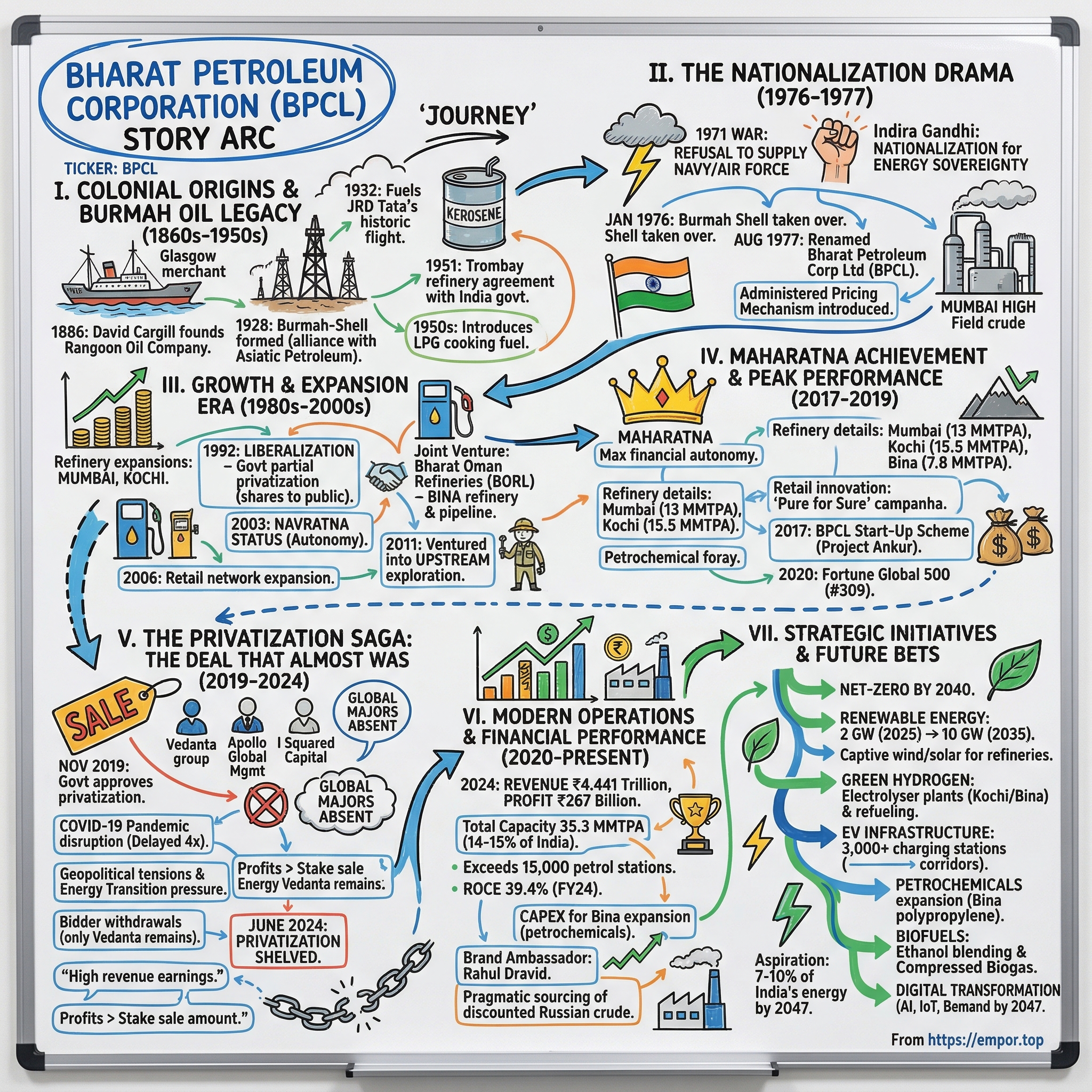
Bharat Petroleum Corporation Limited: The Evolution & Investment Thesis of India's Energy Champion
I. Introduction & The Strategic Question
On the morning of July 22, 2026, the finance team at Bharat Petroleum Corporation Limited published a set of numbers that would have been unthinkable eighteen months earlier. Revenue for the June quarter had surged 23% year-on-year to roughly ₹1.59 lakh crore. Gross refining margins — the spread between what crude costs and what refined products fetch — had exploded to $41.41 per barrel, the highest of any Indian refiner and roughly eight and a half times the level of a year before.12 And the company had lost money. A standalone net loss of ₹3,962 crore; a consolidated net loss of ₹1,873 crore, against a ₹6,839 crore profit in the same quarter a year prior.34
That single quarter is the most compact possible summary of what BPCL actually is. It is not an oil company in the way an investor thinks of Exxon or Shell. It is a two-headed machine — a refiner that profits when crude and product markets dislocate, bolted onto a retailer that is forbidden by informal political convention from passing those dislocations on to Indian motorists. When the US–Iran conflict shut the Strait of Hormuz and drove Brent past $140 a barrel in early 2026, the refining head made a fortune and the marketing head bled it back out.5 Management's own disclosure put the damage precisely: negative margins of ₹25.2 per litre on diesel and ₹7.7 per litre on petrol.2 BPCL was selling diesel to Indian truckers for meaningfully less than it cost to make.
Strip away the drama and the enterprise underneath is formidable. BPCL runs 35.3 million metric tonnes per annum of refining capacity across three sites — Mumbai, Kochi and Bina — which is roughly a seventh of India's total. It sold 55.7 million tonnes of petroleum products in the financial year ended March 2026 through a retail network that reached 25,323 fuel stations after adding 1,691 outlets in that year alone.6 Its retail market share stood at 30.02% in petrol and 29.61% in diesel as of April 2026, and management has stated a long-term ambition of about 32%.6 The equity trades on the NSE under BPCL at roughly ₹319 a share as of mid-August 2026, capitalising the business at about ₹1.39 lakh crore, or somewhere near $16 billion.7
The hook is the arc: a Scottish colonial oil venture, assembled in Rangoon and Glasgow to fight Rockefeller's Standard Oil in Asia, nationalised by an Act of the Indian Parliament in 1976, dragged through a five-year privatisation auction that no one would bid in, and now — as an unsold, state-controlled Maharatna — attempting to spend more capital in a decade than it has cumulatively earned in its history.
The core dilemma for a long-term investor is unusually sharp. On one reading, BPCL is a tollbooth: an un-replicable physical network sitting astride the fuel consumption of a nation whose vehicle fleet is still growing, throwing off enough cash to self-fund a pivot into petrochemicals. On the other, it is a value trap in which the state owns 53% of the equity, controls the selling price, expropriates margin in election years, and now expects the company to underwrite two mega-projects totalling over ₹1.45 lakh crore of capital.68
This piece works through that question in sequence: how a colonial asset became a public sector undertaking; how the downstream empire was assembled and then pruned; why an $8–10 billion privatisation collapsed and what its cancellation means for capital allocation; how Indian downstream economics actually function; what the new management team under Sanjay Khanna is spending money on and whether the discipline is real; where hidden value and hidden risk sit; and finally, where the competitive moat is genuine versus where it is merely the residue of state protection. The story starts in the oilfields of Assam, roughly a century and a half ago.
 Subscribe on LinkedIn
II. Colonial Roots to Nationalization: The Burmah-Shell Footprint (1860s–1977)
The origin story of BPCL begins not in India but in the boardrooms of Glasgow, and it begins as an act of commercial warfare.
In the 1860s, exploration ventures were probing the oil seeps of Burma and Assam — territory that was, at the time, administratively part of British India. In 1886, the Burmah Oil Company was incorporated in Scotland to commercialise those fields. Its problem was not geology but distribution. By the turn of the century, John D. Rockefeller's Standard Oil was flooding Asia with cheap kerosene shipped in distinctive tin cans, and no regional producer could match its logistics or its willingness to price below cost until competitors folded.
The counter-move was a cartel. Royal Dutch, Shell Transport and Trading, and the Rothschild banking interests pooled their Asian marketing into Asiatic Petroleum — a single distribution front designed to make Standard Oil's price war unwinnable. In 1928, the Indian arm of that alliance, Asiatic Petroleum (India), combined with Burmah Oil's Indian marketing operations to create the Burmah-Shell Oil Storage and Distributing Company of India Limited. That entity — half Scottish producer, half Anglo-Dutch marketer — is the direct corporate ancestor of BPCL.
What matters for a modern investor is not the corporate genealogy but what Burmah-Shell physically built. It laid down bulk storage at ports, depots inland, and a dealer network that followed the rail and road corridors of British India. Then, in December 1951, four years after independence, it signed an agreement with the Government of India to build a modern refinery at Trombay, in what is now Mumbai. Burmah Shell Refineries Limited was incorporated in November 1952 to execute it. India in 1952 had almost no domestic refining; nearly every litre of petrol and kerosene arrived as an imported finished product. Trombay changed that, placing a refinery directly adjacent to India's financial capital and its deepest natural harbour.
That siting decision — made by a foreign company for its own commercial convenience — turned out to be the single most valuable asset BPCL ever inherited. A refinery on Mumbai's waterfront, connected to a port and surrounded by the country's densest concentration of industrial and vehicular demand, could not be built today. Modern coastal regulation zone rules, land acquisition hurdles, and urban environmental clearances make that location unrepeatable at any price. The same logic applies, in miniature, to thousands of the company's fuel retail sites on arterial roads that were farmland when the leases were signed.
Then came the reversal. The 1973 OPEC embargo quadrupled crude prices and strained India's balance of payments. For a government already committed to a socialist industrial model, foreign control over the storage, refining, and distribution of a strategic import was politically intolerable. Under Prime Minister Indira Gandhi, Parliament passed the Burmah Shell (Acquisition of Undertakings in India) Act, which received presidential assent on January 24, 1976, vesting the company's Indian undertakings in the Central Government.9 The resulting state entity was named Bharat Refineries Limited. On August 1, 1977, it was renamed Bharat Petroleum Corporation Limited.9
Ownership changed completely, but the physical asset base remained intact. BPCL began life as a public sector undertaking already holding port-connected storage, a functioning refinery, an established dealer network, and trained operating staff — none of which it had to build or purchase at market valuation. Very few state-owned enterprises started from such a formidable physical endowment.
The cost of that endowment was the immediate loss of commercial autonomy. A nationalised fuel retailer in a vast democracy does not set its own pump prices. Every subsequent chapter of BPCL's history — the under-recoveries, the subsidy buffers, the aborted privatisation, and the losses recorded alongside record refining margins — descends from the bargain struck in 1976: the state granted an irreplaceable network and an oligopoly, and in exchange retained the authority to dictate retail pricing.
For four decades after nationalisation, that trade-off functioned effectively. The company enjoyed a captive market and a mandate to expand. The next section examines how far that expansion reached, and what the company eventually had to surrender.
III. Building the Downstream Empire: Refineries, BORL, and Navratna Autonomy (1980s–2010s)
If the 1976 Act gave BPCL its inheritance, the following three decades were about compounding it — first through steel and concrete, then through deal-making.
The flagship Mumbai refinery was progressively debottlenecked and upgraded to 12 million metric tonnes per annum (MMTPA), with secondary processing units added to convert heavier, cheaper crude fractions into high-value transport fuels. In parallel, BPCL took control of Kochi Refineries Limited in Kerala, a facility originally built with foreign technical partnership, and then executed one of the largest refinery expansions in Indian corporate history — the Integrated Refinery Expansion Project — lifting Kochi to 15.5 MMTPA and equipping it with the deep-conversion units needed to run difficult crude grades. Kochi mattered strategically because it gave BPCL a second coastal refinery on the opposite side of the peninsula, hedging cyclone risk, port congestion, and regional demand imbalance in a way a single-site refiner cannot.
Then came the structural outlier. In 1994, BPCL incorporated Bharat Oman Refineries Limited as a joint venture with OQ SAOC, the Omani state oil entity, to build something India had rarely attempted: a large, high-complexity refinery in the landlocked interior, at Bina in Madhya Pradesh. Crude would arrive by tanker at Vadinar on the Gujarat coast and travel roughly 935 kilometres inland via a dedicated pipeline. The logic was distributive. While India's refining capacity clustered along the coasts, its fastest-growing fuel demand was in the northern and central heartland, where transporting finished products long distances by rail tanker is slow and expensive. A 7.8 MMTPA refinery sitting directly within that demand catchment, fed by its own crude pipeline, converted a logistical penalty into a structural freight advantage on every litre sold.
The corporate scaffolding kept pace. BPCL received Navratna status in 2003 and was elevated to Maharatna in 2017 — designations that progressively expanded the board's authority to commit capital without case-by-case ministry approval. In practice, Maharatna status allowed a state enterprise to make ordinary investment decisions much like a private corporation. Crucially, that autonomy did not, and still does not, extend to retail pricing.
The marketing division quietly innovated during the same period. BPCL launched fleet and loyalty programmes — PetroCard and SmartFleet — that provided commercial transport operators with cashless, auditable fueling across a nationwide network, while developing MAK into an established lubricants franchise. Neither initiative transformed overall earnings, but both illustrated an early push to build switching costs in a commodity market by embedding the company directly into corporate customer workflows.
The portfolio surgery of 2021
The most revealing portfolio moves arrived decades later, driven not by organic strategy but by preparing the enterprise for privatisation. Two major transactions closed within days of each other in March 2021, pulling the business in opposite directions.
The first was a forced divestment. BPCL sold its 61.65% controlling stake in Numaligarh Refinery Limited in Assam for ₹9,876 crore to a consortium comprising Oil India Limited, Engineers India Limited, and the Government of Assam.[^10] Commercial rationale was secondary to political necessity: Numaligarh benefited from North-East fiscal incentives that generated exceptionally high profit margins, and the central government was unwilling to let a strategically sensitive border-state asset pass to a private owner alongside BPCL. Carving out Numaligarh yielded a large cash inflow for BPCL but permanently surrendered a stream of tax-advantaged regional earnings. For minority investors, it stands as a clear historic demonstration of the controlling shareholder prioritizing political objectives over the enterprise's asset base.
The second transaction was an opportunistic buyout. BPCL acquired OQ SAOC's entire 36.62% stake in Bharat Oman Refineries for ₹2,400 crore, taking full ownership of the Bina refinery before merging the entity into BPCL the following year.10 The transaction economics were compelling: complete control of a 7.8 MMTPA inland refinery and its crude pipeline at a valuation implying a low-to-mid single-digit multiple of mid-cycle EBITDA — a fraction of greenfield replacement cost. Replicating that complex from scratch — securing land, pipeline rights-of-way, environmental clearances, and civil construction — would require multiple times that expenditure.
The underlying dynamic was clear: BPCL bought out an international partner seeking liquidity during a period of corporate uncertainty, consolidating the precise asset around which it would later anchor its long-term growth plan. Sole ownership of Bina eliminated partner negotiations, allowing BPCL to subsequently commit ₹49,000 crore in expansion capital to the site. Whether that concentrated capital deployment proves prudent or over-extended is examined in Section VI.
By 2021, BPCL possessed a cleaner, more streamlined operating structure: three wholly-owned refineries, a nationwide retail network, and an integrated pipeline backbone. The enterprise had been reshaped for auction — setting the stage for the privatisation attempt that followed.
IV. The Privatization Saga: The $10B Deal That Refused to Happen (2019–2024)
There is a specific kind of corporate limbo that comes from being publicly put up for sale by your own majority owner. BPCL lived in it for four and a half years.
The process opened formally on November 20, 2019, when the Cabinet Committee on Economic Affairs, chaired by Prime Minister Narendra Modi, approved the strategic disinvestment of the Government of India's entire shareholding in BPCL — then 53.29% — together with transfer of management control, and simultaneously cleared the carve-out of the Numaligarh stake.11 This was not a routine minority stake sale of the kind Indian governments run to plug fiscal gaps. It was the proposed handover of the country's second-largest fuel retailer to a private owner.
The prize was substantial. A buyer would acquire, in a single transaction, roughly a quarter to a third of India's retail fuel market, over 35 MMTPA of refining capacity, cross-country product pipelines, LPG bottling and distribution infrastructure reaching tens of millions of Indian households, and thousands of parcels of well-located commercial real estate in a country where land assembly is the binding constraint on nearly every physical business. There is no organic path to that position; even with deep balance sheets and decades of effort, private competitors such as Reliance Industries and Nayara Energy have not matched that retail footprint.
Interest was initially broad. Anil Agarwal's Vedanta Group expressed clear ambition, while global private equity firms — including Apollo Global Management and I Squared Capital — engaged with the process. Reported valuations circled the $8 billion to $10 billion range for the government's stake, though the state never published a formal reserve price.
Then the prospective buyers withdrew, driven by three distinct headwinds.
The first was a shift in macro conditions. The pandemic suppressed transport fuel demand in 2020, undermining long-dated refining cash flow projections. Simultaneously, Western institutional capital faced mounting pressure from limited partners to curtail exposure to fossil fuel infrastructure. A private equity fund seeking to commit billions of dollars to an oil refiner in 2021 encountered fundraising friction at home that was independent of the asset's underlying economics.
The second was the pricing autonomy paradox. On paper, Indian fuel prices were deregulated — petrol in 2010 and diesel in 2014. In practice, state-owned marketers continued to hold pump prices flat through politically sensitive periods regardless of crude price movements. A private owner of BPCL would inherit a major market share without the freedom to set prices, as the remaining two state marketers would continue absorbing losses under government guidance. A private operator could not raise prices unilaterally without ceding volume to state-backed peers not operating under strict profit-maximization constraints.
The third was the absence of an operating partner. Financial sponsors were willing to fund an acquisition, but they required an international oil major — such as Aramco, ADNOC, BP, or Shell — to manage refinery operations and guarantee crude supply. When no operating partner stepped forward, consortia could not be finalized. By May 2022, the government withdrew the offer after the remaining bidders exited.12
The formal conclusion came two years later. On June 12, 2024, Petroleum Minister Hardeep Singh Puri stated that privatization was off the table, noting that BPCL had earned more in three quarters than the stake sale would have realized, making the sale of a high-performing Maharatna economically unviable.1314 That logic underscored a key market reality: the asset was valued higher by the state than by public markets, reflecting a valuation discount tied directly to state control. The government cited profits generated under state control to justify retaining it. As of August 2026, broader commentary on Indian disinvestment policy continues to reflect this structural preference for minority stake sales over complete privatization.15
For shareholders, the four-and-a-half-year process resulted in period-specific strategic friction. During the auction window, management could not commit to long-term capital programs while the eventual ownership structure remained uncertain. While the Numaligarh stake was divested, major organic capital allocation was largely deferred.
The outcome, however, brought structural clarity. Since mid-2024, BPCL has operated with a defined shareholder structure and a clear mandate to plan across market cycles. This stability unlocked the capital expenditure program currently underway. Whether this strategic clarity generates long-term value depends on the returns delivered by this newly deployed capital. Evaluating that requires examining how the business generates — and occasionally loses — its operating margin.
V. Core Business & Industry Structure: Refining, Marketing, & PSU Economics
Picture a fuel station on the Mumbai–Pune expressway at four in the morning. A truck driver swipes a fleet card, fills 300 litres of diesel, and pulls back onto the highway. That transaction looks like standard retail. Economically, however, it is the terminal node of a complex chain that began weeks earlier when a BPCL trader in Mumbai bid for a crude cargo originating in the Persian Gulf, the Black Sea, or the Atlantic basin. Understanding BPCL requires looking across that entire chain to see where value is created—and who controls the price at each step.
The state triad and the entry barrier
India's downstream fuel market functions as a state-dominated oligopoly. Indian Oil Corporation holds the largest position, followed by BPCL and Hindustan Petroleum, while private operators Reliance Industries and Nayara Energy retain modest market shares. As of April 2026, BPCL held a retail market share of 30.02% in petrol and 29.61% in diesel.6
The primary entry barrier protecting this oligopoly is not technology, but physical and administrative infrastructure: rights-of-way for pipelines, access to ports and inland depots, bulk storage facilities, environmental clearances, and prime commercial real estate. Building a fuel station is straightforward; assembling a network of more than twenty-five thousand well-sited locations required seven decades and a colonial head start. BPCL added 1,691 retail outlets in FY26—a rapid build rate in absolute terms—yet that expansion represented under 7% growth on its existing base, illustrating the immense scale needed to shift market share.6
Two businesses in one balance sheet
BPCL operates two distinct economic engines under one roof: refining and marketing.
The refining division earns a gross refining margin (GRM)—the dollar-per-barrel difference between the market value of refined products produced and the delivered cost of crude input. GRMs depend on global crack spreads for diesel, petrol, and jet fuel, as well as a refinery's technical capability to process heavier, cheaper crude grades without sacrificing high-value output. That processing capability is reflected in refinery complexity; BPCL's distillate yield of roughly 84% means the vast majority of every crude barrel is converted into high-margin transport fuels rather than low-value heavy residue.6
The marketing division earns a marketing margin—the gap between retail pump prices and product costs, minus transport costs, dealer commissions, and taxes. Here, prices are not set by market dynamics, but determined informally by state intervention.
In theory, these two businesses form a natural hedge. When crude prices drop, refining margins shrink, but retail pump prices remain steady, allowing marketing margins to widen. Conversely, when crude prices spike, refining margins expand while capped retail pump prices squeeze marketing margins. Over a full commodity cycle, the two divisions are expected to offset one another.
In practice, that hedge works unevenly. In FY25, when global refining margins softened, BPCL's reported GRM dropped to $6.8 per barrel from $14.1 the previous year. Yet the company generated ₹13,275 crore in standalone net profit as strong marketing margins carried the balance sheet.166 In FY26, as refining margins recovered to $11.6 per barrel, standalone profit climbed 75.5% to ₹23,303 crore, while consolidated profit nearly doubled to ₹25,843 crore.176 In both years, the integrated structure delivered robust earnings.
The limitation of this hedge became apparent in the June 2026 quarter. Although refining margins expanded significantly, marketing margins turned deeply negative, resulting in a loss of ₹25.2 per litre on diesel sales.2 The offset failed because BPCL's refining and marketing volumes are mismatched: in FY26, the company sold 55.7 million tonnes of petroleum products while refining 41.2 million tonnes.6 Because retail sales exceed refining output, BPCL must purchase the deficit on the open market. When international product prices surge, the unhedged short position in the marketing book outweighs the gains in the refining book, converting the theoretical hedge into a net operational loss. On the first-quarter earnings call, management urged analysts to evaluate performance on an integrated basis—a logical request during profitable quarters, but one that highlights the structural risk when price freezes persist.1
The Russian crude chapter, and its second act
Following international sanctions on Russia in 2022, Indian refiners became key buyers of discounted Urals crude, often securing barrels at discounts exceeding $10 per barrel relative to Brent. That lower feedstock cost fueled BPCL's record profits in FY24.18
By mid-2026, the dynamics of that trade had changed. Russian crude intake rose from roughly 25% of BPCL's total runs in the December 2025 quarter to 31% in the March 2026 quarter, reaching 40–42% shortly thereafter. However, management disclosed that Russian grades had shifted from trading at a discount to commanding a premium over benchmark prices.6 BPCL increased its Russian volume due to availability rather than cost savings. At the same time, landed crude premiums—including freight, insurance, and supplier markups above benchmark prices—rose to $10–12 per barrel from pre-war levels of $4–5, having peaked at $20–25 during initial disruptions.6 Tanker freight rates on the Worldscale index stood at 380–400, compared with a pre-war baseline of 55–60.1
Consequently, the Russian crude strategy evolved from an opportunistic discount trade into a broader supply-diversification effort. In FY26, BPCL introduced eight new crude grades across four regions, incorporating barrels from Venezuela, Brazil, and Angola. To manage tight contractual availability, the company shifted its purchasing mix from a planned ratio of 55% term contracts and 45% spot purchases to between 50% and 55% spot, with spot buying reaching 69% in the June 2026 quarter.61 While the technical flexibility to process diverse crude slates without lowering product yields represents an operational strength, it functions as a cost-mitigation mechanism rather than a structural margin booster.
Under-recoveries and the LPG buffer
State intervention is also evident in the pricing of domestic liquefied petroleum gas (LPG). Sold to households below import parity, LPG generates an "under-recovery"—an uncollected cost burden that relies on government compensation.
As of June 30, 2026, BPCL carried a cumulative net negative LPG buffer of ₹15,804 crore.2 The company had received ₹11,594 crore in government compensation installments and recognized an additional ₹1,898 crore in the June 2026 quarter, leaving roughly ₹4,210 crore pending.2 Per-cylinder under-recoveries averaged approximately ₹670 in the March 2026 quarter, declining to ₹490 in July and ₹210 in August as global crude prices moderated.61
From an analytical standpoint, these uncompensated costs represent an unsecured receivable from the government, recognized in earnings as sovereign support is confirmed. Management reiterated its expectation of continued government backing during the June-quarter earnings call.1 Historically, subsidy reimbursements have been paid, but their timing remains subject to fiscal discretion, making the LPG buffer a key accounting variable on BPCL's balance sheet.
Accounting judgment also extends to upstream assets held through Bharat PetroResources Limited. In FY26, BPCL recorded a ₹4,350 crore impairment on its Brazilian exploration assets, which management attributed to operational delays rather than reductions in estimated reserves.6
Ultimately, BPCL's financial performance depends less on internal operational efficiencies than on the spread between international market benchmarks and domestic administered prices, alongside the timing of government subsidy settlements. This regulatory environment defines the operational backdrop as management executes its long-term capital deployment plan.
VI. Management, Capital Allocation & "Project Aspire"
Leadership at an Indian public sector undertaking follows a rhythm with little analogue in Western corporate governance. Chief executives are career insiders appointed by a government panel, serving until a fixed superannuation date. There are no founder-CEOs, no outside hires, and virtually no equity compensation. In their place sit deep operating knowledge and a ticking retirement clock.
G. Krishnakumar took charge as Chairman and Managing Director in March 2023 — a 36-year BPCL veteran, an engineer from NIT Tiruchirappalli with a JBIMS MBA, who built his career on the marketing side and was closely linked to retail transformation, loyalty programs, and the MAK lubricants franchise.19 In August 2023, he launched Project Aspire, a ₹1.5 lakh crore five-year capital plan.8 His tenure ended on April 30, 2025.20
That succession carries strategic weight. Sanjay Khanna, previously Director of Refineries, assumed additional charge as CMD on May 1, 2025, and was formally appointed by the Cabinet's Appointments Committee to lead the company through his superannuation on May 31, 2029.2021 A chemical engineer from NIT Tiruchirappalli with a postgraduate finance qualification from the University of Mumbai, Khanna previously ran both the Mumbai and Kochi refineries.20
BPCL has effectively entrusted the largest construction program in its history to a refinery operator rather than a marketer, coming at the exact moment its growth thesis shifts from fuel distribution to petrochemical manufacturing. The appointment aligns logically with that shift. Yet it remains a calculated risk: running complex plants safely at high utilization requires a different skillset than delivering over ₹1.45 lakh crore of greenfield capital on time and on budget across two mega-sites simultaneously. The early execution record provides a mixed picture.
Governance dynamics remain unchanged. As of March 2026, the Government of India held approximately 53% of the equity, foreign institutional investors held 19.6%, and domestic mutual funds held 18.5%, leaving a free float of nearly 44%.6 Executive management holds no material equity, with performance evaluated against annual targets set by the Ministry of Petroleum and Natural Gas. Consequently, company leadership lacks a direct financial stake in share price performance. Alignment with minority shareholders rests on professional discipline and institutional norms rather than equity ownership.
Where the money is going
The capital deployment plan splits into two main tracks. The larger portion reinforces the core business through refinery expansion, petrochemical integration, logistics pipelines, and retail outlet growth. The smaller portion funds energy transition initiatives, including renewable power, city gas networks, electric vehicle charging, compressed biogas, and green hydrogen. Capital expenditure reached ₹20,400 crore in FY26, with FY27 guidance set between ₹25,000 crore and ₹27,000 crore.6 For FY27, management budgeted roughly ₹11,000 crore for refining and petrochemicals, ₹10,000 crore for marketing, logistics, retail outlets, and pipelines, ₹2,250 crore for upstream exploration, and ₹1,700 crore for city gas.6
The Bina downstream petrochemical complex serves as the centerpiece. Approved at roughly ₹49,000 crore, with its foundation stone laid in September 2023, the project expands Bina's refining capacity from 7.8 to 11 MMTPA while integrating a 1.2 MMTPA ethylene cracker to produce polyethylene, polypropylene, and aromatics.2223 The project achieved financial closure in January 2025 through a ₹31,802 crore debt facility arranged by a six-lender consortium led by State Bank of India.2425
The strategic rationale is straightforward. An ethylene cracker converts refinery streams that would otherwise yield low-margin transport fuels into raw materials for plastics and chemicals. By redirecting those hydrocarbon streams, BPCL can capture higher, less cyclical margins tied to packaging, construction, and consumer manufacturing rather than internal combustion engine use. If domestic motor fuel demand crests in the 2030s, petrochemical integration provides an alternate outlet for refined volumes. Management aims to expand total petrochemical capacity to 3.2 MMTPA by FY29 while expanding its natural gas footprint roughly threefold.26
The execution reality check warrants close investor attention. By the March 2026 quarter, Bina achieved 23% physical progress against a target of 32%—a nine-percentage-point delay that management attributed to global supply chain friction and equipment manufacturing lag.6 Physical progress reached 30.7% by the June 2026 quarter, with ₹5,900 crore spent and ₹30,000 crore in contractual commitments.61 Management stated that project costs remain within the sanctioned budget variance of plus or minus 10%, highlighting that 75–80% of contracts are structured on a fixed-price basis and that foreign currency exposure is capped at ₹6,500 crore of the total ₹49,800 crore outlay.6
While this contracting structure mitigates cost inflation, execution remains vulnerable to schedule delays. The company has completed less than a third of physical construction while operating in a volatile crude environment. Progress across secondary projects presents a mixed timeline: the ₹5,000 crore Kochi polypropylene unit reached 40% completion with 85–90% of contracts awarded and commissioning scheduled for May 2027, whereas the Mumbai residue fluid catalytic cracker project reached 7% completion, with commissioning targeted for September 2027.16
The Andhra escalation
In 2025, the scale of capital deployment expanded substantially. BPCL initiated plans to construct a 9–12 MMTPA greenfield refinery and petrochemical complex near Ramayyapatnam Port in Nellore, Andhra Pradesh, featuring a 1.5 MMTPA cracker. The Andhra Pradesh state government allotted 6,000 acres in October 2025, offering in-principle approval for state incentives covering up to 75% of capital expenditure over twenty years, while BPCL signed a non-binding memorandum of understanding with Oil India to collaborate on the project.2728 The project carries an estimated cost of ₹96,862 crore, with expenditures heavily back-loaded: ₹4,843 crore allocated in the initial year, escalating to ₹29,059 crore in FY29 and ₹38,745 crore in FY30.27 By the June 2026 quarter, land registration for 3,082 acres was finalized, with environmental clearances pending.1
Combined, Bina and Ramayyapatnam represent nearly ₹1.46 lakh crore in capital commitments—an amount roughly equal to BPCL's total market capitalization of ₹1.39 lakh crore, undertaken by an enterprise that generated a record ₹23,303 crore in standalone net profit in FY26.177 This massive capital outlay raises a fundamental capital allocation question: whether a state-controlled refiner subject to political price intervention should simultaneously execute two greenfield mega-projects, or whether this expansion reflects public sector mandates prioritizing domestic capacity building and job creation over strict return metrics.
Management maintains full commitment to the timeline. On the June 2026 investor call, Director of Finance V.R.K. Gupta stated: "We are not backing out any of the CapEx program now. All are good in terms of returns point of view."1 Maintaining an ambitious capital program during a loss-making quarter highlights management's confidence in project economics, though it leaves little balance sheet margin if downstream price freezes recur.
The balance sheet, and how fast it can move
BPCL entered this investment cycle with considerable balance sheet strength. At the close of FY26, the company held a net cash position of approximately ₹8,700 crore, supported by a conservative standalone gross debt-to-equity ratio of 0.11, and consolidated gross and net debt-to-equity ratios of 0.43 and 0.25, respectively.6
That liquidity cushion eroded rapidly. Gross borrowings rose to ₹17,396 crore by June 30, 2026, shifting the company into a net debt position of roughly ₹5,000 crore—a ₹13,700 crore balance sheet swing in a single quarter caused by retail marketing losses and delayed LPG compensation.1 While Gupta noted that net borrowings remain modest relative to total assets, sell-side projections forecast net debt rising toward ₹23,000 crore by the end of FY27 as capital outlays accelerate.16 While current leverage remains manageable, the rapid shift illustrates how quickly operating losses can consume balance sheet reserves during an intensive capital cycle.
Dividend policy reflects these competing cash demands. BPCL declared a total dividend of ₹10 per share for FY26, comprising a ₹5 interim and ₹5 final payout.29 That represents a marked reduction from FY24, when the company distributed a ₹21 per share final dividend alongside a 1:1 bonus issue—its first in seven years.30 As capital expenditure ramps up, shareholder distributions have moderated. If refining margins normalize as peak capex approaches in FY29 and FY30, balancing the central government's fiscal demand for dividends against project funding requirements will pose a key capital allocation challenge.
Beyond the headline projects, there is a portfolio of assets that the market does not obviously price. That is where the story goes next.
VII. Hidden Assets, Optionality & Segment Breakdown
Every large industrial enterprise accumulates assets that sit outside its main operating income statement. BPCL holds a notable collection of them, divided across three distinct buckets with sharply contrasting risk profiles.
Petrochemicals: the margin arbitrage already underway
While the expansion at Bina represents the future of BPCL's petrochemical strategy, the Kochi refinery provides its operational present. The Propylene Derivatives Petrochemical Project at Kochi produces acrylic acid, oxo-alcohols, and acrylates — essential input chemicals for paints, adhesives, coatings, and superabsorbent polymers that India has historically imported. The ₹5,000 crore polypropylene unit currently under construction at the site extends that logic into commodity plastics.6
The underlying economic case is straightforward: petrochemical operations across the industry typically earn wider operating margins than fuel refining. Their products are specialized, their customers are industrial buyers rather than retail motorists, and — crucially for BPCL — their prices are not administered by the state. Every unit of margin that migrates from the regulated fuel book to the unregulated chemical book reduces the company's exposure to retail price intervention.
The counter-argument centers on cycle timing. Global production capacity in ethylene and polyolefins has expanded aggressively, driven largely by additions in China, pushing the chemical sector through a prolonged margin trough. BPCL is building into a market cycle it cannot control, with the Kochi unit scheduled for commissioning in 2027 and Bina expected in FY28. If the petrochemical downturn persists into that commissioning window, returns on the ₹49,000 crore investment will be tested when depreciation and interest charges peak. Management has not disclosed project-level internal rate of return metrics, an omission that stands out for a capital program of this magnitude.
The gas stakes: real value, historic cost
BPCL is also a founding shareholder in two of India's prominent gas franchises. It holds roughly 22.5% of Indraprastha Gas Limited, which dominates city gas distribution across Delhi and the National Capital Region, and about 12.5% of Petronet LNG, the country's primary liquefied natural gas importer.31 The company also retains equity stakes in Sabarmati Gas and Maharashtra Natural Gas.
These holdings carry two forms of value. First, as listed securities carried on BPCL's balance sheet at historic acquisition cost, their market capitalization stands at a substantial multiple of book value. While this creates periodic divestment speculation, management has consistently declined to commit to monetizing these stakes.31 Second, they provide strategic optionality: city gas participation directly captures the shift from petrol to compressed natural gas in passenger transport and from domestic cylinders to piped gas in households, helping BPCL hedge against the gradual erosion of its core liquid fuel volumes.
A notable corporate governance dynamic accompanies these investments. Petronet LNG serves simultaneously as an equity holding and a principal commercial counterparty; BPCL sought and received shareholder approval for material related-party transactions with Petronet for FY27, passed with overwhelming support.32 While these transactions are routine and disclosed, a structure where a company acts concurrently as promoter, board member, and anchor customer of a listed affiliate warrants ongoing analytical scrutiny.
Upstream: where the value went the wrong way
Conversely, Bharat PetroResources Limited, the exploration arm, has persistently absorbed capital with limited returns, a trend reinforced in FY26. BPCL recorded a ₹4,350 crore impairment on its Brazilian exploration assets in the March 2026 quarter — attributed by management entirely to project delays rather than to any deterioration in reserves or project economics.6 The floating production storage and offloading tender alone required nearly three years to finalize, pushing initial oil production to calendar year 2031 and first gas to 2032, well beyond the original 2029 target.6 The exploration subsidiary has since consolidated its position, acquiring the remaining 39.14% of the vehicle holding the block's 40% working interest, with gross output projected at approximately 88,000 barrels per day.61 Capital requirements remain heavy, with future equity contributions estimated at roughly $1.2 billion over the next three to four years.6
Meanwhile, the Mozambique LNG project — in which BPCL holds a 10% interest — resumed construction after force majeure was lifted in November 2025, reaching roughly 42% physical completion with first cargo targeted for mid-2028.61
Assessed objectively, the upstream division has represented a decade-long capital drain with an extended payout horizon. While both offshore developments may eventually prove viable, neither will generate meaningful operational cash flows before the end of the decade, both demand ongoing equity infusions, and one has recently sustained a major write-down. Funding deepwater exploration in minority, non-operated overseas positions while committing ₹1.46 lakh crore to domestic downstream mega-projects presents a clear capital allocation tension. While management's stated rationale — securing 6.5 to 7 million metric tonnes per annum of equity oil and gas within the group — is defensible in principle, historical financial returns have yet to validate the strategy.6
The transition portfolio
Looking toward longer-term energy transition goals, BPCL has committed to achieving net-zero Scope 1 and Scope 2 operational emissions by 2040, supported by interim targets of 10 gigawatts of renewable power capacity by 2035 and 30 kilotonnes per annum of green hydrogen production by 2030.26 Early operational steps are already visible, including securing 100 megawatts of wind power capacity through a Madhya Pradesh state tender involving an estimated ₹860 crore in capital outlay.331
The most tangible transition asset, however, is embedded within its existing retail footprint. BPCL expanded its electric vehicle charging network to 6,823 stations by the end of FY26, alongside 2,650 compressed natural gas outlets — holding market leadership among state-owned refiners in both categories.6 This distribution strength reflects an underlying commercial reality: a fuel retailer's primary physical asset is not the pump itself, but prime highway and urban real estate where motorists naturally stop. As vehicle propulsion evolves, driver dwell time creates opportunities for non-fuel revenue. Expanding these offerings under formats such as Apna Ghar and BeCafe makes a portion of the network's long-term enterprise value independent of liquid fuel sales entirely.6
Two key caveats temper this optionality. First, business models for large-scale electric vehicle charging remain economically unproven globally, representing a strategic capability rather than a demonstrated profit center, with BPCL providing no segment-level financial disclosures for its charging operations. Second, charger throughput remains inherently constrained: an electric vehicle charging bay occupies space for thirty minutes to service one vehicle, whereas a traditional fuel pump services multiple vehicles in the same window — a structural utilization challenge the retail industry has yet to resolve.
VIII. Hamilton Helmer's 7 Powers & Porter's 5 Forces Analysis
Strategic frameworks are useful only when applied dispassionately, especially when they deliver uncomfortable conclusions. For BPCL, the analysis yields several.
Hamilton Helmer's 7 Powers
Scale economies — high, but partly shared. Operating 35.3 MMTPA of refining capacity alongside a nationwide pipeline and depot infrastructure drives down unit procurement and logistics costs. That efficiency appears in retail outlet throughput, which management reported at 143 kilolitres per month in the March 2026 quarter, describing it as industry-leading.6 Higher volume per site spreads fixed land, storage, and staffing expenses across more litres. The caveat is that BPCL's two state-owned peers command comparable scale. This power protects the state triad from outside competitors rather than providing BPCL a cost advantage within it.
Cornered resource — high, and the strongest of the seven. The 25,323-outlet retail network is the enterprise's primary structural asset. It is not merely a brand or a technological process, but physical control over the prime locations where Indian transport fuels are sold. Modern urban zoning, environmental regulations, and land costs make replicating a footprint of this density practically impossible at any price. This cornered asset explains why the privatization opportunity attracted interest and why the underlying enterprise value persists through commodity cycles.
Process power — medium. BPCL has demonstrated technical agility in crude procurement and refining flexibility, qualifying eight new crude grades across four regions in a single year, blending heavy Venezuelan slates, and maintaining distillate yields near 84% during operational shifts.6 This accumulated technical expertise protects operating margins, but it does not generate structural pricing power.
Switching costs — low. A motorist choosing between a BPCL outlet and a competing state-owned station on the same road faces no switching friction. Loyalty programs and commercial fleet cards create modest retention among transport operators, but consumer switching costs remain negligible.
Network effects — essentially absent. Additional customers using BPCL fuel stations do not make the network more valuable to the next driver. Network density improves fueling convenience, which reflects scale economies rather than a true network effect.
Counter-positioning — absent. BPCL is an established incumbent. It possesses no disruptive business model that competitors cannot copy, while remaining exposed to private retailers operating without social pricing mandates. However, private peers face their own constraint: they cannot profitably undercut a state-backed rival selling fuel below cost.
Branding — medium at best. The MAK lubricants line commands real brand equity in a category where customers perceive quality differences, and the "Pure for Sure" campaign provides a meaningful trust signal in a market historically concerned with fuel adulteration. Neither, however, enables a price premium on petrol or diesel, where retail prices remain uniform.
The composite assessment shows BPCL's strategic power heavily concentrated in an irreplaceable physical footprint, supported by operational scale and technical expertise. This combination creates a durable defensive moat, but state price controls prevent the company from capturing the economic surplus it generates.
Porter's Five Forces
Threat of new entrants — very low. Capital intensity, statutory licensing, pipeline access, and commercial land constraints make greenfield entry into national fuel retailing virtually impossible. Reliance, the most well-capitalized private challenger, has spent two decades building its network yet retains only a single-digit market share.
Bargaining power of suppliers — high, and rising. BPCL functions as a price-taker in international crude markets and faces elevated landed premiums to secure feedstock. Term contract availability fell to 45–46% from a planned 55%.6 By purchasing 69% of its crude requirements on the spot market during a shipping disruption in the June 2026 quarter, BPCL experienced that supplier leverage directly.1
Bargaining power of buyers — structurally low, functionally extreme. Individual motorists exercise no bargaining power. However, the government acts as a proxy buyer with absolute authority over retail pump prices. State intervention exercised that power directly when BPCL absorbed a loss of ₹25.2 per litre on diesel in a single quarter.2 Standard analytical frameworks understate this risk because buyer power is exercised through political regulation rather than commercial negotiation.
Threat of substitutes — medium and rising. Compressed natural gas is increasingly replacing diesel in commercial vehicle fleets, while piped natural gas is displacing bottled LPG in urban households. Management attributed a 14–15% drop in LPG sales volume during the June 2026 quarter partly to PNG adoption alongside supply constraints.1 Over a longer horizon, vehicle electrification presents an ongoing threat, concentrating first in two- and three-wheelers.
Competitive rivalry — low to moderate. The three state-owned marketers do not compete on retail price. Instead, competition centers on network expansion, station throughput, customer service quality, and non-fuel retail offerings. BPCL's stated ambition to increase its retail market share to roughly 32% reflects this incremental, site-by-site rivalry.6
Industry performance during the June 2026 quarter illustrates how these structural dynamics play out across balance sheets. BPCL delivered the highest gross refining margin among state refiners at $41.4 per barrel, compared with $36 for Indian Oil and $23.4 for Hindustan Petroleum.34 Despite outperforming its peers in refining efficiency, BPCL still posted an overall loss because its marketing volume significantly exceeds its refining capacity. HPCL, with weaker refining yields and higher marketing exposure, suffered larger losses, while IOC's balanced refining-and-marketing footprint offered greater earnings stability. Within India's state-dominated oil sector, the ratio of marketing sales to refining output determines profitability during global price shocks, and BPCL's deficit leaves it structurally exposed when retail price freezes occur.
How management frames these operational trade-offs—and how market analysts respond—provides critical insight into the company's future trajectory.
IX. Transcripts & Earnings Call Stress Test: Analyst Q&A vs. Prepared Remarks
The most revealing forty minutes in a state enterprise's year are not the prepared remarks. They are the questions afterwards, when a sell-side analyst who has modeled the company for a decade asks something that cannot be answered with a slide.
Two earnings calls in mid-2026 bracket the current situation.
The May 2026 call, covering the fourth quarter and full financial year 2026, was delivered from a position of strength. Adjusted EBITDA and net profit beat consensus estimates by 29% and 41% respectively, bolstered by robust marketing margins and inventory gains.6 Management reported a gross refining margin of $17.60 per barrel for the quarter, record annual profits, refinery utilization running at 115% to 118%, and an expansion of nearly 1,700 retail outlets over the year.6 The prevailing narrative was execution and momentum.
Even so, three subtle issues surfaced during the Q&A that warranted scrutiny. First, management disclosed that the Bina expansion stood at 23% physical progress against a planned target of 32%—a self-reported delay volunteered rather than extracted under questioning.6 Second, management addressed the ₹4,350 crore Brazil impairment, attributing it specifically to project delays rather than underlying asset economics—a distinction that represents either genuine operational precision or convenient framing that only future disclosures can test.6 Third, leadership stated plainly that it could provide no near-term gross refining margin guidance due to volatility across crude prices, landed premiums, freight, insurance, and product crack spreads.6 While declining to offer guidance during volatile periods is defensible, it leaves investors without a management-backed benchmark for the single largest driver of quarterly earnings.
The July 2026 call, covering the loss-making first quarter of FY27, provided the true stress test. Analysts focused on the central contradiction: how a company could generate a record gross refining margin of $41.41 per barrel yet post a standalone net loss of ₹3,962 crore. Management responded by reframing the unit of analysis around the integrated business, highlighting extreme market dislocations, including product crack spreads of $60 to $70 per barrel and jet fuel prices that temporarily approached $100 per barrel.1 While evaluating downstream operations on an integrated basis is analytically sound, that integrated perspective was notably less emphasized during quarters when strong marketing margins offset depressed refining returns.
Three specific exchanges from the call highlight key operational and governance dynamics:
On capital discipline. Asked whether the capital expenditure program would be trimmed during a loss-making quarter, Director of Finance V.R.K. Gupta stated: "We are not backing out any of the CapEx program now. All are good in terms of returns point of view," with full-year guidance held at ₹25,000 crore.1 This unhedged commitment gives investors a clear baseline against which to track execution. Unannounced delays or capex reductions in subsequent quarters would signal balance sheet pressure, whereas steady project delivery would validate management's capital allocation discipline.
On the LPG receivable. Management detailed the under-recovery numbers line by line and expressed confidence in continued government support without claiming any contractual entitlement.1 While the granular disclosure was constructive, sovereign support remains outside company control, and management's confidence in government backing does not constitute a legally binding entitlement.
On crude sourcing. Leadership confirmed that August crude requirements were fully contracted while September purchases were being finalized, noting a 35-day crude inventory buffer alongside market reports of buying Russian Urals and CPC grades from non-sanctioned entities.135 Providing detailed visibility on a partially open forward supply position during severe maritime shipping disruptions represents a high level of operational disclosure.
The broader pattern across calls. BPCL's disclosure practices compare favorably with typical public sector benchmarks. Project schedule delays were self-reported, asset impairments were detailed, and under-recovery buffers were quantified down to the crore. The primary analytical limitation lies in forward-looking accountability for strategic drivers: management has published no project-level internal rate of return targets for the Bina or Andhra Pradesh mega-projects, provided no formal guidance on marketing margin normalization, and maintained standard corporate language regarding retail pricing—citing market dynamics and consumer interests—which underscores that retail price settings remain governed by government policy.
A structural asymmetry also characterizes management's narrative framing. Management typically presents high refining margins as operational achievements while treating marketing losses as external market conditions. In reality, external forces shape both segments. While BPCL controls feedstock selection, plant yields, and refinery utilization rates, it does not control global crack spreads or domestic pump prices. A balanced evaluation attributes less of the profitable quarters to internal management skill and more to favorable macro conditions.
That divergence between the factors management controls and the metrics by which the enterprise is evaluated defines BPCL's core investment risk.
X. Risk Radar: Material Threats to the Thesis
The risks facing BPCL are not abstract or generic. They are structural, immediate, and in several cases already active.
1. Political price control and the under-recovery mechanism. This is not a distant tail risk; it represents the operational baseline whenever global crude spikes, as demonstrated in the June 2026 quarter. When the Hormuz disruption drove crude higher, retail pump prices moved only incrementally — with management citing calibrated adjustments of roughly ₹7.5 per litre against per-litre diesel losses several times that amount — leaving the company to absorb the shortfall.12 While government compensation mechanisms eventually recover part of these losses, reimbursement remains slow, discretionary, and legally unenforceable. For investors, this implies that earnings during high-crude periods reflect state policy decisions rather than underlying operational efficiency, making standard valuation multiples applied to peak-cycle earnings misleading.
2. Capital concentration and execution risk. Combining the ₹49,000 crore expansion at Bina with the nearly ₹97,000 crore greenfield project in Andhra Pradesh commits BPCL to spending an amount roughly equal to its entire market capitalization over five years.2327 Physical progress at Bina is already running behind schedule, while the Andhra project awaits environmental clearances.61 Structural risk mitigations — such as fixed-price contracts on 75% to 80% of Bina's packages, capped foreign currency exposure, and pre-arranged project financing — contain potential cost overruns but do not guarantee expected financial returns.6 The chief danger is a timing overlap: peak capital outlays for Andhra in FY29 and FY30 will coincide with rising depreciation and interest expenses from Bina before its new chemical units reach full commercial cash flow generation.
3. The petrochemical cycle. Both mega-projects assume that petrochemical margins will justify the heavy capital investment. However, global ethylene and polyolefin production capacity has expanded aggressively, and while India remains a net importer due to domestic capacity deficits, prices are dictated by regional marginal producers across Asia. If the global chemical sector's margin trough persists through Bina's FY28 commissioning window, BPCL will carry high project debt on assets earning below-target returns. Because management has not disclosed project-level internal rate of return metrics, outside investors cannot independently stress-test these investment returns.
4. Crude sourcing and geopolitics — from tailwind to cost burden. The structural discount that benefitted Indian refiners following international sanctions on Russia has largely dissolved. Russian crude grades have shifted to trading at a premium over benchmark prices, landed crude premiums have expanded to $10–$12 per barrel from pre-war baselines of $4–$5, tanker freight rates stand at nearly seven times their historical baseline, term contract availability has dropped to 45–46%, and spot purchasing surged to 69% in a single quarter.61 Together, these shifts have created a costlier and less predictable procurement environment than at any time since 2022. Stricter sanctions enforcement or further Middle Eastern maritime escalation would compound these pressures directly, with Brent futures in August 2026 continuing to price in Hormuz risk.5
5. Demand substitution in the wrong sequence. While long-term market attention focuses on electric vehicles displacing petrol, immediate volume erosion is being driven by natural gas adoption. Household LPG sales dropped 14% to 15% year-on-year in the June 2026 quarter, with management citing conversion to piped natural gas as a contributing factor, while compressed natural gas continues to capture commercial transport share from diesel.1 Although BPCL's equity holdings in city gas distributors partially cushion these shifts at the group level, gas substitution directly reduces high-margin fuel volume on its primary balance sheet. Vehicle electrification remains a longer-term threat, concentrated initially in the two- and three-wheeler segments.
6. Cost of capital, receivables, and financial flexibility. BPCL's balance sheet swung from a net cash position at the end of FY26 to roughly ₹5,000 crore in net borrowings within three months, dragged down by retail marketing losses and delayed LPG compensation payouts.61 A substantial portion of the company's recorded receivables represents an expectation of government compensation rather than a legally enforceable claim. Combined with an ESG-driven narrowing of global institutional capital for refining assets, this leverage shift increases the long-term cost of debt for funding BPCL's extended capital expenditure program.
7. Operational concentration. BPCL's refining earnings depend almost entirely on three sites operating at 115% to 119% of nameplate utilization.6 Running refineries consistently above nominal capacity demonstrates strong operating discipline, but it leaves little operational buffer. An unplanned outage at either Mumbai or Kochi would immediately impair refining profits without an internal backup to absorb the lost volume.
Taken together, these material risks share a common structure: BPCL's downside exposure stems primarily from factors beyond its control — global commodity pricing, geopolitical disruptions, and government intervention — while its risk mitigations depend on internal execution. That balance defines both the corporate history and the ongoing investment case.
XI. Playbook: Business & Investing Lessons
1. In emerging markets, land is the moat that software cannot route around. The asset that underpins BPCL's long-term enterprise value is not merely a set of refineries or a brand, but a decades-long accumulation of prime real estate that regulation, urbanization, and land acquisition hurdles have rendered irreplicable. When evaluating a physically distributed business in a rapidly urbanizing economy, the relevant question is not what it costs to build one additional node, but whether the existing network could be assembled today at any price. For BPCL, the answer is no—and that physical footprint remains the durable core of the enterprise regardless of how the transport fuel mix evolves.
2. State ownership is a two-sided contract, and the terms are not renegotiable. The sovereign majority shareholder provides oligopoly protection, lower borrowing costs, and an implicit balance sheet backstop. In exchange, it extracts retail pricing control, dividend payouts timed to fiscal requirements, and the right to carve out strategic assets—as demonstrated by the Numaligarh divestment. The market responds with a persistent valuation discount, which is not a temporary mispricing to be arbitraged, but a rational adjustment for a structural transfer of economic value. The error investors make is expecting that discount to close organically. It closes only if governance terms change—and Minister Puri's 2024 statement confirmed they will not.13
3. Vertical integration hedges the commodity cycle only until physical volumes diverge. Combining refining and marketing smooths consolidated financial performance across most cycle phases, as demonstrated in FY25 and FY26. However, a natural hedge holds only when refining and retail volumes are evenly matched. Because BPCL's product sales significantly exceed its refining throughput, an extreme spike in international refined product prices converts a theoretical hedge into an unhedged short position. Investors relying on integrated hedging must verify that the operational legs are equal in scale.
4. Geopolitical windfalls are cyclical rents, not moats—and they expire on schedule. The discounted Russian crude supply provided a substantial multi-billion-dollar benefit to Indian refiners, which BPCL captured through operational flexibility. By 2026, however, those same barrels traded at a premium over benchmarks while freight and landed delivery costs had expanded.6 The durable outcome of that period was not the transient feedstock discount, but the technical capability developed to process eight new crude grades across four regions. In valuation models, external windfalls warrant zero terminal capitalization, whereas the internal operational capabilities forged during those disruptions retain lasting value.
5. Test capital discipline in the quarters when execution is inconvenient. Any management team can profess capital discipline during a record-profit year. The meaningful test occurs when the same team faces operational losses. When BPCL reported a net loss in July 2026, leadership reaffirmed its full capital expenditure program without reduction.1 That commitment provides a clear baseline for investors: it will resolve either through conviction validated by project delivery or through capital inflexibility exposed by subsequent delays or quiet deferrals.
6. Read what a company discloses about its own operational delays. BPCL explicitly self-reported that physical progress at Bina was nine percentage points behind schedule and quantified a substantial upstream impairment alongside its specific operational cause.6 State-owned enterprises that volunteer adverse operational developments early provide a more reliable baseline for analytical evaluation than those that withhold bad news until forced. In an organization where senior executives hold no material equity stakes, transparent disclosure of schedule lags and write-downs serves as one of the few tangible indicators of management quality.
These lessons frame the two competing readings of the company today.
XII. Bull vs. Bear Case
The bull case
The foundation of the optimistic thesis rests on BPCL's cornered physical footprint. A network of more than twenty-five thousand irreplaceable retail stations, three coastal and inland refineries totaling 35.3 MMTPA of capacity, and an extensive pipeline and depot infrastructure serve a market where fuel demand continues to grow. BPCL's sales volume expanded 3.6% in FY26 against an industry trend of roughly 2.5%, while the company added nearly 1,700 retail outlets in a single year to advance toward its long-term market share target of 32%.6 Regardless of how the energy transition unfolds, physical control over high-volume transport corridors remains an irreplicable commercial asset.
The second pillar centers on structural mix migration. Deploying roughly ₹1.46 lakh crore across Bina and Andhra Pradesh aims to redirect hydrocarbon streams from an administered fuel pricing regime toward an unregulated petrochemical market — offering the primary structural mechanism for a state-controlled refiner to exit the retail pricing paradox.2327 Successfully executing this shift would justify re-rating the enterprise away from a pure fuel refiner toward an integrated chemical producer.
Third, the portfolio contains valuable equity holdings that are not fully reflected on the balance sheet. Equity stakes of approximately 22.5% in Indraprastha Gas and 12.5% in Petronet LNG are carried at historic acquisition cost despite market valuations that represent multiples of book value, providing a direct operational hedge against natural gas substitution in domestic fuel markets.31 Furthermore, the company continues to monetize existing site real estate through non-fuel retail initiatives and a network of 6,823 electric vehicle charging stations installed at high-traffic locations.6
Fourth, BPCL entered this capital expenditure cycle with substantial balance sheet capacity. The company closed FY26 in a net cash position on an implied basis, supported by a conservative standalone debt-to-equity ratio of 0.11 — providing financial flexibility after consolidated net profit nearly doubled to ₹25,843 crore in FY26.617
Finally, the cancellation of the strategic disinvestment process eliminated years of corporate ambiguity, allowing management to execute multi-year capital allocation plans with strategic stability.
The bear case
Conversely, the bear case highlights that retail price ceilings remain a structural feature of state control rather than a temporary operational risk. As the June 2026 quarter demonstrated, BPCL can deliver industry-leading refining margins yet post a net loss because pump prices remain capped under informal political guidance.234 Capitalizing peak-cycle earnings assumes operational independence that the governing regulatory environment does not permit.
Second, capital concentration introduces substantial execution risk. Committing nearly ₹1.46 lakh crore across two mega-projects — an outlay approaching the company's total market capitalization — leaves little margin for error. Physical progress at Bina is already running behind schedule, the Andhra project awaits environmental clearances, and both assets will commission into a global petrochemical market absorbing significant new supply, all without disclosed project-level internal rate of return benchmarks.627 The projected capex peak in FY29 and FY30 will coincide directly with rising interest and depreciation expenses from Bina.
Third, balance sheet flexibility can erode rapidly during price freezes. A single loss-making quarter shifted BPCL by roughly ₹13,700 crore from net cash into a net debt position, while its balance sheet recovery depends heavily on uncollected sovereign LPG compensation.12
Fourth, the structural advantages of discounted Russian crude have largely dissipated. Russian barrels now command a premium over benchmarks, landed freight costs have expanded, and long-term term contract availability has fallen.6
Fifth, fuel substitution is impacting volumes today rather than in distant decades. Household LPG sales dropped 14% to 15% year-on-year in the June 2026 quarter, with management citing conversion to piped natural gas as a key factor, while compressed natural gas continues to capture commercial diesel share.1 Meanwhile, a decade of upstream investment has yielded a ₹4,350 crore impairment, delayed first production to 2031, and created an ongoing requirement for $1.2 billion in additional equity contributions.6
Finally, the governance framework imposes a persistent valuation discount. The Numaligarh divestment established that the controlling shareholder will reallocate corporate assets to meet broader political objectives.[^10] Reflecting these competing cash demands, annual dividend distributions fell from ₹21 per share in FY24 to ₹10 per share in FY26 as capital intensity increased.3029
Reconciling the two
Both perspectives highlight fundamental aspects of the enterprise, converging on a central strategic question: can the petrochemical expansion generate sufficient unregulated margin, quickly enough, to re-shape BPCL's earnings profile before its core transport fuel business faces mounting pressure at both ends?
The bull thesis is fundamentally a bet on execution — that a leadership team steeped in refinery operations can deliver two of the largest industrial projects in Indian corporate history close to schedule and budget, landing into a supportive chemical margin environment while state policy buffers the legacy fuel division. The bear thesis contends that BPCL is deploying its entire market capitalization to escape a pricing constraint the government intends to preserve, risking a decade-end profile characterized by expanded physical assets, higher debt loads, reduced shareholder payouts, and the same fundamental pricing ceiling.
Three KPIs to track
Rather than tracking headline numbers that reflect transient commodity spikes, long-term performance hinges on three core operational metrics:
1. Integrated margin per unit. Evaluating gross refining margins or marketing margins in isolation provides an incomplete picture of profitability, as the June 2026 quarter demonstrated. Investors must monitor the combined net spread earned per tonne of product moved across the integrated supply chain over a full commodity cycle.
2. Physical progress and capital expenditure adherence for Bina and Andhra Pradesh. BPCL regularly reports execution metrics, disclosing that physical progress at Bina reached 23% against a 32% target in March 2026 before advancing to 30.7% by June.61 Tracking physical completion against planned timelines and approved budgets offers the most direct test of management's execution discipline.
3. The LPG under-recovery buffer and sovereign reimbursement pace. The cumulative LPG under-recovery buffer of ₹15,804 crore — with ₹11,594 crore collected and ₹4,210 crore outstanding — serves as the primary indicator of financial alignment between BPCL and its controlling shareholder.2 Any persistent slowdown in government compensation would signal a shift in the underlying state backstop.
XIII. Epilogue & Final Verdict
The company's arc spans nearly 140 years: a Scottish oil venture incorporated to challenge Standard Oil in Asia; a marketing cartel formed in London and Amsterdam; a 1951 refinery agreement in Bombay that established domestic fuel manufacturing; nationalization by an Act of Parliament in 1976; four decades of downstream expansion; a four-and-a-half-year privatization attempt abandoned when bidders withdrew and ministers declared the enterprise too profitable to sell; and now a capital commitment nearly equal to the company's total market value, seeking to redirect refining streams into petrochemicals before transport fuel demand crests.
What BPCL represents today is simpler to describe than to value. It operates an irreplaceable physical network that generates substantial cash flow across most cycle phases, led by career executives holding no equity stake, and controlled by a majority shareholder that sets retail prices while periodically reallocating corporate assets. BPCL is neither a declining fossil-fuel relic—given growing domestic fuel consumption and expanding retail market share—nor an unconstrained growth enterprise, because its earnings ceiling remains governed by policy decisions in Delhi rather than market dynamics in Singapore.
The strategic direction is logical. Petrochemical integration provides the primary structural route out of administered fuel pricing. Every unit of margin shifted from transport fuel to polyethylene moves earnings away from direct state price intervention. Whether management can execute this transformation at scale and on schedule during a global chemical margin trough remains untested, particularly as BPCL has not disclosed project-level internal rate of return benchmarks.
The June 2026 quarter encapsulates the central investment dynamic: industry-leading refining margins paired with a standalone net loss, an ambitious capital expenditure program maintained without reduction, a balance sheet transitioning from net cash to net debt in ninety days, and a ₹15,804 crore uncollected LPG compensation buffer. That single quarter compresses both the core investment thesis and its structural risks into a single reporting period.
For long-term fundamental investors, evaluating the company requires focusing on three specific metrics rather than volatile quarterly profit figures that reflect government price interventions: the integrated operating margin per unit across a full commodity cycle, physical construction progress at Bina and Nellore against published project schedules, and the pace of sovereign subsidy reimbursements. These three variables will determine whether BPCL's next chapter delivers a successful strategic transformation or a costly capital expansion bound by the same regulatory ceiling.
References
-
Earnings call transcript: BPCL posts Q1 loss as margins stay volatile — Investing.com, 2026-07-22 ↩↩↩↩↩↩↩↩↩↩↩↩↩↩↩↩↩↩↩↩↩↩↩↩↩↩↩↩↩↩
-
BPCL Q1 FY27 Results: Revenue Jumps 23% to ₹1.59 Lakh Crore, Company Reports ₹3,962 Crore Loss — Indian Masterminds, 2026-07-22 ↩↩↩↩↩↩↩↩↩↩
-
Weak marketing margins drag down BPCL and HPCL Q1 earnings — The Tribune, 2026-07-24 ↩
-
BPCL Q1 results: PAT up 140% at ₹6,839.02 cr on bumper retail fuel margin — Business Standard, 2025-08-13 ↩
-
Oil prices climb as Iranian demands cloud outlook for Strait of Hormuz — Al Jazeera, 2026-08-10 ↩↩
-
BPCL Q4FY26 Result Update: Earnings beat, though lagging peers on lower inventories — Emkay Global Financial Services, 2026-05-21 ↩↩↩↩↩↩↩↩↩↩↩↩↩↩↩↩↩↩↩↩↩↩↩↩↩↩↩↩↩↩↩↩↩↩↩↩↩↩↩↩↩↩↩↩↩↩↩↩↩↩↩↩↩↩↩
-
BPCL Share Price & Corporate Announcements — National Stock Exchange of India (NSE) ↩↩
-
BPCL to invest ₹1.5 lakh crore in 5 years to expand refining, petchem capacity — Mint, 2023-08-29 ↩↩
-
The Burmah Shell (Acquisition of Undertakings in India) Act, 1976 — Indian Kanoon ↩↩
-
BPCL buys OQ's 36.62% stake in Bharat Oman Refineries for Rs 2,400 crore — Business Standard, 2021-03-31 ↩
-
Cabinet approves strategic disinvestment of BPCL — Press Information Bureau, Government of India, 2019-11-20 ↩
-
India calls off BPCL sale after bidders withdraw interest — Bloomberg, 2022-05-27 ↩
-
India's BPCL privatisation called off for now, oil minister says — Reuters, 2024-06-12 ↩↩
-
Modi 3.0: BPCL privatisation completely off the table, high revenue PSUs need not be sold, says Hardeep Singh Puri — Business Today, 2024-06-11 ↩
-
Why India keeps selling stakes in PSUs instead of privatising them — Business Standard, 2026-08-10 ↩
-
BPCL Q4 results: Consolidated net profit down 8.3% to ₹4,392 crore — Business Standard, 2025-04-29 ↩
-
BPCL FY26 Results: Consolidated PAT surges 94% to ₹25,843 crore — PSU Connect, 2026 ↩↩↩
-
India's BPCL Q4 profit falls as refining margins soften — Reuters, 2024-05-09 ↩
-
G Krishnakumar takes over as Bharat Petroleum Corporation's chairman — Business Standard, 2023-03-17 ↩
-
Sanjay Khanna assumes additional charge as Chairman & Managing Director of Bharat Petroleum Corporation Limited — HR Today, 2025 ↩↩↩
-
Shri Sanjay Khanna appointed as Chairman & Managing Director of BPCL — Bharat Petroleum Corporation Limited, 2026-04-09 ↩
-
PM lays foundation stone for downstream petrochemical complex at Bina Refinery — Press Information Bureau, Government of India, 2023-09-14 ↩
-
BPCL unveils Rs 49,000 cr petrochemical, capacity expansion project at MP's Bina refinery — Business Today, 2023-05-17 ↩↩↩
-
BPCL achieves financial closure for Bina Refinery Expansion cum Petrochemical Project — PR Newswire, 2025-01 ↩
-
BPCL ties Rs 31,802 cr funds for Bina refinery expansion, petchem project — Business Standard, 2025-01-17 ↩
-
BPCL Q4 FY25 slides: Strong GRMs drive profits as company unveils green energy roadmap — Investing.com, 2025 ↩↩
-
Andhra Pradesh allots 6,000 acres to BPCL for ₹1 lakh crore ultra-mega refinery project — Elets eGov, 2025-10 ↩↩↩↩↩
-
BPCL plans to invest up to Rs 95,000 cr for a new refinery in Andhra Pradesh — India Energy Week, 2025-08 ↩
-
BPCL Q4 FY26 results: profit estimates, final dividend & share price reaction expected — PSU Connect, 2026 ↩↩
-
BPCL gains 5% on 1:1 bonus, recommends dividend of Rs 21 per share — Business Standard, 2024-05-10 ↩↩
-
No decision on stake sale in Petronet, Indraprastha Gas yet: BPCL — Business Standard, 2021-08-13 ↩↩↩
-
BPCL investors back Petronet LNG deal with overwhelming 99% vote — Whalesbook Corporate News, 2026-04 ↩
-
BPCL strengthens green energy pivot with 100 MW wind power allocation — Trade Brains, 2026 ↩
-
HPCL vs BPCL vs IOC: What drove losses and where they differed in Q1 FY27 — Outlook Business, 2026-07 ↩↩
-
India's BPCL buys Russian Urals, CPC from non-sanctioned entities, sources say — MarketScreener, 2026 ↩
 LinkedIn
 WhatsApp
 Reddit
 Hacker News
 Email
Email Kindle
 RSS Feed
 Spotify
 Apple Podcasts
 Amazon Music
 Audible
 YouTube