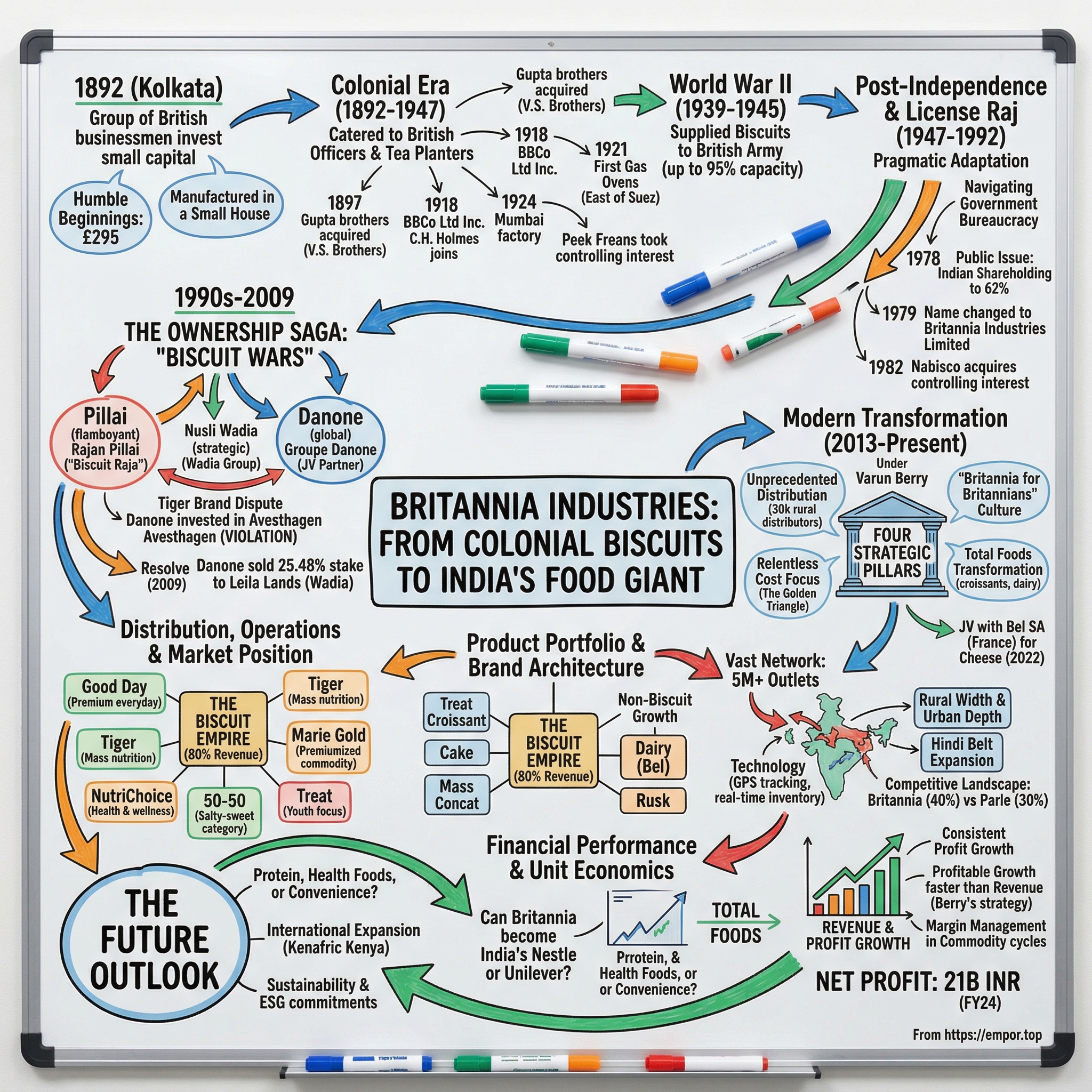
Britannia Industries: From Colonial Biscuit Bakery to India's Food Titan
I. Cold Open & Setup
In 1892, in a rented house in central Calcutta, a British businessman invested ₹295 to begin baking biscuits.1 There was no factory and no brand — just an oven, a modest workspace, and the practical goal of selling crackers to a British expatriate community seeking a taste of home.
One hundred and thirty-four years later, that initial ₹295 has compounded into a major corporate enterprise. For the financial year ended March 2026, Britannia Industries reported revenue from operations of ₹19,152 crore and profit after tax of ₹2,537 crore, representing a 16.3% year-on-year gain.2 Today, the company carries a market capitalisation of approximately ₹1.34 lakh crore, trades at roughly 51 times earnings, and generates a return on capital employed of about 56% — an exceptionally high figure for a physical manufacturing operation.3
The core paradox lies in the nature of the business. Britannia operates in a category with virtually no technological moat. Its essential inputs — wheat flour, sugar, palm oil, and milk — are globally traded commodities subject to sharp price volatility that cannot be easily hedged. Its largest competitor, privately held Parle Products, routinely operates at operating margins thinner than a public company can sustain. Meanwhile, retail price points are anchored in consumer expectations at key thresholds like ₹5 and ₹10. When input costs surge, Britannia cannot easily raise sticker prices; instead, it relies on grammage reduction per pack.
And yet, it generates a 56% return on capital.
The key question is how this was achieved. Over more than a century, Britannia navigated Partition, the License Raj, a high-profile boardroom feud that culminated in a former chairman's death in Tihar Jail, a 15-year dispute with French partner Danone, and persistent pressure from Mondelez, Nestlé, ITC, and regional bakers, to emerge as India's most profitable packaged-food manufacturer.
The primary explanation is that Britannia functions less as a conventional baker and more as a high-efficiency distribution engine. The product acts as the payload, while the distribution network serves as the core asset. By March 2025, Britannia's direct reach expanded to roughly 2.87 million outlets, supported by approximately 31,000 rural distributors — a widespread physical network constructed through a decade of steady execution that cannot easily be duplicated by capital alone.4 Overlaying this network is a continuous cost-management programme that extracts annual savings to fund marketing and further distribution expansion.
While this dynamic underpins the bullish investment thesis, performance data over the past three years raises questions about whether that advantage remains intact.
This analysis traces Britannia's development across several distinct phases: its colonial origins and the Wadia–Danone conflict resolved in 2009; the operational overhaul under Varun Berry starting in 2013 that quadrupled operating margins; the leadership turnover in 2025 that resulted in the departures of both the CEO and his designated successor within eight months; the unit economics of biscuits compared to dairy and adjacent categories; the ongoing market-share competition with Parle and ITC; a strategic evaluation using Hamilton Helmer's 7 Powers and Porter's Five Forces; management disclosures from recent earnings calls; and the balancing of bull and bear cases as of August 2026, with a new chief executive eight months into the post and a portfolio that remains 75% reliant on a single category.
The history begins with a baker, an oven, and a colonial market.
 Subscribe on LinkedIn
II. History: Colonial Roots, Independence & The Wadia-Danone Soap Opera (1892–2009)
The early history of Britannia matters primarily for the structural features it left behind.
The business changed hands in 1897 to a family of Bengali brothers — including attorney Nalin Chandra Gupta — who operated it as V. S. Brothers.1 In 1918, Charles H. Holmes, an English building contractor and friend of the Gupta family, joined as a partner and renamed the company after his construction firm: Britannia.5 The origin of one of India's most recognized consumer brands thus stemmed from a builder rather than a baker.
Three developments from the colonial era carried forward into the modern enterprise.
First was the adoption of technology as a source of differentiation. In 1921, Britannia installed gas ovens, becoming the first biscuit manufacturer east of the Suez to do so.5 In a market where competitors relied on coal-fired or wood-fired baking, gas provided precise temperature control. That thermal control delivered product consistency, establishing manufacturing precision as a core operational advantage.
Second was the rapid expansion of manufacturing scale. During the Second World War, Britannia operated as a defence contractor, committing the vast majority of its capacity to supplying biscuits to British and Allied forces.1 Operationally, this required a mid-sized Calcutta bakery to master continuous, high-volume, quality-controlled industrial production decades before domestic consumer demand would have required it.
Third was overseas ownership and legacy branding. In 1924, Britannia became a subsidiary of British biscuit maker Peek Freans, remaining five decades under overseas control.5 Transition to domestic ownership occurred in stages, marked by a 1978 public equity offering that shifted majority ownership to Indian investors, followed by its renaming to Britannia Industries Limited in 1979.1 Under the License Raj, the company expanded its brand portfolio within a protected, supply-constrained market. Products such as Marie Gold, Bourbon, and Thin Arrowroot established dominant household positions largely due to limited market competition.
By the 1990s, corporate ownership conflicts eclipsed product strategy.
The rise and ruin of Rajan Pillai
Rajan Pillai emerged in the late 1980s as a prominent figure in the Indian packaged foods sector. A Kerala-born entrepreneur who built his business platform from Singapore, Pillai established control over Britannia through offshore holding companies and a partnership with American conglomerate RJR Nabisco and its chief executive, F. Ross Johnson — who was prominent in the buyout of RJR Nabisco detailed in Barbarians at the Gate.6
However, the holding structure exposed the business to sudden shifts in control. Britannia's ownership ran through Associated Biscuits International Holdings (ABIL), a vehicle in which stakes could be traded above the heads of the operating company.7 When French food group Danone (then BSN) acquired Nabisco's international assets, Danone inherited an equity stake in ABIL alongside Pillai.
In 1993, Nusli Wadia, chairman of the Wadia Group, partnered with Danone to challenge Pillai's control. The dispute escalated from boardroom conflicts to litigation and criminal proceedings. Pillai fled Singapore, was arrested in India, and died in Tihar Jail in 1995 amid allegations of medical neglect.6 The struggle demonstrated that control of Britannia during this era was determined not by operational performance, but by holding-company architecture, strategic alliances, and litigation.
Fifteen years of a marriage nobody wanted
The 1993 settlement left the Wadia Group and Danone as equal partners inside ABIL — a 50:50 arrangement over a company that neither could control alone.7 While styled as a major Indo-French joint venture, the arrangement led to a 15-year operational stalemate that diverted significant management focus.
Strategic friction centered on two main issues. Britannia launched the Tiger brand in 1997, and by 2006 Tiger products generated around $151 million in sales, roughly 20% of company revenue.8 Britannia subsequently discovered that Danone had registered the Tiger trademark in approximately 70 countries — securing rights in about 40 — and had launched Tiger-branded biscuits in Indonesia, Malaysia, Singapore, Pakistan and Egypt.8 Britannia initiated legal action in Singapore, resulting in an April 2007 agreement in which Danone agreed to return the brand.9
The second conflict involved regulatory compliance. In October 2006, Danone acquired a stake in Avesthagen, a Bangalore nutraceuticals company, without consent from the Wadia Group. This violated India's Press Note 1 of 2005, which required a foreign partner to obtain its Indian joint-venture partner's clearance before entering a related business independently.8 In September 2007, India's Foreign Investment Promotion Board rejected Danone's argument that no waiver was needed.8 The decision effectively prevented Danone from expanding independently in the domestic food sector while remaining bound to the joint venture.
This regulatory outcome prompted a resolution. In April 2009, Danone sold its 25.48% stake to a Wadia Group entity, taking the Wadia holding to 50.96%.7 Contemporary reports put the consideration in the region of $175–200 million.10 The sale allowed Danone to pursue independent operations in India, while granting the Wadia Group majority voting control.
This 2009 ownership consolidation established the foundation for Britannia's modern operating trajectory. For 16 years prior, Britannia had operated under dual shareholders with divergent priorities. That division was reflected in its operational metrics: margins that remained in single digits, heavy reliance on wholesale distributors, and board-level friction over strategic initiatives. The 2009 buyout unified ownership under a single promoter and board, creating the governance stability required to recruit professional leadership and execute long-term strategy.
Four years after Danone's exit, Britannia hired the executive who would lead that operational transformation.
III. The Varun Berry Transformation & "Golden Triangle" Strategy (2013–2025)
When Varun Berry joined Britannia in January 2013, the company presented a sharp contrast between brand strength and operational performance.
In calendar year 2012, the company generated an operating margin of approximately 4.5%.11 That profile aligned more closely with a low-margin commodity processor than a premier fast-moving consumer goods company; peers such as Hindustan Unilever, Nestlé India, and Colgate-Palmolive India earned operating margins several times higher. Despite its scale, history, and brand recognition, Britannia converted little of its top-line revenue into operating profit.
Berry joined Britannia from PepsiCo, where he had managed beverage distribution across India—a sector where market share depends heavily on last-mile retail execution rather than high-level strategy.11 He initially served as Chief Operating Officer, advanced to Managing Director in 2014 following the departure of Vinita Bali, and by 2022 assumed the combined roles of Executive Vice-Chairman, Managing Director, and CEO.11
To reshape the business, Berry instituted an operating model known internally as the "Golden Triangle." The framework required executing three initiatives simultaneously: expanding revenue, systematically reducing operational costs, and reinvesting those savings into brand marketing and distribution expansion rather than allowing them to flow directly to short-term profits. While conventional cost-cutting produces temporary margin gains, reinvesting operational savings into distribution infrastructure creates compounding long-term growth.
The distribution rebuild
The core of this strategy was a decade-long restructuring of Britannia's supply chain and distribution network.
In 2013, Britannia relied primarily on wholesale channels to move inventory to retail outlets. While wholesale distribution provided rapid sales volume at low initial expense, it restricted visibility into end-consumer demand and offered little control over retail shelf placement or product positioning. Wholesalers prioritized fast-moving, high-margin inventory, hindering Britannia's ability to reliably introduce premium product lines.
To address this, Britannia established a direct distribution system, deploying dedicated sales representatives and building direct relationships with neighborhood retailers. By March 2025, direct distribution expanded to roughly 2.87 million outlets supported by approximately 31,000 rural distributors, with rural reach growing from 1.97 million outlets in March 2020 to 2.79 million in March 2025.4 The company added roughly 2,000 rural distributors in the final year of that period.11
Direct distribution provided both supply push and real-time market data. Rather than relying on distributor feedback, Britannia could track sell-through rates immediately across thousands of stores, turning product rollouts into predictable execution. For example, when launching packaged croissants into the Indian snacking market, the company bypassed wholesale resistance, placing inventory directly onto store shelves and assessing consumer adoption within weeks.
Geographically, Britannia addressed its regional imbalances. Historically strong in Southern and Western India, the company faced deep market penetration by Parle across Northern and Central India—specifically Uttar Pradesh, Madhya Pradesh, Bihar, and Rajasthan. Britannia designated these regions as "focus states," establishing dedicated rural distribution channels rather than extending urban routes. In quarterly disclosures, management tracks performance in these focus states separately; during the June 2026 quarter, key focus states grew at 1.8 times the rate of non-focus states, while overall regional markets maintained double-digit growth at 1.3 times that baseline pace.12
The cost machine
Parallel to distribution expansion, Britannia instituted an ongoing Cost Efficiency Programme. Rather than treating cost management as a temporary initiative, management embedded it as a continuous operational discipline focusing on packaging optimization, waste reduction, renewable energy transition, alternative industrial fuels, and procurement efficiency.12
This structured cost discipline delivered two key operational effects. First, recurring efficiency gains buffered operating margins during periods of commodity price inflation, allowing Britannia to perform better than raw-material trends would indicate. Second, efficiency programs naturally encounter diminishing returns: while initial structural changes yielded substantial margin expansion, subsequent gains require increasingly complex operational shifts, an outcome acknowledged in management's recent guidance.
What the transformation actually delivered
During Berry's tenure, Britannia's financial metrics expanded significantly: operating margins widened from 9.7% in FY2014 to 18.8% in FY2025, annual revenue grew approximately 2.5 times, net profit increased sixfold, and market capitalization rose nearly eighteen-fold to ₹1.47 lakh crore by November 2025.11
Critically, this profitability expansion resulted primarily from product mix and operational efficiency rather than price increases. With entry-level biscuit prices remaining mostly fixed, Britannia drove margin expansion by shifting volume toward premium cookies and cream biscuits, optimizing procurement and manufacturing, and shortening supply chains. Because these margin gains stemmed from structural efficiencies rather than consumer price hikes, they proved resilient against competitive pressures.
However, efficiency-driven margin expansion has inherent limits. By 2025, investors began questioning where Britannia would find its next wave of growth—a question sharpened by unexpected executive transitions.
IV. Executive Leadership, Governance & The New Management Era (2025–Present)
On 10 November 2025, Britannia announced that Varun Berry had resigned as Vice-Chairman, Managing Director, and Chief Executive Officer, effective at the close of business that day.13 The board waived his notice period, cutting short a contract extended in 2023 that ran through March 2029.11
Following the announcement, Britannia's stock fell nearly 7%.14
This marked the second chief executive departure within eight months. Rajneet Singh Kohli, who had joined as CEO in September 2022 after executive roles at Domino's India, Asian Paints, and Coca-Cola, submitted his resignation on 5 March 2025 and stepped down on 14 March 2025.15 Kohli had been the primary internal succession candidate. His exit left Berry running the company alone once more, and Berry's departure eight months later left Britannia without either executive.
For investors evaluating corporate governance, that sequence warrants close scrutiny. A company backed by a stable majority promoter, a celebrated 13-year CEO, and a respected executive bench lost both its chief executive and his designated successor within a single financial year, offering no public explanation beyond standard disclosures about pursuing other opportunities. Whatever the underlying driver, the outcome revealed a succession plan that failed to execute as designed.
The Wadia structure
Behind the executive turnover, ownership structure has remained static. As of March 2026, the promoter group held 50.55% of the company, while foreign institutional investors held 15.63% and domestic institutions held 18.82%.3 Nusli Wadia remains Chairman.
Capital allocation under this ownership structure has been consistent and disciplined. Britannia operates with modest debt — holding roughly ₹1,380 crore against reserves of ₹5,082 crore for FY26 — and distributes the vast majority of its earnings, maintaining a dividend payout ratio between 83% and 86% in recent years.3 For FY26, the board recommended a final dividend of ₹90.50 per share on a face value of ₹1.16
An 85% payout ratio reflects a strategic reality beyond shareholder returns. It indicates management's view that the core business generates more cash than can be productively reinvested at high rates of return. That represents a candid approach in Indian fast-moving consumer goods, where reinvestment and capacity expansion are frequently prioritized. However, it underscores a central tension in Britannia's strategy: if the core biscuit business cannot absorb additional capital, future growth must come from product adjacencies — categories that currently yield lower margins.
Rakshit Hargave
Rakshit Hargave assumed the roles of Managing Director and CEO on 15 December 2025.13 During the interim transition, Executive Director and CFO N. Venkataraman assumed additional charge, signaling that the board prioritized financial continuity over a rushed appointment.13
Hargave brought an atypical background to the position. He most recently headed Birla Opus, the Aditya Birla Group's paints business, directing an aggressive entry into a sector dominated by an entrenched incumbent.17 Prior to that, his career included executive roles at Beiersdorf's Nivea division in India, Hindustan Unilever, Jubilant FoodWorks, Nestlé India, and Tata Motors.13
His career trajectory points to a clear strategic pattern. Hargave is primarily a brand-building and category-entry executive rather than an operational cost cutter, possessing extensive experience launching products into competitive markets. That marks a distinct shift from Berry's distribution and cost-efficiency background, suggesting a deliberate selection by the board. With core operational margins largely harvested, Britannia's next growth chapter requires launching new categories and expanding into non-traditional sales channels.
Eight months into his tenure, early operational decisions align with that orientation. On the Q1 FY27 earnings call in August 2026, Hargave and his leadership team highlighted expansion across e-commerce and quick-commerce channels, channel-exclusive formats, and the development of health, wellness, and protein as scalable platforms rather than standalone stock-keeping units.18 Management also signaled an openness to strategic acquisitions to diversify the portfolio.19 Roughly two months prior to that call, the company appointed a new head of international operations following a period of soft overseas sales.18
Assessing credibility, fairly
While it is early to evaluate Hargave's leadership, the company's track record of execution relative to its public disclosures provides a useful benchmark.
On that measure, Britannia's historic record is solid, though not without gaps. For over a decade, management consistently emphasized three strategic pillars — distribution expansion, cost efficiency, and category adjacencies — with reported financial results broadly aligning with stated goals. When tax transition disruptions affected the September 2025 quarter, management detailed the specific operational mechanisms at play, and performance recovered along the projected timeline. On the August 2026 call, the CFO offered an explicit assessment of pricing constraints, stating, "at best we have been able to mitigate half of the inflation through price increases. The other half we have not been able to."18 Such candid guidance reflects transparent operational reporting.
The weaker spots center on succession transparency and the international business, where management has attributed underperformance to external factors — including Middle East geopolitical conflict and supply-chain disruptions — across consecutive quarters.19 While external headwinds represent real operational challenges, prolonged reliance on external explanations points to persistent execution hurdles in overseas markets.
Ultimately, testing this new strategic direction will depend on performance within the core category, which continues to account for three-quarters of total company revenue.
V. Core Segment Deep-Dive: The Biscuit Empire & Industry Dynamics
Across India’s estimated 5.5 million packaged-food retail outlets, the central battle for market share occurs not on primary aisle shelves, but at the checkout counter, where small-format impulse packs priced at ₹5, ₹10, and ₹20 dominate consumer purchases. The economics of this mass-market channel differ significantly from packaged-goods sectors in developed markets.
Approximately 60–65% of Britannia's product portfolio is concentrated at the ₹5 and ₹10 price thresholds.20 Overall, the Indian biscuit, cookie, and cracker market was valued at approximately ₹1.16 lakh crore in 2025 and is projected to grow at a 6.8% compound annual rate toward ₹1.64 lakh crore by 2030.21
The tyranny and the gift of the fixed price point
In standard consumer categories, manufacturers offset rising raw material costs by increasing retail sticker prices. In India's mass biscuit market, single-coin price points like ₹5 and ₹10 represent deeply entrenched consumer expectations. Priced at ₹6, a product loses the convenience of a single-coin transaction, causing a disproportionate decline in sales volume.
To manage cost volatility without breaking fixed price points, manufacturers alter package weight. During inflationary periods, a ₹5 pack containing 50 grams may be reduced to 44 grams. This practice of shrinkflation serves as the primary mechanism for absorbing input inflation. When commodity prices decline, manufacturers reverse the process through grammage increases, effectively passing on price reductions while maintaining nominal price points.
This pricing dynamic creates a divergence in financial reporting: reported volume growth in tonnage can move opposite to consumer-perceived value, while competitive market-share shifts often occur through weight adjustments rather than headline price changes.
The operational impact of this mechanism was evident during the Goods and Services Tax (GST) recalibration in the September 2025 quarter. Effective 22 September 2025, tax rates on biscuits, cornflakes, sugar confectionery, and pastries were reduced from 12% or 18% down to 5%,22 a change that applied to roughly 80% of Britannia's domestic product line.23
While the tax cut created a favorable long-term policy setting, it required immediate operational adjustments across packaging, price marking, and supply chain inventory. Consequently, Britannia's second-quarter FY26 revenue growth slowed to 3.7% year-on-year, though net profit rose 23% to ₹654 crore as input costs moderated and internal cost-efficiency programs took effect.24
Following the tax cut, Britannia adjusted its packaging to standard weights and passed the tax savings to consumers, lowering its 250-gram Marie Gold pack from ₹45 to ₹42.23 In response, several competitors adopted non-traditional price points, such as ₹4.45 and ₹8.90, allowing them to offer higher channel margins to trade partners and briefly capturing market share.20 Management anticipated that trade pricing would re-align around traditional round figures, which occurred by the December 2025 quarter. During November and December 2025, overall sales growth accelerated to approximately 12%, split evenly between volume expansion and price realization, yielding third-quarter FY26 net sales of about ₹4,970 crore and a net profit of ₹680 crore, up 17% year-on-year.2025 Gross margin expanded 400 basis points to 42.7%, supported by year-on-year cost declines in refined palm oil (down 9%), cocoa (down 12%), and packaging laminates (down 6%).20
The transition demonstrated that in a fixed-price-point retail environment, trade margins offered to distributors and retailers can exert as much immediate influence on market share as consumer pricing.
The brand architecture
Britannia organizes its product portfolio into a multi-tiered brand architecture to address distinct consumer segments and price tiers.
Good Day functions as the primary volume driver in the mass-premium segment, occupying a central position in butter cookies. Marie Gold operates as a high-frequency habit anchor tied to daily tea consumption, generating consistent repeat demand. NutriChoice targets health and wellness categories through digestive and oat formulations, yielding higher revenue realization per kilogram than standard lines. Milk Bikis holds a dominant position in the milk-biscuit segment, particularly in Southern India, while Bourbon and 50-50 cover cream indulgence and savory-sweet combination snacks. Little Hearts and Treat target impulse purchases among younger demographics. During the June 2026 earnings call, management highlighted strategic refreshes for Marie Gold and NutriChoice, alongside strong demand for Little Hearts and the Treat Triple Choco Croissant, where specific product lines achieved volume growth exceeding 30%.26
The competitive set
Parle Products remains Britannia’s main volume competitor. As a privately held firm built around Parle-G, Parle operates on lower operating margins and maintains extensive penetration across value-tier products and Northern India. Industry compilations for 2025 estimated Britannia's market share at approximately 38% compared to Parle's 32%, with Britannia retaining top rank in overall revenue.2127 In operational terms, Britannia leads in revenue realization and net profitability, while Parle maintains parity or leadership in overall tonnage.
ITC's Sunfeast represents a well-capitalized competitor that leverages ITC’s agricultural procurement infrastructure, trade distribution network, and targeted product launches—such as Dark Fantasy, which established a distinct premium sub-category in cream biscuits.
Regional and unorganized manufacturers—including Anmol, Bisk Farm, Priyagold, Cremica, and independent bakeries—exert cyclical pressure on low-tier volume. When raw material costs fall, regional players expand trade margins and pack weights to gain entry-level market share. When commodity prices rise, these smaller operators contract due to balance-sheet constraints. As a result, regional competitors present a recurring headwind to entry-level volumes rather than a structural risk to premium lines.
This industry structure—a profitable premium core, a contested mass-market floor, and price-sensitive regional competitors—explains Britannia's multi-year effort to expand into adjacent food categories outside core baking.
VI. Beyond Biscuits: Adjacencies, Dairy & The "Total Foods" Real Optionality
In October 2024, Britannia and French cheese maker Bel Group commissioned a dedicated cheese factory in Ranjangaon, Maharashtra.28 While modest in physical scale relative to major industrial facilities, the plant represents a pivotal asset in Britannia's long-term strategy, addressing the central constraint imposed by its capital allocation framework.
With the core biscuit division delivering a 56% return on capital while payout policies direct 85% of earnings to dividends, long-term expansion depends heavily on building viable non-biscuit categories. Britannia terms this diversification strategy "Total Foods"—an initiative that functions as the growth option required to support its premium valuation multiple.
Where it stands
Non-biscuit categories reached approximately 25% of total revenue by the June 2026 quarter, expanding at a double-digit pace.12 While this represents progress from a decade prior, when biscuits accounted for more than 80% of sales, the portfolio shift has unfolded gradually. Furthermore, much of this expansion has originated from adjacent bakery lines that utilize Britannia's established biscuit distribution network rather than entirely new product categories.
Bakery adjacencies—such as cakes, rusk, wafers, and brownies—have provided efficient growth, with management consistently noting that these lines expand faster than the company average.19 Strategically, these products leverage existing distribution vehicles, distributor relationships, and retail shelf placements, generating incremental revenue on largely sunk distribution costs. Bread remains an exception within the bakery portfolio: requiring a localized daily-fresh supply chain, it operates on thin margins and functions primarily as an urban brand presence rather than a major profit driver.
Croissants serve as a notable illustration of category creation. Britannia's Treat croissant line reached approximately ₹200 crore in annualized revenue by mid-2026, up from about ₹100 crore, growing at more than 30% annually while remaining margin-accretive.12 Although ₹200 crore represents roughly 1% of total corporate revenue, the launch demonstrates that Britannia can introduce a European product format without Indian precedent into its traditional distribution system to build a profitable new category. The key analytical question is whether the line can scale toward ₹2,000 crore or will cap out as a smaller niche.
Dairy and the Bel joint venture
The dairy segment represents a more capital-intensive initiative.
In December 2022, Bel acquired a 49% stake in Britannia's dairy subsidiary for approximately ₹262 crore (around $32 million), forming Britannia Bel Foods with Britannia retaining a 51% controlling interest.2930 Products are co-branded under the Britannia and The Laughing Cow trademarks.31 The Ranjangaon facility operates five production lines with an annual capacity of roughly 6,000 tonnes of natural cheeses, such as cheddar and mozzarella, and 10,000 tonnes of processed cheese, integrated directly with local milk procurement networks.32
Britannia's dairy strategy deliberately avoids liquid milk—a high-volume, low-margin business dominated by agricultural cooperatives with cost structures public FMCG companies cannot match. Instead, the company focuses exclusively on value-added products, including cheese, ghee, butter, and flavored milk under the Winkin' Cow brand. During the June 2026 quarter, dairy revenues grew in double digits, led by strong performance in ghee and cheese.12
Contrasting the Bel structure with Britannia's earlier Danone partnership highlights clear governance refinements. Where Danone held an equal 50:50 stake at the holding company level alongside independent domestic ambitions—leading to litigation and regulatory stalemates—Bel operates as a 49% minority partner within a focused subsidiary, providing brand equity and technical expertise while Britannia retains operational control and distribution. However, because dairy processing is substantially more capital-intensive than industrial baking and Britannia does not report segment-level return metrics, verifying whether the dairy division meets its cost of capital remains difficult for outside analysts.
International
International operations remain Britannia's most challenging geographic division. In October 2022, the company acquired a 51% controlling stake in Kenafric Biscuits for KES 13.87 crore (roughly ₹9.2 crore), alongside a ₹1.42 crore purchase of Catalyst Britania Brands to secure the "Britania" trademark in Kenya.33 The African expansion has performed consistently, with Kenya highlighted as a key growth area through FY26 and FY27.26
By contrast, Middle Eastern operations have faced significant headwinds. Geopolitical conflict severely disrupted export logistics, prompting Britannia to shift North American product manufacturing from Oman back to its export-oriented facility in Mundra, Gujarat.19 Overall international revenue remained flat in the June 2026 quarter, as weakness in the Middle East and North America offset gains in Africa.12 In response to these operational bottlenecks, management appointed a new head of international operations in mid-2026.18 Accounting for 5% to 6% of overall revenue, the international business is not central to the core investment thesis, but its performance underscores that Britannia's primary distribution advantages remain tied to the domestic Indian market.
This dynamic raises a fundamental structural question: what constitutes Britannia's core competitive moat, and how resilient is that advantage as retail and consumer environments evolve?
VII. Strategic Frameworks: Helmer's 7 Powers & Porter's 5 Forces
Stripping away brand nostalgia raises a fundamental strategic question: if a well-funded competitor sought to capture Britannia's market share, what structural barriers would prevent them?
The powers that are real
Cornered resource — the distribution network. This represents the company's strongest strategic defense. A competitor can purchase industrial ovens or launch extensive advertising campaigns, but replicating a direct network of 2.87 million retail outlets serviced by 31,000 rural distributors who have developed route-specific logistics, credit relationships, and localized demand insights over years requires significant time.4 The core barrier is not merely physical coverage, but the multi-year timeline needed to build it, during which a challenger operates unprofitably against a fully scaled incumbent. Conglomerates such as Reliance, ITC, and Adani possess superior capital reserves, yet none has matched Britannia's retail biscuit reach.
However, this advantage is strictly category- and geography-specific. While it shields domestic biscuit volumes, it offers little strategic protection in international markets like Oman, and its value diminishes as a growing share of urban consumption transitions online.
Scale economies. Britannia's manufacturing footprint combines owned mega-facilities with contract bakeries strategically located near primary consumption hubs. For packaged biscuits—a low-value-density product where freight represents a high proportion of delivered costs—localized production creates a structural cost advantage that requires substantial manufacturing volume to justify. This dynamic explains why regional competitors can capture isolated districts but struggle to establish statewide scale.
Brand power. Flagship brands such as Good Day, Marie Gold, and Milk Bikis benefit from generations of consumer habit. Yet true brand power manifests primarily as pricing power. On the August 2026 earnings call, Britannia's Chief Financial Officer acknowledged that price adjustments mitigated only about half of recent input inflation.18 Net price realization in the first quarter of FY27 reached approximately 1%, driven chiefly by pack-size optimization, with management projecting an additional 1.5% to 2% in subsequent quarters.12 These metrics reflect strong consumer preference rather than pricing power: buyers select Britannia over alternatives at established price points, but exhibit demand elasticity if prices rise independently. That distinction is critical to evaluating the company's long-term margin trajectory.
Process power. The company's institutionalized cost-efficiency program fits Hamilton Helmer's definition of process power, as it is embedded in organizational routine across successive executive tenures. However, process power faces inherent diminishing returns as structural efficiencies become harder to extract over time.
Unrealized powers. Britannia lacks network effects, as additional consumers do not enhance product utility for others. It holds no switching costs, since consumers can change biscuit brands without friction. Nor does it possess counter-positioning advantages; as the established incumbent, Britannia is the primary target of counter-positioning by value discounters and direct-to-consumer snack brands.
Porter, applied honestly
Threat of new entrants: bifurcated. At the national level, entry barriers remain high because building nationwide manufacturing and distribution requires prohibitive time and capital. At the regional level, barriers are low, as localized bakeries can achieve profitability within single districts using single manufacturing facilities.
Buyer power: rising significantly. While individual retail consumers exercise minimal leverage, modern trade holds moderate bargaining power, and quick-commerce platforms command substantial influence. By FY26, e-commerce represented approximately 6% of Britannia's revenue, with quick commerce accounting for nearly 70% of digital sales; by the June 2026 quarter, quick commerce expanded to 80–85% of e-commerce volume.1912 Overall, non-general-trade channels expanded at roughly 2.5 times the growth rate of traditional general trade.12
In mechanical terms, Britannia spent a decade constructing a distribution moat anchored in millions of independent neighborhood grocers. Quick commerce bypasses traditional retail channels, replacing fragmented store owners with concentrated platform buyers who command listing fees, promotional allowances, and margin concessions. Management has responded by creating channel-exclusive formats, deploying larger multi-packs and impulse assortments tailored for quick commerce rather than relying on the traditional ₹5 and ₹10 general-trade architecture.18 While this strategy defends immediate sales volumes, it does not constitute a structural competitive moat.
Supplier power: high and commodity-driven. Key raw materials—including wheat flour, palm oil, sugar, dairy, and flexible packaging laminates—are globally traded commodities subject to international market swings and government policies, such as Indonesian palm oil export rules, domestic wheat procurement quotas, and agricultural monsoon yields. Consequently, Britannia operates as a price taker. This vulnerability was evident during the June 2026 quarter: while wheat flour prices fell 7% and refined palm oil declined 3% year-on-year, dairy costs rose 11%, packaging laminates increased 14%, and industrial fuel jumped 69%, driven by liquefied petroleum gas and compressed natural gas prices spiking to 2.5 times February levels during April and May.1218
Threat of substitutes: moderate and expanding. The primary substitute for a packet of biscuits is often an alternative snacking option, ranging from informal street food and fresh fruit to local bakery rusks and protein bars. India's extensive unorganized food sector provides affordable alternatives, while health-conscious urban consumers are increasingly substituting traditional refined-flour biscuits with functional and protein-rich snacks.
Rivalry: intense and cyclical. Competitive intensity fluctuates with commodity cycles. When input costs decline, regional manufacturers utilize margin relief to offer higher trade commissions and expand pack weights, capturing entry-level market share; when input costs surge, smaller competitors contract under balance-sheet pressures.
The strategic assessment reveals a business with a durable but narrowing competitive moat: formidable in traditional Indian retail, facing greater pressure in fast-growing digital channels, and relying heavily on cost efficiency rather than pricing power to protect operating margins.
Evaluating how management addresses these structural pressures requires examining recent earnings disclosures and investor exchanges.
VIII. Earnings Transcripts, Guidance Track Record & Skeptical Stress Test
Earnings calls are where corporate narratives meet market realities. For Britannia, a close examination of recent earnings transcripts reveals an instructive divergence between prepared management remarks and the ensuing analyst Q&A sessions.
What management leads with
Across fiscal 2026 and into early fiscal 2027, management's opening remarks maintained a consistent structure: highlighting top-line growth, profit delivery, cost-efficiency progress, non-biscuit momentum, digital channel gains, and sustainability metrics. On the fourth-quarter FY26 call, management reported full-year revenue of ₹18,858 crore, reflecting a 7.5% increase, alongside profit after tax of ₹2,533 crore, up 16.3%. Executive commentary credited the long-standing Cost Efficiency Programme with mitigating raw-material cost volatility, while citing operational metrics such as a 7% reduction in specific water usage and a 14% expansion in renewable electricity usage.19 Moving into the first quarter of FY27, management led with 9.5% top-line revenue growth to ₹4,964 crore, driven by roughly 9% tonnage volume growth, with net profit after tax coming in at 11.9% of revenue.1812
The consistent narrative framing depicts a business executing a proven operational model. Based solely on headline figures, that assertion is well-supported.
What analysts push on
The Q&A portion of these calls provides deeper operational context. During the August 2026 call, analyst questions concentrated on four primary areas: the sustainability of consumer demand following the resolution of post-GST pricing adjustments; the outlook for operating margins amid renewed commodity inflation; efforts to enhance distribution efficiency rather than simply expanding outlet count; and the long-term execution plan for the health and wellness product platform.18
Management's disclosures were notably direct by industry standards. Executive leadership acknowledged that pricing adjustments had offset at best half of recent input inflation, leaving the remainder to be managed through internal efficiencies.18 Commodity commentary remained detailed and cautious, while forward margin expectations were explicitly guarded: management targeted holding fiscal 2027 EBITDA margins at least at FY26 levels assuming prevailing market conditions persisted.12 Notably, this guidance signals a plateau rather than continued expansion. After a decade in which steady margin expansion served as a cornerstone of the investment case, management is guiding toward margin stability.
That guidance shift represents a pivotal disclosure for evaluating Britannia's near-term earnings trajectory.
Consistency across calls
A comparison of earnings calls across fiscal 2026 and 2027 shows clear narrative continuity alongside an evolving strategic focus. Throughout fiscal 2026, management emphasized operational stabilization: navigating GST tax recalibrations, managing temporary commodity tailwinds, and restoring traditional price-pack architecture. By early fiscal 2027, executive commentary shifted toward category platforms, channel-specific formats, and strategic expansion—focusing on health, wellness, protein lines, quick-commerce formats, and selective acquisitions.1918 This transition coincided with the arrival of the new chief executive, reflecting an expected strategic shift while establishing an eight-month operational track record for current management.
The activist stress test
Evaluating the cautious investment thesis involves examining several core operational questions:
The margin ceiling. Britannia's operating margin reached 18.8% in FY25, with Q4 FY26 EBITDA margin at 18.54% and Q2 FY26 operating margin spiking above 20% during a period of favorable commodity pricing.113424 Structural factors suggest limited scope for further margin expansion. Historically, margin gains stemmed from internal cost discipline and premium product mix. With low-priced, high-volume products remaining highly price-sensitive, further margin expansion would require ceding entry-level market share, effectively trading long-term volume for short-term profitability.
Capital allocation and segment transparency. Britannia's consolidated return on capital employed of 56% reflects a blended metric across distinct business units.3 The capital-light core biscuit division likely generates returns above this average, whereas the asset-heavy dairy operations—which include dedicated processing infrastructure and direct milk collection networks—yield lower returns. Because Britannia does not disclose separate segment returns, investors cannot evaluate the financial impact of dairy operations. However, capital deployment outside baking has remained measured, evidenced by Bel Group financing 49% of the joint venture and the Kenya acquisition requiring under ₹10 crore.3033 While this disciplined approach limits downside exposure, it also caps the near-term financial contribution of new ventures.
Quick commerce. A skeptic would argue that the margin structure of quick commerce is fundamentally lower than traditional general trade, that digital channels lower distribution barriers for direct-to-consumer competitors, and that Britannia's extensive physical distribution network offers less structural advantage in urban centers where premium products dominate sales.
Governance and leadership continuity. The departure of two chief executives within an eight-month span under a stable majority promoter group introduces relevant questions regarding executive succession planning and institutional continuity.
Valuation expectations. Trading at approximately 51 times earnings against a five-year sales compound annual growth rate of 8% and profit growth rate of 6%, market pricing assumes substantial future success from non-biscuit categories rather than core baking alone.3
These considerations do not undermine the core stability of the business, but they highlight the operational targets required to support current market valuations.
IX. Financial Performance, Capital Allocation & KPI Radar
Britannia's financial statements reflect an enterprise adept at converting a mature category into expanding profit, while increasingly encountering the structural limits of that model.
The recent record
Between fiscal 2024 and fiscal 2026, consolidated sales rose from ₹16,769 crore to ₹17,943 crore, reaching ₹19,152 crore, while net profit moved from ₹2,134 crore to ₹2,178 crore, before expanding to ₹2,537 crore.3 The fiscal 2025 performance underscores the underlying dynamics: revenue expanded by 7%, but profit rose by barely 2% as inflation in palm oil and wheat outpaced price adjustments. Fiscal 2026 reversed that slowdown — revenue increased by 6.7% and net profit grew by 16.3% — as commodity prices eased, tax recalibrations improved realizations, and internal cost programs compounded efficiency gains.2
This pattern demonstrates that Britannia's earnings exhibit significantly higher volatility than its top-line sales, driven predominantly by commodity price cycles. Consequently, treating high-margin periods as permanent operational step-changes misjudges the cyclical nature of the business.
The quarterly trajectory through fiscal 2026 and into early fiscal 2027 highlights this cycle: second-quarter fiscal 2026 revenue grew by just 3.7% due to tax adjustments, yet profit rose 23%; third-quarter profit grew 17% alongside a 400 basis point expansion in gross margin; fourth-quarter profit increased 21.6% with EBITDA margin reaching 18.54%; and first-quarter fiscal 2027 revenue expanded 9.5% to ₹4,964 crore with net profit rising roughly 14% to ₹593 crore — though margin expansion narrowed as fuel, milk, and packaging expenses accelerated.2425343512
The first-quarter fiscal 2027 performance provides a clear look at current operational dynamics. Tonnage volume growth of roughly 9% represented the strongest pace in several years, while traditional general trade channels grew at 1.5 times the prior year's rate.12 That recovery was supported by post-tax affordability adjustments. However, operating profit grew 12.7% against 9.5% revenue growth — a significantly narrower spread than in preceding quarters — reflecting management's disclosure that roughly half of raw-material inflation remained unrecovered through price increases.1218
While volume growth has resumed, margin expansion is moderating under cost pressures.
Capital allocation
Britannia's capital allocation exhibits a disciplined pattern: low debt, high dividend distribution, strategic partnerships for expansion, and an avoidance of major acquisitions. Outstanding debt of ₹1,380 crore against ₹5,082 crore in reserves for fiscal 2026 remains modest relative to cash generation.3 Maintaining a dividend payout ratio between 83% and 86%, alongside a final dividend recommendation of ₹90.50 per share for fiscal 2026, returns most earnings directly to shareholders.316 Manufacturing remains intentionally hybrid, balancing owned large-scale plants with contract facilities positioned near core markets.
This distribution posture highlights both a key operational strength and a structural limitation. Britannia distributes capital because core operations generate more cash flow than can be reinvested at historical rates of return. In the short term, this approach protects shareholder return on capital; over a longer horizon, it reinforces Britannia's status as a mature cash-generation enterprise seeking higher-margin growth options. Chief Executive Officer Rakshit Hargave's indicated openness to selective acquisitions signals a potential shift in this posture, representing a notable strategic evolution for a capital-light enterprise.19
The three KPIs that matter
Evaluating Britannia's operational trajectory depends primarily on monitoring three core performance indicators:
1. Underlying volume growth. Given constraints on direct price increases in core price-pack tiers, volume expansion drives top-line growth and serves as the primary metric for tracking market share against Parle, ITC, and regional bakers. Revenue expansion can mask underlying softness through product mix and tax realizations, whereas tonnage growth reflects actual consumer demand. The June 2026 quarter's approximately 9% volume growth demonstrated strong market uptake, compared with 4.5% to 5% in the December 2025 quarter.1220 Sustained mid-to-high single-digit volume expansion maintains manufacturing and distribution leverage, whereas prolonged low single-digit growth indicates diminishing returns from physical distribution coverage.
2. Non-biscuit revenue share. Standing at approximately 25% of total sales, this metric measures the execution of the company's "Total Foods" expansion.12 Evaluating this metric requires examining its composition: volume driven by bakery adjacencies utilizes established distribution routes, whereas growth from dairy, health, and wellness categories requires building distinct category presence. If non-biscuit revenue remains constrained near current levels over multiple fiscal years, the business thesis defaults to a mature, single-category packaged-food manufacturer.
3. Gross margin relative to input cost trends. Assessing gross margin performance against prevailing prices for wheat, palm oil, sugar, milk, and packaging materials provides a direct evaluation of internal cost programs and premium product mix. Maintaining gross margins during periods of rising input inflation offers empirical evidence of structural cost efficiency. Conversely, gross margin expansion during periods of falling raw-material prices reflects broader commodity cycles rather than operational differentiation.
X. Risk Radar & Material Threats
The primary risks facing Britannia are unglamorous, recurring, and largely mechanical. That operational predictability, however, does not make them any less material to the company's financial performance.
Input cost inflation is the dominant near-term threat, and its effects are already apparent. During the June 2026 quarter, year-on-year input costs climbed substantially: milk rose 11%, packaging laminates increased 14%, and industrial fuel surged 69%, driven by liquefied petroleum gas and compressed natural gas prices that spiked to 2.5 times February levels during April and May before settling around 1.5 times. Sugar prices continued to rise, adding another ₹7 per kilogram, while palm oil traded near the ₹140 mark—up roughly 20% sequentially, even as it remained down 3% year-on-year.1218 Meanwhile, management identified El Niño weather patterns as an ongoing watch item for wheat flour costs.18
The underlying mechanism makes commodity inflation structural rather than merely temporary. Because Britannia's ability to pass on price increases is constrained—management disclosed that half of first-quarter FY27 inflation went unrecovered—its principal operational lever is reducing pack grammage. Yet shrinking pack sizes directly hands market share to regional competitors willing to absorb higher input costs to gain volume. Consequently, commodity inflation penalizes Britannia on two fronts simultaneously: eroding operating margins while pressuring sales volume.
Regional competitor resurgence represents the cyclical counterpart. The post-GST tax recalibration illustrated this pattern in compressed form, as smaller competitors held non-traditional price points to offer higher trade margins to retailers, temporarily capturing market share before trade pricing realigned.20 The broader structural reality is that Britannia's entry-level volume remains permanently contestable, with competitive pressure mounting precisely when commodity costs drop and trade margins expand across the industry.
Channel shift poses a gradual structural risk. With quick commerce representing 80% to 85% of an e-commerce segment that is growing at 2.5 times the pace of traditional general trade, retail bargaining power is shifting toward digital platforms.12 These platforms demand higher trade spend, listing allowances, and promotional funding than the traditional neighborhood kirana network where Britannia built its distribution moat. Simultaneously, digital channels lower entry barriers for direct-to-consumer snacking brands, creating stiffer competition in the premium and health-focused categories that Britannia relies upon to drive product mix improvement.
Leadership transition risk remains real but structurally bounded. Chief Executive Officer Rakshit Hargave is eight months into his tenure following a thirteen-year predecessor, after the designated internal successor departed earlier in 2025. Institutional systems—including the ongoing cost-efficiency program, the physical distribution network, and the continuity provided by the Chief Financial Officer during the transition—provide operational stability.13 Nevertheless, as management pivots strategy toward new product categories and digital sales channels, Britannia's execution track record under the new leadership team remains brief.
Geopolitical and supply-chain exposure remains concentrated in the international business. Middle Eastern conflict disrupted export logistics sufficiently to force management to relocate North American product manufacturing from Oman back to its export facility in Mundra, Gujarat.19 While international business accounts for just 5% to 6% of consolidated revenue, these logistical bottlenecks have recurred across consecutive earnings disclosures, signaling persistent operational friction overseas.
Regulatory and policy developments carry dual implications. The September 2025 GST rate reduction served as a significant tailwind by enhancing product affordability across mass-market lines.2223 However, regulatory momentum could eventually shift toward stricter oversight of packaged foods—such as mandatory front-of-pack nutrition labeling, taxes on sugar or saturated fat, or restrictions on marketing to children, all of which remain active policy discussions in India and internationally. Because Britannia's core portfolio skews heavily toward refined-wheat and sugar-based products, tighter health regulations would pose a material headwind. Although no adverse regulatory measures were pending as of August 2026, global policy trends point toward increasing scrutiny of packaged food composition.
A static inventory of risks cannot resolve the underlying investment debate. Evaluating Britannia's overall trajectory requires weighing the bullish growth thesis directly against the bearish structural headwinds.
XI. Bear & Bull Case Analysis
Why Britannia wins from here
The distribution asset still compounds where 90-plus percent of Indian food is sold. Traditional general trade grew 1.5 times faster than the prior year's pace in the June 2026 quarter, while tonnage volume expansion of approximately 9% reached its highest rate in years.12 The multi-year expansion of rural reach — growing from roughly 1.97 million outlets in March 2020 to 2.79 million in March 2025 — coincided directly with tax-driven affordability gains that bolstered rural purchasing power.422 Infrastructure built during economic downturns yields compounding returns during market recoveries, a dynamic currently unfolding across the retail network.
Premiumisation has demonstrated proof points, not just intentions. A croissant business reaching ₹200 crore in annualized sales with 30-plus percent growth and margin accretion, alongside cakes, wafers, and brownies outstripping corporate averages and double-digit dairy growth led by cheese and ghee, demonstrates that Britannia can launch and scale adjacent categories through its established distribution channels.1219
Capital efficiency provides genuine downside protection. Return on capital employed near 56%, return on equity around 53.5%, nominal debt, and a dividend payout ratio of 83% to 86% ensure that even during soft operating cycles, the enterprise consistently converts earnings into cash and returns it to shareholders.3 Businesses requiring minimal reinvestment capital rarely face existential distress.
Structural category growth is a tailwind that requires no share gains. With the Indian biscuit market valued at ₹1.16 lakh crore and compounding at roughly 6.8% toward ₹1.64 lakh crore by 2030, Britannia can generate mid-single-digit volume expansion while maintaining flat market share.21 Domestic per-capita biscuit consumption remains well below developed-market benchmarks, providing a long-term runway as formalization shifts consumer demand from unbranded to packaged goods.
Why the case could break
Core volume growth has not been reliably strong. The 9% tonnage expansion in early fiscal 2027 contrasts with a broader baseline of low-to-mid single-digit gains — including 4.5% to 5% in the third quarter of fiscal 2026 — and a five-year sales compound annual growth rate of 8% against profit growth of just 6%.203 A single quarter supported by tax reductions does not establish a permanent trend; if volume reverts toward historical 4% to 5% levels, the operating leverage thesis weakens.
Pricing power is weaker than brand equity implies. This constraint represents a central, underweighted vulnerability in the company's valuation thesis. A consumer business whose Chief Financial Officer explicitly acknowledges that price adjustments mitigated only half of raw-material inflation lacks the structural pricing power attributed to dominant consumer franchises.18 Britannia's historical margin gains reflect an impressive cost-efficiency program rather than unrestrained pricing power — and cost efficiencies inherently hit diminishing returns.
Management is now guiding to flat margins. Management's commitment to hold fiscal 2027 EBITDA margins at least at fiscal 2026 levels marks a clear departure from a decade of continuous margin expansion.12 For an enterprise trading at roughly 51 times earnings, stationary margins dictate that future earnings expansion must depend entirely on volume growth and favorable product mix.3
Adjacency returns are unproven at the level that matters. While non-biscuit categories account for 25% of total revenue, Britannia provides no separate segment-level return metrics, and dairy processing requires substantially higher capital expenditure than industrial baking. Consequently, outside investors cannot independently verify whether product diversification generates economic value above the cost of capital or merely inflates top-line revenue.
Channel economics are moving against the distribution moat. As consumer purchasing shifts toward quick commerce and digital platforms with concentrated buying leverage, the strategic asset value of a 2.87-million-outlet physical retail network diminishes relative to its capital replacement cost.
The frameworks, resolved
Evaluated through Hamilton Helmer's 7 Powers framework, Britannia maintains three robust structural advantages: a cornered resource in its physical distribution network, scale economies across manufacturing and logistics, and process power within its institutionalized cost-efficiency program. Its brand power, however, remains less absolute than advertised — driving high consumer preference but failing to deliver unconstrained pricing power. Under Porter's Five Forces, the structural outlook is favorable regarding new entrants and individual consumers, adverse on commodity suppliers, deteriorating with respect to quick-commerce buyers, and subject to intense, persistent rivalry.
Relative to its major domestic peers, Britannia's strategic position becomes distinct. Nestlé India commands stronger pricing power across categories with fewer direct substitutes. ITC leverages a diversified balance sheet and agricultural integration to support long-term market share investment. Parle operates under a private ownership model that tolerates lower operating margins. Britannia occupies the middle ground: generating higher operating margins than Parle, maintaining greater operational focus than ITC, possessing wider retail distribution than Nestlé, but exercising less pricing power than premium peers.
That balanced architecture provides a durable competitive position. Whether that operational foundation justifies a 51-times earnings valuation multiple depends on whether management can successfully expand the non-biscuit portion of the portfolio from one-quarter of revenue to half.
XII. Playbook: Lessons for Founders & Investors
Distilling Britannia's 134-year history yields core operational and strategic lessons for founders and investors.
Own the last hundred metres. The decision to transition from wholesale reliance to direct distribution was slow, capital-intensive, and invisible to end consumers, yet it generated the single largest source of value in Britannia's modern history. In emerging markets where retail remains fragmented across millions of independent grocers, the company controlling the shopkeeper relationship commands demand signals, shelf placement, and new product rollouts. Wholesale is merely a sales channel; direct distribution functions as a strategic asset. That physical infrastructure requires a decade of disciplined execution to construct and cannot be duplicated through capital alone.
A cost programme is only a strategy if savings are reinvested. The core insight of the "Golden Triangle" model lay not in cost reduction — which most enterprises pursue — but in the commitment to recycle operational savings into brand equity and retail reach rather than absorbing them as immediate margin. Reinvestment converts isolated efficiency gains into a compounding growth cycle. However, this model faces natural diminishing returns: management's guidance of flat EBITDA margins for fiscal 2027 indicates that structural cost extraction is nearing its practical limits.
Engineer around the price point, not through it. In retail environments organized around single-coin psychological price thresholds, package grammage serves as the primary operational lever rather than headline price. Britannia's management of product weight across commodity cycles — and its willingness to expand pack sizes when input costs moderate, as demonstrated during the post-GST recalibration — represents a key execution capability. For consumer brands in emerging markets, retail price functions as a fixed constraint, leaving package volume as the flexible variable.
Structure joint ventures around control and scope rather than parity. The Danone experience — a 15-year 50:50 joint venture at the holding company level that resulted in international trademark litigation and regulatory deadlocks — illustrates the structural risks of ambiguous governance.87 Conversely, the partnership with Bel Group provides a contrasting model: a 49% minority partner within a dedicated operating subsidiary, contributing technical expertise and brand equity while Britannia retains operational control.30 Strategic joint ventures succeed when partner scope is bounded by corporate architecture rather than reliance on mutual goodwill.
Governance clarity functions as an operational driver rather than a compliance task. Britannia spent the 16 years prior to 2009 under divided shareholder control with single-digit operating margins, followed by 16 years under unified promoter ownership accompanied by a fourfold margin expansion. While ownership consolidation alone does not guarantee operational success, clear governance allows professional management to execute long-term distribution rebuilds backed by board commitment. However, as the 2025 executive departures demonstrated, promoter clarity does not automatically guarantee seamless succession planning.
Distinguish between business quality and investment valuation. Britannia illustrates the distinction between a high-performing enterprise and an attractive investment entry point. The company's operational strength — evidenced by a 56% return on capital employed in a fiercely competitive, commodity-dependent category — is well established.3 However, whether that operational quality justifies a valuation multiple of roughly 51 times earnings remains a separate question that fundamental business performance alone cannot resolve.
XIII. Final Reflections & Future Outlook
There is a scenario for Britannia's future in which it mirrors Nestlé India: a diversified packaged-food enterprise where no single category dominates, margins are sheltered by genuine pricing power, and the distribution network supports a portfolio broad enough that cost pressure in any single commodity cycle is absorbed elsewhere. This represents the long-standing "Total Foods" vision that management has articulated for over a decade.
As of August 2026, empirical evidence indicates this strategic transformation is progressing, albeit gradually. Non-biscuit categories account for roughly a quarter of total revenue.12 The croissant line has demonstrated category expansion in miniature, while the Bel Group partnership established dedicated cheese manufacturing capacity in Ranjangaon.32 Yet biscuits still generate approximately three-quarters of revenue, and the fastest-growing adjacencies are precisely those leveraging the core biscuit distribution system rather than establishing independent channels. Britannia has effectively expanded its product lineup, but its underlying business model remains largely unchanged.
The next twelve to twenty-four months present several clear operational tests for the enterprise.
First is whether the June 2026 quarter's roughly 9% tonnage volume growth can be sustained once the impact of the post-GST affordability reset recedes.12 Second is whether management's target of holding fiscal 2027 EBITDA margins at fiscal 2026 levels survives the inflation in fuel, milk, and packaging costs currently affecting profit margins — and, if margins fall short, how transparently leadership addresses the divergence.1218 Third is whether the designated health, wellness, and protein platforms translate into meaningful product launches rather than remaining strategic presentation concepts. Fourth is whether Chief Executive Officer Rakshit Hargave's indicated openness to strategic acquisitions yields an actual transaction, and under what valuation and return benchmarks, as a major deal would mark the most significant shift in capital allocation policy in fifteen years.19 Finally, the performance of the international division warrants attention, where a newly appointed leader took over a unit that has repeatedly attributed underperformance to external factors across consecutive quarters.1819
Viewed over a longer historical horizon, Britannia's trajectory remains notable. From a ₹295 investment in a Calcutta residence, the enterprise navigated two world wars, Partition, the License Raj, the death of a chairman in custody, a fifteen-year governance dispute with a French partner, and intense competition from multinational food corporations. The company built its position not through ground-breaking invention, but by mastering two fundamental capabilities: efficient, large-scale industrial baking and extensive physical distribution.
These dual capabilities created one of the highest-returning packaged-food franchises in emerging markets. The central question for the coming decade is whether that traditional foundation remains sufficient as consumer habits evolve — in a market where urban sales increasingly shift to ten-minute quick-commerce delivery, consumers pay closer attention to nutritional labels, and the physical distribution network constructed over a decade defends a retail channel that is no longer the market's primary growth engine.
Britannia has navigated major structural transitions throughout its history. In this new era, the company's progress will be measured not by corporate narratives, but by quarterly performance across volume growth, category diversification, and margin resilience.
References
-
Britannia Industries Company History & Corporate Milestones — Business Standard ↩↩↩↩
-
Britannia Industries Q4 FY26 Results: PAT Jumps 21.56%, Announces ₹90.50 Dividend — Sahi, 2026-05 ↩↩
-
Britannia Industries Ltd — Consolidated Financials, Ratios and Shareholding — Screener.in ↩↩↩↩↩↩↩↩↩↩↩↩
-
Britannia Industries (BRITANNIA) Q4 FY25 Earnings Summary — Quartr ↩↩↩↩
-
Fortune and fraud: The spectacular life and death of biscuit king Rajan Pillai — Mint, 2024-12-21 ↩↩
-
Danone to exit Britannia — Business Standard, 2009-04-07 ↩↩↩↩
-
Indian Cookie Maker Taking Danone To Court — Forbes, 2007-09-20 ↩↩↩↩↩
-
Danone to return Tiger brand to Britannia — Business Standard, 2007-04-20 ↩
-
Finally, Wadia gets Britannia for keeps — The Economic Times, 2009-04-07 ↩
-
Who is Varun Berry and How His Leadership Shaped Britannia — Ventura Securities, 2025-11 ↩↩↩↩↩↩↩
-
Britannia Q1 FY27 slides: profit growth outpaces revenue gains — Investing.com, 2026-08 ↩↩↩↩↩↩↩↩↩↩↩↩↩↩↩↩↩↩↩↩↩↩↩↩↩
-
Britannia MD and CEO Varun Berry resigns; Rakshit Hargave to take charge — Business Standard, 2025-11-10 ↩↩↩↩↩
-
Britannia shares tumble nearly 7% on sudden exit of Varun Berry — Upstox, 2025-11-10 ↩
-
Britannia Industries' CEO and Executive Director Rajneet Singh Kohli steps down — Storyboard18, 2025-03-06 ↩
-
Britannia Industries FY26 Results: Revenue ₹19,151 Cr, PAT ₹2,533 Cr; ₹90.50 Dividend Declared — Whalesbook, 2026-05 ↩↩
-
India's Britannia names Birla Opus former chief Hargave as CEO — MarketScreener, 2025-11 ↩
-
Earnings call transcript: Britannia Industries Q1 FY27 — Investing.com, 2026-08-07 ↩↩↩↩↩↩↩↩↩↩↩↩↩↩↩↩↩
-
Britannia Industries Q4 FY26 Earnings Conference Call Transcript — InvestyWise, 2026-05 ↩↩↩↩↩↩↩↩↩↩↩↩
-
How Britannia Turned a GST Disruption into a 3QFY26 Comeback — Outlook Business, 2026-02 ↩↩↩↩↩↩↩
-
Trends and Opportunities in India's Biscuit, Cookies and Crackers Market — IBEF ↩↩↩
-
FMCG companies to benefit as GST slashed to 5% on key daily essentials — Business Standard, 2025-09-04 ↩↩↩
-
Britannia Set to Benefit as GST on Biscuits Slashed to 5% — ScanX, 2025-09 ↩↩↩
-
Britannia Industries Q2 FY26: Strong Profit Surge Masks Margin Volatility Concerns — MarketsMojo, 2025-11 ↩↩↩
-
Britannia Industries Q3 FY26: Premium Valuations Persist Despite Margin Expansion — MarketsMojo, 2026-02 ↩↩
-
Britannia Industries: Q1 FY27 Revenue Grows 9.5%, PAT Up Double-Digits — InvestyWise, 2026-08 ↩↩
-
Parle Products revenue increases 8.5% in FY25; Britannia retains biscuit lead — BestMediaInfo, 2025 ↩
-
Britannia Bel Foods inaugurates new cheese factory at Ranjangaon, Maharashtra — Business Standard, 2024-10-09 ↩
-
Britannia Industries forms JV with French cheese maker Bel SA — The Economic Times, 2022-11-29 ↩
-
Britannia, Groupe Bel India venture starts cheese production — Just Food ↩↩↩
-
Britannia Industries and French Cheese Maker Bel Group's Joint Venture to offer world-class cheese products to Indian consumers — Groupe Bel ↩
-
Britannia and Bel Group Deepen Strategic Partnership to announce Local Cheese Manufacturing in India — Groupe Bel ↩↩
-
Britannia Industries buys 51% stake in Kenyan biscuits maker — Business Standard, 2022-10-04 ↩↩
-
Britannia Industries Q4FY26 & FY26 Results: Sales Up 7.1%, Net Profit Rises 21.6%, EBITDA Margin at 18.54% — ScanX, 2026-05 ↩↩
-
Britannia Q1 Results: Profit Up 14% to ₹593 Cr On Volume Growth, E-Commerce Momentum — Outlook Business, 2026-08 ↩
 LinkedIn
 WhatsApp
 Reddit
 Hacker News
 Email
Email Kindle
 RSS Feed
 Spotify
 Apple Podcasts
 Amazon Music
 Audible
 YouTube