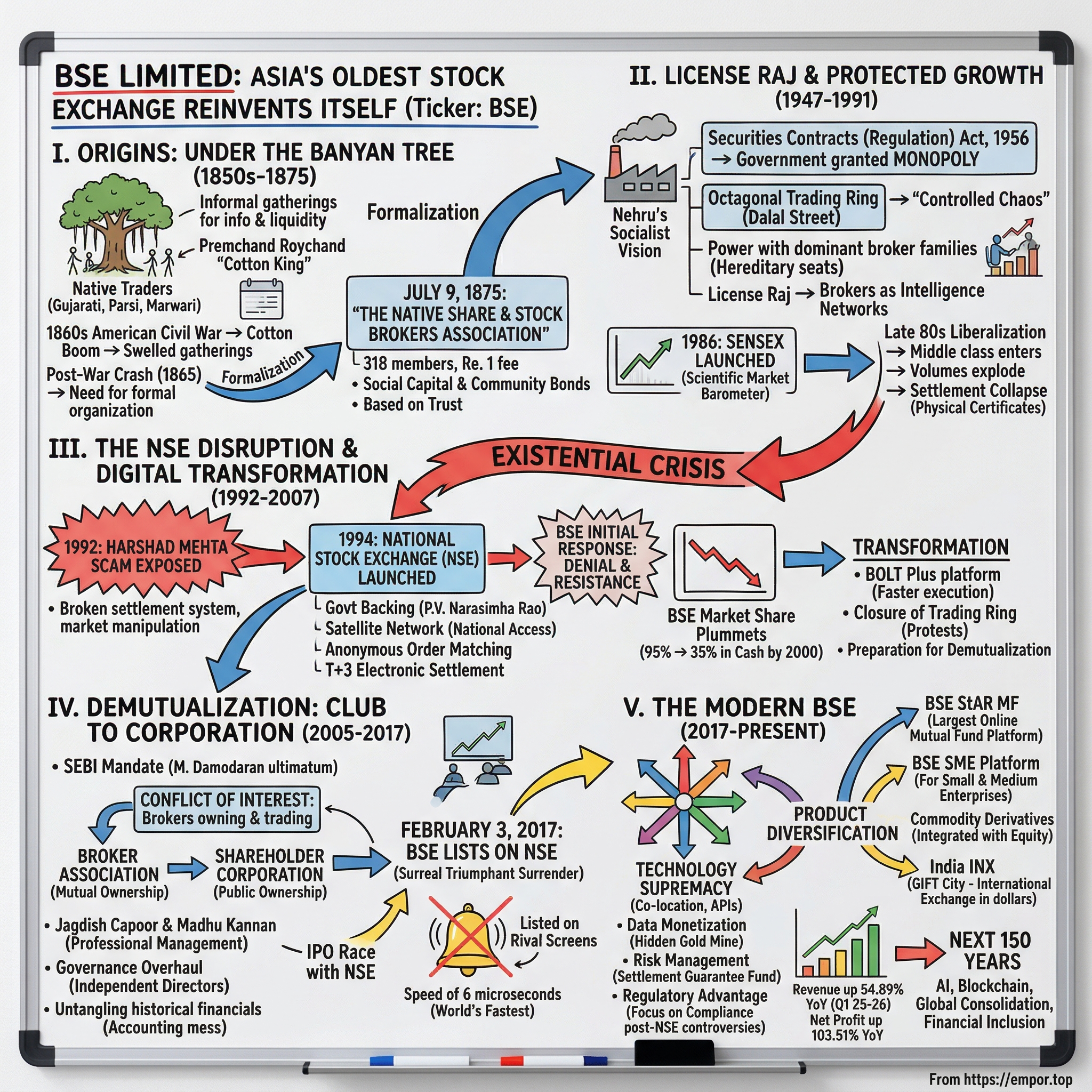
BSE Limited: Asia's Oldest Stock Exchange Reinvents Itself
I. Cold Open & Episode Setup
Incumbents rarely face public role reversal as starkly as BSE Limited did on 3 February 2017.
That morning, the shares of Asia's oldest stock exchange — an institution founded in 1875, four years before Thomas Edison demonstrated the light bulb — began trading for the first time. They did not trade on BSE. They traded on the screens of the National Stock Exchange (NSE), the rival established in 1992 explicitly to end BSE's monopoly. Indian regulation forbids an exchange from listing on its own platform to ensure market surveillance remains independent. As a result, the 142-year-old incumbent went public on the 25-year-old disruptor's tape.
At the time, the arrangement mirrored market reality. By 2017, BSE was primarily a cash-equities venue with a single-digit share of a market it once dominated. It maintained virtually no presence in equity derivatives, the segment that had become the core engine of Indian market profitability. The Sensex, BSE's benchmark index and India's most recognized financial metric, remained a household brand attached to an exchange business that institutional investors had largely sidelined.
Nine years later, the financial picture looks fundamentally different. In the fiscal year ended March 2026, BSE reported total revenue of ₹5,148 crore, up 59% year over year, and consolidated net profit of ₹2,487 crore, up 88% — marking the strongest financial performance in the exchange's 150-year history.1 Operating EBITDA doubled to ₹3,079 crore, as operating margins expanded from 51% to 64%.1 In the quarter ended June 2026, net profit reached ₹872.66 crore on total income of ₹1,706.72 crore, growing 62% and 63% respectively from the prior year.23 Crucially, by June 2026, BSE held 32.4% of India's index options premium market — a category where its market share was effectively zero three years earlier.4
This reversal challenges established market dynamics. Financial exchanges typically operate as winner-take-all network businesses: liquidity attracts order flow, order flow deepens order books, deeper books narrow bid-ask spreads, and narrower spreads draw additional liquidity. Historically, once a competing venue captures this flywheel — whether in Chicago's futures pits, London's LIFFE, or Frankfurt's Eurex — market share rarely shifts back to the incumbent.
Consequently, the core analytical question is not whether BSE recovered, but how the recovery occurred, whether its structural foundation is durable, and to what extent gains stem from internal execution versus regulatory interventions and a broader retail options boom in India. Each driver implies a distinct outlook. If BSE gained ground through product design and contract expiration schedules, its market share may prove defensible. If growth depended primarily on calendar adjustments by the Securities and Exchange Board of India (SEBI), that share remains sensitive to policy shifts. Finally, if performance relies on retail participation in weekly options during an extended bull market, revenues remain tied to a speculative cycle under active regulatory oversight.
A notable historical symmetry is now approaching. NSE received a no-objection certificate from SEBI in January 2026 after nearly a decade of regulatory delays, and its board approved an initial public offering on 6 February 2026 — an offer for sale of up to 14.9 crore shares expected to raise approximately ₹30,000 crore.56 Under listing regulations, NSE must list its shares on BSE, reversing the arrangement from nine years prior.
The physical locus of the exchange remains Phiroze Jeejeebhoy Towers on Dalal Street, the 29-storey building that has anchored Mumbai's financial district since 1980. Inside, a matching engine processes trades in approximately six microseconds — roughly the time required for light to travel a mile and a half.7 The location where floor traders once executed transactions through open outcry now operates one of the fastest electronic order-matching systems globally.
The story begins under the tree.
 Subscribe on LinkedIn
II. Under the Banyan Tree: Colonial Capital & Native Enterprise (1850s–1875)
In the 1850s, a handful of stockbrokers began meeting under a banyan tree in front of Bombay's Town Hall to trade shares of banks and cotton-pressing companies.8 There was no building, rulebook, or regulator — only a group of traders agreeing on prices by voice. As the group expanded, local authorities repeatedly moved them along. They drifted from tree to tree before eventually settling on a lane off Horniman Circle that acquired the name it still carries: Dalal Street, literally Broker Street.
What transformed this informal huddle into a permanent institution was an external geopolitical shock.
When the American Civil War broke out in 1861, the Union blockade cut Lancashire's textile mills off from Confederate cotton. As Britain sought alternatives, western India filled the supply gap, turning Bombay into a global cotton clearing house almost overnight. Capital poured into the city, and the brokers trading bank shares under a tree suddenly found themselves intermediating a massive commodity boom.
The central figure of this boom was Premchand Roychand, a broker who became one of the city's wealthiest financiers and one of the first Indians admitted to the Bombay Chamber of Commerce. He financed land-reclamation projects, banks, and the University of Bombay's Rajabai Tower, named after his mother. But Roychand also embodied the crash that followed. When the Civil War ended in 1865 and American cotton returned to world markets, prices collapsed, reclamation schemes failed, and Bombay's speculative bubble burst. Fortunes evaporated, including much of Roychand's.
Rather than dispersing after the crash, the brokers formalised their organization. On 9 July 1875, they established The Native Share and Stock Brokers' Association — the entity that eventually became BSE — three years before the founding of the Tokyo Stock Exchange, making it Asia's oldest stock exchange.8 The initial entry fee was set at one rupee per member.
The inclusion of "Native" in the title reflected its origins. Built by Gujarati, Parsi, and Marwari merchant communities under British colonial rule, the association emerged at a time when major financial institutions — exchange banks, managing agencies, and shipping lines — were controlled by British capital. The brokers established their own rules for membership, settlement, default, and dispute resolution, creating a clearing convention decades before any state institution oversaw Indian securities markets. In effect, it functioned as an indigenous financial infrastructure.
The exchange acquired its physical premises much later, securing land on Dalal Street in 1928 and beginning construction in 1930.8 The structural sequence was distinct: the trading community formed first, formal rules followed, physical real estate came decades later, and statutory regulation — SEBI was established in 1988 and granted statutory authority in 1992 — arrived more than a century after the association's founding.
This sequence created both BSE's core strength and its long-term vulnerability. Its strength lay in trust: a self-governing broker guild with organizational continuity that survived market crashes, world wars, and Indian independence. Its vulnerability was structural: an institution owned and governed by its trading members inherently prioritized member interests over outside investors. For decades after independence, this conflict of interest remained latent while BSE operated without competition. Once a modern competitor emerged, however, that structural weakness exposed the exchange to rapid disruption.
III. Monopoly, License Raj & The Floor Ring (1947–1992)
On the trading floor of Phiroze Jeejeebhoy Towers in the early 1980s, hundreds of brokers gathered daily in a circular pit. Transactions were executed through isara — a codified system of hand signals, with palms facing outward for sell orders, palms inward for buy orders, and finger positions denoting price and quantity — and logged manually in pocket notebooks. Trades executed on a Monday often took up to two weeks to settle, with physical share certificates transported by hand across Mumbai in cloth bags.
For floor members, this manual arrangement was highly lucrative.
Independent India's post-colonial regulatory framework granted BSE an effective national monopoly. Under the Securities Contracts (Regulation) Act of 1956, BSE gained statutory recognition as the premier venue for corporate capital raising. During the License Raj era, when state permits regulated industrial expansion, BSE controlled access to public equity markets through exchange membership. Broker cards became scarce, hereditary assets that steadily appreciated in value.
The exchange's corporate governance reflected this member-centric structure. As a mutualized, non-profit association, BSE was owned and managed by its trading members. While mutual exchange structures were common globally at the time — including at the New York Stock Exchange — and imposed discipline through shared default risk, they created inherent conflicts of interest. A venue governed by floor brokers had little commercial reason to eliminate physical trading floors or broaden market access. The information asymmetry between floor traders in Mumbai and retail investors in regional centers formed a core driver of broker profitability.
Two major developments during this era permanently shaped BSE's commercial trajectory.
First, in 1986, the exchange launched the Sensex, India's first equity index. Composed of 30 large, liquid, financially established companies, the market-capitalization-weighted index used a base value of 100 anchored to fiscal year 1978–79.8 The Sensex quickly became the standard benchmark for Indian equity markets, gaining widespread national media coverage and establishing valuable brand equity that would later underpin derivative product expansion.
Second, the 1992 securities crisis exposed systemic vulnerabilities in Indian capital market infrastructure. Broker Harshad Mehta and his associates exploited structural gaps between interbank debt markets and equity trading. By using fake bank receipts — informal IOUs intended to verify underlying government bond holdings — Mehta diverted an estimated ₹4,000 crore of banking liquidity into stock purchases. This capital influx drove a nearly fourfold increase in the Sensex over twelve months before the scheme unravelled in April 1992, triggering a market crash.
The crisis highlighted critical structural weaknesses: manual paper settlement lacking real-time auditability, the absence of delivery-versus-payment protocols and central counterparty clearing, and governance conflicts inherent in a broker-led board overseeing member discipline. When senior exchange officials were implicated in the aftermath, the Indian government and the newly statutorily empowered Securities and Exchange Board of India (SEBI) concluded that structural reform required introducing direct competition, leading to the creation of a modern electronic exchange.
IV. The NSE Disruption & The Lost Decades (1992–2005)
The National Stock Exchange (NSE) was designed specifically to dismantle BSE's monopoly and address the structural vulnerabilities exposed by the 1992 securities crisis.
Promoted starting in 1992 by IDBI, Life Insurance Corporation of India (LIC), and a consortium of state-owned financial institutions, NSE was established as a demutualized corporate entity. Professional management was entirely separated from trading rights, and the exchange operated without a physical trading floor. Its National Exchange for Automated Trading (NEAT) system matched orders electronically, while distribution relied on Very Small Aperture Terminal (VSAT) satellite links. This enabled brokerages in regional centers such as Nagpur or Coimbatore to view identical real-time order books alongside traders on Dalal Street.
This distribution model fundamentally disrupted BSE's core business. Floor brokers had historically profited from regional price opacity and wide bid-ask spreads. Electronic order books eliminated those information asymmetries. Transitioning to screen-based execution threatened the value of traditional broker cards, creating institutional resistance to reform among BSE's owner-members. Although BSE launched its screen-based BSE On-Line Trading (BOLT) system in 1995 — roughly a year after NSE began equity operations — the primary divide was governance rather than technology. Unencumbered by member-owners, NSE mandated immediate screen trading across its network, whereas BSE faced internal resistance from members seeking to protect floor-trading privileges.
By the late 1990s, NSE had captured the majority of India's cash-equity turnover. The competitive gap widened further with the introduction of equity derivatives. When index futures and options debuted on Indian exchanges in mid-2000, both venues launched from a standing start. Derivatives trading operates on a self-reinforcing liquidity flywheel: tight bid-ask spreads attract order flow, which in turn deepens order books and draws additional market makers. Building an early lead with its Nifty 50 index contracts, NSE quickly dominated derivative trading. Within a few years, NSE captured virtually the entire derivatives market, establishing a near-total dominance that persisted for nearly two decades.
By 2005, BSE was structurally disadvantaged across multiple dimensions: it operated as a secondary cash-equities venue with inferior liquidity compared to NSE, maintained an overhead structure built for a legacy monopoly, and managed a listing register heavy with dormant companies. Although the Sensex remained India's premier benchmark index, professional market participants had shifted their execution almost entirely to NSE.
A crucial strategic initiative during this period was BSE's role in developing market infrastructure. In 1999, the exchange co-founded Central Depository Services Limited (CDSL) to support the national push for dematerialized share settlement, replacing paper share certificates with electronic recordkeeping. While initially operating as a low-margin utility, CDSL subsequently developed into a highly valuable asset on BSE's balance sheet as retail equity participation expanded.
By 2005, BSE's central challenge was constitutional rather than strategic. Operating a national securities exchange as a member-owned broker guild was no longer viable, prompting regulators and market participants to demand comprehensive demutualization.
V. Demutualization, Corporate Transition & Listing on the Enemy (2005–2017)
The legal instrument that ended 130 years of broker governance was the BSE (Corporatisation and Demutualisation) Scheme, notified by SEBI in 2005. Its core directive was straightforward: separate trading rights from ownership rights. Card-holding members became shareholders of a for-profit corporation, but broker equity was capped to ensure that non-trading institutions and public investors held the majority. The exchange became BSE Limited, completing its structural evolution from a self-governing guild into a corporate entity.
What followed was a decade of institutional retrofitting that proved both protracted and challenging.
Strategic foreign capital arrived as Deutsche Börse and Singapore Exchange acquired stakes in the demutualized entity, bringing capital alongside governance practices from established international exchanges. Domestic institutions, including Life Insurance Corporation of India (LIC), also joined the cap table. In accordance with SEBI's regulatory framework, BSE restructured its board to include independent and public-interest directors. This governance architecture persists today, reflecting the dual role of Indian exchanges as commercial enterprises and frontline market regulators with statutory surveillance obligations over their members.
The operational rebuild was led by Ashishkumar Chauhan, who joined as Deputy CEO in 2009 and became Managing Director and CEO in 2012. Chauhan's career carried a striking structural irony: in the 1990s, he had been part of NSE's founding team, helping construct the electronic platform that dismantled BSE's monopoly. He then spent a decade at BSE working to rebuild the exchange against the competitor he had helped launch.
His central strategic priority was technology. BSE migrated its core trading engine to a new architecture developed with Deutsche Börse, and in 2015 the exchange began advertising order-response times of roughly six microseconds.7 In exchange mechanics, latency is critical. When a high-frequency market maker quotes a two-sided option price, it risks being "picked off"—executed against at a stale price if the underlying index moves before the quote can be updated. Lower latency enables market makers to adjust quotes faster, allowing them to offer narrower bid-ask spreads with reduced risk. Speed thus translates directly into spread efficiency. Yet while high-speed execution is necessary to attract liquidity, it cannot generate trading volume on its own.
For most of the decade following 2015, BSE possessed a high-speed engine but minimal order flow. Infrastructure alone was insufficient to unseat NSE's established liquidity flywheel.
Another key decision during Chauhan's tenure involved Central Depository Services Limited (CDSL). SEBI ownership guidelines eventually mandated that exchanges reduce their holdings in depository subsidiaries, prompting BSE to divest its stake in phases, culminating in CDSL's initial public offering in 2017. The depository—which BSE had co-founded as a clearing utility in 1999—had evolved into a high-margin, capital-light enterprise. The divestments generated substantial cash for BSE's balance sheet, delivering a lucrative capital-allocation outcome driven by a combination of regulatory mandates and favorable market timing.
In early 2017, BSE completed its own initial public offering. The pure offer for sale of roughly ₹1,243 crore allowed existing shareholders, including brokers and strategic investors, to reduce their holdings. The offering opened on 23 January 2017, and the shares began trading on 3 February.9 Under regulatory rules forbidding exchanges from self-listing, BSE debuted on the trading floor of its primary competitor, NSE.
Beyond the symbolic role reversal, public listing imposed structural discipline. It subjected BSE to quarterly reporting, earnings calls, and continuous analyst scrutiny—an accountability framework absent during its history as a member guild. Public equity provided BSE with a transparent market valuation, capital flexibility, and a clear benchmark against which its eventual turnaround could be evaluated.
Yet despite demutualization, technological modernization, and public listing, an operational turnaround remained unrealized. As of 2017, BSE's equity derivatives business remained a negligible fraction of the Indian market.
VI. The Business Architecture: Revenue Segments & Core Economics
Before analyzing the mechanics of the turnaround, it is essential to examine what an exchange actually sells: BSE Limited operates four distinct lines of business with contrasting economics anchored to a shared cost base.
Transaction charges form the primary volume engine. BSE generates fees from cash equity turnover and, more critically, from options premium turnover rather than notional turnover. This distinction is pivotal to understanding exchange revenue. For a single Sensex option contract, the notional value reflects the total index value multiplied by the lot size — often reaching ₹15 lakh or more. By contrast, the premium represents the actual price paid for the contract, typically a few thousand rupees. Because Indian exchanges levy transaction fees strictly on premium, revenue reflects the actual risk capital deployed rather than theoretical market exposure. Consequently, record headline notional turnover can coincide with flat revenue if premium values decline. Analysts track the premium-to-notional ratio as a key proxy for revenue quality: BSE's ratio stood at 12.2 basis points in June 2026, down from 12.9 basis points in May, while averaging 12.5 basis points across the June quarter compared to 11.8 basis points in the March quarter.4
In FY26, equity derivatives alone generated ₹3,134 crore in revenue for BSE — more than double the prior year and representing the majority of the company's ₹4,834 crore in operating revenue.1 That revenue concentration highlights both the primary driver of recent growth and the exchange's core vulnerability.
Services to corporates functions as an annuity stream. Listed companies pay an initial fee upon going public and an annual fee thereafter, scaled to market capitalization. In the first nine months of FY26, this segment contributed ₹290.5 crore.7 While slow-growing, it provides a stable revenue floor during market downturns. Because Indian corporations routinely maintain dual listings across both BSE and NSE, BSE collects recurring listing fees even from issuers whose secondary trading volume occurs almost entirely on NSE — a structural dynamic that has subsidized the exchange for decades. BSE also operates India's dominant SME listing platform. Fiscal year 2026 saw a record wave of primary market activity, with 255 companies listed on BSE — the highest count of any exchange globally — raising roughly ₹1.8 lakh crore.1
BSE StAR MF operates as a high-margin mutual fund distribution utility, detailed in Section IX.
Investment income and clearing float represents the balance-sheet segment. BSE's clearing subsidiary, Indian Clearing Corporation Limited (ICCL), acts as the central counterparty for all transactions, holding member margins and settlement collateral that generate investment yield. ICCL also manages the Core Settlement Guarantee Fund (SGF), a mutualized pool designed to absorb losses if a clearing member defaults. Regulations mandate that BSE maintain at least 51% ownership of ICCL and contribute a minimum of 25% of the Core SGF corpus, though the exchange has historically funded 30% to 35%.10 As of 30 September 2024, ICCL's tangible net worth stood at ₹1,179 crore, including a Core SGF corpus of ₹981 crore.10
The strategic connection among these four business segments lies in high operating leverage — a defining financial feature of exchange market structures.
An exchange operates with an overwhelmingly fixed cost base. The matching engine, data centers, market surveillance departments, compliance staff, and regulatory reporting infrastructure require substantial upfront investment that scales with operational requirements rather than trading volume. The marginal cost of executing an additional options transaction is virtually negligible. As a result, financial performance functions like a step threshold: below a specific volume baseline, an exchange absorbs significant fixed overhead; once trading volume crosses that threshold, incremental revenue flows to operating profit at exceptionally high conversion rates.
BSE's FY26 financial results illustrate this operational leverage in practice. Operating revenue rose 63%, while operating EBITDA doubled and operating margin expanded from 51% to 64%.1 In the December 2025 quarter, revenue from operations grew 62% while net profit grew by more than 170%.7 Profit expanding at nearly three times the rate of revenue growth reflects operating scale rather than new pricing power. However, operating leverage functions symmetrically: the same cost structure that amplified a 59% revenue increase into an 88% net profit gain in FY26 would magnify any potential volume contraction into a disproportionately sharp margin decline.
This structural mechanism leads directly to the leadership execution that generated the volume expansion.
VII. The Great Derivatives Turnaround: Sundararaman Ramamurthy's Masterclass
In January 2023, Sundararaman Ramamurthy assumed leadership at BSE as Managing Director and CEO facing a steep commercial challenge.11 At the time, BSE's equity derivatives business had virtually no market share. NSE's index options products — centered on the Nifty 50 and Bank Nifty — dominated Indian derivatives trading, forming one of the largest derivative markets globally by contract volume. While BSE possessed an ultra-low-latency matching engine and the recognized Sensex brand, it lacked trading volume and order flow.
Ramamurthy brought direct experience from the competitor he was attacking. He had spent nearly two decades at NSE during the construction of its derivatives platform before serving as Chief Operating Officer for Bank of America's India securities business. SEBI approved his appointment in November 2022, and he took charge in the first week of January 2023.1211 His hiring reflected a broader industry reality: specialized operational expertise in exchange microstructure and liquidity creation was concentrated within a small circle of industry veterans.
His strategy focused on structural design rather than marketing, executed through a deliberate sequence of product adjustments.
First, he made the contract usable. A weekly index option functions primarily as a leveraged directional instrument subject to rapid time decay. Participation depends heavily on contract lot size, which determines the minimum capital required per trade. Large lot sizes exclude retail traders and smaller algorithmic desks. BSE reduced the Sensex options lot size, lowering ticket sizes and aligning margin requirements with the retail and institutional affordability thresholds established on NSE.
Second, he altered the contract expiration schedule. In 2023, NSE's weekly index options expired midweek, with Bank Nifty on Wednesday and Nifty on Thursday. Expiry days generate the bulk of premium turnover and exchange revenue because option time decay accelerates sharply near settlement. Rather than launching competing contracts on NSE's established expiry days — where an incumbent's liquidity advantage typically absorbs challenger volume — BSE scheduled weekly Sensex option expiries on Friday and later added Tuesday expiries for Bankex contracts.
This calendar design avoided a direct liquidity battle with NSE. Instead of asking traders to abandon established venues, BSE offered complementary expiry days across the week. Market participants seeking daily expiry exposure could trade BSE contracts alongside NSE positions without duplicating collateral requirements, as contracts expiring on different days do not compete for the same margin simultaneously. This counter-positioning strategy proved effective because NSE could not easily match BSE's schedule without cannibalizing its own high-volume expiry days.
Third, he restructured fee models and broker integration. BSE revised its transaction fee schedule based on option premium turnover rather than notional value, while coordinating with retail discount brokerages and proprietary trading desks to streamline API connectivity and clearing workflows at ICCL. Simplifying back-end integration ensured that member firms could route client orders with minimal technical friction.
Trading volume responded rapidly. BSE's average daily premium turnover in equity derivatives reached ₹8,977 crore in FY25, then more than doubled to ₹19,522 crore in FY26 — a 118% increase in a single year.1 In the quarter ended June 2026, average daily premium turnover reached a record ₹29,615 crore, up 96% year over year.13
Myth versus reality
While market commentary attributed BSE's turnaround primarily to executive strategy, a complete analysis reveals important contextual factors.
Myth: BSE won purely on product design. Reality: The turnaround coincided with an unprecedented expansion in Indian retail options trading. Between 2021 and 2024, weekly index options transformed from a specialized institutional tool into a mass-market retail vehicle. BSE gained market share within an overall market that was expanding rapidly.
Myth: The expiry-day strategy established a permanent moat. Reality: Regulatory changes eliminated calendar differentiation within two years. SEBI's October 2024 framework restricted each exchange to weekly option contracts on a single benchmark index, and a subsequent May 2025 circular standardized all equity derivative expiries to Tuesdays or Thursdays. Effective 1 September 2025, NSE shifted its expiries to Tuesday while BSE was assigned Thursday.[^14]14 The multi-day staggered expiry calendar no longer exists as a competitive differentiator.
Myth: Market share expansion follows a linear trajectory. Reality: Monthly market share figures reflect temporary calendar variations. For example, BSE's index options premium market share dipped to 32.4% in June 2026 as average daily turnover fell 12% month-on-month to ₹26,200 crore, primarily because the calendar handed NSE an extra weekly expiry date during that month.4 Short-term market share shifts often reflect calendar mechanics rather than underlying structural changes.
Nevertheless, BSE successfully established a functional second liquidity pool in Indian index options — securing active market makers, broker integration, and consistent order flow where none existed previously. While notable, maintaining this position faces ongoing structural and regulatory headwinds.
As BSE built its derivatives presence, financial regulators were examining the broader retail options market with increasing scrutiny.
VIII. Regulatory Firestorms: SEBI's 2024 Index Options Crackdown & Market Adaptation
In September 2024, SEBI released a comprehensive study examining individual retail participation in equity index derivatives. The data revealed that roughly nine out of ten individual traders incurred net losses, with cumulative net losses exceeding ₹1.81 lakh crore across the three fiscal years from FY22 to FY24.[^16] The report provided empirical evidence that the rapid expansion of retail options trading was resulting in substantial household financial losses.
For BSE, whose valuation re-rating depended heavily on options premium growth, the regulatory scrutiny targeted its primary revenue engine.
SEBI's regulatory response, issued in October 2024 and implemented starting 20 November 2024, introduced structural constraints across the market:[^14] exchanges were restricted to weekly expiry contracts on a single benchmark index; minimum contract lot sizes were raised to a range of ₹15 lakh to ₹20 lakh; option premiums were required to be collected upfront from buyers; an additional 2% extreme loss margin was applied to short options on expiry days; and intraday snapshot monitoring replaced end-of-day position limit checks.
Faced with selecting a single index for weekly options, both exchanges concentrated liquidity on their primary benchmarks: BSE retained weekly contracts on the Sensex while discontinuing weekly expiries for Bankex and Sensex 50, and NSE retained the Nifty 50 while dropping Bank Nifty.14 In a liquidity-driven market, concentrating volume into flagship products proved essential to maintaining order book depth.
The regulator subsequently standardized the expiry calendar. A SEBI circular issued on 26 May 2025 mandated that all equity derivative contracts expire on either a Tuesday or a Thursday, requiring exchanges to select one designated day.14 Effective 1 September 2025, NSE shifted Nifty expiries to Tuesday, while BSE moved Sensex expiries to Thursday.15 The policy aimed to mitigate operational risks associated with concentrated volume surges on single trading afternoons and eliminate competing expiry-day schedules.
Compounding regulatory shifts, an enforcement action highlighted liquidity concentration risks. On 3 July 2025, SEBI issued an interim order barring U.S. quantitative trading firm Jane Street from Indian securities markets and impounding ₹4,843 crore (approximately $566 million) in alleged unlawful gains.16 The regulator alleged that between January 2023 and March 2025, the firm executed an expiry-day trading pattern on Bank Nifty by aggressively purchasing underlying stocks and futures during morning trading to drive index movement, then unwinding those positions in the afternoon while holding larger options positions structured to profit from the reversal.17 SEBI estimated the firm's total index options profits during the period at over ₹43,000 crore.17
The enforcement order led to an immediate reduction in market activity, with index options premium turnover on both exchanges falling week-on-week in four of the five trading sessions following the directive.18 The measurable drop in national trading volume demonstrated the reliance of the options ecosystem on a concentrated group of high-frequency quantitative market makers who serve as primary counterparties to retail order flow. Exchange revenues derived from options premiums remain tied to the continued quoting activity of these principal trading firms.
Fiscal policy shifts imposed additional transaction costs. In February 2026, the Union Budget increased the Securities Transaction Tax (STT) on futures from 0.02% to 0.05% and on options premiums from 0.1% to 0.15%, effective 1 April 2026 — representing the largest tax increase on derivative transactions in two decades.19 Although STT is paid by market participants rather than exchanges directly, higher transaction friction lowers expected trading returns and compresses marginal trading volume.
Operating margins were also affected by regulatory capital requirements. Mandatory contributions to the Core Settlement Guarantee Fund (SGF) require exchanges to reserve capital against systemic risk, reducing reported cash flow in periods of allocation. Consequently, BSE reports its operating EBITDA margin both including and excluding SGF contributions; in the quarter ended December 2025, the ex-SGF operating margin reached 63%.7 Evaluating exchange profitability requires distinguishing between headline operating margins and those adjusted for mandatory SGF funding.
Despite absorbing higher contract lot sizes, restrictions to a single weekly expiry index, standardized expiry schedules, the Jane Street exit, and increased transaction taxes, BSE recorded its highest annual revenue and net profit in FY26.
Two primary factors explain BSE's operational resilience during this regulatory cycle. First, concentrating order flow into a single benchmark with larger contract sizes increased average premium values per trade, offsetting lower transaction counts. Second, because BSE operated from a smaller market share baseline compared to NSE, market share gains allowed its volume to expand even as total industry growth slowed.
However, market share expansion provides a finite growth runway. As BSE's market share stabilizes, future financial performance will depend increasingly on overall industry volume trends — the precise area targeted by regulatory restrictions — prompting the exchange to focus on diversifying its revenue base across non-derivative business segments.
IX. Strategic Optionality & Hidden Engine: BSE StAR MF & Beyond
Beyond the volatility of the equity derivatives market, BSE operates a quieter but strategically vital infrastructure business focused on processing mutual fund orders.
Launched in 2009, BSE StAR MF functions as a central order-routing network. When an Indian investor purchases mutual fund units through a broker, digital platform, or independent financial adviser, StAR MF routes the order to the asset management company's registrar, timestamps the transaction, reconciles the funds, and confirms execution. The platform does not hold assets, assume market risk, or depend on the direction of asset prices; instead, it earns a per-transaction processing fee of a few rupees.
The significance of the platform lies in its scale. In FY26, StAR MF processed 84.1 crore (841 million) transactions — a 27% increase year over year — generating ₹285 crore in revenue.1 By the end of the fiscal year, the network connected 83,280 distributor participants across 721 cities and offered access to more than 15,000 schemes.1 In the quarter ended December 2025, it accounted for an 87.4% share of transactions processed through exchange-based mutual fund platforms.7 Momentum extended into the quarter ended June 2026, when volume reached 23.4 crore transactions, up 28% from the prior-year period, generating ₹73.3 crore in revenue.13
Although StAR MF accounts for roughly 6% of BSE's total revenue, its strategic importance stems from its revenue profile. The vast majority of transactions originate from systematic investment plans (SIPs) — automated monthly contributions that Indian retail investors have widely adopted. SIP inflows represent a predictable, subscription-like revenue stream for market infrastructure. These recurring allocations tend to persist even during market corrections, slowing only at the margin when equity indices decline. Because StAR MF transaction volumes carry a low correlation with options trading activity, the platform serves as an operational counterweight when derivatives activity cools.
The platform's underlying economics resemble those of a financial payment network: near-zero marginal cost per incremental order, expanding network effects as more distributors and asset managers join, and rising switching costs as intermediaries integrate its API into daily operations. However, this competitive advantage must be evaluated with nuance. StAR MF's high market share partly reflects minimal historical investment by competing exchanges rather than insurmountable structural barriers, while distribution commissions remain regulated by SEBI. Consequently, StAR MF is best characterized as a highly efficient distribution utility with strong network effects rather than an unassailable monopoly.
Market participants frequently note an implicit valuation thesis: that StAR MF, as an independent entity, might command the higher valuation multiples typical of financial technology platforms rather than traditional exchange operators. However, management has announced no plans for a carve-out, spin-off, or separate monetization. From an analytical perspective, the platform is properly evaluated as a high-margin operating segment within BSE's consolidated balance sheet rather than a prospective corporate transaction.
India International Exchange (India INX) represents strategic optionality rather than a primary revenue contributor. Established in 2017 within Gujarat International Finance Tec-City (GIFT City), India INX offers trading in dollar-denominated derivatives, international securities, and debt instruments under a regulatory framework designed to compete with offshore hubs like Singapore and Dubai for India-centric capital flow.20 Monthly turnover crossed $106 billion in late 2025 as GIFT City expanded its role in routing international investment.2021 While establishing an early footprint positions BSE for potential long-term shifts in offshore trading, India INX faces stiff competition: NSE IX hosts GIFT Nifty — which absorbed the benchmark SGX Nifty contract — and continues to command the primary share of offshore liquidity. As a result, India INX remains a long-term strategic option rather than an immediate earnings engine.
The SME platform completes the exchange's secondary business lines. BSE leads the Indian market in listings for small and medium-sized enterprises. In FY26, the venue hosted 255 SME listings — the highest count of any exchange globally — driven by strong primary market issuance and established relationships with smaller corporate issuers.1 However, the segment faces persistent regulatory scrutiny: SEBI has repeatedly raised concerns regarding disclosure quality, price volatility, and retail participation in SME initial public offerings. Stricter regulatory standards or listing eligibility criteria could directly moderate future issuance volumes.
These three businesses present distinct operational and risk profiles. Together with the core derivatives and cash equity engines, they form the business portfolio overseen by a management team whose strategic execution over recent years can now be fully evaluated.
X. Current Management, Incentives & Capital Allocation Record
Sundararaman Ramamurthy's communication style contrasts with typical turnaround chief executives, relying on technical detail rather than promotional rhetoric.
On earnings calls, management has been reluctant to celebrate short-term market share gains. During the first-quarter FY27 call on 4 August 2026, executive commentary focused on institutional participation rather than record options turnover.2213 Management outlined priorities to expand active foreign portfolio investors from roughly 650 toward a target of 800 while building out monthly and longer-dated derivative contracts. Between January 2025 and July 2026, BSE reported a roughly five-fold increase in long-dated contract volumes and a tenfold rise in premium volumes.13
This focus addresses a key structural vulnerability: an options market reliant on zero-day-to-expiry retail contracts remains exposed to regulatory intervention and lacks institutional stability. Conversely, an ecosystem anchored by foreign institutional investors, longer-dated contracts, and hedging flow offers greater defensibility against competition and policy shifts. While management aims to build this institutional depth, the exchange still derives the bulk of its revenue from short-dated options. As of August 2026, transitioning toward longer-dated, institutional flow remains an early-stage initiative rather than an established outcome.
Specific guidance provides clear benchmarks for tracking management execution. During the August 2026 call, management targeted a "meaningful double-digit cash market share by early 2027"—an ambitious goal given that NSE controls approximately 93% of Indian cash equity turnover.1323 BSE's cash segment posted a record average daily turnover of ₹9,955 crore in the June 2026 quarter, up from a full-year average of ₹7,950 crore in FY26.131 However, overall industry cash turnover declined 7% month-on-month in June 2026 to ₹1.41 trillion, with equity research firm Jefferies noting that BSE's cash turnover contracted while NSE's expanded over a comparable period.237 Closing the distance between current market trajectory and management's target presents a significant operational hurdle.
Pricing structure introduces a dual analytical perspective. Management disclosed that order-flow transaction charges sit at approximately 20% of prevailing competitor rates, with potential price increases planned as liquidity deepens.13 On one hand, this discount represents unexploited pricing power that could expand margins if implemented. On the other hand, below-market pricing suggests that current order flow is partially subsidized, meaning headline volume growth may compress if fees are normalized to market levels.
Operational and regulatory challenges persist alongside derivative growth. At the two-year mark of Ramamurthy's tenure, financial press evaluations highlighted ongoing operational concerns despite commercial gains.24 Because stock exchanges serve as frontline market regulators, system stability and surveillance rigor remain central to their operating licenses. Revisions by SEBI to its technical-glitch framework throughout 2025, culminating in a January 2026 circular, underscore that operational outages carry direct financial and regulatory penalties.25
Capital allocation remains conservative, supported by a debt-free balance sheet with substantial cash reserves mandated by regulatory capital requirements and Core Settlement Guarantee Fund (SGF) commitments. For FY26, the board declared a final dividend of ₹10 per share on a face value of ₹2, with a record date of 10 July 2026.262 In March 2025, BSE announced a two-for-one bonus share issue—issuing two additional shares for every share held—with a record date of 23 May 2025 and new share listing on 27 May 2025.2728 While bonus issues do not alter underlying corporate economics, they increase trading liquidity, reduce nominal share prices, and alter year-over-year per-share comparison metrics.
Infrastructure services represent another key operational segment. BSE generated ₹51 crore in colocation revenue across 500 deployed server racks, with management indicating that existing rack capacity would meet demand for at least 18 months.13 Colocation—renting server space adjacent to the matching engine to minimize trade execution latency—yields high operating margins but carries heightened regulatory oversight. The regulatory risk was highlighted by NSE's agreement to pay ₹1,388 crore to settle colocation and dark-fiber proceedings with SEBI ahead of its public offering.29 While BSE operates on a smaller colocation scale, fair and equal infrastructure access remains a sensitive compliance area for market operators.
From a governance perspective, BSE presents few conventional balance-sheet vulnerabilities: it carries no corporate debt, operates no non-core conglomerates, and maintains no history of capital-destroying acquisitions. Instead, fundamental analysis centers on four structural questions: whether cash reserves exceeding regulatory mandates are productively deployed; whether rapid SME platform expansion risks compromising listing standards; whether below-market fee structures obscure true competitive strength; and whether a board heavily weighted with regulator-nominated public interest directors provides effective commercial governance. These factors determine whether BSE's recent operational turnaround translates into long-term enterprise value.
XI. Industry Microstructure, Hamilton Helmer's 7 Powers & Porter's 5 Forces
Strip away the narrative and examine the structural question: what, precisely, prevents NSE from reclaiming lost ground?
Evaluating BSE through Hamilton Helmer's 7 Powers framework produces a more tempered assessment than recent share price gains might suggest.
Network effects represent the dominant power in securities exchanges, and they work against BSE rather than for it. Liquidity inherently begets liquidity, and NSE maintains a vastly larger pool. While BSE has established a viable secondary pool with sufficient depth for traders to enter and exit Sensex options without prohibitive slippage, offering enough liquidity to be functional differs fundamentally from drawing primary order flow away from the market leader. On this dimension, BSE remains the sub-scale venue.
Counter-positioning served as BSE's primary initial advantage, but regulatory intervention has largely neutralized it. The staggered-expiry strategy succeeded because NSE could not replicate it without cannibalizing its own flagship expiry schedules. SEBI's mandate standardizing expiries to Tuesdays and Thursdays ended that asymmetry. What remains is incremental product differentiation, including sector indices, monthly and longer-dated contracts, and the July 2026 launch of derivatives on the BSE Focused IT index — India's first sector-benchmarked derivatives product.13 While these represent genuine product innovations, they can be easily replicated by competitors.
Scale economies are genuine and operate asymmetrically. Because marginal trade processing costs are near zero, BSE generates substantial incremental profit on new volume, enabling an ambitious challenger to compete aggressively on price. However, NSE operates with the same low-marginal-cost architecture across a vastly larger volume base, allowing the market leader to absorb a prolonged price war more comfortably than BSE could initiate one.
Process power is reflected in BSE's six-microsecond matching engine and the operational discipline of its clearing corporation, which processes roughly 10 crore equity trades per day.7 While executing at this scale requires technical capabilities, it does not provide a durable competitive moat. NSE maintains comparable technical infrastructure, rendering ultra-low latency an industry baseline rather than a proprietary advantage.
Cornered resource represents BSE's strongest structural asset. The Sensex is proprietary intellectual property, preventing competing venues from listing derivatives on the benchmark. Combined with SEBI's strict exchange-licensing framework, this creates a legally protected monopoly over a core national financial brand. However, index ownership does not automatically guarantee trading volume; BSE owned the Sensex throughout the two decades when its market share in equity derivatives was effectively zero.
Brand carries weight with corporate issuers and retail investors but holds minimal influence over institutional order routing. An algorithmic trading desk executing options orders is indifferent to BSE's 150-year heritage; its algorithms prioritize bid-ask spreads, order book depth, execution latency, and transaction fees. While brand strength aids BSE in securing small and medium enterprise listings and maintaining retail mindshare, it does not drive institutional liquidity.
Switching costs are exceptionally low across the industry. Regulatory mandates and market expectations require major Indian brokerages to maintain active technical connectivity to both exchanges. Consequently, routing orders between venues involves minimal friction and is often managed through automated software configurations. BSE is protected not by high integration expenses — which represent sunk costs for market participants — but by trader preference for liquid order books. This reflects liquidity network effects rather than true switching costs, favoring the dominant venue.
Porter's Five Forces framework clarifies the broader competitive environment:
Threat of new entrants: very low. Statutory exchange licensing, clearing house net worth mandates, regulatory surveillance obligations, and the liquidity cold-start problem render new entry virtually impossible. Historically, even well-capitalized initiatives like MCX-SX failed to gain meaningful traction against the established duopoly.
Bargaining power of buyers: moderate and rising. A small group of major retail discount brokerages routes the majority of retail order flow in India, giving them substantial influence over exchanges dependent on retail options turnover.
Bargaining power of suppliers: low overall, with one critical exception. While technology vendors are interchangeable and BSE owns its clearing infrastructure, the market makers who provide continuous two-sided liquidity represent a concentrated and non-substitutable input, as demonstrated by the market reaction to SEBI's enforcement action against Jane Street.
Threat of substitutes: low by law. Mandatory exchange execution and central clearing under Indian regulations prohibit off-exchange trading, dark pools, and over-the-counter equity derivatives, protecting domestic exchanges from the structural fragmentation seen in Western markets.
Rivalry: intense and structurally asymmetric. Indian equity trading operates as a duopoly where the market leader controls approximately 93% of cash equity turnover and the majority of options premium, competing against a challenger with identical marginal economics but a much smaller volume baseline.
In synthesis, BSE's competitive moat relies on three pillars: a legally protected benchmark asset in the Sensex, a viable secondary liquidity pool, and transaction pricing that management confirms remains significantly discounted relative to market rates. This architecture provides a defensible position rather than an unassailable fortress. Maintaining market share will require continuous operational execution, while profitability remains vulnerable if a larger competitor chooses to lower fees — a dynamic that could evolve further once NSE completes its public listing and faces quarterly shareholder scrutiny.
XII. Playbook: Lessons from Asia's Oldest Exchange
Beyond the daily stock ticker, BSE's transformation offers broader strategic lessons for legacy incumbents facing agile competitors.
Attack the schedule, not the price. BSE's most instructive move was refusing the conventional play. A challenger that launches an identical product on the same schedule at a discount asks market participants to abandon a deep liquidity pool for minor transaction fee savings, an approach that rarely succeeds because order-book slippage rapidly outweighs fee differentials. By establishing alternative expiry days, BSE reframed its offering from a direct substitute into a complementary product. In network-effect markets, effective strategy requires identifying dimensions where an incumbent's structural scale creates operational inflexibility. NSE could not easily match a Friday expiry schedule without diluting its own established Thursday franchise.
Product parameters are strategy, not administration. Lot sizes and contract multipliers are frequently treated as routine operational details, yet they dictate market accessibility. Lowering the Sensex contract lot size did more to unlock BSE's derivatives franchise than years of infrastructure spending, shifting the contract into an affordability bracket accessible to retail order flow. In many market structures, decisive competitive shifts hinge on operational parameters that receive limited executive attention.
Build utility infrastructure during quiet periods. BSE launched StAR MF in 2009 during a decade of stagnant exchange market share, taking roughly 15 years for the platform to reach operational scale. The utility now generates predictable, high-margin revenue that cushions the organization against trading volume volatility. Financial infrastructure of this scale is difficult to justify on a standard three-year investment horizon, but once established, its network effects prove exceptionally difficult for competitors to replicate.
Governance is a core operational capability. BSE did not fall behind NSE primarily due to technological limitations. It lagged because its owner-members were also its primary trading customers, making structural reforms—such as eliminating floor-broker information asymmetries—politically unviable. While the technical gap between screen-based trading engines was narrowed within a year, overcoming the governance deficit required decades. Institutions structured in ways that prevent decisions counter to their owners' short-term interests struggle to respond effectively to market disruption, regardless of technical capability.
Regulatory alignment is a critical, yet volatile, variable. BSE adapted swiftly to policy shifts by SEBI, delivering record financial performance in FY26. However, the broader episode underscores structural policy risk: regulatory intervention both enabled and altered BSE's strategic positioning within a two-year window. SEBI's single-weekly-expiry rule concentrated liquidity into the flagship Sensex index, aiding market depth, while the subsequent mandate standardizing expiries to Tuesdays and Thursdays removed the multi-day calendar strategy that had driven initial adoption. In heavily regulated industries, competitive advantages derived from regulatory configurations remain rented rather than owned.
Beware the base effect in turnaround metrics. Expanding from a near-zero baseline generates impressive percentage gains. However, compounding growth beyond a 32% market share requires capturing volume from an entrenched, well-capitalized competitor within a market segment subject to active regulatory tightening. Initial market entry and long-term volume retention require distinct operational capabilities, and navigating the transition between them represents the point where corporate turnarounds frequently encounter resistance.
That transition defines BSE's strategic challenge as of August 2026.
XIII. Skeptical Investor Stress Test, Risk Radar & Bull vs. Bear Case
The strongest bear argument against BSE is not that something is currently failing, but that everything is currently going right for a business where operating conditions change rapidly and operating leverage cuts both ways.
The risk radar
Regulatory risk is the base case, not a tail event. SEBI data showed that the vast majority of individual futures and options traders incur losses, prompting repeated regulatory interventions since 2024. Further measures—such as higher contract lot sizes, restrictions on weekly products, mandatory suitability checks, or increased margin requirements—remain distinct possibilities. Federal tax policy aligns with this stance, as demonstrated by the April 2026 increase in Securities Transaction Tax. An exchange deriving most of its revenue from equity derivatives remains directly exposed to a policy mandate intended to curb retail options trading.
Competitive retaliation risk shifts with NSE's public listing. As an unlisted entity managing legacy regulatory proceedings, NSE faced minimal incentive to engage in aggressive fee competition. As a listed corporation reporting quarterly to public shareholders, its commercial incentives change. NSE could choose to compete more aggressively on pricing, product suite, or participant incentives. Meanwhile, BSE's disclosure that its transaction charges sit at roughly 20% of prevailing competitor rates leaves little room to respond with further fee cuts.13
Liquidity provider concentration risk. The Jane Street enforcement action showed that losing a single high-frequency firm measurably depressed national options turnover. Exchange revenue relies heavily on a narrow group of quantitative market makers. Regulatory actions targeting any major liquidity provider, or voluntary capital withdrawals in response to heightened enforcement, translate directly into reduced premium turnover for BSE.
Operational and cybersecurity risks carry existential consequences. A 30-minute system outage during contract expiry damages far more than immediate revenue; it erodes credibility with institutional participants recruited over several years and triggers regulatory penalties. SEBI's revised technical-glitch framework keeps operational resilience at the top of the board's priorities.25
Clearing capital requirements represent a chronic cash drain. Core Settlement Guarantee Fund obligations expand during periods of heightened market volatility and trading volume. While these mandatory reserve contributions protect market stability, they absorb cash reserves and depress reported operating margins during periods of heavy funding.
Cyclicality remains the risk investors most frequently overlook. Derivatives premiums, cash turnover, listing fees, and mutual fund processing counts all track retail participation in equity markets. BSE's record performance in FY26 unfolded alongside an extraordinary influx of retail capital, with 3.53 crore (35.3 million) new investor accounts added in a single year, lifting total accounts past 25 crore (250 million).1 While this expansion marks a structural shift in Indian household savings, retail participation can contract rapidly if equity returns weaken.
The three KPIs that matter
Evaluating BSE's outlook requires monitoring three key operational metrics published on a monthly or quarterly basis:
1. Premium market share and daily turnover in index options. Tracking BSE's share of Indian index options premium turnover alongside its average daily premium turnover separates competitive market gains from broader market conditions. Market share figures alone can fluctuate due to calendar variations, while total turnover reflects overall market volume. Combined, these metrics provide the clearest leading indicator for exchange earnings, given the revenue concentration in equity derivatives.
2. StAR MF transaction volume and unit revenue. Monthly transaction counts gauge the trajectory of systematic investment plan (SIP) inflows from retail investors, providing an indicator of non-cyclical revenue health. Revenue per transaction tracks whether processing scale translates into incremental margin or faces pricing pressure.
3. Cash equity market share and average daily turnover. Cash equity performance serves as the primary test of management's target to achieve a meaningful double-digit market share by early 2027. Because cash equities remain the segment where NSE maintains its strongest competitive lead, this metric demonstrates whether BSE's commercial execution in derivatives can be replicated in traditional equity trading.
Bull case
The bullish thesis rests on structural adoption and operating leverage. BSE has established a functional secondary liquidity pool in index options, securing active market makers, broker API connectivity, and consistent order flow—a barrier that is notoriously difficult for challenger venues to cross. The exchange delivered record revenue and net profit in FY26 while absorbing the most restrictive regulatory tightening cycle in Indian derivatives history, providing evidence of operational resilience.1 Operating leverage remains strong: incremental derivative volume flows to operating profit at high margin conversion rates. In addition, StAR MF delivers a growing, high-margin revenue stream tied to recurring retail savings rather than daily trading volatility.1 The balance sheet holds substantial cash with zero corporate debt. Long-term tailwinds—including low baseline financial asset penetration in Indian households, an expanding retail investor base, and management's focus on building institutional and longer-dated contract volume—provide a foundation for sustained enterprise growth.
Bear case
The bearish thesis emphasizes regulatory vulnerability and market share fragility. BSE's earnings growth remains heavily dependent on retail options activity, a segment that market regulators have identified as harmful to retail households and actively sought to curtail. The primary catalyst behind BSE's initial liquidity gains—staggered weekly expiries—was eliminated by regulatory standardization.14 Headline market share gains remain sensitive to calendar shifts, fluctuating based on the distribution of weekdays in a given month.4 Furthermore, management's disclosure that transaction fees remain deeply discounted indicates that price-normalized market share is lower than headline volume suggests.13 In cash equities, BSE's market share remains in single digits against a competitor holding approximately 93% of trading volume, despite years of infrastructure investment.23 With a fixed cost structure amplifying revenue changes in both directions, any contraction in trading volume will compress net margins rapidly. Finally, a newly listed NSE facing public earnings scrutiny possesses both the financial resources and commercial incentive to launch aggressive competitive countermeasures.5
These opposing perspectives rely on the same underlying operating data. The core analytical question is how to weigh them: whether BSE represents a modernized infrastructure operator capturing structural market growth, or a leveraged beneficiary of a retail options expansion operating in a market subject to tightening regulatory control.
XIV. Epilogue: The Next 150 Years & Capital Market Democratization
On 9 July 2025, BSE marked its 150th anniversary.8 The milestone arrived during a pivotal twelve-month stretch in the exchange's modern history — coming six days after SEBI's interim order regarding Jane Street, seven weeks before the regulatory standardization of derivative expiry schedules, and three months into a fiscal year that ultimately yielded record financial results.
The broader historical context extends beyond near-term competitive metrics. When the initial group of brokers formalized their association under a banyan tree, equity ownership in India was confined to a few thousand merchant families across three port cities. By BSE's 150th anniversary, more than 4,100 companies were listed on the exchange, representing an aggregate market capitalization of roughly ₹419 lakh crore.8 By March 2026, the registered investor base across the platform exceeded 25 crore accounts, with 3.53 crore added in FY26 alone.1
This expansion highlights a broader structural shift. Indian household wealth remains heavily concentrated in physical assets such as real estate and gold, with equities accounting for a small fraction compared to developed market allocations. Should domestic capital continue shifting toward public equities over the coming decades, overall trading and clearing activity across national market infrastructure will expand substantially. Because Indian regulation mandates exchange execution, that volume flows through a national duopoly. For BSE, capitalizing on this expansion does not require displacing NSE as the dominant venue; it requires maintaining a viable secondary liquidity pool as total market activity grows.
Whether BSE can sustain its position remains an open question, presenting investors with compelling arguments on both sides. The evidence for durability is rooted in a modernized derivatives platform that absorbed significant regulatory shifts, an entrenched mutual fund distribution network in StAR MF, a proprietary index brand in the Sensex, a debt-free balance sheet, and executive management with a clear track record of operational execution. Conversely, the case for fragility highlights high revenue concentration in weekly options subject to ongoing regulatory tightening, the elimination of its multi-day expiry strategy, transaction fees held below market rates to sustain volume, and an incumbent competitor preparing for an initial public offering that will introduce fresh shareholder accountability.
A final institutional symmetry underscores this dynamic. When NSE completes its initial public offering, expected in late 2026, listing regulations mandate that its shares trade on BSE — the venue it was created to disrupt three decades ago.6 Nine years after Asia's oldest exchange was required to list on its primary rival's platform, the market leader will follow the same regulatory requirement.
That listing arrangement does not indicate that BSE has won. Capital market duopolies rarely produce definitive victors, operating instead as an ongoing competitive balance shaped by quarterly execution and regulatory policy. What it confirms is that an institution founded by 318 brokers paying one rupee each — which subsequently lost 95% of its market share — has rebuilt its operational relevance, modernized its matching engine to microsecond speeds, and re-established a commercial franchise worth competing for. In an industry where displaced incumbents typically fade into obsolescence, that structural recovery represents a rare corporate transition.
References
-
BSE Records Strongest Financial Performance in 150-Year History, Revenue Crosses Rs 5,000 Crore in FY26 — Indian Masterminds, 2026-05 ↩↩↩↩↩↩↩↩↩↩↩↩↩↩
-
BSE Q1 net profit jumps 62% to ₹873 crore on strong revenue growth — Business Standard, 2026-08-04 ↩↩
-
BSE Share Price in Focus After Q1 FY27 Earnings Results: Total Income Up 63.4% YoY — Angel One, 2026-08 ↩
-
BSE index options market share falls in June, Groww MTF book grows: Jefferies — Business Today, 2026-07-03 ↩↩↩↩
-
NSE IPO nod likely by month-end: Sebi chief Tuhin Kanta Pandey — Business Standard, 2026-01-10 ↩↩
-
NSE IPO Gets Board Approval After Sebi Nod — Kotak Neo, 2026-02 ↩↩
-
BSE To Complete 150 Years In 2025: A Journey From Banyan Tree To Dalal Street — Free Press Journal, 2025-04-17 ↩↩↩↩↩↩
-
BSE Limited Stock Quote & Financial Profile — Moneycontrol ↩
-
Rating Rationale: Indian Clearing Corporation Limited — CARE Ratings, 2025-02-13 ↩↩
-
Sundararaman Ramamurthy takes charge as MD & CEO of stock exchange BSE — Business Standard, 2023-01-05 ↩↩
-
BSE gets approval for Sundararaman Ramamurthy as Managing Director, CEO — Business Standard, 2022-11-28 ↩
-
Earnings call transcript: BSE Limited Q1 FY27 results — Investing.com, 2026-08-04 ↩↩↩↩↩↩↩↩↩↩↩
-
NSE, BSE & F&O expiry days: What has changed for stock investors? — Business Today, 2025-06-18 ↩↩↩↩
-
NSE bids adieu to Thursday expiry as dates swap come into effect: Explained — Business Standard, 2025-08-28 ↩
-
Indian regulator bars US trading firm Jane Street from accessing securities market — CNBC, 2025-07-04 ↩
-
India's ban on Jane Street raises concerns over regulator role — Al Jazeera, 2025-07-18 ↩↩
-
Sebi's ban on Jane Street hits options volumes, rebound expected soon — Business Standard, 2025-07-10 ↩
-
Securities Transaction Tax (STT): Latest Updates, New F&O Rates — ClearTax, 2026 ↩
-
How GIFT City is becoming a gateway for capital flows into India — Business Today, 2026-05-18 ↩
-
Transcript: BSE Limited, Q1 2027 Earnings Call, Aug 04, 2026 — MarketScreener, 2026-08-04 ↩
-
Cash market turnover declines in June after touching 22-month high in May — Business Standard, 2026-07-01 ↩↩↩
-
Mixed signals emerge as Ramamurthy completes two years as BSE chief — Millennium Post, 2026-01 ↩
-
SEBI's New Framework for Technical Glitches: A Step Toward Balance or More Burden? — IndiaCorpLaw, 2025-11-19 ↩↩
-
BSE's Q4FY26 results: Consolidated net profit jumps 61% to ₹797 crore — Business Standard, 2026-05-07 ↩
-
BSE Announces 2:1 Bonus – A Look Back at Its Bonus History — Angel One, 2025-03-30 ↩
-
BSE Share Price Adjusted After 2:1 Bonus Issue, Not a Crash — Groww, 2025-05-27 ↩
-
NSE to settle colocation case with Sebi for Rs 1,388 crore, eyes IPO — Business Standard, 2025-06-25 ↩
 LinkedIn
 WhatsApp
 Reddit
 Hacker News
 Email
Email Kindle
 RSS Feed
 Spotify
 Apple Podcasts
 Amazon Music
 Audible
 YouTube