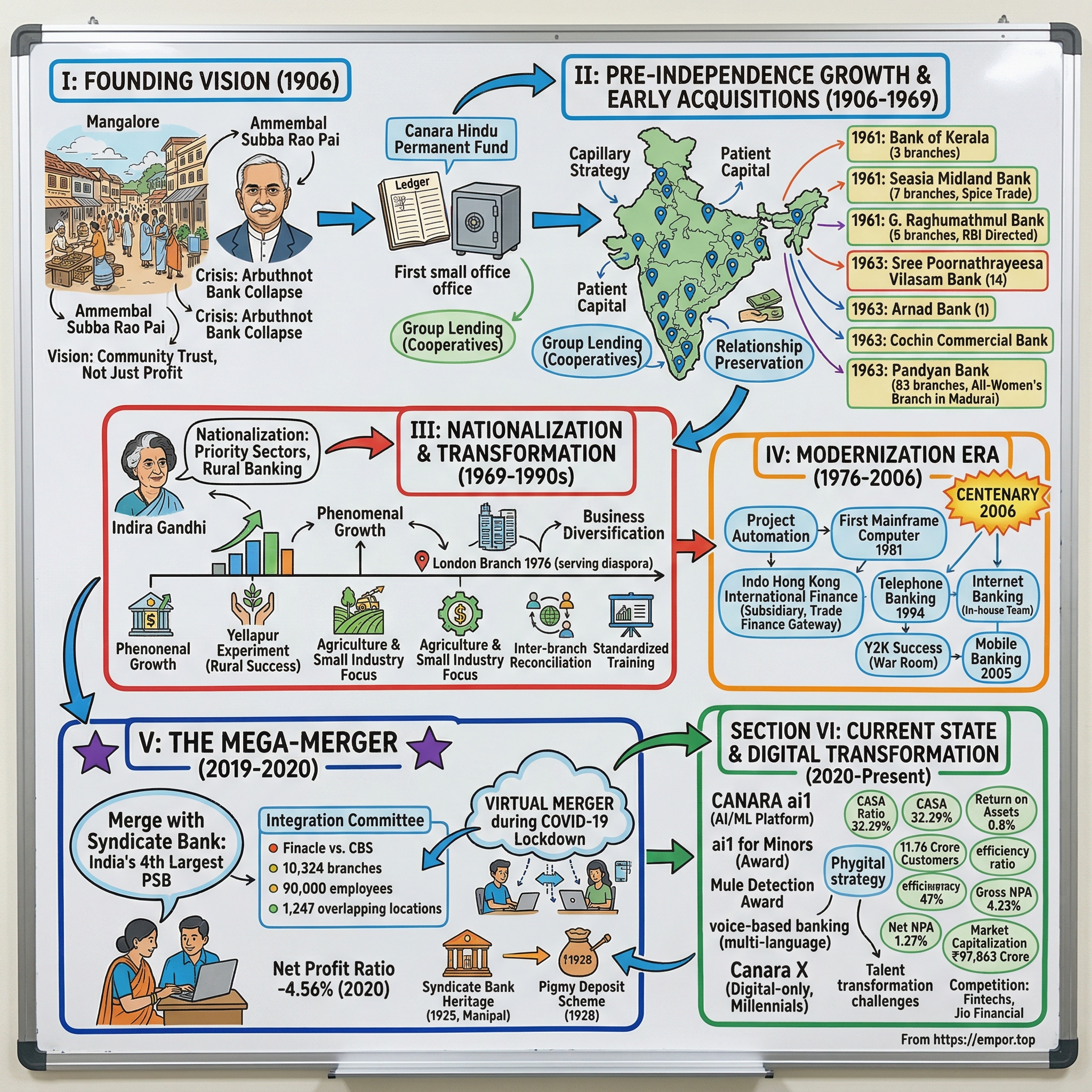
Canara Bank: From Mangalore Roots to National Banking Powerhouse
I. Cold Open & Episode Roadmap
In the first decade of the twentieth century, the coastal port of Mangalore operated on trust and very little else. Rice, coffee, cashews, and coir flowed through the harbor; cash returned; and the savings of shopkeepers, weavers, and small landholders sat with whoever seemed respectable enough to hold them. Then that trust shattered. The 1906 collapse of Arbuthnot & Co., a venerable British managing agency and banking house in Madras, wiped out depositors across the Madras Presidency, teaching an entire generation of South Indian savers a brutal lesson: an institution can appear permanent and still evaporate overnight.
Watching the fallout from Mangalore was Ammembal Subba Rao Pai, a lawyer who argued cases by day and organized community institutions by night. His conclusion was not that banking itself was dangerous, but that banking conducted by outsiders, for outsiders, posed an inherent risk. On July 1, 1906, he founded the Canara Hindu Permanent Fund, anchored on the principle that a community should "mobilize their own resources for self-help."1 Four years later, the fund took the name Canara Bank.2
One hundred and twenty years later, the institution born from that local fund ranks among India's largest state-owned lenders. As of the June 2026 quarter, Canara Bank operated 10,131 domestic branches and 22,625 total banking outlets, carried roughly ₹12.9 lakh crore in global advances, and counted 3.42 crore mobile banking registrations alongside 4.13 crore UPI registrations on its books.3 For the fiscal year ended March 2026, the bank reported a standalone net profit of ₹19,187 crore—up 12.7% year-over-year—and declared a dividend of ₹4.20 per share.4
The equity market's appraisal remains cautious yet warming. In early August 2026, the stock traded near ₹131, translating to a market capitalization of roughly ₹1.19 lakh crore. That pricing values the bank at a trailing price-to-earnings ratio near 6.2 and roughly one times its book value of about ₹131 per share, alongside a dividend yield of around 3.2%.5 Just two years earlier, the market refused to pay book value for the stock. Part of this re-rating reflects genuine operational improvement; part stems from a sector-wide revaluation of Indian public sector banks. Disentangling those twin forces is the central task of this analysis.
The core question is straightforward: how did an institution that suffered outright net losses a decade ago, absorbed one of India's oldest commercial banks during the opening week of the COVID-19 lockdown, and remains 62.93% state-owned6 manage to deliver a reported return on equity above 18%3 while management characterizes its asset quality as industry-best? More critically for long-term investors: does this performance represent a durable operational turnaround, or the peak of a favorable credit cycle?
Five central themes shape this evaluation. First, the economics of a deposit franchise built on regional trust, and whether that legacy translates into a structural cost-of-funds advantage—a dynamic where Canara's metrics suggest it partly does not. Second, the enduring tension within a majority state-owned bank balancing public development mandates against minority shareholder returns.
Third, the operational mechanics of integrating Syndicate Bank, an ₹8 lakh crore merger executed under extreme pandemic disruption. Fourth, the deliberate rebuild of the loan book away from consortium corporate lending toward retail, agriculture, and micro, small, and medium enterprise (MSME) credit—and the new concentrations that pivot has quietly created. Fifth, the monetization of corporate holdings, highlighted by the October 2025 listings of two legacy joint ventures that turned decades-old investments into a one-time earnings boost.
This trajectory reflects neither luck nor inevitability. Canara Bank is an institution that nearly broke, underwent restructuring under state direction rather than market pressure, and now faces the question of how it will perform as easy tailwinds—declining credit costs, recovering write-offs, and non-recurring listing gains—begin to fade.
 Subscribe on LinkedIn
II. The Founder's Vision: Ammembal Subba Rao Pai & Founding Ethos (1906)
Ammembal Subba Rao Pai was born in 1852 in Mulki, a small town north of Mangalore on the Dakshina Kannada coast.1 He trained in law and became the leading advocate of his region, but his biography reads less like a typical lawyer's and more like that of a civic entrepreneur. He practiced law during the day and devoted his evenings to social causes—founding schools, community associations, and scholarships for young men trying to reach engineering and medical colleges.1 He died in 1909, three years after founding the fund that became Canara Bank, and never saw what the institution would become.7
Pai was not a banker by trade; he was an educationist who arrived at banking through a social diagnosis. His stated view was that a strong society requires its members to have access to the information and resources needed to manage their own financial decisions.1 In colonial South India, a small trader's choices were largely limited to local moneylenders charging extortionate rates or European agency houses that appeared safe only until systemic crises hit.
The collapse of Arbuthnot & Co. served as the immediate catalyst for Pai to establish the Canara Hindu Permanent Fund in 1906. Beyond the initial financial shock, the failure demonstrated that outside institutions were opaque, unaccountable, and indifferent to provincial depositors. Protecting local savings required the community to intermediate those funds itself.
A permanent fund operated as a mutual-benefit society: members subscribed small amounts regularly, the pooled corpus was lent back to members against tangible security—typically property or gold—and any surplus remained within the group. Without outside shareholders demanding dividend returns or complex maturity mismatches, the fund operated essentially as a savings-and-loan anchored by social collateral. Default carried not only legal consequences but also severe reputational loss within a tightly knit community.
Three core operating principles emerged from this structure. The first was micro-mobilisation—securing a vast number of small deposits rather than relying on a few large accounts. The second was conservative loan-to-value discipline, as members directly bore any default losses. The third was recycling surpluses into community infrastructure, particularly education.
Pai's broader legacy in Mangalore encompasses both the bank and a network of schools and colleges that still carry the Canara name.1 Rather than mere founding folklore, this legacy established an enduring distribution advantage: funding local institutions created a natural pipeline of teachers, administrators, and families who became lifelong account holders.
In 1910, the fund reorganized and adopted the name Canara Bank Ltd., completing its transformation from a mutual society into a commercial bank.2 This structural shift introduced a fundamental trade-off. While a mutual fund remains safe but constrained in scale, a commercial bank can accept deposits from non-members, expand beyond its home territory, and grow—though it introduces agency risks inherent in corporate banking. The bank managed this transition by maintaining a strict regional lending focus for decades, preserving its social-collateral mechanism even as its legal structure changed.
From an analytical standpoint, Canara Bank did not invent a unique competitive advantage in 1906; rather, it capitalized on a dense, commercially literate coastal community with high savings rates and limited alternatives. That environment generated sticky, low-cost deposit funding for nearly a century. The strategic question in 2026 is how much of that low-cost funding advantage remains intact when depositors can open high-yielding accounts digitally from anywhere in the country—a challenge reflected in Canara's current account and savings account (CASA) metrics.
What the founding era established was a business model driven by high-volume, small-ticket relationships. That core operational orientation would face successive tests through national consolidation and state control.
III. Pre-Independence Growth, Acquisitions & Nationalization (1906–1990s)
For its first four decades, Canara Bank expanded through methodical branch openings. This growth followed the commercial geography of the Canara coast before pushing into neighboring princely states and presidency territories. Each new branch was underwritten by the deposit base of the last, creating a literal network effect: the more locations where merchants could deposit and draw funds, the more essential the bank became to regional trade.
By the 1950s and 1960s, policy directives from New Delhi reshaped this trajectory. Post-independence India contained hundreds of small, undercapitalized commercial lenders, several of which faced collapse. The Reserve Bank of India (RBI) responded by using stronger regional institutions to absorb weaker peers. In 1958, the RBI directed Canara Bank to acquire G. Raghumathmul Bank of Hyderabad, an institution founded in 1870 with five branches, completing the merger in 1961.2 That same year, the bank absorbed a cluster of troubled Kerala lenders: Bank of Kerala, founded in 1944 with three branches; Seasia Midland Bank of Alleppey, established in 1930 with seven branches; and Trivandrum Permanent Bank, dating to 1899 with 14 branches.2 In 1963, Canara Bank acquired four more institutions, highlighted by Pandyan Bank and its 83 branches.2
These regulator-directed rescues lacked competitive bidding, allowing Canara Bank to avoid the premium prices that often erode value in commercial bank mergers. The bank paid in integration effort rather than acquisition capital, acquiring branch networks, deposit relationships, and licenses across Andhra Pradesh, Kerala, and Tamil Nadu. By 1976, Canara Bank had inaugurated its 1,000th branch.2 However, because these acquisitions were mandated rather than negotiated, the institution developed expertise in operational absorption rather than target valuation or deal discipline—a distinction that would resurface during subsequent state-driven consolidation.
On July 19, 1969, the Indira Gandhi administration nationalized 14 major commercial lenders, transferring Canara Bank into state ownership.2 Nationalization fundamentally altered the bank's mandate. Commercial profit gave way to state-directed credit allocation toward agriculture, small-scale industries, and underserved rural districts. Mandatory priority-sector lending targets, administrative branch licensing, and the Lead Bank Scheme reoriented management performance around policy compliance rather than economic returns.
This structural shift created dual consequences. On the asset side, credit expansion into unfamiliar sectors led to elevated non-performing loans, while mandated rural staffing expanded headcount and locked the bank into centralized, industry-wide wage bargaining. On the liability side, however, nationalization generated long-term structural value: an extensive rural and semi-urban branch footprint backed by an implicit sovereign guarantee. This network captured low-cost, sticky retail deposits that established the bank's modern funding core.
State ownership also reshaped internal corporate culture. Operational governance shifted from a regional board evaluating commercial risk to a public administration structure bound by rigid procedural guidelines and seniority-based advancement. Decades later, the resulting institutional posture reflects both an asset and a vulnerability: disciplined process adherence reinforces underwriting caution in stable environments, but administrative inertia slows product innovation in competitive markets.
Subsequent decades brought modernization within these operational constraints. In 1983, the bank established an overseas branch in London to capture non-resident Indian deposit and remittance flows.2 It absorbed Lakshmi Commercial Bank in 1985.2 Through the late 1980s and 1990s, management introduced core technology systems despite resistance from employee unions over automation. On December 23, 2002, Canara Bank completed its initial public offering, introducing minority equity investors alongside its primary shareholder, the Ministry of Finance.2
That listing created an enduring governance tension between two distinct stakeholder priorities: a majority owner focused on public credit mandates and financial inclusion, and public shareholders seeking competitive returns on equity. For a decade, strong macroeconomic growth masked this friction, until the corporate credit cycle turned and exposed the operational vulnerabilities of the dual mandate.
IV. Modern Inflection: The Asset Quality Crisis & RBI AQR Clean-Up (2015–2019)
The setup for the crisis followed a familiar pattern across Indian banking. Following the 2008 global financial crisis, India launched a major public infrastructure push funded heavily by state-owned lenders. Power plants, steel mills, road projects, telecom spectrum, and real estate developments received long-term loans extending 15 to 20 years. Much of this credit was extended through multi-bank consortiums, where underwriting discipline often blurred under the assumption that partner institutions had performed due diligence. Canara Bank participated fully alongside its peers.
Many of these projects subsequently stalled. Fuel supply linkages failed to materialize, land acquisition hit regulatory bottlenecks, power purchase agreements went unsigned, and global commodity prices fell. The delayed realization of these stresses stemmed from regulatory mechanisms that masked deteriorating asset quality between 2012 and 2015.
During that period, Indian lenders utilized regulatory forbearance frameworks—such as corporate debt restructuring, strategic debt restructuring, and "5/25" refinancing models—that permitted stressed loans to be restructured, repriced, and classified as standard assets. Under these provisions, banks could extend fresh credit to distressed borrowers to cover interest payments, preventing loans from entering non-performing status. This practice of evergreening allowed the banking system to report asset quality metrics that did not reflect underlying economic realities.
In 2015, Reserve Bank of India Governor Raghuram Rajan instituted the Asset Quality Review (AQR) to eliminate these discretionary practices. RBI inspectors evaluated large exposures across the banking sector, established uniform classification standards for stressed accounts, and mandated that lenders recognize non-performing assets by strict deadlines. The review triggered a sharp acceleration in bad-loan recognition, forcing multi-year credit losses onto bank balance sheets over four to six quarters.
For Canara Bank, the financial impact was immediate and deep. In the fourth quarter of FY2016, the bank posted a net loss of ₹3,905 crore as bad loans rose.8 Losses widened further over the next two fiscal years: for the quarter ended March 31, 2018, Canara Bank reported a net loss of ₹4,859.77 crore, driven by a near-tripling of provisions, with gross non-performing assets at 11.84% of advances—₹47,468 crore, up 39% from ₹34,202 crore a year earlier.9 Provisioning pressures persisted into 2020, leading to a net loss of ₹3,259 crore for the quarter ended March 2020 on the back of provisioning.10
A gross non-performing asset ratio of 11.84% meant that nearly ₹12 out of every ₹100 lent by the bank was non-performing. Relative to a typical bank equity base of ₹8 to ₹10 per ₹100 of total assets, credit impairment of this magnitude threatened solvency, requiring direct intervention from the bank's principal shareholder, the Indian government.
The government provided emergency equity capital to absorb the losses: in October 2019 alone, Canara Bank moved to issue shares to the government in lieu of a ₹6,571 crore capital infusion.11 While state backing preserved institutional solvency, the recapitalization diluted minority shareholders at depressed equity valuations, highlighting the structural trade-off between sovereign support and equity value preservation.
Three structural shifts emerged from the asset quality cleanup, shaping the bank's modern operational framework.
First, the enactment of the Insolvency and Bankruptcy Code (IBC) in 2016 altered creditor-borrower dynamics. Prior to the IBC, resolution processes in Indian courts were prolonged, leaving defaulting promoters in control of distressed assets. The IBC established a time-bound framework under the National Company Law Tribunal, transferring operational control to resolution professionals and enabling the transfer or liquidation of non-compliant corporate entities. This framework shifted bargaining leverage toward institutional lenders during debt workout negotiations.
Second, Canara Bank reorganized its internal credit recovery operations by creating dedicated stressed-asset management verticals. Separating recovery specialists from the branch managers and relationship teams that originated the loans reduced structural conflicts of interest and improved recovery focus.
This operational restructuring yielded sustained recoveries long after the initial provisioning cycle. As of the December 2025 quarter, Canara Bank was still recovering roughly ₹2,000 crore a quarter from a written-off book of about ₹66,000 crore, and management stated it had made a conscious decision to hold that recovery run-rate above ₹2,000 crore even as the live NPA book shrank.12 Because recoveries from loans already written down to zero flow straight to the profit line, these recoveries have provided an ongoing boost to reported earnings.
Third, the crisis prompted a strategic reallocation of the loan portfolio. Canara Bank reduced its reliance on large-ticket consortium corporate lending, shifting credit growth toward retail, agriculture, and micro, small, and medium enterprise (MSME) segments. While this pivot diversified corporate credit risk, it also introduced new segment concentrations within the bank's current balance sheet.
By 2019, recapitalization, internal restructuring, and balance sheet de-risking had transformed Canara Bank into a more conservative lender. This operational restructuring set the stage for state regulators to select Canara Bank as the anchor institution for a major public sector bank consolidation.
V. The Mega-Merger: Absorbing Syndicate Bank & Scale Economies (2019–2021)
On August 30, 2019, Finance Minister Nirmala Sitharaman announced a major consolidation of Indian public sector banking, restructuring ten state-owned lenders into four entities. Under the plan, Punjab National Bank absorbed Oriental Bank of Commerce and United Bank of India; Union Bank of India acquired Andhra Bank and Corporation Bank; Indian Bank took over Allahabad Bank; and Canara Bank was slated to absorb Syndicate Bank.13
The pairing carried historical resonance rarely captured in market valuation models. Syndicate Bank was founded in 1925 in Manipal—just 35 miles up the coast from Mangalore—by Upendra Ananth Pai, T.M.A. Pai, and Vaman Srinivas Kudva as the Canara Industrial and Banking Syndicate Ltd. Both institutions originated in the same district, shared a commercial culture, and initially incorporated the same regional name.
Syndicate Bank's signature contribution to Indian banking was its Pigmy Deposit scheme, under which mobile agents walked daily routes collecting small sums from shopkeepers and street vendors. The program applied Ammembal Subba Rao Pai's micro-mobilization concept with operational intensity. Ninety-five years after their founding, the two coastal Karnataka pioneers in community finance were unified by state directive.
The transaction was structured as a cashless, all-stock exchange. In early March 2020, the respective boards approved a swap ratio of 158 equity shares of Canara Bank (face value ₹10) for every 1,000 equity shares of Syndicate Bank (face value ₹10).14 Following approval by the Union Cabinet, the merger took effect on April 1, 2020, creating a combined institution with 10,324 branches and establishing it as India's fourth-largest public sector bank at the time.213
The exchange ratio reflected clear financial constraints. First, the cashless structure avoided any cash drain from Canara Bank while it was still restoring its capital base after the asset quality review. Second, because the ratio was derived from relative book values when both stocks traded at deep discounts, Canara issued equity that was itself low-priced to acquire assets priced at similar discounts.
Whether the transaction added long-term economic value depended entirely on the underlying asset quality of Syndicate Bank's loan book—a factor that disclosed metrics at the time did not allow public investors to verify independently. In state-directed consolidations, policy mandates dictate timing and terms, leaving standard pre-transaction public due diligence largely absent.
External operational conditions exacerbated integration challenges. The merger took effect on April 1, 2020, just three days after India imposed a nationwide lockdown to contain COVID-19. Integration teams tasked with harmonizing operational processes, retraining staff, and rationalizing branches were restricted to remote operations. Simultaneously, the combined entity reported a net loss of ₹3,259 crore in its inaugural quarter ended March 2020.10
The primary technical hurdle involved migrating Syndicate Bank's accounts onto Canara Bank's core banking platform, built on Infosys Finacle. As the authoritative ledger governing all accounts, balances, loan schedules, and interest accruals, core integration required reconciling distinct account numbering structures, product masters, interest calculation rules, and regulatory reporting systems while processing daily transaction volumes without disrupting customer access.
Cultural integration presented additional operational friction. Syndicate Bank's identity centered on local daily-deposit agents, whereas Canara Bank relied on traditional branch-based relationships. State-led bank consolidations typically address such overlaps through systemic standardization, adopting the acquirer's operational platform, job designations, and corporate hierarchy. While operationally efficient, this approach effectively retired a distinct institutional brand, though joint branding on regulatory filings acknowledged the combined heritage.
Canara Bank completed the core migration without major public service disruptions, demonstrating technical execution capability. However, validating long-term cost synergies remains complex. While combining overlapping South Indian branch networks, back-office operations, and treasury infrastructure presented theoretical efficiency gains across a workforce approaching 90,000 employees, structural constraints limited rapid cost reduction.
In the Indian public sector banking framework, involuntary headcount reduction is not feasible, leaving workforce rationalization to natural attrition and retirement over several years. Similarly, branch closures require regulatory and local consultations. Consequently, technology and treasury efficiencies materialized quickly, whereas headcount and real estate rationalization progressed gradually over a multi-year period.
Disentangling structural merger synergies from cyclical tailwinds is essential when evaluating the bank's profitability trajectory. If post-2020 earnings expansion reflects structural operating leverage, the margin gains remain permanent. Conversely, if earnings growth stems primarily from falling credit provisions and recoveries from previously written-off assets, the boost remains cyclical. The underlying financial data—evidenced by a 31.34% year-over-year decline in provisions to ₹2,252 crore for the quarter ended March 202615—indicates that credit cycle normalization played a dominant role. This structural reality shifts analytical focus directly to the composition of the bank's current balance sheet.
VI. Core Business Analysis: Balance Sheet, Segment Economics & Competitive Positioning
Every bank is the same machine described two ways. It borrows short from depositors, lends long to borrowers, and keeps the difference minus what it loses to defaults and what it spends on running the operation. Everything else is detail. So the useful way to read Canara Bank in 2026 is to ask three questions in order: how cheaply does it raise money, how well does it lend it, and how much of the resulting profit is repeatable?
Start with the lending, because that is where the transformation is genuine. The bank now organises its domestic book around the acronym RAM — retail, agriculture and MSME — as distinct from wholesale corporate credit. In the June 2026 quarter, RAM advances reached ₹7.65 lakh crore, growing 21.20% year-on-year and representing 59% of domestic advances, up from 58% a year earlier.3 Retail credit inside that grew 35.88%.3 Global advances grew 17.97%, deposits grew 11.63%, and the bank crossed ₹10,000 crore of quarterly net interest income for the first time, at ₹10,215 crore, up 13.39%.316
Growth rates of that order in a retail book invite an obvious question, and analysts asked it directly. On the January 2026 call, an analyst pressed management on whether retail growth above 30% reflected portfolio buyouts from non-bank lenders — a common way for banks to manufacture retail growth by purchasing someone else's originations. Then-MD & CEO Hardeep Singh Ahluwalia answered flatly and repeatedly: "This is totally organic.
No buyout, sir. No buyout. Totally organic."12 That is a specific, falsifiable claim, and to management's credit it was made without hedging. It is also the kind of claim that only seasons over time: a retail book compounding above 30% is, by construction, a book where a third of the loans have existed for less than a year and have not yet had the opportunity to default.
Now the composition, which is where the interesting risk sits. Of a domestic loan book of roughly ₹11.9 lakh crore in December 2025, management disclosed a gold loan portfolio of ₹2,21,000 crore — ₹1,48,000 crore of agricultural gold loans and ₹72,661 crore of non-agricultural — growing about 30% year-on-year.12 That is close to a fifth of all lending secured against a single commodity. Gold loans are, in fairness, among the safest secured lending in India: the collateral is liquid, held in the branch vault, and typically lent against at conservative loan-to-value ratios.
But a fifth of the book is a fifth of the book, and it is exposed to two correlated risks — a sharp fall in the gold price, which compresses collateral cover across the entire portfolio simultaneously, and regulatory intervention. The second risk has already materialised in mild form: management disclosed that following an RBI observation, the bank consciously rolled back gold loan products in metropolitan and urban centres, saying "now, we are totally compliant with it."12 A regulator that has already asked questions about a business line growing at 30% is a regulator worth watching.
Agriculture credit carries a different profile: priority sector compliance, Kisan Credit Cards, and interest subvention that transfers part of the credit economics to the state. Canara's priority sector lending stood at 45.25% of adjusted net bank credit against a 40% requirement, and management has turned that surplus into a genuine revenue line by selling Priority Sector Lending Certificates to deficient banks — a market that generated roughly ₹1,200–1,300 crore in the first quarter of recent years, ₹900 crore in a second quarter and ₹140 crore in the December quarter, with management describing it as having become "a renewed avenue of sustainable quarter-on-quarter earning."12 This is a small but instructive example of a policy constraint being converted into an asset. Canara over-complies with a mandate because of its rural footprint, and sells the excess compliance to urban-heavy banks that cannot meet it.
Corporate and wholesale banking has been deliberately restrained. Management described its approach to non-banking finance company lending — ₹1,51,000 crore of exposure growing only 6.09% — as strictly price-disciplined: "normally the AA, AAA rated NBFCs, when they approach us, but the rates are not competitive, then we are shying away from that because protection of NIM is also our major criteria."12 Choosing not to grow a book because the pricing is bad is precisely the behaviour absent from Indian public sector banking in 2010. Whether it survives the next period of loan growth pressure is the test.
Now the funding side, and here the story is considerably less flattering. The CASA ratio — the share of deposits sitting in low-cost current and savings accounts rather than in interest-bearing term deposits — stood at 29.70% in June 2026, below management's own 30–32% target.3 Global net interest margin was 2.52%, within guidance of 2.50–2.60% but structurally thinner than large private peers and thinner than State Bank of India.3
This is the single most important weakness in the business, and it deserves plain explanation. CASA is nearly free money: a savings account pays a low regulated-ish rate and a current account pays nothing. A bank with 40% CASA is running a materially cheaper liability book than one with 30%, and that difference flows directly to margin without any difference in lending skill. Canara's problem is that Indian savers have discovered alternatives. Money that once sat idle in a savings account now moves into term deposits at 7%, into mutual funds through systematic investment plans, and into equities. The migration is structural, not cyclical, and it is happening fastest among exactly the younger, urban, digitally-native customers a bank needs to acquire.
Management's framing of this is worth examining as a credibility matter. On the December-quarter call, Ahluwalia noted that of thirteen guidance parameters set at the start of the year, the bank had "easily surpassed and comfortably surpassed 11 parameters, except CASA and NIM, which is industry challenge."12 The first half of that sentence is accurate and impressive. The second half quietly reclassifies the bank's two weakest metrics as an industry phenomenon rather than a company outcome. It is a mild deflection — CASA outcomes do differ meaningfully across Indian banks — but it is the kind of framing worth noting, because how management describes its worst numbers is usually more informative than how it describes its best.
There is also an asymmetry embedded in the balance sheet that shows up every time the RBI moves. Management disclosed that about 49% of advances are repo-linked, meaning they reprice essentially immediately when the policy rate changes, while deposits reprice only as they mature.12 When the RBI cut the repo rate by 25 basis points, yield on advances fell 6 basis points against a 4 basis point fall in deposit cost, netting to a 2 basis point margin contraction.12 The bank is, structurally, liability-lagged and asset-sensitive in the wrong direction for a rate-cutting cycle.
Management's counter is that the repricing of legacy high-cost term deposits is nearly complete — only about 15% left to reprice, with new deposits coming in 70–77 basis points cheaper than the ones maturing.12 That is a real tailwind, but it is a one-time one; once the book is fully repriced, the crutch is gone.
Asset quality is where the bank has genuinely earned its re-rating. Gross NPAs fell to 1.57% and net NPAs to 0.36% by June 2026, with a provision coverage ratio of 94.76% and annualised credit cost of 0.49% against 0.75% guidance.3 The forward indicators are, if anything, better than the headline: management disclosed that special mention accounts — loans overdue but not yet classified as non-performing, the leading indicator of future slippage — fell from ₹43,917 crore to ₹35,604 crore year-on-year, taking the SMA ratio from 4.18% to 2.99% even as advances grew 13.59%.12 Slippage ran at 0.64%.12
Two caveats belong alongside those numbers. First, a 94%+ provision coverage ratio means the bank has already written down almost all of its recognised bad loans; the earnings benefit from further provision releases is nearly exhausted, and credit cost from here can realistically only go up. Second, management flagged ₹1,946 crore of additional provisions taken on three accounts with ₹6,600 crore of outstanding exposure, held "as prudent bankers" outside the SMA framework — and separately noted that SMA-1 increased because of a single account, the Kaleshwaram Irrigation Project.12 Large state-government-linked infrastructure exposures do not disappear because the retail book is growing.
Finally, the accounting change that hangs over the whole sector. The RBI's expected credit loss framework takes effect from 1 April 2027, replacing the current incurred-loss provisioning regime.12 The distinction is fundamental: today, a bank provides when a loan actually goes bad; under ECL, it must provide at origination for statistically expected losses across the life of the loan, with Stage 2 provisioning rising from roughly 0.4% to 5%.
Management's estimate, given in detail on the January 2026 call, was ₹2,500 crore for Stage 2, ₹2,500 crore for non-fund limits and ₹5,000 crore for Stage 1 default rates — around ₹10,000 crore in total, amortisable over four years, or ₹2,000–2,500 crore a year against annual profits of ₹17,000–20,000 crore.12 By the July 2026 quarter, management was characterising the ongoing run-rate impact as only 4–5 basis points on credit cost.16 Investors should treat that as an estimate made by the party with the strongest incentive for it to be small, and revisit it as the transition date approaches.
Before benchmarking, it is worth testing three consensus narratives about this bank against its own disclosures.
Myth: the stock is cheap because the market irrationally discounts public sector banks. Partly true, but incomplete. A bank reporting an 18% return on equity at one times book is being told by the market that the return is not sustainable, and the market has specific reasons: a margin at the low end of the peer set, a shrinking share of free deposits, and a provision line that has almost no further room to fall.312 The discount is a judgement about the durability of earnings, not only about the ownership label.
Myth: the Syndicate Bank merger produced the turnaround. The timeline does not support it. The most consequential improvements — recognition of stressed assets, recapitalisation, the recovery infrastructure, the shift toward granular lending — were underway before the amalgamation took effect, and the combined entity's first reported quarter was a loss.10 The merger added scale and a wider rural network. The profit recovery came from the credit cycle and the clean-up.
Myth: a 94% provision coverage ratio means the balance sheet is fortress-strong. It means the recognised bad loans have been written down almost completely, which is genuinely prudent. It does not speak to loans that have not yet been recognised as bad — and the fastest-growing parts of the book are also the youngest.312 Coverage protects against past mistakes. It says nothing about future ones.
Set against peers, the position is legible. State Bank of India runs a materially better funding franchise, with a CASA ratio comfortably above Canara's and the deepest deposit base in the country, which is why it earns a higher margin on comparable lending. Bank of Baroda and Punjab National Bank sit in Canara's competitive weight class, and Canara's net NPA and slippage figures currently compare favourably.
Against the large private banks — HDFC Bank, ICICI Bank, Axis Bank — the comparison is a study in different businesses wearing the same licence: the private banks dominate urban affluent customers, credit cards, wealth management and fee income, and earn much higher margins for it; Canara's counter-position is a cost-to-serve in tier-2 to tier-6 India that no private bank has been willing to match, and a deposit base that is stickier precisely because the alternatives in those locations are thin.
That distribution asset, and how the bank is trying to make it digital rather than physical, is the next chapter.
VII. Digital Transformation & Subsidiary Value Unlocking (2020–2026)
Every Indian public sector bank faces a structural challenge: the physical branch network that historically served as its primary asset is also its largest fixed cost, while higher-margin customers increasingly conduct banking digitally. Canara's strategic response centers on its ai1 application—marketed under the banner "One Bank, One App." The platform functions as a unified digital ecosystem, consolidating over 300 features into a single application, including UPI, RTGS, NEFT, and IMPS transfers, fixed and recurring deposit creation, FASTag recharges, loan servicing, insurance products, bill payments, and locker management.17 By June 2026, mobile banking registrations reached 3.42 crore and UPI registrations stood at 4.13 crore, powering 861.37 crore electronic transactions during the quarter.3
Consolidating these services into a single interface serves a deeper strategic function beyond customer convenience. Fragmented applications for payments, deposits, and credit create isolated login funnels and fractured user data. A single application routes daily transactions—such as routine UPI payments—into a centralized behavioral dataset. That real-time cash-flow visibility powers automated credit underwriting, allowing the bank to offer pre-approved personal loans, Mudra credit, and MSME lines disbursed in minutes without manual branch appraisal. For a lender compounding its retail loan book at over 30% annually, the mobile application operates not merely as a service channel, but as the primary origination engine.
Execution, however, reveals operational friction. Public app store reviews average roughly four stars but detail recurring user complaints regarding login failures, unexpected deregistration, OTP delivery delays, and loan repayment processing errors.17 While software glitches afflict most large public sector banking applications in India, persistent reliability issues create competitive vulnerabilities. Customer friction during routine transactions encourages users to shift primary operating balances to private sector institutions with more dependable digital infrastructure—accelerating the exact customer migration eroding Canara's low-cost CASA deposit base.
Parallel to its digital push, Canara Bank unlocked value from legacy financial joint ventures that had long sat on its balance sheet at historical book value. These included Canara Robeco Asset Management—established in 1993 and structured as a joint venture in 2007 with Robeco, a subsidiary of Japan's ORIX Corporation—and Canara HSBC Life Insurance, a joint venture with HSBC and Punjab National Bank. In April 2025, Canara Bank and PNB filed to take the life insurer public, with Canara proposing to sell up to 137.75 million shares from its 51% stake and PNB trimming its 23% holding by 10 percentage points.18
Both subsidiaries executed initial public offerings within a single week in October 2025. The Canara Robeco AMC IPO—a pure offer for sale of 4.98 crore shares raising ₹1,326 crore at the top of its ₹253–266 price band—was subscribed between October 9 and 13, 2025, and listed on October 16, valuing the asset manager at approximately ₹5,300 crore.19 Canara HSBC Life Insurance followed with a ₹2,517.50 crore offer for sale of 23.75 crore shares from October 10 to 14, listing on October 17 at ₹106 per share—matching its issue price without a listing premium.2021
Because both transactions were pure offers for sale, all proceeds accrued directly to the selling parent entities rather than the operating subsidiaries.19 Canara Bank divested 14.5% of Canara HSBC Life and 13% of Canara Robeco AMC, booking a pre-tax gain of ₹2,006 crore. This treasury inflow elevated net profit to a record ₹5,155 crore for the quarter ended December 2025.12 Structurally, the divestments represented prudent capital allocation: Canara converted illiquid subsidiary holdings into liquid capital at market valuations without diluting parent equity—a sharp contrast to the forced equity issuances at depressed valuations in 2019.11
Management explicitly acknowledged the non-recurring nature of these earnings gains. When net profit contracted 9.94% year-over-year in the March 2026 quarter to ₹4,505.57 crore, management attributed the decline to the absence of the prior quarter's ₹1,930 crore post-tax listing gain, combined with ₹800 crore in mark-to-market treasury losses, which drove treasury income down from ₹1,050 crore to ₹272 crore.2215 Equity markets responded coolly, sending the stock down over 3% following the earnings announcement.23 Furthermore, Canara HSBC Life's flat debut at its issue price established a clear valuation benchmark for the bank's remaining 36.5% stake, signaling that public markets viewed the insurer's pricing as fully valued rather than eligible for a premium sum-of-the-parts multiple.21
Canara Bank also holds a 29.99% stake in listed lender Can Fin Homes as of March 2026.24 The bank's handling of this asset presents a contrasting track record in execution: in January 2020, management abruptly aborted a planned stake sale in Can Fin Homes after inviting bids, causing the stock to fall on the news.25 While the successful 2025 subsidiary listings demonstrate improved deal execution, the earlier reversal highlights historical inconsistency in monetizing non-core assets. Other holdings, including Canbank Factors and Canbank Computer Services, remain financially immaterial to group earnings.
These digital and capital initiatives leave an unaddressed operational question: how efficiently Canara can rationalize its 10,131 physical branches as customer origination moves to mobile channels. Two competing dynamics govern this physical footprint. One trajectory positions branches as specialized origination centers for high-touch products requiring physical verification—such as gold collateral evaluation, agricultural credit assessment, and local MSME underwriting. Canara's loan growth concentration in these exact segments suggests partial adaptation of its physical infrastructure. The alternative trajectory leaves substantial branch capacity underutilized due to political and regulatory constraints on public sector branch rationalization, maintaining pressure on the bank's cost-to-income ratio. Balancing physical overhead against digital migration remains a central strategic test for executive leadership.
VIII. Management, Governance & Capital Allocation
Consider the position of a Canara Bank chief executive. You are appointed by the Government of India for a fixed term that typically ends at your statutory retirement age. You cannot be granted stock options. Your compensation is a public sector salary that a mid-level private bank executive would decline. Your majority shareholder is also your policy-setter, and it has objectives—financial inclusion, priority sector credit, support for government schemes—that are not identical to maximizing return on equity. And your tenure will likely be shorter than the seasoning period of the loan book you are growing.
That is the governance frame within which everything in this section happens, and it explains both the discipline and the limits of Indian public sector bank management.
K. Satyanarayana Raju led the bank as MD & CEO from February 2023 until his retirement in December 2025.26 His tenure covered the most visible value-creating period in the bank's recent history: the post-merger consolidation, the sharp reduction in the stressed book, the sub-division of the stock, and the groundwork for the subsidiary listings.
Following his retirement, Executive Director Hardeep Singh Ahluwalia held additional charge from January 1, 2026—and it was Ahluwalia who took the December-quarter analyst call, with the transcript listing him as MD & CEO.1226 The Government of India notified the permanent appointment on May 30, 2026, and Brajesh Kumar Singh took charge on June 1, 2026, with a term running to April 2029 when he reaches superannuation.26 Singh brings more than three decades in banking and came from the role of Executive Director at Indian Bank, which he had held since March 2024.26
Note what that sequence involves: a five-month interregnum with an acting chief executive, ended by a government notification, at a bank with a ₹28 lakh crore balance sheet. This is not a criticism of any individual. It is a structural fact about public sector banks that investors should price. Continuity of strategy in these institutions comes from the system—the RBI's supervision, the Ministry of Finance's targets, the bank's own vertical structure—rather than from a founder-operator with a decade-long mandate and equity at stake. The upside is that no single executive can drive the bank into a strategic ditch. The downside is that no single executive has the runway or the incentive to attempt something genuinely differentiating.
On capital allocation, the record over the last three years is more disciplined than the sector's reputation would suggest. Three decisions stand out.
The stock split, announced in early 2024 and cleared by the RBI on April 16, 2024, sub-divided each ₹10 face value share into five shares of ₹2 each, with a record date of May 15, 2024.[^27] Splits create no fundamental economic value—the underlying arithmetic is unchanged—but they are not meaningless. At a pre-split price, retail participation in Indian markets is measurably constrained by absolute share price, and management's stated objective was improving liquidity and retail accessibility. In a market where a large share of incremental equity flows come from retail investors buying whole shares in small quantities, that is a modest but rational governance choice.
The dividend policy has been consistent and growing: ₹4.20 per share for FY26, or 210% of the ₹2 face value.4 Against a share price near ₹131, that represents a dividend yield around 3.2%.5 For an institution with a 62.93% government shareholder, dividend policy is partly fiscal policy—the majority owner has a budget interest in receiving cash—but the effect on minority holders is the same, and the payout has been maintained through a period when the bank was also building capital.
Most importantly, the bank has funded its growth from retained earnings and asset sales rather than equity dilution. Capital adequacy stood at 17.17% with CET-1 at 12.91% in June 2026, up 65 and 62 basis points year-on-year respectively.3 That is the practical measure of whether the 2019-era recapitalization is behind them: a bank generating ₹19,187 crore of annual profit against a ₹1.19 lakh crore market capitalization, while growing advances at 15% to 18%, is internally funding its growth and rebuilding buffers simultaneously.453
Now the credibility assessment, which is best done by comparing what management said across successive calls with what subsequently happened.
The pattern on growth guidance is consistent sandbagging. At the FY25 results in May 2025, management targeted around 11% loan growth for FY26.27 By the December 2025 quarter, advances were growing 13.59% and management explicitly declined to revise the target upward when an analyst asked, saying only that the guidance was 10–11% and "already we are crossing 13.59%."12 FY26 closed with global advances up 15.30%.22 For FY27, guidance was again set at 11–12% credit growth, citing GDP projections around 6.9%—and the June quarter delivered 17.97%.322 Setting beatable targets is not a sin, but four consecutive periods of guiding to 11% and delivering 15% to 18% means the guidance carries very little predictive information. Investors should treat Canara's stated growth targets as a floor rather than a forecast.
The pattern on margins and CASA runs the other way. NIM guidance has been repeatedly revised down or held at the low end, ending FY26 at 2.51% for the full year and 2.54% for the fourth quarter, with FY27 guidance of 2.50–2.60%.22 On the December call, Ahluwalia went further, stating that if the repo rate is cut again "we presume that our NIM will be in the range of 2.45 to 2.50."12 That is a management team telling analysts, without being forced to, that its margin could fall below its guidance range under a specific scenario. The candor is worth noting.
Analyst pressure on the earnings calls has been pointed and specific rather than deferential—which is itself a useful signal about how the institution is regarded. Analyst Mahrukh opened the December-quarter Q&A by noting bluntly that "our margins are already slightly lower than peers" and asking what steps the bank would take to close the gap, whether there was a growth-margin trade-off, and what absolute margin level management would defend.12 Emkay Global's Anand Dama pressed on why PSLC fee income was low relative to the prior quarter and whether it reflected a regulatory reclassification.12 Jai Mundra asked for a bifurcation of the SMA book by stage and whether any provisioning had begun for the ECL transition.12 Ashok Ajmera asked whether the treasury contribution—which had nearly doubled to ₹3,056 crore, including ₹2,590 crore of profit on sale of investments—was sustainable enough to hold quarterly profits above ₹5,000 crore.12
Management's answers were, on the whole, specific and numerical rather than evasive. Executives provided exact SMA-1 and SMA-2 figures, exact gold loan splits, the exact size of the written-off book, and a line-by-line explanation of a one-off operating expense increase—₹80 crore of IPO charges absorbed by the promoter, ₹80 crore of accelerated depreciation from shortening the employee furniture replacement cycle from ten years to five, and about ₹100 crore of technology expense, totaling roughly ₹250 crore in non-routine costs.12 Providing that level of granularity on an expense line an analyst noticed reflects the posture of a management team that expects to be scrutinized.
A second-layer note that rarely reaches equity investors: the bank's debt is rated in the highest domestic categories, with ICRA assigning an AA+ (Stable) rating to its Basel III Tier instruments.28 Credit rating agencies analyze a bank from the bondholder's seat—capital adequacy, asset quality, funding stability, and the probability of sovereign support—and their conclusions offer a useful cross-check on the equity narrative. A stable high-grade rating alongside an equity multiple of six times earnings reveals a market comfortable lending to this institution yet unconvinced about paying a premium for its earnings stream. Both views can be correct simultaneously; they answer different questions.
Two minor governance items warrant noting without inflating their significance. On August 10, 2026, the RBI imposed a penalty of ₹1,49,450 on the bank for remittance and counterfeit note discrepancies—an administrative note rather than a material financial event, though underlying process lapses can compound if ignored.5 Separately, on July 31, 2026, Sujit Kumar Sahoo was designated Group Chief Compliance Officer.5 The bank's promoter shareholding has been reported as stable at 62.93% with no encumbrances during FY26.6
The larger unresolved governance question is one no management team can resolve: the government's 62.93% stake sits far above the 75% maximum public shareholding threshold applied to private listed companies. While state banks operate under specific legislative exemptions, any eventual stake reduction implies either a large secondary share sale or a structural decision the Ministry of Finance has shown no urgency to pursue. It remains a permanent overhang on market valuation until policy dictates otherwise.
IX. The 7 Powers & Porter's Five Forces Analysis
Frameworks are only useful if they are applied adversarially. The objective here is not to search for powers Canara Bank might possess, but to evaluate which of its apparent advantages would survive a determined competitor equipped with fresh capital and no legacy constraints.
Begin with Hamilton Helmer's 7 Powers.
Scale economies are real, but narrower than the branch count implies. Operating over 10,000 domestic branches and 22,625 total outlets on a single Finacle core lets the bank amortise fixed technology, compliance, and central administrative costs across an enormous customer base.3 The marginal cost of adding a customer to an established core banking system, digital application, and branch network is genuinely low. However, banking scale economies face structural limits absent in manufacturing: a bank's largest expense is not a fixed operational overhead, but the interest paid to depositors, a cost that does not shrink with size. State Bank of India is far larger than Canara and earns a superior margin not because of scale, but because of a cheaper deposit mix. Here, scale delivers cost-to-income leverage rather than a funding cost advantage.
Process power is the most defensible claim, though it is a recent development. The combination of specialist stressed-asset verticals, the visible reduction of the SMA book from 4.18% to under 3% of advances alongside loan growth, a slippage ratio of 0.64%, and a sustained recovery run-rate from written-off accounts reflects institutional capability built over a decade of painful cycles.12 In Helmer's framework, process power requires that competitors cannot easily replicate the capability even when its blueprint is transparent. Establishing recovery infrastructure, institutional relationships with resolution professionals, and deep NCLT operational expertise requires years to mature. The caveat is that this capability proves most valuable during economic downturns, and the credit cycle is not currently experiencing one.
Switching costs are moderate and systematically eroding. A savings account tied to direct debits, salary deposits, safe deposit lockers, insurance policies, and mortgage loans creates meaningful friction to move. Yet India's regulatory framework has deliberately dismantled these barriers. UPI made the payment layer bank-agnostic, decoupling a customer's payment identity from where their underlying funds reside. Similarly, the Account Aggregator framework allows competing institutions to access a customer's financial history with consent, neutralizing the proprietary informational advantage incumbents historically enjoyed in underwriting. Relationship portability is increasing, driven by clear policy directives.
Counter-positioning is essentially absent. Counter-positioning requires an asymmetric business model that incumbents cannot mirror without cannibalizing their core business. Canara operates a standard universal banking model identical to its primary peers. Its distinctive features—extensive rural distribution, sovereign backing, and surplus priority-sector originations—stem from state ownership rather than strategic choice, and come bundled with the associated operational burdens of public ownership.
Branding provides a specialized advantage: across rural and small-town India, state ownership functions as a core brand attribute signaling sovereign security. That trust yields tangible basis points on deposit gathering and cannot be purchased by private competitors at any price. It represents the bank's single power with a 120-year history.
Turning to Porter's Five Forces, which evaluates structural industry attractiveness rather than firm-specific capabilities:
Threat of new entrants: low. Universal banking licenses in India remain strictly constrained. Stringent capital adequacy requirements, priority-sector mandates, rural branch quotas, and rigorous RBI fit-and-proper checks create high barriers to de novo entry. The primary competitive threat stems not from new commercial banks, but from unbundling. Fintech lenders and non-banking financial companies target specific high-margin profit pools—such as payments, personal loans, gold loans, and wealth management—without incurring full regulatory bank overhead.
Bargaining power of borrowers: high, and rising. Corporate borrowers with top-tier credit ratings command narrow spreads that barely cover capital costs, which explains why Canara has selectively pulled back from lower-yielding non-banking financial company exposures.12 At the retail level, transparent digital comparison tools have turned mortgage pricing into a commodity, shifting pricing power toward borrowers.
Bargaining power of depositors: high. This force represents the primary constraint on Canara's operating economics, reflected in a sub-30% CASA ratio. By 2026, retail depositors have direct digital access to mutual fund systematic investment plans, equity markets, higher-yielding term deposits at small finance banks, and government small-savings schemes.
Threat of substitutes: moderate-to-high. Financial disintermediation impacts both sides of the balance sheet. Mutual funds substitute for traditional savings deposits, capital markets and specialized lenders substitute for bank credit, and zero-fee public payment infrastructure like UPI has compressed transaction fee revenue once generated by current accounts.
Competitive rivalry: high. State-owned peers compete on near-identical product sets, while private banks are expanding aggressively into tier-2 through tier-4 cities, directly targeting regions where Canara's physical distribution advantage historically resided.
The composite analysis reveals an institution possessing modest, partially cyclical powers operating in an industry where structural forces lean unfavorably and regulatory policy actively reduces incumbent advantages. This posture does not invalidate Canara Bank's progress, but it indicates that the bank represents a cyclical value opportunity tied to credit quality normalization rather than a compounding long-term franchise.
X. Playbook: Key Lessons for Founders, Bankers & Investors
Five transferable lessons emerge from a 120-year history, and each carries a practical boundary worth establishing alongside it.
Purpose-built distribution outlasts the original purpose. Ammembal Subba Rao Pai built a community fund to address a specific 1906 problem: predatory moneylending and fragile colonial banking institutions. That initial problem was resolved long ago, yet the resulting distribution asset—a dense network of relationship-driven branches across underserved regional markets—continues generating tangible operating value in 2026. For business operators, the takeaway is that infrastructure established to serve an unbanked constituency often outlasts the specific market inefficiency that justified its creation. The structural limitation: that advantage decays once competitors serve that same constituency digitally—the precise shift currently transforming retail banking.
In bank consolidations, sequence the ledger before the organizational chart. The Syndicate Bank integration succeeded on the core technical dimension that posed systemic risk—the core banking migration—while progressing deliberately on physical rationalization. This operational sequencing is frequently inverted by acquirers who prioritize immediate cost synergies to satisfy near-term market reporting. Data integrity is binary and irreversible; branch and headcount rationalization is gradual and adjust-on-the-go. The structural limitation: executing the technical sequence correctly is necessary but insufficient, and six years post-announcement, durable operating synergies remain difficult to isolate from broader credit-cycle normalization.
Balance sheet provisioning is a strategic asset, not merely an accounting line. Canara Bank's provision coverage ratio above 94% indicates that management pre-absorbed legacy non-performing assets, allowing a shrinking bad-loan portfolio to flow directly into reported earnings while recoveries on written-off accounts bolster net profit.312 Lenders that provision aggressively during favorable credit periods build structural earnings stability for cyclical downturns. The structural limitation: high coverage signals that past credit distress has been fully recognized, which also means the profit tailwind from declining incremental provisions is largely exhausted. Extrapolating profit growth from declining credit costs misinterprets a cyclical tailwind for permanent operating leverage.
Monetize subsidiary equity from capital strength rather than capital pressure. The subsidiary initial public offerings in October 2025 were executed when the parent institution maintained comfortable capital buffers, optimizing asset pricing. By contrast, the 2019 state recapitalization required issuing equity at depressed valuations under acute capital strain.11 The structural limitation: the un-levered listing of the life insurance subsidiary demonstrates that public markets evaluate financial assets on standalone metrics rather than granting automatic sum-of-the-parts valuation premiums.
Guidance that is routinely surpassed loses its signaling value. Management repeatedly set annual credit growth targets around 11% while delivering actual expansion of 15% to 18%, even as key operational metrics—net interest margins and deposit mix—faced persistent structural headwinds.2722 Conservative targets protect public sector leadership from policy scrutiny, but predictable outperformance strips official guidance of analytical utility, forcing market participants to project performance independently. The countervailing positive: executive leadership voluntarily outlined a downside margin scenario below its published target range during analyst calls, providing candid disclosure where visibility mattered most.12
The underlying thread across these five lessons is that Canara Bank's most impactful strategic choices have been defensive: strengthening the balance sheet, preserving core ledger integrity, and building capital buffers. This track record frames the fundamental question that equity markets continue to price.
XI. Investment Thesis & Skeptical Stress Test: Bull vs. Bear Case
Every investment case in a bank reduces to one equation: what return on equity does the institution sustainably earn, what does it cost to hold that equity, and what multiple of book value should that gap justify? Everything else is commentary.
Canara Bank reports a return on equity above 18% and a return on assets around 1.04%, while trading near one times book value with a trailing price-to-earnings ratio around 6.2.53 Read literally, that pricing is arithmetically paradoxical: a lender generating an 18% return on equity at book value implies the market expects earnings to decline. The central question for investors is how far that profitability falls and how quickly.
The bull case rests on four distinct pillars, ordered by operational strength.
The strongest pillar is asset quality that has transitioned from recovery into structural stability. A slippage ratio of 0.64%, a special mention account portfolio contracting in absolute terms alongside 13% to 18% credit expansion, and a net non-performing asset ratio of 0.36% reflect a completed balance sheet cleanup.312 If credit costs stabilize near 0.50% rather than reverting to the 1.5% level of prior cycles, current earnings are far more durable than a six-times earnings multiple implies.
The second pillar is portfolio diversification. Shifting domestic lending to 59% retail, agriculture, and MSME credit reduces exposure to the large, correlated, single-borrower defaults that severely impaired the bank a decade ago.3 Granular loans fail incrementally, whereas corporate consortium loans fail simultaneously.
The third pillar is an ongoing funding tailwind: roughly 15% of term deposits have yet to reprice at interest rates 70 to 77 basis points below maturing deposits, providing mechanical margin support over coming quarters absent aggressive policy rate cuts.12
The fourth, and least impactful, pillar is subsidiary optionality. Following public offerings, equity stakes in Canara Robeco, Canara HSBC Life, and Can Fin Homes carry observable market valuations, removing valuation ambiguity across non-core assets.192024
The bear case presents a counter-narrative grounded directly in regulatory disclosures.
First, structural margin pressure. A net interest margin of 2.52% alongside a CASA ratio under 30% represents a thin spread, driven by long-term shifts in saver behavior as Indian households redirect idle balances toward higher-yielding financial products.3 Management's scenario testing indicates margins could compress to between 2.45% and 2.50% if the central bank cuts repo rates, given that 49% of advances reprice immediately while deposits adjust with a lag.12 Once legacy deposit repricing concludes, the bank must defend margins using a below-peer funding mix.
Second, earnings quality and non-recurring income. FY26 standalone net profit expanded 12.7% to ₹19,187 crore.4 However, December quarter results included ₹2,006 crore in one-time subsidiary listing gains, treasury income nearly doubled to ₹3,056 crore—supported by ₹2,590 crore in investment sales—and recoveries from written-off loans contributed roughly ₹2,000 crore per quarter.12 Stripped of listing gains, March quarter performance illustrated this vulnerability as treasury income dropped from ₹1,050 crore to ₹272 crore and net profit fell 9.94% year-over-year.2215 While core net interest income and fee growth remain steady, a substantial portion of recent net earnings relied on bond gains, asset sales, and written-off recoveries that cannot recur indefinitely.
Third, concentration risk in gold collateral. Gold-backed lending has reached approximately ₹2.21 lakh crore—growing at nearly 30% annually within a ₹12 lakh crore domestic portfolio—in an environment where the RBI directed the bank to withdraw certain gold loan products from metropolitan centers.12 The bank does not disclose granular metrics regarding weighted average loan-to-value ratios or mark-to-market gold price sensitivities. Rapid portfolio growth alongside regulatory intervention highlights an emerging concentration risk.
Fourth, un-seasoned retail expansion. Annual retail loan growth of 32% to 36% means much of the consumer book has not navigated a full credit downturn in its current form.322 Management maintains that expansion is entirely organic, yet rapid organic growth in a competitive lending environment often requires relaxed underwriting standards or lower risk-adjusted pricing. These risks rarely surface in an initial 0.64% slippage ratio because newly originated loans seldom default during their first year.
Fifth, regulatory accounting changes. The Expected Credit Loss framework takes effect on April 1, 2027, with management estimating an incremental provisioning requirement of ₹10,000 crore amortized over four years.12 Management subsequently estimated the ongoing impact at 4 to 5 basis points on credit costs.16 However, formal provisioning rules for SMA-1 and SMA-2 balances remain pending, and ultimate capital impacts will depend on final RBI parameters rather than internal modeling.12
Sixth, structural governance constraints. A 62.93% state ownership stake entails policy-driven credit targets, industry-wide wage bargaining, potential equity dilution overhang, and executive leadership appointed for fixed terms ending at statutory retirement ages.266 These governance factors consistently restrict valuation multiples across public sector banks.
Finally, fee income disintermediation. Zero-fee public payment architecture has eroded transaction fees historically generated by current accounts, while the bank remains a minor participant in high-margin fee pools like wealth management and credit cards.
Weighing both perspectives: the bull thesis asserts that a recapitalized, granularly-lent institution generating double-digit returns on equity should not trade at book value. The bear thesis maintains that elevated returns reflect a temporary convergence of trough credit costs, asset sales, and deposit repricing, while a sub-2.6% net interest margin funded by a low CASA base cannot sustain an 18% return on equity across a full credit cycle. Current market pricing reflects this exact tension between present profitability and medium-term durability.
Falsifying either thesis requires specific operational shifts. For bulls, a stabilizing CASA ratio and a net interest margin holding above 2.50% through monetary easing would confirm structural liability resilience. For bears, rising default rates in retail or gold lending, or an ECL provisioning impact exceeding management guidance, would demonstrate that recent asset quality gains were primarily cyclical.
XII. Current Risk Radar & Key Performance Indicators to Watch
Evaluating Canara Bank's forward outlook requires focusing strictly on mechanisms tied directly to its operating economics. Four distinct risks stand out.
Deposit competition compressing margins below guidance. This represents an immediate operational risk rather than a theoretical concern. Management is currently guiding to a global net interest margin of 2.50% to 2.60%, while acknowledging margins could slip to 2.45% to 2.50% if the central bank executes another rate cut.1222 The underlying mechanism is direct: with roughly half of the bank's assets repricing immediately and its liabilities adjusting only upon maturity, rate cuts trigger immediate yield compression. Recovering that spread requires passing lower rates onto depositors—a maneuver made difficult as savers actively migrate toward high-yielding term deposits and capital market instruments. Consequently, tracking the marginal cost of new deposits is far more instructive than observing average portfolio costs, as legacy term deposit repricing temporarily masks deterioration at the margin.
Slippage acceleration across recently expanded loan books. Canara's retail and gold loan portfolios have expanded at rates exceeding 30% annually within a relatively benign credit environment, creating a structurally unseasoned asset base.312 Rapidly expanding credit portfolios frequently mask underlying asset quality deterioration because a growing loan denominator temporarily dilutes reported non-performing asset ratios. Small-ticket and unsecured originations typically reveal their true default profiles during their second and third years. The primary stress vectors to monitor are cash-flow pressures across micro, small, and medium enterprises, alongside any sharp drop in gold prices that could erode collateral coverage across the gold loan book.
Regulatory compliance and policy shifts. Unlike general regulatory uncertainty, the transition to Expected Credit Loss accounting carries a firm effective date of April 1, 2027, along with explicit management impact estimates.1216 Additional policy shifts—such as tighter liquidity coverage ratio requirements, higher provisioning rules for project finance, or revised priority-sector lending targets—often materialize with short implementation windows. Crucially, a majority state-owned institution possesses far less latitude to lobby, defer, or structurally bypass new regulatory directives than its private sector counterparts.
Operational and cybersecurity exposure within digital channels. With 3.42 crore mobile banking registrations and 861.37 crore quarterly electronic transactions, the ai1 application has become central to the bank's operational architecture.3 The commercial risk of system outages extends beyond immediate transactional disruption to primary banking relationship erosion: customers experiencing digital friction often redirect salary accounts and primary cash flows elsewhere, eroding low-cost CASA deposits. Consequently, persistent user complaints regarding login failures and application deregistration represent a subtle but continuous threat to the funding franchise.17
An enduring structural overhang reinforces these risks: bipartite wage negotiations across Indian public sector banking are conducted at an industry level, result in retrospective expense provisions, and remain outside the control of individual bank management. As a result, cost-to-income efficiency in a state-owned lender is never entirely a management-controlled variable.
The three key performance indicators to monitor. These interrelated risks can be systematically evaluated using three core metrics:
First, global net interest margin alongside incremental deposit costs. This metric sits at the intersection of the bank's structural funding constraints and its temporary repricing tailwinds. Management has targeted a net interest margin range of 2.50% to 2.60%.22 Sustaining margins within that band after new deposit cost reductions flatten would signal that the deposit franchise possesses greater structural resilience than skeptical models project. Conversely, a sustained drift below 2.50% would indicate that recent profitability depended almost entirely on temporary repricing dynamics.
Second, the slippage ratio combined with absolute special mention account balances. Rather than relying on headline gross non-performing asset ratios—which lag credit deterioration and are diluted during periods of rapid loan expansion—investors should monitor new bad-debt formation and overdue account trends. Management discloses special mention account totals in absolute rupee terms and by overdue sub-stage during quarterly earnings calls, allowing precise tracking over time.12 An expanding special mention portfolio during a period of strong loan growth would provide the earliest signal of credit cycle normalization.
Third, the low-cost CASA deposit ratio. This metric offers the clearest indication of whether Canara Bank is securing primary banking relationships and validating its historical funding franchise within a modern digital economy. The CASA ratio stood at 29.70% in the June 2026 quarter, remaining below management's target range of 30% to 32%.3 If rapid retail loan expansion fails to stabilize the CASA ratio over time, it suggests the bank is generating credit volume without anchoring customer relationships—a business profile fundamentally less compounding than optimistic valuations assume.
XIII. Epilogue & Looking Forward: Banking India's $5 Trillion Economy
There is a particular kind of institution that survives by being useful rather than by being excellent, and Canara Bank has been one for 120 years. It was useful to Mangalore shopkeepers who had watched a British agency house evaporate. It was useful to a newly independent state that needed a stronger bank to absorb a dozen failing ones. It was useful to a government that decided in 1969 that credit should reach places commerce had not. It was useful again in 2019, when the state needed an institution to absorb Syndicate Bank. Usefulness of that kind is not identical to a competitive advantage, and the two should not be confused when evaluating the equity.
What comes next is the same bargain in a new form. India's growth over the coming decade will require financing for renewable energy, transport infrastructure, and the millions of small enterprises that generate most of its employment. A bank operating over 10,000 branches, maintaining a 45%+ priority sector allocation, and backed by a sovereign majority shareholder will be asked to fund a substantial share of that expansion.3126 The public policy rationale for that role is clear.
The shareholder case depends entirely on whether the underwriting discipline reflected in a 0.64% slippage ratio survives contact with a national infrastructure push—because the last time Indian public sector banks were asked to fund one, the outcome arrived seven years later in the form of an 11.84% gross NPA ratio.129
Simultaneously, the India Stack is quietly redefining the economic value of physical banking distribution. UPI has commoditised transaction payments. The Account Aggregator framework has commoditised customer financial history. ONDC is attempting the same for digital commerce. Each of these public digital networks expands economic access while eroding traditional banking moats, taking data and payment rails that were once proprietary to account-holding institutions and making them portable. The branch footprint Canara spent a century building is being revalued in real time—from a structural moat into a fixed cost base with a distribution option attached.
The underlying governance friction remains unresolved and likely permanent. A majority state-owned lender cannot be managed strictly to maximize return on equity, and pretending otherwise misinterprets the institution's purpose. What has changed, measurably, is that the gap between policy mandates and commercial returns has narrowed: a bank operating with clean asset quality, granular credit risk, and internally generated capital serves both its sovereign development mandate and its minority equity holders far better than an institution masking stressed corporate exposures behind regulatory forbearance.
Whether that alignment endures remains an empirical question answered quarter by quarter. Ammembal Subba Rao Pai's founding insight in 1906 was that financial institutions must remain accountable to the depositors whose capital they intermediate. One hundred and twenty years later, with 62.93% of its shares held by the state and the remainder traded on public markets, Canara Bank serves two distinct constituencies—with a single set of financial statements to satisfy both.
References
-
Our Founder — Ammembal Subba Rao Pai, Canara Institutions ↩↩↩↩↩
-
Canara Bank Q1 FY27 slides: advances surge 18%, NII tops ₹10,000 Cr — Investing.com, 2026-07-27 ↩↩↩↩↩↩↩↩↩↩↩↩↩↩↩↩↩↩↩↩↩↩↩↩↩
-
Canara Bank Q4 & FY26 Results: Net Profit at ₹19,187 Crore, Declares ₹4.20 Dividend — PSU Connect, 2026-05-11 ↩↩↩↩
-
Canara Bank share price, key ratios and recent announcements — Screener.in ↩↩↩↩↩↩
-
Canara Bank reports 62.93% shareholding by Government of India as of March 2026 — Business Upturn ↩↩↩↩
-
Sri Ammembal Subba Rao Pai — All India Canara Bank Retirees Federation ↩
-
Canara Bank posts Q4 net loss at Rs 3,905 cr on rise in NPAs — Business Standard, 2016-05-27 ↩
-
Canara Bank posts net loss of Rs 4,859.77 cr in Q4 — Business Standard, 2018-05-11 ↩↩
-
Canara Bank's net loss widens to Rs 3,259 cr in Q4 on back of provisioning — Business Standard, 2020-06-24 ↩↩↩
-
Canara Bank to issue shares to govt in lieu of Rs 6,571 cr capital infusion — Business Standard, 2019-10-30 ↩↩↩
-
Canara Bank Q3 FY26 Earnings Conference Call Transcript — Canara Bank, 2026-01-29 ↩↩↩↩↩↩↩↩↩↩↩↩↩↩↩↩↩↩↩↩↩↩↩↩↩↩↩↩↩↩↩↩↩↩↩↩↩↩↩↩↩↩↩
-
Cabinet approves mega bank mergers — The Economic Times, 2020-03-04 ↩↩
-
PSU banks announce swap ratios for proposed merger — Business Standard, 2020-03-06 ↩
-
Canara Bank Q4 Results: At Rs 4,506 crore, PAT meets estimates; PSU bank declares 210% dividend — Zee Business, 2026-05-11 ↩↩↩
-
Canara Bank NII crosses ₹10,000 crore in Q1FY27; ECL impact limited — ScanX, 2026-07-27 ↩↩↩↩
-
PNB, Canara Bank to dilute stake in Canara HSBC Life Insurance through IPO — Business Standard, 2025-04-29 ↩
-
Canara Robeco AMC IPO — date, price band, issue details, Chittorgarh ↩↩↩
-
Canara HSBC Life Insurance IPO — date, price, issue details, Chittorgarh ↩↩
-
Canara HSBC Life Insurance shares list at par with IPO issue price on NSE, BSE — Upstox, 2025-10-17 ↩↩
-
Canara Bank Q4 2026 Earnings Call Highlights: Robust Growth Amidst Profitability Challenges — GuruFocus via Investing.com, 2026-05 ↩↩↩↩↩↩↩↩↩
-
Canara Bank share price falls over 3% on Q4 FY26 earnings results — Angel One, 2026-05 ↩
-
Canara Bank holds 29.99% stake in Can Fin Homes for FY26 — ScanX ↩↩
-
Canara Bank slips after calling off Can Fin Homes stake sale — Business Standard, 2020-01-15 ↩
-
Brajesh Kumar Singh named MD & CEO of Canara Bank — Exchange4media, 2026-06 ↩↩↩↩↩
-
Canara Bank Q4 results: PAT rises 28%, targets 11% loan growth in FY26 — Business Standard, 2025-05-08 ↩↩
-
Canara Bank — ICRA AA+ (Stable) assigned to Basel III Tier instruments, ICRA rating rationale ↩
 LinkedIn
 WhatsApp
 Reddit
 Hacker News
 Email
Email Kindle
 RSS Feed
 Spotify
 Apple Podcasts
 Amazon Music
 Audible
 YouTube