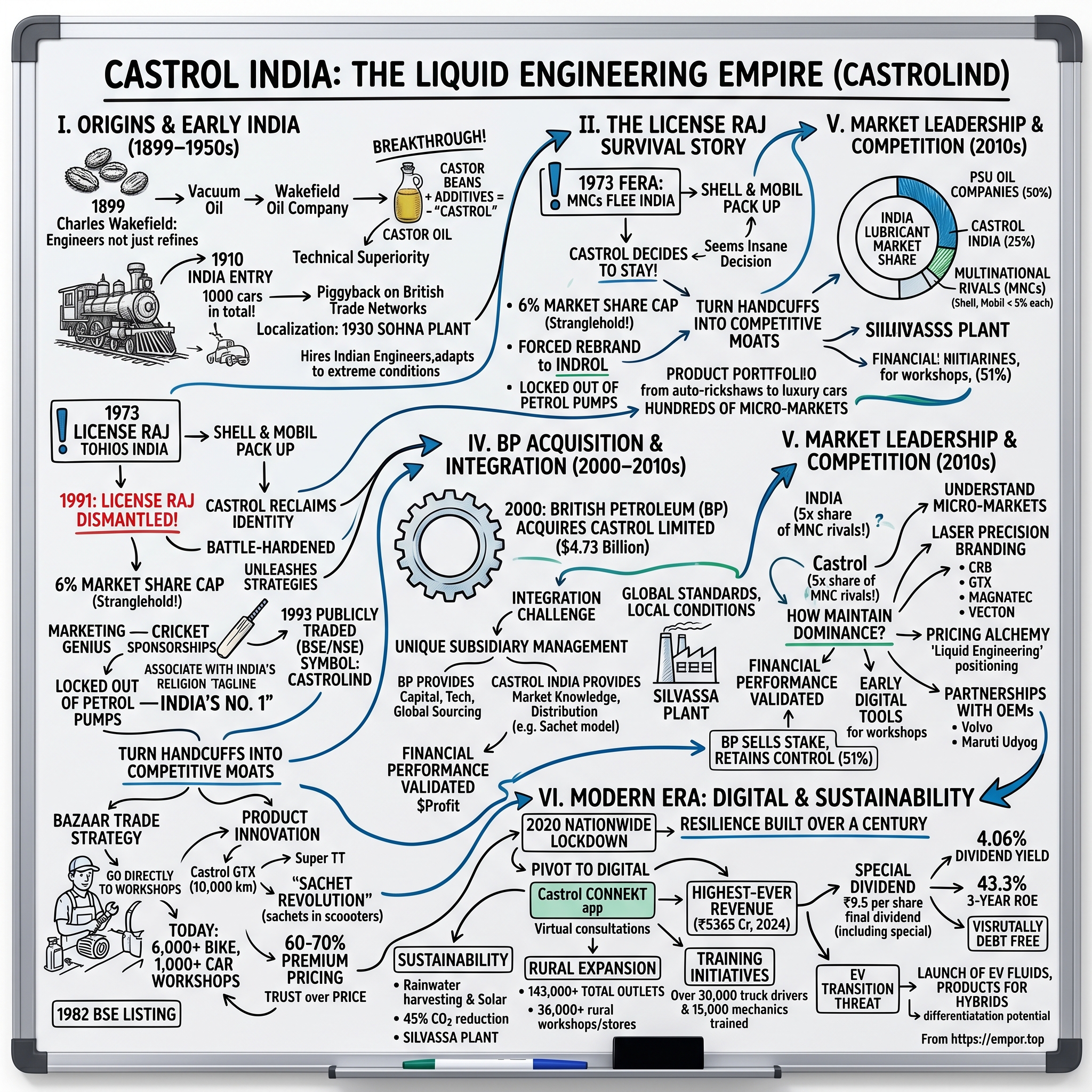
Castrol India: The Liquid Engineering Empire
I. Introduction & Episode Teaser
On the morning of August 4, 2026, Castrol India's management team dialled into an earnings call that presented strong headline figures. Revenue for the June quarter rose 25% year-on-year to ₹1,871 crore, earnings before interest, tax, depreciation, and amortisation (EBITDA) jumped 41% to ₹494 crore, and profit after tax climbed 43% to ₹347.7 crore.12 For a company whose earnings had expanded at low single-digit rates for much of the preceding decade, these numbers marked a sharp departure from recent performance.
Yet the most consequential question on the call had nothing to do with lubricant volumes, rural distribution networks, or new thermal management fluids for data centres. An analyst asked when a New York-based private equity firm would complete its acquisition of the company's parent entity.
Chief Financial Officer Mrinalini Srinivasan provided few specifics, explaining that the transaction is "rather large," spans multiple countries, and requires regulatory approvals across many jurisdictions before the mandatory open offer to Indian minority shareholders can proceed.2 Without a specific timeline or target date, management acknowledged that after more than a century in India—spanning colonial rule, the License Raj, foreign exchange controls, market liberalisation, and four decades as a publicly traded company—Castrol India is once again poised to change hands.
This dynamic defines Castrol India in 2026. The business generates roughly ₹5,700 crore in annual revenue, converts nearly a quarter of that revenue into EBITDA, carries virtually no debt, delivers returns on equity that rank among the highest of Indian consumer-facing companies, and pays out the vast majority of its profits as dividends.3 It remains one of the most capital-efficient enterprises listed on the National Stock Exchange. However, its net profit in calendar year 2025 was only modestly higher than in calendar year 2019—six years of high returns on capital yielding modest growth in absolute earnings.4
The central question of this story: How did a British oil subsidiary—barred from selling at state-owned petrol stations, legally restricted to a small fraction of its target market, and forced to yield majority control under India's historical foreign-exchange regulations—build a highly profitable lubricant franchise in India? And having established that franchise, what is its long-term value as the internal combustion fuels it relies upon are gradually replaced in modern vehicles?
The investment core is deceptively simple and structurally complex. Castrol India maintains strong brand equity among Indian mechanics, a distribution network reaching roughly 160,000 retail outlets, and an asset-light manufacturing model where annual capital expenditure remains around ₹100 crore—under 2% of revenue.2 These fundamentals generate cash well beyond what the core business can internalise for reinvestment, making dividend distributions the primary return vehicle for shareholders. However, the largest single profit pool within the enterprise—engine oil for two-wheelers—is a consumable rendered obsolete by electric drivetrains. Management's strategic response relies on premiumisation in the near term and thermal management fluids for electric vehicles and AI data centres over the longer horizon. Whether this roadmap represents a viable transformation or an optimistic projection remains the key analytical test.
Where this story goes: from a paint-and-oil merchant's shop in London at the turn of the twentieth century, to the first shipments of Wakefield oil arriving in an India with barely a thousand motor vehicles; through the Foreign Exchange Regulation Act that forced structural corporate changes; to the development of the independent bazaar trade; through economic liberalisation, single-use pouch distribution, BP's global acquisition, and BP's subsequent exit a quarter-century later. Finally, the narrative turns to the present: a cash-generative enterprise adapting to new ownership, fresh executive leadership, and fundamental questions surrounding its core product category.
 Subscribe on LinkedIn
II. Origins & License Raj Survival: The Mechanics' Alliance (1899–1990)
Charles Cheers Wakefield was an established executive at the Vacuum Oil Company, the American lubricants firm later absorbed into Mobil. In 1899, he resigned to establish C.C. Wakefield & Company in London, initially selling lubricants for railway locomotives and heavy industrial machinery.
The company's defining commercial turning point arose from a novel engineering challenge. Early internal combustion engines in motor cars and aircraft operated at significantly higher temperatures and speeds than industrial equipment. Standard mineral oils thinned and degraded under severe thermal stress. Wakefield’s researchers discovered that blending vegetable castor oil with a mineral oil base created a lubricant that maintained film strength at elevated temperatures. Contracting "castor" and "oil" yielded the brand name Castrol. Marketed heavily in early motorsports, the product established a long-standing brand association with engine performance and durability.
In 1910, Wakefield established the company’s first overseas operation in India—a country that then had roughly one thousand motor cars on its roads.5 The expansion represented an early long-term wager on India's prospective automotive growth, establishing Castrol's brand presence decades before mass motorisation began.
When the Government Took the Name
For its first six decades, the Indian operation functioned as a conventional import and distribution business. Regulatory shifts in the 1970s fundamentally altered that structure.
The Foreign Exchange Regulation Act (FERA), tightened during the 1970s, mandated that foreign multinationals reduce their equity ownership in Indian subsidiaries to 40% or exit the country. Faced with strict foreign exchange controls, restricted profit repatriation, and trademark limitations, major global peers including Mobil and Shell chose to leave India.
Castrol chose compliance over exit. It diluted its foreign equity stake to 40%, incorporating its Indian business in 1979 as Indrol Lubricants and Specialities—a corporate title adopted because the company was prohibited from trading under its global brand name.5 The company listed its shares on the Bombay Stock Exchange in the early 1980s as Indrol.5 For more than a decade, one of the world's prominent lubricant brands traded in India under an unfamiliar local name.
Equity dilution was accompanied by strict operational quotas. Ravi Kirpalani, who later served as the company's managing director, described the era bluntly: "We were not allowed to have more than six per cent market share, and this was the time many MNCs closed shop in India and left, but we decided to stay put."5
A government-mandated production quota capped Indrol's market share at approximately 6%, creating a legal ceiling on organic expansion. Compounding this volume restriction was a structural channel barrier: lubricants in India were primarily retailed through fuel stations owned by state oil marketing companies—Indian Oil, Hindustan Petroleum, and Bharat Petroleum. Because state energy firms prioritized their own lubricant lines, Indrol was effectively locked out of petrol station forecourts.5
Restricted to a minority foreign ownership structure, operating under a mandated substitute name, capped by production licenses, and denied access to primary retail outlets, Indrol faced severe operational limitations.
The Accidental Moat
Excluded from state-owned fuel forecourts, Indrol adapted by building an alternative distribution strategy.
The company directed its sales team to independent auto spare-parts retailers in crowded urban markets, roadside repair shops, single-bay mechanics behind transport depots, and small-town repair outlets. This independent network became known as the bazaar trade.5
This distribution shift carried significant strategic implications. Because individual vehicle owners lacked technical expertise regarding oil viscosity and engine specifications, they relied heavily on independent mechanics for product recommendations. In the Indian automotive aftermarket, the mechanic functioned as the primary purchasing authority. When an independent repairer specified Castrol, the vehicle owner routinely accepted the recommendation.
Indrol cultivated mechanics as its core distribution partners by offering technical training, diagnostic literature, and reliable inventory support. Conversely, state-owned energy companies treated lubricants as secondary add-ons to fuel transactions, placing minimal emphasis on workshop relationships.
This dynamic created an enduring competitive advantage. While state-owned firms retained control over petrol stations, Indrol built strong brand preference across an expanding network of independent mechanics. By the close of the License Raj era, Indrol remained a small, quota-constrained enterprise operating under a regulatory trade name. However, it had assembled an independent distribution footprint and mechanic network that positioned the firm for rapid growth once economic liberalisation began.
III. Liberalization, The Sachet Revolution, & BP Integration (1990s–2010s)
India’s 1991 balance-of-payments crisis forced the government to dismantle industrial licensing, remove foreign ownership restrictions, and end the production quotas that had long constrained private enterprise.
For Castrol’s Indian operations, economic liberalisation removed the statutory market-share ceiling. The company reclaimed its original corporate identity, changing its name from Indrol back to Castrol India.5 In 1992, its British parent raised its equity stake back to 51%, restoring majority control and re-establishing direct access to global research and development.5
Access to global formulation capabilities provided a crucial technical advantage. Engine lubricants are engineered chemical systems comprising base oils and specialized additive packages: detergents to prevent combustion soot from varnishing piston rings, dispersants to suppress sludge accumulation, anti-wear compounds for extreme-pressure surfaces, and viscosity modifiers to maintain fluid stability across extreme operating temperatures. Securing international original-equipment certifications required testing infrastructure and capital investment beyond the reach of standalone domestic blenders, allowing Castrol to compete on technical performance rather than basic commodity pricing.
The Sachet: A Distribution Weapon Disguised as Packaging
During the 1990s, rapid adoption of motorcycles and scooters established two-wheelers as India's primary mobility segment. These smaller engines required frequent oil changes, but the market faced widespread product tampering and adulteration at independent repair shops, where vehicle owners had little ability to verify bulk oil quality.
Castrol addressed this trust deficit by introducing Super TT two-wheeler oil in single-use 40-millilitre sachets.5 Unit packaging costs per litre increased significantly and distributing small foil pouches added logistical complexity compared to shipping bulk drums.
However, sealed sachets eliminated tampering concerns. Vehicle owners could purchase pouches in advance, store them under their seats, and hand them directly to mechanics during service. This ensured product integrity and allowed the brand to travel with the vehicle rather than remaining static at the point of sale.5 The format also expanded Castrol's distribution footprint beyond traditional workshops into non-standard retail channels, including petrol station forecourts.
By 2013, Castrol commanded roughly 25% of India's ₹12,000 crore lubricant market. State-owned oil marketing companies retained about 50% through their captive petrol station networks, while major foreign competitors Mobil and Shell, which had exited during the foreign exchange restriction era, held less than 5% each.5
This market structure highlighted the durable advantage of Castrol's bazaar distribution footprint. Although returning global competitors possessed recognized brands and advanced technology, they lacked decades of established relationships with independent mechanics across India's local repair ecosystem.
Two Ownership Shocks
As operating performance expanded, Castrol India underwent two corporate ownership shifts.
In 2000, BP plc acquired Burmah Castrol globally, bringing the Castrol brand under BP ownership and making BP the ultimate parent of the Indian listed entity. For local minority investors, the operating business remained structurally unchanged, preserving local management, an independent board, and commercial autonomy over domestic pricing and distribution.
A second restructuring occurred through 2016, when BP sold down a portion of its equity in a series of open-market block transactions, cutting its stake from 71% toward 51% while retaining clear majority control.67 While BP framed the transactions as a reaffirmation of its commitment to India, the sales allowed the parent firm to monetize a portion of a high-valuation asset without relinquishing operational control.
The stake reduction increased Castrol India's public float from 29% to nearly 49%, significantly improving share liquidity and enabling larger institutional investors to build equity positions in the stock.
The transactions also demonstrated that BP viewed its Indian listed subsidiary partly as a flexible financial holding. That capital allocation approach set a precedent that became central to the enterprise in December 2025, when BP demonstrated that flexibility again on a far larger scale.
IV. Core Business Engine & Segment Economics (2015–Present)
A visit to Castrol India’s primary plant in Patalganga, Maharashtra, immediately highlights what the facility lacks: there are no crude distillation units, cracking towers, or flare stacks. Instead, the operation functions similarly to a high-precision chemical blending facility, housing base oil storage tanks, metered dosing systems for additive packages, agitated blending vessels, and automated filling lines handling pouches, bottles, and drums.
Castrol India does not refine crude oil. Instead, it purchases base oil—the refined petroleum fraction constituting the bulk of finished lubricants—from refiners, buys additive packages from specialized global chemical suppliers, and blends these components according to formulations developed in its parent company's laboratories. Across its three manufacturing facilities—Patalganga in Maharashtra (capacity exceeding 95 million litres), Silvassa in Dadra and Nagar Haveli (exceeding 80 million litres), and Paharpur in West Bengal (exceeding 45 million litres)—total installed capacity stood above 220 million litres at the end of 2024.8
This asset-light structure shapes the company's financial profile. Unlike capital-intensive oil refining, which requires heavy infrastructure, long depreciation cycles, and exposure to severe commodity swings, blending requires minimal fixed capital. Castrol India’s annual capital expenditure averages approximately ₹100 crore, split roughly evenly between manufacturing capacity and market-facing investments.2 Measured against calendar year 2025 revenue of ₹5,722 crore, capital intensity remains under 2% of sales.9
Because the business generates steady operating margins without requiring significant reinvestment, return metrics remain high. Return on equity has averaged in the mid-forties in recent years, with return on capital employed reaching even higher levels.3 Rather than reflecting an aggressive capital allocation strategy, these metrics stem from a business model defined by low fixed-asset requirements, established brand equity, and a near-neutral working capital cycle, in which inventory and receivables are largely offset by payables to base oil suppliers.4
Where the Money Actually Comes From
The company's revenue base divides into two distinct operational segments.
The automotive division serves as the primary profit engine and consumer franchise. It includes passenger car motor oils under the Castrol EDGE and Magnatec brands, heavy-duty diesel oils for commercial fleets under Castrol CRB, and two-wheeler lubricants under Castrol Power1 and Activ. In this segment, established mechanic relationships and brand recognition support pricing power over retail consumers.
Castrol’s market share across automotive sub-segments reflects varying degrees of consumer pricing power: the company holds approximately 38% market share in passenger car lubricants, 27% in two-wheeler oils, and 20% in commercial vehicle fluids, compared to an overall market share of roughly 20%.10 Higher-margin segments like passenger cars benefit from strong brand awareness among individual vehicle owners. Conversely, commercial vehicle fleets prioritize procurement tenders and unit cost, yielding lower market share for premium-priced products.
The industrial division supplies metalworking fluids, hydraulic oils, greases, and specialty lubricants to steel mills, auto component plants, wind turbine operators, and general manufacturing facilities. Although industrial buyers negotiate aggressively on price, customer retention remains high due to the technical friction of requalifying production-line fluids. Management has designated industrial lubricants as a primary growth driver, reporting high double-digit growth supported by expanding domestic manufacturing demand.2
The Cost Structure and the Lag
Raw materials—comprising base oils and chemical additives—dominate total operating costs. Because these inputs are priced internationally in U.S. dollars, Castrol's input costs track global crude benchmarks and currency exchange rates. Consequently, the company's cost structure remains directly exposed to global commodity cycles and currency fluctuations.
Unlike commodity blenders, Castrol leverages brand equity and mechanic network loyalty to pass raw material cost increases through to consumers, albeit with an operational lag of one to two quarters. As a result, operating margins tend to compress during sudden crude price spikes and expand as raw material input costs soften.
Financial performance in the first half of 2026 illustrated this lag mechanism. In the March 2026 quarter, revenue rose 9% year-on-year to ₹1,545 crore, profit after tax increased 4% to ₹242 crore, and EBITDA grew 7% to ₹329 crore, representing an EBITDA margin near 21%.11 In the June 2026 quarter, revenue climbed 25% to ₹1,871 crore and net profit rose 43% to ₹347.7 crore, expanding the EBITDA margin to nearly 26%.12
Management clarified that the sharp margin expansion in the June quarter resulted primarily from pricing timing rather than a sudden structural surge in volume. The company implemented two low-double-digit price increases between January and June while utilizing lower-cost inventory acquired in earlier periods.2 Because product prices rose before higher raw material costs fully flowed through inventory, margins expanded temporarily. Management cautioned analysts that the September 2026 quarter would reflect greater pressure from commodity inflation, reiterating a through-cycle target EBITDA margin band of 21% to 24%.2
This distinction between short-term margin fluctuations and underlying operational expansion underscores the core analytical question facing the enterprise. While the operational engine remains capital-efficient and highly cash-generative, assessing Castrol India's long-term outlook requires examining how incoming corporate ownership intends to navigate changing automotive drivetrain technologies and evolving product demand.
V. Current Management, Governance & Capital Allocation
Consider the résumé of the person now running Castrol India, and then consider how he got the job.
Saugata Basuray joined the company in 1999 as a management trainee. He holds an engineering degree from the University of Pune and an MBA from the Symbiosis Institute of Business Management. Over twenty-six years he ran sales for the B2B channel, became head of marketing for Castrol India, then went overseas to lead Castrol Philippines before running Castrol's joint venture in Indonesia.12 He is, in other words, exactly what a lubricants company would design in a laboratory: a lifer who has sold to industrial buyers and to consumers, who has carried a P&L in two foreign markets, and who knows the Indian bazaar trade from the inside.
He became interim chief executive on January 1, 2026, and the board confirmed him as managing director for a five-year term effective June 1, 2026, having approved the appointment at its meeting on May 28.1213
The Churn Problem
Now the part that a shareholder should actually be uneasy about.
Sandeep Sangwan ran Castrol India from January 2020 and then moved up to become Castrol's Global Chief Marketing Officer.14 His successor, Kedar Lele, took over as managing director on November 1, 2024. Lele arrived with a genuinely impressive pedigree — roughly two decades at Hindustan Unilever, ending as an executive director — and represented a deliberate import of fast-moving consumer goods thinking into a lubricants business.13
He resigned effective December 31, 2025, after about fourteen months in the chair.13
Around the same window, the finance function turned over as well. Chief Financial Officer and Whole-time Director Deepesh Baxi resigned in December 2024.15 The role went to Mrinalini Srinivasan, appointed CFO and Whole-time Director effective July 28, 2025 for a five-year term, after seventeen-plus years at Procter & Gamble India, where she served as CFO of the Hygiene and Health business and as group controller.16 She holds an MBA from FMS Delhi and an engineering degree in electronics and instrumentation.16
Set out plainly: between late 2024 and mid-2026, Castrol India cycled through three managing directors and replaced its chief financial officer. The company has not disclosed a substantive reason for Lele's departure beyond the fact of the resignation.13 That is within the letter of disclosure norms and well short of the spirit of them.
There is a benign reading — a highly regarded FMCG executive discovered that a subsidiary of a global lubricants group, with formulations set overseas and royalty terms fixed by contract, offered less strategic latitude than he expected, and left. There is a less benign reading involving disagreement over strategy or over the impending change of ownership. Neither can be verified from public disclosure. What can be stated is the analytical fact: a fourteen-month managing director tenure with no explanation, immediately before a control transaction, is the kind of thing a skeptical investor should register rather than wave through. Elevating a twenty-six-year insider afterwards reads as a deliberate choice for continuity, and given the circumstances, a sensible one.
The Royalty: Alignment, or a Toll?
Castrol India pays a royalty to Castrol Limited, UK — its promoter — at 3.5% of annual turnover for use of the Castrol brand and technology, subject to a cap of 10% of profit before tax.8
Both halves of that structure deserve attention. On revenue of ₹5,722 crore, a 3.5% royalty is roughly ₹200 crore a year of pre-tax profit flowing to the parent before any dividend is declared.9 That is a material, permanent, senior claim on the Indian company's earnings, paid by all shareholders and received by one.
But the profit-based cap is a genuine minority protection, and it is unusual enough to be worth pointing out. A pure revenue royalty with no ceiling would strip cash out of the subsidiary in exactly the years when a downturn made that cash most valuable. Capping the payment at 10% of profit before tax means the parent's take falls when earnings fall. The related-party structure is real; it is also structured with more restraint than many multinational subsidiaries listed in India manage.
Capital Allocation: The Dividend Is the Product
The balance sheet is close to pristine. At the end of calendar 2025 the company held roughly ₹1,141 crore in cash and short-term investments against no meaningful borrowings — only lease obligations of around ₹63 crore appear on the debt line.43
With capital expenditure needs of about ₹100 crore and profit near ₹950 crore, the company has no honest use for most of the money it makes. So it returns it. Castrol India has paid dividends for twenty-six consecutive years and raised the dividend in each of the last four.2 For calendar 2025, the board recommended a final dividend of ₹5.25 per share on top of a ₹3.50 interim, taking the year's total to ₹8.75.9 Against calendar 2025 earnings per share of ₹9.60, that is a payout ratio near 91%.43 For calendar 2024, the company had gone further, declaring a ₹9.50 final dividend that included a ₹4.50 special dividend marking the brand's 125th anniversary — pushing that year's payout above 100% of earnings.17
Note what that means: the special dividend was a one-off return of accumulated balance sheet cash, not a step-up in ordinary earnings power. Shareholders who anchored on calendar 2024's total distribution and expected it to repeat were disappointed. At the current share price of roughly ₹187, the trailing dividend yield sits near 4.7%.318 For the June 2026 quarter the board declared an interim dividend of ₹6.25 per share, payable by September 2, 2026 — a sharp step up from the prior year's interim, and one that arrives conspicuously in the middle of a control transaction.2
The one meaningful deviation from harvest-and-distribute came in November 2022, when Castrol India announced an investment of up to ₹487.5 crore for a 7.09% stake in Ki Mobility Solutions, the TVS group's digital automotive aftermarket venture behind the myTVS platform — completed on January 10, 2023.1920 The logic was to plug Castrol's products into an online-to-offline service network that already reached around three million customers across roughly a thousand garages.19
It was a sensible option to buy: a minority stake, a fraction of one year's free cash flow, and a hedge against the possibility that vehicle servicing migrates from independent mechanics to organised digital platforms — precisely the channel shift that would erode the bazaar-trade advantage the company spent forty years building. But it has been more than three years, and Castrol India has not disclosed a specific, quantified return or revenue contribution from the Ki Mobility relationship. A 7.09% stake also confers influence, not control. Investors should treat it as a modestly sized call option that has not yet demonstrably paid off.
The Elephant: Stonepeak
On December 24, 2025, BP announced it had agreed to sell a 65% shareholding in Castrol to the American infrastructure investment firm Stonepeak, at an enterprise value of approximately $10.1 billion. BP expected roughly $6 billion in proceeds, retained a 35% holding through a joint venture with an option to sell after a two-year lock-up, and slotted the deal into a broader programme to divest $20 billion of assets by 2027. Canada Pension Plan Investment Board joined as a co-investor.21
Two days later the consequence arrived for Indian minority shareholders. Under SEBI's takeover regulations, an indirect acquisition of control over a listed Indian company obliges the acquirer to make an open offer to public shareholders. On December 26, 2025, the acquiring vehicle — Motion JVCo, backed by Stonepeak and CPPIB — announced an open offer for 25.71 crore shares, representing 26% of Castrol India's equity, at ₹194.04 per share, for total consideration of up to approximately ₹4,990 crore.22
Look closely at that price. It was struck at roughly a 2% premium to the then-prevailing market price.22 The stock rallied on the announcement and then went essentially nowhere: as of mid-August 2026 it trades around ₹187, below the open offer price, with a 52-week range of roughly ₹170 to ₹211.18
That market reaction contains the most useful piece of information in this entire section. A mandatory open offer at a token premium is a regulatory formality, not a value event — it is the minimum the law requires, priced off a statutory formula, not a bid for the company. The market has correctly concluded that minority shareholders are along for the ride rather than being bought out at a control premium.
Which sets up the governance question that will define the next several years. BP was a strategic owner: it made money from Castrol India through the royalty, the dividend, and the value of a global brand it also used everywhere else. Stonepeak is an infrastructure private equity firm. Its return comes from cash yield and an eventual exit. Those two owners may want the same things from an asset that already pays out ninety percent of its earnings — or they may not. A financial sponsor could equally decide that a debt-free subsidiary sitting on a thousand crore of cash is an under-optimised balance sheet.
Nothing in the public record says that will happen. But the identity of the controlling shareholder has changed category, the transaction was expected to close by the end of 2026 subject to regulatory clearances, and management has given no timeline.212 For a stock whose entire investment case rests on the reliability of its distributions, who controls the distribution decision is not a footnote.
VI. Industry Structure, Competitive Landscape & 7 Powers / 5 Forces
Picture the Indian lubricant market as two separate retail worlds selling the exact same physical product.
In the first world, a truck pulls into an Indian Oil petrol pump. The driver buys diesel, and the attendant sells a container of Servo alongside it. The transaction takes ninety seconds, the purchasing decision was made by the station owner, and unit price is the governing variable.
In the second world, a vehicle owner wheels a motorcycle into a two-bay workshop in a district town. The mechanic pulls the drain plug, looks up, and specifies a brand. That brand is Castrol roughly a quarter of the time.10
State-owned oil marketing companies—Indian Oil with Servo, Bharat Petroleum with MAK, and Hindustan Petroleum with its proprietary lines—collectively command roughly half the Indian market, built almost entirely on the first world.510 They own the petrol forecourts and supply factory fills directly to vehicle manufacturers, placing their lubricants inside engines before consumers ever form a brand preference.
Castrol, holding approximately 20% of the total market, ranks a distant second in overall volume, yet dominates the second world—the retail bazaar trade where consumers and mechanics choose.10 Behind Castrol sit Gulf Oil, Shell, ExxonMobil, and Tide Water Oil's Veedol, each holding high single-digit or smaller market shares.
7 Powers: Which of These Are Real
Applying Hamilton Helmer's 7 Powers framework requires evaluating whether claimed strategic advantages survive empirical scrutiny.
Branding — real, and measurable. Branding serves as Castrol's load-bearing advantage, demonstrated not by consumer surveys but by the market share gradient across retail channels. Castrol commands roughly 38% market share in segments where individual consumers choose, compared to roughly 20% where corporate procurement departments negotiate.10 A brand that secures nearly double the market share in consumer-driven channels delivers tangible economic value. Castrol maintains a price premium over state-owned competitors on chemically comparable formulations and executed low-double-digit price increases across a six-month period without management reporting share loss.2
Cornered resource — real, but mislabeled. Castrol's distribution footprint is substantial, encompassing roughly 160,000 retail outlets, about 40,000 auto-care points, and a workshop service network spanning around 34,000 independent motorcycle garages and 16,000 car workshops.2 However, a distribution footprint does not constitute a cornered resource under Helmer's definition, as competitors are legally free to contract with the same workshops. Instead, the asset is protected by accumulated switching friction—decades of commercial relationships, credit terms, mechanic training, and loyalty programs—alongside the reality that no rival possesses an Indian lubricant profit pool large enough to justify replicating the investment. This advantage is more accurately classified as scale economies in distribution, where the high cost of serving a fragmented retail ecosystem is amortized across Castrol's high sales volumes.
Counter-positioning — historically real, now spent. Castrol's initial move into the bazaar trade represented classic counter-positioning. State-owned incumbents could not mirror the strategy without cannibalizing their exclusive petrol station networks. However, four decades later, every major competitor operates within the bazaar trade, and state oil companies have established off-forecourt sales channels. An advantage that was decisive in 1985 has become a baseline operational requirement in 2026.
Process power — largely unproven. While management highlights formulation and manufacturing capabilities, core technology originates from the parent company's global R&D facilities and is licensed through royalty agreements, making it a contractual arrangement rather than a proprietary local asset. Furthermore, base chemical additives are sourced from a concentrated group of global suppliers serving the broader industry. Public disclosures provide no evidence of proprietary manufacturing processes that competitors cannot replicate.
Network economies, switching costs, scale economies in production, and cornered technology — not present in any structural form. Castrol operates a branded consumer distribution model rather than a network-driven enterprise.
5 Forces: Where the Pressure Actually Comes From
Supplier power: high and structural. Base oil prices track global crude markets, while additive packages are controlled by a concentrated set of specialty chemical manufacturers including Lubrizol, Afton, and Infineum. Because both inputs are priced in U.S. dollars, Castrol India operates as a price-taker on its core cost structure and lacks a viable path toward backward integration, as constructing refining assets would dismantle its asset-light business model.
Threat of substitutes: the primary structural risk. The principal threat stems not from rival lubricant manufacturers, but from alternative vehicle drivetrains. Battery electric vehicles eliminate internal combustion engines and their associated oil change requirements. While electric vehicles require reduction-gear fluids, thermal management fluids, and specialized greases, these applications demand significantly lower fluid volumes over longer service intervals. This represents structural demand destruction concentrated precisely in Castrol's highest-margin consumer segments.
Buyer power: bifurcated. Individual retail consumers exercise minimal buyer power due to low purchase frequency, technical opacity, and reliance on mechanic recommendations. Conversely, independent mechanics hold substantial influence, as product recommendations directly drive consumer brand selection. Industrial accounts and commercial fleet operators exercise significant buyer power, leveraging formal procurement tenders to negotiate competitive pricing.
Rivalry: high but rational. State-owned oil companies compete on price and forecourt access, Shell and ExxonMobil target premium vehicle segments, and Gulf Oil aggressively courts independent mechanics through workshop loyalty programs. Despite active competition, industry pricing remains disciplined, allowing Castrol to maintain stable operating margins.
Threat of new entrants: low. Capital requirements for blending facilities present minimal entry barriers. However, replicating forty years of brand equity, mechanic trust, and deep bazaar distribution—while entering a market facing long-term volume moderation—creates a formidable barrier to new entrants.
Myth vs. Reality
Myth: Castrol India is a fast-growing consumer compounder. Reality: The company's five-year revenue compound annual growth rate of roughly 14% is distorted by a depressed comparison base, as calendar 2020 revenue dropped to ₹3,004 crore during COVID-19 lockdowns.43 Measured from pre-pandemic calendar 2019 levels, revenue expanded at a compound annual rate of 6.7% through calendar 2025, while net profit grew at 2.3% annually, rising from ₹827 crore to ₹950 crore.4 High returns on capital have yielded modest absolute profit growth, characterizing Castrol India as a mature, cash-generative harvest asset rather than a rapid growth compounder.
Myth: Castrol leads the Indian lubricant market. Reality: Castrol ranks second in total market volume behind the combined state-owned oil companies and behind Indian Oil on an individual basis. Castrol's market leadership is concentrated specifically within the retail bazaar segment.
Myth: Electric vehicle adoption will cause immediate business disruption. Reality: India's installed fleet of internal combustion two-wheelers remains vast and continues to expand in absolute terms, generating multi-year demand for routine lubricant servicing. Electric drivetrain adoption represents a gradual moderation in fleet growth rates rather than an abrupt operational cliff.
Castrol maintains a durable competitive position within a focused market niche, excelling where consumers and mechanics make deliberate product choices. The central analytical question remains how the enterprise will navigate the gradual transition away from internal combustion engines over the coming decade.
VII. Strategic Options: EV Transition, Immersion Cooling & Service Ecosystem
Every incumbent facing technological displacement tells a version of the same story: the core is fine for now, and here is the adjacency that will carry us across. The story is usually sincere. It is usually also unfalsifiable at the moment it is told, which is precisely why it deserves the hardest scrutiny in the analysis.
Castrol India's version has three legs.
Castrol ON: Selling Fluids to Cars That Do Not Burn Fuel
The intuition that electric vehicles need no lubricants is wrong, but the correction is smaller than the industry would like.
An EV has no combustion, so no engine oil. But it does have a reduction gearbox that needs a transmission fluid, an electric motor and battery pack that generate substantial heat and need thermal management, and bearings and joints that need grease. Castrol's global answer is the Castrol ON range — e-transmission fluids, e-coolants, and e-greases engineered for drivetrain efficiency and battery thermal management, including for ultra-fast charging.23
The technical challenge is genuinely different from engine oil, and worth understanding. An engine oil's job is largely mechanical and chemical: reduce friction, carry away combustion soot, neutralise acids. An EV thermal fluid's job is primarily heat transport, and in some architectures it must do that while in direct contact with live electrical components — which means it must be an excellent conductor of heat and a near-perfect insulator of electricity, simultaneously. Those requirements pull in opposite directions chemically, which is where formulation expertise earns its keep.
The commercial evidence in India is real but small. Castrol has supplied EV fluids to Tata Motors and MG Motor, which between them have held roughly 80% of India's four-wheeler EV market.24 Globally, Castrol has signed OEM partnerships including a three-year agreement with 比亚迪 BYD.25 Winning the factory-fill position with the leading domestic EV makers is meaningful: OEM fills are specified in the service manual, which means they pull aftermarket demand behind them for the life of the vehicle.
But the sober framing is this. The EV fluids business is not separately disclosed in Castrol India's reported segments, and on the volume-per-vehicle mathematics it cannot yet be material. Winning a large share of a very small pool of high-value fluid does not replace a modest share of an enormous pool of engine oil. Managing director Basuray's own framing on the June 2026 call was notably unheroic: internal combustion engines and hybrids "will remain the dominant part of India's vehicle park for the next many years."2 That is a defensible statement about the runway. It is not a claim that Castrol ON offsets the decline.
Data Centre Cooling: The Genuinely Interesting Option
The second leg is the one that would not have appeared in a lubricants company's strategy deck five years ago, and it is arguably the most intellectually coherent thing in the portfolio.
Modern AI accelerators dissipate so much heat that blowing air across them has stopped working. The industry's answer is liquid. Three architectures matter: immersion cooling, where entire servers are submerged in a bath of dielectric fluid; direct-to-chip cooling, where fluid is piped through cold plates bolted directly onto the processors; and the facility-level water systems that carry heat out of the building. Castrol has launched fluids for all three.2627
The strategic logic is stronger than it first appears. A data centre coolant must transport heat efficiently, remain chemically stable for years at elevated temperature, not corrode the metals it touches, not degrade seals and plastics, and — for immersion — not conduct electricity. That is the same discipline as formulating an engine oil, aimed at a different problem. This is capability transfer, not diversification for its own sake. And it is an unusually attractive market: customers who are spending billions on accelerators are not price-shopping the coolant, and a fluid that has been qualified into a live data centre is not casually swapped out.
Management, to its credit, has not oversold it. Asked directly about immersion and direct-to-chip on the June 2026 call, Basuray said Castrol has "products available for both," acknowledged the market is early-stage, and estimated that a material contribution was likely "more than two years away," noting that many announced Indian data centres had not yet converted into operating facilities.2
That is a straight answer, and it is the right one to give. It also means that for the purposes of valuing Castrol India in 2026, the data centre business is a free option with no demonstrated revenue, no disclosed order book, and no independent evidence of design wins in India. Worth watching. Not yet worth counting.
Castrol Auto Service: Moving Up the Value Chain
The third leg is the least glamorous and, in the near term, the most likely to matter.
If the risk is that Castrol's influence over mechanics erodes as vehicle servicing organises and digitises, the direct hedge is to own the branded service relationship rather than rent it. Castrol Auto Service is a network of branded multi-brand workshops offering express oil change and maintenance. It scaled from roughly 580 outlets in late 2024 to over 750 across 300 cities by the third quarter of 2025, and to around 850 by the June 2026 quarter.282
The strategic value is that a CAS outlet converts an arms-length brand preference into a controlled point of sale. The strategic limitation is that India's aftermarket is served by hundreds of thousands of independent garages; 850 branded outlets is a rounding error against that base, and the format is asset-light and franchised, meaning Castrol captures product margin rather than service economics. It is a useful defensive position and a channel for premium products. It is not, on current scale, a second business.
Taken together, the three legs are reasonable, cheap, and unproven. None of them is a bad idea. None of them has yet produced disclosed revenue large enough to change the shape of the P&L. Which is why the most revealing evidence about this company right now is not in the strategy — it is in what management says when analysts push, and what it declines to say.
VIII. Transcript Deep-Dive & Analyst Q&A Stress Test
Earnings calls are where corporate narratives face empirical resistance. A close reading of Castrol India's recent analyst calls reveals a management team that is operational, disciplined, and conspicuously selective about what it chooses to quantify.
The Volume Disclosure Problem
Consider the key exchange from the June 2026 earnings call. Asked directly by analysts to provide the underlying volume growth behind the 25% revenue surge, Chief Financial Officer Mrinalini Srinivasan declined, stating that the company does not "share specific volume numbers," while noting that volume expansion was "broad-based" across segments.2
That refusal is analytically significant. For a lubricant manufacturer, volume sold in litres is the fundamental operational unit—the single metric that isolates organic product demand from price increases and product mix shifts. In a quarter where management had already confirmed taking two low-double-digit price hikes over six months, withholding volume figures prevents outside investors from determining how much of that 25% top-line growth stemmed from real demand versus pricing power.2
The shift in communication is particularly notable because the company had previously provided exact figures. On its November 2025 call covering the third quarter of calendar 2025, management disclosed volume growth of 7% for the quarter and 8% year-to-date.2829 Its full-year calendar 2025 results similarly detailed 8% volume growth, attributing the gain to core automotive demand, industrial segment expansion, and deeper rural retail reach.9
Selective disclosure on volume right when price increases distort top-line figures reduces visibility for investors. While remaining fully compliant with disclosure regulations, management chose to withhold a key operational metric at the precise moment it was most diagnostic.
The Growth Ambition, Stated and Repeated
Management has maintained a clear benchmark for growth, consistently stating that Castrol aims to expand at roughly twice the rate of the underlying Indian lubricant market.2 That metric provides a clear, falsifiable performance target, though its evaluation depends on market growth estimates provided by the company itself.
Execution across calendar 2025 offers a test of this commitment. Annual revenue rose 7% to ₹5,722 crore while sales volumes grew 8%, against an Indian lubricant market estimated to be growing in the low-to-mid single digits.930 Achieving 8% volume growth in a mid-single-digit market aligns with management's stated target, accompanied by reported market share gains in both rural and urban retail channels.11
However, evaluating the same period through profit margins reveals a more nuanced picture. While volume expanded by 8% and revenue rose 7%—indicating a slight decline in average realization per litre—EBITDA grew by only 5% to ₹1,348 crore.9 Because earnings grew more slowly than volume, top-line expansion was likely supported by a shift toward lower-margin industrial products or promotional pricing to capture market share. That trade-off may be reasonable for an enterprise defending market share, but it stands in contrast to management's emphasis on premiumisation driving margin expansion.
Margin Discipline Under Scrutiny
The first half of 2026 highlighted this margin dynamic. In the March 2026 quarter, revenue expanded by 9% while net profit grew 4% and EBITDA rose 7%, compressing the EBITDA margin to near 21%—the low end of management's target band.11 By the June 2026 quarter, EBITDA margin expanded to nearly 26%, surpassing the upper threshold.2
Management addressed this margin volatility with transparency. Rather than framing the 26% margin as a permanent step-up, leadership attributed the expansion to timing benefits from earlier price hikes combined with lower-cost inventory, warned that commodity inflation would affect the September quarter, and reaffirmed its long-term EBITDA margin guidance of 21% to 24%.2 Capital expenditure plans were also maintained at approximately ₹100 crore.2
This approach demonstrates disciplined communication. Management consistently frames operational performance against a clear margin target, explains short-term fluctuations through input costs and pricing timing, and resists raising long-term guidance following exceptional quarters.
The EV Question That Never Goes Away
During earnings calls, analysts routinely ask when electric vehicle adoption will begin impacting the core two-wheeler engine oil market.
Management's response has remained consistent: internal combustion engines and hybrid powertrains will dominate India's active vehicle fleet for years to come, total internal combustion vehicles on the road will continue growing even as electric vehicle market share rises, and Castrol is developing EV fluids alongside its core line.2
While logically sound—since fluid demand depends on the total vehicle fleet rather than annual new vehicle sales—this explanation leaves key long-term risks unaddressed. As new two-wheeler sales transition to electric, Castrol's highest-margin product category will eventually crest and decline. Management has not disclosed when it expects this transition to peak, what portion of automotive earnings is exposed, or the volume of EV fluid sales needed to offset lower engine oil demand.
While management continues to address immediate operational performance on earnings calls, long-term investors still await detailed disclosure on the quantitative path through the electric vehicle transition.
IX. Risk Radar & Skeptical Investor Stress Test
An activist investor or short seller constructing a bear case against Castrol India would identify several structural vulnerabilities — alongside notable areas of balance sheet resilience.
The terminal risk is real but slow. Electrification of India's two- and three-wheeler fleet represents the primary structural threat. The mechanism is direct: an electric vehicle eliminates the engine oil change entirely, and two-wheeler engine oil is a high-frequency, high-margin consumable where Castrol commands roughly 27% market share.10 The critical nuance lies in timing. Lubricant demand tracks the installed vehicle fleet, and India's internal combustion two-wheeler population continues to expand in absolute numbers even as electric penetration among new sales grows. The primary risk is not an immediate operational collapse; rather, the highest-margin volume pool will likely plateau and gradually decline over a decade or more, while management's disclosed new-category offsets remain materializing. For an enterprise valued primarily for its dividend yield, a persistent volume plateau presents a de-rating risk long before it becomes an acute earnings crisis.
The growth record is the strongest bear argument, and it is documented. Between calendar 2019 and calendar 2025, net profit grew from roughly ₹827 crore to ₹950 crore — representing an annualized compound growth rate of about 2.3%, trailing Indian inflation over the six-year period.4 The company generates high returns on capital but lacks opportunities to reinvest those earnings internally at scale. From a skeptical perspective, Castrol India operates as a fully optimized mature franchise in a category tied to fleet growth, led by an executive team whose chief growth lever is pricing power. Disclosed performance over the past six years offers little evidence of a structural catalyst for accelerated earnings growth.
Input cost and currency exposure has no structural hedge. Base oils and chemical additives are priced in U.S. dollars and set in global markets. While Castrol successfully passes through cost increases to end consumers, it does so with an operational lag of one to two quarters. A sharp increase in global crude prices combined with rupee depreciation compresses operating margins until pricing adjustments take effect — often occurring when broader consumer purchasing power is already constrained, making price increases harder to sustain. This margin volatility remains a recurring and uncontrollable characteristic of the business model.
State-owned forecourt advantages are extending into electrification. State-owned oil marketing companies are currently building electric vehicle charging infrastructure across their established petrol station networks. Every charging bay creates a direct customer touchpoint controlled by state refiners rather than Castrol — replaying the forecourt exclusion that originally forced Castrol into the independent bazaar trade. Castrol's counter-initiatives, including the Castrol Auto Service network and its minority investment in Ki Mobility, remain modest in scale relative to the broader market transition.
Ownership transition presents an immediate governance overhang. Control of Castrol India is passing indirectly from a strategic industrial parent to an infrastructure private equity consortium, at an enterprise valuation determined in a global transaction where Indian minority shareholders possessed no voting leverage or negotiating role.21 The mandatory open offer at ₹194.04 per share was priced at a token premium to market levels, and the stock has subsequently traded below that offer price — signaling that public investors view the offer as a regulatory requirement rather than a buyout at a control premium.2218 Several operational questions remain unanswered: whether the technical royalty arrangement with the brand owner will persist on current terms; whether the high dividend payout policy will be maintained by a private equity sponsor with different return criteria; and how BP's remaining 35% stake will be managed after its two-year lock-up expires.218 Management has not addressed these structural questions publicly, maintaining that the cross-border transaction remains subject to multi-jurisdictional regulatory approvals.2
Management turnover compounds governance uncertainty. Cycling through three managing directors in under two years, alongside an unexplained fourteen-month chief executive tenure and a chief financial officer transition immediately ahead of an ownership change, indicates executive instability. While not indicative of underlying operational failure, this turnover reduces institutional continuity as the business transitions to a new financial owner.
Balance sheet quality provides a significant cushion. For complete analytical balance, several traditional risks are absent. Castrol India carries no debt and maintains substantial net cash reserves.4 The business faces no refinancing exposure, material pending litigation, accounting restatements, or auditor qualifications. Related-party royalty payments remain contractually capped, and working capital management remains efficient, maintaining a cash conversion cycle in the single digits of days.4 Whatever its long-term strategic challenges, balance sheet strength and financial reporting integrity remain core strengths of the enterprise.
X. Playbook: Business & Investing Lessons
Strip away the specifics of engine oil and India, and Castrol India offers four transferable business and investing lessons—three of them genuinely instructive, and one a warning.
When locked out of the dominant channel, focus on the real decision-maker. The most critical strategic pivot Castrol India made was born of necessity. Barred from state-owned fuel stations, the company targeted independent garages and realized that the vehicle owner paying for the oil rarely selected the brand. In categories where end consumers lack technical expertise—such as auto parts, building materials, pharmaceuticals, agricultural inputs, and industrial supplies—economic influence shifts to a trusted intermediary. Companies that equip, train, and incentivize that intermediary create brand loyalty that withstands price competition, as the technician’s reputation backs the recommendation. However, this advantage holds only as long as the intermediary remains independent. If organized service chains and manufacturer-authorized networks absorb independent mechanics, the distribution moat Castrol spent decades building transfers to whoever controls those networks.
Asset-light business models outperform capital-intensive rivals when value resides in formulation and brand equity. Castrol India operates without refineries, purchasing base oils from the very state-owned refiners it competes against. By positioning itself strictly in blending, brand building, and retail distribution, a business generating under ₹6,000 crore in annual revenue generates returns on capital in the mid-forties while requiring less than ₹100 crore in annual capital expenditure. The strategic principle is simple: occupy the high-margin layer of the value chain where brand differentiation lives, while leaving heavy, depreciating infrastructure to third parties. The risk is that this model relies entirely on maintaining brand power; an asset-light business with a commoditized product is merely an intermediary.
Price premiums in commodity-adjacent categories stem from reframing the purchase decision. Engine oil is a mid-technology chemical product that multiple suppliers can manufacture to comparable technical standards. Castrol commands premium pricing by framing the transaction not as purchasing a fluid, but as protecting a high-value engine asset. This pricing power is evidenced by its market share distribution across channels—holding nearly double the market share in passenger car lubricants, where vehicle owners make quality-driven choices, compared to commercial vehicle fleets, where procurement officers negotiate on unit price.10 In commodity-adjacent markets, pricing power derives from the perceived cost of product failure rather than manufacturing complexity. When the risk of choosing the wrong product is high and uncertain, buyers willingly pay for brand reassurance.
Harvesting a mature asset is a valid strategy—provided optionality is realistically evaluated. Castrol India distributes roughly 90% of its net earnings to shareholders while allocating modest capital to long-term options in EV fluids, data center thermal management, and branded service networks.32 For a mature enterprise facing long-term volume plateaus in internal combustion lubricants, returning excess cash to investors avoids value-destroying diversification through speculative acquisitions.
The critical warning lies in how management frames those strategic options. Leadership has discussed new growth avenues with candor—noting that commercial revenue from data center cooling remains more than two years away and acknowledging that internal combustion engines will dominate the vehicle fleet for years to come.2 However, narrative transparency is not a replacement for quantitative reporting. Until the company explicitly discloses revenue, profit contributions, and timelines for new product segments, investors must evaluate these initiatives as unpriced upside while valuing the core enterprise strictly on current cash flows.
XI. Analysis, Bear vs. Bull Case & Core KPIs
The Bull Case
The bull case starts from a simple observation: Castrol India is one of the highest-quality consumer-facing franchises on the Indian market, yet its valuation does not reflect that status. Trading at roughly ₹187 per share with a market capitalisation near ₹18,500 crore, the stock commands a mid-teens multiple of trailing earnings alongside a dividend yield near 4.7%.183 For a debt-free enterprise generating a return on equity in the mid-forties, that valuation remains modest.34
The operational argument contends that the core business is quietly expanding rather than contracting. Calendar 2025 delivered 8% volume growth against a broader lubricant market expanding in the low-to-mid single digits, accompanied by disclosed share gains in both rural and urban India.911 Rural motorcycle lubricant demand continues to grow at double-digit rates, backed by a distribution network that now reaches roughly 160,000 retail outlets.2 Concurrently, the industrial segment has posted high double-digit growth, offering structural revenue diversification beyond consumer automotive fluids.2 Performance in the June 2026 quarter provided clear empirical evidence of pricing power, as the company absorbed low-double-digit price increases across six months without visible volume degradation.2
The strategic argument positions management's growth initiatives as unpriced call options. The prevailing market valuation assigns virtually no value to EV fluids—where Castrol has secured supplier relationships with India's two largest four-wheeler EV manufacturers—no value to data centre thermal management fluids serving an expanding global infrastructure segment, and no value to a branded service footprint approaching 850 outlets.24262 Should any of these adjacencies scale meaningfully, they represent earnings upside achieved without compromising dividend distributions, as the core model requires minimal capital reinvestment.
Finally, the pending ownership transition may prove advantageous. An infrastructure investor acquiring a cash-generative enterprise at a $10.1 billion global valuation has strong economic incentives to preserve the distribution capacity that justified the transaction.21
The Bear Case
The bear case views the enterprise as a mature, cash-generative asset facing long-term volume moderation.
The central pillar of this perspective is the company's six-year financial trajectory: net profit compounded at an annual rate of roughly 2.3% between calendar 2019 and calendar 2025, trailing broader domestic inflation.4 A mid-teens earnings multiple offers little value margin for a business that has generated modest real earnings growth over six years while facing long-term demand head-winds in its primary profit pool. Similarly, a dividend yield near 4.7% is attractive only if the underlying payout remains sustainable; with distributions exceeding 90% of earnings, the business retains minimal operational cushion against margin volatility.3
Examined structurally, Castrol's competitive moat relies heavily on brand preference among retail mechanics. Its historical counter-positioning advantage in the bazaar trade has largely been equalised as competitors established parallel off-forecourt distribution channels, while the company lacks structural process, network, or manufacturing scale advantages. On the cost side, input prices remain structurally tied to global crude benchmarks and U.S. dollar exchange rates, leaving margins exposed to lag effects. On the demand side, electric vehicle adoption represents a structural substitution threat concentrated in high-margin two-wheeler lubricants, while state-owned oil companies leverage existing forecourt networks to build EV charging infrastructure.
Skeptical investors also highlight the composition of recent operational performance. In calendar 2025, an 8% increase in sales volume yielded only a 5% increase in EBITDA, indicating that volume growth was supported by lower-margin sales or promotional trade terms.9 Furthermore, the sharp margin expansion recorded in the June 2026 quarter was driven primarily by pricing timing ahead of input cost realization, prompting management to guide long-term margins back to the 21% to 24% band.2 Crucially, management chose to withhold specific unit volume disclosures during that exact quarter.2
Governance uncertainties complete the bear case. Cycling through three managing directors in under two years—including an unexplained fourteen-month tenure—alongside a chief financial officer transition immediately prior to a control transaction introduces executive instability.1321 Moreover, the mandatory open offer struck at ₹194.04 per share represented a token premium to prevailing market prices, and the stock's subsequent trading below that benchmark indicates public markets view the transaction as a regulatory requirement rather than a takeover at a control premium.2218
The Synthesis
Both perspectives isolate genuine elements of the enterprise. Castrol India remains a highly efficient, cash-generative business operating within a mature product category facing long-term technological transition. Its mid-teens earnings multiple reflects neither severe distress nor rapid structural expansion. The company's brand strength and balance sheet quality remain intact, yet absolute earnings growth over the past six years has remained modest. Its strategic adjacencies present logical expansion paths, though their financial contribution remains unquantified in reported results. Meanwhile, ultimate control of the parent entity is shifting to financial sponsors whose long-term capital allocation plans for the Indian listed subsidiary have yet to be detailed publicly.
Falsifying the bull case would require clear evidence that unit volume growth is decelerating below broader market rates, that operating margins are settling permanently below the 21% to 24% target band, or that incoming ownership alters the dividend payout policy. Conversely, falsifying the bear case would require detailed segment reporting demonstrating material revenue from industrial lubricants, data centre fluids, or EV applications, or sustained mid-to-high single-digit volume expansion confirming an extended runway for internal combustion lubricants.
The Three KPIs That Matter
Evaluating Castrol India's operational trajectory requires tracking three primary metrics each quarter:
1. Year-on-year unit volume growth in litres. This metric isolates physical product demand from currency fluctuations and price adjustments, confirming whether top-line expansion reflects underlying volume gains across the vehicle fleet. Management's disclosure policy on this metric serves as a key indicator of reporting transparency, evaluated against the 8% volume growth achieved in calendar 2025 relative to broader market expansion in the low-to-mid single digits.9
2. EBITDA margin relative to the guided 21% to 24% band. This metric evaluates consumer pricing power and cost pass-through efficiency within a single ratio. Margins above the target band typically reflect temporary inventory timing benefits, while sustained compressions below the band indicate an inability to offset rising base oil and additive costs. Analytical focus should remain on multi-quarter trends rather than single-period fluctuations, assessing whether management's explanations for margin shifts remain grounded in specific operational dynamics.2
3. Non-automotive revenue as a percentage of total turnover. This ratio provides an objective scorecard for the company's diversification strategy across industrial lubricants, EV fluids, and data centre thermal management. Explicit quantitative expansion in this metric would demonstrate that strategic adjacencies are generating material revenue beyond the traditional internal combustion engine franchise.
References
-
Castrol India Q2 Profit Jumps 43% To ₹347.7 Crore, Revenue Up 25% — Free Press Journal, 2026-08-04 ↩↩
-
Earnings call transcript: Castrol India posts strong Q2 2026 growth, shares rise — Investing.com, 2026-08-04 ↩↩↩↩↩↩↩↩↩↩↩↩↩↩↩↩↩↩↩↩↩↩↩↩↩↩↩↩↩↩↩↩↩
-
Castrol India Ltd — Financial ratios, shareholding and dividend history — Screener.in ↩↩↩↩↩↩↩↩↩↩
-
Castrol India Ltd — Detailed financials, balance sheet and shareholding — Moneycontrol ↩↩↩↩↩↩↩↩↩↩↩
-
Castrol in India: Reaping the fruits of its resilience — Business Today ↩↩↩↩↩↩↩↩↩↩↩↩
-
bp sells partial stake in Castrol India, continues as majority shareholder — BP India, 2016 ↩
-
Castrol India surges after block deals — Business Standard, 2016-09-20 ↩
-
Castrol India Limited — Company summary, plants and royalty terms — India Infoline ↩↩↩
-
Castrol India FY25 Revenue at ₹5,722 Cr, Declares Final Dividend of ₹5.25/share — Prysm, 2026 ↩↩↩↩↩↩↩↩↩
-
Pick of the Week: Castrol India Ltd — HDFC Securities, 2025-02-10 ↩↩↩↩↩↩↩
-
Castrol India Q1 2026 Results: 9% Revenue Growth Reported — InvestyWise, 2026 ↩↩↩↩
-
Castrol India appoints Saugata Basuray as managing director — afaqs, 2026-05-28 ↩↩
-
Castrol India Managing Director Kedar Lele Resigns, Saugata Basuray Appointed Interim CEO — Angel One, 2025-12 ↩↩↩↩↩
-
Sandeep Sangwan named Global CMO of Castrol — Exchange4media ↩
-
Castrol India CFO & Wholetime Director Deepesh Baxi resigns — Business Standard, 2024-12-24 ↩
-
Castrol India appoints Mrinalini Srinivasan as CFO — Castrol India Newsroom, 2025-07-07 ↩↩
-
Castrol India 190% dividend: record date and eligibility — Goodreturns, 2025 ↩
-
Castrol India Limited (CASTROLIND) — share price and market data — National Stock Exchange of India ↩↩↩↩↩
-
Castrol to pick up 7.09% stake in TVS family's Ki Mobility for Rs 488 cr — Business Standard, 2022-11-25 ↩↩
-
Castrol India acquires 7.09% stake in ki Mobility — Business Standard, 2023-01-11 ↩
-
BP to sell 65% stake in $10 billion Castrol Lubricants to Stonepeak — CNBC, 2025-12-24 ↩↩↩↩↩↩
-
Castrol India stock gains as Stonepeak launches offer to acquire 26% stake — India Infoline, 2025-12-26 ↩↩↩↩
-
Castrol announces launch of Castrol ON, range of advanced e-Fluids for improved electric vehicle performance — PR Newswire ↩
-
Castrol India expanding electric vehicle fluids business among Indian OEMs — MarkLines ↩↩
-
Chinese EV maker BYD signs three-year partnership with Castrol — S&P Global AutoTechInsight ↩
-
Behind Castrol's Liquid Cooling Innovation in Data Centres — Data Centre Magazine ↩
-
Castrol India Q3 results: Profit rises 10% to ₹228 crore, revenue up 6% — Business Standard, 2025-11-04 ↩↩
-
Castrol India's Resilient Run Continues as Industrial and Rural Segments Drive Growth — MotorIndia, 2025-11 ↩
-
India Lubricants Market Size, Share & Growth Analysis, 2032 — Persistence Market Research ↩
 LinkedIn
 WhatsApp
 Reddit
 Hacker News
 Email
Email Kindle
 RSS Feed
 Spotify
 Apple Podcasts
 Amazon Music
 Audible
 YouTube