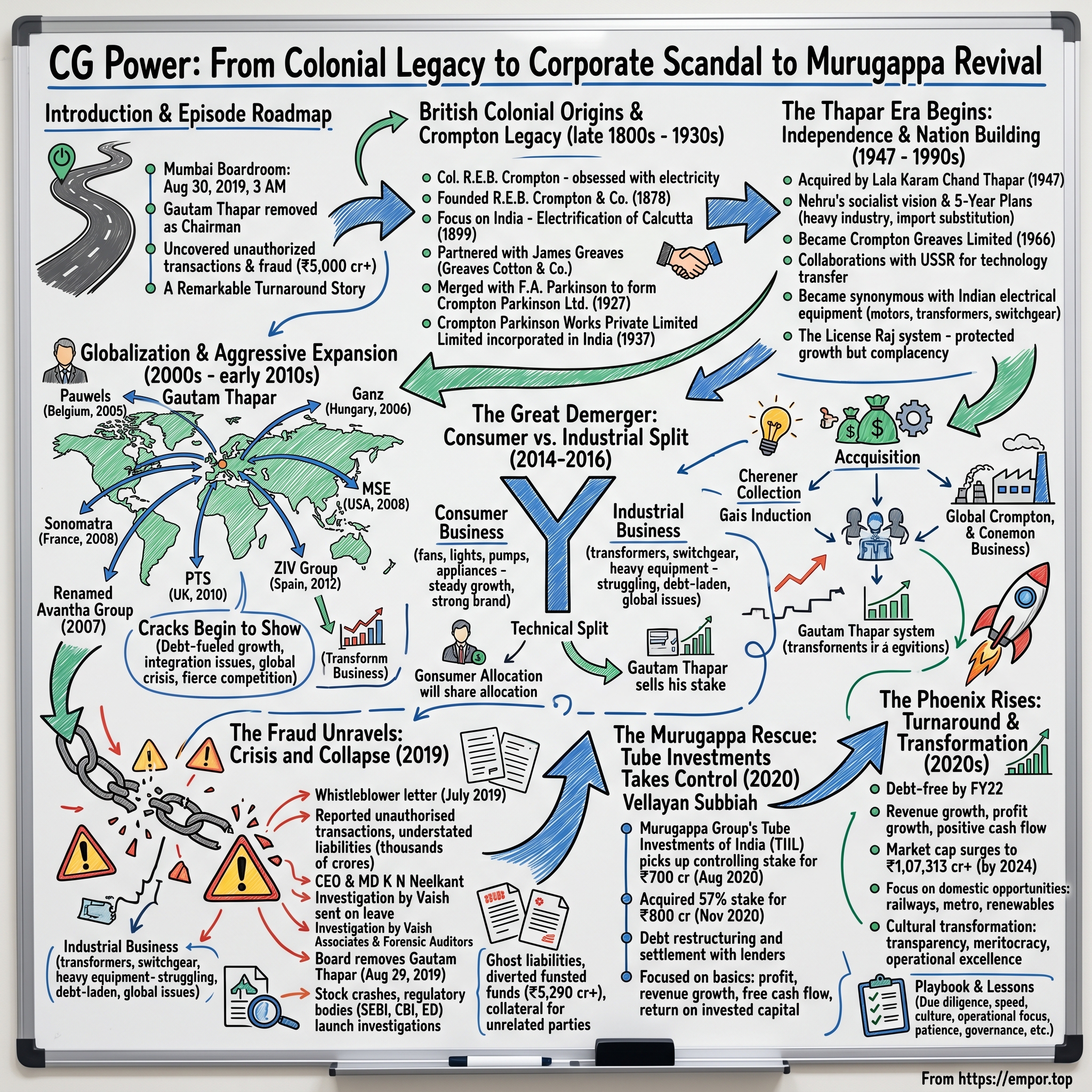
CG Power and Industrial Solutions: From Colonial Heavyweight to Corporate Collapse and the Murugappa Turnaround
I. Introduction & Episode Roadmap
On the morning of August 20, 2019, traders on Dalal Street opened their screens to a filing that read less like a corporate disclosure and more like a confession. CG Power and Industrial Solutions — an eighty-two-year-old manufacturer whose motors turned inside Indian factories, whose transformers sat in substations from Kashmir to Kanyakumari, whose traction equipment moved Indian Railways — told the exchanges that its own liabilities had been understated, that advances had gone to parties nobody on the board had approved, and that its net worth was not what its audited accounts said it was.1 The stock fell. Then it kept falling. Within months, a company that had been worth roughly ₹10,000 crore in early 2015 was worth about ₹300 crore.2 Its promoter had been ejected by his own board. Its shares were being seized by lenders enforcing pledges. Its chairman was barred from the securities market.
Almost exactly seven years later, on August 14, 2026, the same company carries a market capitalisation of roughly ₹1,39,650 crore, with the stock near ₹884 after a fifty-two-week range of ₹525 to ₹981.3 For the year ended March 2026, it reported consolidated revenue of ₹12,418 crore, up 25%, and a consolidated profit before exceptional items of ₹1,232 crore.4 Its standalone order backlog closed FY26 at ₹15,719 crore, 59% higher than a year earlier, and rose further to ₹17,333 crore by June 2026.56 It carries no net debt, having repaid its way out of a restructured loan book years ahead of the schedule its new owners set.
That arc — fraud to compounder, penny stock to premium multiple — is the most dramatic corporate rehabilitation in modern Indian industrial history. It is also, for investors in August 2026, a genuinely difficult one to underwrite. The turnaround is real and documented. The question is what the market is paying for it, and whether the specific engine driving the last two years of earnings is structural or cyclical.
This analysis runs along five threads.
First, the trap of debt-funded globalisation. In the 2000s, under Gautam Thapar's Avantha Group, Crompton Greaves bought European transformer assets at the top of a cycle and spent a decade discovering that owning a plant in Belgium does not confer the right to earn Belgian margins. The overseas arms consumed the domestic business's cash for years before anyone called it a failure.
Second, governance collapse and the mechanics of board intervention. The CG Power fraud was not a clever derivative trade gone wrong. It was old-fashioned: money moving to promoter-linked entities, obligations created without board sanction, and accounts that did not reflect either. What makes the episode instructive is not the theft but the machinery that eventually stopped it — an audit committee that pulled a thread, a board that voted its own chairman out, and a regulator that froze the exits.
Third, the Murugappa playbook. Tube Investments of India paid roughly ₹700 crore for control of a company with over ₹2,000 crore of bank debt and a criminal investigation attached.78 What followed was less financial wizardry than operating grind: settle the lenders, sell the non-core property, close the foreign subsidiaries, fix the shop floor, and measure everything against four numbers.
Fourth, the actual business. Strip away the drama and CG Power is two industrial franchises. Industrial Systems — motors, drives, railway propulsion and signalling — generated ₹6,197 crore of FY26 revenue at a 9.9% segment margin. Power Systems — transformers and high-voltage switchgear — generated ₹5,138 crore at 21.9%.5 Those two margin numbers, moving in opposite directions, are the single most important fact in this analysis.
Fifth, the option. CG Semi, the semiconductor packaging venture in Sanand, began commercial production on July 4, 2026.6 It is a ₹7,584 crore project of which the Indian state is funding a majority.4 It contributes nothing to profit today; it costs ₹43 crore a quarter and rising.6 Sizing it honestly — neither as a distraction nor as a second Nvidia — is most of the analytical work.
To understand why a Chennai-based family conglomerate saw a generational asset in a disgraced one, the story begins where the electricity did.
 Subscribe on LinkedIn
II. Colonial Roots to Post-Independence Industrial Titan (1878–1990s)
Colonel Rookes Evelyn Bell Crompton was a Victorian engineer who fought in the Crimea, built steam road trains in India, and turned his attention to electric lighting. The firm he founded in England in 1878 lit British streets and eventually merged with F.A. Parkinson to form Crompton Parkinson Ltd. It manufactured industrial essentials: lamps, motors, and switchgear — the unglamorous hardware of industrial modernization.
India entered that trajectory through a classic colonial framework: a British manufacturer seeking local distribution and a local trading house seeking product lines. Greaves Cotton provided the market access. On April 28, 1937, Crompton Parkinson Works Private Limited was incorporated in Bombay, alongside a companion selling organization bearing both names.9 The arrangement represented early-stage technology transfer: British designs paired with Indian assembly and sales, with financial returns directed largely overseas.
For modern investors, the enduring value lies in the operational footprint rather than the history. The 1937 foundation created manufacturing capacity, a dealer network, and a brand name that Indian engineers adopted as a default specification. Nearly nine decades later, that specification habit remains potent: CG holds an estimated 38% to 39% share of India's low-tension motor market, a position management reported maintaining even while pushing through substantial price increases.4 Brand preference established during periods of market scarcity often proves durable, as successive generations of engineers inherit initial specification standards.
Indian independence reshaped ownership while preserving manufacturing operations. In 1947, Karam Chand Thapar acquired the Indian business, integrating it into what grew into one of the country's major industrial houses.9 The company listed publicly in 1960 and adopted the name Crompton Greaves Limited in 1966 — a combination of colonial manufacturer and colonial trader that outlasted both parent entities.9
During the License Raj, government regulations deeply influenced the company's operating structure. Under a system where production capacity required state permission, competitive advantage depended on regulatory clearances, institutional relationships, and product reliability rather than cost optimization or rapid innovation. Crompton Greaves built power transformers, high-voltage switchgear, industrial motors, and consumer ceiling fans. It obtained technology where available, including from Soviet-bloc partners during Cold War periods when Western licensing was costly or politically restricted.
That planned-economy environment established lasting commercial patterns. Operating in a regulated market teaches a manufacturer to serve institutional buyers who rarely switch suppliers and operate on extended payment terms. Products were over-engineered to prevent high-stakes failures. Consequently, order books grew long, receivables stretched, and extended working capital cycles became structural. Industry practices of that era — retention payments, liquidated damages provisions, multi-year vendor qualifications, and 90-to-100-day credit terms — continue to influence CG's receivables profile today.
The company also anchored itself in key public-sector relationships: state electricity utilities and Indian Railways. Supplying traction motors, propulsion systems, and signaling equipment to a national railway involves strict procurement standards. Once qualified, incumbent suppliers face minimal risk of rapid replacement. While this creates a formidable moat, it also exposes the business to monopsony buyers operating under public service budgets, which caps operating margins.
Two structural inheritances from this period proved decisive for both the later financial crisis and the eventual turnaround.
The first was technical qualification. Supplying a 765 kV transformer to a state utility requires rigorous certification. Vendors undergo years of pre-qualification, and products undergo type-testing in specialized laboratories. This process creates a significant competitive moat; it also meant that when CG Power suffered financial distress and fraud, customers could not easily replace it. The company's technical certifications survived the crisis, leaving a core operating franchise intact.
The second inheritance was an operating culture shaped by modest returns and long capital cycles. Heavy electrical engineering demanded patience, but it did not instill capital discipline. When the Thapar group pursued rapid global expansion with cheap debt in the 2000s, that absence of capital discipline exposed the business to severe financial strain.
III. The Global M&A Spree: Overreaching under Avantha Group (2000–2014)
Gautam Thapar took the family business somewhere it had never been. Educated abroad and comfortable in the language of global corporate strategy, he assembled the Thapar assets under a new umbrella called Avantha Group and set out to convert a competent domestic manufacturer into an international heavyweight. The strategic logic was straightforward: Indian transformer makers possessed technical competence but sold primarily in their domestic market, whereas European transformer makers held advanced technology and blue-chip utility contracts alongside high-cost operating structures. Buying European peers using cash flows from the Indian operation, transferring technology eastward, and shifting production to lower-cost domestic plants promised a lucrative global arbitrage engine.
That thesis was fashionable across corporate India in the mid-2000s, driving a wave of ambitious cross-border acquisitions: Tata bought Corus, Hindalco acquired Novelis, Suzlon took over REpower, and Crompton Greaves bought into Europe.
The acquisition of Belgium's Pauwels Group in May 2005 marked the opening move — bringing transformer plants across Belgium, Ireland, Canada, and the United States, along with proprietary three-dimensional core technology and a European service footprint that Crompton Greaves could not have built organically in a decade.9 In July 2006, the company followed with the purchase of Hungary's Ganz Transelektro Villamossági through its Belgian subsidiary for roughly €35 million, adding high-voltage transformer and power plant systems capability.10 A series of smaller bolt-on acquisitions followed — Microsol in Ireland, Sonomatra in France, Power Technology Solutions in the UK, and MSE in the United States. Individually, each purchase appeared defensible; collectively, they assembled a portfolio of subscale plants operating in high-cost jurisdictions.
For a few years, the strategy appeared vindicated. Consolidated revenue expanded, international order books grew, and the narrative of an emerging Indian engineering multinational gained traction.
Then the economic backdrop shifted, undermining the core assumptions of the expansion thesis.
The cycle turned. European transmission capital expenditure slowed sharply following the 2008 global financial crisis, prompting utility customers to defer major equipment orders. In an industry characterized by high fixed overheads and lengthy manufacturing cycles, falling volume amplifies operating losses rather than reducing expenses proportionally.
Low-cost competition intensified. Chinese and Korean transformer manufacturers began competing aggressively for global tenders, offering competitive product quality at prices European manufacturing bases could not match. The margin arbitrage Crompton Greaves sought to capture — low-cost Indian manufacturing servicing premium European contracts — was executed more effectively by Asian rivals operating with lower capital costs and larger scale.
Structural costs proved rigid. Restructuring a European manufacturing workforce required extensive works council consultations, statutory redundancy payouts, and political approvals. The rapid headcount rationalization assumed in the original acquisition models proved slow and expensive. Meanwhile, foreign facilities continued operating at a loss, consuming liquidity.
Operational integration stalled. Combining four transformer manufacturers across four separate countries created four distinct units coordinated by corporate overhead rather than a unified business. Engineering standards, costing methodologies, and corporate cultures remained unaligned, and the Indian parent lacked the organizational framework required to enforce operational discipline across unfamiliar markets.
Financial pressures compounded quietly. Consolidated debt climbed past ₹2,000 crore at the parent level while overseas units continuously absorbed capital.2 Capital remitted to Belgium or Hungary reduced investment in domestic motor plants and transformer facilities that generated positive returns. By the time management initiated an exit — selling part of the overseas business to First Reserve in 2016 and placing the Hungarian operations into liquidation — a decade of domestic cash flows had been consumed.
The episode highlights a structural risk common in cross-border industrial M&A. Acquisitions of this nature are frequently justified by technology access. Crompton Greaves acquired advanced transformer design capabilities, but while technology transfers occur once, physical plants remain permanent liabilities. The company could have secured technical know-how through licensing agreements, direct engineering hires, or joint ventures. Acquiring complete cost structures to obtain embedded engineering expertise proved an expensive path, relying on assets that were vulnerable to market downturns.
The breakdown stemmed from underwriting synergies that required operational control over cost bases the acquirer could not easily restructure, in markets whose cyclical downturns were underestimated, financed with debt that limited flexibility. Stripped of its geography, the failure mode was classic: purchasing cyclical assets at peak valuation with leverage and mistaking expanded operational reach for global scale.
By the early 2010s, the company was running out of financial flexibility. The logical next step was separating the performing domestic assets from the loss-making foreign operations — a corporate division that would send the two resulting businesses down drastically different paths.
IV. The Demerger and Divergent Destinies (2014–2018)
Inside one listed entity sat two operations that shared little beyond a corporate name.
One manufactured ceiling fans, pumps, and lighting. It sold through tens of thousands of retail outlets, collected cash quickly, invested in marketing rather than testing laboratories, and earned strong returns on modest capital. The other built transformers and traction motors, sold to utilities and government buyers on multi-year contracts with retentions and liquidated damages, required heavy fixed assets, and carried loss-making European subsidiaries.
Capital markets had long questioned why these two distinct businesses remained under a single parent. In April 2015, Crompton Greaves announced it would demerge its consumer products division. Simultaneously, Avantha agreed to sell its 34.37% stake in the demerged consumer entity to Advent International and Temasek for approximately ₹2,000 crore, with the buyers assuming about ₹700 crore of associated debt.11 The share transfers were completed between July and August 2016.12 Crompton Greaves Consumer Electricals listed as an independent company, while the parent adopted the name CG Power and Industrial Solutions Limited in early 2017.9
At the time, the transaction appeared to be a rational portfolio restructuring. Viewed in hindsight, it functioned as a distress sale.
The consumer business went to two disciplined financial sponsors, arrived debt-light, and was assigned to professional management without legacy ties. It operated as a classic Indian consumer durables franchise, generating steady growth and high returns on capital.
By contrast, the industrial parent retained the capital-intensive assets and cash-draining liabilities: loss-making overseas subsidiaries, a stretched working capital cycle, overdue vendor payments, and a debt burden that remaining operating earnings could not service. Crucially, the proceeds from selling the consumer division did not recapitalize the operating business; instead, they flowed to the promoter holding company to service debt at the promoter level.11
This structural asymmetry signaled underlying governance risks. When a controlling shareholder divests a primary asset and directs the proceeds toward parent-level obligations rather than strengthening the operating balance sheet, minority shareholders become residual claimants on the remaining assets. The financial crisis that erupted in 2019 was already implicit in that allocation of capital.
Over the next two years, CG Power operated under severe liquidity constraints as losses mounted. A heavy loss in the quarter ended December 2018 sent the stock tumbling, and the following quarter brought further deterioration.1 By March 2019, creditors began enforcing share pledges against the promoter: lenders invoked 6.76 crore pledged shares representing a 10.8% stake, while Yes Bank separately acquired possession of approximately 12.8% of the company through share enforcement.13 The enforcement of pledges stripped the promoter of voting control and equity flexibility.
The audit committee had by then begun questioning advances that lacked clear commercial rationale. The full scope of those transactions was about to emerge.
V. The Unravelling: Fraud, Collapse, and Boardroom Drama (2019–2020)
The disclosure that reached the exchanges on August 19 and 20, 2019 used careful legal language for something quite simple. Certain identified company personnel, including some directors, had entered into transactions the board had never authorised. As a result, the company's liabilities were understated, its advances to related and unrelated parties were understated, and its net worth was overstated.1
The scale, when the restated numbers landed, was staggering for a company of CG Power's size. As at March 31, 2018, advances to related parties and to unrelated parties appeared to have been understated by ₹1,990.36 crore and ₹2,806.63 crore respectively; as at April 1, 2017, the corresponding understatements were ₹1,479.34 crore and ₹1,331.47 crore.1 Different investigations subsequently arrived at different aggregate figures depending on what they counted — the CBI's eventual charge sheet framed a ₹2,435 crore bank fraud across twelve banks14 — and no single official number captures the whole. What is not in dispute is that thousands of crores of obligations and outflows existed outside the audited accounts.
The mechanics, as they emerged from the forensic work and regulatory filings, were a catalogue of the classic Indian promoter-extraction toolkit.
Money moved out. Funds went from the listed company to promoter-affiliated entities — Avantha Holdings, Acton Global, Solaris Industrial Chemicals and others named in the regulatory record — without board approval and often without documentation that would survive scrutiny.[^15]
Obligations moved in. The company's assets and guarantees were used to support borrowings that were not the company's. Commitments were created that shareholders did not know they had underwritten. The economic effect is worse than simple theft, because a hidden guarantee has no cash cost until the day it does, at which point it lands on a balance sheet that has no provision for it.
And the accounts did not say so. This is the governance failure that matters most. Related-party transactions of this magnitude are precisely what audit committees, statutory auditors and disclosure regimes exist to surface. That they did not, for years, across multiple reporting cycles, is the reason the CG Power episode became a case study rather than a news item.
The board's response, when it finally came, was decisive in a way Indian boards had rarely been. Over the meeting that ran through August 29, 2019 and into the early hours of the following day, the directors removed Gautam Thapar as chairman.2 The company subsequently terminated V.R. Venkatesh, its managing director, over alleged misconduct and breach of trust. For a promoter-dominated Indian company to eject its own promoter-chairman in an overnight session was, at the time, close to unprecedented.
The regulators followed quickly. On September 17, 2019, SEBI issued an ad interim ex-parte order restraining Thapar, Venkatesh, Madhav Acharya and B. Hariharan from accessing the securities market and from being associated with any listed entity or SEBI-registered intermediary; it froze assets to the extent of outstanding receivables, directed the company to pursue recovery, and ordered a forensic audit of the books from FY2015-16 onwards conducted by an auditor appointed by the exchange.15 The bar was confirmed after the parties were heard.[^15]16 In October 2022, SEBI imposed a ₹10 crore monetary penalty on Thapar in connection with the fund diversion.17 The Enforcement Directorate and the CBI ran parallel investigations, with the charge sheet arriving in January 2023.14
Meanwhile the equity was being liquidated in the open market by people who had no interest in the share price. In September 2019, KKR India enforced its pledge and took close to a 10% stake for a little over ₹89 crore — an average of about ₹14.25 a share.18 By the end of 2019, the Avantha Group's shareholding in CG Power had effectively gone to zero, the entire holding having been pledged and taken by lenders. A stock that traded around ₹225 in September 2014 changed hands near ₹5 in March 2020, and market capitalisation fell from roughly ₹10,000 crore in March 2015 to around ₹300 crore.2
What is easy to miss, reading the regulatory chronology, is how quickly the operating business began to suffocate. A manufacturer's most fragile asset is not its plant; it is its supplier credit. Once vendors learned that CG Power's accounts could not be trusted and its banks were in default, raw material started arriving only against advance payment — which the company did not have. Orders in the backlog could not be executed, which meant milestones were not billed, which meant cash did not come in, which meant more material could not be bought. In December 2019 the company went to shareholders seeking authority to borrow up to ₹5,000 crore simply to keep the business alive — an extraordinary ask from an entity whose existing lenders had already stopped lending.19
This is the doom loop that kills otherwise viable industrial companies, and it moves faster than any legal process. The fraud was the cause; the liquidity spiral was the mechanism. It is also why the eventual rescue had to solve two problems at once: the balance sheet, and the ability to buy a coil of copper on thirty-day terms.
Here is the situation in the spring of 2020, and it is worth stating plainly because it defines how cheap the option was for whoever stepped in next. CG Power had no promoter. It had a leaderless management. It had over ₹2,000 crore of bank debt in default, a consortium of fourteen lenders with competing claims, criminal and securities investigations running, suppliers refusing credit, and a working capital position that made it impossible to execute the orders it still held.
What it also had — and this is the entire investment case, in one sentence — was factories that worked, product approvals that had taken decades to earn, a motor brand that engineers still specified by name, and customers who had nowhere obviously better to go.
Somebody had to be willing to look past the first list to see the second.
VI. The Murugappa Rescue: Tube Investments Takeover & Governance Reset (2020–2021)
Nothing about the Murugappa Group suggested a typical buyer for a fraud-stained asset. Founded in the nineteenth century and headquartered in Chennai, the conglomerate operates across bicycles, abrasives, fertilizers, sugar, steel tubes, gears, and financial services, backed by corporate literature listing its guiding principles as integrity, passion, quality, respect, and responsibility.6 Historically, it built a reputation for conservative capital allocation and steady long-term compounding.
Vellayan Subbiah broke that conservative mold. A fourth-generation family member with an engineering degree from IIT Madras and a background at McKinsey, Subbiah had established a track record as the group's turnaround executive. He led Cholamandalam Investment and Finance, transforming it into a major non-banking financial company — an experience he frequently points to as evidence that long-term compounding is fundamentally different from rapid growth.20 Appointed managing director-designate of Tube Investments of India in 2017, he sought to reduce the company's reliance on the automotive cycle by developing new growth platforms alongside its core tube business.2
CG Power reached Subbiah through a lender-driven auction. As he later recalled, during the Swiss challenge process, "nobody else came in with an offer."20 At the time, the distressed asset carried enough uncertainty that virtually no competing bidder stepped forward.
The transaction required a synchronized two-front negotiation: one with the target company, and another with its lending consortium.
On November 20, 2020, CG Power, Tube Investments, and the lenders executed binding agreements for a one-time debt settlement and restructuring. Against total outstanding debt of ₹2,161 crore, the fourteen-bank consortium accepted a haircut of approximately ₹1,100 crore. The remaining debt was restructured: ₹650 crore was paid upfront, ₹200 crore was converted into five-year non-convertible debentures, and the remainder was scheduled for retirement through the sale of CG Power's Mumbai headquarters property within five years.7 Lenders agreed to take roughly fifty cents on the dollar because an insolvency proceeding against an entity facing criminal investigations offered far lower recovery prospects.
Six days later, on November 26, 2020, CG Power allotted 64.25 crore preferential shares to Tube Investments at ₹8.56 per share, raising ₹550 crore, alongside 17.52 crore warrants for an additional ₹150 crore.8 The initial transaction gave Tube Investments a controlling 50.62% stake in paid-up capital. Subsequent allotments and warrant conversions raised its total holding, including convertibles, from 56.61% to 58.58% on a fully diluted basis by year-end.21 The total capital outlay for control was roughly ₹700 crore to ₹800 crore.2
The subsequent operational turnaround focused on core business execution rather than balance-sheet engineering.
Cleaning the non-core balance sheet. The company sold its Kanjurmarg land parcel in Mumbai — an asset central to the earlier financial improprieties — for approximately ₹382 crore, directing all proceeds toward debt reduction. Management systematically divested or liquidated loss-making overseas subsidiaries that had drained cash for over a decade. Crucially, the company cleared overdue vendor and worker obligations, restoring the supplier credit essential for securing raw materials on standard thirty-day payment terms.
Delivering ahead of operational targets. At the time of acquisition, Tube Investments set a five-year target to eliminate CG Power's net debt and expand annual revenue to ₹5,000 crore. Management eliminated net debt by March 2022 — roughly three years ahead of schedule.2 This early execution established managerial credibility, setting a baseline for evaluating subsequent operational commitments.
Establishing disciplined capital metrics. Subbiah introduced four primary operating metrics across all business units: revenue growth, profit margins, free cash flow relative to net profit, and return on invested capital.220 Under this framework, free cash flow is treated as "easily the most important component," with manufacturing operations managed as cash-generation engines feeding a separate capital-allocation engine.20 This framework directly addressed the core vulnerability of the prior era, where revenue growth had been pursued at the expense of cash generation.
Professionalizing shop-floor leadership. Rather than appointing family members to run daily operations, the group brought in professional industrial management. In July 2024, Amar Kaul became managing director and CEO for a five-year term.22 Kaul brought over three decades of manufacturing experience, including twelve years internationally, with expertise in lean manufacturing, six-sigma deployment, and supplier integration. His career included senior executive roles at Delphi and Bharat Forge before running Ingersoll Rand's compression business across Europe, the Middle East, India, and Africa while chairing its listed Indian company.22 His background signaled an operational focus on shop-floor efficiency and quality control rather than financial engineering.
Governance as an enabler, not a growth driver. A common narrative attributes CG Power's market re-rating entirely to the Murugappa governance dividend. While improved governance restored essential access to bank credit, institutional capital, and long-term customer contracts, governance alone did not expand operating margins or increase transformer factory throughput. The re-rating resulted from a recapitalized balance sheet coinciding with a major cyclical upswing in India's power transmission infrastructure spending. Without that macro tailwind, balance-sheet normalization would have yielded a stable industrial business at conventional multiples rather than a high-velocity compounder.
The key to evaluating CG Power's current valuation lies in examining its two core operating divisions.
VII. Core Business Economics: Industrial & Power Systems Deep Dive
Inside the transformer works at Mandideep near Bhopal, very little of the operation appears automated. A large power transformer is essentially a high-precision sandwich: thin sheets of grain-oriented electrical steel stacked into a core, wound with copper conductors, insulated with paper and pressboard, dried under vacuum for days, encased in a steel tank, and filled with oil. It is craft manufacturing on an industrial scale, where output is constrained not by machinery, but by skilled labor, cycle-time discipline, and the availability of specialized imported components.
That plant illustrates why CG Power's two primary operating segments have diverged so sharply.
Together, these two divisions generate virtually all of the company's revenue and operating profit. While consolidated results include a European drives and automation operation spanning Sweden, Germany, and the Netherlands, alongside an adhesives business, railway electronics subsidiary G.G. Tronics, CG Semi, and the Axiro semiconductor design group, the Indian standalone entity — generating ₹11,331 crore of FY26 revenue against ₹12,418 crore on a consolidated basis — remains the core business.54
Power Systems: the engine, and the question mark
Power Systems — encompassing power and distribution transformers, extra-high-voltage (EHV) switchgear, circuit breakers, and instrument transformers — increased its FY26 revenue by 46% to ₹5,138 crore while expanding its segment margin by 281 basis points to 21.9%.5 In the quarter ended June 2026, revenue grew another 31% with segment margin reaching 23.1%.6 Annual order intake for the division surged 69% in FY26 to ₹11,210 crore, pushing the segment backlog up 91% to ₹12,644 crore, before expanding further to ₹14,434 crore by June 2026.46
These figures reflect an industry-wide supply shortage rather than typical equipment cycle dynamics.
The shortage is global and structural. Grid investment is accelerating simultaneously across multiple fronts: renewable generation requiring evacuation infrastructure, industrial electrification, aging Western transmission networks reaching replacement age, and rapid capacity expansion for data centers. Worldwide transformer lead times have stretched from months to years, shifting customer negotiations from pricing terms to guaranteed delivery slots.
CG Power responded by expanding manufacturing capacity rapidly. Transformer capacity across its Gwalior and Bhopal plants increased from roughly 17,000–18,000 MVA to about 65,000 MVA within a single year, achieved through brownfield capital expenditure and debottlenecking existing assembly lines — lifting Gwalior from 6,000 to 10,000 MVA and Mandideep from 40,000 to 65,000 MVA.4 A greenfield facility is scheduled to add approximately 45,000 MVA, bringing total transformer capacity to roughly 1,10,000 MVA by the end of calendar 2026, with management indicating in July 2026 that the new capacity could be commissioned ahead of schedule.423 In switchgear, the S3 Unit-II facility at Pimpalgaon Garudeshwar near Nashik was commissioned on June 4, 2026, expanding EHV circuit breaker capacity by 80% with an additional 7,200 units annually on a base of 9,000 units, while the board approved a further ₹748 crore greenfield switchgear expansion in October 2025.64
Two major contract wins demonstrate the sources of this demand. In FY26, the company secured a ₹641 crore package for 765 kV transformers from Power Grid Corporation of India — its largest domestic transformer order to date.4 On January 16, 2026, it secured approximately ₹900 crore in power transformer export orders from a US customer for hyperscale data center applications, scheduled for delivery over 12 to 20 months.4 Asked on the May 2026 investor call whether that order represented a one-off gain, Chief Executive Officer Amar Kaul responded that "the game is just started."4
However, segment margins of 22% to 24% in heavy electrical equipment represent a cyclical peak rather than a structural baseline. Hitachi Energy India, the closest direct peer in Indian grid equipment, reported FY26 revenue of ₹8,148 crore and profit after tax of ₹988 crore alongside a record order backlog of ₹29,555 crore24 — reflecting the same sector-wide demand expansion at a larger operational scale. Competitors across the domestic and multinational landscape are adding capacity. Siemens Energy India approved a ₹2,060 crore transformer expansion,25 while ABB India, GE Vernova T&D, and several domestic manufacturers are executing similar expansions. Industry capacity built in response to a visible shortage typically reaches the market concurrently.
Consequently, Power Systems' current operating margins reflect broader industry supply-demand imbalances rather than solely proprietary advantages. While operational debottlenecking has yielded verifiable gains, maintaining 22% segment margins indefinitely assumes that global transformer supply constraints will persist without mean reversion.
Industrial Systems: the franchise, under pressure
The second primary division — housing the company's legacy industrial brand — faces margin compression. Industrial Systems revenue grew 6% in FY26 to ₹6,197 crore, while segment margin contracted from 12.1% to 9.9%.5 In the quarter ended June 2026, revenue increased by 6% year-over-year while segment margin dropped to 8.8%, influenced in part by a ₹20 crore one-off provision in the railway business.6
The segment encompasses several distinct product groups:
Motors remain the core franchise, consisting of low-voltage (LV) and high-voltage (HV) industrial motors sold through an extensive distribution network serving diverse manufacturing sectors. CG Power holds an estimated 38% to 39% market share in low-tension motors and 19% to 20% in higher-voltage industrial motors.4 In response to copper and steel price inflation during FY26, the company implemented cumulative price increases of approximately 17.5% across three to four quarters, followed by an additional 5% increase in the June 2026 quarter. Management reported maintaining market share throughout this period, noting that as the market leader, "the moment we do something like this, everybody has followed us."423 While this demonstrates pricing leadership, raw material cost inflation outpaced price realizations, resulting in net margin compression due to realization lags.
Railways represents an operational drag on profitability. Despite investor focus on railway electrification and the Vande Bharat equipment program, management has clarified that supplying traction motors, propulsion systems, and signaling electronics — the latter through subsidiary G.G. Tronics — operates as a structurally low-margin business. Management noted that Indian Railways procurement limits realization margins, framing operational efficiency, a new services vertical, and product development as the primary mechanisms to raise segment margins "from single-digit margins to double-digit."4 Intense pricing competition in railway tenders was cited in FY26 reporting as a primary driver of the Industrial Systems margin decline.54
The planned expansion into railway services aims to build a higher-margin aftermarket annuity by servicing CG Power's installed equipment base over twenty-year operating lifecycles. Head of Railways Dhananjay Bapat identified services, exports, and new product lines as pathways toward sustained double-digit growth, while emphasizing that "it doesn't happen tomorrow."4 This strategy remains an operational objective requiring longer-term validation.
G.G. Tronics demonstrates a similar lag between contracted backlog and earnings conversion. The subsidiary holds an order backlog of approximately ₹1,000 crore against annual revenue of roughly ₹100 crore and profit before tax of ₹3 crore to ₹4 crore. Execution remains contingent on completing mandatory safety and passenger trials for its signaling systems, with twelve trials completed by May 2026 expected before commercial execution could begin.4 While the backlog provides multi-year revenue visibility once certified, the ₹20 crore quarterly provision is a reminder that project businesses of this type can surprise in both directions.6
Drives and automation includes European operations alongside a newly localized domestic product line, with low-voltage drives now described as almost fully localized.4 Total export contributions across the company remain modest, representing 5% to 7% of standalone Indian sales, or 8% to 9% including European subsidiaries — a breakdown clarified by management when responding to analyst questions.4
How CG wins, and where the case is weakest
Competitive dynamics vary significantly across CG Power's two main business units.
In transformers and EHV switchgear, entry barriers stem from technical qualifications, multi-year utility reference requirements, and mandatory laboratory type-testing. CG Power's Nashik facility incorporates dedicated 500 kV and 350 kV testing laboratories precisely because testing capability is part of the product.6 Switching costs for electric utilities remain high due to strict pre-qualification protocols. However, once multiple vendors obtain qualification, price competition intensifies; current premium pricing reflects market-wide capacity shortages rather than permanent supplier lock-in.
In motors, competitive advantage relies on a dealer distribution network built over decades, localized manufacturing enabling rapid turnaround for customized industrial orders, and a cost structure free of foreign parent royalty fees. However, competition from global manufacturers including Nidec and WEG is expanding as both firms increase Indian manufacturing capacity aggressively.4 Management has framed its response around accelerated product development and cost discipline to maintain market positioning.
Raw material price volatility represents a shared operational exposure across both divisions. Copper, aluminum, and cold-rolled grain-oriented (CRGO) electrical steel constitute the primary cost inputs, with CRGO dependent on imports due to limited domestic production. CG Power mitigates commodity price movements in transformer contracts through price variation clauses that pass cost changes to utility buyers, while the short-cycle motors business relies on list price increases to recover input costs.4 Consequently, Power Systems expanded margins during the recent commodity cycle, while Industrial Systems experienced margin compression during pricing adjustments.
In summary, CG Power's near-term earnings expansion is driven primarily by its Power Systems division during a favorable global grid investment cycle, while its core Industrial Systems motor franchise maintains strong market share under temporary margin pressure. The long-term earnings trajectory depends on how these cyclical and structural forces balance over the coming capital cycle.
Beyond these traditional industrial divisions sits a new venture that generates no current earnings.
VIII. Strategic Optionality: The OSAT Semiconductor Venture
On July 4, 2026, the Prime Minister of India stood in a clean room in Sanand, Gujarat, alongside state and Union officials, to mark the start of commercial production at CG Semi's G1 facility.6 Two weeks earlier, without ceremony, the first commercial consignment had already left the plant, marking a notable step for an economy that has sought to establish domestic semiconductor manufacturing since the 1980s.
For a CG Power shareholder, however, the venture represents a more complex proposition: a large, state-subsidized, technically unfamiliar business being built using cash flows from a cyclically strong industrial operation.
Evaluating the venture requires clarifying what an OSAT actually does. Outsourced Semiconductor Assembly and Test represents the back end of chip manufacturing. While a fabrication facility — or fab — etches circuits onto silicon wafers in a capital-intensive process costing tens of billions of dollars, an OSAT receives those finished wafers, cuts them into individual dies, connects them using wires or solder bumps, encases them in protective packaging, and tests final functionality. If a fab functions as a printing press, an OSAT operates as the bindery. It involves genuine manufacturing with real yield challenges, but requires one to two orders of magnitude less capital per unit of capacity than a fab, operating in a market where established players in Taiwan, Malaysia, and the Philippines have generated modest margins for decades.
CG Power holds a 92.3% controlling stake in CG Semi, with Renesas Electronics holding 6.8% and Thailand's Stars Microelectronics owning 0.9%.26 These partner stakes reflect active operational roles: Japan's Renesas is a major automotive and industrial microcontroller supplier — serving as both a technical guide and a potential anchor customer — while Stars brings operational OSAT experience. The Union Cabinet cleared the project under the India Semiconductor Mission on February 29, 2024, with formal approval granted on March 8, 2024.2627
The venture's financial structure merits careful analysis. Out of the total approved project cost of ₹7,584 crore over five years through FY29, central government subsidies cover ₹3,501 crore, while state incentives add another 40% of that central figure, or roughly ₹1,400 crore.4 The fiscal support agreement was executed on January 17, 2025, followed by the trust and retention account agreement on September 15, 2025.4 Because taxpayers are funding roughly two-thirds of the total project expenditure, CG Power's direct equity exposure is a fraction of the headline commitment — a key structural detail often overlooked in public commentary.
Development is structured in two phases. Facility G1, unveiled on August 28, 2025, was positioned as one of India's first full-service OSAT units spanning traditional and advanced packaging formats, operating at a peak capacity of about half a million units per day.284 Facility G2, located three kilometers away and scheduled for completion by late 2026, is designed to scale output to 14.5 million chips daily. Combined, the facilities aim for a total capacity of 15 million units per day and are projected to create approximately 5,000 direct and indirect jobs.426 Packaging capabilities cover mature formats — including QFN and QFP — alongside advanced flip-chip BGA and chip-scale packaging (CSP) targeted at automotive, consumer, industrial, and 5G applications.26
Complementing the manufacturing footprint is Axiro Semiconductor, the design division. Its revenue base is established rather than speculative, generating approximately ₹500 crore in FY26 primarily through the operating radio-frequency business CG Power acquired from Renesas.4 Management has identified Axiro as a platform for expanding design capabilities, taking an initial step by investing ₹50 crore in AI-focused design firm EdgeCortix.4
Near-term financial results reflect the cost of building this capability. The semiconductor segment reduced consolidated FY26 operating profit by ₹111 crore — an 89-basis-point margin drag — which expanded to a ₹43 crore drag, or 132 basis points, in the June 2026 quarter, driven largely by talent acquisition costs.46 Commercial chip revenue was expected to begin roughly two quarters following management's May 2026 investor call.4 At present, the OSAT division represents an expanding cost center with an initial production run completed and no demonstrated profitability.
Assessing the venture's long-term potential requires an objective view of OSAT economics. Assembly and test is the least differentiated segment of the semiconductor value chain. Customers routinely qualify multiple packaging vendors to maintain supply chain flexibility, and contracts typically include annual per-unit price reductions. Established Asian incumbents have operated these facilities for decades at operating margins that appear modest compared to CG Power's core transformer segment. High returns in OSAT manufacturing depend on advanced packaging capabilities — such as flip-chip and multi-die architectures where packaging directly enhances performance — which is why CG Semi's technical breadth across both legacy and advanced formats is more critical than its total volume capacity.2628
Consequently, a realistic bull case for CG Semi does not assume high-margin expansion. Instead, it positions the venture as a capital-subsidized, mid-single-digit to low-double-digit margin operator of scale, serving global customers seeking geographic diversification in their packaging supply chains. While commercially viable, this outcome differs from more speculative market expectations.
What would have to be true for this to work? Execution hinges on three unproven factors. First, operational yield: packaging requires precise defect control, and bringing a new plant and workforce to competitive yield rates requires time. Second, customer qualification cycles: automotive and industrial clients evaluate packaging suppliers over extended periods, meaning a new facility begins certification from scratch — highlighting why Renesas's strategic participation is more significant than its 6.8% equity stake implies. Third, unit cost competitiveness: initial capital subsidies assist plant construction but do not lower ongoing operating costs against established Asian competitors with decades of manufacturing experience.
What would falsify it? Key indicators to monitor include prolonged segment losses beyond the ramp phase, construction delays extending G2 completion past late 2026, or a lack of disclosed anchor customer commitments as capacity expands.
And the fair criticism. Skeptics highlight that an electrical equipment maker is entering an unfamiliar industry while its primary market experiences a major cyclical upswing, supported in part by a ₹3,000 crore equity raise — a pattern characteristic of corporate overdiversification. Conversely, government subsidies cover the majority of capital expenditures, technical risks are shared with experienced partners, and executive leadership has acknowledged the national policy context, with Subbiah noting that "we need ten more companies to join in this effort" — a recognition that the project combines policy objectives with commercial targets.20 Investors must evaluate whether national strategic priorities align with optimal capital returns.
The quarterly earnings reports will provide the clearer measure of that discipline.
IX. Primary Evidence: Earnings Calls, Guidance, & Analyst Pushback
Indian earnings calls have a distinctive texture. Analysts are deferential in tone and relentless in substance; managements answer with a mix of precise figures and general encouragement; and the most revealing moments are often when an executive declines to answer.
CG Power's Fourth Quarter FY26 call on May 6, 2026, hosted by IIFL Capital, was a revealing specimen because leadership fielded its full operational team. Alongside Chief Executive Officer Amar Kaul and Chief Financial Officer Susheel Todi sat the business heads for drives and international motors, switchgear, transformers, railways, and domestic motors.4 That structure is a disclosure statement in itself: an executive who delegates technical queries directly to plant operators exhibits operational confidence while leaving little room for evasion.
What management emphasises. Across recent quarters, the executive narrative has remained consistent to the point of repetition: disciplined execution, operating leverage, systematic cost programmes, and order backlogs providing clear revenue visibility. In the First Quarter FY27 release, Kaul acknowledged "global trade realignments, currency volatility, and elevated input costs," yet affirmed that the company would "stay the course on capacity investment," arguing that "the medium-term opportunity is stronger than near-term headwinds."6 That strategy carries a tangible cost — expanding capacity into a cyclical peak either compounds returns or impairs capital.
Where analysts pushed, and how management answered.
On motor growth quality. HDFC Life's Ankur Sharma asked how much of the double-digit motor growth represented physical volume versus price realization. Kaul answered directly: roughly 50-50, with volume growth "in sync with the market."4 That explicit concession indicates CG Power expanded its motor business at market rates rather than capturing market share.
On transformer order durability. Asked whether domestic power product order growth of 15% to 20% was sustainable, Kaul shifted the conversation toward global demand rather than quantifying domestic sustainability, and when pressed again characterized Indian utility demand as asking to "give us more, give us more."4 The response was enthusiastic but unquantified; analysts noted that the specific domestic run-rate inquiry went unanswered numerically.
On receivables. ICICI Securities' Mohit Kumar flagged trade receivables rising roughly 50% against 20% revenue growth. Todi attributed the increase to a mix shift toward the power segment, noting an average credit period of 90 to 100 days.4 While project businesses naturally carry longer credit cycles than retail distribution, receivables expanding faster than revenue tests a core tenet of the Murugappa operating framework, which prioritizes free cash flow conversion.
On the balance sheet. In response to inquiries regarding roughly ₹3,000 crore in "other financial assets," Todi confirmed the funds represented capital from a Qualified Institutional Placement parked across liquid asset classes.4 CG Power had raised ₹3,000 crore through a QIP that opened June 30 and closed July 3, 2025, more than three times oversubscribed; as of June 30, 2026, approximately ₹2,497 crore remained unutilised.429 Carrying ₹2,500 crore in undeployed equity while reporting return on capital employed of 20% to 23% including QIP proceeds confirms that return figures are temporarily diluted by idle cash and signals an impending major capital allocation decision.
On product disclosure. Management consistently declined to break out railway segment performance separately from Industrial Systems, export revenues by product line, or the proportion of high-efficiency IE3 and IE4 motors, citing internal policy.4 While applied uniformly, this policy prevents independent verification of the margin trajectory management projects for the railway division.
On the American opportunity. UBS analyst Amit Mahawar inquired how rapidly U.S. utility certifications might follow the company's data center transformer order. Kaul tempered expectations by noting that the United States contains 478 independent utilities, each with its own qualification timeline, warning that "you cannot categorize in six months or one year."4 Macquarie's Rahul Gajare separately pointed out that Korean competitors deliver transformers to U.S. buyers in roughly ten months, compared to CG's twelve-month or longer timeframe. Transformer business head Ajay Jain acknowledged the bottleneck, explaining that tap changers imported from Germany carry nine to twelve-month lead times, leaving operations constrained.4 Identifying a specific supply-chain bottleneck provides a verifiable operational constraint rather than a generalized assertion.
On technology gaps. Asked whether CG Power would enter High-Voltage Direct Current (HVDC) transmission — a high-margin niche in long-distance grid equipment — Kaul acknowledged the company remains at an "infancy stage" with an undeveloped technology roadmap.4 This leaves a structural competitive gap compared to established peers Hitachi Energy and Siemens Energy.
What the July 2026 quarter added. The First Quarter FY27 results provided a test of whether margin compression in Industrial Systems was structural or temporary. Management clarified that ₹20 crore of the ₹24 crore year-over-year drop in segment profit stemmed from a single railway provision, while underlying motor sales maintained double-digit growth.6 If accurate, segment margins should recover once this one-off charge clears. Concurrently, the semiconductor venture's margin drag widened from 110 to 132 basis points on a consolidated basis, management implemented a further 5% motor price hike following prior increases totaling 17.5%, and leadership indicated greenfield transformer capacity could be commissioned in twelve to fourteen months — ahead of the initial timetable.236 Consolidated Industrial Systems margin weakened to 7.6% compared to 10.2% on a standalone basis, reflecting the ongoing cost of absorbing early-stage semiconductor overhead.23
Narrative consistency over time. Across FY26 and FY27, management's core narrative has remained steady around operational metrics and backlog execution, but the underlying drivers have shifted. The FY22 focus centered on balance-sheet survival; FY24 and FY25 emphasized capacity recovery; and FY26 and FY27 rely on transformer-led operating leverage alongside semiconductor expansion. The risk in a consistent narrative is that operational discipline may be credited for earnings gains driven primarily by external cyclical demand in power transmission.
Finally, statutory auditor S.R. Batliboi & Associates LLP resigns effective at the close of business on August 14, 2026 — today — as CG Power aligns its statutory auditing firm with parent entity Tube Investments of India under mandatory ten-year rotation rules.6 While this auditor transition represents standard corporate alignment across holding structures, any auditing shift at a company with CG Power's specific history warrants close review when the successor firm issues its initial accounts.
X. The Turnaround Playbook: Business & Investing Lessons
Distress investing often produces folklore rather than transferable methodology. CG Power is unusually instructive because the intervention is recent, documented, and capable of being measured against the commitments made at the outset.
Lesson 1: The write-off buys time; the shop floor buys value. The ₹1,100 crore bank haircut and the settlement structure were essential — without them, the enterprise could not have survived. But debt relief is a one-time value transfer from lenders to equity holders. It alters the capital structure; it does not fix the operating engine. What transformed the business was far less glamorous: clearing vendor dues so suppliers restored standard credit terms, selling non-operating real estate, liquidating foreign subsidiaries that had drained liquidity for a decade, and deploying lean manufacturing methods to expand transformer throughput from 40,000 to 65,000 MVA without a proportionate capital outlay.4 That operational discipline generated the true compounding. Investors evaluating a corporate turnaround must distinguish financial restructuring from operational execution.
Lesson 2: A small number of metrics, applied without exception. Management focused operating units on four core targets: revenue growth, profit-to-sales margins, free cash flow relative to net profit, and return on invested capital.220 The strength of this framework lies in its clarity and accountability. Prioritizing cash conversion prevents operating managers from purchasing headline growth through stretched working capital. Under previous management, consolidated revenue expanded for years while cash was consumed; a framework weighting cash conversion equally with revenue growth would have exposed that vulnerability far earlier.
Lesson 3: Governance is a valuation input, not a virtue signal. The expansion in CG Power's valuation multiple was driven mechanically by the restoration of factors previously lost: access to bank credit at standard rates, institutional backing for a ₹3,000 crore equity placement, customer willingness to award multi-year contracts, and auditor validation of financial disclosures. Each factor directly influences the enterprise's cost of capital. Trust operates not as market sentiment, but as a discount rate. However, a multiple expansion built on governance can reverse quickly if transparency falters, because corporate trust is far more fragile than operational throughput.
Lesson 4: Cross-border synergy is the most over-claimed figure in M&A. The 2005–2010 expansion assumed CG Power could transfer production to India, rationalize European workforces, and cross-sell across regions. Shifting manufacturing proved only partially achievable; labor restructuring across European jurisdictions proved slow and costly; and cross-selling yielded minimal results. Synergies that depend on altering an acquired entity's cost structure across borders, languages, and labor laws warrant steep analytical discounts — especially when financed with leverage that eliminates operational flexibility.
Lesson 5: Distinguishing managerial execution from cyclical tailwinds. The primary operational phase of this recovery coincided with a major global power transmission equipment cycle. Disentangling executive skill from industry tailwinds remains challenging, as both factors contributed substantially. The definitive test of operational discipline will arrive when global equipment demand normalizes.
XI. Risk Radar & Investment Thesis: Bull vs Bear Case
What to actually track
An investor does not need a complex dashboard for this company; three core operational metrics frame the investment thesis.
1. Power Systems segment margin. This metric underpins the entire valuation argument. The segment margin ran at 19.0% in FY25, 21.9% in FY26, and 23.1% in the quarter ended June 2026.56 If profitability holds above 20% as new industry-wide global capacity comes online, the stock's premium multiple has a rational foundation. If margins drift back toward the high teens, a substantial portion of current earnings power will prove to have been cyclical. Investors must monitor this figure quarterly and evaluate it against peers like Hitachi Energy India and Siemens Energy India rather than against CG Power's historical performance alone — a comparison that separates company-specific execution from broader industry tailwinds.
2. Order intake, not order backlog. While backlog provides lagging comfort, order intake serves as the leading operational indicator. In FY26, consolidated order intake reached ₹19,616 crore against ₹12,418 crore in revenue — a book-to-bill ratio well above one that generated the multi-year revenue visibility management frequently highlights.4 Intake in the first quarter of FY27 reached ₹5,211 crore, maintaining that momentum.6 If quarterly intake drops below quarterly revenue, the growth trajectory will compress regardless of the headline backlog size.
3. Free cash flow conversion. Free cash flow conversion is management's fourth core operational metric, and the discipline most critical to preventing working-capital deterioration. Investors should monitor the relationship between reported net profit, trade receivables, and operating cash flow. While trade receivables expanding by roughly 50% against 20% revenue growth in FY26 was attributed to a higher mix of long-cycle power projects, working capital must stabilize for cash flow quality to match headline accounting gains.4
The current risk radar
Input cost and pass-through asymmetry. Copper and cold-rolled grain-oriented (CRGO) steel dominate the manufacturing cost base, and pass-through mechanisms differ by division. Power Systems relies on contractual price-variation clauses, while Industrial Systems relies on list-price increases implemented with an operational lag.4 The FY26 performance established the pattern: rising raw material costs expand Power Systems margins through indexation while compressing Industrial Systems margins due to lag. A sharp commodity price spike would repeat that dynamic, disproportionately affecting the already margin-constrained industrial motor business.
Supply chain concentration in imported components. Dependencies on key imported components, such as German-sourced tap changers and high-voltage bushings, limit export delivery times to twelve months or longer for U.S. data center transformer orders.4 This reliance creates an operational bottleneck in CG Power's highest-value export market, placing the company at a competitive disadvantage against rivals with integrated domestic supply chains.
Capacity normalisation across the industry. Major grid equipment manufacturers are expanding transformer capacity simultaneously. Once commissioned, heavy electrical manufacturing capacity remains in place through industry downturns, increasing price competition when demand tempers. CG Power's own transformer capacity is approximately six times its level from two years ago — expanding operating leverage during upswings, but increasing fixed-cost exposure if demand softens.
Executive bandwidth across simultaneous expansions. Beyond yield optimization and customer qualification risks in OSAT packaging, the rapid pace of expansion presents management bandwidth risks. CG Power's leadership is concurrently managing greenfield transformer and switchgear projects, an extra-high-voltage facility expansion, the construction of the G2 semiconductor packaging plant, and the integration of chip-design acquisitions — testing the limits of operational oversight.
Customer concentration and cyclical exposure. Indian Railways procurement depends on state capital outlay schedules and represents the lowest-margin segment of the business. While utility grid demand remains robust, Industrial Systems' modest 6% revenue growth in FY26 indicates that broader private industrial capital expenditure is advancing at a slower pace than power infrastructure investments.
Residual legal overhang from legacy fraud. Criminal proceedings and enforcement actions arising from the pre-2020 fraud continue against former executives and promoter entities.[^15]14 Although CG Power is the primary beneficiary of SEBI-mandated recovery efforts rather than a target of enforcement actions, legacy litigation continues to create disclosure requirements and periodic legal headlines.
The activist stress test
A critical analysis of CG Power does not focus on historical fraud, which has been legally addressed and financially remediated. Instead, a skeptical case centers on three structural considerations.
Ownership structure and capital allocation alignment. Tube Investments holds roughly 80.1 crore shares, representing about 55.6% of capital on a post-allotment basis, alongside convertible warrants, with promoter shares entirely unencumbered.2130 While this substantial equity stake aligns ownership with operational stability and mitigates legacy governance risks, CG Power remains a controlled subsidiary subject to parent-level strategic objectives. Tube Investments has stated its intent to diversify away from automotive dependency by developing new growth platforms.2 Consequently, minority shareholders are participating in group-level diversification initiatives — including a semiconductor venture that executive leadership has framed around national strategic priorities alongside commercial targets.20
Disclosure granularity relative to historical precedent. Management maintains an internal policy declining to segment financial disclosures for the railway division, export sales by product line, or high-efficiency motor mix.4 While applied consistently across reporting periods, this reporting limitation prevents independent public verification of two key growth premises: that railway operating margins are structurally expanding, and that higher-margin exports are scaling as projected. Given CG Power's governance history, market participants frequently seek broader segment granularity.
Undeployed equity capital. Approximately ₹2,497 crore of the ₹3,000 crore raised through the July 2025 Qualified Institutional Placement remained unutilized as of June 2026, even as reported returns on capital employed continue to include the cash balance.294 Holding unallocated equity dilutes operational return metrics in the near term. The central strategic question is whether these reserves are fully earmarked for organic transformer, switchgear, and semiconductor commitments, or whether they represent unallocated capital for inorganic acquisitions.
The bull case, stated at its strongest
The optimistic case for CG Power rests on a multi-year domestic transmission infrastructure cycle driven by renewable grid integration, power network modernization, and industrial electrification — an expansion Chief Executive Officer Amar Kaul characterized as an "Amrit Kaal for power sector in India."4 Global demand provides additional growth: the ₹900 crore power transformer order secured from a U.S. customer demonstrated the company's ability to win hyperscale data center contracts internationally, while export and service bookings more than doubled year-over-year from a modest baseline.4 Domestically, CG Power maintains a leading 38% to 39% market share in low-tension motors with proven price leadership, substantial pre-qualification barriers in extra-high-voltage equipment, and expanding production capacity positioned to capture global equipment shortages. Supporting this operational profile is a parent entity with a documented turnaround record, a net-debt-free balance sheet, ₹2,500 crore in available liquidity, and a semiconductor division backed by government capital subsidies.
The bear case, stated at its strongest
The cautious case highlights valuation multiples of approximately 113 times trailing earnings and 16.6 times book value.3 Current pricing assumes that peak Power Systems operating margins and favorable global grid investment conditions will persist indefinitely, while attributing immediate equity value to an unproven semiconductor venture. Meanwhile, Industrial Systems — which accounts for roughly 55% of revenue and holds the core motor franchise — experienced two consecutive years of margin contraction and grew by 6% in FY26. The Power Systems division relies on heavy electrical project execution subject to commodity input costs, where domestic and multinational competitors are expanding capacity aggressively. Furthermore, CG Power lacks technology offerings in High-Voltage Direct Current (HVDC) transmission, leaving a competitive gap relative to multinational peers Siemens Energy and Hitachi Energy.4 Management is deploying capital into chip packaging without prior operational experience in the sector, while supervising multiple simultaneous factory expansions. Finally, statutory auditor S.R. Batliboi & Associates LLP stepped down on August 14, 2026, under mandatory ten-year rotation rules — a routine corporate alignment across parent Tube Investments' subsidiaries that nevertheless warrants scrutiny given the company's past financial restatements.6 At current valuation levels, operational execution leaves minimal margin for cyclical deceleration.
The frameworks, applied honestly
Evaluating CG Power through Porter's Five Forces reveals nuanced competitive dynamics: * Industry Rivalry: High and increasing across both main divisions as domestic and multinational peers add manufacturing capacity. * Buyer Power: Temporarily constrained in power transformers due to worldwide equipment shortages, but structurally moderate to high in industrial motors and public-sector railway procurement. * Supplier Power: Significant in specialized raw materials like CRGO electrical steel and proprietary imported components such as German tap changers. * Threat of Substitutes: Low, as heavy power transmission networks and industrial motor drives lack direct technological substitutes. * Barriers to Entry: High in extra-high-voltage power equipment due to lengthy utility pre-qualification and testing protocols; moderate in industrial motors, where global manufacturers are expanding local production.
Applying Hamilton Helmer's 7 Powers framework highlights specific operational strengths: * Scale Economies: Present in industrial motors, where high manufacturing volume paired with a nationwide dealer distribution network yields structural cost advantages. * Cornered Resource: Applies partially through utility and Indian Railways (RDSO) technical qualifications, which require years of operational testing to obtain. * Switching Costs: Moderate; sufficient to insulate qualified vendors from immediate displacement, but insufficient to prevent price competition among certified suppliers during tendering. * Process Power: Emerging through lean manufacturing and facility debottlenecking, though two years of execution provides an incomplete basis to establish permanent operational process differentiation. * Branding: Retains durable value in the domestic motor market, where the CG brand remains an established industry specification. * Network Effects & Counter-Positioning: Do not apply meaningfully to heavy industrial electrical manufacturing.
CG Power represents a solid, well-positioned industrial manufacturer with distinct competitive moats operating within a favorable capital expenditure cycle. The central investment debate centers on whether current valuation multiples accurately reflect a permanent structural transformation or a cyclical earnings peak.
XII. Epilogue & Final Reflections
Consider the contrast between March 2020 and August 2026. In March 2020, CG Power traded near ₹5 per share — a company without a promoter, a chairman, or available credit, burdened by active criminal investigations. By August 2026, the same business, operating the same plants with many of the same engineers, is valued at nearly ₹1.4 lakh crore, with its products shipping from a new chip packaging facility in Gujarat.36
What connects those two moments is less a grand strategic pivot than the realization that a ninety-year-old manufacturer's underlying capabilities — technical qualifications, brand equity, factory capacity, and the embedded engineering expertise required to build long-lasting power transformers — are remarkably resilient against financial distress. Corporate fraud can force an enterprise into insolvency, but it cannot easily erase its manufacturing know-how. Tube Investments acquired that residual franchise at a price no competing bidder matched, then systematically cleared the accumulated balance-sheet and legal liabilities.
The broader takeaway concerns what enables such corporate turnarounds. CG Power proved recoverable because its operational core remained fundamentally sound. Many distressed industrial firms fail this test when their underlying business models become obsolete, leaving governance repairs ineffective. Identifying that distinction at a time when financial collapse hides underlying asset quality represents the central challenge in turnaround investing.
What remains unresolved is the company's next phase. The initial recovery succeeded against clearly defined operational and financial targets. The second phase represents a broader ambition: transforming a domestic heavy electrical producer into a global grid-equipment exporter and a participant in the semiconductor supply chain, funded by cash flows from a power transmission cycle that will eventually normalize. That ambition carries higher execution risks, pursued at a valuation multiple that leaves little margin for error.
Evaluating this trajectory will require monitoring three key metrics in quarterly disclosures: the stability of Power Systems margins as global equipment capacity expands, the ratio of order intake relative to revenue, and the conversion of reported operating profits into free cash flow. CG Power has demonstrated the viability of its operational recovery; validating its long-term growth ambitions will depend on sustained execution across new and existing markets.
References
-
CG Power slumps after uncovering financial irregularities — Business Standard, 2019-08-20 ↩↩↩↩
-
How Vellayan Subbiah, the fourth generation Murugappa Group scion, successfully turned around CG Power — Business Today, 2024-03-21 ↩↩↩↩↩↩↩↩↩↩
-
CGPOWER Share Price Today: CG Power and Industrial Solutions NSE — Tickertape, 2026-08-14 ↩↩↩
-
CG Power and Industrial Solutions Limited Q4 FY'26 Earnings Conference Call Transcript — CG Power / IIFL Capital, 2026-05-06 ↩↩↩↩↩↩↩↩↩↩↩↩↩↩↩↩↩↩↩↩↩↩↩↩↩↩↩↩↩↩↩↩↩↩↩↩↩↩↩↩↩↩↩↩↩↩↩↩↩
-
CG Power and Industrial Solutions Limited Press Release — Q4 & FY26 Results — Murugappa Group, 2026-05-06 ↩↩↩↩↩↩↩
-
CG Power and Industrial Solutions Limited Press Release — Q1 FY2026-27 Results — Murugappa Group, 2026-07-24 ↩↩↩↩↩↩↩↩↩↩↩↩↩↩↩↩↩↩↩↩
-
CG Power lenders agree for loan recast, pave way for Murugappa takeover — Business Standard, 2020-11-22 ↩↩
-
Tube Investment of India acquires 50.62% stake in CG Power — Business Standard, 2020-11-26 ↩↩
-
CG Power and Industrial Solutions Company History & Timeline — Business Standard ↩↩↩↩↩
-
CG International BV acquires Ganz Transelektro Villamossági Zrt — Windtech International, 2006 ↩
-
Crompton Greaves to sell stake in consumer products division to Advent, Temasek — Business Standard, 2015-04-24 ↩↩
-
Avantha completes stake sale of CGCEL to Advent, Temasek — Business Standard, 2016-08-29 ↩
-
CG Power creditors invoke 6.76 cr pledged shares held by promoter Avantha Holdings — Business Standard, 2019-03-11 ↩
-
CBI chargesheets CG Power, ex-promoter Thapar in Rs 2,435-cr fraud case — Business Standard, 2023-01-04 ↩↩↩
-
CG Power fraud: SEBI bars ex-chairman Gautam Thapar, 3 others from markets — Business Today, 2019-09-18 ↩
-
CG Power Case: SEBI's Ban on Gautam Thapar and 3 Others to Continue — Moneylife ↩
-
Sebi slaps Rs 10 cr penalty on Gautam Thapar for alleged fund diversion — Business Standard, 2022-10-04 ↩
-
KKR India picks up nearly 10% stake in CG Power by enforcing pledge — Business Standard, 2019-09-16 ↩
-
CG Power seeks shareholders' nod to borrow up to Rs 5,000 cr to revive business — Business Standard, 2019-12-08 ↩
-
Free cash flow most relevant measure: Vellayan Subbiah on Murugappa Group's foray into new technology sectors — Business Today, 2026-03-30 ↩↩↩↩↩↩↩
-
Tube Investments stake in CG Power increases after preferential allotment — Business Standard, 2020-12-19 ↩↩
-
Press Release: Appointment of Mr. Amar Kaul as Managing Director & CEO of CG Power — Murugappa Group, 2024-07-10 ↩↩
-
CG Power & Industrial Solutions Ltd Q1 2027 Earnings Call Highlights — Investing.com / GuruFocus, 2026-07 ↩↩↩↩
-
Hitachi Energy India Limited announces Q4 FY26 results — Hitachi Energy, 2026-05 ↩
-
Siemens Energy India Limited announces strong Q1 FY26 results — Siemens Energy India ↩
-
CG Power and Industrial Solutions Limited, Renesas and Stars Microelectronics to Jointly Build Outsourced Semiconductor Assembly and Test Facility in India — Renesas Electronics, 2024-03-01 ↩↩↩↩↩
-
Cabinet approves Union Semiconductor Mission OSAT facility by CG Semi in Sanand, Gujarat — Press Information Bureau, Government of India, 2024-02-29 ↩
-
CG Semi Unveils One of India's First End-to-End OSAT Facilities in Sanand, Gujarat — Business Wire, 2025-08-28 ↩↩
-
Margin expansion, capex completion may drive more gains for CG Power — Business Standard, 2026-06-23 ↩↩
-
Tube Investments acquires 9 crore equity shares of CG Power after conversion of warrants — IIFL / India Infoline ↩
 LinkedIn
 WhatsApp
 Reddit
 Hacker News
 Email
Email Kindle
 RSS Feed
 Spotify
 Apple Podcasts
 Amazon Music
 Audible
 YouTube