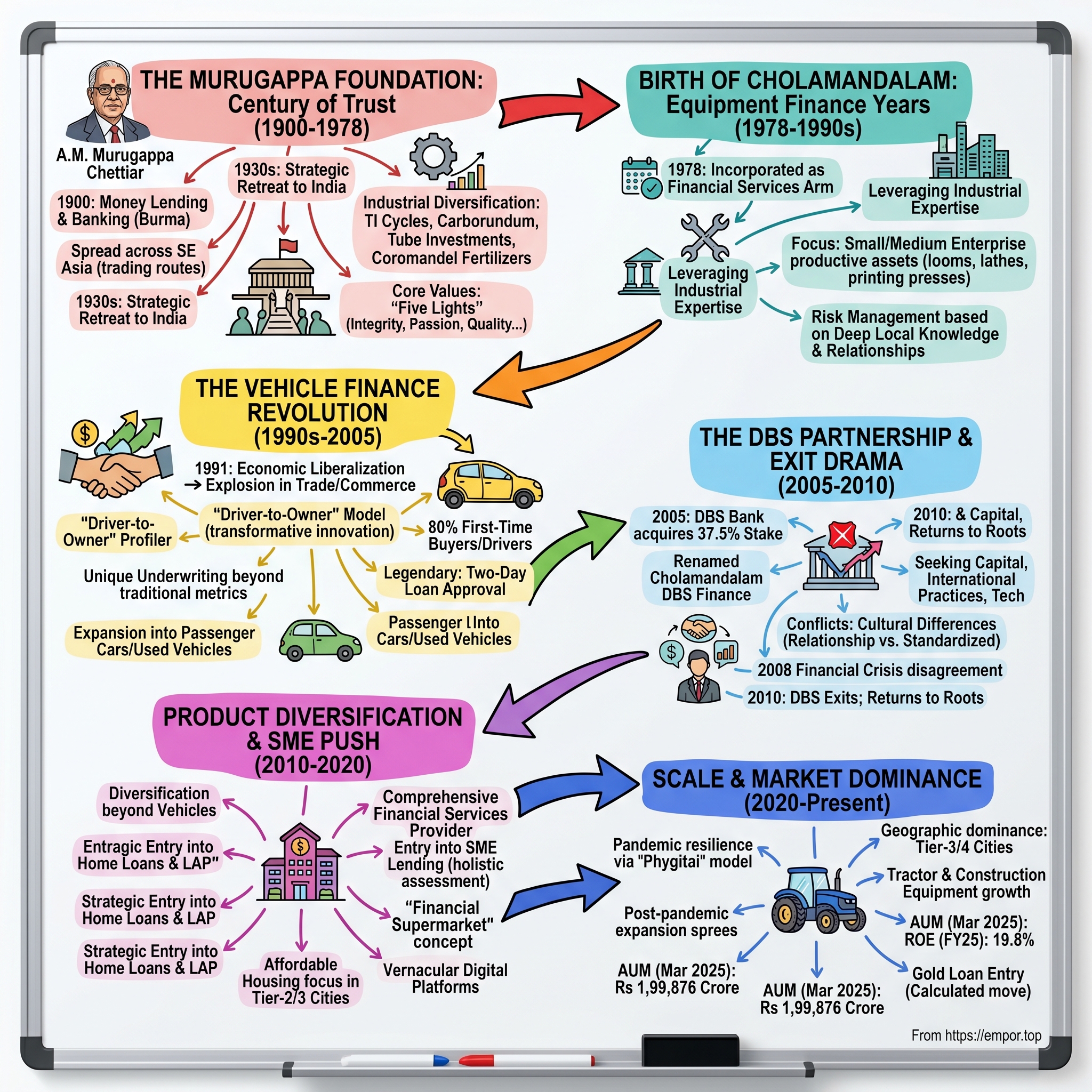
Cholamandalam Finance: The Story of India's Vehicle Finance Giant
I. Introduction & Cold Open
In the final week of January 2009, the board of Chennai-based lender Cholamandalam DBS Finance met to approve a sobering resolution: a capital restructuring that absorbed ₹323.53 crore of company reserves to cover standard assets, write off bad debts, and absorb loan losses.1 The figure was modest against the global financial wreckage unfolding that winter, but what it represented was not.
Chola—a lender that spent three decades building a reputation financing trucks and industrial equipment in southern India with monastic conservatism—discovered how rapidly capital erodes in uncollateralized lending. The losses stemmed from an expansion into unsecured personal loans during a joint venture with Singapore's DBS Bank. By the quarter ending December 2008, the company had swung to a net loss of ₹50.8 crore.1 Six weeks later, in March 2009, it scrambled for a ₹750 crore credit facility to resolve an asset-liability mismatch—having borrowed short to finance long-term loans just as short-term liquidity dried up.2 Promoters injected ₹300 crore of fresh equity, with another ₹200 crore scheduled for the following year.1
Seventeen years later, on July 28, 2026, the same entity—renamed, restructured, and now classified by the Reserve Bank of India as one of seventeen Upper Layer NBFCs3—reported assets under management of ₹2,54,392 crore, up 23% year on year, alongside quarterly profit after tax of ₹1,654 crore, up 46%.4 Operating across 32 states and union territories, it served more than 44 lakh customers,5 while return on equity stood at 21.2%.4
That expansion represents roughly a forty-fold increase in balance sheet scale over a period when several rival non-banking financial companies from 2009—such as Dewan Housing, Reliance Capital, and IL&FS—collapsed entirely.
The central question of this narrative is not simply how an Indian lender expanded during a broader credit boom. The sharper question is how a 1978 industrial equipment financing subsidiary, which came within a rating notch of severe distress in 2009, managed to compound through the 2018 IL&FS liquidity freeze, the 2020 pandemic moratorium, and the 2023 regulatory crackdown on unsecured credit—and whether that performance reflects durable structural advantages or favorable market conditions.
The explanation involves several key themes. First is the governance framework of the Murugappa Group, a century-old family business whose primary contribution to Chola is tangible: lower borrowing costs. Second is the "driver-to-owner" underwriting model, a field-heavy credit evaluation method that has outpaced digital, app-based alternatives. Third is the DBS joint venture and its instructive breakdown. Fourth is the turnaround led by Vellayan Subbiah, who rebuilt the firm around collateralized lending after the 2009 crisis. Finally, there is the current expansion—a multi-engine lender adding gold loans, SME finance, and secured business loans faster than ever, even as asset quality metrics show signs of pressure.
That asset quality trend requires immediate attention. Chola's Stage 3 assets stood at 3.29% of gross assets as of June 2026, up from 3.05% in March 2026 and 3.16% a year earlier.4 Under RBI classification rules rather than Ind AS accounting, gross non-performing assets reached 4.50%.4 Management attributes the quarterly uptick to seasonal factors. While that explanation may hold, evaluating the business requires balancing two realities: a company generating a 21% return on equity alongside credit delinquencies that have gradually increased over three years of rapid growth.
The starting point for this analysis is where that institutional trust originated.
 Subscribe on LinkedIn
II. The Murugappa Group Heritage: Ethics, Governance, and Patient Capital (1900–1978)
The story does not begin in India. It begins in a port town on the Salween River in Burma in 1900, where a Chettiar merchant named Dewan Bahadur A. M. Murugappa Chettiar established a money-lending and merchant banking house in Moulmein.
The Nattukottai Chettiars of Tamil Nadu were then among the world's most effective financial diasporas. They operated a credit network spanning British Burma, Malaya, Ceylon, the Dutch East Indies, and French Indo-China—financing rice cultivation, rubber estates, and trade through an internal system of family capital, mutual trust, and rigorous bookkeeping that predated modern banking regulation. Their advantage was not low capital cost, but localized information. A Chettiar house lending against a Burmese paddy field understood the land and its cultivator in ways no European bank branch in Rangoon could replicate.
That information advantage would re-emerge in a different form on Indian highways ninety years later.
The overseas lending network did not endure. Rising anti-Indian sentiment in Burma during the 1930s, followed by World War II Japanese occupation and eventual Burmese nationalisation, effectively destroyed Chettiar credit operations across Southeast Asia. Families that had spent generations building overseas loan books repatriated whatever capital they could salvage to Tamil Nadu, with many never recovering. The Murugappa family adapted by shifting away from overseas lending and entering industrial manufacturing.
Over the next four decades, the family built one of India's resilient industrial groups—creating Tube Investments of India in precision steel tubes and bicycles, Carborundum Universal in abrasives and ceramics, Coromandel in fertilisers, and EID Parry in sugar. By 2026, the group described itself as a 125-year-old conglomerate generating ₹90,178 crore in revenue, operating ten listed companies with 94,041 employees across sectors including abrasives, technical ceramics, electric vehicles, auto components, transformers, railway signalling, bicycles, fertilisers, sugar, and tea.4
The group codified its operating philosophy as the "Five Lights"—integrity, passion, quality, respect, and responsibility.4 While corporate value statements are common, in Indian financial services a promoter group's reputation serves as a tangible financial asset. Because a non-bank lender cannot accept retail deposits, its primary raw material is borrowed capital—including bank term loans, non-convertible debentures, commercial paper, securitisation, and foreign currency borrowings. The price of that capital depends heavily on credit rating agency evaluations and institutional assessments of promoter governance. In a market where several major non-banking financial company failures over the past decade stemmed from governance breakdowns—such as related-party transactions, opaque structures, and promoter share pledges—a lender attached to a group with an unblemished record borrows at tighter spreads and retains liquidity during market distress.
CRISIL's February 2026 rationale on Chola highlights that linkage, listing "support from the Murugappa group"—which held 49.72% of equity—among its core rating strengths alongside market position and profitability.6 Chola's rated instruments sit at the top of the Indian scale: ICRA rates the company AA+ with a positive outlook, while CRISIL reaffirmed A1+, its highest short-term rating, on ₹12,000 crore of commercial paper.67
For investors, governance quality functions as a measurable spread rather than an abstract ideal. It shows up directly in Chola's cost of funds, which fell to 6.7% in the June 2026 quarter from 7.0% a year earlier.8 Ultimately, the Murugappa heritage allows Chola to raise capital more cheaply than standalone non-bank lenders of similar size and risk profile.
That was the inheritance. In 1978, the family re-entered financial services.
III. Birth of Cholamandalam: The Equipment Financing Era (1978–1995)
Cholamandalam Investment and Finance Company Limited was incorporated in Chennai on August 17, 1978, as the financial services arm of the Murugappa Group, commencing operations in equipment financing.45 Named after the Chola dynasty—the medieval Tamil maritime empire that projected power across the Bay of Bengal—the company began with ambitions that far exceeded its initial operational scale.
That early scale was modest. Chola financed plant, factory equipment, and corporate machinery, primarily serving Murugappa Group enterprises and industrial clients across southern India. Operating during the final decade of India's License Raj, the business faced tight regulatory boundaries: industrial capacity required government licenses, bank credit was strictly rationed under state priorities, and interest rates were administered. In this environment, private financiers occupied a narrow niche—funding corporate clients that state-owned banks could not process quickly enough, charging higher rates, and underwriting specialized assets public institutions routinely bypassed.
However, the economics of corporate equipment leasing remained structurally constrained. Ticket sizes were large, creating high customer concentration risk where a few borrowers dominated the loan book. Repayment schedules were lumpy and tied to long-term project cash flows rather than frequent commercial receipts. Pricing power was thin, as corporate treasurers could readily compare quotes across competing financiers and banks. Crucially, collateral recovery posed severe challenges: specialized machinery bolted to a factory floor was difficult to repossess and even harder to liquidate, unlike commercial vehicles, which benefited from an active secondhand resale market.
Chola went public and expanded its branch network during the 1980s, yet the limits of wholesale equipment leasing were increasingly clear.9 By the early 1990s, management recognized that driving return on equity required shifting from a concentrated pool of corporate borrowers to a granular base of retail clients—particularly across semi-urban and rural markets neglected by state-owned banks.
This transition reflected a fundamental principle in financial services: while wholesale corporate lending competes primarily on price, retail lending in underserved markets competes on physical presence and access. In regions lacking formal credit institutions, a lender willing to establish local credit underwriting holds significant pricing power.
Chola made its first move into this space in the early 1990s, testing loans for new and pre-owned commercial trucks in southern India while developing field-based credit appraisal methods.9 What began as a modest experiment within a company dominated by corporate leasing soon gained strategic urgency.
When India launched sweeping economic reforms in 1991, that vehicle financing experiment provided the blueprint for Chola's next era of growth.
IV. The Commercial Vehicle Pivot & Rural "Driver-to-Owner" Model (1995–2005)
Picture a truck stop along the Grand Trunk Road in the late 1990s: diesel fumes, dhaba tea, and dozens of drivers who had spent fifteen years operating trucks for a monthly wage. Every one of them understood freight economics far better than a bank credit officer in Mumbai—which routes paid reliably, which brokers settled on time, what a used Tata 1613 cost to keep running, and how many days a month a rig could operate before needing major repairs.
What none of them possessed was a tax return, a salary slip, a formal bank balance, or a credit bureau record. In formal banking parlance, they were unbankable. In economic terms, they represented a mispriced credit risk.
India's economic liberalisation from 1991 onward transformed this market dynamic into a scalable business. Dismantling industrial licensing unleashed domestic manufacturing, expanding freight volumes that moved overwhelmingly by road. The Golden Quadrilateral highway programme, launched at the end of the decade, compressed transit times between major metros and dramatically raised long-haul trucking productivity. As commercial vehicle demand surged, the marginal buyer shifted from large fleet operators to individual drivers purchasing their first trucks.
Chola built its underwriting model around this emerging borrower segment, establishing the operational foundation for its core competitive advantage.
Underwriting without documents. Traditional bank credit evaluation relies on formal documentation: tax filings, pay stubs, and audited balance sheets. Chola's field officers instead evaluated the borrower's operational ecosystem and cash flows. That meant inspecting freight contracts, route seasonality, standing with local transport associations and freight brokers, the vehicle's maintenance condition, and character references from long-term industry peers. A driver who had navigated the Coimbatore–Hyderabad route for a decade for the same fleet operator often represented a lower credit risk than formal documentation implied. Chola built its business on capturing this information arbitrage.
Collection integrated with underwriting. In conventional banking models, loan origination and collection are managed by separate departments or third-party agencies. Chola combined these responsibilities within the same relationship. The field officer who evaluated the borrower also collected loan instalments, aligning collection schedules with irregular freight payments rather than fixed monthly dates. Frequent physical touchpoints allowed field officers to detect financial stress early while reinforcing social accountability for repayment.
Repossession as a tangible backstop. Unlike unsecured personal loans, commercial vehicles are registered, titled, hypothecated to the lender, mobile, and liquid in an active secondhand market. This structure fundamentally alters the lender's risk profile. While default probability fluctuates with freight cycles—driven by diesel price spikes, monsoon variations, or axle-load regulations—loss given default remains constrained because the underlying asset can be repossessed and liquidated. Chola's reliance on collateralized recovery would prove decisive during subsequent industry downturns.
During this period, Chola expanded its branch network beyond its southern home base into Maharashtra, Gujarat, Rajasthan, and northern transport corridors, following freight routes rather than urban wealth.9 This geographic strategy targeted Tier-2 through Tier-6 markets where formal banking competition was minimal, offering borrowers an alternative to local moneylenders charging exorbitant rates.
This operational model established a durable foundation for Chola's growth, though it introduced structural cost challenges. Operating physical branches, deploying field officers for frequent client visits, and managing cash collection infrastructure created a high cost-to-income ratio compared to purely digital platforms. The model relies on credit cost savings offsetting elevated operating expenses. While that trade-off has proved successful across multiple vehicle financing cycles, its effectiveness in newer product lines remains an open strategic question.
By the mid-2000s, Chola had established a defensible retail franchise. Seeking further scale and financial sophistication, the company partnered with an international investor to finance its next phase of growth.
V. The DBS Joint Venture & The 2008 Financial Crisis Fallout (2005–2010)
In June 2005, the Development Bank of Singapore (DBS) agreed to acquire a 37.5% stake in Cholamandalam Investment and Finance for ₹228 crore, as the Murugappa Group diluted its holding to match.10 Rebranded Cholamandalam DBS Finance, the entity appeared strategically ideal on paper.
DBS brought global stature as Southeast Asia's largest bank by assets, equipped with advanced risk architecture, technology capabilities, and deep capital reserves. Chola offered an established distribution network in semi-urban and rural Indian markets where credit demand remained structurally unmet. Combining foreign institutional risk management with local field distribution was intended to create a fast-growing retail lender.
What followed, however, became an instructive case study in strategic misalignment.
The joint venture expanded aggressively into unsecured personal loans. The rationale fit the prevailing optimism of the era: unsecured consumer credit carried much higher yields than commercial vehicle loans, required no physical asset appraisals, enabled rapid digital origination, and was generating strong growth for urban retail banks. Centralized credit scoring models—proven in Singapore and among salaried urban borrowers in India—were expected to replace the resource-intensive field verification Chola used in vehicle finance.
The flaw was not the foreign origin of the model, but that it inverted Chola’s core competitive advantage.
Chola's edge in commercial vehicle finance relied on granular, field-level knowledge of informal borrowers combined with liquid collateral that could be repossessed upon default. Unsecured personal lending possessed neither safeguard. The joint venture began extending credit to borrowers it could evaluate far less effectively than urban banks could, backed by no repossessable asset, and supported by a collection infrastructure designed for tracking heavy trucks rather than tracing individual personal borrowers. By increasing default probabilities while surrendering recovery control, the strategy amplified risk rather than diversifying it.
Operational stress materialized before the global financial panic hit. For the quarter ended June 2008, Cholamandalam DBS reported a 60% decline in net profit to ₹5.2 crore.11 When the Global Financial Crisis intensified later that year, it contracted borrower cash flows and froze wholesale credit markets simultaneously.
Freight volumes dropped for small commercial vehicle operators, while unsecured consumer borrowers—lacking financial buffers—defaulted first. Concurrently, short-term wholesale funding dried up, stranding Chola DBS with an asset-liability mismatch as short-term debt funded longer-term loans. In March 2009, the lender arranged a ₹750 crore credit facility to resolve the liquidity shortfall.2 That step followed a January 2009 board resolution deploying ₹323.53 crore of reserves against standard-asset provisions, bad-debt write-offs, and loan losses, alongside a ₹300 crore equity infusion from the promoter group.1
The joint venture did not survive the crisis. On March 30, 2010, Murugappa Group entity Tube Investments of India announced an agreement to buy DBS Bank's 37.48% stake at ₹91 per share, targeting completion on or before April 12, 2010.12 Group entities Tube Investments and New Ambadi Estates paid approximately ₹376 crore for the stake, and the company formally reverted to Cholamandalam Investment and Finance Company with effect from June 2, 2010.9
The financial outcome of the partnership underscored the misstep. DBS had invested ₹228 crore in 2005 and exited for roughly ₹376 crore five years later—a nominal gain of about 65%. After accounting for Indian equity market returns and rupee depreciation over that period, the real return was negligible. Five years of international bank capital produced minimal shareholder value while leaving Chola with a damaged balance sheet and depleted reserves.
Rebuilding commenced immediately. On May 11, 2010, the company signed a subscription agreement with the International Finance Corporation to issue 1.08 crore equity shares at ₹92 apiece, raising ₹100.23 crore.9 Replacing a commercial bank partner with the World Bank's private-sector investment arm signaled a strategic pivot back to asset-backed, development-focused retail lending.
The broader lesson for institutional investors was clear: expanding into a new product line succeeds only if the new business leverages the lender's established operational edge. Without that continuity, product diversification simply creates a high-risk venture operating under a legacy brand.
Restoring Chola's balance sheet required operational discipline and a firm return to collateralized lending. To lead that effort, the Murugappa family turned to one of its most credentialed executives.
VI. The Vellayan Subbiah Turnaround & Multi-Product Platform Expansion (2010–2020)
Vellayan Subbiah took charge of Chola in 2010 with a background distinct from traditional commercial vehicle lending. Trained as an engineer and strategy consultant, he spent his early career outside the Murugappa Group before taking on corporate leadership roles—a trajectory he later described as entering entrepreneurship roughly fifteen years before being named EY World Entrepreneur Of The Year in 2024, becoming only the fourth Indian recipient in the award's history.13 EY's citation specifically highlighted this period, noting that he "first successfully navigated Chola through the fallout of a troubled partnership amid a global recession."13
The restructuring playbook Subbiah executed relied less on novel financial products than on operational subtraction and risk discipline.
Exiting unsecured lending. Management shut down unsecured personal loans and wound down the legacy portfolio. While exiting a loss-making line appears straightforward in hindsight, distressed lenders often face the temptation to dilute non-performing assets by growing overall volume rather than contracting the balance sheet.
Refocusing on collateralized assets. Capital and managerial focus returned entirely to secured vehicle finance across heavy, medium, light, and small commercial vehicles, alongside tractors, passenger cars, pre-owned vehicles, and construction equipment. This core segment leveraged both Chola's field underwriting intelligence and its asset repossession backstop.
Expanding into adjacent secured products. The primary new product line introduced during the decade was Loan Against Property (LAP)—long-tenor working capital financing for micro and small enterprises secured against self-occupied residential or commercial real estate. LAP aligned directly with Chola's core operational capabilities: borrowers were typically self-employed entrepreneurs lacking formal income documentation—the exact segment Chola's field officers were trained to evaluate—backed by tangible real estate collateral. The strategy effectively applied vehicle underwriting principles to a different collateral class.
Decentralizing origination while centralizing risk control. Branch managers received operational autonomy over loan origination within strictly enforced central risk boundaries—an architecture designed to combine local responsiveness with institutional credit control.
The strategy faced a severe stress test in September 2018, when Infrastructure Leasing & Financial Services (IL&FS) defaulted. The default triggered a liquidity freeze across India's non-banking financial sector: mutual funds halted the rollover of NBFC commercial paper, commercial banks re-evaluated credit lines to non-bank lenders, and institutions reliant on short-term wholesale debt to fund long-term assets faced immediate refinancing pressures. Across the sector, major NBFCs suffered sharp declines in market valuation as investors reassessed systemic liquidity risk.14
Chola's performance during the squeeze illustrated the commercial value of its funding structure and promoter backing. Backed by the Murugappa Group, maintaining top-tier short-term credit ratings, and holding a granular, asset-backed loan book, Chola retained access to bank credit lines, non-convertible debentures, and commercial paper while weaker peers struggled to refinance debt. That funding access created a competitive opportunity: as several competing housing finance companies and diversified NBFCs curtailed lending in 2019, credit demand shifted toward lenders with active liquidity.
This outperformance reflected balance sheet positioning rather than macroeconomic foresight. Chola did not anticipate the timing of the IL&FS crisis; rather, its combination of collateralized assets, conservative promoter backing, and clean repayment history allowed it to convert an industry-wide liquidity shock into market share gains. For investors, this balance sheet structure provided effective insulation against short-term liquidity freezes, even as fundamental credit risk remained tied to broader economic cycles.
Another structural expansion during the decade was Chola's entry into affordable housing finance, targeting low- and middle-income self-employed borrowers in Tier-3 to Tier-6 cities.15 Housing finance differed fundamentally from commercial vehicle loans: loan tenors extended fifteen to twenty years, yields were lower, and loan turnover was significantly slower. However, the mortgage portfolio served as strategic balance sheet ballast—providing long-duration, low-default assets that cushioned earnings against commercial vehicle cycles while leveraging Chola's existing rural branch network.
Capital discipline was also evident in Chola's product rationalization. The company had initially entered the gold loan market around 2011 before exiting—joining peers such as Magma Fincorp and Shriram City Union in withdrawing from the segment during a period of industry margin pressure.1614 Chola would re-enter gold finance more than a decade later under altered market conditions, demonstrating a willingness to exit underperforming product lines when returns fell short of targets.
By the close of the decade, Chola had transformed from a distressed joint venture into a diversified secured lender with an established funding franchise. As the COVID-19 pandemic approached in 2020, the company stood prepared for its next phase of expansion.
VII. The Post-COVID Surge, Fintech Bets, & New Growth Engines (2020–Present)
For a lender whose collection model depends on field officers physically visiting borrowers, a national lockdown represents a near worst-case scenario. India's COVID-19 response in 2020 combined a severe mobility freeze with a loan moratorium mandated by the Reserve Bank of India, followed by debt restructuring frameworks and emergency credit guarantee schemes. Freight movement halted, construction ground to a stop, small businesses shuttered, and the monthly physical touchpoints that allowed Chola to detect borrower stress early were suspended by law.
Chola weathered the shock without repeating the balance sheet damage of 2008—an outcome reflecting how differently its portfolio was constructed: secured, granular, and backed by credit lines that remained accessible.
What followed was a deliberate expansion of its product suite, marking one of the most consequential strategic shifts of the current management era.
CSEL — Consumer and Small Enterprise Loans. Launched during financial year 2022, this portfolio covers personal and small business credit, initially scaled through digital and fintech partnerships that funneled origination volume onto Chola's balance sheet.
SBPL — Secured Business and Personal Loans. Providing small-ticket loans to business owners against property collateral, this product sits between Loan Against Property and unsecured lending in both ticket size and yield.
SME Loans. Offering secured term lending, supply chain finance, equipment finance, and solar finance for manufacturing and trading enterprises.5
Stripped of its acronym, CSEL represents unsecured consumer and small-business credit—the same asset class that nearly crippled the lender in 2008. Management contended that the post-2020 iteration differed fundamentally: built atop a far larger secured base, supported by established credit bureau coverage, and guided by digital data and portfolio analytics unavailable fifteen years earlier. Yet the structural reality identified in Section V remains: unsecured lending lacks a repossession backstop, leaving risk management entirely dependent on accurately predicting default probabilities.
The Payswiff acquisition. On January 17, 2022, Chola executed shareholder and share purchase agreements to acquire up to 72.12% of Payswiff Technologies—a Hyderabad-based payments company founded in 2013—for ₹450 crore in cash at ₹1,622.66 per share.17
The underlying thesis centered on cash-flow-based underwriting. By owning the point-of-sale payment terminals on small merchant counters across Tier-3 to Tier-6 towns, Chola aimed to track real-time transaction flows—offering a more immediate view of business turnover than informal financial documentation could provide. Integrating those transaction insights into SME and SBPL credit decisions promised a digital-era equivalent of the driver-to-owner model: superior field intelligence on informal borrowers.
While logically coherent, the thesis encountered challenging execution conditions. The rapid adoption of India's Unified Payments Interface (UPI)—which carries zero merchant discount rates on most person-to-merchant transactions—compressed the economics of card-based payment processing across the industry. A merchant-acquiring business dependent on transaction fees faced structural headwinds when the dominant payment channel operated without fees, alongside elevated merchant terminal churn. Consequently, Payswiff functions primarily as a technology capability purchase—providing payment architecture and onboarding infrastructure—rather than an acquisition that has demonstrated clear underwriting or revenue synergies. Valued at ₹450 crore against a balance sheet exceeding ₹2.5 lakh crore, the transaction represents a manageable outlay: small enough that underperformance is easily absorbed, yet modest enough that success does not significantly alter consolidated earnings. In effect, Chola acquired a strategic option rather than an established growth engine.
Regulation caught up with scale. The Reserve Bank of India's Scale Based Regulation framework categorized Chola as an Upper Layer NBFC, maintaining that designation on the 2026–27 list.3 Upper Layer classification imposes bank-like regulatory standards, including higher capital adequacy requirements, mandatory large-exposure limits, differential provisioning rules, enhanced board oversight, and a prompt corrective action framework. In April 2026, the RBI proposed simplifying this framework into a clear ₹1 lakh crore asset threshold—a transparent rule that would keep Chola firmly within the regulated upper tier.18
A more immediate regulatory adjustment occurred in November 2023, when the RBI increased risk weights on unsecured consumer credit and bank exposure to non-bank lenders. The ruling raised capital costs for unsecured loan growth while increasing bank funding costs for NBFCs at the margin.
Chola's strategic response, documented in its financial disclosures, involved distinct portfolio adjustments. During the March 2025 quarter, management decided to progressively exit fintech-partnered origination volumes in CSEL while deliberately slowing low-return-on-assets segments within SME finance.19 Concurrently, the company re-entered the gold loan market in April 2025, disbursing ₹100 crore in its first quarter of operations.19
Taken together, these actions reveal a clear risk recalibration: Chola scaled back third-party unsecured origination and low-margin SME lending while expanding a physically collateralized, high-turnover product line. This shift traded growth in asset classes with high loss-given-default risk for growth in a category with strong collateral protection, leveraging the company's existing physical branch network.
Evaluating whether this posture is sustained will require examining the most recent operational metrics next.
VIII. Segment Deep Dive: Economics, Unit Math, & Portfolio Breakdown
Strip away the narrative and a non-bank lender operates as an arithmetic engine: borrowing at one interest rate, lending at a higher yield, absorbing operating overhead and credit losses, and magnifying the residual return through financial leverage. Examining that balance sheet segment by segment, using the quarter ended June 30, 2026, as a benchmark, clarifies how individual business lines drive consolidated performance.
Vehicle finance remains the engine, and it is no longer the whole car. The vehicle finance loan book reached ₹1,24,132 crore as of June 30, 2026, up 19% year on year, supported by quarterly disbursements of ₹16,503 crore.4 The portfolio accounts for approximately 49% of total assets under management—down from its overwhelming dominance a decade earlier, and aligning with CRISIL's assessment that vehicle finance represents about 50% of the book, alongside loan against property (LAP) at 23% and housing finance at 10%.6 The segment spans heavy and light commercial vehicles, passenger cars, pre-owned vehicles, two- and three-wheelers, tractors, and construction equipment.5 Its primary strength is high asset yields backed by repossessable collateral, though it also carries the highest delinquency rate among major segments, reaching 4.2% by CRISIL's December 2025 measurement.6
LAP is the quiet compounder. The loan-against-property portfolio reached ₹54,130 crore, growing 23% year on year after quarterly disbursements of ₹4,780 crore.4 While LAP generates lower yields than vehicle finance, it historically incurs lower credit losses because loans are secured by self-occupied residential or commercial real estate—assets that carry high financial and psychological stickiness for borrowers. For a lender, self-occupied real estate represents durable security, as owners typically exhaust all other financial options before defaulting.
Home loans provide duration. Standing at ₹23,644 crore, up 22% year on year following ₹1,797 crore in quarterly disbursements, affordable housing finance has evolved into a substantial business line.4 The strategic value of this portfolio lies in portfolio stability rather than high interest margins: fifteen-to-twenty-year mortgages provide steady long-term cash flows that balance the shorter cyclical swings of commercial vehicle lending.
The new engines are growing fastest, from a small base. SME loans expanded 39% to ₹9,923 crore, while secured business and personal loans (SBPL) grew 40% to ₹3,730 crore. Meanwhile, the gold loan portfolio, restarted just over a year earlier, reached ₹2,143 crore across 171 dedicated branches.4 Combined, these newer secured product lines account for under 7% of total assets under management—large enough to boost overall disbursements, yet small enough that operational missteps remain contained.
CSEL is being deliberately restrained. The consumer and small enterprise loan (CSEL) portfolio grew 12% to ₹15,884 crore—marking the slowest growth rate across all major segments during a quarter in which total assets grew 23%.4 For analysts assessing whether the company is repeating its 2008 unsecured lending expansion, this growth divergence is the most telling operational metric in the release. Management is not merely stating an intent to curb unsecured origination; the portfolio is expanding at half the rate of the broader balance sheet.
Now the consolidated machine. In the June 2026 quarter, Chola generated total income of ₹8,933 crore against finance costs of ₹4,003 crore, leaving net income of ₹4,930 crore—a 28% increase alongside 22% growth in disbursements and 23% growth in total assets.4 Net income expanding faster than the underlying asset base indicates margin expansion: net interest margin widened to 8.2% from 7.8% a year earlier, as the average cost of funds fell to 6.7% from 7.0%.8
That margin expansion explains why quarterly net profit rose 46% while assets under management grew 23%. In a declining interest rate environment, Chola's wholesale borrowing costs fell faster than its overall lending yields, allowing the interest rate spread to flow directly to the bottom line.
From that gross margin, operating expenses of ₹1,787 crore and loan loss provisions of ₹922 crore were deducted.4 The loan loss line was notable: credit provisions rose 5% year on year despite a 23% expansion in total assets. Net credit costs dropped to 1.5% from 1.8%—a level that Managing Director and CEO Ravindra Kundu noted during the July 28, 2026 earnings call met the company's full-year target within the first quarter.8 Consequently, profit before tax reached ₹2,220 crore, producing a pre-tax return on assets of 3.7% and a return on equity of 21.2%.4
What the evidence actually means. Three distinct analytical points emerge from these results, and they must be evaluated together.
First, the quarterly earnings acceleration was driven substantially by the rate cycle. A 30 basis point reduction in funding costs across a ₹2.5 lakh crore borrowing base generates several hundred crore rupees in annual savings without requiring operational improvements. CFO Arul Selvan acknowledged this dynamic on the earnings call, projecting full-year borrowing costs to remain "roughly flat versus last year" while cautioning that funding costs could rise approximately 10 basis points in the second half of the fiscal year if anticipated policy rate hikes of 25 to 50 basis points materialize.8 Investors extrapolating 46% profit growth are witnessing a monetary tailwind rather than a permanent trend line.
Second, the lower net credit cost occurred alongside deteriorating stage-wise asset quality metrics, with both trends appearing in the same disclosure. Stage 3 non-performing assets rose to 3.29% from 3.05% in the prior quarter and 3.16% a year earlier, while Stage 3 provision coverage eased to 45.73% from 47.29% in March.4 Under Reserve Bank of India classification rules, gross non-performing assets stood at 4.50% and net non-performing assets at 2.95%, both increasing sequentially.4 CRISIL had previously flagged this trajectory in February 2026, pointing out that gross delinquencies rose from 2.8% in March 2025 to 3.4% by December 2025, driven primarily by vehicle finance, SBPL, and SME loans.6 On the earnings call, Kundu emphasized that Stage 2 assets improved by 33 basis points year on year while Stage 3 assets rose by 13 basis points—yielding a net 20 basis point improvement in combined stress—and noted that sequential first-quarter deterioration was less pronounced than in the prior year.8 While that framing offers valid context, it is distinct from a broad improvement in asset quality.
Third, the balance sheet remains adequately capitalized for its current growth rate, though without an oversized safety buffer. Total capital adequacy stood at 19.81% against the regulatory minimum of 15%, with Tier-I capital at 14.81% and common equity Tier-I at 14.52%.4 CRISIL's rating rationale identified adjusted gearing of 7.2 times as of December 2025 as a rating sensitivity, stating that the company's "ability to maintain adequate buffer in capitalisation metrics alongside growth remains critical."6 Chola has been converting a ₹2,000 crore compulsorily convertible debenture issue into equity in scheduled tranches—including ₹1,370 crore during fiscal 2026, ₹200 crore in July 2026, and the remaining ₹430 crore scheduled for October 2026—which systematically strengthens equity capital.4 Liquidity reserves remained solid at ₹22,765 crore in cash and liquid assets (including ₹7,614.93 crore in high-quality liquid assets) and ₹23,984 crore including undrawn bank lines, maintaining positive cumulative asset-liability matching across all maturity buckets.4
The operational model continues to generate strong returns. The central question for the company's trajectory is distinguishing its structural competitive advantages from favorable credit cycle conditions—a distinction that depends heavily on leadership execution.
IX. Management, Capital Allocation, & Governance Architecture
Indian corporate governance often relies on a dual-leadership model: a family principal who directs capital allocation and governance, paired with a career operator managing daily execution. Cholamandalam provides a clear example of this structure.
Vellayan Subbiah chairs the board. His leadership role extends beyond Chola as Executive Vice-Chairman of Tube Investments of India, where his corporate record includes the transformation of Tube Investments and the turnaround of CG Power alongside his earlier work at Chola.13 His selection as EY World Entrepreneur of the Year in June 2024 reflected that multi-company track record rather than any single enterprise.13 From an analytical standpoint, the key observation is a consistent capital allocation framework demonstrated across three corporate turnarounds: restructuring underperforming operations, reallocating capital to higher-return segments, and constraining growth in business lines where returns fail to clear the cost of capital.
Ravindra Kumar Kundu assumed the role of Managing Director for a five-year term on October 7, 2024, after serving as Executive Director from January 2020.20 Complementing Subbiah's strategic focus, Kundu brought 24 years of internal experience at Chola and 36 years across the automotive and financial services sectors, having advanced through the organization by managing vehicle finance operations from the field level.20 During his executive tenure between fiscal years 2020 and 2024, assets under management expanded from roughly ₹67,000 crore to ₹1,53,000 crore, while profit before tax grew from approximately ₹1,500 crore to ₹4,500 crore.20
Appointing an internal operational leader to the top executive role aligns with Chola's reliance on field-based credit underwriting. In an organization whose core business model depends on ground-level risk evaluation, leadership drawn from operational ranks preserves institutional memory and underwriting continuity—in contrast to the strategic misstep during the DBS joint venture, when external retail banking practices were introduced.
Arul Selvan serves as Chief Financial Officer, managing capital structure and investor communications. On the July 2026 earnings call, his commentary on net interest margins provided realistic context to the headline figures, noting that the 46% quarterly profit surge was amplified by declining funding costs that may not persist if interest rates adjust upward in subsequent quarters.8 For institutional investors, conservative financial guidance from leadership provides a realistic baseline for evaluating earnings durability.
Ownership structure. As of June 2026, the promoter group held 49.23% of equity, foreign institutional investors held 24.46%, domestic institutions held 20.62%, and public shareholders held 5.70%.21 CRISIL's February 2026 evaluation placed the Murugappa Group's total interest at 49.72%.6 Ownership is held primarily through Cholamandalam Financial Holdings, the group's listed holding entity. This shareholding structure highlights two structural dynamics. Combined institutional ownership of approximately 45% provides active market oversight and valuation discipline. Concurrently, a promoter stake near 50% without share pledging or related-party capital extraction establishes governance stability, although the holding-company architecture creates the standard valuation discount between the holding company and the operating entity.
Capital allocation and balance sheet management. Over the past decade, Chola has retained most of its earnings to finance loan book growth, supplementing internal accruals with equity capital raised during periods of market valuation strength. The October 2023 capital raise illustrates this strategy: the company issued ₹2,000 crore in equity through a qualified institutional placement alongside ₹2,000 crore in compulsorily convertible debentures scheduled to convert fully by October 2026.22 Securing long-term equity capital when market demand is strong, rather than during liquidity shortages, strengthens solvency buffers against macroeconomic volatility.
Acquisition activity has remained minimal. The ₹450 crore purchase of Payswiff represents Chola's only significant external acquisition, representing a modest commitment relative to the company's overall scale. For a lender that reported net profit of ₹5,233 crore on revenue of ₹31,120 crore for fiscal year 2026, avoiding large, complex acquisitions has concentrated management attention on organic portfolio expansion.21
Key governance and execution risks. Despite these strengths, three operational and governance factors warrant ongoing evaluation. First, the group holding structure places an intermediate layer between public shareholders and the operating company, meaning strategic decisions reflect the broader priorities of a promoter entity with a distinct shareholder base. Second, the rapid introduction of multiple new product lines—including consumer and small enterprise loans, secured business loans, SME finance, and gold loans within a five-year period—requires managing multiple credit underwriting models simultaneously, coinciding with rising delinquencies in newer portfolios. Third, public disclosures provide limited detail on executive compensation structures, making it difficult for external investors to verify whether executive incentives are explicitly tied to risk-adjusted returns rather than total disbursement growth.
While historical financial performance supports investor confidence, evaluating Chola's long-term outlook requires examining whether its returns derive from durable competitive moats or temporary market conditions.
X. Playbook: The Chola Method & Strategic Moats
Every lender claims a competitive moat, though most possess only a strong market position—which is not the same thing. Evaluating Chola through established strategic frameworks clarifies where its advantages are structural, where they are merely adequate, and where the thesis falters.
Hamilton Helmer's 7 Powers, applied
Process Power — the strongest claim, and the hardest to verify. Helmer defines process power as an organizational capability embedded in routines that competitors cannot quickly copy, even with full operational transparency. Chola's version rests on three decades of refining methods to estimate cash flows for informal borrowers lacking financial statements, paired with a dual-role field force that handles both underwriting and collections. The evidence supporting this power is tangible: the vehicle finance portfolio expanded past ₹1.2 lakh crore while net credit costs across the consolidated business stood at 1.5% in the June 2026 quarter48—a risk performance digital, algorithm-only lenders in informal borrower segments have struggled to match. Conversely, this capability is labor-intensive, human-dependent, and not automatically transferable across product lines, as evidenced by the elevated delinquencies CRISIL identified across secured business loans and SME finance.6 While process power remains well established in core vehicle financing, treating it as a universal capability across all lending segments remains an untested assumption.
Scale Economies — genuine, and measurable in basis points. Chola's average cost of funds fell to 6.7% in the June 2026 quarter,8 widening its cost advantage over smaller non-bank lenders. This structural edge stems from three mutually reinforcing factors: absolute balance sheet scale, an Upper Layer regulatory classification signaling systemic relevance, and the credit standing of the Murugappa Group. On the July 2026 earnings call, CFO Arul Selvan noted that bank borrowing remains more economical than debt capital markets, particularly for loans qualifying under priority sector lending guidelines.8 This structural breadth enables Chola to arbitrage across funding channels in ways smaller competitors cannot replicate, making scale economies the lender's most quantifiable competitive advantage.
Cornered Resource — partially valid, weakening at the margin. The Murugappa Group reputation carries substantial trust in southern and western India, while a physical distribution footprint of 1,820 branches across 32 states and union territories staffed by 71,260 employees represents a network that cannot be rapidly replicated.5 However, brand trust alone offers limited defensive protection in retail credit. A commercial vehicle buyer comparing Chola to a competitor evaluates loan approval speed, loan-to-value ratios, and repayment flexibility rather than corporate lineage. Consequently, the branch network and brand reputation function primarily to reduce customer acquisition friction rather than to command premium interest rates.
Counter-Positioning versus banks — real and structural. Commercial banks build their underwriting frameworks around documented income verification, while their cost structures prevent relationship managers from making monthly in-person field visits to collect small-ticket instalments. Mainstream banks cannot economically replicate Chola's high-touch field model without eroding the operating leverage that underpins their business models. This dynamic represents classic counter-positioning, as incumbent banks' structural economics inhibit a direct competitive response.
Crucially, several theoretical powers are absent: Chola possesses no network effects, as a lending platform gains no inherent value to existing borrowers when new clients join; no meaningful switching costs, since borrowers can readily refinance vehicle loans; and no standalone brand pricing power. Because three of the seven powers do not apply, investors should view Chola's moat as a combination of cost-of-capital and field-process advantages rather than an unassailable defensive fortress.
Porter's Five Forces, applied
Threat of new entrants: low to moderate. While obtaining a non-banking financial licence is straightforward, building an 1,800-branch network, training a 70,000-person field force, and accumulating three decades of proprietary loss data present formidable barriers. Nevertheless, well-capitalized entrants—including bank subsidiaries, balance-sheet-backed fintechs, and established non-bank lenders expanding into adjacent categories—frequently enter market segments. Chola's own re-entry into gold loans in 2025 demonstrates that established distributors can readily cross into adjacent collateralized products.
Supplier power (capital providers): moderate, representing an underappreciated structural risk. Chola relies on commercial banks, bond investors, securitization markets, and multilateral institutions for capital. While funding diversification is well established—with capital raised through International Finance Corporation syndicates alongside regular issuances of non-convertible debentures and commercial paper237—total borrowings expanded to ₹2,11,070 crore in fiscal 2026 from ₹1,34,475 crore in fiscal 2024.21 A balance sheet scaling liabilities at this velocity remains inherently reliant on uninterrupted wholesale liquidity, exposing the lender to systemic debt market shifts.
Buyer power: moderate. While informal borrowers remain sensitive to borrowing costs, their primary decisions hinge on approval probability, loan-to-value ratios, disbursement speed, and flexible collection terms. A commercial vehicle operator seeking to put a truck into service immediately prioritizes rapid execution over minor interest rate differences, allowing Chola to maintain asset yields across its core segments.
Substitutes: low in core segments, rising in adjacent products. For informal-income borrowers in Tier-3 to Tier-6 towns, alternatives to non-bank financing are typically limited to unorganized moneylenders operating at punitive interest rates. Mainstream commercial banks routinely decline borrowers lacking documented income. However, substitution risk intensifies as Chola expands into affordable housing and larger loan-against-property segments, where commercial banks actively compete for prime borrowers.
Rivalry: high and intensifying. Competitive pressure represents the most significant force facing the business. Shriram Finance maintains a larger balance sheet—reporting assets under management of ₹3,13,000 crore as of June 2026, up 15.3% year on year—backed by deep specialization in pre-owned commercial vehicles.24 Bajaj Finance surpassed ₹5 lakh crore in assets under management during fiscal 2026 with a consumer-led model.25 Mahindra Finance closed fiscal 2026 with assets under management of ₹1,34,096 crore,26 while Sundaram Finance operated a portfolio of ₹59,908 crore with lower delinquency rates.27 Combined with aggressive vehicle financing expansion by private commercial banks, competitive intensity across Chola's core markets remains elevated.
The strategic conclusion is that Chola's competitive moats are real, but they represent advantages of degree—lower borrowing costs, refined field underwriting, and a broader product distribution platform—rather than advantages of kind. No insurmountable structural barrier prevents competitors such as Shriram Finance or commercial banks from underwriting the same borrower segments. Instead, Chola relies on a cost and execution advantage that has endured over decades and continues to drive equity returns.
This dynamic leads directly to the core questions a rigorous investor must address.
XI. Skeptical Investor Stress Test, Risk Radar, & Regulatory Bottlenecks
An activist investor or short-seller assembling a bear case on Chola in August 2026 would likely target its balance sheet durability rather than its headline expansion. Three core arguments form the critical lines of attack.
Challenge one: Is Chola rebuilding its 2008 risk profile under new acronyms?
Critics argue that the company is repeating past mistakes by expanding into consumer and small enterprise loans (CSEL) through fintech channels, alongside newer products like secured business and personal loans (SBPL) and SME finance.
However, the empirical evidence presents a more nuanced picture. By June 2026, the CSEL book stood at ₹15,884 crore, representing approximately 6% of total assets under management, and grew at 12% year-on-year compared to 23% for the overall balance sheet.4 Management explicitly disclosed a decision to exit fintech-partnered origination channels while deliberately slowing lower-return SME lending.19 On the July 2026 earnings call, executives reported CSEL approval rates of 35% to 40% for business loans and roughly 60% for salaried applicants—underwriting standards that indicate selective origination.8 CRISIL similarly confirmed that management actively phased out fintech partnerships to limit unsecured credit exposure.6
The structural risk lies less in CSEL's current scale than in its interaction with newer secured product lines. Asset quality deterioration through 2025 extended beyond vehicle finance into SBPL and SME segments, which remain unseasoned across a full credit downturn.6 A portfolio untested by an economic contraction has yet to prove its true credit loss trajectory.
Challenge two: How vulnerable is the margin structure to a funding cost reversal?
Chola's earnings expansion has relied significantly on an expanding spread between borrowing costs and asset yields, driven largely by falling funding costs.8 If the interest rate environment reverses, liabilities reprice faster than the fixed-rate retail loan book, compressing net interest margins. Company management has acknowledged this dynamic, with the chief financial officer projecting funding costs to rise modestly during the second half of fiscal year 2027.8
To mitigate refinancing risk, Chola has expanded its institutional funding sources beyond domestic bank debt. In 2019, the International Finance Corporation anchored a $222 million financing package, retaining $92 million on its own account and syndicating the remaining $130 million across First Abu Dhabi Bank ($50 million), MUFG ($50 million), National Bank of Ras Al-Khaimah ($20 million), and CTBC Bank ($10 million) for rural micro-lending.23 Subsequently, the IFC committed up to $150 million in additional debt financing for affordable housing, allocating at least 25% specifically for female borrowers.28
While funding diversification broadens liquidity access, it does not eliminate systemic leverage risk for a balance sheet maintaining over ₹2.1 lakh crore in borrowings. While a liquidity buffer of ₹23,984 crore and positive cumulative asset-liability matching provide intermediate insulation,4 reliance on wholesale debt markets remains an inherent operational exposure.
Challenge three: Will commercial vehicle electrification erode secondhand collateral values?
A third structural concern posits that accelerating electric vehicle adoption could depress secondary market prices for legacy diesel commercial trucks, weakening the collateral backstop of the core vehicle portfolio.
To date, electrification in heavy and medium commercial transport has progressed slowly, constrained by battery energy density limits and corridor charging infrastructure. In light vehicle segments where the electric transition has moved faster, smaller ticket sizes and manufacturer battery warranties limit lender exposure. Moreover, Chola's active financing across two-wheelers, three-wheelers, and equipment positions the lender within the transition. Rather than posing an immediate threat, secondary valuation shifts represent a long-term structural trend requiring ongoing monitoring.
Additional material risks on the horizon
Cyclicality. Freight rates, diesel costs, and axle-load regulations directly influence small transporter cash flows. Vehicle finance delinquencies reaching 4.2% during a stable macroeconomic period6 signal potential credit cost sensitivity in a broader downturn.
Monsoon and rural income volatility. On the July 2026 call, Managing Director Ravindra Kundu noted potential risks from monsoon patterns, international trade tariffs, and geopolitical conditions, while confirming that immediate operational impacts remained contained.8 Rural income shocks transmit directly to tractor, light commercial vehicle, and micro-enterprise repayments.
Regulatory oversight. Upper Layer NBFC classification maintains continuous supervisory scrutiny and potential capital requirements. A proposed regulatory framework establishing a ₹1 lakh crore asset threshold would permanently confirm Chola's Upper Layer designation.18 Any future Reserve Bank of India adjustments regarding unsecured consumer exposure, gold loan loan-to-value caps, or bank-NBFC risk weightings directly affect operating costs.
Operational execution. Concurrently expanding four business segments, scaling the gold loan network from 171 branches toward a target of 360 in fiscal 2027,48 and adding over 100 mortgage branches annually8 imposes substantial operational requirements on risk management infrastructure.
Framework accounting metrics. The gap between Ind AS Stage 3 assets at 3.29% and RBI-norm gross non-performing assets at 4.50% as of June 20264 reflects structural framework differences rather than reporting discrepancies. However, evaluating underlying asset coverage requires tracking the provision coverage ratio, which eased from 47.29% to 45.73% during the quarter.4
These factors highlight the operational trade-offs and structural risk management inherent in sustaining a balance sheet expanding at 23% annually.
XII. Bull vs. Bear Case & Competitive Benchmarking
Positioning Cholamandalam alongside its primary peers clarifies where the lender sits on the industry's risk-return frontier.
Against Shriram Finance, the market's largest specialist in pre-owned commercial vehicles: Shriram managed ₹3.13 lakh crore in assets under management as of June 2026—up 15.3% year on year—with gross non-performing assets of 4.64%, net non-performing assets of 2.33%, and a net interest margin above 9%.24 Shriram generates wider margins by underwriting higher-risk borrowers further down the credit spectrum in used vehicles and informal finance, a posture reflected in its delinquency metrics. By comparison, Chola expands faster—23% versus 15.3%—while maintaining slightly better asset quality under Reserve Bank of India rules. The two lenders effectively operate along the same commercial vehicle vector, positioned at different points on the risk-yield curve.
Against Sundaram Finance, a fellow Chennai-based institution sharing a conservative regional lineage: Sundaram's ₹59,908 crore portfolio grew 16.4% in fiscal year 2026 while maintaining delinquencies well below Chola's levels.27 Sundaram functions as the industry's conservative benchmark—accepting lower loan growth, lower asset yields, and lower returns on equity to preserve credit quality. This comparison illustrates the credit risk trade-off embedded in Chola's faster expansion, offering investors a clear choice between conservative asset preservation and aggressive equity compounding.
Against Mahindra Finance, its closest peer in rural and semi-urban vehicle exposure: Mahindra reported ₹1,34,096 crore in assets under management for fiscal year 2026, growing 12.1%, alongside net profit of ₹2,861 crore.26 Chola has expanded to nearly twice Mahindra Finance's balance sheet scale while generating higher returns on equity—a performance divergence driven by Chola's broader multi-product distribution and lower cost of funds.
Against Bajaj Finance, the sector's diversification outlier: Bajaj managed over ₹5 lakh crore in assets under management during fiscal 2026, built primarily on consumer durable loans, personal credit, and a centralized digital ecosystem.25 While Bajaj does not compete directly with Chola in rural commercial vehicle finance, it competes fiercely for institutional equity capital and market leadership in Indian retail lending. Bajaj achieves higher operating margins and returns on equity, but maintains structurally greater exposure to unsecured consumer credit.
The bull case
First, product diversification is evident in balance sheet metrics rather than strategic presentations. Vehicle finance has moderated to approximately half of total assets under management even as overall assets expanded at more than 20% annually.46 Operating five distinct business lines each growing at more than 19% alters the lender's risk profile, ensuring that a downturn in any single asset class does not dictate full-year earnings.
Second, the cost of funds advantage provides a structural competitive edge. An average borrowing cost of 6.7%8 reflects systemic regulatory classification as an Upper Layer NBFC, substantial balance sheet scale, and the credit standing of the Murugappa Group—funding advantages that smaller non-bank peers cannot readily match.
Third, core semi-urban and rural markets remain structurally under-served. Formal bank credit penetration across Tier-3 to Tier-6 locations remains low relative to local economic activity, leaving informal-income borrowers largely outside traditional banking criteria. Consequently, loan book expansion relies on extending physical distribution into underserved regions rather than engaging in direct price competition with commercial banks.
Fourth, management has demonstrated capital discipline by curtailing underperforming origination. Exiting fintech-partnered distribution, slowing lower-margin SME lending, and previously withdrawing from gold loans when returns compressed1916 highlight a willingness to sacrifice volume growth to protect return on capital.
The bear case
First, valuation multiples leave minimal margin for operational error. With a market capitalization of ₹1,62,209 crore against a book value per share of ₹357 and a stock price of ₹1,894, Chola traded at approximately 5.3 times book value alongside a reported return on equity of 19.4%.21 That equity valuation assumes sustained high-teens return on equity and benign credit losses; even a modest deceleration in asset growth accompanied by rising credit costs could trigger valuation multiple compression.
Second, asset quality metrics show sequential weakening during favorable economic conditions. Stage 3 non-performing assets reached 3.29% of gross loans—up from the prior quarter and the previous year—while provision coverage eased, matching credit rating agency documentation of rising delinquencies across newer product lines.46 Increasing default rates during a period of steady economic growth signal potential credit vulnerability if macroeconomic conditions deteriorate.
Third, quarterly profit expansion relies significantly on favorable interest rate movements. The 46% net profit increase reported for the June 2026 quarter was amplified by a 30 basis point decline in borrowing costs alongside a 30 basis point drop in net credit costs—cyclical tailwinds that management acknowledged are unlikely to persist in subsequent quarters.8 Adjusting for these temporary margin benefits reveals a more moderate underlying earnings trajectory.
Fourth, balance sheet leverage constrains un-diluted expansion. Adjusted gearing of 7.2 times and capital adequacy of 19.81% provide sufficient buffer for near-term operations, though rating agencies continue to emphasize the necessity of maintaining capital adequacy as assets expand.64 Sustaining annual asset growth above 20% over the long term will require either high earnings retention or periodic equity capital dilution.
The KPIs that actually matter
Evaluating Cholamandalam's long-term performance requires monitoring three key operational indicators.
Stage 3 assets as a percentage of gross loans, tracked sequentially and by segment. This metric serves as the primary test of management's underwriting model across informal-income borrowers. Because vehicle financing exhibits seasonal delinquency patterns, evaluating year-on-year trends provides a clearer assessment of asset quality than quarter-to-quarter movements.
Net interest margin evaluated alongside cost of funds. Analyzing interest margins in conjunction with borrowing costs distinguishes core pricing power from interest rate cycle fluctuations. If net interest margins hold steady as funding costs increase, the company demonstrates genuine pricing power in its lending segments.
Portfolio composition between secured and unsecured assets, specifically CSEL's share of total assets under management. This ratio tests whether credit risk discipline remains embedded in capital allocation. Maintaining lower growth in unsecured consumer lending relative to the broader balance sheet provides empirical verification of management's risk commitments.
XIII. Key Takeaways & Enduring Business Lessons
Physical distribution beats algorithms where information is informal—but only where operating costs are offset by credit savings. Chola's field officers perform an evaluation that digital models cannot cheaply replicate: inspecting vehicles, assessing freight broker relationships, and evaluating informal borrowers without traditional financial statements. That operational edge holds in commercial vehicle finance and property-backed lending to self-employed borrowers, but it is not a universal capability. Once a borrower possesses established credit bureau records and documented income, an extensive physical branch network becomes an operating expense liability rather than an underwriting advantage—explaining why a lender thriving in rural commercial vehicle finance would struggle to compete for salaried personal loans in major urban centers.
Diversification creates value only when a new business leverages established core advantages. The breakdown of the DBS-era personal loan venture and the subsequent growth of Loan Against Property (LAP) reflect identical strategic principles with opposing outcomes. LAP succeeded because Chola applied its core competency—evaluating informal cash flows against tangible collateral—to an adjacent asset class. Unsecured personal lending failed because it deployed balance sheet capital into credit underwriting capabilities the lender did not possess. When evaluating product expansion, the relevant strategic question is not market size, but whether a lender's existing operational edge applies.
Governance functions as a tangible cost advantage rather than a passive compliance item. For an institution relying on wholesale borrowed capital, a promoter reputation sustained over decades translates directly into lower funding costs and continued market access during liquidity freezes. Chola's ability to maintain debt market access through the 2018 IL&FS crisis provided greater commercial value than any product initiative during that decade—demonstrating the concrete financial return on corporate governance.
Strategic exits require greater discipline than portfolio expansion. Chola exited unsecured consumer lending in 2010, withdrew from gold loans during the 2010s, phased out fintech-sourced partnership volumes in 2025, and scaled back lower-return SME lending in the same year. While each exit curtailed short-term disbursement growth, collectively they preserved balance sheet solvency. In credit markets, underwriting decisions to decline or exit unsafe assets remain imperceptible during economic expansions yet prove decisive during industry downturns. Investors should weight executed product exits more heavily than strategic expansion announcements.
Loan book expansion signals underwriting skill only after surviving a full credit cycle. Chola's core vehicle finance and LAP portfolios have navigated the 2008 financial crisis, the 2018 liquidity freeze, and the 2020 pandemic moratorium. By contrast, its newer gold loan, secured business loan, and expanded SME portfolios have not yet weathered a prolonged credit downturn. Distinguishing seasoned, cycle-tested loan books from unseasoned growth portfolios remains a critical analytical requirement when evaluating balance sheet expansion.
XIV. Recent News & Catalysts
The June 2026 quarter, reported on July 28, 2026, marked Chola's crossing of the ₹2.5 lakh crore assets under management threshold—reaching ₹2,54,392 crore, up 23% year on year, with quarterly disbursements of ₹29,612 crore and profit after tax of ₹1,654 crore.4 Consolidated profit before tax reached ₹2,222 crore, compared to ₹1,531 crore a year earlier.4 This performance followed a full fiscal year in which FY26 assets under management closed at ₹2,42,630 crore, up 21%, supported by fourth-quarter disbursements of ₹32,913 crore (up 25%) and full-year net profit of ₹5,233 crore on revenue of ₹31,120 crore.2921
Several strategic threads extend into the coming quarters.
Guidance and its testability. Management reaffirmed full-year disbursement growth guidance of 22% to 23% and indicated that 23% asset growth could be maintained or improved, while stating that the full-year net credit cost target of 1.5% was achieved in the first quarter.8 Simultaneously, leadership maintained a minimum pre-tax return on assets target of 3.5% for the year, compared to the 3.7% delivered in the June quarter—an implicit acknowledgment that first-quarter operating conditions were unusually favorable.8 Setting full-year targets below the initial quarter's run rate reflects a conservative management posture, signaling that peak quarterly margins should not be automatically extrapolated across the full year.
Gold loans as the growth experiment to watch. Expansion plans target 360 new gold loan branches in fiscal year 2027, aiming for ₹5,000 crore in assets under management by year-end, up from ₹2,143 crore across 171 branches at the end of June 2026.48 Management disclosed that approximately 90% of gold loan customers acquired to date were new to Chola, with 20% to 25% new to gold lending entirely, while per-branch assets averaged ₹12 crore to ₹15 crore with yields comparable to industry peers.8 If these customer acquisition metrics persist, gold financing could function as an effective gateway to cross-sell the broader product suite; if not, the expansion risks becoming a capital-intensive branch rollout in a market dominated by established specialists.
Funding. The board approved ₹55,000 crore in non-convertible debenture issuance capacity to support balance sheet expansion.30 Combined with the final ₹430 crore of compulsorily convertible debentures converting to equity in October 2026,4 the company's funding and capital plan for the year is largely established.
Distribution. Management plans to convert approximately 125 resident vehicle finance locations into full branches during fiscal year 2027, while the mortgage business continues adding over 100 branches annually.8 Geographical expansion remains directed toward lower-income, under-penetrated states beyond the company's traditional southern and western strongholds.
What would change the picture. On the downside: a sequential increase in Stage 3 assets during the September or December 2026 quarters that cannot be attributed to seasonal factors; a funding cost increase exceeding the guided 10 basis points; or evidence of deteriorating loss curves in gold and secured business loans. On the upside: net interest margins remaining above 8% through a rising interest rate environment, demonstrating unproven pricing power; or consumer and small enterprise loans resuming growth through proprietary origination, confirming that in-house digital underwriting capabilities have matured.
The institution that faced severe capital distress in a Chennai boardroom in January 2009 has grown into one of India's largest non-bank financial institutions. That transformation was built on a core Chettiar principle: enduring value in informal credit stems not merely from market analysis, but from granular knowledge of the individual borrower. Whether that localized intelligence can be successfully extended into gold loans, small enterprise finance, and digital credit—the three domains where it remains unproven—defines the central strategic challenge for the next five years.
References
-
Chola DBS gets Rs 750 crore to correct asset-liability mismatch — Business Standard, 2009-03-05 ↩↩↩↩
-
Chola DBS gets Rs 750 crore to correct asset-liability mismatch (funding and restructuring detail) — Business Standard, 2009-03-05 ↩↩
-
RBI released the list of Upper Layer NBFCs for 2026-27 — Traders Union, 2026 ↩↩
-
Cholamandalam Investment and Finance Company Limited (CIFCL) — Unaudited Financial Results for the Quarter Ended 30 June 2026, 2026-07-28 ↩↩↩↩↩↩↩↩↩↩↩↩↩↩↩↩↩↩↩↩↩↩↩↩↩↩↩↩↩↩↩↩↩
-
About Us — Cholamandalam Investment and Finance Company Limited ↩↩↩↩↩
-
Rating Rationale: Cholamandalam Investment and Finance Company Limited — CRISIL Ratings, 2026-02-24 ↩↩↩↩↩↩↩↩↩↩↩↩↩↩
-
Credit Perspective: Cholamandalam Investment and Finance Company Limited — ICRA ↩↩
-
Earnings call transcript: Cholamandalam Q1 FY27 results and management commentary — Investing.com, 2026-07-28 ↩↩↩↩↩↩↩↩↩↩↩↩↩↩↩↩↩↩↩↩↩↩
-
Cholamandalam Investment & Finance Company Ltd — Company Summary and History, IIFL Capital ↩↩↩↩↩
-
DBS to pay Rs 228 cr for 37.5% in Chola Inv — Business Standard, 2005-06-17 ↩
-
Cholamandalam DBS reports a 60% drop in net profit at Rs 5.2 cr — Business Standard, 2008-07-30 ↩
-
DBS to sell stake in Cholamandalam DBS Finance — Institutional Asset Manager, 2010 ↩
-
Vellayan Subbiah from India named EY World Entrepreneur Of The Year 2024 — EY, 2024-06-07 ↩↩↩↩
-
A timeline of the crises that brought India's $370 billion shadow banking sector to its knees — Quartz India ↩↩
-
Cholamandalam to finance affordable homes, enter rural financing — Business Standard, 2012-07-31 ↩
-
Cholamandalam to enter gold loan business — Business Standard, 2011-05-06 ↩↩
-
Cholamandalam Investment to acquire 72% stake in Payswiff for Rs 450 cr — Business Standard, 2022-01-17 ↩
-
RBI moots ₹1 trillion asset threshold for NBFC upper layer classification — Business Standard, 2026-04-10 ↩↩
-
CIFCL — Audited Financial Results for the Quarter and Year Ended 31 March 2025, Cholamandalam ↩↩↩↩
-
Cholamandalam Investment & Finance Company appoints Ravindra Kumar Kundu as MD — Business Standard, 2024-07-26 ↩↩↩
-
Cholamandalam Investment & Finance Company Ltd — shareholding, valuation and financials, Screener.in ↩↩↩↩↩
-
Cholamandalam Investment and Finance Company Limited — Rating Rationale, ICRA, 2025-03-18 ↩
-
IFC Channels $222 million into Cholamandalam to Boost Finance for Small Road Transport Operators and MSMEs — IFC, 2019-05-29 ↩↩
-
Shriram Finance's Q1FY27 results: Earnings zoom 60% to ₹3,444 crore — Business Standard, 2026-07-24 ↩↩
-
FY2026: The Numbers that Defined the Year — Bajaj Finserv Limited ↩↩
-
Mahindra Finance AUM Hits ₹1.34 Lakh Crore, Focuses on Asset Quality — Whalesbook, 2026 ↩↩
-
Sundaram Finance Q4 Profit Hits ₹554 Cr as AUM Surges 16.4% to ₹59,908 Cr — Sahi, 2026 ↩↩
-
DCM Chola FY24 — Project Disclosure, International Finance Corporation ↩
-
Cholamandalam Investment and Finance Company Limited Reports Strong FY26 Growth with Robust AUM Expansion — Business News This Week, 2026 ↩
-
Cholamandalam Investment and Finance Q1 profit surges 46% to ₹1,656 cr — Business Standard, 2026-07-28 ↩
 LinkedIn
 WhatsApp
 Reddit
 Hacker News
 Email
Email Kindle
 RSS Feed
 Spotify
 Apple Podcasts
 Amazon Music
 Audible
 YouTube