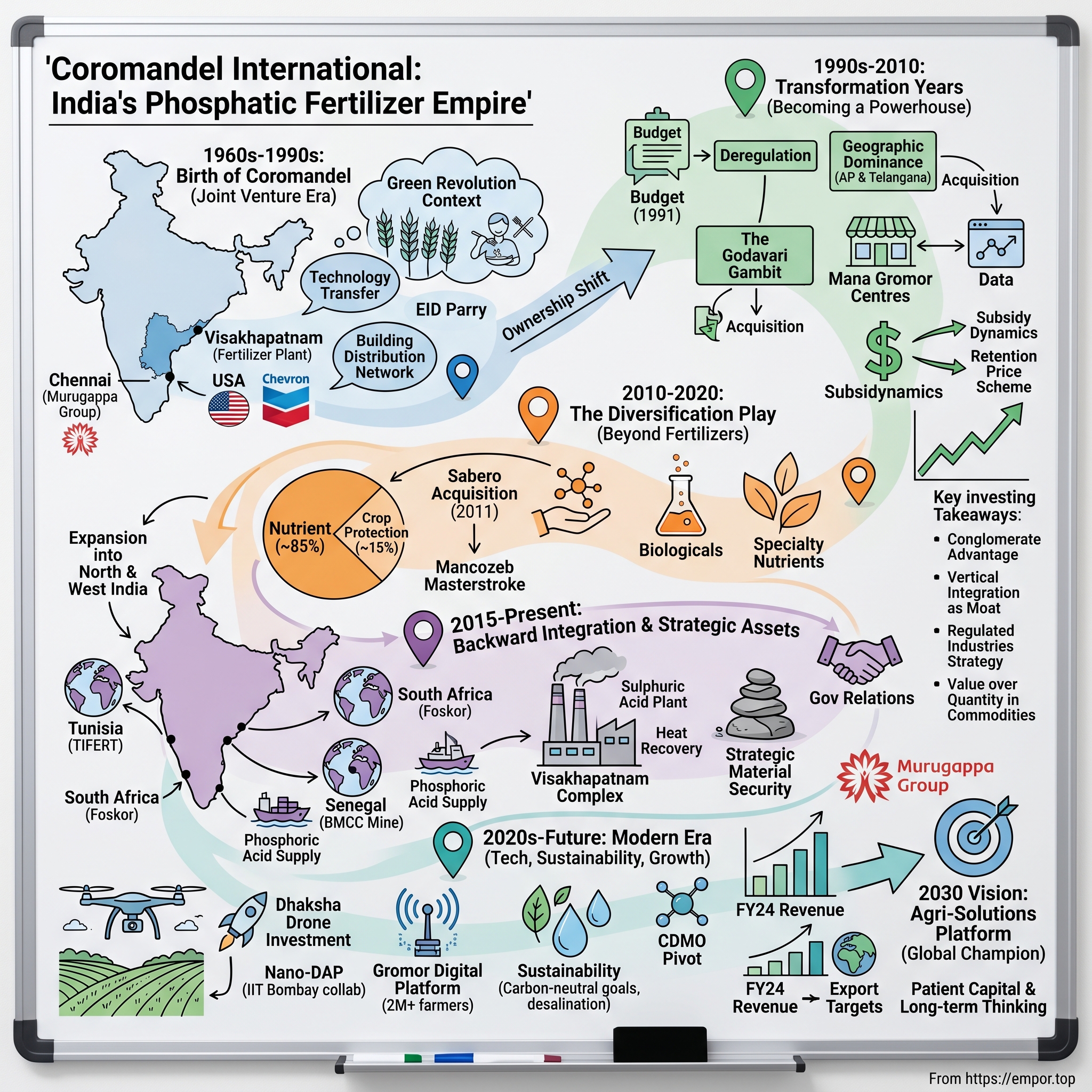
Coromandel International: The Phosphatic Fertilizer Empire of India
I. Introduction & Episode Roadmap
On July 23, 2026, Coromandel International published quarterly results that presented a sharp divergence: revenue rose, but profit dropped by twenty-five percent. Buried in the third paragraph of the press release was a sentence that explained the shortfall: the Middle East conflict had driven a "sharp escalation in raw material prices, while subsidy rates remained inadequate to fully offset the increased input costs."1
That single sentence captures the core economic dynamic of Indian phosphatic fertilizer. A company that serves 3 million farm households, operates 21 manufacturing facilities and more than 1,200 rural retail stores, and generated consolidated turnover of ₹31,827 crore in the fiscal year ended March 2026 remains deeply dependent on two external factors: the landed import prices of ammonia, sulphur, and phosphoric acid, and the per-kilogram subsidy rates set by the Government of India.12
The central question for investors is not whether Coromandel runs efficient operations. By most operational metrics, it does. The critical issue is whether a business with such high exposure to geopolitics and government fiscal policy can sustain a true economic moat—and if so, where that moat resides.
The scale today. Coromandel is India's second-largest manufacturer and marketer of phosphatic fertilizers by installed capacity, and the largest by point-of-sale volume for two consecutive years—a distinction highlighting the gap between manufacturing footprint and retail market throughput.34 In fiscal year 2026, the company sold a record 74.5 lakh metric tonnes of fertilizer, comprising 42.8 lakh tonnes of di-ammonium phosphate (DAP) and NPK complexes, alongside 8.4 lakh tonnes of single superphosphate (SSP), marking its highest-ever SSP volume.4 Coromandel accounts for roughly 17.5% of total Indian phosphatic fertilizer consumption and holds about 35% of the market for unique nutrient grades—proprietary formulations that serve as the industry's closest equivalent to branded products.4 Beyond bulk fertilizers, the group operates units in agrochemicals, specialty nutrients, neem-based bio-pesticides, and agricultural drones, while securing control of a listed crop protection company in August 2025.19
The central thesis to test. Bulk fertilizer presents classic structural challenges: commoditized output, regulated retail pricing, reliance on imported raw materials, and customer purchasing power tied directly to seasonal monsoon rainfall. Coromandel's strategy over two decades of capital allocation has been to counter these headwinds by securing physical supply infrastructure—placing coastal plants near deepwater ports, expanding captive acid production, and acquiring direct equity stakes in rock phosphate mines—while controlling the retail distribution network directly through its proprietary store footprint. The central objective of this analysis is to evaluate whether this vertical integration effectively insulates the business from industry volatility.
The roadmap begins with the Murugappa Group and the post-independence food crisis that elevated fertilizer to a strategic national priority. It details the company's 1961 founding, when two American corporations partnered with a Madras trading house to build a plant on the Bay of Bengal. The analysis then traces how Coromandel transitioned from marketing unbranded commodities to creating proprietary grades, expanding into crop protection, and executing a decades-long backward-integration strategy spanning from a Tunisian joint venture to a Senegalese phosphate mine. Finally, it examines Coromandel's expansion into nano fertilizers, agricultural drones, contract manufacturing, and the NACL acquisition, before evaluating the enterprise through competitive frameworks, operational metrics, corporate governance, and key investment risks.
 Subscribe on LinkedIn
II. The Murugappa Dynasty & The Indian Agri Crucible
The Chettiars of Chettinad were, for a century, the most sophisticated financial network in colonial Asia. They ran a private banking system that moved rice money from Rangoon to Colombo to Penang on handwritten instruments and personal reputation. It was a business built entirely on the durability of a family name—a critical backdrop for understanding a family that would later insist on separating ownership from management.
The Murugappa Group dates its founding to 1900.7 Its early capital emerged from that Burma-centred moneylending network, and its early history was shaped by disruption: the Japanese invasion, Burmese nationalization, and the forced repatriation of a diaspora fortune back to Madras. Capital that had earned returns across Southeast Asia returned home to seek new opportunities in Indian industry.
The governance blueprint. What distinguishes the Murugappa model from the typical Indian promoter group is the deliberate insertion of a professional layer between the family and the operating companies. Family members sit on boards, while professional executives run the operating businesses. Today, the group spans ten listed companies—including Carborundum Universal, CG Power, Cholamandalam Investment & Finance, Tube Investments, E.I.D. Parry, Coromandel, and NACL Industries—generating a combined turnover of ₹90,178 crore in fiscal year 2025 with roughly 94,041 employees.1[^20] The group's stated core values remain focused on traditional principles: integrity, passion, quality, respect, and responsibility.1
That blueprint has faced tests, and later analysis will examine how it held up. For now, the key structural consequence is that Coromandel has never been run by a founder-CEO imposing a personal vision. Instead, it has been managed by professional executives operating on multi-decade horizons under family supervision. This structure yields a patient, conservative enterprise that limits financial leverage, avoids high-stakes gambles, and occasionally moves slower than market dynamics demand.
The scope of that oversight shapes how Coromandel operates. Murugappa's businesses span abrasives, technical ceramics, bicycles, transformers, railway signaling equipment, sugar, tea, and non-banking finance—a portfolio with little operational overlap beyond a mandate to hold a top-two position in every target market.1 A conglomerate of this structure does not rely on Coromandel as a primary growth engine; rather, it requires Coromandel to provide consistent stability. This priority becomes evident in how the company navigates cyclical downturns.
The crucible. To understand why India required this enterprise, consider the agricultural realities of the early 1960s. India imported wheat under the American PL-480 program, paying in non-convertible rupees—an arrangement that granted Washington significant leverage over New Delhi's food supply and gave rise to the phrase "ship-to-mouth." Indian agricultural land, cultivated for centuries, was depleted of key nutrients like phosphorus and nitrogen. Meanwhile, the high-yielding crop varieties developed during the Green Revolution required intensive chemical inputs to function efficiently. Without chemical fertilizers, high-yielding seed varieties underperformed traditional landraces.
The Green Revolution was, in effect, a fertilizer revolution alongside seed innovation. India could not scale agricultural output without fertilizer, yet domestic production was virtually non-existent.
A second structural barrier existed: building fertilizer manufacturing capacity required imported equipment, technology, and raw materials, all of which demanded scarce foreign currency reserves. To overcome this constraint, New Delhi sought foreign direct investment to construct production facilities, offering international firms access to a vast domestic market in exchange for local equity partnerships and regulatory compliance. That economic arrangement, negotiated across major industries in the early 1960s, led to two American corporations taking equity stakes in a fertilizer facility on the Bay of Bengal.
Parry enters. E.I.D. Parry was a Madras-based trading house established in the late eighteenth century that had expanded into sugar and industrial chemicals by the twentieth century. The firm constructed India's first fertilizer plant at Ranipet, Tamil Nadu, in 1906—establishing deep institutional expertise in raw material sourcing, acid plant operations, and regional agricultural distribution.3 Although the Murugappa Group would eventually acquire control of E.I.D. Parry to solidify its position in South Indian agriculture, in 1961 Parry remained an independent entity, joining two American corporations as the domestic partner in a three-way joint venture.
III. The Joint Venture Era: Building Coastal Assets (1961–1990s)
In the early 1960s, a joint venture set out to build a complex fertilizer plant in India. While a traditional domestic manufacturer might have selected an inland location near agricultural demand—such as the Deccan Plateau or the Gangetic Plain—the project's planners selected Visakhapatnam, a port city on the Bay of Bengal.
Coromandel Fertilisers Limited was incorporated in 1961 as a joint venture involving Chevron Chemical Company and International Minerals & Chemical Corporation of the United States, alongside E.I.D. Parry.3 The Visakhapatnam complex fertilizer plant was commissioned in 1967, becoming an anchor asset during India's Green Revolution.3
Why the coast decided the next sixty years. India possesses almost no commercially viable rock phosphate and lacks a natural gas surplus to manufacture ammonia at scale. Consequently, the dominant cost in a bag of Indian phosphatic fertilizer has always been imported raw materials arriving by sea.
An inland plant incurs freight costs twice: first moving heavy, low-value bulk raw materials—rock phosphate, sulphur, ammonia, and phosphoric acid—overland to the factory, and then shipping finished product out to farms. By contrast, a deepwater port facility receives bulk imports directly from vessels, incurring inland transport costs only once, on the higher-value finished goods.
While simple in principle, Coromandel’s early location decision yielded a long-term structural advantage. Over six decades, the company compounded this position by building specialized ammonia storage, acid tankage, jetty access, conveyor systems, and granulation trains on coastal land. By the time competitors attempted to replicate this footprint, comparable industrial land with deepwater berth access was scarce, heavily regulated, and difficult to acquire.
Learning to formulate. The joint venture also established expertise in chemical formulation. A complex fertilizer is not a mechanical blend; it is a chemical granule in which nitrogen, phosphorus, and potassium are bound together, ensuring each particle delivers an identical nutrient ratio. Physically blended fertilizers risk segregation in transit, as particles of different weights separate and yield uneven nutrient distribution in the field.
The distinction between blending and granulation is fundamental. Physical blending resembles mixing gravel and sand in a truck, where vibration causes smaller particles to settle at the bottom. Chemical granulation is akin to mixing concrete, binding components into a uniform material that cannot separate. Granulation requires chemical reactors and controlled drying processes, demanding significantly more capital and technical expertise than simple blending operations.
This technical capability allowed Coromandel to formulate specific nutrient ratios tailored to regional soils and crops, establishing a clear distinction from standardized di-ammonium phosphate (DAP). The company targeted these early complex grades at the paddy and cash-crop belts of coastal Andhra Pradesh. As a result, Andhra Pradesh and Telangana developed into India's most complex-fertilizer-intensive markets, remaining Coromandel's core regional territory.
The Americans leave. By the late twentieth century, Chevron and IMC shifted focus to their primary global operations and divested their Indian equity; Coromandel's official public history records its 1961 incorporation and American partnership without detailing the exit timeline.3 Ownership consolidated under E.I.D. Parry, and by extension, the Murugappa Group. In 2003, E.I.D. Parry's Farm Inputs Division was merged into Coromandel, consolidating the group's agricultural inputs into a single listed vehicle.3
For investors, the joint venture era established key operational assets: coastal infrastructure, chemical granulation capabilities, and a strong market position in South India. However, it did not create pricing power. Under a regulatory regime where the Indian government set both farmgate prices and manufacturer return margins, market pricing power remained unexercised. That regulatory framework was about to undergo fundamental reform.
IV. The Great Transformation: Scale, Branding & Geographic Dominance (1990s–2010)
For thirty years, Indian fertilizer manufacturers operated under a retention price scheme that functioned as cost-plus regulation: the government fixed the farmgate price, calculated each plant's operating costs, and subsidized the difference alongside an assured return. It was a framework that rewarded capital deployment in plant construction while insulating manufacturers from operational inefficiency. Production efficiency simply did not dictate financial survival.
Economic liberalization in 1991, followed by the partial decontrol of phosphatic fertilizers, eliminated that guarantee. Differences in plant operating efficiency and raw material costs began reflecting directly on corporate income statements rather than being absorbed by the public treasury. While partial decontrol presented a severe disruption across much of the industry, it opened an opportunity for a producer positioned adjacent to deepwater ports with lower landed input costs.
Buying the neighbour. Coromandel responded to market decontrol by expanding scale within its primary geographic market. Beginning around 2004, the company initiated an acquisition of Godavari Fertilisers and Chemicals, another Andhra Pradesh-based phosphatic producer, completing the corporate amalgamation later in the decade.3 The economic rationale was straightforward: in a capital-intensive industry producing heavy bulk commodities, regional distribution density dictates profitability. Merging two producers serving identical farmer catchments eliminated redundant dealer networks and overlapping supply chains. The transaction elevated Coromandel to the second-largest phosphatic fertilizer producer in India—a position it retains today.3
Regional distribution density holds exceptional weight in fertilizer manufacturing because of freight economics. A metric tonne of NPK fertilizer carries a modest unit value relative to its weight. Transporting it 1,000 kilometers consumes a substantial fraction of its margin. Consequently, every manufacturing facility operates within an economic supply radius beyond which it cannot cost-effectively compete against closer producers. The Indian market does not function as a single unified national market; rather, it operates as a network of overlapping regional markets where proximity and grade availability determine market share. Coromandel's strength in southern India reflects its coastal manufacturing footprint, just as its historic limits in northern and western India reflect the same freight constraints.
De-commoditizing the bag. Alongside consolidation, Coromandel executed a strategic shift toward product branding.
Agricultural input marketing faces an inherent information asymmetry: farmers cannot visually inspect nutrient quality at purchase. A bag of di-ammonium phosphate (DAP) appears identical to any other. Nutrient concentrations are invisible, product adulteration remains an industry risk, and crop yield outcomes depend on weather, pest pressure, and soil conditions over a full growing season. In markets where buyers cannot independently test product quality before purchase or isolate variables after application, brand reputation serves as the primary proxy for quality assurance.
Coromandel established its Gromor brand to serve that signaling function. Rather than applying a brand label solely to standard commodity formulations, the company developed proprietary nutrient ratios tailored to local soil chemistry and regional cropping patterns. Farmers in target districts were offered specialized nutrient grades backed by agronomic recommendations rather than generic fertilizer.
This formulation strategy generated distinct commercial positioning. Coromandel holds approximately 35% of the unique-grades market segment in India, compared to an overall consumption share of roughly 17.5% in standard DAP.4 That divergence reflects the value generated through proprietary formulation. Unlike commodity DAP, which is priced against international market benchmarks, unique grades are priced primarily on localized agronomic value, providing partial insulation from global raw material price swings.
However, the distinction carries structural limits. Unique grades remain classified within regulatory subsidy frameworks, and their per-kilogram government subsidies are set using the same nutrient-based formula applied across the industry. Formulation differentiation provides margin resilience rather than total pricing independence.
Owning the last mile. In 2007, Coromandel launched its proprietary rural retail store network.3 Direct retail represented a departure from traditional industry distribution, which relied on independent dealers who managed multi-brand inventories, provided informal grower credit, and controlled direct farmer relationships. Building a company-owned retail presence placed the manufacturer in direct competition with traditional wholesale channels.
The retail network provided direct supply chain control and customer data access. Company-managed outlets eliminated product counterfeiting risks, offered verified inputs, and provided on-site soil testing to validate grade recommendations. By selling crop protection products and specialty nutrients alongside bulk fertilizers, the stores converted seasonal fertilizer purchases into multi-product customer relationships. Crucially, direct retail provided real-time point-of-sale demand data rather than delayed channel inventory reports.
From its initial footprint, the network grew to roughly 750 outlets by March 2023.7 Expansion accelerated over the subsequent three years, expanding the network past 1,200 stores across Andhra Pradesh, Telangana, Karnataka, Tamil Nadu, and Maharashtra—supported by a net addition of approximately 320 stores in fiscal year 2026 alone, which drove a 31% annual increase in retail segment revenue.14 Across this retail infrastructure, Coromandel delivers agronomic advisory, soil testing, and farm mechanization services to approximately 3 million farming households.1
This service integration reinforces product sales. Soil testing identifies specific field nutrient deficits, providing an objective basis for recommending tailored fertilizer formulations. Recommending proprietary grades backed by soil data builds customer trust while driving demand for products manufactured by the company and stocked at its stores. This integration converts bulk commodity sales into advisory-led input distribution.
Managing a direct retail footprint requires sustained capital expenditure across agricultural cycles. Coromandel continued funding network expansion through periodic industry downturns, establishing a retail asset base that would become central to its modern distribution strategy.
Toward the close of this expansion decade, the corporate entity removed "Fertilisers" from its official name to become Coromandel International—reflecting the broadening of its operating portfolio beyond bulk fertilizer manufacturing.
V. The Agrochemical & Diversification Playbook (2010–2020)
The central economic challenge facing Coromandel's leadership throughout the 2010s was structural margin volatility in the nutrient business. When global prices for raw materials like phosphoric acid spiked, input costs escalated immediately while realized revenues lagged, bounded by government farmgate price ceilings and competitive dynamics. Gross margins compressed precisely when working capital demands expanded—making bulk fertilizer operations most vulnerable during periods of international commodity volatility.
To counter this vulnerability, Coromandel sought a business line operating on a different economic cycle. Crop protection offered that structural balance: non-patented generic active ingredients, prices governed by market demand rather than public subsidy, export market access, and a cost structure driven by entirely distinct chemical feedstocks.
The company executed this strategic pivot through acquisitions.
Sabero Organics, 2011. In May 2011, Coromandel announced the acquisition of a controlling interest in Sabero Organics Gujarat, purchasing roughly 1.24 crore shares—representing about 36.75%—from Sabero's promoters, before completing a mandatory open offer on December 17, 2011 that raised its total stake to 67.75%.10[^11][^21] The company guided total acquisition costs, including the open offer, at ₹400 crore to ₹450 crore.10 The specific non-compete arrangement was not detailed in Coromandel's official release.
Sabero, founded in 1991, generated ₹413 crore in turnover during fiscal year 2011, with exports accounting for ₹220 crore. It manufactured fungicides, herbicides, and insecticides across facilities in Gujarat, held more than 240 product registrations, and operated international subsidiaries in Brazil, Argentina, Australia, and Europe. In Coromandel's characterization, the acquired entity stood "among the lowest cost producers in the world for its key products."10 Executive Chairman A. Vellayan framed the deal as part of a strategy "to grow its non-subsidy businesses," noting that the combined entity would offer sixteen technical-grade pesticides.10
The critical distinction lay in the technical-grade designation. Most Indian agrochemical companies operate as formulators, purchasing active chemical molecules and blending them into commercial products. Synthesizing the active ingredient itself—the technical grade—requires complex multi-step chemical synthesis, hazardous material management, and multi-year regulatory approvals. While formulation resembles baking with purchased flour, technical manufacturing is akin to operating the flour mill. The Sabero acquisition provided Coromandel with synthesis capabilities.
The honest assessment. Sabero was not an immediate operational success. Integration required several years, the acquired business carried debt that had to be restructured, and the core strategic benefits—synthesis capabilities and international product registrations—were slow to translate into earnings. The transaction also created a corporate governance issue that subsequent analysis will examine, as the Securities and Exchange Board of India (SEBI) later alleged that unpublished price-sensitive information concerning the deal had leaked.15
For long-term investors, the transaction represented an acquisition of technical capability rather than immediate cash flow, requiring management to absorb years of sub-par performance. Distinguishing patient capital deployment from a delayed admission of an overpayment depends on evaluating what the capability ultimately delivered. By fiscal year 2026, crop protection revenue grew 16% with segment profitability up 55%, and the company commissioned a 9,000 metric tonne Mancozeb technical facility at Dahej in January 2026.24 Because Mancozeb represents a legacy Sabero molecule, the facility demonstrates that the underlying synthesis capability achieved operational scale fifteen years after the original transaction.
The neem business. A smaller asset within the portfolio is the bio-pesticides division. Coromandel describes itself as the world's largest manufacturer of neem-based bio-pesticides, with a business built on botanical extraction.3 The active compound, azadirachtin, is extracted from neem kernels and acts as an insect growth regulator rather than a neurotoxin, disrupting pest moulting and feeding rather than causing immediate mortality.
The strategic value rests on regulatory dynamics in key export markets. Organic certification frameworks in North America and Europe prohibit synthetic chemical pesticides while permitting botanical actives. As organic acreage expanded in those regions, demand grew for a product in which India holds a natural agricultural advantage due to widespread neem cultivation. Coromandel acquired E.I.D. Parry's bio-pesticides business in 2023, consolidating the group's market position.3 Because the company does not independently disclose precise global export share figures for azadirachtin, specific market share claims require cautious evaluation.
Segment reality check. Throughout the 2010s, bulk nutrients generated the vast majority of corporate revenue while crop protection remained a secondary segment—a distribution that has only recently started to shift. In the first quarter of fiscal year 2027, the nutrient and allied business contributed roughly ₹6,951 crore in gross consolidated revenue, compared with ₹1,251 crore from crop protection, which was expanded by the consolidation of NACL.9 While diversification has broadened the portfolio, fifteen years after the Sabero acquisition, Coromandel remains fundamentally a fertilizer enterprise with an attached crop protection division. Evaluating the firm primarily as a specialty chemicals producer misinterprets its core revenue drivers.
VI. The Moat Building: Backward Integration & Raw Material Security (2015–Present)
The global phosphate market is among the most geographically concentrated commodity sectors in the world. A small group of countries—led by Morocco, followed by China, the United States, Saudi Arabia, Jordan, and Russia—controls the vast majority of economically extractable rock phosphate. India possesses virtually no domestic reserves, leaving the country dependent on imports for nearly all of its rock phosphate and roughly half of its phosphoric acid requirement.
This dependency leaves Indian manufacturers in a structurally weak bargaining position. In annual procurement negotiations, domestic buyers face a consolidated supplier base aware of two key constraints: Indian agriculture cannot function without imported feedstock, and domestic retail fertilizer prices remain politically regulated. Under these conditions, international contract negotiations often resemble administrative price announcements rather than open market discovery.
Coromandel’s strategic response over two decades has been to move upstream through progressive backward integration—not to escape global commodity markets entirely, which remains impossible for an Indian producer, but to alter the nature of its cost exposure.
Rung one: internalizing acid production. The primary method for reducing dependence on merchant phosphoric acid is purchasing raw rock phosphate and processing it in-house. This requires constructing both sulphuric acid units to dissolve the raw rock and phosphoric acid facilities to execute the chemical conversion. Both assets demand heavy capital deployment, complex environmental permits, and multi-year construction timelines.
In the fourth quarter of fiscal year 2026, Coromandel commissioned a 650 tonne-per-day phosphoric acid plant alongside a 2,000 tonne-per-day sulphuric acid facility at Kakinada, representing a project investment of roughly ₹1,100 crore.2 This project formed part of a total capital expenditure of ₹1,337 crore in fiscal 2026, embedded within a broader ₹7,000 crore organic and inorganic investment program executed between fiscal years 2021 and 2026.417
The underlying economic logic rests on spread capture. Because international rock phosphate and merchant phosphoric acid prices do not move in exact lockstep, the differential between raw rock and processed acid represents a conversion margin. When global acid markets tighten faster than raw rock supplies—typically during periods of merchant acid capacity constraints—a producer with internal processing infrastructure captures that conversion spread while unintegrated competitors face margin compression. Consequently, management has consistently framed captive acid capital expenditure as a supply security initiative first and a cost reduction tool second.
However, an analytical caveat is necessary: Coromandel does not publicly report a breakdown comparing captive manufacturing costs against imported merchant acid prices. Any specific percentage cost advantage cited in secondary commentary reflects external estimates rather than audited corporate disclosures.
Rung two: strategic equity in overseas acid producers. Prior to expanding its domestic processing plants, Coromandel secured equity positions in foreign acid producers. In 2005, the company acquired a stake in South Africa’s Foskor, a major global phosphoric acid manufacturer, paired with a technical and operational agreement covering plant performance, procurement, and logistics to stabilize supply reliability.
A larger joint venture was established in Tunisia. Tunisian Indian Fertilisers (TIFERT) was developed as a $498 million project in which Coromandel and Gujarat State Fertilizers & Chemicals (GSFC) each held a 15% equity stake, alongside Tunisian state entities Groupe Chimique Tunisien and Compagnie Des Phosphates de Gafsa, which retained 35% each.11 Commissioned on July 12, 2013 following operational delays linked to political instability in Tunisia, the facility processes approximately 1.4 million tonnes of local rock phosphate annually to yield 360,000 tonnes of phosphoric acid—with the total output contracted for long-term export to Coromandel and GSFC in India.11
The execution timeline of TIFERT highlighted the inherent limits of foreign equity partnerships. Political upheaval during the Arab Spring pushed the plant's planned 2011 startup to 2013. A minority equity position in a foreign enterprise does not eradicate supply chain vulnerability; rather, it shifts exposure from commercial price fluctuations to geopolitical and sovereign risk. For investors, TIFERT functioned not as a risk elimination tool, but as a trade-off between market price volatility and country-specific operational disruption.
Rung three: acquiring upstream rock phosphate assets. In May 2022, Coromandel expanded into raw material extraction by acquiring a 45% equity stake in Baobab Mining and Chemicals Corporation (BMCC), a Senegalese rock phosphate mining firm, for approximately ₹225 crore.[^14] Rather than taking full control immediately, the company expanded its ownership progressively, investing an additional $3.84 million in equity alongside a $6.5 million loan in September 2024 to reach a 53.8% stake, before raising its total holding to 71.5% by fiscal year 2026.124
Managing Director and Chief Executive Officer S. Sankarasubramanian stated during the 2024 stake increase that investing directly in rock phosphate mines was "critical for attaining long term supply security."12 Coromandel currently blends Senegalese rock phosphate at its Visakhapatnam complex and has linked expanding BMCC extraction volumes to supplying the newly commissioned phosphoric acid facility at Kakinada.12
This phased entry illustrates Coromandel’s disciplined approach to capital deployment. Rather than acquiring a mine prior to securing downstream processing assets or constructing plants without guaranteed feedstock, the company secured an initial minority position, spent two years evaluating operational performance, expanded equity control as production stabilized, and synchronized majority ownership with the commissioning of its Kakinada acid plant.
The rationale behind phased acquisition. While initial minority investments in mining assets can appear cautious, resource projects in emerging markets carry operational risks that financial due diligence cannot fully uncover. Sustainable mine throughput relies on local infrastructure, equipment maintenance, port logistics, and labor relations. Securing a 45% stake permitted Coromandel to test operational viability on-site before committing majority capital.12[^14] The decision to subsequently acquire controlling equity and ultimately reach a 71.5% holding served as operational validation; an underperforming asset would have halted capital expansion at the initial entry level.4
Structural limitations of the economic moat. A rigorous assessment requires defining the boundaries of what backward integration accomplishes. BMCC output provides only a portion of total rock phosphate requirements, TIFERT covers a fraction of overall acid imports, and domestic captive plants reduce but do not eliminate merchant market purchases. The vulnerability to global price swings remains evident: during the June 2026 quarterly earnings call, management disclosed that quarterly contract prices for imported phosphoric acid had increased by $350 per tonne, settling at $1,700 per tonne compared to $1,350 in the prior quarter—a cost surge that partial backward integration could not fully offset.6
Backward integration does not grant complete immunity from global commodity cycles. Instead, it provides operational flexibility and supply continuity. Coromandel retains the ability to adjust its raw material mix between imported merchant acid and captive rock processing based on prevailing market spreads, while maintaining high plant utilization during global supply shortages when unintegrated competitors struggle to secure cargo. In a high-fixed-cost manufacturing environment, sustained plant utilization during industry downturns represents a tangible competitive advantage—a defensive moat that is more bounded than promotional narratives suggest, but operationally effective nonetheless.
VII. Modern Era: AgTech, CDMO, & Strategic M&A (2020–Present)
By the early 2020s, Coromandel faced a challenge typical of mature, cash-generative enterprises: a strong balance sheet, a dominant position in its core business, and substantial capital requiring productive allocation. What followed was the most active period of acquisitions and strategic expansion in the company's history—a phase demanding rigorous scrutiny from prospective investors.
The shocks that framed the decision. The 2021–2024 period underscored the structural volatility inherent in fertilizer manufacturing. International prices for key inputs—ammonia, sulphur, and phosphoric acid—swung dramatically due to pandemic-related supply chain dislocations and the war in Ukraine. Global shipping freight rates spiked simultaneously. Concurrently, the Indian government adjusted per-kilogram subsidy rates each season under the Nutrient Based Subsidy (NBS) framework, leaving manufacturers to fund working capital gaps when subsidy revisions lagged input cost inflation.
The mechanics of fiscal policy remain a primary external variable affecting corporate earnings. Under the NBS regime, the Cabinet fixes per-kilogram subsidies for nitrogen, phosphorus, potassium, and sulphur for six-month seasonal blocks, while manufacturers determine retail farmgate prices within government-tolerated limits. For the Kharif season running from April 1 to September 30, 2026, the Cabinet approved a fertilizer subsidy outlay of ₹41,533.81 crore on April 8, 2026—an increase of roughly ₹4,317 crore over the ₹37,216.15 crore allocated for Kharif 2025.14
Because subsidy rates remain fixed for six-month periods while raw material import prices fluctuate daily, sudden cost increases after a season begins must be absorbed by manufacturers until the subsequent rate revision. This lag served as the direct mechanism driving Coromandel's margin compression in the quarter ended June 2026.1
NACL Industries: doubling down on crop protection. On March 12, 2025, Coromandel entered into definitive agreements to acquire a 53% controlling stake in NACL Industries from promoter entity KLR Products at ₹76.70 per share, representing an investment of ₹820 crore, alongside a mandatory open offer for up to 26% under SEBI takeover regulations.8 The transaction closed on August 8, 2025.9
NACL brought technical synthesis and formulation manufacturing units in Andhra Pradesh, an R&D facility near Hyderabad, a newly constructed technical-grade plant at Dahej, a pan-India branded distribution footprint, and established contract manufacturing relationships with multinational agrochemical companies.8 Executive Chairman Arun Alagappan described the deal as "a defining moment for Coromandel International's Crop Protection business."8
The strategic rationale reflected geographical and operational alignment: Coromandel’s crop protection footprint was concentrated in South Indian retail channels and specific technical molecules, whereas NACL provided branded formulation reach across Northern and Central India alongside active contract manufacturing operations. Operational overlap was modest and portfolio complementarity was evident. Following the acquisition, NACL reported fiscal 2026 revenue growth of 28% to ₹1,584 crore and returned to profitability, achieving quarterly EBITDA of ₹41 crore and improving its operating margin from 8% to 11% by the June 2026 quarter.246
However, NACL was acquired out of financial distress, and an 11% EBITDA margin remains modest compared to the 18% to 22% operating margins earned by leading Indian crop protection peers during favorable market cycles. While early integration metrics are encouraging, the full long-term value creation thesis remains to be proven.
CDMO: the genuinely unproven bet. On March 22, 2023, Coromandel’s board approved an entry into Contract Development and Manufacturing Operations (CDMO), alongside diversification into specialty and industrial chemicals, committing a planned capital expenditure of ₹1,000 crore over two years to construct multi-product synthesis plants at two manufacturing locations.7 Arun Alagappan, then Executive Vice Chairman, framed the initiative as leveraging internal "expertise in handling complex chemistries at commercial scale."7
Evaluating this expansion requires recognizing the distinct execution demands of custom synthesis. In a CDMO model, global innovator firms contract the production of proprietary molecules under stringent quality standards, intellectual property safeguards, and detailed customer audits. Customer relationships are long-term and sticky, but supplier qualification spans multiple years and depends as much on regulatory compliance, quality management, and data integrity as on basic chemical synthesis.
Coromandel contends that its operational experience in scaling multi-step chemical reactions translates directly to custom synthesis. However, manufacturing high-volume generic actives like Mancozeb differs fundamentally from producing low-volume, high-value patented intermediates to external customer specifications. At present, CDMO investments represent early-stage capital deployment with negligible current revenue and no public revenue targets from management. Until commercial supply agreements with anchor customers are secured, the segment provides theoretical optionality rather than established earning power.
Drones and nano. In September 2022, Coromandel's venture capital arm, Dare Ventures, acquired an 18.34% equity stake in Dhaksha Unmanned Systems. On June 30, 2023, the company acquired an additional 32.68% stake for ₹204 crore—valuing Dhaksha at ₹625 crore—to secure a 51.02% controlling interest, before further increasing its holding in 2024.13 Founded in Chennai in 2019, Dhaksha held three DGCA type certificates and had trained approximately 950 remote pilots, while generating fiscal 2022 revenue of ₹4.52 crore.13
The transaction metrics underscore its venture capital character: Coromandel committed ₹204 crore to acquire a controlling stake in an entity generating under ₹5 crore in annual sales. During the June 2026 earnings call, management noted that Dhaksha was pursuing defense supply contracts alongside its agricultural drone platform—a strategic pivot indicating that agricultural spraying services alone had not achieved commercial scale.6
In contrast, nano fertilizers have shown faster initial commercial adoption. Coromandel commissioned a nano-fertilizer production facility at Kakinada in 2024 and subsequently captured approximately 50% of the domestic nano DAP market.34 Nano-formulated nutrients offer logistics advantages by substituting bulk bags with liquid foliar sprays. However, long-term agronomic efficacy across diverse soil types and widespread farmer adoption remain subject to ongoing field validation, meaning a high market share in an emerging product category does not yet represent a major earnings contributor.
The scale that was quietly added. Beyond segment initiatives, Coromandel expanded its physical infrastructure substantially. In March 2023, the enterprise operated 17 manufacturing facilities and roughly 750 company-owned retail outlets, generating fiscal 2022 turnover of ₹19,255 crore.7 By mid-2026, the operational footprint expanded to 21 manufacturing facilities, 8 R&D centers, and over 1,200 retail stores, generating fiscal 2026 turnover of ₹31,827 crore with approximately 13,650 employees.13 Adding four manufacturing plants and 450 retail outlets in three years without increasing financial leverage represents significant balance-sheet-funded physical expansion, creating a broader asset base over which future earnings will be generated.
The financial picture. Fiscal 2026 delivered record top-line performance, with consolidated total income rising 30% to ₹31,827 crore, EBITDA increasing 23% to ₹3,232 crore, and profit before exceptional items growing 13% to ₹2,688 crore.2 However, consolidated net profit fell 8% to ₹1,898 crore, impacted by fourth-quarter performance where total income rose 19% to ₹6,068 crore while net profit declined 80% to ₹115 crore.2 Annual phosphatic fertilizer sales volumes expanded 7% to 4.3 million tonnes.2 The board of directors declared a total dividend of ₹11 per share for the fiscal year, comprising a ₹9 interim dividend in February 2026 and a ₹2 final dividend.2
The decade in perspective. Evaluating a cyclical enterprise over a single fiscal year provides limited perspective. Over a ten-year horizon, consolidated sales grew from approximately ₹11,481 crore in fiscal 2016 to ₹31,480 crore in fiscal 2026, while net profit expanded from ₹357 crore to ₹1,898 crore.5 This long-term growth reflects structural margin improvement across economic cycles despite short-term input volatility.
However, revenue trajectory highlights the pass-through nature of bulk fertilizer pricing. Consolidated sales reached ₹19,111 crore in fiscal 2022, surged to ₹29,628 crore in fiscal 2023 during global commodity spikes, contracted to ₹22,058 crore in fiscal 2024 as input prices normalized, and subsequently recovered to ₹24,085 crore in fiscal 2025 and ₹31,480 crore in fiscal 2026.5 These revenue swings reflect changes in underlying raw material price indices rather than shifts in structural farmer demand.
Consequently, physical sales volume—demonstrated by 74.5 lakh tonnes of total fertilizer and 4.3 million tonnes of phosphatic products sold in fiscal 2026—serves as the primary indicator of franchise strength, maintaining steady growth throughout global commodity fluctuations.24 Financial performance in any short window reflects international phosphate market dynamics rather than core operational expansion.
The divergence between rising sales volume and temporary profit compression encapsulates Coromandel's current operational position: the business continues gaining physical market share while unit margins remain subject to raw material costs and subsidy timing. Operating metrics remain sound, with return on capital employed at 22%, return on equity at 16.4%, conservative debt of ₹1,506 crore against reserves of ₹12,528 crore, and a working capital cycle of 35 days.5 For long-term investors, monitoring margin trajectories across subsidy revisions remains more critical than assessing static return ratios.
VIII. Industry Structure, Competitive Dynamics & 7 Powers Moat Analysis
An analysis of the Indian fertilizer market begins with a structural anomaly: Coromandel's largest competitor is not a commercial corporation, but a cooperative.
The competitive landscape. IFFCO—the Indian Farmers Fertiliser Cooperative—is owned by farmer cooperative societies, operates at massive scale, and benefits from tax privileges and political relationships that private competitors cannot replicate. Its primary objective is serving member farmers rather than maximizing corporate profits. Beneath IFFCO sit state-owned enterprises, including Rashtriya Chemicals and Fertilizers, Gujarat State Fertilizers & Chemicals, and Fertilisers and Chemicals Travancore. These public sector units operate under varying levels of efficiency and frequently prioritize public supply targets over capital returns. The private sector includes Paradeep Phosphates under the Adventz group, Chambal Fertilisers in the nitrogen-heavy northern belt, and Indian Potash Limited in imports and trading.[^24]
Competing against entities that are not required to earn a return on invested capital represents a permanent structural headwind. This market dynamic caps pricing power across the sector, regardless of operational efficiency. Any investment thesis for Coromandel must account for this constraint.
Coromandel's market standing. Within this environment, Coromandel holds the second-largest position in Indian phosphatic fertilizers with approximately 17.5% of national consumption. It ranks first by point-of-sale retail volume for two consecutive years, leads the single superphosphate segment with a record 8.4 lakh tonnes sold in fiscal year 2026, and controls roughly 35% of the unique-grades market.34 During the June 2026 earnings call, management reported that primary market share expanded from 18% to 22%—a gain achieved even as the company intentionally curtailed complex NPK fertilizer production to 72% of capacity to manage inventory risks during raw material cost spikes.6
This dynamic—expanding market share while reducing factory output—highlights the strength of Coromandel's retail presence and customer demand, allowing it to manage supply without surrendering shelf space to competitors. Whether this distribution power persists through a prolonged commodity downturn remains a key operational test.
Evaluating competitive moats. Applying Hamilton Helmer's 7 Powers framework provides a structured lens to evaluate which specific mechanisms generate sustainable, differential returns for the business:
- Cornered Resource — partially present. The 71.5% BMCC holding represents a strategic asset, but Senegalese rock satisfies only a fraction of total requirements and is not uniquely high-grade.4 Coromandel's more defensive cornered resource resides in its coastal industrial footprint: prime land, dedicated jetty access, and environmental clearances at Visakhapatnam and Kakinada that cannot be duplicated at any price today.
- Scale Economies — present but shared. Large coastal granulation complexes allow Coromandel to spread fixed overhead across millions of tonnes of output. However, scale advantages are shared with IFFCO and state-owned enterprises built with public capital. Furthermore, Coromandel's scale is primarily regional, maintaining strong dominance in South India while remaining less dense in northern markets—a geographic gap that the NACL acquisition partially addresses within crop protection distribution.
- Process Power — plausible but difficult to verify. Six decades of experience in granulation chemistry and specialized grade development represent substantial institutional knowledge. The company's 35% market share in unique nutrient grades offers the strongest empirical evidence of this capability.4 Nevertheless, process power remains difficult to isolate from brand reputation and historical distribution strength.
- Branding — present and significant. In an agricultural input market where farmers cannot independently verify chemical quality before application, the Gromor brand provides a vital signal of trust. This reflects genuine brand equity rather than counter-positioning, as the company-owned retail model can be replicated by competitors with sufficient capital and patience.
- Switching Costs — largely absent. Farmers face virtually zero monetary switching costs when choosing alternative fertilizer brands for a new planting season. While company-owned retail stores and agronomic advisory services foster customer habits and trust, they do not create structural lock-in. Consequently, customer retention requires continuous operational reinvestment in farmer engagement.
- Network Economies and Counter-Positioning — absent. Fertilizer distribution exhibits no network effects, as one farmer's purchase does not increase product utility for another. Similarly, established competitors can adopt Coromandel's strategic initiatives, eliminating counter-positioning advantages.
Porter's five forces analysis. * Supplier power: very high. Concentrated global rock phosphate and merchant phosphoric acid exporters face structurally deficit Indian buyers. Backward integration mitigates this exposure but cannot eliminate it. * Buyer power: low individually, decisive through government intervention. While individual farmers possess negligible bargaining leverage, the Indian government exercises decisive buyer power by regulating retail farmgate prices and dictating subsidy disbursements. * Threat of new entrants: very low. High capital intensity, strict environmental permitting, and scarcity of deepwater industrial land render greenfield entry nearly impossible. * Threat of substitutes: low in the near term. Crops require essential phosphorus that cannot be synthetically substituted. Emerging liquid nano and organic fertilizers modify application methods rather than underlying plant chemistry, and Coromandel holds positions in both categories. * Rivalry: intense but disciplined. Industry competition focuses on volume throughput, regional distribution density, and product formulation rather than price wars, primarily because government subsidies anchor retail price structures.
Strategic verdict. Coromandel maintains a defensible operational moat within a structurally challenging industry. The enterprise generates above-average returns on capital not through favorable industry dynamics, but by assembling specific, hard-to-replicate advantages: deepwater port infrastructure, proprietary formulation expertise, a direct rural retail footprint, and targeted upstream equity stakes. These operational strengths are durable. However, they remain insufficient to fully insulate corporate earnings during severe raw material price escalations or delayed government subsidy adjustments—a reality starkly demonstrated by the earnings contraction in the June 2026 quarter.
IX. Management, Governance & Capital Allocation
In 2019, the board of Ambadi Investments—the Murugappa family holding company—voted on whether to seat Valli Arunachalam. She brought two decades of Fortune 500 experience. Her late father, M.V. Murugappan, had served as the group's executive chairman and left an 8.15% stake in Ambadi to his wife and two daughters upon his death in 2017. Ninety-one percent of the board vote went against her.16
She and her sister Vellachi took the matter to the National Company Law Tribunal in 2021, alleging oppression and mismanagement, and publicly characterized the group's practice of appointing only male family members to the board as patriarchal. A confidential family arrangement was announced on August 20, 2023, under which all legal proceedings were withdrawn; the terms were not disclosed, and the listed Murugappa companies were not party to the settlement.16
This analysis opens here rather than with an organizational chart because governance within an Indian promoter group is not a mere checklist item. It is the primary mechanism determining whether minority shareholders are treated as partners or passengers. The Murugappa Group's record on governance presents a mixed picture that investors must weigh carefully.
The other half of the record. In May 2015, the Securities and Exchange Board of India (SEBI) charged A. Vellayan—then chairman of both the Murugappa Group and Coromandel—along with three others, alleging the passage of unpublished price-sensitive information concerning the Sabero Organics acquisition. The regulator impounded ₹2.15 crore in alleged unlawful gains from two individuals and indicated it would freeze demat holdings if cash proved insufficient.15
Vellayan stepped down as chairman of E.I.D. Parry days later.15 This represented a significant historical governance event at the apex of the promoter structure, tied directly to the company's largest acquisition of that era. Although the matter did not involve the operating company's direct finances or accounting, and the executive resigned from the chairmanship, any investment thesis relying on conservative family governance must incorporate this event.
The current structure. As of June 2026, promoter ownership stood at 56.35%, held primarily through E.I.D. Parry, alongside domestic institutional holdings of 19.92%, foreign institutional holdings of 11.50%, and public equity of 12.07%, against a total market capitalization of roughly ₹61,809 crore.51819 Combined institutional ownership of more than 31% ensures that the free float is dominated by professional investors who actively engage on earnings calls and scrutinize corporate strategy.
The board comprised ten directors as of March 31, 2026, including six independent members—a 60% independent majority that exceeds statutory requirements.4 Credit ratings sit at CRISIL AAA (Stable) and IND AAA (Stable), the highest domestic tier, providing external validation of balance sheet conservatism.4
Executive leadership is divided in line with traditional Murugappa governance practices: Arun Alagappan serves as Executive Chairman, S. Sankarasubramanian as Managing Director & CEO, and Narayanan Vellayan as Executive Director for the nutrient business.3 On the July 2026 earnings call, Deepak Natarajan presented as Chief Financial Officer.6 Alagappan's role has focused publicly on corporate transformation: he signed the March 2023 CDMO announcement as Executive Vice Chairman and the March 2025 NACL acquisition release as Executive Chairman, serving as the primary voice for diversification initiatives.78 Sankarasubramanian directs operational commentary—covering sales volumes, market share gains, plant commissioning, and raw material negotiations.212 This clear division of labor allows investors to monitor strategic direction and operational execution through distinct leadership roles.
A second-layer read on non-financial disclosures. Operational risk indicators provide external validation of management standards. Coromandel received Responsible Care certification in April 2026—a global chemical industry standard requiring independent verification of health, safety, and environmental systems—while its Kakinada facility earned the British Safety Council's Sword of Honour, reporting a total recordable injury rate of 0.25.4 For an enterprise operating ammonia storage facilities, sulphuric acid plants, and complex chemical synthesis units, safety performance serves as a key operational risk metric, as facility incidents carry severe revenue implications. The company also reported Scope 1 and Scope 2 emissions of 278,564 tonnes of CO2 equivalent against Scope 3 emissions of 5,159,431 tonnes.4 This ratio demonstrates that the corporate carbon footprint is concentrated overwhelmingly in imported raw materials and maritime shipping rather than direct plant operations, meaning any future carbon border adjustments would impact input supply chains where management has limited pricing control.
Capital allocation, assessed on behavior. Capital deployment over the five-year period through fiscal 2026 demonstrated consistent balance sheet discipline. The company committed approximately ₹7,000 crore between fiscal 2021 and 2026 toward organic and inorganic expansion, funded primarily through internal cash generation.4 Total borrowings remained conservative at ₹1,506 crore against accumulated reserves of ₹12,528 crore, reflecting substantial growth without excessive financial leverage.5 The working capital cycle was maintained at 35 days, a notable result in an industry where delayed government subsidy disbursements routinely extend working capital requirements.5 Meanwhile, annual dividends rose to ₹11 per share against earnings per share of ₹68, retaining the vast majority of net profits for business reinvestment.24
The phased acquisition of Baobab Mining and Chemicals Corporation—expanding from an initial 45% stake to 53.8% and ultimately 71.5% over four years—illustrates structured capital allocation: securing initial operational option value before committing majority capital for control.12[^14]4
Conversely, certain capital allocation choices warrant closer scrutiny. The valuation of Dhaksha Unmanned Systems at ₹625 crore for a business generating under ₹5 crore in annual revenue represents a substantial premium over underlying fundamentals.13 Similarly, while the board approved a ₹1,000 crore capital expenditure program for Contract Development and Manufacturing Operations (CDMO) over a two-year horizon in March 2023, three years later the business line yields immaterial financial contributions, and management has not published detailed accounting of cumulative capital spent against operational progress.7
Narrative consistency. Comparing public disclosures between the March 2023 CDMO announcement and the July 2026 earnings call highlights a strategic pivot in executive messaging. Management has shifted focus from capital deployment to asset optimization. During the June 2026 quarter earnings call, leadership indicated that annual baseline capital expenditure would normalize to approximately ₹300 crore, following the roughly ₹7,000 crore invested over the preceding four years, explicitly redirecting priority toward generating cash flows from recently commissioned assets.6 Communicating a transition from capacity construction to cash flow harvesting provides a clear metric for evaluating future capital returns.
X. Earnings Call & Transcript Deep Dive: Analyst Interrogations
On July 24, 2026, the day after publishing first-quarter results showing a 24% drop in consolidated profit, Coromandel's executive team hosted its quarterly analyst call.6 Comparing management’s opening address against the subsequent question-and-answer session offers a clear picture of corporate priorities and operational pressures.
What management chose to lead with. Executive commentary prioritized operational discipline and market share gains over top-line growth. Management had deliberately curtailed NPK fertilizer production to roughly 72% of capacity to prevent high-cost inventory build-up amid raw material price volatility, leading to a 9% to 10% decline in sales volume. Despite that volume reduction, primary market share expanded to 22% from 18% in the prior-year period.6 Leadership also emphasized performance across non-subsidy segments: crop protection revenue rose 20% to ₹870 crore, with earnings before interest, taxes, depreciation, and amortization (EBITDA) increasing 44% to ₹159 crore. Meanwhile, standalone retail revenue grew 85% year-over-year, supported by 76% of store locations operating profitably compared to 61% a year earlier.16
That retail profitability metric represents one of the most critical disclosures from the call, shifting the store network from a strategic assertion into an established unit-economics model. With three-quarters of retail outlets turning a profit, the network can support further geographic expansion without relying on cross-subsidization from bulk fertilizer margins.
What analysts pushed on. Wall Street interrogations focused on three primary vulnerabilities.
First, raw material price escalation. Management confirmed that the second-quarter contract price for imported phosphoric acid settled at $1,700 per tonne, up 26% from $1,350 per tonne in the first quarter—a sharp increase in the company's primary raw material input.6 Rather than offering generalized commentary on input inflation, management provided explicit price metrics.
Second, subsidy exposure and receivables. Management disclosed that subsidy-dependent products accounted for 77% of total revenue. While the company received ₹1,392 crore in subsidy disbursements during the quarter—a 7% increase—outstanding government receivables remained substantial at ₹3,254 crore as of June 30, 2026.6 On policy, management advocated for setting Nutrient Based Subsidy (NBS) rates based on a rolling six-month average of global raw material costs to improve predictability, while noting that domestic manufacturers had already implemented retail price increases of 25% to 30% to offset rising import costs.6
Advocating for a predictable formula rather than emergency relief reflects a long-term institutional approach to regulatory risk. Commercially, the implemented price adjustments confirm that domestic producers retain partial pricing power, demonstrating that political constraints on farmgate prices allow for cost pass-through when raw material inflation escalates significantly.
Third, execution across emerging business segments. Following the acquisition of NACL, management highlighted an operating margin expansion from 8% to 11%. Conversely, commentary surrounding Contract Development and Manufacturing Operations (CDMO) remained conceptual, offering no customer commitments or concrete revenue timelines.6 Analysts also queried digital supply chain tracking pilots and agricultural drone operations, where management noted that subsidiary Dhaksha Unmanned Systems was actively pursuing defense contracts alongside commercial agricultural services—a strategic pivot away from a purely farm-focused model.
The project book, and why it matters more than guidance. Despite short-term margin pressures, management outlined specific project commissioning timelines: the expansion of Mancozeb production capacity at Sarigam scheduled for the second quarter of fiscal 2027, a brownfield granulation expansion adding 7.5 lakh metric tonnes targeted for the fourth quarter of fiscal 2027, alongside ongoing development of a mono-ammonium phosphate (MAP) facility at Kakinada and a specialty seaweed granulation plant.16 Providing explicit quarterly commissioning targets creates a clear, audit-ready framework for investors to track capital deployment and project execution over subsequent earnings reporting cycles.
The forward numbers management put on record. Management established specific multi-year operating benchmarks, targeting approximately 4 million tonnes of domestic fertilizer production alongside 1 million tonnes of traded volume, backed by visibility toward 8 million to 9 million tonnes of aggregate nutrient sales over a two-year horizon. In specialty nutrients, leadership projected annual revenue growth of 25% to 30% with EBITDA margins near 20%, while targeting premium formulation grades to exceed 50% of total single superphosphate (SSP) volume. Crucially, management guided per-tonne EBITDA contribution to between ₹2,500 and ₹3,000.6
Per-tonne contribution serves as a fundamental benchmark for evaluating product differentiation, as it measures net realized spread after absorbing underlying raw material cost fluctuations across the product portfolio. Volunteering a definitive target range provides a concrete metric against which future operational performance can be measured.
Overall read on management's disclosure behavior. Coromandel demonstrated detailed transparency regarding immediate operational headwinds, quantifying import price increases, subsidy receivables, production cuts, and sales volume declines. However, disclosures remained generalized regarding early-stage strategic initiatives, particularly CDMO. Tracking whether management transitions these new growth platforms from qualitative commentary to verifiable financial metrics will remain essential for assessing long-term strategic execution.
XI. Skeptical-Investor Stress Test & Risk Radar
If an activist investor were to build a position and issue a public letter, the critique would focus not on generic market risks, but on the specific structural vulnerabilities inherent to Coromandel's business model.
Challenge one: a government receivable in a chemical company's clothing. Seventy-seven percent of revenue is subsidy-linked, with ₹3,254 crore outstanding at the end of June 2026.6 That figure represents a direct structural exposure to the fiscal position of the Union budget. When the Department of Fertilizers delays disbursements—as it has done repeatedly across economic cycles—the manufacturer must fund the working capital gap through short-term market borrowing on an interest-free receivable. The working capital facility effectively operates as an involuntary loan to the sovereign.
The counter-argument is that Coromandel manages this exposure more efficiently than its peers: a 35-day working capital cycle is remarkably tight for the fertilizer sector, while a AAA credit rating secures the lowest available domestic borrowing costs.54 However, managing a structural exposure efficiently does not eliminate it. In periods of public fiscal stress, this line item represents the primary source of balance sheet friction.
Challenge two: evaluating diversification versus capital dispersion. From a skeptical perspective, Coromandel has acquired a rock phosphate mine in West Africa, a drone startup at 130 times revenue, a distressed listed agrochemical producer, and committed ₹1,000 crore to a custom manufacturing business in which it lacked prior operational experience. While each transaction was justified individually, collectively they span mining, aerospace, formulation chemistry, and pharmaceutical-grade custom synthesis—four distinct industries with divergent critical success factors.
The counter-narrative emphasizes operational alignment: three of the four units target the same farming customer base or draw on the same phosphate rock feedstock, while delivering a consolidated return on capital employed of 22%.5 Nevertheless, the custom synthesis initiative sits outside the core agricultural footprint, having absorbed capital for three years without disclosing major commercial contracts while competing for resources against a supply-constrained core business.
Challenge three: raw material geography represents concentration rather than diversification. Coromandel's upstream positions are located in Senegal, Tunisia, and South Africa, complemented by merchant purchases from the Middle East. Management directly attributed earnings compression in the quarter ended June 2026 to conflict in the Middle East.1 In addition, political instability in Tunisia previously delayed the TIFERT project startup by two years.11 The company has effectively exchanged exposure to concentrated global commodity markets for operational exposure in politically volatile jurisdictions—improving raw material optionality without providing the total risk reduction suggested by corporate narratives.
Challenge four: governance and holding structure dynamics. Coromandel operates within a multi-tiered corporate structure: E.I.D. Parry holds the promoter stake, Ambadi Investments serves as the ultimate holding entity, and both Coromandel and NACL Industries trade as separately listed Murugappa Group companies operating in overlapping crop protection markets.15 Furthermore, Coromandel acquired its bio-pesticides business from E.I.D. Parry.3 While fully disclosed and legally compliant, this structure leaves minority shareholders exposed to capital allocation decisions made at higher corporate levels—including how business opportunities are divided between Coromandel and its 53%-owned listed subsidiary, where 47% of economic returns accrue to minority holders of NACL.
Challenge five: historical governance precedents. The SEBI insider trading investigation and the promoter family board dispute are both resolved, but both remain part of the corporate record and bear on how minority shareholder interests are prioritized.1516 Crucially, the settlement terms resolving the family dispute were kept confidential, and the listed operating entity was not a party to the agreement.
The material risk radar. Beyond structural governance and strategic challenges, four operational exposures warrant close monitoring based on their underlying business mechanisms:
Monsoon and climate dependence. Coromandel's core operations are concentrated in peninsular India, where the southwest monsoon dictates Kharif planting acreage. A deficient or delayed monsoon reduces cultivated area, dampening nutrient demand and hurting margins in a business with high fixed operating costs. Performance in the quarter ended June 2026 was directly impacted by a delayed monsoon.9
Maritime logistics and freight bottlenecks. Because every tonne of imported rock phosphate, sulphur, and ammonia arrives by sea, shipping disruptions in the Red Sea or Indian Ocean simultaneously elevate landed raw material costs and extend working capital cycles, compounding operational pressures.
Subsidy policy and regulatory restructuring. Rather than the absolute quantum of government support, the primary risk lies in policy design. A transition toward direct benefit transfers to farmers or structural modifications to the Nutrient Based Subsidy formula would alter industry cash flow dynamics in ways that are difficult to project in advance.
Operational complexity and execution risk. Concurrently managing three major integration processes—NACL, majority control of Baobab Mining, and the Kakinada plant expansion—alongside greenfield CDMO development imposes significant demands on leadership while navigating volatile raw material cost cycles.
Conversely, technological disruption presents a minimal long-term threat: crop production requires physical phosphorus, for which digital solutions offer no substitute.
XII. Playbook: Business & Investing Lessons
Stripping Coromandel down to its transferable business and investing insights yields six core principles.
One: in categories where quality is unverifiable, brand is infrastructure. The Gromor franchise succeeds not because farmers have emotional loyalty to a logo, but because they cannot test a bag of fertilizer before purchase nor isolate its specific effect on harvest yields after application. Where buyers cannot verify quality independently, seller reputation bears the entire informational load. The generalizable rule: look for enterprises selling credence goods—products whose quality cannot be assessed before or reliably evaluated after purchase—because brand economics in those categories are far more durable than the commodity nature of the underlying material suggests. The crucial corollary is that this strategy requires proprietary formulations. Branding a generic commodity is merely advertising; branding a genuinely differentiated formulation creates an economic moat.
Two: integrate for optionality, not for savings. The basic case for backward integration is cost reduction. The strategic case, as Coromandel’s expansion demonstrates, is securing operational flexibility. Owning rock phosphate equity, captive acid plants, long-term supply contracts, and merchant purchasing access simultaneously allows a manufacturer to run whichever raw material source is cheapest in a given quarter and maintain production when competitors face market shortages. In a capital-intensive industry with high fixed operating costs, maintaining operational continuity through global supply bottlenecks generates far more value than saving a few percentage points on average landed input costs. Investors should evaluate backward integration by asking what operational choices it creates rather than what cost savings it promises.
Three: distribution ownership converts a transaction into a relationship—but only if the unit economics work. Coromandel's retail store network required nearly two decades to reach 1,200 outlets and only recently reached a threshold where 76% of store locations operate profitably.6 Until achieving that scale, the footprint represented a persistent capital drag. Once profitable, it operates as a self-funding platform for selling higher-margin crop protection products and specialty nutrients directly to a captive farm customer base. The key investment lesson centers on operational patience and monitoring unit economics: the critical metric is not raw store count, but the proportion of retail locations that sustain their own overhead.
Four: buy capabilities cheaply and wait, but keep score. The Sabero Organics acquisition required nearly a decade to demonstrate clear strategic value, ultimately doing so by providing the technical synthesis capabilities that enabled the Dahej Mancozeb plant.4 The staged acquisition of Baobab Mining represents a more mature execution of that same strategic playbook. However, capital allocation discipline requires continuous performance monitoring: three years after its announcement, the contract manufacturing (CDMO) initiative has yielded no disclosed commercial supply agreements, illustrating how patient capital and unaccountable capital can appear indistinguishable for extended periods.
Four and a half: geography is strategy in heavy industry. The most consequential operational decision in Coromandel’s history occurred before it manufactured its first bag of fertilizer: selecting a deepwater coastal location at Visakhapatnam. Six decades of compounding freight advantages flowed from that single siting decision—an edge that no subsequent marketing campaign, chemical formulation, or corporate acquisition could have replaced if the initial plant had been built inland. For investors evaluating enterprises that move heavy physical volume—such as cement, steel, industrial chemicals, or bulk logistics—the physical asset location map defines the competitive strategy and warrants scrutiny before reviewing corporate strategy presentations.
Five: professional management under family supervision is a real model, with real failure modes. The Murugappa Group structure has delivered multi-decade operational consistency, conservative balance sheet leverage, and structured executive succession without the public volatility affecting many promoter-led Indian conglomerates. However, that framework has also generated a high-profile governance dispute over family board representation alongside a securities regulator's insider-trading action against a former group chairman.1516 Both outcomes stem from the same organizational governance model. The practical takeaway for investors is to treat a reputation for strong corporate governance not as a permanent attribute, but as a continuous operational record that requires ongoing evaluation as new events unfold.
XIII. Analysis & Bull vs. Bear Case
The bull case, stated as mechanisms rather than adjectives.
The company's margin structure stands to improve as integration at the Kakinada complex matures. The 650 tonne-per-day phosphoric acid plant and 2,000 tonne-per-day sulphuric acid facility were commissioned only in the March 2026 quarter and were still being stabilized through the June quarter, making fiscal year 2027 the first full period in which they generate operational contributions.12 Meanwhile, a brownfield granulation project adding 7.5 lakh tonnes of annual capacity is targeted for completion in the fourth quarter of fiscal 2027.1 Combining expanded captive acid production with increased granulation capacity—partially supplied by a Senegalese phosphate mine in which Coromandel holds a 71.5% controlling stake—creates an integrated operational chain rather than a fragmented series of capital projects.4
At the same time, non-subsidy business lines are expanding faster than the core fertilizer division while delivering higher margins. Earnings before interest, taxes, depreciation, and amortization (EBITDA) in crop protection grew 44% in the June 2026 quarter even as bulk nutrient margins compressed; specialty nutrients generated 25% to 30% annual revenue growth with 20% EBITDA margins; and standalone retail revenue rose 85%.16 If this product mix shift persists, the consolidated enterprise will become progressively less exposed to the public subsidy cycle—fulfilling the strategic objective outlined by management as early as 2011.10
The retail distribution network has similarly shifted from a capital burden to a strategic asset, functioning as the primary delivery channel for higher-margin offerings: liquid nano DAP—where the company controls roughly half the Indian market—alongside bio-pesticides, specialty nutrients, organic formulations, and agronomic advisory services.4
Finally, the balance sheet provides a distinct advantage in a capital-intensive sector: the capacity to maintain strategic investments through industry downturns while leveraged peers retrench. Supported by a CRISIL AAA credit rating, conservative borrowings of ₹1,506 crore against accumulated reserves of ₹12,528 crore, and a tight 35-day working capital cycle, Coromandel retains significant financial flexibility.45
The bear case, stated with equal specificity.
Conversely, margin compression represents an immediate operational reality rather than a theoretical risk. The consolidated EBITDA margin fell to roughly 9.3% in the June 2026 quarter from 11.1% a year earlier, while standalone EBITDA declined 15% despite a 10% increase in revenue.1 That margin erosion followed the fourth quarter of fiscal 2026, when consolidated net profit dropped 80%.2 Experiencing two consecutive quarters of sharp profit contraction alongside top-line growth illustrates the vulnerability of a business unable to immediately pass rising input costs on to end customers.
Furthermore, the statutory subsidy framework remains structurally mismatched to raw material price volatility. Government subsidy rates are fixed for six-month seasonal blocks, whereas global prices for ammonia, sulphur, and phosphoric acid fluctuate continuously. In an inflationary raw material environment, the manufacturer absorbs the cost differential, while an outstanding government receivable of ₹3,254 crore forces the company to finance public disbursement lags on its balance sheet.6
Recent strategic expansion initiatives also remain unproven at target profitability levels. Operating at an 11% EBITDA margin, NACL Industries represents an ongoing turnaround rather than a completed integration.6 Dhaksha Unmanned Systems was acquired at a premium valuation requiring substantial long-term scale to justify, and it has increasingly pivoted toward defense supply contracts.136 Meanwhile, the custom manufacturing (CDMO) initiative has absorbed capital for three years without yielding publicly disclosed commercial supply agreements.7
Additionally, broader industry structure caps long-term upside. Competing against a tax-exempt cooperative and public sector units that do not prioritize return on capital means that during market upcycles, industry supply expands rapidly, compressing unit margins faster than would occur in a purely commercial market.
Finally, seasonal performance remains tied to peninsular monsoon patterns, where unpredictable rainfall can disrupt planting schedules and depress sales volume across an enterprise with high fixed operating costs.
The synthesis. Evaluating these opposing perspectives requires separating structural competitive position from cyclical industry conditions. Structurally, Coromandel has assembled durable operational advantages: coastal manufacturing complexes that cannot be easily replicated, proprietary formulation capabilities commanding a 35% share of the unique-grades market, a direct rural retail footprint that has achieved unit-level profitability, and an upstream equity network providing raw material optionality.46 Cyclically, however, the enterprise is navigating an unfavorable phase of raw material inflation and fixed subsidy rates, which directly depresses near-term earnings.
The central analytical question for investors is whether current margin compression reflects a temporary cyclical trough or the onset of structural erosion. Empirical evidence to date supports a cyclical interpretation: primary market share continues to expand, sales volumes are being curtailed intentionally to manage inventory risk rather than lost to competitors, non-subsidy segments are compounding, and major integration capital investments are only beginning to contribute to operations.16 Nevertheless, that thesis remains a testable hypothesis subject to ongoing verification.
The KPIs that will falsify or confirm it.
One: contribution per tonne of nutrient. Management established a target range of ₹2,500 to ₹3,000 per tonne under current market conditions.6 This single metric measures net realized spread after absorbing raw material cost fluctuations across the product portfolio, capturing whether unique grades maintain their pricing premium, whether captive acid production generates cost savings, and whether regulatory subsidy revisions keep pace with input inflation. Sustained movement below this guided range would indicate structural margin degradation rather than routine cyclical pressure.
Two: the non-subsidy share of gross profit—encompassing crop protection, specialty nutrients, bio-pesticides, and direct retail. Evaluating gross profit contribution rather than top-line revenue provides the true measure of whether strategic diversification is meaningfully reducing reliance on regulated fertilizer subsidies or simply generating additional volume at narrow margins.
Three: outstanding subsidy receivables alongside working capital days. The government receivable balance of ₹3,254 crore as of June 30, 2026, paired with a 35-day working capital cycle, serve as baseline benchmarks.65 Tracking these two metrics reveals whether public disbursement timelines are stabilizing or extending, offering the earliest indicator of balance sheet friction in the fertilizer sector—preceding shifts in operating margins or sales volumes.
XIV. Epilogue & Key Takeaways
The plant at Visakhapatnam has manufactured fertilizer since 1967.3 Almost everything surrounding the facility has changed since its inception. The American partners who launched the joint venture departed decades ago, and the cost-plus retention pricing regime that once guaranteed returns was dismantled. The enterprise formerly named Coromandel Fertilisers now markets agricultural drones, neem extract, liquid nano-nutrients, and technical-grade pesticides to global agrochemical customers, while holding a controlling stake in a West African rock phosphate mine.
What remains unchanged is the fundamental structural constraint: India must feed its population, its soils require phosphorus, and the country remains dependent on imports for nearly all of its raw material requirements. Every strategic initiative across this sixty-five-year history—the coastal siting, proprietary formulations, company-owned retail outlets, the Tunisian joint venture, the Senegalese mining stake, and the captive acid plants at Kakinada—represents a response to the same underlying challenge: building a durable enterprise on top of an inescapable supply dependency.
Coromandel's strategy relies on systemic accumulation rather than a single structural breakthrough. By securing deepwater port land, proprietary chemical formulations, direct retail distribution, and upstream resource equity, while maintaining balance sheet discipline to fund expansion during industry downturns, the company has assembled complementary operational assets. While none of these components individually creates a traditional moat like a patent or network effect, combined over six decades, they have allowed the enterprise to generate a 22% return on capital employed in an industry where economic theory suggests capital should earn no more than its basic cost.5
The central question for investors as of August 2026 is whether this capital accumulation will continue to compound returns, or whether recent acquisitions extend beyond the firm's core operational capabilities. Upstream mining equity and domestic acid plants align directly with its core processing operations, while the NACL acquisition expands its traditional formulation footprint. Conversely, drone manufacturing and custom synthesis (CDMO) initiatives remain unproven, with their ultimate financial contribution dependent on disclosures over coming reporting cycles.
For long-term investors, Coromandel presents a testable operational thesis: a business with transparent competitive advantages, acute but explicable short-term margin pressures, and early-stage experimental bets structured to avoid balance-sheet strain while offering potential upside. The next phase of corporate execution will be judged on contribution per tonne of nutrient, the proportion of gross profit insulated from government subsidy revisions, and whether an Indian phosphatic fertilizer producer can successfully execute high-value custom synthesis for global innovators.
References
-
Coromandel International Limited Posts Q1 FY27 Results — Coromandel International / Murugappa Group, 2026-07-23 ↩↩↩↩↩↩↩↩↩↩↩↩↩↩↩↩↩↩↩
-
Coromandel International Limited Posts FY26 Results, Sustains Growth Momentum — Coromandel International, 2026-05-07 ↩↩↩↩↩↩↩↩↩↩↩↩↩
-
About Coromandel International Ltd. — Company History, Milestones and Leadership — Coromandel International ↩↩↩↩↩↩↩↩↩↩↩↩↩↩↩↩↩
-
Coromandel International FY 2025-26 Integrated Annual Report: Record Revenue, Strategic Acquisitions and ESG Milestones — ScanX ↩↩↩↩↩↩↩↩↩↩↩↩↩↩↩↩↩↩↩↩↩↩↩↩↩↩↩↩
-
Coromandel International Ltd — Consolidated Financials, Ratios and Shareholding — Screener.in ↩↩↩↩↩↩↩↩↩↩↩↩
-
Earnings call transcript: Coromandel International Q1 FY2027 profit falls on fertilizer pressure — Investing.com, 2026-07-24 ↩↩↩↩↩↩↩↩↩↩↩↩↩↩↩↩↩↩↩↩↩↩↩↩↩
-
Coromandel International Limited announces entry into Specialty and Industrial Chemicals, foray into CDMO and expansion in Crop Protection Chemicals — Coromandel International / Murugappa Group, 2023-03-22 ↩↩↩↩↩↩↩↩
-
Coromandel International signs Definitive Agreement to acquire controlling stake in NACL Industries — Coromandel International, 2025-03-14 ↩↩↩↩
-
Coromandel Completes Acquisition of 53% Stake in NACL Industries for Rs 820 Cr — Business Standard, 2025-08-08 ↩↩↩↩
-
Coromandel International acquires 'Sabero Organics' — Coromandel International, 2011-05-31 ↩↩↩↩↩
-
Phosphoric acid Plant of Coromandel's JV Company in Tunisia inaugurated — Coromandel International, 2013-07 ↩↩↩
-
Coromandel International Increases Shareholding in Senegal-based Rock Phosphate Mining Company BMCC — Coromandel International, 2024-09-25 ↩↩↩↩↩↩
-
Coromandel To Acquire Stake In Drone Startup Dhaksha For INR 204 Cr — Inc42, 2023-06-30 ↩↩↩↩
-
Cabinet clears ₹41,534 crore fertiliser subsidy for Kharif 2026 season — Upstox, 2026-04-08 ↩
-
Murugappa group chairman Vellayan charged with insider trading by SEBI — The News Minute, 2015-05-22 ↩↩↩↩↩
-
After allegations of misogyny, Murugappa Group reaches agreement with Valli Arunachalam — The News Minute, 2023-08-20 ↩↩↩↩
-
Coromandel International — Investor Relations Official Portal ↩
-
Coromandel International Ltd (COROMANDEL) — NSE India Stock Quote & Filings ↩
-
Coromandel International Financial Overview & Ratios — Moneycontrol ↩
 LinkedIn
 WhatsApp
 Reddit
 Hacker News
 Email
Email Kindle
 RSS Feed
 Spotify
 Apple Podcasts
 Amazon Music
 Audible
 YouTube