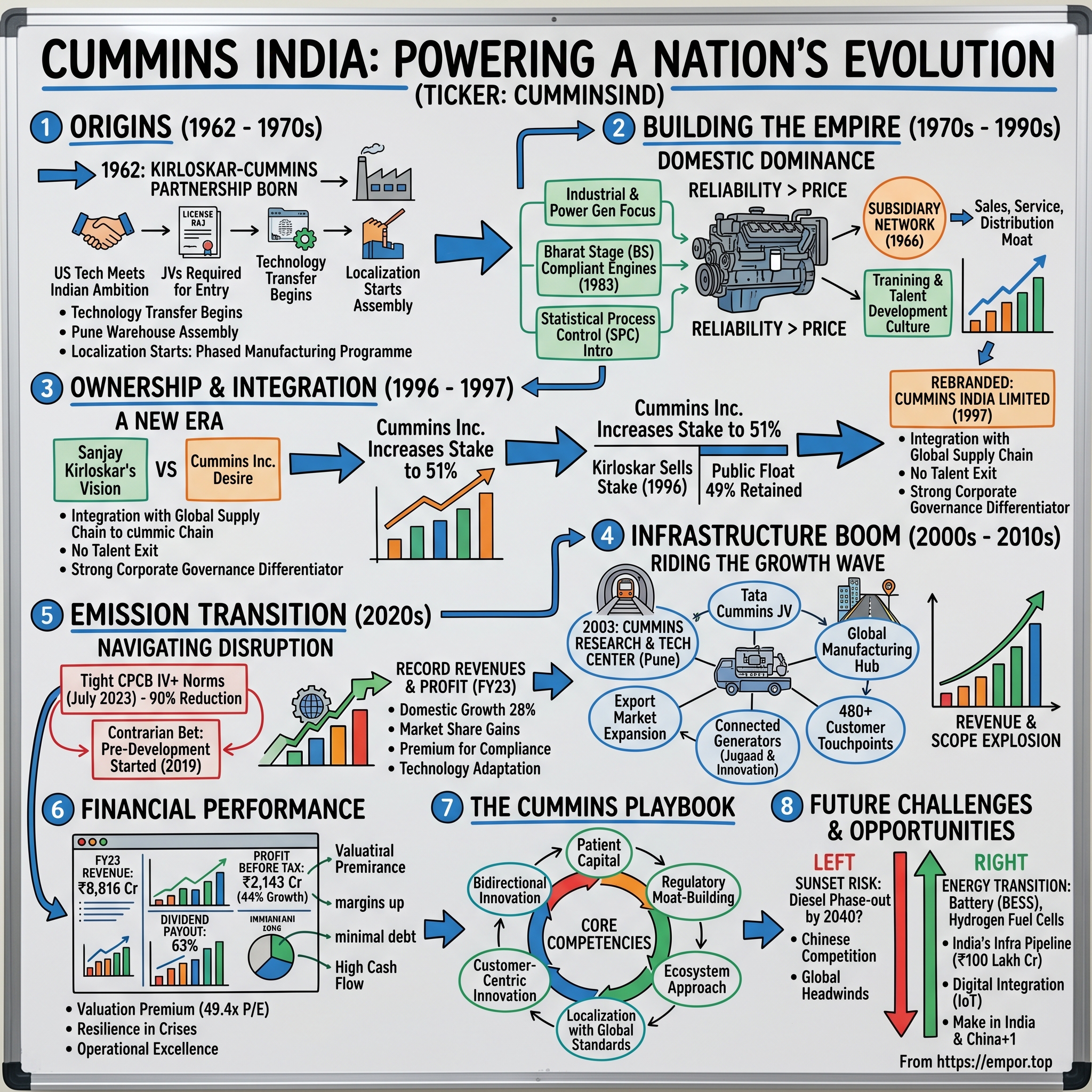
Cummins India: Engineering India's Power Infrastructure
I. Cold Open & Episode Roadmap
There is a distinct sound known across Indian office towers, hospitals, and telecom exchanges. The lights flicker. A half-second of darkness follows. Then, from a basement or rooftop, a deep mechanical cough turns into a steady, throaty roar, and power returns. Meetings continue uninterrupted. Financial transactions clear without delay.
That mechanical roar represents a business model.
For much of the world, backup power functions as an insurance policy — a machine that sits idle for years to justify its existence once a decade. In India, it operates closer to an essential utility.
The country's electrical grid improved significantly over the past three decades. Generation capacity multiplied, rural areas joined the network, and the persistent blackouts of the 1990s largely vanished from major metropolitan centers. Yet grid improvement is distinct from absolute power quality suitable for operating theaters or hyperscale data halls. Frequency fluctuates, and distribution networks in industrial belts often predate the facilities they supply. A single four-second power disruption can crash a server rack, ruin a pharmaceutical batch, or destroy a semiconductor wafer.
Consequently, Indian commerce constructed a parallel, privately funded, diesel-powered shadow grid, one generator set at a time. Built without central planning, it emerged building by building as thousands of individual enterprises determined that private backup capacity cost far less than operational downtime.
That shadow grid now underwrites a massive artificial-intelligence infrastructure expansion. India's operational data center capacity reached roughly 1.8 gigawatts of IT load by mid-2026, driven by 258 megawatts added in the first half of the year alone — a 59% acceleration in annual expansion. Hyperscalers occupy approximately 36% of installed capacity, with industry projections pointing to more than 7 gigawatts by 2030.1 Every megawatt of that capacity contractually requires standby power capable of starting within ten seconds.
This dynamic transforms an infrastructure story into a business strategy case. Backup power is purchased under operational stress, specified by engineers, and evaluated on a single metric: immediate startup upon grid failure. While capital expenditure matters, pricing remains a secondary consideration for operators whose hourly downtime expenses dwarf the purchase cost of the machine. Industries with this demand structure naturally consolidate around suppliers trusted by specifying engineers — a reputation established over decades of reliable execution. That reality creates a slow path to building a commercial franchise, and an exceptionally difficult one to dislodge.
That context brings the central paradox of the business into focus. A joint venture established in 1962 between an engine manufacturer from Columbus, Indiana, and an industrial family from Pune has evolved into one of the most richly valued industrial franchises on the National Stock Exchange. Cummins India Limited closed the fiscal year ended March 31, 2026, with consolidated sales of roughly ₹12,143 crore and consolidated net profit of about ₹2,330 crore, backed by a balance sheet carrying virtually no debt.2 Its market capitalization stood near ₹1.49 lakh crore in August 2026 — a valuation implying that investors view the company less as a cyclical engine manufacturer and more as a critical-infrastructure operator with an attached toll booth.2
A market capitalization of that scale for an engine manufacturer indicates that public markets no longer categorize the business as a traditional industrial manufacturer. Investors have instead priced it as a critical-infrastructure franchise with an installed-base annuity attached. Whether that reclassification remains justified is the central question under evaluation.
The core thesis is deceptively simple: Cummins India represents a textbook case of a multinational that built a durable local franchise, but it is now priced as if that franchise were permanent and immune to the standard physics of industrial cycles. Both premises require rigorous examination.
The empirical evidence points in competing directions. The same company that reported a record quarter of domestic power generation revenue for the period ended June 2026 also disclosed that profit before tax stagnated year-over-year in that quarter and fell 12% sequentially.3 The management team that guided investors through a complex emission-norm transition unexpectedly lost its managing director to an outside opportunity less than two years into a three-year term.4 Furthermore, while the stock trades at roughly 63 times trailing earnings, a domestic peer is expanding faster off a smaller base at less than three-quarters of that valuation multiple.25
Four primary themes frame the analysis that follows. First, how a foreign parent transformed a license-era joint venture into a controlled subsidiary while maintaining local partner relationships and minority-shareholder trust. Second, how environmental regulations under CPCB IV+ served less as a compliance burden and more as a competitive filter — and where that edge now faces erosion. Third, how unit economics split between heavy high-horsepower engine manufacturing and the higher-margin, resilient aftermarket business. Fourth, the recurring governance debate surrounding listed multinational subsidiaries in India: when the parent company holds a 51% stake and establishes operational terms, how margin distribution is ultimately determined.
An additional framing element warrants upfront attention. The prevailing consensus narrative positions Cummins India as a technology leader with an unassailable regulatory moat, capitalizing on a structural data center boom, backed by pricing power that permanently elevated its margin baseline. While each element of that narrative contains partial truth, company disclosures complicate the story. Across the subsequent analysis, these market assumptions are evaluated against regulatory filings, earnings call transcripts, and peer financial metrics — not because the enterprise is fundamentally weak, but because an equity valuation priced for perfection demands rigorous verification.
The narrative begins in an era when India possessed minimal foreign exchange reserves, limited domestic engine manufacturing technology, and an urgent requirement for both.
 Subscribe on LinkedIn
II. Origins: The Kirloskar-Cummins Partnership (1962–1980s)
In 1962, India's Second Five-Year Plan directed national resources toward heavy industrialization. Steel plants were rising at Bhilai, Rourkela, and Durgapur. Mining projects, hydroelectric dams, and rail lines were expanding across the country. Yet almost every one of these capital projects relied on machines powered by heavy-duty diesel engines that domestic factories could not manufacture.
The bottleneck was regulatory and financial rather than aspirational: the licence-permit system. Importing finished diesel engines required foreign exchange reserves that the Reserve Bank of India strictly rationed. Producing them domestically required proprietary technology no Indian firm possessed. The government's solution, deployed across multiple sectors during that era, was the mandated joint venture: pair an Indian company with a foreign technology partner, require domestic assembly, mandate progressive indigenisation of components, and cap foreign equity ownership to keep operational control onshore.
Cummins Engine Company had manufactured diesel engines in Columbus, Indiana, since 1919 and possessed specialized expertise in high-horsepower compression-ignition systems. The Kirloskar Group, led by S.L. Kirloskar in Pune, was among India's established industrial engineering families, producing pumps, machine tools, electrical equipment, and small oil engines. Kirloskar Oil Engines provided domestic manufacturing capability, while Cummins provided engine design expertise. In 1962, the two partners incorporated Kirloskar Cummins Ltd., broke ground on a factory in Pune later that year, and commenced engine manufacturing at the start of 1964.6
The operational orientation of the domestic partner proved critical. The Kirloskar Group was a manufacturing enterprise with multi-generational experience operating in an environment lacking a developed component supply chain. Rather than relying on imported knock-down kits for basic assembly, the venture established domestic foundries, precision machining capability, and local component suppliers. Building this industrial supply base required a decade of capital investment, but it established a durable entry barrier against potential competitors.
Adaptation, not translation
While joint ventures were common during the licence era, Kirloskar Cummins' trajectory diverged in how it adapted the licensed technology to local operating conditions.
Standard American heavy-duty diesel engines proved poorly suited for unadapted deployment in India. High sulphur content and particulate matter in local fuel clogged standard fuel injectors. Ambient summer temperatures in Rajasthan exceeded standard cooling system limits. Severe dust loads in mining operations choked air filtration systems designed for American highways. Furthermore, equipment was subject to continuous duty cycles with minimal preventive maintenance.
Engineering teams at the Kothrud plant in Pune modified standard engine designs to withstand these harsh environments. They added heavy-duty filtration systems, redesigned cooling packages, adjusted power curves, and modified fuel systems to tolerate contaminated fuel. Crucially, the venture designed engines to be economically overhauled and rebuilt in the field multiple times rather than replaced upon failure. This overhaul-focused model established a long-life installed base that generated recurring parts and service revenue for decades. The company currently services engines across a network extending through India, Nepal, and Bhutan, with a product range extending from small industrial units up to generator sets of 3,000 kW.7
The venture's early product line prioritized industrial applications, supplying engines for construction equipment, mining haulers, locomotives, defense vehicles, and marine vessels, alongside a nascent power generation business.6 During the 1960s and 1970s, commercial backup power remained a secondary segment, as private enterprise had not yet begun installing large-scale captive backup power systems on a widespread basis.
Through the 1970s and 1980s, the venture expanded manufacturing beyond the original Kothrud plant into a cluster of facilities across the Pune region and beyond, including Pirangut, Daman, Nagar Road, Lonikand, and eventually Phaltan.6 This physical expansion aimed to maximize vertical integration, reducing vulnerability to unpredictable foreign exchange controls and import restrictions.
For its first three decades, the venture operated at a modest scale within an economy of scarcity. Customers purchased available engine models, accepted long delivery lead times, and maintained existing equipment through repeated rebuilds. Industry growth tracked the gradual expansion of Indian industrial production rather than aggressive market share gains, while pricing power remained constrained.
During this period, the venture accumulated the foundational assets of its commercial franchise — an expansive field-service network and a large installed engine base — as routine operational by-products. These investments were not immediately reflected in elevated profit margins.
This history underscores a central structural pattern: the service capability and operational data that ultimately created pricing power were built during decades when pricing power did not exist. The high returns earned in later decades reflect the long-term compounding of early supply-chain and service investments rather than an inherently fast baseline growth rate.
The strategic takeaway illustrates a broader emerging-market principle. Cummins did not treat India purely as a sales destination; it used the market to refine heavy-duty engine durability under harsh operating conditions. Decades of operational data regarding engine degradation under high heat, dust, and poor fuel quality created a proprietary asset that late entrants could not easily duplicate through capital expenditure alone.
However, a joint venture framework structured for the licence-permit era faced structural friction once India initiated economic liberalization. That reckoning arrived in the 1990s.
III. The Ownership Buyout & Independence (1996–1997)
The 1991 balance-of-payments crisis did more than force a currency devaluation. It dismantled the logic that had held Indian joint ventures together for thirty years.
Before liberalisation, a foreign company required a domestic partner — not primarily for capital or manufacturing capacity, but for the industrial licence, government relationships, and raw material allocations. After liberalisation, foreign direct investment routes opened, licensing requirements fell away across most of manufacturing, and the corporate arithmetic reversed. The Indian partner was no longer an indispensable gateway. In several industries, the local partner became a direct competitor sharing a boardroom.
Consider what that shift meant inside a boardroom in Pune. Two shareholders sat at the table. One wanted the venture to move aggressively into smaller engines, where Indian market volumes were concentrated. The other already sold smaller engines under its own brand to the same distributors in the same towns. Every capital allocation decision became a negotiation over market share between co-owners rather than a decision focused on corporate growth. Joint ventures rarely survive that structural conflict once the external rationale for their existence vanishes.
That was precisely the dynamic inside Kirloskar Cummins by the mid-1990s. Kirloskar Oil Engines maintained its own engine business, concentrated in lower-horsepower nodes where volumes were high and domestic demand was thickest. Cummins wanted to push down from heavy industrial engines into that same territory. Two shareholders in one company, competing in adjacent markets with a shared brand, created an unsustainable structure.
The resolution arrived in the second half of the 1990s. Cummins acquired Kirloskar Oil Engines' equity interest, lifting the parent's holding to 51%, and the company was renamed Cummins India Limited — the corporate identity it has carried ever since.8 The parent's stake has remained at exactly 51.00% in the three decades since, with the balance held by institutional and public investors: as of June 2026, foreign institutional investors held 21.19%, domestic institutions held 19.06%, and public shareholders held 8.65%.2
The arithmetic of 51%
That 51% ownership structure warrants examination, as it represents a deliberate strategic choice rather than a historical accident.
A foreign parent taking a listed Indian subsidiary to 75% — the maximum threshold permitted before triggering delisting pressure — acquires a larger economic interest but surrenders an important asset: a locally listed, locally scrutinized entity with its own equity currency for hiring, dedicated analyst coverage, and distinct regulatory standing. While several multinationals in India chose to buy out minority shareholders and delist, Cummins retained its public listing.
What the parent preserved instead was a structure where a substantial minority of institutional Indian capital sits on the register and monitors related-party transactions. That oversight functions both as a governance discipline and a credibility asset, providing the transparency that allows domestic mutual funds to underwrite the subsidiary's capital allocation.
The parent's discipline is equally evident in what it did not do over subsequent decades. Indian equity markets presented multiple valuation downturns — including the 2013 taper tantrum and the 2020 pandemic crash — when buying out minority investors would have been exceptionally cheap. While other multinationals used those market disruptions to consolidate ownership or delist, Cummins maintained its 51% stake through each cycle, demonstrating consistent ownership behavior for thirty years.
The trade-off is symmetrical. A 49% public float requires the parent to continuously justify its commercial terms. Every royalty rate, every cross-border export price to an overseas affiliate, and every allocation of a new product line between the listed entity and an unlisted Indian subsidiary becomes a matter of public scrutiny. That allocation debate stands as the single most persistent bear case on the company.
A second, subtler advantage concerns executive recruitment. A listed subsidiary functions as a talent magnet. Senior Indian engineers and executives who might hesitate to join a regional branch office will join an entity with its own independent board, public financial disclosures, and prominent executive leadership. Over three decades, Cummins India built a leadership bench deep enough that the parent repeatedly promoted Indian executives into global corporate roles — a reverse talent flow rarely seen in multinational subsidiary networks.
The corporate separation delivered unambiguous strategic clarity. Unburdened by a partner competing in the same product categories, Cummins India expanded across the full horsepower spectrum, strengthened its distribution network, and transformed into a core manufacturing hub for the parent's global operations rather than remaining a licensee bound to a single market. That transformation shaped the subsequent two decades of expansion.
A historical nuance complicates this transition. Corporate restructurings are often framed retroactively as seamless strategic planning, but in real time they represent negotiations between parties with asymmetrical information and alternatives. The Indian partner sold its stake in a business built over three decades into a newly liberalized economy where the foreign partner's options had expanded dramatically. While the public record does not settle whether the transaction price fully reflected that shift in bargaining power, the operational outcome was clear: Cummins secured a controlled subsidiary with a national industrial franchise, while Kirloskar acquired capital to expand an independent competitor.
Furthermore, the former joint-venture partner did not exit the industry. Kirloskar Oil Engines developed a substantial standalone business and, three decades later, returned to compete directly against Cummins India in high-horsepower nodes.
IV. Building the Infrastructure Engine: CTCI, Tata Cummins, & Phaltan (2000s–2010s)
Following the ownership restructuring of the late 1990s, Cummins addressed a strategic question: how to position the listed Indian subsidiary within its broader global corporate network.
Rather than operating purely as a local distribution arm or an isolated domestic manufacturer, Cummins constructed a set of specialized operational nodes around a central industrial footprint in Maharashtra, each serving distinct economic functions.
The commercial vehicle carve-out. In 1993, Cummins Inc. formed a joint venture with Tata Motors to produce mid-range engines for commercial vehicles, with plants at Jamshedpur and later Phaltan.6
Commercial vehicle engines represent a fundamentally different business model from industrial and power generation units: high production volumes, intense price competition, customer concentration, and low operating margins defended primarily through scale.
By housing commercial vehicle engine manufacturing inside a separate joint venture rather than within the listed subsidiary, Cummins insulated Cummins India's revenue profile. The listed entity maintained a product mix tilted toward higher-margin, lower-volume, service-intensive diesel engines. Consequently, investors in Cummins India avoided direct exposure to the cyclicality of the Indian commercial vehicle market, preserving a higher margin profile relative to broader engine peers.
This structural separation offered an additional operational advantage. Unburdened by high-volume commercial vehicle manufacturing, Cummins India's production lines were configured for variety rather than uniform scale — accommodating multiple engine families, broad horsepower ranges, and diverse customer specifications in modest batch sizes. While flexible manufacturing carries higher unit production costs, it aligns directly with the requirements of data center operators, mining enterprises, railways, and defense clients. A plant optimized for mass-producing standard truck engines cannot easily pivot to manufacture specialized, high-horsepower units for hyperscale data centers.
The engineering node. In 2003, Cummins established a research and technology centre in Pune — notable at the time for being the first Cummins research centre built without physical laboratories, relying instead on computational design and simulation.6 That computational focus matched local cost structures: simulation-led engineering scales with specialized engineering talent and computing power rather than capital-intensive physical test cells. The Pune facility subsequently expanded into one of the parent group's principal technical centers outside the United States, contributing engineering work to Cummins programmes globally.9
The financial structure of this engineering hub carries specific implications for public shareholders. Engineering services provided to a parent company are typically billed on a cost-plus basis, ensuring steady, low-risk revenue while capping profitability regardless of the intellectual property generated. Consequently, while the Pune technical facility provides a substantial competitive advantage for the global parent group, its direct economic contribution to the listed Indian entity remains structurally constrained — a distinction sometimes obscured in corporate communications.
The manufacturing node. To support long-term physical expansion, Cummins assembled an industrial campus in Phaltan, approximately 100 kilometers from Pune, in the mid-2000s. The site grew to house multiple operational units, including Tata Cummins' second manufacturing plant, an engine rebuild facility, and a distribution centre launched in 2011.6 The campus strategy aimed to co-locate assembly, remanufacturing, distribution, and supplier networks to capture state industrial incentives and compress supply-chain logistics costs across the Indian market.
Large-scale industrial campuses require substantial initial capital commitments and long payback horizons. Cummins built the Phaltan campus shortly before an extended slowdown in Indian industrial capital expenditure, resulting in underutilized fixed assets for several years. However, maintaining the campus through that downturn provided the physical capacity required to absorb subsequent demand surges, such as the rapid expansion of data centers, without requiring new land acquisition or fresh regulatory approvals. Capital investments maintained through an economic trough ultimately yielded low-cost expansion capacity.
The rebuild center provides a clear physical illustration of aftermarket unit economics. A high-horsepower engine capable of being returned to the factory, disassembled, remanufactured, and redeployed generates recurring revenue across its operational lifecycle while encouraging enterprise customers to remain within the official service channel.
The export node. A fourth structural component was the export organization. Leveraging its lower-cost manufacturing base in India, Cummins India established itself as a supply point for parent-company operations across the Middle East, Africa, Southeast Asia, and Latin America. For a decade, exports functioned as an economic stabilizer, offsetting domestic demand slowdowns with international orders.
That stabilizing mechanism has weakened in recent years. Over the five years to FY2026, exports compounded at roughly 5% a year against 23% for the domestic business.10 As a result, exports represent a diminishing share of total revenue, shifting the company from a dual-engine growth model driven by domestic and global demand toward greater reliance on the domestic market.
By 2011, the combined operations of the Cummins group in India — including the listed subsidiary, unlisted entities, and joint ventures — reported combined sales of about $2.3 billion, prompting then-managing director Anant J. Talaulicar to publicly framed an aspiration of reaching $7 billion within five years.6 That target was not achieved within the projected timeframe, as an extended slowdown in domestic infrastructure investment constrained revenue growth. Standalone sales were around ₹5,659 crore in FY2019 with net profit of ₹723 crore; two years later, after the pandemic, sales had fallen to ₹4,329 crore.2
That historical performance demonstrates that for much of the decade leading into 2021, Cummins India operated as a cyclical industrial manufacturer with range-bound financial results. Evaluating the company solely on its recent five-year performance overlooks the cyclical pattern evident across its broader operating history.
What changed the trajectory was not a product. It was a rule.
V. The Great Regulatory Inflection: CPCB IV+ & Data Center Boom (2020–2024)
Emission regulation usually arrives at an industrial company as bad news: engineering cost, capital cost, operational disruption, and a compressed execution timeline. For the Indian generator set industry, the Central Pollution Control Board's CPCB IV+ norms arrived as something considerably more strategic — a forced technology reset that a handful of manufacturers could afford and most could not.
Consider what the rule actually required in operational terms.
A conventional diesel generator, of the type that powered Indian commercial buildings for forty years, is a mechanical device. Fuel is injected by a mechanical pump, the engine burns it, and exhaust exits through a standard pipe. A competent field mechanic with basic hand tools can diagnose and repair it. Under CPCB II norms, that mechanical architecture was legal.
CPCB IV+ made that architecture obsolete for gensets up to 800 kW. Meeting the new limits on particulate matter and nitrogen oxides — representing a reduction of roughly 90% compared to the prior standard — cannot be achieved by tuning a mechanical engine. It requires three systems operating in tandem: high-pressure electronically controlled fuel injection, allowing the engine control unit to meter fuel in precisely timed micro-doses; a diesel particulate filter, which uses a ceramic honeycomb structure to trap soot and periodically burn it off; and selective catalytic reduction, which sprays a urea solution into the exhaust stream so that a catalyst converts nitrogen oxides into nitrogen and water.
The shift mirrors the automotive transition from carburettors to modern fuel-injected engines. The older equipment could be repaired by an independent mechanic. The newer architecture functions as a computer with attached pistons, requiring proprietary diagnostic software, factory calibration files, and authorized parts for service.
Cummins India launched its CPCB IV+ compliant range in mid-2023, following certification, and completed the transition ahead of the July 2024 manufacturing deadline.11 The company stated it was first to market with a fully compliant product lineup and established supply chain.
Three distinct operational consequences followed this regulatory shift.
The pricing reset was real and largely permanent. The new architecture is fundamentally more expensive to build, as electronic control units, injectors, after-treatment hardware, and urea dosing systems add material manufacturing cost. Brokerage research published as the norms took effect estimated genset price increases in the range of 15% to 25%, with realisations per unit on compliant sets running materially higher than the equipment they replaced.[^12] For a manufacturer delivering tens of thousands of gensets annually — Cummins India delivered over 26,000 units in FY2026 alone — a structural step-up in average selling price expands top-line revenue significantly.10
This dynamic does not represent pricing power in the classic sense; it is a regulated cost pass-through enjoyed by all compliant manufacturers. However, it permanently elevated revenue per unit of installed capacity across the sector.
The aftermarket lock-in was real and more valuable than the initial price increase. Once emissions compliance depends on software calibration and consumable after-treatment components, independent mechanics are excluded by technology constraints rather than contract. Diagnostics require manufacturer-specific tools, calibration files remain proprietary, and after-treatment parts must meet exact OEM specifications. Furthermore, maintaining warranty coverage requires documented, authorized service.
Consequently, the manufacturer captures a significantly higher share of the machine's lifetime service and parts expenditure than under mechanical architectures. That structural shift formed the core of the analytical case brokerages outlined for the sector as the norms took effect.[^12]
The competitive filter was real but temporary. In 2023 and 2024, certifying a complete compliant product range offered a genuine first-mover advantage. By 2026, that advantage had normalized into a standard requirement. Management noted on the June 2026 earnings call that ten to twelve players were actively competing in the market.3 Regulatory moats carry a finite half-life: they favor the fastest mover for two to three years before becoming baseline industry standards. Categorizing CPCB IV+ as an enduring structural moat in 2026 overlooks this operational reality.
Myth versus reality: three claims worth checking
Myth: CPCB IV+ handed Cummins India durable pricing power. Reality: The regulation established a higher price baseline across all compliant industry participants. True pricing power allows a company to raise prices faster than costs at will. The June 2026 quarter — featuring 18% revenue growth alongside flat profit before tax, and a price hike implemented only in the subsequent quarter with an acknowledged one-quarter realization lag — does not demonstrate structural pricing power.3
Myth: The regulation permanently locked out competitors. Reality: The rule delayed competitors rather than excluding them permanently. Management's disclosure of ten to twelve active players confirms that the certification barrier of 2023 no longer acts as a structural impediment in 2026.3 Peer Kirloskar Oil Engines expanded revenue by 25% in FY2026 while aggressively expanding manufacturing capacity.12
Myth: The aftermarket lock-in is a new phenomenon created by the regulation. Reality: The lock-in pre-existed the regulation — built on decades of investment in engine rebuild facilities, dealer networks, and parts availability — and the new standards simply reinforced it. This distinction highlights that the moat's true foundation is sixty years of distribution scale rather than a recent regulatory change.
That regulatory shift coincided with a sudden demand expansion that contributed even more directly to the company's recent financial performance.
From a power engineering perspective, a hyperscale data center represents a uniquely demanding customer. Operators contract for uptime measured in fractions of a percent, making even multi-second grid interruptions unacceptable. Backup generation is sized to cover 100% of the IT load plus cooling requirements, backed by redundant units. These high-horsepower generators are purchased in large blocks and must pass rigorous global engineering qualifications before suppliers receive initial purchase orders.
That demand surged in the Indian market. Data centers accounted for approximately 25% of Cummins India's power generation revenue in the December 2025 quarter, rising to roughly 35% of domestic power generation revenue in the March 2026 quarter as deliveries to a hyperscale client materialized, while management projected a robust data center demand pipeline for the subsequent three to four years.1314
The timing of these deliveries illustrates an essential operational detail: data center revenue arrives in concentrated, lumpy tranches — a pattern reflected in quarterly results and examined further in the subsequent financial analysis.
VI. Segment Economics & Revenue Engine Breakdown
Two quarters, six months apart, illustrate how the business operates in practice.
In the quarter ended December 2025, Cummins India reported sales of ₹3,006 crore — a 1% decline year-over-year. Domestic sales fell 2%, while domestic power generation revenue dropped 16% to ₹1,069 crore. Management attributed the decline to the absence of major data center executions that had bolstered the preceding quarter.1315 Three months later, in the quarter ended March 2026, sales rebounded 23% to ₹2,963 crore, with domestic sales rising 30% as hyperscaler deliveries resumed.14 The underlying enterprise and competitive landscape remained identical across both periods; only the delivery schedules shifted.
This quarterly volatility reflects a structural characteristic of the revenue model. Large power generation orders are tied to project timelines, shipping when customer facilities are ready rather than on calendar deadlines. With hyperscale programs accounting for a quarter to a third of domestic power generation revenue, quarterly figures can fluctuate significantly without indicating a shift in the core commercial franchise.
Full-year financial results clarify these quarterly swings. For the fiscal year ended March 31, 2026, standalone sales reached ₹11,950 crore, an 18% increase year-over-year. Domestic sales rose 19% to ₹9,961 crore, while exports grew 12% to ₹1,989 crore. Profit before interest and tax stood at ₹3,117 crore, yielding an operating margin of 26.1%, with cash generated from operations reaching ₹1,734 crore.1410 On a consolidated basis, the company reported sales of roughly ₹12,143 crore and net profit of about ₹2,330 crore, translating to earnings of ₹84.06 per share.2
Power generation serves as the primary growth driver. In the quarter ended June 2026, domestic power generation revenue reached a record ₹1,424 crore, up 35% year-over-year. Management noted that demand in the high-horsepower segment was outpacing supply.3 When demand exceeds supply in high-horsepower nodes, manufacturers can select projects and defend pricing. Capacity utilization across company facilities stood at approximately 70% to 75%, providing room to absorb near-term volume growth without immediate step-changes in capital expenditure.3
Distribution — comprising spare parts, field service, engine rebuilds, and recurring maintenance — functions as an economic stabilizer backed by a sixty-year installed base. Revenue in this segment reached an all-time high of ₹939 crore in the December 2025 quarter, up 26% year-over-year, accounting for 31% of total sales during a quarter when power generation contracted.13 This performance demonstrates counter-cyclical resilience, as service income expands off the cumulative stock of operational machinery rather than the flow of new equipment sales.
Furthermore, management noted that distribution revenue from a new installation typically materializes roughly two years after commissioning.3 Consequently, the elevated generator set volumes delivered in FY2025 and FY2026 point to a predictable service tailwind through FY2027 and FY2028, independent of near-term equipment sales.
The economics of the distribution segment also enhance overall earnings quality. Equipment purchases are negotiated by corporate procurement teams focused on upfront capital expenditure, whereas maintenance and spare parts are authorized by facility engineers prioritizing operational continuity. The secondary buyer exhibits substantially lower price sensitivity, resulting in higher structural margins as service income grows relative to equipment sales.
Industrial applications — spanning construction, mining, railways, marine, air compressors, and defense — represent the most macro-sensitive and fragmented segment. In the June 2026 quarter, domestic industrial revenue rose 10% year-over-year to ₹458 crore. Construction contributed ₹148 crore, railways ₹145 crore, air compressors ₹52 crore, and marine applications ₹50 crore.3 This revenue fragmentation limits customer concentration risk but constrains operating leverage. Tracking public infrastructure expenditure with a lag, industrial revenue remains susceptible to economic downturns, having contracted 9% in the December 2025 quarter.13
Exports have lagged broader domestic expansion, a trend management has acknowledged. Exports grew 12% in FY2026 to ₹1,989 crore, following a five-year compound annual growth rate of 5%, compared to 23% for the domestic business.10 In the June 2026 quarter, exports remained flat year-over-year at ₹521 crore, as a 16% increase in high-horsepower units was offset by a 20% decline in low-horsepower shipments.3 While management cited geopolitical headwinds in key overseas markets, the underlying constraint reflects structural allocation parameters within the parent company's global supply network.315
Working capital dynamics highlight the cash conversion characteristics of project-linked sales. Large data center and infrastructure clients settle payments against project milestones rather than upon initial delivery, extending the cycle between shipment and cash realization. Operating cash flow of ₹1,734 crore against profit before interest and tax of ₹3,117 crore in FY2026 confirms positive cash generation, but indicates a conversion rate below 100%, demonstrating that top-line expansion absorbs working capital before releasing cash.1410
Recent margin performance underscores the vulnerability of operating profitability to cost pressures. Gross margin reached a record peak of approximately 38% in the December 2025 quarter, driven by favorable product mix under CPCB IV+ standards and moderate raw material prices.13 Six months later, profitability narrowed. In the June 2026 quarter, profit before tax excluding exceptional items fell 0.7% year-over-year and 12% sequentially to ₹721 crore, despite an 18% revenue gain, as management cited rising commodity costs and general inflation.34 Standalone net profit fell roughly 8% to ₹543 crore, compared against a prior-year period that included a ₹44.15 crore exceptional gain.4 Consolidated net profit remained flat at ₹609 crore.4
Management signaled that gross margins are unlikely to return rapidly to the historical 36% to 37% range. To offset cost inflation, the company implemented a price increase in the September 2026 quarter, with margin realization expected to lag implementation by one quarter.3
This financial trajectory clarifies the company's margin dynamics. While Cummins India demonstrated volume expansion and underlying market demand through FY2026 and early FY2027, it proved unable to insulate peak margins from rising input costs. An 18% top-line expansion alongside flat pre-tax profit illustrates that pricing adjustments lagged cost increases rather than anticipating them. Consequently, peak margins recorded in FY2026 reflect favorable operating conditions rather than a permanent new margin baseline.
VII. Competitive Moats: Hamilton Helmer's 7 Powers & Porter's 5 Forces
Evaluating Cummins India through competitive analytical frameworks reveals a commercial position more nuanced than the unassailable monopoly framing prevalent in market commentary.
Applying Hamilton Helmer’s Seven Powers framework clarifies which structural advantages genuinely endure.
Switching costs — strong and deepening. When a data center operator or hospital standardizes on an engine manufacturer's power architecture, that choice is embedded into its electrical engineering design, maintenance contracts, spare parts inventory, technician training, and service-level uptime agreements. The transition to CPCB IV+ electronic engine architectures reinforced this lock-in, binding customers to authorized diagnostics and calibrated replacement parts through technical design rather than contractual preference. The two-year lag between equipment installation and distribution revenue serves as the quantifiable signature of this power, demonstrating that the installed base converts into recurring service revenue with mechanical consistency.3
Cornered resource — substantial and difficult to replicate. This edge stems not from proprietary engine designs — which the parent group licenses across multiple entities — but from a national distribution and service network paired with six decades of field data on engine performance under severe local operating conditions. A competitor can license or engineer an engine design; building a nationwide service footprint, training specialized technicians across secondary cities, and establishing regional rebuild facilities requires decades of sustained capital investment.
Scale economies — significant at the group level, partially captured locally. Cummins India shares in a global research and development base and component-sourcing network that domestic-only competitors cannot match. However, because engineering services provided to the parent group are structured on a cost-plus basis, the listed entity captures a defined margin on that work rather than full economic rent. Consequently, global scale advantages accrue primarily to Cummins Inc., with a portion flowing through to the Indian subsidiary.
Process power — plausible but unverified by public metrics. Manufacturing expertise in precision metallurgy, fuel-injection calibration, and electronic control unit tuning represents a genuine operational discipline developed over decades. For public investors, however, this advantage remains difficult to verify empirically, as corporate disclosures omit standardized operational metrics such as field failure rates, warranty expense as a percentage of sales, or mean time between engine overhauls relative to peers like Caterpillar or Kirloskar.
Notably absent from this framework are network economies (a generator set gains no network utility as adoption increases), brand power in the form of pure pricing premiums (industrial buyers purchase through structured competitive tenders), and counter-positioning (the underlying business model presents no structural dilemma preventing incumbents from copying it).
Analyzing the business through Michael Porter’s Five Forces framework highlights where competitive pressures are concentrating.
Threat of new entrants: low. Stringent emission certification, high capital intensity, and extensive qualification cycles for mission-critical applications create multi-year barriers to entry. Enterprise clients and hyperscale data center operators evaluate prospective generator suppliers through rigorous validation protocols before approving them for live facilities.
That qualification cycle forms the primary structural barrier protecting incumbents. Before a hyperscale operator approves a generator set for installation in a live data hall, the unit undergoes months of witnessed load-bank testing, black-start verification, and integration testing with site switchgear and building management systems, frequently at the manufacturer's expense. Once certified, the specific engine model is written into the client's global engineering specifications. Replacing an incumbent supplier requires repeating this capital-intensive process, offering minimal operational benefit unless the existing vendor experiences severe execution failures or aggressive pricing expansion. Consequently, incumbency in mission-critical standby power commands a higher retention barrier than in standard industrial machinery categories.
Rivalry: moderate and intensifying. Competitive intensity represents the most understated risk in the current market environment. Kirloskar Oil Engines — the venture's former joint-venture partner — reported FY2026 revenue of ₹5,646.8 crore, up 25%, with net profit rising 35% to ₹464 crore and its power generation division accounting for 46% of total revenue. The peer committed roughly ₹2,100 crore toward manufacturing capacity expansion.12 KOEL is expanding faster off a smaller revenue base while actively moving upward from its historical low-horsepower stronghold into the high-horsepower nodes where Cummins India generates its premium margins. Management's explicit disclosure of ten to twelve active market participants confirms a competitive landscape inconsistent with monopoly dynamics.3 Caterpillar, Perkins, Mahindra Powerol, and Volvo Penta further solidify a contested market.
Buyer power: moderate and rising with customer concentration. The rapid growth of data center infrastructure concentrates the customer base among a smaller cohort of enterprise buyers. With data center projects generating between a quarter and a third of domestic power generation revenue, and hyperscalers occupying a substantial share of total installed IT load, a small cohort of global procurement organizations exercises considerable commercial leverage.131 While these buyers prioritize operational uptime over initial purchase price — protecting baseline margins — they also negotiate global framework contracts, enforce standard equipment specifications, and maintain qualified secondary suppliers. Financial results for the quarter ended June 2026, where revenue expanded 18% while pre-tax profit stagnated, demonstrate the impact of buyer leverage in constraining cost pass-through.
Supplier power: low to moderate. Vertical integration and parent-company sourcing mitigate component supply risks. However, raw material price fluctuations remain an external vulnerability, as steel, copper, and alloy costs move through the income statement with an operational lag that management cannot fully control.3 Channel dynamics introduce an additional structural constraint: Cummins India distributes a significant volume through original equipment manufacturers, including Powerica, a partner since 1984 that posted FY2026 revenue of ₹3,011.5 crore.12 While these channel partnerships expand distribution reach, they also shift a portion of the end-customer relationship and associated margin outside the listed entity.
Substitutes: low in the near term, uncertain over longer horizons. Battery energy storage systems cannot currently replace multi-hour standby diesel generation for critical facilities due to energy density and cost constraints during extended grid outages. Nevertheless, the technology trajectory is shifting. Cummins India implicitly acknowledged this transition by introducing its own battery energy storage systems alongside its FY2026 product rollouts.10
A strategic evaluation of potential competitive threats underscores how international rivals could challenge this market position. Global competitors such as Caterpillar and its subsidiary Perkins possess advanced engine technology, strong balance sheets, and established relationships with global hyperscalers that purchase their equipment in North America and Europe. Their primary weakness in India remains a less dense domestic service footprint and a higher cost base relative to Cummins India's six-decade domestic supply chain. Consequently, a global competitor's primary entry path involves securing global framework agreements with hyperscale buyers and requiring Indian project builds to adopt those global standards. This dynamic highlights how buyer power and international rivalry can compound to compress domestic margins.
In summary, Cummins India possesses a robust competitive moat built primarily on service network density and customer switching costs rather than unassailable core technology. With rivalry intensifying in high-horsepower segments, the company presents a durable industrial franchise operating in a contested market — a profile that demands disciplined valuation expectations for its future earnings stream.
That operational reality focuses attention on corporate leadership — an area marked by an unexpected management change in early August 2026.
VIII. Management Credibility, Governance, & Capital Allocation
On August 5, 2026, Cummins India's board met to approve its first-quarter financial results. Alongside those numbers, the board accepted the resignation of its managing director.
Shveta Arya had served in the role for less than two years. Appointed as an additional director on August 8, 2024, she took over as managing director on September 1, 2024, succeeding Ashwath Ram, who moved to a global role at the parent company.16 Her professional background diverged from traditional industrial leadership — holding an information technology degree from Delhi University, an MBA from IIM Ahmedabad, and nearly two decades of experience across Infosys, Kearney, and Thomas Cook before joining Cummins in 2016 as head of strategy.16 Rather than a traditional mechanical engineer, Arya was a corporate strategist who previously led the high-margin distribution business, authoring its five-year strategy, before directing the power systems division and leading the critical CPCB IV+ product launch in July 2023.16
The executive who steered the company's most consequential regulatory shift and oversaw a record financial year is scheduled to step down on August 31, 2026, to pursue an external opportunity, with no successor named at the time of disclosure.4
That appointment reflected how Cummins India had reassessed its operational priorities. Promoting a strategy consultant with a software background rather than a traditional plant manager signaled that the company viewed its primary challenge not as mechanical engineering, but as commercial execution, product positioning, and managing a complex regulatory rollout across a nationwide dealer network. Arya had previously led both the distribution channel and the power systems product line — the two operational units that generated the bulk of the company's growth over the subsequent two years.
Her predecessor, Ashwath Ram, guided the enterprise through the stagnant mid-2010s and the pandemic disruption before transitioning to a global executive role at the parent group.16 This sequence establishes an operational pattern: two managing directors departing within two years, with executive transitions moving upward into the parent organization or outward to external roles. In multinational subsidiary networks, leadership of a domestic entity often functions as a career waypoint rather than a permanent post. While this deepens group talent, it implies that executives who craft five-year strategic roadmaps are rarely present to oversee their final execution.
For public investors, this rapid executive turnover presents a clear risk, albeit a bounded one. Cummins India operates within a broader global framework supported by institutional systems and leadership depth across Columbus and Pune. Consequently, operational continuity relies more on parent organization capabilities than on individual executives. Nevertheless, announcing a leadership departure alongside a quarter of stagnated profits and sequential margin contraction creates narrative friction that company disclosures left unaddressed, triggering a negative market reaction across both metrics.
Furthermore, leadership continuity carries practical weight for public markets. The managing director of a listed subsidiary serves as the primary bridge to domestic investors, communicating strategic choices and articulating parent-level decisions. Frequent changes in the executive office disrupt narrative consistency, forcing analysts and minority shareholders to recalibrate guidance and margin expectations against a shifting leadership baseline.
Evaluating long-term management execution provides a clearer baseline for assessing governance quality.
Guidance discipline has remained consistent through cyclical fluctuations. Management targeted double-digit domestic growth throughout FY2026, ultimately delivering a 19% full-year expansion.14 During the December 2025 quarter — when total sales contracted 1% year-over-year — leadership maintained its full-year guidance rather than revising forecasts downward, a projection validated when sales expanded 23% in the subsequent March quarter.1314 Maintaining annual targets through a temporary quarterly drop demonstrates detailed visibility into underlying project delivery schedules.
Explanation of operational misses has been specific. Management linked the December 2025 drop in power generation sales to project scheduling around hyperscale data center deliveries rather than broader economic weakness.13 Similarly, leadership attributed the margin compression in the June 2026 quarter to input cost inflation, outlining a compensatory price hike in the following quarter while explicitly noting a one-quarter lag before margin benefits materialize.3 Furthermore, management avoided promising a rapid recovery to historical gross margins of 36% to 37%, tempering market expectations.3
Narrative consistency is stronger on end-market demand than on margin durability. Leadership has provided transparent disclosures regarding data center revenue, tracking its expansion from 25% of power generation sales in December 2025 to 35% of domestic power generation in March 2026, alongside a three-to-four-year project pipeline.1314 Conversely, margin commentary has proven less consistent: peak gross margins of 38% recorded during FY2026 were followed two quarters later by disclosures indicating that prior 36% to 37% baselines would remain elusive in the near term.133 This shift illustrates that peak margins reflected temporary pricing tailwinds rather than a structural baseline elevation.
Capital allocation exhibits extreme conservatism. Cummins India maintains a virtually debt-free balance sheet, carrying modest borrowings of ₹37 crore against financial metrics that include a return on capital employed of roughly 42% and a return on equity near 32%.2 Growth capital expenditure is fully funded through internal cash flows. Retained cash is distributed to shareholders: for FY2026, the company declared a dividend of 3,300% on face value, returning approximately ₹1,830 crore.10 Measured against consolidated net profit of about ₹2,330 crore, this distribution represents a payout ratio near 78% — a significant step-up from historical levels of 60% to 65%.
This elevated payout ratio highlights a central capital allocation paradox. Distributing nearly four-fifths of net earnings underscores capital discipline by preventing empire-building or un-disciplined M&A. However, it also indicates capital deployment constraints: despite projecting a multi-year data center demand cycle and operating at 70% to 75% capacity utilization, the enterprise finds limited internal reinvestment avenues capable of absorbing additional retained capital.3 For an enterprise generating a 42% return on capital employed, retained earnings reinvested at scale would compound shareholder value far more efficiently than cash distributions. Distributing 78% of profits suggests that management views its high-return growth runway as inherently capacity-constrained.
Governance oversight provides another critical reference point for public investors. At its 2026 annual general meeting, Cummins India disclosed that women held 100% of key managerial personnel roles and 50% of board seats, alongside environmental initiatives covering zero-landfill waste, zero liquid discharge, and water conservation.10 Beyond ESG compliance metrics, independent board oversight represents the primary defense for minority shareholders in a 51%-controlled subsidiary. The independent audit committee evaluates cross-border royalty rates, shared service allocations, and transfer pricing terms between the listed Indian entity and the parent group.
This dynamic leads directly into the central governance debate: how commercial terms, royalty payments, and product allocations are divided between a foreign parent and its Indian public shareholders.
IX. Activist & Skeptical Investor Stress Test
A skeptical investor assembling a bear case on Cummins India would focus less on operational execution and more on the structural governance realities of a listed multinational subsidiary.
The margin-share problem. Cummins India does not operate in isolation. It functions within a web of related corporate entities: the parent Cummins Inc.; the Tata Cummins joint venture; and wholly owned unlisted Indian affiliates, including Cummins Technologies India Limited. Every rupee of economic value generated across the domestic footprint must be allocated among these structures, with decisions directed by a controlling parent that holds a 51% stake in the listed company alongside 100% ownership of unlisted affiliates.
This dynamic carries practical earnings implications. On the June 2026 earnings call, leadership addressed questions regarding rising procurement from Cummins Technologies India Limited, explaining that the increase reflected route-to-market optimization and scale benefits within the power generation segment, while explicitly disputing any adverse margin impact tied to data center deliveries.3 Management further acknowledged that purchases from that unlisted affiliate had expanded rapidly over the preceding three to four years.3
Evaluating management's explanation highlights an enduring structural challenge: when a listed enterprise sources an expanding share of inputs from a wholly owned subsidiary of its parent, a mechanism exists through which operational margin could theoretically shift from a 51%-owned entity to a 100%-owned affiliate. While no evidence in the public record suggests improper transfer pricing, and Indian related-party transaction rules mandate audit committee approval alongside explicit disclosure, minority shareholders possess limited capacity to independently verify transfer-pricing economics. Consequently, this structural arrangement represents one of the primary unquantifiable risks facing public investors.
Royalty and technology fees. Cummins India pays technology royalties to its parent group — a standard commercial practice across multinational subsidiaries in India that remains a frequent topic of debate among institutional investors. The precise royalty rate and monetary quantum are detailed within related-party disclosures rather than summarized in quarterly results commentary, and are omitted here pending verified line-item disclosures.17
The core analytical question concerns whether royalty terms account for the substantial volume of global engineering research performed locally at Indian cost structures within the Pune technical center.69 An operating model where a subsidiary pays technology fees while simultaneously delivering engineering services on a cost-plus basis creates an asymmetrical arrangement, as the domestic entity helps fund and develop intellectual property for which it subsequently pays licensing fees.
Export territory allocation. Cummins India's exports expanded at a five-year compound annual rate of 5%, trailing the 23% annual expansion recorded in the domestic market.10 While leadership has attributed this divergence to macroeconomic weakness and geopolitical headwinds across overseas markets,3 a structural boundary also governs international sales. Within a global manufacturing network, geographic market allocations are established by the parent company. Cummins India cannot independently expand into North American or European territories served by primary group facilities. Consequently, the export business functions as an administratively bounded segment rather than an unconstrained growth engine.
Business-opportunity allocation. A parallel dynamic applies to new product introduction. As the parent group develops alternative powertrains, hydrogen technology, and battery energy storage systems for the Indian market, decisions regarding whether manufacturing rights are assigned to the listed entity or an unlisted affiliate rest with parent leadership. Minority shareholders exercise minimal influence over these allocation decisions, creating uncertainty around which corporate vehicle will commercialize next-generation energy transition technologies in India.
Disclosure quality. Financial disclosures provide granular visibility into quarterly segment performance, breaking out domestic power generation, distribution, industrial, and export revenue by sub-application, while quantifying data center contributions each quarter.313 However, reporting omits absolute figures for order backlogs, installed manufacturing capacity, and exact market share, constraining independent verification of management's competitive positioning claims.
Exceptional items and earnings tracking. Financial reporting across recent periods reflects notable exceptional items, including a charge in the December 2025 quarter that resulted in a 12% decline in reported pre-tax profit despite a 7% increase prior to exceptional adjustments, as well as a ₹44.15 crore exceptional gain in the June 2025 quarter.154 While these items represent a small fraction of annual revenue, their recurrence highlights the importance of evaluating pre-exceptional profit before tax to track core operational performance cleanly.
Second-layer diligence. Several secondary factors warrant ongoing monitoring:
- Shareholding concentration: Institutional investors hold more than 40% of equity—split between foreign and domestic funds—against a retail public float below 9%.2 This concentrated structure reduces effective trading liquidity relative to headline market capitalization, leaving share price movements susceptible to fund rebalancing.
- Capacity utilization: Operating capacity utilization between 70% and 75% allows the company to absorb near-term volume expansion without immediate capital deployment, though lower demand would reduce fixed-cost absorption.3
- Portfolio focus: Capital deployment remains disciplined within core competencies, as product introductions in FY2026 focused exclusively on adjacent categories, including lower-horsepower compliant generator sets, battery energy storage systems, and fuel management solutions.10
None of these structural characteristics indicate governance impropriety. Rather, they illustrate why listed multinational subsidiaries often trade at valuation discounts relative to independent peers with identical operating profitability. That structural reality underscores the valuation paradox facing Cummins India, which continues to command a premium earnings multiple over its domestic listed competitors.
X. Bear vs. Bull Case & Current Risk Radar
Evaluating the competing investment theses reveals that the core debate centers on a single question: to what extent does recent performance reflect structural advantages rather than cyclical conditions?
The bull case rests on four primary pillars.
The first and most durable is the installed-base annuity. Six decades of engines operating across India generate recurring distribution revenue that materializes with a roughly two-year lag following initial installation. This service model expanded 26% in a quarter when equipment sales contracted, demonstrating counter-cyclical resilience. Consequently, the elevated generator set deliveries recorded in FY2025 and FY2026 are already embedded into the service pipeline.133
Second is demand visibility. India added 258 megawatts of data center IT load during the first half of 2026 against an installed base of 1.8 gigawatts, with industry forecasts projecting capacity to exceed 7 gigawatts by 2030 and grid power availability remaining a primary constraint.1 Management's outlook for a three-to-four-year project pipeline aligns directly with these independent infrastructure data points.13
Third is balance sheet strength. Operating with minimal debt, Cummins India reported a return on capital employed of roughly 42%, a return on equity near 32%, and operating cash flow of ₹1,734 crore in FY2026.214 This financial structure eliminates refinancing risks and provides internal funding for capacity expansion through cyclical downturns without requiring external capital raising.
Fourth is the regulatory mix shift. While CPCB IV+ compliance elevated equipment baseline pricing, this transition has already materialized in reported financial results and no longer serves as an active growth catalyst.
The bear case focuses on structural valuation dynamics rather than immediate operational performance.
The primary bear argument centers on valuation metrics. Cummins India traded at approximately 63 times trailing earnings in August 2026, alongside a price-to-book multiple above 21.25 Peer comparisons highlight this valuation premium: Kirloskar Oil Engines traded near 45 times earnings with a price-to-book of 7.4, Elgi Equipments near 43 times, and Ingersoll-Rand India near 50 times with a 31% return on equity.5 Cummins India commands roughly a 40% valuation premium over its closest listed domestic peer, even as that peer expands faster off a smaller revenue base.12 Sustaining such multiples requires accelerated earnings growth rather than steady performance, leaving the valuation vulnerable to multiple compression over time.
The second bear argument posits that peak operating margins have already passed. Disclosed financial results show a record 38% gross margin in the December 2025 quarter followed six months later by flat pre-tax profit despite 18% revenue growth, with management signaling that gross margins are unlikely to return rapidly to historical 36% to 37% levels.133 If the 26.1% operating margin recorded in FY2026 represented a cyclical high rather than a permanent baseline, future earnings expansion will depend primarily on volume growth, which remains subject to quarterly fluctuations.10
The third argument involves terminal value risks within the energy transition. Corporate sustainability targets are becoming contractually binding for hyperscale data center operators. While high-horsepower diesel generation remains technically essential for extended backup power, evolving customer requirements prompted Cummins India to launch its own battery energy storage solutions in FY2026.10 A valuation of 63 times earnings embeds long-term growth assumptions that may prove vulnerable as alternative energy architectures mature.
The fourth argument addresses export stagnation, where growth remains constrained by parent-company geographic allocations.
The current risk radar highlights six operational and structural factors:
- Input cost inflation: Raw material cost increases represent an immediate margin headwind. With management implementing price hikes that carry a one-quarter implementation lag, cost pass-through remains structurally delayed.3
- Customer concentration: As data centers contribute an expanding share of power generation sales, revenue becomes increasingly dependent on procurement schedules from a small cohort of hyperscale clients, amplifying quarterly revenue volatility.
- Leadership transition: Executive continuity risk remains elevated following the managing director's resignation with no successor named at the time of disclosure.4
- Technology substitution dynamics: Current battery chemistry limitations prevent immediate replacement of multi-hour diesel backup generators. However, adoption of hybrid architectures—utilizing battery systems for initial response and load smoothing alongside diesel units for extended outages—could reduce engine operating hours, dampening long-term distribution and service revenue before impacting initial equipment sales.
- Competitive encroachment in high-horsepower nodes: Kirloskar Oil Engines' ₹2,100 crore capacity expansion represents a direct competitive push into the high-horsepower segment where Cummins India earns its highest margins.12 While Cummins maintains rigorous qualification advantages with enterprise clients, established technical leads can be eroded over time by sustained capital investment.
- Related-party transfer pricing: Sourcing an expanding volume of components from unlisted parent affiliates introduces structural oversight risks regarding margin distribution between controlling and minority shareholders.
A synthesis of both perspectives demonstrates substantial common ground. Both market positions acknowledge favorable demand drivers through FY2028, a strong debt-free balance sheet with high returns on capital, and the defensible nature of the distribution service annuity. The core valuation debate reduces to two unresolved variables: whether peak operating margins recorded in FY2026 can be maintained, and what earnings multiple is appropriate for a controlled subsidiary facing increased high-horsepower competition alongside export allocation constraints. Asserting that financial analysis alone can resolve these questions misrepresents the nature of equity valuation, as both factors depend on future execution and market sentiment.
Clear empirical milestones will determine which thesis prevails. The bull case would be challenged by several consecutive quarters of domestic power generation growth accompanied by gross margin compression, or by the loss of a major hyperscale procurement contract to a competitor. Conversely, the bear case would be weakened if distribution revenue continues compounding above 20% while gross margins stabilize near 36%, confirming that the installed-base service annuity is robust enough to support elevated valuation multiples across cyclical equipment trends.
XI. Epilogue & Investing Lessons
There is a version of this story that is simply about India's electricity grid challenges. It would be an incomplete version.
The more durable lesson concerns what it takes for a foreign enterprise to build a permanent industrial franchise in an emerging market. Cummins arrived in 1962, when doing business in India faced severe structural constraints — non-convertible currency, import controls, mandatory local partnerships, and a domestic market with limited purchasing power. Rather than operating at a distance, the enterprise established local manufacturing, adapted engine technology to harsh operating conditions, built a service network, and remained for over six decades through licensing regimes, currency crises, economic liberalization, extended periods of flat earnings, and a global pandemic.
Sixty-four years of operating history demonstrate a pattern that quarterly earnings updates obscure: returns on long-term capital commitments in emerging markets are rarely linear. Profits materialize in concentrated expansion bursts separated by extended periods of stagnant growth. The decade leading to 2021 represented one such lull — flat revenue, compressed operating margins, and range-bound equity returns while the company continued funding its dealer network and engineering center. The five years following 2021 delivered one of those expansion bursts. Financial models for the coming decade must account for both phases recurring across future industrial cycles.
The primary competitive asset was not the core engine technology. Technology diffuses over time as competitors license, reverse-engineer, or develop equivalent hardware. The enduring asset was the physical infrastructure of field service and operational trust — nationwide dealer coverage, factory-trained technicians, engine rebuild capabilities, and six decades of field performance data. That accumulated footprint generates the financial returns reflected on the balance sheet, representing a structural entry barrier that capital expenditure alone cannot quickly replicate.
The second lesson involves regulatory transitions. The reflexive market response to stringent environmental mandates is to calculate compliance costs. A more rigorous analysis examines which market participants lack the capital or scale to comply. CPCB IV+ standards elevated technical requirements, resetting equipment price baselines and shifting lifetime service economics from independent mechanics to authorized manufacturer channels. Incumbents with deep engineering capabilities captured that transition. However, the episode also illustrates that regulatory advantages carry finite half-lives. Three years after implementation, a dozen competitors offer compliant products, and competitive differentiation has reverted to distribution scale, customer switching costs, and field service quality.
A broader corollary applies across industrial categories. Businesses that provide essential background utilities — backup power, industrial safety equipment, commercial insurance, or structural plumbing — build enterprise value differently from consumer-facing brands. They rely neither on brand sentiment nor viral customer acquisition. Instead, they depend on an extended track record of operational reliability paired with localized field support. That structural advantage requires decades of capital investment to construct, shows limited visible progress during initial development, and ultimately creates high competitive barriers. Consequently, equity markets routinely underestimate such franchises during buildout phases and periodically overvalue them during cyclical demand surges.
The third lesson concerns narrative discipline during capital investment supercycles. Every decade produces a major demand driver — telecom expansion in the 2000s, national infrastructure projects in the 2010s, and hyperscale data centers in the 2020s — which public markets tend to extrapolate into permanent growth baselines. The record financial results of FY2026 reflected genuine operational expansion. Equally relevant was the December 2025 quarter, when revenue contracted as project delivery schedules slipped. Both data points belong in a balanced valuation model.
The fourth lesson applies specifically to listed subsidiaries of multinational parent companies. Purchasing shares in a controlled subsidiary means acquiring an operating business paired with a corporate allocation framework that minority shareholders cannot direct. The parent entity determines geographic export territories, product introduction pipelines, technology licensing fees, and related-party procurement terms. While this structure grants the subsidiary access to global research and development alongside supply-chain scale, the economic arrangement remains asymmetrical. The appropriate analytical response is not knee-jerk skepticism, but rather applying a discount rate that reflects structural parent control. As of mid-2026, public markets apply a substantial valuation premium instead, creating a central analytical paradox for equity investors.
For investors evaluating the company's forward trajectory, three specific metrics provide the clearest operational signal, each published in quarterly corporate disclosures:
First, domestic power generation revenue and its data center composition. This metric captures both the primary growth driver and customer concentration risk. Expanding revenue alongside an increasing data center share indicates an ongoing capital cycle accompanied by rising customer concentration. Conversely, revenue growth paired with a declining data center share would signal broader industrial demand beyond hyperscale clients.
Evaluating two to three quarters of trailing data provides a more accurate trend line than relying on a single quarterly report. As demonstrated by the sequential variance between the December 2025 contraction and the March 2026 rebound, delivery scheduling alone can alter quarterly results by up to 30% without indicating a shift in underlying market demand.
Second, gross margin trajectory. The primary valuation debate centers on whether historical gross margins of 36% to 38% represent a permanent baseline or a cyclical peak. Management signaled that gross margins are unlikely to return rapidly to those historical levels.3 Monitoring whether price adjustments implemented in the second half of FY2027 restore profitability — and tracking the operational lag before margin benefits materialize — will test management's pricing power.
Certain secondary metrics are intentionally excluded from this framework: export growth, which is administratively governed by parent territory allocations; order backlogs, which the enterprise does not publicly report; and precise market share figures, which lack standardized industry disclosure. Evaluating unverified or administratively constrained data risks generating misleading operational signals.
Third, distribution segment revenue growth. This figure serves as the core quality metric — an installed-base annuity that compounds independently of new equipment cycles. It provides a direct empirical test of whether the elevated generator set deliveries recorded in FY2025 and FY2026 convert into recurring service revenue over the two-year lag identified by management.
Quarterly earnings commentary, export updates, and short-term delivery fluctuations represent secondary noise around these three core indicators. Sixty-four years after an engine manufacturer from Indiana and an industrial family from Pune established a joint factory, the central commercial question facing the enterprise remains unchanged: not whether India requires continuous electric power, but which enterprise collects the economic return for keeping it on.
References
-
India Data Center Capacity Hits 1.8 GW After 258 MW H1 Jump — Whalesbook, 2026-07-21 ↩↩↩
-
Cummins India Ltd — financials, shareholding and ratios — Screener.in ↩↩↩↩↩↩↩↩↩↩
-
Cummins India Ltd (CUMMINSIND) Q1 FY27 Earnings Call — Cofacto, 2026-08-06 ↩↩↩↩↩↩↩↩↩↩↩↩↩↩↩↩↩↩↩↩↩↩↩↩↩↩↩↩
-
Cummins India Q1 FY27: Domestic Sales Jump 22% to ₹2,854 Crore, Yet Profit Falls 8% — NiftyTrader, 2026-08 ↩↩↩↩↩↩↩
-
Cummins India Q4 FY26: Premium Valuations Under Scrutiny as Growth Momentum Stalls — MarketsMojo, 2026-05 ↩↩↩
-
Cummins Group's 50-year saga of success in India — MotorIndia ↩↩↩↩↩↩↩↩
-
Kirloskar Cummins renamed Cummins India — Business Standard Archives, 1997-09-11 ↩
-
Cummins India Outlines FY26 Performance and Future Strategy at 65th AGM — InvestyWise, 2026-08-06 ↩↩↩↩↩↩↩↩↩↩↩↩
-
Cummins India receives CPCB IV+ certification — Cummins Newsroom, 2023-06-05 ↩
-
India's Diesel Generator Market Booms: Powerica, Kirloskar Lead Demand — Whalesbook, 2026 ↩↩↩↩↩
-
Cummins India Reports Q3 FY26 Results with Strong Margins Amid Mixed Segment Performance — ScanX, 2026-02 ↩↩↩↩↩↩↩↩↩↩↩↩↩↩
-
Cummins India FY26 Results: Revenue hits ₹11,950 crore record — ScanX, 2026-05 ↩↩↩↩↩↩↩↩
-
Cummins India Ltd (BOM:500480) Q3 2026 Earnings Call Highlights — Yahoo Finance, 2026-02 ↩↩↩
-
Shveta Arya appointed Managing Director of Cummins India — Indian Chemical News, 2024-08 ↩↩↩↩
-
Cummins India Limited Annual Reports — Cummins India Investor Relations ↩
 LinkedIn
 WhatsApp
 Reddit
 Hacker News
 Email
Email Kindle
 RSS Feed
 Spotify
 Apple Podcasts
 Amazon Music
 Audible
 YouTube