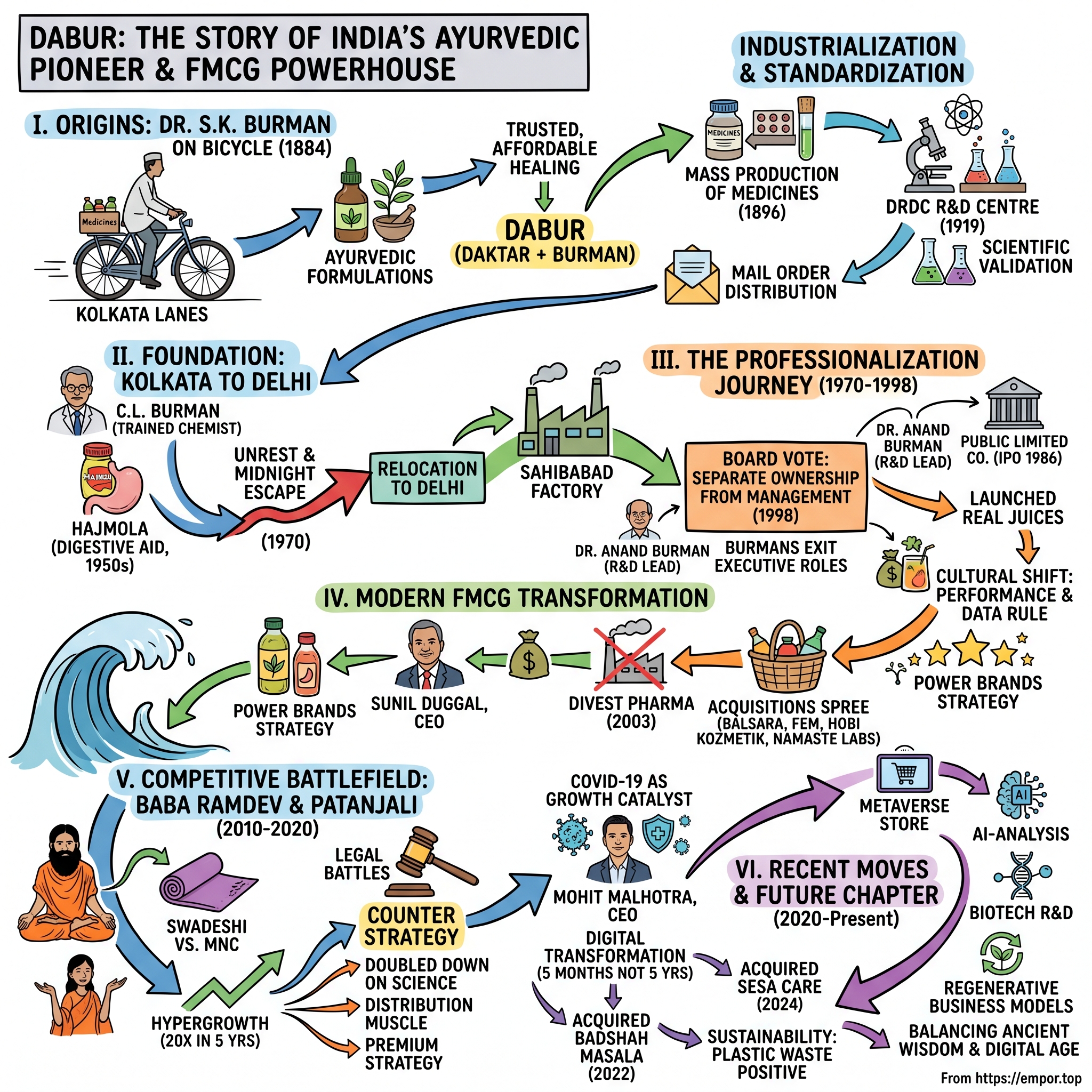
DABUR: The Story of India's Ayurvedic Pioneer and FMCG Powerhouse
I. Introduction & Cold Open
In Bengal during the 1880s, a physician's reputation was measured in miles walked. Cholera and malaria moved through the villages outside Calcutta with a grim seasonal rhythm, and practitioners carried their pharmacies on their backs. One of those men was Dr. S. K. Burman, who in 1884 began preparing Ayurvedic formulations himself and distributing them to patients who could not reach a city dispensary.1 Corporate tradition holds that he made his rounds on a bicycle, mixing remedies at home and carrying them to the sick. The bicycle may be an embellishment—as origin stories often are—but the underlying commercial insight was sound. Burman observed that the primary constraint on Ayurvedic medicine was not efficacy but consistency: local practitioners mixed their own preparations, resulting in variable quality across batches. Standardizing those remedies transformed a localized practice into a scalable product.
Patients began calling him "Daktar Burman." The company that emerged from those rounds took its name from that contraction—Da-Bur.1
One hundred and forty-two years later, Dabur India Limited trades on the National Stock Exchange under the ticker DABUR. For the financial year ended March 2026, the company reported consolidated revenue of ₹13,193 crore and a net profit of ₹1,869 crore.2 It distributes products through a retail footprint that management estimates at nearly 7.9 million outlets, placing it among India's largest domestic fast-moving consumer goods companies. In the quarter ended June 2026, revenue increased 10.6% year-over-year to ₹3,764 crore while net profit rose 15% to ₹586 crore—marking its strongest quarterly growth performance in several years.3
Yet the equity market reflects a more cautious assessment. Dabur crossed a ₹1 trillion market capitalization in April 2021, a milestone widely highlighted by the Indian financial press.4 By mid-August 2026, the stock traded near ₹407, bringing its market valuation down to approximately ₹71,700 crore—roughly 40% below its all-time high of ₹672 in September 2024 and well under its 2021 peak.5 Over a five-year horizon, shareholders in one of India's prominent consumer goods companies have seen negligible capital appreciation. Revenue expanded steadily, but the valuation multiple contracted.
That divergence highlights the central question facing the business today. The familiar narrative—built on 140 years of brand heritage and deep rural distribution—reflects real operational strengths. A more critical examination, however, must address why a company with those assets grew revenue by roughly 5% in FY26, saw its return on capital employed decline from 24% in FY24 to about 20% on a trailing basis, and experienced a one-third compression in its valuation multiple over the same period.26
Addressing that gap requires examining several structural questions. How did a family-run dispensary transform into a consumer goods institution, and what trade-offs were required along the way? How did Dabur navigate the sharp competitive disruption from Baba Ramdev's Patanjali, and at what financial cost? Does its extensive rural network remain a durable competitive advantage, or is its strategic value being diluted by the rapid rise of quick-commerce platforms in urban markets? Finally, has the professional management structure instituted in 1998 delivered performance consistent with its reputation over the past five years?
The analysis begins where the medicine did.
 Subscribe on LinkedIn
II. Origins & Foundation: Science in the Service of Tradition (1884–1970)
The first genuinely important decision in Dabur's history was not the founding. It was what happened twelve years later, in 1896, when the family stopped making medicine by hand and built a factory.1
To appreciate why that mattered, consider what Ayurveda looked like as a commercial category in nineteenth-century India. It was not an industry. It was tens of thousands of individual practitioners—vaidyas—each with inherited formulations, each sourcing herbs from local markets, and each preparing batches by eye and by season. A patient's experience of a remedy depended entirely on which practitioner made it. There was little reason to trust a preparation one had not seen made, and therefore no such thing as a brand.
By moving to mass production, the Burmans made a bet that would take a century to fully pay off: that the scarce resource in traditional medicine was not the knowledge, which was widely held, but reliability. The 1919 decision to set up research laboratories to develop scientific processes for the manufacture of Ayurvedic formulations pushed that bet further.1 This was a family of Ayurvedic physicians voluntarily submitting their inherited craft to laboratory standardization—extraction methods, potency measurement, batch consistency—at a moment when the colonial medical establishment regarded indigenous medicine as folklore. The company added manufacturing units at Narendrapur and Daburgram, and in 1936 formally incorporated as Dabur India (Dr. S. K. Burman) Pvt. Ltd.1
The commercial consequence took decades to compound, but its logic is foundational to the margins Dabur earns today. A consumer buying honey, a herbal digestive, or a winter health tonic cannot independently verify what is inside the container. Adulteration is invisible; efficacy is slow and ambiguous. In categories like these, the brand is not a marketing veneer sitting on top of the product—the brand is the product's primary verifiable attribute. Dabur spent the first half of the twentieth century accumulating that asset, in a market where the alternative was often an anonymous jar from a local shop.
From Medicine Cabinet to Kitchen Shelf
The second foundational move was a reframing of product utility. Chyawanprash—a herb-and-fruit preparation rooted in classical Ayurvedic texts—was historically treated as medicine. Dabur reframed it as a daily household winter ritual: a spoonful a day for the whole family for immunity. Hajmola, a tangy digestive tablet, made a similar leap, transitioning from a post-meal remedy to a daily impulse purchase enjoyed for its taste.
This shift carried significant commercial implications. Therapeutic products are purchased during illness—an irregular, low-frequency demand pattern that contracts as public health improves. A daily habit, by contrast, is purchased year-round by healthy consumers. By converting therapeutic categories into daily consumption items, Dabur built the foundation for a scalable consumer goods enterprise. It also established the seasonal revenue cycles that continue to shape the company's financial calendar: Chyawanprash in winter, cough remedies during the monsoon, and glucose powder in summer.
The Move to Delhi
By the late 1960s and early 1970s, industrial unrest and capital flight from Calcutta prompted many manufacturers to relocate operations out of West Bengal. Dabur adjusted its footprint: operations moved to Delhi in 1972 with a facility at Faridabad, and in 1979 the company opened its Sahibabad factory in Uttar Pradesh alongside the Dabur Research & Development Centre.1
Establishing a formal research center in 1979—for a herbal products company in an economy governed by state licensing rules and limited competitive rivalry—represented an unconventional capital allocation at the time. Its strategic value would become clear decades later, when new market entrants emerged selling traditional wellness categories on ideological appeal, requiring Dabur to defend its position with verifiable product standards alongside its historical legacy.
Before facing that competitive shift, however, the founding family addressed a structural challenge common to legacy enterprises: transitioning from family management to professional leadership.
III. The Revolutionary Pivot: Professionalization & Governance Split (1970–1998)
The conventional pattern for Indian family businesses in the 1990s was straightforward: the promoter ran the enterprise, the founder's children inherited leadership, and professional managers executed operational tasks. Economic liberalization in 1991 expanded product markets but left that management dynamic largely unchanged. The typical corporate response to emerging competition was for controlling families to intensify personal oversight rather than relinquish operating authority.
Dabur took a gradual path to public markets. The company converted into a public limited entity in 1986 following a reverse merger with Vidogum, then completed its initial public offering in 1994 in an issue that management reported was oversubscribed 21 times.1 By 2000, annual revenue surpassed ₹1,000 crore.1 However, expanding scale created a structural governance challenge rooted in family demographics rather than market dynamics.
Five Generations, Too Many Cousins
By the mid-1990s, the Burman family had entered its fifth generation, producing multiple family branches, numerous cousins, and a limited set of executive roles. The family's public explanation for its restructuring was straightforward: leadership concluded that formal professionalization was necessary to prevent inevitable inter-branch friction, while noting that broader economic opening offered family members attractive opportunities to deploy capital outside the core consumer goods business.7
This decision reflected pragmatic capital allocation alongside governance principles. The controlling family recognized that distributing operational authority among five family branches presented long-term governance risks, while stepping back allowed family members to pursue investments across emerging sectors. Stepping away from daily operations yielded a governance model that aligned promoter incentives with institutional management.
In 1998, the family formally separated ownership from operational management. In November of that year, Dabur appointed Ninu Khanna, a former executive at Procter & Gamble and Colgate-Palmolive, as chief executive officer.78 It marked the first time a non-family professional assumed operating control of the enterprise.1
The First Attempt Did Not Work
The initial executive transition encountered early friction. Khanna served as CEO for approximately three years before resigning in January 2002.8 During his tenure, he initiated a strategic shift to reposition Dabur from a traditional Ayurvedic house toward a broader natural and herbal personal care company, beginning efforts to modernize brand perceptions.7 Nevertheless, the brief tenure of its first non-family chief executive reflected the operational adjustments required to establish genuine executive autonomy.
Institutional stability was established under his successor. Sunil Duggal assumed the CEO role in June 2002 and led the business for seventeen years, solidifying professional management as standard corporate governance rather than a temporary initiative.7 Long-term executive continuity converted the 1998 governance framework into a permanent institutional structure.
What the Family Kept
The Burman family retained strategic control through equity ownership, maintaining a promoter holding of approximately 66.2%. That majority stake provides dominant economic control and precludes hostile takeover attempts.9 The resulting structure represents a division of responsibility: the promoter family retains board leadership, oversees capital allocation, and sets high-level strategy, while professional executives manage day-to-day operations and financial results.
For institutional investors, this governance model mitigates several risks common in promoter-led peer companies, including disputed family successions, key-person risk tied to aging founders, opaque related-party transactions, and direct promoter interference in daily execution. While peers such as Emami have managed family succession transitions, Patanjali remains tied to its founder's personal brand, and traditional Ayurvedic firms like Baidyanath remain unlisted family businesses, Dabur's professionalized governance structure remains a key factor supporting institutional equity ownership.
However, a 66.2% promoter stake also leaves minority shareholders with limited voting influence on major corporate decisions. Furthermore, the family's active investment activities outside Dabur—the core driver of the 1998 separation—have occasionally drawn public scrutiny. A prominent example was the Burman family's multi-year campaign to acquire control of financial services firm Religare Enterprises, a contested effort involving regulatory reviews, legal battles, and boardroom disputes that concluded with an open offer in February 2025.10 Although that transaction had no direct operational link to Dabur, it required significant promoter focus and generated media attention unrelated to the core consumer business.
With its governance framework established, professional management turned to restructuring the product portfolio, beginning with a systematic evaluation of underperforming business units.
IV. Building the Modern FMCG Machine: The Power Brands Strategy (1998–2010)
Every conglomerate reaches a moment when it must clarify its operational focus. Dabur reached that threshold in 2003, concluding that its long-term future lay outside the pharmaceutical sector.
Cutting the Pharma Cord
Dabur demerged its pharmaceutical business into a separate entity in 2003.1 On paper, the move appeared counterintuitive: the pharmaceutical division was a viable enterprise with an established oncology franchise, and Dabur's historical identity was deeply rooted in healthcare. In practice, the separation provided critical strategic clarity. Pharmaceuticals and fast-moving consumer goods require opposing operational models. Pharmaceuticals depend on lengthy regulatory approvals, high capital expenditure, drug pipelines, and patent litigation. Consumer goods rely on rapid distribution turnover, modest working capital, retail shelf presence, and marketing scale. Managing both under one corporate structure diluted management focus across both divisions.
The strategic pivot delivered a substantial cash return five years later. In 2008, German healthcare group Fresenius Kabi acquired a 73.3% controlling stake in Dabur Pharma at ₹76.50 per share—a transaction valued by the buyer at roughly €139 million—followed by an open offer for an additional 17.6%.11 By separating the pharmaceutical asset, allowing the market to value it independently, and executing a sale to a global specialist, Dabur successfully monetized a non-core unit and freed capital for its core consumer enterprise.
Learning to Buy
Freed from pharmaceutical management, Dabur expanded through targeted acquisitions, prioritizing small, strategic assets with clear integration potential.
In January 2005, Dabur purchased the hygiene, home care, and cosmetics businesses of the Balsara group for ₹143 crore in an all-cash transaction.112 While the purchase price was modest by corporate standards of the mid-2000s, the assets filled specific portfolio gaps. Balsara brought established oral care brands Babool, Promise, and Meswak, alongside Odomos insect repellent and household products Odonil and Odopic. The transaction transformed Dabur from a single-brand oral care player into a multi-tier provider spanning mass to premium herbal segments, while establishing a home care division overnight.
The deal established an M&A template that Dabur would replicate repeatedly. While mid-sized Indian consumer brands often generate strong consumer demand within specific niches or regions, they frequently lack distribution scale. Dabur possessed a nationwide distribution network reaching millions of retail outlets. Integrating acquired brands into Dabur's existing supply chain generated immediate operational leverage—enabling sales representatives to distribute additional product lines through established retail relationships at minimal incremental cost.
Dabur applied the same strategy in 2008 by acquiring Fem Care Pharma, entering the skin care market and securing access to professional salon distribution.1 The company then expanded its acquisition playbook internationally. In 2010, Dabur acquired Turkey's Hobi Kozmetik for approximately $69 million and U.S.-based Namaste Laboratories for roughly $100 million.1 The Namaste transaction secured a position in ethnic hair care products for consumers of African descent—a category with natural export expansion into Sub-Saharan Africa. These acquisitions converted Dabur's international division from an export business catering to the Indian diaspora into an operating unit with local manufacturing facilities across the Middle East, North Africa, Sub-Saharan Africa, and Turkey.
The Power Brands Doctrine
Alongside acquisitions, management enforced strict internal portfolio discipline, concentrating marketing resources on a core group of "power brands" while curtailing support for peripheral products. The core portfolio focused on flagship names: Dabur Chyawanprash, Dabur Honey, Honitus, Pudin Hara, Dabur Lal Tail, Dabur Amla, Dabur Red Paste, and Real.
This strategy addressed a persistent risk in consumer goods management: SKU proliferation. As consumer businesses expand through new launches and regional variants, marketing budgets risk being fragmented across dozens of minor brands. By focusing media investment and trade support on a small set of category leaders and strong challengers, Dabur achieved superior share of voice while simplifying inventory management and retail relationships.
By 2012, consolidated revenue surpassed $1 billion, reaching ₹5,283 crore.1 The combination of distribution scale, disciplined acquisitions, and focused brand strategy had built a highly efficient consumer goods platform. However, the stability of that model would soon be tested by a wave of new market disruptions.
V. The Competitive Battlefield: Patanjali, HUL, & The Natural Boom (2010–2020)
The competitive disruption of the 2010s did not originate from traditional multinational rivals such as Unilever or Procter & Gamble. Instead, it emerged from Patanjali Ayurved, led by yoga guru Baba Ramdev, who leveraged mass television broadcasts to build a broad consumer audience around an ideological message.
The Swadeshi Shock
Patanjali Ayurved scaled at a rate unprecedented in Indian consumer goods history. Its commercial proposition integrated three elements: swadeshi nationalism, anti-multinational positioning, and pricing below incumbent brands. Supported by its founder's daily broadcast presence, Patanjali targeted core categories where Dabur maintained historical market dominance—including honey, Chyawanprash, herbal toothpaste, ghee, and mustard oil.
For Dabur, the competitive threat was structural. While multinational manufacturers selling synthetic or fluoride products were framed as chemical alternatives, Dabur faced direct competition on its core domain from a rival claiming greater Ayurvedic authenticity, stronger national credentials, and lower prices. Established brand heritage was no longer an insurmountable defense; it became the primary point of contestation. Across the fast-moving consumer goods sector, incumbents responded by launching or repositioning natural product lines, adjusting pricing structures, and revising ingredient marketing.13
The financial impact manifested as extended stagnation rather than rapid market share loss. Volume growth slowed, promotional expenses increased, and Dabur's share price traded in a narrow range as equity markets evaluated whether the company's category leadership could endure.
The Counter-Attack: Evidence Versus Assertion
Dabur countered Patanjali's expansion through three main strategic initiatives.
First, the company shifted marketing claims toward scientific verification. While Patanjali relied on broad assertions of natural purity, Dabur utilized the research infrastructure of the Dabur Research & Development Centre (DRDC) to emphasize clinical trials, published research, and standardized formulation science. Management bet that consumers purchasing health products would prioritize verified efficacy over ideological messaging. That positioning proved resilient, particularly as Patanjali subsequently faced regulatory and judicial scrutiny over its advertising claims in later years.
Second, Dabur expanded its rural distribution network beyond the reach of Patanjali's standalone franchise store model. Under its "Yodha" initiative, Dabur deployed dedicated sales agents to service retail outlets directly in smaller habitations. By FY25, the Yodha network employed over 25,000 rural sales agents and expanded direct distribution to approximately 132,000 villages.14 Expanding physical availability across traditional retail channels provided a durable counterweight to Patanjali's broadcast reach.
Third, Dabur modified product formats to broaden consumer adoption. The traditional Chyawanprash format—a dark, viscous paste packaged in glass jars—appealed primarily to older demographics. Dabur introduced sugar-free variants, child-friendly flavors, tablets, and modern packaging to adapt legacy products for contemporary urban consumption.
The Wars That Never Stop
While Patanjali presented a sudden disruption, ongoing competition persisted with established multinational and domestic peer companies. In oral care, Colgate-Palmolive retained overall market leadership, prompting Dabur to concentrate on the herbal segment. Through brands including Dabur Red Paste, Meswak, Babool, and Promise, Dabur secured approximately one-third of India's herbal toothpaste market.15 This counter-positioning strategy allowed Dabur to capture growth in herbal oral care without competing directly against Colgate's core fluoride franchises.
In hair oils, Dabur contested market share against Marico's Parachute, Bajaj Consumer Care, and Emami's Kesh King across multiple price tiers, ranging from single-use sachets to premium therapeutic formulations. Although the Dabur Amla franchise maintained volume leadership in its core category, small price adjustments by competitors continued to influence quarterly market share shifts.
The Immunity Super-Cycle — and Its Hangover
The onset of the COVID-19 pandemic in 2020 generated unprecedented demand for traditional healthcare and immunity products. Products such as Chyawanprash, honey, giloy, and turmeric supplements experienced rapid sales expansion. Management directed the resulting cash flow toward digital infrastructure, direct-to-consumer platforms, and supply chain modernization.
However, the demand surge created elevated baseline comparisons for subsequent financial periods. Elevated pandemic purchasing pulled forward consumer adoption, making multi-year growth targets difficult to maintain once emergency health concerns normalized. This post-pandemic correction contributed to investor debate over whether Dabur's health supplement portfolio represented a steady structural growth engine or a mature category subject to cyclical volatility.
The period also brought heightened regulatory and public scrutiny. In December 2020, during peak pandemic demand, the Centre for Science and Environment published test findings alleging that multiple Indian honey brands, including Dabur, failed Nuclear Magnetic Resonance (NMR) testing designed to detect adulteration from modified sugar syrups, noting that only three of thirteen tested brands passed.16 Dabur rejected the findings as unfounded and confirmed that its honey products complied fully with national food safety regulations.16 Because consumer trust functions as the primary asset in unstandardized health categories, Dabur subsequently increased capital deployment into NMR testing protocols and purity verification marketing to defend its brand equity.
As the market normalized, the company faced a broader strategic transition: shifting from defending core legacy categories to expanding into new growth adjacencies.
VI. Modern Capital Deployment & Strategic M&A (2020–Present)
There is a particular kind of Indian enterprise that is enormously profitable, regionally beloved, and almost invisible outside its home turf. Badshah Masala was one of them: a Mumbai-based maker of blended spices with a devoted following across Gujarat and Maharashtra, run by a family, and largely absent from markets like Kolkata or Chennai.
Buying Into the Spice Aisle
In October 2022, Dabur agreed to acquire 51% of Badshah Masala for ₹587.52 crore, valuing the enterprise at ₹1,152 crore, with the remaining 49% scheduled to be acquired after five years.17 The transaction closed on January 2, 2023.18
The valuation warrants close examination. Badshah generated FY22 revenue of ₹189 crore and projected FY23 revenue of ₹256 crore with EBITDA margins near 22.9%, pricing the deal at roughly 4.5 times forward sales and 19.6 times forward EBITDA.18 Compared to Indian branded-food transactions of that period—where ITC's acquisition of Sunrise Foods and Orkla's purchase of Eastern Condiments closed at lower revenue multiples, while Tata Consumer paid a substantially higher valuation for Capital Foods—Badshah landed squarely in the middle of the range. For a business producing EBITDA margins above 20% in a category benefiting from formalization, the price was defensible rather than cheap. Dabur did not acquire a bargain; it paid a fair valuation and assumed the operational responsibility of delivering on distribution synergies.
Initial operational results appear encouraging. On its Q1 FY27 earnings call, management reported that Badshah had expanded from roughly ₹220 crore in revenue at the time of acquisition to an annualized run rate of approximately ₹400 crore, driven by 13.3% quarterly revenue growth on 11% volume growth.1920 That represents nearly a doubling in top-line scale over three and a half years, achieved primarily by introducing a West Indian regional brand into Dabur's nationwide distribution network. While this performance validates the core deal thesis, it does not yet guarantee that Badshah can displace entrenched incumbents such as MDH, Everest, or Tata Consumer across northern and eastern markets.
The Sesa Consolidation
The second major deal of this period followed a similar template within familiar territory. In October 2024, Dabur agreed to acquire Ayurvedic hair oil brand Sesa Care at an enterprise value of ₹315 crore to ₹325 crore, initially taking a 51% controlling stake.21 Rather than operating the business as a standalone subsidiary, Dabur pursued a full corporate merger: the National Company Law Tribunal's New Delhi bench issued an order on March 12, 2026, directing shareholder and creditor meetings, which approved the scheme on May 2, 2026, establishing an effective appointed date of April 1, 2026.22
The strategic rationale is clear: Sesa competes in the therapeutic anti-hairfall segment alongside Emami's Kesh King and Marico's premium lines, representing a higher-margin tier of a category where Dabur primarily operates at mass price points. Amalgamating the business directly rather than maintaining a majority stake eliminates minority profit leakage, streamlines corporate structure, and places the brand directly on Dabur's balance sheet and supply chain network. The structure indicates a management team acknowledging that partial ownership of smaller brands often introduces administrative friction without adding strategic flexibility.
Building, Not Just Buying
Beyond external acquisitions, Dabur initiated internal brand development. In June 2025, the company launched Siens, its first digitally native nutraceutical brand, distributed primarily through direct-to-consumer channels and e-commerce platforms across beauty, daily wellness, and gut health categories.23 Management expects Siens to reach an annual recurring revenue of approximately ₹50 crore by the end of FY27.20
Financially, this project represents less than half a percent of total revenue. Its value lies in organizational learning rather than near-term income. For an enterprise whose legacy advantage rests on physical trade distribution, developing digital-first capabilities requires mastering direct marketing, customer reviews, and online retention where physical retail space provides no shelter. Whether Dabur can execute effectively in direct-to-consumer channels remains unproven, making Siens a strategic trial to observe rather than an immediate growth catalyst.
The Discipline Question
Dabur maintains a conservative capital allocation policy. The company closed FY26 with reserves of ₹11,242 crore against total borrowings of ₹1,287 crore, keeping balance sheet leverage low.2 Capital returns to shareholders have remained high: total dividend distributions reached ₹1,417.86 crore in FY25, followed by a recommended final dividend of ₹5.50 per share for FY26.2425 Dividend payouts have absorbed high-seventy percentage levels of net profits in recent periods, yielding a dividend payout near 2%.2
This capital distribution pattern presents a dual narrative. Returning three-quarters of annual earnings reflects disciplined capital management that avoids dilutive acquisitions. Conversely, it signals that management sees limited high-return internal reinvestment opportunities within its core categories. At approximately 36 times earnings, Dabur's stock valuation implies growth expectations beyond those of a mature legacy consumer enterprise.2 While management has allocated roughly ₹500 crore for future acquisitions and aims to execute one or two transactions over three years, execution timing remains uncertain.20 The tension between the growth implied by Dabur's valuation multiple and its conservative reinvestment rate remains a central question for equity investors.
That execution gap places the focus squarely on the executive team responsible for closing it.
VII. Deep Dive: Current Management, Governance, & Incentive Structure
In February 2026, Dabur reorganised its leadership in a way that revealed something about how it now sees itself. Mohit Malhotra, who had run the company as chief executive since 2019, was redesignated Whole-Time Director and Global Chief Executive Officer with effect from 17 February 2026.26 Two months later, on 15 April 2026, Herjit S. Bhalla joined as Chief Executive Officer – India Business, reporting to Malhotra.27
Splitting the Job
Structurally, this is a company acknowledging that its international arm has outgrown being a side-show. Malhotra is unusually well suited to the global brief: he is a career Dabur executive who led the international business before taking the top job, which means the person now overseeing group strategy spent years operating in Egypt, Nigeria, Turkey and the Gulf rather than only in Uttar Pradesh.
Bhalla's appointment is the more revealing choice. He came from The Hershey Company, where he had served as Vice-President for Canada and Global Customers after joining as Managing Director for India in 2018, with earlier senior roles at Metro Cash & Carry and Unilever.2728 Dabur went outside — to a foods company, and to an executive with modern-trade and global-customer experience — for the job of running its Indian business. Read alongside the Badshah acquisition and the foods ambition, and alongside the shift of Indian retail toward organised and digital channels, the hire looks less like a routine succession and more like a statement about which capabilities management thinks the India business is missing.
It also introduces execution risk that should not be waved away. Splitting a CEO role creates ambiguity about who owns the largest P&L, and outside hires into 140-year-old institutions with strong internal cultures do not always land. This is a change to watch, not a change to applaud.
Above the executives sits the family. Mohit Burman serves as Non-Executive Chairman and Saket Burman as Vice Chairman, with the promoter group's roughly 66% holding underwriting the board's authority.9 The compensation architecture, as disclosed in the company's remuneration policy and annual reporting, ties variable pay for the chief executive and key management personnel to consolidated financial performance, market share progression across the power brands, distribution expansion, and sustainability commitments.29
Judging Management by the Tape, Not the Slides
The more useful exercise is to test what management said against what happened.
FY25 was the hard year, and it is the right place to start. Consolidated revenue grew only marginally to ₹12,563 crore, net profit fell 3.9% to ₹1,740 crore, operating margin contracted from 19.3% to 18.4%, and return on capital employed dropped from 24.1% to 22.0%.624 Dabur was not alone — Indian FMCG broadly suffered from urban demand weakness and food inflation squeezing household budgets — but a year of declining profit and falling returns at a company valued for consistent compounding is a genuine failure to deliver, and no amount of context erases it.
What management did in response is more informative than the miss itself. Rather than defend the portfolio, it began cutting: Dabur said it would exit underperforming categories including tea and diapers, and guided to high single-digit to low double-digit revenue growth for the year ahead.24 Pruning categories you have publicly invested in is unpleasant and is exactly the behaviour a sceptical investor should want to see.
Then came the tax test. When India's GST overhaul took effect on 22 September 2025, moving most of Dabur's portfolio to a 5% rate, the immediate effect was disruptive rather than helpful — consumers deferred purchases waiting for lower prices, and retailers ran down higher-priced inventory. Management said so in advance, guiding publicly in early October 2025 that Q2 FY26 consolidated revenue growth would be only mid-single-digit because of the transition.30 Q2 revenue came in at ₹3,191 crore, up 5.4%.31 Guiding down before a bad print, with a specific mechanism and a specific number, and then landing on it, is the single most credible thing a management team can do. Dabur did it.
The recovery narrative that followed also held. Management pointed to early demand revival in the December 2025 quarter as trade stabilised post-GST, with rural continuing to outrun urban.32 FY26 ended with revenue up 5% to ₹13,193 crore, profit up 7.4% to ₹1,869 crore, gross margin expanding 30 basis points to 48.3% and operating margin improving 15 basis points to 18.6%.25 Then the June 2026 quarter delivered the double-digit consolidated growth the company had been promising, and management guided to double-digit growth for the full FY27 with margins better than the prior year.20
The honest summary: this is a management team whose narrative has been consistent, whose bad-news communication has been timely and specific, and whose recent execution has matched its guidance — after a two-year stretch in which the actual results were mediocre. Credibility of process, established during a period of underwhelming outcomes. Whether the outcomes now compound is the open question, and it turns on the machine described next.
VIII. Business Model, Unit Economics, & Distribution Moat
To understand why Dabur is difficult to displace, picture a village of nine hundred people somewhere in eastern Uttar Pradesh. There is one shop. It stocks perhaps four hundred SKUs in a space the size of a garage. The shopkeeper buys on credit, has no storage, and cannot afford to hold anything that does not sell within days. Getting a product onto that shelf requires a person to physically arrive, take an order, extend credit, deliver a small quantity, and come back a fortnight later. Multiply by hundreds of thousands of such villages. That is the asset.
What Dabur Actually Sells
The portfolio relies on three primary business engines. In the June 2026 quarter, Home and Personal Care represented the largest segment at ₹1,385 crore, accounting for roughly 55% of domestic revenue and growing 12.3% year-over-year behind hair oils, oral care, skin care, and home care brands such as Dabur Amla, Dabur Red Paste, Odomos, and Odonil.19 Healthcare contributed ₹623 crore, or about 24% of domestic revenue, expanding 5.5% through products like Chyawanprash, honey, Honitus, Pudin Hara, and glucose—forming the company's highest-gross-margin and most seasonal category.19 Food and Beverages generated ₹528 crore, about 21% of domestic sales, growing 7.2% across the Real juice franchise, coconut water, and Badshah.19
This product mix shapes Dabur's overall financial profile. Healthcare products generate the highest gross margins because consumers pay a premium for perceived efficacy and trust rather than raw commodity inputs. Home and Personal Care drives volume and daily retail visibility, maintaining distributor engagement. Food and Beverages expands basket size and strengthens modern-trade presence, though at structurally lower margins. Overall gross margin, which sits near 48%, does not stem from dominant pricing power in a single product line, but rather from a portfolio intentionally structured around brands that capture perceived consumer value.25
Granular category dynamics in the June 2026 quarter illustrate these segment mechanics. Hair oils expanded 18% on 8% volume growth, picking up 102 basis points of market share; herbal oral care outpaced non-herbal products by 550 basis points; active juices surged over 40%; and coconut water grew more than 70%.1920 Offsetting those gains, the healthcare division's glucose sales faced headwinds from unseasonal rainfall—a reminder that a meaningful portion of quarterly performance remains tied to seasonal weather patterns.20
The Machine Itself
Dabur's distribution network spans roughly 7.9 million retail outlets across India, with a growing subset—well over one million—serviced directly by the company's distributors rather than third-party wholesalers.3314 The distinction between total footprint and direct distribution is critical. Products reaching a village store through multiple wholesale layers depend heavily on intermediary trade preferences. Direct distribution allows Dabur to manage shelf placement, launch new variants, enforce consistent stock replenishment, and maintain price integrity.
Through its Yodha network of rural sales agents, Dabur expanded direct distribution coverage to approximately 132,000 villages in FY25.14 Consequently, rural markets account for a larger share of domestic sales at Dabur than at major FMCG peers such as Hindustan Unilever, Marico, or Britannia.
This distribution footprint functions as a leveraged exposure to rural economic conditions rather than an unconditional moat. Results from the first quarter of FY27 highlighted the upside of this leverage, as rural sales growth outpaced urban performance by 550 basis points in general trade channels, excluding modern trade and e-commerce.19 When monsoons prove favorable, agricultural realization holds, and government transfers support farm incomes, Dabur's geographic mix generates superior growth relative to urban-heavy competitors. Conversely, when rural wage growth stalls, the same exposure depresses overall corporate performance, as demonstrated in FY25.
Outside India
Dabur's international operations expanded 15.5% in rupee terms during the June 2026 quarter. Market performance varied significantly across regions: Turkey grew 26.9% in rupees (33.5% in constant currency), Nigeria rose 35.1% in rupees but just 5.6% in constant currency, and Bangladesh increased 34.3% in rupees (21.5% in constant currency).19 Divergences between reported rupee figures and constant-currency performance underscore the impact of foreign exchange fluctuations, particularly in Nigeria where reported top-line expansion largely reflected currency movements rather than volume gains. Local manufacturing facilities across the Middle East, North Africa, Sub-Saharan Africa, and South Asia provide operational diversification against Indian rural demand shifts and allow Dabur to deploy its herbal positioning in receptive overseas markets. However, international exposure introduces frontier-market currency volatility and geopolitical risks, with management highlighting that Middle East conflicts disrupted input costs and supply chains during the June quarter.20
Behind the Product
Manufacturing operations encompass more than a dozen domestic production facilities alongside overseas plants, supported by backward integration into herb cultivation across Himachal Pradesh, Uttarakhand, and southern India to secure raw material supply and botanical traceability.29 This supply chain infrastructure represents a key operational defense. While competitors can replicate classical Ayurvedic formulations, establishing long-term contract cultivation networks for high-quality amla, ashwagandha, and giloy requires years of agricultural development and supplier relationships that cannot be easily copied.
Dabur's distribution and supply chain engine remains formidable. The strategic question for investors is whether that traditional engine is fully calibrated for the evolving landscape of Indian retail.
IX. The Investment-Story Spine: Why Win / Why Not
Strip away the historical narrative, and Dabur's investment thesis rests on a single testable proposition: the company commands a physical distribution network and a suite of trusted brands that rivals cannot economically duplicate, allowing it to drive higher volume through those channels over time. The optimistic outlook assumes that dynamic holds. The cautious view argues that structural retail shifts are gradually eroding its durability.
Why It Wins From Here
The rural footprint provides leveraged exposure to India's consumption recovery. Dabur maintains greater sales exposure to rural India than nearly any of its major listed peers. Establishing profitable distribution to remote villages at low price points creates a formidable barrier to entry because the unit economics require substantial route density and volume scale. The 5.5-percentage-point sales growth advantage that rural channels delivered over urban general trade in the June 2026 quarter demonstrates how effectively this portfolio captures demand when rural purchasing power turns.19 India's goods and services tax overhaul added a secondary tailwind, placing roughly 85% of Dabur's portfolio in the lower 5% tax bracket—structurally reducing consumer costs where price sensitivity is highest.30
The herbal and Ayurvedic strategy operates as a structural counter-positioning model. A multinational relying primarily on traditional fluoride toothpaste cannot pivot aggressively into herbal formulations without risking its core product lines. That structural divide helped Dabur's herbal oral care segment outpace non-herbal category growth by 5.5 percentage points in the June 2026 quarter, while its hair oil line picked up market share.1920 Its long-standing R&D infrastructure enables the company to pair herbal heritage with standardized laboratory evidence—occupying a strategic middle ground between unsubstantiated natural claims and purely synthetic formulations.
The acquisition integration framework demonstrates repeatable distribution leverage. Expanding Badshah Masala from approximately ₹220 crore at acquisition to an annualized revenue run rate near ₹400 crore provides concrete proof that regional brands accelerate growth once integrated into Dabur's national distribution architecture.20 As the Sesa Care amalgamation progresses and leadership seeks additional bolt-on opportunities, this integration model offers a clear pathway for portfolio expansion, provided deal valuations remain disciplined.
Premiumization unlocks value growth in mature product categories. Introducing sugar-free Chyawanprash variants, specialized hair oils, premium fruit juice offerings, and coconut water—which expanded over 70% in the June 2026 quarter—addresses the structural limit of mature categories.1920 Where total unit volume expansion slows, shifting toward higher-priced, specialized formats allows revenue and realization per unit to expand.
Why It May Not
Urban distribution advantages face structural disruption from quick commerce. Rapid-delivery platforms in major metropolitan centers bypass legacy wholesale networks by delivering directly to urban households. Management has noted that these emerging digital channels grew in the high teens even as traditional general trade experienced pressure.32 While quick commerce expands availability, digital channels extract higher margin concessions than traditional wholesalers, altering trade economics. Although e-commerce reached 6% of sales in the June 2026 quarter while expanding at triple-digit rates, the rapid shift toward digital fulfillment diminishes the relative advantage of physical distributor reach in affluent urban markets where unit realizations are highest.20
The high-margin healthcare division shows signs of category maturity. Domestic healthcare revenue expanded 5.5% in the June 2026 quarter, trailing the 12.3% increase recorded by Home and Personal Care.19 Household penetration for core products like Chyawanprash and honey is already high in target demographics, while pandemic-era demand acceleration set an elevated baseline. Additionally, younger urban consumers increasingly turn toward specialized nutraceuticals and digitally native wellness brands. If Dabur's highest-margin segment stabilizes at single-digit growth, overall margin expansion must rely on operational cost efficiencies rather than favorable product mix.
Expanding into branded spices enters a heavily contested market. The packaged spice segment features entrenched competitors including MDH, Everest, ITC's Sunrise, and Tata Consumer, alongside strong unorganized local processors. Much of Badshah's initial sales acceleration stemmed from distributing products into geographical territories where the brand was previously unavailable. Winning market share against deeply established incumbents in their core home markets presents a substantially harder operational challenge that remains unproven over the long term.
Raw material volatility creates ongoing gross margin exposure. Key inputs including honey, amla, botanical herbs, and fruit concentrates depend heavily on agricultural yields and climate conditions. Management cited elevated commodity input costs and Middle East supply chain disruptions as active margin pressures during the June 2026 quarter.20 Consequently, the company's gross margin of roughly 48% remains vulnerable to seasonal harvest fluctuations and raw material inflation.
Ultimately, Dabur's investment profile reflects a balance of three forces: a durable advantage in rural physical distribution paired with established consumer trust, an urban distribution moat undergoing gradual erosion from digital fulfillment, and an Ayurvedic heritage that secures market position but does not automatically insulate core categories from long-term maturity.
X. Strategic Frameworks: Porter's 5 Forces & Hamilton Helmer's 7 Powers
Strategic frameworks are useful only when applied rigorously enough to surface uncomfortable conclusions. Examined through both lenses, Dabur possesses fewer distinct sources of economic power than its market reputation suggests—yet the advantages it does retain are structural and durable.
The Seven Powers, Unevenly Held
Brand — high, and genuinely load-bearing. This is Dabur's strongest source of competitive power, though its strength is category-specific rather than universal. In unstandardized health categories where consumers cannot independently verify quality—such as honey, herbal remedies, or children's immunity supplements—brand trust acts as a proxy for physical inspection. That trust commands real pricing power. However, the Centre for Science and Environment's 2020 honey testing controversy illustrated the inherent vulnerability of this power: in trust-based categories, a credible quality challenge does not merely trim margins; it threatens the fundamental value proposition. Brand power in wellness products is simultaneously high-margin and structurally fragile.
Scale economies — high in distribution, moderate elsewhere. The substantial fixed costs of maintaining a rural salesforce, a sub-stockist network, and national media campaigns are spread across a massive revenue base. A new entrant seeking to match Dabur's direct reach across 132,000 villages would require comparable sales volume to justify the setup costs, yet cannot achieve that volume without equivalent retail distribution. This self-reinforcing dynamic renders Dabur's rural distribution footprint highly defensible. In manufacturing and procurement, by contrast, its scale advantages are more standard for an incumbent consumer goods operator.
Cornered resource — moderate. Proprietary formulations, the clinical research repository of the Dabur Research & Development Centre, and long-standing contract-farming networks for specialized botanicals are difficult for new entrants to replicate quickly. However, these assets fall short of a true cornered resource: classical Ayurvedic formulations reside largely in the public domain, and well-capitalized competitors can establish their own contract-cultivation programs over time.
Process power — moderate. Consistently converting variable, seasonal agricultural raw materials into standardized consumer products at industrial scale represents an operational capability built over decades. This capability manifests primarily as batch consistency and brand reliability rather than as a clear cost advantage over major peers.
Counter-positioning — moderate, and category-limited. Pitting natural and herbal formulations against synthetic chemical alternatives creates a counter-positioning dilemma for multinational incumbents like Colgate-Palmolive or Procter & Gamble, as aggressively copying herbal lines risks cannibalizing their main franchises. However, this power provides no protection against domestic rivals such as Patanjali, Emami, or Himalaya, which operate on the same herbal footing.
Switching costs — low, essentially absent. Consumers face minimal financial or operational barriers to switching toothpaste, hair oil, or packaged juices. Customer retention relies on brand trust, habit, and taste preferences—which are manifestations of brand power rather than true switching costs.
Network economies — none. Physical fast-moving consumer goods do not become inherently more valuable to an individual user as adoption spreads, beyond basic social proof.
In total, Dabur commands two strong powers, three moderate advantages, and two absent forces. This profile reflects a durable consumer franchise rather than an unassailable moat—an assessment consistent with a company compounding revenue in the mid-to-high single digits rather than double digits.
Five Forces on the Board
Competitive rivalry — high, and rising. Dabur faces simultaneous competition across multiple product categories from domestic conglomerates and multinational leaders, including Hindustan Unilever, Colgate-Palmolive, Marico, Emami, Patanjali, ITC, Tata Consumer, and Himalaya. While no single rival threatens the enterprise in its entirety, intense multi-front competition constrains industry-wide pricing power.
Threat of new entrants — bifurcated across geographies. Building a physical distribution network capable of matching Dabur's rural reach requires decades of capital deployment, creating a formidable barrier to entry in traditional trade. Conversely, launching a digitally native brand targeting urban households via e-commerce and quick-commerce channels requires modest upfront capital and can be executed rapidly. Entry barriers remain extraordinarily high in rural markets where per-unit margins are lower, but markedly lower in affluent urban centers where unit realizations and premiumization potential are highest. This structural geographic asymmetry represents a key long-term strategic challenge for the company.
Bargaining power of buyers — rising. Traditional kirana store owners possessed virtually no bargaining leverage against established FMCG manufacturers. Modern trade chains and quick-commerce platforms—such as Reliance Retail, DMart, Blinkit, and Zepto—exert substantial channel power. As trade shifts toward organized, data-driven platforms, margin concessions tilt toward retailers, squeezing manufacturer margins in high-growth urban channels.
Bargaining power of suppliers — moderate. Agricultural producers and contract farmers are fragmented, yet specific botanical inputs face climate sensitivity and harvest volatility. Concurrently, packaging materials remain linked to international petrochemical pricing cycles, exposing gross margins to input cost fluctuations.
Threat of substitutes — moderate to high. Modern pharmaceutical treatments offer functional alternatives to Ayurvedic healthcare remedies, while specialized nutraceuticals and dietary supplements compete for health-conscious urban consumers. In the beverage segment, packaged juices face broad competition from alternative non-alcoholic drinks and fresh options.
The composite competitive picture reveals an enterprise with robust defensive barriers around its traditional rural footprint, but facing increased margin pressure and lower entry barriers in modern urban retail channels. That structural tension explains why the market has re-rated Dabur's valuation multiple in recent years.
XI. Risk Radar & Skeptical-Investor Stress Test
In June 2024, the Food Safety and Standards Authority of India instructed food manufacturers to cease labeling reconstituted juice products as "100% fruit juice" across packaging and advertising.34 For Dabur, whose Real franchise leads India's packaged juice category, this was not a routine compliance update. It was a regulatory directive compelling the company to remove the central marketing phrase it had established with consumers over decades.
The Risks That Actually Matter
Regulatory and labelling risk is now a recurring feature, not an event. The juice-labelling directive forced packaging and messaging revisions across the beverage industry.34 Separately, heightened international scrutiny over pesticide residues in Indian spices affects any consumer goods company expanding in branded masala. Regulatory oversight in Indian consumer markets has increasingly shifted from basic licensing to product claims—specifically what health benefits a company may promise—placing Dabur's wellness-centered portfolio in a structurally exposed position.
Purity and trust risk represents the tail risk capable of impairing brand equity. The 2020 honey adulteration controversy serves as the template. The critical vulnerability is not the specific testing methodology under debate, but the reality that Dabur's primary commercial asset—consumer trust in product purity—cannot be independently verified at the retail counter. In unstandardized health categories, trust can be challenged far more rapidly than it can be rebuilt. Consequently, ongoing capital deployment into Nuclear Magnetic Resonance testing operates as a permanent insurance premium on brand equity.
Rural and monsoon volatility cannot be fully diversified away. The high rural exposure that generates outperformance during strong agricultural cycles contributed directly to the earnings contraction in FY25 when rural purchasing power softened.
Input cost inflation compresses margins with an operational lag. Key raw materials—including honey, botanical herbs, packaging laminates, and paraffin—follow commodity cycles outside management's control. Concurrently, pricing adjustments in mass consumer categories remain constrained by competitors willing to absorb cost increases to maintain volume share.
Channel transition risk presents a gradual structural challenge. The rapid rise of quick commerce requires higher trade margin concessions, faster fulfillment turnarounds, and dedicated packaging formats. This digital shift gradually disintermediates the traditional physical distributor network that Dabur spent decades and substantial capital constructing.
What a Sceptical Investor Would Press On
"Is the Foods division a low-return distraction from a high-margin healthcare business?" Packaged juice is a volume-intensive, input-cost-exposed category with lower gross margins than traditional healthcare remedies, and acquiring Badshah Masala deepened that commitment. Management's thesis is that foods provide urban shelf presence, basket relevance, and a seasonal counterweight to winter-heavy healthcare sales, while Badshah's high-margin spice economics improve overall segment profitability. The empirical test is straightforward: monitor whether food segment operating margins expand as Badshah scales. If margins fail to improve, portfolio diversification risks becoming margin dilution.
"Why is a company priced at 36 times earnings paying out three-quarters of its profit?" The optimistic interpretation is capital allocation discipline. The skeptical interpretation is that internal high-return reinvestment opportunities within mature core categories are constrained, and that the ₹500 crore earmarked for future acquisitions remains modest relative to a ₹13,000 crore revenue enterprise.202 Both arguments align with disclosed financial data. Which view proves accurate will depend on the purchase valuations and return profiles of future transactions.
"How much of the promoter's attention is actually on Dabur?" The Burman family's multi-year campaign to secure control of Religare Enterprises—involving open offers, regulatory proceedings, and a public boardroom dispute—represented a major strategic commitment outside the core consumer business.10 While there is no evidence this activity disrupted Dabur's daily operations, and the 1998 governance separation was designed to insulate professional management from promoter activities, equity investors in a promoter-controlled company are allocating capital alongside the founding family's broader strategic priorities.
"Are the D2C initiatives optionality or theatre?" At a projected annual recurring revenue of ₹50 crore, the digital-first Siens brand remains immaterial to consolidated financial performance.20 It functions as a legitimate trial vehicle for developing direct-to-consumer capabilities rather than an immediate growth driver, and management's restraint in presenting it as a core earnings catalyst reflects realistic positioning.
XII. Bull vs. Bear Case & Earnings Call Transcript Analysis
The live version of any corporate narrative is rarely found in the polished pages of an annual report. It unfolds during quarterly earnings calls, where executive management addresses analyst scrutiny in real time.
What the Calls Reveal
Three central themes have dominated Dabur's recent investor calls, with the quality of management's disclosures varying across topic areas.
On volume versus price, analysts have consistently pressed for underlying volume metrics rather than headline revenue growth, reflecting the perspective that price-led expansion in mass consumer goods provides temporary top-line gains at the expense of future volume. Management addressed this directly, reporting that domestic fast-moving consumer goods revenue expanded 9.5% in the June 2026 quarter, backed by 5% underlying volume growth.19 Consistently disclosing volume growth across different operating environments provides a clear benchmark for assessing underlying consumer demand.
On quick commerce, executive responses have been descriptive rather than financially explicit. Management acknowledged that emerging digital channels expanded in the high teens while traditional general trade faced pressure, noting that e-commerce reached 6% of total turnover while growing at triple-digit rates, supported by dedicated pack formats and customized fulfillment arrangements.3220 However, executive commentary omitted detailed margin arithmetic—specifically whether quick-commerce sales generate net margins comparable to traditional general trade after accounting for platform fees and promotional concessions.
On acquisitions, management outlined clear strategic parameters while maintaining flexibility on timing—allocating approximately ₹500 crore for one or two bolt-on transactions over a three-year horizon, while emphasizing that completion remains contingent on disciplined target valuations.20 Maintaining flexibility on transaction timing reflects a measured approach to capital deployment.
During the June 2026 call, executive guidance shifted toward top-line acceleration, projecting double-digit consolidated revenue growth through FY27 alongside operating margin expansion over the prior year, supported by quarterly results that met target levels.20 This guidance followed management's earlier pre-announcement of slower growth during the September 2025 GST transition, establishing a pattern of updating revenue expectations in advance of reported quarters.
The Bull Case, Stated Plainly
The positive investment thesis rests on brand equity in trust-sensitive categories, supported by an extensive rural distribution network that amplifies volume growth during agricultural recoveries. Tax restructuring under the GST framework lowered consumer prices on roughly 85% of the company's portfolio, enhancing product affordability across price-sensitive regional markets. Furthermore, the expansion of Badshah Masala provides empirical backing for scaling acquired regional brands through Dabur's national distribution architecture. Supported by a conservative balance sheet and clean corporate governance, the equity valuation de-rated roughly 40% from its September 2024 peak, embedding a more realistic outlook relative to historical valuation multiples.
The Bear Case, Stated Plainly
The cautious thesis highlights structural shifts in retail channels that diminish physical distribution advantages in high-margin urban markets. The company's highest-margin healthcare division expanded at 5.5% in the June 2026 quarter, trailing the 12.3% growth recorded by Home and Personal Care, signaling potential category maturity. Meanwhile, return on capital employed compressed from 24% in FY24 to approximately 20%, while dividend payouts absorbing over three-quarters of net profit point to constrained internal high-return reinvestment avenues.62 Additionally, entering branded spices introduces competition against established incumbents, while agricultural raw material volatility creates ongoing margin exposure. At approximately 36 times earnings, the stock valuation continues to price in sustained compounding beyond recent operational performance.2
The Two or Three Things Actually Worth Tracking
Evaluating Dabur's execution requires focusing on three primary performance indicators.
India FMCG underlying volume growth. Disclosing underlying volume growth separately from pricing gains provides the clearest indicator of real consumer demand. Relying on price increases to drive top-line expansion offers temporary revenue gains at the expense of market penetration, whereas volume growth indicates compounding brand equity across urban and rural channels.
Consolidated gross margin. Consolidated gross margin captures the net impact of agricultural input costs, GST adjustments, brand premiumization, and segment mix. If premiumization efforts and Badshah's higher-margin spice economics succeed, gross margin should expand over multi-year cycles despite temporary commodity inflation. Sideways or contracting margins would indicate that premiumization initiatives are failing to offset cost pressures.
Share of revenue from e-commerce and quick commerce — and what it does to margin. The shift toward digital channels reflects an evolving retail dynamic. Expanding e-commerce and quick-commerce sales alongside stable or improving operating margins would demonstrate effective channel adaptation. Conversely, digital sales growth accompanied by margin compression would signal that third-party platforms are capturing distribution rents previously held by physical wholesale networks.
XIII. Playbook: Lessons in Building a Century-Old Institution
Strip Dabur's 142-year history down to transferable strategic lessons, and five endure.
Separate ownership from management before crisis forces the issue. The Burman family executed this transition in 1998 when the business was financially stable and facing no immediate crisis, explicitly citing the prevention of future inter-branch family friction as the primary objective.7 Many family-owned enterprises attempt professionalization only after a succession conflict erupts, when operational damage has already occurred and incoming executives inherit a compromised organization. The takeaway is not that professional managers inherently outperform founding families—Dabur's initial non-family leadership transition lasted only three years—but that executing the separation from a position of strength is far less costly.
Validate traditional heritage with science before competitors attack it. Dabur established a dedicated research center in 1979 when competitive pressure in traditional herbal categories was minimal. Three and a half decades later, when Patanjali emerged claiming greater Ayurvedic authenticity at lower price points, Dabur's clinical research infrastructure proved to be the single asset that could not be matched by ideological assertion alone. Heritage is a claim any brand can make; verifiable scientific evidence requires long-term prior investment. Capital deployed into institutional credibility must occur long before that credibility is tested, explaining why such investments often appear redundant when initiated.
In emerging markets, distribution is strategy. A consumer brand without a reliable route-to-market exists primarily on paper. Dabur's capacity to service remote village stores profitably at modest price points underpins its acquisition strategy, turning each acquired brand into a distribution leverage opportunity. Yet the corollary carries a harder lesson: a physical distribution moat is only as valuable as the retail channel it commands, and retail channels evolve. The rural logistics network that appeared unassailable in 2015 provides a diminished competitive advantage in urban centers where quick-commerce platforms are expanding rapidly in 2026.
Anchor on power brands while acquiring strategic adjacencies. Concentrate marketing investment and executive attention on a focused core of power brands capable of establishing genuine category dominance, while utilizing targeted acquisitions to enter product categories and geographies that would be costly to build organically. The acquisitions of Balsara, Fem Care, Hobi Kozmetik, Namaste Laboratories, Badshah Masala, and Sesa Care represent variations of the same playbook: buy established brand affinity, then apply distribution scale. The discipline preserving this model is purchase valuation. Paying roughly 4.5 times sales for a business growing revenue at 20% with EBITDA margins near 23% allows synergy arithmetic to succeed; paying inflated multiples destroys capital regardless of distribution reach.
Treat structural macro exposure as a deliberate choice, not an accident. Dabur's heavy rural revenue weighting guarantees periodic performance contractions when agricultural conditions soften, as demonstrated in FY25. The strategic lesson is not that geographic concentration is inherently desirable, but that an enterprise must clearly acknowledge its core macroeconomic exposures, communicate them transparently, and be evaluated across full economic cycles rather than individual quarters. Investors who buy Dabur for its consumer brands but express surprise at its sensitivity to monsoon weather patterns misunderstand the structural mechanics of the business.
XIV. Epilogue & Reflections
There is a structural symmetry running through Dabur's 142-year history. Dr. S. K. Burman's initial challenge in 1884 was consumer skepticism: individual Ayurvedic preparations lacked standardization, making quality unverifiable. In December 2020, the company faced a modern variant of that same dilemma when questions arose over honey purity and a testing laboratory in Germany became the arbiter.16 One hundred and thirty-six years apart, the core commercial vulnerability remained unchanged: in categories where buyers cannot independently verify product quality, enterprise value rests entirely on trust.
Dabur's corporate evolution reflects a continuous effort to institutionalize that trust. The opening of its first automated factory in 1896, the establishment of research laboratories in 1919 and 1979, the deployment of clinical studies to counter Patanjali's assertions, and the adoption of advanced testing protocols represent a single, recurring investment across five generations: reinforcing consumer confidence in unstandardized health categories.
That long-term focus built a ₹13,193 crore consumer goods enterprise operating across four continents, while the 1998 governance separation remains an instructive model for promoter-held businesses. Yet longevity has not translated into sustained equity returns. An investor buying into the company at its ₹1 trillion market capitalization milestone in April 2021 has seen five years elapse without capital appreciation. Over that period, a rural distribution network constructed over decades has confronted rapid channel shifts in urban markets, while mature healthcare categories have constrained overall margin expansion.
Dabur has demonstrated that an enterprise can endure for nearly a century and a half. What it must still prove to equity markets is that operational endurance leads inevitably to compounding shareholder value. The strong earnings performance in the June 2026 quarter provided the most compelling evidence in several years that a growth trajectory could resume. Whether that result marks a durable operational inflection or a temporary surge driven by favorable seasonal demand will depend on execution over the coming quarters.
References
-
Dabur India Ltd — Financial Summary, Ratios and Balance Sheet — Screener.in ↩↩↩↩↩↩↩↩
-
Dabur India Q1 results: Profit up 15% at Rs 591 crore YoY; revenue climbs 11% — Business Today, 2026-07-29 ↩
-
Dabur India hits fresh record high; m-cap crosses Rs 1-trillion mark — Business Standard, 2021-04-15 ↩
-
Why Is Dabur India Share Price Falling? Key Reasons — Univest, 2026 ↩
-
Why Indian Business Families are Hiring Professional CEOs — Business Today, 2022-09-13 ↩↩↩↩↩
-
Ninu Khanna Quits As Dabur Chief Executive — Business Standard, 2002-01-09 ↩↩
-
Burman Family's Path Clear for Religare Takeover? SEBI Blocks Gaekwad's Offer, Saluja Ousted — Outlook Business ↩↩
-
Fresenius Kabi strengthens its position in i.v. drugs by acquiring Dabur Pharma, a leading manufacturer of oncology generics — Fresenius, 2008 ↩
-
Dabur India merges Balsara, announces Q3 results — Dabur India ↩
-
How Baba Ramdev's Patanjali forced Indian FMCG giants to adapt — Forbes India, 2017-06-12 ↩
-
Honeygate! Only Saffola, MarkfedSohna, Nature's Nectar among 13 brands pass sugar syrup test, claims CSE — Business Today, 2020-12-02 ↩↩↩
-
Dabur acquires 51% stake in Badshah Masala for Rs 587.52 crore — The Economic Times, 2022-10-26 ↩
-
Dabur India concludes acquisition of 51% stake in Badshah Masala — Business Standard, 2023-01-03 ↩↩
-
Dabur Q1 FY27 slides: 10.6% revenue growth amid inflation headwinds — Investing.com, 2026-07-29 ↩↩↩↩↩↩↩↩↩↩↩↩
-
Dabur India Ltd (BOM:500096) Q1 2027 Earnings Call Highlights — Yahoo Finance, 2026-07-29 ↩↩↩↩↩↩↩↩↩↩↩↩↩↩↩↩↩
-
India's Dabur to acquire 51% stake in hair care firm Sesa Care — Reuters, 2024-10-18 ↩
-
Dabur India Ltd. NCLT Order Received for Sesa Care Amalgamation — InvestyWise, 2026 ↩
-
Dabur Enters Nutraceutical Category with SIENS — Dabur India, 2025-06-18 ↩
-
Dabur India Reports Modest Revenue Rise and FY25 Profit of Rs 1,768 Crore — Indira Trade, 2025 ↩↩↩
-
Dabur Q4 FY26 Result: Net profit rises 15% to ₹369 crore YoY; board recommends final dividend for FY26 — Upstox, 2026 ↩↩↩
-
Dabur India elevates Mohit Malhotra to Global CEO — Storyboard18, 2026-02 ↩
-
Dabur India appoints Herjit Bhalla as CEO for India business — Business Standard, 2026-02-18 ↩↩
-
Dabur India Appoints Herjit S. Bhalla As CEO Of India Business — BW Businessworld, 2026 ↩
-
Management Discussion & Analysis — Dabur India Digital Annual Report ↩↩
-
GST rate cuts impact biz, Dabur likely to see mid-single digit growth in Q2 — Business Standard, 2025-10-07 ↩↩
-
Dabur India Q2 PAT jumps 6% YoY to Rs 453 cr — Business Standard, 2025-10-31 ↩
-
Dabur sees early demand recovery in Q3 FY26 on GST revision — Storyboard18, 2026-01 ↩↩↩
-
Dabur India's business rebounds as consumer demand improves — Business Standard, 2026-01-06 ↩
-
FSSAI asks FMCG firms to remove '100% fruit juice' claim from packaging — Business Standard, 2024-06-03 ↩↩
 LinkedIn
 WhatsApp
 Reddit
 Hacker News
 Email
Email Kindle
 RSS Feed
 Spotify
 Apple Podcasts
 Amazon Music
 Audible
 YouTube