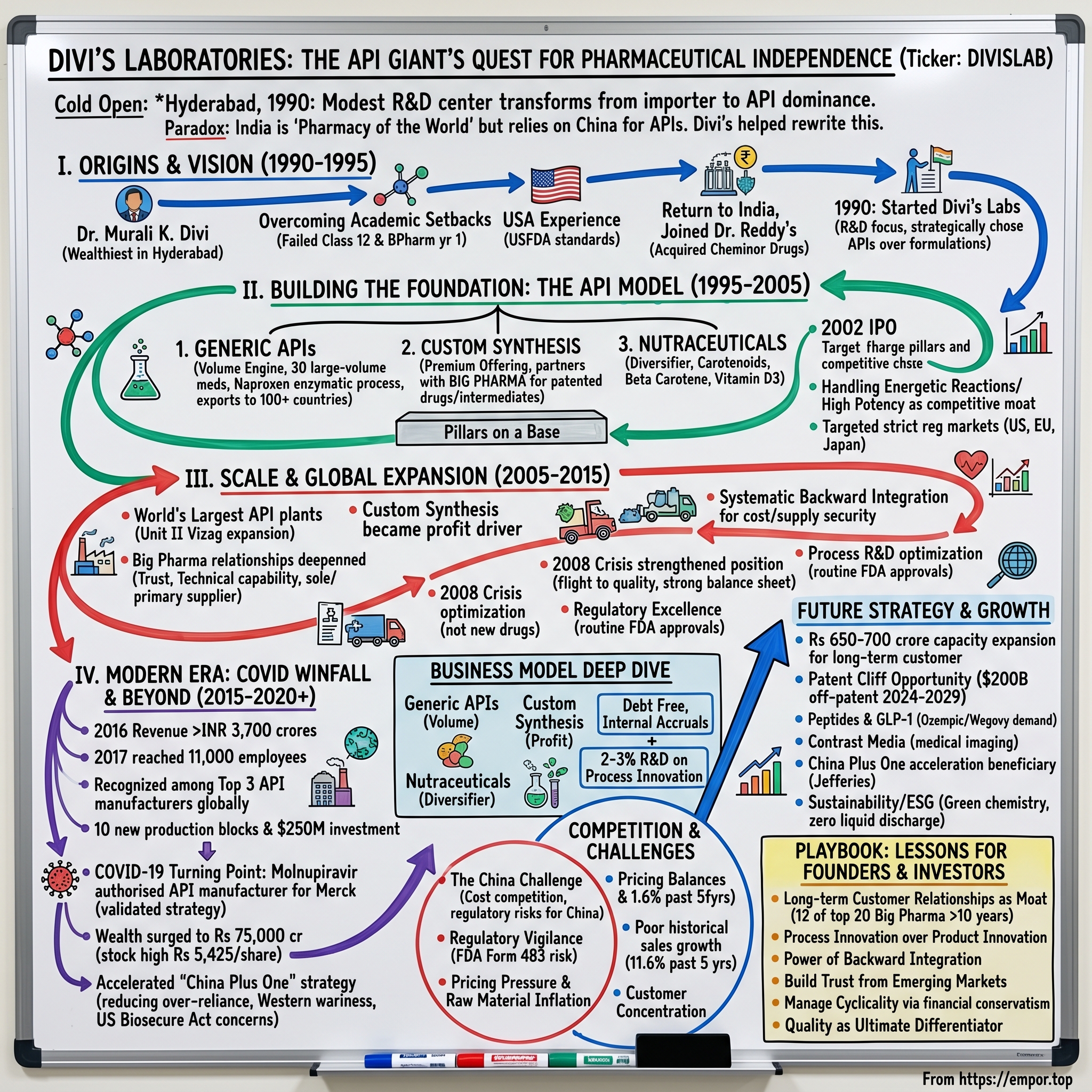
Divi's Laboratories: The Chemistry Behind the World's Medicine Cabinet
I. Introduction & Cold Open
Inside a walled industrial campus outside Hyderabad, a stainless-steel reactor the size of a small apartment runs a chemical reaction that few standard facilities would attempt. Under high pressure and precise temperature, a hydrogenation reaction converts one organic molecule into another with a purity specification measured in parts per million. The batch will be filtered, dried, milled, tested, sealed into drums, and loaded into containers sailing from Visakhapatnam through the Suez Canal to Rotterdam or Newark. Months later, the contents will be blended, compressed into tablets, blister-packed, and dispensed at a pharmacy counter in Ohio to a patient with high blood pressure, epilepsy, or a persistent cough.
That patient will read the label on the box and see the name of a global pharmaceutical company. They will not see the words "Divi's Laboratories," because the name appears nowhere on the packaging, advertising, or patient leaflet. That anonymity is not an accident of marketing; it is the core business model. Divi's sells to drugmakers, not consumers. Its brand equity lives entirely inside the procurement and quality departments of the world's largest pharmaceutical manufacturers, where it is worth a great deal, and nowhere else, where it would carry no value at all.
Here is the number that frames the business. As of mid-August 2026, Divi's Laboratories carried a market capitalization of roughly ₹2.25 lakh crore—or about $26 billion—with the stock trading at about ₹8,482, within a few percent of its 52-week high of ₹8,674 and well above its 52-week low of ₹5,636.1 For a company that manufactures unbranded chemical ingredients and reported annual revenue of a little over ₹10,500 crore, that is a striking valuation. It works out to roughly 75 times trailing earnings and more than 13 times book value.1 The market is not paying that price for past performance; it is paying for what it expects Divi's to deliver next.
That expectation defines the central tension facing the business. Over three decades, Divi's built a reputation as a remarkably reliable supplier of active pharmaceutical ingredients—the actual therapeutic compounds inside pills, as opposed to the binders, dyes, and coatings surrounding them. It established that standing through process chemistry, backward integration into its own raw materials, and a regulatory compliance record that made it a safe choice for procurement officers focused on preventing supply disruption. Twelve of the world's twenty largest pharmaceutical companies have worked with Divi's for more than a decade, by the company's own account.2
Now the company is deploying capital against that reputation. Capital expenditure has escalated sharply: three major projects alone carry a combined cost of roughly ₹2,000 crore and were about 70% complete as of the June 2026 quarter, with capital work-in-progress on the balance sheet standing at ₹2,034 crore.34 The funds are going into peptide synthesis capacity targeted at the GLP-1 obesity and diabetes market, contrast media for medical imaging, and custom synthesis blocks for innovator molecules that Divi's is contractually forbidden to disclose. Almost none of this expansion generates revenue today.
This story examines how an unglamorous chemical manufacturer avoided commodity price wars, how a pandemic briefly drove its valuation to peak levels before an eventual post-pandemic correction, and how it is now converting two decades of client trust into room to build ahead of demand. The analysis explores why backward integration acts as a structural moat, why pharmaceutical buyers pay a premium for reliable regulatory compliance, and how to distinguish a capital expenditure cycle driven by operational conviction from one designed to justify a demanding stock valuation.
 Subscribe on LinkedIn
II. Origins: From a Research Consultancy to a Manufacturer (1990–2002)
In 1990, the year before economic liberalisation, the Indian pharmaceutical industry operated as a protected market. Indian patent law recognised manufacturing processes rather than end products. Consequently, an Indian chemist who invented a novel synthetic route to an existing molecule could legally manufacture and sell it domestically without the innovator's permission. The law cultivated a domestic industry focused on reverse-engineering chemical compounds at lower costs. While India produced skilled process chemists, it lacked companies with international regulatory credibility.
Into that environment stepped Dr. Murali K. Divi, a US-trained scientist who founded his enterprise in Hyderabad in 1990.56 The business did not begin as a commercial factory, but as a contract research operation selling chemical expertise rather than physical output. That distinction formed the foundational strategy of the enterprise.
The standard playbook for Indian pharmaceutical entrepreneurs in 1990 was to produce finished dosage forms—tablets, capsules, and syrups—sold under proprietary brands in the expanding domestic market. Peer firms such as Sun Pharma, Cipla, Dr. Reddy's Laboratories, and Lupin built large consumer-facing franchises following that model. Divi chose a different path: selling active ingredients and intermediates directly to global drugmakers rather than finished products to patients or pharmacies.
This model created a structural advantage over time. Finished-formulation manufacturers directly compete with potential multinational customers. By contrast, a pure-play supplier of chemical ingredients and intermediates avoids commercial conflicts. For global pharmaceutical companies like Merck or Novartis, outsourcing API manufacturing to a vendor that sells competing retail formulations introduces strategic friction. Outsourcing to an entity permanently dedicated to business-to-business chemical supply eliminates that conflict. Divi's established its customer base on this structural neutrality and maintained that positioning over the subsequent decades.
By 1994, the research consultancy was incorporated as Divi's Laboratories, and in 1995 the company transitioned into commercial manufacturing by commissioning its first plant in Choutuppal, in present-day Telangana, establishing itself as a credible API manufacturer.5 In 2002, the company opened a significantly larger facility near Visakhapatnam on the Andhra Pradesh coast—which would serve as the operational anchor for future expansion—and completed its initial public offering on Indian stock exchanges.5
That initial public offering holds limited relevance for the modern investment thesis. The capital raised was modest, and the core enterprise was subsequently built using retained earnings at a pace dictated by its ability to secure long-term client trust abroad.
What the origin story clarifies is the company's operational discipline. Founded by a process chemist, Divi's prioritized technical know-how and deliberate operational boundaries from its inception. Those three elements—a technical founder, chemical process optimization as the primary product, and structural self-limitation—shaped the company's trajectory, including the strategic allocation decisions under debate in 2026. As of August 2026, Forbes estimated Murali Divi's personal net worth at $12.6 billion, ranking him 256th globally, describing a founder who established a yoga center at corporate headquarters and spends weekends on an organic farm near Hyderabad.6
The central operational challenge then became clear: persuading global pharmaceutical companies managing multi-billion-dollar drug franchises to integrate a manufacturing site in coastal Andhra Pradesh into their regulated global supply chains. Establishing that credibility required the next thirteen years.
III. Building Big Pharma's Trust: The API and Custom Synthesis Model (2002–2015)
A single regulatory document governs much of the active pharmaceutical ingredient industry. When a drugmaker files to sell a medication in the United States or Europe, its regulatory application specifies the exact facility manufacturing the active ingredient, the exact chemical synthesis route, and the specific quality controls. That filing is a strict regulatory commitment rather than a flexible operational preference. Substituting a supplier—or altering a manufacturing route at an existing supplier—requires submitting new validation data to regulators and awaiting approval.
That single regulatory reality explains much of how Divi's established its market valuation and customer lock-in.
Through the 2000s and early 2010s, Divi's organized itself around two distinct business streams built on shared chemical capabilities. The first was generic APIs: large-volume, off-patent molecules—such as the naproxen used in anti-inflammatories, the gabapentin in seizure medications, and the dextromethorphan in cough suppressants—manufactured at scales ranging from tens to thousands of metric tonnes annually and sold to dozens of generic drugmakers worldwide.2 The second was custom synthesis: proprietary, still-patented molecules manufactured exclusively for innovator companies under strict confidentiality agreements.
Innovator pharmaceutical companies outsource complex API manufacturing for three compounding reasons. Cost advantages are the baseline factor, but capability and balance-sheet risk are more decisive. First, specialized API chemistry involves hazardous reactions at scale—including cyanations, brominations, and high-pressure hydrogenations—that generate extreme exothermic heat and require specialized containment infrastructure and deep institutional experience. Few global commercial facilities operate such hazardous chemistry safely at scale. Second, building a dedicated chemical plant for a single proprietary drug creates a stranded asset if the molecule fails in clinical trials or loses patent protection. Global drugmakers prefer renting specialized external manufacturing capacity over committing fixed capital.
Qualifying an API supplier requires extensive facility audits, validation batches, multi-year stability testing, and regulatory filings, costing millions of dollars before commercial shipments begin. Once a vendor is integrated into a regulatory filing, economic leverage shifts. Replacing an approved supplier requires re-filing with the FDA, the European Medicines Agency (EMA), and other global regulators. It demands fresh validation batches, long-term stability studies, and potential supply disruption while transitioning to an unproven plant. For a therapeutic franchise generating billions of dollars in annual sales, procurement teams rarely risk supply interruptions simply to seek modest ingredient savings.
This regulatory mechanism creates high switching costs. Divi's reported that twelve of the world's twenty largest pharmaceutical companies across the United States, Europe, and Japan had maintained supply relationships with the firm for more than ten years.2 While this figure is company-reported rather than independently audited, it aligns with broader operational evidence: the persistence of custom synthesis revenues across industry cycles, client co-funding of dedicated manufacturing blocks, and an expansion strategy achieved entirely through organic capital deployment rather than acquisitions.
Underneath the physical supply of chemical compounds, Divi's was effectively selling regulatory risk mitigation. Each consecutive year a facility completes regulatory inspections without adverse findings, its option value to multinational clients increases by lowering client compliance risk. Comprehensive quality management systems—encompassing rigorous documentation, data integrity, chain-of-custody tracking, and precise analytical controls—became the core differentiator. Basic chemical synthesis was broadly available across competing Indian and Chinese manufacturers; maintaining audit-ready regulatory compliance across continuous production runs was the scarcer capability.
Simultaneously, Divi's executed a strategic push into backward integration, manufacturing key starting materials and advanced chemical intermediates internally rather than importing them from third-party suppliers in China. During the 2000s, the primary objective was margin capture and cost predictability by insulating production from external price fluctuations. While supply-chain resilience and single-country dependency concerns did not dominate global pharmaceutical discussions until much later, early backward integration positioned Divi's with structural cost advantages and supply continuity well before supply chain security became an industry-wide priority.
By the mid-2010s, the Visakhapatnam site served as the company's primary scale platform, transitioning Divi's from a regional niche vendor into a preferred global partner for complex chemistry. The company expanded its international footprint, with exports reaching more than 50 countries by 2005 and exceeding 100 countries by 2010.5 The subsequent decade would test whether that market position could survive an environment where competitors were willing to undercut prices without regard for operating margins.
IV. Scale, Backward Integration & the China Question (2005–2019)
Between the mid-2000s and late 2010s, the global fine chemicals industry experienced severe price competition from Chinese suppliers. Operating with state-subsidized capacity, lower capital costs, and historically looser environmental enforcement, Chinese active pharmaceutical ingredient (API) and intermediate manufacturers priced standardized molecules below the fully loaded cost of most Western and Indian producers. As incumbents exited these product lines, entire categories of bulk pharmaceutical chemistry relocated to China, creating broad global reliance on single-country starting materials.
Divi's avoided direct price competition through a three-part strategy: prioritizing complex hazardous chemistries that required specialized containment infrastructure and metallurgy, expanding its custom synthesis business tied to proprietary innovator filings, and deepening backward integration to secure a structurally low cost position on mature generic molecules.
Through steady capacity expansion during the 2010s, Divi's grew by 2018 into one of the world's top three API manufacturers.5 The company today reports roughly 17,000 employees and around 400 scientists, making it one of the larger private industrial employers in the Telangana–Andhra Pradesh corridor.5 Across thirty core generic molecules, Divi's claims a top-two global position in most, with analyst estimates placing its global share in key molecules—such as naproxen, gabapentin, and dextromethorphan—between 65% and 85%.7
However, high market share in mature commodity categories offers limited ongoing revenue growth. When end-market demand stabilizes, category revenue depends heavily on volume and pricing power. An IIFL analysis in early 2024 showed that sales of Divi's four key generic APIs compounded between negative 6% and positive 2% annually over FY21–FY24, leaving the overall generic API portfolio growing at just 2–3%.7 Market dominance in this segment meant defending a mature revenue plateau.
That operational model faced a major regulatory test in late 2016. Between 29 November and 6 December 2016, the US FDA inspected Divi's Unit II facility at Visakhapatnam. The audit revealed data integrity issues rather than synthetic chemical failures. In a warning letter issued on 13 April 2017, the FDA concluded that the facility's quality systems did not adequately ensure the accuracy and integrity of production data, citing specific concerns regarding chromatography records and integration settings that could suppress inconvenient peaks.8 Industry reports highlighted regulatory dissatisfaction regarding access to records during the inspection.9 An import alert followed, causing a sharp decline in the company's share price.
Data integrity findings represent a severe regulatory outcome because they directly challenge trust in compliance documentation. Divi's initiated immediate remediation, and on 7 November 2017, the FDA issued a close-out letter concluding the firm had addressed the cited deviations, while noting that future inspections would assess whether the corrections held.10
Resolving a warning letter in roughly seven months represented an unusually rapid turnaround compared to industry norms. While the initial inspection revealed risk at the company's primary export site, the prompt resolution demonstrated the institutional capacity to remediate complex compliance issues to a regulator's satisfaction—a contrast to longer regulatory disruptions experienced by several Indian peer firms during the same period.
During this period, Divi's also established a third business segment: nutraceuticals. Operating out of the Visakhapatnam complex, the division produces carotenoids and vitamins sold into food and supplement customers rather than pharmaceutical ones.2 While representing a modest fraction of total revenues, the division established that the company's process chemistry platform could be applied outside traditional prescription pharmaceuticals.
By 2019, Divi's maintained a clear operational profile: a debt-free manufacturer with high return metrics, a slow-growing commodity API portfolio, an expanding custom synthesis business, and a cost structure protected by backward integration. However, the onset of the COVID-19 pandemic in 2020 would temporarily disrupt baseline operational assumptions across the global pharmaceutical industry.
V. The Molnupiravir Supercycle — and the Bust (2020–2023)
In the spring of 2021, global public health priorities shifted toward oral antivirals. While vaccines were in distribution, there remained an urgent need for an oral treatment that patients could take at home during the initial days of infection. Merck—operating as MSD outside the United States—had molnupiravir in late-stage development. The pharmaceutical giant faced the classic operational challenge of pandemic drug development: manufacturing capacity had to be established before clinical efficacy was fully confirmed, scaling production within months to volumes rarely attempted in standard commercial operations.
On 26 May 2021, Merck named Divi's Laboratories among the manufacturers authorized to produce the active pharmaceutical ingredient.11 Divi's served as the authorized API manufacturer for the Indian market, and public announcement of the supply agreement between Merck and the U.S. government drove an immediate market rally in Divi's shares.11 Few contract manufacturers globally possessed the capability to transition a novel molecule from technology transfer to commercial scale at pandemic speed. Divi's leveraged two decades of process chemistry infrastructure, utilizing pre-audited manufacturing blocks and experienced technical teams to rapidly scale the synthetic route.
The surge in demand delivered the most profitable fiscal year in the company's history—while simultaneously creating an unsustainable baseline for future growth.
Financial performance surged accordingly. Consolidated revenue in FY22 reached roughly ₹8,960 crore, yielding an operating margin before interest, tax, depreciation, and amortization of 43.3%—an extraordinary level of profitability for a chemical manufacturer.7 Net profit after tax reached nearly ₹2,960 crore, representing a year-over-year increase of more than 49%.7 Investors extrapolated this temporary windfall into permanent earnings power, re-rating Divi's from a steady active ingredient producer into a structural contract development and manufacturing organization, expanding its valuation multiple alongside peak earnings.
However, molnupiravir represented a temporary demand surge rather than a long-term therapeutic franchise. Independent market estimates at the time indicated that recurring annual demand would settle in the low tens of millions of dollars rather than establishing a higher revenue run-rate. As hospitalization rates moderated and alternative oral antiviral therapies entered the market, commercial orders contracted sharply.
The subsequent recalibration was pronounced. In FY23, consolidated revenue fell to ₹7,768 crore, operating margins contracted from 43.3% to 30.5%, and reported net profit dropped 38% to ₹1,823 crore.71 In FY24, net earnings compressed further despite stable top-line sales, with ₹7,845 crore in revenue generating ₹1,600 crore in net profit.1 Peak to trough, between FY22 and FY24, overall revenue declined by about 12%, while operating profit and net income fell by roughly 43% and 46%, respectively.7 By August 2023, the company reported a quarterly profit decline of nearly 50%, explicitly citing intensified drug pricing pressure across generic product lines.12
This earnings trajectory illustrated negative operating leverage. While revenue experienced a modest pullback, profitability compressed sharply as manufacturing capacity built for peak volumes sat underutilized while fixed overhead costs persisted. This margin pressure was exacerbated by falling prices for generic active pharmaceutical ingredients as Chinese chemical producers renewed aggressive market competition. The pandemic volume surge had temporarily burdened the business with an operating cost base sized for peak demand.
Evaluating the durability of the company's competitive moat reveals a split dynamic across its core divisions. While commodity product earnings declined, the custom synthesis division remained resilient. Key innovator partnerships persisted, and commercial projects such as sacubitril and iopromide scaled production during the industry downturn, with analysts at IIFL estimating that each compound contributed $50 million to $60 million in revenue in FY24.7 The earnings contraction was concentrated in the price-sensitive generic API segment rather than reflecting lost customer relationships. High customer switching costs successfully insulated the proprietary custom synthesis business, even as generic market prices eroded.
This divergence highlighted the dual nature of Divi's operating model. The competitive moat provided strong protection for the custom synthesis order book, but offered limited pricing power in standardized generic ingredients. During both the 2021 market expansion and the subsequent 2023 contraction, equity valuations frequently treated the entire enterprise as a single cohesive unit rather than evaluating the distinct economic drivers of each division.
By early 2024, market sentiment turned cautious. On 17 January 2024, IIFL named Divi's a top sell candidate, arguing that the core generic portfolio faced structural stagnation, that custom synthesis revenue had compounded at only 7% annually between FY20 and FY24, and that market expectations regarding upcoming GLP-1 opportunities were overextended—setting a price target of ₹3,160 against a prevailing stock price of ₹3,815.7 Subsequent trading proved that bearish thesis premature, as the stock subsequently doubled well past its early 2024 valuation. The analysis accurately identified ongoing generic margin pressures, but underestimated the speed with which new growth drivers would materialize.
VI. Business Model Deep Dive: Three Segments, One Chemistry Platform (Today)
Strip away the narrative, and Divi's operates a single physical asset base—three manufacturing complexes, a shared pool of process chemists, and a common quality management infrastructure—deployed across three distinct customer relationship models. The economics of these three segments differ substantially, and most analytical debates surrounding the company center on the relative revenue mix among them.
Generic APIs: dominance without pricing power
Roughly 40% of revenue in the June 2026 quarter came from generic APIs.4 This is the volume business: roughly thirty mature molecules, manufactured at vast scale, sold to generic formulators who buy primarily on price and technical specification. Divi's is the world's largest producer of several of these compounds, yet it retains minimal pricing power over them.
Market share and pricing power represent distinct economic dynamics. In a market where the output is chemically identical across producers and every pharmaceutical buyer qualifies two or more suppliers, high market share reflects a superior cost position rather than an ability to raise prices. Divi's preserves its volume leadership because its backward-integrated cost structure enables it to remain profitable at price points that force higher-cost competitors out of the market—a defensive advantage rather than an offensive one. When competing Chinese producers with idle capacity cut prices to clear volume, realisations fall, leaving Divi's to choose between matching lower market prices or surrendering volume share.
On the June 2026 earnings call, management acknowledged that generic pricing pressure persisted even as the company passed through raw material inflation, noting that solvent costs doubled or tripled during the quarter due to supply disruptions in West Asia.43 Consequently, the generic API portfolio functions as a cash-generating, capacity-absorbing, share-defending asset whose top-line trajectory remains largely outside management's pricing control.
Custom synthesis: the actual engine
The remaining 60% of revenue in the June 2026 quarter came from custom synthesis, up from 53–54% a year earlier.4 This mix shift represents the central structural trend line in the business.
Custom synthesis revenue is generated under long-term, frequently exclusive manufacturing agreements to produce patented molecules for innovator pharmaceutical firms. Pricing is established against the synthetic complexity and therapeutic value of the compound rather than spot market rates, with volumes tied to the innovator's commercial product cycle. High regulatory switching barriers prevent clients from re-sourcing compounds quickly. Every incremental percentage point shift toward custom synthesis improves both the level and stability of operating margins by substituting contracted earnings for price-taking commodity revenues.
However, this segment introduces concentration risk and vulnerability to patent cliffs. An IIFL analysis in early 2024 identified the diabetes medication sitagliptin and the heart failure drug sacubitril as Divi's two largest custom synthesis products, flagging their US patent expiries in May 2026 and early 2027 as potential revenue headwinds.7 The June 2026 quarter—the first period fully exposed to the sitagliptin patent expiration—delivered the highest custom synthesis revenue mix in the company's history alongside record overall profit.4 While a single quarter does not fully resolve the multi-year impact of patent transitions, initial disclosures indicate that commercial replacement volumes or expanded client programs helped offset the initial cliff.
Nutraceuticals: small, and that is the whole story
The carotenoids and vitamins division generated ₹298 crore in the June 2026 quarter, representing a 19% year-over-year increase.4 While it remains a stable business serving food and dietary supplement customers, it accounts for roughly one-tenth of total corporate revenue. The division validates the broader application of the firm's synthetic chemistry platform, though its scale means it does not materially alter the consolidated investment thesis.
Myth vs. reality: "Divi's is a CDMO"
Industry commentary frequently labels Divi's a contract development and manufacturing organisation (CDMO), a description that oversimplifies its actual operational scope. Full-service CDMOs such as Lonza or Syngene offer contract services across multiple modalities, including biologics, drug product formulation, and sterile fill-finish operations. In contrast, Divi's focuses strictly on large-scale chemical synthesis of active ingredients and advanced intermediates, alongside the process chemistry required to scale production. It does not manufacture finished dosage forms or operate biological platforms. Valuing Divi's against full-service contract research and manufacturing multiples conflates two structurally distinct business models.
The working capital question
Divi's cash conversion cycle reached 343 days in FY26.1 Total inventory stood at ₹4,413 crore in the June 2026 quarter, reflecting a ₹500 crore increase as the company deliberately accumulated a three-month buffer of critical starting materials to hedge against geopolitical and maritime logistics disruptions.4 Whole-Time Director Nilima Motaparti characterized the inventory expansion as operational insurance, noting that management's objective was "to make sure that we wouldn't have any production stoppage or a production loss."3
This high working capital requirement is largely inherent to the company's operating strategy. A backward-integrated manufacturer carries raw starting materials that non-integrated peers do not hold, as non-integrated producers purchase pre-assembled intermediates directly. Furthermore, when serving global pharmaceutical clients where a supply disruption carries multi-million-dollar clinical consequences, carrying substantial safety stock is a strategic priority. When key raw materials are sourced by sea across long global transit routes, balance-sheet liquidity is converted into supply chain continuity.
Divi's effectively uses balance-sheet strength to offer supply reliability, for which multinational pharmaceutical clients pay a commercial premium. The trade-off is a lower return on capital than gross operating margins might imply: a return on capital employed (ROCE) of roughly 22% alongside operating margins above 30% reflects the significant capital required to sustain this inventory model.1
The company finances these working capital needs without relying on long-term debt. Total borrowings in FY26 stood at ₹7 crore against thousands of crores in annual operating cash flow, maintaining a balance sheet that has remained virtually debt-free for over a decade, supported by ₹3,611 crore in cash and equivalents as of June 2026.14
Finally, R&D expenditures are directed strictly toward process engineering rather than novel drug discovery. Research teams focus on optimizing synthetic routes: reducing reaction steps, enhancing batch yields, minimizing hazardous waste, recovering expensive solvents, and improving process safety at industrial scale. Rather than generating proprietary drug patents, this process research builds a lower cost structure on existing chemical compounds—a critical defensive advantage in commercial chemical manufacturing.
This operational baseline framing sets up the next strategic question: with a debt-free balance sheet and a established operating model, why has the company initiated its largest capital expenditure program to date?
VII. The Capex Supercycle: Betting on Peptides, GLP-1s & Contrast Media (2023–Present)
In January 2025, Phase I of a greenfield complex at Kakinada, on the Andhra Pradesh coast, began commercial operations.13 Phase I carries an estimated capital cost of ₹1,200 crore to ₹1,500 crore across 200 acres of a 500-acre site, with Phase II deliberately deferred until market demand warrants further expansion.13
The strategic significance of Kakinada lies in its output. Rather than manufacturing finished active pharmaceutical ingredients for clients, the site initially produces basic starting materials and chemical intermediates previously purchased from external vendors—freeing regulator-approved GMP capacity at Units I and II exclusively for high-value product lines.13 This reflects a disciplined capital allocation strategy: investing in upstream infrastructure to lower input costs and unlock operational capacity across existing assets.
Capital spending subsequently accelerated. Divi's raised its fiscal 2026 capital expenditure target twice during the year—expanding the budget from an initial ₹1,400 crore to ₹2,000 crore, with management indicating final outlays would exceed that projection across three initiatives: custom synthesis capacity for global innovators, dedicated peptide manufacturing infrastructure under negotiation with major pharmaceutical clients, and general plant expansion.14 The firm reported investing more than ₹1,500 crore in fiscal 2026 on expansion and technology upgrades.15 By the June 2026 quarter, these three primary projects reached roughly 70% completion against their combined ₹2,000 crore budget, with ₹451 crore capitalized during that quarter alone.34
The peptide bet, explained without the jargon
The central driver of market expectations rests on peptide manufacturing.
The blockbuster obesity and diabetes treatments of this decade—the GLP-1 class—differ fundamentally from the traditional small molecules Divi's produced over its first thirty years. As short chains of amino acids, peptides require distinct manufacturing processes. The dominant commercial method, solid-phase peptide synthesis, constructs chemical chains step-by-step while anchored to a solid support matrix, requiring repeated coupling steps, extensive washing, cleavage, and complex purification. The process is technically intricate, highly solvent-intensive, and historically operated at volumes far below the unprecedented commercial demand created by GLP-1 therapies.
Divi's is positioning itself to capture this demand by installing multiple 3,000-liter solid-phase peptide synthesis reactors. Rather than focusing solely on finished active ingredients, the company is targeting peptide fragments, supplying amino acid building blocks and intermediate sub-chains, emphasizing that it synthesizes its own starting materials internally.43 On the June 2026 earnings call, Chief Executive Officer Dr. Kiran Divi asserted that the firm is "the only ones who start from basic raw materials" in this supply chain.3 While that statement reflects management's commercial positioning, the underlying approach aligns with the firm's long-standing backward-integration strategy.
Three large projects have completed validation, with test batches delivered to clients, while additional programs remain in development.43 However, commercial scaling remains subject to external regulatory timelines: Divi's cannot record commercial volume sales until client regulatory submissions naming the firm as an approved supplier receive formal agency approval. When asked about potential GLP-1 commercial volumes during the June 2026 earnings call, Dr. Divi stated he "cannot answer that question," citing customer non-disclosure agreements.3
While strict confidentiality agreements are standard in custom synthesis, this leaves investors underwriting capacity expansion without explicit disclosure regarding contract size, timing, or client identity. Management noted that projected demand across validated projects ranges from 1,000 kilograms to 6,000 metric tonnes annually depending on the specific compound—a broad spectrum underscoring the early-stage nature of commercial adoption.4 Concurrently, several equity research brokerages have deferred their projected custom synthesis revenue contributions from fiscal 2028 to fiscal 2029 or 2030, extending the gestation period between capital deployment and earnings realization.
Contrast media: the second, smaller vector
Contrast media represent a secondary growth initiative. These diagnostic chemical agents are administered prior to medical imaging to enhance tissue visualization, with iodine-based compounds used for CT scans and gadolinium-based agents for MRI procedures. Divi's has commercialized iodinated products with an initial client, signed two multi-year supply contracts, and expects a second commercial launch within months.4 Meanwhile, its gadolinium program remains in Phase II/III clinical development, pending client regulatory filings.4 While smaller in scale than the peptide business, the segment highlights a recurring industry pattern: an ingredient supplier's commercial timeline is dictated by its clients' regulatory approval cycles.
What it means
Viewed comprehensively, Divi's strategic trajectory is clear: the enterprise is translating two decades of established customer relationships into an expanded asset base, building specialized capacity in manufacturing modalities that multinational pharmaceutical companies increasingly choose to outsource. This strategy rests on tangible foundations—client-supported projects, completed validation batches, and a cost structure protected by internal raw material synthesis.
Yet this expansion also concentrates the firm's operational risk. Capital expenditure is front-loaded, while revenue realization remains dependent on third-party regulatory approval timelines outside the company's control. With public disclosures constrained by commercial confidentiality, investors must evaluate a high-capacity expansion cycle with limited visibility into long-term commercial terms. At roughly 75 times trailing earnings, the stock's valuation reflects significant market confidence that this spending will convert into profitable scale.
VIII. Industry Structure & Competition: Who Divi's Actually Fights
Applying Porter's Five Forces framework reveals an enterprise that effectively operates as two distinct businesses sharing a single balance sheet.
Buyer power in generic active pharmaceutical ingredients (APIs) is high and unrelenting. The product is standardized, customers maintain multiple qualified suppliers, and purchasing decisions are driven almost entirely by price. In custom synthesis, buyer power inverts: clients have registered Divi's manufacturing sites in their regulatory filings, invested years in facility qualification, and cannot switch vendors on commercial terms alone. Supplier power over Divi's is constrained by its extensive backward integration, which systematically eliminated external intermediaries. Threat of new entrants is low in hazardous organic chemistry and virtually non-existent in custom synthesis, where the primary barrier is not capital but a decade-long track record of successful regulatory audits. Rivalry is intense in generic ingredients and relationship-governed in custom synthesis.
This leaves substitutes, where the primary competitive threat is not an alternative chemical technology, but an entire nation's manufacturing ecosystem.
The China dynamic, stated plainly
Chinese API and intermediate producers frequently undercut Divi's fully loaded production costs on standardized molecules. This structural price pressure compresses realizations across the roughly 40% of company revenue generated by generic APIs, even during quarters when shipment volumes remain steady. Because both Indian and Chinese producers utilize essentially identical synthetic routes for mature compounds, process chemistry optimization cannot fully bridge the cost differential. Long-term financial modeling must assume this competitive pressure persists indefinitely.
The counterweight: BIOSECURE and China Plus One
Geopolitical policy introduced a new variable to this competitive dynamic in late 2025. On 18 December 2025, the BIOSECURE Act was signed into law as part of the FY2026 National Defense Authorization Act.16 The law's direct scope is specific: it restricts US federal agencies from procuring biotechnology equipment and services from designated "biotechnology companies of concern," prohibits federal contractors from utilizing such equipment for government contracts, and bars federal grant and loan funds from being spent on designated entities.16 Firms appearing on the Department of Defense's 1260H list of "Chinese military companies" received automatic designation, with a comprehensive list expected from the Office of Management and Budget by 18 December 2026.16
On 8 June 2026, WuXi AppTec (药明康德)—the largest Chinese contract research and manufacturing company and a central focus of the legislative debate—was added to the 1260H list.17
Indian contract manufacturers, including Divi's, have been positioned as key beneficiaries of this policy shift, driving a valuation re-rating across Indian CDMO stocks since early 2024. However, practical execution timelines warrant a cautious perspective. Analysts at Elara Capital noted that while the regulatory shift is "sentimentally positive" for Indian contract research, development, and manufacturing organizations (CRDMOs), "the transfer of pharmaceuticals manufacturing and supply chains is a complex process that usually takes several years."17 Data from the US National Security Commission indicated that American pharmaceutical firms estimate a minimum of eight years to establish and qualify alternative supply sources.17 Furthermore, Jefferies estimated China's total CRDMO market at roughly $18.7 billion, projecting that Indian CRDMOs will capture between $700 million in a base case and $1.4 billion in an optimistic scenario annually, supporting an overall sector growth rate of approximately 18% per year through fiscal 2030.17
These projections describe a meaningful, multi-year expansion for the broader Indian industry. However, even under favorable assumptions, the annual market gains distributed across all Indian competitors remain smaller than Divi's current annual revenue base. Re-qualifying a regulated-market API facility typically requires 18 to 24 months after a client decides to relocate production. Consequently, geopolitical realignments represent a gradual structural tailwind rather than an immediate revenue surge.
The named competitive set
Divi's competes against different peers depending on the product segment. In complex generic APIs and backward-integrated manufacturing, Laurus Labs represents its closest domestic peer, currently executing its own substantial capital expenditure program. Neuland Laboratories competes in complex small molecules and specialized peptides, offering a direct comparison for peptide contract manufacturing, albeit from a much smaller operational base. Syngene International and the combined Suven/Cohance platform compete for innovator research and manufacturing budgets through a service-oriented model focused on billable scientific headcount. Piramal Pharma maintains a diversified global footprint that includes sterile fill-finish dosage operations—a capability Divi's deliberately avoids. Internationally, Western benchmarks such as Lonza and Siegfried operate with higher cost structures but benefit from proximity to client headquarters and established pricing power.
Divi's differentiation against these peers is narrow but concentrated: it operates as a high-reliability, low-cost producer of complex chemistry at industrial scale. However, this strategy does not extend into biologic therapies, finished dosage formulations, or early-stage drug discovery. As innovator pipelines shift toward novel therapeutic modalities beyond small molecules and peptides, Divi's addressable market depends on its ability to build corresponding manufacturing capabilities.
Through Hamilton Helmer's 7 Powers
Applying Hamilton Helmer's economic framework, Divi's demonstrates two clear strategic powers. Switching costs represent its primary moat, driven by the regulatory burden of re-filing drug applications with health authorities. Cornered resource / process power serves as the second: combining backward integration with large-scale hazardous chemistry infrastructure creates a cost structure that competitors cannot readily replicate without decades of capital investment and institutional experience.
Equally notable are the strategic powers the firm lacks. It possesses no brand power, as end-market consumers do not purchase unbranded active ingredients by manufacturer name. It exhibits no network effects, since adding new clients provides no direct operational benefit to existing customers. Scale economies exist but are matched or exceeded by larger Chinese chemical producers. Finally, counter-positioning—a business model incumbents cannot copy without damaging their legacy revenues—is held primarily by lower-cost Chinese competitors rather than by Divi's.
The tariff overhang
Trade policy introduces an additional macro variable that evolved during 2026. On 2 April 2026, a White House factsheet outlined a 100% tariff on patented and branded pharmaceutical products and active ingredients, while establishing lower preferential rates for the European Union, Japan, South Korea, Switzerland, and the United Kingdom, alongside a temporary exemption for generic medicines and biosimilars subject to annual review.18 Subsequently, on 22 July 2026, the administration announced the implementation schedule for generic pharmaceuticals: a zero-percent rate for two years starting 1 August 2026, followed by a 100% tariff in year three and 200% in subsequent years.19
For Divi's, trade exposure is indirect and mediated through its client base. Exports account for approximately 90% of standalone revenue, with North America and Europe representing roughly 75% of total export sales.3 If future tariffs increase the landed cost of finished generic drugs manufactured from Indian active ingredients, procurement pressure will transmit upstream to ingredient pricing. Conversely, if trade barriers accelerate the relocation of innovator supply chains out of China, Divi's stands to gain additional market share. With both mechanisms operating concurrently, trade policy broadens the range of potential operational outcomes rather than pointing toward a single directional trend.
IX. Management, Ownership & Capital Allocation
The Divi's leadership structure is, by the standards of Indian promoter-led companies, unusually legible. Founder Dr. Murali K. Divi, now 75, remains Managing Director.6 His son, Dr. Kiran S. Divi, has served on the board for more than two decades, took over as Chief Executive Officer in January 2020, and continues to lead earnings calls and set operational guidance. In 2025, Nilima Prasad Divi—the founder's daughter, who had previously managed material sourcing, procurement, corporate finance, and investor relations—was elevated to the board as Whole-Time Director, Commercial, in a newly created role.20 N. V. Ramana, a long-tenured executive director, remains both an operating leader and a significant promoter shareholder alongside the family.21
Promoter equity stood at about 51.9% as of the most recent disclosure, with foreign institutional investors holding roughly 20.2% and domestic institutions accounting for 19.3%—a shareholding structure that has remained notably stable over time.1 This high level of insider ownership aligns management incentives with long-term capital preservation: when founders retain more than half the company's equity, balance-sheet leverage and equity dilution are viewed through a fundamentally different lens than by professional executives operating on short-term contract cycles.
The succession, done in public
Unlike corporate successions triggered by sudden executive departures, the generational transition at Divi's has unfolded in public view over several years. Kiran Divi has served as CEO for more than six years, routinely leading earnings calls, setting corporate guidance, and explaining the technical details of the company's expansion into peptide chemistry. Nilima Divi has similarly addressed investors on calls regarding inventory policies and raw material sourcing strategies.3 Rather than introducing an untested leadership team during a crisis, the second generation has managed key operational and financial functions in full view of public markets. While prospective management capabilities can never be guaranteed, the execution risks associated with an abrupt handover have been largely mitigated.
The governance flag, stated plainly
Executive compensation presents a more complex governance debate. In fiscal 2026, founder Murali K. Divi drew total remuneration of ₹100.26 crore, making him the highest-paid executive among India's major listed pharmaceutical firms—more than double the ₹45.73 crore earned by the next highest paid peer, Cipla's Umang Vohra.22 The composition of this payout is highly unusual: only ₹0.36 crore was classified as fixed salary, perquisites, and allowances. The remaining ₹99.9 crore consisted of a variable commission calculated as a direct percentage of net profits under Section 197 of the Companies Act, 2013.22 Driven entirely by net income growth, the commission rose 13.7% year-over-year without requiring a new compensation contract or board-approved structural increase.22
This pay structure yields two contrasting interpretations for investors. Proponents view it as a strict pay-for-performance model: there is virtually no guaranteed base salary, no equity option grants that dilute existing shareholders, and no upward ratchet during earnings downturns. When corporate net income fell during the fiscal 2023–2024 slump, executive commission automatically contracted alongside it.
Conversely, critics argue that linking executive compensation strictly to net profit does not guarantee alignment with overall shareholder value creation. Consolidated net profit can expand simply as a function of new capital deployment, regardless of whether that capital generates returns above the corporate cost of capital. For a controlling promoter who already owns majority equity to extract a nine-figure annual payout from reported earnings—precisely while asking public shareholders to forego near-term free cash flows to fund major capital projects—raises legitimate governance questions. Specifically, a commission tied strictly to short-term net profit may incentivize maximizing immediate reported earnings rather than optimizing long-term returns on capital being invested in facilities like Kakinada and the new peptide blocks.
Return metrics illustrate this structural tension. Divi's reported a return on equity of about 16.5% and a return on capital employed of roughly 22%.1 While these represent solid baseline figures, they sit below what a business with 30%-plus operating margins might generate if it were not maintaining nearly a full year of working capital alongside substantial non-revenue-generating capital work-in-progress. As capital expenditure expands the balance sheet faster than immediate profit growth, return on equity faces mechanical downward pressure until newly constructed assets generate returns well above the historical average.
The capital allocation record
Counterbalancing executive pay concerns is a conservative capital allocation record. Divi's has expanded almost entirely through organic project deployment, avoiding large-scale acquisitions that frequently result in overpayment, goodwill write-downs, or integration friction. The firm has funded its major expansion programs through internal cash accruals rather than financial leverage, leaving balance-sheet debt at just ₹7 crore in fiscal 2026 against substantial monthly cash flows.1 Meanwhile, dividend distributions have remained consistent through economic cycles, marked by a recommended final dividend of ₹30 per share for fiscal 2026 and historical payout ratios averaging between 31% and 50% of annual net income.151
Abstaining from M&A eliminates a major source of historical value destruction in capital-intensive industries. By avoiding speculative acquisitions, the company's capital allocation risk is concentrated entirely on a single operational test: whether its greenfield facilities and specialized chemistry blocks can achieve expected commercial utilization.
Narrative consistency as a credibility test
Corporate credibility is frequently tested during operational downturns. Throughout its public history, Divi's has maintained a consistent core narrative centered on process chemistry expertise, backward integration, innovator custom synthesis partnerships, and debt-free balance-sheet growth. During the fiscal 2023–2024 post-pandemic earnings decline, management attributed the margin compression directly to generic API price erosion and the expected drop-off of one-off pandemic sales, rather than pointing to general macroeconomic factors.12
Management has also maintained specific operational guidance. On the June 2026 earnings call, Chief Executive Officer Kiran Divi reaffirmed the company's growth target, stating, "I would like to stick to my statement saying that we will show double-digit growth no matter what."3 Furthermore, when gross margins reached nearly 68% during the same quarter, management cautioned analysts against extrapolating peak quarterly results into permanent baseline expectations, advising against assuming those levels would persist and guiding toward a 60% full-year gross margin and stable EBITDA margins relative to the previous fiscal year.3 Tempered guidance during high-margin quarters provides a rare benchmark of managerial conservatism in public corporate communications.
X. Financial Performance & The Valuation Question
Fiscal year 2026, which ended in March 2026, marked the highest revenue year in the company's history. Consolidated sales reached approximately ₹10,560 crore with a net profit of ₹2,568 crore, up from ₹9,360 crore in revenue and ₹2,191 crore in net profit during fiscal 2025.1 Standalone operational revenue of ₹10,388 crore represented a 12.9% increase, while earnings before interest, tax, depreciation, and amortization (EBITDA) rose 17.7% to ₹3,920 crore, prompting the board to recommend a final dividend of ₹30 per share.15 Measured against the post-pandemic trough of ₹1,600 crore in net profit in fiscal 2024, the figures reflect a two-year earnings recovery, with profits expanding roughly 60% from their low point.1
The first quarter of fiscal 2027, ending June 2026, indicated further operational acceleration. Consolidated total income reached ₹3,144 crore compared to ₹2,429 crore in the prior-year period, while profit after tax expanded 65.5% to ₹902 crore from ₹545 crore.43 Profit before tax rose to ₹1,180 crore from ₹733 crore.23 Operating margins expanded as overall plant utilization reached 80% to 85% across all three manufacturing complexes, while net material consumption declined to 31.2% of revenue—demonstrating how backward integration enhances operating leverage when production volumes increase.4
Management added two qualifications to those quarterly results. First, standalone top-line growth in constant-currency terms was 10%, well below headline reported growth rates of 22% to 32%, indicating that foreign exchange movements accounted for a substantial portion of the gain.3 Second, management attributed the expansion in gross margins to a favorable product mix and explicitly declined to project those levels across full-year results.3 Because custom synthesis carries higher profitability than commodity active ingredients, a quarter in which custom synthesis generates 60% of revenue naturally yields stronger margins than one at 50%, and product mix fluctuates across quarterly periods.
The valuation tension
At approximately ₹8,482 per share and a market capitalization of ₹2.25 lakh crore, Divi's traded at roughly 75 times trailing earnings and 13.4 times book value in mid-August 2026.1 While trailing twelve-month revenue grew 16% and profit expanded 29%, the company's five-year revenue compound annual growth rate stood at approximately 9%, reflecting the impact of the post-pandemic earnings contraction.1 The dividend yield remained low at 0.35%.1
Free cash flow presents a more significant constraint. With annual capital expenditures exceeding ₹2,000 crore against operating cash flows of a comparable magnitude, alongside ₹2,034 crore tied up in uncapitalized work-in-progress, the implied free cash flow yield on the ₹2.25 lakh crore valuation approaches zero.414 Rather than acquiring an immediate cash-generating asset, equity investors are purchasing a claim on future cash flows expected when new peptide and custom synthesis capacity achieves commercial scale—a transition dependent on client regulatory approvals that lack fixed timelines.
Consequently, current equity valuations price in successful execution of future growth initiatives in peptides and contrast media rather than merely reflecting baseline operations. Paying a premium for growth optionality is supported by the company's historical execution record, but it leaves limited margin for error. If commercial adoption of new capacity experiences delays, the underlying operating quality of the enterprise remains intact, yet the valuation multiple leaves the stock vulnerable to earnings repricing.
The analyst split is itself information
Analyst sentiment remained divided throughout 2026 despite the stock trading near historical highs. Equity research services downgraded the stock from Buy to Hold on 29 June 2026 and from Hold to Sell on 11 May 2026, pointing to elevated valuation multiples and modest long-term growth trends despite strong quarterly earnings. Notably, at least one brokerage raised its fiscal 2027 and 2028 earnings forecasts by 6% to 9% while simultaneously downgrading the equity rating to Sell—a combination signaling confidence in operational recovery alongside skepticism regarding prevailing equity prices.
When upward earnings revisions coincide with rating downgrades, market debate centers on valuation rather than underlying business health. That split captures the core investment dilemma facing Divi's in August 2026.
The three numbers that decide this
Evaluating the company's trajectory requires monitoring three key operational indicators.
One: custom synthesis as a percentage of product mix. The custom synthesis share of revenue expanded from approximately 53% to 60% over a twelve-month period.4 This ratio tracks the transition from price-sensitive commodity ingredients to high-margin contracted manufacturing, indicating whether innovator contract wins are outpacing price erosion in the generic active ingredient portfolio.
Two: conversion of capital work-in-progress into commercial assets. Tracking the capital work-in-progress balance alongside quarterly capitalizations provides early visibility into project timelines.4 Persistent expansion in uncapitalized work-in-progress without corresponding additions to active plant assets serves as an early indicator of commercialization delays before financial results reflect lagging revenue.
Three: underlying operating margin stability and constant-currency growth. Reported operating margins fluctuate with product mix and foreign exchange shifts. Evaluating EBITDA margins at constant mix alongside constant-currency top-line growth clarifies whether internal cost efficiencies effectively offset generic price pressure without the distorting effects of currency movements.
XI. Risk Radar
While corporate risk disclosures are often generic boilerplate, the factors that could impact Divi's Laboratories are concrete, identifiable, and in several instances already visible in operational results.
Chinese pricing on the generic portfolio. This represents the most persistent structural threat to the business. On standardized molecules, Chinese producers operating with idle capacity can price below Divi's fully loaded cost, compressing realisations even when shipment volumes hold steady. With roughly 40% of corporate revenue exposed to commodity APIs, the primary strategic countermeasure—shifting the product mix toward custom synthesis—means this margin drag will persist as long as the generic portfolio remains a major revenue contributor.
Regulatory and compliance risk. Active pharmaceutical ingredient manufacturing requires continuous compliance, where the consequence of an adverse inspection finding is rarely a routine fine; it is an immediate revenue halt and lasting damage to the regulatory standing the company monetizes. The 2017 FDA data-integrity warning letter established the operational impact: an inspection finding at a primary export facility, an import alert, and a sharp equity decline, followed by intensive remediation. While Divi's resolved the warning letter within seven months, regulatory audits remain recurring, high-stakes pass-fail evaluations.
Customer concentration in custom synthesis. The trade-off of long-term, exclusive innovator partnerships is concentration risk. A single cancelled contract, a client's decision to bring manufacturing in-house, a clinical trial failure for a molecule with dedicated capacity, or a patent cliff arriving faster than replacement commercial volume can materialize all pose material risks to a division that generates 60% of corporate revenue. Because Divi's does not disclose client-level revenue concentration, outside investors cannot precisely quantify this exposure—a lack of visibility that constitutes a risk factor in itself.
Execution risk on the capital expenditure cycle. This is the company's most concentrated operational exposure. Divi's is deploying capital ahead of commercial orders that depend entirely on client regulatory approval timelines, with several equity research brokerages already pushing expected revenue contributions out to fiscal 2029 or 2030. For a stock trading at a high valuation multiple, delayed qualification timelines do not merely defer cash flows; they directly undermine the growth thesis supporting the stock price.
Geopolitical and trade policy risk. Trade policy introduces dual-directional exposure. The generic tariff schedule announced in July 2026 establishes a two-year zero-rate window starting 1 August 2026 before escalating to 100% and eventually 200%, while the branded-drug tariff framework introduced in April 2026 remains in effect with generic ingredients temporarily exempt pending annual review.1918 Trade policy could act as a headwind if higher landed costs filter upstream into ingredient price pressure, or as a tailwind if trade barriers accelerate the relocation of global supply chains out of China. Given these competing dynamics, trade policy requires ongoing scenario planning rather than fixed forecasts.
Input cost and logistics volatility. Operational results in the June 2026 quarter demonstrated these supply-chain pressures in real time: solvent prices doubled or tripled due to West Asia tensions, freight rates increased, port congestion mounted, and the firm reported a ₹7 crore net foreign exchange loss compared to a ₹39 crore gain in the prior-year period.43 The company's response—maintaining a rolling three-month inventory buffer of starting materials—insulates manufacturing operations from supply disruptions, but it permanently ties up cash in working capital.
Governance and compensation structure. While no activist pressure exists and the executive compensation structure is shareholder-approved, a pay model that scales automatically as a percentage of reported net profit while capital expenditures rapidly expand the balance sheet warrants close monitoring—particularly if returns on newly invested capital fall short of historical benchmarks.
Equally instructive are the risks Divi's avoids. Refinancing risk is non-existent because the balance sheet carries virtually no debt. Accounting risk is low, as working capital intensity is fully disclosed and aligns with the operational model rather than masking underlying cash flows. Finally, technology disruption affects the business only indirectly: while synthetic chemistry is largely insulated from software disruption, the pharmaceutical industry's gradual shift toward novel therapeutic modalities requires Divi's to continuously expand its technical capabilities to maintain its market position.
XII. Bull vs. Bear Case
The bull case
The bull thesis rests on a structural mechanism rather than a corporate narrative. Customer retention is driven primarily by the substantial time and financial costs required for regulatory re-filing—expenses measured in years and millions of dollars rather than brand loyalty. The fact that twelve of the world's twenty largest pharmaceutical companies have maintained decade-long relationships with Divi's reflects that switching-cost dynamic in practice.2
Simultaneously, the product mix is shifting toward higher-margin operations. Custom synthesis accounted for 60% of revenue in the June 2026 quarter, up from roughly 53% a year earlier, replacing price-sensitive generic volume with contracted, single-sourced revenue.4 Significantly, this margin expansion occurred during the same quarter analysts had identified as vulnerable to revenue loss from the sitagliptin patent expiration.7
The balance sheet provides strategic flexibility. Holding ₹3,611 crore in cash alongside virtually no debt allows Divi's to fund its expansion into peptides and contrast media without equity dilution or financial leverage, preserving capacity to sustain outlays even if commercial adoption proceeds slowly.14 Unlike leveraged peers, the firm avoids the risk of having to curtail capital expenditures during market downturns.
Geopolitical realignments also offer long-term tailwinds. With the BIOSECURE Act enacted into law and WuXi AppTec designated on the U.S. Department of Defense 1260H list, research firm Jefferies projects the Indian contract development and manufacturing sector will grow at roughly 18% annually through fiscal 2030.1617 As one of India's largest and most backward-integrated producers with a strong compliance track record, Divi's is well positioned to capture market share from global supply chain realignments.
Finally, executive succession has advanced smoothly. The second generation of leadership already directs daily operations publicly, backed by experienced teams across both commercial and technical divisions.
The bear case
The bear thesis centers primarily on valuation. Trading at roughly 75 times trailing earnings and 13.4 times book value with a free cash flow yield near zero, the stock price already discounts perfect execution across projects that will not generate material revenue for years.1 A five-year revenue compound annual growth rate of approximately 9% provides limited historical support for such elevated multiples.1
Price competition from Chinese producers in generic active ingredients remains a structural drag rather than a temporary cyclical pressure. Price erosion limits earnings recovery across the 40% of revenue tied to generic molecules, a portfolio where sales of key base compounds grew at annual rates between negative 6% and positive 2% even prior to recent competitive pressures.7
Commercial realization in peptide manufacturing also remains unverified. While facility validations are complete, large-scale commercial contracts matching current market expectations have not been disclosed, and management is restricted by confidentiality agreements from confirming volumes. Independent projections by IIFL in 2024 estimated Divi's GLP-1 intermediate revenue could reach $100 million to $150 million by fiscal 2029 assuming a 10% to 15% market share, benchmarked against peer projections.7 While meaningful, that revenue scale alone may not justify the stock's current market re-rating.
Furthermore, executive compensation that expands faster than return on capital poses governance concerns if new investments yield subpar returns. Without a valuation margin of safety, any quarterly interruption—whether from adverse product mix shifts, delayed client regulatory filings, or unfavorable currency swings—leaves the stock vulnerable to sharp pullbacks.
The activist stress test
An institutional investor analyzing the company's capital allocation would find few traditional vulnerabilities: Divi's carries virtually no debt, avoids speculative acquisitions, and operates a focused core business. Instead, an activist critique would focus on corporate disclosure and governance. Key targets would likely include requesting detailed customer and product concentration metrics in custom synthesis, segment-level reporting on return on capital to evaluate generic versus custom synthesis performance, and explicit hurdle rates for the ₹2,000-crore-plus capital expenditure program. An activist might also question why a promoter family controlling majority equity receives a nine-figure profit commission unlinked to incremental capital returns, while noting that a 343-day working capital cycle ties up substantial shareholder capital in safety stock without public quantification of its economic cost.1
These issues do not reflect operational failures, but they represent fundamental governance questions for independent shareholders evaluating a firm trading at a valuation that presumes flawless strategic execution.
XIII. Playbook: Lessons for Founders & Investors
Win a commodity industry by refusing to play it on its own terms. Divi's did not beat Chinese API producers on price. It moved up the complexity curve—into chemistry that is hazardous, into products where regulatory approval is the barrier, and into relationships where the customer is buying certainty rather than kilograms. The general lesson: when a competitor has a structural cost advantage you cannot match, the answer is rarely to try harder on cost. It is to change what the buyer is buying.
The best switching costs are created by process, not preference. The most durable moats are often invisible to consumers because they exist inside someone else's compliance department. A supplier written into an FDA filing is not protected by brand or affection; it is protected by the arithmetic of what it costs to change the filing. Investors chronically underrate this kind of moat because it produces no consumer-facing evidence, and chronically overrate brand moats because the evidence is everywhere.
Backward integration is a cost lever that turns into an insurance policy. Divi's integrated into its own starting materials for margin reasons in the 2000s. Twenty years later, the same decision reads as geopolitical hedging. Strategic decisions made for narrow operating reasons sometimes acquire enormous option value when the world changes—which is an argument for building durable structural advantages rather than optimizing for the current environment.
Staying debt-free through a capital-intensive cycle buys the right to be patient. When the molnupiravir revenue evaporated and profits fell by nearly half in two years, Divi's faced a bad stretch, not an existential one.7 It kept paying dividends and kept investing. That is what a clean balance sheet purchases: not higher returns in good times—leverage would deliver those—but the ability to hold a strategy through the bad ones.
Beware the market re-rating a windfall as a trend—and then beware the mirror image. In 2021–2022, the market treated a pandemic contract as a structural change in earnings power and paid up. In 2023–2024, it treated a normalization as a broken business and marked it down. In 2026, it is treating a pre-revenue capital expenditure program as a near-certainty. The specific error changes; the underlying mistake—extrapolating whichever direction the recent line points—does not. The discipline is to ask, every time: is this a change in the earning power of the asset, or a change in the weather?
Family succession works better in daylight. A founder-led company that puts the next generation into operating roles years before it needs to, and lets them face analysts in their own voice, converts an existential risk into a manageable one. The contrast with abrupt founder transitions elsewhere is the whole lesson.
XIV. Epilogue & Reflection
A vital layer of the global economy operates best out of public view: container shipping, payment rails, industrial gases, and active pharmaceutical ingredient manufacturing. These businesses share a core characteristic: their direct buyers care immensely about them, while end consumers rarely know they exist. Divi's Laboratories has spent thirty-six years occupying that layer of healthcare. Its anonymity is not a marketing deficiency; it is the fundamental business model.
The company's defining operational tests have both turned on the distinction between a temporary windfall and a structural trend. The first came from the outside: a pandemic-driven demand surge produced a contract Divi's was not built to sustain permanently. Markets capitalized that earnings spike as if it were perpetual, and the subsequent normalization erased nearly half the firm's net profit along with substantial investor conviction.7 What survived that downturn was instructive: key custom synthesis partnerships remained intact, the balance sheet stayed debt-free, and regulatory compliance held. What dissolved was the assumption that Divi's was insulated from price competition in its generic ingredient operations.
The second test is unfolding in 2026, driven entirely by internal strategy. Divi's is deploying capital at an unprecedented rate relative to its revenue base, building specialized capacity for confidential molecules and unidentified clients on timelines governed by external regulatory bodies. Management has articulated a clear operational rationale backed by a long record of capital discipline, and performance in the June 2026 quarter indicated that recent investments are beginning to yield operational momentum.4 Yet equity markets have already priced in much of that expected success.
That dynamic leaves a fundamental question that financial analysis cannot immediately resolve. When an enterprise with a record of strict capital discipline accelerates capital expenditures so sharply, two interpretations emerge, both looking virtually identical from the outside for years. The first is that of an owner-operator leveraging decades of industry insight to make a calculated investment in the future of pharmaceutical supply chains—expanding capacity ahead of explicit client demand. The second is that of a company whose equity valuation has detached so far from current baseline earnings that aggressive expansion is no longer merely an option, but a structural necessity to justify its market price.
Chemical synthesis alone cannot resolve that tension. Only the pace at which capital work-in-progress converts into profitable commercial revenue over the next three years will provide the answer.
References
-
Divis Laboratories Ltd — Key financials, ratios and shareholding — Screener.in ↩↩↩↩↩↩↩↩↩↩↩↩↩↩↩↩↩↩↩↩
-
Earnings call transcript: Divi's Laboratories quarterly earnings call — Investing.com ↩↩↩↩↩↩↩↩↩↩↩↩↩↩↩↩
-
Divi's Laboratories Ltd (BOM:532488) (Q1 FY27) Earnings Call Highlights — GuruFocus via Yahoo Finance, 2026-08 ↩↩↩↩↩↩↩↩↩↩↩↩↩↩↩↩↩↩↩↩↩↩↩
-
Divi's Laboratories Ltd. — Overview, History & More — Bajaj Broking ↩↩↩↩↩↩
-
Divis Laboratories – REDUCE: Elevated expectations, Underwhelming delivery — IIFL Institutional Equities, 2024-01-17 ↩↩↩↩↩↩↩↩↩↩↩↩↩↩
-
Divi's Laboratories Ltd. (Unit II) Warning Letter, 2017-04-13 — U.S. FDA ↩
-
FDA warning scorches Divi's Labs for refusing to cough up API records — Fierce Pharma ↩
-
Divi's Laboratories Ltd. (Unit II) Warning Letter Close-Out, 2017-11-07 — U.S. FDA ↩
-
Divi's Lab jumps after US-based Merck inks supply agreement with US govt for molnupiravir — Business Standard, 2021-06-10 ↩↩
-
Divi's Labs reports loss in Q1 on back of drug pricing pressures — Business Standard, 2023-08-14 ↩↩
-
Divi's Labs: part of Phase I of Unit III of the Kakinada plant has commenced operations — ICICIdirect, 2025-01-03 ↩↩↩
-
Analyst Concall: Divi's Lab to exceed FY26 capex aim on capacity expansion — Informist Media ↩↩
-
Divi's Labs FY26 results: profit, revenue growth and capital investment — Whalesbook Corporate News, 2026-05 ↩↩↩
-
BIOSECURE Act Becomes Law, Limiting Grants With Biotechnology Companies of Concern — Latham & Watkins, 2025-12 ↩↩↩↩
-
India's CRDMOs stand to gain from addition of China's WuXi AppTec to Pentagon list — Pharma Manufacturing, 2026-06-15 ↩↩↩↩↩
-
US 100% Tariff on Patented Pharma Products: India's Generic Drug Exports Get a Temporary Pass — India Briefing, 2026 ↩↩
-
0% now, 100% in 2 years, 200% by 2029 — US plan for generic pharma tariffs & what it means for India — ThePrint, 2026-07-22 ↩↩
-
Divi's Labs MD's payout tops ₹100 cr on commissions, leads industry peers — Business Standard, 2026-07-20 ↩↩↩
-
Divi's Laboratories Q1 FY27 earnings conference call details — InvestyWise, 2026-08 ↩
 LinkedIn
 WhatsApp
 Reddit
 Hacker News
 Email
Email Kindle
 RSS Feed
 Spotify
 Apple Podcasts
 Amazon Music
 Audible
 YouTube