Garware Hi-Tech Films: The Precision Polymer Pivot
I. Introduction & Episode Roadmap (10-15 min)
In May 2012, traffic police across major Indian cities began flagging down motorists and peeling tinted film from vehicle windows at the roadside. The Supreme Court had ruled that no aftermarket film of any tint could be affixed to vehicle safety glass, giving car owners days, not months, to comply.12 For domestic film manufacturers, an entire addressable market vanished almost overnight. Among the hardest hit was a Mumbai-headquartered polyester film producer operating out of Aurangabad, bearing a surname familiar to generations of Indian households from the golden emblem stamped across VHS cassettes: Garware.
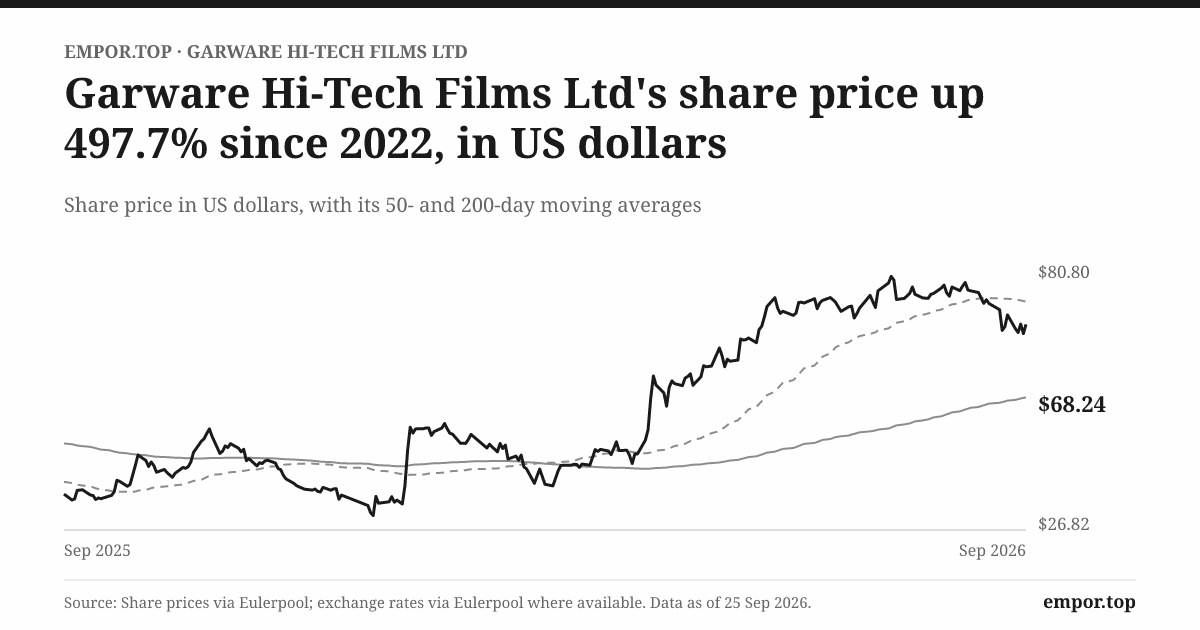
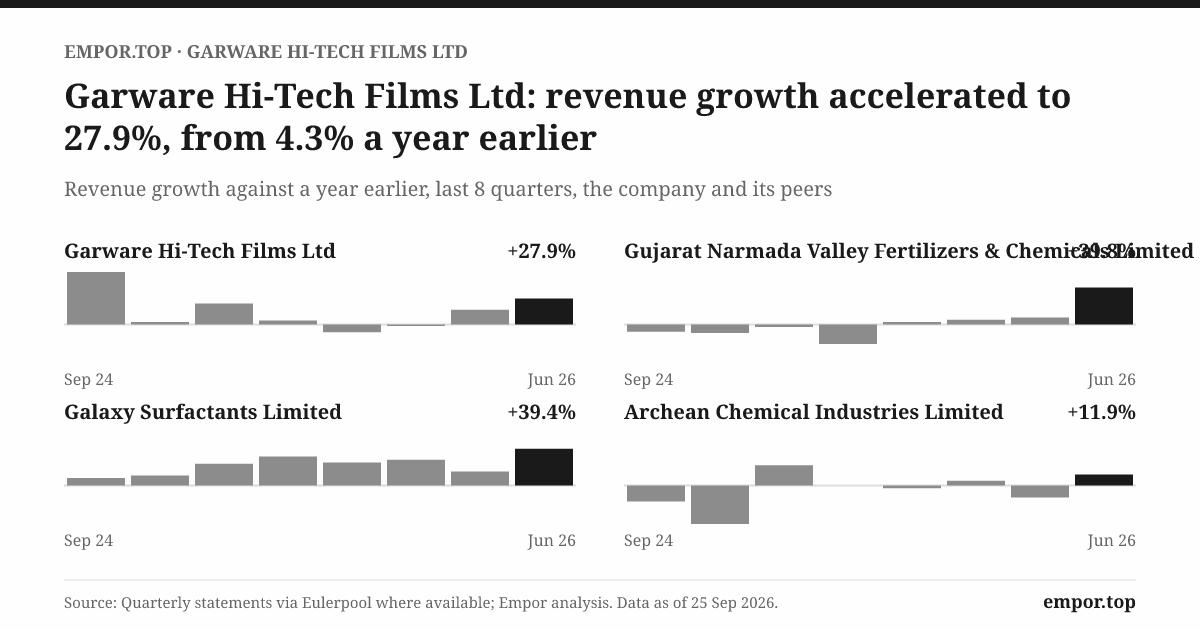
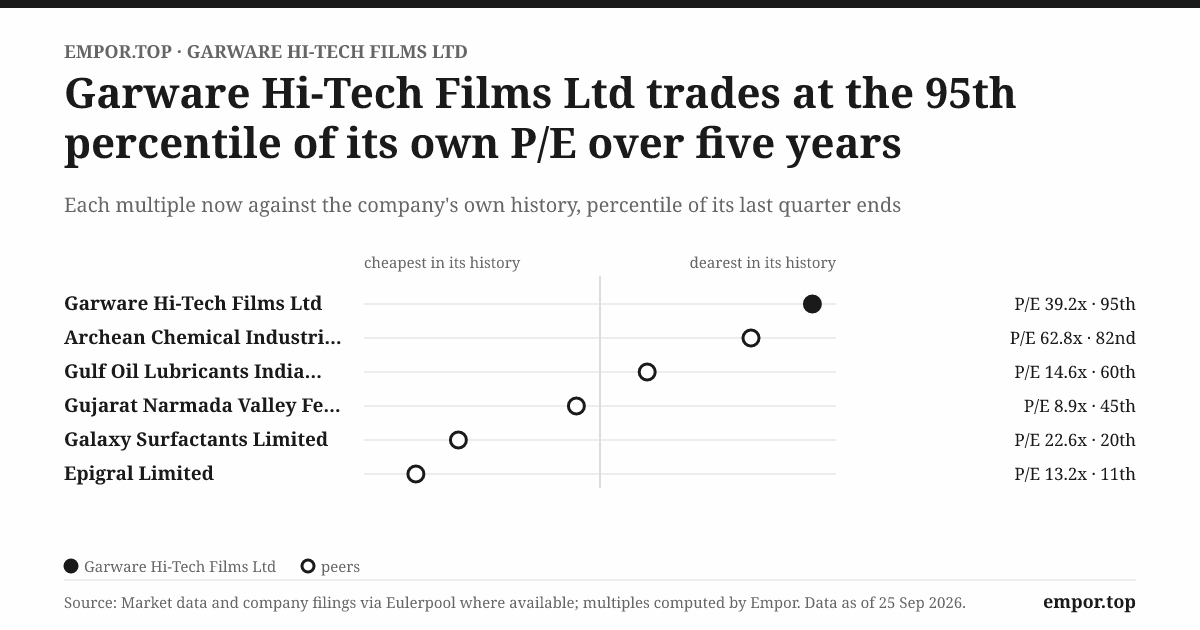
Fourteen years later, the reconstituted enterprise, Garware Hi-Tech Films (GHFL), delivered the most profitable quarter in its operating history. In the June 2026 quarter, revenue expanded 28% year-on-year to ₹633 crore, while EBITDA margins breached 30% for the first time.34 Public markets value the company at roughly ₹15,400 crore—approximately 40 times trailing earnings—underpinned by a debt-free balance sheet.5 International sales generate roughly three-quarters of total top-line revenue, with the United States alone accounting for approximately 45% of fiscal 2026 receipts.64 Its finished catalog—automotive sun-control films, architectural window films, and self-healing paint protection films (PPF) engineered for premium vehicles—reaches distributors and installers across more than 90 countries.7
This transition highlights a central structural puzzle. Polyester film manufacturing has historically ranked among the most volatile commodity niches in industrial chemistry: highly capital-intensive, hostage to crude oil feedstocks, and periodically destabilized by aggressive capacity additions. Domestic peers like Polyplex, Cosmo First, Jindal Poly Films, and UFlex have spent decades navigating these boom-and-bust margin compressions. Garware originated in that same commodity stream. Determining how the company navigated out of that cyclical trap—and evaluating whether its current earnings power reflects an enduring competitive moat or an unusually favorable phase of the specialty cycle—forms the core of this inquiry.
The central investment debate is straightforward to frame, yet difficult to resolve. Garware attributes its operational advantage to integrated manufacturing: polymerizing its own dyed polyester chips, stretching them into high-tensile biaxial film, and coating, laminating, and metallizing the substrates within a single facility—a vertical architecture management terms "chip-to-film" integration. Its primary global competitor in PPF, US-based XPEL, pursues an opposing strategy. Historically asset-light, XPEL outsources base film conversion to third-party coaters, deriving pricing power from technician training networks, retail branding, and proprietary cut-pattern software spanning more than 90,000 vehicle design profiles.8 Upstream manufacturing control and downstream distribution capture represent two distinct competitive philosophies, and Garware's valuation multiple rests on which form of operating leverage proves more durable.
This analysis progresses through eight distinct chapters. It begins with the Garware family origins and the import-substitution mechanics of the License Raj that built the early polyester franchise. It then examines the post-liberalization margin squeeze, the 2012 domestic automotive ban that forced an aggressive export push, and the operational turnaround from packaging film toward specialized optical and surface coatings. Next, it analyzes the premium automotive PPF boom and Garware's capital commitment toward internalizing thermoplastic polyurethane (TPU) film extrusion. Subsequent sections detail the unit economics of the Consumer and Architectural divisions, stress-test the company's competitive advantages using the strategic frameworks of Hamilton Helmer and Michael Porter, review corporate governance and balance-sheet liquidity, analyze the focal tensions between management and institutional research analysts on recent earnings calls, and conclude with the primary bull and bear investment theses.
A brief methodological note on the documentary record: multiple widely circulated investment profiles repeat several verifiable inaccuracies, including claims of an ₹800 crore peak debt burden, structural working-capital strain tied to US accounts receivable, and biographical timelines placing the founder's death in 1992. Regulatory filings, legal proceedings, and corporate disclosures show a different factual sequence on each count. Those corrections are highlighted where relevant throughout the text, as an investment thesis built on inaccurate history offers an unreliable basis for long-term underwriting.
The narrative begins, as so many chapters in Indian industrial history do, with an independent trader identifying an acute structural shortage.
 Subscribe on LinkedIn
II. The Garware Legacy & Founding Context (1933–1980s) (25-30 min)
A sixth-standard dropout who sold used cars
That narrative begins with Bhalchandra Digambar Garware, known to everyone as Abasaheb, who was born on December 21, 1903, in Tasgaon in what was then Maharashtra's Satara district.9 When his father lost the family fortune and ran up severe debts, Abasaheb had to leave school after the sixth standard.9 Moving to Bombay with no capital, he relied on commercial drive and traded second-hand motorcars. His Deccan Motor Agency in Girgaon built a name as a reliable dealer, and he branched into tyres, accessories and spare parts.9 In 1933, he travelled to London to buy cheap used vehicles during the Depression. The company now counts that year, and the formation of Garware Motors to import cars, as its origin.910
The key turn came during the Second World War. Abasaheb saw that plastics were an industry about to be born in India, and he began making plastic buttons for the Navy.9 Corporate records document that initiative: the company's timeline records a plastics venture in 1942 and the takeover of Vasco Plastic Corp, renamed Dominion Plastic Industries, in 1946.10 From buttons he moved into nylon yarn, bristles, fishing nets, ropes, injection moulding and, eventually, polyester film.9 That trajectory established an operating playbook that still echoes in GHFL today: identify a specialized material nobody in India manufactures, master the conversion process under protected domestic conditions, and migrate up the value chain toward higher-value applications.
Beyond industry, Abasaheb became Sheriff of Bombay in 1959–60 and received the Padma Bhushan in 1971.9 While several investment profiles incorrectly place his death in 1992, corporate records confirm he died in Pune on November 2, 1990, aged 86, having founded about 75 charitable trusts.9
The son who came home
His eldest son, Shashikant Bhalchandra Garware, was born in Mumbai on November 5, 1934. He was schooled at Dulwich College in London and studied business management at the University of Edinburgh.11 He returned to India in 1951, joined Garware Motors, and in 1957 set up the company then known as Garware Polyester, which is credited with starting India's polyester film industry.1110
Nearly seven decades later, S.B. Garware continues to serve as the company's Chairman and Managing Director, now in his nineties.11 Over his career he served on the central board of the State Bank of India and the board of LIC, was president of the Maharashtra Chamber of Commerce and Industry, and acted as Honorary Consul General of Turkey in western India.11 Mumbai University gave him an honorary D.Litt. in 2022, and cricket fans know the family name from the Garware Club House at the Wankhede Stadium.11
The mix of influences proved formative. He was educated in England but built his executive career inside India's closed economy, where commercial success accrued to industrialists who could manufacture domestically what the country had historically imported. The company's early awards were for exactly that: a Gold Shield for import substitution and top-exporter recognition from the plastics export council.11 That operating philosophy—make it here, make it well, then sell it abroad—is recognizable in today's GHFL. So is a founder-centred style of leadership in which one family has run the same company for its entire listed life.
That longevity represents both an operational asset and a corporate governance question. Managerial continuity has kept the company focused on chemical process engineering rather than fashionable diversification. At the same time, it has concentrated corporate oversight and succession planning into a very small circle, a strategic consideration evaluated in later sections.
Why polyester film was a license to print money, for a while
To understand the early economics, picture the Indian economy of the 1960s and 1970s. Imports were tightly controlled, foreign exchange was scarce, and manufacturing almost anything at industrial scale required a government licence. A company that held an industrial licence and knew how to operate a biaxially-oriented film line faced negligible competition. Production was less a competitive market than a regulatory permission.
Garware's timeline says it built a polyester film plant at Aurangabad in Maharashtra and a metallising unit at Nashik in the 1970s, and that exports to the Middle East began in the same decade.10 In 1980 the government's Ministry of Industry awarded it a Gold Shield for import substitution.11 By 1981 it had a polyester chips plant running, which meant it made the plastic pellets itself rather than buying them.10 That capital allocation choice, made more than forty years ago, established the physical foundation of today's "chip-to-film" claim.
The 1982 breakthrough: colour inside the film, not on top of it
In 1982 Garware introduced UV-stabilised polyester film and obtained a US patent for it.11 The engineering principle behind the company's dyed films is straightforward to visualize. Many conventional tinted window films function like a clear plastic sheet with coloured ink coated on top. After prolonged exposure to the sun, that surface-level colour oxidizes, fades, or turns purple. Garware's process infuses the dye and UV stabilizers directly into the polyester resin before the film is stretched. The colour permeates the entire cross-section of the substrate, the way the orange of a carrot runs all the way through rather than being painted on the skin.
This distinction matters for the investment case because it provides the earliest historical evidence that Garware's edge lives in chemical process engineering, not retail branding. Yet process advantages also carry inherent strategic limits. Formulations can be reverse-engineered, patents eventually expire, and competitors learn. A patent secured in 1982 says nothing by itself about 2026 competitiveness unless backed by continuous reinvestment.
The video cassette years
The 1981 timeline lists a string of products, including Garfilm, Sun Control film, X-ray film and Garware Video Cassettes.10 For a generation of Indians, the gold Garware logo on a VHS tape was the brand.7 The company took its media business seriously enough to defend its distribution rights in court. In 1989 the Bombay High Court granted Garware an interim order restraining a cable operator, Telelink, from broadcasting films it had bought on Garware cassettes. The court held that cable transmission to paying subscribers counted as a "public performance."12
Then technology moved on. Magnetic tape gave way to optical discs and eventually to streaming, and the base polyester film Garware manufactured for cassettes had to be redirected toward alternative end uses. For investors, the lesson is fundamental: an enterprise can engineer exceptional film, but high-grade film tied to a vulnerable end market is only as durable as that market itself. That proved true for VHS cassettes, and it would prove painfully true for Indian aftermarket automotive tint.
The family had built a formidable industrial franchise behind regulatory walls. The economic liberalization of the 1990s would test whether that model could survive open competition.
III. The Solvency Crisis & The Supreme Court Guillotine (1990s–2012) (35-40 min)
When the licence stopped protecting you
When India dismantled its industrial licensing regime in 1991, the protective moats that had shielded domestic polyester film manufacturers collapsed. Competitors rapidly commissioned large-scale biaxially oriented polyethylene terephthalate (BOPET) lines, shifting the domestic market from structural deficit into persistent oversupply. BOPET—a high-tensile, transparent substrate essential for packaging laminates and magnetic media—rapidly commoditized. In an oversupplied market, pricing power defaults to the lowest marginal-cost producer, compressing margins across the board.
While secondary market commentary frequently cites formal Board for Industrial and Financial Reconstruction (BIFR) proceedings and debt-recovery suits during this downturn, regulatory records do not substantiate those specific claims. The verified financial record, however, reveals prolonged operational stagnation. As late as fiscal 2015, Garware generated a modest ₹18 crore in net profit on ₹896 crore in revenue—a paper-thin net margin of roughly 2%. The company omitted dividend distributions across both fiscal 2015 and fiscal 2016, burdened by ₹368 crore in total borrowings.5 For an industrial enterprise that had once operated a protected domestic oligopoly, this margin compression illustrated the classic commodity trap.
Intra-group restructuring further complicated the operational picture. In 2011, Garware Chemicals Limited and an affiliated entity, Great Designs, were merged into Garware Polyester.10 While absorbing promoter-controlled entities into a flagship listed vehicle is common in family-run industrial houses, the consolidation served as a reminder that the enterprise had operated within an interconnected web of promoter holdings, where capital allocation decisions were historically insulated from public minority oversight.
The ruling
On April 27, 2012, the Supreme Court of India delivered a verdict that upended the domestic automotive accessories sector in Avishek Goenka v. Union of India. The public-interest petition argued that heavily tinted vehicle windows facilitated criminal acts, particularly violent assaults and kidnappings concealed behind opaque glass. Concurring with the petitioner, the bench adopted a strict, literal interpretation of Rule 100 of the Central Motor Vehicles Rules, 1989. The court issued an absolute prohibition on the aftermarket application of any film—regardless of its visual light transmission (VLT) rating—on windscreens and side windows, directing state police authorities nationwide to enforce immediate removal.1
Visual light transmission measures the percentage of visible light passing through a glazing material. Prior to the verdict, enforcement norms had permitted aftermarket films provided the combined glass-and-film assembly maintained at least 70% VLT on windscreens and 50% on side windows. The Supreme Court's ruling eliminated that interpretive leeway entirely: because the underlying statute referenced only the safety glass as manufactured, any supplemental film, even an optically transparent thermal-insulation layer, was declared illegal. When nationwide enforcement commenced in mid-May 2012, India's aftermarket automotive film sector was extinguished overnight, with contemporary trade accounts identifying 3M, LLumar, V-Kool, and Garware among the primary manufacturers affected.2
Why the ban mattered so much to Garware
The domestic shock struck Garware with unique severity. As the sole domestic manufacturer of dyed sun-control film, the company had spent decades cultivating tiered distributor and dealer networks across metropolitan India.7 Sun-control window film was Garware's most visible retail-facing product line, carrying substantial brand equity among urban auto-dealers and independent mechanics. While corporate filings from that period did not disclose the precise proportion of top-line revenue wiped out by the ban, the systemic collapse of domestic aftermarket installation eliminated the division's primary cash engine.
From an investment underwriting perspective, the 2012 ban provides critical empirical evidence regarding the true nature of Garware's competitive advantage. Conventional marketing narratives suggest that high consumer brand recall, specialized installer networks, and product certifications create a defensive moat. In 2012, those attributes offered zero protection. The market did not merely soften under competitive pressure; regulatory fiat dissolved it entirely. An enterprise whose competitive position relies on a single sovereign jurisdiction remains structurally vulnerable to regulatory risk, regardless of customer loyalty.
A contemporaneous intellectual property dispute reinforced that operational reality. Garware had registered "SUN CONTROL" as a trademark and initiated infringement proceedings against 3M for marketing "3M Sun Control Window Films." In 2016, the Bombay High Court dismissed the suit, ruling that "sun control" was merely a descriptive phrase incapable of exclusive trademark protection.13 The legal loss stripped Garware of proprietary ownership over the very phrase that had defined its retail presence. The lesson reinforced the central investment thesis: Garware's durable competitive edge never resided in brand equity or legal nomenclature; it resided entirely in the chemical formulations and physical tolerances achieved on the factory floor.
Survival by leaving home
With its domestic retail channel shut down, Garware redirected its automotive film capacity into high-volume export corridors. The US automotive sun-control film market represented an estimated $300 million to $400 million annual opportunity, serviced by only a handful of qualified global coaters.7 Operating through an established US subsidiary, Garware methodically cultivated regional master distributors and independent tint shops across the American Sun Belt, while expanding shipments to the Middle East, where the company had maintained export footholds since the 1970s.10
Operating in competitive export markets imposed far more rigorous technical standards than the domestic Indian trade had demanded. Installers in Texas, Arizona, or Dubai required multi-year manufacturer warranties against blistering, adhesive failure, and UV-induced discoloration under prolonged solar exposure. Crucially, professional tint shops demanded tight roll-to-roll optical consistency: a driver replacing a single window pane expected an exact spectrophotometric color match with the rest of the vehicle. For distributors, maintaining lean inventory required predictable transoceanic supply lines and local warehousing. Meeting those specifications forced Garware to refine its cleanroom standards, tighten polymer quality control, and transition into an export-disciplined manufacturer. While historical disclosures did not detail the immediate annual cadence of export growth following the ban, the long-term transformation was decisive: by fiscal 2026, international sales accounted for approximately 77% of total revenue.14
What the ban falsifies, and what it does not
The 2012 Supreme Court intervention serves as the cleanest historical stress test for claims regarding Garware's consumer brand power or regulatory moats. It decisively disproved both in the domestic context. Decades of consumer goodwill and trade recognition in India failed to preserve a single rupee of aftermarket automotive tint revenue once the legal framework shifted. What endured was not brand equity, but precision manufacturing capability—the technical competency to polymerize, dye, stretch, and coat optical-grade film to exacting tolerances—which successfully secured commercial demand overseas.
The underwriting takeaway is precise: Garware's compounding asset is adaptable, high-tolerance chemical conversion infrastructure. Its most fragile attributes are those dependent on localized regulatory protections or end-consumer brand loyalty. That structural dichotomy re-emerges later in this analysis, when evaluating the impact of US trade tariffs and Indian anti-dumping duties—two further instances where state policy, rather than market economics, dictates commercial outcomes.
This pivot marks the inflection point in Garware's modern trajectory. An exogenous regulatory shock compelled a commoditized domestic converter to satisfy international performance benchmarks and negotiate with demanding overseas distribution networks. The strategic challenge across the ensuing decade was whether management could leverage this forced internationalization into high-margin specialty dominance—or whether Garware would simply remain a low-cost, white-label subcontractor in someone else's market.
IV. The Architectural & Industrial Bridge (2013–2019) (30-35 min)
A chess move: stop selling the cheap stuff
The strategic pivot that defined the ensuing decade began with a disciplined decision: cease competing on price. In commodity packaging BOPET, commercial economics dictate that the lowest marginal-cost producer sets the price floor. Following 2010, that dynamic increasingly favored massive Chinese manufacturing facilities supported by state subsidies and vast domestic scale. Garware could neither out-scale nor underprice those state-backed commodity lines. Rather than accepting secular margin compression, the company methodically withdrew from unremunerative volume.
This portfolio reorientation is reflected in the product mix. Value-added specialty products accounted for 48% of total revenue in fiscal 2017; by fiscal 2025, that proportion had expanded to 87%.7 Management reiterated the 87% contribution in fiscal 2026, disclosing that the commercial catalog spanned more than 3,000 individual SKUs.15 Operationally, this value-added catalog converged into two primary product families.
The first comprised architectural window films engineered for commercial office towers, retail storefronts, and residential structures—designed to reject solar heat, lower building cooling loads, mitigate ultraviolet glare, enhance privacy, and prevent glass fragmentation in the event of structural impact or blast events. The second encompassed an array of industrial specialty substrates, including high-shrinkage films used for printed bottle sleeves, silicone-coated release liners, and specialized electrical insulation films deployed in electric motor windings. While secondary investment commentary frequently asserts that Garware commands a 70% domestic market share in shrink sleeves, that estimate remains absent from audited regulatory disclosures and cannot be independently substantiated.
What "chip-to-film" actually means
Stripped of marketing nomenclature, Garware's core manufacturing thesis centers on vertical process integration. Most global window film marketers function as downstream converters or asset-light distributors. They procure generic clear polyester base film from merchant extruders, then pass the master rolls through external coating operations to introduce chemical dyes, deposited metal layers, pressure-sensitive adhesives, and scratch-resistant protective topcoats. Each intermediary conversion step introduces operational friction: unwinding, handling, and rewinding generate mechanical scrap, while each third-party supplier extracts a tolling margin.
Garware internalizes the entire production cascade within its Aurangabad manufacturing footprint. The company synthesizes base petrochemical feedstocks into polyester chips, incorporates optical dyes and ultraviolet inhibitors directly into the molten resin, extrudes and biaxially stretches the polymer into finished film, and executes metallizing, coating, and laminating operations in-house. To use an everyday analogy, it operates like an artisanal bakery that mills its own whole grain, proofs the dough, bakes the loaf, and packages the sliced bread on-site, rather than a commercial baker reheating par-baked frozen dough purchased from an industrial distributor. Complete vertical integration affords granular control over molecular consistency and retains compounding margin across each processing stage—provided factory utilization remains sufficiently high to absorb substantial fixed capital overhead.
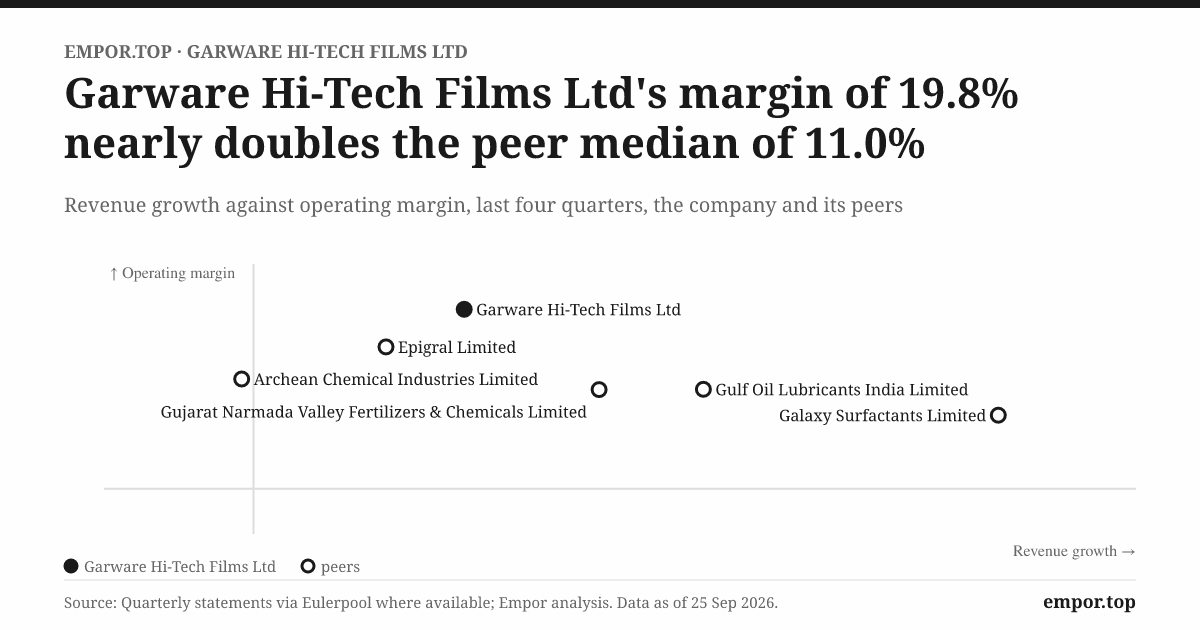
Management framed this architecture as a structural defense conferring cost and optical advantages. While secondary market commentary frequently asserts that this integration yields a 400-to-600 basis point gross margin premium over non-integrated coaters, GHFL has not published segment-level unit costs to substantiate that specific spread. The empirical evidence remains indirect: GHFL reported an EBITDA margin of 23.6% in fiscal 2026, markedly above XPEL's 16.3% operating margin in calendar 2025.616 A portion of that delta naturally reflects structural differences in business models—XPEL incurs heavy downstream operating expenses maintaining proprietary company-owned installation centers and regional distribution hubs—meaning the margin spread cannot be attributed solely to raw manufacturing efficiency. Nevertheless, the divergence demonstrates that captive chemical conversion captures meaningful economic rent.
Cleaning up the balance sheet
The resulting financial turnaround progressed slowly before accelerating rapidly. Between fiscal 2015 and fiscal 2018, revenue hovered between ₹833 crore and ₹896 crore, while net profit crept upward from ₹16 crore to ₹33 crore.5 Operating leverage then took hold: net profit jumped to ₹82 crore in fiscal 2019 and reached ₹86 crore in fiscal 2020.5 Dividend distributions resumed in fiscal 2017, with the dividend payout ratio expanding to between 27% and 28% across fiscal 2019 and fiscal 2020.5
Borrowings fell from ₹368 crore in fiscal 2015 to zero by fiscal 2024.5 While widely circulated secondary investment profiles frequently assert that Garware carried an ₹800 crore peak debt burden, the company's audited balance sheets confirm that total borrowings peaked at roughly ₹368 crore during this period. The verified historical record is no less compelling: an industrial enterprise burdened by 2% net margins fully extinguished its institutional debt obligations entirely out of internal operating cash flow, requiring zero dilutive equity raises along the way.
The broader strategic lesson of this bridge era is that Garware's turnaround was driven by disciplined portfolio selection rather than de novo chemical discovery. The company had possessed the baseline process engineering to extrude dyed films for decades; the decisive shift lay in actively retiring commoditized packaging volumes and redirecting capacity exclusively toward end markets willing to pay for tight optical and physical tolerances. That capital discipline restored balance-sheet liquidity and laid the operational groundwork for the product category that would ultimately redefine the company's economic trajectory—a substrate that was not made of polyester at all.
V. The Paint Protection Film (PPF) Revolution & The Rebrand (2020–Present) (45-50 min)
A rock chip on a Lamborghini
Picture a new supercar accelerating along an open highway. A stray pebble kicks up from a truck ahead, striking the bonnet and carving a small white crater through the clear coat into the paint. Repairing that damage requires sanding, respraying, and blending an entire body panel, permanently compromising the factory finish. Paint protection film exists to prevent that exact outcome. It is a transparent, high-elongation urethane film, roughly the thickness of several sheets of printer paper, installed directly over painted surfaces. The substrate absorbs the kinetic impact of road debris, shields against bird droppings and chemical etching, and, in premium grades, features an elastomeric topcoat that self-heals: surface swirls and light abrasions disappear when exposed to ambient solar heat or warm water.
The commercial dynamics of the category differ sharply from traditional automotive accessories. Sold once and fitted by certified technicians, PPF sits at the top tier of automotive surface protection. Vehicle owners pay not for visible styling, but for invisible defense. That functional necessity generates robust operating margins, explaining why specialty film manufacturers across the globe have targeted the segment.
How a roll of PPF is built
A roll of PPF consists of four functional layers. At the surface lies an elastomeric clear coat that resists environmental staining and reflows under heat to eliminate micro-scratches. Directly underneath sits the structural core: a layer of thermoplastic polyurethane (TPU) engineered to stretch across compound vehicle curves while dissipating the kinetic energy of flying stone chips. Below the TPU is a pressure-sensitive adhesive system that must bond securely for up to a decade yet peel away cleanly without lifting original clear coat upon removal. At the base rests a silicone release liner that shields the adhesive until application.
Failure can originate within any individual layer. The topcoat can haze under chemical wash exposure; the TPU can turn yellow under ultraviolet radiation or exhibit an irregular "orange peel" optical distortion; and an unstable adhesive can leave stubborn residue or strip OEM paint upon de-installation. Because a decade-long warranty on an exotic vehicle is only as dependable as the weakest conversion layer, independent detailing shops remain hesitant to switch suppliers, and defect reports spread rapidly through installer networks. Crucially, this dynamic highlights the strategic importance of the base TPU layer—a substrate Garware historically outsourced rather than synthesized in-house.
Garware's entry
Garware entered the PPF category in 2020. The company committed approximately ₹50 crore to ₹60 crore to install an initial line with an annual capacity of 300 lakh square feet (30 million square feet), commissioned in December 2020.7 Management subsequently allocated roughly ₹125 crore toward a second line of identical size, expanding total PPF nameplate capacity to 600 lakh square feet.715 Corporate guidance indicated that the second line could generate approximately ₹350 crore in incremental revenue at full ramp.7
Comparing that investment with traditional window film illuminates the underlying commercial strategy. Management projected that its ₹191 crore sun-control film line would add roughly 1,200 lakh square feet of capacity—four times the volumetric output of a PPF line—yielding peak annual revenue of ₹500 crore to ₹550 crore.615 Evaluating those figures on a unit basis reveals that a square foot of PPF commands roughly two and a half to three times the revenue of an equivalent area of sun-control film. That realization explains the aggressive capital reallocation toward paint protection.
By fiscal 2026, PPF generated approximately 25% of total company revenue, while sun-control film contributed roughly 50% and industrial specialty products accounted for the remaining 25%.6 PPF production lines operated at 85% to 89% capacity utilization, compared with 75% to 80% across the sun-control lines.6 This utilization spread confirms that downstream demand kept pace with the company's doubled extrusion and coating capacity.
The capital efficiency of each new line
The underlying capital expenditure numbers illustrate an important progression in incremental returns. The debut PPF line required an outlay of roughly ₹50 crore to ₹60 crore and was projected by management to support approximately ₹300 crore in turnover at EBITDA margins exceeding 30%.7 The second line required roughly ₹125 crore to unlock an expected ₹350 crore in revenue.7 By comparison, the new sun-control line required roughly ₹191 crore to deliver ₹500 crore to ₹550 crore in peak turnover.6
In practical terms, the initial PPF installation generated roughly five rupees of peak annual revenue for every rupee of invested capital, whereas the second line yielded less than three. While an asset turnover ratio near 2.8x remains attractive for chemical conversion, the step-down reflects higher automated equipment costs and greenfield infrastructure requirements. Early returns were exceptionally high because Garware could leverage idle cleanroom space, existing utility tie-ins, and established coating knowledge. Subsequent capacity additions reflect the more typical capital intensity of high-spec manufacturing, meaning that projecting first-line capital productivity across future expansions would overstate forward return on capital.
The rebrand
In the spring of 2021, Garware Polyester officially rebranded as Garware Hi-Tech Films, and by late May the stock traded under the updated ticker GRWRHITECH.17 The corporate renaming served notice to institutional investors and distributors that the business had decoupled from legacy commodity polyester packaging. It was also an explicit pitch for a higher market valuation multiple—an expectation supported by trading history, with the stock registering a 52-week trading range of ₹2,681 to ₹7,987 as of August 2026.4
The TPU gamble
Yet a critical structural gap remained in Garware's PPF manufacturing narrative. Unlike automotive tint and architectural film, PPF is not formulated from polyester; its structural base is thermoplastic polyurethane, an elastic, tear-resistant polymer. Historically, Garware purchased un-coated optical TPU film from merchant suppliers before applying proprietary adhesive, primer, and self-healing topcoats. Consequently, the enterprise that owned its polyester production from raw chips to finished rolls remained an intermediary converter in paint protection.
To resolve that dependency, Garware committed ₹118 crore toward a captive TPU extrusion line with an annual capacity of 360 lakh square feet at Waluj, Aurangabad.718 Management targeted utilizing roughly 75% of the line's output for internal PPF conversion, allocating the remaining 25% toward new industrial TPU applications, and projected that the facility could support over ₹500 crore in revenue within three years.15 The integration was guided to deliver a gross margin expansion of 1.5 to 2 percentage points, primarily materializing in fiscal 2028.318
Project execution milestones require close monitoring. In May 2026, alongside fiscal 2026 annual earnings, management guided to an October 2026 commissioning date.6 On the first-quarter fiscal 2027 earnings call in August, that guidance shifted to the third quarter of fiscal 2027, spanning October through December.3 While a quarterly adjustment is routine for complex industrial commissioning, the technical hurdle is material. Extruding optical-grade aliphatic TPU differs fundamentally from stretching biaxially oriented polyester. The molten polymer must remain entirely free of internal gels, fish-eyes, and thickness variations across wide web widths; any micro-flaw in the core film is magnified once installed over dark, glossy vehicle clear coats. Garware possesses four decades of polyester process expertise, but zero operating history in commercial TPU synthesis. The assumption that biaxial polyester knowledge transfers seamlessly to optical TPU extrusion remains an unproven thesis until the plant reaches commercial run-rates.
Tariffs, trade defence and the China question
Faced with rising import competition, Garware turned to trade policy remedies. The company petitioned India's Directorate General of Trade Remedies (DGTR) for anti-dumping duties on Chinese TPU-based PPF imports. On June 12, 2026, the DGTR released its final findings, recommending an anti-dumping duty calculated as the lesser of the dumping margin and the injury margin, with official government notification pending as of late September 2026.19
The trade petition provides an informative stress test of the company's purported cost moat. If captive conversion and lower domestic labor expenses provided an unassailable cost advantage, petitioning for tariff protection at home would have been unnecessary. The petition confirms that Chinese converters were landing finished PPF in Indian ports at prices that pressured domestic realizations. Furthermore, while anti-dumping duties protect realizations within the Indian market once formally notified, they provide zero protection across the United States, Europe, or the Middle East, where Chinese master rolls compete freely on price.
India's shops: Garware Application Studios
Because the Supreme Court ruling barred domestic retail automotive tint, Garware channeled its aftermarket automotive efforts into branded detailing outlets focused on PPF, ceramic surface treatments, and specialty coatings. By early 2026, the company had established more than 250 Garware Application Studios, targeting 300 locations by the close of fiscal 2027, alongside 14 international studios distributed across the Middle East and the United States.153 Domestically, the distribution network encompassed over 5,000 professional tinters and partnerships with more than 850 OEM auto dealerships, supported by consumer financing tie-ups with Bajaj Finance to allow installment-based PPF purchases.7 On the OEM side, four vehicle manufacturers signed on as domestic PPF installation partners, with discussions underway with two additional marques.6
Direct-to-consumer and captive studio retail accounted for 10% to 15% of global PPF revenue and roughly 40% of domestic PPF volume, generating gross margins that management stated were 25% to 30% higher than wholesale distribution.6 Those figures highlight the domestic strategic value of the studio network, but they also delineate the limits of the channel. The vast majority of Garware's PPF volume still flows through third-party independent distributors and detailers. In managing that expansion, executive disclosures acknowledged pushback from established channel partners regarding direct retail encroachment, prompting the company to terminate several non-compliant distributor contracts.15 This friction illustrates the classic channel conflict that arises whenever an upstream component manufacturer attempts to bypass its independent distribution base.
The direct-to-consumer model is being mirrored in the architectural segment. Garware Home Solutions—a dedicated retail concept marketing solar-control and safety films directly to residential homeowners—expanded from six locations at the fiscal 2026 year-end to nine studios by August 2026, with an operational target of 50 centers by the close of fiscal 2027.36 Concurrently, management set an annual sales target of $20 million to $22 million for the Middle East and North Africa region, up from roughly $15 million booked in fiscal 2026.6
Myth versus reality: the "India's first" framing
Garware frequently frames itself in marketing literature as India's pioneer in PPF and the country's sole integrated manufacturer of both solar-control window film and paint protection film.7 While trade records verify that it is the only domestic coater producing both lines, the competitive significance of that status requires context. Being the first domestic producer does not imply early global mover advantage in PPF, where XPEL, 3M, and Eastman Chemical established dominant market presence and certified installer networks years prior. Moreover, claiming sole domestic manufacturing status applies to a market that represented approximately one-quarter of company revenues in the June 2026 quarter.4 The decisive investment test is not domestic exclusivity, but whether Garware can sustain volume and margin parity across demanding export markets in North America and the Middle East against entrenched global brands.
The transition into paint protection film elevated Garware's operating margins and cash-flow profile. Whether those margins can withstand rising capacity additions and downstream channel competition depends directly on the structural defenses of the global competitors confronting it.
VI. Competitive Landscape, Industry Structure, & Channel Dynamics (35-40 min)
The war map
Picture the protective film industry as a three-stage relay. First come the chemical synthesizers who produce optical-grade raw resins. Next are the precision converters who extrude, dye, coat, and metallize those polymers into finished master rolls. Finally come the brand marketers, master distributors, and certified detailing shops who install the finished film onto a vehicle body panel or architectural window pane. Across this value chain, economic rent accrues to whichever participant controls the scarcest, highest-barrier link.
Garware's operational strength resides in the intermediate manufacturing leg. US-based XPEL commands the final retail and technician interface. Eastman Chemical, operating through its LLumar and SunTek subsidiaries, integrates across both domains to a greater extent than either competitor. Meanwhile, a proliferating cohort of Chinese and South Korean coaters competes in intermediate conversion, frequently exerting downward price pressure across commoditized tiers. XPEL's annual disclosures explicitly identify Eastman alongside "numerous suppliers in Korea and China" as its primary competitive threats.8
XPEL: the software-and-installer model
XPEL serves as the primary operational and valuation benchmark for Garware. For calendar year 2025, XPEL reported revenue of $476.2 million, up 13.3%, while delivering a gross margin of 42.2% and an EBITDA margin of 16.3%.16 Paint protection film constituted 52.4% of its consolidated sales.8 Unlike Garware, XPEL has historically operated as an asset-light marketer, sourcing converted master rolls from third-party coaters and contract manufacturers.8 What the company controls instead is the technician interface.
Its core competitive mechanism is DAP (Design Access Program), a proprietary subscription software database holding more than 90,000 vehicle cut patterns.8 A technician selects a vehicle profile, and an automated plotter cuts the TPU sheet to fit complex body contours with millimeter precision. This workflow eliminates the hazard of hand-trimming with razor blades against original automotive clear coats, conserves expensive film, and accelerates bay turnover. Once an independent detailing shop standardizes its daily workflow around DAP, migrating to a competing film brand entails switching software ecosystems, retraining labor, and risking costly installation errors. Downstream, XPEL operated 34 company-owned installation centers, while independent detailers and tint shops generated approximately 51% of total revenue.8
The financial divergence between the two businesses illustrates contrasting sources of economic value. Garware generated a higher EBITDA margin on roughly half of XPEL's top-line revenue, demonstrating the cash generation inherent in captive chemical conversion. Yet XPEL's 42.2% gross margin reflects the pricing power commanded by brand equity and installer loyalty at the retail point of sale—an advantage offset on the bottom line because XPEL reinvests heavily into channel support, training facilities, and corporate retail outlets. The two enterprises capture profit from fundamentally different stages of the value chain.
A strategic convergence may soon test that dichotomy. In its 2025 annual report, XPEL disclosed intentions to invest directly in manufacturing and supply-chain assets to lower procurement costs and secure quality oversight, pivoting away from its historically asset-light architecture.8 If the category's downstream channel leader successfully backward-integrates into film conversion, Garware's core premise—that precision coating and extrusion represent the indispensable bottleneck—will face its most direct competitive test.
The integrated giants and the Chinese wave
Incumbent industrial conglomerates—Eastman Chemical, 3M, Avery Dennison, and Saint-Gobain's Solar Gard division—wield established brand awareness, substantial research budgets, and legacy supply agreements with automotive OEMs and commercial glazing contractors. Their premium pricing umbrellas have historically created an opening for lower-cost chemical coaters to undercut branded price points.
Chinese converters represent the countervailing structural pressure. Operating with lower capital costs and aggressive capacity additions, Chinese film producers have expanded across price-sensitive regional tiers where brand equity carries minimal weight. Garware's anti-dumping petition before the DGTR provides verifiable internal evidence of the commercial friction generated by this imported volume. Concurrently, operational volatility has constrained near-term momentum: on the first-quarter fiscal 2027 earnings call in August 2026, management cited disruptions to Middle East supply chains affecting PPF raw material shipments, as well as low consumer awareness across several developing markets, as reasons for keeping its full-year guidance conservative.415
How Garware wins, and where it loses
Garware's competitive advantage resides primarily within the physical perimeter of its manufacturing plants. Captive chip polymerization, internal optical dyeing, and vertically integrated coating operations allow the company to extrude and finish rolls at competitive conversion costs. However, a significant share of that finished output reaches end consumers under third-party branding: executive disclosures indicate that proprietary brands account for roughly 55% of revenue, while private-label tolling and contract manufacturing generate 40% to 45%.6
That private-label contribution introduces structural vulnerability. When an enterprise derives over two-fifths of its receipts from private-label contracts, customer loyalty attaches to the intermediary brand rather than the underlying substrate. Master distributors and retail brands retain ownership of the installer relationship and can, in principle, reallocate purchase orders if rival coaters offer superior pricing or terms. Because Garware does not disclose the identities or volume commitments of its primary private-label accounts, the degree of customer concentration in this channel remains unquantifiable for external investors.
Downstream, Garware lacks equivalent leverage in brand recognition and digital installer tooling. Across the North American market, the Garware label is recognized predominantly as a high-specification value alternative rather than a top-tier luxury badge. Furthermore, corporate filings and investor calls make no mention of an in-house pattern-cutting software database comparable in scale or adoption to XPEL's DAP. The 2016 Bombay High Court verdict that invalidated Garware's "Sun Control" trademark serves as an enduring reminder of how fragile legal brand defenses have proven even within its domestic market.13
The analytical reality is that Garware's cost and optical consistency yield a durable manufacturer's edge, safeguarding unit contribution margins per square foot. What that integration cannot secure on its own is long-term channel capture.
The second front: the Middle East and beyond
While North America represents Garware's largest geographic exposure, the Middle East constitutes its longest-standing export corridor, with commercial ties dating to the 1970s.10 The region also serves as the centerpiece of management's strategy to balance geographic exposure away from the United States. Management disclosed fiscal 2026 Middle East and North Africa (MENA) revenues of approximately $15 million and targeted $20 million to $22 million, reflecting projected expansion of 25% to 30%.6 To support regional detailing networks, Garware expanded its international application studio network across the United Arab Emirates and the US, bringing its overseas total to 14 locations.15
Two structural realities frame this international push. First, the absolute revenue baseline remains modest: even if the upper target of $22 million is fully realized, MENA turnover would equal approximately one-tenth of US sales based on disclosed geographical splits. Geographic diversification is progressing, but at a tempo that leaves consolidated earnings closely tethered to North American demand for the foreseeable future. Second, regional expansion introduces distinct geopolitical and logistical vulnerabilities. On the first-quarter fiscal 2027 earnings call, management directly linked raw material delivery disruptions in PPF to geopolitical tension and war in the region.415 A channel cultivated to mitigate sovereign trade exposure in North America has introduced supply-chain vulnerabilities of its own.
Europe remains the least transparent among the major automotive film markets in the company's disclosures, with no segment-specific revenues published in regulatory filings. For investors, this leaves an affluent automotive territory with an established detailing culture as an unverified frontier in Garware's global distribution footprint.
Tariffs: the stress test that actually happened
The preeminent risk factor in any institutional underwriting of Garware is exposure to US trade policy. During fiscal 2026, that risk moved from theoretical sensitivity to an active operational stress test when US customs duties on Garware's exports escalated to as high as 50%, compelling the company to absorb a portion of the tariff burden to preserve distributor relationships.14 The financial impact was immediate: in the September 2025 quarter, consolidated revenue contracted 8.2% year-on-year, while EBITDA margins compressed to 23.4%.14 Operational strain deepened in the December 2025 quarter, when revenue slipped to ₹459 crore—down 1.6% year-on-year and 19.5% sequentially—and EBITDA margins fell to 18.9%, a contraction management attributed to absorbing the full brunt of the 50% tariff.20
Relief arrived in February 2026, when US authorities reduced the duty rate to 10% on top of a 6.26% base rate.6 Having maintained approximately $16 million in finished inventory across bonded US warehouses and ocean pipelines, Garware was positioned to capture the ensuing demand rebound.6 The operational recovery was pronounced: the March 2026 quarter delivered record profitability, followed by a milestone 30% EBITDA margin in the June 2026 quarter.63 Regarding duty recovery, management projected approximately ₹50 crore in net tariff refunds after sharing a portion with customers, though only 30% to 40% had been received by July 2026.315
Across the full fiscal year, the disruption altered Garware's geographic mix: the US contribution to total revenue declined from 48% in fiscal 2025 to 45% in fiscal 2026.6 Concurrently, sales outside the United States expanded by roughly 20% in the September 2025 quarter, providing partial operational insulation.14
The tariff episode offers a tangible empirical stress test of Garware's operating resilience. On one hand, it demonstrated that captive conversion provides sufficient margin cushion for the business to absorb a severe 50% tariff penalty while keeping EBITDA margins in the high teens and defending distributor alignment. On the other hand, it underscored that unilateral regulatory actions in Washington can erase two quarters of operating momentum almost overnight. Despite gradual international diversification, Garware's consolidated earnings power remains inextricably linked to US trade policy.
VII. Hamilton Helmer's 7 Powers & Porter's Five Forces Analysis (25-30 min)
A factory test for moats
Hamilton Helmer's 7 Powers framework evaluates whether an enterprise commands structural attributes that enable persistent economic profits above its cost of capital. Applied to Garware Hi-Tech Films, the analysis reveals a pronounced asymmetry: the company possesses meaningful Process Power in polyester film conversion, but exhibits only moderate or weak standing across the remaining six powers, with several absent altogether.
Process Power: strong, but narrower than it sounds. Process power exists when proprietary operational know-how delivers cost or quality advantages that rivals cannot replicate, even when purchasing identical capital equipment. Garware's four decades of polymerizing optical-grade polyester chips, integrating chemical dyes directly into molten resin, and biaxially stretching film to exacting physical tolerances exemplify that definition. The empirical evidence lies in its operating resilience: absorbing steep tariff shocks while maintaining double-digit operating margins and retaining private-label accounts that could contract with rival coaters. However, that power remains strictly bounded by polymer chemistry. It applies comprehensively to biaxially oriented polyester, but does not yet extend to thermoplastic polyurethane. In paint protection film—the engine of recent margin expansion—Garware historically operated as an intermediary coater, reliant on third-party optical TPU base film. Until its captive extrusion facility demonstrates stable commercial yields at target optical tolerances, Process Power in paint protection remains an operational aspiration rather than an established competitive moat.
Cornered Resource: moderate, and eroding. Preferential access to an unreplicable, value-generating asset defines a Cornered Resource. Historical milestones, such as the 1982 US patent for UV-stabilized dyed film, conferred genuine technological advantages in their day.11 Yet chemical formulations face eventual patent expiry and competitive reverse-engineering. Disclosed filings provide no evidence of a contemporary intellectual property portfolio extensive enough to preclude rivals from engineering comparable optical-grade films. Outside of specialized chemical recipes embedded in daily factory routines, the enterprise commands few unreplicable assets.
Branding: weak outside India. Brand power allows a manufacturer to charge premium prices for an objectively identical offering because buyers attribute value to the brand identity itself. While Garware commands trade recognition across domestic auto-detailing studios and architectural channels in India, its pricing power diminishes across international markets. In the United States—which generates roughly 45% of corporate turnover—Garware sells nearly half its volume under third-party and private-label brand names.6 Rather than commanding a luxury pricing umbrella, the company functions primarily as a high-specification, value-oriented alternative, competing on manufacturing tolerances and unit economics rather than brand prestige.
Switching costs: low for car owners, moderate for installers. Switching costs arise when buyers incur meaningful operational, financial, or procedural penalties by defecting to a competing supplier. For vehicle owners, switching costs are negligible: purchase decisions hinge on multi-year warranty terms and dealer recommendations. For independent detailing shops and tint installers, switching costs are moderate. Technicians develop tactile familiarity with a film's adhesive tack, stretch characteristics, and response to heat-gun application. If Garware's rolls deliver reliable optical clarity and higher bay margins, installers will adopt them. Conversely, because installers operate as independent contractors rather than captive franchisees, they can switch to alternative coaters just as readily if pricing or product quality falters.
Network effects: absent. Direct or indirect network effects require that each incremental customer enhance the product's value for the existing user base. Finished rolls of window tint and paint protection film exhibit zero network dynamics. In contrast, downstream competitors like XPEL generate software-driven network value: as its global installer base expands, user feedback continuously broadens and refines its proprietary cut-pattern database, raising switching hurdles for independent detailers. Garware possesses no equivalent digital ecosystem or installer software network.
Scale economies: moderate. Scale economies produce declining unit costs as production volume expands across a fixed capital base. Garware captures tangible scale efficiencies within its Aurangabad conversion complex, where high-output continuous lines spread fixed engineering, cleanroom, and utility overhead across massive roll output. Management's 1,200 lakh square foot sun-control expansion represents a direct scale play to dilute fixed manufacturing expenses.6 Nevertheless, these advantages remain localized: when benchmarked against global chemical conglomerates like Eastman Chemical and 3M, or heavily subsidized commodity extruders in China, Garware operates at a modest absolute scale.
Counter-positioning: moderate. Counter-positioning occurs when a challenger adopts a commercial model that incumbents cannot replicate without damaging their existing profitability or channel relationships. Garware exercises a moderate form of counter-positioning by delivering near-premium optical performance and multi-year warranties at wholesale price points materially lower than those of legacy Western brands. Incumbents cannot aggressively discount their master rolls to match Garware's factory-gate realizations without eroding their high-margin pricing umbrellas and upsetting established distribution networks. This dynamic secures a durable niche, though its stability requires Garware to maintain strict parity in physical performance.
Porter's Five Forces
Threat of new entrants bifurcates along capital and technical boundaries. In downstream finishing—procuring merchant base film and applying third-party adhesives or protective topcoats—capital barriers are modest, inviting persistent entry from regional converters. In contrast, integrated chip-to-film manufacturing demands substantial capital, cleanroom infrastructure, and multi-year operational calibration to achieve commercial optical yields, insulating Garware's core conversion operations from rapid greenfield disruption.
Supplier power is moderate, but highly asymmetric across divisions. For polyester film, base petrochemical feedstocks like purified terephthalic acid and monoethylene glycol are widely traded commodities linked to global crude oil refining, allowing the company to source from multiple industrial suppliers. In paint protection film, supplier leverage presents a far more acute vulnerability. Prior to the full commercial ramp of its captive TPU extrusion facility, Garware relies entirely on merchant suppliers for optical-grade aliphatic TPU film. Recent Middle East supply disruptions affecting PPF raw material shipments show what that dependence can cost.15
Buyer power is high and represents Garware's primary channel vulnerability. Because international sales flow through concentrated master distributors and large private-label brand marketers, buyers hold substantial bargaining leverage. Distributors can pit competing coaters against one another to negotiate keener terms or demand margin support during periods of trade friction. The tariff episode, where Garware shared costs and then promised to share refunds, is a live example of buyer power at work.3
Threat of substitutes is low for paint protection film, as ceramic coatings and surface sealants impart gloss and hydrophobicity but cannot absorb the kinetic impact of flying stone chips. The threat is moderate and secularly rising for automotive sun-control film, where factory-installed acoustic, infrared-reflective, and switchable electrochromic glass across premium electric vehicles could soften aftermarket demand over time. In architectural glazing, substitution operates similarly: newly constructed commercial developments typically specify pre-coated, low-emissivity smart glass, confining aftermarket film largely to existing building retrofits.
Rivalry is intense and accelerating across two fronts. At the premium tier, entrenched global marketers like XPEL and Eastman Chemical dominate technician brand loyalty, OEM dealership integration, and digital pattern workflows. At the commodity tier, an aggressive wave of Chinese and South Korean coaters is adding capacity, exerting downward pressure on wholesale spot prices. Garware operates squarely in the contested middle, squeezed between brand-dominant Western marketers and cost-competitive Asian converters.
The sum of these strategic frameworks provides an unvarnished assessment of Garware's competitive posture. The enterprise does not occupy a self-reinforcing redoubt protected by high switching costs, brand loyalty, or network effects. Its structural defense rests on a narrower foundation: rigorous chemical process execution and cost efficiency achieved within its Aurangabad conversion footprint. That operational engine can generate outstanding returns during supportive phases of the specialty cycle, as fiscal 2026 performance and the June 2026 quarter demonstrate. Yet it remains a competitive advantage that must be won every day on the factory floor, not an unassailable fortress that defends itself. Whether management allocates those cash flows wisely across corporate governance and balance-sheet liquidity forms the next critical inquiry.
VIII. Financial Dissection, Capital Allocation, & Management Credibility (35-40 min)
Two businesses under one roof
Under Indian accounting standards, Garware reports its financials as a single operating segment: polyester films.6 Consequently, divisional profitability figures are not audited. What management does disclose is a broad operational split between the Consumer Products Division—encompassing automotive sun-control, architectural window films, and paint protection film—and the Industrial Products Division, which manufactures shrink films, release liners, and electrical insulation substrates.
The commercial center of gravity has shifted decisively toward consumer applications. The consumer division expanded from 49% of consolidated revenue in fiscal 2023 to 67% in fiscal 2025, reaching approximately 74% in the June 2026 quarter.74 Within that consumer basket, architectural films surged from roughly 5% of total revenue to more than 25%, with management characterizing architectural glazing as its highest-margin category.3 Across corporate presentations, management has indicated that consumer product EBITDA margins range between 22% and 40%, compared with 10% to 12% for the industrial portfolio.7 More granular estimates of divisional gross or operating margins circulated in secondary market commentary are not officially reported and cannot be verified as fact.
The industrial division, now generating roughly a quarter of top-line revenue, functions primarily as a mature cash generator anchored to domestic manufacturing and packaging demand, yielding thin margins with minimal reinvestment ambitions. The consumer division constitutes the entire growth and valuation thesis.
The growth record
Consolidated revenue expanded from ₹925 crore in fiscal 2020 to ₹2,120 crore in fiscal 2026, more than doubling over six years, while net profit grew nearly fourfold from ₹86 crore to ₹338 crore.5 In fiscal 2026, EBITDA reached ₹500 crore, reflecting a 23.6% operating margin.6 Yet the long-term compounding cadence masked an abrupt pause: the US tariff shock caused top-line expansion to stall in fiscal 2026, with revenue inching up less than 1% above the ₹2,109 crore recorded in fiscal 2025.5 Net profit managed a slight advance only because higher-margin specialty products offset volume declines.
For fiscal 2027, management has guided to at least ₹2,500 crore in revenue, an EBITDA margin of 25% plus or minus 200 basis points, and 15% to 20% annual top-line growth over the medium term.3 Assessing management credibility against past targets provides necessary context. In early disclosures around 2024, leadership had initially targeted reaching ₹2,500 crore by fiscal 2026 or fiscal 2027.7 The tariff disruption pushed the operational timeline toward the back of that window. While the delay stemmed directly from an exogenous trade policy shock, management showed conviction at the fiscal 2026 annual results by narrowing its guided EBITDA margin corridor from plus or minus three percentage points to plus or minus two.6 The critical operational test for investors is whether fiscal 2027 delivers that top-line target through organic volume growth rather than relying on non-recurring tariff refunds.
What the margin record says about pricing power
A central question for institutional investors is whether operating margins in the mid-20s signify an enduring structural moat or merely a cyclical peak in specialty film pricing. The historical record offers clarity. Between fiscal 2015 and fiscal 2018, operating largely out of the same conversion assets and baseline polymer chemistry, Garware generated net margins in the low single digits.5 The subsequent surge in profitability stemmed directly from portfolio discipline, as value-added specialty films expanded to represent nearly nine-tenths of total revenue.7 Product mix optimization—not a sudden breakthrough in conversion efficiency—explains today's elevated margin baseline.
The fiscal 2026 tariff shock crystallizes the boundaries of that pricing power. When US customs duties spiked, Garware was unable to pass the cost increase through to wholesale accounts; it absorbed a substantial portion of the levy, causing quarterly EBITDA margins to compress from 24.8% in the June 2025 quarter to a trough of 18.9% in the December 2025 quarter.1520 An enterprise commanding genuine pricing power would have passed the tariff through to buyers or maintained realizations through distributor contracts. The sharp rebound once duties were reduced confirms that underlying conversion economics remain healthy, but margin compression during the crisis revealed definite pricing constraints. Captive integration provides a robust cost cushion that shields profitability under ordinary market conditions, but Garware lacks the downstream pricing power to dictate terms during trade disruptions.
The activist's first question: why so much cash?
Garware concluded fiscal 2026 holding ₹774 crore in cash and liquid mutual fund investments, a reserve that expanded to approximately ₹850 crore by the first-quarter fiscal 2027 earnings call in August.63 In mid-2024, that liquid balance stood at ₹493 crore.7 The underlying operating business generates roughly ₹220 crore to ₹250 crore in free cash flow each year.7 In contrast to that cash accumulation, the board declared a dividend of ₹12 per share for fiscal 2026.6 That distribution translated into a dividend payout ratio of roughly 8% and a dividend yield of approximately 0.18%.5
Capital return to minority shareholders has steadily contracted as net earnings have expanded: the dividend payout ratio drifted downward from 28% in fiscal 2019 to 18% in fiscal 2021, 14% across fiscal 2022 and 2023, 11% in fiscal 2024, and roughly 8% across fiscal 2025 and 2026.5 This retention policy directly depresses headline corporate returns. Return on equity stood at 13.5% in fiscal 2026 and averaged roughly 13% over the trailing three-year period—a subdued return profile for an industrial enterprise delivering mid-20s operating margins.5 An expanding treasury balance invested in low-yielding liquid instruments inexorably dilutes the return on equity generated by the core operating assets.
Management defends this liquidity cushion as capital earmarked for organic capacity expansion. The company funded more than ₹500 crore in capital expenditures entirely out of internal cash flow, with the captive TPU extrusion facility and the new sun-control line representing major ongoing commitments.6 While those capital outlays are tangible, operating cash flow continues to outpace capital deployment, causing net cash to accumulate. Disclosed filings reveal no share repurchases, no special distributions, and no formalized capital allocation policy. It is the absence of an explicit capital allocation framework, rather than conservative liquidity itself, that poses a dilemma for institutional investors: absent a defined ceiling on balance-sheet cash, capital efficiency remains subordinated to liquidity accumulation.
The working capital myth, corrected
A prominent bear thesis in secondary research suggests that Garware ties up operating cash by extending aggressive trade credit to North American master distributors. The audited financials refute that assertion: debtor days stood at a negligible 9 days in fiscal 2026.5 The true absorption of working capital occurs in inventory. Inventory holding periods expanded from 93 days in fiscal 2015 to 116 days in fiscal 2025 and reached 149 days in fiscal 2026, stretching the company's consolidated cash conversion cycle from 58 days in fiscal 2020 to 89 days in fiscal 2026.5
A portion of that inventory build reflects deliberate operational strategy. To insulate international sales from transoceanic shipping bottlenecks, Garware established regional warehousing across the United States, maintaining roughly $16 million in finished inventory onshore that positioned it to exploit demand immediately after duties were reduced.6 Furthermore, managing an active catalog of over 3,000 SKUs across branded studios and direct installer channels demands broader safety stock.15 Nevertheless, in specialty film conversion, elevated inventory carries operational risk: coated master rolls face shelf-life limits, color tints risk obsolescence, and slow-moving SKUs tie up working capital. Lengthening inventory cycles represent the key operational metric to monitor, as unsold roll accumulation frequently signals end-market deceleration before headline revenues reflect it.
Governance: a family firm at a transition point
The promoter family controls 60.73% of the equity, with zero pledged shares reported.5 While institutional ownership has broadened—foreign institutional investors raised their holding from 0.14% in September 2023 to 4.22% in June 2026, alongside a 6.35% domestic institutional stake—institutional participation remains modest for an enterprise valued above ₹15,000 crore.5
Executive governance is navigating an acute leadership transition. S.B. Garware continues to preside as Chairman and Managing Director into his nineties.11 His daughter Monika Garware, a board member since March 31, 1989 holding an MBA from the Lubin School of Business, was reappointed as Vice-Chairperson and Joint Managing Director for a five-year term commencing November 1, 2026.21 Her sister, Sarita Garware Ramsay, who had served as Joint Managing Director since 2002, passed away unexpectedly in July 2026.22 On the independent oversight side, corporate litigation attorney Sonali Mehta joined the board as an independent director for a one-year term beginning June 25, 2026.21
Shareholder approval for Monika Garware's reappointment registered 99.99% support, with approximately 15.84 million votes in favor against 792 dissenting, under a resolution that incorporated minimum remuneration protections in the event of inadequate corporate profit.21 That apparent consensus, however, reflects capital structure rather than broad public endorsement: with roughly 2.32 crore shares outstanding and the promoter group controlling 60.7% of the equity, promoter-held votes accounted for almost the entire tally, meaning independent public participation remained negligible.5 Proxy advisory recommendations on the resolution were not publicly disclosed in corporate filings.
Two supplementary regulatory data points complete the governance profile. In February 2026, the Securities and Exchange Board of India (SEBI) levied a nominal ₹10,000 penalty concerning a procedural lapse under insider-trading regulations.7 Additionally, the 2011 merger of Garware Chemicals into the listed vehicle provides a precedent of consolidating promoter-held corporate entities into the public flagship.10 While neither incident indicates structural misconduct, their presence—alongside an 8% dividend payout ratio and executive succession concentrated within a small family circle—clarifies why certain institutional asset managers continue to assign a governance discount to the shares.
Garware's headline financials confirm operating strength and exceptional balance-sheet liquidity. How executive leadership defends those metrics when challenged by institutional analysts on quarterly calls reveals the strategic tensions beneath the reported figures.
IX. Primary Evidence: Conference Call Clues & Analyst Battles (20-25 min)
The calls as a live record
Earnings calls provide a different lens on an enterprise than audited annual reports. While prepared remarks highlight the narrative executive leadership seeks to project, question-and-answer exchanges with institutional analysts expose the operational anxieties confronting the market. For Garware Hi-Tech Films, transcripts recorded between November 2025 and August 2026 document an organization navigating an acute trade disruption in real time, followed by increasingly pointed interrogation over forward growth drivers and capital discipline. Transcripts of these quarterly calls, maintained on the company's investor portal and financial aggregators, trace how management framed its strategy during a period of acute operational volatility.2324
November 2025: talking through the tariff
When executive leadership convened for the second-quarter fiscal 2026 earnings call on November 14, 2025, the escalating trade dispute with the United States dominated discussion. Management disclosed that US customs duties had surged to as high as 50% across its export catalog, and that the company had elected to absorb a portion of the tariff burden to safeguard relationships with North American master distributors.14 Management modeled several stress cases for analysts, arguing that even if tariffs permanently settled around 20%, consolidated EBITDA margins would remain viable within a corridor of 25% plus or minus three percentage points.14 Among product lines, paint protection film bore the brunt of the disruption because it commanded the highest unit value per square foot.14
This communication proved methodologically disciplined and ultimately conservative. When US duties dropped below management's 20% modeled threshold in February 2026, operating margins rebounded cleanly into the guided corridor. By articulating clear operational scenarios and explicit assumptions during an active crisis, executive leadership avoided being blind-sided by subsequent channel developments.
February 2026: the worst quarter
The third-quarter fiscal 2026 call in February 2026 addressed the operating trough, characterized by EBITDA margins compressing to 18.9% alongside a sharp sequential contraction in revenue.20 To counterbalance the downturn in automotive exports, management redirected analyst focus toward the architectural division, highlighting that architectural films had expanded from roughly 10% to between 22% and 23% of consumer segment sales, while projecting divisional revenue of ₹400 crore to ₹500 crore for the subsequent fiscal year.20 Concurrently, the company announced the launch of Garware Home Solutions, inaugurated with a flagship retail showroom in Mumbai.20 For institutional listeners, this strategic pivot offered a dual interpretation: it signaled proactive diversification into domestic building retrofits, but it also functioned as an intentional narrative shift designed to divert scrutiny from a bruising quarterly export print.
May 2026: the victory lap, with footnotes
By the annual earnings call on May 7, 2026, the tone had shifted toward operational vindication. Supported by duty reductions and inventory releases, fourth-quarter EBITDA margins rebounded to 26.2% as quarterly net profit reached a historic high.6 During the presentation, leadership disclosed that proprietary brands generated roughly 55% of consolidated sales, while private-label tolling and contract manufacturing accounted for 40% to 45%—a commercial split that revealed significant ongoing reliance on third-party brand intermediaries.6 On trade policy, management confirmed that all evidentiary submissions in its domestic anti-dumping petition had concluded, guiding that a favorable regulatory outcome was imminent.6 That projection proved accurate five weeks later, when the Directorate General of Trade Remedies formally recommended duties on imported Chinese TPU film.19
August 2026: record margins, cautious guidance
The first-quarter fiscal 2027 call on August 7, 2026, provided the most nuanced strategic disclosure of the cycle. Despite delivering a record EBITDA margin of 30.3%, executive leadership refrained from lifting its full-year margin guidance of 25% plus or minus two percentage points.3 Management grounded its conservatism in operational headwinds: the June quarter benefits from seasonal peak demand, regional conflict in the Middle East was disrupting PPF raw material supply lines, consumer awareness across several developing export territories remained subdued, and the domestic architectural showroom rollout was in its nascent stages.4 Market reaction was swift, with the stock declining roughly 5% on the day as traders adjusted expectations.4
This managerial restraint conveyed an implicit operational message. Rather than endorsing a 30% margin as a permanent structural baseline, leadership signaled that the milestone quarter benefited from an exceptionally favorable convergence of product mix and post-tariff shipment timing. The guided midpoint indicated that margins across the remainder of fiscal 2027 would normalize at lower levels.
The questions that keep coming back
A review of questioning patterns across consecutive earnings transcripts reveals several recurring focal points. Institutional analysts repeatedly pressed leadership on the commissioning schedule for the captive TPU line and the exact unit cost savings it would unlock. Analysts also sought clarity on tariff recovery, where management projected approximately ₹50 crore in net refunds after sharing proceeds with customers, though only a fraction had been realized by mid-2026.3 Others probed the commercial friction arising from channel conflict as the company opened company-affiliated Application Studios alongside independent distributors.15
On the domestic automotive window film front, the legal landscape has begun to evolve. A 2021 regulatory amendment to the Central Motor Vehicles Rules permitted "safety glazing" maintaining at least 70% visual light transmission on windscreens and 50% on side windows, compliant with specified Bureau of Indian Standards norms. On September 14, 2024, the High Court of Kerala ruled that state enforcement authorities could not penalize vehicle owners whose aftermarket films conformed to those statutory standards.[^25] However, that decision reflects a single state jurisdiction rather than a Supreme Court reversal of the nationwide 2012 ban, and reviewed conference calls did not quantify any material domestic automotive tint revenue.
The longitudinal pattern across these calls portrays an executive team that communicates with greater quantitative precision than many mid-cap industrial peers: leadership establishes numerical guidance corridors, articulates operational sensitivities, and narrowed its guided margin band as visibility improved. Yet the notable analytical gaps center on topics management leaves unaddressed: the persistent accumulation of treasury cash alongside an 8% dividend payout, customer concentration within private-label tolling contracts, and the working capital dynamics driving a 149-day inventory cycle. These unresolved considerations form the critical tension in the closing investment debate.
X. Bull vs. Bear Case & What to Watch (20-25 min)
The bull case, tested
PPF demand keeps expanding. The investment premise holds that paint protection film still penetrates only a fractional share of the global passenger fleet, and that rising vehicle acquisition costs encourage owners to install protective surface barriers. In support of that thesis, Garware's PPF conversion lines operated at 85% to 89% capacity utilization even after nameplate capacity doubled to 600 lakh square feet.6 The constraint is that PPF receded from approximately 25% of consolidated revenue in fiscal 2026 to roughly 20% in the June 2026 quarter, as automotive sun-control and architectural lines expanded more rapidly.64 While multi-product diversification reduces operational vulnerability, the paint protection narrative alone cannot account for record profitability. Verdict: Intact, but narrower than marketed—PPF represents one of three core growth vectors rather than a solitary cash engine.
TPU integration lifts margins. The operating case assumes that captive optical-grade TPU extrusion replicates Garware's vertical polyester playbook, internalizing conversion rent to unlock 1.5 to 2 percentage points of gross margin expansion.3 In its favor, the capital expenditure is funded at ₹118 crore, construction milestones are advancing, and the Directorate General of Trade Remedies issued a recommendation for anti-dumping duties that could insulate domestic realizations from underpriced Chinese imports once formally notified.19 The operational hurdle is that Garware has no commercial track record in extruding aliphatic TPU, and management pushed the guided commissioning date from October 2026 into the third quarter of fiscal 2027.63 Verdict: Plausible, but unproven. Validation requires achieving defect-free commercial yields and demonstrating visible gross margin gains in fiscal 2028.
Architectural film is the hidden earnings driver. High-margin architectural glazing provides an effective counter-cyclical anchor to automotive accessories. Architectural films surged from roughly 5% to more than 25% of total revenue, generating what management characterizes as the catalog's highest operating margins.3 Furthermore, the ₹191 crore sun-control expansion scheduled for completion around mid-2027 provides substantial incremental capacity earmarked primarily for architectural demand.6 Verdict: The most structurally compelling chapter of the recent pivot, yet inherently exposed to the cyclicality of commercial real estate retrofits and broader construction activity.
Multiple re-rating from cyclical converter to specialty player. Public markets have aggressively rewarded the pivot away from packaging films with substantial multiple expansion. Trading at approximately 40 times trailing earnings, much of that valuation re-rating has already occurred.5 The equity's 52-week trading band of roughly ₹2,681 to ₹7,987 illustrates how swiftly investor sentiment shifted.4 Verdict: With the valuation multiple realigned to specialty chemical peers, incremental equity returns must now be earned through organic volume and bottom-line delivery rather than further multiple expansion.
How the weighing comes out
Weighing these investment dynamics reveals a central structural asymmetry. The bull thesis rests on variables directly within Garware's operational control: chemical conversion efficiency, product mix discipline, capacity commissioning, and downstream studio rollout. The bear thesis centers on forces entirely outside its perimeter: unilateral shifts in US trade policy, aggressive pricing from state-subsidized Chinese extruders, and the sourcing allegiances of major private-label marketers. While recent operating performance demonstrates rigorous internal execution, the fiscal 2026 tariff episode proved that external policy shocks can derail an entire year of consolidated earnings.
In peer comparison, Garware occupies a distinct intermediate niche along the value chain. Commodity polyester converters like Polyplex, Cosmo First, and Jindal Poly remain captive to petrochemical feedstock swings and regional capacity gluts. Downstream brand aggregators like XPEL bear the heavy operating overhead of managing retail detailing centers, technician training academies, and digital pattern networks—a burden reflected in XPEL's lower EBITDA margin.16 Garware captures superior manufacturing margin per square foot compared to either group, yet commands far less direct control over end-consumer demand than XPEL. That intermediate positioning is exceptionally remunerative during cyclical upswings, but uniquely vulnerable whenever downstream brand owners evaluate backward integration into captive manufacturing.
Domestic tint as an option. A nationwide regulatory reopening of the Indian aftermarket automotive film sector would provide Garware with an immediate domestic growth runway supported by its established application studio footprint. While the September 2024 Kerala High Court ruling upheld statutory provisions for safety glazing compliant with specified light-transmission norms, that judicial relief remains confined to a single state jurisdiction rather than constituting a Supreme Court reversal of the 2012 nationwide ban.[^25] Verdict: Genuine long-term optionality with an undefined execution timeline, appropriately underwritten as speculative upside rather than baseline expectation.
The bear case, tested
The channel squeeze. Private-label tolling and contract manufacturing generate 40% to 45% of consolidated receipts, meaning that nearly half of Garware's volume flows through third-party brands.6 If integrated Western incumbents like Eastman Chemical or 3M expand tolling capacity, or if downstream marketers reallocate purchase orders toward lower-cost Korean or Chinese coaters, Garware's baseline volume faces sudden attrition. That threat is concrete: XPEL explicitly declared in its 2025 disclosures that it will invest directly in conversion assets to secure manufacturing oversight.8 Verdict: The paramount structural risk confronting the enterprise, corroborated by management's own disclosures.
Chinese deflationary capacity. Garware's domestic trade petition before the Directorate General of Trade Remedies demonstrates that aggressive pricing from Chinese TPU extruders has already disrupted wholesale realizations within the Indian home market.19 Across export destinations in North America, Europe, and the Middle East, no tariff wall shields Garware from Chinese spot pricing. Verdict: An active, structural headwind that will continuously test export realizations.
Recurring US trade policy exposure. The vulnerability of geographic concentration was empirically verified in fiscal 2026. Consolidated top-line growth stalled and quarterly operating margins compressed to a trough of 18.9% as the company absorbed customs levies.520 Although internal cost reserves enabled survival, North America still represents approximately 45% of consolidated revenue.6 Verdict: A manageable risk on an existential level, but one capable of erasing annual earnings growth overnight through executive decree.
The capital allocation drag. Consolidated liquid reserves escalated from approximately ₹493 crore in mid-2024 to roughly ₹850 crore by August 2026, even as the board maintained an 8% dividend payout ratio.735 In the absence of share repurchases or a formalized treasury distribution policy, this swelling non-operating cash balance will continue to dilute return on equity into the low teens. Verdict: An ongoing drag on capital efficiency, readily addressable through capital allocation discipline that executive leadership has yet to articulate.
Concentrated executive succession. S.B. Garware continues to serve as Chairman and Managing Director into his nineties, Joint Managing Director Sarita Garware Ramsay passed away unexpectedly in July 2026, and Vice-Chairperson Monika Garware was reappointed through 2031.112221 Verdict: Severe operational concentration within a family circle, paired with an executive succession strategy that remains largely undefined in public disclosures.
Three KPIs that matter
-
Blended realization and volumetric output by category. Tracking total square feet shipped alongside average net realization per square foot across automotive sun-control, architectural glazing, and paint protection film will expose whether top-line expansion is propelled by organic volume growth, pricing discipline, or product mix migration—and whether aggressive Chinese discounting or private-label distributor pushback is eroding unit margins.
-
Inventory holding duration. Reaching 149 days in fiscal 2026, inventory velocity functions as the primary early indicator of channel saturation or obsolete roll accumulation.5 A structural compression back toward historical levels near 100 days would validate management's thesis that the onshore US inventory buffer was a temporary, proactive deployment. A persistent drift above 150 days would indicate sluggish downstream sell-through and growing working capital impairment.
-
Consolidated gross margin post-TPU commissioning. The strategic premise of backward integration into optical-grade TPU extrusion hinges on delivering the guided 1.5 to 2 percentage point gross margin expansion in fiscal 2028.3 If gross margins fail to expand within several quarters following commercial operations, the capital case for vertical integration over merchant procurement will be severely compromised.
These three operational metrics encapsulate the defining tension of Garware Hi-Tech Films: whether precision chemical conversion within an integrated complex can reliably compound shareholder capital, or whether downstream channel power ultimately captures the economic rent. The concluding chapter evaluates what this trajectory reveals about Indian industrial transitions.
XI. Epilogue & Playbook Lessons (10-15 min)
What the factory taught
Consider again the scene along Indian roadsides in May 2012, with traffic police scraping tinted film from vehicle windscreens. For Garware, that judicial intervention appeared to mark the sudden extinction of its primary retail franchise. Instead, that regulatory shock compelled the company to abandon the comfort of a protected domestic market. What preserved the enterprise was neither brand equity nor licensing barriers. It was an accumulated operational capability: the technical competence, honed across decades of chemical conversion, to manufacture high-tolerance optical films at competitive unit costs. Process knowledge embedded within plant machinery and engineering routines, rather than legal nomenclature or expiring patents, proved to be the asset that traveled across borders.
Regulatory shocks can cut both ways
The 2012 Supreme Court ruling inflicted severe immediate damage, and subsequent operational recovery should not be misconstrued as evidence that regulatory disruption was an unalloyed benefit. Nevertheless, domestic displacement forced Garware to satisfy stringent international optical standards, construct overseas distribution pipelines, and tap addressable markets far larger than India's aftermarket tint sector. Yet that same historical lesson cuts both ways. While Garware's recent margin rebound benefited from lower US customs duties, and domestic realizations may gain temporary relief from proposed anti-dumping duties on Chinese imports, sovereign trade interventions remain fundamentally unpredictable. An industrial enterprise whose profitability fluctuates with administrative decrees cannot assume that future trade rulings will consistently break in its favor.
The manufacturer's dilemma
The concluding strategic lesson captures the central tension of modern precision manufacturing. Garware has demonstrated that an Indian industrial converter can attain top-tier conversion efficiency and optical quality within a specialized chemical niche, as reflected in its operating margins. Yet across industrial value chains, the most durable economic rent rarely accrues to intermediate coaters; it concentrates in the hands of whoever commands the end-customer interface. XPEL controls the technician workflow through proprietary pattern software and installer loyalty; global conglomerates like Eastman Chemical and 3M command legacy brand umbrellas and OEM supply channels. Garware commands the factory floor, a nascent studio footprint, and a catalog where over 40% of finished volume ships under third-party labels.
Resolving that structural imbalance depends on capital and operational choices currently unfolding: whether captive retail studios can scale without alienating wholesale distribution partners, whether backward integration into optical-grade TPU extrusion delivers projected unit yields, and whether accumulated treasury cash is deployed with greater capital discipline. Garware's operating history documents an enterprise adept at converting operational crises into higher-specification chemical products. The test of its current valuation is whether superior manufacturing conversion can ultimately translate into durable channel power.
References
-
Avishek Goenka vs. Union of India, Writ Petition (Civil) No. 265 of 2011 — Supreme Court of India via Indian Kanoon, 2012-04-27 ↩↩
-
Sun Films Banned In India — The Truth About Cars, 2012-05-08 ↩↩
-
Garware Hi-Tech Films Ltd (BOM:500655) Q1 2027 Earnings Call Highlights — Yahoo Finance / GuruFocus, 2026-08-07 ↩↩↩↩↩↩↩↩↩↩↩↩↩↩↩↩↩↩
-
Garware Hi-Tech Q1 FY27 slides: record margins, cautious outlook — Investing.com, 2026-08-07 ↩↩↩↩↩↩↩↩↩↩↩
-
Garware Hi Tech Films Ltd — Consolidated Financials, Shareholding and Ratios — Screener.in, 2026 ↩↩↩↩↩↩↩↩↩↩↩↩↩↩↩↩↩↩↩↩↩
-
Garware Hi-Tech Films Q4 & FY26 Earnings Call: Revenue at ₹2,120 Cr, Targets ₹2,500 Cr in FY27 — ScanX, 2026-05-11 ↩↩↩↩↩↩↩↩↩↩↩↩↩↩↩↩↩↩↩↩↩↩↩↩↩↩↩↩↩↩↩↩↩↩↩
-
From Making VHS Tapes to Protecting Lamborghinis — Ashish Deodhar (Substack), 2026 ↩↩↩↩↩↩↩↩↩↩↩↩↩↩↩↩↩↩↩↩↩
-
XPEL, Inc. Form 10-K for fiscal year 2025 — US SEC EDGAR, 2026 ↩↩↩↩↩↩↩↩
-
Our Legacy: Garware's 90+ Year Journey of Innovation — Garware Hi-Tech Films ↩↩↩↩↩↩↩↩↩↩
-
Garware Plastics and Polyester v. Telelink (Bombay High Court, 1989) — Wikipedia ↩
-
Garware Polyester Limited v. 3M Company & Anr., 2016 (67) PTC 233 (Bom) — LexOrbis, 2016 ↩↩
-
Garware Hi-Tech Films Ltd (BOM:500655) Q2 2026 Earnings Call Highlights: Navigating Tariff Challenges — Yahoo Finance / GuruFocus, 2025-11-14 ↩↩↩↩↩↩↩
-
Garware Hi-Tech Films Q1 FY27: Record Margins, D2C Push, and the Next Capacity Wave — Multibagg, 2026-08 ↩↩↩↩↩↩↩↩↩↩↩↩↩↩
-
XPEL Fourth Quarter and Full Year 2025 Results — US SEC EDGAR (Exhibit 99.1), 2026-02-25 ↩↩↩
-
Garware Polyester renamed as Garware Hi-Tech Films — ICICIdirect, 2021-05-25 ↩
-
Garware Hi-Tech Films Q1 Standalone Profit Hits ₹130 Crore; TPU Expansion On Schedule — Sahi, 2026-08 ↩↩
-
Garware Hi-Tech Films Anticipates Benefits from Anti-Dumping Duty on TPU Films from China — InvestyWise, 2026-06-16 ↩↩↩↩
-
Garware Hi-Tech Films Navigates Tariffs with Strategic Resilience and Growth Initiatives in Q3 FY26 — Multibagg, 2026-02 ↩↩↩↩↩↩
-
Garware Hi-Tech Films re-appoints Monika Garware, appoints Sonali Mehta — ScanX, 2026-06 ↩↩↩↩
-
Garware Hi-Tech Films JMD Sarita Garware Ramsay passes away — ScanX, 2026-07 ↩↩
-
Garware Hi-Tech Films Investor Relations — Investor Meet, Presentations and Transcripts — GHFL ↩
-
Garware Hi-Tech Films Earnings Call Transcripts — Trendlyne ↩
 LinkedIn
 WhatsApp
 Reddit
 Hacker News
 Email
 Kindle
 RSS Feed
 Spotify
 Apple Podcasts
 Amazon Music
 Audible
 YouTube