Gujarat State Fertilizers & Chemicals: The State-Capitalist Commodity Trap
I. Introduction & The Industrial Paradox (10 min)
On April 26, 2023, traders across Mumbai witnessed a rare surge in a stock that had stagnated for decades. Shares of Gujarat State Fertilizers & Chemicals, a state-promoted manufacturer with operating complexes in Vadodara and Jamnagar, jumped 20% in a single session to close at ₹153.30 on the BSE.1 The catalyst was neither a new plant commissioning, a product breakthrough, nor an earnings surprise. It was a government resolution: the day before, Gujarat’s finance department had issued guidelines directing listed state enterprises to formalize capital return policies and pay higher dividends.2
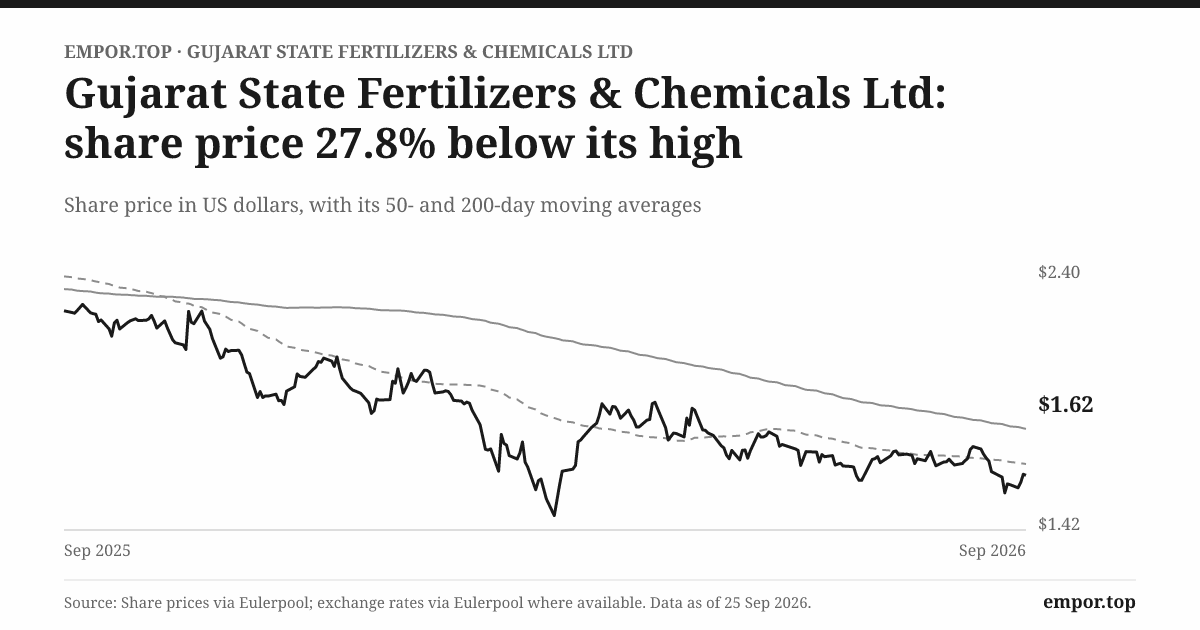
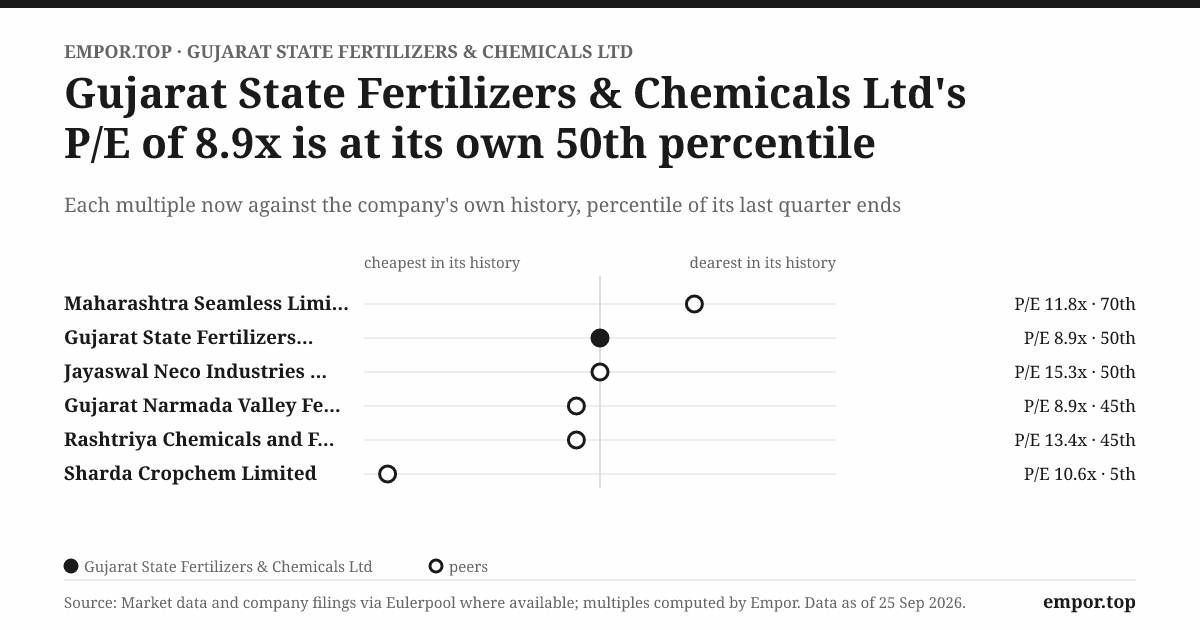
Fast-forward roughly three and a half years to September 25, 2026. GSFC's shares closed near ₹157.3 The rally had come and gone, leaving the stock almost exactly where that one-day surge had left it. At that price, the company held a market capitalization of about ₹6,250 crore against a reported book value of around ₹308 per share—meaning the market valued GSFC at roughly half of what its own accounts said it was worth.3
That gap frames an industrial paradox. GSFC is an enterprise of genuine manufacturing firsts. Filings describe the company as India’s pioneer in diammonium phosphate (DAP) manufacturing, the sole domestic producer of melamine and hydroxylamine sulphate crystal, and a major producer of caprolactam, nylon-6, and methanol.4 Credit rating agency CARE Ratings similarly identifies it as the sole domestic manufacturer of melamine and the largest domestic manufacturer of caprolactam and nylon-6 in India.5 It operates with virtually no debt and carries a AA+ credit rating.5
Yet returns on capital remain modest. Return on equity stood at about 6% in the latest fiscal year, and return on capital employed was around 7%.3 Over the past decade, return on equity reached double digits only during FY22 and FY23, peaking at 13% when a global commodity spike lifted every boat.3 Why does an established industrial producer with domestic monopolies and a clean balance sheet trade at such a persistent discount?
The shape of the machine
GSFC runs two distinct businesses under one corporate roof. The larger division produces and distributes agricultural fertilizers: urea, DAP, ammonium sulphate (AS), ammonium phosphate sulphate (APS), and a spectrum of NPK grades, marketed primarily under the farmer-facing "Sardar" brand. In FY24, fertilizers accounted for roughly three-quarters of total operating income and about 95% of profitability.5 The smaller division manufactures industrial chemicals: caprolactam (the core intermediate for nylon-6), nylon-6 chips, melamine, hydroxylamine sulphate crystal (HX), methyl ethyl ketone oxime, alongside traded ammonia and methanol.5
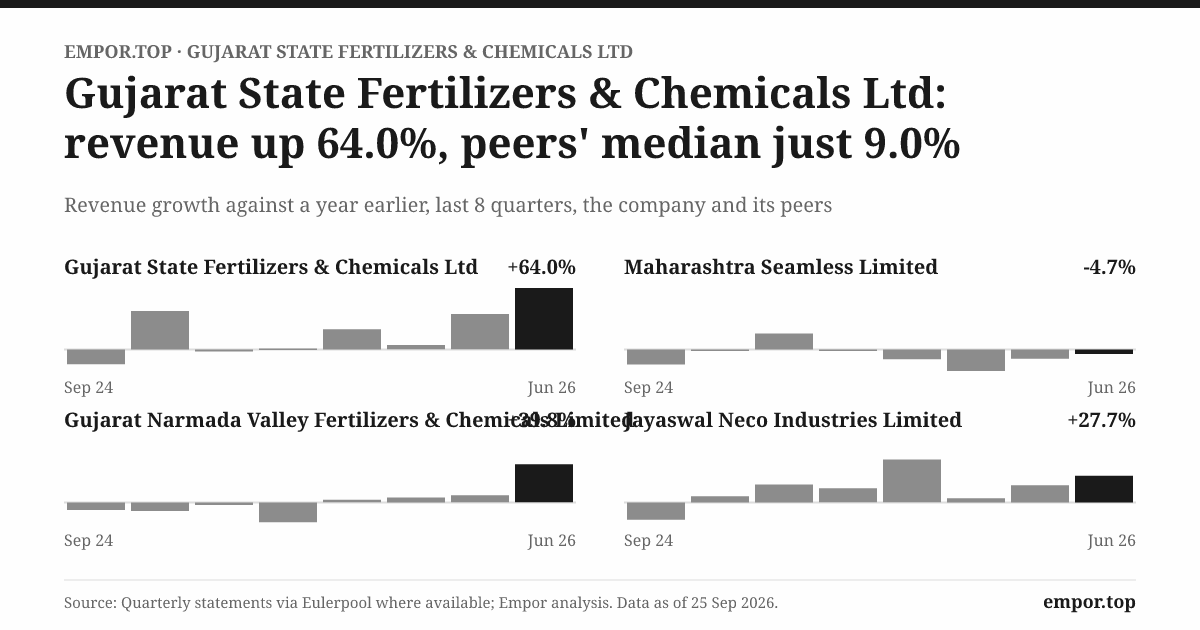
In FY26, the fiscal year ended March 31, 2026, standalone operating revenue reached a record ₹10,827 crore, up 15%, while profit after tax was ₹652 crore.6 On a consolidated basis, net profit was ₹673 crore on total income of ₹11,222 crore.7 That bottom line was roughly half of what the company earned at the FY23 peak.3
The governance structure reflects its state backing. The Government of Gujarat, through Gujarat State Investments Limited (GSIL), holds 37.84% of the company and appoints both its chairman and its managing director.5 Foreign institutional investors hold about 12%, domestic institutions about 7%, and the public holds the rest.3
The tension
The central tension in GSFC's story runs between two contrasting expressions of state capitalism. One is state entrepreneurship: the willingness to finance and build complex, capital-intensive chemical plants that private capital in 1960s India would not touch, driven by a national mandate for food security. The other is state capital allocation: rotating civil-service leadership, liquidity held in state-linked deposits, overseas joint ventures that failed to deliver planned resource security, and acute price exposure to Chinese commodity swings.
The first dynamic built one of India's most integrated fertilizer and chemical complexes. The second explains why the equity market prices that complex at less than its reported asset value. This story follows both threads: the Green Revolution origins, the Bharuch spin-off and the expansion into synthetic fiber intermediates, the melamine "monopoly" sustained primarily by trade tariffs, the resource ventures in Tunisia and Canada, the underlying segment economics, and the durability of the state's 2023 dividend mandate.
Every industrial paradox has an origin, and GSFC's began with a hungry country waiting at the docks.
 Subscribe on LinkedIn
II. Green Revolution Genesis & The Vadodara Blueprint (1962–1975) (35 min)
In the mid-1960s, India's food security depended on the arrival of American grain shipments. Under the US Public Law 480 "Food for Peace" program, about three vessels docked daily at Indian ports, discharging grain that was moved almost immediately into ration queues—a precarious vulnerability known as a "ship-to-mouth" existence.8 Consecutive monsoon failures in 1965 and 1966 pushed the agrarian economy to the brink. By January 1966, an estimated 30 million people were reported to be in "dire distress."8 The shortfall was severe enough that Prime Minister Lal Bahadur Shastri appealed to citizens nationwide to skip a meal on Mondays.8
The escape route came through agronomic reform. Food and Agriculture Minister C. Subramaniam, working alongside geneticist M.S. Swaminathan, introduced high-yielding semi-dwarf wheat varieties developed in Mexico by Norman Borlaug.8 Those seeds came with an inescapable condition: they unlocked their dramatic yield potential only when supported by heavy, disciplined applications of chemical fertilizer.8 An agronomic revolution required an industrial chemical revolution, and India lacked the domestic plants to supply it.
A state that wanted to make things
Gujarat, created in 1960 following the bifurcation of Bombay State, moved aggressively to build an industrial foundation. In 1962, the young state administration promoted a commercial enterprise to manufacture chemical fertilizers on the outskirts of Vadodara.4 The corporate architecture was deliberate: GSFC was structured as a joint sector corporation, promoted and backed by the state government but listed with institutional and retail public shareholders rather than administered as a state department.4 The goal was to align a public developmental mandate with commercial operating discipline.
That hybrid structure remains the company's defining feature. While GSFC publishes audited quarterly financials and hosts earnings calls like any publicly traded corporation, the state government continues to appoint both its chairman and its managing director.5
The first flowchart
Commercial production commenced in 1967. Urea-I, with a daily rated capacity of 323 tonnes, was built using Japanese Mitsui Toatsu technology alongside Toyo Engineering; Urea-II followed in 1969, adding 800 tonnes per day.9 That same year, 1967, GSFC commissioned a DAP unit engineered with TVA and Chemico processes from the United States, with Hitachi-Zosen acting as equipment supplier.9 A companion phosphoric acid plant, commissioned in May 1967, utilized a Chemico dihydrate process that the company claimed was deployed for the first time anywhere in the world.9
The early commitment to DAP addressed a fundamental agronomic imbalance. Crop nutrition resembles human dietetics: urea supplies concentrated nitrogen, the chemical equivalent of dietary protein, but crops also require phosphorus to establish root systems and transfer energy. Applying only nitrogen is like an athlete subsisting entirely on chicken breast—it accelerates foliage growth while leaving the plant structurally deficient. DAP provides both nitrogen and phosphorus in a single granule. GSFC's early scale in complex fertilizers helped nudge Indian farming toward a more balanced nutrient regimen, establishing the basis for the company's claim to have pioneered domestic DAP manufacturing.4
Waste as a feedstock
The governing logic of the Vadodara layout was chemical integration. A fertilizer complex operates as an interconnected cascade of chemical reactions, where the effluent of one unit becomes the feedstock of the next. Ammonia synthesis generates carbon dioxide, which provides the essential secondary input for urea. Burning elemental sulphur to produce sulphuric acid generates intense exothermic heat, which is captured as high-pressure steam to power adjacent plant machinery. Later ammonia expansions similarly recovered argon and industrial oxygen as saleable co-products.9
GSFC's chemical engineers designed the site on a principle of industrial thrift, ensuring minimal chemical energy went to waste. Credit rating agency CARE Ratings continues to describe the operating profile as "marked by high level of vertical integration," with captive ammonia and sulphuric acid feeding both fertilizers and industrial chemicals.5 That integration created lasting operational efficiencies. Yet it also introduced structural rigidity: because every production loop feeds another, idling or reconfiguring an unprofitable unit risks disrupting the operating economics of the entire complex.
The Sardar brand and the farmer's table
A chemical manufacturing site is only half of an agricultural inputs business; the other half is last-mile rural distribution and farmer trust. Beginning in 1968, GSFC published Krishi Jivan, a monthly Gujarati agricultural advisory magazine that remains in continuous publication, alongside a quarterly Hindi edition.10 To build agronomic demand, the company established field demonstration plots, opened soil-testing facilities, and assembled a distribution network that today operates through Kisan Suvidha Kendras and authorized private dealers.11
That brand equity proved durable. In September 2026, Gujarat Chief Minister Bhupendra Patel launched seven new GSFC crop protection products under the Sardar brand name, at a state event attended by GSFC Chairman M.K. Das and Managing Director Rajender Kumar.11 Six decades after its founding, the state government continues to treat GSFC as an operational instrument of its farm policy.
For public investors, this genesis reveals the company's institutional DNA. GSFC was engineered to secure domestic fertilizer volume and rural distribution, not to optimize returns on capital. The Vadodara flowchart succeeded at producing critical industrial molecules at scale. But corporate priorities built around physical availability rather than capital efficiency tend to shape corporate behaviour for decades—a reality that became evident when offshore natural gas transformed Indian industrial chemistry.
III. The Great Spin-Off & The Chemical Pivot: GNFC & Caprolactam (1976–1992) (40 min)
In the mid-1970s, the economics of Indian fertilizer were rewritten under the Arabian Sea. The discovery of oil and gas at Bombay High and the South Basin, the company recalls, "triggered the birth of 8 new generation fertilizer plants to fulfill the growing food needs of India."12 Cheaper domestic feedstock supported larger, more capital-intensive complexes. Gujarat moved to secure one of those allocations, with GSFC serving as the natural corporate sponsor.
A sibling at Bharuch
In 1976, the Government of Gujarat and GSFC jointly promoted Gujarat Narmada Valley Fertilizers & Chemicals (GNFC) at Bharuch.[^13] Commercial operations commenced in 1982 with what GNFC describes as one of the world's largest single-stream ammonia-urea fertilizer complexes.[^13] Over subsequent decades, GNFC diversified beyond fertilizers into chemicals, energy, electronics, and IT.[^13]
Why create an independent listed company rather than an operating division within GSFC? The public record preserves no detailed board rationale. The practical consequence, however, was clear: Gujarat’s state chemical portfolio became a family of listed siblings with overlapping public-sector shareholders and separate corporate managements. GNFC evolved into a major producer of methanol, acetic acid, aniline, toluene di-isocyanate, and nitric acid, with industrial chemicals now generating roughly 60% of its revenue.13 Today, the two sister companies share a state promoter, a geographic base, natural gas suppliers, and several product markets, but maintain distinct balance sheets and separate procurement desks.
Public markets value these two siblings very differently. On September 25, 2026, GNFC traded at about 1.0x book value, supported by a return on equity of roughly 9% and a return on capital employed of about 12%.13 GSFC traded at about 0.5x book.3 Both enterprises share the same state promoter, operate under the same civil-service administrative framework, and draw from the same regional industrial ecosystem, yet deliver divergent capital returns. That performance gap weakens the assertion that GSFC's depressed multiple is merely an unavoidable "Gujarat PSU" discount.
Why a fertilizer company makes nylon
The more consequential strategic pivot of this era was GSFC's entry into caprolactam, the cyclic monomer that polymerizes into nylon-6. Nylon-6 serves as a critical synthetic input across industrial manufacturing, finding use in automotive tyre cord, textile yarn, commercial fishing nets, carpets, and engineering plastics. GSFC operates two caprolactam plants at Vadodara with rated capacities of 20,000 and 50,000 tonnes a year.14
The underlying engineering logic offers a case study in chemical co-products. Synthesizing caprolactam through the conventional cyclohexanone-oxime process consumes substantial volumes of ammonia and sulphuric acid, generating large quantities of ammonium sulphate along the way. Ammonium sulphate is an effective agricultural fertilizer that supplies crops with both nitrogen and sulphur. At its Vadodara complex, GSFC maintains an annual ammonium sulphate capacity of 196,000 tonnes, described explicitly as a co-product of the caprolactam plants.9
Consider an industrial parallel: a dairy that churns cream into butter and ends up with an enormous stream of buttermilk. Management can either discard the secondary stream as waste or build a commercial distribution channel to monetize it. GSFC built a large fertilizer business around its byproduct—and subsequently discovered that during cyclical slumps in industrial polymers, the agricultural co-product could prove more valuable than the primary chemical.
That dynamic remains an operating reality rather than a historical curiosity. On the Q3 FY26 earnings call in February 2026, CFO S.K. Bajpai explained that when caprolactam carries a "little negative contribution," the company keeps running the plant anyway: "we do not shut the operation because it cuts the production of the Ammonium Sulphate also."15 In practice, the caprolactam unit doubles as a fertilizer plant operating in chemical attire.
Protected markets
Throughout the licence-raj decades, this integrated model functioned smoothly. High import tariffs and quantitative restrictions insulated domestic producers from foreign competition, while expanding demand from tyre and textile manufacturers absorbed growing plant volumes. GSFC's caprolactam, which the company still calls a "blue chip product," found a ready market.9 Within a closed economy, process integration looked like an unassailable commercial moat.
GSFC used that regulatory protection to widen its downstream footprint. Polymers Corporation of Gujarat, established in 1973 with state backing, was later merged into GSFC, bringing manufacturing capacity in acrylic monomers and polymers at Nandesari.16 A dedicated fibre unit at Kosamba near Surat was set up to convert Vadodara caprolactam into nylon-6 filament, with 6,000 tonnes a year of capacity.16 In 1982, the company commissioned a 5,000-tonne melamine plant, engineered using Austrian Agrolinz know-how.9
By the end of the 1980s, GSFC had assembled a regional equivalent to a European chemical conglomerate: fertilizers, synthetic fibre intermediates, resins, acrylics, and captive utilities, all bolted together in one integrated complex. Yet that entire edifice rested on an artificial pricing structure. The question the 1990s posed was blunt: could any of those capital-intensive product lines survive once the tariff walls came down?
IV. The Monopoly Experiment: Melamine, Nylon-6, and Value-Chain Dominance (1993–2008) (45 min)
Picture a laminate showroom in Morbi or Surat. Glossy sheets in walnut, marble, and matte grey line the walls, destined for kitchen cabinets and office desks across India. The hard, scratch-resistant surface on those sheets comes from melamine-formaldehyde resin. As the Indian government's trade authority described it, melamine resin used for decorative laminates provides "good hardness, resistance to scratch, stain, water and heat."17
For decades, GSFC was the sole domestic company manufacturing the white crystalline powder behind that surface. The company describes itself as "the pioneer and only company manufacturing Melamine in the country."9 That status has long served as a central pillar of the bull case for GSFC. It warrants closer scrutiny.
How melamine is made
Melamine synthesis starts with urea. Under conditions of high temperature and pressure, urea molecules condense into a ring-shaped compound, releasing ammonia and carbon dioxide that must be captured and recycled back into the complex. In commercial terms, a melamine unit functions as a value-add upgrade for a urea plant: taking a low-cost, bulk agricultural commodity, applying process heat and proprietary engineering know-how, and producing a higher-value specialty chemical.
For GSFC, the operational fit was direct. The Vadodara complex possessed captive urea synthesis, existing ammonia recycling infrastructure, and an engineering culture accustomed to high-pressure chemical processing. GSFC commissioned its initial 5,000-tonne Melamine-I unit in 1982, followed in 1997 by Melamine-II, which added 10,000 tonnes of annual capacity.9
Liberalisation and the bet on scale
The economic reforms of 1991 dismantled industrial licensing and initiated a steady reduction in protective tariffs. For GSFC, deregulation meant domestic products had to compete directly against landed import prices. Management chose to respond not by retrenching, but by investing in operating scale. In July 1998, the company commissioned Ammonia-IV, a 1,350-tonne-per-day plant built at a capital cost of ₹1,140 crore, which replaced older, energy-intensive units and recovered argon and industrial oxygen as saleable co-products.9 In 2001, the coastal Sikka unit near Jamnagar—supplied with imported phosphoric acid and ammonia through a dedicated offshore jetty and pipeline—produced APS for the first time, demonstrating that the plant could alternate between complex fertilizer grades.16
On the chemical side, GSFC integrated forward from caprolactam into nylon-6 chips under the Gujlon brand, anchored by a 7,000-tonne Vadodara plant that the company described as the largest in India.9 The complex also developed hydroxylamine sulphate (HX) crystal, which the CFO described as "our own R&D created product," a niche chemical intermediate that remains unique to GSFC in the domestic market.15
Myth vs reality: the "domestic monopoly" pricing illusion
The claim. Being India's sole melamine producer, and effectively its only active caprolactam manufacturer, endows GSFC with durable pricing power and insulates its operating margins.
The mechanism to test. If this monopoly position were economic, GSFC would possess the pricing power to command a premium over import parity or sustain steady margins during global market downturns. If the monopoly is merely physical—meaning GSFC is the only plant inside India's borders—domestic selling prices will track landed international cargo prices, leaving the company dependent on state trade remedies to defend its margins.
The evidence. The regulatory record provides a definitive answer. India's Directorate General of Trade Remedies (DGTR) initiated an anti-dumping investigation into Chinese melamine imports in September 2003, leading the central government to impose a definitive duty in November 2004.1718 GSFC subsequently petitioned for repetitive sunset reviews to keep those trade protections alive: a review initiated in 2008 and concluded in 2009, a second review in 2014–2015, a new-shipper review in 2018–2019, and another sunset review initiated in September 2020.18 In August 2021, the DGTR recommended extending the duty for an additional five years at $161 per tonne, observing that the protective measure had already been in effect for 16 years and that "capacities in China are in far excess of their total domestic consumption."19
The 2009 review had already documented this structural vulnerability: while GSFC's share of Indian consumption rebounded following the original 2004 tariff, a renewed surge of Chinese imports quickly eroded the domestic producer's market share once more.17 In September 2025, the DGTR initiated yet another anti-dumping probe into Chinese melamine; the authority issued its disclosure statement on September 18, 2026, with the final government determination still pending.18
Caprolactam illustrates an even more precarious dynamic. In September 2021, the DGTR recommended anti-dumping duties on caprolactam imports arriving from the European Union, Korea, Russia, and Thailand, explicitly noting that GSFC was "the sole existing producer of the subject goods in India."20 Final authority over trade remedies, however, rests with the Ministry of Finance. In an office memorandum, the ministry declined to impose the recommended duty, citing "public interests."21 In practice, policymakers determined that protecting downstream industrial users—including automotive tyre-cord manufacturers and textile spinners—outweighed the commercial interests of a lone domestic chemical producer.
By 2025 and 2026, management was still seeking tariff intervention. On the August 2025 earnings call, the CFO noted that the company had "taken up with the Government of India for anti-dumping duty because a lot of Caprolactam and Melamine is dumped from the Chinese material in India."22 By February 2026, he went further, disclosing that GSFC had requested "some minimum support price or some basic duty structure" to protect melamine, caprolactam, and nylon-6.15
The verdict. The historical record refutes the strong version of the pricing-power thesis. GSFC's status as a sole domestic manufacturer functions as an effective barrier to entry—given that no competitor has committed the capital to build rival domestic plants—but it offers no barrier to competition, because landed imports establish market clearing prices. Moreover, despite melamine tariffs being active almost continuously for more than two decades, GSFC's industrial products division saw its annual segment profit collapse from ₹524 crore in FY22 to just ₹5 crore in FY23, as a later section details.2324 A competitive moat that requires regulatory renewal every five years, and still leaks during global downcycles, is better understood as a trade tariff than a commercial advantage.
What remains is a narrower reality: GSFC operates an efficient, integrated domestic asset base that generates outsized profits during global logistical disruptions, when import volumes face physical bottlenecks or international ocean freight rates spike. The durability of even that narrower position sits before trade authorities. If the pending melamine investigation leads to fresh tariffs and industrial margins still buckle during the next Chinese supply cycle, the thesis of a protected domestic niche loses much of its remaining weight.
Having learned that it could not control prices at home, GSFC tried to control its costs from abroad. That journey took it to Tunisia and Saskatchewan.
V. The Overseas Resource Trap: Karnalyte, TIFERT, and Capital Allocation Missteps (2008–2018) (45 min)
Across the flat prairie near Wynyard, Saskatchewan, lies a potash deposit that a small Canadian junior has planned to mine for more than a decade. On paper, the projected scale looked formidable: an updated feasibility study effective November 26, 2025 outlined a 70-year mine life producing 2.175 million tonnes of potash a year.25 Yet on the ground, execution never followed: as of December 31, 2025, the company developing it held just C$0.4 million in cash.25 Its single largest shareholder is a state-promoted fertilizer manufacturer from Vadodara.
The supercycle logic
The strategic rationale behind GSFC's overseas expansion was coherent at the outset. India possesses virtually no domestic commercial potash reserves and imports most of its phosphoric acid from a handful of producer nations. When international agricultural commodity prices spiked during the late-2000s supercycle, domestic fertilizer makers were caught between fixed, state-regulated farm-gate prices and escalating import bills. Across the Indian fertilizer industry, securing upstream equity stakes in foreign mines and acid complexes became the standard recipe for "resource security."
GSFC made two major overseas bets under that doctrine. Both remain on its balance sheet. Neither delivered what it promised.
TIFERT: security that wasn't
Tunisian Indian Fertilizers (TIFERT) was incorporated in 2006 as a joint venture among two Tunisian state enterprises, Groupe Chimique Tunisien and Compagnie des Phosphates de Gafsa holding 35% each, and two Indian fertilizer producers, Coromandel International and GSFC with 15% each.26 The plant at Skhira was designed to convert roughly 1.4 million tonnes of Tunisian rock into 360,000 tonnes of phosphoric acid (measured as P2O5) annually, at a total project cost of roughly US$465 million.26 GSFC's own filings promised that at full capacity, TIFERT would supply enough acid to raise DAP output at its Sikka complex by 390,000 tonnes per year.12 Commercial production commenced in 2013.26
One contractual detail was easy to overlook. GSFC's annual entitlement was 180,000 tonnes of phosphoric acid, priced strictly "at the market price."5 The arrangement offered no structural cost advantage. At best, it was a guarantee of physical availability.
Even that availability failed to materialize. GSFC received 52,388 tonnes in FY21, 63,808 tonnes in FY22, 50,690 tonnes in FY23, and 32,158 tonnes in FY24—consistently capturing only a fraction of its entitlement.23245 Management told credit rating agency CARE Ratings that TIFERT was operating at only 30% to 35% of its rated capacity.5 Supply bottlenecks in the Gafsa mining basin and recurring mechanical breakdowns repeatedly idled the plant.26
The financing structure compounded the operational trouble. GSFC had extended a proportionate sponsor guarantee of US$41.1 million backing TIFERT's debt. In March 2017, lenders served an acceleration notice on TIFERT following debt-servicing delays, and on April 4, 2017, issued a formal call notice demanding payment from the joint-venture shareholders. While TIFERT ultimately paid the instalment, allowing the guarantee to expire in March 2018 and the final loan instalment to conclude in March 2024, the episode demonstrated how a minority overseas equity stake can expose a state-backed enterprise to outsized sovereign and balance-sheet risk.5
Then came physical disruption. During the August 2025 earnings call, GSFC's chief financial officer disclosed that "there was a fire in February" at the plant, that the complex remained closed, and that "there is no supply we are receiving from the TIFERT presently."22 Asked how much capital GSFC had invested in the venture, the CFO could only recall: "It is way back in 2012 or 2013, maybe Rs. 200 crores or figures."22 That an investor had to prompt the disclosure, and executive management could approximate the carrying value only from memory, highlighted how peripheral the asset had become to day-to-day oversight. As late as August 2026, Tunisian stakeholders and regional authorities were still convening meetings to assess relaunching TIFERT's activities.26
Karnalyte: the option that kept costing
The Canadian venture followed an even more troubling trajectory. In 2013, GSFC deployed approximately US$44.7 million for a 19.98% stake in Karnalyte Resources, a Toronto-listed junior developing the Wynyard project, alongside a 20-year offtake agreement covering roughly 350,000 tonnes of potash a year.275
On March 14, 2016, both sides announced an agreement in principle for GSFC to provide roughly US$700 million to finance Phase 1—a proposed 625,000-tonne-per-year solution mine—extolling it as a "ground-breaking deal structure."27 Less than five months later, on August 2, 2016, negotiations ceased. The parties had failed to agree on "certain fundamental terms," notably "governance matters" and how Karnalyte's secondary minerals, such as magnesium, would be developed.28 Softening global potash prices formed the backdrop, but boardroom control proved the decisive sticking point.
By November 2020, the investment had become a public controversy. Alexander Luke, a retired IAS officer and former chairman and managing director of GSFC, wrote to Gujarat's Chief Secretary on November 2, 2020, questioning who had authorized the ₹250 crore investment. He pointed out that the stake, which had risen to 38%, had dwindled in market value to about ₹8 crore, while Karnalyte had yet to deliver any potash.29 "Rs 250 Crore is not a small amount. It is public money," he wrote.29 The letter also flagged that GSFC's chief financial officer at the time was simultaneously serving as chairman of Karnalyte's board.29
What followed was the most revealing capital allocation decision of all. Rather than writing off the investment and walking away, GSFC committed more capital. In July 2022, management decided to invest another ₹20 crore (roughly C$3.25 million) in a Karnalyte rights issue, lifting GSFC's stake from 38.73% to 47.73%.2324 Karnalyte then produced an updated feasibility study, yet the venture remained financially stalled: its 2025 net loss reached C$992,000, and its stated agenda for 2026 was limited to pursuing "strategic partnerships, financing initiatives and business development opportunities."25
Myth vs reality: capital allocation discipline
The claim. GSFC is a conservative, debt-free company that makes prudent, counter-cyclical strategic investments.
The test. Did its two major overseas deployments deliver cost-advantaged, secure feedstock and returns above the cost of capital?
The evidence. The operational record provides an unequivocal answer. TIFERT delivered phosphoric acid at market prices rather than a captive discount, supplied volumes far below GSFC's entitlement, and stopped shipments entirely after a plant fire. Across thirteen years, Karnalyte has delivered no potash at all. GSFC's equity ownership in the Canadian junior more than doubled, while Karnalyte held just C$0.4 million in cash at the end of 2025. The US$700 million financing framework collapsed over corporate governance, not geology. A debt-free balance sheet is real, but it reflects an avoidance of debt-funded mistakes, not the execution of disciplined capital allocation.
Putting the known outlays side by side reveals the scale: about ₹250 crore into Karnalyte in 2013, roughly ₹200 crore into TIFERT by the CFO's own estimate, and another ₹20 crore committed to the 2022 Karnalyte rights issue.292224 Together that totals close to ₹470 crore—equivalent to about 7% to 8% of GSFC's entire market value in September 2026.3 For that capital, the company secured some acid at market prices and zero potash.
The verdict. The empirical record refutes the "prudent strategic investor" framing for GSFC's overseas ventures. A narrower reality holds: GSFC is conservative about leverage, but that is not the same as being disciplined about capital. The specific signal to watch is Karnalyte's next financing overtures. If GSFC commits meaningful new money to a greenfield potash mine without a bankable, derisked structure, it will demonstrate that the capital allocation lessons of the past decade remain unlearned. If it formally exits or ring-fences further commitments, investors will see the first concrete evidence of change.
While these overseas bets were quietly failing, GSFC was preparing its biggest domestic chemical wager in years, and it was betting on melamine.
VI. The Melamine-III Gamble & The Chinese Capacity Shock (2018–2022) (40 min)
In January 2019, engineers at Vadodara reached mechanical completion on a new 40,000-tonne-per-year melamine plant and brought it online immediately.30 Built with Casale's Low Energy Melamine technology, which the Swiss engineering firm had acquired from Borealis in 2013, the facility was the first commercial unit of that design to reach full operation worldwide.30 Combined with the existing 5,000- and 10,000-tonne units, the expansion nearly quadrupled GSFC's total melamine capacity to roughly 55,000 tonnes a year.930
The logic of the bet
The strategic rationale appeared compelling. India's furniture, real estate, and decorative laminate industries were expanding steadily. Melamine demand, which the Directorate General of Trade Remedies (DGTR) had measured at roughly 21,000 to 30,000 tonnes a year in the mid-2000s, was climbing.17 If GSFC could substitute imports with domestically manufactured material using an energy-efficient process, it could capture that domestic growth. A modern, world-scale plant promised to counter China's pricing advantage.
The answer China gave
China, however, was building on a vastly larger scale. The DGTR's 2021 findings on melamine highlighted Chinese manufacturing capacity "far in excess of their total domestic consumption," leaving an enormous export surplus looking for overseas outlets.19 A parallel expansion unfolded in caprolactam, where Chinese producers rapidly built out fully integrated value chains linking benzene, cyclohexanone, caprolactam, and downstream nylon.
For GSFC, the governing metric in this business is the caprolactam-benzene spread—the margin between the selling price of caprolactam and the cost of benzene, its principal petrochemical raw material. The relationship resembles a bakery's margin between the retail price of bread and the wholesale cost of flour: when the spread widens, every tonne generates robust cash flow; when it collapses, the manufacturer is effectively paying for the privilege of operating the kiln.
That spread swung erratically. It stood at US$730 per tonne in the first quarter of FY24 before retreating to US$582 in the first quarter of FY25.5 By the third quarter of FY24 it was US$674, slipping to US$588 in the third quarter of FY25.4 Across FY26 as a whole, the spread averaged only US$535, down from US$578 in FY25.6 In the third quarter of FY26 it dropped to US$495 per tonne.15 Around that US$500 mark, the CFO acknowledged that the caprolactam unit was running with a "slight negative contribution."15 Yet by June 2026, the spread abruptly rebounded to US$816.31
What happened to the industrial segment
Reported segment earnings reflected this wild volatility. In FY21, the industrial products division recorded ₹126 crore in profit before interest and tax (PBIT) on revenue of ₹1,771 crore.24 In FY22, as caprolactam spreads widened and global melamine prices peaked, segment PBIT surged to ₹524 crore on revenue of ₹2,935 crore.2324 A year later, in FY23, operating profit collapsed to just ₹5 crore on ₹2,528 crore in revenue, crushed by softening finished chemical prices and escalating costs for benzene and natural gas.23
That FY23 collapse underscores the segment's underlying fragility. At the corporate level, FY23 was GSFC's most profitable year in a decade, generating ₹1,266 crore in consolidated net profit.5 Virtually all of that earnings windfall originated in fertilizers, where elevated government subsidy rates propelled the agri-business PBIT margin to 16.5%.23
Myth vs reality: chemicals as a counter-cyclical hedge
The claim. Operating agricultural fertilizers alongside industrial chemicals stabilizes corporate earnings, because the two businesses follow distinct cyclical patterns.
The test. Did the industrial chemical business support corporate earnings when fertilizers weakened, and vice versa?
The evidence. While the two divisions did not move in lockstep, their divergence offered little genuine portfolio protection. In FY23, agricultural fertilizers boomed while industrial chemicals collapsed. In FY24, when fertilizers retrenched after the central government sharply cut nutrient-based subsidy rates effective October 1, 2023, chemical margins failed to pick up the slack. Fertilizer revenue dropped 23%, while industrial products remained depressed by "heavy dumping from China and low caprolactam-benzene spread."5 Consolidated net profit dropped from ₹1,266 crore to ₹564 crore, and operating margin (PBILDT) fell from 14.07% to 5.72%.5 A retroactive wage settlement that drove annual employee benefit expenses from ₹668 crore to ₹850 crore compounded the margin compression.5
Operating losses followed. In the first quarter of FY25, the industrial products division slipped into the red.5 Across all of FY25, industrial segment operating profit (EBIT) came in at ₹56 crore, before climbing to ₹200 crore in FY26—a result management highlighted as the "highest yearly profitability in last four years."6
The verdict. The diversification hypothesis holds only in a superficial sense: the two divisions do not peak at the same time, but they share fundamental macroeconomic vulnerabilities. Both businesses remain tethered to global energy prices, Chinese export allocations, and the value of the Indian rupee. When these headwinds converge, as they did in FY24, portfolio diversification fails to cushion earnings. Industrial chemicals act not as a stabilizing counterweight, but as a high-beta wager on volatile global chemical spreads.
A significant portion of that business, moreover, relies on commercial trading rather than domestic manufacturing prowess. Merchant ammonia distribution quietly became an essential earnings support. In February 2026, GSFC's CFO acknowledged that ammonia trading had been "helpful for getting the IP segment in a profitable segment," while noting that with import prices around US$525 to US$530 per tonne, smaller industrial buyers "cannot afford to purchase the Ammonia."15 Management indicated it was pursuing long-term ammonia procurement contracts to protect operating margins.15 While distribution spreads generate legitimate cash flow, merchant reselling provides no industrial moat. An industrial division that depends on merchant arbitrage to preserve profitability has not remedied its structural cost disadvantages.
Indeed, the earnings recovery in industrial products in FY26 was driven largely by melamine export volumes, merchant ammonia trading, and specialized hydroxylamine sulphate crystal rather than by caprolactam manufacturing.615 Examining why caprolactam continues to struggle requires unpacking the underlying economics of both divisions in detail.
VII. Segment Autopsy: The Real Unit Economics (Fertilizers vs. Industrial Products) (45 min)
Walk into a GSFC dealer's shop in Anand district during the kharif sowing rush, and the price on a bag of DAP or urea is not set by GSFC. It is set, directly or indirectly, by New Delhi. That single reality governs the economics of the company's dominant division.
The fertilizer engine: volume high, margin capped
GSFC's fertilizer business operates across three distinct regulatory and commercial regimes.
Urea operates under complete administrative control. The central government fixes the maximum retail price and reimburses manufacturers for the difference between their concession cost and that farm-gate price, evaluated against statutory energy-efficiency benchmarks measured in gigacalories per tonne of urea. Plants consuming less gas than the benchmark retain the efficiency savings; plants exceeding it absorb financial penalties. GSFC's Urea-I plant from 1967 was decommissioned, while Urea-II, dating from 1969, underwent a ₹364 crore revamp to reduce specific energy consumption to approximately 5.9 to 6.0 gigacalories per tonne.615 The CFO noted that the government would continue reimbursing the company under the older energy norms for three more years, providing an estimated payback period of four to five years.15
Non-urea fertilizers (DAP, APS, ammonium sulphate, and customized NPK grades) fall under the Nutrient Based Subsidy (NBS) framework. The government fixes a predetermined subsidy per kilogram of nitrogen, phosphorus, potash, and sulphur, leaving manufacturers to establish retail prices within informal administrative guidance. The primary commercial risk is price-transmission lag. When global procurement costs for imported phosphoric acid, ammonia, or elemental sulphur escalate faster than the government adjusts subsidy disbursements, domestic manufacturers absorb the margin squeeze. That vulnerability materialized in the first quarter of FY27: year-on-year, sulphur prices surged 231%, ammonia jumped 144%, and phosphoric acid (P2O5) rose 30%, halving the fertilizer segment's EBIT margin from 8.49% to 4.09% despite record sales volumes.31
Traded fertilizers round out the commercial portfolio. GSFC imports finished DAP and secondary nutrients for direct domestic distribution. In August 2025, the CFO acknowledged that domestic DAP manufacturing "is not cost-economical," prompting the company to line up four imported DAP cargoes instead.22 That was a striking admission from the enterprise that pioneered domestic DAP production in India.
Merchant trading also expands reported top-line revenue without generating proportional operating profit. In the third quarter of FY25, segment revenue climbed 42% year-on-year "primarily due to an increase in DAP trading revenues."4 In FY26, total fertilizer sales volumes expanded 12% to 22.31 lakh tonnes, with captive manufacturing reaching 17.59 lakh tonnes—the highest in five years.6 In the first quarter of FY27, volumes grew another 17% to 5.26 lakh tonnes.31 These figures confirm expanding physical market reach. Yet because imported DAP generates thin resale margins compared to manufactured complex fertilizers like APS, volume growth driven by merchant cargoes does not signal an expansion in underlying earning power.
The Sikka swing line and the acid problem
Management's operational response to expensive imported inputs centers on plant flexibility and captive backward integration. At Sikka, management moved to reconfigure an idle DAP train to switch dynamically between DAP, APS, and complex NPK grades depending on relative product spreads; in February 2026, the CFO indicated that engineering work would conclude "by the end of September this year."15 A modified C-train was engineered to deliver 1,200 tonnes per day of APS.32
Sulphuric acid represents the other critical cost lever. While the commissioning of the SA-V plant brought the Vadodara complex close to self-sufficiency, the coastal Sikka facility still relies on external procurement for roughly 1.6 to 2 lakh tonnes of acid annually, depending on product mix.15 When an analyst inquired whether a massive new copper smelter in Kutch—which produces sulphuric acid as a byproduct—might flood the Gujarat market with cheap acid and strand GSFC's upstream investments, the CFO responded that the units fulfill captive requirements and that prevailing market prices supported a two-to-three-year capital payback.15 He also attributed the international price spike to China and Russia having "stopped supplying" sulphuric acid to global markets.15 That logic cuts both ways: if those exporters return, market prices could fall "drastically," in the CFO's words, shrinking the payback benefit even as it lowers input costs.15
How much does GSFC earn per bag?
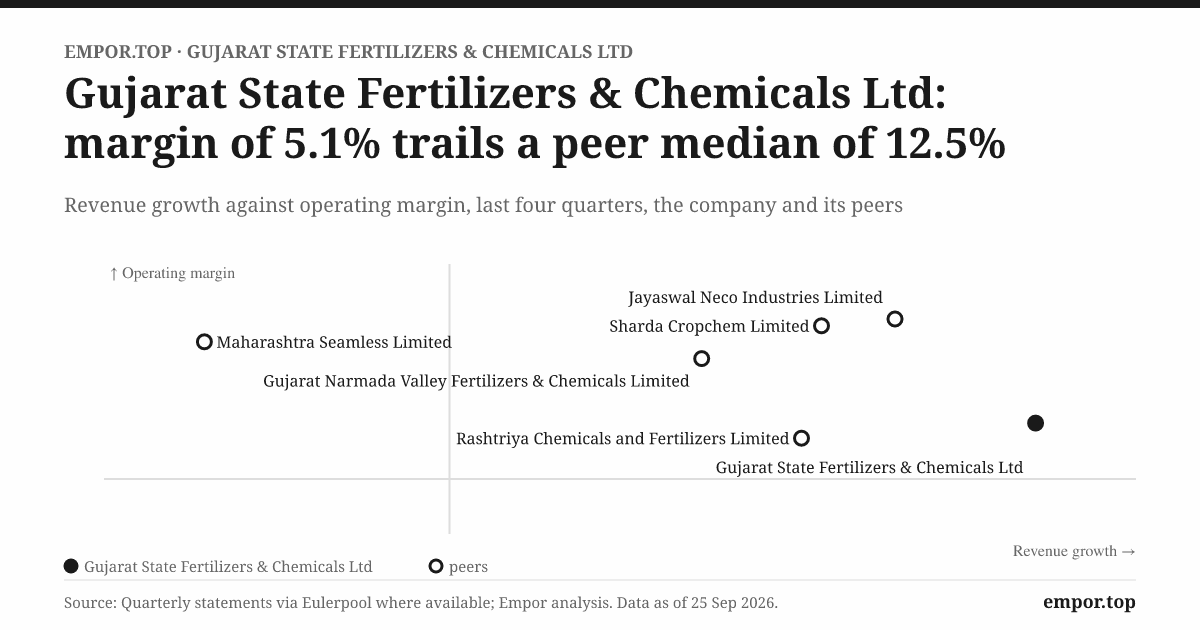
In practice, very little. In February 2026, when an analyst asked for EBITDA per tonne, the CFO stated that while a blended unit figure was not available, "5%-6% EBITDA is there in the fertilizer segment."15 On FY25 sales, the fertilizer division generated ₹430 crore of EBIT, up from ₹352 crore in FY24.33 Those returns resemble a regulated utility exposed to volatile commodity feedstocks, not a high-margin industrial franchise.
Working capital: the hidden drag
Subsidy entitlements are recognized as revenue when products are sold, but cash realisation depends entirely on government treasury releases. CARE Ratings notes that subsidy receivables declined from ₹1,661 crore in March 2023 to ₹1,076 crore in March 2024, before climbing back to ₹1,266 crore by June 2024 on seasonal volume growth.5 Total subsidy income recognized by the company fell from ₹5,810 crore in FY23 to ₹3,533 crore in FY24, underscoring how much of GSFC's top line is really a government transfer.5
The central fiscal framework governs working-capital velocity. The central government's fertilizer subsidy budget contracted from ₹2.5 lakh crore in FY23 to ₹1.9 lakh crore in FY24 and ₹1.6 lakh crore in FY25.5 Disbursements through late FY26 remained relatively timely: in February 2026, the CFO reported that the company had received subsidy payments for manufactured phosphatic fertilizers through the first week of January.15 Yet on the Q1 FY27 earnings call, management flagged that subsidies under a special DAP scheme lagged by roughly six months, creating a "short-term cash crunch" during periods of heavy cargo imports.32
Industrial products: the margin driver of bull runs
The industrial products division accounts for a smaller share of corporate revenue but generates virtually all of the company's cyclical profit expansions. Its core products comprise caprolactam (70,000 tonnes a year of rated capacity across two plants), nylon-6 at Vadodara and Kosamba, melamine at approximately 55,000 tonnes a year, HX crystal, methyl ethyl ketone oxime, and merchant trading in ammonia and methanol.149165
Three operational characteristics define this segment.
First, the caprolactam plant is not operated primarily to maximize caprolactam profits. It is run partly to generate ammonium sulphate, which earns dependable profits in the fertilizer segment.15 Management even imports merchant cyclohexanone ("anone") because captive production is more expensive, signaling that segments of the integrated chain are no longer cost-competitive.15
Second, plant managers route chemical intermediates toward products offering superior immediate returns. The CFO explained that the company aims "to run the HX Crystal at the full level rather than the Caprolactam," diverting shared oxime intermediate to HX where "the margins are better."15 This tactical flexibility demonstrates active operational scheduling, but it remains an exercise in micro-optimisation across an exposed commodity complex.
Third, export channels have become essential for volume absorption. Across FY26 and early FY27, increased melamine exports, where net realisations were stronger than domestic prices, helped drive the segment's profitability turnaround.156 The CFO also highlighted that evolving India–EU trade negotiations and US tariff shifts could open additional export markets for melamine, caprolactam, and HX crystal.15 Realizing higher net prices abroad than at home underscores the structural limit of GSFC's domestic positioning: because local prices are pinned to import parity, sole domestic producer status confers no local pricing power.
Segment EBIT: who carries whom
Across FY21 to FY26, the earnings swing was stark. Industrial products recorded ₹126 crore of PBIT in FY21, surged to ₹524 crore in FY22, dropped to ₹5 crore in FY23, contributed only about 5% of company profitability in FY24 (with fertilizers supplying the remaining 95%), before recovering to ₹56 crore of EBIT in FY25 and ₹200 crore in FY26.242356 Q1 FY27 opened at ₹116 crore on the strength of a US$816 per tonne spread.31
Fertilizers, by contrast, deliver steady, low-margin earnings, interrupted only by occasional windfalls when subsidy revisions outpace input costs, as seen in FY23.
For equity investors, the structural dynamic between the two divisions explains the persistent valuation discount. GSFC's fertilizer business sets the operating floor: a regulated baseline of modest, policy-dependent cash flows that insulates the balance sheet from distress. Its industrial chemicals business sets the ceiling: sharp cyclical swings determined by global petrochemical spreads beyond management's control. Multiple reratings depend on the chemical business, but baseline survival rests on agricultural subsidies.
That structural tension brings the central governance issue into focus: who controls the cash generated by these twin engines, and how is it allocated?
VIII. Governance, The IAS Carousel, and The Gujarat Shareholder Mandate (2023–Present) (35 min)
On January 3, 2026, a new managing director arrived at GSFC's headquarters in Fertilizernagar. Dr. Rajender Kumar, a 2004-batch Gujarat-cadre IAS officer trained as an Ayurvedic doctor (B.A.M.S.), had served as Director in the Prime Minister's Office from 2016 to 2021, working on national programmes such as the Swachh Bharat Mission and Ayushman Bharat, and had been an adviser at the World Bank.34 He replaced Sanjeev Kumar, another IAS officer.34
Dr. Kumar's appointment terms are revealing. His appointment stipulated that he would serve for five years "or until Government of Gujarat directs otherwise." He draws no remuneration from GSFC, continuing to receive his government salary instead.34 During the same period, Ashwani Kumar, a 1997-batch IAS officer and IIT Kanpur chemical engineer serving as Principal Secretary of the state's Energy and Petrochemicals Department, joined the board as a non-executive director.34 The company's chairman is the Chief Secretary of Gujarat.22
Incentives without equity
This structure offers distinct administrative strengths. IAS officers bring bureaucratic competence, direct access to state and central government machinery, and a public-service ethos. Dr. Kumar's PMO background spans large, execution-heavy national initiatives. Credit rating agency CARE Ratings notes that 57% of GSFC's board is independent and that the company maintains "healthy disclosures."5
Yet the incentive architecture remains unusual for a listed commercial enterprise. The managing director holds no meaningful equity, receives no stock options, and is compensated directly by the state rather than by the company. His tenure depends entirely on the state administration's transfer decisions. None of this implies substandard management. It does mean, however, that the executive running GSFC receives no financial reward if the stock doubles, and bears no financial penalty if capital is misallocated. The state's policy priorities—such as farmer supply, local employment, and regional industrial stability—naturally take precedence, while the interests of minority shareholders remain secondary.
There is also an executive visibility gap. Across earnings call transcripts reviewed for this story, including those from August 2025 and February 2026, the company was represented by its CFO and an executive director; the managing director did not take questions.2215 While common among state-owned enterprises, this practice means public investors rarely hear corporate strategy articulated directly by the executive nominally accountable for it. With the top post subject to administrative transfer, strategic continuity resides largely with long-serving professional managers, while authority over major capital allocation rests with the state-appointed board.
The CFO's own words illustrate this dynamic. Asked on the August 2025 earnings call whether GSFC would execute the share buyback or bonus issue envisioned by state policy, he replied: "our Chairman is the Chief Secretary of Government of Gujarat. So, he knows better. So, whatever the instruction coming from the board for buyback or bonus, suitably applies."22
The April 2023 policy
The policy in question dates to April 25, 2023, when Gujarat's finance department issued a formal resolution establishing capital-return guidelines for state PSUs:2
- Minimum dividend of 30% of profit after tax or 5% of net worth, whichever is higher.
- Buyback: every state PSU with net worth of at least ₹2,000 crore and cash and bank balances of ₹1,000 crore must exercise the option to buy back shares.
- Bonus shares for PSUs whose reserves and surplus are ten times or more of paid-up capital.
- Stock splits where market price or book value exceeds 50 times face value.
Brokerages immediately highlighted GSFC as the standout beneficiary. IIFL Securities called it "the biggest beneficiary of this policy change," pointing out that GSFC held ₹2,360 crore in cash and bank balances alongside approximately ₹4,200 crore of investments in other Gujarat PSUs, whose own higher payouts would flow back into GSFC's coffers.1
What actually happened
GSFC's dividend initially surged. The board approved ₹2.50 per share for FY22 and raised it to ₹10 per share for FY23, a fourfold increase.35 Yet that generosity quickly receded: the payout fell back to ₹4 per share for FY24, ₹5 for FY25, and ₹5 for FY26.357
Tested against the policy's arithmetic, the shortfall becomes apparent. With roughly 40 crore shares outstanding, a payout of ₹5 per share totals about ₹200 crore. Against FY26 standalone profit after tax of ₹652 crore, that represents approximately 31% of profit, satisfying the 30% profit-after-tax threshold.6 But the second leg of the rule requires 5% of net worth, whichever is higher. CARE Ratings placed GSFC's tangible net worth above ₹12,700 crore in March 2024.5 Five percent of that figure exceeds ₹600 crore—roughly three times what GSFC actually distributed. Unless state guidelines define net worth under a different formula, such as excluding fair-value gains on quoted investments, the company has fallen well short of the "whichever is higher" mandate. GSFC has offered no public clarification for this discrepancy in the disclosures reviewed for this story.
The capital-return mandates beyond dividends are even more unambiguous. GSFC's paid-up share capital remains tiny relative to its accumulated reserves, and in March 2024 it held ₹2,295 crore of free cash and fixed deposits, easily clearing the state's ₹1,000 crore threshold for mandatory share repurchases.5 Yet across corporate filings and earnings calls from April 2023 through September 2026, GSFC announced neither a share buyback nor a bonus issue. When asked about available liquidity in August 2025, the CFO explained that the cash buffer "has been reduced quite a bit" due to working-capital commitments and high raw material costs, adding that a proposed expansion at Sikka costing more than ₹1,600 crore might ultimately require external debt financing.22
Where the cash sits
Where that liquidity resides presents a separate governance question. In March 2022, CARE Ratings noted that cash and fixed deposits totaling approximately ₹1,622 crore were "largely parked with Gujarat State Financial Services Limited," another state entity.24 GSFC also carries substantial quoted equity holdings, valued at ₹5,315 crore in March 2022 and ₹4,885 crore in March 2024.245 These positions include strategic equity stakes in other state enterprises, such as power producer GIPCL, from which GSFC draws 38 MW of power as a promoter.5
In aggregate, a substantial portion of GSFC's balance-sheet value is tied up in state-linked deposits and cross-held public-sector equities. While operationally convenient for Gujarat's state treasury, this structure means corporate liquidity that could otherwise be returned to shareholders remains circulating within the state's public sector.
The market's assessment of the 2023 shareholder mandate is written directly into GSFC's share price: a one-day leap to ₹153.30 in April 2023, followed by a drift to around ₹157 by September 2026.13 Investors bought the promise, but the full value of the mandate remains unpaid.
IX. Playbook & Strategic Powers Analysis (30 min)
Picture a war-game table with GSFC's manufacturing footprint laid out across Gujarat. On one flank sit millions of Indian farmers and the Ministry of Chemicals and Fertilizers. On the other stand mega-scale Chinese chemical complexes, North African rock and acid suppliers, Gulf ammonia exporters, and domestic laminate workshops. Assessing each operating piece reveals a straightforward question: where does GSFC possess a structural advantage that competitors cannot replicate?
Hamilton Helmer's 7 Powers
Scale economies: modest domestically, weak globally. Vadodara and coastal Sikka operate at considerable scale by Indian standards, and an integrated flowchart spreads shared overhead across multiple product streams. Yet GSFC's 70,000 tonnes of caprolactam and 55,000 tonnes of melamine remain modest beside Chinese capacity, which the DGTR has repeatedly documented as far outstripping China's domestic demand.19 In global commodity chemicals, the lowest-cost producer dictates the clearing price, and GSFC does not hold that cost crown.
Network effects: none. Granular fertilizer and industrial chemicals are physical commodities. A bag of APS or a tonne of melamine creates no incremental utility for other users as sales volume expands.
Counter-positioning: none. As an incumbent industrial processor, GSFC operates established assets. It has introduced no novel business model or distribution architecture that rivals cannot adopt without cannibalizing their existing operations.
Switching costs: low. Industrial buyers evaluate GSFC against foreign imports primarily on landed price, credit terms, and delivery schedules. The reality that GSFC routinely exports melamine to capture higher net realisations abroad than it can command domestically confirms that domestic buyers pay no premium for local supply.15
Branding: durable in agriculture, absent in chemicals. Backed by six decades of rural extension work and the continuous publication of Krishi Jivan since 1968, the Sardar brand commands authentic farmer trust across western India.1011 The launch of Sardar-branded crop protection formulations demonstrates management's ambition to extend that goodwill into higher-margin agronomic categories.11 Yet across price-controlled bulk fertilizers, where maximum retail prices and NBS subsidies are dictated by central policy, brand loyalty secures volume allocations rather than premium pricing.
Cornered resource: physical, not economic. GSFC's deep-water jetty and pipeline corridor at Sikka for imported ammonia and phosphoric acid, its rail-linked Vadodara hub, and its captive utility backbone are extraordinarily difficult to duplicate.16 Sole domestic producer status in melamine and hydroxylamine sulphate crystal represents another physical corner. Yet as the regulatory history reveals, an asset corner unsupported by protective import tariffs yields negligible economic pricing power.
Process power: moderate. Decades spent mastering high-pressure ammonia synthesis, complex caprolactam chemistry, and proprietary in-house developments like hydroxylamine sulphate crystal reflect hard-won engineering expertise.15 Yet the financial evidence that this operational skill generates superior unit economics remains ambiguous: management routinely imports commercial intermediates when captive manufacturing proves uncompetitive, while its original 1960s urea unit had to be retired.15
In aggregate, GSFC's durable business powers distill down to an established agricultural brand and a difficult-to-replicate physical infrastructure. Neither asset endows the company with pricing power—the single determinant that dictates returns across its exposed industrial chemical portfolio.
Porter's Five Forces
Buyer power: very high. In fertilizers, the central government acts as the de facto buyer of last resort: it fixes retail urea prices, sets NBS subsidy disbursements, and schedules payment releases. In industrial chemicals, while downstream purchasers are fragmented, the absence of import barriers gives them frictionless access to global supply, creating immense collective bargaining power.
Supplier power: high. GSFC depends on international markets for phosphoric acid, rock phosphate, ammonia, and elemental sulphur, while purchasing natural gas under market-linked contracts. Captive ammonia synthesis covers approximately 4.2 to 4.5 lakh tonnes of its 5.5 to 6 lakh tonne annual requirement, leaving the remainder exposed to spot import markets.15 The dramatic cost surge in early FY27—when international sulphur and ammonia prices spiked—illustrated how swiftly upstream suppliers can compress operating margins.31
Threat of substitutes: low in fertilizers, moderate in chemicals. Basic crop physiology requires nitrogen and phosphorus, leaving bulk fertilizers immune to direct nutrient substitutes. In downstream polymers, however, nylon-6 constantly contends with alternative synthetic resins, including polyester and polypropylene, across textiles and engineering plastics.
Threat of new entrants: low. Constructing an integrated chemical-fertilizer complex demands thousands of crores in upfront capital expenditure, years of complex environmental permitting, and specialized chemical engineering know-how. Given that sector returns on capital hover in the mid-single digits, private capital has little incentive to sponsor competing greenfield complexes.
Rivalry: intense. Domestically, GSFC battles public-sector peers such as GNFC, RCF, and FACT, alongside well-capitalized private majors including Coromandel International, Chambal Fertilisers, and Deepak Fertilisers. Internationally, the company faces direct competition from any overseas producer capable of discharging cargo at Indian ports.
The peer mirror
The contrast with Coromandel International highlights the divergence. Coromandel, GSFC's co-investor in TIFERT, generated a return on capital employed of roughly 22% and traded at approximately 4.6 times book value in September 2026.36 GSFC delivered a return on capital employed near 7% and traded at about 0.5 times book.3 Both corporations operated under the identical NBS subsidy regime, navigated the same volatile international phosphoric acid trade, and absorbed the same operational setbacks in Tunisia. The divide in capital market valuation reflects not geographic location or raw material access, but product-mix discipline, private commercial orientation, and long-term capital allocation choices.
That divergence crystallizes the central valuation question for public investors: does GSFC's persistent valuation discount represent a fleeting market mispricing, or a structural reflection of its state-capitalist design?
X. The Skeptical Investor Stress Test & The Bull vs. Bear Case (35 min)
Imagine an activist fund manager walking into GSFC's annual general meeting with a concise slide deck. The first slide highlights the company's market value: roughly ₹6,250 crore.3 The second details what sits on the balance sheet: ₹2,295 crore of free cash and fixed deposits alongside ₹4,885 crore of quoted equity investments as of March 2024.5 The conclusion is hard to escape: public markets value GSFC's operating complexes, land holdings, and established brand at little or nothing—or perhaps even less.
That balance-sheet arithmetic comes with important caveats. The cash figures date from March 2024, corporate liquidity has since declined as working-capital commitments expanded, and liquidating quoted equity holdings would trigger capital-gains tax liabilities.22 Even after adjusting for those frictions, the valuation discount is wide enough to invite searching questions.
The activist's cross-examination
The cash question. Why does an enterprise earning 6% on equity hoard thousands of crores in state-linked deposits and cross-held public-sector equities rather than returning capital to shareholders, as its own promoter's policy appears to dictate? The conventional defense points to capital expenditure: CARE Ratings estimated GSFC's planned outlays—including a phosphoric and sulphuric acid complex at Sikka and a fungible APS/DAP train—at approximately ₹2,690 crore across FY25 through FY27.5 Yet committing fresh cash to industrial assets generating a 7% return on capital employed is hardly a superior use of funds compared to repurchasing shares at half of book value.
The sibling question. Why do GSFC and GNFC, promoted by the same state government and operating within the same industrial corridor, maintain parallel corporate headquarters, separate executive suites, independent procurement desks, and distinct treasuries?[^13] Consolidating the two chemical siblings could pool bulk purchasing for natural gas and imported feedstocks while eliminating redundant administrative overhead. The practical obstacles are substantial—divergent product portfolios, the sheer complexity of GNFC's downstream chemical operations, and the bureaucratic inertia inherent in merging state-backed enterprises. No formal merger proposal appears in the public record.
The capex record. Management commissioned Melamine-III in 2019 at a moment when extensive Chinese overcapacity was already meticulously documented in DGTR trade filings.1930 A further 40,000-tonne melamine expansion remained under active deliberation as recently as 2023, along with proposed polymer, Dahej, and synthetic fibre facilities.23 In February 2026, the CFO disclosed that GSFC had retained Boston Consulting Group to formulate a ten-year growth roadmap, had acquired industrial land at Dahej for future chemical projects, and had identified at least ₹40 crore in prospective annual operational efficiencies.15 The decisive question for investors is whether that strategic roadmap will enforce rigorous return hurdles, or merely channel more shareholder capital into unhedged commodity capacity.
Management credibility: promises vs outcomes
Management's operational guidance warrants a fair appraisal. In February 2025, the company cautioned that caprolactam would "remain under pressure due to rising Benzene prices and capacity expansions in China."4 That assessment proved accurate. In August 2025, leadership reiterated that caprolactam spreads were "likely to remain under pressure."22 By February 2026, management anticipated that spreads were "expected to improve" in the fourth quarter; they did, recovering to US$593 per tonne by March and US$816 by June.15631 Furthermore, the SA-V sulphuric acid plant was successfully commissioned on January 7, 2026, with the CFO projecting roughly ₹100 crore in annual savings and a payback period of two to three years.15
On near-term plant operations, therefore, executive commentary has been candid and reliable. The credibility gap widens when the discussion shifts to long-term capital allocation and legacy assets. Joint ventures such as TIFERT and Karnalyte rarely appear in prepared earnings remarks. The buyback and bonus-share mandates outlined in the state's April 2023 policy remain unexecuted. Project execution schedules have also slipped: while corporate disclosures in FY26 targeted a Q2 FY27 commissioning for the Sikka acid expansion, management acknowledged in August 2026 that engineering tenders were still being evaluated and finalized.632
The bear case
Chinese deflation becomes permanent. If Chinese chemical overcapacity keeps caprolactam-benzene spreads persistently below the roughly US$550 to US$600 per tonne threshold where the CFO noted operating contribution turns positive, the industrial products division could revert to break-even in most years.15 The US$816 per tonne spread recorded in June 2026 would then represent a brief cyclical spike rather than a sustainable recovery. Management itself projected that spreads would remain "stable to soft in the near term."32
Subsidy squeeze. The central government's fertilizer subsidy allocation has already contracted from its FY23 peak.5 If NBS subsidy revisions continue to lag international input inflation—as seen in the first quarter of FY27—fertilizer operating margins could remain compressed in the low single digits.31
Feedstock shocks. Procurement costs for imported ammonia, elemental sulphur, and phosphoric acid can swing by 100% or more within a single fiscal year, leaving GSFC as an exposed price-taker across all three critical inputs.31
The wider risk radar. Management has identified erratic monsoon distribution and emerging El Niño weather patterns as key demand variables for the cropping season.6 It has also warned that caprolactam spreads face headwinds from crude oil volatility and ongoing geopolitical tension across the Middle East.32 Meanwhile, statutory adjustments under India's new labour codes required additional provisions in the third quarter of FY26, though the CFO stated that the ultimate financial impact would remain modest because the company already complies with most requirements.15 While none of these headwinds is individually existential, together they reinforce a core vulnerability: virtually every significant driver of corporate earnings, from domestic rainfall to global sulphur pricing, sits beyond management's control.
Permanent PSU discount. Absent managerial equity ownership, predictable capital returns, and decisive exits from non-performing overseas assets, equity markets may continue pricing GSFC well below book value indefinitely. GNFC's valuation at 1.0 times book proves that a severe discount is not an inevitable fate for a Gujarat state enterprise, but it also demonstrates that the valuation ceiling for state-run chemical producers remains modest.13
The bull case
Trade protection finally bites. A favorable determination in the DGTR's pending melamine investigation, combined with management's lobbying for a "minimum support price or some basic duty structure" across melamine, caprolactam, and nylon-6, could lift domestic net realisations.1815 However, two decades of melamine tariff history suggest that trade barriers typically cushion operating losses during global downturns rather than generating durable excess profits.
Dividend floor. If the Gujarat administration strictly enforces its April 2023 mandate—specifically the requirement to distribute 5% of net worth—GSFC's annual dividend distribution would multiply several-fold. At the FY26 payout of ₹5 per share, the stock offered a dividend yield of approximately 3.2% in September 2026.3 That statutory payout requirement represents the most potent catalyst in the bull thesis, but also the least proven in practice.
Brownfield capex. The commissioning of the SA-V sulphuric acid unit, the energy-efficiency revamp of Urea-II, and the Sikka acid expansion are engineered to reduce reliance on merchant intermediates while enhancing flexible APS and DAP production.615 A 10% increase in nutrient subsidy rates for nitrogen, phosphorus, and sulphur, highlighted by management for the upcoming agricultural season, provides an additional near-term earnings tailwind.6
Asset backing. With shares trading near half of reported book value, the equity market has already priced in substantial operational distress. Depreciated manufacturing complexes, extensive land holdings at Vadodara, Sikka, and Dahej, and a multi-thousand-crore portfolio of listed state equities offer a tangible margin of safety—provided that asset value is eventually unlocked for public shareholders.
Weighing it
The empirical evidence sharpens both arguments. The core vulnerability in the bear case is not Chinese competition or agricultural subsidy cycles, but an institutional record of capital allocation: two unremunerative overseas resource bets, an unhedged equity increase in Karnalyte, and incomplete compliance with the state's capital-return directive. The core strength of the bull case is the sheer magnitude of the balance-sheet discount relative to hard industrial and financial assets. Which dynamic prevails depends on whether a new managing director, a BCG-designed strategy, and the state government can alter how cash is harvested, protected, and returned to owners.
That leaves one final set of questions: what would a disciplined commercial operator do with these assets, and what specific metrics should investors track next?
XI. Epilogue & "If We Were CEOs" (15 min)
At the Vadodara complex, the original 1967 urea unit has been decommissioned, the SA-V sulphuric acid plant is online, and planners are drafting project blueprints for Dahej. The enterprise that began as a state answer to a national food crisis faces, six decades later, a fundamental question no planner in 1962 had to consider: can it consistently earn more than its cost of capital?
The KPIs that matter
Three indicators capture the core drivers of GSFC's economic value.
1. The caprolactam-benzene spread (US$ per tonne). This metric serves as the primary determinant of profitability in the industrial products division. Management discloses the spread in earnings releases and investor calls, with the CFO outlining the thresholds where caprolactam operating contribution turns positive.15 Because caprolactam synthesis directly yields ammonium sulphate as a co-product, this spread also dictates plant operating rates and volume availability in the profitable fertilizer business.
2. Subsidy receivables and disbursement timing. The scale of outstanding dues from the Department of Fertilizers, and the length of the payment lag following farm-gate sales, determines whether GSFC's cash flow remains available for dividends and brownfield expansions or gets trapped in working capital.532
3. Return on equity across a full cycle. The double-digit returns achieved in FY22 and FY23 proved to be the exception rather than the rule. Delivering a sustained return on equity above the cost of capital over a five-year cycle—one that encompasses an inevitable global commodity downturn—remains the definitive test of whether the underlying economics have truly transformed.
If we were CEOs
A strategic thought experiment, rather than an operational forecast, helps clarify what would genuinely alter GSFC's investment thesis.
Resolve legacy overseas positions. The clearest signal of a disciplined capital allocation regime would be an explicit determination on Karnalyte and TIFERT: monetize the assets, take transparent write-downs, or strictly ring-fence any future outlays behind commercially bankable milestones. The decision to inject fresh capital into Karnalyte's July 2022 rights issue demonstrated that the default administrative response had been to keep funding legacy commitments.23
Implement the state shareholder mandate in full. The Gujarat finance department's April 2023 resolution already outlines a clear framework for dividends, share repurchases, and bonus issues.2 Publishing a formal, board-approved capital return policy that clarifies how GSFC applies each provision—including the formula for tangible net worth—would eliminate a persistent valuation overhang.
Enforce strict hurdle rates on future capital expenditure. Any new industrial capacity at Dahej or initiatives emerging from the ten-year strategic roadmap must clear return hurdles substantially higher than the company's historical 6% to 9% returns on capital across the cycle. Downstream specialties, such as engineering nylon compounds or customized water-soluble fertilizers, represent viable growth avenues, but only if their unit economics withstand open Chinese competition without relying on perpetual tariff protection.
Rethink the GSFC–GNFC relationship. Consolidating Gujarat's twin chemical state enterprises could generate meaningful procurement synergies and eliminate duplicative administrative overhead, even if political and organizational hurdles make a full merger difficult. A coordinated joint procurement desk for natural gas, imported ammonia, and phosphoric acid could capture immediate scale advantages without requiring a formal corporate amalgamation.
Align executive incentives with minority shareholders. A managing director compensated directly by the state civil service, with no equity ownership or financial exposure to the company's share performance, remains a defining feature of the state-enterprise model.34 Altering that structure would require a policy shift by the state government rather than a routine board resolution. Until executive compensation reflects long-term economic value creation, the most dependable mechanism for shareholder alignment is a transparent, formulaic capital return policy that operates independently of administrative transfers in the corner office.
GSFC helped build Gujarat's agrarian foundation and proved that India could synthesize industrial molecules it once had to import. The decisive challenge ahead is whether management and its state promoter can transform that pioneering manufacturing legacy into sustainable returns for all shareholders, rather than just the government that appoints its leadership.
References
-
Gujarat PSU stocks rally: GSFC, GSPL are biggest beneficiaries of new policy on dividend, share buyback — Business Today, 2023-04-26 ↩↩↩
-
Gujarat govt's new PSU policy mandates bonus shares, dividends, buybacks — Business Standard, 2023-04-26 ↩↩↩
-
Gujarat State Fertilizers & Chemicals Ltd — Consolidated financials, valuation and shareholding — Screener, 2026-09-25 ↩↩↩↩↩↩↩↩↩↩↩↩
-
Media Release: Q3 FY 24-25 Results Update — Gujarat State Fertilizers & Chemicals Ltd, 2025-02-10 ↩↩↩↩↩↩↩
-
Rating Rationale: Gujarat State Fertilizers and Chemicals Limited — CARE Ratings, 2024-10-07 ↩↩↩↩↩↩↩↩↩↩↩↩↩↩↩↩↩↩↩↩↩↩↩↩↩↩↩↩↩↩↩↩
-
GSFC FY 2025-26: Record Q4 Sales, Fertilizer Volume Growth, and a Better Industrial Products Mix — Multibagg, 2026-05 ↩↩↩↩↩↩↩↩↩↩↩↩↩↩
-
GSFC Q4 Profit Down 27% to ₹52 Crore, Revenue Rises to ₹2,668 Crore — Outlook Business (PTI), 2026-05-22 ↩↩
-
Hungry India, a nawabi US President, 'Mexican blood' — The real story of Green Revolution — ThePrint, 2022-02-19 ↩↩↩↩↩
-
Vadodara Unit — Gujarat State Fertilizers & Chemicals Ltd ↩↩↩↩↩↩↩↩↩↩↩↩↩
-
Gujarat CM Bhupendra Patel Launches Seven GSFC Crop Protection Products Under Sardar Brand — Indian Masterminds, 2026-09-24 ↩↩↩↩
-
GSFC Ventures (GNFC, TIFERT, GIPCL, GGRC and others) — Gujarat State Fertilizers & Chemicals Ltd, 2018-05-31 ↩↩
-
Gujarat Narmada Valley Fertilizers & Chemicals Ltd — Consolidated financials and valuation — Screener, 2026-09-25 ↩↩↩
-
Transcript of Q3 FY26 Earnings Conference Call — Gujarat State Fertilizers & Chemicals Ltd, 2026-02-10 ↩↩↩↩↩↩↩↩↩↩↩↩↩↩↩↩↩↩↩↩↩↩↩↩↩↩↩↩↩↩↩↩↩↩↩
-
Other Units: Sikka, Polymer Unit and Fibre Unit — Gujarat State Fertilizers & Chemicals Ltd ↩↩↩↩↩
-
Final Findings: Sunset Review of Anti-Dumping Duties on Melamine from China PR — Directorate General of Anti-Dumping & Allied Duties, 2009-11-20 ↩↩↩↩
-
Anti-Dumping Duty investigation concerning imports of Melamine from China PR — Directorate General of Trade Remedies ↩↩↩↩
-
India to extend anti-dumping duty on melamine from China for 5 years — Indian Chemical News, 2021-08-31 ↩↩↩↩
-
DGTR recommends anti-dumping duty on imports of Caprolactam — TaxGuru, 2021-09 ↩
-
Finance Ministry's decision not to impose anti-dumping duty – Blurred lines — Lakshmikumaran & Sridharan Attorneys ↩
-
Transcript of Q1 FY26 Earnings Conference Call — Gujarat State Fertilizers & Chemicals Ltd, 2025-08-08 ↩↩↩↩↩↩↩↩↩↩↩
-
Rating Rationale: Gujarat State Fertilizers and Chemicals Limited — CARE Ratings, 2023-10 ↩↩↩↩↩↩↩↩↩
-
Rating Rationale (Revised): Gujarat State Fertilizers & Chemicals Limited — CARE Ratings, 2022-12 ↩↩↩↩↩↩↩↩↩
-
Karnalyte Resources Inc. Announces 2025 Year End Results and Provides Corporate Update — Karnalyte Resources, 2026-03-27 ↩↩↩
-
Fiche entreprise : TIFERT, le géant tuniso-indien de l'acide phosphorique à l'épreuve de la relance — WMC (Webmanagercenter), 2026-08-20 ↩↩↩↩↩
-
Gujarat State Fertilizers and Chemicals to provide $700m for Karnalyte's potash mine in Canada — Mining Technology, 2016-03-14 ↩↩
-
Karnalyte Resources Inc. Announces Cessation of Negotiations in Respect of Financing for Phase I Potash Mine — Newswire.ca, 2016-08-02 ↩
-
Gujarat rope trick: Who decided in 2013 to invest Rs 250 Crore in a dubious company in Canada? — National Herald, 2020-11-20 ↩↩↩↩
-
GSFC melamine plant fully operational — World Fertilizer, 2019-04-25 ↩↩↩↩
-
Record fertilizer sales lift GSFC Q1 FY27 profit by 15% — Indian Chemical News, 2026-08-13 ↩↩↩↩↩↩↩↩
-
GSFC Q1 FY 2026-27: Record sales meet a tougher cost cycle — Multibagg, 2026-08 ↩↩↩↩↩↩
-
GSFC reports Q4 FY25 PAT at Rs. 58 Cr — Indian Chemical News, 2025-05-22 ↩
-
GSFC Seeks Shareholder Approval for IAS Officers Dr Rajender Kumar as MD & Ashwani Kumar as Director — PSU Connect, 2026-02 ↩↩↩↩↩
-
Gujarat State Fertilizers & Chemicals (NSE:GSFC) Dividend History — StockAnalysis ↩↩
-
Coromandel International Ltd — Consolidated financials and valuation — Screener, 2026-09-25 ↩
 LinkedIn
 WhatsApp
 Reddit
 Hacker News
 Email
 Kindle
 RSS Feed
 Spotify
 Apple Podcasts
 Amazon Music
 Audible
 YouTube