Gujarat Gas Limited: The Industrial Molecule & The State Energy Machine
I. Introduction & The Industrial Anomaly
In the second week of April 2026, most of the kilns in Morbi stood cold. A dusty town in Saurashtra where tile factories line the highway, Morbi produces the bulk of India's ceramic tiles. Six weeks earlier, regional war involving Iran had thrown shipping through the Strait of Hormuz into chaos. The propane tankers that routinely supplied the manufacturing cluster stopped arriving, while liquefied natural gas grew scarce and prohibitively expensive. An adviser to the local manufacturers' association counted roughly 550 factories that had suspended operations.1 In April, the volume of piped natural gas Gujarat Gas supplied to the entire cluster dwindled to an average of roughly 0.4 million standard cubic metres per day (mmscmd). By May and June, that figure surged to around 8 mmscmd—a twentyfold swing in about eight weeks.2 By August, alternate propane shipments began arriving from the United States and Venezuela. Offtake of piped gas in Morbi retreated to about 3 mmscmd as imported propane undercut pipeline supplies by roughly ₹13 per standard cubic metre (scm).2
That single spring illustrates the true character of the business far more clearly than any annual report. City gas distribution is conventionally considered one of the steadiest, most predictable segments in the energy industry: a regulated pipeline monopoly supplying captive residential kitchens and commercial fleets, yielding stable, utility-style returns akin to an annuity. Delhi's Indraprastha Gas and Mumbai's Mahanagar Gas fit that model well. More than 80% of their volume has sat in "priority" segments—compressed natural gas (CNG) for vehicles and piped gas for households—which historically received subsidized, government-allocated domestic gas.3 Gujarat Gas is India's largest city gas distributor by volume.4 Yet it operates less like a protected municipal utility and more like an industrial fuel merchant. Its financial performance fluctuates with global spot LNG benchmarks, landed propane tariffs at Kandla and Mundra, and export demand for ceramic tiles across the Persian Gulf and Europe.
The Scale of the Machine
The company's physical infrastructure is vast by any Indian benchmark. Its disclosed distribution footprint spans more than 45,900 kilometres of pipeline, 844 CNG stations, about 24.77 lakh (2.48 million) connected households, 16,600 commercial establishments, and nearly 4,500 industrial customers. The underlying network covers 44 districts across six states—Gujarat, Maharashtra, Rajasthan, Haryana, Punjab, and Madhya Pradesh—alongside the union territory of Dadra & Nagar Haveli.4 During the quarter ended June 2026, the city gas business sold 12.34 mmscmd. Industrial consumers accounted for 7.71 mmscmd of that volume, CNG dispensers took 3.76 mmscmd, residential households consumed about 0.70 mmscmd, and commercial users made up 0.17 mmscmd.25 Industrial volume therefore represented over 60% of total sales in that quarter—a commercial profile starkly different from peers in Delhi and Mumbai.
The company has also expanded beyond traditional city gas distribution. On May 1, 2026, a corporate restructuring twenty months in development officially took effect. The state-owned parent, Gujarat State Petroleum Corporation (GSPC), and intermediate holding entity Gujarat State Petronet (GSPL) were merged into Gujarat Gas, while GSPL's pipeline transmission business was spun off into an independently listed entity.6 On May 14, 2026, the combined enterprise formally changed its name to Gujarat Energy Limited.7 Its stock ticker shifted in tandem, from GUJGASLTD to GUJENERGY.2 This account continues to refer to the operating business as Gujarat Gas, or GGL, when discussing its pre-merger era, where virtually all of its operating history was established.
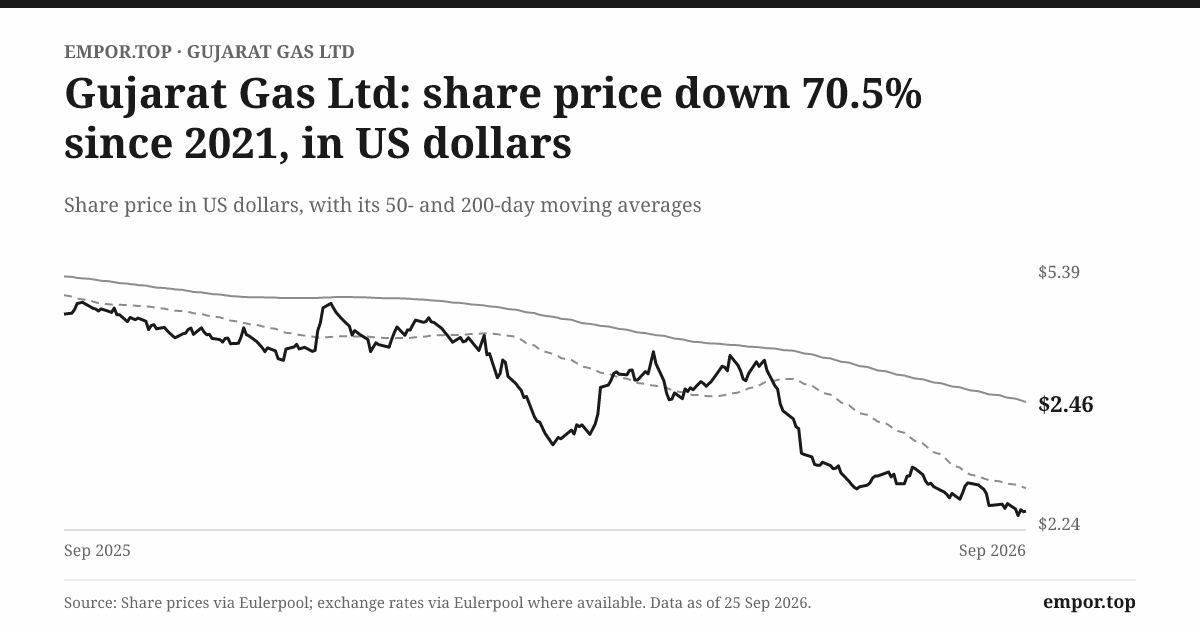
Public markets have viewed the realignment skeptically. In late August 2024, on the eve of the restructuring announcement, standalone Gujarat Gas carried a market capitalization of ₹41,531 crore.8 By September 2026, the merged Gujarat Energy commands a market value of roughly ₹22,100 crore, trading near ₹236 per share—just above its 52-week low of ₹230.9 That comparison is not entirely like-for-like: legacy shareholders received equity in the spun-off transmission company, while fresh shares were issued to absorb GSPC and GSPL stakeholders. Even so, the sharp contraction in equity value is unmistakable, and unpacking the reasons behind it forms the core of this analysis.
The Arc and the Questions
Gujarat Gas has evolved under four distinct ownership regimes, each reflecting its era. Founded in 1980 as a joint venture between the state and private entrepreneurs, it began by laying pipelines to South Gujarat's textile mills and chemical plants. Starting in 1997, the UK's BG Group managed it as a disciplined multinational subsidiary. In 2012, the Gujarat state government repurchased the business through GSPC. The 2024–2026 consolidation then folded the distributor into its own parent organizations.
This study examines the critical assumptions underpinning the business model. Does owning a physical monopoly over regional pipelines guarantee pricing power over the end customer's fuel choice? The volatile history of Morbi provides the clearest answer. Did the state overpay when it reacquired the grid from BG Group? Did a landmark 2019 environmental court directive create a permanent profit engine or merely a cyclical windfall? And can a state-run energy conglomerate, holding more than ₹7,000 crore in cash with a leadership team openly planning "diversification," allocate capital more effectively than the focused utility it replaced?2 The assessment tests these dynamics using Hamilton Helmer's 7 Powers framework and Porter's Five Forces, concluding with three operational metrics that will decide the company's future. The journey begins with its origins, in an era when India flared its natural gas because it lacked the pipes to transport it.
 Subscribe on LinkedIn
II. The Genesis & The Socialist Gas Experiment (1980–1997)
In the early 1980s, Ankleshwar was a modest industrial town along the Narmada River, surrounded by the onshore oil wells of the Oil and Natural Gas Corporation (ONGC), where associated gas surfaced alongside crude oil. Lacking evacuation infrastructure, much of that gas was flared or vented near the wellhead. India's hydrocarbon economy was then firmly state-dominated, allocating gas almost exclusively as feedstock for public-sector fertilizer complexes and power stations. The concept of piping gas directly to a textile mill's boiler or a household burner remained virtually untried.
A Chemical Company Becomes a Gas Company
The corporate vehicle originated in 1980 under the name Gujarat Amico Chemicals. It was promoted jointly by Mafatlal Fine Spinning & Manufacturing—part of the Mafatlal textile group—and the state-owned Gujarat Industrial Investment Corporation (GIIC). The partnership captured the mixed economy of the era: a private industrialist seeking low-cost thermal fuel teamed with a state agency mandated to accelerate regional industrialisation. The venture was established to build gas distribution across Ankleshwar and Bharuch, formalised through an agreement in 1987.10 The commercial logic was straightforward: capture associated gas that would otherwise be flared at nearby wellheads, and deliver it via pipeline to the mills, dye houses, and chemical plants clustering along the Surat–Ankleshwar–Bharuch corridor.
In 1989, the company commissioned its first piped natural gas connection in Ankleshwar, establishing the basis for its later claim as one of India's earliest entrants in city gas.8 Compressed natural gas operations followed in 1992.10 By comparison, Delhi's high-profile CNG transition unfolded roughly a decade later, driven by a Supreme Court environmental ruling rather than commercial fuel-switching.
Why the Early Years Still Matter
This foundational era established a lasting structural precedent: Gujarat Gas was conceived as an industrial fuel merchant long before it served households or commercial fleets. Domestic kitchens and CNG stations were subsequent additions to a pipeline grid laid primarily for factories. That heritage continues to shape the company's operating profile decades later. Industrial demand justified the initial capital expenditure, but it also exposed the network to sharp commercial swings.
The initial model faced hard physical constraints. Maturing local onshore fields could not sustain expansion across the wider state. Scaling beyond South Gujarat required long-term capital, international pipeline engineering standards, and the capability to import liquefied natural gas. While disclosed records do not detail the listing mechanics, specific transaction terms, or Mafatlal's decision to exit, the outcome was decisive: in 1997, the UK's BG Group acquired the company.10
That inaugural chapter left an enduring lesson for investors. The distributor's franchise was built around the price tolerance of industrial manufacturers rather than a captive, regulated utility base. That commercial focus delivered rapid early growth, but it also introduced the volatility that has defined its operations ever since. BG Group's arrival upgraded network integrity and operating governance, but it did not alter the fundamental identity of the customers the pipes were built to serve.
III. The British Gas Era: Multinational Engineering & Standards (1997–2012)
When BG engineers arrived in Surat in the late 1990s, they stepped into a dense, crowded commercial hub where subterranean infrastructure was scarcely mapped. The assignment required laying high-pressure gas mains beneath congested streets and connecting households accustomed to liquefied petroleum gas cylinders. While the technical hurdles were considerable, the commercial challenge was equally steep: convincing residential consumers that natural gas piped directly into their kitchens was safe.
What BG Brought
BG Group had emerged in 1997 following the demerger of British Gas plc, which separated international pipeline and exploration assets from Centrica's UK retail supply operations. Seeking gas assets across supply-deficit emerging markets, BG acquired Gujarat Gas Company, creating one of India's few foreign-controlled city gas utilities. While disclosed transaction records do not specify the initial purchase price, by 2012 BG held a 65.12% controlling stake in the enterprise.11
The defining contribution of the BG tenure lay in operational and engineering standards. The distributor introduced high-density polyethylene pipelines—flexible polymer mains that could be electrofusion-welded into seamless, leak-resistant networks, eliminating the corrosion risks inherent to joined steel pipes. Management implemented gas odorisation to ensure fugitive emissions could be detected immediately by smell, alongside centralised telemetry to monitor grid pressures in real time. In practical terms, BG converted an entrepreneurial regional pipeline installer into a utility operating under multinational safety protocols. That capability remains difficult to isolate on a balance sheet, but it proved critical as the network expanded toward 45,900 kilometres, where a single catastrophic failure could permanently damage consumer adoption.
The Commercial Temperament
BG managed Gujarat Gas with the financial discipline characteristic of multinational subsidiaries, focusing squarely on return on capital, operating cash flow, and steady dividend distributions. Rather than deploying capital into outlying rural districts requiring extended payback horizons, management concentrated capital expenditure on dense, highly lucrative industrial nodes in Surat, Ankleshwar, and Bharuch. When analysts evaluated BG's eventual departure in 2012, one brokerage cautioned that an exit would "erode the management quality premium" the equity had long enjoyed under British administration.12 The observation underscored how the market viewed the foreign parent: as an assurance of governance and capital efficiency rather than an engine of speculative volume growth.
Friction with the State
Meanwhile, the Gujarat state government was advancing an alternate, far more expansive development agenda. State-backed GSPC, incorporated in 1979 and active in energy since 1994, alongside its transmission affiliate GSPL, established in 1998, sought to transform Gujarat into a comprehensive "gas-based economy."8 To widen pipeline access, GSPC created its own retail distribution vehicle, GSPC Gas. By 2012, that state-run entity was operating across ten districts, including Rajkot and Gandhinagar, developing an operational footprint separate from Gujarat Gas.13 Coexisting within the same state were two parallel distributors with fundamentally incompatible mandates: one managed for capital returns, the other deployed for administrative reach.
BG's Exit
By the early 2010s, BG Group was reallocating corporate capital toward large-scale global upstream and liquefied natural gas projects. A downstream Indian distribution holding in an increasingly assertive domestic regulatory environment no longer fit corporate priorities. Market observers at the time attributed the planned exit in part to regulatory scrutiny surrounding city gas marketing margins.12
For investors, the British Gas era left a distinct structural imprint. The multinational’s most enduring legacy was institutional operating discipline—a safeguard that does not register as a tangible asset, yet underpins physical pipeline safety. The immediate question was whether that rigorous standard would survive public-sector control, and the buyer was already waiting in Gandhinagar.
IV. The Nationalist Buyback & The GSPC Consolidation (2012–2015)
On October 3, 2012, GSPC announced a transaction framed as far more than a routine commercial buyout. "We are pleased to announce this acquisition that enhances GSPC group's presence in the state of Gujarat," said Tapan Ray, managing director of the GSPC Group, adding that the purchase was "in the long term interests of the industrial and retail customers of Gujarat."11 Through a wholly owned subsidiary, Gujarat Distribution Networks Ltd (GDNL), GSPC agreed to buy BG Group's entire 65.12% controlling stake for ₹295 per share, or ₹2,463.8 crore.11 Narendra Modi was Chief Minister of Gujarat at the time, and the state administration presented the deal as returning a strategic utility to regional control.
Did GSPC Overpay? The Evidence Says No
A common market narrative held that the state buyer had paid a political premium to reclaim the grid. The transaction record showed the opposite. The agreed purchase price of ₹295 was well below Gujarat Gas's previous closing price of about ₹336.12 When trading resumed, the stock fell nearly 12% to about ₹297, landing right on the transaction price.14 Under domestic takeover rules, GSPC then made a mandatory open offer for an additional 26% stake at about ₹314 per share.12 Securing control at a discount to prevailing market prices was hardly an expensive buyout; BG Group's acceptance of discounted terms reflected how multinational management viewed the tightening regulatory oversight and long-term returns of Indian city gas marketing.
The state acquired control below prevailing market value, and the share price—not the buyer—absorbed the change in governance. The deeper financial burdens of the transaction emerged later and through other channels, driven by GSPC's upstream balance sheet.
The Competition Commission of India cleared the acquisition on January 12, 2013, concluding that GSPC Gas and Gujarat Gas Company operated in distinct geographical areas and that combining them would not harm competition.13 That antitrust finding carried direct implications for the durability of the company's competitive advantage. It confirmed that each network operated as a localized monopoly, meaning unified ownership eliminated no intra-gas rivalry. The decisive commercial threat came not from competing pipelines, but from alternate fuels—and physical pipes could not block those.
Stitching the Pieces Together
The operational consolidation followed. Under a court-approved scheme of arrangement, GSPC Gas, Gujarat Gas Company, Gujarat Gas Financial Services, and Gujarat Gas Trading Company merged into the acquisition vehicle GDNL (formally GSPC Distribution Networks), which was renamed Gujarat Gas Limited. The merger was completed in May 2015.15 When the consolidated entity listed on September 15, 2015, trading opened to immediate selling pressure. The stock opened at ₹680 against the predecessor entity's final close of ₹743.10, closed at ₹646, and hit the lower circuit on both exchanges.15 The unified business was now India's largest city gas distributor, but public markets remained skeptical that a GSPC-controlled enterprise would be managed in the interest of minority shareholders.
The KG Basin Shadow
Those doubts had a specific source. While GSPC was acquiring Gujarat Gas, the state parent was carrying one of the costliest failures in Indian upstream exploration: the Deen Dayal West field in offshore block KG-OSN-2001/3 in the Krishna-Godavari Basin. The field had cost roughly $3.41 billion to develop against an original budget of $2.75 billion, yet delivered less than 20 million cubic feet per day against targeted production of 200 million.16 The immediate fear was that the parent entity would draw upon the distributor's healthy, cash-generating business to support a distressed upstream balance sheet.
That risk did not materialize in its most direct form. In August 2017, the central government-owned ONGC completed the acquisition of an 80% stake in the block for ₹7,738 crore (about $995 million), taking the asset off GSPC's hands.16 Free from direct extraction, Gujarat Gas steadily deleveraged its own operations. Borrowings fell from ₹1,998 crore in fiscal 2020 to ₹897 crore in fiscal 2021 and ₹478 crore in fiscal 2022, leaving the distributor entirely debt-free in fiscal 2023 and fiscal 2024.8
Parent-level financial pressures were contained rather than eliminated, resurfacing when GSPC transferred its Gujarat Gas shares to transmission affiliate GSPL in 2018. For minority shareholders, the 2012–2015 consolidation delivered a mixed outcome: while the distributor's balance sheet emerged intact, the ownership structure above it became more complex—creating the corporate entanglement that the 2024 restructuring would ultimately have to unwind. First, however, understanding the company requires examining what the business actually earns.
V. Anatomy of the Business: The Industrial Giant Disguised as a Utility
Consider a ceramic kiln in Morbi, 150 metres long, where tiles travel continuously through firing zones heated past 1,100°C. Shutting down and restarting a kiln consumes substantial fuel and costs days of lost production. Yet the plant manager overseeing that furnace does not view Gujarat Gas as a public utility; the calculation is made strictly in rupees per unit of heat, weighed hour by hour against whatever alternative hydrocarbon can be burned. Most of Gujarat Gas's commercial dynamics follow directly from that transactional mindset.
Four Businesses in One Pipe
Operationally, the distributor runs four distinct customer segments through a single shared network, each with fundamentally different economic characteristics.
Industrial PNG forms the bulk of the company's volume and virtually all of its volatility. Segment volumes have fluctuated sharply: reaching 7.71 mmscmd in the quarter ended June 2026 when propane was largely inaccessible, falling to 4.34 mmscmd in the September 2025 quarter, and hovering between 5 and 6 mmscmd across most quarters in fiscal 2024 and fiscal 2025.21718 Demand is concentrated in a handful of manufacturing hubs. The largest is the Morbi tile cluster, which Business Standard reported accounted for roughly 70% of the company's total industrial sales in early 2022.19 Outside Morbi, the industrial customer base—encompassing chemical manufacturers and textile mills across South Gujarat, alongside newer zones like Thane, rural Ahmedabad, Dahej, Kutch, and Dadra & Nagar Haveli—has proved more stable but slower to expand, delivering 2.10 mmscmd in the December 2024 quarter and 2.04 mmscmd in the June 2026 quarter.202
CNG serves as the company's steady volume engine, delivering 3.76 mmscmd in the June 2026 quarter—a 13% year-on-year increase and an all-time quarterly high for the segment.2 Management estimated that CNG offered a 46% discount to petrol and a 25% discount to diesel at prevailing retail prices, supporting plans to add more than 75 new stations during fiscal 2027.2
Domestic PNG accounts for modest volumes, typically between 0.7 and 0.9 mmscmd, but carries outsized strategic and political importance.185 Once a kitchen is connected, household churn is negligible, and state policy actively accelerates household penetration. Amid the 2026 regional LPG supply disruptions, the state government championed an "LPG-free" Gujarat initiative, helping the company add roughly 91,000 household connections between January and June 2026.26
Commercial PNG, serving hotels, restaurants, and hospitals, remains a niche segment, recording 0.17 mmscmd in the June 2026 quarter.2
Margins: A Thin, Volume-Driven Business
Gujarat Gas measures operating profitability in EBITDA per standard cubic metre sold, a metric that illuminates the core tension of the franchise. In the quarter ended December 2022, after industrial volumes plummeted, unit EBITDA expanded to ₹8.7 per scm on depressed total volume of just 7.29 mmscmd.21 Across fiscal 2024 and fiscal 2025, when the company discounted tariffs to recover lost industrial volume, unit EBITDA retreated to roughly ₹5.5 and ₹5.4 per scm while volumes recovered to between 9.3 and 9.6 mmscmd.18 By the June 2026 quarter, city gas EBITDA stood at ₹5.18 per scm on record sales of 12.34 mmscmd.2 The structural trade-off recurs consistently: management can harvest high per-unit margins or high aggregate volume, but rarely both simultaneously. That dynamic is the defining hallmark of a commodity reseller exposed to fuel substitution, not a protected utility exercising pricing power.
The operational contrast is straightforward: a household consumer resembles a tenant locked into a multi-year lease, whereas an industrial kiln operator behaves like a hotel guest comparing room rates across the street each evening. Both draw from the same physical distribution network, but the company's pricing leverage over them could hardly be more different.
Where the Gas Comes From
Gujarat Gas owns no upstream production assets; its role is strictly to purchase gas and resell it through its network. In the quarter ended March 2025, its sourcing portfolio comprised roughly 25% government-allocated domestic gas under the Administered Price Mechanism (APM), 35% Brent-linked long-term LNG, 25% spot LNG, and 15% other short-term purchases.18 By the June 2026 quarter, that procurement profile had shifted dramatically: APM allocation dropped to about 14%, domestic gas from new wells contributed 6%, GAIL pool supplies represented 2%, and legacy long-term contracts fell to about 9%, leaving roughly 69% of supplies reliant on short-term procurement or internal transfers from the trading arm.2 In a market environment where Asian spot LNG had spiked to $25 per million British thermal units (mmbtu), sourcing over two-thirds of sales at marginal market rates created acute margin exposure.22
The physical molecule travels through an integrated midstream chain, originating at coastal LNG import terminals—with Dahej, Hazira, Mundra, and Dabhol listed among the trading arm's supply points—moving through a roughly 2,700-kilometre high-pressure transmission grid, and discharging into Gujarat Gas's city gate stations.58 Following the corporate restructuring, that high-pressure pipeline network operates within an independently listed entity, GSPL Transmission, converting what was once an affiliated sister subsidiary into an arm's-length midstream service provider.6
This anatomy clarifies the central tension of the enterprise. Gujarat Gas houses two opposing commercial models within the same distribution grid: a sticky, steadily expanding utility serving kitchens and vehicles, and an outsized, price-sensitive industrial merchant whose volumes hinge on the shifting spread between natural gas and alternate fuels. The chapter that follows explores how a landmark judicial order temporarily obscured that vulnerability, making an inherently cyclical industrial load look like a captive utility.
VI. The Morbi Inflection: When an Environmental Court Rewrote the P&L (2019–2021)
Before 2019, Morbi's skyline was hazy for a clear reason. Hundreds of ceramic plants operated coal gasifiers, partially burning coal into low-grade "producer gas" and leaving behind toxic, tar-laden wastewater. An investigative committee appointed by the National Green Tribunal (NGT) subsequently documented illegal dumping sites for that effluent throughout the district.23 Because coal was inexpensive, piped natural gas remained an optional operational upgrade that many kiln owners simply bypassed.
The Order
In early March 2019, the NGT ordered the immediate closure of all industrial units operating coal gasifiers across Morbi and neighbouring Wankaner. The directive applied broadly to ceramic, silicate, and frit manufacturers, allowing compliant operations only through piped natural gas or alternate non-coal technologies.23 For kiln operators, the commercial dilemma was stark and immediate: connect to Gujarat Gas, which held the exclusive pipeline distribution authorisation across the geographical area, or halt production entirely.
The Boom
The operational consequence registered swiftly across the distributor's volume metrics. Disclosures from the corporate restructuring showed Gujarat Gas's distribution volumes holding at roughly 9 mmscmd across fiscal 2020 and fiscal 2021 before climbing to about 11 mmscmd in fiscal 2022.8 Revenue rose from ₹10,116 crore in fiscal 2021 to ₹16,878 crore in fiscal 2022 and ₹17,407 crore in fiscal 2023, while profit after tax expanded from about ₹1,193 crore in fiscal 2020 to ₹1,534 crore in fiscal 2023.8 Historical financial records captured the step-change in profitability even more starkly: net profit surged from ₹418 crore in fiscal 2019 to ₹1,199 crore in fiscal 2020.9 Within twelve months, an administrative environmental ruling had nearly tripled net income—an abrupt earnings expansion seldom witnessed in rate-regulated utility operations.
Why Everyone Believed It Was Permanent
The investment narrative appeared compelling on its face. The judicial bench had outlawed coal, the distribution pipelines were already laid, and the ceramic cluster seemed transformed into a captive customer base. Sell-side analysts highlighted the tribunal's directive as a structural driver behind the company's 15% compound annual volume growth between fiscal 2017 and fiscal 2022.24 Yet that consensus conflated a regulatory ban on a specific dirty fuel with a permanent commercial mandate for natural gas. The court had prohibited coal gasifiers; it had not prescribed natural gas as an exclusive remedy, nor had it restricted manufacturers from trucking in alternate clean hydrocarbons.
The Economic Reality Underneath
Fuel accounted for more than 30% of a Morbi tile maker's total input costs, according to industry participants quoted in 2022.19 Because the regional cluster competed aggressively on price in export destinations across the Persian Gulf and Europe, thermal energy remained an existential cost discipline rather than an emotional loyalty. Factory owners had switched to natural gas under judicial compulsion, not because pipeline molecules had become cheaper than coal. Once coal was removed from the fuel matrix, the relevant economic benchmark became piped natural gas against the next permissible alternative: landed propane.
The judicial intervention had generated an immense profit pool anchored to an unmonitored variable: piped natural gas remaining priced below imported propane. Between 2019 and 2021, with global liquefied natural gas abundant and inexpensive, that price spread remained comfortable and untested. In 2022, the global energy complex tested it decisively.
VII. The Commodity Shock & The Propane Falsification Crisis (2022–2024)
In March 2022, K.G. Kundariya, chairman of the tile exporter Win-tel Group, laid bare the sudden escalation in Morbi's fuel bill. Natural gas prices had jumped more than 80% in six months, climbing from ₹32 to ₹58 per standard cubic metre. The contract price of ₹62 per scm including taxes had become commercially unviable, and incremental volumes beyond contracted quotas were being quoted at an eye-watering ₹150 to ₹160 per scm. Gujarat Gas was supplying only 80% of contracted volumes at the baseline tariff, requiring manufacturers to purchase the balance at prevailing market rates.19
The Shock
The disruption was triggered by the escalation of the Russia–Ukraine war in early 2022. As European utilities scrambled to secure non-Russian pipeline substitutes, global liquefied natural gas cargoes were bid to record heights, dragging Asian spot prices upward in their wake. Because Gujarat Gas sourced the vast majority of its industrial volumes as LNG—heavily exposed to spot and crude-linked indices—management confronted an immediate dilemma: absorb the surging procurement costs and wipe out operating margins, or pass the price increases directly to consumers and risk widespread demand destruction. Management chose to pass the costs along.
The Moat Breaks
That decision exposed the physical limitation of the distributor's competitive moat. A pipeline franchise grants exclusive rights to lay pipes through a geographical concession; it confers no control over alternative hydrocarbons delivered by road. Propane, a byproduct of petroleum refining and natural gas processing, followed distinct pricing dynamics from LNG and traded at a substantial discount. Ceramic manufacturers with sufficient yard space and working capital swiftly invested in vaporisers and storage tanks, bypassing the pipeline grid entirely.
The financial fallout was swift. By the quarter ended December 2022, Gujarat Gas's total sales volume had plunged 36% year-on-year to 7.29 mmscmd, while industrial and commercial PNG volumes tumbled 47% to 4.9 mmscmd.21 With Morbi accounting for roughly 70% of total industrial sales entering the downturn, the volume contraction was concentrated almost entirely within that single manufacturing hub.19 In less than twelve months, the company shed virtually all the industrial volume handed to it by the National Green Tribunal's 2019 coal ban.
What Management Actually Chose
A common market retrospective suggested management sacrificed unit margins to defend sales volume. The quarterly disclosures reveal the reverse. During the December 2022 quarter, even as distribution volumes collapsed, operating EBITDA expanded to ₹8.7 per scm—a level exceeding nearly every normalized operating period in the company's recent history.21 In the depths of the commodity crisis, the distributor chose to protect unit cash margins over volume. Price concessions and volume recovery efforts followed only in subsequent periods, with unit EBITDA settling near ₹5.5 per scm by fiscal 2024.18
By early 2025, commercial pricing had explicitly devolved into propane parity management. On the December 2024 earnings call, executives noted that while Morbi volumes had recovered to 3.35 mmscmd, a ₹4 per scm discount in favour of propane would inevitably push cluster offtake back toward 2.75 to 3 mmscmd.20 When asked why dual-fuel kilns had not switched entirely to propane given that price spread, management explained that ceramic manufacturing involves continuous-process kilns that make complete fuel abandonment difficult, leading factory owners to maintain a diversified fuel blend.20 On that same call, management trimmed its full-year EBITDA guidance from ₹5–6 per scm down to ₹4.5–5.5 per scm.20
Competitive conditions deteriorated further over the course of 2025. In the quarter ended September 2025, Morbi offtake sank to 2.13 mmscmd, with an exit run-rate between 1.7 and 1.8 mmscmd, as landed propane undercut pipeline gas by ₹4 to ₹6 per scm.17
The 2026 Reversal and What It Proves
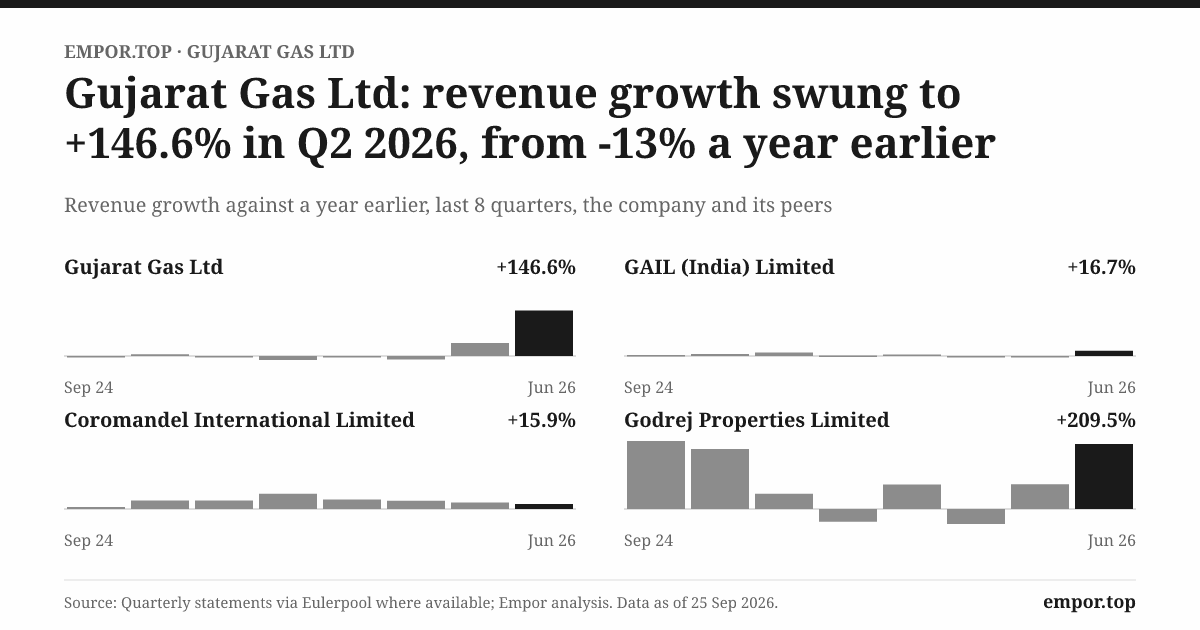
Then came the geopolitical shock of 2026. Prior to the escalation in the Persian Gulf, a regional industry census identified 377 Morbi units operating on Gujarat Gas's pipeline network alongside 415 running on propane, with propane supplying nearly 70% of the cluster's aggregate 5.6 mmscmd fuel demand.25 When the Strait of Hormuz closed in the spring of 2026, maritime propane supplies vanished, spot LNG surged to between $18 and $20 per mmbtu, and tile kilns across the district went dark until mid-April.251 Stepping into the void, Gujarat Gas raised tariffs—charging ₹94 per scm for new industrial connections and ₹70 per scm for existing customers.26 Leveraging non-Middle Eastern supply contracts through its trading parent, the company briefly became the cluster's sole viable fuel provider. Morbi volumes averaged 5.67 mmscmd across the June 2026 quarter, touching 8 mmscmd during May and June.2
The windfall proved short-lived. As soon as alternative propane shipments docked at western ports in August, Morbi offtake retreated to roughly 3 mmscmd, with pipeline gas priced at ₹78 per scm against imported propane at approximately ₹65 per scm.2 Management conceded that remaining pipeline demand was anchored primarily by smaller manufacturers that lacked the physical yard footprint or balance-sheet scale for bulk propane storage, establishing a realistic baseline volume floor of 1.8 to 2 mmscmd on flexible, month-to-month contracts.2
The falsification verdict: The thesis that Gujarat Gas commands an unassailable competitive moat across its industrial concessions is rejected by the operating evidence across two consecutive commodity shocks. Exclusive pipeline rights do not confer pricing power over thermal energy. What remains is a far narrower economic moat: roughly 2 mmscmd of baseline Morbi demand from units physically incapable of fuel switching, complemented by a less concentrated non-Morbi industrial base where competing fuel logistics are fragmented. Every molecule sold above that structural floor is effectively rented, month to month, from the global propane arbitrage. Falsifying this narrower perimeter would require demonstrating sustained Morbi volume above 4 mmscmd while propane trades at a material discount—an outcome the company has failed to achieve at any point over the preceding four years.
Management has tacitly acknowledged that reality. Its proposed strategic response is to enter the propane value chain directly, shortlisting coastal sites near Morbi for a dedicated import and storage terminal, with capital deployment planned across roughly two years once a detailed project report is completed.2 If industrial customers refuse loyalty to natural gas, the distributor intends to supply the substitute fuel itself. While commercially logical, that transition remains unproven and its long-term project economics undisclosed. In the meantime, even the traditionally protected utility half of the business was preparing to face direct pressure from federal regulators in Delhi.
VIII. The Regulatory Squeeze: APM Allocation Cuts & The Open Access Threat
On November 18, 2024, Indian city gas stocks suffered one of their steepest single-day sell-offs in years. Indraprastha Gas plunged 18.66%, Mahanagar Gas dropped 13.45%, and Gujarat Gas fell 6.36%. The immediate trigger was the central government's decision to slash domestic gas allocations to city gas distributors by roughly 20% for the second consecutive month.27
The Subsidy That Was Being Withdrawn
Administered Price Mechanism (APM) gas originates from mature state-controlled fields, predominantly operated by ONGC. The central government had long allocated this supply at a regulated price, then capped at $6.5 per mmbtu, exclusively to designated "priority" segments: CNG for vehicles and piped natural gas for households.3 For city gas distribution companies, this allocation served as an invisible structural subsidy, insulating politically sensitive retail consumers from volatile imported LNG benchmarks. But as production from aging domestic fields stagnated and vehicular CNG consumption steadily climbed, the central government began rationing the low-cost fuel.
Why Gujarat Gas Fell Less Than Its Peers
In this market rout, the heavy industrial exposure that had penalized Gujarat Gas in Morbi worked to its temporary advantage. Priority segments accounted for less than 40% of Gujarat Gas's total sales volume, compared with more than 80% at Indraprastha Gas and Mahanagar Gas. Because the distributor already procured the vast majority of its supplies as spot or contracted LNG, equity analysts anticipated less acute earnings disruption than at its metro peers.3 On the February 2025 earnings call, management disclosed that the cumulative shortfall against priority-segment requirements had reached roughly 45% following the October and November cuts. The company bridged that supply gap with higher-cost alternatives: newly drilled domestic well gas, Reliance's deepwater high-pressure, high-temperature (HPHT) output, domestic exchange purchases, and spot LNG.20 By the quarter ended September 2025, that deficit had widened to 51% across priority segments overall and 64% for CNG specifically.17
Myth vs reality: The prevailing market narrative assumed that APM reductions were exclusively a crisis for Delhi and Mumbai, leaving Gujarat Gas largely insulated. In truth, Gujarat Gas was less exposed, but far from immune. Every unit of replacement gas carried a substantially higher procurement cost than legacy APM supplies. Those procurement pressures contributed directly to management's decision to cut full-year EBITDA margin guidance in February 2025, an adjustment executives explicitly linked to "the APM gas reduction."20 The broader structural consequence was that the cost advantage separating Gujarat Gas from its peers narrowed: as metro distributors lost their subsidized feedstock shield, their operating economics began to converge toward Gujarat Gas's merchant model, rather than the reverse.
The Open Access Question
The second regulatory challenge is slower-moving and potentially far more disruptive. The Petroleum and Natural Gas Regulatory Board (PNGRB) has sought to declare city gas distribution networks "common carriers" once their statutory marketing exclusivity periods expire. Under common carriage, third-party marketers could book spare capacity in Gujarat Gas's pipeline grid and sell gas directly to end users, relegating Gujarat Gas to earning a regulated transportation tariff rather than a marketing margin.
The commercial dynamic resembles a landlord who has long rented fully furnished apartments suddenly being compelled by regulators to lease vacant rooms to rival property managers at a fixed, modest rate. For industrial consumers in clusters like Morbi, who already shop aggressively across alternative fuels, open access would introduce direct gas-on-gas pipeline competition within the company's proprietary network.
The litigation record demonstrates how the company has pushed back against that outcome. According to management, when the PNGRB initially issued the common-carrier regulation around 2020–21, Gujarat Gas obtained an interim stay from the Delhi High Court. When the regulator notified a revised framework in mid-2024—a maneuver management suggested was designed "to overcome the judicial challenge"—Gujarat Gas returned to the Delhi High Court and secured an order restraining coercive action, with executives arguing that domestic city gas markets were "not mature enough" for common carriage.20 The company has thus far defended its marketing margins through legal injunctions rather than structural barriers to entry. While effective in the near term, an interim stay does not constitute an economic moat, leaving a significant and unresolved regulatory overhang with no final judicial resolution on record.
These regulatory interventions reveal a fundamental vulnerability: both of Gujarat Gas's historical cost protections—subsidized domestic feedstock allocations and exclusive marketing rights—depend entirely on government discretion. The same state that owns the enterprise also dictates its input costs and market access. That dependency framed the rationale for the most ambitious corporate restructuring in the company's history.
IX. The 2024–2026 Mega-Restructuring: GSPC, GSPL, and the Creation of "Gujarat Energy"
On August 30, 2024, the boards of GSPC, GSPL, and Gujarat Gas met concurrently to approve a sweeping composite scheme aimed at dismantling the three-tier corporate pyramid the Gujarat government had maintained over three decades.8 The market greeted the announcement with immediate enthusiasm, sending shares of both listed entities sharply higher over the following trading sessions.6
The Old Structure
The legacy architecture had long burdened the group with nested equity holdings and conflicting corporate mandates. The unlisted state parent, GSPC, held 37.63% of GSPL, which in turn held a 54.17% controlling stake in Gujarat Gas, alongside a direct 6.53% government stake.8 This layered structure imposed a persistent valuation discount. Gujarat Gas procured substantial gas volumes from GSPC and transported them through GSPL’s transmission pipelines, generating massive, recurring related-party transactions that drew consistent skepticism from institutional investors. Meanwhile, GSPL traded primarily as a discounted proxy for its underlying equity in Gujarat Gas. As the restructuring presentation frankly conceded, "GSPL's growth [was] not fully reflected in its valuation due to holding company discount."8 On August 29, 2024, Gujarat Gas commanded a market value of ₹41,531 crore and GSPL stood at ₹23,657 crore—meaning GSPL’s 54.17% stake in the downstream distributor was valued almost on par with GSPL's entire standalone market capitalization.8
The Mechanics
The consolidation unfolded across four integrated steps.86
- GSPC and its subsidiary GSPC Energy merged into Gujarat Gas, with GSPC shareholders receiving 10 shares of Gujarat Gas for every 305 shares held.
- GSPL merged into Gujarat Gas, swapping 13 GSPL shares for 10 shares of Gujarat Gas.
- GSPL's gas transmission business was carved out into a newly formed entity, GSPL Transmission Limited (GTL), with Gujarat Gas shareholders receiving 1 share of GTL for every 3 shares held.
- The amalgamated enterprise was formally renamed Gujarat Energy Limited.
Ernst & Young Merchant Banking Services and SSPA & Co prepared the joint valuation reports, supported by fairness opinions from Fortress Capital for GSPL and Saffron Capital Advisors for Gujarat Gas, setting an appointed merger date of April 1, 2024.8 Institutional proxy advisory firms SES and IiAS recommended voting in favor, and public shareholders of GSPL and Gujarat Gas endorsed the scheme in October 2025.6 The Ministry of Corporate Affairs sanctioned the arrangement on April 17, 2026, clearing the merger to take effect on May 1, 2026.6 The corporate rechristening to Gujarat Energy followed on May 14.7 To complete the transmission spin-off, GTL allotted 31.27 crore equity shares to eligible shareholders on July 8, 2026, based on a July 2 record date.28 During an investor call on August 12, management noted that GTL's independent stock exchange listing required an exemption from the Securities and Exchange Board of India (SEBI) to bypass a standard public issue, with trading expected to commence "towards early September."2
What the Combined Company Contains
The transaction transformed Gujarat Gas from a dedicated retail distributor into an integrated state energy conglomerate. Disclosures accompanying the merger’s completion outlined an expansive portfolio: natural gas trading, oil and gas exploration and production, wind energy generation, and equity stakes in gas-fired thermal power stations (GSEG and GPPC), an LNG import terminal (GSPC LNG), sister distributor Sabarmati Gas, and an information technology services affiliate.6 The combined operating footprint spanned 12 operational exploration and production blocks, 123.9 megawatts of wind generation capacity, a 5-million-tonne-per-annum LNG terminal, and 1,200 megawatts of gas-fired power generation housed in subsidiary units.4 The newly integrated trading division ranked as India's second-largest gas marketer entering the merger. Over the preceding five fiscal years, it had delivered an average trading volume of roughly 15 mmscmd, generated cumulative revenue exceeding ₹1 lakh crore and net earnings above ₹6,500 crore, and unloaded more than 400 imported LNG cargoes through June 2024.8
Stress-Testing the Stated Rationale
Claim 1: related-party friction eliminated. Legally, the issue was resolved by consolidating buyer and seller into a single corporate vehicle. Operationally and financially, however, the conflict simply shifted from audited intercompany contracts to opaque internal accounting transfers. On the August 2026 earnings call, an analyst pressed management on how gas transfers between the trading arm and the city gas distribution network are priced. Executives conceded that while separate listed corporate entities were mandated to transact strictly at arm's length, that requirement "is not typically applicable when you are having the same business internally." Management added that the unified structure granted "the flexibility" to calibrate sourcing and tariffs, explicitly confirming that "there is still a markup" on gas routed into the city gas division.2 For minority shareholders, this internal pricing discretion represents the central governance question of the merger. Margins that were once negotiated across independent balance sheets are now dictated by internal managerial discretion. The trading segment's robust ₹726 crore profit in the June 2026 quarter—contrasted against city gas unit EBITDA of ₹5.18 per scm, which lagged management’s historical target band—may largely reflect where leadership decided to book that internal markup.2
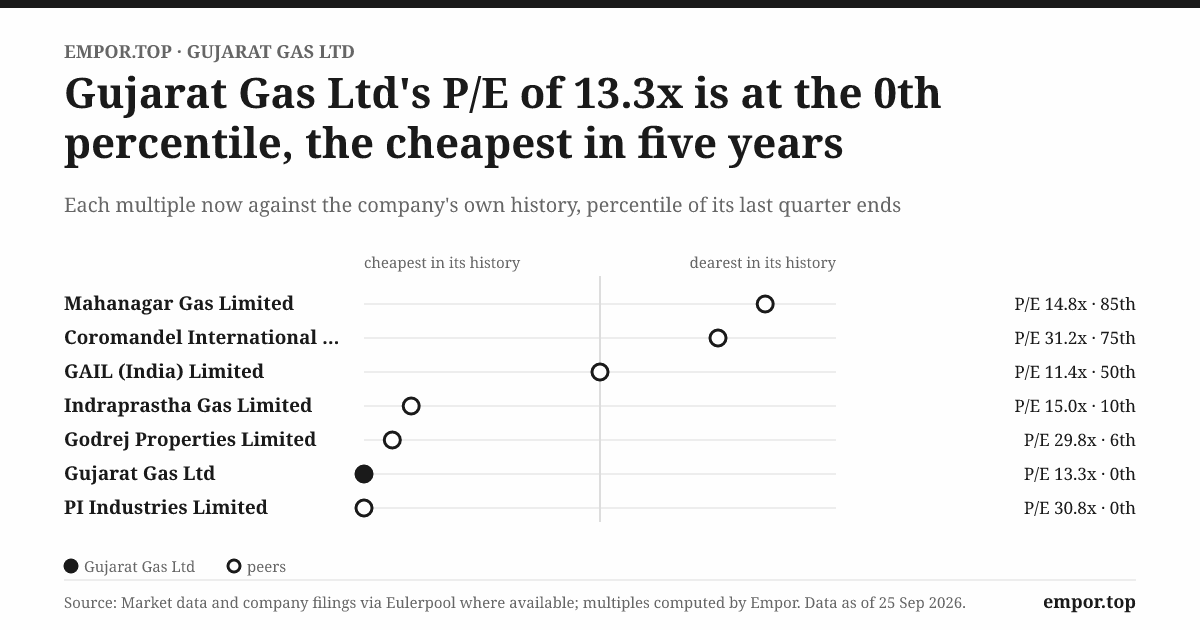
Claim 2: holding-company discount eliminated. Structurally, the holding-company layers were removed. In public markets, however, the promised valuation rerating has failed to materialize. The merged equity trades near ₹236 per share, valuing the company at roughly 11 times earnings and below book value, against a 52-week trading range of ₹230 to ₹385.9 Rather than unlocking value, the conglomerate structure appears to have transferred the holding-company discount from GSPL onto the entire consolidated business.
Claim 3: scale in LNG procurement. Management cited roughly 2 million tonnes per annum of contracted term LNG, satisfying approximately 28% of aggregate supply requirements through long-term agreements with TotalEnergies, Uniper, and QatarEnergy, alongside two additional contracts under active negotiation aimed at securing at least 4 million tonnes annually by 2030.2 An analyst from Morgan Stanley challenged this strategic progress, observing that the company had absorbed "three shocks" over five years while its recurring commitments to secure competitive long-term gas had remained "a bit of a struggle."2 Management countered that the primary obstacle was not "confidence in demand," but successive geopolitical disruptions that repeatedly delayed the availability of attractively priced term cargoes, which are now anticipated to reach the market from 2028 onward.2
Did minority GGL shareholders absorb GSPC's baggage? In practical terms, minority shareholders now directly own the parent group's legacy assets. These include gas-fired power plants idling at roughly 1% plant load factor, with GSEG's 51-megawatt unit averaging just 6% utilization during the March 2026 quarter. Management acknowledged it was still "working on the strategy" for these stranded thermal assets, including exploring potential power-purchase arrangements with commercial data centers.2 While these plants were previously tied to the broader group through GSPC and GSPL, they now sit directly on the consolidated balance sheet as an operational distraction. The valuation assigned to unlisted GSPC was the most contentious variable in establishing the share-swap ratios. Although joint valuation reports and favorable proxy advisory recommendations provide institutional legitimacy, the post-merger contraction in equity market value demonstrates that public investors have stopped short of endorsing the terms.
In sum, the composite scheme accomplished its administrative objectives: simplifying corporate ownership, spinning off the transmission network, and eliminating formal related-party filings. Yet its core economic premises remain largely unproven, and internal transfer-pricing latitude introduces fresh governance risks for minority capital. The broader question turns on how the leadership of this larger, more sprawling state conglomerate intends to allocate its capital and align its incentives.
X. Governance, Management, & Capital Allocation Under the State Radar
On December 24, 2025, a Government of Gujarat notification transferred Milind Torawane, the managing director of Gujarat Gas, to the post of Principal Secretary in the state's Education Department, appointing Avantika Singh Aulakh, IAS, in his place.2930 Barely four months before the largest corporate reorganization in the company's history took effect, its chief executive was reassigned by administrative decree—in the exact manner a state government relocates a district collector.
The Bureaucratic Paradigm
Aulakh is a 2003-batch officer of the Indian Administrative Service with an engineering degree in instrumentation and control from Netaji Subhas Institute of Technology in Delhi and a Master in Public Administration from Harvard's Kennedy School of Government. Her career spans postings as collector across Ahmedabad, Vadodara, Bharuch, and Anand, Additional Principal Secretary to the Chief Minister, chief executive of the Gujarat Maritime Board and the Gujarat Infrastructure Development Board, and managing director of Gujarat Alkalies and Chemicals.30 It is an accomplished pedigree in public administration and state-run enterprise, but not a background in commercial energy trading. Her predecessor's redeployment to the education portfolio illustrates the underlying structural dynamic: the civil service rotates senior administrators across unrelated policy domains, and Gujarat Energy's top leadership is selected from that administrative cadre rather than the merchant energy sector. Operational continuity rests instead with career technocrats; the executive team participating in the August 2026 investor call comprised a chief financial officer, an executive director for regulatory affairs and gas sourcing, and a commercial head.2
Executive incentives reflect that governance model. A deputed civil servant’s career path is governed by administrative standing—ensuring unhindered fuel supplies, executing state economic priorities, and maintaining procedural rectitude—rather than stock market returns. Capital distributions mirror the same state alignment: when queried whether the corporate merger would alter shareholder payouts, management confirmed that the company adheres strictly to the Gujarat state government's official guidelines regarding dividends.2
Capital Allocation: What the Record Shows
The affirmative record. Over the decade following the 2015 consolidation, the distribution franchise self-funded its pipeline buildout while steadily eliminating financial leverage. Long-term borrowings fell from ₹1,998 crore in fiscal 2020 to zero by fiscal 2023.8 Annual capital expenditure has held steady near ₹1,000 crore, with management projecting a comparable outlay across fiscal 2026 and fiscal 2027.182 That balance-sheet discipline earned the entity AAA credit ratings from CARE, India Ratings, and CRISIL, which were reaffirmed following the restructuring announcement.20 Furthermore, the distributor's balance sheet was not tapped to rescue GSPC from its upstream exploration losses in the Krishna-Godavari Basin; that obligation was absorbed by central public-sector major ONGC.16
The disconfirming record. State-guided capital allocation across the broader group presents a far more checkered history. The Deen Dayal West venture in the KG Basin severely exceeded its development budget while recovering only a fraction of its targeted output.16 Meanwhile, the gas-fired thermal power stations absorbed into the consolidated Gujarat Energy balance sheet continue to idle at nominal utilization rates.2 Corporate timelines have also repeatedly drifted: group presentations in August 2024 targeted regulatory clearance and share allotments by mid-2025, and brokerage projections as late as May 2025 anticipated closing by autumn.818 The composite scheme was ultimately implemented in May 2026, approximately nine months behind original management milestones.6
The forward question. As of June 2026, the company held roughly ₹7,200 crore in cash reserves against a ₹1,000 crore annual city gas capex budget, alongside an anticipated tax refund of roughly ₹900 crore.2 Management disclosed that it was formulating a broader diversification strategy across the energy complex, pledging to unveil a concrete deployment blueprint during the third quarter.2 For public market investors, this combination—abundant surplus liquidity, state ownership, a recently rotated administrative leadership, and an open mandate to diversify—raises classic concerns over value-destructive expansion. While not predetermining a wasteful outcome, it elevates the forthcoming deployment roadmap into the most critical capital allocation test of the post-merger era.
On statutory audit safeguards, this analysis makes no claim regarding historical auditor qualifications, as CARO annexures across the preceding decade were not examined in detail. The available external signals remain supportive: an unblemished AAA credit standing and the absence of disclosed accounting restatements across recent conference call disclosures.
Hidden Businesses, Sized Honestly
Green hydrogen. On January 4, 2023, NTPC and Gujarat Gas launched India’s first green hydrogen blending initiative, injecting 5% hydrogen by volume into the piped natural gas network supplying NTPC’s Kawas township in Surat. Powered by electrolysis via a 1-megawatt floating solar facility, the project envisioned scaling blending levels toward 20%.31 While representing an engineering milestone, its commercial contribution remains negligible: confined to a single residential township on a pilot scale, without disclosed earnings impact. Gujarat Gas’s operating track record indicates that technical pioneering rarely translates into immediate commercial earnings. The Kawas installation represents a long-term technology option, not an active operating driver.
The propane terminal. As detailed earlier, the planned coastal propane import and storage facility represents the group’s most commercially consequential capital initiative, directly addressing its core fuel-substitution vulnerability. However, the terminal remains at the detailed project report stage, and its eventual capital requirements sit outside current capex guidance.2
The governance verdict: Gujarat Gas exhibits sound operational discipline at the balance-sheet level, counterbalanced by substantial ambiguity at the corporate strategy level. While the operating utility’s financial conservatism is well established, the wider state group’s record in capital deployment and project selection has proved far more erratic. The strategic frameworks that follow evaluate whether the company’s underlying economic moats are strong enough to withstand that friction.
XI. Strategic Frameworks: Hamilton Helmer's 7 Powers & Porter's Five Forces
If an activist investor had a single slide to argue that Gujarat Energy commands a regulated utility valuation, it would display a map of exclusive pipeline licences. A counter-slide, however, would simply plot Morbi's gas offtake from 2021 through 2026. Two analytical frameworks help adjudicate between these opposing narratives.
Hamilton Helmer's 7 Powers
Helmer defines a power as a set of structural conditions that create persistent differential returns. Testing Gujarat Energy against those seven dimensions illuminates where the business model holds economic leverage—and where it breaks down.
Scale economies: moderate. High pipeline density reduces capital and operating costs per customer across dense urban clusters, while operating India's largest city gas footprint spreads administrative overhead across substantial volume. On the procurement side, however, the advantage falters. The company still purchased roughly two-thirds of its city gas requirements on short-term or spot terms during the June 2026 quarter.2 Immense distribution scale has not yet translated into lower molecule costs.
Network effects: absent. A gas grid is a physical conduit, not a two-sided platform. Connecting an additional residential kitchen in Surat does not make the network more valuable or cost-effective to an industrial tile manufacturer in Morbi.
Counter-positioning: absent. Gujarat Energy's strategy does not impose collateral damage on an incumbent's legacy business model; it simply operates the conventional city gas playbook at larger regional scale.
Switching costs: bifurcated. For a connected household, switching away from piped gas entails prohibitive friction and appliance replacement, effectively locking in customer loyalty. For industrial consumers, however, switching barriers are remarkably low. A kiln operator with sufficient yard space for a propane storage tank can convert operations in weeks and switch back whenever spot prices shift. Management itself characterised Morbi deliveries as operating on flexible, month-to-month contracts.2
Branding: absent. Thermal energy is an undifferentiated commodity; methane molecules are chemically identical. No industrial kiln operator pays a premium because gas originates from Gujarat Gas rather than an alternative supplier.
Cornered resource: real but narrow. Statutory geographical concessions granted by the Petroleum and Natural Gas Regulatory Board provide exclusive rights to lay pipeline infrastructure within designated districts. The Competition Commission of India's 2013 ruling that GSPC Gas and Gujarat Gas operated in distinct territories confirmed that each franchise functioned as a localized monopoly.13 Yet that cornered asset protects the subterranean pipe, not the broader industrial heat market. Furthermore, that exclusivity faces administrative dilution from common-carrier open-access regulations, which the company continues to challenge through judicial stays.20
Process power: moderate. Decades of polyethylene pipeline engineering and network safety protocols inherited from the British Gas tenure represent genuine operational capabilities. The geopolitical disruption of 2026 surfaced an additional organizational strength: the newly integrated trading division secured 10 LNG cargoes during a quarter when Middle Eastern maritime flows were paralyzed, keeping Morbi's kilns supplied when imported propane vanished.2 That emergency procurement capability provides the most tangible validation of the merger's commercial rationale to date. Yet it proves most decisive during extraordinary external crises—precisely when normalized market conditions subside.
Net assessment: Gujarat Energy commands one strong power (a cornered resource in residential and retail vehicle distribution), two moderate advantages (infrastructure scale and operational process), and an acute vulnerability across the industrial customer base that generates over 60% of its volume. The franchise's structural protections attach almost entirely to its smallest, most regulated segments.
Porter's Five Forces
Threat of new entrants: low for pipelines, high for road logistics. Regulatory concessions prevent competing distributors from laying duplicate pipeline infrastructure within authorized geographical areas. However, road tankers transporting landed propane—and increasingly, trucked liquefied natural gas—can access industrial factory gates without requiring statutory distribution licences.
Bargaining power of buyers: asymmetric. Residential households and vehicular CNG motorists are fragmented price-takers who accept posted retail tariffs. By contrast, industrial ceramic manufacturers in Morbi negotiate collectively through organized trade associations. In April 2026, those manufacturers pressed for cluster-wide uniform gas pricing and formally petitioned the state government for intervention.26 A concentrated customer bloc capable of switching fuels and lobbying the political administration that oversees its state-owned supplier exercises formidable commercial leverage.
Bargaining power of suppliers: elevated. Low-cost domestic gas allocations remain strictly rationed by the central government. Replacement LNG feedstock is indexed to volatile global dollar-denominated benchmarks and has suffered two severe supply shocks in five years. Qatar alone supplied roughly 45% of India's imported LNG in 2025, a geographical concentration risk that the regional conflict in the Persian Gulf exposed in 2026.22
Threat of substitutes: severe. For industrial users, landed propane serves as an immediate, ready substitute, complemented by agricultural biomass briquettes, solid fuels, and commercial steam piped by third-party industrial suppliers in South Gujarat.2 Across the retail vehicle segment, rapid fleet electrification presents a secular long-term substitute for CNG in municipal buses, three-wheelers, and light commercial vehicles. CNG's pricing discount relative to petrol and diesel remains a compelling commercial advantage, but one entirely dependent on manageable feedstock costs.
Competitive rivalry: nonexistent within pipelines, intense across the thermal spectrum. No secondary pipeline network competes directly against Gujarat Gas's physical grid. Yet virtually every gigajoule of energy delivered to industrial off-takers contends in real time against alternative liquid, solid, and gaseous fuels.
The Peer Comparison
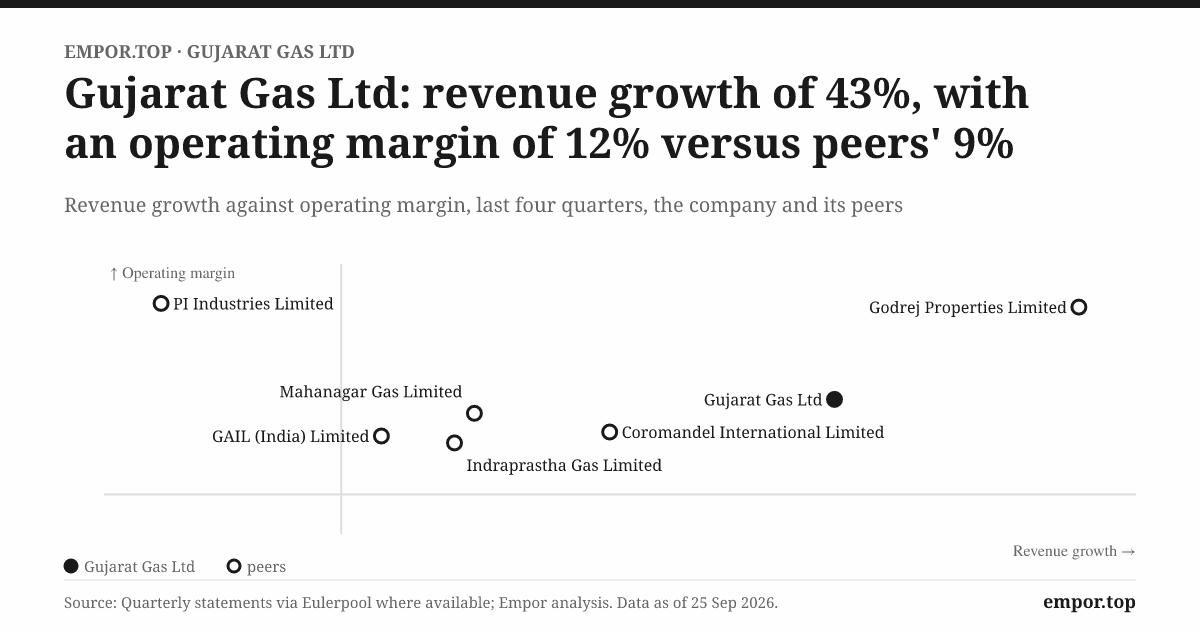
Relative to metro distributors Indraprastha Gas and Mahanagar Gas, Gujarat Energy maintains lower proportionate exposure to domestic APM gas rationing, but carries far greater vulnerability to industrial fuel substitution. It also operates burdened by an active trading desk and a portfolio of non-core legacy assets. Compared with private-sector peers like Adani Total Gas, it possesses superior physical pipeline scale, but lacks owner-operator capital allocation discipline. If metro city gas distributors function like municipal toll roads, Gujarat Energy behaves like a regulated toll bridge tethered to a high-volume commodity trading house.
Both strategic frameworks arrive at the same structural conclusion: operating returns will remain durable and defensive across residential and retail mobility segments, but inherently volatile and cyclical across industrial clusters. The long-term equity thesis ultimately hinges on which of those two commercial realities dictates the company's capital allocation.
XII. The Core Investment Spine: Why Win vs. Why Not
Picture the investment committee weighing Gujarat Energy in late 2026. On the table sit two competing charts: vehicular CNG sales marching steadily upward each quarter, set against Morbi industrial volumes swinging between 0.4 and 8 mmscmd within a single twelve-month span. Each side of the table points to the chart that confirms its thesis.
The "Why Win" Case, Tested
1. The clean-fuel mandate and industrial Gujarat. India's stated target of expanding natural gas from 6% to 15% of the primary energy mix provides national policy tailwinds and featured prominently in the company's restructuring rationale.8 Gujarat remains the country's manufacturing heartland. Test: while public authorities actively push domestic and commercial piped gas, no regulatory mandate forces industrial kilns to burn natural gas over liquid alternatives. Management acknowledged this dynamic plainly on an investor call: "Industrial, it is open competition ... customers have a choice to switch to propane."2 Outside Morbi, industrial volume expansion has remained sluggish. An analyst from ICICI Securities pointed out that non-Morbi demand had lingered within "a fairly narrow range" for two to three years. Management responded that distribution grids across Thane, rural Ahmedabad, and Kutch were only beginning to connect new industrial clusters, pointing to 86 newly connected industrial clients in a single quarter and setting a medium-term goal of lifting non-Morbi volumes from roughly 2 mmscmd to 3 mmscmd over the following 18 to 24 months.2 Verdict: intact but unproven. The confirming milestone is non-Morbi industrial offtake breaking sustainably above 2.5 mmscmd by fiscal 2028.
2. Integration synergies. The trading division's capacity to source alternative cargoes during external disruptions was demonstrated during the 2026 Strait of Hormuz bottleneck. Trading profits of ₹726 crore in the June 2026 quarter compared favorably against full-year earnings guidance of ₹1,100 to ₹1,200 crore.2 Test: management described that quarterly haul as an exceptional windfall, attributing part of the margin expansion to pricing lags in Brent-linked contracts that had not yet reset to prevailing spot levels, while holding full-year guidance unchanged.2 Meanwhile, external third-party trading volumes contracted to 3.32 mmscmd from roughly 5 mmscmd as elevated prices dampened demand from thermal power generators.2 That trend mirrored the broader fiscal 2026 outturn: trading volume totaled 10.2 mmscmd, a 19% decline from fiscal 2025, even as trading profit before tax climbed to approximately ₹1,335 crore. In essence, the trading arm generated fatter margins across fewer molecules—a hallmark of commodity volatility that normalized market conditions may quickly reverse.32 Verdict: a narrower version of the thesis holds. Upstream trading integration improves physical security of supply during geopolitical crunches. Whether it provides a durable structural uplift to group earnings will remain uncertain until global liquefaction capacity expands around 2028.
3. Balance sheet and cash generation. The standalone city gas business operated entirely debt-free across fiscal 2023 and fiscal 2024, and the consolidated group commands roughly ₹7,200 crore in cash reserves.82 Test: accumulated liquidity creates shareholder value only through disciplined capital allocation, yet management's current deployment roadmap is framed broadly around "diversification."2 Verdict: the balance-sheet strength is confirmed, while the capital allocation thesis remains unresolved until the group details its investment blueprint in the third quarter of fiscal 2027.
The "Why Not" Case, Tested
1. The propane ceiling. Across four years of operating data, the pattern has repeated without exception: whenever pipeline natural gas prices exceed landed propane, Morbi's offtake retreats toward an inelastic baseline of roughly 2 mmscmd, recovering only when pipeline tariffs undercut the alternative fuel.172 Management's unit EBITDA guidance has traced that constraint: originally targeted at ₹5 to ₹6 per scm, trimmed to ₹4.5 to ₹5.5 in February 2025 under pricing pressure, and reset at ₹5.5 to ₹6.5 for the city gas business following the merger. For the June 2026 quarter, unit EBITDA slipped to ₹5.18 per scm, trailing the bottom of that targeted corridor.202 Reclaiming the ₹8 to ₹9 per scm margins seen during the 2022 commodity shock would, as demonstrated in 2022 and 2023, require surrendering the vast majority of industrial volume. Verdict: the skeptical thesis is firmly substantiated by the historical record.
2. APM depletion and the CNG cost gap. Rationing of domestic APM gas left Gujarat Gas facing a 64% supply deficit across its vehicular CNG network by late 2025.17 If high-cost replacement feedstock keeps procurement expenses elevated, CNG's traditional pump discount against petrol and diesel could compress, narrowing the running-cost advantage and accelerating the fleet transition toward electric vehicles. Verdict: a credible medium-term headwind. However, with vehicular CNG sales expanding at 12% to 13% year-on-year, demand destruction has not yet materialized in the reported numbers.2
3. State-controlled conglomerate drag. The consolidated company now houses stranded thermal power stations, exploration and production acreage, renewable wind assets, a wholesale gas trading desk governed by internal transfer pricing, and an executive leadership team subject to administrative civil-service rotation.229 Verdict: this conglomerate complexity represents the most compelling explanation for the persistent valuation discount, and it will remain a structural drag until capital allocation demonstrates disciplined capital returns.
The Activist's Stress Test
A disciplined institutional investor evaluating Gujarat Energy would press management on five concrete governance and capital tests:
- Disclose transfer-pricing methodology. Publish the quarterly formula governing molecule transfers between the trading desk and the city gas network, allowing public shareholders to track underlying distribution margins without accounting opacity.
- Establish hurdle rates for diversification. Commit to explicit return-on-capital thresholds before committing balance-sheet cash to non-core energy ventures.
- Resolve stranded power assets. Present a definitive, binding timeline for the gas-fired generation portfolio: either contract power off-take at economic rates, divest the assets, or permanently decommission them.
- Clarify propane terminal returns. Tie the proposed coastal propane import project to transparent capital outlay estimates, contracting structures, and payback targets before breaking ground.
- Account for execution slippage. Clarify why the corporate reorganization required until May 2026 to complete against an initial mid-2025 target, and establish what that delay reveals about administrative execution on complex infrastructure developments.
The Three KPIs That Matter Most
- The pipeline-to-propane spread (₹ per scm equivalent) and Morbi cluster offtake. This single price differential dictates whether industrial volumes in Morbi—which have swung between one-fifth and nearly half of total city gas sales in recent quarters—remain on the grid or migrate to road-delivered propane. Management tracks and discusses both metrics on quarterly earnings calls.2
- City gas EBITDA per standard cubic metre. Tracked against management's guidance band of ₹5.5 to ₹6.5 per scm, this unit margin metric reveals whether retail tariffs, sourcing costs, and internal transfer markups are balancing sustainably.2
- Proportion of contracted versus marginal feedstock. With secured domestic allocations and long-term contracts representing roughly 31% of total city gas supply in the June 2026 quarter against nearly 69% procured through spot or internal short-term transfers, this ratio serves as the direct barometer of the company's vulnerability to the next international energy shock.2
The investment spine resolves into a clear trade-off: Gujarat Energy succeeds if steady retail CNG expansion and non-Morbi industrial additions expand the predictable utility base, while an expanding portfolio of competitive long-term LNG contracts narrows the structural propane discount. The investment thesis falters if surplus cash is diverted into low-return diversification and the core industrial volume continues to trade like an unpredictable spot merchant. The broader implications extend well beyond this single enterprise.
XIII. Playbook: Lessons from the Subcontinent's Gas Grid
A ceramic tile factory in Morbi with a propane tank and a pipeline gas meter sharing the same yard captures the central dilemma of Gujarat Gas. That single industrial plot illustrates four strategic lessons that extend well beyond the company itself.
1. Physical Monopolies Are Not Molecule Monopolies
Owning the only pipeline in the ground protects an enterprise only when the customer has no practical alternative for delivered thermal energy. For a residential kitchen, that lock-in is real: replacing a piped stove or storing pressurized cylinders indoors entails substantial friction. For a kiln operator with yard space for a storage tank and a vaporiser, however, the subterranean pipe is merely one competing vendor among several. Infrastructure investors must segment every purported monopoly by customer category, calculating switching costs in both capital outlay and conversion time. For Gujarat Gas's industrial buyers, as the commodity shocks of 2022 and 2026 demonstrated, that barrier amounted to just a few crore rupees and several weeks of installation work.
2. Regulation Can Create a Profit Pool Overnight, but Cannot Guarantee It
When the National Green Tribunal banned coal gasifiers in 2019, the judicial directive nearly tripled the distributor's net profit within a single year.9 Yet it generated that windfall by outlawing a polluting fuel, not by making natural gas fundamentally cheaper. Demand conferred by regulatory intervention without an underlying cost advantage survives only until an unconstrained, compliant substitute undercuts the network tariff. When valuing any enterprise whose earnings inflected on an administrative order, investors must stress-test the franchise against the next-cheapest legal alternative. Once landed propane traded at a discount, the court-mandated volume boom rapidly unwound.
3. How the State Takes Back Infrastructure
The transfer of control from BG Group to GSPC reflects a recurring emerging-market pattern: a multinational reallocates capital away from a tightening, margin-capped downstream asset, and a state-backed entity steps in to advance regional industrial priorities. In this instance, the state did not overpay; it acquired control below prevailing market value.12 The financial penalty manifested instead in governance. Public markets immediately stripped away the equity's long-standing "management quality premium," and the consolidated entity hit its lower circuit on the day it relisted in 2015.1215 State ownership can mobilize capital to extend pipeline networks into areas private capital would bypass. The trade-off is an enduring discount in public market valuation.
4. Simplifying a Group Is Necessary but Not Sufficient
Collapsing an intricate holding-company structure removes a valuation discount only if the consolidated business is an asset public investors actively want to own. Gujarat Energy successfully dismantled the intermediate GSPL holding tier, but in the process it absorbed an active wholesale trading desk, stranded gas-fired power plants, and an open-ended diversification mandate. The broader lesson for corporate reorganizations is straightforward: investors must rigorously assess what ends up inside the surviving corporate vehicle, rather than merely celebrating the administrative layers stripped away from above it.
These lessons point directly to the strategic questions that will define the enterprise over the decade ahead.
XIV. Epilogue & The Next Decade
In September 2026, the company that began as Gujarat Amico Chemicals trades under a name that reflects the state's broader ambition: Gujarat Energy.7 Its operating portfolio now spans wholesale gas trading, retail city distribution, upstream exploration, renewable wind capacity, and an assortment of legacy investments. The legacy Gujarat Gas was India's largest city gas distributor; the unified entity is still defining what kind of business it intends to be.
What the Next Few Quarters Will Reveal
Several near-term milestones will clarify that identity. The capital deployment blueprint promised for the third quarter of fiscal 2027 will reveal whether the group's ₹7,200 crore cash balance funds core pipeline expansion, the proposed coastal propane terminal, or diversification farther from the core.2 The fate of the idling gas-fired power stations will signal whether leadership is prepared to exit or decommission underperforming inherited assets. The pace and market reception of GTL's independent stock exchange listing will determine how public markets value the transmission carve-out. Meanwhile, second-quarter earnings, anticipated around mid-November 2026, will show whether the June quarter's trading windfall was an exceptional surge or a repeatable baseline.2
The Longer Threat Radar
Over a longer horizon, two structural forces loom over the industrial customer base. The first is whether Gujarat's manufacturing clusters eventually move past fossil fuels entirely, adopting electric kilns powered by the state's large solar and wind buildout—a transition that remains technically demanding and distant, but secular. The second is cross-border carbon accounting. If frameworks such as the European Union's Carbon Border Adjustment Mechanism penalize carbon-intensive goods, export-dependent hubs like Morbi could face renewed pressure to seek lower-emission fuels. That shift might temporarily favor piped natural gas over propane or solid fuels, or ultimately accelerate industrial electrification. The green hydrogen blending trial at Kawas provides a modest technical hedge for that eventuality, not an active commercial shield.31
The decisive variable, however, remains one no management team controls: the global price of liquefied natural gas. The distributor anticipates a wave of uncommitted international liquefaction capacity reaching the market around 2028.2 If that supply arrives and depresses LNG benchmarks enough to consistently undercut landed propane, the industrial franchise could once again drive profitable volume growth. If those supplies are delayed or global spot markets stay elevated, Gujarat Energy will remain locked in the same zero-sum trade-off that has governed its business since 2022: sacrificing unit margins to retain industrial volume, or protecting cash spreads while watching factory kilns migrate to rival fuels.
From its first pipeline connection in Ankleshwar in 1989 to a 45,900-kilometre grid spanning six states, Gujarat Gas has navigated four ownership regimes, one judicial windfall, three global commodity shocks, and a corporate restructuring that ultimately folded the distributor into its own parent institutions. Its physical infrastructure is extensive, and its household and vehicular franchise remains fundamentally sound. Yet the industrial market that built the business remains both its greatest source of operating scale and its sharpest point of vulnerability. The coming decade will determine whether the transformed Gujarat Energy can sustain an industrial base that owes no loyalty to the pipe in the ground, and remains entirely free to switch whenever a cheaper molecule appears.
References
-
550 factories halt production in Morbi: Gas crisis now paralyses India's Rs 750 bn industry — BusinessToday, 2026-03-19 ↩↩
-
Transcript of Q1 FY27 Earnings Conference Call held on 12 August 2026 — Gujarat Energy Limited (BSE filing), 2026-08-17 ↩↩↩↩↩↩↩↩↩↩↩↩↩↩↩↩↩↩↩↩↩↩↩↩↩↩↩↩↩↩↩↩↩↩↩↩↩↩↩↩↩↩↩↩↩↩↩↩↩↩↩↩
-
IGL, MGL, Gujarat Gas shares: Target prices for CGD stocks as selloff likely on APM gas allocation cut — BusinessToday, 2024-11-18 ↩↩↩
-
Gujarat Energy Q1 Results: CGD Volume Hits 12.34 MMSCMD — ScanX, 2026-08 ↩↩↩
-
GSPC Group's Scheme of Arrangement takes effect (Press Release) — Gujarat Gas Limited, 2026-05-01 ↩↩↩↩↩↩↩↩↩
-
Intimation of Change of Name to Gujarat Energy Limited — Gujarat Energy Limited, 2026-05-14 ↩↩↩
-
Composite Scheme of Arrangement Investor Presentation — Gujarat Gas Limited, 2024-08-30 ↩↩↩↩↩↩↩↩↩↩↩↩↩↩↩↩↩↩
-
Gujarat Energy Ltd Share Price and Financials — Screener, 2026-09 ↩↩↩↩
-
GSPC to acquire 65% stake in Gujarat Gas — Business Standard, 2012-10-03 ↩↩↩
-
Street cautious on Gujarat Gas after BG sellout — Business Standard, 2012-10-05 ↩↩↩↩↩↩
-
CCI nod to Rs2,460 crore stake sale in Gujarat Gas to GSPC — Moneylife, 2013-01 ↩↩↩
-
Gujarat Gas tanks as British Gas exits — Business Standard, 2012-10-04 ↩
-
Gujarat Gas lists after amalgamation; hits lower circuit — Business Standard (PTI), 2015-09-15 ↩↩↩
-
ONGC acquires 80% stake in GSPC KG Basin block (India) — Enerdata, 2017-08-08 ↩↩↩↩
-
Gujarat Gas Ltd Q2 2026 Earnings Call Highlights — GuruFocus, 2025-11 ↩↩↩↩↩
-
Gujarat Gas 4QFY25 Results Update — Motilal Oswal, 2025-05-21 ↩↩↩↩↩↩↩
-
Largest ceramic manufacturing cluster bears brunt of gas price hike — Business Standard, 2022-03-17 ↩↩↩↩
-
Transcript of Q3 FY 2024-25 Earnings Conference Call — Gujarat Gas Limited, 2025-02-07 ↩↩↩↩↩↩↩↩↩↩
-
Gujarat Gas reports Q3FY23 numbers — ICICI Direct, 2023-02 ↩↩↩
-
How is Gujarat's Morbi ceramic cluster driving India's LNG demand? — BusinessToday, 2026-07-06 ↩↩
-
NGT orders shut down of Coal Gasifiers in Morbi and Wankaner in Gujarat — Bar & Bench, 2019-03-10 ↩↩
-
Gujarat Gas research note (ICICI Direct via Moneycontrol) — TradingView News, 2022-11-16 ↩
-
142 Ceramic Units Operational in Morbi: Gujarat Gas — DeshGujarat, 2026-04-15 ↩↩
-
Propane-Based Ceramic Units in Morbi Face Higher Gas Rates — DeshGujarat, 2026-04-03 ↩↩
-
Gas stocks plunge as government cuts domestic gas allocation — Business Standard, 2024-11-18 ↩
-
Gujarat Energy Shareholders Get GTL Shares After Demerger; Key Details — PSU Connect, 2026-07 ↩
-
Gujarat Gas Names Senior IAS Officer Avantika Singh Aulakh as New Managing Director — Indian Masterminds, 2025-12 ↩↩
-
Avantika Singh Aulakh Appointed Managing Director of Gujarat Gas Limited — PSU Connect, 2025-12 ↩↩
-
NTPC starts India's first green hydrogen blending operation in PNG network — NTPC Limited, 2023-01-04 ↩↩
-
Gujarat Energy Ltd Q4 2026 Earnings Call Highlights — Yahoo Finance / GuruFocus, 2026-06 ↩
 LinkedIn
 WhatsApp
 Reddit
 Hacker News
 Email
 Kindle
 RSS Feed
 Spotify
 Apple Podcasts
 Amazon Music
 Audible
 YouTube