Hindustan Aeronautics Limited: The Sovereign Aerospace Monolith
I. Introduction & Episode Roadmap
In the first week of January 2019, the only enterprise in India capable of designing and building fighter jets and military helicopters had to borrow money simply to meet its operating obligations. Hindustan Aeronautics Limited, the state-owned contractor behind nearly every aircraft flown by the Indian Air Force, drew approximately ₹962 crore on a bank overdraft.1 Media outlets reported that HAL had borrowed close to ₹1,000 crore to cover payroll for roughly 29,000 employees, although the company never confirmed that salaries were the explicit reason for the credit line.[^2]1 The root cause of the liquidity squeeze was neither an empty order book nor a failing product line: HAL's primary customer, the Ministry of Defence, had simply stopped settling its bills on time.
Seven years later, the corporate picture could hardly look more different. In October 2024, the Indian government granted HAL Maharatna status, the highest tier of operational and financial autonomy awarded to state-owned companies.2 By March 2026, the company held ₹42,425 crore in bank deposits, posted a consolidated annual net profit of ₹9,116 crore, and sat on an order book of ₹2.54 lakh crore.34 That backlog represents nearly eight years of revenue. By September 2026, public equity markets valued the entire enterprise at around ₹3.2 lakh crore.5
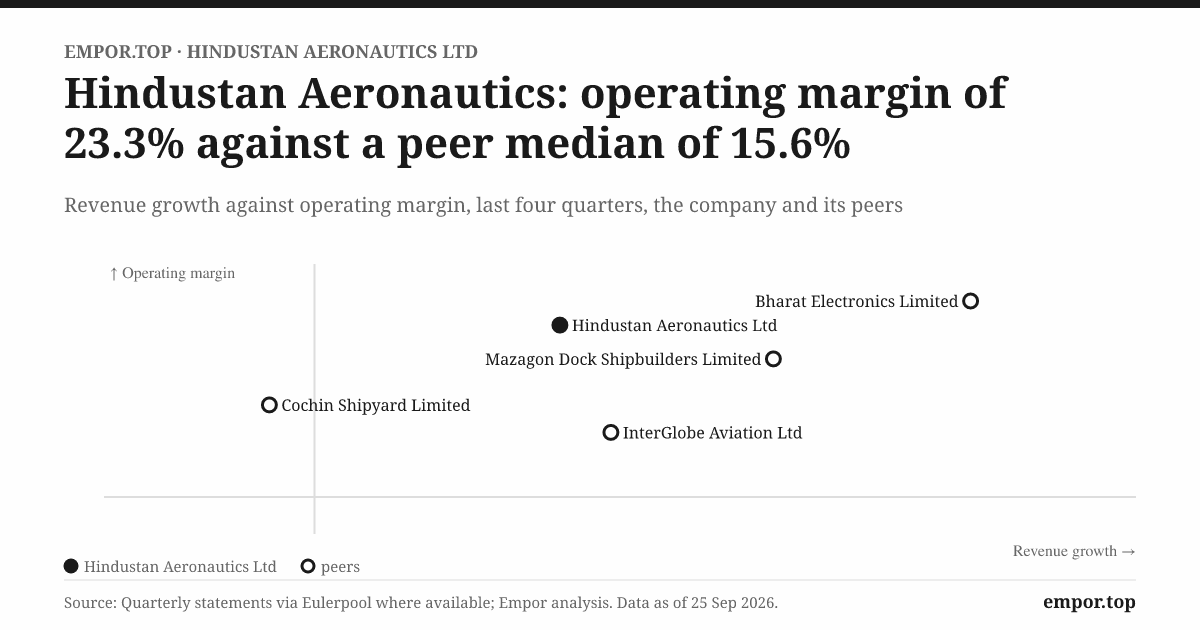
Here lies the fundamental puzzle of the business. For decades, Western defence analysts dismissed HAL as an inefficient, licence-assembling public-sector unit. Today, the company reports operating margins of around 30% before interest income—substantially higher than what most listed Western defence primes generate in their aircraft segments.6 How did that transformation happen, and how durable are those economics?
Much of the explanation lies in an operational reality that headlines frequently overlook. Investors typically view HAL as a fighter-jet manufacturer capitalizing on the indigenous Tejas program and favorable geopolitical tailwinds. Yet in fiscal 2025, by management's own reporting, only about 23% of revenue came from manufacturing new aircraft and engines. Approximately 70% came from repair, overhaul, and spare parts for active military fleets.7 In fiscal 2026, the breakdown remained heavily weighted toward service, at roughly 28% manufacturing and 62% repair and overhaul.6 In structural terms, HAL functions primarily as a high-margin fleet-servicing annuity with an aerospace manufacturing plant attached—at least for now.
That caveat matters because management has indicated the revenue balance is poised to shift. On the May 2026 earnings call, the director of finance guided that the split between manufacturing and maintenance should move from approximately 30:70 toward 50:50 as new aircraft begin shipping in volume.6 Consequently, the high-margin servicing annuity that anchored the company's recent profit pool will account for a smaller proportion of overall revenue. That single piece of guidance forms the core tension in the investment case, and this analysis returns to it repeatedly.
The roadmap unfolds across seven sections. First is the genesis: an Indian industrialist, an American aviation promoter, a princely state, and the pressures of World War II. Second is the Kurt Tank era, which produced an advanced airframe but lacked a viable domestic engine to power it. Third is the long path toward indigenous aircraft development, culminating in the 2019 cash squeeze. Fourth is a detailed deconstruction of the operating model. Fifth evaluates competitive dynamics and entry barriers. Sixth tests the bull thesis against the historical record. Seventh assesses current leadership and weighs the structural risks against the upside.
A brief note on leadership before proceeding: initial project outlines identified Dr. D.K. Sunil as chairman. He retired on April 30, 2026, and Ravi K. (Kota Ravi), the executive who led HAL's Tejas division, took over as chairman and managing director on May 1, 2026.8 That leadership change marks the moment the company's most scrutinized commitment—delivering the new Tejas Mk1A—became the incoming chairman's defining benchmark.
 Subscribe on LinkedIn
II. The Genesis: Private Industrial Vision, Royal Capital, & Wartime Requisition (1940–1947)
Picture Bangalore in 1940: a quiet cantonment town of gardens and military barracks, situated safely beyond the reach of hostile carrier fleets. That geographic buffer from the coast was the primary reason India's aircraft industry took root there—a strategic calculation that proved far more consequential than its founders anticipated.
The driving force behind the venture was Walchand Hirachand, an ambitious Bombay industrialist known for establishing enterprises in sectors British colonial authorities treated as their exclusive preserve. His partner was William D. Pawley, an American aviation entrepreneur.9 Pawley supplied American engineering designs, technical specialists, and production licenses; Walchand provided domestic capital and an unyielding conviction that India should manufacture its own machinery.
The partnership was improbable. Walchand was a nationalist industrialist operating within a colonial administration that had shown little appetite for domestic aerospace manufacturing. Pawley was an opportunistic dealmaker focused on marketing American hardware across wartime Asia. What brought them together was geopolitical urgency. With war raging across Europe and Japanese forces expanding through China, any facility capable of assembling or repairing aircraft in Asia commanded immediate strategic value. The initial production plan centered on licensed American aircraft: a trainer, a fighter, and a bomber.9 From its very inception, Indian aviation began by assembling other nations' blueprints.
The British colonial administration initially showed little enthusiasm. The decisive catalyst was the princely state of Mysore. The Mysore government subscribed ₹25 lakh in equity and provided land in Bangalore, with several historical accounts recording a free grant of 700 acres.109 Hindustan Aircraft was incorporated in Bangalore on December 23, 1940, under the Mysore Companies Act, with Walchand serving as chairman and Pawley as the American partner.9 Recognizing the facility's strategic utility, the British Indian government acquired a one-third equity stake in April 1941.9
The escalation of World War II soon removed the enterprise from private hands. On April 2, 1942, as Japanese forces advanced through Burma toward the Indian frontier, the colonial government announced it would buy out private shareholders and nationalize the business.9 Walchand's venture had operated as an independent private firm for less than eighteen months. By 1943, operational control of the factory was transferred to the United States Army Air Forces, which ran it as the 84th Air Depot. The facility overhauled Consolidated PBY Catalina flying boats initially, before servicing, in the words of one contemporary account, "every type" of aircraft American forces operated across the India-Burma theater.9
Why does a wartime repair depot matter to an investor in 2026? Because it established the company's institutional DNA. The Bangalore plant learned industrial aerospace not by designing original airframes, but by stripping, inspecting, and rebuilding foreign aircraft under intense operational deadlines for a sovereign military customer. That technical discipline is the direct ancestor of the high-margin fleet-servicing annuity that generates the majority of HAL's revenue eight decades later.
The founding era also established an enduring structural precedent: the state intervened when private capital could no longer shoulder strategic national-security risks, and it retained ownership once the emergency subsided. Walchand's vision of a privately owned national aerospace champion was absorbed by wartime requisition. When India gained independence in August 1947, the new nation inherited sophisticated tooling and a skilled technical workforce—but not a single indigenous aircraft design.
That structural imbalance—a factory capable of building almost anything, but with nothing of its own to manufacture—set the stage for the turbulent decades that followed.
III. The Kurt Tank Era & The Structural Engine Bottleneck (1947–1980s)
In August 1956, a German aeronautical engineer arrived in Bangalore with an ambitious mandate for a nation independent for just nine years. Professor Kurt Tank had designed the Focke-Wulf Fw 190, a premier piston fighter of World War II. Jawaharlal Nehru's government tasked him with designing and building India a supersonic fighter-bomber from scratch.11
Tank delivered the airframe. The HF-24 Marut first flew on June 17, 1961, with Wing Commander Suranjan Das at the controls.11 Sleek, twin-engined, and optimized for supersonic speed, the aircraft represented an extraordinary milestone for a country that had never designed a jet. More importantly, the program provided a young Indian design team with hands-on education in advanced jet aerodynamics that no licensing agreement could replicate.
Tank was an unconventional choice to lead a newly independent country's flagship project: a wartime German designer who had spent the postwar years seeking engineering work abroad, first in Argentina and then in India.12 Nehru's government approached the partnership pragmatically. India required technical capability quickly, and Tank possessed it. That willingness to import foreign design expertise would become an enduring feature of Indian defence industrial policy.
Then came the structural obstacle that would complicate HAL's programs for the next six decades: propulsion. The Marut entered service powered by the licence-built Bristol Orpheus 703, which aviation archive Bharat Rakshak describes as leaving it "critically underpowered."11 India evaluated a succession of alternatives, including a reheated Orpheus B.Or 12, the Rolls-Royce RB-153, the French Atar 09K-53, and the RB-199.11 An Egyptian-built E-300 engine was tested around 1966 and failed.12 None of these powerplants propelled the aircraft to the supersonic speeds envisioned on Tank's drawing board.
The dilemma was akin to designing a high-performance racing chassis only to discover that the only available motor came from a family sedan. The airframe design was sophisticated, but the aircraft could never achieve its intended speed. The Marut stayed subsonic.
Despite its propulsion limitations, the aircraft proved dependable in combat. In the 1971 war, it flew roughly 200 sorties in ground-attack roles, including at the Battle of Longewala, and shot down a Pakistani F-86 on December 7, 1971.11 Production, however, remained limited: only 147 were built, including 18 trainers.11 The IAF began replacing it with the Soviet MiG-23BN from 1982, and the last aircraft left squadron service on March 31, 1990.1112
The lesson is the most critical in this entire story, and it warrants plain language: airframe capability without an indigenous high-thrust engine leaves a nation dependent on whichever foreign government controls the engine. Six decades later, when the Tejas Mk1A sat on HAL's tarmac waiting for American engines, the Marut demonstrated that this vulnerability was not a new problem.
The 1964 merger and the Soviet decades
While the Marut struggled with its propulsion constraints, India made a parallel, highly consequential bet: licensing the Soviet MiG-21. A dedicated state company, Aeronautics India Limited, was set up in 1963 to build it, with factories at Nashik for airframes, Koraput for engines, and Hyderabad for electronics.9 On October 1, 1964, Hindustan Aircraft and Aeronautics India merged to form Hindustan Aeronautics Limited, while the IAF's Aircraft Manufacturing Depot at Kanpur moved under HAL at the same time.13
For the next three decades, HAL operated primarily as a contract manufacturer. The company produced the MiG-21 family, the Anglo-French Jaguar, and French-designed Chetak and Cheetah helicopters, among others. The MiG-21 alone served the IAF for more than sixty years before its final retirement on September 26, 2025, at Chandigarh.14
Why did licensing win out over original design for so long? The economics were straightforward. A licence provides an air force with a proven aircraft on a predictable delivery schedule, while giving the manufacturer steady work with low technical risk. Clean-sheet indigenous development entails the exact opposite: uncertain schedules, volatile costs, and the risk of a high-profile setback like the Marut's engine saga. For a government buyer managing immediate security requirements on a tight budget, licensing was the rational short-term choice. For the manufacturer's long-term design capability, it proved to be slow poison.
The Soviet partnership brought one distinct structural advantage: Moscow was willing to license not only airframes but also engines, manufactured at Koraput. That arrangement gave HAL deep experience in building and overhauling jet engines—a capability that continues to generate reliable income today. In fiscal 2026, HAL's manufacturing revenue growth came partly from Russian-designed AL-31FP and RD-33 engines.6 The Soviet decades, in other words, are still on the income statement.
This era left HAL with an enduring duality. The asset was scale: a national network of factories, test airfields, and a workforce that could absorb almost any blueprint. The liability was design atrophy: licensed production sustained the business without the operational risks of original engineering. For investors, this prolonged licensing era explains why HAL's durable profits come from maintaining fleets rather than inventing them, and why its original designs have so often run late.
The effort to reverse that dynamic, beginning in the 1980s, forms the next chapter of HAL's trajectory—an ambitious push toward indigenous design that eventually brought the company's working capital to the brink.
IV. The Long March to Indigenization: Tejas, Dhruv, & The Near-Death Working Capital Shock (1983–2019)
In 1983, the Indian government approved a Light Combat Aircraft programme to replace the ageing MiG-21 fleet. It then made an institutional choice that still shapes HAL's economics: it did not put HAL in charge of the design. Instead, a dedicated agency under the defence research establishment—the Aeronautical Development Agency (ADA)—was established in 1984 to lead development, leaving HAL as the manufacturing partner. The Tejas was born with two institutional parents, and that divided custody created an enduring ambiguity over who answers for schedule slippage.
The logic was understandable at the time. HAL was a production contractor steeped in licensed Soviet and European manufacturing processes, and the government wanted a clean-sheet design culture unencumbered by legacy factory habits. The price of that decision was a permanent operational seam running through the programme: ADA owns the design, while HAL owns the factory floor. When an integration defect emerges—such as a radar failing to communicate cleanly with a mission computer—the dispute lands squarely on that boundary. In May 2026, HAL's director of finance drew that boundary explicitly for analysts: the Light Combat Helicopter and the HTT-40 trainer were "our own design," whereas the Tejas was "a joint production between ADA and HAL."6 That distinction helps explain why delivery timelines diverge, but it is also a convenient narrative for HAL when the delayed aircraft happens to be the Tejas.
Even by defence aerospace standards, the Tejas development cycle was protracted. The project required mastering a compound delta wing, an airframe built largely from advanced composites, and digital fly-by-wire flight-control software that continuously stabilises an aircraft a human pilot could not fly manually. None of those technologies existed domestically when the programme began. While the Mk1's eventual induction into active service represented a genuine engineering milestone, the fundamental question for investors was never whether Indian research labs could design a viable fighter. The question was how rapidly HAL could manufacture it at industrial scale.
Dhruv: the in-house exception
HAL's internal rotary-wing division took an alternative route with the Advanced Light Helicopter, the Dhruv. Conceived as an in-house platform, the Dhruv first flew in 1992 and entered military service in 2002.15 By January 2025, HAL had manufactured more than 400 units,15 demonstrating that the enterprise could independently design, certify, and mass-produce an aviation platform.
Yet the Dhruv also revealed that military certification does not automatically ensure commercial viability or flawless operational safety. The Tribune documented 23 crashes and multiple fleet-wide groundings across the 23 years following its induction.15 The platform's premier international export campaign ended in disaster: Ecuador procured seven Dhruvs delivered between 2008 and 2009, lost four to accidents between October 2009 and January 2015, and formally terminated its relationship with HAL in October 2015.16 That track record remains an essential benchmark when evaluating HAL's ongoing export ambitions.
Engines, again
With the Tejas, India reenacted the Marut's core propulsion vulnerability. After India conducted nuclear tests in May 1998, United States sanctions cut off American technical assistance, compelling domestic engineers to develop their own digital fly-by-wire flight-control laws from scratch—a rare technical triumph forced by geopolitical isolation. The indigenous Kaveri engine project met a far bleaker fate. With revised development costs reaching ₹2,839 crore and target deadlines repeatedly missed, the powerplant was ultimately decoupled from the Tejas programme.17 Instead, the production Tejas relied on General Electric's F404 engine, with its next-generation variant slated for GE's F414. The propulsion dependency Kurt Tank encountered in the 1960s was effectively locked in for another generation.
A trainer that would not recover
A secondary indigenous programme mirrored this same execution pattern. Initiated in 1999, the HJT-36 Sitara intermediate jet trainer completed its maiden flight in March 2003 powered by a French Snecma Larzac engine.18 HAL subsequently swapped powerplants for the Russian Saturn AL-55I, but development ground to a halt when the airframe failed to reliably recover from aerodynamic spins. Flight testing resumed only in 2019 following an extensive structural redesign.1819 A trainer conceived for induction in the early 2000s remained in development decades after its inception.
The IPO nobody wanted
In March 2018, the Indian government sought to monetize a 10% equity stake in HAL through an offer for sale, with an indicative price band of ₹1,215 to ₹1,240 per share.20 Public appetite was lukewarm. The offering achieved an overall subscription rate of just 0.98 times and was priced at the lower end of the band, requiring an intervention of roughly ₹3,000 crore from the state-owned Life Insurance Corporation of India to cross the completion threshold.2021 When the stock debuted on the National Stock Exchange on March 28, 2018, it opened at ₹1,152—a clear discount to its issue price.20 Public equity markets delivered a clear verdict: an execution-delayed, state-controlled defence manufacturer commanded no scarcity premium.
Nine months later, the overdraft
Then arrived the liquidity crisis introduced in this story's opening scene. Operating disbursements from the armed forces had dwindled for over a year, allowing outstanding dues to accumulate well into five figures of crore.[^2] To fund continuing operations, HAL drew down an overdraft facility of ₹962 crore.1 For an enterprise operating as a sovereign monopoly with an expansive order backlog, the spectacle was striking: the nation's sole military aircraft manufacturer had run out of liquid cash.
The timing amplified the embarrassment. HAL had concluded its public listing only nine months earlier. New minority shareholders—including public institutions such as LIC—had invested in an enterprise marketed as debt-free and cash-generative. Within three quarters, that same company was tapping commercial bank credit lines simply to sustain basic liquidity. The episode illustrated that a debt-free balance sheet is merely an accounting snapshot rather than a structural safeguard when working capital is captive to a single monopsony buyer's fiscal calendar.
The structural lesson centers on the asymmetry of commercial power. HAL's principal customer, primary regulator, and majority shareholder are identical. When the national defence budget encountered liquidity constraints, HAL's trade receivables functioned as the ultimate fiscal shock absorber. Neither formal contract terms nor monopoly status shielded its cash balances. For equity investors, this remains the foundational vulnerability of any captive sovereign contractor: what happened in 2019 can happen whenever state budgets tighten.
What transformed HAL's balance sheet after 2019 was not an overhaul of that governance structure, but a dramatic inflection in contract awards and upfront procurement advances—setting the stage for the modern operating model.
V. The Inflection Points: Contract Scaled, Greenfield Capex, & Maharatna Status (2020–Present)
At the Aero India exhibition in Bengaluru on February 3, 2021, HAL signed a contract that fundamentally reshaped the company's operational scale. Valued at approximately ₹48,000 crore, the order encompassed 83 Tejas aircraft—73 Mk1A fighters and 10 dual-seat trainers—under a delivery schedule requiring three aircraft in the third year followed by 16 annually over the subsequent five years.22 The deal represented HAL's first large-scale, multi-year procurement contract for a combat jet it had co-developed rather than built under foreign licence.
That timeline provides a critical benchmark for evaluating execution. Under the contractual schedule, initial Mk1A deliveries were slated for 2024. By mid-September 2026, HAL had yet to formally hand over a single production aircraft to the Indian Air Force.23
Tumakuru: building for helicopter volume
On February 6, 2023, Prime Minister Narendra Modi dedicated HAL's greenfield helicopter manufacturing facility at Tumakuru, northwest of Bengaluru. Spanning 615 acres, the facility was promoted by the government as India's largest helicopter factory, initially dedicated to producing the Light Utility Helicopter.24 HAL projected long-term plans to manufacture more than 1,000 helicopters spanning the 3-tonne to 15-tonne classes over a 20-year horizon, representing an estimated potential value exceeding ₹4 lakh crore.24 That projection represents aspirational industrial capacity rather than committed order backlog, and investors ought to distinguish between the two.
The GE engine deal: promise and slow reality
On June 22, 2023, during Prime Minister Modi's state visit to Washington, GE Aerospace and HAL signed a memorandum of understanding to co-produce the F414-INS6 engine in India to power the next-generation Tejas Mk2, though GE noted the pact remained subject to United States export licensing authorization.25 Domestic financial markets initially greeted the announcement as a definitive breakthrough in resolving India's chronic propulsion chokepoint.
Subsequent developments underscored the persistent friction of international technology transfer. Nearly three years later, on April 14, 2026, the two companies announced alignment on technical specifications, yet stopped short of executing a binding commercial production contract.26 In the interim, deliveries of the older F404 engines designated for the Tejas Mk1A slipped roughly two years behind schedule, with GE handing over the first powerplant only in March 2025.27 In November 2025, HAL nevertheless concluded an additional contract valued at approximately $1 billion for 113 more F404 engines to equip the second Tejas production tranche.28 Few transactions illustrate HAL's strategic vulnerability more vividly: the company re-engaged the very supplier whose supply-chain bottlenecks had stalled its flagship fighter line because no viable alternative powerplant existed on the global market.
Maharatna
On October 12, 2024, the Indian government granted HAL Maharatna status.729 This designation grants the board enhanced operational autonomy to approve substantial capital expenditures, overseas subsidiaries, and joint ventures without requiring case-by-case clearance from the Union Cabinet. While this administrative elevation improves managerial agility, its commercial impact remains constrained by operational realities: Maharatna status neither expedites foreign engine deliveries, nor accelerates flight certification, nor alters the monopsony dynamic in which the Ministry of Defence acts simultaneously as sole domestic customer, sectoral regulator, and majority owner.
The order wave
The stock market changes its mind
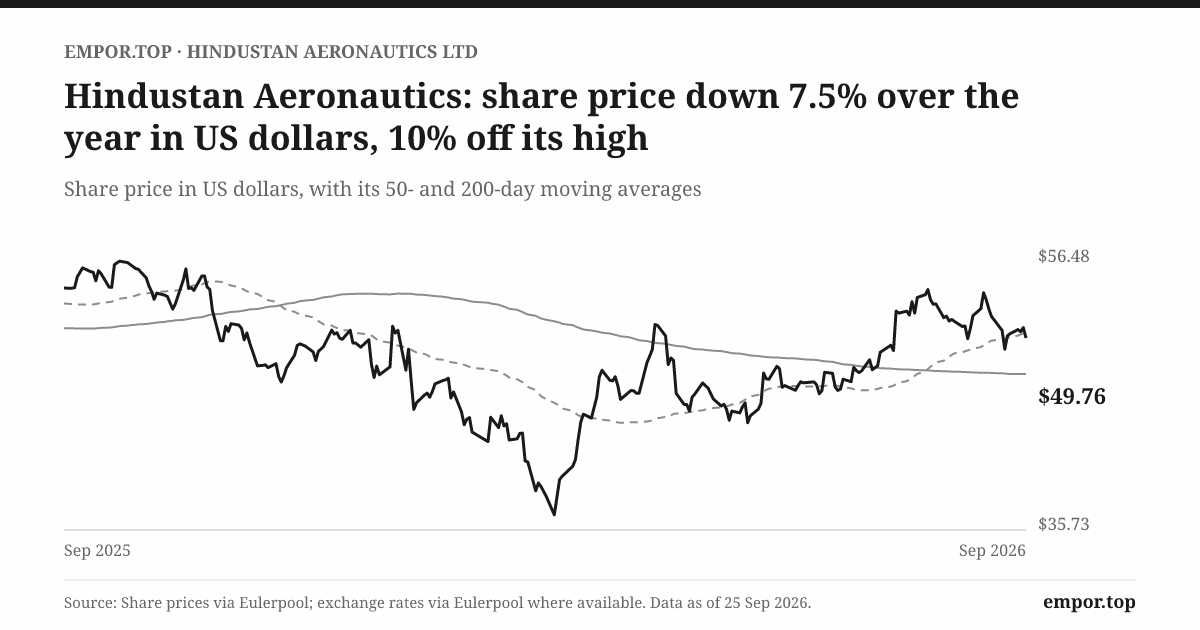
Public equity markets reflected a profound institutional re-rating. In March 2023, five years after the subdued initial public offering, the government divested up to an additional 3.5% stake through an offer for sale at a floor price of ₹2,450 per share, reducing state ownership from 75.15% to approximately 71.64%.30 That floor represented nearly double the 2018 listing price. Following a stock split later that year, the shares advanced steadily, reaching a split-adjusted 52-week high of roughly ₹5,055 by August 2026.31
What underpinned this valuation expansion? Market sentiment responded to three distinct factors: an accelerating order inflow, robust reported operating margins, and widespread retail and institutional enthusiasm for the broader defence indigenization mandate under the "Make in India" framework. Disentangling those drivers is critical for fundamental analysis. Backlog expansion and margin realization reflect enterprise-specific operational mechanics, whereas multiple expansion driven by sector-wide thematic enthusiasm can swiftly contract without any change in physical hangar productivity.
The order wave
The quantitative inflection following the 2021 milestone was driven by an unprecedented wave of procurement awards. In fiscal 2025, HAL secured manufacturing contracts totaling ₹1,02,337 crore. Major commitments included an order for 240 AL-31FP aero-engines for the frontline Su-30MKI fleet valued at ₹25,500 crore, a ₹62,777 crore procurement covering 156 Light Combat Helicopters for the Air Force and Army, and ₹13,454 crore for 12 additional Su-30MKI fighters.7 In fiscal 2026, the company booked an additional ₹97,028 crore in new orders, anchored by a second Tejas contract for 97 aircraft valued at ₹62,370 crore, formalized on September 25, 2025.632
As a result of this contracting surge, HAL's total order backlog expanded from ₹94,127 crore in April 2024 to ₹1,89,300 crore by March 2025, reaching ₹2,54,538 crore by March 2026.76 Relative to an annual revenue baseline of approximately ₹33,000 crore, that backlog represents nearly eight years of forward production visibility.
Yet an unprecedented backlog introduces acute structural obligations. While it confirms robust sovereign demand from the company's sole domestic buyer, it commits HAL to an annual delivery cadence far exceeding its historical manufacturing throughput. Moreover, as subsequent developments in next-generation fighter programs demonstrated, an overstretched order book can itself become a liability, providing the Ministry of Defence with compelling rationale to direct prospective programs toward emerging private competitors.
To understand why this massive contracting influx has not yet fundamentally transformed HAL's reported top-line revenue, it is necessary to examine the underlying mechanics of its core operating model.
VI. The Core Business Deconstructed: The Stealth Annuity vs. The Lumpy Assembler
Walk through one of HAL's overhaul hangars and the scene looks nothing like a fighter-jet showroom. Jets sit stripped to bare metal, engines hang on maintenance stands, and technicians work through inspection cards line by line. It is slow, methodical, unglamorous work—and it is where the vast majority of HAL's cash is actually generated.
Segment 1: repair, overhaul and spares
Every aircraft in military service runs against a strict maintenance clock. After a prescribed number of flying hours, components must be inspected, reconditioned, or replaced, while entire airframes and aero-engines undergo deep structural overhauls. For most platforms operated by the Indian armed forces, HAL manufactured the airframe, holds the proprietary technical documentation and specialized tooling, and operates the only industrial depot network in the country equipped to execute this work at scale.
That captive servicing footprint rests on an expansive installed base. On the May 2025 earnings call, management tallied roughly 340 Dhruv helicopters in active service, alongside more than 250 Su-30MKI fighters and 150 Dornier utility aircraft.7 The director of finance noted that repair and overhaul had been compounding at approximately 5% annually, arguing that freshly inducted platforms like the Tejas, Dhruv, and Light Combat Helicopter would steadily replenish the maintenance pipeline.7
Financially, fleet servicing forms the bedrock of the corporate income statement. Repair and overhaul, combined with spare-parts sales, accounted for approximately 70% of HAL's revenue in fiscal 2025.7 In fiscal 2026, repair and overhaul generated ₹20,524 crore, compared to ₹9,227 crore from new manufacturing.6 While HAL does not disclose segment-specific operating margins, management has acknowledged that repair and overhaul yields "a little bit higher" profitability than assembly work.6
In operational terms, an overhaul is vastly more involved than routine maintenance. A turbofan engine must be completely pulled, disassembled to its constituent components, inspected for micro-fractures and thermal fatigue, rebuilt with replacement parts, and test-fired in a ground cell before re-entering active service. Airframes undergo an equally exhaustive cycle: non-destructive structural testing, corrosion mitigation, complete rewiring, and avionics recalibration. Crucially, as an airframe ages, the bill of materials for each maintenance visit expands. For a sole-source depot operator, an ageing fleet is not an operational headache—it is an expanding high-margin annuity.
Yet this captive annuity carries bespoke balance-sheet hazards. When an asset suffers damage inside HAL's hangars, the financial liability falls directly on the contractor. In fiscal 2025, a frontline Su-30MKI was damaged in an accident during repair and overhaul, forcing HAL to take a ₹804 crore provision while the director of finance noted that settlement negotiations with the Air Force remained ongoing.7 The episode serves as an unvarnished reminder that sovereign fleet maintenance carries direct operational liabilities alongside its high margins.
The strategic durability of this division mirrors commercial aftermarket monopolies, such as industrial elevators or commercial jet engines. Delivering an airframe establishes a maintenance relationship that endures across a 30- to 40-year operational lifecycle. Because proprietary technical data, specialized depot tooling, certified technicians, and regulatory approvals reside exclusively within HAL, the customer cannot defect to an alternative domestic provider.
That economic moat, however, comes with a structural ceiling: the maintenance annuity is inherently slow-growing, and its relative contribution to top-line revenue is set to diminish. When an analyst on the May 2026 earnings call inquired about decelerating maintenance growth, the director of finance explained that spare-parts sales had declined by ₹500 to ₹600 crore during the year, while baseline overhaul turnover remained "almost at the same level" because no new platform had been added to the overhaul base.6 Management subsequently guided that the overall revenue split between manufacturing and repair would rebalance from roughly 30:70 toward 50:50.6 Compounding this natural maturity is fleet attrition: the final phase-out of the MiG-21 in September 2025 permanently extinguished a maintenance stream that had sustained factory bays for decades.14
The core takeaway is clear: while the fleet-servicing annuity provides an exceptionally sticky, highly profitable foundation, it operates as a defensive ballast rather than a rapid growth driver. Future top-line acceleration hinges entirely on new manufacturing—a structurally more volatile and execution-sensitive discipline.
Segment 2: new manufacturing
Manufacturing turnover expanded from ₹7,957 crore in fiscal 2025 to ₹9,227 crore in fiscal 2026.6 Management acknowledged, however, that this expansion was driven by scheduled deliveries of Dhruv helicopters alongside Russian-licensed AL-31FP and RD-33 aero-engines, rather than the flagship Tejas fighter.6 The indigenous platforms intended to anchor future volume remain caught between contracting milestones and shop-floor execution:
- Tejas Mk1A. HAL holds orders for 180 aircraft across two contracts, representing an aggregate commitment of roughly ₹1.1 lakh crore.23 The company states it now possesses an annual capacity of 24 fighters across three production lines, including a third line at Nashik inaugurated in October 2025.236 As of September 18, 2026, however, formal deliveries of production fighters to the Air Force had still not commenced.23
- Light Combat Helicopter Prachand. On March 28, 2025, the government signed procurement contracts for 156 helicopters—66 for the Air Force and 90 for the Army—valued at ₹62,700 crore before taxes, with deliveries scheduled to begin in the third year and run across five years.33 Because the Prachand is an internally developed platform, management has cited that status to argue it will face fewer schedule disruptions than the jointly designed Tejas.6
- Su-30MKI. The 12 additional fighters ordered in December 2024 will be manufactured at Nashik with 62.6% indigenous content.34 A broader upgrade program for the existing operational fleet remains classified by HAL as an anticipated opportunity rather than an executed contract.6
- HTT-40 basic trainer. In March 2023, the government approved a ₹6,828 crore procurement for 70 trainers to be delivered across six years.35 In May 2026, management indicated it was targeting more than 20 deliveries in fiscal 2027, after the program was identified alongside the Tejas as a source of fiscal 2026 delivery slippage.6
A critical revenue-recognition policy governs this manufacturing segment: HAL recognizes top-line revenue on defence manufacturing contracts only upon physical delivery rather than on a percentage-of-completion basis as work progresses.6 As a result, delivery bottlenecks do not merely defer cash inflows; they trap substantial working capital in half-finished airframes. Inventories climbed 42% in fiscal 2026 to ₹30,851 crore.3 That expansion followed fiscal 2025, when inventory holding periods lengthened from 159 to 263 days—a stretch management attributed to extensive production cycles of 18 to 36 months.7
Segment 3: space, civil and other bets
Beyond frontline military aviation, HAL maintains a modest portfolio of space systems and commercial partnerships. In the space vertical, an HAL–L&T consortium won an ₹860 crore contract from NewSpace India in September 2022 to fabricate five PSLV launch vehicles.36 In September 2025, HAL secured the technology-transfer award for the Small Satellite Launch Vehicle.37 On the civil aviation side, HAL signed a memorandum of understanding with Russia's United Aircraft Corporation in October 2025 to evaluate manufacturing the SJ-100 regional passenger jet in India,38 alongside an effort to industrialize rotating parts for Safran's commercial LEAP aero-engines.6
While technologically meaningful, none of these initiatives is yet financially material. Export sales, third-party design and development, and other income accounted for approximately 7% to 10% of consolidated revenue across fiscal 2025 and fiscal 2026 combined.76 Given the company's historical record in commercializing auxiliary aerospace projects, investors are best served treating these ventures as long-dated call options rather than foundational earnings drivers. In addition, the SJ-100 partnership with a sanctioned Russian aerospace entity introduces untested supply-chain and secondary sanctions risks.
The business anatomy points to an unmistakable conclusion: HAL operates today as a high-margin, defensive fleet-servicing annuity that is actively underwriting an aggressive manufacturing ramp—one that has yet to demonstrate consistent delivery cadence at scale. The durability of that dual identity depends squarely on the competitive moats protecting it, a dynamic examined next.
VII. Competitive Dynamics & Strategic Moat: Hamilton Helmer’s 7 Powers & Porter’s 5 Forces
Consider the operational stakes confronting Indian military aviation. The Indian Air Force operates against an authorized strength of 42 fighter squadrons, yet fielded only 31 at the end of 2024, according to a parliamentary standing committee assessment.39 Following the formal retirement of the MiG-21 fleet in September 2025, independent defence analysts estimated operational strength had fallen to approximately 29 squadrons.40 The only domestic manufacturing facilities capable of building supersonic combat aircraft sit in Bengaluru and Nashik. On paper, the sole domestic supplier commands near-total pricing power. In commercial practice, the sovereign buyer holds virtually all the leverage.
Helmer's 7 Powers, tested
Cornered resource: strong, but narrower than it looks. HAL possesses decades of accumulated flight-test data, specialized manufacturing plants, dedicated airfields, and sovereign security clearances that would take any private domestic challenger decades to replicate. It remains the only Indian manufacturer to have built supersonic fighter jets in volume. Yet the critical component required to sustain that production—a high-thrust aero-engine core—belongs to General Electric. An industrial moat that depends fundamentally on a foreign supplier's proprietary subsystem is only partially cornered.
Switching costs: the strongest power, especially in overhaul. Once an aircraft enters active military service, the specialized depot tooling, supply channels for spare parts, maintenance documentation, and certified technical staff remain tethered to HAL across the platform's operational lifecycle. This captive servicing dynamic sustains the high-margin maintenance annuity: roughly two-thirds of HAL's revenue continues to come from platforms already delivered.76
Process power: real in metalwork and assembly, weaker in integration. HAL manufactures foreign blueprints with disciplined precision, as demonstrated by decades of licensed Su-30MKI fighter and aero-engine production. It has faced substantially greater friction, however, in complex system integration on indigenous platforms. In September 2026, the chairman identified the primary operational bottlenecks delaying the Tejas Mk1A as persistent radar snags and incomplete weapons-integration trials.23
Scale economies: domestic only. HAL distributes its substantial fixed overhead across a captive domestic fleet, but it lacks international manufacturing scale. Export revenue totaled ₹501 crore in fiscal 2026, representing approximately 1.5% of net sales.6
Brand, network effects, counter-positioning: largely absent. HAL's brand carries significant administrative weight with domestic defence planners, but that status generates little pricing power or commercial prestige in competitive international tenders, as its historical export campaigns demonstrate.
Porter's 5 Forces
Buyer power: severe. The Ministry of Defence and the armed services represent virtually the entire addressable market. Operating as a classic monopsonist, the government determines pricing through cost-negotiation committees, writes punitive liquidated-damages clauses into procurement agreements, and dictates the payment disbursement schedule—as the 2019 cash squeeze starkly demonstrated. HAL routinely maintains annual balance-sheet provisions of approximately ₹2,500 crore for replacements, liquidated damages, and contractual warranties, alongside exceptional hits such as the ₹804 crore provision booked in fiscal 2025 for a Su-30MKI damaged during depot overhaul.7
Supplier power: very high at the chokepoints. Propulsion dependence on General Electric remains the most visible operational constraint, but supply bottlenecks extend across global Tier-1 vendors. In May 2026, the chairman acknowledged that while purchase orders for Su-30MKI and HTT-40 components had been placed, physical deliveries were "slow because of the geopolitical situation," prompting the company to identify secondary suppliers for critical hardware.6 Similarly, deliveries of Honeywell turboprop engines for the HTT-40 basic trainer experienced protracted disruptions before supply flows stabilized.6
New entrants: low in fighters, rising everywhere else. Prohibitive capital requirements and stringent military airworthiness certifications continue to insulate HAL from direct private competition in supersonic fighters, but private conglomerates are gaining significant ground in adjacent aerospace segments. Tata Advanced Systems manufactures Airbus C-295 military transport aircraft at its final assembly facility in Vadodara.41 More consequentially, private industry consortia, rather than HAL acting as sole nominee, were shortlisted to fabricate the initial prototypes for India's fifth-generation Advanced Medium Combat Aircraft.42
Substitutes: emerging. The operational maturation of autonomous unmanned systems, loitering munitions, and stand-off strike platforms is steadily reshaping how military planners evaluate close air support and light combat missions. HAL's internal hedge against this structural shift is the Combat Air Teaming System Warrior, an unmanned loyal-wingman drone. The airframe completed ground engine testing and entered structural fabrication, with the chairman indicating in May 2026 that its maiden flight was expected "next year, not this year."6
Rivalry: near zero at home in fighters, intense abroad. Domestically, HAL faces no direct rival for crewed combat jet manufacturing. In export competitions, however, the enterprise squares off against Korea Aerospace Industries, Sweden's Saab, and the Sino-Pakistani JF-17 alliance—and has consistently lost contested tenders.
The comparison with South Korea's KAI is particularly instructive. Like HAL, KAI developed as a state-backed national champion licensed to build foreign aircraft before graduating to indigenous designs, and its FA-50 light combat jet relies on the same American F404 engine family as the Tejas. The critical distinction lies in industrial execution: KAI commercialized its platform into an export workhorse supported by reliable production schedules and responsive lifecycle maintenance. When the Royal Malaysian Air Force evaluated both platforms, it weighed two state-backed contractors confronting identical American engine dependencies. Malaysia selected KAI. The episode indicates that HAL's export deficit stems less from aerodynamic design and more from institutional delivery credibility and aftermarket customer support.
Where the powers net out
Synthesizing these strategic frameworks reveals a distinct structural asymmetry. HAL's most potent competitive advantages—insurmountable switching costs and a cornered domestic infrastructure—protect the legacy business it already operates. In contrast, its most acute vulnerabilities—monopsony buyer power and Tier-1 supplier chokepoints—land directly on the manufacturing programs intended to drive future revenue expansion.
This creates an unusual corporate profile: an economic moat that is deepest behind the company and shallowest in front of it. Investors capitalizing the business on the promise of an accelerating manufacturing ramp are, in practical terms, paying for the operational segment where HAL possesses the least commercial leverage and the highest execution exposure.
HAL's defensive barriers remain formidable where military aircraft are already deployed in active service, but prove far more fragile where the next generation of aerospace programs is being contested. That underlying tension provides the framework for testing the broader investment thesis against the historical record.
VIII. The Historical Falsification Layer: Testing the Bull Thesis Against Decades of Evidence
Bull cases are usually built from announcements. Falsification tests are built from records. The four claims below are the ones that most matter to the investment case, and each is tested against HAL's own operating history.
Stress test 1: does HAL hold an unassailable domestic monopoly?
The claim. HAL is India's sovereign aircraft champion and will get all major domestic military aircraft work.
The evidence against it. In September 2021, the Ministry of Defence signed a ₹21,935 crore contract with Airbus for 56 C-295 transport aircraft. Sixteen were delivered fly-away from Spain, while 40 are being built by Tata Advanced Systems in Vadodara, with no HAL role.41 The final assembly line was inaugurated on October 28, 2024.41
The more consequential disruption arrived in fighter jets, HAL's core domain. In May 2025, the defence minister approved an execution model for the fifth-generation Advanced Medium Combat Aircraft (AMCA) that opened development to competitive bids from public and private firms.43 In February 2026, Livefist reported that three private-led consortia had been shortlisted for the prototype phase: Tata Advanced Systems, Larsen & Toubro, and Bharat Forge. HAL was not among them.42 The reported reason was a tender condition penalising bidders with large undelivered order books; HAL's backlog stood at roughly eight times its annual turnover.42 HAL stated it had received no official communication regarding the decision.42 On the May 2026 call, the chairman acknowledged that HAL was "not part of" the current prototype tender but hoped to take part later, noting that the government had not said the prototype builder would automatically receive serial production.6
Verdict: the history narrows the claim. HAL's monopoly remains intact for the fleets it already supports and the programmes already under contract. It is not guaranteed for future platforms, including the fifth-generation jet that will define Indian fighter manufacturing in the 2030s. Crucially, HAL's accumulated delivery delays have provided the Ministry of Defence with an operational justification for introducing private competitors. What to watch: whether HAL secures a production role in AMCA, and whether expected orders for 143 Dhruv helicopters and the Su-30MKI upgrade package are awarded to HAL as guided.6
Stress test 2: can HAL win combat-aircraft exports?
The claim. The Tejas will open large export markets in Asia, Latin America and Africa.
The evidence against it. Malaysia was the most serious competitive test. On February 24, 2023, it chose Korea Aerospace Industries' FA-50 over the Tejas for 18 light combat aircraft worth $920 million.44 Ecuador's experience with the Dhruv helicopter, where four of seven aircraft were lost to accidents before the relationship formally ended in 2015, still shapes how international buyers view HAL's aftermarket support.16 Furthermore, on November 21, 2025, a Tejas crashed during an aerial display at the Dubai Airshow, killing Wing Commander Namansh Syal in front of the international delegations HAL most wanted to impress.45 That tragedy followed the platform's first airframe loss near Jaisalmer in March 2024, where the pilot ejected safely.46
Verdict: the history largely rejects the claim for now. HAL has not won a major fighter export contract. In fiscal 2026, total export revenue was ₹501 crore and its export order book stood around ₹400 crore—together accounting for less than 2% of the business.6 A prudent valuation model assigns little or no value to fighter exports until commercial traction materializes. What would change that: a signed Tejas export contract with a named foreign air force, backed by clear delivery schedules and lifecycle support terms.
Stress test 3: are execution delays behind HAL?
The claim. With new lines, digital tools and a third Nashik line, HAL has solved serial production.
The evidence against it. This is the most critical test, because it directly measures management's recent commitments against shop-floor delivery.
On May 16, 2025, then-chairman D.K. Sunil told analysts the GE engine problem was "behind us." He said GE had "confirmed" 12 engines in calendar 2025 and assured the market that "12 aircraft will be ready this year."7 He added: "Next year definitely these deliveries will happen."7 Over the course of fiscal 2026, GE delivered only six engines, and HAL delivered zero Mk1A aircraft to the Air Force.647
A year later, on May 15, 2026, the incoming chairman told investors that deliveries would start by "August or September" 2026, targeting about 20 aircraft in fiscal 2027.6 When an analyst pointed out that six completed aircraft already had engines, indicating that the delivery delay extended beyond American supply chains, the chairman answered that the remaining work involved "refinements" to meet certain parameters, while declining to go into technical detail.6 Quwa reported that an Air Force acceptance review had been deferred because HAL had made insufficient progress on mandatory benchmarks, with radar calibration and Astra missile integration among the issues.47
By September 18, 2026, HAL held 10 engines and 27 completed airframes. The chairman described "a few radar issues" and pending weapons-integration testing as "last-mile corrections" that should take about a month.23 "For the deliveries to happen, the aircraft must meet the specifications we committed to the services," he said.23 Meanwhile, the defence ministry set deliveries for the second batch of 97 jets from September 2027 to September 2033.48
The same execution pattern appears in other programmes. In May 2025, management said the Tejas Mk2 prototype would fly in early 2026.7 By May 2026, that target had slipped to a prototype rollout by March 2027.6 Similarly, the HJT-36 intermediate jet trainer began in 1999 and still spent years stuck on spin recovery.18
Verdict: the history rejects the claim. Delays are not behind HAL. Some constraints are genuinely external, above all GE's engine delivery cadence. But the 2026 record reveals internal integration bottlenecks that HAL and its design partner ADA share, beyond anything GE could fix. HAL has also not publicly quantified its balance-sheet exposure to contractual liquidated damages for these delays, nor disclosed the financial penalties it says it has assessed against GE. When asked on the May 2026 call, management said it was "not the right time" to put a number on them.6 What to watch: formal Mk1A handovers to the Air Force, and whether fiscal 2027 ends anywhere near the guided target of roughly 20 aircraft.
Stress test 4: is the overhaul annuity as durable as it looks?
The claim. Repair and overhaul is a permanent, growing, high-margin profit pool that protects HAL whatever happens to new programmes.
The evidence against it. Management's own operating disclosures bound this claim. In fiscal 2026, spare-parts sales fell by ₹500 to ₹600 crore and overhaul revenue stayed roughly flat, because no new platform joined the overhaul base.6 The director of finance explicitly guided for the maintenance share of revenue to compress from about 70% toward 50% as manufacturing deliveries expand.6 In addition, legacy fleets that sustained the depot annuity for decades, such as the MiG-21, have reached final retirement.14 Safety groundings also curb the aftermarket pipeline: the Dhruv fleet, one of the largest installations in HAL's overhaul base, has spent long stretches grounded after accidents, which directly cuts flying hours and the recurring maintenance they generate.1549
Verdict: the history leaves the claim intact but smaller. The annuity is durable in the sense that high switching costs and a captive domestic fleet prevent it from disappearing. But it is a defensive earnings floor rather than a top-line growth driver, and its relative contribution to consolidated revenue is guided to shrink. What to watch: whether maintenance revenue resumes growth as early batches of the Tejas and Light Combat Helicopter enter the overhaul cycle, which management expects to begin around next year.6
These four tests leave the investment case narrower and more demanding than promotional headlines suggest. The next question is whether HAL's executive leadership and capital allocation frameworks are equipped to bridge that divide.
IX. Management, Governance, & Financial Anatomy
On May 1, 2026, a mechanical engineer from Malnad College of Engineering, with advanced management training from IIM Ahmedabad and in Toulouse, formally assumed office as HAL's 22nd chairman.8 Ravi K. had spent more than three decades inside the enterprise, serving as general manager of the Tejas division before advancing to Director (Operations)—a trajectory that earned him the internal reputation as HAL's "LCA man."8 His tenure runs until June 30, 2029.8
The institutional irony is sharp: the executive most associated with the Tejas must now answer for the programme's chronic delivery slippage. That appointment can be interpreted in two ways. Optimists maintain that no corporate leader understands the physical factory floor and its production sequences more thoroughly. Sceptics counter that the aircraft's recent assembly bottlenecks unfolded directly on his watch as operations head. Both perspectives have merit, and physical delivery volumes over the coming year will ultimately settle the debate.
The predecessor
His predecessor, Dr. D.K. Sunil, took additional charge as chairman on September 1, 2024,50 and became full-time chairman on September 9, 2024.51 With a background as director of engineering and R&D, he presided over the award of Maharatna status, the Light Combat Helicopter procurement, and the second major Tejas order. He was also the leader who issued the confident delivery commitments in May 2025 that the historical record does not substantiate. He retired on April 30, 2026.8
Incentives and accountability
As a state-owned enterprise, HAL compensates its executives under Department of Public Enterprises rules. There are no expansive stock-option packages, and senior leadership is appointed through the defence ministry. That governance framework discourages the aggressive financial engineering or short-term earnings manipulation common among private corporations. Yet it also substantially weakens the link between shareholder returns and executive compensation. At the 63rd annual general meeting on August 28, 2026, all seven ordinary resolutions, including Ravi K.'s confirmation, passed with no reported opposition.52 With the government holding approximately 71.64% of equity following its March 2023 stake sale, minority shareholders possess virtually no practical influence over corporate votes.30
Guidance versus delivery
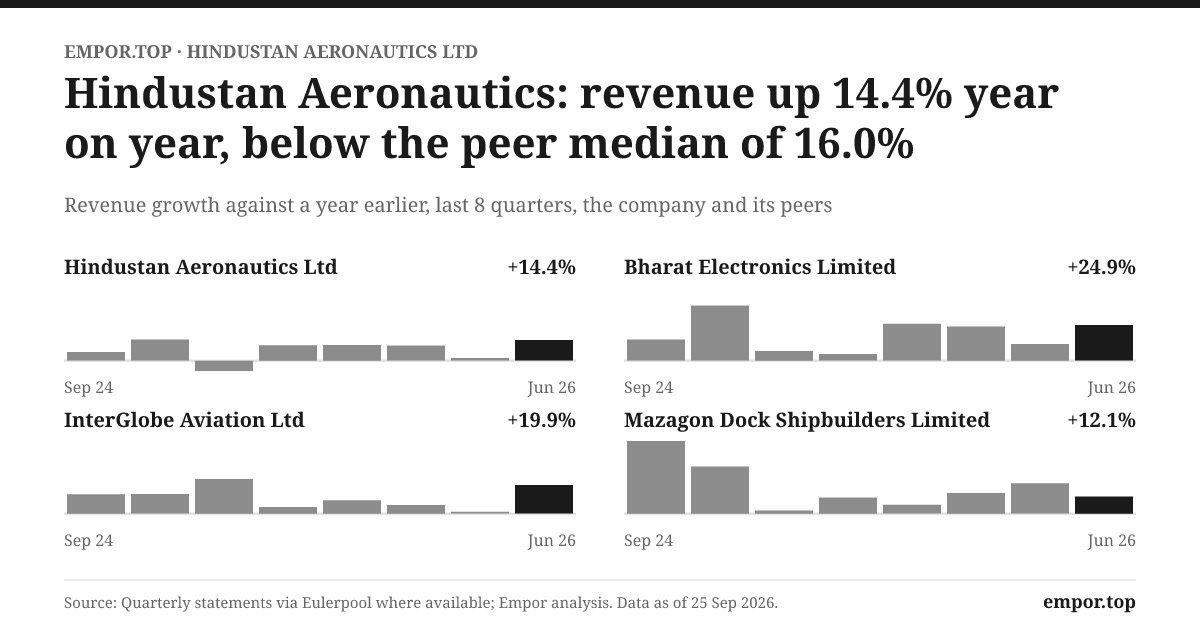
HAL's financial guidance record is mixed and warrants direct scrutiny. In May 2025, the finance director guided to revenue growth of 8% to 10% for fiscal 2026 alongside an operating EBITDA margin of about 31%.7 Fiscal 2026 revenue grew approximately 7% by management's own reporting, falling just short of that target band, while the operating EBITDA margin came in at 30%.6 For fiscal 2027, management guided to double-digit revenue expansion, which press reports placed at 10% to 12%, with an EBITDA margin of 30% to 31%.653 First-quarter fiscal 2027 revenue subsequently rose 14.4% to ₹5,515 crore, generating an EBITDA margin of about 27.7%.31 First quarters are seasonally muted for HAL because product recognition occurs primarily near the fiscal year-end: the fourth quarter alone accounted for 42% of fiscal 2026 revenue.3
The balance sheet: strong, but read it carefully
HAL is effectively debt-free and holds large cash balances.5 Bank deposits reached ₹42,425 crore at March 2026.3 Yet a significant share of that liquidity derives from customer advances: capital the government prepaid for combat aircraft and engines that HAL has yet to deliver.3 That capital does not represent unencumbered corporate surplus in the manner of a commercial technology company. If deliveries continue to slip, those advances remain performance obligations effectively owed back to the sovereign customer in physical hardware.
Other income, generated primarily from interest on those bank deposits, rose to ₹3,704 crore in fiscal 2026 from ₹2,566 crore the year before.3 That sum was equivalent to roughly 40% of HAL's consolidated net profit, although because it is fully taxed, its net contribution to the bottom line was somewhat lower. In practical terms, a meaningful component of recent profit expansion stemmed from receiving advance payments early and collecting treasury interest on them, rather than from manufacturing additional aircraft. While entirely compliant with accounting standards, this earnings source depends on sovereign customer advances continuing to flow into bank accounts faster than finished hardware leaves the factory.
Operational cash generation remained healthy, with cash from operations reaching ₹10,920 crore in fiscal 2026.3 Capital spending totaled ₹2,386 crore, while research and development expenditures came in at ₹2,794 crore, or about 8.4% of revenue.6 Looking forward, management plans to invest about ₹12,000 crore by 2030 in manufacturing capacity for the Tejas Mk2, licensed GE F414 and indigenous helicopter engines, and commercial space launch vehicles.6 Shareholder returns remained measured: the fiscal 2026 dividend totaled ₹45 per share, representing a payout of about a third of profits.5
Credit markets continue to view this liquidity structure as exceptionally secure, with CARE Ratings reaffirming its AAA (Stable) rating on HAL's bank facilities in March 2026.54 Furthermore, no auditor qualification was identified in the statutory filings reviewed for this analysis.
Reading management's language across two calls
Comparing the May 2025 and May 2026 earnings calls side by side reveals a telling rhetorical evolution. In May 2025, executive commentary was definitive: aero-engines were "confirmed," the supply bottleneck was "behind us," and fighter deliveries would "definitely" happen.7 By May 2026, the language had softened considerably: management spoke of being "hopeful," emphasized that delivery cadence depended on engine supplies "stabilizing," and noted that GE was committing to "15 to 20" engines, "but not the exact number."6 When an analyst observed that persistent delivery deferrals were "causing a fair bit of anxiety among the investor base," leadership offered only a generalized response.6
That shift provides essential insight into corporate communication. Management has adopted a more cautious, hedged posture—a prudent posture, but one that arrived only after earlier, assertive promises failed to materialize on the tarmac. To its credit, management handled specific operational inquiries transparently. On the Advanced Light Helicopter, leadership noted that all deliveries under legacy procurement contracts had been completed as agreed.6 On balance-sheet provisions, the finance director explained clearly why fiscal 2026 charges were lower: the exceptional ₹804 crore charge for the damaged Su-30MKI did not recur.6 The broader pattern, however, depicts an executive team that is precise on financial accounting and loose on production schedules—the opposite of what an investment case centered on manufacturing acceleration requires.
An activist's questions
A sceptical activist investor scrutinizing the business would press management on four central questions. First, why does HAL refuse to disclose its contractual exposure to liquidated damages on the 83-aircraft Tejas order, alongside the value of financial penalties it has claimed from General Electric? Second, how much of fiscal 2026 profit growth was driven by interest income on advance payments rather than industrial operations? Third, why was delivery guidance repeatedly issued with a certainty that the physical production record did not substantiate? And fourth, against an unexecuted order backlog representing nearly eight years of revenue, is HAL's ₹12,000 crore capital expenditure plan sufficient to clear commitments on schedule—especially after that very backlog led defence planners to exclude the company from AMCA prototype fabrication?
These questions do not merely evaluate past management performance; they define how the company will handle the long-dated production pipeline that will shape its next decade.
X. The Future Pipeline: AMCA, Tejas Mk2, & Next-Gen Optionality
Every aerospace manufacturer maintains a development hangar where the future is being assembled, and HAL's is crowded. For investors, however, the central question is not what platforms sit in the development pipeline, but what will actually roll out, on what timeline, and who will ultimately be contracted to build them.
Tejas Mk2
The Tejas Mk2 is a larger, medium-weight evolution of the baseline fighter, powered by the General Electric F414 and intended to replace the Indian Air Force's ageing Mirage 2000, Jaguar, and MiG-29 fleets. HAL secured initial F414 powerplants for development airframes, prompting management to assure investors in May 2025 that there was "no hold up" on prototype fabrication.7 At that time, leadership projected a maiden flight in early 2026, airworthiness certification around 2029, and series production commencing in 2030–31.7 A year later, that milestone had slipped: the target shifted to rolling out the prototype by March 2027, with the chairman noting that several technical matters still required resolution by ADA.6
Serial production of the Mk2 also depends on executing a binding F414 co-production contract, which remained unsigned as of April 2026.26 Commercial revenue from the Mk2 is therefore an event for the 2030s at the earliest, and its development schedule has already slipped by approximately a year within a twelve-month span.
AMCA
In March 2024, the Cabinet Committee on Security formally approved the fifth-generation Advanced Medium Combat Aircraft stealth-fighter program, allocating roughly ₹15,000 crore for prototype development.55 Reporting by Livefist on the program shortlist outlines five flying prototypes alongside a structural test airframe, targeting a maiden flight in 2028–29 and operational induction by 2035.42 HAL was not included among the shortlisted prototype consortia.42
For equity investors, the AMCA program can no longer be modeled as a guaranteed source of long-term manufacturing revenue. Whether HAL will build the production aircraft at all remains an open question. The mitigating factor highlighted by management is that the prototype fabrication contract does not automatically determine who receives the serial-production order, as the chairman emphasized to analysts.6
Unmanned systems
HAL's Combat Air Teaming System concept pairs autonomous "loyal wingman" drones with crewed combat jets. The CATS Warrior airframe completed ground engine trials, and HAL is currently fabricating the flying article, with its maiden flight anticipated in 2027. HAL also has a rotary-wing unmanned aerial vehicle prototype in ground testing.6 While these initiatives represent sensible positioning for future aerial combat doctrine, they remain in early development. Private Indian defence firms and international aerospace primes maintain a substantial lead in fielding operational unmanned systems.
Helicopters and civil aviation
The company's most concrete near-term pipeline sits in rotary-wing aviation. HAL expects a formal contract for 143 Dhruv helicopters across the Army and Air Force, which management identified as the single largest contributor to an anticipated ₹90,000 crore order pipeline.6 In the civil segment, a new Dhruv NG commercial variant completed its maiden flight on December 30, 2025.6
The operational safety record of the Dhruv platform remains an active concern, however. Following a fatal Indian Coast Guard crash near Porbandar on January 5, 2025, that claimed three lives, the military fleet was temporarily grounded before Army and Air Force variants resumed operations in May 2025.56 Navy and Coast Guard variants remained grounded substantially longer while a critical mechanical component underwent modification.49
The helicopter line: HAL's best near-term bet
Among HAL's forward manufacturing commitments, the rotary-wing division presents the most credible operational thesis. Both the Light Combat Helicopter Prachand and the Light Utility Helicopter are internal HAL designs, assembled in HAL's own facilities, unencumbered by a separate design agency to share accountability. Management has affirmed that LCH deliveries will begin in fiscal 2028 as per contract, in batches of approximately 30 aircraft annually across Bengaluru and Tumakuru.76
This manufacturing ramp provides the cleanest upcoming test of HAL's industrial execution on an aerospace program it controls from blueprint to tarmac. If the company delivers the LCH on schedule, it reinforces management's contention that fighter-line bottlenecks stem primarily from foreign propulsion suppliers and institutional interfaces with ADA. If the helicopter timeline slips as well, the execution deficit is indisputably internal.
The trainer line
The HTT-40 basic trainer represents another internally developed platform. Following protracted supply disruptions involving its Honeywell turboprop engines, management stated in May 2026 that supply had stabilized and guided to more than 20 deliveries in fiscal 2027.6 The strategic importance of the platform extends beyond its contract value: procuring an indigenous basic trainer displaced previous reliance on foreign aircraft, making disciplined delivery essential to rehabilitating customer confidence following the protracted setbacks on the HJT-36 intermediate jet trainer.
HAL's forward pipeline is expansive, yet it consists largely of programs that have experienced schedule slippage, introduced competitive threats from private consortia, or remain uncommitted in formal contracts. That operational tension makes the institutional lessons and structural risks examined next as consequential as the product roadmap itself.
XI. The Playbook: Defense Economics & Institutional Lessons
Step back from the assembly hangars and the balance sheet, and HAL's 86-year trajectory offers five institutional lessons that apply well beyond India.
1. The money is in keeping fleets flying. HAL's most dependable business is not assembling airframes; it is sustaining them. Much like commercial jet-engine or elevator manufacturers, the enterprise generates its steadiest profits across the decades following delivery. The structural caveat, underscored in management's own guidance, is that this servicing annuity compounds only as freshly inducted platforms enter the depot pipeline, while contracting each time a legacy fleet reaches final retirement.6
2. Whoever controls the engine holds the leverage. From the Marut's propulsion shortfalls in the 1960s to the Tejas Mk1A's protracted wait for General Electric powerplants in the 2020s, HAL's most intractable delivery bottlenecks have stemmed from a critical subsystem it cannot manufacture independently. A national champion that sources its high-thrust propulsion cores from foreign suppliers remains strategically vulnerable, regardless of its internal airframe sophistication.
3. A sole customer that is also the controlling shareholder alters normal commercial rules. HAL's sovereign buyer determines contract pricing, suspended operating disbursements during the 2018–2019 cash squeeze, and excluded the incumbent from the next-generation fighter's prototype phase in 2026. Yet that same customer provides upfront procurement advances, guarantees an expansive order book, and insulates the depot overhaul franchise from private competition. For equity investors, this monopsony relationship functions simultaneously as the company's deepest economic moat and its most acute governance risk.
4. Deep aerospace technology demands generational patience and sovereign capital. The Tejas programme commenced in 1983 and, more than four decades later, continues to resolve last-mile avionics and weapons-integration hurdles. Commercial private capital would almost certainly have abandoned the enterprise decades ago. While state forbearance is indispensable for nurturing sovereign industrial capability, it also risks entrenching an institutional culture where schedule slippage carries muted financial penalties.
5. An expanding backlog is a performance obligation, not a competitive moat. HAL's order backlog nearly tripled across a two-year contracting surge, yet that very accumulation was reportedly cited as operational justification to exclude the enterprise from the AMCA prototype shortlist.42 For contractors serving sovereign monopsonies, an order book that dramatically outstrips annual shop-floor throughput ceases to be an unalloyed asset; it actively incentivizes the customer to cultivate private-sector alternatives. The only durable backlog is one the factory floor can reliably convert into finished deliveries.
These institutional dynamics frame the essential question: what do these operating realities mean for an investor assessing whether HAL's public-market valuation reflects sustainable industrial execution?
XII. Analysis, Valuation, & The Bull vs. Bear Case
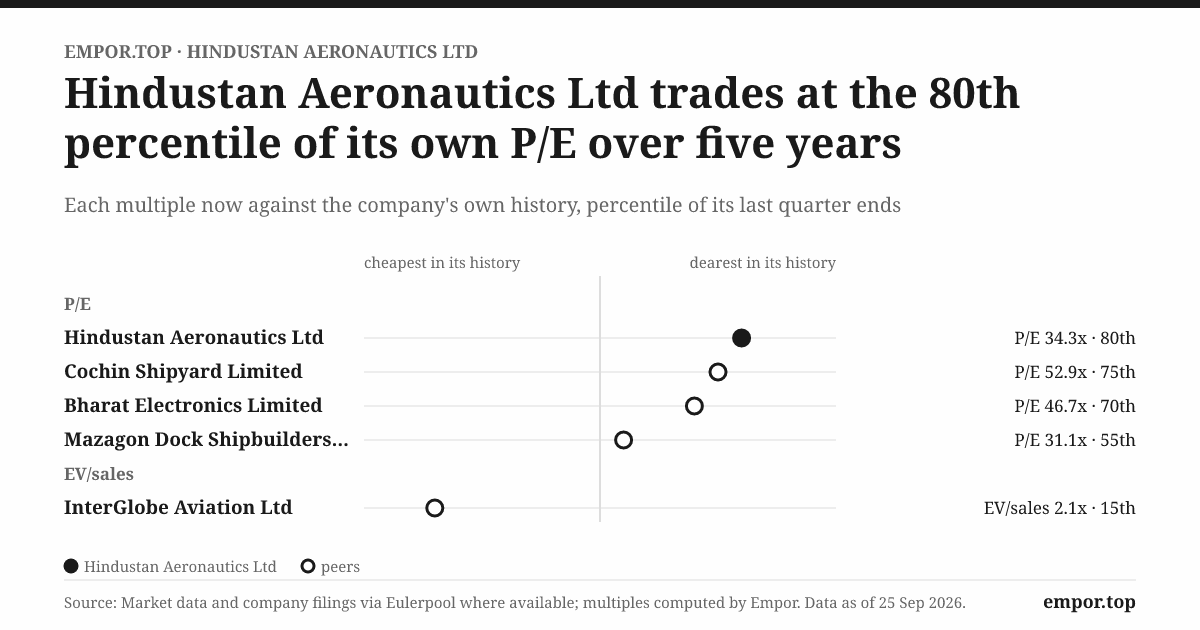
At approximately ₹3.2 lakh crore in market value, HAL trades at roughly 35 times fiscal 2026 earnings of ₹9,116 crore.54 That valuation implies an optimistic future where industrial execution matches contracting scale. The central investment debate turns on whether an unprecedented order book justifies that assumption.
The bull case
Sovereign demand remains structurally secure. Fielded squadron strength stands at roughly 29 to 31 operational units against an authorized complement of 42, reflecting an acute shortage of frontline fighters.3940 Contract awards for two tranches of Tejas fighters, 156 Light Combat Helicopters, and additional Su-30MKIs confirm the government's commitment to procurement at scale. Backed by an existing order book of ₹2.54 lakh crore, management anticipates an additional ₹90,000 crore in fresh contracts over the next two years.6
The fleet-servicing annuity underwrites industrial expansion. Repair, overhaul, and spare-parts supply provide steady, high-margin revenue that has preserved HAL's operating margin near 30% even through extended manufacturing delays.6 Few aerospace manufacturers possess a captive, high-margin aftermarket franchise capable of self-funding a large-scale manufacturing ramp without external debt.
A strong balance sheet buffers operational volatility. HAL is debt-free, holds a AAA credit rating, and maintains large cash and deposit reserves, providing balance-sheet capacity to absorb supply disruptions without the liquidity distress seen in 2019.543
Operational execution could catalyze rapid top-line growth. If serial handovers of the Tejas Mk1A commence and scale toward the company's stated industrial capacity of 24 airframes annually, manufacturing turnover could accelerate substantially past the single-digit revenue growth posted in recent years.
The bear case
Propulsion bottlenecks and avionics integration remain unresolved. General Electric delivered only six engines in fiscal 2026, while the Mk1A continued to face radar and weapons-integration hurdles in September 2026.623 These persistent delivery postponements tie up working capital in unfinished inventory, defer revenue recognition, and create unquantified balance-sheet exposure to contractual liquidated damages.
A shifting revenue mix threatens underlying profitability. Management guides for manufacturing to expand toward half of consolidated revenue while maintaining that operating margins will hold near 30%.6 Given that overhaul historically yields higher margins, sustaining that profitability remains unproven, particularly as interest income on customer advances continues to bolster reported profit.3
The domestic manufacturing monopoly is eroding at the margin. Decisions on the C-295 transport aircraft and the AMCA prototype shortlist demonstrate that the government is willing to cultivate private competitors in transport aviation and next-generation fighters.4142
Monopsony governance subordinates minority shareholder interests. With the government retaining 71.64% ownership, minority shareholders cannot influence capital allocation, leaving dividend payouts and investment programs subject to sovereign policy directives.30
What the price implies
Evaluating HAL's valuation requires clarifying the assumptions embedded in the equity price. A multiple in the mid-30s against trailing earnings reflects a growth premium. It prices in a future where manufacturing output surges, operating margins hold near historical highs, and the order book converts at a pace aligned with procurement contracts. None of these outcomes is unattainable, but all of them hinge on an industrial delivery cadence that HAL has yet to demonstrate on its flagship fighter line.
The structural mechanics cut in both directions. If Tejas deliveries commence and scale smoothly, top-line revenue could compound in double digits across several years, supported by firmly contracted, price-escalated backlog. If deliveries continue to stall, HAL retains its defensive foundations: a captive fleet-overhaul annuity, substantial treasury cash, and stable auxiliary production lines. Yet under that outcome, revenue growth would remain confined to single digits, interest on customer deposits would continue to flatter earnings, and the valuation multiple would face severe compression. The primary downside risk is not corporate insolvency, but a persistent divergence between market expectations and shop-floor execution.
Furthermore, an unexecuted backlog introduces an unintended second-order consequence. When forward commitments accumulate to nearly eight times annual turnover, an overextended order book ceases to act purely as a competitive barrier. Instead, chronic delivery slippage provides sovereign planners with a practical justification to direct subsequent aerospace programs toward private domestic consortia. In a state-directed defence market, a backlog that substantially outpaces factory throughput does not merely demonstrate commercial demand; it invites domestic competition.
The three KPIs that matter most
- Annual Tejas Mk1A formal handovers. Physical handovers accepted by the Air Force, benchmarked against management's fiscal 2027 guidance of about 20 aircraft and the baseline contractual rate of 16 per year. This remains the definitive operational test of whether HAL can translate signed backlog into recognized revenue.
- Quarterly GE F404 aero-engine receipts. The physical volume of powerplants delivered from General Electric's production facilities. The Week reported HAL expected 22 in total by the end of 2026.57 Without a predictable flow of propulsion units, fighter handovers cannot accelerate.
- Manufacturing revenue share alongside core operating EBITDA margin. The extent to which manufacturing expands toward management's 50% target, accompanied by whether operating profitability—measured strictly before interest income on treasury deposits—can hold near 30%.
XIII. Epilogue: The Sentry of the Skies
In the summer of 1940, Walchand Hirachand set out to build aircraft in India. Eighty-six years later, twenty-seven new Tejas fighters sat on HAL's tarmac, waiting for final technical refinements and additional American engines before they could join the Air Force.23 The distance between those two scenes captures the entire corporate arc. India has built the factories, trained the workforce, and mastered domestic airframe design. Yet it still does not control the high-thrust engine that turns an airframe into a frontline fighter.
Along the way, the company operated as a wartime depot for an Allied air force, a licensed manufacturer of Soviet jets, a co-designer of India's first modern fighter, a cash-squeezed supplier tapping bank overdrafts in 2019, and a Maharatna enterprise by 2024. Each identity left an enduring institutional legacy. The depot created the high-margin overhaul capability that generates the majority of profits today. The licensing decades established the national manufacturing infrastructure. The Tejas built sovereign design capability. And 2019 delivered an unmistakable warning about what happens to a captive contractor when its sole customer stops paying on time.
HAL is neither the stagnant state enterprise of past Western commentary nor the frictionless compounder implied by its recent market valuation. It is, at its core, a highly profitable fleet-servicing annuity, insulated by insurmountable switching costs across the aircraft it already maintains. Yet it is now expected to perform as a high-volume aerospace manufacturer, even as its sole customer begins testing whether private domestic consortia can shoulder part of that burden. Over the coming year, physical delivery numbers on the Tejas line will reveal which of those two realities defines the business.
References
-
Cash-strapped HAL takes Rs 962-crore overdraft — The News Minute, 2019-01-07 ↩↩↩
-
HAL's Maharatna Status: India's Growth Towards Aerospace Industry — Press Information Bureau, 2024-10 ↩
-
HAL FY26 Results: Profit, Margins and What Investors Miss — Sahi, 2026-05-14 ↩↩↩↩↩↩↩↩↩
-
Can HAL Convert Its Massive Order Book Into Revenue? What Q4 FY26 Numbers Really Tell Investors — INDmoney, 2026-05-15 ↩↩
-
Hindustan Aeronautics Ltd — Consolidated Financials and Key Ratios — Screener, accessed 2026-09-25 ↩↩↩↩
-
Transcript of Earnings Call Q4 FY26 (held 2026-05-15) — HAL filing to NSE, 2026-05-22 ↩↩↩↩↩↩↩↩↩↩↩↩↩↩↩↩↩↩↩↩↩↩↩↩↩↩↩↩↩↩↩↩↩↩↩↩↩↩↩↩↩↩↩↩↩↩↩↩↩↩↩↩↩↩↩↩
-
Hindustan Aeronautics Limited Q4 FY25 Earnings Conference Call Transcript — HAL / Elara Securities, 2025-05-16 ↩↩↩↩↩↩↩↩↩↩↩↩↩↩↩↩↩↩↩↩
-
HAL Appoints Ravi Kota as New CMD Effective May 1, 2026 — Indian Masterminds, 2026-05-01 ↩↩↩↩↩
-
A Brief History Of Indian Aerospace Manufacturer Hindustan Aeronautics Limited — Simple Flying, 2022-10-22 ↩↩↩↩↩↩↩↩
-
Hindustan Aeronautical Limited is the vision of Walchand Hirachand, Mysore Maharaja and US industrialist Pawley — eSamskriti ↩
-
HAL HF-24 Marut – Where the wind blows — Bharat Rakshak, 2015-03-26 ↩↩↩↩↩↩↩
-
When Nehru and a Nazi Germany engineer built the first India-made operational combat fighter — ThePrint, 2018-09-24 ↩↩↩
-
The IAF as an Aircraft Manufacturer — Bharat Rakshak, 2015-03-29 ↩
-
Indian Air Force bids farewell to legendary MiG-21 after six decades of service — All India Radio News, 2025-09-26 ↩↩↩
-
Explainer: In 23 years since induction, Dhruv fleet suffers 23 crashes, several groundings — The Tribune, 2025-01-07 ↩↩↩↩
-
Ecuador terminates links with HAL after four Dhruv accidents — HeliHub, 2015-10-18 ↩↩
-
Kaveri Engine Development Project — Press Information Bureau ↩
-
HJT-36 Flight Test Resumption Renews Hope for AL-55 Engine — AIN, 2019-05-01 ↩↩↩
-
Sitara To Yashas: To Hell & Back, Ready To Serve — Livefist, 2025-02-19 ↩
-
LIC bails out Rs 42-billion Hindustan Aeronautics IPO — Business Standard, 2018-03-20 ↩
-
Rs. 48,000 Crore Contract for 83 Light Combat Aircraft (LCA) Tejas handed over to HAL — Press Information Bureau, 2021-02-03 ↩
-
LCA Tejas Mk1A fighter jets almost ready, but these two key issues must be fixed before IAF delivery — The Week, 2026-09-18 ↩↩↩↩↩↩↩↩↩
-
Prime Minister dedicates to the nation HAL Helicopter Factory at Tumakuru — Press Information Bureau, 2023-02-06 ↩↩
-
GE Aerospace signs MoU with Hindustan Aeronautics Limited to produce fighter jet engines for Indian Air Force — GE Aerospace, 2023-06-22 ↩
-
GE Aerospace, HAL make significant progress regarding co-production of F414 jet engines; reach agreement on technical matters — The Tribune, 2026-04-14 ↩↩
-
GE Aerospace starts delivery of F-404 engines for Tejas MK-1A jets after two years of delay — Deccan Herald, 2025-03 ↩
-
HAL, GE sign fresh contract for 113 more engines for Tejas jets — The Tribune, 2025-11-07 ↩
-
Intimation of Maharatna Status — HAL filing to NSE, 2024-10-14 ↩
-
Centre to sell up to 3.5% stake in Hindustan Aeronautics Ltd via offer for sale — Business Today, 2023-03-22 ↩↩↩
-
Hindustan Aeronautics Q1 results: HAL profit rises 15% YoY to ₹1,581 crore, revenue climbs 14% — Upstox, 2026-08-12 ↩↩
-
MoD signs Rs. 62,370 crore contract with HAL for procurement of 97 LCA Mk1A aircraft for IAF — Press Information Bureau, 2025-09-25 ↩
-
MoD signs contracts worth Rs 62,700 crore with HAL for 156 Light Combat Helicopters Prachand — Press Information Bureau, 2025-03-28 ↩
-
MoD signs contract with HAL for procurement of 12 Su-30MKI aircraft — Press Information Bureau, 2024-12-12 ↩
-
MoD signs contracts for 70 HTT-40 basic trainer aircraft with HAL — Press Information Bureau, 2023-03-07 ↩
-
HAL-L&T consortium bags Rs 860 crore contract to build five PSLV rockets — Business Standard, 2022-09-05 ↩
-
NSIL, ISRO, IN-SPACe and HAL ink pact for SSLV technology transfer — All India Radio News, 2025-09 ↩
-
HAL signs MoU with Russia's PJSC UAC to produce passenger aircraft SJ-100 in India — The Tribune, 2025-10-28 ↩
-
Parliamentary panel alarmed at fall in IAF fighter squadrons — Deccan Chronicle, 2024-12-17 ↩↩
-
India's Iconic MiG-21 Blasts Off Into Retirement — The War Zone, 2025-09-26 ↩↩
-
PM and Spanish President jointly inaugurate TATA Aircraft Complex for manufacturing C-295 aircraft at Vadodara — Press Information Bureau, 2024-10-28 ↩↩↩↩
-
HAL Sidelined, Private Giants Shortlisted for India's AMCA Stealth Jet — Livefist, 2026-02-04 ↩↩↩↩↩↩↩↩
-
Raksha Mantri approves execution model for Advanced Medium Combat Aircraft programme — Press Information Bureau, 2025-05-27 ↩
-
Malaysia picks South Korea's FA-50 light combat jet over Indian bid — Defense News, 2023-02-24 ↩
-
India's home-built fighter jet Tejas crashes at Dubai Air Show, pilot dies — Al Jazeera, 2025-11-21 ↩
-
IAF's Tejas aircraft crashes near Rajasthan's Jaisalmer, pilot ejected safely — All India Radio News, 2024-03-12 ↩
-
HAL-IAF Tejas Mk1A review pushed to June as radar, engine and weapons integration challenges compound — Quwa, 2026 ↩↩
-
LCA Tejas Mk1A delivery question gets a clear answer: Defence ministry sets timeline for 97-aircraft order for IAF — The Week, 2026-09-14 ↩
-
ALH Dhruv fleet of Indian Navy, Coast Guard set for a crucial tech fix before flying again — The Week, 2025-12-11 ↩↩
-
Dr D.K. Sunil Takes Over as CMD (Additional Charge) of HAL — Force India, 2024-09 ↩
-
HAL appoints Dr DK Sunil as its full-time CMD — PSU Watch, 2024-09 ↩
-
Hindustan Aeronautics Ltd Shareholders Approve Final Dividend and New CMD Appointment — Whalesbook, 2026-08-31 ↩
-
HAL Targets 10-12% Revenue Growth in FY27, 30-31% EBITDA Margin — ScanX, 2026-05-15 ↩
-
Hindustan Aeronautics secures reaffirmed CARE AAA rating for ₹6,050 crore bank facilities — Free Press Journal, 2026-03-10 ↩↩
-
India approves fifth-generation AMCA fighter project — Janes, 2024-03 ↩
-
Army, IAF resume Dhruv helicopter operations after Jan 5 crash probe — Deccan Herald, 2025-05 ↩
-
LCA Tejas latest updates: Engine delays ease for India's fighter aircraft as HAL awaits key GE shipment — The Week, 2026-09-04 ↩
 LinkedIn
 WhatsApp
 Reddit
 Hacker News
 Email
 Kindle
 RSS Feed
 Spotify
 Apple Podcasts
 Amazon Music
 Audible
 YouTube