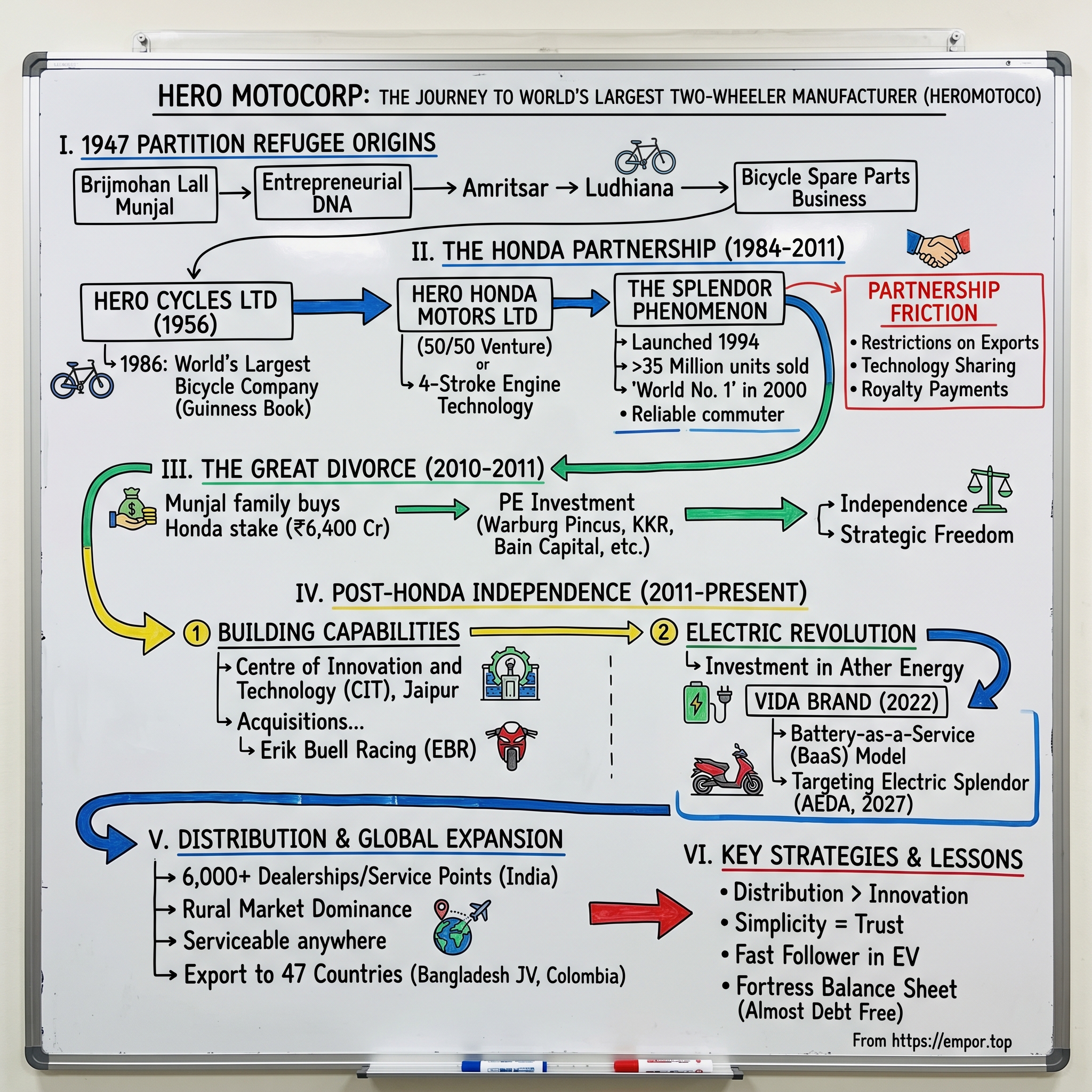
Hero MotoCorp: Can the World's Largest Two-Wheeler Maker Out-Run Its Own Success?
I. Introduction & Episode Roadmap
Somewhere in India right now — in a Ludhiana bylane, a Bihar village market, or a Nairobi suburb — someone is riding away on a new Hero. In the fiscal year that ended in March 2026, Hero MotoCorp dispatched 6.47 million two-wheelers, roughly one every five seconds of the working year.1 The company has maintained its position as the largest two-wheeler manufacturer globally by volume for twenty-five consecutive years.1 It carries virtually no net debt, generates strong cash flow, and in FY26 paid out ₹185 per share in dividends.2
And yet the most compelling story about Hero MotoCorp in August 2026 is not its historic scale. It is the narrowing distance between Hero and its competitors.
In FY26, Hero sold 6,468,834 units across Indian and international markets. Honda Motorcycle & Scooter India — Hero's former joint-venture partner turned direct rival — sold 6,369,504 units.3 That leaves a gap of roughly 99,000 units on a base of six and a half million, representing about a week and a half of Hero's production. In retail registration data for July 2026, Honda surpassed Hero, securing 25.83% of the Indian market compared to Hero's 24.23%.4 On the most recent monthly retail scoreboard, the world's largest two-wheeler maker ranked second in its home market.
That tension defines the company's current position. Hero is simultaneously reaching financial peaks and facing competitive pressures. FY26 marked the highest revenue and net profit in company history — ₹46,830 crore and ₹5,268 crore, respectively.1 Yet in the same fiscal year, Hero wrote down its investment in American electric motorcycle maker Zero Motorcycles by 92%, reducing its carrying value to ₹19 crore.5 This write-down followed the quiet retirement of the Mavrick 440, Hero's proprietary premium motorcycle, which was discontinued in 2025 after eighteen months on the market.6 Meanwhile, the single largest contributor to Hero's first-quarter profit surge in FY26 was not a motorcycle sale, but a mark-to-market gain on its stake in Ather Energy, an electric scooter maker Hero funded as a minority investor.7
The result is a company whose core operating engine remains strong, even as its strategic initiatives produce mixed outcomes.
The narrative follows a clear roadmap. It begins with the company's origins: a Partition refugee who built a global bicycle manufacturing operation from a Ludhiana parts shop, establishing a culture of disciplined manufacturing and expansive distribution that sustains Hero's cost advantages today. It then examines the twenty-six-year partnership with Honda that established Hero's operational scale, followed by the separation that industry observers expected would cripple the firm. It details the subsequent decade, during which Hero maintained volume leadership while leaving core strategic questions unresolved.
That brings the analysis to the present, defined by a three-front competitive challenge. First is the core commuter segment, where Hero retains near-monopoly status in 100cc motorcycles yet continues losing overall market share to a competitor with a stronger scooter lineup. Second is premiumisation, where three years of effort and a strategic partnership with Harley-Davidson have produced mixed results in higher-margin segments. Third is electrification, where Hero operates as a late entrant with its proprietary VIDA brand while simultaneously benefiting as a primary shareholder in Ather Energy from an investment made in 2016.
Three core questions frame this analysis. Why did Hero's market leadership erode precisely while earnings reached record levels? Does management's capital allocation across Ather, Zero Motorcycles, and Harley-Davidson reflect a coherent strategic portfolio or a reactive hedge against shifting market dynamics? And can a manufacturer built on low-cost entry-level motorcycles maintain its leadership through an EV transition where traditional manufacturing cost advantages may not apply?
Addressing these questions requires returning to 1944, when Hero's founder arrived in Amritsar with minimal capital and an exceptional focus on low-cost production.
 Subscribe on LinkedIn
II. Origins: From Partition to the World's Largest Bicycle Maker
Brijmohan Lall Munjal was twenty when he came to Amritsar from Kamalia, a town in what is now Pakistan, in 1944, alongside his three brothers Dayanand, Satyanand, and Om Prakash.8 Three years later, Partition redrew regional borders and turned a family relocation into a refugee displacement. The brothers settled in Ludhiana, a Punjabi manufacturing town that developed over the next four decades into a major Asian bicycle manufacturing center.
The business did not begin with complete bicycles. It began with bicycle parts — forks first, then handlebars, and progressively more components of the machine.8 That progression reflected the Munjal operating philosophy: rather than designing a finished product and seeking customers, the founders started at the component level in the lower-margin section of the supply chain, mastering unit manufacturing costs and distributor pricing. In 1954, the family formalised Hero Cycles; in 1956, the Punjab government granted them a licence to manufacture complete bicycles.8 By the 1980s, Hero Cycles had become the largest bicycle manufacturer in the world.8
That growth established the operational foundation for Hero MotoCorp's modern cost structure. Bicycles in post-independence India were utility vehicles for working-class buyers, representing several months of household income. Winning that market required three simultaneous operational conditions: an accessible retail price point, structural reliability to prevent lost wages from vehicle downtime, and a dense service and spare-parts network providing repairs within walking distance. Brand marketing could not substitute for deficiencies in any of the three. The Munjals structured their business around supplier relationships that delivered low component costs, manufacturing discipline that closely scrutinised the bill-of-materials, and a distribution network extending into rural markets that competitors routinely bypassed.
Those three capabilities transferred directly to motorcycles three decades later. They enabled Hero to produce 100cc motorcycles profitably at price points that challenged international competitors. They also built the foundation for Hero's high-margin aftermarket division, which generated ₹1,689 crore in revenue in a single quarter of FY27 through a network of over 400 distributors and 40,000 retail outlets.9 The central strategic question facing Hero in 2026 is not whether its low-cost manufacturing discipline remains effective in entry-level segments, but whether that capability provides a competitive advantage in the premium and electric categories where market growth is shifting.
Brijmohan Lall Munjal led the group until his death in November 2015 at age ninety-two.8 That operational culture continues to shape Hero's financial structure, reflected in the gross margins extracted from its 100cc motorcycle portfolio and in management's reliance on volume scale and distribution density as core strategic levers.
In 1984, that manufacturing model joined with Japanese engineering to form a joint venture that transformed the domestic two-wheeler industry.
III. The Honda Joint Venture: Building the Machine (1984–2010)
Picture the Indian two-wheeler market in the early 1980s. Scooters dominated — the Bajaj Chetak had a waiting list measured in years, and a booking was a tradeable asset. Motorcycles were heavy, thirsty, two-stroke machines. Fuel was expensive relative to income. Roads were bad. And the government had just begun opening a license-permit economy to foreign technology partnerships, provided the foreign partner took a minority stake.
Into that opening, in 1984, Hero partnered with Honda Motor Company. The joint venture, Hero Honda, established its first plant at Dharuhera in Haryana, with the Munjal family and Honda each holding 26% equity and the remainder held publicly.10 It was an unusually clean division of labor. Honda contributed four-stroke engine technology — quieter, cleaner, and dramatically more fuel-efficient than the two-stroke engines then on Indian roads. Hero provided local execution: the vendor base, plant discipline, and a dealer network adapted from its bicycle operations.
The breakthrough product was the CD 100, marketed under a four-word campaign: "Fill it — Shut it — Forget it."
The campaign proved strategically decisive. While competitors marketed motorcycles on global benchmarks of power, styling, and performance, Hero Honda positioned its product on total cost of ownership. For a schoolteacher in Kanpur or a milk trader in Nashik, operating cost and reliability outweighed top speed. By prioritizing fuel efficiency, Hero Honda reframed the category around the primary economic constraint of its core customer base, leveraging the structural advantage of Honda's four-stroke engine.
That positioning laid the groundwork for the Splendor, which became one of the highest-volume motorcycle nameplates in global automotive history. The commercial logic endured for decades: in the first quarter of FY27, Hero still held an 85.8% share of India's 100cc motorcycle segment.9 A positioning decision established in the 1980s continues to anchor Hero's dominance in the entry-level commuter category.
By 2001, Hero Honda had become the world's largest two-wheeler manufacturer by volume, a title the successor company has retained.1 Sales volume compounded, margins remained healthy, the promoter family accumulated wealth, Honda collected steady royalties, and public shareholders earned strong returns. For a decade and a half, the partnership appeared seamless.
Yet the alliance contained deep structural vulnerabilities.
First, Hero lacked technological independence. Honda supplied engines and platforms on its own terms and schedule. Because the joint venture relied entirely on Honda's engineering, Hero built no meaningful internal R&D capabilities. This arrangement was efficient until partner incentives diverged, leaving Hero controlling manufacturing and distribution but lacking proprietary product IP.
Second, the economic structure favored the foreign partner over time. Royalty and technical-fee payments to Honda represented a continuous claim on the joint venture's profit pool, rising with every new model introduction.
Third, and most critical, Honda created a competing parallel track. In 1999, Honda established Honda Motorcycle & Scooter India (HMSI) as a wholly owned subsidiary, operating without Munjal participation in the same domestic market where Honda held a 26% stake in Hero Honda.10 HMSI initially focused on scooters, a segment Hero Honda largely ignored, masking the conflict. In reality, Honda had secured a strategic hedge that would unfold over two decades.
From Honda's perspective, the incentive structure was asymmetric. Honda held a minority economic interest in Hero Honda alongside a 100% interest in HMSI. As the joint venture expanded India's two-wheeler market — broadening rural credit access, normalizing motorcycle ownership, and training thousands of mechanics — HMSI absorbed those ecosystem benefits. Hero Honda effectively subsidized the market development of a future competitor.
By the late 2000s, the Munjal leadership recognized that the partnership was reaching its end. The core strategic challenge was no longer maintaining the joint venture, but managing the eventual separation and positioning Hero for independent survival.
IV. The Split (2010–2011): A Bet the Market Didn't Believe In
On December 16, 2010, Hero and Honda announced they were dissolving the joint venture.10 The Munjal family, through its holding vehicle, agreed to buy out Honda's entire 26% stake for ₹3,841.83 crore.10
The financial structure of the buyout reflected how investors evaluated the business at a moment of maximum uncertainty. The family did not hold ₹3,842 crore in liquid capital. Instead, the buyout was funded through bridge financing and private equity investment from global firms. Capital came from Bain Capital, through BC India Private Investors, and the Government of Singapore Investment Corporation (GIC), through Lathe Investment, which together acquired less than a 15% indirect economic interest in Hero Honda.10
Private equity investors were underwriting an India-only manufacturer in a standardized product category that had just lost access to its primary technology partner and had never independently designed a motorcycle engine. On paper, the enterprise resembled a distribution network with attached assembly plants. The willingness of Bain Capital and GIC to commit capital at that valuation signaled a clear market calculation: Hero's enterprise value resided primarily in its distribution density and cost discipline rather than Honda's proprietary engineering.
Public equity markets were far less confident. The central question among Indian equity analysts throughout 2011 focused on what would happen once Hero's inherited Honda engine platforms grew obsolete. While logical, that inquiry focused on the wrong timeframe.
On July 29, 2011, Hero Honda Motors Limited officially changed its name to Hero MotoCorp Limited. The new brand identity, created by London agency Wolff Olins, was unveiled on August 9, 2011, at Lord's Cricket Ground in London during an India–England Test match, accompanied by the promotional campaign "Hum Mein Hai Hero."11
Staging the launch at Lord's rather than in New Delhi was a calculated positioning statement. Hero was framing itself not as a former Japanese affiliate reverting to local control, but as an emerging Indian multinational. Whether operational capabilities justified that positioning remained unproven at the time.
What Hero acquired in the separation proved more consequential than what it lost, establishing two advantages that remain central to its business in 2026.
The first was export freedom. Under the joint venture, Hero Honda's international expansion was restricted to protect Honda's wholly owned operations in Latin America, Africa, and Southeast Asia. The separation eliminated those geographic boundaries. In FY26, exports reached a record 402,786 units, up roughly 40% year over year.12 In the first quarter of FY27, global dispatches grew 63% as Hero entered Germany, its 53rd international market.9 None of those territories were contractually accessible before 2011.
The second advantage was supplier independence. Within the joint venture, Honda specified major portions of the bill of materials. Following the split, Hero gained the autonomy to re-tender component contracts, negotiate directly with suppliers, and re-engineer parts for local cost efficiency—a critical capability for a business reliant on low manufacturing costs.
What Hero did not acquire was internal powertrain engineering. The company had to build engine design capabilities from a standing start, within a domestic market containing a limited pool of powertrain engineers, while continuing to manufacture six million vehicles annually using platforms originally engineered by a now-direct competitor.
That operational transition represented the core risk of the split. The subsequent decade tested whether Hero could bridge that technical gap.
V. Proving It: The Independent Decade (2011–2020)
To address its internal engineering deficit following the separation, Hero began investing directly in research and development infrastructure. The company established the Centre of Innovation and Technology in Jaipur, building a greenfield research campus for an enterprise that had spent twenty-six years outsourcing technology development to Tokyo.
In 2012, Hero launched its first fully in-house-developed motorcycle, the Impulse. An off-road-styled vehicle targeted at an undeveloped niche, the Impulse was commercially insignificant. Strategically, however, it served as an essential proof of concept, demonstrating to internal engineering teams and public markets that Hero could take a vehicle from concept to showroom without relying on Honda designs.
Meanwhile, Hero's core business continued to generate steady cash flow. The Splendor and HF Deluxe consolidated their positions in the entry-level commuter segment throughout the 2010s. Sales volumes and operating margins remained resilient, disproving analyst predictions of a post-separation collapse. By the end of the decade, Hero had answered the question of basic operational survival without a foreign partner.
Yet the nature of that survival revealed underlying strategic limits. Hero maintained its dominance because its distribution network and cost structure were exceptionally durable, and because India's entry-level commuter motorcycle market evolved very little between 2011 and 2020. The core product required little reinvention. Customer purchasing criteria—purchase price, fuel economy, resale value, and service accessibility—remained identical to the priorities Hero had optimized since its bicycle manufacturing era. Hero secured its volume leadership in the 2010s largely because the entry-level segment did not demand rapid product innovation.
That outcome resolved the survival question, but left a broader strategic inquiry open. Skeptics had asked whether Hero could survive without Honda's engineering. The more consequential question was whether Hero could out-innovate agile domestic and international rivals. That question remained unresolved, establishing a central vulnerability that would manifest in Hero's subsequent efforts to enter premium and electric vehicle segments.
The 2010s also established an informative track record regarding management's capital allocation beyond its core commuter business.
In 2014, Hero established a joint venture in Bangladesh with the Nitol-Niloy Group, committing approximately ₹254 crore for a 55% stake in a local manufacturing operation serving one of South Asia's densest two-wheeler markets. The investment represented a logical expansion into an adjacent market using Hero's established manufacturing template.
In 2016, management executed two strategic investments that yielded starkly divergent outcomes. Hero invested ₹205 crore into Ather Energy, a Bengaluru-based electric scooter startup founded by two Indian Institute of Technology Madras graduates with significant engineering ambition but limited commercial track records. In the same year, Hero acquired a 49.2% stake in Erik Buell Racing, an American performance motorcycle firm, aiming to secure high-end engineering and design capabilities. Erik Buell Racing subsequently shut down, wiping out the carrying value of Hero's equity stake.
Both minority investments were executed under identical strategic rationales: purchasing external engineering capabilities that Hero could not build internally. Yet while the Ather investment grew into Hero's most lucrative venture holding, the Erik Buell Racing stake resulted in a total write-off. That strategic divergence established a recurring pattern in which Hero's overseas capability acquisitions consistently underperformed its domestic investments.
By 2020, Hero's long-term investment profile had crystallized around four elements: a highly cash-generative monopoly in entry-level commuters, a proven capacity to operate independently of Honda, an unproven ability to develop category-defining new products, and a venture portfolio characterized by extreme binary outcomes. Shortly thereafter, shifts in consumer demand and technology began transforming the Indian two-wheeler market, testing the assumptions underlying Hero's core operating model.
VI. The Core Business Today: Commuter Bikes, Industry Structure, and a Shrinking Lead
Walk into a Hero dealership in a district town in Uttar Pradesh and the economics of this company become physical. There will be a handful of Splendors and HF Deluxes on the floor. There will be a financing desk, because roughly half the customers are buying on credit and the availability of that credit is often the binding constraint on the sale. There will be a service bay out back and a parts counter, and both of them matter more to the dealer's profit and loss than the showroom does. There will not be much marketing. The customer already knows what a Splendor is; their father owned one.
That is the machine. In FY26, it produced ₹46,830 crore of revenue, up 14.9%, and ₹5,268 crore of profit after tax, up 14% — both all-time records. EBITDA rose 17.1% to ₹6,871 crore, with margins improving 30 basis points to 14.7%.1 Return on equity remains in the mid-twenties. Net debt is essentially nil. On any conventional screen of quality, this business passes comfortably.
So why is it losing?
The structure of the game
India's two-wheeler market has an unusual industrial structure, and understanding it explains both Hero's strength and its vulnerability.
Roughly 98% of volume sits at or below 350cc. Within that, the largest single pool is entry-level commuter motorcycles, where the product is close to commoditised: four manufacturers can all build a competent 100cc motorcycle, the technology has been stable for decades, and no manufacturer has a patent that meaningfully excludes another. Buyers face almost no switching cost — nobody is locked into a Hero by software, subscription or ecosystem — and price sensitivity is extreme, because for a large share of purchasers the vehicle is a working asset bought against a monthly repayment schedule.
In a market like that, the classical sources of advantage are mostly absent. Brand matters less than you would expect, because the purchase is functional rather than expressive. Technology matters less, because the technology is mature. Scale in manufacturing matters, but all the major players have it.
What actually creates advantage is distribution density and the credit infrastructure attached to it. Hero's network exceeds 6,000 customer touchpoints in India, weighted toward exactly the smaller towns and rural districts where competitors' networks thin out. When a buyer in a town of 40,000 people can walk to a Hero dealer, get financed on the spot, and know that spares will be available for a decade, the effective choice set collapses to one. That is not a brand moat. It is a physical-presence moat, and it is genuinely hard to replicate because it took forty years and thousands of independent dealer relationships to build. The GoodLife loyalty programme, running since 2000, layers a retention mechanism on top — points earned on service visits, redeemable against parts and accessories, designed to keep the customer inside Hero's service network for the life of the vehicle and to make the next purchase a default rather than a decision.
Input costs and regulation, meanwhile, hit everybody roughly equally. Emission norm transitions, steel and aluminium prices, GST changes — these move the industry, not relative position. In the first quarter of FY27, Hero's EBITDA margin compressed to 13.3% from 14.4% a year earlier, explicitly on commodity inflation, even as revenue grew 36%.9 That is the category's exposure showing through, not a Hero-specific problem.
The scoreboard
Now the uncomfortable part.
In FY25, Hero's share of Indian two-wheeler retail sales fell to roughly 28.8% from about 30.8% the year before, while Honda's HMSI rose to around 25.4% from 23.4%.13 TVS held roughly 17.5%, and Bajaj also contracted.14 Honda's management was explicit that the number one position was within reach — and unlike most competitive posturing, the arithmetic supported it.14
FY26 tightened the vice further. Hero's total dispatches of 6,468,834 units grew 9.66%. Honda's 6,369,504 grew 9.23%. Both were comprehensively outrun by TVS, which grew 23.02% to 5.67 million units and posted its highest market share in eighteen years, while the overall industry grew 12.52% to 26.54 million units.3 Read that again: in a year the industry grew 12.5%, Hero grew 9.7%. Hero's domestic share fell to its lowest level in about two decades.3
Then July 2026 delivered the symbolic moment. In retail registrations, Honda sold 469,687 units to Hero's 440,662 — a gap of roughly 29,000 units in a single month — with TVS growing fastest of the big three at 33.5% year on year.4
Why the erosion is happening
The explanation is not that Hero got worse at what it does. Hero's 100cc share actually rose, to 85.8% in the first quarter of FY27 from 83.5% a year earlier.9 Its position in its core is strengthening, not weakening.
The problem is that its core stopped being the market's growth engine. Indian two-wheeler demand over the past several years has grown fastest in scooters and in premium motorcycles — categories driven by urbanisation, rising female ridership, and the shift of first-time buyers toward automatic transmissions. Honda's portfolio, built around the Activa, is structurally aligned to that shift. TVS's is aligned to both scooters and exports. Hero's was aligned to none of it.
This is the single most important analytical point about Hero MotoCorp in 2026: the company is not losing a fight in its own segment. It is winning its segment while its segment shrinks in relative importance. That distinction matters enormously for how you underwrite the business, because it means the fix is not operational discipline — Hero has plenty — but portfolio construction, which is a much harder and slower thing to change.
To management's credit, the scooter response has finally arrived with force. Hero's scooter dispatches in the first quarter of FY27 more than doubled, up 107% year on year to about 193,000 units, and its share of the Deluxe 125cc segment jumped to 17.8% from 12.8%.9 That is real progress off a low base. It is also a response arriving roughly a decade after the trend became obvious.
The GST 2.0 question
On September 22, 2025, the Indian government's next-generation GST reform cut the tax rate on two-wheelers up to 350cc from 28% to 18%. Hero passed the benefit through in full, reducing prices by up to ₹15,743 on select models across the Splendor, Glamour, Xtreme, Xoom, Destini and Pleasure ranges.15
The effect was immediate and large. Hero's VAHAN-based retail market share rose to 31.6% in the second quarter of FY26, a twelve-quarter high and a 70 basis point sequential gain.16 Revenue and profit set quarterly records — ₹12,126 crore and ₹1,393 crore respectively, each up 16%.17 Momentum continued through the year: Q3 FY26 revenue reached ₹12,487 crore with profit of ₹1,275 crore,18 and Q4 FY26 delivered ₹12,797 crore of revenue and ₹1,401 crore of profit, up 29% and 30%.19
Here is where an investor has to be careful, because this is precisely the kind of data that gets narrated as execution. A ten-percentage-point tax cut on a price-elastic product bought by credit-constrained customers is close to a natural experiment in demand elasticity. It lifted the entire industry — recall that total industry volume grew 12.52% in FY26 — and it lifted Hero's absolute numbers spectacularly. But the relevant question for competitive position is not whether Hero grew. It is whether Hero grew faster than the market, and in FY26 it did not.
The honest reading is that GST 2.0 was a genuine, quantifiable demand catalyst that flattered every headline number Hero reported for four consecutive quarters, and that underneath it the relative share trend continued to deteriorate. The tailwind also annualises: by the September 2026 quarter, the year-on-year comparisons stop benefiting from the tax reset. That is the moment at which the market gets a clean read on whether Hero's FY26 recovery was structural.
Why Hero wins from here — and what breaks it
The bull mechanism is concrete and testable. In its stronghold, Hero has a distribution density competitors cannot economically replicate, a cost position built over seventy years, and a share so high in 100cc that the segment is effectively its own. Rural demand recovery flows disproportionately to Hero. The parts and accessories business — up 30% year on year to ₹1,689 crore in a single quarter — is a high-margin annuity riding on an installed base of tens of millions of vehicles.9
The bear mechanism is equally concrete. Hero's advantage is strongest in the slowest-growing part of the market. Honda's scooter franchise gives it structural exposure to urban and female ridership that Hero is only now addressing. TVS is executing better in both premium and exports. Bajaj dominates exports and the 125cc-plus performance segment. And critically, none of Hero's advantages — dealer density, low-cost manufacturing of internal combustion engines, an entry-level brand — obviously transfer to the two segments where growth is actually happening.
Hero has now tested that transferability twice. The first test was premium motorcycles, and it did not go well.
VII. The Premiumization Bet: Harley-Davidson, and a Cautionary Tale
The strategic rationale behind Hero’s premium push was compelling, making its execution a clear test of brand leverage.
By the early 2020s, the strongest unit economics in the domestic market had shifted to middleweight motorcycles — machines between 350cc and 450cc priced from ₹2 lakh to ₹4 lakh. Royal Enfield held a dominant position in this category, generating high gross margins that attracted major Indian two-wheeler manufacturers.
Hero responded in 2023 by partnering with Harley-Davidson. Under the agreement, Harley supplied brand licensing and design direction, while Hero contributed platform engineering, low-cost Indian manufacturing, and its distribution network. The collaboration produced two models sharing a common platform: the Harley-Davidson X440, sold and serviced through Hero's network, and the Hero-badged Mavrick 440.
The arrangement offered operational advantages for both partners. Hero gained access to an established global motorcycle brand without acquiring it outright, while Harley secured localized manufacturing costs and dealer reach in India. For Hero, the dual-model strategy created a secondary opportunity: if the platform gained traction, the Mavrick 440 would allow Hero to capture full operating margins under its own brand.
Initial sales data appeared promising. Combined dispatches of the X440 and Mavrick 440 rose 77% year over year from April through December of FY25, capturing approximately 13% of India's premium motorcycle segment.
Sales momentum quickly stalled. Full-year FY25 combined volumes totaled 13,963 units — a minor fraction of Hero's six-million-unit scale and well below earlier growth trajectories. The breakdown between the two models was instructive: the Harley-badged X440 sold 8,974 units, while the Hero-badged Mavrick 440 generated 3,214.6 Despite sharing underlying components, the Harley-badged vehicle outsold its Hero equivalent by nearly three to one.
In the first quarter of FY26, combined dispatches fell 63% year over year, with monthly Mavrick sales dropping below fifty units. Hero quietly discontinued the Mavrick 440 in 2025, eighteen months after its introduction.6 Industry analyses attributed the shortfall to proportions and styling, noting that the 440cc motorcycle visually resembled a smaller 250cc machine; however, styling critiques reflected broader positioning challenges rather than root causes.20
In the premium segment, purchasing decisions are driven less by basic transportation needs than by brand identity and social signaling. Buyers spending ₹2.5 lakh on a motorcycle evaluate discretionary and aspirational factors. Hero's core brand identity — built over four decades around utility, fuel economy, and low maintenance — contrasts directly with the aspirational attributes valued by middleweight motorcycle buyers. The operational reputation that secures Hero's dominance in entry-level commuters creates a positioning hurdle in higher-margin categories.
The dual-launch functioned as a controlled experiment in brand equity. Built on identical engineering, manufactured at the same cost base, and distributed through the same retail channel, the two models differed primarily by brand badge. That single variable generated a nearly three-to-one sales disparity. The outcome indicated that Hero's challenge in premium categories stems not from product engineering or distribution density, but from brand perception.
Hero continues to pursue the premium segment by expanding its specialized retail and brand-building infrastructure. The X440 remains active within Harley-Davidson's Indian lineup.6 Hero has established 132 dedicated Premia outlets — covering an estimated 55% of the upper-premium market — while supporting community initiatives such as the 3,600-member XClan and the 2,700-member Harley Owners Group.9 In FY26, the company broadened its premium portfolio with the Glamour X, Xtreme 125R and 250R, Xoom 160, XPulse 210, and the Harley-Davidson X440 T.21 In August 2026, Hero appointed former Royal Enfield and Bajaj Auto executive Anuj Dua as Chief Business Officer for the Premium Segment, tasking him with overseeing retail networks, partnerships, and product strategy.21
While these structural adjustments demonstrate clear strategic focus, they do not yet confirm a successful repositioning. Separate retail channels and rider clubs provide the infrastructure for brand building, but sustained volume growth remains the definitive metric. The strategic test over upcoming quarters centers on whether Hero can expand its proprietary premium volume, or if its role in middleweights will remain primary contract manufacturer and distributor for partner brands.
The premium initiative highlights the boundary conditions of Hero's traditional operating model. This challenge bears directly on the company's electric vehicle strategy, which similarly tests whether manufacturing efficiency and rural retail reach can secure leadership in an evolving market.
VIII. The Electric Transition: VIDA, Ather, and a Real Capital-Allocation Scorecard
Electric two-wheelers currently account for a small fraction of Hero's revenue, yet the category represents a central swing factor in the company's long-term competitive outlook. Management has framed electrification as a primary strategic priority, reflecting the rapid pace of market adoption. In June 2026 alone, India's electric two-wheeler market expanded 74.98% year over year to reach 193,735 retail registrations.22 Growth at that rate accelerates structural change across the industry. If the entry-level commuter segment electrifies, legacy assets that built Hero's traditional advantage—internal combustion engine assembly plants, an ICE-focused supplier ecosystem, and a dealer service model dependent on routine mechanical maintenance—risk becoming less valuable or even stranded. Rather than a hypothetical threat, this shift represents the precise mechanism by which an incumbent's market dominance can erode without losing a direct fight within its legacy category.
VIDA: late, then fast
Hero launched VIDA as a standalone EV brand in 2022, entering the market after Ather and Ola Electric had established early positions and after TVS and Bajaj had committed to their own electric scooter lines. Hero subsequently introduced the V2 range and the VX2 series—comprising the VX2 Go and VX2 Plus—structured around a Battery-as-a-Service (BaaS) model.
The BaaS model directly addresses the primary economic barrier to EV adoption. In a conventional electric scooter, the battery accounts for a third to a half of the total vehicle cost and must be purchased upfront. Under BaaS, the customer purchases the scooter without the battery and pays a recurring subscription or per-kilometer fee for battery usage. This arrangement significantly reduces the initial purchase price—a critical factor for credit-constrained buyers evaluating down payments and monthly installments—while transferring battery degradation risk to the manufacturer's balance sheet.
This approach applies Hero's traditional commuter strategy to electric mobility: eliminating the primary affordability constraint to compete on total cost of ownership rather than raw performance specifications.
Commercial adoption of the brand has shown steady expansion. VIDA's share of the Indian electric two-wheeler market moved from single digits in 2024 to approximately 8% across calendar year 2025 on 109,276 units, reaching roughly 11% by early 2026 and peaking at a quarterly high of 11.7% in the second quarter of FY26.17 For full-year FY26, VIDA dispatches grew 154%, capped by a record monthly volume in March 2026 of 21,434 registrations.12 In the first quarter of FY27, VIDA retailed 57,058 units compared to 21,652 units a year earlier, lifting its EV market share to 10.9% from 6.9%.9 To support this trajectory, Hero is expanding monthly EV production capacity from approximately 15,000 units toward 45,000 units by the end of FY27.9
Despite these operational gains, ranking fourth in the electric segment highlights ongoing competitive pressures. In June 2026, TVS led the EV market with 47,064 units and a 24.29% share, followed by Bajaj with 43,306 units (22.35%), while VIDA ranked fourth with 20,198 units.22 Across the first half of calendar 2026, total EV registrations expanded 53%, with TVS, Bajaj, Hero, and Ather collectively capturing 95.6% of incremental industry volume; over the same period, former market leader Ola Electric experienced a 44.1% drop in registrations, reducing its market share to 6.8%.23
These market dynamics yield two key analytical conclusions. First, VIDA's sales growth indicates that the BaaS subscription model is effectively lowering initial purchase barriers. Second, recent market consolidation has favored established legacy manufacturers with extensive dealer and service infrastructure over venture-backed startups. This trend validates the continuing relevance of Hero's physical distribution network in an electric market, where local service availability remains a decisive factor for vehicle buyers.
The bet that actually decides it: Electric Splendor
While initial electric growth has concentrated in scooters, the long-term determinant of Hero's competitive standing rests in commuter motorcycles.
Under the internal codename Project AEDA, Hero has been developing an electric Splendor at its Jaipur technology centre since 2024, targeted for launch in 2027 at an estimated price near ₹99,000 and an internal volume target of approximately 200,000 units annually.2425 The vehicle forms part of a broader product roadmap comprising roughly half a dozen electric models planned over two to three years, spanning entry-level scooters, dirt bikes, and performance motorcycles.25
This initiative represents the most critical product program in Hero's development pipeline due to the underlying structure of the market. Electric two-wheeler adoption in India has been overwhelmingly concentrated in urban, higher-income scooter segments. The entry-level commuter motorcycle market—Hero's primary volume driver—remains largely un-electrified. Developing a sub-₹1 lakh electric commuter motorcycle that delivers practical operating range and low running costs would effectively establish an entirely new volume category.
If Hero achieves first-mover advantage with a competitive cost structure, it could replicate the Splendor's entry-level dominance in electric form, neutralizing risks associated with legacy ICE assets. Conversely, if a 2027 introduction encounters lower price benchmarks established by international low-cost entrants or domestic competitors with superior battery cost structures, Hero risks ceding leadership in the core commuter category it historically dominated.
The scorecard
That brings the analysis to capital allocation, where external investments display a stark divergence in operational and financial outcomes.
Ather Energy represents the primary success in Hero's portfolio. Hero initially invested ₹205 crore in 2016, added ₹130 crore in 2018, and participated in subsequent funding rounds to reach a cumulative investment of roughly ₹1,700 crore over a decade.5 Ather's initial public offering in April 2025 raised approximately $352 million and was fully subscribed on its final day of bidding.26 By FY26, Hero's roughly 30% equity stake had expanded in valuation to over ₹13,000 crore.5 As of June 30, 2026, Hero held a 29.48% stake; on July 15, 2026, Ather's board approved issuing 7,619,047 convertible warrants to Hero at ₹1,260 each, totaling ₹959.99 crore, which will increase Hero's ownership to 30.68% on a fully diluted basis.27 Ather shares rose 9.7% to ₹1,318.9 following the announcement.28
Generating approximately eight times invested capital, the Ather holding represents the most profitable investment decision in Hero's corporate history, delivering higher financial returns than the company's internal EV developments.
However, the holding introduces accounting volatility into Hero's financial reporting. Because consolidated results incorporate mark-to-market revaluations of listed non-controlled entities, fair-value adjustments can obscure core operational performance. In the first quarter of FY26, Hero reported a 65% increase in consolidated net profit to ₹1,706 crore, driven substantially by paper gains on its Ather holding rather than manufacturing operations.7 Over the same period, standalone operational results—₹9,579 crore in revenue and ₹1,126 crore in profit—reflected a more modest underlying trend.9 Consequently, reported consolidated earnings have become sensitive to Ather's equity valuation, where market fluctuations directly impact top-line profit figures.
Zero Motorcycles serves as the counterexample. Hero began investing in March 2023 to co-develop premium electric motorcycles above 350cc targeted for launch around 2026–27, framing the deal as a partnership to advance high-performance electric platforms.29 By FY26, the carrying value of the investment fell to ₹19 crore from ₹241 crore the previous year and ₹438 crore in FY24—representing a cumulative markdown of roughly 96% over two years, including a ₹222 crore fair-value loss recorded in FY26.5 The write-down occurred after Hero declined to participate in a subsequent funding round, diluting its equity stake from 6.9% to 0.8%.5
Refusing to commit capital to a deteriorating position demonstrates balance-sheet discipline. However, the initial investment thesis—that Hero could import high-end electric performance capabilities from an overseas partner—mirrored its earlier failed investment in Erik Buell Racing. The repeated write-downs of international performance motorcycle ventures highlight ongoing difficulties in acquiring and integrating foreign engineering capability.
Smaller positions round out the venture portfolio, including an additional ₹275 crore invested in commercial EV manufacturer Euler Motors and a solar power agreement with CleanMax. While currently immaterial to overall balance-sheet performance, these positions provide specialized operational options. Meanwhile, technical collaboration with Zero persists: Hero has displayed electric motorcycle concepts, including Project VxZ co-developed with Zero Motorcycles USA, alongside the VIDA Concept Ubex and the DIRT.E off-road series.21 Public disclosures do not yet indicate whether these concept vehicles will yield commercial returns or represent continued development effort on a written-down asset.
Evaluating Hero's capital allocation reveals a consistent operational pattern. Capital deployed in domestic electric mobility—such as Ather and the expansion of the VIDA network—has generated value by aligning with Hero's core competencies in Indian supply chain management, localized pricing, and distribution density. In contrast, capital deployed to acquire foreign performance engineering has twice resulted in complete asset write-downs. Hero continues to demonstrate operational strength in high-volume domestic markets, while facing persistent challenges in building or acquiring aspirational premium brands.
This portfolio structure also introduces a strategic friction. Holding nearly a third of Ather Energy places Hero as both the primary shareholder of a direct competitor and the owner of rival EV brand VIDA. As both entities scale, managing overlapping retail channels and target customer segments will require careful corporate governance.
Meanwhile, another division of the business has expanded quietly with strong unit economics—an operational capability enabled directly by the separation from Honda.
IX. Global Footprint & Distribution
When Hero entered Germany in the first quarter of FY27, it marked the company's 53rd international market.9 For an enterprise contractually confined to India until 2011, that footprint quantifies the core geographic freedom secured by its separation from Honda.
The company's international business comprises three distinct legs, each operating at a different stage of strategic maturity.
The first leg is direct exports from India. In FY26, global business dispatches reached a record 402,786 units, expanding roughly 40% year over year to become the fastest-growing segment of Hero's volume mix.12 March 2026 capped the fiscal year with 45,693 export units, compared with 39,518 units in the prior-year period.12 That momentum carried into the first quarter of FY27, as global dispatches rose 63% to approximately 105,000 units, increasing Hero's share of Indian two-wheeler exports to 6.8% from 5.7%.9
That share expansion provides essential context for management's growth thesis. While export volumes are expanding rapidly, Hero still holds less than 7% of Indian two-wheeler exports. Competitors such as Bajaj Auto and TVS Motor have built dominant distribution positions across Africa, Latin America, and Southeast Asia over several decades—territories Hero was contractually barred from entering prior to 2011. Consequently, Hero is scaling off a modest base into markets with entrenched incumbents. Assessing management's framing of exports as a primary margin and volume catalyst requires measuring progress against absolute export market share rather than top-line growth rates.
The second leg is international manufacturing. Hero operates an assembly plant in Colombia and holds a majority stake in its joint venture with Bangladesh's Nitol-Niloy Group. Both facilities provide local assembly economics and favorable trade structures within their respective regions, though neither has scaled sufficiently to alter consolidated financial performance materially.
The third leg is Hero's domestic and global distribution network, which represents its most defensive asset. The system encompasses over 6,000 domestic dealerships and more than 10,000 total customer touchpoints worldwide. In FY26, Hero routed 6,066,048 domestic dispatches through this channel,12 generating the high-margin spare parts and accessories volume that supports dealer economics.
This export strategy relies on a distinct operational alignment. Markets across Latin America, Africa, West Asia, and South Asia feature buyers whose purchasing criteria closely resemble Hero's traditional domestic customer base: price-sensitive, fuel-conscious riders seeking durable basic transportation in regions where spare-parts availability dictates purchase decisions. International expansion thus represents the primary growth vector where Hero's core low-cost manufacturing and distribution capabilities transfer without requiring a fundamental repositioning of its brand or product design.
This alignment makes global expansion Hero's most structurally sound growth opportunity on capability grounds, even if it carries a longer execution timeline. It is also the area where Hero trails its domestic rivals most significantly. If Hero's export share steadily expands from below 7% into double digits, it will demonstrate that its low-cost commuter model remains effective in international markets. Conversely, if export share stalls while rivals maintain their lead, international expansion will remain a secondary contributor to top-line performance.
That trajectory hinges directly on execution leadership—raising the question of who is guiding strategy at the top, and whether executive transitions reflect strategic continuity or organizational friction.
X. Current Management, Governance, and Capital Allocation Credibility
On August 6, 2026, Hero MotoCorp held its 43rd Annual General Meeting by video conference, with over 85% of shares participating in the voting.2 The financial statements passed with 99.98% support, and the ₹185 per share dividend passed unanimously. Dr. Pawan Munjal's re-appointment as Whole-time Director passed with 96.82% support.
However, the resolution on his remuneration passed with 79.62% support—representing a 20.38% dissent of about 3.49 crore votes cast against the package, almost entirely by institutional investors, while retail shareholders backed the package at 99.27%.2 Promoter votes were unanimously in favour across every resolution.2
That vote offers a concise summary of Hero MotoCorp's governance dynamics, highlighting the structural tension between institutional shareholders and promoter voting control.
Ownership and who actually decides
The Munjal family and promoter group hold roughly 35% to 39% of the company, depending on filing definitions and reporting dates. The free float is dominated by foreign institutional investors at around 27% and domestic mutual funds at around 15%.30
The underlying arithmetic is straightforward: institutional shareholders collectively own more of the company than the promoter group. They can register meaningful, visible dissent—a 20% voting block against executive pay represents coordinated action among major asset managers. What institutional holders cannot do on an ordinary resolution, where promoters vote alongside supportive retail investors, is change the outcome.
This structure is a standard feature of Indian promoter-led enterprises rather than an isolated vulnerability. For investors, it indicates that shareholder votes cannot serve as a direct mechanism of corporate accountability. Instead, voting tallies act as a gauge of institutional sentiment—and on executive pay, that gauge has signaled persistent dissatisfaction for several years.
The pay question
This governance friction has a documented history. Pawan Munjal's compensation reached ₹99.6 crore in FY23, an 18% year-over-year increase that drew criticism from proxy advisors and institutional investors over its absolute scale and its ratio to median employee pay. In November 2023, Munjal announced a voluntary 20% reduction in his fixed salary, effective January 2024.31
While significant, the voluntary pay cut did not fully resolve institutional concerns. Nearly three years later, at the August 2026 Annual General Meeting, the executive remuneration package remained the single most contested item on the agenda.2 Institutional investors did not view the salary reduction as a complete resolution. This pattern—repeated, quantified institutional dissent neutralized by promoter voting control—defines the governance environment surrounding Hero's leadership.
Three CEOs in three years
Beyond executive compensation, operational governance presents a more immediate execution risk.
Niranjan Gupta, previously Hero's Chief Financial Officer, was elevated to Chief Executive Officer in May 2023. He resigned in April 2025 to become CFO at Hindustan Unilever. Operations executive Vikram Kasbekar served as Acting CEO through 2025, until Hero appointed Harshavardhan Chitale as CEO, effective January 5, 2026.3233
Chitale brings a distinct background to the role. An IIT Delhi graduate with more than three decades of experience across industrial automation, lighting, IT services, and digital transformation, he previously served as Global CEO of Signify's €4 billion Professional Business, managing 12,000 employees across 70 countries.32 Chitale has also been an active angel investor in electric vehicles, clean energy, health technology, and agricultural technology.32
His appointment reflects a clear corporate strategy. Rather than selecting an executive from the traditional automotive sector, Hero brought in a leader who directed a major global enterprise through a fundamental technology shift—transitioning from legacy lighting to LED and connected systems. If the transition to electric mobility mirrors that sector shift, hiring an executive with direct experience managing technological disruption provides a logical operational template.
However, navigating three CEO transitions within three years during a major strategic pivot introduces clear execution risks. Automotive manufacturing operates on multi-year product development cycles; for example, the Electric Splendor targeted for 2027 was conceived under one CEO, developed under an interim leader, and will launch under a third. Such turnover raises valid questions regarding strategic continuity and the degree of operational autonomy granted to professional CEOs alongside an Executive Chairman from the promoter family. The public record does not specify the reasons for Gupta's departure.
The DRI and ED matter
Governance analyses of Hero also encompass legal proceedings involving Pawan Munjal, which require objective evaluation based on public records.
The Directorate of Revenue Intelligence alleged the unauthorized export of foreign currency totaling approximately ₹54 crore between 2014 and 2019 through a third-party service provider for personal expenses. In August 2023, the Enforcement Directorate searched Munjal's premises and initiated a case under the Prevention of Money Laundering Act, subsequently attaching assets valued at approximately ₹25 crore.34
These matters were later addressed through the judicial system. Munjal was exonerated by the Customs, Excise and Service Tax Appellate Tribunal. In November 2023, the Delhi High Court stayed the trial court proceedings initiated by the Directorate of Revenue Intelligence, noting that the summoning order lacked recorded reasoning and highlighting Munjal's exoneration in the underlying customs matter.35 The High Court subsequently stayed the Enforcement Directorate's money-laundering proceedings, citing the stay on the predicate offence,36 and ultimately annulled the Directorate of Revenue Intelligence summons against Munjal.37
The legal record stands resolved in Munjal's favour with no adverse findings standing against him. While these proceedings represent an important element of the company's recent corporate history, no further legal updates have been reported.
Reading credibility through the calls
Management credibility is best evaluated through long-term disclosure consistency, where earnings calls offer a clear record.
Throughout FY26 and into FY27, corporate disclosures have maintained strong narrative focus on positive metrics while providing less detailed commentary on underperforming initiatives. Executive communications routinely emphasize EV market share growth, scooter sales expansion, and international footprint gains, while maintaining medium-term EBITDA margin guidance of 14% to 16% despite reporting a 13.3% margin in the first quarter of FY27 due to commodity cost pressures.9 Maintaining medium-term target ranges while clearly identifying external cost drivers reflects disciplined investor communication.
Conversely, disclosures regarding underperforming investments have been less detailed. The discontinuation of the Mavrick 440 and the write-down of Zero Motorcycles represent critical benchmarks for Hero's capital allocation beyond its core commuter portfolio, yet neither received the detailed commentary dedicated to the Ather Energy valuation gains. Paper gains on Ather featured prominently in first-quarter FY26 earnings summaries, whereas the ₹222 crore fair-value loss on Zero Motorcycles was disclosed as required without detailed presentation.57
For investors, evaluating management credibility requires balancing headline growth figures against the execution record of capital allocation outside entry-level commuter segments. With CEO Harshavardhan Chitale overseeing upcoming disclosures, future earnings calls will indicate whether Hero provides more balanced commentary on both legacy investments and new strategic initiatives.
XI. Durable Lessons & Playbook
Seventy years of Hero's history compress into several transferable strategic lessons that apply far beyond two-wheelers.
Know what your joint venture partner is optimising for. Hero Honda was, by almost any metric, the most successful joint venture in modern Indian industrial history. Yet from 1999 onward, it operated as a structure in which one partner was actively building a wholly owned competitor in the same market. Honda was not acting in bad faith; it was advancing its own corporate interests. The lesson is not that joint ventures are inherently flawed, but that a partnership's value to each side is asymmetric and evolves over time. The party that does not control the core intellectual property should assume from day one that the arrangement is temporary and build internal capabilities accordingly. Hero did not begin developing independent R&D until after the split was formally agreed. The decade it spent closing that technical gap was the direct cost of that assumption.
In emerging markets, physical distribution is the most durable moat available. This single advantage has sustained Hero across three distinct eras—bicycles, joint-venture motorcycles, and post-split independence—and continues to hold during the electric transition. When Ola Electric lost its category lead, dropping to a 6.8% market share, the primary drivers were service bottlenecks and eroding customer trust rather than product specifications. Established legacy manufacturers with expansive dealer networks absorbed nearly all of the incremental industry growth. In markets where a vehicle is a working asset and downtime directly impairs earnings, the ability to service a product nearby matters more than the ability to design a superior theoretical prototype.
Cost leadership does not automatically travel upmarket. The Mavrick 440 serves as a controlled experiment in strategic positioning. Built on the same platform, in the same facility, through the same supply chain, and using the same cost structure as the Harley-Davidson X440, it generated roughly a third of the sales volume. The decisive variable was brand equity: Hero's reputation, extraordinarily potent in entry-level commuter motorcycles, proved to be a positioning hurdle at a ₹2.5 lakh price point. Operational excellence in a value segment creates brand associations that can actively disqualify a product in premium categories. Companies attempting to move upmarket must recognize that higher-margin segments often require distinct brand identities and tailored organizational capabilities.
Minority venture stakes can outperform direct strategic control. Hero spent a decade and substantial operational management building its proprietary VIDA brand. In contrast, its cumulative investment of roughly ₹1,700 crore for a minority stake in Ather Energy grew to a valuation exceeding ₹13,000 crore.5 That contrast challenges the assumption that corporate strategy is best executed exclusively through internal development. The nuanced insight extends beyond simply purchasing external equity: Hero's financial returns were highest when funding independent founders operating adjacent to its core market, and lowest when purchasing minority stakes in foreign firms whose technical capabilities it sought to import. Proximity to the core consumer market predicted success; organizational integration did not.
Family control is a structural reality, not a transitional phase. Sustained institutional dissent of over twenty percent against executive compensation across multiple years—even following a voluntary salary reduction—has not altered board outcomes. For investors in family-controlled enterprises, this is neither an anomaly nor an unexpected friction; it is an established feature of the corporate structure that must be explicitly underwritten. Practically, investor alignment must be evaluated through executive capital allocation and strategic choices rather than traditional governance voting mechanisms, which do not constrain promoter control.
These lessons establish the framework for the final evaluation: what must hold true for Hero to maintain its market leadership, and what indicators would signal that its strategic transition is failing?
XII. Bull Case, Bear Case, and What to Watch
The bull case
The positive thesis begins with balance-sheet strength, which reshapes the valuation of the rest of the enterprise. Hero carries virtually no net debt and generates a return on equity in the mid-twenties from a capital-light operating model—evidenced by FY27 capital expenditure guidance of ₹1,500 crore against annual revenue approaching ₹47,000 crore.91 A manufacturer with that cash-generation profile can fund an entire powertrain transition out of operating cash flow without diluting equity or taking on leverage, a flexibility rarely available to incumbents facing technological disruption.
Furthermore, the core entry-level franchise is concentrating rather than eroding. Hero's share of the 100cc motorcycle segment expanded to 85.8%, while its share in the Deluxe 125cc segment climbed nearly five percentage points in a single year.9 In scooters, despite a delayed entry, dispatches are generating triple-digit volume growth.9 Concurrently, GST 2.0 permanently lowered ownership costs across India, with FY26 demand elasticity demonstrating an expanded addressable market for price-sensitive buyers.15
In electric mobility, VIDA's growth trajectory is accelerating alongside a tripling of manufacturing capacity, while its Battery-as-a-Service model adapts Hero's traditional low-cost playbook to electric powertrains.9 International business is expanding at over 40% annually into overseas markets that mirror India's two-wheeler landscape from two decades ago.12 Finally, the Ather Energy holding provides liquid optionality representing a significant fraction of Hero's operating enterprise value—a stake Hero can systematically expand, as demonstrated by its July 2026 warrant subscription.27
The bear case
Conversely, the counter-thesis suggests that market share erosion reflects structural challenges rather than cyclical fluctuations. Hero's dispatches grew 9.66% in a fiscal year when total industry volume expanded 12.52%, culminating in Honda surpassing Hero in monthly retail registrations in July 2026.34 Domestic market share has reached roughly a two-decade low.3 Underperforming during an exceptionally favorable demand environment—marked by tax cuts, rural market recovery, and peak festive demand—indicates systemic market share pressure that cannot be attributed to macroeconomic headwinds.
In higher-margin segments, premiumization efforts have struggled to generate traction. The discontinuation of the Mavrick 440 after eighteen months marks the conclusion of the initial Hero-branded premium strategy.6 Concurrently, the write-down of Zero Motorcycles, coming after the earlier liquidation of Erik Buell Racing, establishes a consecutive pattern of unfulfilled overseas technology acquisitions.5
Executive stability presents an additional execution vulnerability, as Hero has operated under three Chief Executive Officers within three years during the critical design, engineering, and rollout phase of its electric commuter platform.32 This turnover coincides with revenue growth that averaged in the high single digits over five years prior to recent market share declines.
The central structural risk rests in asset inertia. Hero's manufacturing facilities, vendor supply chains, and dealer service revenue models are configured specifically for internal combustion engines. If low-cost international entrants or agile domestic competitors establish an electric price benchmark below Hero's unit manufacturing cost, the company risks losing market share in its core commuter category. In an accelerated powertrain shift, legacy volume scale in combustion engines risks transitioning from a competitive asset into a structural liability as fixed infrastructure faces potential write-downs.
Through Porter's lens
Evaluating India's two-wheeler industry through Porter's Five Forces framework highlights a challenging competitive structure that Hero's historical returns have defied.
Rivalry among existing competitors is intense and escalating, with six scaled manufacturers competing aggressively and the second-largest maker narrowing the annual dispatch gap to within 1.5 percentage points of the industry leader. Buyer power is functionally high at the retail level due to near-zero switching costs, transparent pricing, and high price sensitivity, even though individual purchasers remain fragmented. Supplier power is moderate overall but concentrating in key components such as battery cells, where Indian original equipment manufacturers rely heavily on imported cell supply and scale purchasing power accrues to early electric adopters. Threat of substitutes is expanding as urban transit infrastructure improves, ride-hailing networks scale, and entry-level passenger cars become more affordable. Threat of new entrants, historically low due to the immense capital and network required to build national distribution, experienced a temporary reduction during the initial electric vehicle shift—demonstrating that while market entry became simpler, long-term commercial survival remained bound to service infrastructure.
This structural analysis indicates that Hero's historical profitability relied primarily on a single favorable force: high entry barriers created by physical distribution density. Electrification represents the primary catalyst capable of permanently lowering that barrier.
Through Helmer's 7 Powers
Assessing Hero through Hamilton Helmer's 7 Powers framework isolates the specific structural mechanisms that generate persistent differential returns.
Scale economies exist across manufacturing and procurement, though these efficiencies are shared with scaled rivals including Honda, TVS, and Bajaj. Cornered resource represents Hero's most formidable power, anchored in an exclusive, deeply rooted rural dealer network that cannot be replicated by competitors at a reasonable capital cost. Counter-positioning, which Hero originally leveraged by reframing two-wheelers around fuel economy, has inverted; electric startups counter-position against incumbents whose dealer models rely on regular mechanical maintenance fees that electric platforms eliminate. Switching costs remain low at the consumer level, only modestly reinforced by the GoodLife loyalty program and dealer service routines. Branding functions as a powerful asset in entry-level utility motorcycles but encounters resistance in aspirational premium categories, as demonstrated by the Mavrick 440 trajectory. Network economies are largely non-existent in hardware sales. Process power persists in Hero's institutional manufacturing frugality and supply-chain integration, developed over decades across component vendors and assembly lines.
In summary, Hero relies on two primary powers: a cornered resource in distribution density and process power in low-cost manufacturing. Both advantages are concentrated in the slowest-growing market segment, while brand equity encounters friction in higher-margin expansion categories.
The activist stress test
An institutional investor conducting a rigorous strategic assessment would focus on four core operational and governance questions.
First, capital allocation transparency within the venture portfolio. Hero has deployed capital across Ather Energy, Zero Motorcycles, Euler Motors, and CleanMax with varying strategic rationales and divergent financial results. Establishing an explicit capital allocation policy—defining return hurdles, investment criteria, and governance oversight for minority investments—remains an essential disclosure requirement for a firm committing significant capital to external ventures.
Second, the structural relationship with Ather Energy. Hero maintains an equity stake of nearly 30% in Ather while expanding its proprietary VIDA electric brand. Defining whether Ather represents a long-term strategic asset targeted for deeper integration or a financial holding intended for eventual monetization is critical for establishing clear corporate valuation models.
Third, execution benchmarks for the Electric Splendor platform. A projected 2027 commercial introduction at an estimated price point near ₹99,000 and an annual volume target of 200,000 units establishes specific operational milestones. Capital markets will evaluate CEO Harshavardhan Chitale on whether Hero meets these target timelines and cost metrics.
Fourth, corporate governance and executive structure. With institutional dissent over executive compensation exceeding twenty percent and three Chief Executive Officers heading operations within a three-year span, clarifying the operational division of authority between the Executive Chairman and professional executive management remains central to long-term governance evaluation.
The KPIs that matter
Three key performance indicators will determine the trajectory of Hero MotoCorp's strategic transition:
Hero's domestic retail market share versus Honda HMSI, tracked monthly. Measuring retail registrations through official VAHAN data rather than factory dispatches eliminates channel-stocking distortions and provides the definitive metric of core franchise health. Following the July 2026 monthly shift, tracking retail market share momentum offers a clear indicator of competitive stability.
VIDA's electric two-wheeler market share, alongside evidence on Battery-as-a-Service unit economics. Evaluating market share expansion in combination with BaaS subscription economics clarifies whether volume gains reflect sustainable unit profitability or margin-dilutive customer acquisition subsidies. Expanded disclosure regarding BaaS return profiles will indicate whether the model generates positive cash flows or defers battery depreciation onto Hero's balance sheet.
Ather Energy's market valuation as a measure of venture portfolio returns. Ather's public market valuation marks the carrying value of Hero's most profitable non-core holding while serving as an ongoing benchmark for the company's external capital allocation strategy.
XIII. Epilogue & Reflections
There is a symmetry in this story that is almost too neat to be true.
In 1944, four brothers arrived in Amritsar from a town that would shortly sit across an international border, with no capital and no finished product, and began manufacturing bicycle forks because forks were the component they could figure out how to produce cheaply. Eighty-two years later, the enterprise that grew out of that Ludhiana shop is the largest two-wheeler manufacturer on the planet, having dispatched 6.47 million vehicles in its most recent full year while reporting the highest revenue and profit in its history.1
Yet what determines Hero's next decade is not manufacturing scale. It is whether the company can build, buy, or borrow two capabilities it has never possessed: an aspirational brand identity and a competitive electric powertrain priced for Indian commuters.
The evidence so far remains genuinely mixed. Hero has proven twice that its core structural advantages are real. It survived the Honda split — contrary to market expectations — because distribution density and cost discipline proved more decisive than engine intellectual property. It also converted the GST 2.0 tax cut into four consecutive record quarters, demonstrating that when the price of a Hero motorcycle falls, Indian consumers buy in volume — a price elasticity that remains a vital asset.
What Hero has not proven is its ability to win where those traditional advantages do not apply. The Mavrick 440 provides the clearest evidence: an identical machine carrying a different badge generated roughly one-third the sales of its partner equivalent. The write-down of Zero Motorcycles, following the failure of Erik Buell Racing, reinforces the difficulty of acquiring foreign engineering capability. Meanwhile, the company's most lucrative investment outcome came from writing a check to two founders in Bengaluru and allowing them operational independence.
There is a scenario in which these dynamics resolve favorably. The Electric Splendor arrives on time in 2027 at an unmatched price point, as Hero's seven decades of bill-of-materials discipline prove as effective in battery assembly as in bicycle forks. VIDA's market share expands past Bajaj and TVS on the strength of an unmatchable dealer network. Exports compound from under 7% share into double digits across markets that mirror Hero's traditional landscape. The Ather Energy stake is monetized or integrated at a substantial gain. Honda maintains leadership in scooters while Hero protects its motorcycle stronghold, with both operating profitably.
There is an alternative scenario in which a competitor establishes an electric commuter price benchmark below Hero's cost structure, Hero's 85% share of the 100cc segment becomes an 85% share of a shrinking category, premium ambitions remain confined to contract manufacturing and distribution for partner brands, and the most valuable asset on the balance sheet remains a minority stake in an entity Hero does not control.
The central question dividing these futures extends beyond two-wheelers. It is whether an operating culture forged in scarcity and optimized over seven decades for functional affordability can succeed in markets that reward aspirational brand positioning and rapid innovation rather than thrift. Hero has tested that transition twice — in premium motorcycles and overseas capability acquisitions — without success. The Electric Splendor represents the third attempt, positioned in the one domain where Hero's operational instincts directly apply: the sub-₹1 lakh commuter segment, where affordability remains the defining requirement.
That is the ultimate bet. Its resolution arrives in 2027.
XIV. Recent News
Record FY26, followed by margin compression. Hero closed fiscal 2026 with record revenue of ₹46,830 crore and net profit of ₹5,268 crore on total dispatches of 6.47 million units, supporting a full-year dividend of ₹185 per share.12 Strong fourth-quarter momentum capped the fiscal year, as revenue rose 29% to ₹12,797 crore and profit grew 30% to ₹1,401 crore.19 That top-line expansion continued into the first quarter of fiscal 2027, reported on August 7, 2026, with revenue climbing 36% to ₹12,999 crore and net profit rising 29% to ₹1,454 crore. However, EBITDA margin contracted from 14.4% to 13.3% due to input-cost inflation, even as management retained its medium-term target range of 14% to 16%.9
New executive leadership and dedicated premium oversight. Harshavardhan Chitale assumed the role of Chief Executive Officer on January 5, 2026.33 In August 2026, Hero appointed Anuj Dua as Chief Business Officer for the Premium Segment, assigning him operational responsibility over portfolio expansion, brand partnerships, dedicated retail networks, and rider communities—a structural initiative to address premium execution rather than relying solely on individual model launches.21 Executive Chairman Pawan Munjal publicly framed the mandate as integrating product innovation, design, performance engineering, and deeper customer engagement.21
Electric capacity expansion and market positioning. Hero is expanding its monthly electric two-wheeler production capacity from approximately 15,000 units toward 45,000 units by the end of fiscal 2027, following a 151% year-over-year surge in first-quarter EV dispatches.9 Its proprietary VIDA brand retailed 57,058 units during the quarter, securing a 10.9% market share.9 Across the broader market, June 2026 electric two-wheeler registrations expanded 74.98% to 193,735 units, led by TVS at 24.29% and Bajaj Auto at 22.35%, while VIDA held fourth position as former market leader Ola Electric saw its share slip into single digits.2223 Meanwhile, development continues on the electric Splendor under Project AEDA, targeted for a 2027 introduction at an estimated price near ₹99,000.24
Expanded capital commitment to Ather Energy. On July 15, 2026, Ather Energy's board approved issuing 7,619,047 convertible warrants to Hero at ₹1,260 per share, totaling ₹959.99 crore, which will increase Hero's ownership from 29.48% to 30.68% on a fully diluted basis.27 Ather's stock advanced 9.7% to ₹1,318.9 following the disclosure, extending strong gains over the previous year.28 By fiscal 2026, Hero's cumulative ₹1,700 crore investment in Ather was valued at over ₹13,000 crore, contrasting sharply with its holding in Zero Motorcycles, which was marked down by 92% to ₹19 crore.5
Record export growth and geographic expansion. Global business dispatches reached an all-time high of 402,786 units in fiscal 2026, representing a 40% year-over-year increase.12 Momentum accelerated in the first quarter of fiscal 2027 as global shipments grew 63% to approximately 105,000 units, raising Hero's share of Indian two-wheeler exports to 6.8% and marking its entry into Germany as its 53rd international market.9
Ongoing institutional dissent on executive compensation. At the 43rd Annual General Meeting on August 6, 2026, shareholders approved all tabled resolutions, but Executive Chairman Pawan Munjal's remuneration proposal drew 20.38% dissent—representing roughly 3.49 crore votes, predominantly cast by institutional investors—making executive pay the most contested item on the ballot for another year.2
Status of regulatory and legal proceedings. No material public developments have occurred in the Directorate of Revenue Intelligence and Enforcement Directorate matters involving Pawan Munjal following earlier judicial rulings, in which the Delhi High Court stayed proceedings under the DRI and Prevention of Money Laundering Act and annulled the DRI summons after his exoneration by the Customs, Excise and Service Tax Appellate Tribunal.373536
References
-
Hero MotoCorp Sees Record Annual Revenue of ₹46,830 Crore; Profit touches ₹5,268 Crore in FY26 — ackodrive ↩↩↩↩↩↩↩↩
-
Hero MotoCorp shareholders approve ₹185 dividend and board reshuffle at 43rd AGM — ScanX, 2026-08 ↩↩↩↩↩↩↩
-
Two Wheeler Sales March 2026, FY26 — Hero, Honda, TVS, Bajaj, Suzuki, RE, Yamaha — Rushlane ↩↩↩↩↩
-
India Two-Wheeler Sales July 2026: Retail Registrations Jump 28%; Honda Leads Hero, TVS Gains Market Share — Autopunditz ↩↩↩
-
Hero Just Swiped Left On Zero's Latest Funding Round. Here's Why — RideApart ↩↩↩↩↩↩↩↩↩
-
Hero MotoCorp Pulls the Plug On the Mavrick 440, Harley X440 Carries On — RideApart ↩↩↩↩↩
-
Hero MotoCorp Q1 FY26 Results: Profit Jumps 65% to ₹1,706 Cr — Business Standard, 2025-08-06 ↩↩↩
-
Brijmohan Lall Munjal: A champion among leaders — Forbes India ↩↩↩↩↩
-
Hero MotoCorp Q1 FY27 slides: 36% revenue growth, EV surge — Investing.com, 2026-08 ↩↩↩↩↩↩↩↩↩↩↩↩↩↩↩↩↩↩↩↩↩↩
-
Hero, Honda part ways in deal valued at $2 bn — Business Standard, 2010-12-17 ↩↩↩↩↩
-
Hero MotoCorp Sales March 2026: 6.5 Million Units Dispatched in FY26 — GaadiKey ↩↩↩↩↩↩↩
-
Hero MotoCorp Leads FY25 Two-Wheeler Retail Sales; Market Share Dips — Autocar Professional ↩
-
Honda, TVS & Suzuki: The Gainers of FY25 Two-Wheeler Market — Autocar Professional ↩↩
-
GST 2.0: Hero MotoCorp slashes prices by up to ₹15,743; check model-wise benefits from Sept 22 — Upstox, 2025 ↩↩
-
Hero MotoCorp Q2 FY26 Result Update — Axis Direct, 2025-11-17 ↩
-
Hero MotoCorp Reports Record Revenue and PAT in Q2 FY26 — Autocar Professional, 2025-11-14 ↩↩
-
Hero MotoCorp Q4 Results: At Rs 1,401 crore, PAT beats Street estimates; revenue up 29% — Zee Business ↩↩
-
Hero MotoCorp Discontinues Mavrick 440 After Poor Sales Performance — Cartoq ↩
-
Hero MotoCorp To Accelerate Premium Mobility Strategy — Outlook Business, 2026-08-03 ↩↩↩↩↩
-
Electric 2W Sales June 2026 — TVS, Bajaj, Ather, Hero Vida, Ola, Ampere, River, Bgauss — Rushlane ↩↩↩
-
TVS, Bajaj, Hero and Ather corner 96% of H1 e2W growth as Ola loses ground — Business Standard, 2026-07-14 ↩↩
-
EXCLUSIVE: Hero MotoCorp plans Splendor EV, eyes slew of other electric motorcycles — Autocar Professional ↩↩
-
Ather's $352 Million IPO Subscribed Fully on Final Day of Bidding — Business Standard, 2025-04-30 ↩
-
Hero MotoCorp to Invest INR 960 Crore in Ather Energy Through Preferential Warrant Issue, Raising Stake to 30.68% — EMobility+, 2026-07-16 ↩↩↩
-
Ather Energy Share Price Jumps Over 9%, Hits 52-Week High on Hero MotoCorp's ₹1,000 Cr Investment — Outlook Business ↩↩
-
Zero Motorcycles Partners with Hero MotoCorp — Zero Motorcycles ↩
-
Hero MotoCorp Executive Chairman Pawan Munjal Volunteers 20% Pay Cut — Business Today, 2023-11-01 ↩
-
Hero MotoCorp Appoints Harshavardhan Chitale as CEO, Effective January 2026 — Business Standard, 2025-09-08 ↩↩↩↩
-
Hero MotoCorp Appoints Harshavardhan Chitale as CEO, Effective Jan 5, 2026 — Moneycontrol via TradingView ↩↩
-
ED Raids Hero MotoCorp Chairman Munjal's Residence, PMLA Case Registered — Business Standard, 2023-08-01 ↩
-
Delhi High Court stays DRI proceedings against Hero MotoCorp Chairman Pawan Kant Munjal — Bar and Bench, 2023-11 ↩↩
-
Delhi HC stays proceedings in money laundering case against Pawan Munjal — Business Standard, 2023-11-17 ↩↩
-
Delhi HC Annuls Summons Against Hero MotoCorp Chairman Pawan Munjal in DRI Case — LawBeat ↩↩
 LinkedIn
 WhatsApp
 Reddit
 Hacker News
 Email
Email Kindle
 RSS Feed
 Spotify
 Apple Podcasts
 Amazon Music
 Audible
 YouTube