Indian Oil Corporation: Running the World's Largest Fuel Retailer Inside a Government
I. Introduction & The Central Tension
On the morning of April 1, 2026, India's Ministry of Petroleum and Natural Gas published a number that would have ended most listed companies' quarters, and possibly their management teams. Global product prices had spiked as much as 100 per cent in a month. At the pumps, nothing had moved. The ministry's own arithmetic put the gap at ₹24.40 per litre on petrol and ₹104.99 per litre on diesel — an under-recovery on diesel larger than the retail price of diesel in most of the world.1
Indian Oil Corporation kept selling. Every day, at every one of its more than forty-one thousand outlets, tankers rolled out and nozzles clicked and the price on the board stayed exactly where it had been. Ten weeks later the company reported a net loss of ₹2,661 crore for the June 2026 quarter — against a profit of ₹11,378 crore in the quarter immediately before it.2
This is the company. Eleven refineries and about 80.75 million tonnes of annual crude processing capacity, including the 10.5 MTPA held through subsidiary Chennai Petroleum.3 A cross-country pipeline grid past 20,000 kilometres that moved 105.556 million tonnes in FY26.45 Roughly 41,664 retail outlets out of India's 100,266 — about 41.5 per cent of the national forecourt count, in a country that now has the third-largest fuel retail network on earth behind the United States and China.6 Revenue of ₹8.86 lakh crore in FY2025-26.5 It is, by outlet count and by volume served, one of the largest fuel retailers in the world, and it is almost entirely unanalysed by investors outside India.
The reason it is under-analysed is the same reason it is interesting. Indian Oil answers to two masters who want opposite things.
The first master is the capital market. IOC trades on the NSE and BSE, has a free float of roughly half its equity, publishes quarterly results, holds analyst calls, and is measured on gross refining margin and return on capital like any Reliance or Valero or Marathon.
The second master is the Indian voter, via a government that owned 51.51 per cent of the company as of April 2026.7 That voter would like fuel to be cheap and stable. When crude goes to $100, the voter does not want to hear about Brent. And because the majority shareholder is also the entity that wins or loses elections, the price on the board does not move.
Everything that follows — the profit swings, the discount to book, the pipeline moat, the ₹1 trillion petrochemicals gamble — is downstream of that single structural fact. The throughline of this story is how an instrument of post-colonial economic policy became a genuinely formidable industrial machine that is still, in the moments that matter most, not fully in control of its own income statement.
We will start with why India built it at all, move quickly through the decades that constructed the distribution backbone, then spend most of our time where the money actually is: the refining-and-retail engine, the Russian crude windfall and its unwinding, and the largest capital commitment in the company's history — a bet that the future of a fuel retailer is chemicals.
 Subscribe on LinkedIn
II. Origins: Energy Independence as Nation-Building (1947–1964)
Picture Delhi in the mid-1950s. India is less than a decade into independence, running a planned economy, and short of foreign exchange in a way that shapes every industrial decision. And the entire petroleum value chain — the refineries at Trombay and Vizag, the tank lorries, the dealer networks — belongs to three foreign companies: Burmah Shell, Standard Vacuum, and Caltex.
The friction was not primarily ideological. It was operational, and it was humiliating. Indian negotiators found the foreign refiners reluctant to train Indian engineers into senior technical roles. They disagreed over product pricing formulas that were set by reference to the Gulf of Mexico. And then came the moment that crystallised everything: the Government of India secured Soviet crude on unusually favourable terms — barrels India could pay for in ways that did not drain scarce dollars — and the foreign-owned refineries declined to process it.8
That refusal was, in retrospect, the founding act of Indian Oil Corporation. A country that could not compel the refining of its own imported crude did not control its own energy supply, regardless of what the flag over the refinery said.
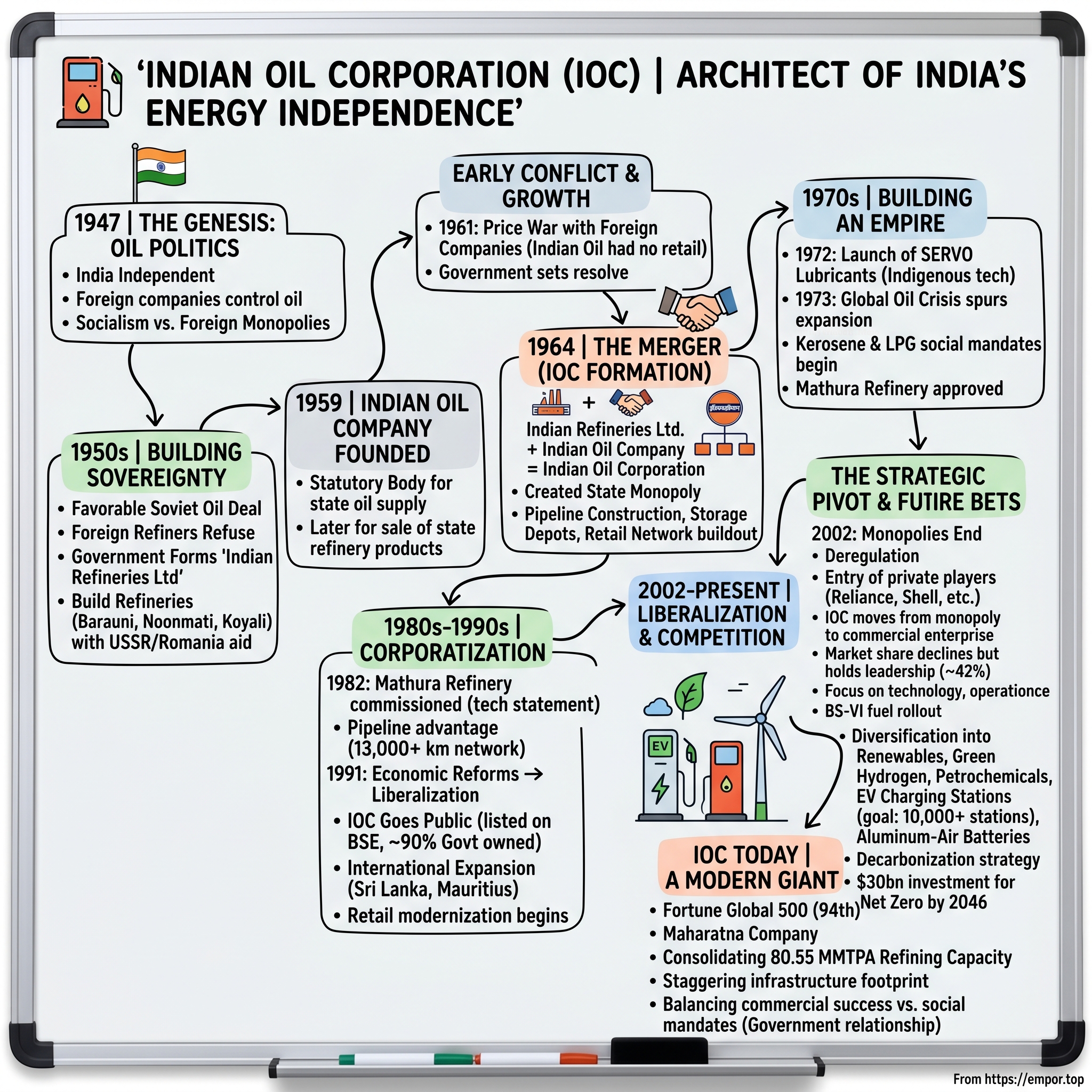
The response came in two pieces, deliberately separated. In August 1958, the government incorporated Indian Refineries Ltd — 100 per cent state-owned, chartered to build refineries and lay pipelines.8 With Soviet and Romanian technical assistance, it went after three greenfield sites: Noonmati in Assam, Barauni in Bihar, and Koyali in Gujarat.8 These were not simply factories; they were placed to serve regions the incumbents had underserved, and they came with the transfer of process knowledge that the private majors had withheld.
Then, on June 30, 1959, the government incorporated the Indian Oil Company Ltd, also wholly state-owned, to market petroleum products across the country.8 Refining and marketing were built as separate instruments, which tells you something about the sequencing of the anxiety: first secure the ability to process, then secure the ability to distribute.
On September 1, 1964, the two were merged and renamed Indian Oil Corporation.8 The new entity was not designed to earn a return on equity. It was designed to guarantee that the fuel supply of a large, poor, newly sovereign country could not be interrupted by a commercial decision taken in London or New York.
That founding purpose has never been formally retired. Sixty-two years later, when a listed IOC absorbs a hundred rupees a litre of diesel under-recovery so pump prices do not move during a Middle East conflict, it is executing the 1958 mandate. The share listing came later and changed the reporting obligations. It did not change what the institution is fundamentally for. Understanding that is the difference between reading IOC's results as a series of operating surprises and reading them as the predictable output of a company built for a different objective function.
What the merger created next, though, was something the founders may not have fully anticipated: a distribution monopoly of extraordinary durability.
III. Building the Monopoly Backbone (1964–1991)
The single most consequential sentence in Indian Oil's corporate history was not spoken by a founder. It was a government policy note issued around the 1964 merger: all future refinery partnerships in India would be required to sell their products through Indian Oil.8
Read that again with an investor's eye. Any foreign or private company that wanted to build refining capacity in India could do so — and then had to hand the output to a state marketing company to sell. IOC did not have to win customers. It did not have to out-market anyone. Every incremental barrel refined in the country flowed into its distribution system by law. That monopoly on marketing, alongside an exclusive grip on crude imports that persisted until April 2002, is the foundation on which everything visible today was poured.8
Monopolies granted by decree usually produce sclerotic organisations. What makes IOC's case unusual is what it did with the guaranteed volume: it built physical infrastructure that would have been irrational for a competitive company to fund, and which turned out to be the real asset.
Consider the pipelines. Moving petroleum products across a subcontinent by rail rake or tanker truck is expensive, slow, and lossy. Moving them by pipe is roughly the difference between couriering a letter and sending an email — enormous fixed cost up front, then a marginal cost per tonne-kilometre so low it reshapes where you can profitably compete. IOC spent decades laying that grid, and by FY25 it stood above 20,000 kilometres.4 In FY26 it pushed 105.556 million tonnes through it, and in the June 2026 quarter alone set a record of 28.5 million tonnes.52
Here is the part that matters for the next fifty years: a competitor cannot replicate that network. Not because the engineering is hard, but because acquiring a continuous right-of-way across thousands of kilometres of Indian farmland, forest, and municipality is a multi-decade political and legal undertaking that no private balance sheet will underwrite for a commodity-margin business. The pipelines were built under a legal regime and a land-acquisition environment that no longer exists. They are, in the most literal sense, unrepeatable.
The second thing IOC did with its protected position was less obvious and more revealing: it tried to build a brand.
In 1972, the company set up its R&D centre at Faridabad and launched SERVO, India's first indigenous lubricant brand, formulated to its own specifications rather than licensed from a foreign major.9 A monopolist moving barrels does not need a consumer brand. SERVO was evidence that somewhere inside the state enterprise there were people who wanted to compete on product, and it produced a durable franchise — IOC recorded its highest-ever lubricant sales in FY26, more than five decades later.5
The physical build-out continued through the era. Mathura Refinery was commissioned in 1982 at 6.0 MMTPA to serve the north-western region including what would become the National Capital Region — a plant deliberately sited near demand rather than near a port.10 Panipat followed in 1998 as the seventh refinery, and would eventually become the centre of gravity for the company's chemicals ambitions.8
Then, in 1995, something quietly significant: Indian Oil listed on the Bombay Stock Exchange.11 The government retained overwhelming control and would not divest a meaningful slice — close to 10 per cent — until 2000.8 But from 1995 onward there was a share price, and there were outside shareholders, and there was a published quarterly number that could embarrass people.
That was the first crack in the arrangement. The far bigger crack was already forming, and it arrived from the direction of macroeconomic crisis.
IV. Liberalization and the Competitive Turn (1991–2014)
In 1991, India nearly ran out of dollars. The balance-of-payments crisis that forced the country to airlift gold to London also forced the dismantling of the licence system that had made companies like Indian Oil untouchable. Over the following decade, the protective architecture came down in stages — and unlike in telecom or aviation, where liberalisation arrived as a thunderclap, in petroleum it came as a slow, negotiated, politically fraught retreat.
The Administered Pricing Mechanism — the system under which the government set petroleum product prices and settled the difference through an oil pool account — was formally dismantled in 2002, the same year IOC's monopoly on crude imports ended.812 In principle, that made India's fuel market a market.
In practice, it did nothing of the kind. Petrol prices were not actually deregulated until June 2010. Diesel — the fuel of trucks, tractors, buses, and therefore of inflation and of rural politics — was not decontrolled until October 2014, and even then the timing was chosen because global crude was collapsing, making the reform painless.12 Daily price revisions arrived only in 2017.12
That twelve-year lag between formal deregulation and actual deregulation is the single most useful piece of history for anyone trying to understand IOC today. It established a precedent that has never been broken: the Indian state deregulates fuel prices when crude is low and quietly re-regulates them, without changing any statute, when crude is high. The mechanism is not legislation. It is a phone call. The state-owned marketing companies simply decline to raise prices, and because they control roughly nine-tenths of the retail network, the market clears at the price they choose.
Meanwhile, real competitors appeared. Reliance Industries built the Jamnagar complex into the largest refining site in the world and entered fuel retail. Essar Oil constructed Vadinar; that asset would later be sold to a Rosneft-led consortium and renamed Nayara Energy. Fellow public-sector firms BPCL and HPCL, once part of the same national plan, became rivals for the same dealers and the same corners.
The first private retail entry was instructive. When crude spiked in 2005-06 and PSU pumps sold below cost, private retailers could not match the subsidised price and simply shut their outlets. Competition in Indian fuel retail is not a contest of efficiency; it is a contest of who can afford to lose money when the state decides prices should not move. That asymmetry protected IOC's share far more effectively than its brand did — and it is a protection that cuts both ways, since the price of the protection is the losses themselves.
IOC's own response through this period was technological and, tentatively, international. It upgraded refineries to meet successively tighter fuel specifications. It took control of a Sri Lankan retail and storage business, operating as Lanka IOC. It picked up exploration stakes and overseas trading arms. None of this became a growth pillar — the international footprint remains a modest contributor against a domestic base measured in lakhs of crores — and it is best understood as a competent conglomerate's diversification reflex rather than a strategic pivot.
By 2014, then, the shape of the modern company was set: a liberalised market in law, a managed market in practice, a dominant incumbent with unrepeatable physical assets, and a growing set of private competitors waiting for the state to stop intervening.
That is the machine we now need to take apart.
V. The Core Engine: Refining and Fuel Retail at National Scale
Start at a single nozzle. A motorcyclist in Kanpur pulls into an IndianOil pump and buys two litres of petrol. Trace that transaction backwards and you get the entire company.
The petrol came from a tank buried under the forecourt, filled by a tanker from a depot, fed by a pipeline, supplied by a refinery, which processed crude that arrived at Paradip or Vadinar or Mundra on a VLCC that loaded in the Persian Gulf, West Africa, the Baltic, or the US Gulf Coast five weeks earlier. IOC owns or controls essentially every link in that chain. That is what "integrated" means, and it is why the company's economics cannot be understood by looking at revenue.
The two margins that are the whole business
IOC makes money in two places, and they behave completely differently.
The first is the gross refining margin, or GRM: the difference between what a barrel of crude costs and what the basket of products squeezed out of it sells for, expressed in dollars per barrel. Think of a refinery as a very expensive kitchen. Crude oil is a mixed grocery bag you cannot choose. The kitchen's skill is in turning the cheap, ugly, heavy parts of that bag into the expensive dishes — diesel, jet fuel, petrol — instead of leaving them as fuel oil and bitumen. A more "complex" refinery, with more secondary processing units, can buy uglier groceries and still produce expensive dishes. That complexity is the source of structural GRM advantage, and it is why refinery upgrade capex is not optional.
The second is the marketing margin: the spread between the price at which the marketing arm buys product and the price on the board at the pump, minus the cost of moving and storing it and paying dealers. In a functioning market this is a modest, stable, boring spread. In India it is neither modest nor stable, because the retail price is politically determined and the purchase cost is not.
Revenue tells you almost nothing about either. In FY26, IOC's revenue rose about 5 per cent to ₹8,86,224 crore while standalone net profit rose 184 per cent to ₹36,802 crore from ₹12,962 crore.5 The volume barely moved. The margins did everything.
The volatility is genuinely extreme. IOC's reported GRM was $12.05 per barrel in FY24, then $4.80 in FY25 — a collapse of roughly 60 per cent that dragged standalone profit from ₹39,619 crore to ₹12,962 crore.4 Quarterly, it is worse: GRM of $6.39/bbl in the June 2024 quarter fell to $2.15/bbl in the June 2025 quarter.13 CARE Ratings framed the same period sector-wide, putting Indian OMC margins at roughly $4-6/bbl in FY25 against $10-12/bbl in FY24, and attributed the drop to cycle normalisation, weaker middle-distillate cracks, and a shrinking crude discount advantage.14
Here is the analytical point that most coverage of IOC misses: a swing of eight dollars a barrel on roughly 75 million tonnes of throughput is worth vastly more than any conceivable improvement in volumes, market share, or cost control. Everything management does on the operating side — the record throughputs, the 107 per cent utilisation, the pipeline records — is real work that moves earnings by single-digit percentages. The GRM and the marketing margin move earnings by multiples. Investors who focus on IOC's operational excellence are watching the wrong dial.
The distribution moat, stress-tested
IOC's retail footprint is genuinely enormous. Against India's 100,266 fuel outlets as of 2026, IOC operated approximately 41,664 — about 41.5 per cent — with BPCL at 24,605 and HPCL at 24,418, meaning the three state marketers together hold well over 90,000 sites.6 The company's own count was 39,008 at the end of December 2024, up from 37,473 nine months earlier, which tells you the build-out is still running at thousands of sites a year.3
Is that a moat, or just an inherited footprint?
The honest answer is: partly both, and the composition is changing. The moat is real in three respects. Land in Indian towns near arterial roads is genuinely scarce and expensive; the licensing and safety approval process for a new outlet is slow; and dealer relationships, many decades old, are sticky. Fuel is also one of the few genuinely commodity products where Indian consumers have persistent adulteration anxiety, and the PSU brands carry a trust premium that is worth something real at the margin.
But the counter-evidence is accumulating. Nayara Energy crossed 7,000 retail outlets after adding more than 500 in eighteen months — roughly a station a day — a pace it accelerated precisely because Western sanctions closed its export markets and forced it to sell domestically.15 Jio-bp operated about 2,100 outlets and Reliance around 1,500 by 2026.6 These are still small numbers against 41,664. But they are the growth numbers, and they are being added by companies whose pricing is not politically constrained in the same way.
The structural question is what happens to that share in a decade of normal politics. Private retailers gain share when the state lets prices float and lose it — or exit — when it doesn't. So IOC's retail share is, paradoxically, partly a function of how often the government intervenes. Frequent intervention protects share and destroys margin. That is not a trade most shareholders would voluntarily make.
The administered-pricing trap, quantified
We have already seen the 2026 version. The 2022 version was worse in aggregate. After Russia's invasion of Ukraine sent crude vertical, the three PSU marketers held pump prices flat and reported combined losses of ₹21,201 crore in the first half of FY23.16 Compensation followed, partially, unpredictably, and late.
The 2026 episode produced a genuine institutional novelty. With retail prices frozen and losses accumulating, the state marketers on March 26, 2026 fixed internal transfer prices for petrol, diesel, ATF and kerosene at a discount of up to ₹60 per litre to import parity, effective retroactively from March 16.1 In effect, the marketing arms stopped paying refiners the market price. For a vertically integrated company like IOC this shuffles profit from one internal segment to another. For standalone refiners such as MRPL, CPCL and HMEL — companies that only refine and must sell to the marketers — it transfers the loss directly onto their income statement.1
Note what happened there. Deregulated pricing, in a moment of stress, was replaced by an administered transfer price agreed among the state-controlled players. No law changed. This is the mechanism described in the previous section, operating in real time, and it is the clearest available evidence that the 2010 and 2014 deregulations are conditional rather than structural.
LPG and the social mandate
Domestic cooking gas is the purest expression of the dual-master problem. IOC's Indane brand is one of the two or three largest LPG distribution businesses in the world by customer count, and under the Pradhan Mantri Ujjwala Yojana the government extended subsidised connections to tens of millions of poor households — an unambiguous public-health success, as it displaced biomass cooking that was killing people.
It is also a loss-making obligation carried on a listed company's balance sheet. Cylinder prices are set politically; international LPG prices are not. In June 2026, IOC's under-recovery ran at ₹665 per cylinder, and management guided to roughly ₹250 per cylinder for the September quarter assuming Saudi contract prices held.2 The state does compensate — the Union Cabinet approved ₹30,000 crore of compensation to the three OMCs for FY25 LPG under-recoveries, payable in twelve tranches, alongside ₹12,060 crore of targeted Ujjwala subsidy for 10.33 crore households in FY26.17
But look at the mechanics. Compensation is approved by Cabinet after the losses are incurred, disbursed over a year, and recognised as revenue when received rather than when the loss occurs. IOC booked ₹6,035.85 crore of LPG compensation covering November 2025 to March 2026 in its FY26 accounts.18 That means the reported profitability of any given quarter depends partly on the timing of a Cabinet decision. This is an accounting judgment worth watching: it is legitimate, it is disclosed, and it makes quarterly comparisons across the LPG line close to meaningless without adjustment.
Where IOC wins, and where it doesn't
IOC's genuine advantages are physical and legal: refining scale close to demand, an irreplaceable pipeline grid, the largest dealer network in a country adding vehicles fast, and a brand with real trust equity in a category where trust is scarce. Those are durable.
Its disadvantage is precise and severe: it does not control its own selling price in the moments when price control matters most. Reliance and Nayara face the same crude market and the same product cracks, but they are not asked to absorb a hundred rupees a litre of diesel under-recovery for political reasons. Over a full cycle, that asymmetry is a permanent haircut on IOC's realised return relative to its asset quality — and it is the single best explanation for why the equity persistently trades at a discount to what the balance sheet and the throughput would otherwise support.
For the last four years, though, that haircut was partly offset by something no strategic plan anticipated: a war.
VI. The Russian Crude Pivot and Its Aftershocks (2022–2026)
In February 2022, Russian tanks crossed into Ukraine and the crude oil market broke into two.
Western buyers stopped lifting Russian barrels. Russia still had to sell them. And a few thousand kilometres to the south sat the world's third-largest oil importer, a country with enormous refining capacity, a chronic current-account problem, a foreign policy of studied non-alignment, and refineries technically capable of running medium-sour Urals crude.
The scale of what followed is hard to overstate. Russian oil had been about 2.5 per cent of India's imports in 2021.19 Within two years it settled around a third of the barrel and stayed there through 2026.20 In July 2026, Russian supply to India hit a record of roughly 2.8 million barrels per day, before slipping back below 40 per cent of the crude basket in August.21 India became Russia's second-largest fossil fuel customer after China, accounting for around 37 per cent of Russian crude exports.19
IOC was among the largest single buyers in that trade.
The arbitrage, and what it was actually worth
The commercial logic was simple. Sanctioned barrels sell at a discount because the buyer pool shrinks. In the early phase, Urals traded well below Brent at Indian ports, and Indian refiners captured that spread as pure margin.
Then it compressed — not because sanctions eased, but because the arbitrage worked. More Indian and Chinese refiners competed for the same discounted cargoes, Russian sellers regained pricing power, and shipping and insurance workarounds got priced in. CARE Ratings identified the shrinking crude discount as one of the explicit drivers of the FY25 GRM collapse from $10-12/bbl to $4-6/bbl across Indian OMCs, alongside weaker middle-distillate cracks.14
That sequence deserves to be stated plainly, because it is the most important analytical lesson of the period: a meaningful share of the FY23-FY24 refining outperformance that Indian refiners reported was discount capture, not refining skill. It was a transfer of economic rent from a sanctioned seller to a willing buyer, available to anyone with the right crude slate and the political cover to transact. It was never a durable competitive advantage, and the FY25 numbers proved it when the discount narrowed. Any investor who capitalised that windfall into a permanent margin assumption learned an expensive lesson in FY25.
Sanctions escalate — and hit a competitor harder
The regime tightened repeatedly. The G7, EU and Australia imposed a $60 price cap in December 2022, later reduced by the EU and UK to roughly $48.19 On October 22, 2025, the United States sanctioned Rosneft and Lukoil — together suppliers of around 60 per cent of India's Russian crude — with the measures taking effect on November 21, 2025; the EU adopted its 19th package the same day.19
But the most consequential action for Indian competitive dynamics came earlier. In July 2025, the EU's 18th sanctions package named Nayara Energy directly, citing Rosneft's 49.13 per cent shareholding and Nayara's reliance on Russian feedstock.15
What followed was a live demonstration of how quickly financial plumbing becomes a strategic vulnerability. State Bank of India halted Nayara's overseas transactions over sanctions-risk concerns.22 Nayara approached the Indian government for help shipping its fuel as lenders and shipowners backed away.23 The government ultimately routed Nayara's trade payments through UCO Bank — reportedly chosen for its prior experience handling Iran oil trade, precisely because it has minimal Western exposure to lose.24
This is a genuinely unusual competitive situation. Sanctions aimed at Russia did more damage to IOC's largest private domestic competitor than to IOC itself. And yet the second-order effect was not obviously favourable: cut off from export markets, Nayara redirected its output into the Indian domestic market and accelerated retail expansion to over 7,000 outlets.15 A competitor that cannot export becomes a more aggressive competitor at home. Investors reading the sanctions headlines as unambiguously good for IOC's market position had the sign wrong.
Diversification, in real time
IOC's own response has been to reduce single-source dependence — and the disclosure around it has been unusually specific.
Chairman Arvinder Singh Sahney described the shift in structural terms: a few years ago about 80 per cent of purchases were term contracts; the company had moved to roughly 60 per cent term and 40 per cent spot, and was heading toward an even split. His stated reasoning was operational rather than geopolitical — "If you are saddled with more term contracts, people don't approach you when there are opportunity crudes."25
The mix has moved fast. US crude rose from about 2 per cent of IOC's basket to nearly 7 per cent during 2025-26, driven, per management, by relative value rather than diplomacy.26 Sahney has also said the company would evaluate Venezuelan barrels if they became available.26 By the June 2026 quarter, under the pressure of the West Asia conflict, spot purchases had surged to 84 per cent of procurement from 51 per cent a year earlier, with cargoes sourced from Russia, Venezuela, Brazil and West Africa, and peak procurement premiums reaching around $10 per barrel over Brent.2 Bloomberg reported IOC buying record volumes on the spot market as Middle East supply was disrupted.27
Read those two facts together and the strategy reveals its cost. Flexibility is genuinely valuable when discounted barrels appear. It is expensive when supply is short, because a spot-heavy buyer pays the panic price. IOC has chosen optionality over certainty in crude sourcing — a defensible choice, but one that will amplify, not dampen, the earnings volatility that already defines the company.
The receipt
The last three years of reported profit are the cleanest possible illustration. Standalone net profit of ₹39,619 crore in FY24, collapsing to ₹12,962 crore in FY25 — including a December 2024 quarter down 77 per cent to ₹2,115 crore — then recovering through FY26 quarter by quarter: ₹5,689 crore in June 2025, ₹7,817 crore in September, and ₹11,378 crore in the March 2026 quarter, for a record standalone year of ₹36,802 crore and consolidated profit of ₹42,096 crore.42813292518 And then, three months later, a loss of ₹2,661 crore.2
That is a company whose annual profit moved by a factor of three in each direction within thirty-six months, on volumes that changed by single-digit percentages.
The June 2026 quarter is worth dissecting because it inverts the usual narrative. Management reported a GRM of $15.59 per barrel net of the special additional excise duty — the windfall levy on fuel — and said the figure would have been roughly $36 per barrel excluding that levy.230 In other words, refining had a spectacular quarter. The loss came from everything downstream: crushed retail marketing margins under the price freeze, LPG under-recoveries at ₹665 a cylinder, and adverse inventory effects from crude racing upward, with EBITDA falling to ₹2,332 crore from ₹22,345 crore in the prior quarter.302 On the call, Director (Finance) Anuj Jain framed the result as needing to be "viewed in the context of heightened geopolitical tensions and ongoing conflicts."2
That framing is accurate as far as it goes — the West Asia conflict did drive the Indian crude basket to $100.74 per barrel, up 21.4 per cent sequentially.2 But it is also incomplete in an important way. Crude spikes are a risk every refiner faces. What made IOC's quarter a loss rather than a squeeze was the decision — not made by IOC — not to pass the cost through. The geopolitics explains the input price. The ownership structure explains the outcome.
Which brings us to the thing management has decided to do about it.
VII. The ₹1 Trillion Petrochemicals Bet
In early August 2026, on an investor call, IOC's management laid out the largest capital commitment in the company's history: approximately ₹1 trillion over five to six years, to raise petrochemical intensity — the share of processed crude converted into chemicals rather than fuels — from about 6.5 per cent toward 16 per cent.31 On the June-quarter earnings call the same programme was described with a 15 per cent intensity target and the same roughly ₹1,00,000 crore price tag.2
To understand why, you have to understand what a barrel is for.
The oil-to-chemicals logic, in plain terms
Every barrel of crude is a mixture. Refining separates and reshapes it. Traditionally, the valuable output was fuel: petrol, diesel, jet. But the same molecules can be routed differently — a naphtha cracker breaks them into ethylene and propylene, which become polyethylene and polypropylene, which become packaging, pipes, car parts, textiles, and everything else plastic.
The strategic argument is straightforward. Fuel demand in a country is ultimately capped by the vehicle fleet and eroded over time by electrification. Petrochemical demand tracks GDP, urbanisation, and consumption — and India's per-capita polymer consumption remains a fraction of the global average. A refiner that can dial its output between fuels and chemicals depending on which is worth more is structurally less exposed to any single demand curve. Management has argued petrochemicals carried roughly 25 per cent higher margins than fuels in FY25.
Former chairman S.M. Vaidya put the thesis on the record in 2024, describing the oil-to-chemicals approach as a way to "enrich our value chain, meet rising petrochemical demand, reduce import reliance, and insulate the bottom line from the impacts of oil price fluctuations."32
That last clause — insulate the bottom line — is the claim that deserves the most scrutiny. Petrochemicals are cyclical too. Global polyolefin margins have been depressed for years under a wave of Chinese and Middle Eastern capacity additions. Chemicals diversify IOC's cycle exposure; they do not eliminate it. A company adding 9 MTPA of polymer capacity into a structurally oversupplied global market is taking a considered risk, not buying an insurance policy.
The numbers, and the trajectory of the target
The base is small. IOC's petrochemical capacity was 4.28 MTPA in FY24 with a Petrochemical Intensity Index of 6.1 per cent; the target was 14 MTPA and 15 per cent PII by 2030, with about ₹30,000 crore of projects under implementation and ₹90,000 crore in feasibility studies at that time.32 Petrochemical sales reached a record 3.294 MTPA in FY26.5
The centrepiece is Paradip in Odisha — a roughly ₹61,000 crore mega complex built around a 1.5 million tonne naphtha cracker with downstream polypropylene, polyethylene and PVC units, targeted for completion around August 2029.32 Nearer term, the PX-PTA complex at Paradip, an ₹13,805 crore project producing 800,000 tonnes of paraxylene and 1.2 million tonnes of purified terephthalic acid for the textile chain, was 94.6 per cent complete as of June 30, 2026 with commissioning targeted for the end of August 2026 — and notably, on budget.33
The credibility test: Panipat
Here is where an analyst should slow down. IOC's ability to announce a ₹1 trillion programme is not in question. Its ability to deliver one is, and there is a specific, documented precedent.
The Panipat expansion — lifting the refinery from 15 to 25 MTPA, with a polypropylene unit, a catalytic dewaxing unit, and a 60,000 tonne polybutadiene rubber plant attached — was originally budgeted at roughly ₹32,946 crore for a September 2024 start-up.33 In December 2023, IOC raised the estimated cost about 10 per cent to ₹36,225 crore and pushed the deadline out by more than a year, to December 2025.34 As of June 30, 2026, the project was 94 per cent complete, the investment required had risen to ₹38,231 crore, and commissioning had moved again to December 2026.33
So: roughly two years late against the original schedule, and about 16 per cent over the original budget. Management has attributed the escalation to COVID-era construction disruption and Ukraine-related supply-chain pressure — genuine, industry-wide causes that affected every large project globally.34
The pattern is not confined to Panipat. The Koyali expansion from 13.7 to 18 MTPA was 89.2 per cent complete at ₹18,936 crore against an earlier ₹17,825 crore. Barauni, going from 6 to 9 MTPA, was 91.6 per cent complete at ₹18,113 crore against an original ₹14,800 crore — a roughly 22 per cent overrun.33
What does this tell us? Two things, and they point in opposite directions.
The negative reading: on a portfolio of four major projects, three ran materially over budget and at least two ran materially late. If a ₹1 trillion programme experiences the same 15-20 per cent escalation, that is ₹150,000-200,000 crore of unbudgeted capital — a sum comparable to the company's entire current borrowing.
The more generous reading: the projects are being finished. Panipat at 94 per cent, Koyali at 89 per cent, Barauni at 92 per cent, PX-PTA at 95 per cent and on budget, with four major commissionings clustered into late 2026 — that is a delivery organisation, not a stalled one. And Indian project cost overruns of 15-20 per cent across a pandemic and a European war are, in context, unremarkable.
The fair conclusion is that IOC has demonstrated it can build very large refining assets, and has not yet demonstrated it can build them on the schedule and budget it announces. For a ₹1 trillion programme, that distinction is worth many thousands of crore.
The Reliance comparison
The obvious benchmark is Reliance Industries, which spent two decades building the world's most integrated refining-to-chemicals complex at Jamnagar and now runs a petrochemical business at a scale and integration depth IOC will not approach this decade.
Is IOC therefore late and under-scaled? Partly, yes — it is entering a market where the incumbent has twenty years of learning curve and where global capacity is abundant. But the strategic situations are not identical. Reliance built chemicals as its primary business and bolted retail on afterwards. IOC has captive refining feedstock at eleven sites, a pipeline network to move product, and — this is the underrated part — an existing industrial distribution relationship with much of Indian manufacturing. It is not trying to out-Jamnagar Jamnagar. It is trying to stop exporting naphtha and start selling polymer.
That is a rational, defensible use of assets it already owns. Whether it earns an adequate return depends almost entirely on where global polymer margins sit in 2030 — a variable IOC does not control and cannot hedge.
The chairman question
One uncomfortable governance observation belongs here. Sahney ran IOC's petrochemicals vertical before becoming chairman and was instrumental in conceptualising the Paradip petrochemical complex.35 That is genuine domain expertise, and the continuity between his prior role and the current strategy is a reasonable signal that the plan is technically grounded rather than consultant-generated.
It is also, structurally, a chairman championing the expansion of the division he built. A sceptical investor is entitled to ask whether the ₹1 trillion figure survived the same hurdle-rate scrutiny it would have received from a chairman with a marketing or finance background — particularly in a PSU where the board's independent directors are government appointees and the controlling shareholder has industrial-policy objectives that do not perfectly align with return on capital. Nothing disclosed suggests impropriety. The point is that the incentive structure warrants attention, and the disclosure to date has emphasised capacity and intensity targets far more than expected returns.
VIII. Energy-Transition Optionality: Sized to What It Actually Is
At the Panipat refinery, alongside the crude units and the polypropylene plant, a different kind of facility is under construction: a 10,000 tonne-per-annum green hydrogen plant, being built by L&T Energy GreenTech under a 25-year supply agreement, targeted for commissioning by December 2027 and billed as India's largest green hydrogen project to date.36
Hydrogen made from natural gas is standard in refineries — it strips sulphur out of diesel. Making it instead by splitting water with renewable electricity removes the carbon from that step. It is a real decarbonisation move on a real industrial process, not a demonstration project.
It is also, financially, a rounding error, and it is important to say so clearly before cataloguing the rest.
IOC's transition portfolio is broad. The company has targeted net zero by 2046, with plans for 2,750 MW of renewable energy and around 14,000 EV charging stations.37 On the June 2026 call, management referenced an 18 gigawatt renewable capacity ambition over three to four years — a step change from the earlier figure that itself deserves scrutiny for how it will be funded.30 The company has stated an intention to expand green hydrogen capacity toward 350,000 tonnes per year by 2030.38 There is sustainable aviation fuel at Panipat, a programme of compressed biogas plants, and city gas distribution through joint ventures.
The most commercially interesting of these is Indofast Energy, a 50:50 battery-swapping joint venture with SUN Mobility formed in June 2024. Rather than building charging points, Indofast lets two- and three-wheeler drivers exchange a depleted battery for a charged one in under a minute — solving the two problems that actually block Indian electric two-wheeler adoption, which are charging time and the upfront cost of the battery. By December 2025 the venture had over 200 franchise partner stations across 12 cities and had facilitated more than 44.5 million swaps for over 50,000 vehicles.39
The strategic elegance is obvious: a swap station is a forecourt business, and IOC has more forecourts than anyone in India. If electrification comes for the two-wheeler market — the most likely place for it to arrive first — IOC has a mechanism to keep monetising the same real estate.
Now the necessary discipline. Against revenue of ₹8.86 lakh crore, none of this is material.5 Not the hydrogen plant, not the biogas, not the swap stations, not the 3,294 kilotonnes of petrochemicals — well, the petrochemicals will matter, which is exactly why Section VII got three times the space this section does. The transition portfolio should be read as genuine optionality purchased at low cost, plus positioning for a regulatory environment that will eventually price carbon. It should not be read as a growth pillar, and any presentation that gives it equal billing with refining is telling you about narrative priorities rather than economics.
Does it constitute a credible hedge against fuel-demand disruption? Partially, and asymmetrically. The forecourt-based businesses — EV charging, battery swapping, CNG — are credible hedges because they defend the specific asset most at risk. The renewables and hydrogen ambitions are better understood as compliance-driven and reputational, worthwhile but not competitive differentiators against peers making identical announcements.
The honest framing is this: IOC has bought cheap call options on several transition outcomes while keeping essentially all its capital in hydrocarbons. That is probably the correct allocation for the next decade. It is not a transformation, and investors should not pay for one.
IX. Capital Allocation, Ownership, and the Government Relationship
In August 2015, the Government of India offered a slice of Indian Oil to the market as part of its disinvestment programme. The offering raised ₹9,379 crore. The buyer of the overwhelming majority of it was Life Insurance Corporation of India, whose stake jumped from 2.52 per cent to 11.11 per cent as it absorbed 20.87 crore shares.40
That transaction tells you almost everything about the ownership structure. The government sold shares. A government-controlled insurer bought them. The float increased on paper. Genuine outside ownership increased far less.
As of April 2026, promoter holding — the Government of India — stood at 51.51 per cent, with foreign institutional investors at 8.57 per cent, domestic institutions at 19.59 per cent, and retail at 10.34 per cent.7 The controlling shareholder can pass ordinary resolutions unilaterally. The largest institutional holder is itself state-controlled. Minority shareholders own roughly half the economics and functionally none of the control.
Dividends: the good news, honestly stated
IOC's dividend policy is genuinely shareholder-friendly by PSU standards, and the government's own fiscal needs are the reason — the dividend is a meaningful revenue line for the exchequer, which aligns the majority holder with minorities on this one specific issue.
For FY26, the board recommended a final dividend of ₹1.25 per share on top of ₹7 already paid as interim, on a ₹10 face value share.5 For FY25 — the year profit collapsed to ₹12,962 crore — the final dividend was ₹3.00 per share.4
The pattern is the honest one: the payout is roughly a third of profit, and because profit swings by multiples, so does the rupee dividend. That is not a policy failure; it is arithmetic. But it does mean IOC cannot be modelled as a stable-income holding. An investor buying for yield is buying a claim on a number that halved and then tripled inside three years.
The balance sheet under a ₹1 trillion commitment
This is where the stress test bites hardest.
IOC guides to annual capex of ₹30,000-40,000 crore, with ₹32,700 crore targeted for FY27, of which ₹6,461 crore was spent in the June quarter — ₹3,945 crore in refining and ₹1,418 crore in marketing.230 Against that, throughput guidance rises from 77 MMT in FY27 to 85 MMT in FY28 and 90 MMT in FY29 as the four expansions commission.2
Now overlay the debt. FY26 was a deleveraging year: strong profits allowed total borrowings to fall by ₹23,798 crore.5 One quarter later, borrowings had risen from ₹1,10,668 crore in March 2026 to ₹1,41,453 crore in June — an increase of ₹30,785 crore, or 28 per cent, in ninety days.30
That single data point is the most important thing in this section. A quarter of loss-making, working-capital-consuming operations — crude bought at $100 and sold at frozen retail prices, with inventory building at high cost — added nearly ₹31,000 crore of debt. That is roughly one full year of planned capex, consumed by three months of adverse pricing policy.
The implication for the petrochemicals programme is direct. The ₹1 trillion is fundable comfortably out of internal accruals in years like FY26. It is not fundable out of internal accruals in years like FY25 or quarters like June 2026. IOC is therefore committing to a decade-long capital programme whose funding depends on an earnings stream the company does not fully control. The likely outcome is not project cancellation — PSU capital programmes rarely get cancelled — but leverage that ratchets upward during political price freezes and pays down in good years. Interest expense was ₹1,610 crore in the June quarter, down from ₹1,849 crore, so the burden is manageable today.30 The question is what it looks like after two consecutive intervention years coinciding with peak capex.
The activist stress test
Suppose a genuinely independent investor with a large stake sat across from this board. What would they say?
They would start with the compensation asymmetry. When the government directs a price freeze, the loss is immediate, certain, and borne 100 per cent by the income statement — of which minorities own roughly half. The compensation, when it comes, is partial, discretionary, delayed, and confined to LPG; auto fuels receive no compensation at all.1 There is no formula, no statutory entitlement, no defined lag. A private company forced to sell below cost by regulation would litigate or exit. IOC does neither, because its controlling shareholder is the regulator.
They would note the recurrence. This is not a tail risk that materialised once. Price-freeze episodes hit PSU marketers in 2008, in 2011, in 2022, and again in 2026.161 Four times in eighteen years is not an outlier — it is the base rate, and it should be modelled as such rather than treated as an exceptional item each time it appears.
They would push on disclosure. IOC reports GRM, throughput, sales volumes and pipeline utilisation in useful detail. It discloses marketing margins far less crisply, and the retroactive product transfer-price arrangement of March 2026 was a material change to inter-segment economics that reached investors largely through the trade press rather than as a prominently framed disclosure.1
And they would ask the uncomfortable structural question: what is the actual mechanism by which a minority shareholder's interests get represented when the controlling shareholder, the price regulator, the compensation-approver, the appointer of the chairman, and the largest institutional co-investor are all, ultimately, the same party?
There is no satisfying answer. That absence is the governance discount, and it is not going away.
X. Management Credibility Under Pressure
Arvinder Singh Sahney took over as chairman on November 13, 2024 — three weeks before the quarter in which IOC's profit would fall 77 per cent.4128 It was not a gentle start.
His profile is that of a career operator rather than a policy appointee: a chemical engineer from HBTI Kanpur, more than three decades inside IOC, experience across five of its refineries, and a record that includes commissioning and optimising the 15 MMTPA Paradip refinery before heading the petrochemicals vertical.4135 In a sector where PSU leadership sometimes rotates in from the civil service, an insider who has personally started up a greenfield refinery brings a different kind of authority to a discussion about project schedules.
The test of any management team is not what they say when results are good. It is what they say when results are bad, and whether the story stays the same.
On the consistency question, Sahney scores reasonably well. The crude-sourcing narrative he articulated in September 2025 — moving from 80 per cent term contracts toward a 50-50 term-spot split, explicitly to stay available for opportunity cargoes — was followed by observable behaviour.25 US crude went from about 2 per cent of the basket to nearly 7 per cent in 2025-26.26 By June 2026, spot was 84 per cent of procurement.2 The action matched the stated strategy. That is the simplest and most useful form of management credibility: the thing they said they would do is visible in the operating data.
The petrochemicals narrative is similarly consistent across administrations, which matters. The 6.1 per cent intensity and 14 MTPA-by-2030 targets articulated under Vaidya in 2024 map onto the 6.5-to-15/16 per cent intensity framing in 2026.32312 The strategy has not drifted with the chairman, which argues it is institutional rather than personal — and slightly weakens the pet-project concern raised earlier, without eliminating it. One inconsistency worth flagging: the target has been stated as both 15 and 16 per cent intensity in different 2026 communications, and the capacity endpoint has been quoted at both 13 and 14 MTPA. Small, but on a ₹1 trillion programme, precision in the stated goal is not a trivial expectation.
Where the record is weaker is in how misses get explained.
Anuj Jain's framing of the June 2026 loss — that it must be viewed in the context of heightened geopolitical tensions and ongoing conflicts — is the recurring pattern.2 Crude volatility and government pricing policy are genuinely the dominant drivers, so this is not dishonest. But it is also a framing that assigns approximately zero of the outcome to anything management controls. Inventory positioning ahead of a foreseeable conflict escalation, hedging policy, the decision to run 84 per cent spot into a shortage and pay $10 over Brent — these are choices, and they are not discussed with the same specificity as the external factors.
The clearest contrast is with project execution. IOC's disclosure on the four major expansions is admirably granular: percentage completion, revised cost, revised date, project by project.33 The company does not hide the Panipat slippage; it publishes it. But the explanation is consistently external — COVID, Ukraine, supply chains — and there is little public discussion of what changed internally in project management as a result, or what the ₹1 trillion programme will do differently.34
The pattern, then, is a management team that discloses more than it explains. The data is there. The accountability narrative is thinner. For investors, the practical response is to weight the disclosed operating data heavily and the guidance framing lightly — and to watch the four late-2026 commissionings as the single best real-time test of whether this team's revised dates are now reliable.
XI. Playbook: Durable Lessons
Strip away the specifics of Indian energy policy and four transferable lessons remain.
Infrastructure is the moat that commodity businesses actually have. IOC does not have a better molecule than BPCL. What it has is 20,000-plus kilometres of pipeline and 41,664 forecourts, assembled over sixty years under land-acquisition and licensing conditions that no longer exist. In commodity businesses, the durable advantage is almost never the product — it is the cost and reach of getting the product to the customer, and the physical impossibility of a competitor reproducing that path. The corollary is unglamorous: the capital that builds such a moat looks wasteful for a very long time before it looks brilliant.
State ownership is a genuine asset and a genuine liability, and you cannot unbundle them. IOC gets guaranteed market access, sovereign-adjacent credit standing, and a government that will find a way to keep it solvent. It pays for those with an inability to price its own product when pricing matters most. Investors in state-linked champions anywhere — from national carriers to utilities to banks — should resist the temptation to underwrite the benefits and treat the costs as episodic. They are the same arrangement viewed from different ends of the cycle.
Do not capitalise a windfall. The Russian crude discount was worth billions and it was, always, a temporary transfer of rent from a sanctioned seller under duress. It compressed exactly as economics predicted once enough buyers arrived. The discipline required is to bank a windfall into the balance sheet and into permanent-advantage assets, and to keep telling investors it is temporary while it is still generating headlines. The market's willingness to extrapolate is not management's excuse.
Sequence diversification around the cash engine, not instead of it. IOC's petrochemicals push uses crude it already processes, at sites it already owns, fed by pipelines it already built, sold partly to industrial customers it already serves. Its transition portfolio clusters around forecourts it already operates. Neither requires the company to become something it is not. Compare that to the numerous energy majors that bought unrelated renewable platforms at cycle peaks and wrote them down. Adjacency is not a lack of ambition; it is the discipline of building where your existing assets create real advantage.
The fifth lesson is the one IOC has not yet passed: announcing capital and deploying capital are different skills, and the market should price them differently. Which brings us to the case for and against.
XII. Industry Structure and Bull vs. Bear
Porter's Five Forces
Threat of new entrants: low, but not zero. Building a refinery in India requires tens of thousands of crore, environmental clearance, coastal or pipeline access, and a decade. Building a competitive retail network requires thousands of land parcels. Yet Nayara added over 500 outlets in eighteen months and Jio-bp reached about 2,100, so entry at the retail layer is difficult rather than impossible — particularly for entrants who already own refining capacity.156
Buyer power: moderate, and structurally odd. Retail fuel buyers are atomised and have near-zero individual power. But collectively, as voters, they have enormous power — exercised through the government rather than the market. This is the inversion at the heart of IOC: its customers cannot negotiate, and yet they set the price.
Supplier power: elevated and rising. Crude suppliers are sovereigns and national oil companies. IOC's response — spot-heavy, geographically diversified procurement — reduces dependence on any one supplier but increases exposure to spot price spikes, as the $10-over-Brent premiums of mid-2026 demonstrated.2
Threat of substitutes: low today, real over a decade. Electric two- and three-wheelers are scaling in India now; passenger cars and heavy freight are further out. CNG and biofuels are chipping at the edges. None of this dents FY27 volumes. All of it matters to a company committing capital through 2035.
Rivalry: intense but non-price. BPCL and HPCL are effectively identical competitors with identical pricing constraints, so rivalry expresses itself as outlet count, loyalty programmes and dealer capture rather than price. Nayara and Reliance can compete on price when the state is not intervening — which is precisely when PSU margins are healthiest.
7 Powers
Applying Helmer's framework, IOC has two powers clearly and one contestably.
Scale economies are real and substantial. Fixed costs across refining, pipelines and a national logistics network are spread over 105 million tonnes of annual sales.5 No Indian competitor amortises fixed cost over a comparable base.
Cornered resource applies to the pipeline right-of-way and the forecourt land bank — assets that cannot be recreated at any reasonable price, which is the definition of the power.
Counter-positioning is the contestable one, and it runs in reverse. IOC does not hold a counter-positioning advantage; it holds a counter-positioning liability. Nayara and Reliance operate a business model IOC cannot imitate — pricing to the market at all times — precisely because IOC's ownership prohibits it. In Helmer's terms, the incumbent is the one who cannot respond.
What IOC conspicuously lacks is branding power in the pricing sense (it cannot charge more), switching costs (a driver passes three pumps a day), and network economies (one more IOC customer does not make IOC better for the next).
Bull Case
The refining-to-retail footprint is not replicable within an investment horizon. Land, right-of-way, licensing and capital together create a barrier that even well-funded challengers are crossing at a few hundred outlets a year against a base above forty thousand.6
The petrochemicals programme targets genuine structural demand. Indian polymer consumption per capita has substantial room to grow, and IOC would be converting naphtha it currently exports into products it can sell domestically. Even a mediocre return on ₹1 trillion diversifies the earnings base away from a fuel demand curve that eventually flattens.
Crude flexibility has demonstrated real optionality value. The move from 80 per cent term toward an even term-spot split, plus a supplier list spanning Russia, the US, Brazil, West Africa and potentially Venezuela, gives IOC the ability to capture dislocations when they appear.25262
Government backing is worth something concrete. IOC can carry ₹1.4 lakh crore of borrowing through a loss-making quarter without a financing crisis. Its competitors could not lose ₹105 a litre on diesel for a quarter and survive it. In genuine stress, sovereign proximity is an asset.
And the near-term operating setup is favourable: four major expansions commissioning by end-2026, throughput guided from 77 MMT in FY27 to 90 MMT in FY29, and the PX-PTA complex adding petrochemical earnings on budget.233
Bear Case
Earnings are structurally volatile and partly outside management's control. Standalone profit of ₹39,619 crore, then ₹12,962 crore, then ₹36,802 crore, then a quarterly loss — with volumes moving by single-digit percentages.452 No discounted cash flow survives contact with that series, which is a large part of why the equity carries a persistent valuation discount.
The compensation mechanism is discretionary and incomplete. LPG under-recoveries get Cabinet-approved compensation on a lag; auto fuel under-recoveries get nothing.171 Minorities absorb the difference.
Petrochemicals execution risk is demonstrated, not theoretical. Panipat is roughly two years late and about 16 per cent over its original budget; Barauni is about 22 per cent over.3334 Extrapolating that experience to ₹1 trillion produces a number large enough to matter.
The Russian discount was a windfall, not an edge, and its compression already showed up in the FY25 margin collapse.14 The sanctions regime remains a moving target — Rosneft and Lukoil sanctions took effect in November 2025, and India's Russian share has oscillated since.1921
Electrification is a genuine long-horizon threat to the specific asset that constitutes the moat. Battery swapping and EV charging are sensible hedges but currently immaterial.3937
And the balance sheet can move fast in the wrong direction. Borrowings rose ₹30,785 crore in a single quarter under a price freeze — roughly a full year of planned capex, absorbed in ninety days.30
The three KPIs that matter
Everything above collapses into three numbers worth tracking every quarter.
One: reported GRM per barrel, alongside the normalised figure. This is the single largest swing factor in IOC's earnings. The gap between reported and normalised isolates inventory and duty effects from actual refining performance — and after the four expansions commission, the normalised figure is the cleanest test of whether the added complexity delivers the structurally higher margin management implies.
Two: marketing margin, proxied by under-recovery per litre on auto fuels and per cylinder on LPG. This is the direct measurement of the political tax. When these are near zero, IOC earns what its assets deserve. When they widen, the shortfall flows straight to the bottom line, partially and belatedly reimbursed at best.
Three: petrochemical intensity index. The stated goal is 6.5 per cent toward 15-16 per cent. This is the clearest single measure of whether the ₹1 trillion is converting into a different business mix or merely into announcements. It moves slowly, which is exactly why it cannot be faked.
XIII. Risk Radar
Crude and refining-margin cyclicality. The dominant risk, and the mechanism is simple: IOC buys crude weeks before it sells product, so a rapid price move creates inventory gains or losses independent of operating performance. In the June 2026 quarter this produced a roughly ₹15,000 crore finished-goods inventory gain offsetting crude-side losses — a set of entries larger than the entire quarterly result and driven purely by price timing.2 Any quarter can be dominated by this effect in either direction.
Geopolitical and sanctions risk in sourcing. IOC's crude slate is now deliberately opportunistic. That means exposure to whichever supplier becomes sanctioned next, and to the payment and shipping infrastructure that supports discounted barrels. The Nayara experience showed how quickly banking access can be withdrawn once a Western regulator acts.2224 IOC is far less exposed than Nayara, but the mechanism is identical, and its Russian volumes remain substantial.21
Regulatory and political pricing risk. The most company-specific risk and the least forecastable. Freezes are triggered by crude spikes, election calendars, and inflation prints. Compensation is discretionary. The March 2026 introduction of administered inter-company transfer prices showed that the state can reallocate margin along the value chain without any change in law.1
Execution risk on ₹1 trillion. Discussed at length; the precedent is documented, the disclosure is good, the delivery is late.33
Long-horizon demand risk. Not a threat to the next five years of volumes. Very much a threat to terminal-value assumptions on a forty-thousand-outlet network. The two-wheeler segment is the leading edge, which is why the swap-station optionality is strategically sensible even while financially trivial.39
Working capital and financing. Crude at $100 with frozen retail prices consumes cash violently — the ₹30,785 crore quarterly borrowing increase is the proof.30 Interest cost is manageable now, but the interaction of peak capex with an intervention year is the scenario that would genuinely stress the credit profile.
Two overlays worth a mention. First, the accounting judgment around when LPG compensation is recognised — legitimate and disclosed, but it makes year-on-year quarterly comparisons unreliable without adjustment.18 Second, the standalone-versus-consolidated gap: consolidated FY26 profit of ₹42,096 crore exceeded standalone ₹36,802 crore, so subsidiaries including Chennai Petroleum and the overseas entities contribute meaningfully, and the March 2026 transfer-price mechanism specifically disadvantages standalone refiners like CPCL — a related-party dynamic inside IOC's own consolidation worth watching.181
XIV. Epilogue: What a State-Owned Energy Major Owes Its Shareholders
Return to the founding moment. In 1958, foreign-owned refiners in India declined to process Soviet crude the government had secured, and India responded by building its own refining and marketing companies from scratch.8 The purpose was never profit. The purpose was that no external commercial decision should be able to interrupt the fuel supply of a sovereign country.
By almost any measure, that mission succeeded completely. India refines more than it consumes, exports products, and moves fuel from eleven refineries across a subcontinent through its own pipelines. The company built to guarantee supply guaranteed it.
The unresolved question is what happens to the second mission — the one added in 1995 when the shares were listed and outside capital was invited in.
Three things are worth holding in view. The petrochemicals pivot is best read as a hedge and a genuine second act simultaneously: a real response to a fuel business that will eventually plateau, deployed into a global market that is currently oversupplied, with an execution record that says the capital will be spent and the timeline will slip. It is neither the transformation the announcements imply nor the vanity project a cynic would assume.
Competition will keep grinding. Nayara, hardened rather than crippled by sanctions, has redirected an export business into the domestic market. Reliance has integration depth IOC will spend a decade approaching. Neither will take 41 per cent share from IOC. Both will keep taking the incremental site, the incremental fleet contract, the incremental margin point — most effectively in exactly the periods when IOC's pricing hands are tied.
And then the question no analysis resolves. Can government ownership and shareholder-value maximisation be reconciled at IOC?
The evidence suggests not fully. The state has, four times since 2008, chosen the consumer over the shareholder when they conflicted, and compensated the shareholder partially and late. There is no reason to expect a different choice next time, because the choice is rational for the party making it — the government's stake in cheap fuel during an inflationary spike is larger than its stake in IOC's quarterly profit.
What that means, practically, is that the discount at which IOC's equity trades relative to the replacement value of its refineries, pipelines and forecourts is not a mispricing waiting to be corrected. It is the market's estimate of the present value of all future political interventions, net of all future partial compensations. The discount is not the market being wrong about the assets. It is the market being roughly right about the arrangement.
The interesting investment question, then, is not whether IOC is a good company. It refines efficiently, executes large projects eventually, distributes at a scale nobody can copy, and is committing serious capital to a rational adjacency. The question is whether the discount adequately compensates for the arrangement — and whether the four commissionings landing at the end of 2026, and the intensity index that follows them, change the composition of the earnings enough that the political tax applies to a smaller share of the business.
That is a question the next three years will answer, one quarter at a time, with the pump price on the board serving as the running scoreboard.
References
-
Domestic OMCs to pay discounted rates to refiners amid fuel price freeze — Business Standard, 2026-04-05 ↩↩↩↩↩↩↩↩↩
-
Earnings call transcript: Indian Oil posts Q1 FY27 loss as crude swings bite — Investing.com, 2026 ↩↩↩↩↩↩↩↩↩↩↩↩↩↩↩↩↩↩↩↩↩
-
Indian Oil Corporation Limited — Ministry of Petroleum and Natural Gas, Government of India ↩↩
-
IndianOil Financial Performance FY 2024-25 (Standalone) — Indian Oil Corporation ↩↩↩↩↩↩
-
IndianOil Delivers Record-Breaking Performance in FY 2025-26 with Highest-Ever Throughput and Profit — Indian PSU ↩↩↩↩↩↩↩↩↩↩↩↩
-
India Retail Fuel Market Size & Share Analysis — Mordor Intelligence ↩↩↩↩↩
-
Indian Oil Corporation Shareholding Pattern — Choice Broking, 2026 ↩↩
-
Indian Oil Corp Ltd's Overview, History & Operations — Bajaj Broking ↩
-
Indian Oil Q1 net profit doubles to ₹5,689 cr on strong margins — Business Standard, 2025-08-14 ↩↩
-
Gross Refining Margins of Indian OMCs to Moderate — CARE Ratings ↩↩↩
-
Sanctions reshape Nayara as it crosses 7,000 retail outlets — Fuels & Lubes Asia ↩↩↩↩
-
IOC, HPCL, BPCL loss at ₹2,749 crore in Q2; total loss in H1 reaches ₹21,201 crore — Deccan Herald ↩↩
-
Cabinet approves ₹30,000 crore as compensation to public sector Oil Marketing Companies for losses in domestic LPG — Prime Minister of India, 2025 ↩↩
-
Indian Oil's profit triples in FY26 on margin recovery & LPG subsidy — PSU Watch ↩↩↩↩
-
How India plans to continue buying Russian oil despite sanctions — Al Jazeera, 2025-12-09 ↩↩↩↩↩
-
Russian crude never left India's import mix. It made up 1/3rd of oil imports from 2024 to 2026 — ThePrint ↩
-
India's Russian crude imports hit record in July'26 — PSU Watch ↩↩↩
-
SBI halts Nayara's overseas transactions over Russia sanctions risk — Business Standard, 2025-08-12 ↩↩
-
Nayara seeks India's help to ship fuel as EU sanctions disrupt operations — Business Standard, 2025-08-07 ↩
-
Govt taps UCO Bank to manage payments for Nayara Energy after EU sanctions — Business Standard, 2025-09-16 ↩↩
-
India CEO Series: Indian Oil eyes flexible crude buying strategy amid shifting trade flows — S&P Global Commodity Insights, 2025-09-01 ↩↩↩
-
IEW 2026 interview: Indian Oil aims to boost US crude imports, open to Venezuelan supplies — S&P Global, 2026-01-27 ↩↩↩↩
-
Indian Oil Buys Record Spot Market Crude on Mideast Supply Hit — Bloomberg, 2026-08-01 ↩
-
Indian Oil Q3 results: Net profit drops 77% to ₹2,115 cr, revenue down 5% — Business Standard, 2025-01-27 ↩↩
-
Indian Oil reports ₹7,817 cr net profit in Q2FY26, revenue up 3.9% — Business Standard, 2025-10-27 ↩
-
Indian Oil Q1 FY27 slides show sharp loss amid crude volatility — Investing.com, 2026 ↩↩↩↩↩↩↩↩
-
Indian Oil to invest ₹1 trillion in petrochemicals over next 5 years — Business Standard, 2026-08-03 ↩↩
-
Indian Oil's petrochemical capacity to more than triple by 2030 — ICIS, 2024-08-14 ↩↩↩↩
-
Indian Oil to commission refinery expansions by yearend — Oil & Gas Journal, 2026 ↩↩↩↩↩↩↩↩
-
IOC raises Panipat refinery expansion cost 10%, pushes deadline by a year — Business Standard, 2023-12-03 ↩↩↩↩
-
Arvinder Singh Sahney appointed Chairman of IndianOil — Indian Chemical News, 2024 ↩↩
-
L&T Energy GreenTech to set up 10,000 TPA green hydrogen plant at Indian Oil's Panipat Refinery — Energetica India ↩
-
IndianOil Sustainability 2025: Targets Net Zero by 2046, Plans 2,750 MW Renewable Energy and 14,000 EV Charging Stations — GreentechLead ↩↩
-
World Hydrogen: Indian Oil to expand renewable hydrogen footprint in energy diversification — S&P Global, 2025-09-24 ↩
-
Indofast Energy expands franchise-based battery swapping network across India — EVreporter ↩↩↩
-
LIC buys 90% of Indian Oil shares offer — Business Standard, 2015-08-25 ↩
-
Indian Oil Corp appoints Arvinder Singh Sahney as chairman — Business Today, 2024-11-14 ↩↩
 LinkedIn
 WhatsApp
 Reddit
 Hacker News
 Email
Email Kindle
 RSS Feed
 Spotify
 Apple Podcasts
 Amazon Music
 Audible
 YouTube