Indian Railway Finance Corporation: The Banker Who Never Runs a Train
I. Cold Open: The Landlord Who Never Sees a Train
Somewhere on the Indian rail network tonight, an electric locomotive is pulling a rake of freight wagons through the dark. The driver works for Indian Railways. The track belongs to Indian Railways. The signals, the stations, the timetable and the passengers' complaints all belong to Indian Railways. On paper, though, the locomotive and the wagons may belong to someone else: a company with a small office in New Delhi, no workshops, no drivers and no rolling stock yards, which has never run a train.
That company is Indian Railway Finance Corporation. It borrows in the bond market, at home and abroad, and uses the money to pay for locomotives, coaches, wagons and, since the early 2010s, whole railway projects. It then leases all of it to a single customer, the Ministry of Railways (MoR), which also happens to be its parent.1 By March 2026 its total debt stood at about ₹4.36 lakh crore.2 Against that mountain of borrowed money, its property, plant and equipment is worth roughly $2 million, about the price of a mid-sized office floor.1 It spends nothing on research and development, because, in the company's own words, it is "engaged only in financing activities".1
Here is the paradox that makes it worth a long look. In FY26 this landlord-without-a-building earned a record profit of about ₹7,009 crore, the highest in its history.5 Yet the margin it earns on each rupee it lends to the railway is tiny: a markup of about 35 basis points on projects and 40 on rolling stock, which is a third of a percentage point or so.3 Picture a toll booth on a superhighway that collects a paisa per car. The fee is trivial, the traffic is enormous, and the owner of the highway decides how much traffic comes through.
Four questions run through this story. First, is IRFC's profit a growing business, or a fixed spread that the government decides? Second, how much of the reported profit is interest that the Ministry has accrued but not yet paid in cash? Third, does the AAA credit rating rest on government ownership and the company's special role, and is that role shrinking? Fourth, can IRFC lend to power and fertiliser companies at wider spreads without taking on real credit risk for the first time?
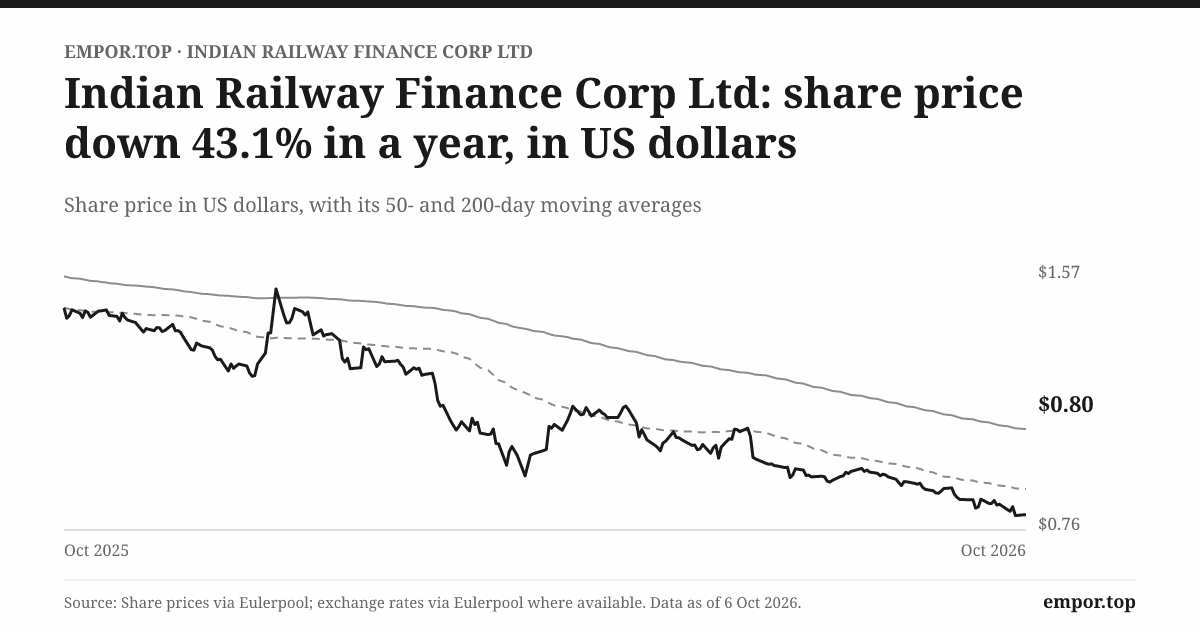
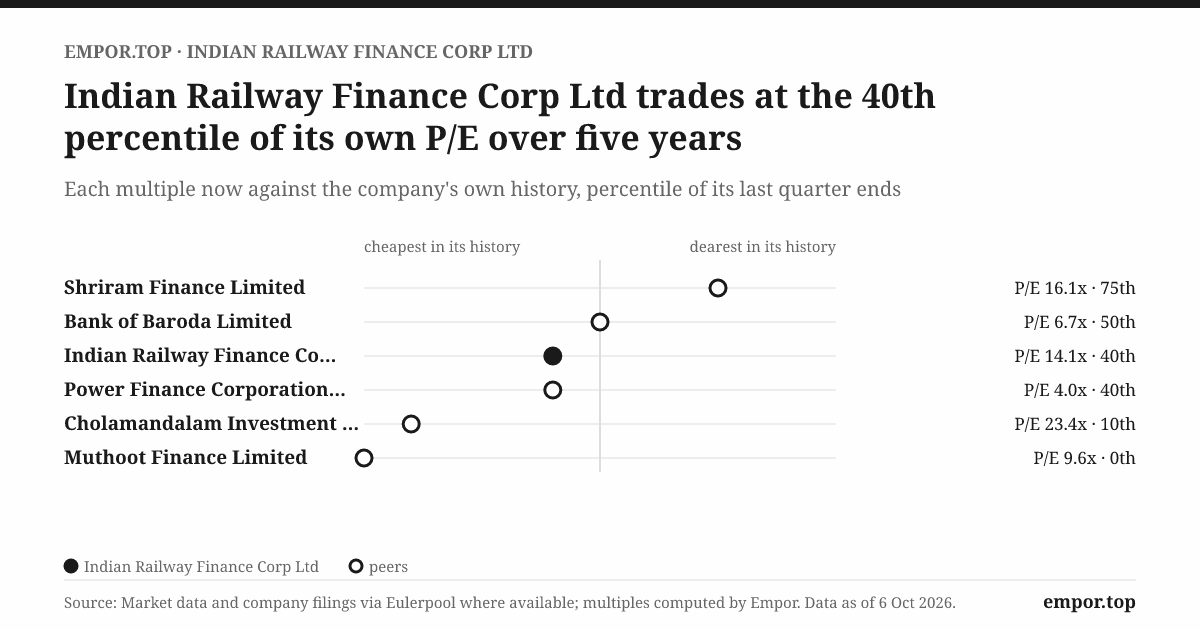
A "boring" lessor turns out to be an unusually clean test of a broader idea: what is a sovereign guarantee worth to a minority shareholder? Public investors have been arguing about that answer with their money. On 6 October 2026 IRFC's shares closed at ₹77.35, about 42% below their 52-week high of ₹133.64 and barely above the year's low.2 The stock trades at about 14 times trailing earnings, against a five-year median of about 16.5 times.2 To understand whether that discount is a bargain or a warning, start with why India built a bank for its railway at all.
 Subscribe on LinkedIn
II. Why Does a Railway Need a Bank of Its Own? (1986 and Before)
A railway that outgrew its budget
Picture New Delhi in the mid-1980s. Indian Railways was one of the largest employers on earth and one of the oldest railway systems in Asia, and it was running out of rolling stock faster than the Union budget could replace it. Every locomotive, every coach and every wagon competed for money in the same budget that paid for defence, food subsidies and interest on the national debt. Multilateral loans helped at the margin. Gross budgetary support, the cheque the Finance Ministry wrote to the Railway Ministry each year, could not carry a modernisation programme of the size the network needed.
The answer the government chose was elegant and a little sly. Instead of borrowing more on the sovereign's own balance sheet, it would create a separate company that could borrow in the market, buy the trains and lease them back to the railway. The debt would sit on the company's books, not the government's. The railway would pay lease rentals out of its operating budget over many years, rather than finding the full purchase price up front. In budget jargon, the money became "extra-budgetary resources", or EBR: funds raised off the budget while the sovereign stayed firmly behind them.
Birth of the vehicle
Indian Railway Finance Corporation was incorporated on 12 December 1986, wholly owned by the government through the President of India, and began raising money from the market in 1987–88.1 Its mandate was narrow: raise funds for the Ministry of Railways' capital programme, mainly through bonds and term loans, and pass them through as leases.1 Over time the company was registered with the Reserve Bank of India as a non-banking financial company, and later as a systemically important NBFC in the infrastructure finance category.2 The state also gave it "Navratna" status, the label India uses for its larger, more autonomous central public-sector enterprises.1
Why would bond investors lend to a company with no trains of its own and no independent revenue? Because every rupee of its income came under a contract with the Indian state, and the company was owned by that same state. The paper traded on trust in the sovereign, not on the company's own cash-generating power. Early bond issues built that credibility one series at a time, and the ratings agencies have always written up IRFC as an extension of government, citing its "strategic importance to and support from" the Government of India as the first strength.3
What the origin explains about today
This origin story is not just a museum piece. It explains almost every number that follows. IRFC was built as a fiscal workaround, so its fortunes follow the government's funding choices rather than any market's demand. When the Ministry wants to keep capex off the budget, IRFC grows. When the Ministry decides to fund railways directly from the budget, IRFC's lending pipeline goes quiet.
That is not theory. The Ministry's EBR allocation to IRFC was nil for FY24, FY25 and FY26, according to CRISIL.3 The company's own accounts confirm that it made no disbursement to the Ministry in FY24 or FY25.1 Three straight years in which the reason IRFC was created simply did not apply is the clearest evidence in the company's 40-year history about who controls its growth.
The verdict from the founding era is therefore simple. IRFC is an instrument of fiscal policy that happens to be listed. That structure gives it near-sovereign safety. It also means its volume is not set by competition or customer demand, but by the Finance and Railway ministries' view of how capex should be paid for in any given year. The question becomes how that instrument turns borrowed money into profit, and that is the machine at the heart of the business.
III. The Lease That Prints a Margin (The 15+15 Machine)
A Tuesday bond, a locomotive months later
Imagine a Tuesday morning on the debt desk in IRFC's office. The treasury team prices a bond issue: a few thousand crore of ten-year paper sold to insurers, pension funds and banks. The money arrives within days. Months later, perhaps longer, a new electric locomotive rolls out of a government factory and is handed to the railway. The lease rate the Ministry will pay on that locomotive was not haggled over on the day of delivery. It was fixed in advance, by formula, on the cost of the money IRFC raised plus a small agreed margin.
That is the entire business model, and it runs on a structure that could be called the 15+15 machine.
How the lease works
IRFC's leases with the Ministry typically run for 30 years. The first 15 years are the primary period, during which the Ministry pays rentals that recover IRFC's full principal and interest. The second 15 years are a secondary period at a nominal rent. At the end, ownership passes to the Ministry for a token price.1 In plain English, it is a hire-purchase agreement: the railway is buying the trains in instalments, and IRFC is the finance company that pays the dealer up front.
The pricing is cost-plus. IRFC adds its markup to the weighted average cost of the money it borrowed, and that becomes the lease rate. The statutory auditors treated lease income as a key audit matter and described the arrangement plainly: the cost-plus model "ensures a net interest margin" for the company.1 The spread is about 35 bps on project funding and 40 bps on rolling stock.3
Two further clauses make the margin almost bulletproof. The first is the variation clause. If interest rates or exchange rates move against IRFC's borrowings, the difference is adjusted through lease income, so the Ministry carries the risk. In FY25 that adjustment was about ₹3,617 crore in IRFC's favour, roughly the same as the year before.1 The second is the hedging clause. For foreign-currency borrowings it chose not to hedge, IRFC charges the Ministry a notional hedging cost set in the lease agreements. In FY25 it recovered about ₹1,536 crore under that clause while booking no actual hedging cost, and the balance is refundable to the Ministry.1 Put simply, currency risk sits with the sovereign, not with the shareholders.
Then there is the liquidity backstop. If IRFC ever lacks the cash to service its debt, the lease agreements allow the Ministry to pay rentals in advance.1 It is the equivalent of a tenant promising to prepay rent whenever the landlord's mortgage payment falls due.
Why a lessor, not a lender?
Aircraft lessors offer a useful contrast. A company such as AerCap buys planes and leases them to airlines, and its profits depend on two risks: the airline may fail, and the plane may be worth less than expected when the lease ends. IRFC carries neither. Its only lessee is the Indian state, which cannot fail in rupees, and its assets are handed over for a nominal price at the end, so there is no residual value to worry about. What remains is a pure financing spread, insulated from almost every risk except the one that matters most: whether the customer keeps coming back.
The related-party price
Now for the uncomfortable part. Who sets the margin? Not a market. The company's own note on the Ministry relationship says the weighted average cost and margin are "finalised in consultation with Ministry of Railways", and at the FY25 annual report they had been finalised for disbursements made up to FY23.1 The price is negotiated with the parent, approved administratively and then applied. That is a related-party price in every meaningful sense.
How much of the business is related-party? Essentially all of it. In FY25 lease income from the Ministry was about ₹19,427 crore, about 72% of turnover.1 Add about ₹7,174 crore of pre-commencement lease interest on projects not yet leased, which also comes from the Ministry, and the total is about ₹26,600 crore. On revenue of roughly ₹27,150 crore that is about 98% of income from one counterparty that is also the controlling shareholder.1 IRFC is exempt from detailed related-party disclosure on the Ministry because Indian accounting rules give government-related entities a carve-out, so investors see the relationship through scattered notes rather than one clean schedule.1
Flat revenue, rising profit
The numbers of the past three years show the machine idling. Revenue from operations in FY26 was about ₹27,284 crore, up less than half a percent, while profit rose 7.8%.5 How does profit grow faster than revenue in a cost-plus business? Because finance cost fell, by about 2.4% to roughly ₹20,005 crore, as old high-cost debt rolled off and nothing new was lent to the Ministry.5 With no disbursements to the Ministry in FY24 and FY25, the loan book stopped growing, interest costs declined and the spread on the existing book flowed straight through.1
Net interest margin, the gap between what IRFC earns on assets and what it pays on debt, was about 1.50% in FY26, and management has guided to 1.65% for FY27.5 That looks generous next to a 35–40 bps markup, and the reconciliation is equity: IRFC funds part of its book with its own net worth, which costs it no interest, so the reported NIM is wider than the contractual spread.
The verdict on the first central question is clear. The spread is contractual and nearly risk-free, but it is also administratively set. IRFC does not grow by winning customers, cutting costs or innovating. It grows when the Ministry chooses to borrow through it, at a price the Ministry agrees to. The next chapter shows how big that choice once made the company.
IV. Scale: How a Funding Vehicle Became the Railway's Balance Sheet (2000–2021)
The build-up
For most of its first quarter-century, IRFC was a specialist rolling-stock financier. Then, in the 2010s, the railway's capex ambitions grew and the company's balance sheet grew with them. Borrowings were about $11.6 billion in FY2016. By FY2022 they were about $52 billion, roughly four and a half times larger in six years.1 Debt-to-equity rose to a peak of about 9.5 times in FY2022.1 For a while, IRFC was less a finance company than the railway's off-budget balance sheet.
The decisive step came from 2011–12, when IRFC began financing railway projects as well as rolling stock: new lines, doubling, electrification and other works.2 Projects behave differently from locomotives. A locomotive can be leased the day it arrives. A new line takes years to build, so IRFC disburses money long before there is any asset to lease. In the meantime the money sits in a balance called "advance for railway projects to be leased", and interest on it accrues. That account would become the subject of a large part of this story in section VI.
Why operating cash flow looked like a disaster
Anyone glancing at IRFC's cash-flow statement from that era would think the company was haemorrhaging money. Cash from operations was negative every year from FY2015 to FY2023, reaching about minus $12.1 billion in FY2021.1 That is not a sign of distress. For a lender, money lent out is classified as an operating outflow, the way a retailer's purchase of inventory is. The bigger the lending programme, the more negative the operating cash flow, with the borrowing that funds it showing up in financing.
The proof came when lending stopped. In FY24 and FY25, with disbursements to the Ministry paused, operating cash flow flipped to roughly plus $1 billion a year, and in FY26 it fell back to about $460 million as lending resumed.1 Read correctly, the operating cash line is a thermometer of the lending programme, not a measure of earnings quality.
The honest growth rate
The growth record looks spectacular at first glance. Net profit compounded at about 23.5% a year over the ten years to FY2026.1 But FY2016 was the starting line of the borrowing boom, so the ten-year figure measures the build-up of the balance sheet rather than any repeatable growth engine. Over five years the rate falls to about 9.7% a year, and over three years to about 4.4%.1 Those are the honest base rates for a business whose volume depends on government choices.
The verdict for this era is that the growth was pass-through. IRFC grew because the government decided to route a large share of railway capex through it, not because it did anything a competitor could not have done. There was no rival "sole arranger", and the question of whether that position is a moat is argued in full in section VIII. What the build-up did create, at its peak, was an asset worth taking to the stock market.
V. The IPO: A Retail Stock at ₹26 (2021)
January 2021
In January 2021 India was emerging from the first wave of the pandemic, interest rates were at historic lows and a new generation of retail investors had opened demat accounts during the lockdown. Into that market the government brought IRFC, the first listing of a non-banking finance company from the public sector. The price band was ₹25–26 a share.8 On listing day the shares opened slightly below the issue price, around ₹24.9.7 For a company with a sovereign behind it and a predictable spread, the debut was strikingly flat.
The pitch to investors was simple: a near-riskless lessor to the Indian state, a stable dividend and a valuation close to book value. What followed was anything but simple.
The run-up and the fall
For a couple of years the stock went nowhere. Then the railway-stocks rally of 2023 and 2024 arrived. Public-sector rail companies became a retail theme, and IRFC shares rose to several times their IPO price. The company became what Indian market commentary calls a "people's stock": one owned by millions of small investors who rarely look at a balance sheet. By March 2025 it had about 5.8 million shareholders.1
The fall was as dramatic as the rise. Over five years the stock's largest drawdown was about 65%, and on 6 October 2026 it sat about 42% below its 52-week high.2 A stock whose earnings grew at single digits had been priced, at its peak, as a growth story. The market has spent the past two years undoing that.
Who owns it
The register explains the volatility. At March 2025 the President of India, the promoter, held about 86.4% of the shares, with no pledge.1 Resident individuals held about 10.7%. Mutual funds held about 0.18%, foreign portfolio investors about 1% and insurers about 1.1%.1 So a company owned overwhelmingly by the government had a free float held mainly by retail investors, and almost no domestic fund managers.
Why would mutual funds ignore a AAA-rated company with a record profit? Because, as the next sections show, its growth is set by the government, its spread is thin and its future depends on a policy decision rather than a business plan. Institutions that build models on return on equity and growth find little to underwrite. Retail investors bought the railway story; professionals mostly stayed away.
The stake sales
In 2026 the government began to sell. A first offer for sale ran in February 2026, and institutional investors bid for about 95% of the shares reserved for them.6 In June 2026 the government announced a second offer: a 1% base issue plus a 1% greenshoe option, on 24 and 25 June, framed as part of a ₹80,000 crore disinvestment and asset monetisation target for FY27.6 The shares fell almost 5% intraday on the first day.6 Promoter holding fell from about 84.7% before the June offer to about 82.9% after it.7 The shares sold were the government's own; IRFC issued nothing new.
On a thinly institutional register, every stake sale adds supply that retail investors must absorb, and it caps the price at roughly the floor the government sets for the sale. That is the market cost. The credit cost is more subtle. ICRA lists among its negative rating factors "a significant dilution in the GoI's stake or a decline in the strategic importance of IRFC as the sole arranger of lease finance for the MoR".4 The two halves of that sentence are exactly the two things happening at once in 2026: the stake is being sold down, and the "sole arranger" role has spent three years without new Ministry business.
The verdict on ownership is that disinvestment so far adds supply without threatening control. At about 83%, the government still owns more than four-fifths of the company, far above any line that would plausibly worry the agencies. The trigger worth watching is dilution well below a comfortable majority, or rating language that softens on the company's role. Until then, the ownership story is mainly a share-price story. The cash story is where the real questions start.
VI. Is the Profit Real Cash? The ₹37,000 Crore Receivable
The note in the back of the annual report
Deep in the financial statements of IRFC's FY25 annual report is a line item with a name only an accountant could love: "interest accrued but not due on advance for railway projects to be leased". At March 2025 it stood at about ₹37,310 crore, up from about ₹29,927 crore a year earlier.1 That balance is larger than half of the company's net worth. It is the most important number in the story that almost nobody talks about.
Here is what it means. When IRFC pays out money for a railway project, a new line or an electrification job, the project takes years to finish. Until it is commissioned and formally leased to the Ministry, IRFC cannot charge lease rent. So it charges interest on the money it has advanced, called pre-commencement lease interest, and books it as income. But it does not receive that interest in cash. It adds it to the receivable balance, to be recovered once the asset is leased.
How big is the accrual relative to profit?
In FY25, pre-commencement lease interest was about ₹7,174 crore.1 Net profit that year was about ₹6,502 crore.3 The accrued-not-due balance rose by about ₹7,383 crore over the year.1 Put those three numbers side by side, and the conclusion is uncomfortable: the interest IRFC recognised as income but did not collect in cash was larger than its entire profit for the year.
That does not mean profit is fake. IRFC's costs, mainly interest on its bonds, are paid in cash, and those are covered by cash lease rentals from the Ministry on assets already leased. What it does mean is that a large slice of the reported earnings is a promise from the Ministry that will turn into cash only when projects go on lease. Profit and cash are separated by years of construction schedules.
Other balances with the Ministry point the same way. Other receivables from the Ministry rose to about ₹9,205 crore from about ₹5,702 crore.1 A new line, "amount recoverable from Ministry of Railways – leased assets", appeared at about ₹2,516 crore, against nil the year before.1 Partly offsetting all this, IRFC owed the Ministry about ₹9,624 crore in other payables.1
The fact sheet's "debtor days" figure of about 5,100 days, roughly 14 years of revenue, looks alarming.1 It is an artefact of comparing long-dated lease receivables with one year's revenue. For a lessor whose leases run 30 years, the receivable is the business. The figure tells a reader nothing about collections.
Why no loss provision?
IRFC books no expected credit loss on lease receivables from the Ministry. Its risk note gives the reason in a single line: "There is no credit risk on lease receivables being due from sovereign".1 The logic is sound in a narrow sense. The Indian government will not default on a rupee lease to its own company. But it means the quality of earnings rests entirely on the assumption that every accrued rupee will eventually be paid, on time, at the agreed rate.
Reconciliation is the weak link. The company's note says balances with the Ministry were reconciled through FY24, with FY25 balances to be reconciled after the audit.1 When nearly all of your revenue comes from one party and your largest asset is an accrued receivable from that party, a one-year lag in agreeing the numbers matters.
What the auditors noticed
Two small observations by the auditors are telling. Under the CARO report, they noted: "There is currently no system in place for the physical verification of assets that have been leased out".1 For a company whose entire asset base consists of leased-out trains and projects, that is not a footnote; it is a gap in control over everything it owns. The auditors also flagged that title to the office building, with a book value of about ₹11 crore, is not yet in IRFC's name.1 Neither item is large in money. Both suggest that controls are built around the assumption that the sovereign will make everything right.
Tax and legal overhangs
The contingent liabilities are modest. The largest is a GST demand from Chennai of about ₹353 crore, with interest and penalty, for FY2020-21, concerning input tax credits. The Madras High Court stayed it in July 2023, the case is ongoing, and management has made no provision.1 Income-tax disputes run to about a crore each.1 Sales tax and VAT exposures are recoverable from the Ministry under the leases.1 Against a net worth of about ₹56,700 crore, the tax risk is small.2
Dividends against accruals
IRFC paid about ₹3,005 crore in dividends in FY25.1 Payout was about 46% of profit that year and about 39% in FY26, against a policy floor of 20% of profit.1 The cash for those dividends comes from a business where a large part of profit is accrued rather than received. That works as long as cash lease rentals cover interest and dividends, and the Ministry's advance-rental clause stands behind the liquidity. It is still worth naming: shareholders are being paid partly out of income the company has not yet collected.
The verdict on the second central question is that a large share of reported profit is accrued, not received, until assets go on lease. The sovereign makes recoverability near-certain, so the risk is timing and reconciliation, not credit. The number that will settle it is the FY26 split between cash lease rentals and pre-commencement accrual, and whether the accrued balance starts to fall as projects are commissioned. If it keeps rising, IRFC's profit is increasingly a claim on the Ministry's future budgets. That is one reason management has started looking for borrowers other than the Ministry.
VII. The Pivot: Lending to Power and Fertiliser Companies
A first loan to someone else
For most of its history IRFC had one borrower. Then, in the quiet years when the Ministry stopped drawing money, management did something new. It signed agreements to lend to companies outside the railway: NTPC Renewable Energy, NTPC itself, fertiliser plants, and rail-related public enterprises such as Rail Vikas Nigam and IRCON.2 By the end of FY26 the company's investor presentation showed about ₹72,949 crore of non-Ministry agreements executed, of which about 60% were in power, 23% in fertilisers and 17% in railway-linked entities, with about ₹35,067 crore disbursed.2
This is the first strategic shift in IRFC's 40-year history. It has made no acquisitions. "Capital allocation" here means one thing: whom the company lends to.
What the diversification looks like so far
The Ministry's share of assets under management fell from about 99% at March 2024 to about 92.6% at March 2026.42 AUM itself was about ₹4.85 lakh crore.2 So the non-Ministry book is real money, roughly ₹35,000 crore, but still about 7% of the total.
The early borrowers are all state-owned. At March 2025, Rail Vikas Nigam owed IRFC about ₹4,492 crore and NTPC Renewable Energy about ₹700 crore.1 Every loan was in Stage 1, the accounting category for loans with no sign of stress, and the impairment charge for the year was less than ₹1 crore.1 No non-performing assets, no overdue loans.3
The spread temptation
Why bother? Because the spread is wider. Management targets 100–120 bps on non-Ministry assets, against 35–40 bps on the Ministry book.5 Even a small shift in mix lifts the blended margin, which is why management has guided NIM up from about 1.50% to 1.65% for FY27.5 That target is the first public promise against which this management team can be measured.
The catch is equally simple. A wider spread is payment for risk. Lending to NTPC is very safe, but it is not lending to the sovereign. A fertiliser plant depends on subsidy payments, gas prices and government pricing decisions. A renewable-energy subsidiary depends on power purchase agreements with state electricity distribution companies, which have a long history of paying late. For the first time IRFC is taking credit risk it cannot pass to the Ministry under a variation clause.
The capital ratio collapse
The clearest sign of that risk is in the capital ratio. IRFC's capital-to-risk-weighted-assets ratio (CRAR), which compares capital with assets weighted for their riskiness, was about 616% at March 2024, according to ICRA.4 By FY26 it was about 111%.2 Lending to the sovereign carries a zero risk weight under RBI norms, so the Ministry book uses almost no regulatory capital. Lending to companies carries full or near-full risk weights. A relatively small corporate book can therefore consume a large share of capital headroom. The company has not published a bridge explaining the fall, but the direction is consistent with the change in mix. A CRAR of 111% is still far above the regulatory minimum of 15%, so there is no shortage of capital. What has gone is the sense that the balance sheet is a fortress built for one riskless tenant.
Funding the new book
The pivot coincides with a shift in funding. At FY26 year-end, bonds were about 54% of borrowings, term loans about 22% and external commercial borrowings (ECB) about 18%, and management has spoken of taking ECB to 30–35% over time.5 IRFC also raises money through capital-gains bonds under section 54EC of the tax law, which let investors defer capital-gains tax; it pays about 5.25% on them and has about a 28% share of that market.5 Cheap, sticky funding is an advantage. Foreign currency borrowing is cheaper still, but on a Ministry lease the currency risk is passed through. On a loan to a fertiliser company, unless the loan is in the same currency, it is not.
Peer context
The natural comparisons are the other government financiers: Power Finance Corporation and REC in power, HUDCO in housing and urban infrastructure, and IREDA in renewables. All lend to state-owned and private borrowers, all carry real credit risk and all earn wider spreads than IRFC's Ministry book. That is exactly the territory IRFC is now entering. It enters as a newcomer in sectors where PFC and REC have decades of underwriting history and their own long experience of stressed power loans.
The verdict on the fourth central question has to stay open. The diversification is financially real but small, and the borrowers so far are blue-chip state companies. There is no loss history because there has been no time for one. The test will be the first non-Ministry loan to move to Stage 2 or become an NPA, and the FY27 CRAR. Until then, the claim that IRFC can earn 100–120 bps without real credit risk is plausible but unproven. And the pivot raises a deeper question about the moat itself.
VIII. Industry Structure and the Moat: Sole Arranger or Convenient Habit?
The rating that frames everything
In April 2026 CRISIL assigned its AAA/Stable rating to a new ₹70,000 crore borrowing programme from IRFC and reaffirmed its A1+ for short-term debt.3 The rationale reads like a portrait of the company's dependence. Its strengths: strategic importance to and support from the government, net worth of about ₹56,625 crore at December 2025, nil NPAs and diversified access to funding.3 Its constraints: an "average" earnings profile from cost-plus lending at 35–40 bps, and gearing of about 7.4 times, against an expected steady state of about 10 times.3
In plain English: the rating is a rating of the government, lightly adjusted for a company with a thin margin and a lot of debt. That is not a criticism. It is what makes IRFC's bonds cheap to issue. It is also the starting point for any discussion of its moat.
Porter's five forces
Buyer power is total. The Ministry is the lessee, the controlling shareholder and the party that sets the price through "consultation". It accounts for more than 90% of assets. No company in the Indian market faces a customer with more leverage.
Threat of entry is low in form and real in substance. No other company is the Ministry's designated arranger of lease finance. But PFC, REC, HUDCO and IREDA all lend to the same state-owned borrowers IRFC is now chasing outside the railway, and any of them could finance railway-linked projects if the government wished.
Substitutes are the biggest force. The Ministry can fund capex directly from the budget, or through gross budgetary support, without IRFC at all. That is exactly what happened in FY24 to FY26.
Supplier power is limited. IRFC's suppliers are bond investors, and its AAA rating gives it some of the cheapest non-sovereign funding in India.
Rivalry within the railway is nil, because there is no rival. Outside the railway, it is intense, and IRFC is the new entrant.
Hamilton Helmer's seven powers
Helmer's framework asks what gives a business durable pricing above its cost of capital. Scale economies are weak: IRFC is large, but its cost of funding comes from the sovereign rating, not from its size. Network effects, switching costs and brand do not apply. Counter-positioning is absent. Process power is minimal; the company runs a lean treasury, not a hard-to-copy process.
What remains is a cornered resource: privileged access to a sovereign customer and sovereign-linked funding. But it is a borrowed power. IRFC did not create it and cannot defend it. The government can withdraw it by policy at any time without compensating shareholders. A cornered resource that the counterparty controls is less a moat than a lease.
Testing the moat against the record
The best evidence about the strength of the "sole arranger" moat is IRFC's own recent history. EBR allocation from the Ministry was nil for three straight years.3 Disbursements to the Ministry were nil in FY24 and FY25.1 Borrowings fell from about $52.2 billion in FY2023 to about $48.7 billion in FY2025.1 For three years, the customer showed that it could simply turn the tap off. It paid its leases, of course. It just stopped adding to them.
The bargaining dynamic follows. A government trying to minimise its own borrowing costs has every incentive to keep IRFC's spread as thin as possible. The margin is finalised in consultation, not negotiated at arm's length, and the claim that nothing is overdue rests on reconciliations that run a year behind.1
The verdict is that the moat is a statutory and policy position, not an economic edge. History narrows the claim rather than rejecting it: the position is intact while the Ministry routes capex through IRFC, and unproven while EBR allocation stays at nil. The return metrics fit: return on equity of about 12.7%, respectable for a near-riskless lender, and return on capital employed of about 1.5%, which says more about how that ratio treats a lender's borrowings than about the business.2 The KPI that would confirm or falsify the revised claim is simple: renewed, sustained Ministry disbursements. If the people running the company have influence over that, their record is the next thing to examine.
IX. The People Running It: Pay, Boards and Credibility
The fine
On 9 November 2024 the tenures of two of IRFC's independent directors came to an end.1 They were not replaced in time. Under India's listing rules, a listed company needs a board with enough independent directors to staff its audit, nomination and risk committees. Without them, IRFC fell out of compliance on several provisions at once. The National Stock Exchange and BSE fined it about ₹26.6 lakh, and the company applied for a waiver.1 The independent directors are appointed by the Ministry, which the company says it asked to fill the vacancies.1
The fine is tiny next to a profit of several thousand crore. It is also a perfect miniature of how IRFC is governed. The board is shaped by the owner, the timetable is set by the owner, and the listed company cannot fix the problem on its own.
The people
Manoj Kumar Dubey became chairman and managing director on 10 October 2024, appointed by Ministry order.1 Like most CPSE heads, he came from the government system rather than from private finance, and his appointment terms are decided by the President of India. Shelly Verma is Director (Finance), the board member responsible for treasury and borrowing. Sunil Kumar Goel is chief financial officer.1
Their pay is set by Department of Public Enterprises rules. In FY25 the CMD's total pay was about ₹0.40 crore, a partial year. The Director (Finance) earned about ₹1.10 crore, the CFO about ₹0.67 crore and the company secretary about ₹0.44 crore.1 There are no stock options, and the annual report shows no meaningful personal shareholdings.1 Pay does not respond to profit, AUM growth or share price.
That is not a scandal. It is simply the absence of an incentive structure. Management is not paid to grow the business, and in a business whose growth is set by the Ministry, perhaps it does not need to be.
Credibility through the record
How should investors judge management, then? By its promises and outcomes. The record here is short. The main public commitment is the NIM target of 1.65% for FY27, and the broader promise to build a non-Ministry book at 100–120 bps.5 Management has been concrete about margins and much vaguer about the one thing investors most want to know: when, and how much, the Ministry will borrow again. On recent results calls, analysts have pressed on three themes again and again: visibility of Ministry disbursements, the risks in the non-Ministry book and the fall in CRAR. The margin answers came with numbers. The Ministry answers came with hope.
On audit, the record is clean. The Comptroller and Auditor General's supplementary audit of the FY25 accounts produced nil comments.1 The statutory auditors raised no significant exceptions on lease income, though they did flag the leased-asset verification gap discussed earlier.1
The activist's question
A skeptical investor would put one question to this board: "If the Ministry decides tomorrow to fund all its own capex from the budget, what is left?" The honest answer is a run-off book that will earn a fixed spread for years and shrink slowly, a small and unseasoned corporate book, and a large net worth. That is not nothing. It is also not a growth company, and no amount of governance can change that, because the decision belongs to the owner.
The verdict is that governance is a state-owner arrangement with small, recurring-looking lapses on board independence. It does not threaten the credit, but it confirms that the listed company has little say over its own future. With that in mind, the question becomes what the market is paying for.
X. Frameworks and Bull vs. Bear
The retail investor's screen
Picture a retail investor in Pune in early October 2026, scrolling a broker app. IRFC is at about ₹77. It has a dividend yield of about 2.7%, a P/E of about 14 times, against a five-year median of about 16.5 times, and a price-to-book of about 1.8 times.2 It is down about 42% from its high. The headline says "record profit". On the screen, it looks cheap.
What is that price actually paying for? An earnings yield of about 7%, for a company whose earnings are a fixed spread on a book that the customer decides whether to grow.2 Book value is about ₹43 a share, and return on equity about 12.7%.2 The equity is a leveraged claim: debt is about 7.7 times equity, and the agencies expect that to drift towards 10 times over time.23 Enterprise-value multiples are not meaningful here, because the data treat the company's debt as its working stock in trade.
The bull case
The bull case runs as follows. IRFC's income comes from the Indian state under contracts that pass through interest and currency risk. Profit hit a record in FY26.5 It has no NPAs.3 Lending resumed in FY26, and revenue in the June 2026 quarter rose about 22% from a year earlier, the strongest quarterly growth in three years.2 The non-Ministry book earns spreads roughly three times as wide as the Ministry book, so a modest shift in mix could lift margins towards the 1.65% target.5 The payout floor of 20% means some of that profit always comes back to shareholders, and in recent years the payout has been closer to 40%.1 At about 14 times earnings, the stock is priced below its own history.
The bear case
The bear case runs as follows. The spread is 35–40 bps, and the customer sets it.3 Profit growth over three years was about 4.4% a year, closer to a bond coupon than a growth stock.1 EBR allocation has been nil for three years.3 The government is selling stock and has a large disinvestment target, so supply will keep coming. A large part of profit is accrued interest, not cash.1 Mutual funds own almost none of it.1 And because the agencies treat steady-state gearing of about 10 times as normal, debt can grow faster than equity, so shareholders own a thinner slice of a bigger, riskier balance sheet.3
The risk radar
Only a handful of risks matter, and each works through a specific mechanism.
The main one is policy and funding-route risk: the Ministry funds capex from the budget instead of through IRFC, and growth stops. This has already happened for three years.
Refinancing and cost-of-capital risk is real in principle, because IRFC borrows short and long against 30-year leases, but the advance-rental clause and the sovereign rating limit it in practice.
Currency and interest-rate risk is passed to the Ministry under the variation and hedging clauses, so it matters only on the non-Ministry book.
Non-Ministry credit risk is new and unseasoned.
Rating risk from dilution depends on how far the government sells down.
Demand slowdown does not apply, because income is contractual rather than tied to freight or passenger volumes. Technology disruption does not apply either: no new technology changes how a sovereign borrows.
The KPIs that matter
Three numbers capture the business. The first is disbursements, to the Ministry and to everyone else: lending resumed in FY26 after two years at nil to the Ministry.1 The second is net interest margin, about 1.50% in FY26 against a 1.65% target for FY27.5 The third is the non-Ministry share of AUM, which rose from about 1% to about 7.4% over two years.2
The verdict is that the price looks fair to cheap on the earnings, but those earnings come from a spread the buyer sets. The case turns on FY27 disbursements, not on the multiple. The lessons below are what IRFC teaches beyond its own share price.
XI. Playbook: Lessons from a Company That Owns the Rails but Not the Risk
"A guarantee is a moat only while the guarantor keeps choosing you." For three years, the Ministry of Railways sent IRFC no new business. It honoured every lease, missed no payment and gave the company a AAA rating by association. It just did not grow it. Founders who build on a single powerful partner, whether a government, a platform or an anchor customer, should notice the difference between a partner who will not hurt you and a partner who will keep feeding you. IRFC has the first. Its share price is waiting to see whether it has the second.
"Cost-plus is safe because someone else sets the plus." The 35–40 bps markup is the reason IRFC never loses money, and the reason it will never earn much more. A cost-plus contract removes risk by handing the pricing decision to the customer. Investors who love "riskless" business models should ask who decides the margin and what incentive they have to keep it thin.
"Profit is a promise until the asset is on the track." The ₹37,310 crore accrued-not-due balance is IRFC's most honest disclosure. It shows that accounting profit and cash can be separated by years of construction delays, even when the debtor is the government. The safest receivable in India is still a receivable.
"A cheap-looking multiple on a leveraged spread is a bet on the spread." At 14 times earnings and nearly 8 times gearing, IRFC's equity is a thin layer of capital on top of a vast book. Its valuation depends far less on the earnings multiple than on the volume and margin the Ministry chooses to allow.
"Diversifying away from your only customer means becoming a lender for the first time." The power and fertiliser book is IRFC's first real strategic choice, and it brings the first real credit risk. The CRAR fall from 616% to 111% is what that choice looks like on a regulator's scorecard.
"A people's stock can still have no institutional bid." Nearly six million shareholders, about 0.18% held by mutual funds: popularity is not the same as sponsorship. When the government sells, retail investors must absorb the supply, and the price shows it.
XII. Epilogue: The Moments That Decide It
Tonight, IRFC is a company with a record profit, a falling share price and a parent that holds the keys to almost everything that matters. The next twelve months contain four moments that will tell investors which story is true.
The first arrives with each quarterly result: disbursements. If the Ministry resumes regular borrowing through IRFC in FY27, and the non-Ministry book keeps growing, the asset base will grow again, and the honest growth rate will move up from the low single digits. If NIM reaches the 1.65% target, management will have kept the one promise it made in numbers. If disbursements stall and NIM stays near 1.5%, the first central question is answered: this is a fixed spread on a book the government is no longer growing.
The second is the next stake sale. Every further tranche tests the line between disinvestment and dilution. If government ownership slips far enough that the rating agencies change their language on "sole arranger" or on strategic importance, the third central question is answered in the worst way, because IRFC's cheap funding is the source of its whole margin.
The third is the first stressed non-Ministry loan. A loan to a fertiliser plant or a power company that moves to Stage 2, or worse, would be the first credit event in IRFC's history. It would show what the 100–120 bps spread really pays for. A clean FY27, with CRAR holding steady, would push the fourth question towards a yes.
The fourth is the FY26 annual report. Its notes will show how much of FY26's ₹7,009 crore profit came as cash lease rentals and how much as pre-commencement accrual, and whether the Ministry and IRFC have agreed the FY25 balances. A falling accrued-not-due balance would mean projects are being commissioned and promises are turning into cash. A rising one would mean IRFC's profit is increasingly an IOU from its parent.
The tension that remains is the one IRFC was born with. It is about as safe as an Indian company can be, and about as dependent. Its safety and its dependence come from the same source, and investors cannot buy one without the other.
XIII. Outro
Back to that freight train in the dark. The driver does not know that the locomotive is leased, or that a bond priced on a Tuesday in Delhi paid for it, or that a few basis points of every rupee of its cost end up as a dividend in a retail investor's bank account in Pune. The train will run whether IRFC exists or not.
That is the point. IRFC is a landlord that never sees a train, and a bank whose only customer is its owner. Buying its shares is not a bet on Indian railways. It is a bet on the Indian government's willingness to keep railways on IRFC's books.
XIV. Recent News
XV. Links & Resources
References
-
Annual Report 2024-25 (38th) — Indian Railway Finance Corporation, 2025 ↩↩↩↩↩↩↩↩↩↩↩↩↩↩↩↩↩↩↩↩↩↩↩↩↩↩↩↩↩↩↩↩↩↩↩↩↩↩↩↩↩↩↩↩↩↩↩↩↩↩↩↩↩↩↩↩↩↩↩↩↩
-
Investor Presentation FY 2025-26 — Indian Railway Finance Corporation, 2026 ↩↩↩↩↩↩↩↩↩↩↩↩↩↩↩↩↩↩↩
-
Rating Rationale (CRISIL AAA/Stable) — CRISIL Ratings, 2026-04-01 ↩↩↩↩↩↩↩↩↩↩↩↩↩↩↩
-
IRFC FY26: Diversification begins to lift margins — Multibagg, 2026 ↩↩↩↩↩↩↩↩↩↩↩↩
-
IRFC OFS June 2026: Why IRFC Shares Are Falling Today? — Sahi, 2026-06 ↩↩↩
-
IRFC corporate announcements, results and shareholding patterns — NSE India ↩↩
-
SEBI public issues filings (IRFC RHP, January 2021) — Securities and Exchange Board of India ↩
 LinkedIn
 WhatsApp
 Reddit
 Hacker News
 Email
 Kindle
 RSS Feed
 Spotify
 Apple Podcasts
 Amazon Music
 Audible
 YouTube