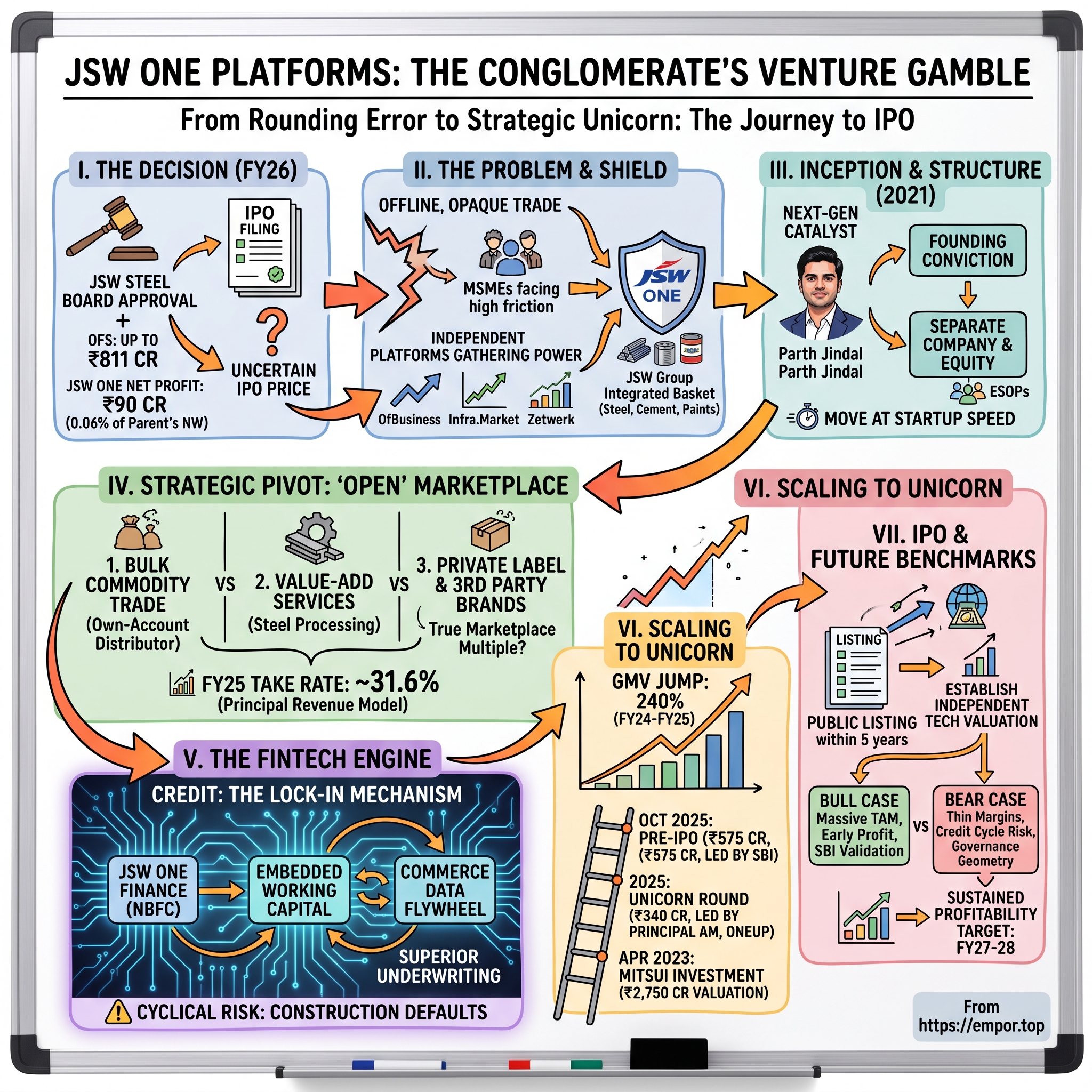
JSW One Platforms: The Conglomerate's Venture Gamble
I. Introduction & The ₹811 Crore Boardroom Decision (0:00–0:15)
Start with the two numbers the parent chose to publish, because the choice is itself a piece of evidence. JSW Steel disclosed that JSW One's FY26 net profit of ₹90 crore amounted to 0.35% of its own consolidated net profit and 0.06% of its net worth.[^1] Run those ratios backward and the parent is telling you its own scale: a consolidated net profit on the order of ₹25,700 crore and a net worth near ₹150,000 crore.
For context, JSW Steel's standalone quarterly profit swings alone dwarf the entire annual earnings of its e-commerce child — the company reported a ₹1,623 crore net profit in a single quarter, Q2 FY26, up 270% year on year.1 JSW One, against that backdrop, is a rounding error.
And yet the same ₹90 crore reads completely differently in the other frame. In the world of Indian consumer and B2B internet startups — a world littered with companies that have raised hundreds of crores and never earned a rupee — a young marketplace posting a genuine net profit is a rarity.
JSW One recorded a gross merchandise value of ₹12,567 crore in FY25, a 2.4x jump over the prior year, on operating revenue of ₹3,976 crore, serving more than 84,000 registered MSMEs.2 It entered the unicorn club — the informal designation for a private company valued at a billion dollars or more — in 2025, roughly four years after its 2021 founding.3 Filing for a public listing within five years of inception, while profitable, is not the normal shape of an Indian venture story.
So which frame is correct? Both, and the tension between them is the entire investment question. To the parent, JSW One is a small, strategically useful appendage whose IPO conveniently establishes a separate, tech-flavoured valuation for a business that would otherwise be buried inside a steelmaker's consolidated accounts. To a prospective public shareholder, JSW One is being asked to stand on its own — to be judged not as 0.06% of a steel balance sheet but as an independent marketplace with its own unit economics, its own cost of capital, and its own path to free cash flow.
The offer for sale structure sharpens the point: an OFS raises money for the selling shareholder, JSW Steel, not for JSW One itself.[^1] The parent is monetising a stake. The child, in this transaction, receives nothing.
That distinction — money to the seller, not to the company — is the first thing a careful reader should hold onto, and it recurs throughout what follows.
It means the headline "₹811 crore IPO" is not a growth-capital event for JSW One; it is a partial exit dressed as a coming-of-age.
Three threads run through the rest of this story, and it is worth naming them at the outset so the later detail has somewhere to land.
The first is macro: India's digital economy is widely argued to be pivoting from consumer internet to business digitisation. Bessemer Venture Partners' oft-cited 2023 estimate holds that online-first, tech-enabled B2B marketplaces could address a $200 billion opportunity in India by 2030 as fragmented, largely unorganised supply chains move online.[^5] JSW One is a direct bet on that thesis.
The second is defensive: this is, at root, an incumbent's counterattack. Independent, venture-funded platforms — OfBusiness, Infra.Market, Zetwerk — began pooling MSME demand for steel and cement in the late 2010s, and in doing so threatened to stand between mills like JSW Steel and their end customers. A supplier that loses the customer interface becomes a commodity. JSW One is, in part, JSW's insurance against that fate.
The third is the awkward middle: to be credible as an open marketplace, JSW One had to agree to sell its rivals' steel and cement alongside its parent's — to cannibalise, deliberately, the very captive distribution the parent built over decades. Whether it has genuinely done so, or merely says it has, is one of the load-bearing questions of the underwriting.
Everything downstream — the funding rounds, the fintech arm, the competitive maps, the bull and bear cases — is an elaboration of those three threads.
 Subscribe on LinkedIn
II. Legacy Conglomerate Context: JSW Group & Sajjan Jindal's Empire (0:15–0:35)
To understand why a steelmaker would build an e-commerce company, you have to understand the distribution machine it was trying to protect.
JSW Steel is the flagship of the JSW Group, the diversified industrial conglomerate built by Sajjan Jindal, a son of the late O.P. Jindal, the patriarch whose Jindal group seeded a generation of Indian steel and power businesses. Over three decades Sajjan Jindal turned a modest Mumbai-region operation into India's largest private-sector steel producer, and the broader group extended horizontally into cement, paints, energy, ports, and — through a joint venture with the British marque's Chinese owner — automobiles.
The group's logic has always been vertical and horizontal integration: control the inputs, control the adjacent materials, control the route to the buyer. JSW Steel's own reported scale — quarterly profits measured in thousands of crores — is the product of that machine operating at full tilt.1
The machine's weak point is its last mile. Heavy building materials in India move through a distribution system that is, to put it politely, pre-digital. Steel long products and coils, cement, and paints reach construction sites and small factories through a deep, fragmented network of regional distributors, dealers, sub-dealers, and stockists. Pricing is opaque and often set daily by word of mouth or WhatsApp. Procurement is paper-based. Credit — the lifeblood of any small trader — is extended informally, settled slowly, and priced with wide, idiosyncratic spreads.
For the buyer at the bottom of this chain, typically a micro, small, or medium enterprise, the experience is defined by uncertainty: uncertain price, uncertain availability, uncertain delivery, and chronically expensive working capital.
This friction is not a bug that the incumbents were eager to fix. It was, in many ways, the moat. Opacity protects intermediary margins. A dealer who alone knows today's mill price and who alone can advance thirty days of informal credit is a dealer who is hard to disintermediate.
For decades, the fragmentation of the last mile was precisely what kept the value in the hands of the traditional trade — and, indirectly, what let mills push volume without owning the customer relationship.
The group's strategic response, over the 2010s and early 2020s, was to assemble the full basket of heavy materials a site needs. JSW built out cement capacity and launched JSW Paints in 2019, so that the group could, in principle, supply steel, cement, and paint — the three big-ticket material categories of any construction or manufacturing project — under one corporate roof.
On paper this created the ultimate cross-sell. In practice, each category still reached the buyer through its own separate, offline, opaque channel. The basket existed at the level of the balance sheet; it did not yet exist at the level of the customer's cart. Closing that gap — turning a portfolio of factories into a single digital storefront for the MSME — is the specific job JSW One was created to do.
The distinction matters for the investment case because it defines what JSW One is and is not. It is not a technology company that happened to pick steel. It is a distribution-reform project launched by a materials group to defend and extend the reach of its factories.
That origin is simultaneously its greatest asset — privileged supply, a trusted name, deep pockets — and the source of nearly every governance question a public investor should ask.
III. The Next-Gen Catalyst: Parth Jindal and the Inception of JSW One (0:35–1:00)
Corporate venture bets usually need a sponsor with the standing to spend money that will not pay off for years. At JSW that sponsor was Parth Jindal, Sajjan Jindal's son, who returned from a Western business education to take operating roles across the group's newer, more consumer-facing businesses — JSW Cement, JSW Paints, and the group's automotive venture.
His mandate, as the next generation, was explicitly modernisation: to digitise, to reach customers more directly, and to find the connective tissue between the group's many product lines and the small businesses that ultimately consume them.
The intellectual on-ramp came earlier, and from the venture side. Around 2015–16 the group set up JSW Ventures, an early-stage technology investment arm, and brought in Gaurav Sachdeva — an ISB alumnus with prior stints spanning technology and banking — to run it. For several years Sachdeva's job was to watch the Indian startup ecosystem from the inside: to see which models raised money, which ones scaled, and, crucially, which ones were beginning to encroach on the group's own turf.
That vantage point matters. When JSW eventually decided to build rather than merely invest, the person it put in charge had spent years studying exactly the companies JSW One would have to beat.
The threat those years revealed became acute around 2020–21. Independent B2B commerce platforms — OfBusiness, backed by a roster that came to include large global funds, and Infra.Market — were scaling fast by doing precisely what the traditional trade could not: aggregating the fragmented demand of thousands of MSMEs, offering transparent pooled pricing, and layering on credit. Each of these platforms was, from a mill's perspective, a demand aggregator that could swing volume between suppliers. The more successful they became, the more pricing power they accumulated over the primary producers of steel and cement.
The strategic nightmare for JSW was not that these platforms would fail; it was that they would succeed, and in succeeding would insert themselves permanently between JSW's factories and JSW's customers, reducing the group to an interchangeable commodity vendor bidding for shelf space on someone else's marketplace.
Framed that way, the decision to build JSW One in 2021 was less an act of entrepreneurial optimism than of strategic self-defence. Sachdeva moved from managing partner of the venture arm to joint managing director and chief executive of JSW One Platforms, carrying the operating conviction that the interface with the MSME was worth owning even at the cost of building a whole new company to own it.
By 2025 he was publicly framing the endgame plainly, telling interviewers the company intended to list within 18 to 24 months and was targeting $5 billion of GMV by FY27–28.4
For a public-market reader, the founding story carries two implications that pull in opposite directions. On the favourable side, JSW One was seeded by people who understood venture economics and who had a clear, rational, defensive reason to build — a reason grounded in protecting a real cash-generative business, not in chasing a slide-deck TAM.
On the cautionary side, a company created to defend a parent's interests will always face the question of whose interests it serves when the two diverge. A management team recruited from the parent's own venture arm, running a company the parent controls, selling shares on the parent's behalf, is not structurally independent. That is not an accusation; it is a description of the incentive geometry, and it is the geometry a minority shareholder inherits.
IV. The Strategic Pivot: Building an "Open" B2B Marketplace (1:00–1:30)
The first thing JSW got right was structural: it did not build JSW One inside JSW. It set it up as a separate company, with its own leadership, its own equity, and — critically — its own employee stock ownership culture, so that engineers and category managers could hold meaningful upside rather than draw conglomerate salaries.
This sounds like a soft point but it is a hard one. Industrial groups routinely smother digital ventures by running them through the parent's procurement rules, the parent's hierarchy, and the parent's risk committees, until the venture moves at the parent's speed. Separating the cap table and the culture is the precondition for moving at startup speed, and JSW at least paid that price.
The second thing it got right — or at least claims to have gotten right — is harder and more consequential: it made the platform open.
The skeptic's version of JSW One writes itself. An old-line materials group launches an e-commerce site; the site is, in effect, an expensive digital catalogue for the group's own steel and cement; MSMEs are supposed to be grateful for the privilege of buying JSW-branded product through a slightly nicer interface.
That version would have failed, and JSW seems to have understood why. An MSME manufacturer or builder does not want one brand; it wants selection, price discovery, and the assurance that it is not being captive-priced. A platform that offers only its parent's product is not a marketplace at all — it is a sales channel with a login page, and it earns none of the trust that keeps a small business coming back.
So JSW One positioned itself as a full-stack solution for MSMEs in manufacturing and construction and, according to the company's own description, sells not only JSW-related product but third-party brands of steel and other materials, steel coils cut to buyers' specifications, and JSW One-branded goods procured through contract manufacturing.5
The willingness to stock competitors' materials is, if genuine and sustained, the strategic hinge of the entire enterprise. It is also the step almost every incumbent refuses, because it means a group's shiny new digital front door will, on some transactions, route a customer to a rival's product and away from the parent's own factory.
JSW's tolerance for that self-cannibalisation — selling the competitor's coil to keep the customer's account — is the thing that could make JSW One a real marketplace rather than a captive storefront. It is the kind of choice that is cheap to announce and expensive to honour, and the honouring is what a public shareholder should watch: an incumbent under earnings pressure will always be tempted to quietly re-privilege the house brand, and the day JSW One does that at scale is the day it stops being a marketplace and reverts to a storefront.
The word "if" is doing a great deal of work in that sentence, and a public investor should insist on evidence for it. "Open" is easy to assert and hard to verify from outside. The relevant proof would be the share of GMV transacted in non-JSW product, the number of genuinely competing brands available in each category, and whether third-party sellers get neutral placement or are quietly ranked below the house label.
None of that is disclosed today. Until a prospectus quantifies the non-captive mix, "open marketplace" should be read as a credible strategy and an unproven fact — a claim whose truth determines whether JSW One earns a marketplace multiple or a distributor's.
The economics underneath the marketing separate into two very different businesses, and the split matters enormously for how the company should be valued.
The overwhelming majority of activity — more than 90% of GMV — sits in what the company calls its MSME business: the digital procurement engine for small manufacturers and builders.5 This is where the customised steel matters.
JSW One does not merely list coils; it operates processing centres that cut and slit steel coils to a buyer's exact specifications before delivery. That is a value-added service, not pure distribution, and it carries a different — thicker — margin than simply passing a mill's product through to a dealer. The private-label, contract-manufactured JSW One-branded goods are the other margin lever: a house brand, if customers accept it, earns more than a reseller's cut.
The blended economics of this segment therefore depend on the mix between thin-margin third-party pass-through and thicker-margin processing and private label. A rising GMV number tells you nothing, by itself, about whether that mix is improving or deteriorating.
The logistics layer is the segment's quiet moat, and it is deliberately asset-light. Rather than owning a large fleet, JSW One built a specialised supply chain optimised for the awkward physics of its cargo — heavy, high-volume steel coils and industrial materials that most general logistics networks handle badly.5 Asset-light means the company orchestrates third-party transport rather than sinking capital into trucks, which protects the balance sheet and the return on capital as volumes scale.
The risk of asset-light is the mirror image: capabilities you do not own can be replicated, and a logistics edge that lives in software and relationships rather than in owned infrastructure is more defensible against a slow incumbent than against a fast, well-funded competitor doing the same orchestration. Whether this is a durable moat or merely competent operations is, again, something the operating disclosures will have to settle.
There is one number in the public record that deserves far more scrutiny than it usually receives, because it quietly settles the question of what kind of business JSW One actually is. In FY25 the company reported GMV of ₹12,567 crore and operating revenue of ₹3,976 crore.2 Divide the second by the first and you get a "take" of roughly 31.6% — a figure that is impossibly high for a true marketplace, where the platform books only its commission on a third-party sale and take rates typically sit in the low single digits to low teens.
A revenue-to-GMV ratio near a third is the signature not of a commission marketplace but of a business that takes principal ownership of inventory and recognises the full sale value as its own revenue. In plain terms: on a large share of its volume, JSW One is not a broker earning a fee; it is a distributor buying steel and reselling it, booking the gross sale and the cost of that steel as its own.
That is not a criticism — it is the honest reading of the accounts — but it changes the valuation frame decisively. Distributors of commodity materials earn thin net margins on large revenue and are valued on modest multiples of earnings; asset-light marketplaces earning high-margin commissions are valued on multiples of revenue.
Which model JSW One most resembles — and how much of its GMV is genuine third-party commission versus own-account distribution — is the single most important disclosure the prospectus can provide, because the two frames can differ in implied value by an order of magnitude. Until it is disclosed, any valuation that applies a marketplace revenue multiple to JSW One's numbers is quietly assuming an answer the evidence does not yet support.
V. The Fintech Engine: Embedded Credit & JSW One Finance (1:30–1:55)
Ask anyone who has actually run a B2B commerce business in India what the product really is, and they will eventually stop talking about the catalogue and start talking about credit. Technology and delivery are table stakes. The thing an MSME cannot get easily, cannot get cheaply, and cannot live without is working capital.
In Indian B2B commerce, credit is not a feature bolted onto the marketplace. It is frequently the entire reason the customer shows up.
JSW One built for this directly. Alongside the distribution business it established JSW One Finance, a registered non-banking financial company — an NBFC, in Indian regulatory shorthand, a lender that is not a bank but is licensed to lend.6 The strategic decision embedded here is that JSW One chose, over time, to originate and underwrite credit on its own book rather than merely refer customers to partner banks.
A referral model earns a fee and carries no risk; an on-book lending model earns a spread and carries the risk. JSW One is deliberately walking toward the risk, because the spread — and the customer lock-in — is where the durable economics live. The JSW Group had signalled this intent early, committing on the order of ₹400 crore to seed a captive NBFC as it moved into lending.7
The scale so far is meaningful but should be read carefully. Across FY25, JSW One's platform facilitated roughly ₹3,800 crore of credit, working with both banking and NBFC partners, in service of its 84,000-plus MSME base.2 The word "facilitated" is important: a large portion of that credit was arranged through partners rather than carried on JSW One Finance's own balance sheet, whose own assets were still being scaled from a small base toward larger targets.6
For a prospective shareholder this is the difference between a capital-light distribution-of-credit business (arrange loans, earn fees, hold little risk) and a capital-hungry balance-sheet lender (fund loans, earn spread, absorb defaults, and require ever more equity to grow). The mix between the two is one of the most economically consequential facts about JSW One, and it is one of the least clearly disclosed.
The reason credit is treated here as the lock-in mechanism rather than a side business is behavioural. Once an MSME's daily purchasing runs on a JSW One credit line — once the limit that lets a small fabricator buy Monday's steel before Friday's customer pays is a JSW One limit — switching suppliers stops being a procurement decision and becomes a financing decision. The buyer is not choosing between coils; it is choosing whether to disrupt the working-capital plumbing its whole week depends on. That is a genuine, high switching-cost moat, and it is the single most defensible thing about the model.
The independent leader OfBusiness understood the same truth and built it into a separate, highly profitable lending arm, Oxyzo, whose economics — discussed below — arguably outshine the parent's commerce business. Embedded credit is not JSW One's clever idea; it is the industry's proven playbook, and JSW One is running it.
The strategic implication is that the marketplace and the lender are not two businesses but one flywheel: the commerce data (what a buyer purchases, how often, at what value, with what payment history) is the raw material for underwriting, and the credit line is the reason the buyer keeps transacting on the platform so that more data accrues.
A pure lender has to acquire borrowers and assess them cold; a commerce-plus-credit platform underwrites customers it can already watch. That proprietary transaction data is a real, if hard-to-quantify, underwriting edge, and it is the mechanism by which JSW One could, in principle, lend to thin-file MSMEs more safely than a bank that sees only their tax returns.
The capital dimension is where the fintech ambition collides with the reality of a balance sheet. An NBFC that lends on its own book must fund those loans, and funding grows linearly with the book: doubling the lending assets roughly doubles the equity and debt the NBFC must raise to support them, subject to regulatory capital requirements. JSW One Finance was scaling its own assets from a small base — reported in the low hundreds of crore — toward larger targets, which means that if on-book lending becomes the growth engine, JSW One will need progressively more capital, and some of that capital will be equity that dilutes shareholders.6
This is the quiet tax on the lending flywheel: the more of the credit JSW One keeps on its own book to capture the spread, the more equity it consumes to fund it, and the less the reported net profit resembles free cash a shareholder could ever receive. A marketplace that throws off cash and a lender that swallows it are very different investments, and JSW One is deliberately becoming a blend of both.
But the same feature that creates the moat creates the tail risk, and a public investor must hold both thoughts at once. A lending book concentrated in MSMEs in manufacturing and construction is a lending book concentrated in two of the most cyclical, working-capital-sensitive corners of the Indian economy. When construction slows, when interest rates rise, when a real-estate cycle turns, small builders and fabricators are among the first to miss payments. A credit engine that looks like a moat in an expansion looks like a source of non-performing assets in a downturn, and the losses in lending are not linear — they arrive in clusters, precisely when the commerce business is also weak.
The very correlation that makes embedded credit powerful (the same customer, the same cycle) makes it dangerous (the same customer defaulting exactly when the same customer stops buying). How JSW One provisions, how it prices risk, how much of the book it retains versus passes to banks, and how it behaved through a stress it has not yet faced — these are the questions that decide whether the fintech engine is an asset or a latent liability.
None of them can be answered from what is public today, which is itself the answer for now: this is the highest-variance part of the business and the part with the least visibility.
VI. Scaling to Unicorn: Funding Rounds and IPO Benchmarking (1:55–2:20)
Every private valuation is a price at which a specific investor bought a specific security on a specific day, under specific terms. It is not a fact about what the whole company is worth to a public shareholder buying ordinary shares. That distinction is the discipline this section tries to keep, because JSW One's valuation history is a ladder of prices that will be tempting to treat as a ladder of values.
The base of the ladder is April 2023. Japanese trading house Mitsui & Co. invested about ₹205 crore for a minority stake, in a round that reportedly valued JSW One at roughly ₹2,750 crore.8 Two things are worth noting.
First, Mitsui is a strategic investor — a global trading and supply-chain house whose interest in an Indian steel-distribution platform is partly financial and partly about access, relationships, and optionality on Indian industrial trade flows. Strategic investors sometimes pay for reasons a pure financial buyer would not, which means their entry price is an imperfect proxy for fair value. Second, ₹205 crore into a ₹2,750 crore post-money is a small primary cheque relative to the whole, and extrapolating the price of a minority preferred stake to the entire equity is exactly the move a careful reader should resist.
The next rung is the unicorn round. In 2025 JSW One raised ₹340 crore, in a round led by Principal Asset Management and OneUp with participation from JSW Steel and others, and that round carried the company across the $1 billion threshold — a jump the company itself described as more than 3x its April 2023 valuation.3 A 3x-plus step from roughly ₹2,750 crore lands you in the neighbourhood of ₹8,000–8,500 crore, consistent with a billion-dollar mark.
The tripling is real, and it tracks real operating progress — GMV more than doubled in FY25 and the company reached profitability. But "unicorn" is a headline, not an audited value. The $1 billion is the price a lead investor agreed to pay for preferred shares with, in all likelihood, protective terms that ordinary public shares will not carry.
That last point deserves to be stated without hedging, because it is where private marks and public prices genuinely diverge. Late-stage private financings are typically done in preferred stock that carries some combination of liquidation preferences (paid back first, ahead of common, in a downside), anti-dilution protection (repricing if a later round is cheaper), and information and governance rights. A $1 billion "valuation" struck on preferred shares with a 1x liquidation preference is not the same as a $1 billion market capitalisation of ordinary shares; the preferred holder has downside insurance the common holder does not.
None of JSW One's specific preferred terms — preferences, ratchets, conversion mechanics, side letters — are public today. A prospective public shareholder should therefore treat the unicorn valuation as an upper-bound anchor set under investor-friendly terms, not as a floor, and should expect the IPO to convert everyone into ordinary shares on terms the offer document will finally disclose. Until that document exists, the true common-equivalent value sits somewhere below the preferred-share headline by an amount that cannot be quantified from outside.
The third rung is the pre-IPO round of October 2025: ₹575 crore from a group that notably included the State Bank of India, alongside Principal Asset Management, OneUp, International Conveyors, Scarlett Ventures, and JSW Steel.9 The presence of SBI — India's largest public-sector bank — is genuinely useful signal, and not only for the money. A large, conservative, government-owned lender putting equity into a private NBFC-owning marketplace is a form of diligence: SBI has both the analytical resources to assess a lending book and an obvious commercial interest in JSW One's credit rails.
That is stronger validation than a generic growth fund's cheque. It is still, however, a private preferred investment with the same interpretive caveats as the round before it, and its motives (a strategic banking relationship, priority access to a growing MSME lending channel) are not identical to a public investor's.
One acquisition rounds out the capital story and illustrates the group's preferred deal grammar. In 2026 JSW One absorbed BuildNext, a proptech startup, from Pidilite Ventures via a share-swap agreement dated 28 April 2026 at a "mutually agreed valuation," with Pidilite continuing to participate in BuildNext's growth and completion scheduled by August 2026.10
Two features stand out. The consideration was equity, not cash — JSW One paid in its own shares — which conserves cash but issues stock at whatever value the parties agreed, a value not disclosed and therefore not verifiable. And the target strengthens JSW One Homes, the group's turnkey home-construction arm, by adding design and project-management technology.
This is a small, sensible, low-cash bolt-on into an adjacent B2C-flavoured business; it is not, by itself, material to the valuation. It matters mainly as a data point on how JSW One prefers to transact — in shares, at privately negotiated prices, with related and friendly counterparties — which is the same pattern that will govern the harder-to-see transactions with the parent.
The BuildNext deal also carries a subtle governance echo worth flagging: Pidilite, which retained a stake in BuildNext even after transferring it, and JSW One agreed a valuation between themselves that no external market tested.10 That is ordinary for private M&A, but it is exactly the kind of related-and-friendly-party pricing that, once JSW One is listed and issuing shares to counterparties, minority shareholders will want to see benchmarked.
The pattern — cashless share swaps at negotiated marks — is efficient and low-risk for the company; it is also, structurally, a mechanism through which value can be exchanged at prices the public market never sets. Noting the pattern now makes it easier to interpret the far larger version of it, the JSW Steel supply relationship, later.
The Homes business itself deserves a brief, proportionate mention, because it is the part of the story most prone to being over-weighted relative to its economic size. JSW One Homes is a turnkey home-construction and renovation offering — a B2C-flavoured venture aimed at individual homeowners rather than MSMEs — and BuildNext's design and project-management technology is meant to strengthen it.
It is strategically coherent (it deepens the group's reach across the construction value chain and could, over time, become a demand channel for the same materials) but it is early, capital-light in ambition, and immaterial to the near-term valuation, which rests overwhelmingly on the MSME procurement engine and its embedded credit. A reader should resist letting the more relatable, consumer-facing Homes narrative colour the underwriting; the value, and the risk, sit in the boring B2B core, not the shiny B2C edge.
Now stand back and assemble the capitalisation honestly, because this is where restraint is required.
What is public: parent JSW Group entities own about 78.76% of JSW One, per market-intelligence data, with the balance held by enterprises, funds, and angels; the IPO shares carry a face value of ₹10 each; the OFS is up to ₹811 crore and is entirely secondary, sold by JSW Steel.[^1] What is not public: the total ordinary and preferred share count, the size of the ESOP pool and how much is vested, any warrants or convertibles, the full preferred-conversion mechanics, the free float the IPO will actually create, and — the number everyone wants — the IPO price.
Because the OFS is secondary, JSW One's own cash and debt position is not changed by the listing, so even the enterprise-value bridge (equity value plus net debt and lease-like financing, less cash) cannot be reliably drawn from outside; for a company that also runs a lending book, "net debt" is itself an ambiguous concept, since borrowings that fund loans are raw material, not leverage in the ordinary sense.
The honest conclusion is that no defensible market capitalisation can be computed today. The ₹811 crore is the size of a stake sale, not a valuation; multiplying it by anything to "imply" a whole-company value would be inventing precision the disclosures do not support.
What the IPO is actually engineered to do is worth naming plainly, because it is the strategically interesting part. A listing forces price discovery. Inside JSW Steel's consolidated accounts, JSW One is invisible — 0.06% of net worth, valued at nothing in particular. A public market will, for the first time, attach an independent, tech-marketplace multiple to it, separate from the low single-digit multiple the market assigns to a cyclical steelmaker.
That is the real prize for the parent: not the ₹811 crore of proceeds, but the establishment of a separate currency — a listed, marked-to-market equity in JSW One that can later be used to raise growth capital, fund acquisitions, and reward employees. The OFS is the mechanism; the re-rating is the motive.
It is worth pausing on what a purely secondary IPO signals about intent, because the choice is not neutral. When a company needs money to grow, it does a primary issue and the proceeds go onto its own balance sheet. When existing owners want liquidity, they do a secondary sale and the proceeds go to them. JSW One's listing, as approved, is the second kind: JSW Steel sells, JSW One receives nothing.[^1] For a business that its own management says will not reach sustained profitability until FY27–28 and that is deliberately building a capital-hungry lending book, the absence of a primary raise is notable.4
One benign reading is that JSW One is already well-funded from the ₹340 crore and ₹575 crore private rounds and does not need IPO cash yet. A less benign reading is that the transaction is timed more for the parent's convenience and for benchmark-setting than for the child's capital needs. Both can be partly true. The point for a prospective shareholder is that a company arriving on the market without raising fresh growth capital is telling you either that it does not need it or that it is choosing not to take it at this price — and the eventual prospectus, if it converts to include a primary tranche, will reveal which.
VII. The Competitive Arena: JSW One vs. OfBusiness vs. Infra.Market (2:20–2:50)
JSW One does not compete in an empty field. It competes against two independent, venture-built giants that reached scale first, and comparing the three is the fastest way to see both what JSW One's parentage buys it and what that parentage cannot buy.
Consider the raw magnitudes, keeping firmly in mind that these are not like-for-like metrics — which is itself the first analytical point.
JSW One reports GMV of ₹12,567 crore for FY25 and operating revenue of ₹3,976 crore for the same year, with FY26 net profit of ₹90 crore.[^1]2 OfBusiness, by contrast, reported operating revenue of ₹19,296 crore for FY24, up about 26%, with net profit of roughly ₹603 crore.11 Infra.Market reported FY25 revenue of ₹18,472 crore — crossing $2 billion — up 27%, but with net profit falling 42% to about ₹220 crore as operating and finance costs climbed.12
The single most important thing to notice is that GMV and revenue are different animals: GMV is the gross value of goods transacted across the platform, while revenue is what the company actually books, and for a business that takes ownership of inventory the two can be close or far apart depending on how sales are recognised.
Comparing JSW One's ₹12,567 crore of GMV to OfBusiness's ₹19,296 crore of revenue is comparing a speedometer to an odometer. On revenue, JSW One at roughly ₹3,976 crore is a fraction of either independent — perhaps a fifth of OfBusiness's scale — and that gap, not the flattering GMV number, is the honest measure of relative maturity.
The three also differ in what actually generates their profit, and here the comparison becomes genuinely instructive. OfBusiness's earnings are, to a striking degree, a lending story. Its financing arm, Oxyzo, reported FY24 operating revenue of about ₹903 crore and net profit of roughly ₹290 crore13 — meaning a large share of the group's consolidated profit is spread income from an NBFC, not margin from commerce. The lesson for JSW One is double-edged: it confirms that the credit engine is where the money is (validating JSW One Finance's strategy) and it warns that the profits of a B2B commerce champion may be, in substance, the profits of a lender wearing a marketplace's clothes — with all the cyclicality and capital intensity that implies.
Infra.Market took a different route, building a "house of brands" in building materials — private labels and downstream assets in paints and concrete — chasing deeper manufacturing and retail margins rather than pure distribution or pure lending. Its FY25 profit decline, even as revenue grew, shows the cost of that capital-heavier strategy: more assets, more finance charges, thinner conversion of growth into earnings.12
Against these two, JSW One's differentiation is captive supply, and it is worth being precise about how much that is worth. Through its parent it has privileged access to JSW's steel, cement, and paint capacity. In the language of competitive strategy, this is closest to what Hamilton Helmer would call a cornered resource — preferential access to a valuable input that rivals cannot easily replicate — and it does real work in a supply-constrained market, where a platform that can guarantee steel when others cannot wins the customer.
It also inverts one of Porter's five forces: for OfBusiness or Infra.Market, the bargaining power of upstream suppliers (the big mills) is a live constraint they must negotiate against constantly; for JSW One, the supplier is the parent, so that force is largely neutralised. And the aggregate volume JSW One channels — on the order of two million tonnes of steel in a year, per the company's own framing — gives it scale economics in freight, processing, and procurement that a smaller platform cannot match.2
But cornered resources cut both ways, and a skeptic should press hard here. Privileged access to the parent's factories is only an advantage if MSMEs actually want the parent's product at the parent's price — and the entire "open marketplace" thesis of Section IV rests on the admission that they often want something else.
If JSW One leans on captive supply, it drifts back toward being a storefront for JSW; if it leans into openness, the captive advantage matters less. The cornered resource and the open marketplace are in quiet tension, and JSW One cannot maximise both at once.
Meanwhile the independents have advantages JSW One structurally lacks. OfBusiness's aggressive category diversification — into agricultural inputs, chemicals, and beyond — gives it a wider base that cushions any single sector's downturn, whereas JSW One is concentrated in construction and manufacturing materials and is therefore more exposed to a real-estate or infrastructure slowdown. Infra.Market's ownership of downstream brands gives it margin pools further from the thin economics of bulk distribution. JSW One's edge is real but narrow: it is the best-supplied and best-parented of the three, and the smallest, least diversified, and least battle-tested at the same time.
The most useful way to hold the comparison is this. OfBusiness is the proof that the model can be very profitable, mostly through lending, at roughly five times JSW One's revenue scale. Infra.Market is the proof that chasing margin through owned assets and brands can stall earnings even as revenue grows.
JSW One is the youngest of the three, profitable earlier than either was at a comparable age, but profitable at a tiny absolute level and on a business whose openness — the quality that would justify a marketplace valuation rather than a distributor's — remains asserted rather than demonstrated.
One methodological caution belongs here, because it governs how much any of these comparisons is worth. OfBusiness and Infra.Market are the right direct peers — same customer (industrial and construction MSMEs), same monetisation (materials distribution plus embedded credit), same geography, same broad capital intensity. What they are not is a clean read-across on valuation, because none of the three is yet a listed company with a market-tested multiple; their "valuations" are private marks struck on preferred shares under investor-friendly terms, exactly the kind of number this analysis has repeatedly warned against carrying forward.
Aspirational category leaders — global marketplaces, Indian consumer-internet IPOs — are worse comparables still, because their gross margins, take rates, and capital needs bear no resemblance to a business that buys and resells steel. The honest peer set is small, private, and itself unpriced, which is another way of saying the comparable-multiple method has weak foundations here and the weight of the analysis must fall on the operating evidence.
VIII. Playbook: Key Lessons for Corporate Innovators & Investors (2:50–3:10)
Step out of JSW One specifically for a moment, because the case illustrates four general lessons that a public investor can carry to any incumbent-versus-disruptor situation — and each lesson doubles as a diligence question.
The first is the asymmetry of trust, and it is JSW One's most underrated real advantage. An independent startup courting India's MSMEs must spend heavily to overcome a small business's rational fear that the shiny new platform will vanish, change its terms, or fail to deliver when it matters. That fear is expensive to overcome — it shows up as customer-acquisition cost and as slow, grinding adoption.
JSW One walks into the room carrying a multi-decade industrial brand that the same MSME has bought steel from, directly or indirectly, for years. Trust that a startup must purchase, JSW One inherits. For an investor, the diligence question is whether that inherited trust is actually lowering JSW One's customer-acquisition cost and improving its retention relative to peers — a claim that is plausible but, absent cohort and CAC disclosure, currently unproven.
The second lesson is the incumbent's imperative: if you do not build the digital interface to your own customers, someone else will build it and use it to commoditise your factory. JSW One is the embodiment of a materials producer taking that threat seriously. The lesson generalises to any asset-heavy business whose distribution is fragmented and opaque — the opacity that protects margins today is exactly the inefficiency a platform will attack tomorrow.
The investor's version of the question: is JSW One genuinely defending the parent's demand, or merely digitising a channel that would have been fine anyway? The honest answer requires seeing how much of JSW One's GMV is incremental versus cannibalised from the group's existing offline sales — again, not disclosed.
The third lesson is the conflict of double margins, and it is the governance crux of the whole enterprise. When a parent sells materials to a captive marketplace that then resells them, there are two places for margin to sit — in the parent's factory gate and in the marketplace's take — and the transfer price between them determines which entity's shareholders capture the value. Set the transfer price high and the parent's shareholders win at the marketplace's expense; set it low and the marketplace's growth is quietly subsidised by the parent.
JSW managed a related version of this tension offline for years, protecting its traditional dealers while feeding a new channel. The unlisted version of that balancing act is a private matter. The listed version is not: once minority shareholders own a piece of JSW One, every rupee of transfer-price generosity or stinginess is a wealth transfer between two shareholder groups, and the fairness of that price becomes a first-order investment question rather than an internal accounting choice.
The fourth lesson is the one the whole industry has already internalised: a B2B commerce platform without an embedded credit engine is a low-margin logistics broker, and the market will value it as such. Oxyzo's profitability inside OfBusiness makes the point empirically; JSW One Finance is JSW One's attempt to be on the right side of it.
The corollary for the investor is that a large and growing share of any such platform's value — and its risk — lives in a lending book that must be underwritten and stress-tested as a lender, not as a marketplace. Valuing JSW One as a pure marketplace would miss both the upside of the spread and the downside of the credit cycle.
IX. The Investment Case: Bull vs. Bear & Activist Stress Test (3:10–3:35)
Having laid out the machine, it is worth stating plainly what has to be true for a buyer of JSW One's ordinary shares to do well from here — and, with equal force, what could make that buyer regret it.
The bull case is coherent and rests on three pillars.
First, the market is early and vast: the digital migration of India's largely unorganised B2B materials economy is in its opening innings, and even Bessemer's oft-repeated $200 billion-by-2030 framing, discounted heavily for optimism, describes a category with room for several large winners rather than one.[^5] A platform growing GMV 2.4x a year is capturing that shift, not merely riding a cycle.2
Second, and unusually for the category, JSW One is already profitable — a ₹90 crore net profit in FY26 rather than the customary ocean of red ink — which suggests the model has genuine operating leverage and is not dependent on perpetual subsidy to move volume.[^1]
Third, the shareholder register carries hard validation: a strategic global trading house in Mitsui and, more tellingly, India's largest bank in SBI have both underwritten the model with their own capital, and SBI in particular is a discerning judge of exactly the lending economics that drive the business.89
Before crediting the first pillar too generously, though, the market claim deserves the discipline of separating a category TAM from a reachable market. The $200 billion figure is a projection of the entire online-first B2B opportunity across every category, geography, and buyer segment in India by 2030 — chemicals, agriculture, packaging, apparel inputs, and much else, not merely construction materials.[^5] JSW One's actually reachable market is far narrower: MSMEs in manufacturing and construction, buying steel, cement, paint, and adjacent materials, within the regions where JSW One has processing centres, logistics density, and a credit presence.
That reachable slice is large enough to build a serious company on, but it is a small fraction of the headline category, and it is already contested by two better-scaled independents plus the traditional trade. Market-share gains, therefore, must come at someone's expense — pooled from fragmented offline dealers, or won from OfBusiness and Infra.Market — and each of those sources will respond.
The unorganised dealer defends with relationships and informal credit; the funded independents defend with capital and their own lending arms. A bull case that assumes JSW One glides into open space is assuming away the competitive response; the honest version assumes a grinding, contested, region-by-region share fight in a reachable market measured in single-digit billions of dollars of GMV, not the two-hundred-billion-dollar cloud.
A transparent way to see what the eventual IPO price will embed is to sketch, without false precision, the scenarios the operating evidence permits.
In a conservative case, JSW One remains substantially an own-account materials distributor with a modest attached lending book: GMV compounds but blended net margins stay thin (well under 2% of GMV), the credit book grows carefully but consumes equity, and the business is properly valued on a distributor-like multiple of a small, cyclical earnings stream.
In a base case, the mix shifts toward higher-margin processing, private label, and retained-spread lending; net margins on GMV improve toward the low single digits, the ₹5 billion GMV target for FY27–28 is broadly met, and the business earns a hybrid multiple — richer than a distributor, well short of a pure software marketplace.4
In an optimistic case, the "open marketplace" thesis proves real and durable, third-party commission volume and the lending flywheel both scale, proprietary data produces genuinely superior underwriting, and JSW One approaches the revenue scale and lending profitability that OfBusiness already demonstrates — at which point a marketplace-plus-fintech multiple becomes defensible.
The spread between these outcomes is enormous, and which one obtains depends on facts (the non-captive GMV mix, the on-book credit share, the through-cycle default experience) that are not yet public. That is not a dodge; it is the accurate statement of the uncertainty, and any single "fair value" quoted today is choosing one of these scenarios and hiding the choice.
Each pillar, though, has a load-bearing crack, and an honest underwriter names them.
Take the profit first, because it is the bull case's centrepiece and the bear case's favourite target. A ₹90 crore net profit on ₹12,567 crore of GMV is a net margin measured against GMV of well under one percent, and even against the ₹3,976 crore of booked revenue it is thin.[^1]2 Profit that slender is fragile: it can be produced, in a fast-growing platform, by the timing of credit income, by the mix of high-margin private-label and processing sales in a given year, or by holding back on the very sales-and-marketing spend that future growth requires.
The bull reads ₹90 crore as proof of durable operating leverage; the bear reads it as a number small enough to be an accounting outcome rather than an economic one. The way to tell them apart — the composition of that profit, how much came from lending spread versus commerce margin, and whether it survives a year of heavier growth investment — is not yet visible.
And the company's own guidance implicitly concedes the fragility: management has pointed to sustained profitability arriving only around FY27–28, alongside the $5 billion GMV target, which is a tacit acknowledgement that FY26's profit is a first flicker, not a settled state.4
The second crack is the governance geometry, and it is the one a public-market activist would press hardest. JSW Group entities control roughly 78.76% of the company before the IPO, and the listing itself is the parent selling shares, not the company raising them.[^1] That configuration concentrates every conflict discussed earlier into one structure. Transfer pricing between JSW Steel and JSW One is not a footnote; it is the mechanism by which value can be moved between the listed parent and the soon-to-be-listed child, and minority shareholders in JSW One will have little ability to police it.
A controlling shareholder that is simultaneously the largest supplier, a significant customer channel, the seller in the IPO, and the appointer of the board is a controlling shareholder whose interests and the minority's can diverge in a dozen ordinary transactions. None of this is disclosed adversely today — there is no evidence of abuse — but the absence of disclosure is not the same as the absence of risk, and the terms of the related-party dealings are precisely what a prospectus must be read to establish.
The third crack is credit cyclicality, already flagged in Section V and worth restating as a bear thesis in its own right. The embedded-finance moat and the embedded-finance landmine are the same object. JSW One's borrowers are MSMEs in construction and manufacturing — cyclical, thin-buffered, and correlated with each other and with the commerce business.
A downturn in real estate or a sustained rise in interest rates would raise defaults on the lending book at the same moment it depressed GMV, a double hit rather than a diversified one. A platform that has only ever operated in a benign or expanding credit environment has not yet shown how its underwriting behaves under stress, and the first real test of that book will arrive when it is least convenient.
There is a fourth, quieter bear point that ties the others together: the low-margin bulk trap. Heavy materials carry thin distribution margins. JSW One's path to attractive economics runs through the higher-margin activities — customised steel processing, private-label goods, and lending spread — outgrowing the low-margin pass-through of third-party bulk product.
If, instead, the flattering GMV growth is driven disproportionately by low-margin third-party distribution (which is also the growth most consistent with the "open marketplace" story), then blended margins erode even as the headline number soars, and the company grows into a larger, thinner, more capital-hungry version of itself.
The tension is structural: the mix that makes the marketplace look open is the mix that makes the economics look poor, and the mix that makes the economics look rich is the mix that makes the marketplace look captive. Which way JSW One resolves that tension, over several years, is the real long-run question — and it is unresolved.
Put the intrinsic and the comparable views side by side and the reconciliation is sobering in its honesty: it cannot be completed today, and pretending otherwise would be the error. A scenario-based intrinsic valuation would need a credible revenue path, a defensible steady-state margin (which depends entirely on the unresolved mix question), a reinvestment and lending-capital requirement (unknown), a tax rate, a dilution schedule from the ESOP pool (undisclosed), and a cost of capital appropriate to a business that is part marketplace and part cyclical lender. Too many of those inputs are missing to output anything but a very wide range.
The comparable view is only marginally firmer: the natural peers are OfBusiness and Infra.Market, and against them JSW One is roughly a fifth of the revenue scale, earlier in its life, and profitable at a far smaller absolute level.1112 Whatever multiple the IPO ultimately strikes will therefore embed strong assumptions — that JSW One closes much of the scale gap to the independents, that its openness earns a marketplace rather than a distributor multiple, and that its credit book compounds without a cycle-driven accident.
The market may well pay above a sober central estimate anyway, for reasons that have nothing to do with business value: IPO scarcity, the JSW brand, a constrained free float that makes the stock easy to move, and the narrative momentum of the "India B2B" theme. Those forces are real, and they set prices. They do not create value, and the discipline this whole analysis has tried to keep is to refuse to confuse the two.
X. Earnings Calls & Primary Evidence (Where the Battle is Fought) (3:35–3:50)
Because there is no prospectus yet, the best primary evidence available before the offer document arrives comes from the parent's own investor communications — and a reader who wants to underwrite JSW One should mine JSW Steel's earnings calls and investor interactions for the tells the child cannot yet disclose itself.
The most valuable single artifact is the JSW Steel quarterly earnings call around the IPO announcement — the Q1 FY27 cycle in July 2026 — and the investor-day Q&A that will follow the OFS approval.[^1]
Prepared remarks in these settings are marketing; the analyst Q&A is diligence, and the gap between the two is where the information lives. A careful listener should be doing three things.
First, listen for how management handles the valuation-benchmark question. Sell-side analysts will press JSW Steel on what the ₹811 crore OFS implies for JSW One's whole-company value and on how that value was arrived at. Confident, specific answers grounded in the operating metrics are one signal; vague deferrals to "the competent body" and "in due course" are another, and while some vagueness is legally required before pricing, the texture of the evasion is informative.
Second — and this is the crux — listen for how transparently management describes transfer pricing between JSW Steel and JSW One. The single most important governance fact for a JSW One minority shareholder is whether materials flow from parent to platform at genuinely arm's-length prices.
Management answers here tend to fall into two categories: plain statements that intercompany sales are at market prices with a mechanism to verify it, or long, structured, carefully-worded responses that describe process without disclosing price. The latter is not proof of wrongdoing, but it is a flag that the wealth-transfer question has not been put to rest, and it should raise the reader's insistence on seeing the related-party section of the eventual prospectus in detail.
Third, listen for the dealer-channel question. Analysts covering JSW Steel have a direct interest in whether JSW One's hyper-growth is genuinely incremental or is cannibalising the parent's traditional, higher-margin offline dealer network — because if it is cannibalising, then JSW One's impressive GMV is partly JSW Steel's revenue relocated to a thinner-margin channel, which is bad for the parent's shareholders and flattering to the child's.
How management characterises the interaction between the new digital channel and the legacy trade — whether it claims incrementality and whether it offers any evidence for that claim — bears directly on how much of JSW One's growth is real value creation versus internal reallocation.
The broader principle is to treat the entire available record as a diligence file rather than a marketing brochure. Weigh the disclosed concentrations (a lending book in cyclical sectors, a customer base of MSMEs, a supply chain leaning on a single parent), notice where the company's own language reveals limited control (the deferral of sustained profitability to FY27–28 is a candid admission that today's profit is not yet the settled state), and compare what is said in optimistic press releases against what is conceded in interviews and calls.4
When the real prospectus arrives, the analysis in this piece becomes testable against hard numbers — the non-captive GMV mix, the on-book versus facilitated credit split, the ESOP overhang, the preferred-conversion terms, and the audited relationship pricing. Until then, the earnings calls are the closest thing to primary evidence, and they should be read with the skepticism owed to a controlled company selling a stake in its own child.
XI. Outro & Sinks (3:50–4:00)
The question JSW One poses is bigger than JSW One. For a generation, the assumption in technology investing was that the digital frontier belonged to insurgents — that legacy industrial giants were the prey, not the predators, of software-enabled disruption.
JSW One is a test of the opposite proposition: that an incumbent with real factories, a trusted name, a deep balance sheet, and the discipline to build outside its own bureaucracy can reclaim the digital interface to its own customers, and can do so profitably and early rather than after years of subsidised losses. If it works, and works durably, it becomes a blueprint that materials and industrial groups around the world will copy, because the strategic logic — own the customer or become a commodity — is universal.
But "if it works" is carrying the same weight at the end of this story that it carried at the beginning, and the honest posture is to hold the verdict open. The bull can point to genuine, unusual profitability, explosive GMV growth, a defensible embedded-credit moat, and validation from Mitsui and SBI. The bear can point to a profit thin enough to be an accounting artifact, a controlling parent whose transfer-pricing incentives sit uneasily with minority interests, a lending book concentrated in cyclical sectors and never yet stress-tested, and an "open marketplace" thesis that remains asserted rather than quantified.
Both cases are built from the same public facts. The facts that would tip the balance — the composition of the profit, the non-captive share of GMV, the on-book credit exposure, the fairness of related-party pricing, the ESOP and preferred overhang — are precisely the facts a real filing must disclose and this pre-filing record cannot.
Three things will confirm or falsify the underwriting once the company is public, and they are worth watching above the noise of the listing itself.
The first is margin trajectory: whether blended margins hold or improve as GMV scales, which will reveal whether growth is coming from the rich mix or the thin one. The second is credit quality through a cycle: whether JSW One Finance's book behaves when construction and manufacturing next turn down. The third is the transparency of the parent relationship: whether the prospectus and subsequent disclosures let a minority shareholder actually verify that value is not quietly moving between parent and child. Those are the KPIs of the thesis, and they will not be settled by the IPO pop.
For the price itself, the only responsible thing to say is that it is coming, that it will be set by demand and narrative and scarcity as much as by the operating record, and that a price which moves on the mood of a hot listing tells you what the market feels, not what the business is worth.
The two will eventually converge, as they always do, when the first hard set of post-listing numbers forces the reckoning. Until the offer document exists, JSW One is best understood as a genuinely interesting, genuinely early bet — a conglomerate's venture gamble that has cleared its first hurdles and has not yet faced its hardest ones.
References
-
JSW Steel Q2FY26 results: Net profit jumps 269.7% to ₹1,623 crore — Business Standard, 2025-10-17 ↩↩
-
SBI backs JSW One Platforms in ₹575 crore funding round, powering India's B2B e-commerce growth — JSW Group, 2025-10 ↩↩↩↩↩↩↩
-
JSW One Platforms raises fresh capital of ₹340 Cr, enters unicorn club — JSW Group, 2025 ↩↩
-
JSW One Platforms: it started with steel — Deutsche Bank flow, 2025 ↩↩↩↩↩
-
Integrated B2B E-commerce Platform | JSW One Platforms — JSW Group ↩↩↩
-
JSW Group to foray into lending with Rs 400 cr investment in captive NBFC — Business Standard, 2022-10-23 ↩
-
JSW One raises Rs 205 cr from Japan's Mitsui at Rs 2,750 cr valuation — Business Standard, 2023-04-10 ↩↩
-
JSW One Platforms raises ₹575 crore from SBI, others — StartupTalky, 2025-10 ↩↩
-
JSW One acquires BuildNext; transaction sees continued participation from Pidilite Ventures — JSW Group, 2026-04 ↩↩
-
OfBusiness FY24 operating revenue up 26% on year to Rs 19,296 crore — OfBusiness, 2024 ↩↩
-
Infra.Market FY25 Results: Topline Jumps 27% To ₹18,472 Cr, Profit Slips To ₹220 Cr — IPO Central, 2026-01 ↩↩↩
-
Oxyzo FY24 operating revenue up 59% to Rs 903 crore, net profit at Rs 290 crore — Oxyzo, 2024 ↩
 LinkedIn
 WhatsApp
 Reddit
 Hacker News
 Email
Email Kindle
 RSS Feed
 Spotify
 Apple Podcasts
 Amazon Music
 Audible
 YouTube