Kalyan Jewellers India: Can a Jewellery Shop Scale Trust?
I. The Gold on the Shelf
In 1993, in the temple town of Thrissur in central Kerala, a textile merchant's son opened a jewellery showroom of about 4,000 square feet.1 That number sounds modest today. At the time it was a provocation. The typical Kerala jeweller ran a narrow shop with a counter, a safe and a few trays, and a customer who wanted a wedding necklace often looked at a printed booklet, trusted the jeweller's word on purity, and waited while the piece was made. T.S. Kalyanaraman did the opposite. He put the finished gold on the shelf, in quantity, under lights, so a family could see and touch what it was buying before handing over the savings of years.1
The bet hidden inside that showroom was not really about square footage. It was about trust. Gold jewellery in India is bought by weight, at a price that moves every day, and its purity is invisible to the naked eye. For generations the only guarantee was the jeweller himself, which is why families tended to stay with one jeweller for life. Kalyanaraman wagered that a store could manufacture trust differently: through visible stock, transparent pricing and a brand that would mean the same thing in the next town as in this one.
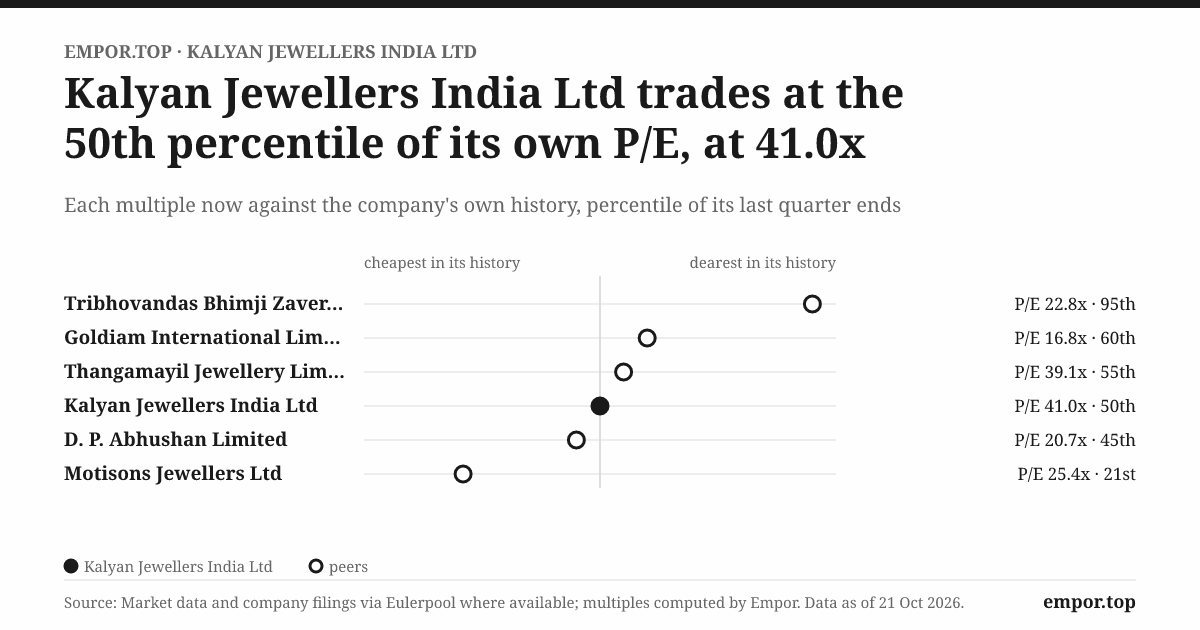
Thirty-three years later, that wager has become a listed company with 546 showrooms across India and the Middle East as of the end of September 2026.2 The network now carries three names. There is Kalyan itself, the large-format jeweller; Candere, an online-born lighter-jewellery brand that now also has physical stores; and a new regional brand launched in Tamil Nadu in August 2026.2 In the year to March 2026, the company reported consolidated revenue of about ₹35,700 crore and profit after tax of about ₹1,350 crore.3 On October 21, 2026, the market valued it at roughly ₹58,800 crore, about 41 times trailing earnings, almost exactly its own five-year median of about 40 times.
It is tempting to call Kalyan the number-two jeweller in India and move on. The evidence does not support so tidy a ranking. Titan, through Tanishq and its sister brands, is the clear leader, with an estimated 8% of India's jewellery market by value in 2025, while Kalyan and Malabar Gold & Diamonds are each estimated at about 5%.4 That means two things at once. Kalyan is one of a handful of national chains in a market that is still overwhelmingly served by regional chains and neighbourhood jewellers. And roughly nineteen of every twenty rupees spent on jewellery in India still go somewhere other than Kalyan.
This story turns on three questions. The first is about money. Since 2022, Kalyan has grown its store network mostly through a format it calls FOCO, short for franchise-owned, company-operated, in which an outside partner pays for the store and its stock while Kalyan runs it. Does that let the company grow without stretching its own balance sheet, or does it simply move the burden somewhere less visible? The second is about trust itself. A brand built in Kerala, with Kerala tastes, now does most of its new business in the north, west and east of India. Can local trust travel? The third is about shareholders. A jeweller is, underneath the glass cases, a gold-financing business. Does all this growth turn into cash?
The clock on those questions is running now. In early October 2026, Kalyan's business update for the September quarter reported India same-store sales growth of about 20%, Candere revenue up about 64%, and a statement that the Indian business's non-gold-metal-loan debt had reached zero.2 Audited quarterly results and the call that follows will test that snapshot. Before testing it, though, it helps to go back to the single store in Thrissur, and to the seven years when it was the only one.
 Subscribe on LinkedIn
II. One Shop, Seven Years
The Kalyanaraman family did not start in gold. The family ran a textile business in Thrissur, a trade built on the same rhythms that drive Indian jewellery: weddings, festivals and families buying for occasions that come once in a lifetime.1 That background matters only as context. The family's wider business interests, including real estate, sit outside the listed company, and the advantage that public investors are paying for has to be found in what Kalyan built in jewellery, not in the family's older trades.5
What T.S. Kalyanaraman seems to have learned from textiles was a retailer's insight rather than a goldsmith's. A wedding shopper wants choice. She wants to compare, to bring her mother and her aunts, to see a hundred necklaces rather than a sketch of one. A traditional jeweller could not afford to offer that, because every piece of finished jewellery on display is gold sitting idle, bought with money the jeweller has to finance until a customer arrives. The small shop's model of ordering pieces after a customer asked was not laziness. It was a way of keeping capital light.
So the 4,000-square-foot showroom in 1993 was an expensive commitment.1 It meant holding inventory on a scale that the neighbourhood competitor would never risk, and it meant betting that the extra traffic, the extra conversion and the extra trust would pay for the gold that sat in the cases. That is the original economic logic of Kalyan, and it has never gone away. Every showroom since has been a version of the same trade: tie up gold in display so the customer can see it, and hope the turnover is fast enough to pay for the carry.
Then Kalyanaraman did something unusual for a successful first-generation retailer. He waited. For seven years, Thrissur was the only Kalyan showroom.1 The second did not open until 2000, in Palakkad, a town not far away by road but different in its customers.1 Palakkad sits near the Tamil Nadu border, and its buyers did not want exactly what Thrissur's buyers wanted. Designs, weights and the mix of everyday and bridal jewellery all had to change. The lesson the founder later described was that a jeweller cannot simply copy a successful store; it has to rebuild the assortment for each market.1
That seven-year pause looks almost quaint against a company that, in recent years, has opened stores by the dozen every quarter. But it says something about the original culture. The first store was treated as a laboratory, not a template. By the time Kalyan expanded, it had learned that its product was not just gold, which every jeweller sells at the same international price, but a way of selling gold: the display, the selection, the pricing transparency and the local merchandising.
There is a limit to how much a founding story can prove, and it is worth naming here. A winning store in a small market can be copied by a local rival with a larger showroom. Thrissur itself is famous in Kerala as a gold town, crowded with jewellers. Kalyan's early advantage was real enough to finance growth, but nothing in the first store prevents a competitor from building one just like it. What Kalyan needed next was not a better store. It was a way to carry its name and its way of selling across a country with dozens of distinct jewellery cultures.
III. The Local Jeweller Goes National
Picture a woman in a small town in Uttar Pradesh, a few months before her daughter's wedding, answering a knock at the door. The visitor is not selling gold. She is from a "My Kalyan" centre, a small neighbourhood outpost that carries catalogues, explains the company's savings schemes and invites families to visit the nearest showroom. By the end of FY26, Kalyan ran 1,139 of these centres, and the company attributes about a fifth of its India revenue to customers sourced through them.3
That door-to-door network is the most revealing thing about how Kalyan went national. A jewellery brand from Kerala could not arrive in Lucknow or Ahmedabad with the reputation it had in Thrissur. Indian jewellery buying is local almost by definition. A family trusts the jeweller its grandparents used, and the designs, karatage and occasions differ sharply across regions. A Bengali bride, a Gujarati bride and a Tamil bride may want almost nothing in common. So Kalyan built two things at once: regional assortments, and a ground-level sales force that could translate a distant brand into a neighbourhood relationship.
The geographic path was gradual. From Kerala, the company moved into Tamil Nadu, Karnataka and Andhra Pradesh, the other large South Indian gold markets, and then crossed into the west with Ahmedabad before pushing into the north and east.6 Each new entry was a test of the Palakkad lesson at larger scale: could the head office in Thrissur design and stock for a customer it had never met? By FY26, roughly 70% of Kalyan's showrooms were outside South India, a remarkable reversal for a company whose name is still most powerful in Kerala.3
The other engine of that expansion was a savings habit. Kalyan's Dhanvarsha and Purchase Advance Scheme let customers pay a fixed amount every month, typically for eleven instalments, and redeem the accumulated value as jewellery at the end, usually with a concession on making charges.7 For a family planning a wedding, this is a disciplined way to buy gold in pieces. For Kalyan, it does two things. It locks in future demand to a specific showroom, and it brings cash in before the sale. That advance money is useful working capital, but it is not free, permanent financing. It is a promise to deliver jewellery, it carries the cost of the discount, and in India it is regulated so that a jeweller cannot run it like a deposit scheme. When customers redeem, the float disappears.
Kalyan also looked abroad early. In 2014, it opened its first showrooms in the Middle East, following the Indian diaspora in the Gulf, where Kerala's migrant workers and their families had long bought gold.3 That move deserves its own chapter later, because the economics of selling gold in Dubai are not the economics of selling it in Delhi.
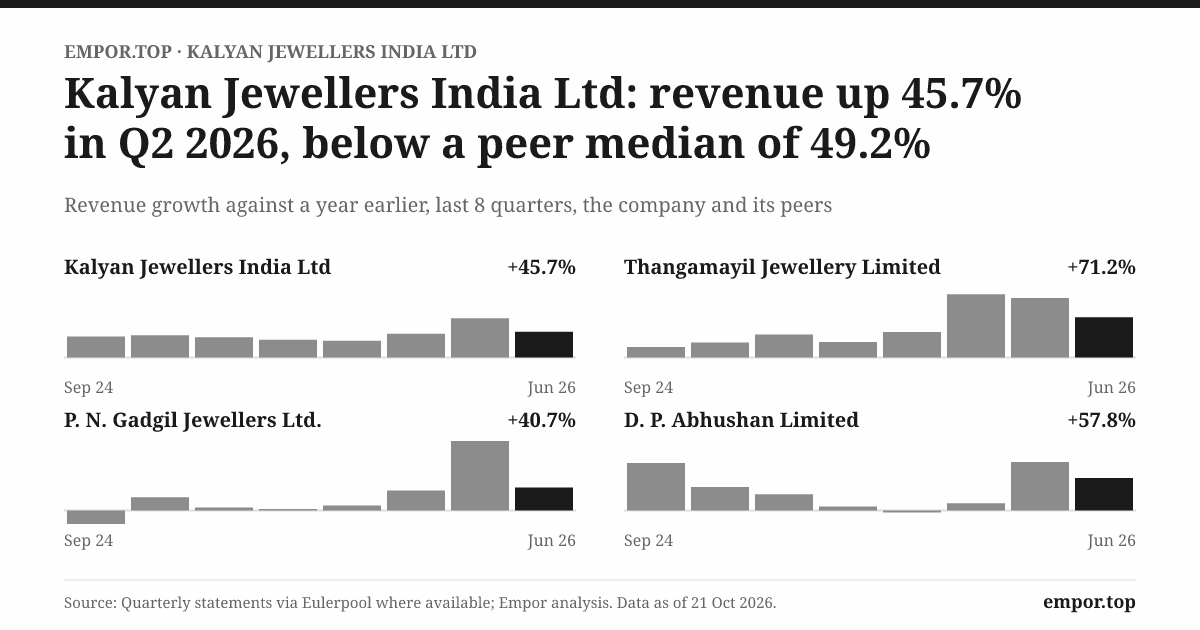
Here, though, it is worth correcting a common impression. Kalyan is often described as a company that has compounded at 30% a year for decades. The filings tell a different story. Consolidated revenue was about ₹9,800 crore in FY16 and about ₹10,500 crore in FY18, and it was still in that neighbourhood in FY20.6 For the half-decade before its listing, Kalyan was a large but stalled business, earning thin profits and, in two of those years, small net losses once interest and taxes were counted.6 Then COVID shut stores in FY21. The growth that followed, roughly a third a year in revenue from FY21 to FY26, is a real acceleration from a flat base, not the continuation of a long-run trend.5
What does the national expansion prove? It proves distribution and awareness. Kalyan has shown it can open stores in markets far from home and fill them. The company's own data on My Kalyan revenue share, regional store mix and same-store growth supports that. What the public record proves less well is the deeper claim that a Kalyan customer in the north stays a Kalyan customer. The company does not publish repeat-customer rates by region, and it does not publish evidence that it commands a price premium over local jewellers on comparable pieces. Distribution is the visible part of the moat. Loyalty and pricing power are the part investors have to infer.
By 2017, the founder's family was already looking past showrooms altogether. The next bet was a website.
IV. Candere's First Promise—and Its ₹350 Crore Test
In 2017, Kalyan bought a majority stake in Candere, an online jeweller selling lighter, more fashion-oriented pieces to young urban buyers who might never walk into a large-format gold showroom.7 The logic was easy to state. Kalyan's core customer was a family buying heavy gold for a wedding; Candere's customer was a working woman buying a diamond pendant for herself on a phone. One brand could not easily serve both. Owning a digital brand was a hedge against the possibility that the next generation of Indian jewellery buyers would shop the way it shops for everything else.
For years, Candere stayed small. In June 2024, Kalyan agreed to buy the remaining 15% for ₹42 crore, making Candere wholly owned.8 That price is a useful clue. If 15% was worth ₹42 crore, the whole company was valued at roughly ₹280 crore. Candere's revenue in FY24 was about ₹130 crore, so the price was a little over two times sales.9 That screen cannot say whether Kalyan overpaid, because a sales multiple ignores whether the sales make money. But it does show that the founders were not paying a dot-com valuation for their digital arm. They were consolidating an experiment at a price close to its revenue scale.
Then Candere changed shape. Kalyan began opening Candere physical stores, many of them under the franchise format, turning a website into an omnichannel brand. Growth followed. By FY26, Candere's turnover had reached about ₹425 crore, more than three times its FY24 level.10 It is now a real business by revenue, though still small: in the March 2026 quarter, Candere contributed about ₹131 crore against roughly ₹9,000 crore from Kalyan's India business.3
The economics are where the story gets harder. For FY26, Candere's own accounts reported a loss after tax of about ₹12.8 crore, and the subsidiary's net worth was negative, at about minus ₹32.5 crore.10 Meanwhile, on the June 2026 quarter call, management said Candere had turned profitable at the profit-after-tax level in the second half of FY26.11 Both statements can be true. A business can lose money in the first half, earn a little in the second, and still post a full-year loss. Store-level or quarter-level profitability is not the same thing as a legal entity that can cover its own costs over a year. The distinction matters because the parent soon had to write a cheque.
In September 2026, Kalyan put ₹350 crore into Candere through a rights issue, subscribing for 17.5 lakh shares at a premium of ₹2,000 each.10 The company said the money was to repay a loan that Kalyan itself had extended to Candere.10 In plain terms, the parent converted debt it was owed by its subsidiary into equity. That cleans up Candere's balance sheet and reduces its interest burden. It also confirms what the negative net worth implied: Candere had been funded by the parent, not by its own profits. A month later, Candere's revenue growth of about 64% in the September quarter showed the brand still has momentum.2 Momentum is not self-sufficiency. The proof Candere now owes shareholders is a full year of profit at the entity level, without fresh parent funding.
Alongside Candere sits the newest experiment. In August 2026, Kalyan opened the first showroom of a new regional brand in Chennai, with four more planned under franchise.2 Tamil Nadu is one of India's deepest gold markets and one where local chains have strong loyalties, so a separate regional brand is an interesting admission: perhaps the Kalyan name alone was not winning there as fast as the company wanted. Management pointed to encouraging early traction, but a few weeks of sales cannot establish durable demand.2 It is an option, not a business yet.
So the honest verdict on Candere is that it has become a credible second channel, not yet a second engine. And the ₹350 crore rights issue shifts the test from "can it grow?" to "can it pay for itself?" That question about funding brings the story to the moment Kalyan asked public investors to fund it.
V. The IPO Opens the Next Chapter
On March 26, 2021, Kalyan Jewellers listed on India's stock exchanges.6 The timing was awkward. COVID's second wave was weeks away, jewellery stores had spent much of the previous year shut, and the company had just reported a year of falling revenue. The ₹1,175 crore offering priced at ₹87 a share.6 It had two parts that are easy to blur together but mean very different things. About ₹800 crore was a fresh issue: new shares, with the money going into the company, largely to fund working capital.6 The other ₹375 crore was an offer for sale: existing shareholders selling some of what they held, with the money going to them.6
The largest seller was Warburg Pincus. The American private-equity firm had invested ₹1,200 crore in Kalyan in 2014, one of the largest private-equity bets ever made on Indian jewellery retail at the time, and it added to that investment later.126 Warburg was never the parent. It was a large minority investor whose money helped fund the expansion out of Kerala and into the Gulf, and whose presence gave the family-run company institutional credibility. The IPO was, among other things, Warburg's exit door. It sold in the offering, sold more in later tranches, and in August 2024 sold its entire remaining stake of about 9%.13
That final exit is the scene that matters for today's shareholders. T.S. Kalyanaraman personally bought about 2% of the company from Warburg for about ₹1,300 crore, at ₹535 a share, while institutional investors took the rest of the block.13 The price itself is a verdict on the IPO. A share sold to the public at ₹87 in 2021 was bought back by the founder at more than six times that price three and a half years later. For Warburg, the investment worked. For IPO investors, it worked even better. And for the founder, the purchase was a loud statement of conviction: he chose to own more of the company at a valuation many times what it had listed at.
Conviction, though, had to be financed. ₹1,300 crore is a large sum even for a wealthy family, and the promoters funded it in part by pledging shares as collateral. In the latest shareholding data, about 25% of the promoter group's shares were pledged, equal to roughly 15.6% of all of Kalyan's equity.14
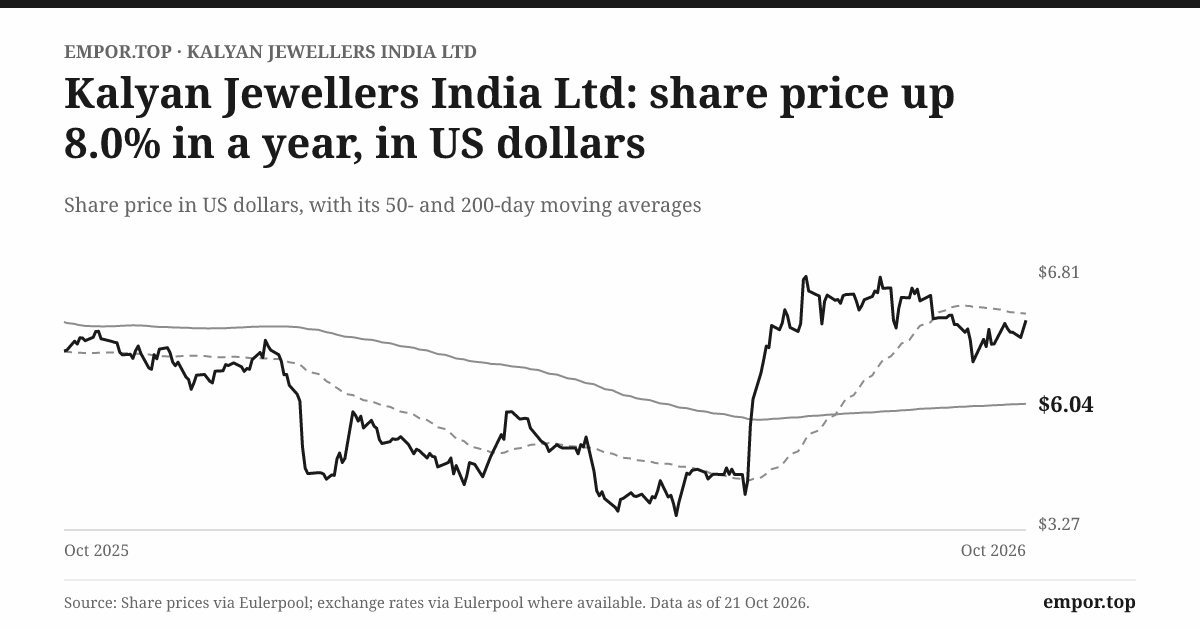
It is important to keep two kinds of risk apart here. The pledge is not Kalyan's debt. The company did not borrow this money, it does not owe it, and the loan does not appear on its balance sheet. But a share pledge has a way of becoming everyone's problem. If the share price falls far enough, lenders can demand more collateral or sell the pledged shares into the market. Kalyan's stock is volatile enough to make that more than theoretical. Over the past year it has traded between about ₹331 and ₹633, and over five years its worst peak-to-trough fall was about 58%. A stock that can halve in a bad stretch is not ideal collateral.
How has management explained the pledge? On the March 2026 quarter call, an analyst asked about it. Management said the pledge had not changed for about fifteen months and declined to discuss it further on the call.15 That is a defensible position, since it is a promoter matter rather than a company one. It is also an unsatisfying one for minority shareholders, who carry the price risk if the pledge is ever enforced. The disclosure record shows that the pledge was created to fund the Warburg purchase and has not yet been unwound; it does not show how or when it will be.14
The IPO, then, did what IPOs do. It gave the company public capital and gave an early investor a route out. The founder's later purchase consolidated family control. But it left behind a financing arrangement that ties a slice of the company's equity to a loan. The founders own the bet more than ever, and they have borrowed to do so. While that loan remains, the market will judge Kalyan's growth model partly by what it means for the promoter's collateral. The growth model itself was being rebuilt around another person's money.
VI. The Franchisee Pays for the Store
In the June 2022 quarter, a Kalyan showroom opened in Aurangabad, in Maharashtra, that looked exactly like every other Kalyan showroom.3 The same glass cases, the same uniformed staff, the same pricing boards. What was different was invisible to the customer. The store's fit-out had been paid for by a local business partner, and so had most of the gold in the cases. Kalyan ran the store, hired and trained its staff, set its prices and controlled its merchandise. The partner owned the economic asset. This was Kalyan's first FOCO showroom, and it marked the most important strategic change in the company's history since the founder put gold on the shelf.3
To understand why it mattered, recall the original trade. Every jewellery showroom ties up a large amount of gold, which is the dominant cost of opening one. For a company growing at the pace Kalyan wanted, opening dozens of stores a year with its own money would have meant either borrowing heavily or issuing shares again. FOCO changed who carried that load. Under the format, for most new stores outside South India, the franchise partner funds the store fit-out, the inventory and most showroom operating expenses.3 Kalyan supplies the brand, the systems, the staff and the supply chain, and in return keeps a share of the store's profit along with fees and royalties.3
A useful way to picture it is a hotel chain that manages properties owned by local investors. The traveller sees the brand and the service; the building belongs to someone else. The brand owner earns less per room than if it owned the hotel, but it can put its name on many more hotels with the same capital. The difference with jewellery is that the asset the partner funds is not a building that lasts decades but gold inventory that has to turn over, at prices that swing.
The scale of the shift is striking. Kalyan India had 15 FOCO showrooms at the end of FY23. By the end of FY26, it had 222.3 Candere had another 70 franchise stores, and the international business five.3 In three years, a format that did not exist became the main way the company grows.
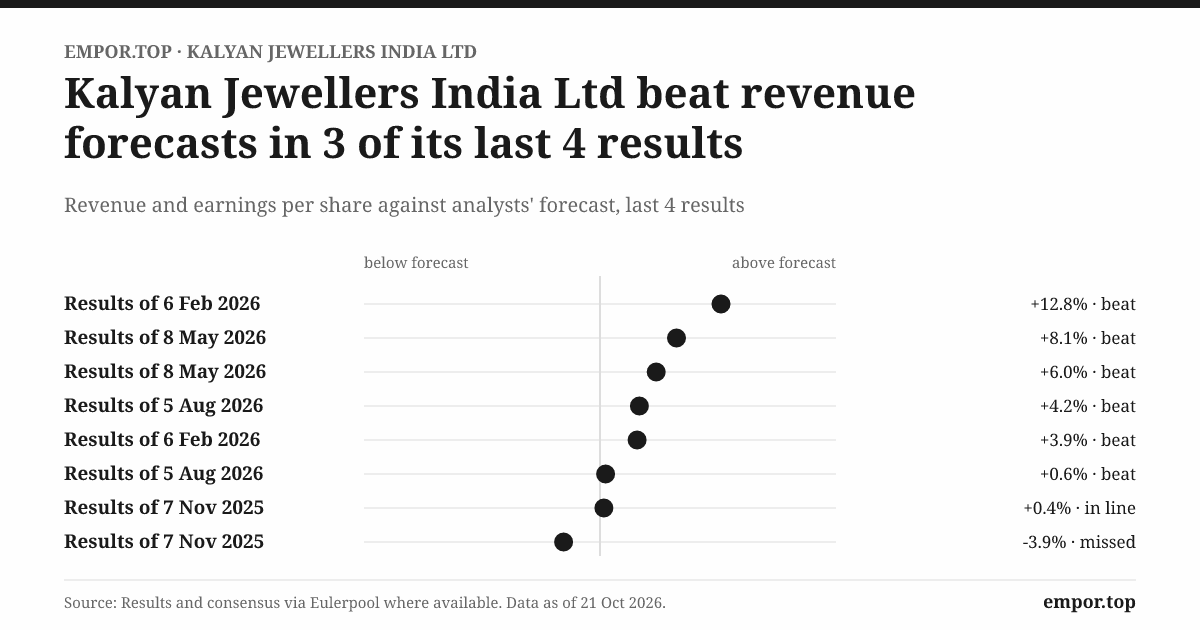
Has management delivered what it promised? The record here is better than many fast-growing retailers can show. On the March 2024 quarter call, management spoke of opening about 80 Kalyan and 50 Candere showrooms in FY25.11 The company later reported 129 launches across both formats against that combined target of 130, close enough to call a promise kept.3 On the March 2026 call, it set a new plan for FY27: 84 Kalyan showrooms in India, six international showrooms and 50 Candere stores.15 By the end of September 2026, with the network at 546 showrooms, the year's rollout was proceeding.2 Setting a store target and meeting it is not the same as proving every store earns its keep, but it is evidence of operational discipline in the part of the business that is easiest to measure.
The return metrics moved with the model. On the company's own calculation, consolidated return on capital employed rose to about 28.8% in FY26 from about 19.8% in FY25.3 That definition is the company's, built on average equity, net debt excluding gold loans, and lease liabilities. Other methods give different numbers, so the level matters less than the direction. On every reasonable measure, Kalyan is earning more operating profit per rupee of capital than it did before FOCO. Asset turnover tells the same story: revenue per rupee of total assets rose from under one in FY21 to about 1.7 in FY26.5
People are the other half of the reinvestment. Because Kalyan operates every FOCO store itself, the franchise model shifts capital to partners but not labour: the staff behind the counters, the store managers and the merchandisers are still Kalyan's. Permanent headcount rose from about 11,200 in FY24 to about 14,700 in FY26, roughly a third more people in two years.5 That is the hidden cost line of the format. A franchise partner can write a cheque for gold in a week; a trained jewellery salesperson who can be trusted with a bride's family and a tray of necklaces takes much longer to produce. If Kalyan's growth ever stalls, it is as likely to be for want of people as for want of partners.
This is the bull case in one sentence: Kalyan has found a way to grow faster while needing less of its own money. And it is a real improvement. But it deserves a skeptical second look, because a better return on capital for the parent does not automatically mean the system as a whole is earning more.
Whose capital, whose return?
Start with what Kalyan gives up. A franchised store's revenue counts in Kalyan's sales, but its profit is shared with the partner, so FOCO revenue carries a lower reported margin than company-owned sales. Management has acknowledged that franchise growth weighs on reported margins even as it lifts returns.15 In effect, Kalyan trades margin for capital efficiency. That is a sensible trade if the alternative is not growing at all. It is a less obviously good trade if the company could have funded the stores itself at a return above its cost of capital.
Then consider the partner. The franchisee has put up the store and the gold. Their return depends on the store's sales, the share of profit they keep, and how quickly the inventory turns. If same-store sales are strong and gold prices rise, the franchisee does well: the inventory appreciates and turns into higher-value sales. If sales slow, the partner is left holding expensive gold in a store they do not control. The whole model rests on franchisees continuing to want in. Kalyan does not publish franchisee returns, payback periods, or revenue per franchise store against company-owned stores, so investors cannot see directly whether partners are earning enough to keep signing up. The continued pace of openings is indirect evidence that they are, for now.
The demand behind the expansion is the evidence that matters most. Here, the recent numbers are genuinely strong. India same-store sales growth of about 20% in the September 2026 quarter means existing stores, not just new ones, are selling more.2 Part of that is gold inflation, since higher prices raise the rupee value of each sale, and it is a different thing from more customers buying more jewellery. But strong same-store growth across an expanding network is the best sign that new stores are not simply cannibalising old ones.
The balance-sheet milestone sits next to all this. The September 2026 quarterly update stated that Kalyan's Indian non-gold-metal-loan debt had reached zero.2 That is a meaningful result for a company that, before its IPO, carried borrowings more than twice its equity.5 It should be read precisely. Gold metal loans, which are gold borrowed from banks and repaid as jewellery is sold, remain, and so do lease liabilities on rented showrooms. Zero non-GML debt in India is also a point-in-time statement at a moment of strong sales; the harder test is whether it stays at zero through the festive and wedding stocking seasons, at gold prices that keep rising.
So FOCO has worked in the way that is easiest to observe: more stores, better returns, less debt. The open question is how much of the improvement is a genuinely more productive business, and how much is the inventory burden moving from Kalyan's balance sheet to its partners'. The answer runs through the gold itself, and through how Kalyan pays for it.
VII. A Jewellery Sale Is Also a Gold-Financing Decision
A family walks into a Kalyan showroom in Kanpur to buy a wedding set. The bill they will eventually pay has three parts. The first is the gold, priced by weight at that day's rate. The second is the making charge, which pays for design and craftsmanship and varies from a modest premium on simple chains to a large one on intricate pieces.7 The third, if the set carries diamonds or other stones, is the value of those stones, where jewellers typically earn much more. The family sees one number. Kalyan sees a transaction that began months earlier, when it bought or borrowed the gold now sitting on the velvet.
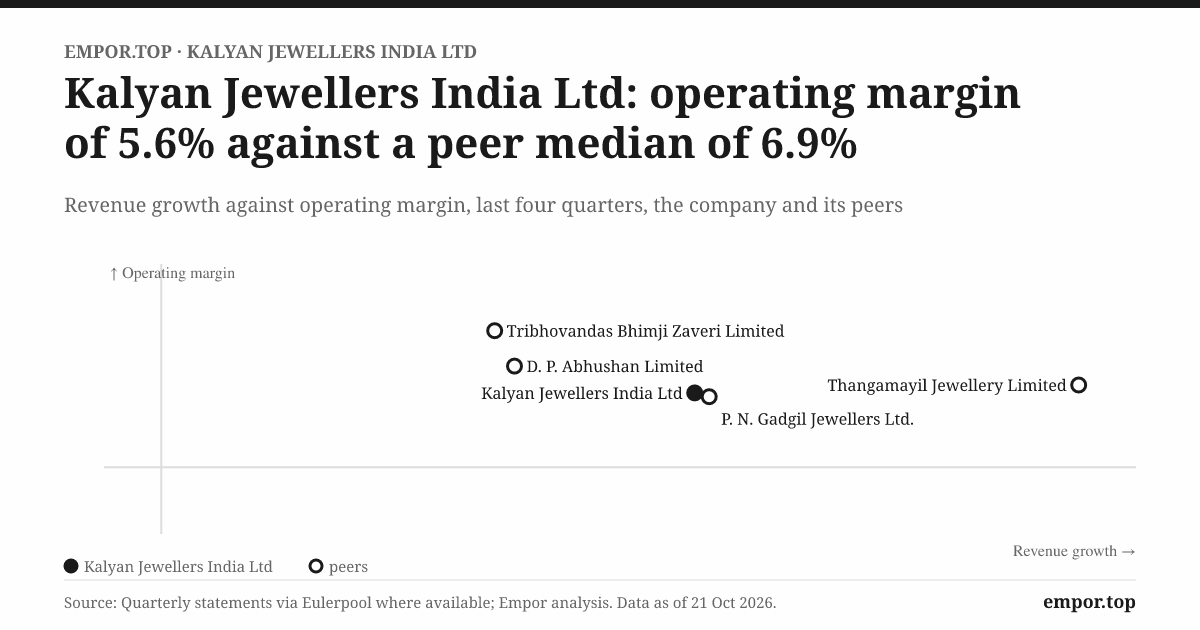
That is the core of the business model, and the reason jewellery retail never produces software margins. The gold in each sale is a near-commodity that the customer can price anywhere. Kalyan earns its money mainly on making charges, on studded jewellery, and on scale, while carrying inventory for months before sale. In FY26, its operating margin was about 5.8%.5 For every ₹100 of jewellery sold, less than ₹6 was left after the cost of goods, staff, rent and marketing. Secondary income adds a little, through franchise fees, royalties and the spread on supplying franchise stores, but it does not change the basic shape.3
Thin margins on a high-value sale mean that the speed of turnover decides everything. Here Kalyan's record is genuinely impressive. In FY21, when stores were shut and the old company-owned model held all the gold, inventory sat for about 272 days on average before being sold.5 By FY26, that was down to about 160 days.5 Some of the improvement reflects post-COVID demand recovering, but much of it reflects FOCO: when a franchise partner owns a store's stock, that stock no longer sits on Kalyan's balance sheet. Customers pay quickly, with receivables equal to about nine days of sales, mostly card and digital payments waiting to settle.5 Kalyan, in turn, pays its suppliers in about 38 days.5 Add it up and the cash conversion cycle, the time between paying for gold and collecting cash for it, is about 131 days, down from well over 200 at the start of the decade.5 The lesson of those figures is that customers do not create Kalyan's cash risk. Inventory does.
Gold metal loans are how Kalyan manages that inventory risk. Instead of buying gold outright, the company borrows physical gold from banks and repays in gold, or its cash value at the time, as the jewellery is sold.9 The arrangement works like a natural hedge. If the price of gold rises between borrowing and selling, the value of the inventory rises, but so does the obligation to the bank. It removes much of the price risk on the gold in stock. It does not remove all risk. Kalyan still pays interest, still needs bank lines to be renewed, and still bears the cost when duty changes or sudden price moves catch inventory in the wrong place.
Over the long run, Kalyan's accounts look like a strong cash generator. Over the nine years from FY18 to FY26, it reported cumulative net profit of about ₹3,600 crore and cumulative operating cash flow of about ₹6,000 crore, roughly 1.7 times profit.56 That looks exceptional, and part of it is real: the business collects quickly and the advance schemes bring in cash before sales. Part of it is accounting. Under Indian lease accounting, rent on showrooms is split into depreciation and interest, which inflates operating cash flow, while the lease payments themselves sit in financing cash flow. So operating cash flow overstates what the stores generate after paying the landlord. Over those same nine years, free cash flow after capital spending was about ₹3,800 crore, of which only about ₹330 crore, under a tenth, went out as dividends.5 Most of the rest went to reducing debt and funding growth.
Then FY26 broke the pattern. In the year Kalyan reported record profit, compiled cash-flow data shows operating cash flow slightly negative, at about minus ₹170 crore, and free cash flow of about minus ₹600 crore.5 On the March 2026 call, management told a different-sounding story: it said about ₹350 crore of cash had been used to reduce debt and about ₹150 crore paid as dividends.15 Both accounts can be reconciled, but only with the audited cash-flow statement and its working-capital bridge in hand. The most plausible mechanism is inventory: gold prices rose sharply over the year, the network grew by well over a hundred stores, and every gram of gold Kalyan held for its own stores, and to supply franchisees, cost more. How gold-loan movements are classified between operating and financing cash flow can also swing the operating line. What should not be assumed is a link to the July 2024 customs duty cut. That event belongs to a different year.
The duty cut is worth telling in its own time. In July 2024, India's Union Budget cut the import duty on gold and silver from 15% to 6%.16 For customers, it made jewellery cheaper overnight and lifted demand. For jewellers holding stock bought at the old, higher duty-inclusive price, it meant inventory suddenly worth less than it cost, and Kalyan took a one-time margin hit in FY25 as a result.9 That episode explains a dent in FY25's profit. It does not, on its own, explain FY26's cash.
There is another clue in the profit line itself. In FY24 and FY25, Kalyan's other income, mostly interest on bank deposits and security deposits, was about ₹100 crore and ₹150 crore, between an eighth and a sixth of pre-tax profit.9 That income is real, but it is treasury income, not retail income, and it means headline profit growth in those years overstated what the stores earned. FY26's jump in operating profit is a cleaner signal, because the gain came from the core.
A final caution about the size of the business. The company's FY26 presentation and call reported consolidated revenue of about ₹35,700 crore and profit after tax of about ₹1,350 crore.315 Some compilations of the same accounts show revenue nearer ₹38,700 crore and profit near ₹1,450 crore, which reflects different treatment of the revenue line and of profit attribution. The growth story is the same either way, but precise growth rates should be taken from the audited statements.5
What does all this mean? Kalyan is a scale retailer with thin margins and a large, gold-heavy working-capital need. Its customers pay fast, its inventory turns faster than it used to, and its long-run cash record is solid once lease accounting is understood. But FY26 showed that rapid growth during a gold-price surge can absorb cash even while profits hit records. That pattern is not unique to India. It is about to reappear in the Gulf.
VIII. The Gulf Is a Second Market, Not a Second India
In 2014, Kalyan opened six showrooms in Dubai on a single day.3 It was a theatrical entrance into one of the most competitive gold markets in the world. Dubai's gold souk had been trading for generations; its shoppers included tourists, Emiratis and, above all, the vast South Asian diaspora that had made the Gulf its working home. Many of those workers came from Kerala, and they already knew the Kalyan name from home. The Gulf was an obvious place to follow customers abroad.
Over the following years, Kalyan spread across the UAE, Qatar, Oman and Kuwait, and by late 2026 operated 38 showrooms in the Middle East.2 Those operations run through subsidiaries that sit inside Kalyan's consolidated accounts, so their results are part of the listed company's numbers rather than a separate family venture.5 In the September 2026 quarter, international markets contributed about 11% of consolidated revenue.2
Scale tells the first part of the story. In the March 2026 quarter, India generated revenue of about ₹9,000 crore, the Middle East about ₹1,070 crore, and Candere about ₹130 crore.3 India is the centre of gravity, by a factor of eight or nine. The Gulf is meaningful, but it is a second market, not a second engine.
Margins tell the second part. In that same March quarter, India's segment operating margin was about 5.9% and the Middle East's about 5.3%.3 That gap is narrower than many investors assume. Older estimates had put Middle East margins far lower, closer to 2.5% to 3.5%, and a single strong quarter may flatter the region. The annual segment disclosure is the right place to settle the question, and the March 2026 quarter suggests the Gulf business has improved, not that it has matched India.
The reasons Gulf margins tend to be lower are structural. Buyers there often purchase high-purity 22- and 24-karat gold with low making charges, treating jewellery partly as savings. Studded jewellery, where margins are richest, is a smaller part of the mix. Competition is intense, with a dense cluster of established Gulf jewellers, other Indian chains such as Malabar, and souks where price comparison takes seconds. Operating costs, from rents to staff, are higher than in an Indian town. And the currency pegs to the US dollar that some investors read as safety do not protect against what actually drives this business: the gold price and the spending power of migrant workers, whose incomes depend on oil-funded construction and services.
Kalyan's current strategy for the region borrows from its Indian playbook. On the March 2026 call, management said it was talking to potential franchise partners in the Middle East.15 The international business already had five franchise stores by the end of FY26.3 If the model travels, it could reduce Kalyan's capital in the Gulf and lift returns the same way it did in India. But the Indian franchise wave rode on rising same-store sales in a market where organised jewellers were taking share from neighbourhood shops. In the Gulf, the brand is a visitor in a market that is already highly organised. Franchise partners will want proof of store economics before they write cheques.
So the Gulf gives Kalyan a foothold abroad, hard-currency revenue and a customer base tied to home. It does not yet give the company a second India. The test is whether the India store playbook can be reproduced there without diluting the margins that paid for it, and the next annual segment numbers will say more than any single quarter. Either way, the decision about how far to push abroad, like every large decision at Kalyan, rests with the family.
IX. The Founders Still Own the Bet
After the Warburg purchase in August 2024, T.S. Kalyanaraman had put more of his own wealth behind the company he runs.13 By September 2026, the promoter group held about 63% of Kalyan.14 Few large Indian retailers are so firmly controlled by the family that founded them. That control is the reason this chapter exists. When owners hold nearly two-thirds of a company, the question for the other third is whether the family's incentives line up with theirs, and whether its record of decisions earns the trust it asks for.
The leadership is a mix of family and professionals. T.S. Kalyanaraman is chairman and managing director. His sons, Rajesh and Ramesh Kalyanaraman, are executive directors, and the family has run the business together since its expansion years.5 Day-to-day operations are led by chief executive Sanjay Raghuraman, a professional manager, with V. Swaminathan as chief financial officer.5 The CEO and CFO have stayed in place through the post-listing period, and that continuity shows in the calls: the same team set the store targets and then reported against them. The founder himself rarely takes centre stage on analyst calls. His decisions, from the seven-year wait before a second store to the 2024 share purchase, speak for him.
The pledge remains the central complication for minority shareholders.14 A pledge can be a sign of alignment, because the family has borrowed to own more, and a source of risk, because the collateral is the stock everyone else owns. Both are true here. What tips the balance is the trend. A pledge that shrinks as the family repays its lender would turn the 2024 purchase into an unambiguous vote of confidence. A pledge that stays flat for years leaves an overhang whose size depends on the share price.
Pay is the next test of alignment, and it is often misread. In May 2024, shareholders approved by postal ballot the reappointment of the three promoter-directors for five years from June 2024, with each allowed annual remuneration of up to ₹12.12 crore, or about ₹36 crore for the three combined.9 Those are caps, not salaries paid. Even at the cap, ₹36 crore would be under 3% of FY26 profit after tax, which is not extravagant for a company of this size; the actual amounts paid in each year are reported in the annual report and are what should be compared with profit.5 The resolutions passed with more than 90% support, which means the institutional shareholders who vote did not regard the terms as abusive.9 The September 2026 annual general meeting brought the board's resolutions back to a vote, and the scrutinizer's report is the place where any dissent from minority holders would show.17
Capital allocation over time is where behaviour reveals the most. There are three recent decisions to weigh. The franchise shift, which let the company grow without heavy borrowing, has so far been the best capital decision since the IPO. The Candere rights issue is more mixed: ₹350 crore went into a subsidiary that lost money for the full year, albeit to retire a loan the parent had already made.10 And the company has been selling non-core assets, including corporate aircraft, and using the proceeds alongside cash from operations to bring down debt.9 Taken together, the record shows a family that has become more capital-conscious since listing, with Candere the one place where enthusiasm has run ahead of proof.
Related-party dealings are a natural worry with a controlling family, and the answer here is narrower than the worry. The reported transactions are mainly rents on showroom properties leased from promoter-linked entities and the remuneration of the family directors.9 The Kalyan trademark belongs to the company, not the family, and the company receives royalties from franchisees rather than paying them to the promoters.9 That is a cleaner structure than at many Indian family companies, where the brand sits in a private entity and the listed company pays to use it. Standalone showroom rent was about ₹56 crore in FY25, of which leases with promoter-linked owners are one part, approved by the audit committee as arm's length.9
Tax disputes are the other governance item worth carrying. At the end of FY25, Kalyan reported disputed indirect-tax demands, mostly sales tax, VAT and GST claims, of about ₹379 crore, up from about ₹314 crore a year earlier, against which it had deposited only about ₹1.4 crore under protest.9 These are contingent liabilities, claims the company is contesting, not debts it owes. Many relate to how credit was claimed on stock moved between states, which is a common area of dispute for multi-state retailers. They are small next to Kalyan's equity, but they have been rising, and their resolution would be a cash event if the tribunals decide against the company. The audit record for FY24 and FY25 is clean: both years carried unmodified opinions, through a change of auditor from Deloitte to Walker Chandiok & Co in 2024 after Deloitte's mandatory rotation.97
The credibility test comes back, as it must, to that March 2026 call. The call added no new detail on the pledge.15 The pledge has been disclosed, and the company's own balance sheet has moved in the right direction while it stood still. But it is not an answer. The next disclosure on the pledge, or on how the promoter loan is refinanced, will say more about the family's position than any call. Meanwhile, out in the market, the family's company faces rivals who would like nothing more than to take its customers.
X. The Chain Versus Titan and the Neighbourhood Jeweller
A young couple in Indore is choosing where to buy wedding jewellery. On one side of the main road is a large Kalyan showroom, its windows bright, its prices posted daily, its hallmarked gold backed by a national brand and an exchange policy that lets them trade old gold for new. A few streets away is the jeweller who made the bride's mother's wedding set, who knows the family by name, who will adjust a design over a cup of tea and may knock a little off the making charge for a loyal customer. Down the road is a Tanishq. Every one of those options sells gold at roughly the same international price. The decision comes down to trust, design, service and the size of the making charge.
That scene captures the competitive map. Titan is the leader, with Tanishq at the top of the market and Mia and CaratLane reaching younger and lighter-jewellery buyers.18 Titan is larger, earns higher reported margins, and has a higher share of studded jewellery, where the money is. Malabar Gold & Diamonds is a Kerala-born national rival of similar scale to Kalyan. Below them sit strong regional chains, and below those, tens of thousands of independent jewellers who still make most of India's jewellery sales.
Market share estimates put this in context. Euromonitor estimates that in 2025 Titan held about 8% of the Indian jewellery market by value and Kalyan and Malabar about 5% each.4 These are research estimates of a fragmented market, not company-filed numbers, but the shape is clear. Even the leader holds a single-digit share. The industry's long-run story, documented by the World Gold Council, is that organised chains have been gaining share from unorganised jewellers as hallmarking rules, tax formalisation and shifting consumer habits favour brands.19 That trend is the tailwind under every national chain. It does not tell anyone which chain will capture it.
Store counts are easy to compare and easy to misuse. At the end of FY26, Kalyan and Candere together had 466 showrooms in India; Titan reported 1,194 domestic jewellery stores across its brands.318 But a Tanishq flagship, a CaratLane kiosk and a Kalyan showroom are very different in size and sales. The count says Titan's network is denser. It does not say which stores earn more per square foot.
The frameworks strategists use help organise what the evidence shows. Start with the five forces that shape an industry's profits. Rivalry is intense: national chains, regional chains and local jewellers all compete on design, making charges and exchange offers, and during festivals discounts are routine. Buyer power is high in the way that matters for retail. No customer is a large share of Kalyan's revenue, but every customer can walk across the road, and the price of the main ingredient is public every morning. Supplier power is moderate: gold comes from a handful of bullion banks under gold metal loans, and craftsmanship from a broad network of artisans and manufacturing units, so no single supplier holds Kalyan hostage, but the banks control the financing on which the model depends.9 Regulation cuts both ways, raising compliance costs through mandatory hallmarking while tilting the field toward organised players. And the threat of new entrants at scale is limited, because a national jeweller needs three things that are hard to assemble quickly: trust, enormous working capital and distribution.
Now test Kalyan's claimed sources of lasting advantage, the "powers" that let a company earn more than its rivals for long periods. The first is brand. Kalyan's brand plainly matters, because it is the reason a franchise partner will pay for a store with Kalyan's name on it and the reason a family in a new town will walk in. That is real evidence of brand value. But it is a brand that earns its money through trust and selection rather than prestige. Titan's higher margins suggest that customers pay more for Tanishq than for Kalyan, so Kalyan's brand power is narrower than the leader's.
The second is scale. Kalyan's size gives it bargaining power with bullion banks, a national supply chain and the ability to spread marketing across hundreds of stores. Those are real cost advantages over a neighbourhood jeweller. Against Titan and Malabar, they are roughly matched.
The third is counter-positioning, and here FOCO is the most interesting candidate. A model in which partners fund the stores lets Kalyan grow faster than a rival that insists on owning its stores. But Titan has long used franchise partners in its own network, so the model is not one an incumbent cannot copy. It is a speed advantage, not a structural one.
Then there are the powers Kalyan does not have. Switching costs are minimal. The savings schemes create a short lock-in, but once a scheme matures, the customer is free. There is no network effect: one more customer at a Kalyan store does not make the store more valuable to anyone else. There is no proprietary technology and no cornered resource; gold is gold. The 1,139 My Kalyan centres extend reach and are hard for a small rival to replicate, but they are an expensive, labour-intensive distribution asset rather than a moat that compounds by itself.3
The case against a moat is concrete. Organised chains already fight each other with discounts, exchange offers and design launches, especially around wedding and festival seasons. Independent jewellers keep their local relationships and often charge less in making charges. A customer who bought from Kalyan last year owes it nothing this year. The industry shift toward chains is real, but Kalyan has to earn its share of that shift store by store.
The verdict is that Kalyan's defensible edge is brand trust combined with regional merchandising and operating scale. That is enough to take share in a fragmented market, and the recent growth shows it doing so. It is not a switching-cost moat, and buyer power sits squarely with individual consumers and their many alternatives. The evidence that would confirm Kalyan is winning on its own strengths, rather than riding the industry's formalisation, lies in same-store sales growth by region, the share of studded jewellery in sales, the share of new customers, and the economics of franchise stores. Those are the measures a skeptic should watch, and they lead naturally to what this story has to teach.
XI. Playbook: Business & Investing Lessons
Go back to Thrissur in 1993, to gold under bright lights where a family could touch it before believing in it. Then jump almost thirty years to Aurangabad, where a local partner paid for a store's gold so that Kalyan could run it under its own name.13 Between those two showrooms sits a set of lessons that belong to this company and no other.
The first is that in a high-trust business, you make the product visible before you ask for belief. Kalyanaraman's big shop was a costly way of saying "look for yourself." Every business that sells something its customer cannot easily verify, from gold to insurance to software security, faces the same problem. Kalyan's answer was to spend capital on transparency rather than on persuasion. That is a lesson for founders: when trust is the product, put it on the shelf.
The second is that a national brand wins locally, one assortment at a time. The seven-year wait before Palakkad, and the discovery that Palakkad's customers wanted different jewellery, set the template for a company that now does most of its business far from Kerala. Kalyan did not export Thrissur; it rebuilt itself in each region and built My Kalyan centres to make a distant name feel like a neighbour.13 Investors who assume a brand travels on its own should remember that Kalyan needed both regional design and a door-to-door network to make it travel.
The third is that capital-light growth works only when the franchisee's return is as real as the parent's ROCE. FOCO lifted Kalyan's returns and took the company to 222 franchise showrooms in India by FY26.3 But the capital did not vanish; it moved to the partners. A franchise model is only as durable as the partner's willingness to keep paying for the next store. The parent's return on capital is the visible half of the equation. The partner's return is the half that decides whether the expansion lasts.
The fourth is that fast sales growth is a beginning, and self-funding profit is the proof. Candere tripled its revenue in two years and still needed ₹350 crore from its parent to repay what it owed.10 Many promising subsidiaries look like that. The discipline is to keep asking whether the new business can pay its own way, rather than applauding its growth rate.
The fifth is that owner commitment counts most when the balance sheet can carry the commitment. The founder bought more of his company at more than six times the IPO price, a powerful signal.13 He also pledged shares to do it. Meanwhile Kalyan itself has spent its cash paying down debt, to the point where its Indian non-gold-loan debt reached zero.2 The lesson for investors is to look at both balance sheets, the company's and the owner's, because a strong company with a stretched owner is not as safe as it looks.
Over nine years, Kalyan paid out under a tenth of its free cash flow as dividends.5 That is the quiet thread connecting the lessons: this company has preferred to reinvest, deleverage and grow. Whether that preference creates value is the debate that follows.
XII. Analysis & Bear vs. Bull Case
On October 21, 2026, Kalyan's shares closed at about ₹570, about 10% below their 52-week high. In the previous days, the company had reported another quarter of store additions and consolidated revenue growth in the high twenties.2 At that price, investors were paying about 41 times trailing earnings, close to the company's own five-year median of about 40 times. The question for this chapter is whether Kalyan's growth justifies that price given the capital and execution risks that remain.
The bull case begins with an industry tailwind and a company positioned to ride it. Organised jewellers have been taking share from unorganised ones for years, and regulation such as mandatory hallmarking pushes customers toward brands.19 Kalyan's growth outside the South gives it room to keep opening stores in markets where its share is still small; about 70% of its showrooms already sit outside the South, and the number keeps rising.3 FOCO lets that expansion happen with partners' money, which has already lifted the company's returns. Same-store sales growth of around 20% in the September 2026 quarter shows that demand is not coming only from new stores.2 A rising share of studded jewellery, if it materialises, would widen margins. On this view, Kalyan is a compounding retailer with years of runway, and the price is reasonable for the growth.
The bear case starts with gold itself. Kalyan's business requires holding large amounts of gold, and when the gold price spikes, each new store and each additional gram of stock ties up more cash. FY26 showed what that looks like: record profit and negative operating cash flow in the same year.5 Franchise growth brings its own risks. Shared store profits dilute reported margins, and if same-store growth slows, franchise partners could find their returns disappointing, slowing the openings on which the growth story depends. The core still operates on margins of about 6%, which leaves little room for error.5 And the newer bets, Candere and the Tamil Nadu brand, consume capital before proving their contribution.102
The bear case also has an activist's edge. A skeptical shareholder would ask why the family's pledge has not moved in more than a year, and why the company will not discuss it. They would ask why a subsidiary with negative net worth received ₹350 crore, and what the hurdle rate was. They would ask for franchisee economics, store-level payback and same-store growth by region, all of which the company has not published in the detail a franchise-dependent model invites. None of those questions implies wrongdoing. Each is a gap between what investors are asked to believe and what the disclosures prove.
Valuation sharpens the debate. At about 41 times earnings, the market is paying close to its own five-year average for Kalyan, so the price embeds no special optimism and no special discount relative to its history. That is not a margin of safety. Free cash flow yield, at about 0.9%, is very low, because FY26 free cash flow was negative; on that measure, investors are paying almost entirely for future cash, not current cash. Enterprise value is about 21 times EBITDA, and the price is about nine times book value. The market is assuming that the FY26 cash shortfall was a timing effect of gold prices and expansion, and that profit growth will keep translating into cash. If FY27's cash flow recovers, the low yield will look like an artifact. If it does not, the earnings multiple will look generous. Against Titan, Kalyan trades at a lower multiple, which reflects Titan's higher margins and stronger brand premium rather than any obvious mispricing.
The other multiples tell a consistent story. Return on equity of about 23% over the twelve months to June 2026 is respectable for a retailer, and it goes some way to explaining why investors tolerate a price of nine times book value. The ratio of the earnings multiple to recent earnings growth sits a little below one, which on its face suggests the market is not overpaying for growth. But that ratio rests on profit growth that came partly from a recovering margin and a rising gold price, both of which can reverse. A multiple anchored to earnings that are growing faster than cash is only as reliable as the conversion of those earnings into cash, which brings the argument back to the same place every time.
Three measures will settle most of the argument. The first is same-store sales growth, split between South and non-South India. The latest reading is about 20% for India as a whole, strong and recently rising.2 What matters is whether non-South stores, which carry most of the expansion, keep pace without the help of gold inflation. The second is cash from operations after working-capital movements. Its latest annual reading was slightly negative in FY26, a sharp break from a long positive record.5 Recovery in FY27 would confirm that the franchise model really lightens Kalyan's capital load; another negative year would suggest growth is trapping cash in inventory. The third is FOCO openings measured against the productivity of mature stores and, if the company ever discloses it, franchisee returns. FOCO showrooms in India numbered 222 at the end of FY26, and the FY27 plan calls for 84 more Kalyan stores in India.315 The openings are visible; the economics underneath them are not.
Two events will matter beyond the regular quarters. The FY27 audited cash-flow statement will show whether the FY26 shortfall was a one-off. The next disclosure on the promoter pledge, whether a release, a refinancing or an increase, will show which way the family's own balance sheet is moving. The next annual report's segment margins will also test whether the Gulf can lift the consolidated mix.
The risks that matter are specific. Gold prices and import duty changes affect how much jewellery customers can afford, what Kalyan's inventory is worth and how much cash it needs, as the 2024 duty cut showed.16 Hallmarking and sourcing rules raise compliance demands. The pledge creates collateral risk in a volatile stock. Fast store rollout creates execution risk and depends on franchisees earning enough to stay. Credit agencies see the same picture: ratings were reaffirmed in 2026, with thin margins and gold-price-driven working capital cited among the constraints.2021
The decision hinge is plain. Kalyan's growth is credible: stores are opening, same-store sales are rising and returns have improved. What is not yet equally proven is that the growth produces durable cash and that the franchise economics work as well for the partners as they do for the parent. The next set of results will start to answer that.
XIII. Epilogue
Tonight, Kalyan stands with 546 showrooms, India same-store sales growing at about 20%, a fresh ₹350 crore invested in Candere, and a statement that its Indian business carries no debt other than gold metal loans.210 It is a bigger, more efficient and less indebted company than the one that listed in 2021. The September quarter's audited results, due in the weeks ahead, and the earnings call that follows will be the first test of whether that snapshot holds.
The first fork concerns cash. If operating cash flow recovers in FY27, the story to tell will be which line of working capital did the work: lower inventory per store, more stock carried by franchise partners, or simply a pause in gold's climb. If cash stays weak, the question becomes whether higher gold prices or the pace of expansion are keeping money locked in the display cases. Either answer will say more about the franchise model than any return-on-capital figure.
The second fork concerns the family. If the pledge falls, the important detail will be where the repayment came from: dividends from the company, sales of shares, or other family assets. If the pledge stays, the measure to track is how much of the promoter holding and of the company's equity remains encumbered, and how close the share price drifts to levels where lenders start to worry.
The third concerns Candere. If it keeps growing, the figures that will matter are full-year profit at the subsidiary, its debt, and whether the parent has to fund it again. Revenue growth alone has already been proven. Self-funding has not.
The fourth concerns the franchise engine. If FOCO openings stay near plan, the comparison that will matter is between store additions and regional same-store sales, and whatever evidence emerges on what franchisees earn. A slowdown in openings without an explanation would be the earliest sign that partners are less eager.
Behind all four lies the question that has run through this story since Thrissur. The first Kalyan showroom asked customers to trust what they could see. The modern Kalyan asks franchise partners, lenders and public shareholders to trust what they cannot fully see: the economics of stores they do not run, the cash flows of a gold-heavy business in a rising market, and a family's private financing. Can a business that began by putting gold on display keep that trust intact when more of its growth is financed by others?
XIV. Outro
Picture that first showroom in Thrissur once more: a long glass case, gold under bright lights, and a customer leaning in to decide whether this shop has earned her trust. In 1993 there was one of those cases. By September 2026 there were 546 showrooms, each with the same cases, the same lights and, increasingly, a partner's money in the gold.12
Kalyan's achievement was to turn a single act of transparency into a retail system that could be copied across a country and beyond it. Its next challenge is to show that the system holds when the people funding it are no longer the people who built it. Kalyan's story is not just how far a jeweller can travel; it is whether trust can travel with the gold.
References
-
From a Textile Store to Building a ₹10,000 Crore Jewellery Brand — YourStory, 2020 ↩↩↩↩↩↩↩↩↩↩
-
Quarterly Update Q2 FY2026–27 — Kalyan Jewellers, 2026-10-07 ↩↩↩↩↩↩↩↩↩↩↩↩↩↩↩↩↩↩
-
Q4 FY26 Investor Presentation — National Stock Exchange of India, 2026-05-08 ↩↩↩↩↩↩↩↩↩↩↩↩↩↩↩↩↩↩↩↩↩↩↩↩↩↩
-
Annual Report 2025–26 — Kalyan Jewellers ↩↩↩↩↩↩↩↩↩↩↩↩↩↩↩↩↩↩↩↩↩↩↩
-
Kalyan Jewellers to Invest ₹42 Crore to Complete Candere Buyout — Business Standard, 2024-06-03 ↩
-
Kalyan Jewellers Invests ₹350 Crore in Candere Through Rights Issue — Kotak Neo, 2026-09-19 ↩↩↩↩↩↩↩↩
-
Quarterly Results, Investor Presentations and Earnings Call Transcripts — Kalyan Jewellers ↩↩
-
Warburg Invests ₹1,200 Crore in Kalyan Jewellers — The Economic Times, 2014 ↩
-
Warburg Pincus to Sell Entire 9.17% Stake in Kalyan Jewellers India — Business Standard, 2024-08-22 ↩↩↩↩
-
Q4 FY26 Earnings Call Transcript — National Stock Exchange of India, 2026-05-11 ↩↩↩↩↩↩↩↩
-
Gold Moving Out of Duty Cloud Brings Shine to Jeweller Stocks — The Economic Times, 2024-07 ↩↩
-
18th AGM Voting Results and Scrutinizer Report — Kalyan Jewellers, 2026-09-19 ↩
-
Titan Crosses ₹75,000 Crores in FY 2025–26 — Titan Company ↩↩
-
India's Gold Jewellery Market Structure — World Gold Council ↩↩
-
Kalyan Jewellers India Limited: Ratings Reaffirmed — ICRA, 2026-04-10 ↩
-
Credit Rating Reaffirmation — India Ratings and Research, 2026-09-22 ↩
 LinkedIn
 WhatsApp
 Reddit
 Hacker News
 Email
 Kindle
 RSS Feed
 Spotify
 Apple Podcasts
 Amazon Music
 Audible
 YouTube