Life Insurance Corporation of India: The Sovereign Giant's Second Act
I. Introduction & Episode Framework
On the morning of August 4, 2026, the Government of India offered a secondary stake in Life Insurance Corporation of India (LIC) to the public market—an action unprecedented across most of the institution's 70-year history—only for the market to respond with cold indifference.
The offer-for-sale opened at a floor price of ₹382 per share, representing a 10.8% discount to the previous closing price of ₹428.50.1 The stock dropped 8.7% that day to close at ₹391.30.2 While institutional investors eventually oversubscribed their allocated portion 3.3 times, allowing the government to exercise the full green-shoe option and sell 82.23 crore shares (6.5% of the company) for a record ₹31,552 crore,3 the transaction carried a stark valuation. It priced India's largest financial institution at roughly two-thirds of what its own actuaries estimate its in-force policy book is worth.
That valuation gap defines the central conflict of LIC's investment case.
As of mid-August 2026, LIC carried a market capitalization of approximately ₹5.18 lakh crore at a share price near ₹410, trading at a trailing price-to-earnings multiple under nine.4 Beneath that equity valuation sits an institution of massive scale: ₹57.29 lakh crore (roughly $650 billion) in assets under management as of March 31, 2026, an Indian Embedded Value of ₹7,89,185 crore, and full-year FY26 net profit of ₹57,419 crore—up 19% from the prior year.5 In the quarter ending June 2026, LIC still accounted for 60.1% of India's first-year life insurance premiums.6
In short, a financial enterprise generating nearly ₹60,000 crore in annual profit and controlling the country's largest pool of investable capital trades below 0.7 times its embedded value, while smaller private sector peers command multiples between 1.3x and 2.1x.7
This discrepancy yields two competing interpretations. Either public markets misunderstand a dominant national asset, or investors are accurately discounting a state-controlled enterprise characterized by modest growth, peer-trailing profit margins, and a majority shareholder whose broader fiscal priorities can supersede minority shareholder returns. The evidence points closer to the second interpretation, though operational and structural shifts over the past 24 months warrant careful examination.
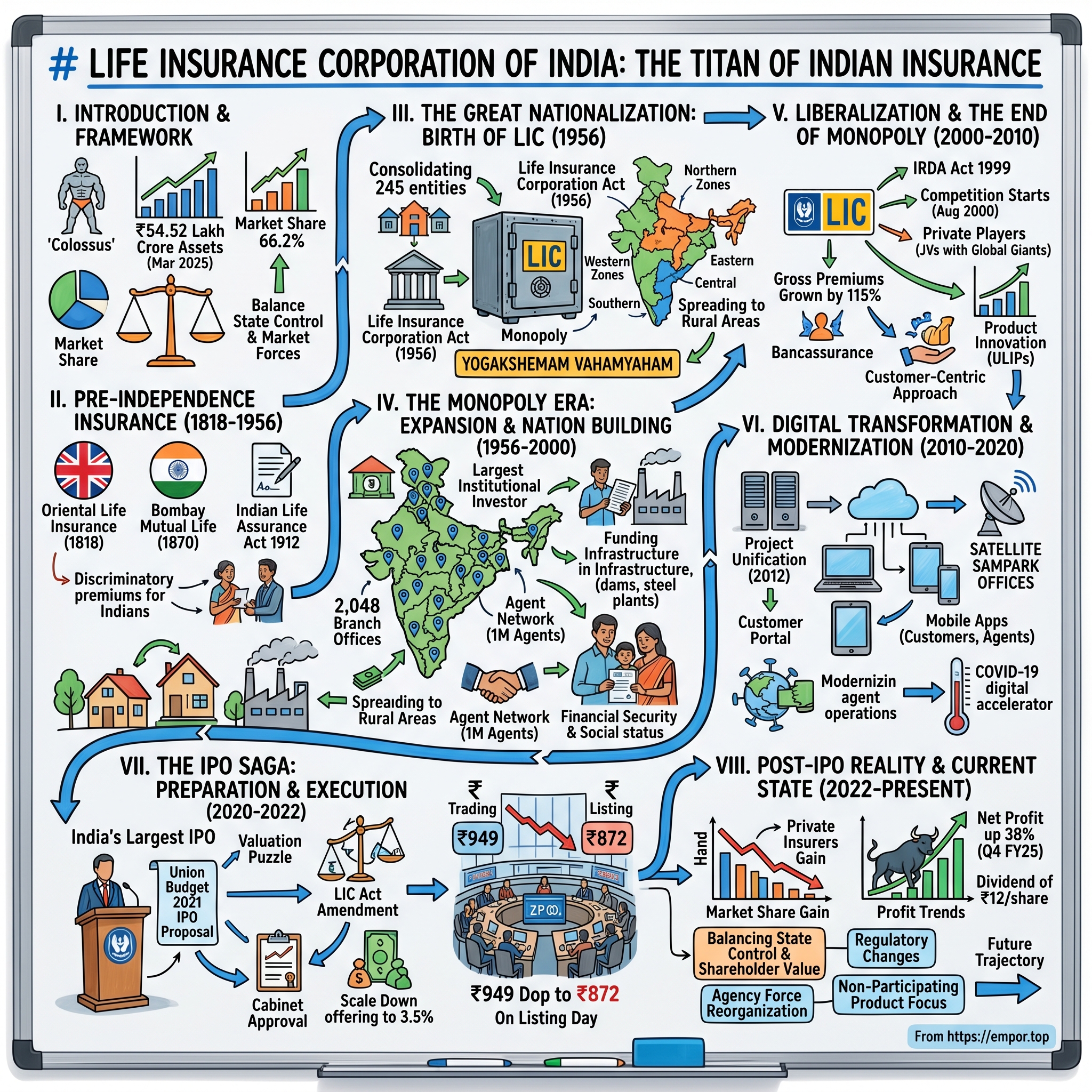
The narrative splits into two distinct eras. The first is a 20th-century nation-building story: a 1956 act of Parliament that merged 245 private insurers into a state monopoly, establishing insurance as a primary savings vehicle for Indian households. This history created LIC's institutional legacy—its massive agent network, deep brand trust, and enduring presence as a quasi-public utility.
The second story is a modern corporate restructuring: a 2022 initial public offering that fell below issue price on day one, a decade-long decline in individual market share, a governance reform creating a unified chief executive role, regulatory changes reshaping product economics, public scrutiny over equity investments in the Adani Group, and a December 2025 legislative outcome that constrained a key growth option.
This analysis moves rapidly through the foundational historical legacy before examining the modern financial and operational transformation in detail.
 Subscribe on LinkedIn
II. Origins & The Case for Nationalization (1818–1956)
The history begins in Kolkata in 1818, where the East India Company's British civil servants faced high mortality rates and lacked financial protection for their families. The Oriental Life Insurance Company opened that year to sell policies to Europeans in India. Indians could not buy coverage on equal terms; when Indian lives were eventually insured, they were classified as substandard risks and charged extra premiums. That detail planted an enduring perception—carried forward by nationalists over the next century—that insurance in India was something conducted to Indians rather than for them.
The Bombay Mutual Life Assurance Society arrived in 1870 as the first Indian-owned insurer willing to underwrite Indian lives at standard rates. Over the next four decades, the industry expanded rapidly and chaotically. The Indian Life Assurance Companies Act of 1912 represented the first serious attempt at regulatory oversight, requiring actuarial certification of premium rates and periodic valuations. It was a necessary step, but ultimately insufficient.
By the mid-1950s, the market had become a cautionary tale in the economics of trust. Roughly 154 Indian insurers, 16 foreign insurers, and 75 provident societies were operating.8 Many were severely undercapitalized. Several were outright frauds: promoters used premium float as a private piggy bank, invested policyholder funds in companies they controlled, and left policyholders with claims against empty shells. Because life insurance requires customers to pay capital today for a promise redeemable decades later, it is uniquely vulnerable to governance failure, as misconduct is often exposed long after promoters have departed.
The government's response was not tighter regulation, but full nationalization.
On September 1, 1956, the Life Insurance Corporation Act came into force, merging the entire industry—245 insurers and provident societies—into a single state-owned entity capitalized by a government contribution of ₹5 crore.9 It stood as one of the most complete acts of financial-sector consolidation in the twentieth century: not a rescue package or a resolution of distressed firms, but the statutory abolition of a private market.
Two features of that 1956 statute reverberate today. First, it provided LIC with an explicit government guarantee on the sums assured under its policies—a legal backstop unavailable to any private insurer, which underpins the trust premium LIC retains. Second, it structured surplus distribution overwhelmingly in favor of policyholders rather than shareholders. When the government moved to list the corporation 66 years later, both features required renegotiation: the sovereign guarantee raised competitive fairness issues, and the surplus arrangement had to be restructured to establish meaningful equity value for investors.
The institutional mandate extended beyond solvency. LIC's motto—Yogakshemam Vahamyaham ("your welfare is our responsibility"), drawn from the Bhagavad Gita—reflected an explicit directive to extend life insurance into rural India, including regions where commercial insurers found branch operations unviable.10
This nineteenth- and twentieth-century origin story directly shapes the 2026 investment thesis through three main inheritances. First, distribution: built to reach rural villages when human agents were the primary distribution channel, LIC's agency network became its defining asset; seven decades later, agents still generate roughly 98.5% of LIC's policies.6 Second, the guarantee reflex: policyholders treat LIC as sovereign-backed, creating a trust premium private competitors cannot replicate. Third, policy mandate: created as an instrument of national development policy, LIC was not designed to maximize return on embedded value.
That third inheritance remained largely dormant for 44 years, as LIC operated without commercial competitors against which its performance could be benchmarked.
III. The Monopoly Decades: Scale Without Competition (1956–2000)
With a legal monopoly over a nation of 400 million people and no private shareholders to answer to, LIC spent the second half of the twentieth century executing a straightforward strategy: physical expansion across the country.
The agency network LIC constructed operated as much like a social institution as a sales channel. The typical LIC agent—often a part-time worker, schoolteacher, or local shopkeeper embedded in the community—served as the primary contact for financial services to households with no access to formal banking. Agents collected premiums in cash, tracked renewal deadlines, and assisted with claims filings. In an economy characterized by low financial literacy and minimal consumer protection, personal trust functioned as the core product, while the policy document remained secondary.
This structure was reinforced by unique product economics. LIC primarily sold participating endowment policies—savings contracts with modest life coverage that allowed policyholders to share in actuarial surpluses. For customers, these products operated less as pure insurance and more as structured savings vehicles offering tax benefits and guaranteed returns. In the absence of large-scale alternatives, LIC effectively functioned as middle-class India's mutual fund manager, pension provider, and life insurer all at once.
A crucial incentive structure emerged from this model. Because agents earned high first-year commissions compared to smaller renewal payouts, economic incentives favored selling new policies over servicing existing contracts. Furthermore, reliance on personal trust meant product innovation was secondary; the primary alternative to an LIC endowment policy was a post office savings certificate. For four decades, a distribution model built on local agents and a product portfolio focused on tax-advantaged savings reinforced one another without competitive pressure.
As a result, LIC evolved into India's largest domestic institutional investor. Statutory mandates required LIC to deploy its accumulating premium float primarily into government securities, alongside allocations to corporate bonds and equities. By the 1990s, LIC's capital flows held market-moving influence on Indian stock exchanges. When the government sought to absorb public asset sales, place infrastructure debt, or stabilize volatile capital markets, LIC regularly served as a buyer of last resort—combining a quasi-sovereign wealth fund role with commercial insurance operations.
This structural role was unusual by international standards. In most major economies, the life insurance market consists of multiple competing institutions with dispersed assets. In India, a single state enterprise concentrated a decisive share of long-term household savings while operating under an implicit mandate to support national financial stability. This dual identity helps explain why public market investors have often found LIC difficult to benchmark using standard insurance valuation metrics.
This dynamic remains central to evaluating LIC as a public company. The defining feature of its balance sheet is that for seven decades, it has served public policy goals alongside fiduciary responsibilities, creating an ongoing tension between shareholder returns and national mandates.
In 2000, statutory monopoly status ended when the Insurance Regulatory and Development Authority Act opened the market to private firms, often formed as joint ventures between domestic financial groups and global partners, including HDFC Standard Life, ICICI Prudential, SBI Life, Max, Bajaj Allianz, and others. Private entrants introduced modern product structures, shareholder-focused capital allocation, and bancassurance partnerships that leveraged bank branch networks for distribution.
LIC initially responded by scaling its established model. While total premium volume continued to expand, the enterprise's growth lagged overall industry expansion, masking a gradual decline in relative market share as private competitors captured an increasing portion of new business.
IV. Liberalization, Digitization, and the Long Runway to an IPO (2000–2020)
The two decades following market liberalization presented LIC with a deceptive paradox: expanding absolute metrics alongside steady relative market share decline.
Year after year, total premium volumes expanded, the branch network extended, and in-force policy counts grew. Yet simultaneously, bank-backed private insurers captured incremental shares of the lucrative individual new-business market. Because the erosion was gradual rather than sharp, it failed to provoke an urgent institutional response—a classic vulnerability for dominant incumbents that react to sudden crises but overlook persistent gradients.
The mechanism behind this share shift was structural. Private entrants did not outperform LIC on an agent-by-agent basis; instead, they altered the distribution venue. By establishing bancassurance partnerships with major lenders like HDFC Bank and State Bank of India, private competitors allowed relationship managers to cross-sell life policies to fixed-deposit customers across the same desk. This model leveraged existing customer documentation, account balance visibility, and institutional trust, drastically reducing customer acquisition costs. Furthermore, bank customers yielded higher average policy sizes and demonstrated greater appetite for unit-linked insurance plans (ULIPs) and pure protection policies—categories carrying significantly better margin economics than LIC’s traditional participating endowment contracts.
LIC, by contrast, relied on an agent network unparalleled in geographic reach but limited in productivity. While an army of more than one million agents across semi-urban and rural India represented a moat no private rival could replicate, it was costly per rupee of premium generated and structurally ill-equipped to target urban, mass-affluent policyholders.
Crucially, this distribution architecture suffered from high internal inertia. Retraining and incentivizing a vast, dispersed agency force to adopt new product suites required years. By comparison, bank-led insurers could pivot sales priorities across a centralized corporate relationship manager network within quarters. When market dynamics or regulatory frameworks shifted, bank-backed competitors adjusted rapidly, leaving LIC constrained by its own primary distribution asset—a moat that protected its core rural market while slowing its strategic adaptation.
A similar pattern characterized LIC’s digital transformation. The corporation introduced satellite Sampark offices and customer information centers throughout the 2000s, eventually reporting by FY23 that a majority of policy servicing transactions were conducted via digital channels.11 Across a customer base spanning hundreds of millions of policies, this represented significant operational modernization. However, the initiative lagged private peers by nearly a decade and focused primarily on back-end policy servicing rather than front-end digital customer acquisition, where market share shifts occurred.
Underpinning these commercial dynamics was a governance structure that would ultimately complicate LIC’s public listing. Unlike private peers bound by capital efficiency metrics, value of new business (VNB) margins, persistency rates, and product mix optimization, LIC operated under a statutory mandate that directed 95% of participating surpluses back to policyholders. While this structure favored policyholders, it insulated management from equity-market metrics.
While defensible for a state-owned utility executing national development objectives, this capital allocation framework presented a fundamental challenge for prospective equity investors—setting the stage for the structural valuation hurdles that emerged during its 2022 initial public offering.
V. The IPO: India's Biggest Listing Meets a Valuation Reset (2020–2022)
When Finance Minister Nirmala Sitharaman presented the Union Budget on February 1, 2021, to a Parliament chamber thinned by pandemic distancing rules, she included a single directive that reshaped Indian financial markets: the government intended to list LIC.
The surrounding ambitions grew rapidly. In the months that followed, government officials and investment bankers floated informal valuations that would have placed LIC among India's three most valuable listed entities, alongside Reliance Industries and Tata Consultancy Services, with estimates of a $200 billion-plus enterprise valuation circulating widely throughout 2021.12 That logic relied heavily on absolute scale: because LIC outperformed all private insurers combined across primary operating metrics, market commentators assumed it would command a commensurate combined market value.
Two distinct factors dismantled that initial expectation before the offering reached public markets.
The first was structural arithmetic. Before LIC could be listed, its financial architecture required extensive corporate restructuring to establish equity value for public shareholders. This involved revising the surplus-sharing mechanism so that a larger portion of participating-fund profits accrued to shareholders, splitting the unified "Life Fund" into distinct participating and non-participating funds, and calculating an actuarial embedded value for the first time. LIC's draft prospectus, filed with the Securities and Exchange Board of India (SEBI) in February 2022, provided market participants with their first detailed look at the enterprise's underlying economics.13 The disclosures revealed a substantial but slow-growing embedded value, a value-of-new-business (VNB) margin in the low teens, and expense ratios noticeably higher than private-sector benchmarks.
The second factor was macroeconomic disruption. Russia's invasion of Ukraine on February 24, 2022—occurring three weeks after the draft prospectus filing—triggered a sharp retreat by global funds, which withdrew roughly $16 billion from Indian equities over the subsequent months. Faced with narrowing market liquidity, the government adjusted the transaction structure. When the final prospectus was issued in April 2022, the government reduced the offering from a planned 5% of the company to 3.5%, cutting the target capital raise from an initial ₹65,000–70,000 crore to approximately ₹21,000 crore.14
Crucially, while market volatility reduced the scale of the sale, it did not dictate the underlying valuation multiple. Even at the lower issue price, LIC was priced at roughly 1.1 times embedded value, whereas private competitors such as HDFC Life, SBI Life, and ICICI Prudential Life traded at significantly higher multiples.15 The market's pricing reflected a clear distinction: investors declined to pay a monopoly premium for a state insurer with sub-15% new-business margins, modest shareholder surplus allocations, and a controlling sovereign owner whose fiscal priorities could diverge from minority shareholder returns.
The offer opened on May 4, 2022, and closed on May 9, priced at ₹949 per share. To encourage broad public participation, the deal included dedicated policyholder reservations along with price discounts for policyholders, retail investors, and employees. Given that nearly 40 million Indian households held LIC policies, the transaction was structured as a broad-based retail offering.
On May 17, 2022, the stock listed at ₹872 per share, an 8.1% discount to the issue price. In a domestic market where retail participants had come to expect listing-day gains on state-backed mega-issues, the outcome carried political as well as financial ramifications. Millions of first-time retail investors, entering the market on the strength of an institutional brand associated with absolute safety, saw their holdings open at an immediate capital loss.
The retail structure of the transaction exacerbated the impact of the listing-day decline. Unlike conventional initial public offerings allocated primarily to institutional buyers evaluating long-term business models, LIC's structure deliberately targeted policyholders—a customer base whose relationship with the institution was founded on capital preservation. Introducing market volatility to policyholders at a price set by a selling shareholder driven by fiscal targets blurred a long-standing distinction between sovereign safety and equity risk, leading to widespread retail disappointment.
Two additional structural elements complicated the market's pricing task. First, the embedded-value figure disclosed in the prospectus was brand new, leaving investors without historical data to evaluate whether the actuarial methodology would prove conservative or aggressive over time. Second, the shareholder entitlement to participating-fund surpluses was a newly engineered structure designed to step up incrementally rather than a long-tested operational reality. Consequently, public markets were asked to price a newly calculated metric applied to a newly modified profit-sharing model, making a valuation discount relative to established private peers logical and anticipated.
The core lesson of the 2022 listing was not one of poor market timing, but of misaligned evaluation frameworks. The pre-IPO debate centered on traditional metrics of physical scale—assets under management, policy counts, agency networks, and total market share—whereas equity investors priced the asset based on the margin profile and growth trajectory of new business. LIC's financial performance under those modern capital metrics left a substantial gap relative to its absolute market presence—a divergence that defined its corporate trajectory over the following four years.
VI. Post-IPO Reckoning: Market Share, Margins, and the Adani Overhang (2022–2024)
The enterprise's first two years as a listed entity demonstrated the stark scrutiny public disclosure brings to an institution historically unaccustomed to quarterly accountability.
Market share erosion had long been underway, but public quarterly filings now highlighted the trend for analysts and investors. LIC's overall first-year premium market share drifted from the high sixties toward the low sixties. That headline aggregate figure, however, masked a sharp divergence between two distinct business segments. In group insurance—encompassing corporate superannuation, gratuity funds, and government schemes—LIC's balance-sheet scale and institutional relationships preserved a market share near 70%. In individual business, where private insurers with bank distribution competed most aggressively, LIC's share fell into the high thirties.6 The overall market share reflected legacy scale, but the metric driving modern equity value creation did not.
In January 2023, an unexpected stress test further challenged public perception.
Hindenburg Research published a short-seller report on the Adani Group on January 24, 2023. Within weeks, roughly ₹49,700 crore in notional market value evaporated from LIC's Adani holdings, which carried a historical cost basis of approximately ₹36,470 crore.16 The sharp drop brought a long-standing governance question into sharp focus: how much of India's largest pool of policyholder savings had been allocated to a single, highly leveraged conglomerate, and under what oversight framework?
LIC's initial public stance was cautious. The insurer stated publicly that it would seek clarifications from Adani management and review its position.16 It did not, however, divest its holdings. Through the market turbulence—marked by a canceled follow-on offering, index-exclusion concerns, and escalating short-seller claims—LIC maintained its positions. By June 2024, the market value of its Adani portfolio had recovered to ₹66,388 crore, representing a 51.6% gain over the prior year.17
While management viewed the recovery as validation of its stance, the episode highlighted a broader structural trait. Under market stress, LIC acted less like a return-maximizing asset manager and more like a stabilizing domestic institution. Holding firm spared the insurer from crystallizing losses at market troughs—a discipline many active fund managers lack. However, the corporation also showed little indication of trimming exposure as concentration risks built during the prior rally, and the specific position-sizing guidelines governing the original investment remained unclarified to shareholders. The episode underscored lingering investor questions regarding single-group concentration limits, internal governance exceptions, and public disclosure practices for an enterprise safeguarding a vast share of national household savings.
Alongside equity market volatility, two regulatory shifts directly impacted LIC's underlying earning power.
The first change stemmed from the 2023 Finance Act. Beginning April 2023, maturity proceeds on non-linked life insurance policies with total annual premiums exceeding ₹5 lakh lost their tax-exempt status. While applicable across the industry, the rule hit LIC particularly hard, as its high-ticket traditional participating policies relied heavily on tax-advantaged status as a primary selling feature. Removing the tax shelter eroded a major driver of demand for those high-ticket contracts.
The second regulatory shift was more structural. Effective October 1, 2024, the Insurance Regulatory and Development Authority of India (IRDAI) mandated higher special surrender values, requiring insurers to offer meaningful payouts to policyholders exiting in the first year, replacing the legacy practice of near-total forfeiture. Economically, the rule transferred value from persisting policyholders and equity owners to early lapsers. Analysts and industry executives estimated that the ruling threatened new-business margins by 100 to 300 basis points across the sector, prompting a mid-2024 debate over mitigation options such as repricing, commission clawbacks, trail-based agent payout structures, and product redesigns.18
The economic impact of the surrender value rule was significant due to the front-loaded cost structure of traditional insurance products. Initial expenses—including first-year agent commissions, medical underwriting, and policy issuance—are incurred immediately, while policy premiums are collected over fifteen to twenty years. Historically, insurers recovered upfront acquisition costs from persisting policyholders while retaining forfeited funds from early lapsers to support overall policy economics. Mandating first-year payouts eliminated that implicit subsidy, forcing insurers to either adjust distribution costs or accept lower profit margins per policy.
For LIC—the industry's highest-volume, par-heavy insurer operating with a legacy commission model and an agency force exceeding one million representatives—the higher surrender payouts represented a formidable operational headwind. Consensus expectations pointed toward shrinking margins and persistent pressure on earnings.
Yet the operational reality unfolded differently.
VII. The Turnaround Signal: Margin Recovery and a New Governance Model (2024–2026)
The surrender-value regulation forced an immediate shift in LIC's operating model that three decades of private competition had failed to trigger, rendering the economics of its legacy product mix unsustainable as of October 1, 2024. The firm regulatory deadline required rapid institutional alignment rather than prolonged internal study.
In response, LIC altered its core product strategy. Throughout fiscal year 2025, the insurer accelerated sales of non-participating products—such as guaranteed-return savings plans, annuities, and pure protection—where profits accrue entirely to shareholders rather than being shared with policyholders. Non-participating annualized premium equivalent (APE) grew by approximately 50% in FY25, with management explicitly identifying an expanded non-participating share as its main driver of margin recovery.19 Simultaneously, operational efficiency improved: the FY25 expense ratio dropped 315 basis points to 12.42%, while profit after tax reached ₹48,151 crore.20
Subsequent financial performance confirmed that these gains stemmed from structural operational changes rather than temporary shifts in product mix.
For the full year ended March 31, 2026, LIC's value of new business (VNB) rose 41.6% to ₹14,179 crore, while net VNB margin expanded 360 basis points to 21.2%, up from 17.6% the previous year.5 Indian Embedded Value expanded to ₹7,89,185 crore. The momentum continued into the first quarter of fiscal 2027 (ending June 2026), where profit after tax rose 22.8% year-over-year to ₹13,492 crore.21 During the quarter, VNB surged 61.3% to ₹3,136 crore as margins reached 22.9%—a 750-basis-point expansion compared to the prior-year period.22
During the Q1 FY27 earnings call, Appointed Actuary A.K. Srivastava attributed this expansion primarily to product mix optimization. Individual non-participating savings premiums expanded 59.2% and protection premiums rose 43.6%, increasing the non-participating share of individual APE to 32.5% from 30.3% a year earlier. Management noted that margins expanded across all three core categories—participating, non-participating, and group business—partially offset by a 15-basis-point drag from changes in goods and services tax (GST) input credit rules.6
However, independent analysis reveals that a significant portion of the quarterly margin expansion reflected favorable risk-free rate assumptions rather than operational gains alone. When analyst Shobhit Sharma of Elara Securities questioned the sustainability of the 750-basis-point margin increase, CEO R. Doraiswamy indicated that margins should settle near industry averages through structural efficiency gains, targeting a mid-20s VNB margin by the close of FY27.6 That benchmark represents a far more explicit commitment than management had offered during its initial two years as a public entity. When Swarnam Mukherjee of 361 Capital asked whether a market-driven rebound in unit-linked products (ULIPs) might cannibalize higher-margin non-participating sales, management dismissed the risk. Nonetheless, because ULIPs carry lower margins and LIC historically prioritized volume, that assertion remains untested in changing equity market conditions.
The man now accountable for the answer
R. Doraiswamy assumed office as Managing Director and Chief Executive Officer on July 15, 2025, with a mandate extending to August 28, 2028.23 The leadership transition carried structural weight beyond the individual appointment.
For most of its operating history, LIC was governed by an executive Chairman presiding over four Managing Directors with separate zonal or functional jurisdictions—an administrative structure suited to a state ministry rather than a publicly traded enterprise. A 2021 amendment to the LIC Act, enacted as part of pre-IPO legal reforms, consolidated the chairman and chief executive responsibilities into a single chief executive office. Doraiswamy became the first executive appointed to serve a full term under this unified structure.23
A career insider, Doraiswamy joined LIC in 1986 as a direct recruit officer and spent 38 years within the organization, most recently serving as Managing Director overseeing the Southern Zone.23 This background presents a distinct corporate profile. An insider possesses detailed knowledge of operational mechanisms across a 100,000-employee enterprise—helping explain the speed of the non-participating product pivot and agency network rationalization. Conversely, an insider may be less inclined to challenge the corporation's historical social mandates or policy alignment.
Early operational decisions provide key evidence of his management approach. In August 2025, Doraiswamy established a public target of double-digit top-line growth for FY26, offering an unusually concrete benchmark for the state insurer.24 He also demonstrated a willingness to curtail long-standing strategic initiatives. After two years of public speculation regarding a potential stake in a standalone health insurer, Doraiswamy formally shelved the proposal at the Q3 FY26 briefing on February 5, 2026, stating that board evaluations indicated "it is not the kind of thing that is going to be immediately required" and citing concerns that acquiring an entity with an inferior claims-settlement track record could impair LIC's brand reputation.25 The public cancellation signaled a degree of capital discipline and transparent rationale infrequently observed in state-owned enterprises.
The option that closed
Alongside operational adjustments, a central growth catalyst favored by institutional investors was eliminated by legislative action.
Throughout 2025, LIC management publicly outlined plans to secure a composite insurance license—allowing the corporation to underwrite life, health, and general insurance within a single corporate entity—pending statutory reform.26 Although composite licensing was included in early legislative drafts, it was omitted from the final statute.
The Sabka Bima Sabki Raksha (Amendment of Insurance Laws) Bill passed the Lok Sabha on December 16 and the Rajya Sabha on December 17, 2025, raising the foreign direct investment cap in insurance from 74% to 100%, and received presidential assent on December 20, 2025.27 The expanded FDI framework took effect on February 5, 2026. However, lawmakers excluded the composite licensing provision from the enacted law, obliging multi-line expansion strategies across the industry to be reassessed.28
This statutory outcome directly shaped LIC's strategic options: Parliament removed composite licensing in December 2025, and management formally abandoned its health-insurance acquisition plan in February 2026. Consequently, investment hypotheses premised on multi-line expansion currently lack statutory support or an active operational roadmap.
Float, bonus, and the shareholder question
Government actions during 2026 further illustrated the state's approach to its controlling stake. On April 13, 2026, LIC's board approved the enterprise's first bonus share issue since listing, capitalizing ₹6,325 crore from reserves to double paid-up capital to ₹12,650 crore on a 1:1 basis, with a record date of May 29, 2026.29 While a capitalization issue leaves economic value unchanged by adjusting share count and price proportionally, it reduced the trading price per share into a more accessible range for retail investors while expanding market liquidity ahead of public equity sales. The board also recommended a final dividend of ₹10 per share for FY26.5
These corporate actions prepared the ground for the August 2026 offer-for-sale. The transaction satisfied regulatory mandates: SEBI regulations required LIC to achieve a 10% minimum public float by May 16, 2027, whereas the government retained a 96.5% equity stake prior to the offering.30 By selling a 6.5% interest, the sovereign holding declined to exactly 90%, fulfilling the regulatory requirement nine months ahead of schedule. Following the sale, Doraiswamy noted that the government was unlikely to conduct a subsequent offering for 18 to 24 months, given that regulatory guidelines permit LIC until 2032 to reach the standard 25% public float requirement.3
That extended compliance window introduces a persistent structural condition for public shareholders. Reaching the 25% public float mandate will require divesting an additional 15% equity stake in India's largest financial institution—representing a multi-trillion-rupee equity supply overhang through 2032, where seller execution timing remains tied to sovereign fiscal targets rather than equity market valuation metrics.
The gap that has not closed
Despite notable progress on margins, LIC's core distribution challenge remains substantially unchanged. In the quarter ending June 2026, LIC's agency force totaled 1.45 million representatives—down 2.7% year-over-year following management efforts to prune inactive agents—yet this network generated 98.51% of all new policies issued.6 Conversely, the bancassurance channel, which drove private-sector market share gains over the preceding two decades, generated ₹483 crore in premium during the quarter, representing an 8.6% decline. Executive Director Hemant Buch attributed the bancassurance contraction to West Asian geopolitical conflicts affecting non-resident Indian remittance flows and delayed partner marketing initiatives, projecting a recovery in subsequent quarters.6
While macroeconomic factors may affect overseas remittance segments, the explanation underscores ongoing structural limitations in distribution. LIC has expanded its bank partnerships, including a September 2025 agreement with RBL Bank that provided access to approximately 570 branches and 1,474 business-correspondent locations alongside LIC's network of over 3,600 branches and satellite offices.31 However, RBL Bank remains a mid-tier private lender, whereas primary competitors such as SBI Life leverage the branch network of India's largest state-owned bank. Without deep distribution arrangements across major tier-one lenders or an alternative urban acquisition framework, LIC lacks a clear mechanism to halt individual market share erosion.
The risks that sit underneath the recovery
Underneath recent financial improvements, several structural risks characterize LIC's evolving business profile.
First, interest rate risk has emerged as a primary operational sensitivity. The recent margin expansion relied on increasing sales of guaranteed-return products, which commit the insurer to fixed payout obligations regardless of future reinvestment yields. While LIC maintains unmatched access to long-term Indian government securities, domestic capital markets offer limited long-duration hedging instruments. Public disclosures regarding duration-matching strategies for the expanding non-participating portfolio remain constrained.
Second, equity portfolio concentration risk remains unaddressed from a governance perspective. Establishing and disclosing formal single-group exposure limits would provide public shareholders with clear risk-management parameters, mitigating recurring concerns over portfolio concentration.
Third, technology and cybersecurity risks represent critical vulnerabilities. Safeguarding the financial and demographic data of hundreds of millions of policyholders across a decentralized network of 1.45 million independent agents presents a complex security perimeter. Given that LIC's competitive advantage rests on public trust, a major security incident would carry reputational risks exceeding direct financial losses.
Finally, execution and leadership risks remain significant during this transitional phase. Simultaneously expanding non-participating product lines, rationalizing the agency force, and expanding bank distribution channels requires sustained managerial focus under a Chief Executive Officer whose term expires in August 2028. Because executive succession at LIC was historically brief and politically directed, the consolidated chief executive framework increases the strategic importance of future leadership appointments.
In summary, while product mix, profit margins, and governance frameworks have shown measurable improvement, the institutional distribution model remains largely unhedged against agile private competition.
VIII. Capital Allocation & Portfolio Moves: LIC as Investor, Not Just Insurer
Setting aside its insurance policy book, agency force, and branch network reveals an institution managing ₹57.29 lakh crore ($650 billion) in investable assets—a capital pool larger than the domestic mutual fund industry's total equity holdings, larger than most sovereign wealth funds, and large enough that its asset allocation decisions function as macroeconomic variables rather than routine portfolio moves.5
LIC is, fundamentally, India's largest asset manager. Yet public analysis of its equity story rarely focuses on how effectively it manages that capital.
Statutory directives account for part of this oversight. Regulatory mandates require life insurers to deploy the vast majority of assets into government securities and approved debt instruments, leaving LIC's massive equity portfolio as a minority share of total assets. Within these regulatory boundaries, investment returns remain steady and serve as the main driver of net profit. However, stable returns within a restricted mandate differ from active asset management skill, and public markets have seldom evaluated LIC through a pure asset-management lens.
The IDBI Bank test
A prominent case study in LIC's capital allocation is its investment in IDBI Bank. In 2019, LIC acquired majority control of the lender in a transaction that functioned as a state-directed recapitalization of a bad-loan-burdened bank using policyholder float. While serving broader policy objectives, the acquisition represented an unconventional deployment of life insurance reserves. Since 2022, the government and LIC have sought to exit the institution, with LIC holding a 49.24% stake and the government owning 45.48% as both entities work to sell a combined 60.7% controlling interest.32
The divestment process has stretched across four years. Kotak Mahindra Bank secured regulatory clearance to review the asset but subsequently withdrew over valuation concerns, later clarifying that it had not submitted a financial offer.32 Initial bids fell short of the government's reserve price, prompting a temporary pause in early 2026 before the process reopened for revised submissions. By mid-July 2026, Fairfax Financial Holdings emerged as the frontrunner after improving its valuation, alongside a revised submission from Emirates NBD, leaving the transaction—valued at approximately $5.7 billion at market prices—awaiting approvals from the Union Cabinet and the Reserve Bank of India.3233 The government indicated plans to conclude the sale within FY27 and raise ₹50,000 to ₹55,000 crore across both selling entities.
This transaction yields three key analytical conclusions. First, LIC's largest strategic equity allocation was driven by state policy priorities rather than insurance economics, with the exit timeline governed by sovereign fiscal targets rather than corporate strategy. Second, the four-year divestment timeline and repeated restarts reflect a persistent disconnect between public sector reserve pricing and private market valuations. Third, while a successful closing would generate significant cash proceeds for LIC, public shareholders lack visibility into how those funds will be redeployed, as management has never published a formal capital allocation framework comparable to private financial peers.
What the Adani hold really tells us
Reevaluating the Adani Group investment through a capital allocation lens illustrates a similar institutional pattern. While the position ultimately recovered in value, investment process must be distinguished from market outcome. Management has described an institutional policy of avoiding forced sales of major domestic holdings during market stress. While this stabilizing approach aligns with the role of a systemically important sovereign institution, it creates potential friction with strict fiduciary duty focused on optimizing policyholder and shareholder returns. Under state ownership, these dual roles operated without market distinction; under public listing, they remain unseparated before an equity investor base.
A secondary capital allocation question involves LIC's extensive real estate holdings, valued in company disclosures at approximately ₹45,000 crore across prime urban locations. In February 2026, CEO R. Doraiswamy stated that the corporation intends to monetize these properties for rental yield rather than pursue outright asset sales.25 While representing substantial non-core value, these holdings remain an underutilized asset class where public markets expect clearer yield optimization strategies.
The M&A record: there isn't one
Evaluating LIC's mergers and acquisitions discipline encounters a basic structural reality: the enterprise has virtually no transaction history. Aside from the state-directed IDBI Bank acquisition, LIC has never executed bolt-on acquisitions, integrated external businesses, or acquired technology and distribution platforms in the manner of private competitors. The proposed health insurance stake—evaluated for two years before management formally shelved it in early 2026—would have represented its first test of inorganic execution.
This lack of M&A history presents a dual-edged profile. On one hand, LIC has avoided the value-destroying acquisition sprees that frequently afflict capital-rich financial institutions. On the other hand, should the enterprise require inorganic expansion to acquire new capabilities or distribution channels, investors must underwrite a leadership team with no established track record in corporate integration—a key risk factor for investment strategies reliant on inorganic growth.
IX. Business Model & Segment Economics
Evaluating value creation at LIC requires separating two distinct operational segments, as consolidated figures risk presenting a misleading picture of underlying profitability.
The group business—managing gratuity, superannuation, and pension funds for corporate and government entities alongside large-scale public insurance schemes—represents the segment where LIC's dominance remains near absolute. Its share of group first-year premiums reached 70.9% in the June 2026 quarter.6 Characterized by large ticket sizes, thin profit margins, and volatile quarter-to-quarter flows, this franchise relies on balance-sheet scale, sovereign association, and entrenched institutional relationships that private competitors struggle to displace. While defensible, it generates modest returns on capital, illustrating why aggregate market-share metrics can overstate LIC's competitive position.
By contrast, the individual business serves as the primary engine of shareholder value and the front line of competitive pressure. LIC's share of individual first-year premiums stood at 38.89% in the same quarter—reflecting a two-decade pattern of gradual erosion.6
Why the par-to-non-par shift is the whole ballgame
The economics of the individual segment hinge on product composition. A participating (par) policy functions as a savings contract in which policyholders share in actuarial surpluses. Statutory mandates and corporate policy direct the overwhelming majority of that surplus back to policyholders, leaving a limited slice for equity owners. While advantageous for customers, this structure yields modest profitability for shareholders.
A non-participating (non-par) policy—comprising guaranteed-return savings plans, annuities, and pure protection cover—operates on fixed commitments. LIC absorbs the underlying investment and mortality risks, retaining any margin earned above the guaranteed payout. Because those excess margins accrue entirely to equity holders, shifting new business from participating to non-participating products generates substantially higher value per rupee of premium. This operational pivot underpins the enterprise's recent margin expansion, making the non-participating share of individual annualized premium equivalent (APE) a critical operational metric. Accounting for roughly one-third of individual APE, LIC retains significant headroom relative to private peers, alongside ongoing exposure should the product mix revert.
However, this strategic transition introduces clear balance-sheet risks. Non-participating products commit LIC to guaranteed returns regardless of reinvestment yields. Unlike participating contracts, which allow the insurer to adjust surplus distributions when investment returns soften, non-participating guarantees insulate policyholders and place investment downside entirely on the insurer. Building a larger portfolio of fixed obligations during a period of declining domestic interest rates heightens asset-liability management risk—a dynamic reminiscent of the yield challenges faced by Japanese and European life insurers during historical low-rate cycles. Given that Indian capital markets offer relatively thin long-dated hedging instruments and forward rate agreements, investors require expanded disclosure regarding the duration-matching strategies supporting the non-participating portfolio.
Distribution economics
LIC's agency network remains both its primary competitive moat and a major structural cost driver. Spanning roughly 1.45 million individual agents—nearly half of India's licensed agency force—the network reaches deep into semi-urban and rural districts where physical bank branches are sparse. This distribution infrastructure provides a formidable geographic reach that would require competitors decades and substantial capital to replicate, supporting policy persistency and brand-driven customer acquisition in regional markets.
Nevertheless, the channel carries higher unit expenses and lower average policy sizes, remaining underrepresented in high-value urban segments where premium per customer is concentrated. Although the reduction of LIC's expense ratio to 12.42% in FY25 demonstrated tangible operational discipline, the baseline remains elevated compared to bancassurance-led private peers. Recent reductions in agent headcount reflect a deliberate effort to prune unproductive representatives, signaling an operational shift toward agent productivity rather than raw scale—a promising but early-stage realignment.
Persistency: the quiet quality metric
Persistency—the percentage of policies remaining active after 13, 25, 37, 49, and 61 months—serves as a vital indicator of underlying underwriting quality. Because embedded-value calculations assume long-term premium payments, early policy lapses convert anticipated profits into realized acquisition losses. Persistency figures also offer a clear view of sales practices, distinguishing genuine customer demand from volume pushed to meet short-term targets.
In this area, LIC's institutional trust yields tangible economic benefits. Customers acquiring policies through brand affinity demonstrate higher retention rates than those targeted by aggressive cross-selling. Furthermore, mandatory surrender-value regulations have raised the financial penalty for early policy cancellations across the sector. Insurers with sticky policy books benefit relative to competitors previously dependent on lapse-forfeiture margins. For LIC, tracking persistency in longer-duration cohorts—specifically 49 and 61 months—provides a clearer measure of agency channel health than headline quarterly premium figures.
The trust asset
Finally, an unquantified asset underpins the enterprise: Indian households view LIC policies as carrying an implicit sovereign backing. Regardless of strict legal definitions, this public perception operates as a practical reality, lowering customer acquisition costs and driving inbound demand in ways marketing budgets cannot match. This trust underwrites strong brand affinity and supports renewal premium stability.
Yet the past two decades highlight the boundaries of that advantage. Institutional trust captures customers actively seeking LIC coverage, but it fails to convert prospective buyers at bank branch counters when presented with alternative products by relationship managers. While trust protects the core customer base, it has proven insufficient to stem market share loss in competitive distribution channels.
X. Competitive Landscape & Why LIC Wins or Loses
Comparing India's four listed life insurers reveals a clear market verdict that extends far beyond sheer balance-sheet scale.
Based on fiscal year 2026 metrics, HDFC Life traded at roughly 2.07 times embedded value, ICICI Prudential Life at 1.46 times, and SBI Life at 1.32 times.7 LIC—with an embedded value several times larger than all three peers combined—traded at approximately 0.66 times. Public markets are pricing the growth trajectory and margin quality of new business rather than historical asset scale. On that metric, LIC continues to lag: SBI Life generated a 27.5% value-of-new-business margin in FY26 and ICICI Prudential delivered 24.7%, compared with LIC's 21.2%.34355
While that margin gap narrowed significantly following LIC's non-participating pivot, it has not closed entirely. For investors, the fundamental question is whether the stock's persistent valuation discount reflects that remaining profitability gap—which operational progress could eventually eliminate—or a structural governance discount inherent to state ownership that financial engineering cannot fix.
Porter's five forces, honestly applied
Supplier power — favors LIC. The primary inputs for a life insurer are investment capital, underwriting capacity, and reinsurance access. LIC's unmatched balance-sheet scale yields optimal terms across all three, while its capacity to retain mortality risk internally minimizes dependence on external reinsurers.
Buyer power — rising, particularly against LIC's core model. Digital aggregation platforms and the regulatory push for the Bima Sugam marketplace drive price transparency across the sector. Greater transparency erodes the pricing power of agency-led distribution reliant on personal recommendations, favoring screen-comparable products like pure term cover and guaranteed savings over traditional relationship-sold endowment contracts.
Threat of new entrants — low currently, but structurally expanding. Statutory capital thresholds and licensing frameworks restrict entry. However, the December 2025 legislation permitting 100% foreign direct investment alters long-term incentives, enabling global carriers to own domestic subsidiaries outright rather than operating through joint ventures.27 While near-term disruption remains modest, wholly owned foreign entrants typically bring longer investment horizons and greater competitive pressure over a ten-year horizon.
Threat of substitution — the most potent headwind. As Indian household savings increasingly shift toward formal financial assets, mutual funds, systematic investment plans (SIPs), direct equities, and the National Pension System contend for capital that historically flowed into LIC endowment policies. Traditional participating products offered an attractive value proposition when competing primarily against bank fixed deposits or physical assets, but struggle to match the fee efficiency of low-cost equity index funds. While tax reforms further narrowed that traditional advantage, LIC's strategic emphasis on protection and annuities addresses this threat directly in categories where life insurers retain a structural product advantage.
Rivalry — intense and focused on high-margin segments. Competitors show little interest in contesting LIC's legacy rural endowment market. Instead, industry competition centers tightly on urban non-participating savings and protection policies—the precise high-margin categories LIC is striving to expand.
The 7 Powers read
Applying Hamilton Helmer's 7 Powers framework highlights the precise boundaries of LIC's competitive moat.
LIC commands genuine scale economies, driven by fixed-cost absorption across its massive policy book, unmatched investment deployment capacity, and extensive mortality data. It also benefits from branding in its truest economic sense: a household name built over seven decades that instills trust and lowers customer acquisition costs.
Conversely, the absent powers are equally telling. LIC possesses no switching costs in initial customer acquisition, as policyholders evaluate new purchases independently. It derives no benefit from network effects, since an individual policy gains no utility as total policyholder counts grow. It holds no cornered resource, lacking proprietary underwriting algorithms, exclusive distribution channels, or unique asset access. Nor does it enjoy counter-positioning; rather, LIC is the legacy incumbent being counter-positioned against by private rivals leveraging agile, bank-integrated, and digital-first models that LIC's agency structure cannot easily emulate. Finally, process power—operational excellence embedded in organizational routines—remains an emerging capability; recent non-participating product pivots and expense-ratio reductions represent initial steps toward developing this advantage rather than an established structural moat.
In summary, LIC relies on two primary powers—both defensive in nature and neither optimized for rapidly expanding urban channels.
Myth versus reality
Evaluating common market assumptions regarding LIC reveals three prevailing narratives where factual observations have produced incomplete analytical conclusions.
Myth: LIC is an enterprise in terminal decline. Reality: LIC held a 60.1% share of first-year premiums in the quarter ending June 2026—down from 63.5% a year earlier—even as its total premium income expanded by 6.8%.6 The corporation continues to grow in absolute terms while underparticipating in relative industry expansion, maintaining a pattern established over the past two decades. This distinction reshapes strategic priorities: the management challenge is not reversing contraction, but capturing market-rate growth within high-value individual segments.
Myth: The stock's discount to embedded value represents an obvious market mispricing. Reality: Equity markets apply persistent valuation discounts when questioning long-term cash flow sustainability or majority-shareholder alignment. LIC's embedded value relies on actuarial projections regarding persistency, cost ratios, and investment yields that public markets have evaluated for only four years. Consequently, the discount incorporates unresolved governance and ownership questions alongside operational variables.
Myth: Enterprise scale guarantees shareholder safety. Reality: Systemic importance protects institutional solvency, not minority equity value. Massive scale secures the enterprise against financial failure, but it does not insulate per-share earnings when a sovereign majority owner controls both equity supply and broader strategic objectives. For equity investors, the primary risk has never been financial distress, but the potential dilution of commercial focus to satisfy state policy mandates.
The regulator as the biggest variable
The Insurance Regulatory and Development Authority of India's (IRDAI) "Insurance for All by 2047" initiative—anchored by the "Bima Trinity" framework—represents a major structural variable for the sector. The framework combines Bima Sugam as an open digital marketplace, Bima Vistaar as a standardized, low-cost composite policy, and Bima Vahak as a dedicated rural distribution network focused on female village-level representatives. Designed to expand national insurance coverage, these regulatory programs offer a natural top-line tailwind for the market's largest incumbent.
However, the underlying mechanics introduce distinct competitive risks for LIC. Each component promotes an open-architecture model: digital marketplaces facilitate direct price comparisons, standardized products emphasize fee efficiency over personal sales relationships, and public distribution networks grant all insurers equal access to rural households. In effect, regulatory open architecture commoditizes the two assets underpinning LIC's legacy dominance—its exclusive 1.45-million-agent network and its unrivaled rural reach. A shared, regulator-sponsored distribution infrastructure dilutes the strategic value of an agency moat built over seven decades.
While expanding industry coverage creates growth opportunities, open regulatory architecture simultaneously threatens legacy distribution advantages. An accurate valuation model must weigh both the expanding market opportunity and the structural pressure on LIC's competitive moat.
XI. Playbook: Strategic & Investing Lessons
Strip away the specifics, and LIC offers a set of lessons that generalize well beyond Indian insurance.
Trust is a moat with a defined perimeter. LIC's brand is among the most powerful consumer-trust assets in India, performing exactly what trust is designed to do: retain existing policyholders, support renewal premiums, and maintain customer affinity through competitive pressure. What it has not done is capture new distribution channels. Trust defends the customer who is already inclined to select the incumbent, but it offers little leverage against a competitor who engages that customer at a different moment, in a different venue, through a different relationship. Investors who treat brand as a universal moat consistently overestimate its reach.
Discretion without discipline compounds quietly. For decades, LIC allocated capital and designed products without an external equity-market scorecard. The result was not immediate failure, but the gradual accumulation of a cost structure, product portfolio, and distribution mix optimized for an uncompetitive environment. When public market discipline arrived with the 2022 listing, operational adjustments had to be executed rapidly under full public view. The broader lesson: the absence of external pressure in an operating business is not an asset, but deferred maintenance.
Distribution moats decay unevenly, masking underlying weakness in aggregate figures. LIC's agency network expanded in geographic reach while declining in relative productivity per representative. A single line item for distribution advantage concealed two diverging trends for more than two decades. Whenever an enterprise describes its moat in aggregate terms, the critical inquiry is which segments are expanding and which are being bypassed by alternative channels.
Regulation can be a more effective catalyst than competition. Over nearly a quarter-century of private sector competition, LIC's core product mix shifted gradually. By contrast, a single regulatory mandate governing surrender values with a firm compliance deadline forced an immediate, decisive pivot toward non-participating products. The constraint was never technical capability—actuaries understood non-participating economics long before 2024—but organizational incentive. When evaluating slow-moving incumbents, analysts must distinguish between what an enterprise cannot do and what it has not needed to do.
Governance structure is a leading indicator of operational change. Consolidating a fragmented leadership structure—previously divided among a chairman and four managing directors—into a single, accountable chief executive role represents more than administrative housekeeping. Diffusing executive accountability across multiple leaders dilutes operational responsibility. For investors evaluating state-owned enterprises, tracking structural shifts in executive authority provides a clearer signal of future performance than formal strategic announcements.
The persistent sovereign constraint. None of these operational refinements resolves the fundamental ownership dynamic. Every recent margin improvement, cost reduction, and governance reform occurred while the Indian government retained a controlling stake of 90% or more. While operational progress is documented and measurable, the sovereign ownership constraint remains intact.
XII. Bull vs. Bear Case
The bull case
The re-rating argument rests on a straightforward proposition: LIC's valuation discount was earned by a margin and growth profile that is now demonstrably improving, and if that improvement persists, the discount should narrow.
The margin trajectory provides the strongest evidence: value-of-new-business (VNB) margin moved from the mid-teens to 21.2% in FY26, before reaching 22.9% in the quarter ending June 2026—a gain driven by deliberate product mix changes.521 Value of new business expanded 41.6% in FY26 and 61.3% in the June 2026 quarter—growth rates outpacing listed domestic peers. If Chief Executive R. Doraiswamy delivers the mid-20s VNB margin targeted for the end of FY27, LIC's margin profile would approach ICICI Prudential's level while the stock trades at less than half its valuation multiple.67
Second, the physical distribution network remains unmatched. No competitor possesses an agency force of 1.45 million representatives reaching deep into rural and semi-urban India. In a market with low insurance penetration where regulators target universal coverage by 2047, LIC's physical reach positions it to capture incremental regional volume.
Third, the valuation disconnect is significant. At roughly 0.66 times embedded value, the stock trades below the actuarial value of its existing policy book, assigning little implicit value to future new business, its ₹45,000 crore real estate portfolio, its pending IDBI Bank divestment proceeds, or its asset management franchise.2532 Combined with a dividend yield near 2.4% and a single-digit price-to-earnings multiple, the current share price reflects substantial market pessimism.4
Finally, its systemic role provides structural downside protection. Backed by a dominant group insurance franchise, unmatched capital scale, and an integral position in domestic financial markets, LIC faces minimal risk of catastrophic operational disruption.
The bear case
First, market share erosion in the individual segment lacks a proven counter-strategy. While LIC has improved margins on written policies, it has yet to accelerate growth in high-margin urban channels. Bancassurance premiums declined 8.6% in the June 2026 quarter, with management attributing the drop to West Asian geopolitical friction and delayed marketing launches—explanations centered on short-term timing rather than structural adaptation.6 Until bancassurance outpaces agency growth over consecutive quarters, the competitive gap against SBI Life and HDFC Life will remain.
Second, the valuation discount may accurately reflect structural profitability bounds. LIC continues to trail listed peers in VNB margin, and a portion of recent margin expansion reflected favorable risk-free interest rate assumptions that could reverse in a shifting yield environment. Management's guidance that margins should eventually settle near industry averages indicates that peak quarterly prints may not represent a permanent run rate.6
Third, a 90% sovereign equity stake creates an ongoing structural overhang. This manifests through equity supply pressure—as reaching the mandated 25% public float by 2032 requires divesting an additional 15% stake aligned with fiscal timelines rather than market conditions;3 through governance concerns highlighted by portfolio concentration in major conglomerates; and through extended transaction timelines, such as the four-year IDBI Bank divestment process.32 Without explicit single-group exposure limits, clear capital allocation guidelines for asset sales, or robust independent board oversight, public investors remain exposed to majority-shareholder priorities.
Fourth, statutory options for multi-line expansion have been removed. Strategic expectations for composite licensing—enabling multi-line expansion across life, health, and general insurance—ended when Parliament excluded composite provisions from the December 2025 legislation, leading LIC to shelve its health-insurance acquisition plan in February 2026.2825 Consequently, growth models relying on multi-line cross-selling currently lack legal or operational backing.
Fifth, regulatory initiatives present double-edged structural impacts. While open-architecture platforms like Bima Sugam and shared networks like Bima Vahak expand insurance access, they also commoditize proprietary distribution networks built over decades. Simultaneously, the statutory expansion of foreign direct investment caps to 100% enables wholly owned global entities to compete with long-term capital horizons.27
Finally, the shift toward non-participating guaranteed products introduces long-term balance-sheet sensitivity. Committing to fixed payouts in a declining interest rate environment—where long-duration domestic hedging tools remain scarce—transfers reinvestment risk directly onto the balance sheet, creating potential exposure that VNB margin metrics do not capture.
The three numbers that actually matter
Rather than tracking numerous operational metrics, investors can assess the trajectory of LIC's business transformation through three quarterly disclosures:
Non-participating share of individual APE and corresponding VNB margin: This metric serves as the primary gauge of structural margin expansion. Continued product mix shifting toward non-participating contracts supports VNB margins toward management's mid-20s target, whereas a rebound in lower-margin unit-linked or participating products would stall margin growth.
Individual first-year premium market share: Unlike aggregate market share, which is elevated by group business, individual market share reflects competitive strength in high-margin retail channels. Stabilizing this metric would signal a halt to two decades of market share erosion in core consumer segments.
Bancassurance and alternative-channel share of individual APE: This metric tests LIC's capability to diversify away from traditional agency distribution—which currently generates 98.5% of policy volume—toward higher-margin, bank-led urban sales channels.
XIII. Recent News & What to Watch
The next twelve months offer several concrete tests, most of which will resolve into observable operating metrics rather than corporate narrative.
The composite-license question returns to the agenda only if the government revisits insurance legislation. Nothing in the December 2025 law provides a statutory path, and LIC's own health-insurance expansion plans remain on hold. Investors should watch for fresh legislative signaling, but treat commentary regarding LIC becoming a multi-line insurer as speculation until a bill is introduced.
The float trajectory is clearer than it has been since the 2022 listing. With the August 2026 offer-for-sale complete and public shareholding reaching 10%, the government's stated intention is an 18-to-24-month pause before further share sales.3 The strategic question shifts from the timing of the next government block to whether expanded free float—and the higher index weights and institutional liquidity it enables—will alter how public markets price the asset. Foreign institutional ownership stood below 0.5% as of June 2026; whether that figure expands serves as a clear test of the market re-rating thesis.4
Quarterly VNB margin and non-participating product mix remain the primary operational scoreboard, with the September and December 2026 earnings disclosures serving as the first real test of management's mid-20s VNB margin guidance for FY27. Crucially, investors must observe whether margin expansion holds when underlying interest rate assumptions are neutral rather than favorable.
The IDBI Bank divestment presents a concrete capital-allocation test during FY27 if the transaction concludes. The process offers a two-stage evaluation: first, the transaction price relative to the government's long-standing reserve valuation; second, how LIC deploys its share of the cash proceeds. The second outcome holds far greater economic significance for equity owners, though it may receive less public disclosure.
Bancassurance growth remains the single metric capable of changing the trajectory of individual market share rather than merely slowing its decline. LIC possesses bank partnerships and unmatched brand trust. What management has yet to demonstrate is the ability to drive high-volume policy sales through bank branches when lenders maintain competing partnerships.
Underpinning all of these catalysts is the fundamental governance question that has accompanied the institution since 1956: whether an enterprise created to advance sovereign development goals can simultaneously maximize returns for public shareholders—and how management will navigate the friction when those dual mandates inevitably diverge.
References
-
LIC Share Price in Focus as Government Launches 6.5% OFS at ₹382 Per Share — Angel One, 2026-08-04 ↩
-
LIC's OFS gets 3.3x institutional subscription; shares tumble nearly 9% — Business Standard, 2026-08-04 ↩
-
Will there be another LIC stake sale after the ₹31,552 crore OFS? CEO answers — Upstox, 2026-08 ↩↩↩↩
-
Life Insurance Corporation of India — financial data, Screener.in ↩↩↩
-
LIC share price jumps 5% as brokerages raise target prices after strong Q4 — Business Standard, 2026-05-22 ↩↩↩↩↩↩
-
Earnings call transcript: LIC Q1 FY2027 results — Investing.com, 2026-08 ↩↩↩↩↩↩↩↩↩↩↩↩↩
-
SBI Life vs HDFC Life vs ICICI Pru: FY26 Valuation Analysis — Money Muscle, 2026 ↩↩↩
-
India's life insurance giant faces its public market reckoning — Insurance Business magazine ↩
-
Milliman Asia Embedded Value Full-Year Report 2025 — Milliman ↩
-
LIC Investor Conference filing, November 2025 — NSE archives ↩
-
LIC Q3 PAT rises 17% YoY to ₹11,056 cr — Business Standard, 2025-02-08 ↩
-
India's largest insurer LIC may review stake in Adani after meeting — CNBC, 2023-02-13 ↩↩
-
LIC's investment in Adani companies surges 51.6% to ₹66,388 crore — Business Standard, 2024-06-02 ↩
-
Multiple levers with insurers to mitigate higher surrender value — Business Standard, 2024-06-13 ↩
-
LIC focuses on non-par products to boost margins after Q4FY25 — Business Standard, 2025-05-28 ↩
-
LIC eyes FY26 rebound as FY25 APE stays flat, VNB margin improves — Business Standard, 2025-05-28 ↩
-
LIC Q1 FY27 slides: profit surges 23% as VNB margin expands to 22.9% — Investing.com, 2026-08 ↩↩
-
LIC Q1 Results: Profit Rises 23% to ₹13,492 Crore, VNB Jumps 61% — PSU Connect, 2026-08 ↩
-
LIC Appoints R Doraiswamy as New CEO and Managing Director Effective July 14 — Angel One, 2025-07 ↩↩↩
-
LIC targets sales growth in double digits for FY26: MD & CEO R Doraiswamy — Business Standard, 2025-08-11 ↩
-
LIC Puts Health Insurance Foray on Back Burner — Deccan Chronicle, 2026-02-05 ↩↩↩↩
-
LIC composite insurance, health acquisition — comments from CEO Doraiswamy — Business Standard, 2025-08-07 ↩
-
India's Parliament Approves Bill to Raise Foreign Direct Investment in Insurance to 100% — Insurance Journal, 2025-12-17 ↩↩↩
-
Insure All Protect All: India Opens the Insurance Sector to 100% FDI — Clyde & Co, 2025-12 ↩↩
-
LIC Share Price Falls 50% After 1:1 Bonus Issue Record Date — Angel One, 2026-05 ↩
-
Govt plans additional LIC stake sale through OFS; talks in early stage — Business Standard, 2025-07-10 ↩
-
RBL Bank and LIC announce tie-up for Bancassurance — RBL Bank press release, 2025-09-30 ↩
-
IDBI Bank Stake Sale Nears Final Stage As Govt Evaluates Revised Bids — Outlook Business, 2026-07-14 ↩↩↩↩↩
-
Fairfax leads race to acquire majority stake in IDBI Bank from govt, LIC — Business Standard, 2025-12-12 ↩
-
SBI Life Insurance FY26 Results: Navigated Well in a Challenging Year — ICICI Direct Research, 2026 ↩
-
ICICI Prudential Life Q4: VNB Beats, APE Misses — HDFC Securities via HDFC Sky, 2026 ↩
 LinkedIn
 WhatsApp
 Reddit
 Hacker News
 Email
Email Kindle
 RSS Feed
 Spotify
 Apple Podcasts
 Amazon Music
 Audible
 YouTube