Larsen & Toubro: The Sovereign Contractor
I. Introduction & Episode Framing
On October 1, 2023, a man who had spent almost six decades inside one company finally handed over the keys. A.M. Naik, who joined Larsen & Toubro as a junior engineer in 1965 and went on to defend it against two of India's most powerful business families, moved up to Chairman Emeritus. The executive chair passed to S.N. Subrahmanyan, a civil engineer who had come up through the construction business and had run the company day to day as CEO since 2017.1 There was no family heir in the room, no promoter to sign off on the choice, no holding company deciding the succession. In a country where most great companies are passed from father to son, L&T passed itself from one employee to another.
That is the paradox at the heart of this story. Larsen & Toubro is the closest thing India has to a private-sector ministry of capital expenditure. It builds metros and expressways, nuclear reactor parts and submarine hulls, refineries in Gujarat and gas platforms off the coast of Qatar. And yet nobody owns it. Its promoter shareholding is zero.2 It is run by technocrats, protected by an employee trust, and held mostly by insurers, mutual funds and foreign institutions.
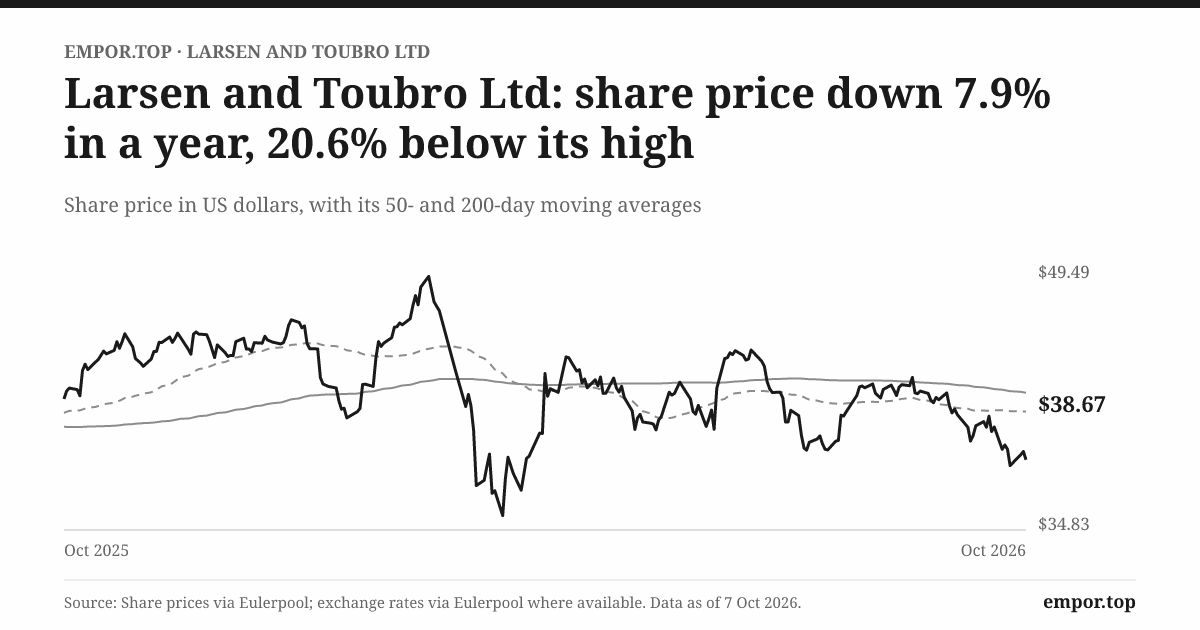
The scale is hard to hold in the head. In the year to March 2026, L&T reported consolidated revenue of about ₹3.14 lakh crore, roughly $32 billion.[^3] Its unexecuted order book stood at more than ₹7.4 lakh crore, which is more than two years of revenue already signed and waiting to be built.[^3] On October 7, 2026, the stock market valued the whole thing at about ₹5.15 lakh crore, or roughly $53 billion.[^3]
So here is the question this episode tries to answer. Can a company with no controlling owner, operating at the scale of a nation-state, turn a low-margin backlog of construction contracts into compounding returns for the people who own its shares?
The short version of the verdict: L&T is irreplaceable as India's national builder and has become a serious contender in Middle Eastern energy construction. But its core economics are stuck in a permanent tug-of-war. Revenue is booked before cash arrives, mega-projects swallow working capital, and operating margins have slid into single digits. The question for investors is not whether L&T will keep winning work. It almost certainly will. The question is how much of that work turns into cash that belongs to shareholders.
The road map runs like this. Two Danish engineers stranded in Bombay by a world war. A swamp outside the city that became India's most important heavy-engineering workshop. A partnership with the state on nuclear power, rockets and submarines. Two hostile raids, first by Dhirubhai Ambani and then by Kumar Mangalam Birla, and the defence that turned L&T into an ownerless fortress. A detour into owning toll roads and a metro that nearly broke its returns. The hostile takeover of a software company. A Gulf energy boom. And finally, the cash puzzle that decides whether all of this is worth what the market pays for it.
It begins, as so many Indian business stories do, with an accident of history.
 Subscribe on LinkedIn
II. The Danish Refuge & The War-Surplus Scramble (1938–1960)
Picture a cramped office in Bombay's Ballard Estate in April 1940. Two young Danes, Henning Holck-Larsen and Søren Kristian Toubro, share it. Company lore says the room was so small that only one of them could sit at the desk; the other was expected to be out selling. Their business, founded in 1938, was modest: importing Danish dairy equipment and selling it to Indian customers. Then news arrived from home. German troops had marched into Copenhagen. Denmark was occupied, and with it the supply line for everything the two men sold.[^4]
Most trading firms would have closed. Larsen and Toubro could not go home and had nothing to import, so they did the only thing left: they started fixing things. Bombay harbour was full of Allied warships that needed repair, and some needed degaussing, the process of neutralising a ship's magnetic field so it would not set off magnetic mines. The two engineers took that work. They also landed their first serious industrial job, helping Tata Chemicals with its soda ash plant at Mithapur.[^4]
This is the origin myth, and like the best origin myths it explains the company that came later. L&T did not begin as a builder by choice. It was pushed into engineering because trading became impossible. That instinct, to make in India what could not be bought from abroad, would become the company's commercial identity for the next eight decades.
The Caterpillar opening
The end of the war created a different kind of opportunity. Asia was suddenly full of surplus military equipment, and some of the most valuable was earthmoving machinery. Larsen and Toubro saw that a newly independent country would need bulldozers and excavators to build dams, roads and factories. To finance that inventory they formed Larsen & Toubro Private Limited on February 7, 1946.[^4] The same year they set up Engineering Construction & Contracts, or ECC, which moved the business from selling machines to actually using them to build things.[^4]
ECC matters more than it looks. It was the seed of what is today L&T's construction business, the largest part of the group by far. The founders had discovered that the money in a developing economy was not just in supplying equipment but in taking responsibility for the whole job.
The swamp at Powai
In 1948 the two Danes bought about 55 acres of undeveloped, marshy land at Powai, then well outside Bombay.[^4] Peers thought it was a strange purchase. There was nothing there. But the founders wanted space for heavy workshops, the kind of precision fabrication yards where large steel structures could be cut, welded and machined to tight tolerances. That swamp became the Powai campus, and the Powai workshops would later produce some of the most demanding equipment India ever built, including parts for its nuclear programme.
In December 1950 the company went public, listing in Bombay with a paid-up capital of about ₹20 lakh and sales of about ₹1.09 crore that year.[^4] Those numbers are tiny even after adjusting for inflation. What was large was the ambition.
For investors, the founding years explain two traits that still define L&T. First, it is a problem-solving engineering firm before it is a construction contractor, which is why it can take on work that rivals cannot. Second, it grew up alongside the Indian state. When independent India set out to industrialise, it needed someone who could build things the country had never built before. Two stranded Danes with a swamp full of workshops were ready to be that partner, and the state would soon come knocking with work far more sensitive than dairy plants.
III. The Strategic State: Nuclear, Space, & The Defense Moat (1960s–1980s)
In the early 1960s, Homi Bhabha, the physicist who led India's atomic energy programme, had a problem. India wanted nuclear power, and nuclear reactors need components made to standards that very few factories anywhere could meet. Calandrias, the large vessels that hold fuel and moderator in heavy-water reactors, had to be machined with extraordinary precision. Foreign suppliers could provide them, for now. But India's nuclear ambitions were already drawing suspicion abroad, and after the country's 1974 nuclear test, Western sanctions would make that supply line unreliable. Bhabha needed a domestic fabricator. He found one at Powai.[^4]
This partnership with the state on strategic programmes is one of the most distinctive features of L&T's history. Over the following decades the company became a supplier to India's atomic energy establishment, building hardware for the pressurised heavy water reactors that became the backbone of the country's nuclear fleet.[^4] It worked with the space agency ISRO, founded by Vikram Sarabhai, on motor casings and other components for launch vehicles including the PSLV and GSLV.[^4] And in defence it eventually built the hull of India's first nuclear-powered ballistic missile submarine, INS Arihant, along with Pinaka rocket launchers and, in partnership with South Korea's 한화에어로스페이스 Hanwha Aerospace (then Hanwha Defense), the K9 Vajra self-propelled howitzer.[^4]
The founders step back
While this strategic business was taking shape, the founders were stepping away. Toubro retired in 1962. Holck-Larsen, who received the Ramon Magsaysay Award in 1976, stepped down as chairman in 1978.[^4] Neither left a family dynasty in charge. That choice, made quietly decades before anyone tried to buy the company, is what made L&T so unusual. Its board was full of professional managers rather than heirs. It also made the company vulnerable, as the next section shows.
The defence paradox
Here is where the investor has to slow down. Strategic work for the state creates enormous technical barriers. A competitor cannot simply decide to start making nuclear components or submarine hulls; it needs decades of certification, trust and specialised equipment. In that sense L&T's position is close to unique among Indian private companies.
But barriers to entry are not the same thing as profits. Defence and nuclear customers are monopsonies, meaning there is effectively one buyer. Procurement cycles run for years. Contracts are often priced on a cost-plus basis or through tight competitive tenders, and the government sets the rules. India's own indigenisation policy deliberately spreads orders across multiple vendors, including state-owned shipyards and newer private entrants, precisely so that no single supplier gains pricing power. Rating agencies, when they describe L&T's strengths, emphasise its diversified mix and market leadership, but they do not describe defence as a high-margin engine.3
The history supports a narrower version of the "strategic moat" claim. L&T's nuclear, space and defence capabilities are real, difficult to replicate and valuable as a qualification for other complex work. They make L&T the contractor the government calls when failure is not an option. What they have not done, over more than half a century, is turn into a major profit pool on their own. R&D spending across the group remains well under 1% of revenue, which tells you L&T competes on execution and fabrication skill rather than proprietary technology.[^4]
The real value of this strategic work may be less about defence profits and more about credibility. A company trusted with a submarine hull is trusted with a metro or a refinery. And that credibility, combined with a board that answered to no family, made L&T an extraordinarily tempting target.
IV. The Raider Wars: Ambani, Birla, & The Fortress Trust (1987–2004)
In the late 1980s, L&T's engineers noticed something odd in the share register. Someone was buying, steadily and quietly. By 1988 it was clear who: Dhirubhai Ambani's Reliance group had built a stake of roughly 18.5%, assembled through market purchases and blocks from state-controlled financial institutions.4 Soon Dhirubhai was chairman of L&T, and his son Mukesh sat on the board.4
To understand why Reliance wanted L&T, you have to understand what Reliance was planning. It was about to build some of the largest petrochemical and refining complexes in India. Owning the country's best engineering contractor would give Reliance a captive builder for its own projects, and access to L&T's considerable cash. For L&T's other shareholders, this was a nightmare scenario: the company would become an in-house vendor to a single powerful customer.
The Reliance era did not last. The political winds shifted, the government that had tolerated the move fell, and state financial institutions, which still held large stakes in L&T, turned against the Ambanis. By 1991 Reliance's representatives had left the board.4 But Reliance kept its shares, and that unresolved stake was a loaded gun pointed at the company for another decade.
The Birla assault
In 2001, the gun went off. Reliance suddenly sold its remaining stake, about 10%, to Grasim Industries, the flagship of Kumar Mangalam Birla's Aditya Birla Group.4 Grasim then crept higher. Birla's interest was clear and specific: L&T owned one of India's largest cement businesses, and Grasim was a cement company. Combining them would create a dominant player. For L&T's management, it looked like the start of a slow-motion takeover in which the engineering business would end up as an afterthought inside a cement empire.
This is where A.M. Naik becomes the central character. Naik was the son of a schoolteacher from a village in Gujarat, an engineer who had joined L&T in 1965 as a junior engineer and climbed through the construction business. By the early 2000s he was running the company. He was famously intense, a workaholic who spoke openly about putting L&T above everything else. And he decided L&T would not be taken.
The poison pill that was also a peace treaty
Naik's defence was a two-part masterpiece of corporate engineering.4
The first part was to give Birla what he actually wanted. L&T demerged its cement business into a new company, UltraTech, and Grasim acquired control of it. In return, Grasim gave up its stake in L&T. Birla got the cement; L&T got its independence. Both sides walked away with something, which is why the deal stuck.
The second part was the permanent shield. Grasim's L&T shares were bought by the L&T Employees' Welfare Foundation, a trust holding equity on behalf of employees.4 Today that trust owns roughly 13–14% of the company, making it the largest single block apart from LIC.2 Because the trust's interests line up with management's continuity, any future raider would have to start from behind a wall of employee-held shares, the state insurer and a fragmented institutional base.
The structural legacy is visible in every shareholding filing. There is no promoter. Domestic institutions led by LIC and mutual funds hold a large share; foreign portfolio investors hold another large share; the employee trust sits in the middle.2
Myth versus reality
The popular story says Naik "saved" L&T. The fuller version is more interesting. He saved its independence, but at a price: the cement business, one of its most profitable assets, left the building and later became one of India's most valuable companies under Birla. Whether that trade was good for L&T's shareholders depends on how you value independence. Those who held L&T shares through the demerger also received UltraTech shares, so they did not lose the cement value outright. What they lost was a diversified group with a high-return commodity business inside it.
The fortress has a less discussed side, too. A company with no owner is protected from raiders, but it is also protected from shareholders. There is no family whose wealth rises and falls with the share price, and no single large holder who can force a change in strategy. Discipline must come from management culture, the board and institutional voting. That is a theme this story will return to.
Freed from the threat of takeover, L&T now had to decide what to do with its independence. The answer it chose in the boom years after 2004 would turn out to be the biggest capital allocation mistake in its modern history.
V. The Concession Trap & Portfolio Pruning: Hyderabad Metro to the Schneider Divestment (2004–2020)
Stand on an elevated platform of the Hyderabad Metro and the scale is impressive: about 69 km of track across three lines, built as a public-private partnership that was described as the largest of its kind for a metro in the world.5 L&T did not just build this metro. It owned the right to run it. That difference is the whole story of this section.
The BOT mirage
In the mid-2000s Indian infrastructure was booming, and the fashionable model was "build, operate, transfer", or BOT. Instead of simply being paid to build a road, a power plant or a metro, a contractor would form a special company, borrow heavily, build the asset, and collect tolls, tariffs or fares for decades before handing it back to the state.
The appeal was obvious. A contractor earns a thin margin once. An asset owner earns cash flows for 30 years. And the contractor could book construction profits on its own project while also owning the upside. L&T, like nearly every large Indian builder, piled in: toll roads, ports, a thermal power plant at Nabha in Punjab, and the Hyderabad Metro.[^4]
The problem was that BOT turned a contractor into a bet on traffic, tariffs and politics. A builder understands steel and concrete. It does not control how many people ride a train, what fare a state government will approve, or whether land is handed over on time.
The Hyderabad quagmire
Hyderabad got almost everything wrong at once. The project was hit by the split of Andhra Pradesh and the creation of Telangana, disputes over right-of-way, delays and route changes. When the metro finally opened in stages from 2017, ridership came in below plan. Then the pandemic lockdowns emptied the trains entirely. Fare revenue could not service the debt, and the debt was large: over ₹13,000 crore sat inside the project company.5 L&T, as parent, had to put in more equity and support restructuring.5
The deeper lesson is about risk. When L&T builds a metro for a fee, its downside is a cost overrun. When it owns the metro, its downside is that a city changes its commuting habits. Those are completely different risks, and the second one cannot be managed with better engineering.
The balance sheet showed the strain. Consolidated borrowings rose to about $20 billion by March 2020 and debt reached roughly 2.15 times shareholders' equity.[^3] A large part of that sat in L&T Finance and the concession companies rather than the core construction business, but investors could not ignore it.3
The crown jewel sale
The response was a long, unglamorous pruning. L&T worked to sell road assets and its Nabha power plant. And then it made a much bigger decision: it sold its Electrical & Automation business, a respected maker of switchgear and control systems, to Schneider Electric for about ₹14,000 crore in cash. The deal was announced in 2018 and closed on August 31, 2020, after a long competition review.[^8]
It was a striking move. E&A was a good business, steady and higher-margin than construction. Selling it was an admission that L&T's capital was better used reducing debt and focusing on its core than owning a solid manufacturing unit. Over the next six years borrowings fell to about $14 billion and debt-to-equity dropped to about 1.15 times.[^3]
Falsification check: is the concession lesson learned?
Management's narrative is that L&T is now an asset-light engineering and technology company. The record narrows that claim. The Hyderabad Metro remained on the books for years after the pandemic, its debt unresolved, and talks with the Telangana government over its future dragged on.5 L&T Finance still carries a sizeable lending book. The lesson has been learned in words and in most new commitments, but L&T has not fully exited the past. The clean test is simple: a formal transfer or deconsolidation of the Hyderabad Metro and its debt. Until that happens, the concession era is a scar, not a closed chapter.
While L&T was trying to shrink its exposure to slow, capital-hungry infrastructure, it went looking for something with the opposite character. It found it in a software company in Bangalore, and it did not ask permission.
VI. The Hostile Software Raid: Assembling LTIMindtree (2019–2023)
On March 18, 2019, L&T announced that it would buy the about 20% stake in Mindtree held by V.G. Siddhartha, the coffee entrepreneur behind Café Coffee Day, and launch an open offer for more.6 Mindtree's founders were furious. They had built a respected mid-sized IT services firm with a distinctive culture, and they did not want to be absorbed by a construction company. One of them, Subroto Bagchi, captured the mood with the line that a tree needs to be nurtured, not bulldozed. It was India's first hostile takeover in the software industry.
There was an irony nobody missed. The company that had built a fortress to stop hostile takeovers was now launching one.
Why a builder wants a software company
L&T already owned two listed technology businesses, L&T Infotech (LTI) and L&T Technology Services (LTTS), both spun out of its own engineering roots. The logic for adding Mindtree was about the shape of the cash flows. Construction is lumpy, capital-hungry and paid in rupees by slow-paying governments. IT services are steady, capital-light, high-margin and paid in dollars by global corporations. Owning both smooths the group's earnings and cash.
L&T ended up with about 61% of Mindtree for roughly ₹10,700 crore after the open offer.6 The founders left. In 2022 L&T merged Mindtree with LTI to form LTIMindtree, one of India's larger IT services companies, with combined revenue of more than $4 billion a year.[^3]
The financial reality
The technology and services businesses together contribute something in the range of 15–20% of consolidated revenue, but a disproportionately larger share of operating profit and much better cash conversion.[^4] In years when government clients pay slowly or a big project absorbs cash, the software side keeps generating cash.
Myth versus reality
The bull story is that L&T built a "cash ballast" that subsidises its construction business. That is partly true, but with an important caveat: L&T owns only part of LTIMindtree and LTTS. Minority shareholders in those listed subsidiaries own the rest of their profits, and that cash does not flow freely to the parent. It arrives as dividends, and the subsidiaries' boards decide how much. So the ballast is real for consolidated reporting and credit ratings, but less so for the cash that L&T shareholders can actually claim.
There is also a valuation question. LTIMindtree trades as its own listed company, and investors can buy it directly. That is why many analysts apply a "holding company discount" to L&T's stake. If you can own the software business on its own, why pay full value for it wrapped inside a contractor?
The Mindtree episode also tests the claim that L&T is a disciplined, conservative capital allocator. The deal was aggressive and culturally messy, and its success depended on retaining clients and staff after the founders walked out. So far it has worked: the merged company is larger and profitable. But it was a high-stakes bet, not a cautious one. It tells you SNS-era L&T is willing to act boldly when it believes the logic is right.
With software providing steadier earnings, L&T turned its construction engine toward the biggest construction boom on its doorstep, and it was not in India.
VII. The Middle Eastern Energy Supercycle & The ₹7.4 Lakh Crore Backlog (2020–2026)
In early 2025, QatarEnergy handed out the contracts for the next phase of its giant North Field gas development, the reservoir it shares with Iran under the Gulf.7 L&T emerged with a large offshore package, one it described as among the biggest in its history.7 It followed a run of wins with Saudi Aramco for gas and oil field work, including packages linked to the Jafurah gas project and offshore fields.8
For a company that had spent most of its life building Indian roads and power plants, this was a profound change in where the growth came from.
The Gulf pivot
The reason is straightforward. After years of underinvestment, Gulf energy producers began spending heavily to expand gas output, maintain production and build new petrochemical and renewable capacity. Saudi Arabia's in-kingdom value programme favoured contractors who would hire and build locally.8 L&T had years of experience in hydrocarbon construction and fabrication yards that could build offshore platforms, giving it a real shot at work that used to go mainly to Western and Korean contractors.
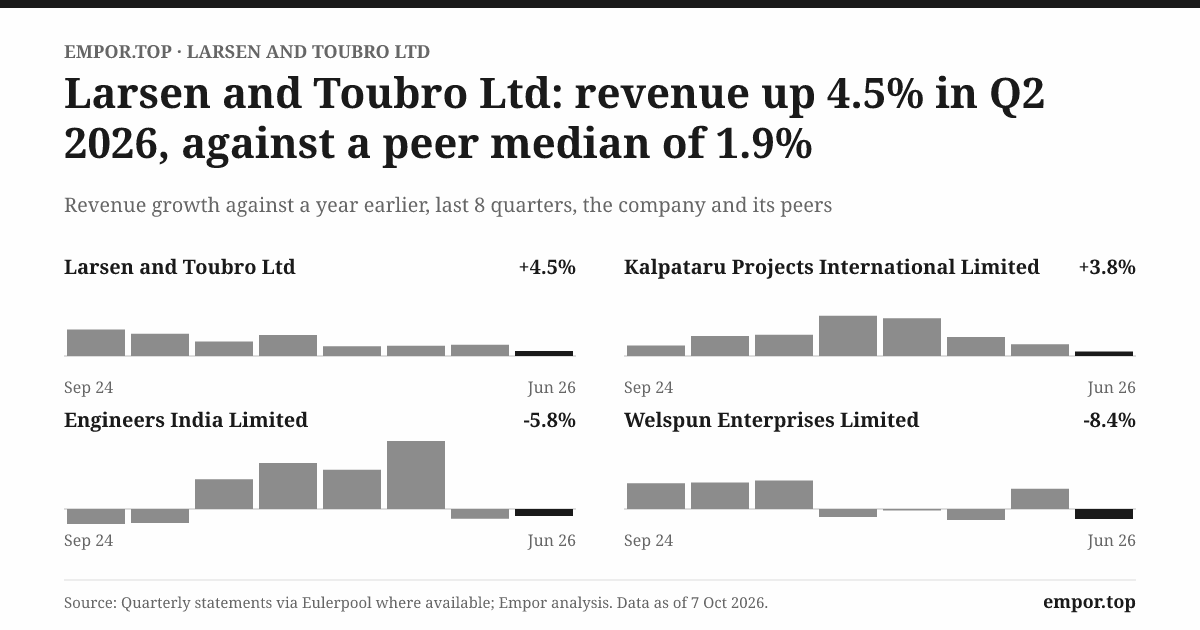
The result showed up in orders. International work rose to a large share of inflows, at times close to half.[^4] By the end of FY2026 the order book had swollen to more than ₹7.4 lakh crore, or about 2.3 years of revenue.[^3] Revenue grew at around 15% a year over the three years to FY2026, well above L&T's ten-year pace of about 11%.[^3]
The margin puzzle
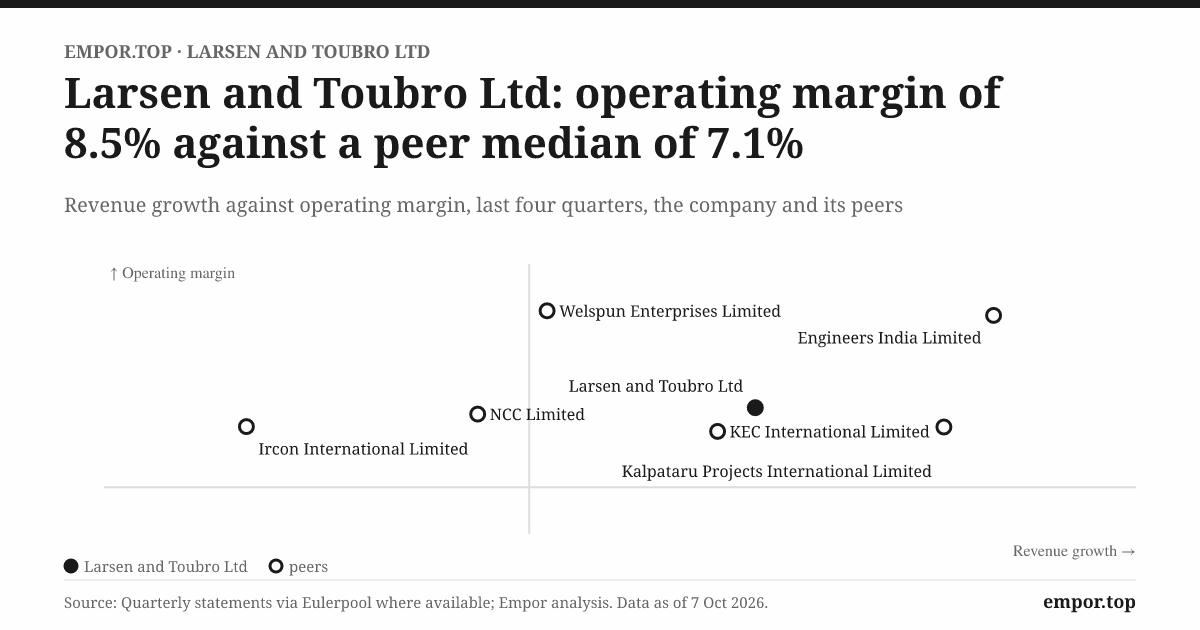
And yet the profit line tells a different story. Consolidated operating margin, which was about 12.5% in FY2021, slid to about 10.4% in FY2024 and then to about 8.7% in FY2026.[^3] The most recent quarter, ended June 2026, came in lower still, at about 7.5%, even as revenue grew only modestly.[^3]
Why would margins fall while the business boomed? Four forces are visible.
First, mix. Large international energy projects are bid competitively against global rivals, and the winning margin is thinner than on many domestic projects.
Second, the contract type. Domestic government contracts usually include price variation clauses that pass commodity inflation back to the client. Many international energy contracts are fixed-price lump-sum turnkey jobs, where the contractor absorbs cost surprises.3
Third, timing. Early in a big project, revenue is recognised as costs are incurred, but contractors often book conservative margins until risk is retired. That depresses reported margins in the ramp-up phase. Management has repeatedly argued on earnings calls that margins on the new jobs will improve as they mature.910
Fourth, the IT services business. As software growth slowed, its higher margins did less to lift the group average.
The management claim, tested
Management's message has been that the margin dip is temporary, a function of execution phasing and legacy contracts working through the system. The record narrows that claim. Margins have declined fairly steadily for five years, not in a single bad year, and the latest quarter was worse than the year before. That pattern looks more like a structural feature of the new revenue mix than a temporary blip. It does not prove margins cannot recover, but it means investors should treat recovery as unproven. The clean test: the core infrastructure segment's margin in L&T's own disclosures moving back above roughly 9.5%.
On currency, L&T has a natural hedge. Revenue in dollars, riyals and dirhams is partly offset by costs in the same currencies, and forward contracts cover much of the remainder.3 Currency moves have been a minor factor in profits.
The Gulf has given L&T scale it could never have found at home. The price has been paid in margin, and, as the next section shows, in cash.
VIII. The Cash Conversion Engine: Working Capital & The Debtor Days Miracle
On L&T's earnings calls, one theme keeps returning in the analyst questions: where is the cash? Year after year, management has been asked about unbilled revenue, receivables from state governments and the money tied up in retention.9 And year after year, S.N. Subrahmanyan and his finance team have talked about collection discipline, mobilisation advances and pushing clients to pay on time.
How a contractor really gets paid
To see why this matters, it helps to understand how construction cash works. Imagine building a house for a client who agrees to pay in stages. You do the work first, then submit a bill, then wait for the client to approve it. Some money is held back, called retention, until the job is finished and inspected. Sometimes the client pays an advance at the start to help you mobilise. At any moment you are owed money for work done but not yet billed (contract assets), money billed but not yet paid (receivables), and money held back (retention). Multiply that by hundreds of projects and dozens of government clients, and you get L&T's balance sheet.
Accounting standards let a contractor recognise profit as work progresses. Cash comes later. That gap is where contracting profits can quietly disappear.
The debtor turnaround
Here is the remarkable part. Debtor days, the number of days of revenue sitting in unpaid receivables, peaked at about 383 in FY2021 and fell to about 133 in FY2026.11 That is a collapse of more than two-thirds in five years. At the same time, L&T leaned on its own suppliers: it took roughly 100 days on average to pay them.11 The combined effect pushed working capital days below zero, meaning that, on this measure, suppliers and customers were financing more of L&T's operations than L&T itself.11
Some of this is genuine discipline: tighter contract terms, more advances, a concerted push on collections, and the settlement of old disputes. Some of it is mix: Gulf energy clients pay more reliably than Indian state governments. And some of it reflects scale: L&T is big enough to push its payment terms on to smaller subcontractors, which is profitable for L&T but shifts stress to its supply chain.
The falsification clue
Now comes the twist. If working capital had improved so dramatically, cash from operations should have soared. It did not.
Cash from operations as a share of EBITDA was above 95% in FY2021 to FY2023, peaking at about 124% in FY2021. It then fell to about 31% in FY2025 and about 51% in FY2026.11 In plain terms, in FY2025 less than a third of operating profit arrived as cash.
How do you reconcile improving debtor days with falling cash conversion? The answer lies in what the debtor-days figure leaves out. Unbilled contract assets, advances to suppliers and the working capital of the financing arm sit elsewhere. Large new projects require upfront spending on procurement and mobilisation before billing catches up. In other words, the money has moved from one line on the balance sheet to others.
Over the full twelve years from FY2015 to FY2026, L&T turned about 88% of its net profit into operating cash, which is respectable for a contractor but not exceptional.[^3] The long-run picture is of a company that does eventually collect most of what it books, but with long and variable delays.
The verdict here is that the "debtor days miracle" is real but partial. It has improved the quality of L&T's receivables, but it has not translated into a sustained surge in cash. The single most useful number for investors to watch is cash from operations as a share of EBITDA. It was about 51% in FY2026, recovering from the FY2025 low but well short of the 90%-plus years. Sustained readings above 75% would confirm that the mega-project ramp is paying back; continued readings near 50% would suggest that growth in the Gulf is consuming more cash than the headline profits imply.
Cash, margins and debt are the outputs. To understand whether L&T can improve them, investors need to look at where its competitive power actually comes from.
IX. Strategic Positioning: Porter's 5 Forces & Hamilton Helmer's 7 Powers
Imagine a high-speed rail tender in India. The pre-qualification criteria demand balance-sheet size, specific experience with similar structures, heavy lifting capacity and engineering certifications. When the bids arrive, only a handful of groups clear the bar, and L&T is in the frame for the biggest packages. This is what L&T's moat looks like in practice. It is not about having the lowest price. It is about being one of the few companies allowed to bid at all.
The market values the whole business at about ₹5.6 lakh crore in enterprise value.[^3] Both CRISIL and ICRA rate L&T at the highest level, AAA.3[^15] To see whether those valuations are justified, it helps to use two frameworks.
Hamilton Helmer's 7 Powers
Scale economies: strong. L&T's equipment fleet, fabrication yards at Hazira and Kattupalli, and procurement volumes give it cost and capability advantages that smaller Indian rivals like NCC, Afcons or Tata Projects struggle to match. Scale also lets it bid on jobs large enough to exclude most competitors.
Cornered resource: strong but narrower than it looks. Decades of nuclear, space and defence certifications are hard to replicate. But, as Section III showed, the government deliberately spreads such work across several suppliers. The resource is real; the pricing power that comes with it is limited.
Process power: meaningful. L&T's project management systems, internal engineering training and experience in modular construction allow it to deliver complex jobs reliably. This is hard to prove from outside, but it shows up in the repeat orders from demanding clients like Aramco.
Switching costs: moderate. Once a project is under way, replacing the contractor is costly. But at the bidding stage clients can and do choose others.
Branding: moderate. The L&T name carries an assurance that a project will be finished, which matters to governments that cannot afford a stalled metro.
Counter-positioning: weak. L&T is the incumbent. Nimble specialists can outbid it on smaller, standardised jobs.
Network economies: none. Construction has no network effects.
Porter's 5 Forces
Buyer power: severe. L&T's customers are governments and sovereign energy companies. They set the terms, hold retention money, enforce multi-vendor policies and can delay payment. This is the biggest single constraint on L&T's margins, and the reason its moat translates into volume rather than pricing.
Threat of substitutes: negligible. Nothing replaces a nuclear vessel or an offshore platform.
Rivalry: high in the Gulf, moderate at home. In international energy work L&T competes with Saipem, McDermott, Korean contractors such as 현대건설 Hyundai Engineering & Construction and 삼성E&A Samsung E&A, and Chinese state firms. In Indian mega-civil projects, the field is narrower.
Supplier power: moderate. L&T's scale gives it leverage over subcontractors, as the payable days show, but specialised equipment suppliers and skilled labour can command premiums.
Threat of new entrants: low for the largest projects, higher for mid-sized ones.
The verdict: L&T's moat is real, but it is a moat that wins work, not one that sets prices. Its scale and certifications ensure a steady stream of large orders. The power of its customers ensures those orders come at thin margins. That combination explains almost everything in the financials: big revenue growth, slipping margins, and a rating agency view that values its stability more than its profitability.
The obvious question is whether L&T can escape that trap by moving into businesses with better economics. That is exactly what its newest bets are trying to do.
X. The Next Bets: Green Hydrogen, Data Centers, & LTSCT (2024–2030)
In 2024, L&T did something that surprised many investors. It created L&T Semiconductor Technologies, or LTSCT, a fabless chip design company focused on analog, power and mixed-signal products.12 The same year it was building out electrolyser manufacturing at Hazira, aiming at India's green hydrogen ambitions.[^4] A company famous for pouring concrete was suddenly talking about silicon.
The Lakshya 2026 blueprint
These bets sit inside L&T's five-year strategic plan, Lakshya 2026. Its headline goals included roughly doubling revenue to around ₹3 lakh crore and lifting return on equity toward 18%.[^4] The revenue goal was effectively reached in FY2026, when revenue crossed ₹3.1 lakh crore.[^3] The return goal was not: ROE was about 14.7%.[^3] That split is telling. L&T is good at growing; making that growth more profitable is harder.
What the new bets are
Semiconductors. LTSCT plans to design chips and outsource manufacturing, which limits the capital required.12 But the competition is formidable: Texas Instruments, Infineon, STMicroelectronics and others have decades of customer relationships and product catalogues. A new entrant can find niches in Indian demand and government-linked supply chains, but building a profitable chip business is a ten-year project with no guarantee.
Green hydrogen. L&T partnered with France's McPhy Energy for electrolyser technology and built manufacturing capacity at Hazira.[^4] The opportunity depends on Indian subsidies and on whether green hydrogen becomes cheap enough to replace fossil-derived hydrogen. Globally, many green hydrogen projects have been delayed or cancelled as costs remained high, and McPhy itself ran into financial difficulties.
Data centres and digital platforms. L&T has invested in data centre capacity and digital businesses, including B2B platforms.[^4] These fit the demand for cloud capacity in India but compete with deep-pocketed global and domestic players.
Capital spending across the group has remained modest relative to revenue, around 1.5–2% a year.[^4] That restraint is the best feature of the new bets: they are options, not bets of the balance sheet.
Certification is not commercialisation
The historical test here is uncomfortable. L&T's past diversifications into new manufacturing areas had a mixed record. Its joint ventures with Mitsubishi Heavy Industries for supercritical boilers and turbines were set up to supply India's thermal power boom, then suffered from low utilisation when the boom faded and new coal orders dried up.[^4] The concession business, as Section V showed, destroyed value. And decades of nuclear, space and defence firsts did not turn into a large profit stream.
None of this means the new bets will fail. It means technical milestones should not be mistaken for revenue. The test for LTSCT is not a design announcement but meaningful product sales to customers outside the L&T family. The test for electrolysers is orders backed by actual hydrogen production. Until those appear, these are interesting options with small current value.
Which raises the question of who decides where L&T's capital goes, and whether they are accountable to shareholders.
XI. Management, Governance, & The Skeptical Investor Stress Test
At L&T's annual general meetings, the resolutions pass by wide margins. Institutional investors, led by LIC and domestic mutual funds, typically vote overwhelmingly in favour of the board's proposals, with approval commonly above 95%.13 But one figure in the annual reports deserves a second look: the pay of the chairman.
The two leaders
A.M. Naik was the builder and defender. He saved L&T's independence, built its construction business into a national champion and expanded it overseas. He was also the chief architect of the concession push that later had to be unwound. His legacy is both the fortress and the scar.
S.N. Subrahmanyan, who took over as chairman in 2023, is an execution manager. An engineer from the construction side, he became known for a sharp focus on collections and working capital, and, less flatteringly, for remarks in early 2025 suggesting employees should work 90 hours a week, which drew a public backlash. Under his leadership L&T has grown revenue rapidly, cut receivables and expanded abroad.
Pay and alignment
Subrahmanyan's total remuneration rose from about ₹51 crore in FY2024 to about ₹76 crore in FY2025 and roughly ₹121 crore in FY2026, driven largely by profit-linked commission and the vesting of stock options.[^4] In FY2024 his pay was several hundred times the median employee's.[^4]
In a promoter-run company, a founder's wealth lies mostly in shares. At L&T, without a promoter, executive pay is the main incentive lever. Linking commission to consolidated profits aligns management with earnings growth, but not necessarily with returns on capital or cash conversion. A management team paid on profit has every reason to grow revenue, even at thin margins.
Capital returns
The most shareholder-friendly move of recent years was the buyback. In September 2023 L&T repurchased about 3.1 crore shares at ₹3,200 each, a total of ₹10,000 crore.14 Dividends have taken a fairly steady share of profits, typically around 29%.[^3] Over the twelve years to FY2026, dividends absorbed about 62% of free cash flow.[^3] That is a healthy share given how lumpy L&T's free cash has been.
The skeptical investor's stress test
An activist looking at L&T would ask three questions.
Hyderabad Metro. Why, years after the concession lesson was learned, is the metro still a drag on returns and still not resolved?5 Every year it stays on the balance sheet, it ties up capital that earns little.
The conglomerate discount. Does it make sense to own large stakes in LTIMindtree, LTTS and L&T Finance inside a construction parent? Each is separately listed. Investors who want IT services can buy them directly. A cleaner L&T might command a better multiple, or might lose the stabilising cash flows that support its AAA rating. There is no obvious answer, which is why the question persists.
Gulf concentration. A large share of the order book now depends on Saudi and Qatari energy spending. Those programmes are tied to oil and gas economics and regional politics. Aramco has in the past slowed or reshaped capital programmes when priorities changed, and a similar pause would hit L&T's inflows.
On governance, the record is generally clean. Auditors have issued unmodified opinions, with the usual emphasis on the judgement involved in long-term contract accounting.[^4] Contingent liabilities, mostly guarantees and tax disputes, are large in absolute terms but modest relative to the company's size.[^4] The governance risk at L&T is not misconduct. It is the subtler risk that a professional management without an owner grows the business in ways that suit management more than shareholders.
All of which leads to the question every investor eventually has to answer: what is the market already paying for?
XII. Bull vs. Bear Case
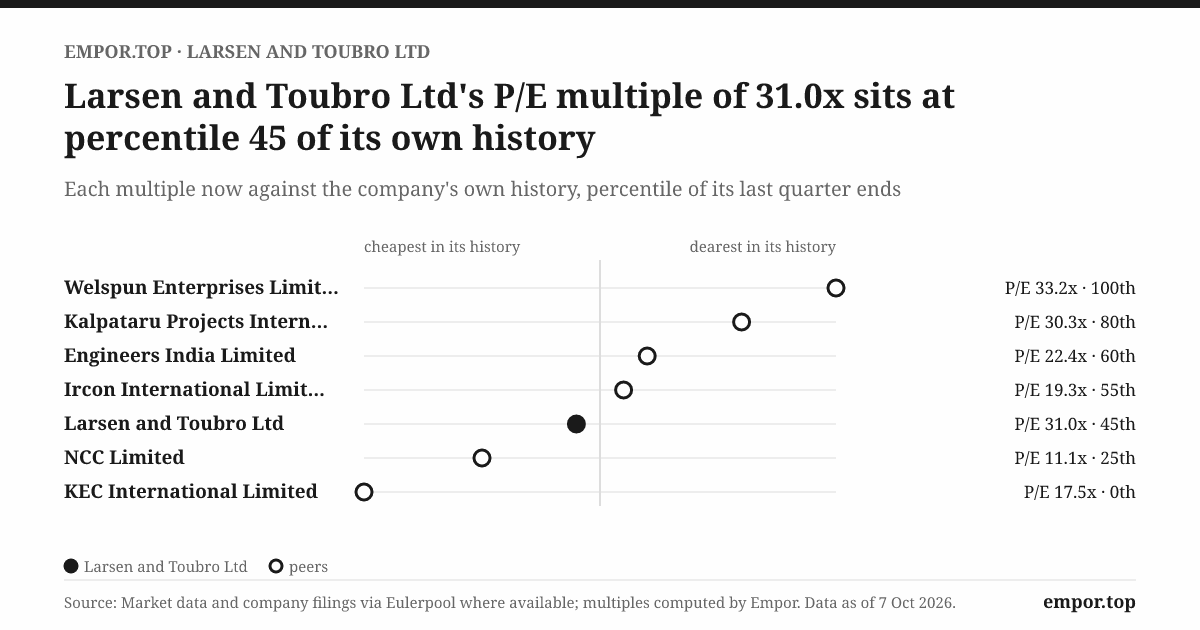
On October 7, 2026, L&T's shares traded at about ₹3,742, around 15% below their 52-week high.[^3] At that price the stock sat at about 31 times trailing earnings, almost exactly its five-year median of about 32.[^3] On enterprise value to EBITDA the multiple was about 17.[^3] Return on equity was about 15% and return on capital employed about 13%.[^3]
Put simply, the market is paying a full but not extreme price for a business it believes will keep growing. It is not pricing a margin collapse, and it is not pricing a margin recovery either. It is pricing more of the same.
The bull case
The bull case starts with India. The country's long-running push on infrastructure, from high-speed rail and freight corridors to metros, nuclear power and defence, needs a builder that can handle the largest and most complex projects. L&T is the default choice for many of them.
Second, the Gulf. If L&T executes well on its Aramco and QatarEnergy contracts, it establishes itself as a top-tier global energy contractor, with access to a pipeline of work far larger than India alone.
Third, defence indigenisation. India's desire to build more weapons at home benefits the few private companies with real capability, and L&T is one of the most advanced.
Fourth, the cash ballast. The technology subsidiaries add steady earnings and help preserve the balance sheet.
The bear case
The bear case starts with margins. Operating margin has slid from about 12.5% to under 9% over five years, and the latest quarter was weaker still. If the new revenue mix is structurally lower margin, earnings will grow more slowly than revenue.
Second, cash. Cash conversion has fallen sharply, and big Gulf projects demand upfront capital. If that continues, growth will require more working capital than investors expect.
Third, legacy assets. The Hyderabad Metro and the financial services arm continue to weigh on consolidated returns.
Fourth, valuation. At around 31 times earnings, the stock already assumes steady double-digit growth. A shortfall in execution or a slowdown in either Indian or Gulf spending would leave little cushion.
The KPIs that decide it
Two numbers matter most. The first is operating margin, which was about 8.7% in FY2026 and drifting lower into the latest quarter.[^3] The second is cash from operations as a share of EBITDA, which recovered to about 51% in FY2026 from about 31% a year earlier.[^3] If both rise, the bull case is being proven. If margins keep falling while cash conversion stays weak, the bear case is gaining ground. A third useful signal is the order book's coverage of revenue, which is currently around 2.3 years and tells you whether the growth runway is intact.[^3]
XIII. Playbook: Business & Investing Lessons
1. When there is no owner, the employees must become the owner. When Birla came for L&T, Naik did not try to find a white knight. He handed the raider's shares to the people who worked there. The Employees' Welfare Foundation turned a company with no promoter into a company that could not be bought. The lesson for any widely held company: the best defence is not a legal trick but a shareholder whose interests can never be bought out.
2. A builder needs something that does not need building. The Mindtree raid looked like a strange detour for a construction company. In practice, it gave L&T steady, dollar-denominated, high-margin earnings to offset the lumpiness of contracting. But the cash belongs partly to minority shareholders in the subsidiaries. A ballast that you only partly own is still a ballast, just a lighter one.
3. Take the fee, not the fare. The Hyderabad Metro taught L&T the hardest lesson of its modern history. As a builder it controlled concrete and steel. As an owner it was exposed to ridership, politics and pandemics. Contractors who own concessions stop being engineers and start being gamblers on traffic.
4. A moat that wins work is not a moat that sets prices. L&T can qualify for jobs few others can. Its customers, however, are governments and sovereign oil companies that set the terms. That combination produces volume, not margin. For investors in any business that sells to the state, the question is never "is it the best?" but "who sets the price?"
5. In contracting, profit is a promise; cash is the proof. L&T's debtor days collapsed while its cash conversion also fell. The money did not disappear, it moved into other lines of the balance sheet. A profit booked on an EPC contract is a claim on future cash. Until the client pays and the retention is released, it is not yet money.
XIV. Epilogue & Outro
Tonight L&T stands as India's largest engineering and construction company, with an order book of more than two years' revenue, a balance sheet far stronger than five years ago, and a growing presence in the Gulf. It also faces the toughest questions it has faced in a decade.
Three moments will decide the next chapter. The first is the margin reports in FY2027: if the core infrastructure segment's margin climbs back above roughly 9.5%, management's claim that the dip was temporary will be vindicated; if it keeps sliding, the market will have to price L&T as a lower-margin business. The second is cash: two years of cash from operations above 75% of EBITDA would show that the Gulf ramp-up is paying back. The third is the Hyderabad Metro: a clean exit from the project and its debt would finally close the concession era.
None of these outcomes is guaranteed. L&T could keep growing revenue at double digits while margins and cash conversion drift sideways. That is not a disaster, but it is not the compounding story the multiple implies.
Go back to Powai in 1948. Two Danish engineers walk through marshland outside Bombay, swatting mosquitoes, deciding that India should fabricate its own heavy machinery rather than import it. They could not have imagined submarine hulls, Gulf gas platforms or a software company inside their firm. But they would recognise the instinct: build what others cannot, for whoever needs it most.
In a country where dynasties build empires, India's greatest engineering empire was built by two foreigners who left, inherited by the employees who stayed, and cemented into every ton of steel that holds the nation together. Whether it can also become a great compounding machine for its shareholders is the question the next few years will answer.
References
-
S.N. Subrahmanyan Takes Charge as Chairman & MD of L&T — Business Standard, 2023-10-01 ↩
-
Corporate Filings, Shareholding Pattern & Board Disclosures — BSE India ↩↩↩
-
CRISIL Ratings Rating Rationale on Larsen & Toubro Limited — CRISIL Ratings, 2024-07-02 ↩↩↩↩↩
-
How A.M. Naik Saved L&T from Hostile Takeovers by Reliance and Birla — Mint, 2023-09-30 ↩↩↩↩↩↩
-
L&T Hyderabad Metro Restructuring and Debt Divestment Plans — Financial Express, 2024-01-18 ↩↩↩↩↩
-
Mindtree Open Offer Detailed Public Statement — SEBI / Larsen & Toubro Limited, 2019-03-26 ↩↩
-
QatarEnergy Awards Major Offshore Contracts for North Field — Reuters, 2025-03-15 ↩↩
-
Saudi Aramco In-Kingdom Total Value Add (IKTVA) Program & L&T Energy EPC Wins — MEED (Middle East Economic Digest) ↩↩
-
L&T Q4 FY2024 Earnings Conference Call Transcript — ResearchBytes / Larsen & Toubro Limited, 2024-05-09 ↩↩
-
L&T Q4 FY2025 Earnings Conference Call Transcript and Investor Presentation — Larsen & Toubro Limited, 2025-05-08 ↩
-
Corporate Announcements and Financial Filings — National Stock Exchange of India ↩↩↩↩
-
L&T Semiconductor Technologies (LTSCT) Strategy & Fabless Roadmap — Electronics Weekly / L&T Corporate, 2024-04-12 ↩↩
-
L&T Annual General Meeting Scrutinizer Report and Voting Results — BSE India, 2024-08-01 ↩
-
Letter of Offer for Buyback of Equity Shares — SEBI, 2023-09-13 ↩
 LinkedIn
 WhatsApp
 Reddit
 Hacker News
 Email
 Kindle
 RSS Feed
 Spotify
 Apple Podcasts
 Amazon Music
 Audible
 YouTube