Marico: The Coconut Oil Brand That Wants to Become a Consumer Portfolio
I. The Blue Bottle Meets the ₹20,000 Crore Ambition
Picture a small grocery shop in almost any Indian town. Behind the counter, between the biscuit packets and the detergent sachets, sits a row of squat blue plastic bottles with a coconut-tree logo. Nobody in the shop thinks of that bottle as a piece of strategy.
It is simply what coconut oil looks like. A grandmother rubs it into a child's scalp on a Sunday morning, a college student keeps a small one in a hostel room, and a migrant worker in Dubai buys the same bottle in a supermarket because it tastes, smells and feels like home.
That bottle is Parachute, and it is the foundation on which Marico Limited was built. It is also the reason a company best known for coconut oil now tells investors it believes it can become something much bigger.
In the spring of 2026, management repeated its Vision 2030 ambition: roughly ₹20,000 crore of revenue by the end of the decade, built on foods, premium personal care, digital-first brands and a broader international business.1 Put the humble blue bottle next to that number and the distance between them is the whole story.
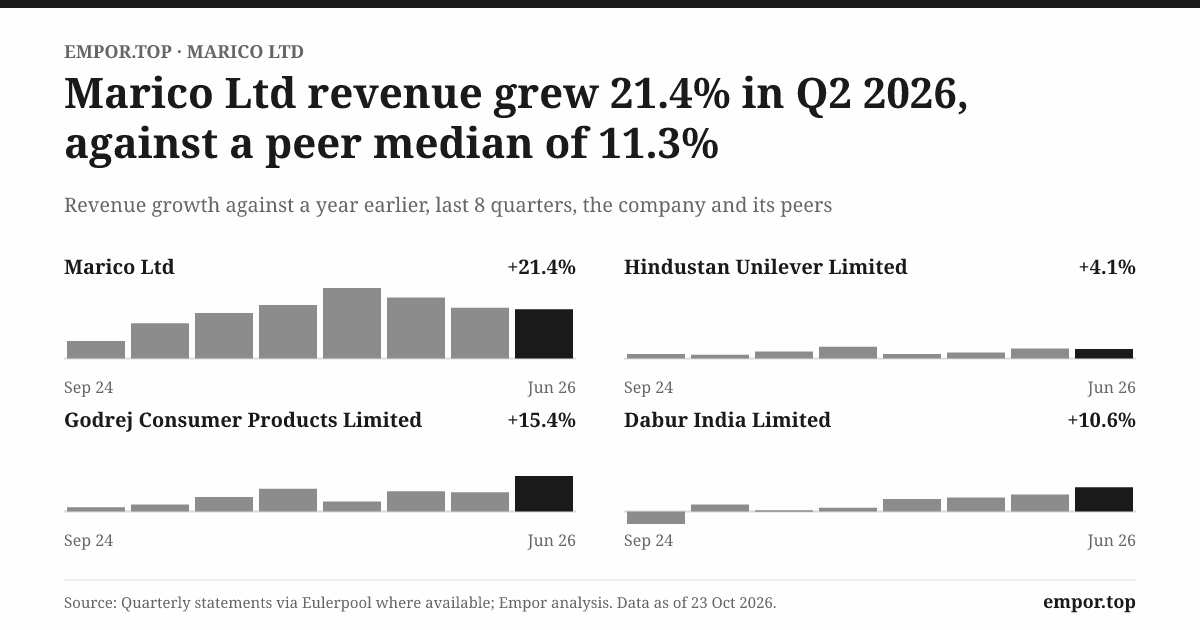
The distance is not imaginary. In the year to March 2026, Marico's consolidated revenue reached ₹13,611 crore.2 Ten years earlier it had been about ₹5,936 crore.2 That works out to growth of about 8.5% a year over the decade, steady and respectable for a consumer-goods company, but hardly the stuff of a hockey stick. Then FY26 arrived, and revenue jumped by 26%, the fastest growth the company had reported in fourteen years.2
A jump like that is the kind of number that makes a slide deck glow. It is also the kind of number a careful investor should treat as a clue rather than a new baseline. When a company that has compounded at 8.5% suddenly grows at triple that rate, there are only a few possible explanations.
It sold a lot more stuff. It charged a lot more for the same stuff. Or it bought other companies whose sales now show up in its own accounts. In FY26, all three were at work.
Why does the distinction matter so much? Because each source of growth has a different shelf life. Volume growth means more households buying more often, and it tends to compound. Price growth is borrowed from the commodity cycle and often has to be handed back, through promotions or slower demand, when costs fall.
Acquired growth is a one-time step up that only becomes compounding growth if the bought brands keep expanding on their own. A rupee of revenue from each source looks identical in the headline. It is not identical in value.
The volume clue is the most important. Marico's India business, which is still the larger part of the group, grew its underlying volumes by about 8% in FY26.3 That is healthy by the standards of Indian consumer staples, where volume growth in low single digits has been common in recent years. But 8% volume growth does not get you to 26% revenue growth.
The gap was filled mostly by price. Copra, the dried coconut kernel from which coconut oil is pressed, became sharply more expensive during the year, and Marico passed much of that inflation through to shoppers.3 On top of that came the newer brands, including businesses it had acquired, and an international arm that grew about 20% in constant currency.3
So the honest way to read FY26 is this: the acceleration was real, but it was flattered by unusually strong pricing and by acquisitions. Pricing tends to unwind, or at least stop compounding, once commodity costs settle. Acquisitions add revenue once and then must grow on their own. The test for Marico over the next few years is whether volume, mix and profit can keep moving up as those one-time tailwinds fade.
It helps to be clear about what Marico is, because the boundary matters. Marico Limited is a publicly traded fast-moving consumer goods company listed on the NSE and BSE. It is not a subsidiary of some larger listed parent, and its consolidated accounts cover the Indian business, the international subsidiaries and the newer brands it has bought.2
When this story talks about Marico's revenue, margin or cash, it means that consolidated group, controlled by the founding Mariwala family and run by professional managers. On 23 October 2026 the market valued it at roughly ₹1 lakh crore.4
Three questions run through everything that follows. The first is about durability: how strong is the core, really, once you separate Parachute's genuine brand power from the general good fortune of selling a household staple in a growing country?
The second is about the new bets: can foods, premium personal care and acquired digital brands earn their place in the portfolio, measured by profit and return on capital rather than by revenue alone? The third is about price: at roughly 58 times trailing earnings, how much success does today's share price already assume?4
The tension that carries the story is simple to state. The old core throws off cash and gives Marico shelf space in millions of shops. Management is using that cash and that reach to build what it hopes will be the next growth engine.
Every rupee that goes into a new brand is a rupee that could have been paid out as a dividend or left in the bank, so the question is never just whether the new brands grow. It is whether they grow into businesses that deserve the capital the old business generates.
The story of why Marico has that cash and that reach in the first place goes back to a young man in a family trading firm who decided that selling commodities in barrels was the wrong business to be in.
 Subscribe on LinkedIn
II. From Trading House to Consumer Company
In 1971, a twenty-year-old named Harsh Mariwala walked into the offices of Bombay Oil Industries, the family business, as the first member of the third generation to join it.5 Nobody had prepared a job for him. The company had three manufacturing businesses, edible oils, chemicals and spice extracts, and young Mariwala was left to find his own way into them.5
What he did next shaped everything that came after. Instead of settling into an office, he went into the markets of western India to watch how traders handled the family's products and how ordinary people actually used them.5 He visited factories, talked to customers and studied competitors. It was the kind of unglamorous fieldwork that a family scion could easily have skipped, and it led him to an uncomfortable conclusion about the family's oil business.
Bombay Oil Industries sold much of its edible oil unbranded, in barrels and tankers, to traders who repackaged it and sold it under their own names.5 That made it a commodity business. A commodity seller is paid for volume and nothing else, and its margins are thin because buyers can always switch to whoever is cheapest this week.
Parachute coconut oil existed as a name, but it was sold in large tin cans that traders broke down into smaller packs and relabeled.6 The brand was, in effect, being given away to the middlemen.
Mariwala's insight was that the same oil, put into a consumer pack with a name the shopper could trust, could be a different kind of business. Starting in the mid-1970s, the company began pushing into consumer products.2 It moved bulk oil into smaller retail packs, including small tins of Parachute.5
It took Saffola, a safflower oil, and positioned it as a heart-healthy choice, which allowed it to charge a premium over ordinary cooking oil.5 The idea was the same in both cases: stop selling oil, and start selling a promise about the oil.
Saffola is the more subtle of the two moves, and it foreshadows much of what Marico does today. Coconut oil's promise was purity, something a sealed bottle could show. Saffola's promise was health, something no bottle can show at all. To sell it, Marico had to borrow authority from an idea, the link between cooking fats and heart disease, and attach it to a brand name.
That is a harder trick, and it is exactly the trick the company is now trying to repeat with oats, honey, wellness supplements and nutrition powders, where the product's benefit is invisible on the shelf and the brand has to carry the whole weight of belief.
That shift created an organisational problem. Bombay Oil Industries had roughly ten family members working in it, accountability was diffuse, and there was no clear way to allocate resources between the old trading and manufacturing lines and the new consumer brands.5
A consumer business needs patient spending on advertising, distribution and packaging before it earns a return. A commodity business needs tight control of working capital and an eye on the daily price. Putting both under one roof, run by a committee of relatives, was a recipe for the new business to be starved by the old.
So Mariwala asked for independence. Marico was incorporated in 1988 and, in 1990, the consumer products business was separated from Bombay Oil Industries into a company of its own.2 It was a family matter, but it was also a strategic decision.
Separation gave the brands their own balance sheet, their own management and their own priorities, and it gave Mariwala the room to build what he wanted to build: a professionally run consumer company rather than a family trading house.
It is worth pausing on how unusual that choice was. In the India of the late 1980s, family businesses typically grew by adding more lines under the same roof, keeping control tight and managers close to the family. Mariwala went the other way. He narrowed the business to brands, gave it its own legal identity and then set about hiring outsiders to run parts of it.
The decision traded the comfort of a diversified family conglomerate for the focus of a single-purpose consumer company, and it is the reason Marico today looks more like a professionally managed multinational than a traditional promoter-run firm.
He leaned hard into that word, professional. He recruited young, qualified managers, flattened the hierarchy and tried to make it safe for people to fail.5 Recruiting was not easy for a company headquartered near the docks, so he met candidates at a sports club instead.5
He also learned from his own missteps. A baked Saffola snack flopped because consumers ranked taste above health, a small lesson that echoes through Marico's later push into foods.5 "Growth is like oxygen in business," he once said, a line that explains both the company's restlessness and its appetite for new categories.5
More than five decades after Mariwala first walked into the family offices, the family still controls the company he carved out of them. Promoters held about 59% of Marico in June 2026, with foreign institutions holding about 23% and domestic institutions about 13%.[^7]
Mariwala is chairman; the company has been run since 2014 by a professional chief executive, Saugata Gupta.2 That combination, family ownership with a hired manager in charge, is the template Mariwala set up in 1990, and it remains Marico's operating model today.
The challenge the new company inherited was the one every brand-builder faces. A brand can command trust, but trust is fragile. It has to survive scale, as the product moves into more shops in more towns. It has to survive price increases, when shoppers start asking whether the name on the bottle is worth the premium.
And it has to survive diversification, when the company asks consumers to trust the same organisation with products they have never bought from it before. Marico's first test of that kind came not in a boardroom but in a cage full of rats.
III. How Parachute Made a Commodity Feel Like a Brand
Sometime in the 1980s, Marico locked a group of rats in a cage with bottles full of coconut oil and filmed what happened.6 It sounds like a prank. It was actually the turning point of the company.
Here is the problem the rats were meant to solve. Mariwala wanted to move Parachute out of tin cans and into plastic bottles. Tins were awkward to open, could cut fingers, and looked like what they were: a container for a commodity.6 Plastic was lighter, cheaper to handle and, he believed, could make Parachute look like a premium product.6
But retailers had already been burned by plastic. A few years earlier, a rival had tried selling coconut oil in square plastic containers, and rodents, attracted by the smell, had gnawed through them, spilling oil over the rest of the shopkeeper's stock.7 When Marico came calling with plastic of its own, shopkeepers said no.
Marico's answer was a piece of design thinking before the phrase was fashionable. It built a round, edgeless bottle that rats could not easily grip or bite, and that did not drip.7 Then it proved the point on film, with rats and oil-filled bottles shut in a cage, and used the evidence to win over the trade.6
To remove the last of the retailers' risk, it promised to compensate them for any damage.7 Mariwala later recalled that there was "a lot of resistance and scepticism" at first, and then the entire market moved from tin to plastic in a short period.7 By his own account, Parachute's share rose from roughly 10–15% to nearly half the market within about five years.5
Why did a bottle matter so much? Because in an unbranded market, the buyer cannot see quality. Loose oil sold from a tin could be adulterated, stale or simply inferior, and the shopper had no way to tell until it was too late.
A sealed, branded bottle made purity visible. It turned an act of faith into a habit. That is the conversion at the heart of Marico's business: taking an everyday commodity and making it a branded purchase that people repeat, week after week, without thinking about it.
Those repeat purchases are the engine of the economics. Marico sells through a vast network of distributors and retailers and, increasingly, through modern trade and e-commerce. It books revenue when control of goods passes to the customer, on dispatch, delivery or acceptance depending on the terms, net of the discounts and trade schemes it offers.2
It is worth being precise about what this is and what it is not. Marico's revenue is recurring in the sense that households keep buying, but it is not contracted. There are no subscriptions, no minimum commitments, no multi-year deals. Every bottle has to be bought again.
One more accounting detail matters for anyone reading the revenue line. Because Marico records sales net of the discounts and schemes it offers the trade, a period of heavy promotion shows up as lower revenue rather than as higher marketing cost. When competition intensifies, the first sign often appears in realised price per unit, not in a separate expense line. That makes volume and price, read together, a better gauge of brand strength than revenue alone.
That distinction matters because it tells you where the moat really lives. It lives in the consumer's habit and in the trade's willingness to stock and push the product. Marico reaches about 5.8 million retail outlets, and CRISIL counts more than 10,200 stockists and distributors in its network.28
The trade is fragmented, with no single customer large enough to dictate terms: Marico sold to 1,825 dealers and distributors in FY26, and the top ten accounted for about 28% of those sales.2 No individual customer is disclosed as being above 10% of revenue.2
To see how the portfolio fits together, take a snapshot of the India business in FY25. Parachute coconut oil was about 36% of India revenue. Saffola edible oils and value-added hair oils were roughly 19% each.
Foods, led by Saffola Oats, were about 11%, and premium personal care plus the digital-first brands were another 11% or so.9 In other words, more than half of India revenue still came from two oil franchises, and the newer businesses together were roughly the size of Saffola's cooking oil.
The strength of those franchises varies by category, and it is a mistake to talk about one company-wide moat. In coconut oil, Marico's franchise held about 63% market share in FY24.10 In Parachute Rigids, the bottled format, its volume share was about 53% in September 2025.11
In value-added hair oils, the scented, enriched and medicated oils that sit a step above plain coconut oil, Marico's share was much lower, around 28–29%.11 In oats, Saffola held about 41%.11 Those are company-reported figures, and each describes a different battlefield.
Saffola's cooking oil is the clearest example of how uneven the advantage is. It sits in one of the most crowded aisles in the shop, next to dozens of refined oils sold on price, and its premium rests entirely on the health message.
When edible-oil prices swing, Saffola has to move with them, because a shopper comparing two litres of oil can see the price gap instantly. That makes it a strong brand in a weak category structure, and it is why Saffola's edible-oil business behaves more like a branded commodity than like Parachute.
The competitive pressure differs by battlefield too. In coconut oil, Marico's main rival is not another brand but the loose, unbranded product. Roughly a quarter to nearly a third of the coconut oil market was still unbranded in FY25.9 Unbranded oil competes on one thing, price, and every time Marico raises prices it gives some shoppers a reason to go back to the tin.
In value-added hair oils, the fight is with Dabur, which has its own deep roots in hair care, and with regional players whose scents and formulations are tuned to local tastes. And across the broader portfolio, Marico faces Hindustan Unilever, Godrej Consumer Products and Dabur, all of which have larger product ranges and, in Hindustan Unilever's case, a much larger distribution machine.
Think about the industry the way a strategist would. Consumers can switch brands at almost no cost, but habit and trust slow them down, especially for products that touch the body. The trade is fragmented and individually weak, though shopkeepers can still choose which brands to push and how much shelf space to give, and Marico's reach is what keeps it on their shelves.
Suppliers are where the real power sits during bad years: copra and vegetable oil prices can jump sharply, and a coconut-oil company cannot simply buy a different input. New entrants, particularly digital brands, find it cheap to launch a product online, but far harder to prove repeat purchase and profitable scale. Substitutes, from loose oil to other hair-care formats, are always present.
The fairest test of the brand-strength claim is the company's own record of share and volume. Marico's disclosures show sustained leadership in coconut oil and in bottled Parachute, and they show the brand holding share through periods of input-cost turbulence. But the evidence is narrower than a sweeping claim of pricing power.
Leadership in coconut oil does not prove Marico can push prices in hair oils, where its share is under a third, or in edible oils, where it competes with commodity cooking oil. And these are company-reported numbers, which are useful but not the same as an independent audit of the market.
The weak spot in the core shows up whenever input costs rise. Copra is a farm product, and its price swings with harvests and weather. When it spikes, Marico can raise prices to protect value sales, but higher prices push some shoppers to cheaper or loose alternatives, which pressures volumes.
If it holds prices, margins suffer instead. Either way, the bottle that made a commodity into a brand cannot fully escape the commodity inside it. FY26 was exactly that kind of year, and it shows what the cost of growth looks like when the price of coconuts goes up.
IV. The Price of Growth: Copra, Cash and Working Capital
There is a moment in Marico's FY26 numbers that captures the squeeze. Revenue rose by a quarter. Profit before tax rose by only about 8%, from roughly ₹2,116 crore to ₹2,277 crore.2 Somewhere between the shopper's purchase and the bottom line, a lot of money was being eaten up.
Where did it go? Mostly into the bottle itself. Raw materials, copra, vegetable oils, liquid paraffin and the polymers that make the plastic, consumed about 56% of FY26 sales.8 When more than half of every rupee of revenue goes on inputs whose prices are set by harvests and global commodity markets, a sharp rise in those inputs moves the whole income statement.
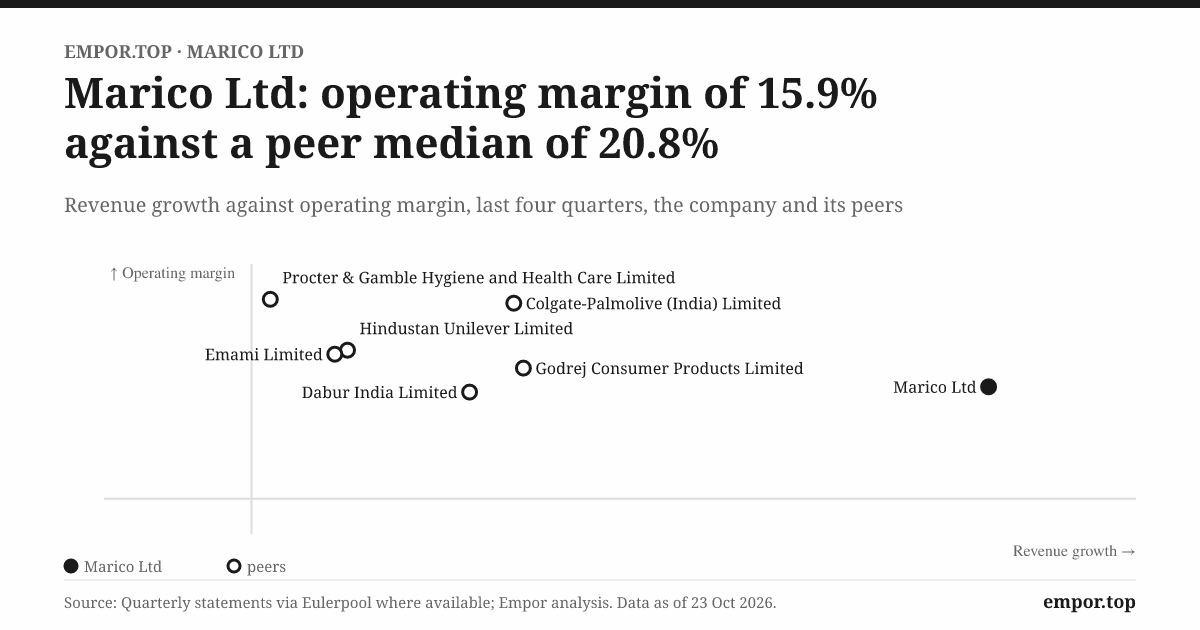
CRISIL reported that Marico's operating margin fell to 17.1% in FY26 from 19.7% the year before, because of elevated copra and vegetable-oil costs and because the company kept spending on brands and distribution.8
Here is the mechanism in plain terms. Imagine a bottle that costs ₹56 in materials and sells for ₹100. If copra pushes the material cost to ₹70, Marico can either raise the price, risking that some shoppers buy less or switch, or absorb the hit and watch margin shrink.
In FY26 it did a bit of both. It raised prices enough that revenue surged, but not enough to fully protect the margin. That is why price did most of the work in FY26 revenue growth.3
The way Marico buys its inputs also shifted during the year. Purchases through trading houses rose to about 15% of total purchases in FY26, from under 9% a year earlier, and the ten largest trading houses accounted for about 44% of that channel, up from about 36%.2
Marico does not explain the change, and it does not disclose how concentrated its overall supplier base is. The practical point is that in a year of scarce, expensive copra, more of the company's sourcing ran through intermediaries, which can help secure supply but also adds a layer between Marico and the farm gate.
The quarterly results tell the same story with more drama. Operating margin, on the measure used in the company's statements, slid through FY26 and bottomed in the March 2026 quarter at under 14%, before rebounding above 19% in the June 2026 quarter as costs eased and earlier price increases held.212 That rebound is welcome, but it also shows how much of Marico's profit in any given year depends on the timing of commodity cycles.
If margins are the volatile part of the story, cash is the reassuring part. Over the twelve years from FY15 to FY26, Marico reported cumulative net profit of about ₹13,600 crore and generated about ₹14,300 crore of cash from operations.2
In other words, operating cash exceeded profit by roughly ₹670 crore, or about 105% of earnings. For a business that has to fund inventory and extend credit to distributors, converting more than all of its profit into cash over a long stretch is a mark of quality.
What did Marico do with the cash? After capital spending, free cash flow over those twelve years came to roughly ₹12,460 crore. About ₹9,050 crore of it, nearly three-quarters, went out as dividends. The rest helped grow the cash and short-term investment pile from about ₹670 crore at the end of FY14 to roughly ₹2,440 crore at the end of FY26.2 This has been a company that paid shareholders generously and still built a buffer.
But the long-run average hides a lumpy year-to-year pattern. In FY26, operating cash flow was about ₹2,084 crore, helped by a working-capital inflow of about ₹253 crore.2 In FY25, the opposite happened: working capital absorbed about ₹293 crore and operating cash flow was only about ₹1,363 crore.2 Swings of that size mean a single strong year should not be treated as a new normal, and FY26's working-capital release should not be assumed to repeat.
Receivables are where the working-capital story gets interesting. At the end of March 2026, Marico was owed about ₹1,304 crore by its trade customers, after setting aside a ₹30 crore allowance for bad debts.2 Of the gross amount, about ₹693 crore was not yet due. About ₹510 crore was overdue by less than six months. And a small tail, about ₹26 crore, had been outstanding for more than three years.2
Who is paying late? The honest answer is that Marico does not name anyone. The ageing schedule includes about ₹11 crore of disputed balances with significant credit risk and about ₹12 crore of disputed, credit-impaired receivables, but the company does not identify a customer with unusual overdue terms.2
Given Marico's fragmented customer base, there is no reason to imply that a single large account is behind the overdue balances. The more plausible reading is a broad base of trade partners paying on varying schedules, with a small pocket of genuine disputes.
The longer trend is worth watching. Marico used to collect its money astonishingly fast: in FY15, debtors amounted to about 12 days of revenue. That rose steadily to a peak of about 45 days in FY24, before improving to about 35 days in FY26.2 Marico does not break the rise down by channel.
A plausible part of it is the shift toward modern trade and e-commerce, which across the industry tend to pay more slowly than traditional distributors, but that is an inference rather than a disclosure. The improvement from the peak is encouraging, but a business that once collected in under two weeks now waits about five, and that is a structural change in how much cash it must tie up.
On the other side of the balance sheet, Marico looks nearly debt-free, but it is worth reading closely. Reported borrowings were about ₹355 crore at the end of FY26, all short-term and variable-rate.2 Lease liabilities, mostly for offices and warehouses, were another ₹202 crore. And then there were acceptances, short-term obligations to pay suppliers through bank instruments, which jumped to about ₹405 crore from about ₹57 crore a year earlier.2
CRISIL treats those acceptances as short-term debt in its analysis, which is why its adjusted gearing of 0.39 times is higher than the headline borrowing figure suggests.8 None of this is alarming for an AAA-rated company with ample cash, but it does show that reported borrowings alone understate Marico's short-term funding.
The credit view supports that calm reading. On 2 September 2026, CRISIL reaffirmed Marico's AAA/Stable long-term rating and its A1+ short-term rating, while raising the bank facilities it rates to about ₹1,087 crore from about ₹657 crore.8 The agency pointed to interest coverage of about 45 times and average use of working-capital bank limits of only about 28%, and it described no refinancing pressure.8
It also named the two constraints any reader of this story would expect: intense competition in consumer goods and exposure to commodity prices.8 The larger bank lines are a sign of a bigger, more complex group, not of distress, but they are worth tracking alongside the acceptances.
There is also money in the income statement that does not come from selling hair oil. Other income was about ₹204 crore in FY26, roughly 9% of profit before tax, and about ₹147 crore of it came from gains on investments held at fair value, plus a ₹26 crore foreign-exchange gain.2
That treasury income is a natural result of holding a large cash pile, but it is also a reminder that a slice of earnings depends on bond markets and currency movements rather than on consumers.
So the cash story leaves an investor with a clear tension. Marico's core generates more cash than profit over long periods, and that cash has paid for dividends and for growth. But margins are hostage to copra, cash conversion moves around from year to year, and the most recent year benefited from a working-capital release that may not recur.
The new growth strategy will need to show it can earn returns without relying on favourable working capital or simply passing through higher prices. That is precisely the bet management has been making with the newer brands.
V. The Growth Bet Moves Beyond Parachute
Every few quarters, Marico's management stands before analysts and describes its newer brands as platforms: bases on which bigger businesses will be built. The subsidiary accounts that accompany the FY26 annual report tell a more varied story. Some of those platforms are standing firm. Others are still sinking money.
The push beyond oil did not begin with acquisitions. It began, as Marico's best moves often do, with an existing brand. Saffola had spent decades telling Indians that its cooking oil was good for the heart.
Oats, eaten for breakfast and marketed as heart-healthy, were a natural extension, and Saffola Oats and later Saffola Masala Oats, which adapted a Western breakfast food to Indian savoury tastes, gave Marico a foothold in packaged foods.9 By 2025, Saffola had a leading position in oats, on the company's own figures.11
That deserves its own weight because it is a different kind of growth from what came later. Saffola Foods was built in-house, with an existing brand name, existing distribution and existing consumer trust. It is a strategic extension of the core, not a bolt-on.
And it is distinct from the legacy edible-oil business: oats, honey, soya chunks and similar products carry different margins and different competitive dynamics from refined cooking oil. Foods remained a minority of India revenue.9
The acquired portfolio is a different animal. Starting with an investment in Beardo, a men's grooming brand born online, Marico began buying stakes in digital-first brands that had found an audience through Instagram, marketplaces and their own websites.
Over the following years it added Just Herbs, an Ayurvedic beauty brand, True Elements, a healthy-foods brand, and Plix, a plant-based nutrition and wellness brand.9 Late in FY26 came two more: 4700BC, a gourmet popcorn and snacks brand, and Cosmix, a wellness and supplements brand.28
The timing of those last two matters. Because 4700BC and Cosmix arrived late in FY26, their full-year results in the subsidiary accounts are mostly from before Marico owned them. They are evidence about the businesses Marico bought, not about how well Marico has run them.
Taken together, the acquired brands covered in the FY26 subsidiary accounts generated about ₹1,552 crore of revenue.13 That is a real number, roughly a ninth of group revenue. But revenue is not the same thing as profit, and the brands diverged sharply. Beardo reported about ₹299 crore of revenue and about ₹22 crore of profit.13
Plix's revenue and profit both rose sharply.13 True Elements, on the other hand, reported a loss of about ₹43 crore, wider than the year before, and 4700BC lost about ₹24 crore, also a wider loss.13 Cosmix entered with a positive reported profit, though that was earned before Marico bought its stake.13
The organic side of the growth machine is modest by comparison. Marico spent about ₹50 crore on research and development in FY26, roughly 0.37% of revenue, most of it expensed.2 Capital spending roughly doubled to about ₹319 crore, or about 2.3% of revenue, from about ₹161 crore the year before.2 The company launched 25 new products in India and 17 abroad, with a workforce of about 1,944 people.2
Those figures describe a business that innovates mainly through marketing, packaging and formulation tweaks, not deep laboratory science, and that increasingly buys its new categories rather than inventing them. That is a legitimate strategy for a consumer company. It also means the acquisition record carries more of the weight of the growth story than it would at a company with a bigger in-house pipeline.
It is worth separating two different ways of measuring this portfolio. Management likes to talk about annualised revenue run rate, which takes the most recent month or quarter and multiplies it up to a full year. On that basis, management said its digital-first brands, led by Beardo, Just Herbs and Plix, had crossed ₹1,100 crore in FY26.1
A run rate is a snapshot of momentum. The ₹1,552 crore figure is something else: recognised revenue across a broader set of acquired businesses, including the food brands. Neither number tells you how much money these businesses earned for Marico's shareholders.
The best way to test management's "profitable growth" claim is to go back to what it promised. In the FY25 annual report, management described Beardo and Plix as EBITDA-profitable, while Just Herbs and True Elements were not yet at breakeven and were given an 18–24 month path to get there.9
One year into that window, the FY26 results showed Beardo profitable and Plix growing, as advertised. But True Elements' loss had widened, not narrowed.13 The 18–24 month clock has not yet run out, so the promise is not broken. It is, however, moving the wrong way for at least one of the brands it covered.
What about the prices Marico paid? This is where the public record gets thin. Marico disclosed purchase considerations for individual deals, and some revenue and profit figures for the acquired companies, but there is no consistent set of valuation multiples across its deals and comparable transactions by peers. Without that, it is impossible to say with confidence whether Marico overpaid or got a bargain, and any such claim would be guesswork dressed up as analysis.
The earnings calls offer a better window into whether the acquisition playbook is maturing. On the Q4FY26 call in May 2026, analysts pressed management on how involved Marico would be in running the newest acquisitions and how it would balance growth against profitability.1
Management described a platform approach, in which acquired brands plug into Marico's sourcing, distribution and back-end, and said profitable growth mattered more than growth at any cost.1 That is the right thing to say. Whether it becomes the right thing to do will show up in the subsidiary numbers, not in the transcript.
There is a historical footnote worth recalling here. Marico has diversified before. Kaya, a chain of skin-care clinics that Marico incubated in the early 2000s, was demerged and separately listed in 2013.2
Kaya is not part of Marico's current economics, and its history is not evidence that today's portfolio will fail. But it is a reminder that a consumer company's ability to build a brand on a shelf does not automatically transfer to a different kind of business, and that sometimes the best decision is to let a venture go.
So the verdict on the new portfolio is mixed. There is real evidence of scale and improving profitability in parts of it, especially Beardo and Plix. There is also evidence of continuing losses in others, and a breakeven promise that has not yet been kept. Revenue growth alone does not establish that these businesses are earning attractive returns.
The proof point that would settle the question, category-level profit and return on invested capital disclosed consistently over time, is something Marico does not yet publish. Until it does, investors are being asked to trust the platform story on partial evidence.
That same tension between a proven core and a hopeful extension plays out in another part of the business, one that began not with a digital brand but with a short trip across the border into Bangladesh.
VI. From Bangladesh to Vietnam: Exporting the Brand, Localizing the Product
When Marico took Parachute into Bangladesh, it did not invent a new playbook. It used the old one. The same blue bottle, the same argument about sealed purity over loose oil, the same patient work with shopkeepers.
Mariwala later said the company repeated its approach there and, within a decade, held more than 80% of that market.7 For a company that had only recently split from a family trading house, that was a remarkable early proof that its formula could travel.
Bangladesh became, and remains, the anchor of Marico's international business. That is both a strength and a vulnerability. A dominant position in one large neighbouring market produces steady cash, but it also concentrates risk in a single economy, a single currency and a single political system. For years, the question about Marico's international arm was less "how fast is it growing?" and more "how much of it is just Bangladesh?"
The answer has been changing, slowly. Over time Marico moved beyond South Asia, often by buying local brands rather than exporting Indian ones. In Vietnam, it built a men's grooming business around X-Men, a local brand it acquired.
In the Middle East and North Africa, and in South Africa, it added local hair-care and personal-care brands to supplement the products it exported from India.2 The pattern is instructive: Marico learned that a brand trusted in Kerala is not automatically trusted in Ho Chi Minh City, and that buying a brand someone already trusts can be faster than teaching them to trust yours.
The trade-off is the same one the Indian business now faces with its digital brands. Buying a local brand gets you a customer base and a name on day one, but you pay for that trust up front, and you inherit a business whose culture, suppliers and channels you did not build.
Exporting your own brand is cheaper to start and slower to scale. Marico's international history is effectively a long-running experiment in both approaches, and its result so far is that the two can coexist, provided the parent is willing to let local managers run local brands.
Even where Marico did export its own brands, it learned to listen first. In the Middle East, consumers wanted a hair product that felt less sticky than the heavy oils popular in India, and a different scent.2 The answer was not a translated advertising campaign but a reformulated product.
It is a small story, but it captures a real capability: the willingness to change the product, not just the packaging, to fit how people in a particular place actually live. Still, a good adaptation story is not a permanent guarantee. What matters is whether those adapted products keep growing and keep earning margin, year after year.
The recent numbers are encouraging. International revenue grew about 20% in constant currency in FY26.3 More importantly for the concentration question, markets outside Bangladesh rose from about half of international revenue in FY20 to about 55% in FY26.1 Management expects the non-Bangladesh share to reach roughly 65% by FY30.1 If that happens, the international business will be meaningfully more diversified. If it does not, Bangladesh will remain the single biggest swing factor in the segment.
Currency is the other complication. A multinational consumer company earns in many currencies and reports in one. Marico's exposures span the US dollar, the Bangladeshi taka, the UAE dirham, the Egyptian pound, the Vietnamese dong and the South African rand.2
Export receivables, imported raw materials, balances between subsidiaries and some borrowings all create exposure. Marico's policy allows only plain-vanilla hedges, forwards and options, and in FY26 it booked a net foreign-exchange gain of about ₹26 crore, up from about ₹6 crore the year before.2
How big is the currency risk? The company's own sensitivity analysis says a 6% move in the rupee against the dollar would change FY26 profit after tax by about ₹9 crore, in either direction.2 That sounds small, and against group profit of more than ₹1,800 crore it is. But the figure only captures the direct effect on dollar-denominated balances.
It does not capture what happens when, say, the Egyptian pound or the Bangladeshi taka weakens sharply, shrinking the rupee value of an entire subsidiary's sales and profits, or when local inflation forces price increases that slow demand. Those translation and operating effects can matter much more than the hedged balances.
Bangladesh shows why. When a large share of the segment's profit is earned in taka, a sustained fall in the taka against the rupee cuts that profit when it is translated into Marico's reporting currency, even if Bangladeshi shoppers keep buying exactly as before.
And a weaker local currency usually raises the cost of imported materials there, forcing price increases that test demand. No hedge book of forwards and options fully neutralises that kind of exposure; only diversification across markets does, which is why the non-Bangladesh share matters so much.
So the international business has demonstrated something real: local adaptation, the ability to buy and grow local brands, and strong recent growth. The early quarters of FY27 continued the trend, with international constant-currency growth of about 15% in the June 2026 quarter.12
But Bangladesh remains material, currency and local-market risks have not gone away, and one or two strong years are not the same as a durable second leg. The evidence to watch is sustained growth and margins across several markets at once.
Behind all of these choices, which markets to enter, which brands to buy, how much to spend, sits one person more than any other. For more than a decade, Marico's capital has been allocated by a professional chief executive working for a founding family, and his record is the next thing to examine.
VII. Saugata Gupta's Portfolio: Targets, Incentives and Trust
On a May evening in 2026, as Marico reported its full-year results, the analysts on the call had a pointed set of questions. How involved would Marico be in running the brands it had just bought? How would it balance growth with profitability as the portfolio got more complicated?1 Underneath the polite phrasing was a sharper question: should a company with a dominant coconut-oil franchise trust its managers to keep buying new businesses?
The man answering was Saugata Gupta, who has run Marico as managing director and chief executive since 2014.2 An engineer and management graduate by training, Gupta came to Marico from the marketing side of consumer goods and rose through its India business before taking the top job.2
Harsh Mariwala, the founder, remains chairman.2 It is a clean division of roles that the company has maintained for over a decade, and CRISIL notes a split chair and CEO structure and a board on which independent directors make up about 58%.8
Gupta's era has a distinct character. Under Mariwala, the defining moves were about turning commodities into brands and separating from the family firm. Under Gupta, the defining moves have been about diversification: pushing Saffola into foods, building premium personal care, buying digital-first brands and setting the Vision 2030 target. He is, in effect, the portfolio builder. That makes his credibility the right lens for judging whether the portfolio deserves more capital.
Start with ownership, because it is easy to get wrong. The promoter family owns about 59% of Marico.[^7] That is the family's stake, not Gupta's. As a professional manager, his alignment with shareholders comes primarily through stock options and his own direct shareholding, which is a personal holding disclosed separately and is far smaller than the family's. Family control gives Marico continuity and a long-term owner. It also means the family, not outside shareholders, ultimately decides whether management's acquisition strategy continues.
The pay numbers need careful reading. Gupta's reported remuneration for FY26 was about ₹47.25 crore.2 That headline figure, though, includes about ₹28.48 crore of perquisites from exercising stock options, a value that reflects share-price gains on options granted in earlier years. Excluding those exercises, his remuneration was about ₹18.77 crore.2
A separate figure, ₹65 crore of compensation across all key managerial personnel in the consolidated accounts, covers several executives and is not comparable with the CEO's individual pay.2 The structure, with a large share of pay linked to equity, aligns the CEO's fortunes with the share price. It also means that high pay in good years is partly a reward for past performance, and the figures alone do not settle whether the level is fair.
Shareholders have largely backed him. At the 2025 annual general meeting, about 98.85% of votes cast supported Gupta's reappointment as managing director and chief executive, for a term running from April 2026 to March 2028.142
About 1.15% voted against, but the opposition was more concentrated among public institutions, where about 3.23% of votes in that category opposed.14 That is a small number, but it signals that a minority of professional investors had reservations, most likely about pay or tenure, that the overall result conceals.
The fairest test of management is promises against outcomes. In FY25, management described a path to breakeven within 18 to 24 months for True Elements and Just Herbs.9 By FY26, True Elements remained loss-making, with a wider loss than before.13 Meanwhile Beardo and Plix delivered profit and growth.
The portfolio, in other words, diverged: some bets paid off, others did not, at least not yet. Management deserves credit for the winners and for setting a measurable target in the first place. It also owes investors a clear account of what happens if the losers miss.
The calls show how the story has evolved. On the Q4FY26 call, management focused on the new acquisitions and on profitability as a priority alongside growth.1 By the Q1FY27 call in August 2026, the emphasis had shifted to stronger volume growth, recovering margins and an FY27 outlook of more than ₹15,000 crore of revenue.15
The narrative has been consistent in its broad direction. What it has not yet included is the disclosure that would let outsiders verify the platform claims: profit and return on capital for each acquired brand, over time.
That gap is where an activist-minded investor would push. Marico has a large cash pile, almost no long-term debt and a controlling family. It can afford to keep funding new brands for a long time. So what return should an acquisition have to earn?
And at what point should management stop funding a brand that keeps missing its targets? A company with fewer resources would be forced to answer those questions by its bankers. Marico is not, which is why the discipline has to come from management and the board.
A few smaller items round out the governance picture. The group was contesting income-tax demands of about ₹324 crore at the end of FY26, down slightly from about ₹336 crore, mostly over deductions and incentives; management says it has provided where needed and does not expect a material adverse outcome.2
The auditor's opinion on the consolidated accounts was unmodified, but its report flagged cash losses at two subsidiaries, Zea Maize, the company behind 4700BC, and HW Wellness, the company behind True Elements.2 Those flags are bounded, but they line up neatly with the brands whose losses widened.
Related-party dealings are small where they touch operations. At the listed-company level, sales to related parties were about 2.7% of sales in FY26 and purchases from them under 0.1% of purchases, and the company describes these transactions as ordinary-course and at arm's length.2 Most of those parties are Marico's own subsidiaries, which is why related-party loans and advances made up about 97% of the parent's total loans and advances.2
The family-linked entities named include Kaya, which paid Marico about ₹1 crore of lease rent, and the Mariwala family's foundations; Marico does not disclose any royalty or brand fee flowing to the promoter group.2 For a family-controlled company, that is a clean pattern, and the main item to watch is the size and recipients of loans to subsidiaries as the acquired brands absorb funding.
There is one more detail worth noting. The promoters' pledged shares rose to about 2.03% of their holding at March and June 2026, up from about 0.13% through FY25.4 The amount is small relative to the family's stake, but it is a change in behaviour, and pledges are something investors usually prefer to see shrink rather than grow. Meanwhile, the share count continues to edge up through employee stock options, including a June 2026 allotment of 54,734 shares.16
The dilution is trivial, with paid-up shares rising from about 129.55 crore to about 129.81 crore during FY26, and there was no public offer or preferential issue.2 Institutional ownership has rotated more noticeably. Foreign investors cut their stake from about 25.6% in March 2024 to about 22.1% a year later, then rebuilt it to about 24.1% by March 2026, while domestic institutions moved in the opposite direction.4
Among the largest non-promoter holders at March 2026 were HDFC Mutual Fund, Norway's Government Pension Fund Global and LIC, each holding between about 1% and 2.5%.2 The register of shareholders grew to about 2.94 lakh by June 2026.4 The company offers no explanation for these moves, but together they describe a stock that big institutions trade around rather than one they are abandoning.
The credibility test for Gupta's portfolio is therefore not about whether he is a good manager in general. The record of continuity, solid shareholder support and a strong core says he has been. The test is narrower: will management report acquired-brand profitability, margin recovery and return on capital clearly enough for investors to compare promises with outcomes? That question leads straight into the bigger one: what is the market paying for, and is it right?
VIII. Analysis & Bear vs. Bull Case
Imagine a long-term shareholder looking at Marico in October 2026. On one side of the ledger: a dominant coconut-oil brand, revenue growth of 26% in the last fiscal year, a strong cash record and an AAA credit rating.
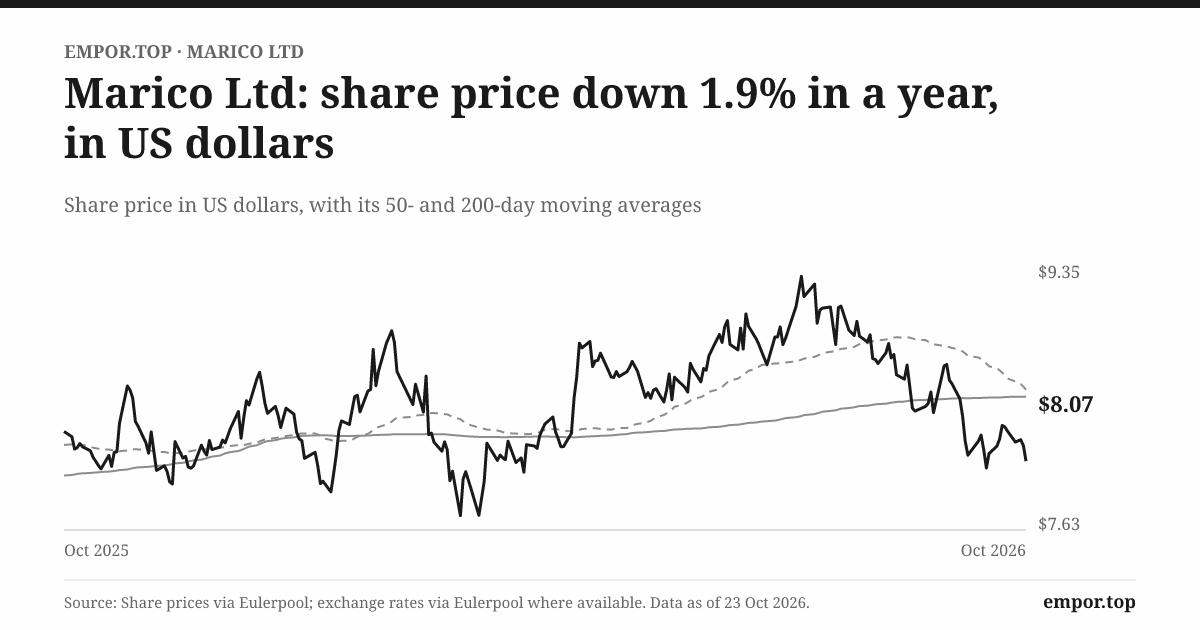
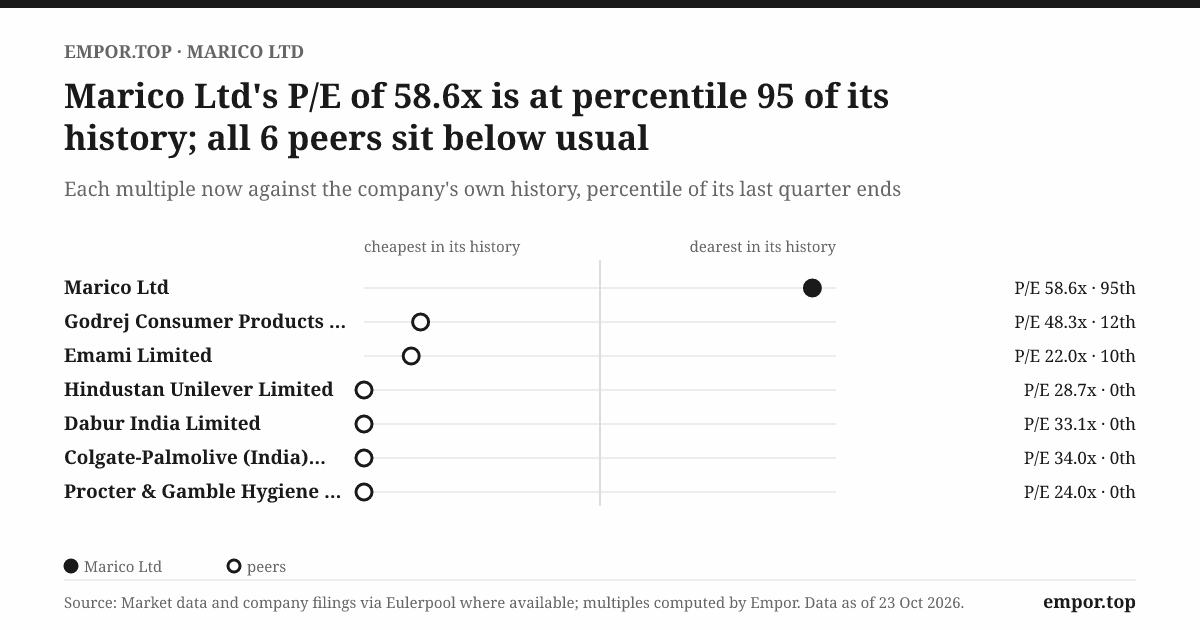
On the other side: a share price that values the company at about 58.6 times trailing earnings, above its own five-year median of about 53 times.4 The question that shareholder has to answer is not whether Marico is a good company. It is whether it is good enough to justify that price.
Turn the multiple upside down and it becomes easier to feel. At about 58.6 times earnings, a shareholder's slice of Marico's profit amounts to an earnings yield of about 1.7%. The dividend yield is about 0.5%, and free cash flow relative to the market value is about 1.2%.4
Those are thin returns for a buyer today, which means the price only makes sense if Marico's profit grows strongly for many years. The shares closed on 23 October 2026 at about ₹766, roughly 13.5% below their 52-week high, so the market has tempered some of its enthusiasm, but not by much.4
Start with the case for winning. Marico's core franchises have real, measurable positions: leadership in coconut oil, a commanding volume share in bottled Parachute and leadership in oats, built over decades and defended through repeated commodity cycles.
It reaches about 5.8 million retail outlets, which gives it a distribution platform that any new brand it buys can plug into.2 It has sourcing expertise in copra and vegetable oils that a digital-first startup cannot match. And it has a long history of turning profit into cash, with operating cash flow exceeding cumulative net profit across FY15–FY26.2
Now the case against. The core faces a permanent competitor in unbranded oil, which wins whenever Marico raises prices too far. Oils expose margins to commodity prices that Marico does not control, as FY26 showed. The acquired brands have a mixed profit record, with some profitable and others still losing money. International growth brings currency and local-market risks, and Bangladesh remains a large single exposure. None of these risks is new, but at a premium valuation each matters more.
The competitive landscape is crowded. Hindustan Unilever, Godrej Consumer Products and Dabur all compete with Marico in overlapping categories, and all are larger or have broader portfolios. On a peer screen using March 2026 financial years, Hindustan Unilever traded at about 28.8 times earnings, Godrej Consumer at about 46 times and Dabur at about 33.7 times, against about 50.8 times for Marico on that same screen.17
These are snapshots, not like-for-like forecasts, and the companies differ in growth, mix and margin. But the comparison makes one thing plain: the market is paying more for each rupee of Marico's profit than for its larger rivals.
What kind of moat justifies that premium? Run Hamilton Helmer's seven powers over the evidence. Branding is the clearest power: Parachute and Saffola carry trust that lets Marico charge more than loose oil and keep shoppers coming back, though the unbranded share of coconut oil and the lower share in hair oils show the limits. Scale economies exist in distribution and sourcing; Marico's network and purchasing volume give it cost advantages a startup lacks, but Hindustan Unilever's scale is larger still.
Counter-positioning, the advantage of a business model rivals cannot copy without hurting themselves, is weak; nothing stops bigger rivals from buying digital brands too. Switching costs for consumers are low, and network effects are absent.
Process power, the hard-won know-how of sourcing copra and running a brand-heavy supply chain, is real but hard to measure. Cornered resources, like exclusive access to an input, do not apply. On balance, Marico has one strong power, branding, in a few categories, and supporting advantages in scale and process.
Porter's five forces complete the picture. Buyer power is low at the individual level, because the trade is fragmented and no customer exceeds 10% of revenue, but consumers can switch freely, which caps pricing. Supplier power is high in bad years, since copra and vegetable oils make up most of the cost base and cannot be substituted.
The threat of new entrants is high for launches, since digital brands can start cheaply, but low for profitable scale. Substitutes, from loose oil to new hair-care formats, are always present. And rivalry among the large incumbents is intense. That is not an industry where a single company can raise prices at will. It is one where trusted brands, good distribution and cost control produce good but not unlimited returns.
The cash advantage is real but bounded. Operating cash has exceeded profit over twelve years, but year-to-year conversion has varied widely, from under half of EBITDA in some years to more than all of it in others. In FY26, cash from operations was about 82% of EBITDA.2 And dividends absorbed roughly three-quarters of cumulative free cash flow, which means the cash available for acquisitions is not unlimited unless the payout ratio falls.
Return ratios deserve similar caution. Marico reports a return on equity above 40% and a return on invested capital that looks even higher on some measures.2 Those numbers are flattered by the large cash pile, which reduces invested capital, and by a capital-light model in which much of the value sits in brands that never appear on the balance sheet. As acquisitions add goodwill and intangible assets, these ratios will be tested. High returns are a clue to economic quality, not standalone proof of it.
The bear case, told as a chain of causes, runs like this. Copra and edible-oil prices rise again, squeezing margins. Marico raises prices to protect profit, and volumes slow as shoppers trade down to unbranded oil. The new brands keep growing revenue but fail to earn adequate returns, and losses at the weaker ones persist. Because the shares trade at a premium multiple, even a modest disappointment in growth or margin produces a large fall in the share price.
The bull case runs the other way. Household trust and distribution allow Marico to keep raising penetration in rural and smaller-town India. Foods and premium personal care broaden the profit pool, reducing dependence on oil. International markets outside Bangladesh grow fast enough to diversify the segment. And margins recover as commodity costs normalise, while volume growth stays high.
Three numbers will tell investors which story is playing out. The first is India underlying volume growth, which was about 8% in FY26 and stronger in the June 2026 quarter; it shows whether demand is real or price-driven.312
The second is consolidated operating margin, which fell to about 17.1% in FY26 on CRISIL's measure; it shows whether Marico can absorb commodity swings and still invest.8 The third is acquired and digital portfolio revenue alongside operating profit, with about ₹1,552 crore of revenue in FY26 from the acquired brands; it shows whether the new bets are becoming businesses or remaining costs.13
At about 58.6 times earnings, the market is not paying for a stable, dividend-paying core. It is paying for continued execution: sustained volume growth, recovered margins and profitable diversification. Those outcomes are plausible, given the evidence. They are not guaranteed by brand leadership alone, and the gap between plausible and guaranteed is exactly where the risk in the valuation sits.
IX. Playbook: Business & Investing Lessons
Two moments, decades apart, bracket Marico's story. In the first, a team of managers watches rats sniff at a round plastic bottle and fail to bite through it. In the second, a team of managers signs the papers to buy a digital-first brand that was born on Instagram. The first decision built the company. The second is still being tested.
The first lesson is to make trust tangible. The sealed blue bottle made purity something a shopper could hold in their hand and carry home.
The wider lesson for founders is that in markets where quality is hard to judge, the brand that makes quality visible wins.
The second lesson is to listen before exporting. Marico adapted its hair oils for Middle Eastern consumers and bought local brands like X-Men in Vietnam when its own did not fit. Exporting a brand is easy. Exporting the reason people trust it requires starting from their habits, not yours.
The third lesson is that a brand is a promise paid for repeatedly. Parachute's leadership has to be re-earned when higher prices give shoppers a reason to turn to unbranded oil. A brand is not an asset you build once and then own. It is a subscription the consumer can cancel at any shelf, on any day.
The fourth lesson is that cash is a strategy. Marico's cash generation funded generous returns to shareholders and still left room to invest.
Every new acquisition competes for cash that could otherwise go to dividends or remain in the bank. A company with a cash machine has more choices, which makes the quality of those choices more important.
The fifth lesson is the one that is not yet proven: a platform is not a payoff. Some acquired brands are delivering; others are not yet. The acquisition era is still being tested.
Put those five lessons side by side and a single thread runs through them. Marico has been at its best when it made something hard to judge easy to trust, and when it let the evidence of the shelf, rather than the ambition of the boardroom, decide what to do next.
The rats in the cage were a test designed to fail if the idea was wrong. The question for the acquisition era is whether Marico is still running tests like that, ones that could prove it wrong, or only telling stories that prove it right.
X. Epilogue
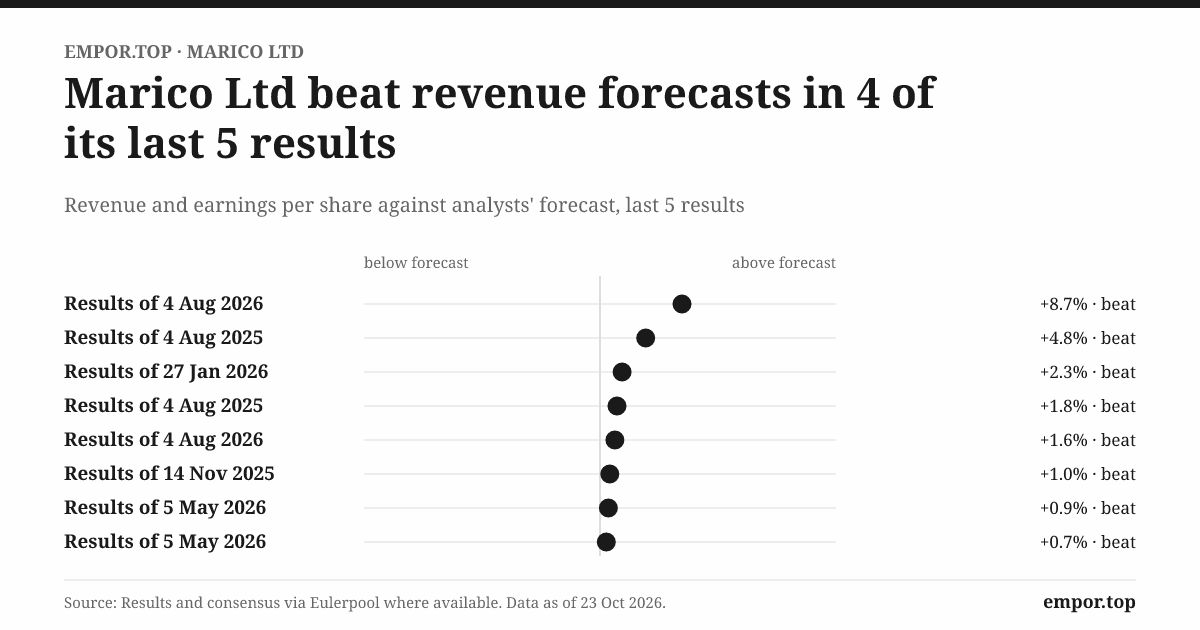
On 4 August 2026, Marico reported results for the quarter to June, and the numbers looked like a company hitting its stride. Revenue grew about 23%. India volumes rose about 11%, faster than the year before. International grew about 15% in constant currency.
And EBITDA margin recovered to about 20.7%, well above the troughs of the previous year.12 Management guided to more than ₹15,000 crore of revenue in FY27, a step on the road to the ₹20,000 crore Vision 2030 target.15
That quarter answered some questions and left others open. It showed that volume growth could accelerate even as price increases began to roll off, which is the strongest evidence yet that FY26's surge was not purely about price.
It showed that margins could recover once copra costs eased. But one strong quarter does not settle whether the recent growth is the new base. The next results, for the quarter to September 2026, are scheduled for 2 November 2026, and they will add another data point.18
There was a quieter tailwind in that quarter, too. Net profit rose about 25%, helped by a lower effective tax rate of about 17.5%, compared with about 22% a year earlier.12 Lower tax is welcome, but it is not something a brand can repeat on demand, which is why operating margin and volume, rather than net profit growth, are the cleaner signals to follow.
Four things will decide the next chapter. First, whether growth stays volume-led as FY26's pricing effects fade. If India volumes hold near double digits, the bull case strengthens; if they slip back toward low single digits, the 26% year will look like an outlier.
Second, whether margins keep recovering while Marico continues spending on brands, distribution and new categories. A company that can grow and expand margin at the same time is rare, and Marico would have to prove it can do both.
Third, whether management discloses the profitability of the acquired businesses clearly, including the loss-making brands and the newest additions. Investors have been asked to accept the platform story on partial evidence, and the next annual report is the natural place to provide more. Fourth, whether international growth outside Bangladesh continues, with stable currencies and solid local operations. The goal of 65% non-Bangladesh revenue by FY30 is specific enough to track.
Consider what the 2 November results could reveal. A quarter with double-digit India volume growth and margins holding near the June level would suggest that the business has turned a corner, from price-led to volume-led growth, and that the FY27 guidance is within reach.
A quarter where volumes slow and margins slip would suggest that the June quarter benefited from timing, with price increases still in the base and copra costs only briefly favourable. Neither outcome would settle the long-term question on its own. But at a valuation that leaves little room for disappointment, each quarter carries more weight than it would for a company priced as a steady compounder.
Each of these outcomes maps onto one of the central questions. Volume growth answers whether the core is durable. Acquired-brand profit answers whether the new bets deserve their capital. Margins and international mix answer whether the growth is real or borrowed. And all of them together answer the valuation question, because at nearly sixty times earnings, the market has already priced in a good outcome on most of them.
The tension that remains is the one that has run through Marico's whole history. The core has given Marico the cash and the reach to change. The next chapter depends on what that capital earns.
XI. Outro
Go back to that row of blue bottles behind the shop counter. Once, that bottle was a clever answer to a practical problem: how to sell coconut oil in plastic without the rats getting in. It turned a commodity into a brand that millions of families buy without thinking twice.
Today it anchors a company that is trying to make the same trust travel, into breakfast oats and grooming kits, gourmet popcorn and wellness supplements, from Mumbai to Dhaka to Ho Chi Minh City.
Marico's advantage was never the oil. It was the ability to turn consumer trust into repeat purchases. Whether that advantage extends to the brands it has bought is a question of profit, not promise. Marico's next chapter depends on whether the brands it buys can earn the same trust, and the same repeat purchase, as the one it built.
References
-
Q4FY26 Earnings Call Transcript — Marico Limited, 2026-05-05 ↩↩↩↩↩↩↩↩
-
Integrated Annual Report FY2025–26 — Marico Limited, 2026-05-05 ↩↩↩↩↩↩↩↩↩↩↩↩↩↩↩↩↩↩↩↩↩↩↩↩↩↩↩↩↩↩↩↩↩↩↩↩↩↩↩↩↩↩↩↩↩↩↩↩↩↩↩↩↩
-
Marico Limited – Q4FY26 Results — Marico Limited, 2026-05-05 ↩↩↩↩↩↩
-
Marico Ltd consolidated financials, valuation and shareholding history — Screener ↩↩↩↩↩↩↩↩
-
How CEO Harsh Mariwala is changing the face of the family business — YPO, 2021-06-10 ↩↩↩↩↩↩↩↩↩↩↩↩
-
Rats to success – the Parachute story — Packaging South Asia, 2024-03-11 ↩↩↩↩↩
-
Marico's Harsh Mariwala gets Lifetime Achievement Award at 6th Injection, Blow, Roto & PET Plastic International Summit 2018 — Packaging South Asia, 2018-07-10 ↩↩↩↩↩
-
Marico Limited Rating Rationale — CRISIL Ratings, 2026-09-02 ↩↩↩↩↩↩↩↩↩↩
-
Marico Limited – Q1FY27 Results — Marico Limited, 2026-08-04 ↩↩↩↩↩
-
Marico's Acquired Brands Generate ₹1,552 Crore in FY26 — Marico Limited ↩↩↩↩↩↩↩↩
-
Voting Results and Scrutinizer's Report, 37th AGM — Marico Limited, 2025-08-08 ↩↩
-
Q1FY27 Earnings Call Transcript — Marico Limited, 2026-08-04 ↩↩
-
Intimation of ESOP allotment — Marico Limited / NSE, 2026-06-09 ↩
 LinkedIn
 WhatsApp
 Reddit
 Hacker News
 Email
 Kindle
 RSS Feed
 Spotify
 Apple Podcasts
 Amazon Music
 Audible
 YouTube