Max Healthcare Institute: Building India's Healthcare Powerhouse
I. Introduction & The ₹88,000 Crore Turnaround
On August 21, 2020, a hospital company began trading in Mumbai without a roadshow, a price band, or a single retail investor being asked to subscribe. India was five months into a pandemic. Elective surgeries had collapsed, operating theatres sat dark, and the wards that were full were full of the least profitable kind of patient a private hospital can have: COVID admissions billed at government-capped rates. Into that silence, Max Healthcare Institute Limited listed its shares on the BSE and NSE under an Information Memorandum, the paperwork that follows a court-approved merger rather than an initial public offering.12
It was an odd way to be born. There was no IPO party because there had been no IPO. What the market received instead was the product of a three-way corporate transaction: a family conglomerate letting go of its hospitals, a South African hospital group cashing out, and an American private equity firm and a former restructuring banker taking the keys.
Six years later, that strange birth looks like the opening scene of one of the more instructive stories in Indian business. The private equity sponsor, KKR, is long gone, having sold its last shares in a single day in August 2022.[^3] The banker, Abhay Soi, is the sole promoter. And the company, as of October 7, 2026, carries an enterprise value of about ₹87,000 crore.3
The headline operating number is the one every hospital analyst in India knows by heart. In the quarter ended June 2026, Max earned about ₹81,900 for every occupied bed, every day.1 That figure, average revenue per occupied bed, or ARPOB, is the hospital industry's equivalent of revenue per available room in hotels, and Max's is the highest among listed Indian hospital chains. For context, a hospital charging ₹60,000 a day is considered premium in most of the country.
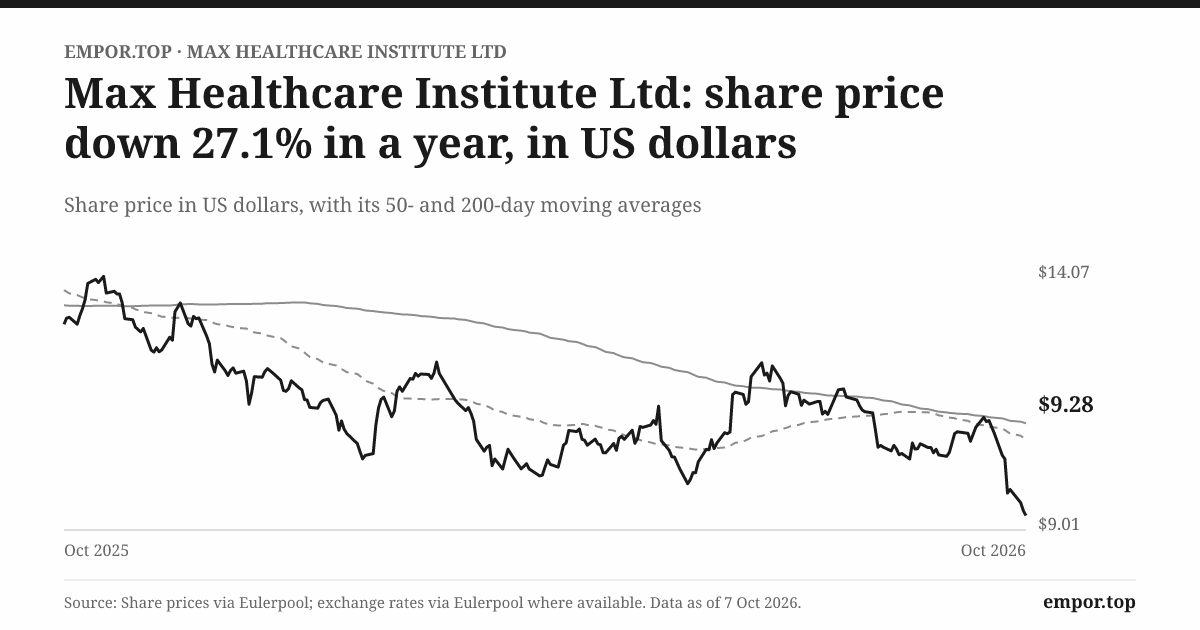
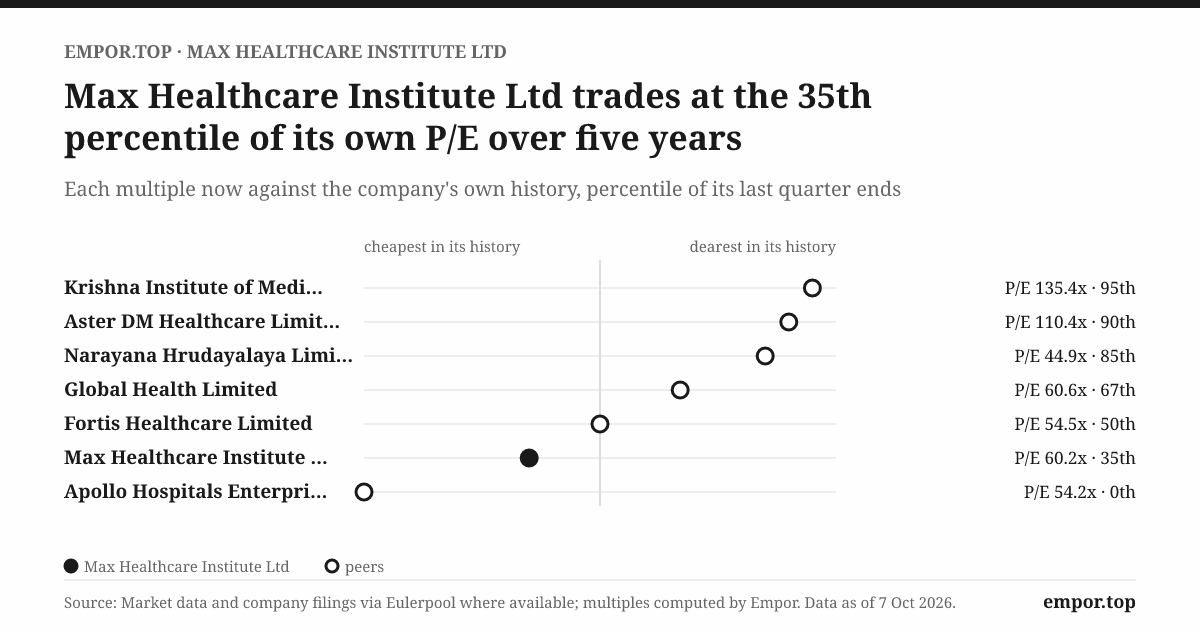
The market prices that efficiency richly. At about 60 times trailing earnings, the stock is far from cheap, though it is noticeably cheaper than its own five-year median of roughly 74 times.3 It trades at about ten times sales, a multiple more commonly attached to software than to buildings full of beds, nurses and MRI machines. The share price has fallen about a quarter from its 52-week high, which tells you the market has started asking harder questions.
There is one more number that matters before the story begins. Across the twelve fiscal years from FY2015 to FY2026, the cash this business generated from operations came to about 155% of its reported net profit.34 Hospitals are not supposed to look like that. They are capital sinks. The gap between accounting profit and cash is partly depreciation, partly a working-capital machine that collects from patients faster than it pays suppliers, and it is the quiet engine behind everything else in this story.
So what is Max Healthcare, really? It is not a founder-built miracle; the original founder spent two decades building assets that barely earned their keep. Nor is it a passive real estate play; the company does not own much of the land its flagship hospitals stand on. The better description is this: Max is the premier case study in Indian private equity operational restructuring, in which an operator and a financial sponsor took an underperforming portfolio, merged it into a cleaner listed vehicle, and then ran it like a machine optimised for one variable, the yield of a hospital bed.
The roadmap for this episode follows the money. First, the Analjit Singh era, when beds accumulated faster than margins. Second, the Radiant and KKR takeover, when a smaller operator swallowed a larger one through a demerger and reverse merger. Third, the operational machine that produced India's highest ARPOB. And finally, the growth paradox that hangs over the stock today: a capital plan of about ₹6,650 crore intended to roughly double the network toward 10,000 beds by FY2029.5 The question for investors is whether the machine that worked so well on Delhi's best hospitals can be stretched across Lucknow, Nagpur and the outskirts of Noida without breaking.
To understand why that question is hard, start where the beds first came from.
 Subscribe on LinkedIn
II. The Analjit Singh Era: The Burden of First-Generation Private Healthcare (2000–2017)
At the turn of the millennium, South Delhi's affluent families had a problem that money could not quite solve. The city's best government hospitals were overwhelmed, and the private alternatives were a patchwork of nursing homes and a handful of trust-run institutions. Max India, the holding company of industrialist Analjit Singh, decided to build a branded private hospital network, beginning with a medical centre in Panchsheel Park and then moving to Pitampura and, crucially, Saket.6
Analjit Singh was a classic first-generation Indian conglomerate builder of the liberalisation era. His group spanned life insurance through Max Life, packaging films, and healthcare. Healthcare fitted a powerful thesis: India's state spending on health was chronically low, Apollo Hospitals was already proving in the South that patients would pay for quality, and North India had no equivalent brand. The vision was right. The economics took much longer to arrive.
The structure that defined everything
The defining choice of this era was not a hospital but a contract. Prime metro land in Delhi was, and remains, nearly impossible to buy for hospital use at a price that earns a return. So Max built its flagships through partnerships with non-profit societies that held land, often allotted by the government at concessional rates. The arrangement is called a Master Service Agreement. The society owns the land and the hospital licence; Max provides doctors, protocols, procurement and management, and earns service fees in return.7
The partners became part of the company's DNA. Gujarmal Modi Hospital & Research Centre anchors Max Smart in Saket under an agreement that runs to 2105. The Devki Devi Foundation anchors the Saket East Block to 2064. Balaji Medical and Diagnostic Research Centre operates Max Patparganj to 2065.75 These are some of the longest commercial contracts in Indian business, in a few cases running further into the future than the Republic of India has existed in the past.
The benefit is obvious: Max got access to irreplaceable real estate without paying for the land. The cost is subtler. The listed company does not hold title to its most valuable assets, the society structure caps how cash can flow, and concessional land comes with public obligations, notably free treatment for poor patients, which become a central risk later in this story.
The treadmill
Under the original ownership, the hospital business kept adding capacity, but profit refused to follow. The legal predecessor of today's listed entity reported net losses in FY2015, FY2016, FY2018 and FY2019, with the FY2015 loss at about $6 million.3 By FY2019, return on capital employed had fallen to under 3%.3 Debtor days, the average time it took to collect a bill, climbed to a peak of 145 in FY2020, meaning the company was effectively lending its customers almost five months of revenue.3
That last number is worth sitting with. Patients paying cash settle before discharge. A debtor book stretching toward five months means a heavy reliance on slow payers: government schemes, public sector companies, and insurers in dispute. It is the fingerprint of a hospital chain that grew volumes without controlling who it treated and on what terms.
There is a measurement caveat. The pre-2020 financials in the fact sheet belong to a different corporate perimeter, before the merger reshuffled which hospitals sat inside which company, so revenue swings such as the drop from about $268 million in FY2018 to $149 million in FY2020 reflect demergers as much as business performance.3 But the direction is unambiguous. Network EBITDA margins sat around 10% before the merger, according to the company's own before-and-after presentation.5 Good hospitals were generating mediocre economics.
Enter Life Healthcare
In 2012, South Africa's Life Healthcare bought into Max Healthcare and eventually held a 49.7% stake, a vote of confidence from one of the more sophisticated hospital operators in the emerging world.6 It brought capital and governance credibility. It did not fix the domestic problems: payer mix drift, receivables and a cost base that grew with beds rather than with revenue per bed.
By 2017, both partners had reason to want out of the status quo. Life Healthcare had spent years watching an investment underperform its home market returns. Analjit Singh's group was simplifying a sprawling conglomerate. The lesson from this era is blunt: greenfield hospitals in great locations are not enough. Without ruthless control of case mix, collections and procurement, beds become a treadmill that consumes capital and produces little.
Meanwhile, a few kilometres away on Pusa Road, someone had been running exactly that experiment in reverse.
III. The Architect and the Sponsor: Abhay Soi, KKR, and Radiant Life Care (2010–2018)
Dr. B. L. Kapur Memorial Hospital sits on Pusa Road in central Delhi, a large old institution run by the Lahore Hospital Society, founded by a family of Partition-era refugees. By the early 2010s, it was the kind of hospital Delhi residents respected but did not necessarily choose for complex surgery: big, worthy, under-managed. It was this hospital that Abhay Soi's company, Radiant Life Care, took over under a long-term operation and management agreement, a contract that today runs to 2054.7
Soi was not a doctor. He came from finance and distressed-asset restructuring, the world of balance sheets that do not balance and businesses whose value is trapped by poor administration.6 That background explains nearly everything about how Max is run today. Where a physician-founder might see a hospital as a centre of clinical excellence first, Soi saw an under-utilised asset with fixed costs that could be spread across far more valuable work.
The playbook
The Radiant model had three moves, each later exported to Max.
First, do not buy the land. Partner with a legacy charitable trust that has the building, the licence and the reputation, and take over management under a decades-long contract. That avoids the largest capital outlay in hospital economics.
Second, change the case mix. A bed occupied by a patient with a long, low-intensity medical stay earns a fraction of a bed that turns over a cancer surgery, a transplant or a cardiac procedure every few days. Recruiting senior specialists and investing in high-end equipment shifts a hospital from the first kind of revenue to the second.
Third, centralise the boring stuff: procurement of implants and drugs, billing, insurer negotiations and collections. None of it is glamorous, and all of it compounds.
Radiant repeated the formula in Mumbai with Dr. Balabhai Nanavati Hospital in Vile Parle, another venerable trust hospital, under an agreement now running to 2043.7 The company says its acquired and turned-around units reached stabilised EBITDA margins in the mid-to-high twenties, more than double the network's pre-merger level.5 That claim is management's own, presented in its before-and-after comparisons, and the hospital-level accounts of the trusts are not separately published. But the consolidated outcome after 2020, which is public, is consistent with it.
KKR's bet
KKR backed Radiant, seeing what many global investors saw in the 2010s: Indian hospital demand was growing fast, supply was fragmented, and the best operators would consolidate it. A sponsor of KKR's kind does not want to own one hospital in central Delhi; it wants a platform. Radiant was a capable operator in search of scale.
Max was the scale in search of an operator. By 2018, Life Healthcare wanted an exit, and Analjit Singh was willing to step back from healthcare. A smaller company with a better playbook was about to swallow a bigger one with better assets. The way it did so was a piece of financial engineering worth examining slowly.
IV. The Financial Engineering Masterclass: Demerger, Reverse Merger, and Listing (2018–2020)
On June 1, 2020, with India still under some of the world's strictest lockdown rules, a scheme of amalgamation took effect that had taken almost two years to assemble. Radiant Life Care, the hospital undertakings of Max India, and Max Healthcare were combined into a single listed company, Max Healthcare Institute Limited.28 KKR described the result as North India's largest healthcare network.8
Untangling the knot
The difficulty was that three parties wanted three different things. Life Healthcare wanted cash for its 49.7% stake. Max India's shareholders held a conglomerate that contained much more than hospitals. KKR and Soi wanted control of the hospitals in a clean, listed vehicle without having to buy the whole of Max India.
The solution came in three steps. Radiant, backed by KKR, bought Life Healthcare's 49.7% stake in Max Healthcare.6 Max India's non-healthcare businesses were demerged into a separate entity, so that only the hospital business remained. Then the hospital businesses were amalgamated into a single listed company, with Max India's existing public shareholders receiving shares in the new hospital company. After the merger, KKR's investment vehicle owned roughly 51.9% and Abhay Soi about 23%.25
The elegance lies in what the structure avoided. There was no IPO, so no need to price an offering in a frozen market; the shares simply listed on August 21, 2020, via the Information Memorandum.1 Public shareholders of Max India came along for the ride, so the listed company had a shareholder base from day one. And the legacy conglomerate overhead stayed behind in the demerged entity. What emerged was a single-segment hospital company, which is exactly the kind of security large institutional investors like to own.
Cleaning the balance sheet
The new company still carried legacy debt. Debt-to-equity at the end of FY2020 stood at about 1.8, a leveraged position for a hospital chain heading into a pandemic.3 In March 2021, Max raised ₹1,200 crore through a qualified institutional placement, issuing about 6.1 crore new shares at about ₹195 each.59 Debt-to-equity fell to about 0.2 by March 2021 and drifted below 0.1 by March 2023.3
The QIP was the one meaningful equity raise of the post-merger era, and it was well timed: at about ₹195 per share it was issued at roughly a fifth of today's share price. For the institutional investors who took it, it was an extraordinary trade. For the existing owners, the dilution was the price of entering the post-COVID surgical rebound with a clean balance sheet.
KKR's clean exit
KKR sold down in stages, and in August 2022 it sold its remaining 27.5% stake, about 26.7 crore shares, for approximately ₹9,185 crore through open-market block trades in a single day.[^3]5 It was one of the largest block deals the Indian market had seen. For a sponsor, the result was the best-case exit: total liquidity, no lingering overhang, and a return of roughly five times. KKR itself did not publish a precise multiple, so that figure should be read as an estimate.
The exit left behind an unusual shareholder register. Abhay Soi holds about 23.7%, with no shares pledged in any reported quarter.15 Foreign portfolio investors held about 42% in June 2026 and domestic institutions about 30%, with domestic funds steadily absorbing what foreign funds sold over the preceding quarter.1 Retail investors own less than 5%. Max is, in effect, an institutional stock with a single operator-owner.
The investor lesson is about structure as strategy. The reverse merger turned a multi-party deadlock into a clean vehicle, gave a sponsor a liquid exit, and left an operator with an institutional base that has, so far, mostly deferred to him. That deference has been earned by what happened inside the hospitals next.
V. The Operational Machine: The Anatomy of ₹81,900 ARPOB
Walk into Max's Saket complex on a weekday morning and the most important activity is not visible in the lobby. It happens in the scheduling system: which patient gets which bed, for how long, after which diagnostic workup, and in which theatre slot. A hospital bed is perishable inventory. A night it sits empty is revenue gone forever, and a night it is filled with the wrong kind of case is margin forgone. The whole Max operating model is built around that insight.
ARPOB, explained
Think of ARPOB as a hotel's average daily room rate, except that the "room rate" in a hospital includes everything billed during the stay: surgery, implants, drugs, imaging, intensive care. It rises not mainly because the bed is more expensive, but because the patient in it is receiving more complex care.
Max's network ARPOB was about ₹75,800 in FY2024. It dipped to about ₹73,900 in FY2025 when lower-priced acquired hospitals were added, while mature hospitals stood above ₹81,000. By the quarter ended June 2026, the network figure had climbed to about ₹81,900.157 Average length of stay is about 4.1 days, and occupancy runs around 75%.15
Those three numbers together tell the story. Short stays plus high occupancy plus high daily yield means each bed is being turned over to high-value cases rapidly. A peer with a similar occupancy but an ARPOB nearer ₹60,000, the level analysts attach to Fortis, generates a quarter less revenue from the same physical bed.1
Who pays
Max's payer mix in FY2024 explains why its yield is high and where the friction lies. Private insurance and corporate payers through third-party administrators made up about 39% of revenue, self-paying patients about 34%, international patients about 9%, and institutional government schemes such as CGHS and ECHS about 18%.5
The institutional segment is the drag. It used roughly 29% of occupied beds in FY2024, rising to about 32% by mid-2026, while yielding about 45% less per bed than private channels.15 In plain terms, almost a third of the beds earns well under two-thirds of the rate. Max accepts this business because government schemes bring steady volume and, in some cases, are a condition of the land it operates on. But each institutional bed is a bed that could, in theory, have been filled by a privately insured cancer patient.
International patients are the reverse: a small share of revenue at very high yields, growing about 18% a year in the June 2026 quarter.1 Medical travellers from South Asia, the Middle East, Africa and Central Asia come for complex procedures and pay market rates.
What gets treated
The specialty mix tells you the strategy. In FY2024, oncology accounted for about a quarter of inpatient revenue, followed by cardiac sciences at about 12%, orthopaedics at about 10% and neurosciences at about 9%.5 Internal medicine, the low-intensity, long-stay work that fills many hospitals, was under 4%.
Cancer care is the heart of the machine. It is recurring, since patients return for cycles of chemotherapy and radiation; it is complex, requiring linear accelerators, PET-CT and robotic surgery; and demand does not fall in a recession. A hospital that becomes a regional cancer destination effectively builds an annuity.
The working capital turnaround
The second engine is less glamorous and arguably more important. Debtor days collapsed from 145 in FY2020 to 57 in FY2021 and have since stayed in a band of about 29 to 42 days.3 The cash conversion cycle swung deeply negative: by FY2026, Max was paying suppliers on long terms while collecting from patients quickly, so suppliers effectively financed part of the business.3
Procurement is the lever behind the payables. Drugs, consumables and implants cost about ₹1,496 crore in FY2025, about 21% of revenue.4 Centralised buying across the network means a single contract for stents, knee implants or oncology drugs spans many hospitals. The company and its observers put the resulting discounts at 200 to 300 basis points.1
There is an honest caveat. Debtor days have crept up from 29 in FY2023 to 42 in FY2026, as acquired hospitals with more government business came into the fold and as trade receivables rose by about ₹210 crore in FY2025.34 That is still a fraction of the pre-merger level, but the direction has reversed. The machine is not immune to the payer mix of the hospitals it buys.
Feeders, not engines
Max Lab, the pathology business, and Max@Home, the home care service, are often presented as growth platforms. The company does not publish standalone profitability for them in a way that lets an outsider judge them as businesses in their own right. The more defensible view is that they are feeder funnels: they bring patients into the Max system and extend relationships after discharge. Their value lies in the beds they help fill.
The verdict on this section is clear. Max's margin premium is not a pricing trick. It rests on case mix, location, collections and procurement, with a heavy dose of affluent metro geography. The question the next chapter asks is how much of that is portable.
VI. M&A and the ₹6,650 Crore Capital Deployment Gamble (2021–2026)
In October 2024, the National Company Law Appellate Tribunal closed the insolvency process of Jaypee Healthcare, the hospital arm of the collapsed Jaypee group, whose flagship stood in Noida.10 Max had emerged as the resolution applicant. One more hurdle remained: the Yamuna Expressway Industrial Development Authority, which had allotted land to the group, had to approve the change in ownership. Max paid about ₹74 crore to YEIDA as an exceptional settlement to secure it.4
Buying a hospital out of insolvency is a very different game from operating a trust hospital in Saket. The assets are cheap because something went badly wrong. Doctors have left, suppliers have been unpaid, and the brand may be damaged. The bet is that a better operator can restore what was lost faster than a greenfield hospital could be built.
The roll-call
Max's acquisitions between early 2024 and late 2024 assembled a new geography. Alexis Multi-Speciality Hospital in Nagpur, about 200 beds, came in February 2024. Sahara Hospital in Lucknow, owned by Starlit Medical Centre, about 550 beds, arrived in March 2024. An operation and management agreement with Muthoot Hospitals added a hospital in Dwarka, Delhi, with the contract running to 2082. And Jaypee Healthcare brought hospitals in Noida, Bulandshahr and Anoopshahr, with about 1,200 beds of potential capacity.75
The cash cost was meaningful. Business acquisition outlays were about ₹561 crore in FY2024 and ₹625 crore in FY2025, on top of capital expenditure on property and projects of roughly ₹790 crore and ₹970 crore in those years.4
The capex plan
On top of acquisitions sits the main event: a network capital plan of roughly ₹2,100 to ₹2,200 crore a year, adding up to about ₹6,650 crore through FY2029, to bring the network toward 10,000 beds.7 The pipeline includes Nanavati Phase I with 241 beds, the Saket Vikrant tower with 415 beds, Mohali expansion, a 525-bed greenfield in Sector 56 Gurugram, and new capacity in Lucknow and Patparganj.7 At Saket's Max Smart, around 200 new beds were operational by June 2026.1
The economics depend on where the beds go. A brownfield bed, added on a campus Max already runs, uses existing roads, diagnostics, doctors and brand. A greenfield bed requires everything from scratch. Management and analysts estimate that distressed acquisitions cost around ₹1.5 to ₹1.8 crore per bed, against more than ₹2.5 crore for a new metro bed.7 Brownfield additions on owned campuses are where the highest returns are usually claimed. Those estimates are reasonable but they are estimates, and the proof only arrives as utilisation does.
What the balance sheet says
Borrowings excluding leases rose from about ₹1,150 crore in March 2024 to about ₹2,489 crore a year later. Including lease liabilities, which jumped with the Dwarka hospital, total debt was about ₹3,010 crore.4 Debt-to-equity doubled, from about 0.16 to 0.32, where it remained in March 2026.3 Free cash flow, which was about $109 million in FY2023, fell to about $17 million in FY2026.3 On the fact sheet's measure, the free-cash-flow yield is effectively zero.
The return figures look alarming at first glance: return on capital employed fell from about 22% in FY2025 to about 12% in FY2026.3 Some of that is real. New hospitals add capital before they add profit, and capital work in progress earns nothing. But part of it appears to be a measurement shift in the data provider's figures. EBITDA rose roughly 20% in FY2026, while the reported "operating profit" line almost halved and the quarterly operating margin dropped abruptly from about 40% to about 22% between June and September 2025.3 A hospital business does not lose half its operating margin in one quarter while its EBITDA rises and its profit before tax grows. The likelier explanation is that the provider began deducting costs, such as doctors' fees, that it previously excluded. The honest conclusion is that returns have compressed, as they must during a build-out, but less dramatically than the headline ratio suggests.
The falsification test
Can the BLK and Nanavati playbook travel? The strongest disconfirming evidence is in Max's own numbers. When the tier-2 hospitals arrived, network ARPOB fell, and operating EBITDA per bed slipped from about ₹74 lakh in FY2024 to about ₹70 lakh in FY2025.7 The new hospitals earn ARPOB of roughly ₹35,000 to ₹47,000, around half of the mature metro level.7
The counter-evidence is that network ARPOB recovered to about ₹81,900 by mid-2026, above the pre-acquisition level, meaning either the acquired units are improving or the mature metro hospitals are carrying them.1 The company does not publish unit-level profitability for each acquired hospital in a way that settles which. On balance, the history narrows the claim rather than rejecting it: the playbook demonstrably works in large metro trust hospitals; its success in Lucknow, Nagpur and Bulandshahr is plausible, partly visible in recovering blended numbers, and not yet proven unit by unit.
CARE Ratings put a hard line under the leverage question. It affirmed Max's facilities at AA+ Stable in October 2025, but said a sustained rise in net adjusted debt to PBILDT, a measure close to EBITDA, above 1.8 times would be a negative trigger. In FY2025 the figure stood at about 1.43 times on a consolidated basis.7 That is headroom, but not unlimited headroom while ₹2,000 crore a year leaves the building.
Whether the money is building a moat or merely more buildings is the next question.
VII. Moat Analysis: 7 Powers & Porter's 5 Forces
Picture a family in South Delhi that has just received a cancer diagnosis. Within a 30-kilometre radius sit Max Saket, Medanta in Gurugram, and Fortis Memorial Research Institute, also in Gurugram. All three have robotic surgery, linear accelerators and senior oncologists. The family's choice will hinge on a few things: which surgeon they trust, which hospital their insurer pre-authorises fastest, and which one a friend recommends. That decision, repeated hundreds of thousands of times, is where any hospital moat either exists or does not.
Max's own network shows how concentrated its battlefield is: 15 of its 22 facilities are in Delhi-NCR, generating more than 55% of revenue.7 So the moat question is really this: is Max's margin premium a structural advantage, or an accident of operating in India's richest, most insured metro?
Hamilton Helmer's 7 Powers
Cornered resource. This is Max's strongest power. Its flagship campuses in Saket, Pusa Road, Patparganj and Vile Parle sit on land secured through agreements running until 2043 to 2112.7 A competitor cannot replicate a large hospital site in South Delhi at today's land prices and make a return. The limit is that Max does not own the title; the societies do, and their land carries public obligations. It is a cornered resource held on a very long lease rather than outright.
Process power. The combination of case-mix management, central procurement and collections discipline is real and visible in the numbers: debtor days down from 145 to around 40, and ARPOB rising while length of stay stays short.31 Process power is hard to copy because it lives in thousands of small habits. But it is also the power most at risk of dilution as the organisation doubles in size and stretches into cities where it has no history.
Scale economies. Procurement discounts of 200 to 300 basis points are meaningful, but Apollo is larger, and global equipment vendors sell to everyone.1 Scale helps, but it is not decisive.
Where powers fail. There are no network effects: one more patient at Max Saket does not make the hospital more valuable to the next. Switching costs are low; patients follow surgeons, and surgeons can move. Max has no counter-positioning against Apollo, Fortis or Medanta, which run broadly similar models. Brand matters in healthcare, but brand is built on doctors, and doctors are mobile.
Porter's Five Forces
Buyer power is bimodal. An individual cash patient has almost no bargaining power. Government schemes have enormous power: they set package rates, pay on 90 to 180 day terms, and impose deductions.7 Insurers are consolidating and increasingly negotiate hard. In 2026 the balance tilted Max's way on both fronts: the government raised CGHS package rates, an estimated ₹140 crore annual benefit to the network, and private insurers accepted about a 6% rate revision.1[^12] One good year does not reverse a structural force, but it shows that pricing power at the top of the market still exists.
Supplier power is moderate and rising. The most powerful suppliers are not device makers but doctors. Professional fees paid to visiting and retained doctors were about ₹1,475 crore in FY2025, up about 32% from FY2024.4 That outpaced revenue growth. Star surgeons are the true scarce input in Indian hospital economics, and their share of the pie is an under-discussed risk.
Threat of substitutes is low. There is no app for a bone-marrow transplant. Telemedicine and AI diagnostics, including tools Max uses from companies such as Qure.ai, help with throughput rather than replacing inpatient care.5
Threat of new entrants is low in metros. Land and doctor recruitment make greenfield entry slow. The bigger threat is existing players adding beds in the same micro-markets.
Rivalry is intense. Apollo, Fortis, Medanta and Manipal all compete for the same affluent NCR patient and the same star surgeons.
The market's verdict
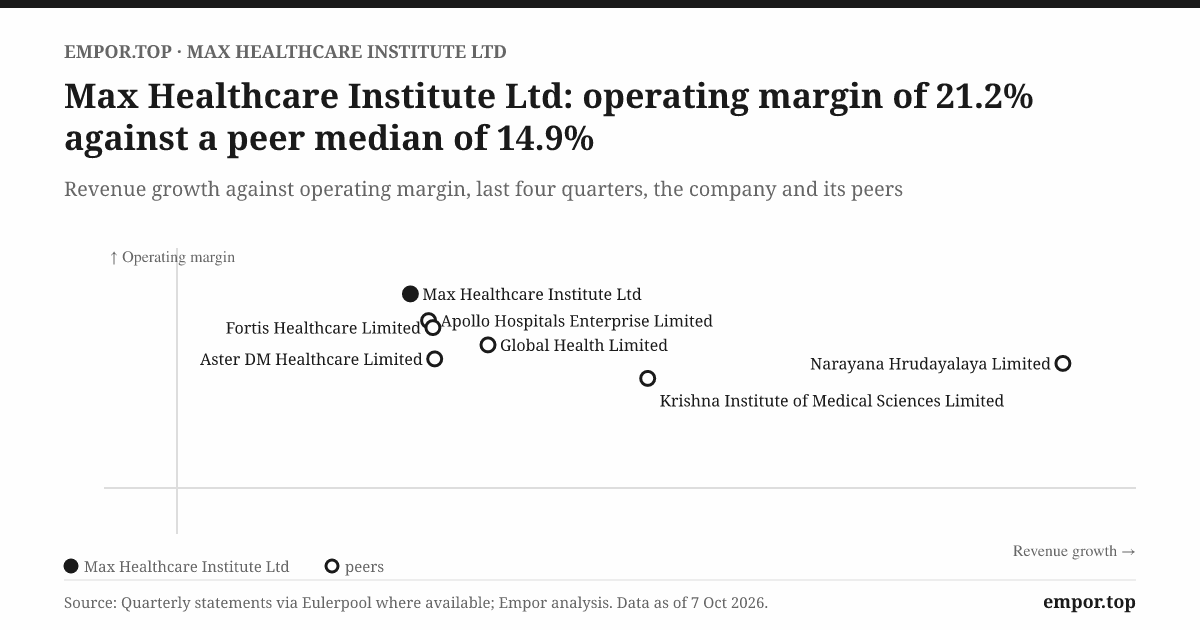
At about 36 times EV/EBITDA, Max trades above Fortis at roughly 22 to 25 times and Medanta at about 27 to 30 times, and broadly in line with or above Apollo's blended multiple.13 The market is paying for a moat that is mostly cornered real estate plus process discipline. The fair conclusion is that the moat is real but narrow: it is strongest in Delhi's mature campuses, weaker in the new cities, and exposed to payer regulation and doctor bargaining everywhere. That narrowness matters most when one looks at the legal scaffolding beneath it.
VIII. Governance, Structural Trusts, and the Disconfirming Evidence
In May 2024, the results of a postal ballot landed with a small but telling signal. Shareholders had been asked to approve the re-appointment of independent director Mahendra Lodha. The resolution passed comfortably, but about 20% of institutional votes cast went against it.11 By contrast, the re-appointment of another independent director, Michael Neeb, drew only about 2% institutional dissent. Two years later, in May 2026, the re-appointment of Narayan Seshadri as a non-executive director drew about 12% institutional opposition.12
Neither vote threatened control. Abhay Soi's stake and broad institutional support made that impossible. But dissent of this size from professional investors is a signal worth logging: some institutions are uncomfortable with board tenure and independence in a company dominated by one operator.
The trust and society vulnerability
The structure that made Max's real estate possible is also its ongoing legal surface area. The listed company runs its most valuable hospitals through agreements with societies it does not own. It lends money to those partner facilities, with loans to healthcare partners standing at about ₹383 crore at the end of FY2025, and it guarantees some of their borrowings.47 It also owes deferred and contingent consideration to trusts, carried at about ₹461 crore in March 2024, under contracts running 19 to 30 years. The fair-value change of that liability cost about ₹37 crore in FY2025.74
None of this is hidden; it is disclosed. But it means part of Max's economics flows through counterparties governed by society and trust law, whose boards and regulators have their own priorities.
The free treatment quota
The sharpest edge of this structure is the Economically Weaker Section obligation. Delhi hospitals built on land allotted at concessional rates, including key facilities in Saket and Patparganj, must provide free treatment in 10% of inpatient beds and 25% of outpatient consultations, under rulings of the Delhi High Court and Supreme Court.4[^15] The Directorate of Health Services in Delhi has periodically issued notices alleging shortfalls and seeking recovery. This is not a new risk, and it has not historically threatened Max's solvency. But any court-driven clawback for past underuse could hit the most profitable hospitals in the network directly.
Incentives and pay
Abhay Soi's 23.7% stake is worth about ₹20,800 crore at the October 7, 2026 market value.31 That is serious alignment; no salary comes close to the effect of a share price move on that position. His annual remuneration of about ₹27.4 crore is high by Indian standards, some 550 to 600 times the median employee.4 ESOP expense of about ₹55 crore in FY2025 adds to the bill.4 Pay is large but not out of line with India's largest listed healthcare CEOs, and the equity stake dominates incentives.
Encouragingly, no royalties or brand fees flow to the promoter, and the Max brand sits inside the operating network.7 Deloitte Haskins & Sells issued an unmodified opinion on FY2025 accounts, and S.R. Batliboi was appointed as the next statutory auditor for a five-year term.4
Historical falsification
How has management's word held up? The strongest test is the post-merger promise of margin expansion and de-leveraging. Both happened: margins rose, debt fell, and the QIP funds were deployed into growth. The weaker spots are timing and scope. Bed commissioning targets in Indian hospitals routinely slip, and Max is no exception; its own project list has moved forward and back across presentations, with Saket's expansion going live in stages rather than all at once.15 The pivot from a "metro brownfield" narrative to large tier-2 and insolvency acquisitions was a strategic change that management explained, but it was a change.
The verdict: governance is far stronger than in the pre-2020 era and the promoter has zero pledged shares, but the trust structure, the free-treatment rules and a board facing visible minority dissent add risks equity holders cannot diversify away. Those risks are part of what a 60 times earnings multiple must absorb.
IX. Bull vs. Bear Case & Activist Stress Test
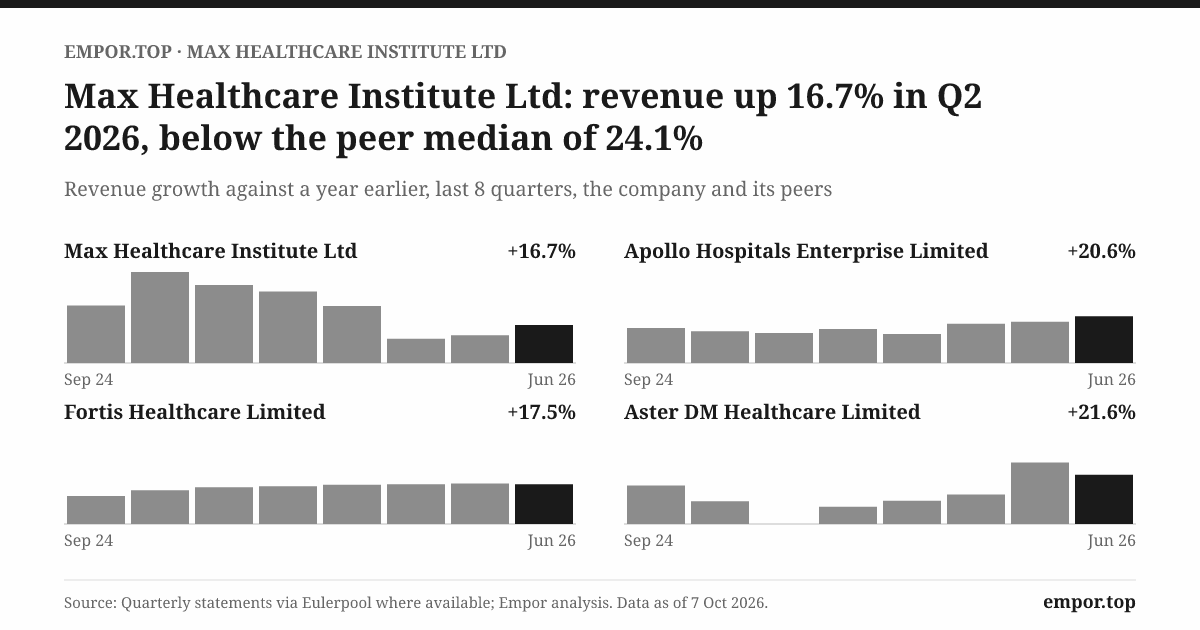
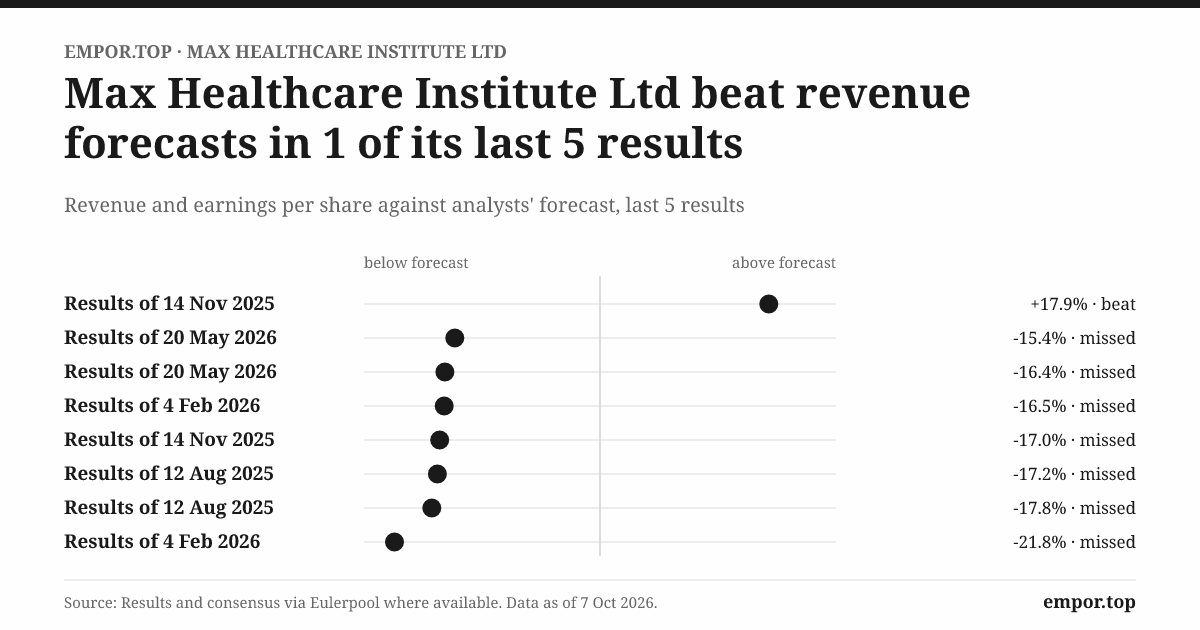
When Max reported results for the quarter ended June 2026, sell-side desks found something for everyone. Revenue grew about 17%, net profit about 5%.31 ARPOB crossed ₹81,900. The CGHS tariff revision promised an annual lift of about ₹140 crore.1[^12] HDFC Securities summarised the quarter as steady, expansion-led growth with steady margins.1 Yet net profit growth had slowed sharply from the 30%-plus pace of a year earlier, and free cash flow was being absorbed by construction.3
At 60 times earnings, the market is not paying for steady. It is paying for the next 5,000 beds to look like Saket rather than like Bulandshahr.
The bull case
Metro bed scarcity. Delhi-NCR and Mumbai remain under-bedded relative to demand, and the majority of Max's pipeline is in those cities.7 Every new bed on an existing campus inherits the brand, the doctors and the diagnostics.
Brownfield economics. Expansions at Saket, Nanavati and Mohali are the lowest-risk beds in Indian healthcare. If they ramp as past expansions have, returns on that capital should be high.
Turnaround upside. If Lucknow, Nagpur and Jaypee follow even part of the BLK and Nanavati arc, today's low-ARPOB beds become tomorrow's growth.
Pricing tailwinds. The CGHS revision and private insurer rate increases in 2026 show that pricing can still move in Max's favour.1[^12]
Medical tourism. International revenue growing about 18% a year adds high-margin volume.1
The bear case and the activist's questions
Valuation. At about ten times sales and 36 times EV/EBITDA, any slip in commissioning or margins could pull the multiple toward the peer range of roughly 22 to 30 times EV/EBITDA.13 The P/E has already compressed from a median of 74 to 60, which shows the market is willing to de-rate.3
ARPOB dilution. As tier-2 beds fill, blended ARPOB could stall even if each hospital improves. A skeptic would ask management to disclose ARPOB and margin for mature and new hospitals separately every quarter.
Price regulation. India has capped stent and knee-implant prices before, and public interest litigation over standardised procedure pricing remains alive.7 A metro premium is the most visible target.
Leverage and execution. Front-loaded capex of more than ₹2,000 crore a year against operating cash flow of roughly ₹1,500 to ₹1,800 crore means borrowings will likely rise further.37 An activist would ask why a company trading at 60 times earnings pays a dividend at all while borrowing to build, and whether some lower-return tier-2 assets should be sold rather than turned around.
Doctor costs. Professional fees grew faster than revenue in FY2025.4 If star surgeons capture more of the value they create, the margin advantage narrows.
The KPIs that matter
Three numbers will tell investors whether the case is holding.
-
Blended network ARPOB. Latest reading about ₹81,900 per day for the quarter ended June 2026, up from about ₹73,900 in FY2025.17 Direction: rising. This is the test of whether the new hospitals are being pulled up or the old ones are being pulled down.
-
Net debt to EBITDA. About 1.43 times on CARE's consolidated measure for FY2025, with network net debt of about ₹2,384 crore in June 2026.71 Direction: rising with capex. CARE's 1.8 times trigger is the line to watch.
-
Network operating EBITDA margin. Management's mature hospitals run in the mid-to-high twenties; CARE's negative trigger sits at a 20% margin floor.7 Direction: broadly stable so far, under pressure as new beds open.
The case therefore reduces to an execution question rather than a demand question. Demand for complex care in North India is not in doubt. Whether Max can double its footprint without diluting the machine is.
X. Playbook: Business & Investing Lessons
"Don't build hospitals; restructure their administration." When Radiant took over BLK on Pusa Road and Nanavati in Vile Parle, it did not buy land, pour foundations or wait a decade for a brand to form. It took over the management of respected trust hospitals and changed what happened inside them. The wider lesson for founders and investors in capital-heavy industries is that the cheapest capacity is often the capacity that already exists and is badly run. The highest-return asset in Indian healthcare in the 2010s was a hospital with a great address and a poor operator.
"ARPOB is driven by acuity, not room rates." Max's leap to about ₹81,900 a day did not come from raising the price of a bed. It came from filling beds with cancer surgeries, transplants and complex cardiac cases while sending patients home in about four days. Pricing power in services rarely comes from charging more for the same thing. It comes from doing harder things that fewer competitors can do, which is also why regulators find it harder to cap.
"A reverse merger can be a liquidity machine." The 2020 scheme let a smaller operator take control of a bigger one, let a South African investor cash out, let a conglomerate exit healthcare and, two years later, let KKR sell ₹9,185 crore of stock in a day. Complex structures are often treated as red flags. Sometimes they are the only way to untie a knot with three owners pulling in different directions, and the measure is what the structure leaves behind: here, a clean single-segment company with no pledged shares.
"Collections are the hidden equity in a hospital." Cutting debtor days from 145 to around 40 freed cash that would otherwise have had to come from shareholders. The cumulative result, cash from operations at about 155% of net profit over twelve years, means that much of the expansion was funded by patients and suppliers rather than new equity. For investors, a hospital's receivables ledger is often more revealing than its brochure.
"The playbook is proven until the map changes." Every lesson above was learned in Delhi and Mumbai. The final lesson is the one still being written: a process advantage is only as portable as the people and conditions that created it, and Lucknow is not Saket.
XI. Epilogue: The Race to 10,000 Beds
Tonight, Max Healthcare is the most richly valued hospital equity in India per bed, standing at an inflection point. The machine works: high yields, short stays, fast collections and a balance sheet that still has room. But the next phase of the story will be written in places where the machine has not yet been tested at scale.
Three moments will decide it.
The first is Jaypee Healthcare. The Noida hospital and its sister units carry about 1,200 beds of potential capacity, bought out of insolvency.710 If occupancy and ARPOB climb quickly over the next two years, the distressed-asset strategy will look like the BLK playbook reborn. If they stall, Max will own a large, low-yield asset on the edge of NCR that drags the blended numbers for years.
The second is the commissioning calendar. Nanavati Phase I with 241 beds and Saket Vikrant with 415 beds are the brownfield showpieces.7 On time and filled, they should produce the highest incremental returns in the plan. Delayed, they leave capital work in progress earning nothing while debt accrues interest.
The third is the credit line. CARE's AA+ Stable rating rests on net debt staying below 1.8 times EBITDA.7 With network net debt around ₹2,400 crore in mid-2026 and annual capex above ₹2,000 crore, the next rating review will show whether cash generation is keeping pace with construction.1
Each outcome maps onto a central question. Sustained ARPOB above ₹82,000 with margins holding would mean the tier-2 expansion is not diluting the franchise. Net debt below 1.5 times through peak capex would mean the growth is self-funding. A quiet decade in the courts over free-treatment quotas and trust agreements would mean the cornered resource stays cornered.
The tension that remains is simple to state and hard to resolve: can India's highest-yield hospital operator double its footprint across secondary cities and still be India's highest-yield hospital operator?
XII. Outro
In 2000, Max started with a neighbourhood medical centre in Panchsheel Park. For nearly two decades, its hospitals were admired more than they were profitable. Then an outsider who had never practised medicine took over, treated every bed as perishable inventory, and turned a family conglomerate's healthcare arm into an institutional asset worth about ₹88,000 crore. The sponsor that financed him took its money and left. The operator stayed.
What makes Max unlike any other Indian company is not its hospitals, which competitors can match, or its land, which it does not own. It is the idea that ran through every chapter: a hospital chain that treated healthcare not as real estate development, but as an optimisation algorithm for clinical capacity. The next thousand beds will show whether that algorithm can run on new hardware.
References
-
HSIE Results Daily: Max Healthcare Institute — Steady Q1; expansion-led growth, steady margin — HDFC Securities, 2026-08-17 ↩↩↩↩↩↩↩↩↩↩↩↩↩↩↩↩↩↩↩↩↩↩↩↩↩↩↩↩
-
Information Memorandum for Listing of 61,71,83,799 Equity Shares — Max Healthcare Institute Limited, 2020-08-18 ↩↩↩
-
Audited Financial Results (Standalone & Consolidated) for the Year Ended March 31, 2025 — National Stock Exchange of India / Max Healthcare Institute Limited, 2025-05-20 ↩↩↩↩↩↩↩↩↩↩↩↩↩↩↩↩↩↩↩↩↩↩↩↩
-
Audited Consolidated Financial Statements for the Year Ended March 31, 2025 — Max Healthcare Institute Limited, 2025-05-20 ↩↩↩↩↩↩↩↩↩↩↩↩↩↩
-
Investor Presentation Q4 / FY24 — Max Healthcare Institute Limited, 2024-05-28 ↩↩↩↩↩↩↩↩↩↩↩↩↩↩↩↩
-
Abhay Soi: The Man Behind the Max Healthcare Turnaround — Forbes India, 2023-01-16 ↩↩↩↩
-
CARE Ratings Press Release: Max Healthcare Institute Limited — CARE Ratings, 2025-10-14 ↩↩↩↩↩↩↩↩↩↩↩↩↩↩↩↩↩↩↩↩↩↩↩↩↩↩↩
-
Radiant Life Care and Max Healthcare Complete Merger to Create North India's Largest Healthcare Network — KKR Press Release, 2020-06-01 ↩↩
-
Placement Document: Qualified Institutions Placement of Equity Shares — Max Healthcare Institute Limited, 2021-03-10 ↩
-
NCLAT Order on Closure of CIRP & YEIDA Resolution: Jaypee Healthcare Limited Acquisition — National Company Law Appellate Tribunal, 2024-10-22 ↩↩
-
Voting Results of Postal Ballot & Scrutinizer's Report — Max Healthcare Institute Limited / DPV & Associates LLP, 2024-05-06 ↩
-
Voting Results and Scrutinizer's Report on Postal Ballot — Max Healthcare Institute Limited / DPV & Associates LLP, 2026-05-12 ↩
 LinkedIn
 WhatsApp
 Reddit
 Hacker News
 Email
 Kindle
 RSS Feed
 Spotify
 Apple Podcasts
 Amazon Music
 Audible
 YouTube