ONGC: India's Energy Anchor
I. Cold Open: The Strike at Sagar Samrat
In the early months of 1974, India was a country being squeezed by a barrel it did not own. The Arab oil embargo of late 1973 had quadrupled the price of crude, and a nation that imported most of what it burned watched its scarce foreign exchange drain away to pay for fuel. Western oil companies had spent decades telling New Delhi that its basins outside Assam held little worth drilling for. And yet, roughly 160 kilometres off the coast of what was then Bombay, a squat, three-legged steel platform called Sagar Samrat was standing in the Arabian Sea, its drill string turning into the seabed.
Sagar Samrat was not glamorous. It had been built at a Mitsubishi yard in Japan and had sailed from Hiroshima in April 1973, a jack-up rig bought by a state agency that had never before drilled a well at sea.3 In February 1974 it struck oil.3 The structure underneath it would become Bombay High, later Mumbai High, the field that turned a socialist-era geological commission into the most important industrial asset in the Indian state's portfolio. Over the next three decades the rig itself drilled around 125 wells and took part in 14 significant offshore discoveries.3
Fifty-two years later, the descendant of that commission is a listed company called Oil and Natural Gas Corporation, and it still sits at the centre of India's energy system. ONGC and its partners produce about 63% of the crude oil and natural gas pumped inside India.[^3] Its consolidated revenue, swollen by refining subsidiaries, came to about $75bn in the year to March 2026.12 And over the twelve years from FY2015 to FY2026, the business generated roughly ₹828,692 crore of cash from operations, close to two and a half times the ₹344,413 crore of net profit it reported over the same stretch.12
Here is the strange part. For all that cash, the whole enterprise, upstream fields, refineries, petrochemical plant and a portfolio of stakes in other state companies, was valued by the stock market on October 8, 2026 at about $28.8bn, or ₹278,490 crore.2 That is less than the book value of its equity. The market is looking at the steel and the cash and saying, in effect, that it does not trust who gets to spend them.
That distrust is the subject of this story, and it comes down to three questions. The first is geological: can expensive frontier projects such as the deepwater block known as KG-DWN-98/2 in the Bay of Bengal outrun the natural decline of ageing giants like Mumbai High? The second is political: does majority ownership by the Government of India protect ONGC, or does it turn the company's balance sheet into a shock absorber for national budgets and for struggling sister companies? The third is strategic: has the build-out into refining through Hindustan Petroleum, and into petrochemicals through ONGC Petro additions, protected the group's cash flows, or permanently diluted its returns?
The verdict, stated once and tested throughout, is this. ONGC is India's indispensable upstream anchor, and its cash generation is real. But its identity is caught between three masters: the commercial logic of a listed oil producer, the physics of reservoirs that are past their prime, and a controlling shareholder that sees the company as an instrument of national policy. The route to that verdict runs from Soviet geologists in the Gujarat mud to the deepwater battles of the Krishna Godavari basin, and it starts with a minister who refused to take no for an answer.
 Subscribe on LinkedIn
II. The Geological Impossible: Soviet Drills in the Cambay Mud (1955–1965)
Picture India in the mid-1950s. The country had been independent for less than a decade, and its oil was largely in foreign hands. In the northeast, the British-owned Assam Oil Company worked the old Digboi field. Distribution was controlled by multinationals with names like Burmah-Shell and Standard Vacuum. Their geologists had looked at the rest of the subcontinent, the vast alluvial plains, the Gujarat coastline, the shallow western shelf, and had concluded that commercial oil was unlikely to be found there. For a new nation trying to industrialise, that was not just a geological opinion. It was a statement of permanent dependence.
The man who decided to test that opinion was Keshav Dev Malaviya, a Congress politician from Allahabad who held the natural resources portfolio and who is remembered inside ONGC as its founding father. Malaviya's argument was simple and political: a country that could not find its own oil would never control its own destiny, and companies whose profits depended on selling imported products had little reason to look hard for domestic crude. Under the Industrial Policy Resolution of 1956, mineral oil was reserved for the public sector, and on August 14, 1956 the Oil and Natural Gas Commission came into being as a state body charged with finding it.3
What made the bet unusual was where the expertise came from. With the Western majors uninterested, Malaviya looked east. Soviet geologists and Romanian drilling equipment arrived to help the young commission plan its first campaigns, and the Soviet influence shaped the organisation's habits for decades: in-house geology, in-house drilling crews, and a preference for building capability rather than buying it. That culture is still visible today in ONGC's own drilling fleet and its huge internal library of seismic data, which is part of why the company can operate in places a pure contractor model would struggle.
The early discoveries came onshore, in the Cambay basin of Gujarat around Ankleshwar and Cambay itself, and later in the Assam-Arakan fold belt in the northeast. They were not giant fields by world standards, but they did something more important than produce oil. They proved the foreign surveys wrong. Every barrel from Ankleshwar was an argument that India's sedimentary basins deserved serious exploration, and that the state could do it.
Within a decade the commission was even looking abroad, taking part in offshore ventures in Iran in the 1960s, a first sign of the instinct that would later produce ONGC Videsh, its overseas arm. That instinct, buying equity barrels wherever geology and diplomacy allowed, would eventually take the company into some of the world's riskiest jurisdictions.
For an investor today, the origin story matters for one reason. ONGC was not created to earn a return on capital. It was created to make India less dependent on foreigners for fuel. Every later tension in this story, between dividends and drilling, between the minority shareholder and the ministry, flows from that founding purpose. And the next chapter shows how that purpose was rewarded with one spectacular, and spectacularly concentrated, prize.
III. The Arabian Sea Gamble: Mumbai High and the 400,000-Barrel Peak (1970–1985)
The seismic surveys came first. In the early 1970s, a Soviet research vessel mapped the shallow shelf off the west coast and found a large dome-shaped carbonate structure beneath the sea, a classic trap in which oil could have collected over millions of years. The problem was getting to it. ONGC had never operated offshore. The monsoon threw heavy swells across the Arabian Sea for months each year. The seabed was soft marine clay, unforgiving for a rig that had to stand on legs. And the reservoir itself was limestone, a rock type that is notoriously complex to produce from because its pores and fractures do not drain evenly.
Then came the oil shock. When Arab producers cut supply in late 1973, the economics of Indian offshore exploration flipped overnight. What had been a long-term ambition became a matter of national survival, because every barrel found at home was a barrel the country did not need to buy with dollars it did not have. Sagar Samrat's strike in February 1974 arrived at exactly the moment the country needed it, which is why it lives in Indian memory less as a commercial success than as a kind of national rescue.3
Turning a discovery into a producing field took a few more years of engineering improvisation: production platforms in open water, pipelines to bring crude ashore at Uran, near Mumbai, and processing complexes offshore. By the late 1970s Mumbai High was flowing, and over the following decade it grew into the backbone of Indian production, at its peak producing on the order of 400,000 barrels a day and supplying a large share of the country's domestic crude. Neighbouring discoveries followed: the giant Bassein gas field, and smaller oil fields such as Neelam and Heera, turning the western offshore into a hydrocarbon province rather than a single lucky well.
Think of what this meant for the young state. Mumbai High was a cash machine and a foreign-exchange saver at the same time. It funded the government, trained a generation of offshore engineers, and created the platforms, pipelines and terminals that still form the physical skeleton of ONGC's western operations. Much of the "infrastructure moat" that bulls describe today, the subsea pipelines no newcomer could replicate cheaply, was poured in this era.
But a jackpot is also a concentration risk. A nation's upstream output came to depend on the natural life cycle of one offshore complex, and all oil fields follow the same arc: they rise, plateau and decline as pressure falls and water creeps into the producing wells. Mumbai High would be no exception. Its peak has long passed, and today it produces only a fraction of what it once did, with the company spending heavily on enhanced recovery merely to slow the slide.
The lesson of this era is double-edged. ONGC proved it could find and develop a giant offshore field in hostile conditions, which is real process knowledge. Yet it found only one Mumbai High, and nothing since has replaced it. That single geological wonder masked the depletion problem for a generation, and when the field matured, the company's owners had already learned to treat its cash as theirs to direct. That habit was about to be formalised.
IV. The Socialist Hangover: APM, Disinvestment, and Corporatization (1985–2003)
For most of its first four decades, ONGC did not sell its oil in anything resembling a market. Under what India called the Administered Price Mechanism, the government set the prices at which crude and gas changed hands, and it set them to keep fuel cheap for consumers and industry, not to reward the producer. The commission took the full geological risk of drilling dry holes in deep water and was paid a price decided by a ministry committee. In good years that was tolerable. When world prices rose, the gap between what ONGC's oil was worth and what it was paid became an invisible subsidy flowing from the producer to everyone downstream.
The 1991 balance-of-payments crisis cracked that model. India came close to defaulting on its foreign debts and had to pledge gold to borrow. The reforms that followed opened sector after sector, and oil was among them. The state began inviting private and foreign companies to bid for exploration blocks, a process later formalised as the New Exploration Licensing Policy, and it started to turn its statutory commissions into companies that could, at least in principle, be partly sold.
ONGC's turn came in February 1994, when the commission was converted into Oil and Natural Gas Corporation Limited, a company under the Companies Act. Overnight a body of civil-service-style employees found themselves working for a corporation with a balance sheet, auditors and, soon, outside shareholders, as the government sold part of its holding through disinvestment.4 Corporatisation gave ONGC the vocabulary of a commercial enterprise. It did not give it control of its own prices.
The clearest illustration of who was really in charge came at the end of the decade. Facing fiscal deficit targets, the government arranged for its oil companies to buy pieces of one another. ONGC, Indian Oil Corporation and GAIL took cross-holdings in each other, with ONGC acquiring stakes in IOCL and GAIL, while the government booked the proceeds as disinvestment receipts.4 It was a neat piece of fiscal engineering: the state raised cash without losing control, because the shares simply moved from one government pocket to another. Those stakes still sit on ONGC's balance sheet today as part of roughly $14.8bn of long-term investments, and they pay dividends that help explain why other income is a meaningful slice of profit.[^3]
The same years produced ONGC Videsh, the overseas arm, built to buy equity in foreign oil fields as a hedge against domestic depletion. Its early deals took it into some of the riskiest jurisdictions in the world, from Sudan to Russia's Sakhalin, which said something about the strategy: India was willing to go where the majors were nervous, because it was paying for energy security, not just barrels.
What should an investor take from this era? The tools that would later be used against minority shareholders were all assembled here: administered prices, the habit of using oil company balance sheets to hit budget targets, and a corporate structure that was commercial in form but governmental in substance. When oil prices exploded in the following decade, those tools would be pulled out and used at scale.
V. The Subsidy Mill and the $14 Billion Upstream Tax (2004–2014)
Imagine running an oil company in 2008. Brent crude touched nearly $150 a barrel that summer. Exxon, Shell and BP were reporting the largest profits in corporate history. And at ONGC, the oil coming out of Mumbai High was effectively being sold for a fraction of that, because the government had decided that ONGC should help pay for India's fuel subsidies.
The mechanism was called burden-sharing. The state wanted to keep diesel, kerosene and cooking gas cheap for a poor country, so it capped retail prices. The marketing companies that sold those fuels, Indian Oil, Bharat Petroleum and Hindustan Petroleum, lost money on every litre, and someone had to fill that hole. Part came from the budget. A large part came from upstream producers like ONGC, which were instructed to give discounts on the crude they sold to refiners. Every time global prices rose, the discount rose too. ONGC was, in practice, a tax collector with a drilling department.
This is the historical record that the bull case has to confront, because it is the most direct test of whether ONGC's shareholders capture the value of rising oil prices. The answer, through the last oil super-cycle, was largely no. The windfall from $100 oil went to Indian consumers and the budget, while ONGC's realised prices were held far below world levels. A company with genuine pricing power does not behave like this. A policy instrument does.
The government did offer ONGC something in return: status. In November 2010 it was named a Maharatna, the highest tier of public-sector enterprise, which gave its board more freedom to approve investments without ministry sign-off. But autonomy over capital spending is not the same as autonomy over price, and the burden-sharing continued until fuel prices were deregulated: petrol in 2010 and, crucially, diesel in 2014. Only then did the formal subsidy discount fade away.
The decade left two other marks. Offshore work remained dangerous, a fact brought home in 2005 when a vessel collided with the Mumbai High North platform and the resulting fire destroyed it, a reminder that operating ageing infrastructure in open sea carries tail risks that never show up in a P/E ratio. And contractual disputes from earlier joint ventures hardened into long-running liabilities. The most important is the arbitration over the Panna-Mukta and Tapti fields, operated with partners under a production sharing contract, in which the government's hydrocarbons regulator claims roughly $1.6bn, about ₹13,549 crore, in disputed cost recovery and profit petroleum; ONGC's auditors have repeatedly flagged it as an emphasis of matter.8 A separate fight over service tax and GST on royalty payments adds disputed demands of around ₹1,872 crore for ONGC alone, with a larger amount attributed to joint-venture partners.8
Look at the long-run numbers through this lens. Across FY2015 to FY2026, ONGC paid out ₹136,555 crore in dividends, with payout ratios ranging from about 19% of profit in the pandemic year to about 77% in FY2020, and a median around 42%.12 That is generous by any standard. But notice what drives the swings. The 77% year came when the government needed cash, not when ONGC had a bumper year. The dividend policy, like the pricing policy, is set with the treasury's needs in mind.
So the investor's verdict on this era is stark. In the last great oil boom, the sovereign intercepted the upside, and the record gives no reason to believe that instinct has died. The next chapter shows it simply found a new channel: instead of discounting ONGC's oil, the government sold ONGC a refinery.
VI. The Forced Sovereign Marriage: The ₹36,915 Crore HPCL Takeover (2018)
By the winter of 2017, the Government of India had a familiar problem: an ambitious disinvestment target and a fiscal year running out. Selling a big stake in a state company to the public market takes time and can embarrass a government if the price disappoints. There was a faster option. One state company could buy another.
On January 31, 2018, ONGC agreed to acquire the government's entire 51.11% stake in Hindustan Petroleum Corporation, one of India's three big fuel retailers, for about ₹36,915 crore, close to $5.8bn.5 The government called it a strategic sale that would create a vertically integrated oil major. Because the buyer and seller were both, ultimately, the state, control of HPCL never left government hands, so no open offer to HPCL's minority shareholders was required. The treasury got its cash. The country got an "integrated" champion. And ONGC got a very large bill.
There is a real industrial argument for owning a refiner. Upstream producers make money when oil is expensive; refiners often do better when crude is cheap and product margins widen. Put them together, and the theory says you smooth the cycle. Management made exactly that pitch. The question is whether the deal was chosen for that logic, or whether the logic was found for the deal.
The evidence leans toward the second. ONGC paid a premium over HPCL's prevailing share price for a stake it could not run in the ordinary sense. For a long period after the purchase HPCL kept its own board and management culture and resisted being folded under ONGC as its promoter, and the two companies were never merged. What ONGC bought was a large financial stake in a separately listed refiner, not an integrated operating machine. The synergies on paper, crude supply, shared logistics, joint purchasing, were mostly the kind any two state companies could have pursued by contract.
The balance sheet tells the cost plainly. To pay for HPCL, ONGC took on commercial debt. Consolidated borrowings rose from about $7bn in FY2016 to around $19bn by FY2020, and debt rose from under a quarter of equity to about two-thirds of it.12 For a company that had spent most of its life with very little debt, that was a change of character, and rating agencies began to watch the parent's leverage more closely, even as they kept the top rating on the strength of sovereign ownership.6
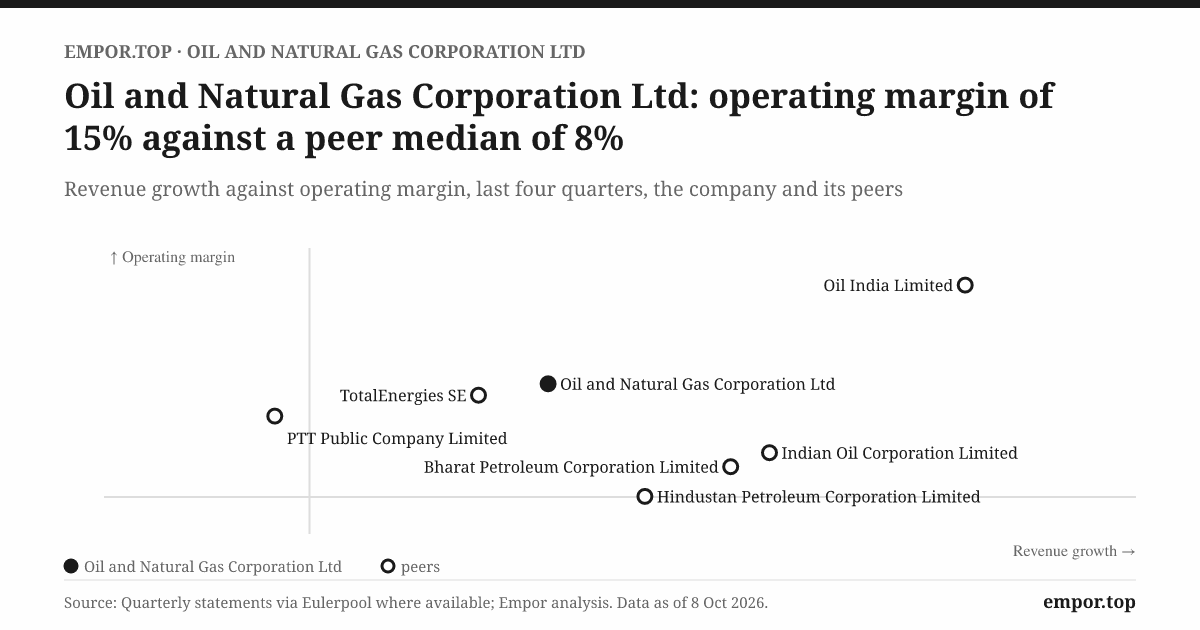
The income statement changed shape too. Consolidated revenue jumped from about $19bn in FY2016 to around $60bn by FY2019 and about $75bn in FY2026.12 That makes ONGC look like a global giant by sales, but most of the extra revenue is refined product sold at thin margins, which is why the group's operating margin has trended from around 40% in the pre-HPCL years toward low double digits today.2 The headline growth rate of roughly 18% a year over a decade is almost entirely acquisition and oil price, not more oil pulled from the ground.
And the bill did not end with the purchase price. HPCL went on to commit to large expansions, including its Visakhapatnam refinery upgrade and the greenfield Barmer refinery in Rajasthan, each requiring capital the group as a whole must ultimately support. So the honest assessment is this: the HPCL deal transformed ONGC into an integrated group on paper, but it converted a net-cash upstream company into a leveraged conglomerate, at a price set to suit the seller's budget. To see whether that trade-off is worth it, one has to understand exactly how ONGC's upstream business makes its money.
VII. The Anatomy of Upstream Cash: Pricing Formulas, Depletion, and Taxes
Follow one barrel of oil from Mumbai High. It comes up through a well, gets separated from water and gas on a platform, travels by subsea pipeline to the Uran terminal, and is sold to a refinery, very often a state-owned one. The price is set with reference to international benchmarks like Brent and quoted in dollars, then converted to rupees on the day.[^12] That one fact matters more than it looks: when the rupee weakens, ONGC's rupee revenue rises automatically, a natural currency hedge that most Indian companies would envy.
Then the state takes its cut, before any profit appears. Royalties go to the states where the oil is produced, and a central cess goes to New Delhi, both calculated on the value of the oil. Corporate tax comes later. Between 2022 and 2024 there was an extra layer: after Russia's invasion of Ukraine sent crude soaring, the government introduced a Special Additional Excise Duty, a windfall tax on domestic crude reset every two weeks. It was the burden-sharing of the 2000s reborn in a new form, and it lasted until the government abolished it on December 2, 2024.[^9] Its removal is real good news for ONGC's realisations, but its existence is equally real evidence: when prices spike, New Delhi reaches for the windfall.
Gas is a different machine. Most of ONGC's gas comes from old "nomination" fields handed to it by the state without auction, and its price follows a formula recommended by a committee led by economist Kirit Parikh and adopted in April 2023. The price is linked to 10% of the Indian crude basket but bounded by a floor of $4 and a ceiling of $6.50 per million British thermal units, with a 20% premium allowed for gas from new wells or well interventions.7 Translated: the government guarantees ONGC will never be paid disastrously little for its legacy gas, and also guarantees it will never be paid a lot. Gas from difficult deepwater and high-pressure fields like the KG block falls under a separate, higher ceiling.[^12]
Now to the cash. Over FY2015 to FY2026, ONGC's cash from operations came to about 2.4 times its reported net profit.12 Why such a gap? Because an oil producer's biggest costs are recorded long after the money was spent. When ONGC drills a field, it spends cash up front, and then charges that spending against profit gradually over the field's life as depletion and depreciation; dry exploration wells are written off. These are real costs, but they are not cash leaving the building this year. Year after year, operating cash has tracked EBITDA closely, at roughly 96% to 107% in recent years.2 That is a sign that reported profit is not being flattered by aggressive accounting: if anything, earnings understate the cash the business throws off.
Working capital reinforces the point. Customers now pay ONGC in about 12 days on average, down from about 45 days a decade ago.2 That is unusually fast, and it reflects who those customers are: state refiners, including ONGC's own subsidiaries HPCL and Mangalore Refinery and Petrochemicals, plus Indian Oil and Bharat Petroleum, who together take most of its crude, while GAIL takes most of its gas.[^3] Bad debts are negligible because the buyers are, in effect, the state. That is a strength for collections. It is also the root of the problem with pricing, because a customer that never defaults is the same customer that writes the price formula.
Where did the cash go? Over the twelve years, ONGC produced about ₹296,568 crore of free cash flow after capital spending, and paid out about 46% of it as dividends.12 The majority of those dividends went to the President of India, who holds about 59% of the shares.13 Most of the rest went into the HPCL purchase, other acquisitions and debt service, while the company's cash pile barely moved over the period.2 FY2026 was a standout year, with free cash flow of about $8.1bn as capital spending eased and borrowings were paid down.2
The conclusion is clear. As a cash engine, upstream ONGC is excellent: dollar-linked, fast-collecting and conservatively reported. Its margins, though, are fenced by royalties, cess and price ceilings that its controlling shareholder writes. And all of this rests on volumes that have been sliding for a decade, which is why the company's future has moved to the other side of the country.
VIII. The Battle for the Deep: Krishna Godavari Basin and KG-DWN-98/2 (2018–2026)
In January 2024, oil began flowing into the Armada Sterling V, a floating production, storage and offloading vessel moored in deep water in the Bay of Bengal off Andhra Pradesh. The FPSO is essentially a ship-shaped factory: it takes oil and gas from wells on the seabed far below, processes it on deck, stores the crude in its hull and offloads it to tankers. Its arrival marked first oil from KG-DWN-98/2, ONGC's flagship deepwater block, and it came years later than first promised.[^3]6
The move east from Mumbai High to the Krishna Godavari basin is a move to a different kind of geology. Instead of shallow-water limestone, the KG deepwater finds sit in sandstone laid down by ancient underwater avalanches, beneath deep water, often at high pressure and temperature. Every well costs much more, and every piece of subsea equipment has to work in conditions where a repair can mean months of delay.
ONGC also has a neighbour that serves as a running comparison. Next door, Reliance Industries and its partner BP operate the KG-D6 block, which brought deepwater gas fields into production on a faster rhythm, while ONGC worked through multi-layered public-procurement tenders. Reliance's own KG-D6 story included disappointments of its own, so this is not a simple tale of private virtue. But the contrast shows the cost of a state procurement system in a business where time is the most expensive input.
The promises are where the falsification test bites. The project was originally expected to produce first oil around 2020 and to scale to roughly 77,000 barrels a day. The pandemic, supply-chain crunches and the sheer difficulty of the subsea work pushed first oil to January 2024, and peak oil targets were cut to about 45,000 barrels a day, with gas targeted at over 10 million standard cubic metres a day.[^3] Rating agencies have repeatedly listed execution delays at the block as a constraint on ONGC's credit profile.[^3]6 Management's history here is one of guiding to milestones and then moving them.
Meanwhile, the legacy fields keep eroding. ONGC's standalone crude output, which ran at around 22 to 23 million tonnes a year in the mid-2010s, has slipped to around 19 to 20 million tonnes, despite heavy and sustained capital spending.[^3] Mumbai High, which once gushed far more, now produces a fraction of its peak, and every enhanced-recovery project there is a fight to slow the decline rather than reverse it. That is why ONGC has turned to outside expertise, bringing in BP as a technical services provider for Mumbai High to apply modern reservoir management to the old field.[^3] A national oil company inviting a foreign major to help it run its crown jewel is a striking admission about the limits of in-house capability.
There are other levers. The Daman Upside gas project in the western offshore was scheduled for commissioning around spring 2026, adding roughly 5 million standard cubic metres a day of gas.[^3] Together with the KG ramp-up, that is the core of the bull case on volumes.
So what does the record say? KG-98/2 has proved that ONGC can bring a deepwater project into production, which is real. But the claim that new frontiers will reverse the overall decline is, so far, unproven, and the project's own history of slippage and down-sized targets narrows it to a smaller version: these fields may slow the slide, not end it. The single number that will settle it is ONGC's standalone oil-and-gas production in million tonnes of oil equivalent for FY2027. And while that test plays out, a different drain on capital has been running in Gujarat.
IX. The Balance Sheet Black Hole: OPaL and the Downstream Trap (2020–2026)
On August 12, 2024, ONGC's board approved a rescue. The patient was ONGC Petro additions Limited, known as OPaL, a petrochemical complex at Dahej in Gujarat. The package totalled about ₹18,365 crore: up to ₹10,501 crore of fresh equity, plus conversion of about ₹7,778 crore of compulsorily convertible debentures into shares.9 When it was done, ONGC's stake rose from about 49% to roughly 96%.9 A joint venture that had once been kept off the parent's balance sheet was now almost entirely ONGC's problem.
The idea behind Dahej, conceived in the mid-2000s, was elegant. Natural gas contains heavier components, ethane and propane, that can be separated out and "cracked" into ethylene and propylene, the building blocks of plastics. ONGC had those components from its offshore gas and from LNG terminals at Dahej. Why sell them as fuel when you could turn them into higher-value polymers? On a whiteboard, OPaL was a textbook way to capture more value from each molecule.
In reality, the project ran badly over budget and was financed largely with debt and quasi-equity instruments, while its earnings disappointed. Petrochemical margins were crushed by a flood of new capacity, especially from China, and OPaL's feedstock was not cheap enough to compete through the cycle. The result was a business that could not service its own debt. ONGC had already been supporting it through guarantees and comfort letters, and rating agencies flagged support for OPaL as one of the main constraints on ONGC's credit profile.[^3]6
The rescue went beyond cash. As part of the restructuring, OPaL was allocated gas from ONGC's nomination fields at a premium of up to 20% over the APM price, supporting its feedstock supply.69 Read carefully, that is the parent's upstream resource being dedicated to propping up a downstream subsidiary. It may be sensible for the group, but it is a transfer of value from ONGC's most profitable activity to its least.
The cost shows up in returns. Consolidated return on capital employed, which peaked at about 26% in FY2019, fell to about 12% in FY2026; return on invested capital, about 24% in FY2022, fell to about 11%.2 Not all of that is OPaL: lower oil prices, the HPCL refining cycle and impairments all play a part, and the FY2026 operating margin of about 11.5% reflects a group dominated by refining.2 But the direction is unmistakable, and an 11% return on invested capital is close to the cost of capital for an Indian energy company. The group, on this measure, is barely creating value.
This is the classic trap of state-owned enterprises, played out in miniature. A sub-scale joint venture is set up to keep debt off the parent's books; it underperforms; it accumulates borrowings it cannot pay; and eventually the listed parent absorbs it, because a state company cannot be allowed to default. Management presented the restructuring as a step toward oil-to-chemicals integration. The record says otherwise: the money went to repair a balance sheet, not to create new capacity, and it could instead have funded deepwater exploration or bigger returns to shareholders.
That leaves a puzzle. If ONGC keeps making allocation decisions like this, why is it still so dominant? To answer that, one has to look at what genuinely protects it, and what does not.
X. Hamilton Helmer's 7 Powers and Porter's 5 Forces: The Sovereign Moat
Every few years, New Delhi holds bidding rounds under its Open Acreage Licensing Policy, inviting companies from anywhere in the world to bid for exploration blocks. In theory this is an open contest. In practice ONGC tends to win a large share of the acreage, and the global majors mostly stay away. That pattern says something important about where ONGC's advantage comes from, and about its limits.
Start with Hamilton Helmer's framework, which asks which of seven sources of durable advantage a company has. ONGC's strongest is Cornered Resource. It holds legacy nomination fields given to it by the state, the largest seismic library in India built over seventy years, and offshore infrastructure, platforms, pipelines and terminals, that would be prohibitively expensive to duplicate. That is why credit agencies describe it as contributing around 63% of domestic oil and gas output.[^3] The second is Scale Economies, of a moderate kind: its own drilling fleet, logistics bases and port facilities are spread over a production base no domestic rival comes close to. A third, Process Power, is also moderate: decades of wrangling Mumbai High's complex carbonates and difficult onshore wells have created know-how, though the decision to invite BP onto Mumbai High suggests the edge is narrower than the folklore.
The other powers are absent. Crude and gas are commodities sold on chemical specification, so there are no switching costs and no network effects. And ONGC, as the incumbent state producer, cannot counter-position against anyone; it is the slow-moving giant others counter-position against.
Porter's five forces sharpen the picture. The decisive force is buyer power, and it is structural. ONGC's crude goes overwhelmingly to state refiners, including its own subsidiaries, and its gas to GAIL, under formulas set by the government.[^3] The buyer and the regulator are, ultimately, the same entity that owns ONGC. That is why Cornered Resource does not translate into pricing power: ONGC owns the oil, but someone else decides what it is worth.
The threat of new entrants is low, because offshore development needs enormous capital, complex approvals and patience, and global majors have largely declined to bet heavily on Indian acreage. Rivalry is also low: Oil India works mainly in the northeast, and private producers such as Vedanta's Cairn and Reliance operate their own blocks. Supplier power is moderate, because ONGC depends on a small club of global service companies, SLB, Baker Hughes, Halliburton and others, for high-end deepwater tools.[^3] The threat of substitutes is low today and rising over the long run, as India pushes electric vehicles and targets around 500 gigawatts of non-fossil power capacity by 2030.
Put together, the verdict is that ONGC has a genuine moat around its resources but not around its returns. Its cornered resources and scale make it nearly impossible to displace, and its sovereign ownership makes it nearly impossible to bankrupt; both underpin its AAA ratings.[^3]6 But the same sovereign sits on the other side of the table as buyer, price-setter and capital allocator, so the economic rent the moat should generate leaks away. The market's valuation, about 0.7 times book value with the government holding about 59%, is the price of that leak.213 Which raises the next question: who, inside ONGC, is actually in a position to stop it?
XI. Governance Under Sovereign Watch: The Chairman's Dilemma
Every year ONGC holds an annual general meeting, and every year the resolutions pass with overwhelming majorities. The 2024 meeting was no exception; the scrutiniser's report recorded comfortable approval across the agenda.16 That is not a sign of shareholder enthusiasm. It is arithmetic. With the President of India holding about 59% of the votes, any resolution the government supports passes, and the remaining shareholders, about 19% held by domestic institutions led by the Life Insurance Corporation and about 8% by foreign investors, are observers rather than decision-makers.1315
The man at the top today is Arun Kumar Singh, appointed chairman and CEO in December 2022 after running Bharat Petroleum.10 Singh came from the downstream side of the industry, a refiner's chief leading a producer, which says something about how the government thinks of its oil companies: as a single system whose leaders can be rotated among the parts. His tenure was extended to December 2026.10 On the finance side, Vivek Chandrakant Tongaonkar became director of finance and chief financial officer in July 2024 and retired on reaching superannuation age on May 1, 2026.11 Two years in the CFO chair is short for a company with multi-decade projects, but it is normal for an Indian state enterprise, where retirement age rather than performance sets the clock.
Pay follows the same logic. Board compensation is fixed according to Department of Public Enterprises guidelines, and it is tiny relative to profits, well below a hundredth of a percent of profit before tax, with no stock options. That has a clean side: there is no dilution from employee equity, no manipulation of earnings to hit an option target. It also has a cost: the executives who decide whether to spend the next ₹10,000 crore on a deepwater well or a petrochemical bailout have no personal stake in the share price.
The board itself has repeatedly fallen short of the rules that apply to listed companies. Because independent directors are appointed through the petroleum ministry, appointments lag, and ONGC has at times not had the number of independent or women directors that SEBI's listing regulations require, drawing warning letters and fines from the exchanges. The government has not treated these lapses as urgent. For a minority investor, that is a telling signal: the one shareholder who could fix the board has little reason to, because it already controls the outcome.
On capital allocation the record is mixed. The good news is visible in recent years: consolidated borrowings fell from about $22bn in FY2025 to about $20bn in FY2026, bringing debt to under half of equity, and ICRA reaffirmed its AAA rating in March 2026.2[^3] The less flattering view is the buyback. In early 2019, ONGC repurchased about 25 crore shares at ₹159 each, spending about ₹4,022 crore.12 Buybacks at state companies in that period were widely understood as a way to transfer cash to the government, the largest seller, to help meet disinvestment targets, rather than an opportunistic decision to retire undervalued stock. The share count has otherwise been stable since a bonus issue in 2016.14
What about the conversations with investors? On recent calls, management has repeatedly guided toward a production turnaround, driven by KG-98/2 and new projects, while analysts have pressed on capital spending, OPaL's needs and the pace of the deepwater ramp. The full-year numbers, meanwhile, have mostly shown continued erosion in standalone output.[^3] A management team that keeps forecasting a reversal that does not arrive is not necessarily dishonest; reservoirs are unpredictable. But it is a team whose guidance deserves to be discounted until the production line actually turns.
The overall picture is of competent, rule-bound managers working inside a structure that does not let them own the big decisions. Which brings the story to the price the market is willing to pay for that structure.
XII. Bear vs. Bull Case & Investment Analysis
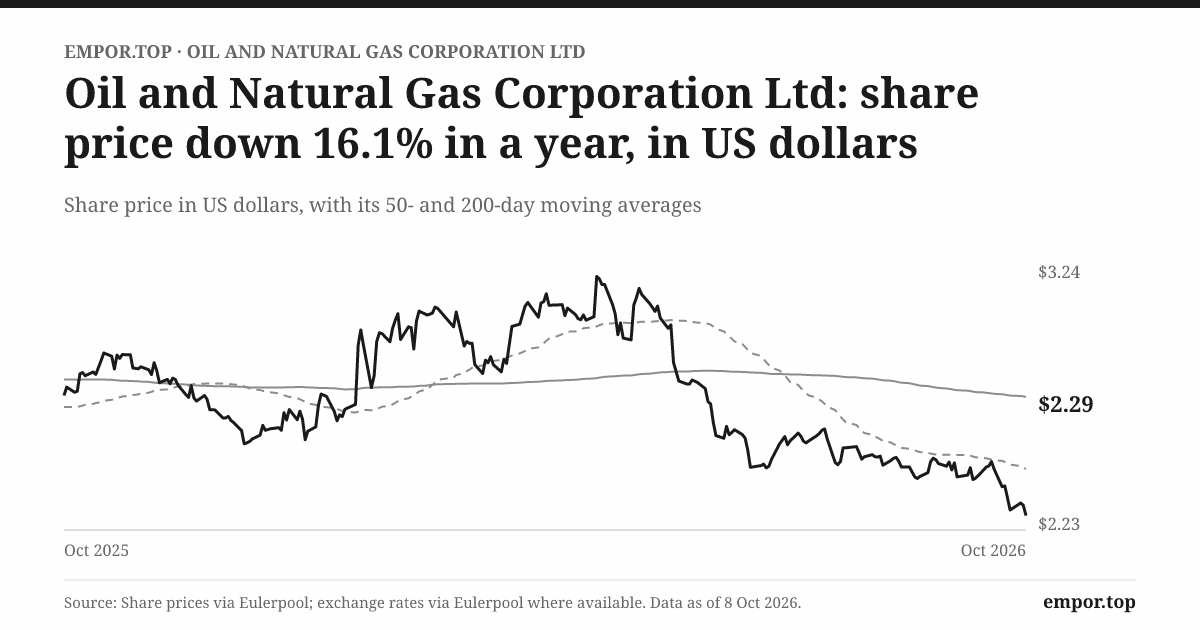
On October 8, 2026, ONGC's shares closed at about ₹221, about 27% below their 52-week high of about ₹301, and right at their 52-week low.2 The whole company was worth about ₹278,490 crore, or $28.8bn. Add net debt and other claims, and the enterprise value was about $43bn.2 For that price, an investor gets an operator producing most of India's oil and gas, majority control of a large refiner, a petrochemical complex and a portfolio of stakes in other state companies.
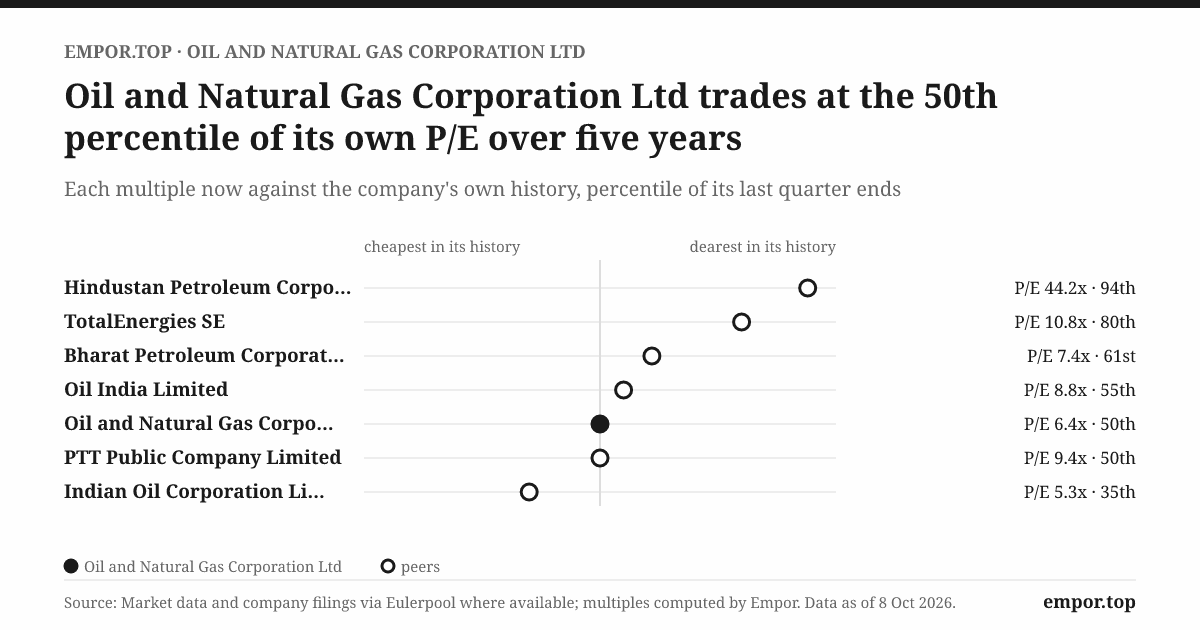
The valuation is low by every conventional yardstick. The shares traded at about 6.4 times trailing earnings, exactly their own five-year median, at about 0.7 times book value, and at about 4.6 times EBITDA.2 The dividend yield was about 6%, and the free cash flow yield about 12.7%.2 In other words, the market is not pricing ONGC as distressed. It is pricing it exactly as it always has: as a cash generator whose cash it does not fully trust.
The bull case starts with that cash. FY2026 operating cash flow of about $12.8bn against a $43bn enterprise value means the business generates its own value in a handful of years, and much of that cash has historically come back as dividends.2 The second leg is policy: with the windfall tax abolished in December 2024, ONGC once again realises something close to international prices on its domestic crude.[^9] The third is volume: if KG-98/2 reaches its targets and Daman Upside delivers, the decade-long slide in output could finally flatten. The fourth is replacement cost: the platforms, pipelines, refineries and terminals on the balance sheet would cost far more to build today than the market's valuation implies, so the price offers a cushion of hard assets.
The bear case is that every one of those strengths has been neutralised before. Geology first: despite spending billions a year, ONGC's domestic crude output has fallen from about 22 to 23 million tonnes to under 20 over a decade.[^3] Then the sovereign: whenever oil prices rise, the government has found a way to capture the gain, through subsidy burden-sharing in the 2000s, the windfall tax in 2022, or directed acquisitions such as HPCL in 2018 and the OPaL rescue in 2024.5[^9]9 Then the downstream bleed, which has pulled group return on invested capital down to about 11%.2 And finally, the energy transition: Indian oil demand is still growing, but long-cycle frontier projects sanctioned now must pay back in a world where electric vehicles and renewables steadily erode the demand for fuel.
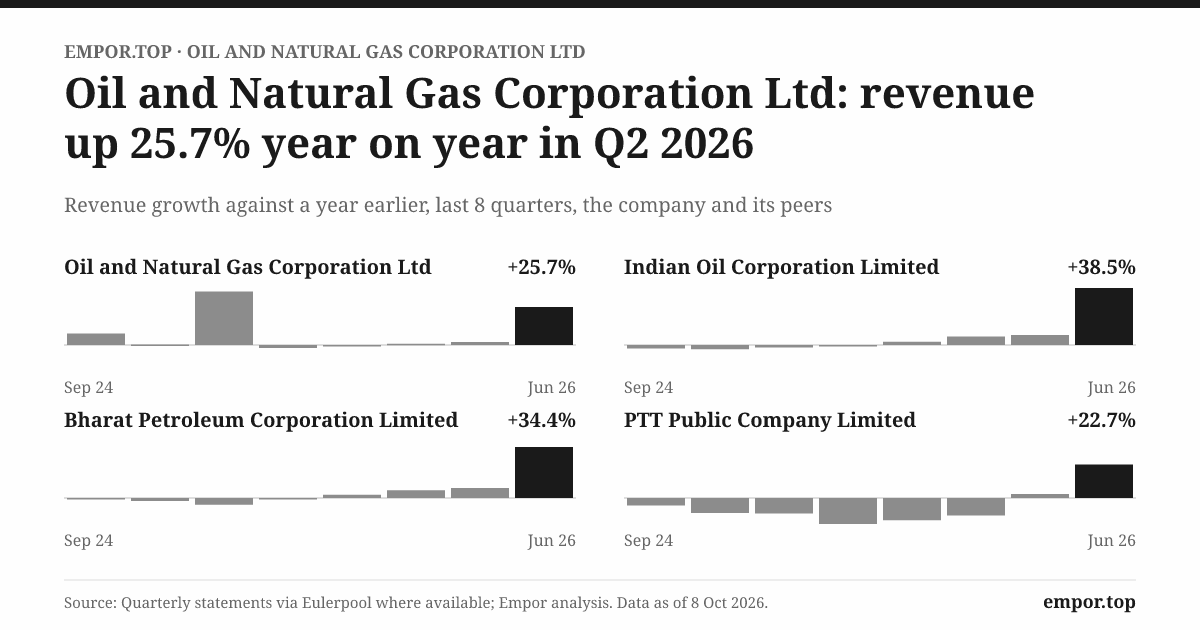
The quarterly numbers show the tension in real time. In the June 2026 quarter, consolidated revenue rose about 26% from a year earlier, while operating profit fell sharply and the operating margin dropped to about 10%.2 Net profit still grew, helped by an unusually low tax rate that quarter.2 Profit quality, in other words, can swing on items an investor does not control.
Against its peers, ONGC looks cheap but not uniquely so. Oil India, a smaller upstream producer with stronger volume growth from Assam, trades at around 8 to 9 times earnings, while integrated majors such as Shell, BP and TotalEnergies sit around 7 to 10 times.[^3] Petrobras offers a similar story of sovereign risk with its own record of state interference, and Saudi Aramco shows what a national oil company with superior geology and margins can command. ONGC trades at the bottom of that range, which is roughly where its history says it belongs.
Three numbers capture most of what matters. The first is standalone oil and gas production, which has been drifting down for a decade and is the test of whether the deepwater bet works. The second is free cash flow, about $8.1bn in FY2026 and rising, which shows how much cash survives the capital programme.2 The third is consolidated return on invested capital, about 11% and falling, which measures whether the downstream empire is earning its keep.2 The market is assuming these stay roughly where they are. Upside requires production to turn or returns to recover; downside requires another directed deal.
The verdict is balanced. The downside appears well cushioned by tangible assets and cash yield, but the multiple has a ceiling built into it, set by depletion and by the government's demonstrated willingness to call on the balance sheet. The lessons from this business reach well beyond one stock.
XIII. Playbook: Business & Investing Lessons
Picture the room where ONGC's board decides what to do with a year's cash. On one side of the table is a deepwater exploration programme: wells costing $100 million or more each, in water too deep to see the bottom, with perhaps a one-in-three chance of finding something worth producing. On the other is the dividend, much of which flows to a government that has schools, roads and subsidies to pay for. On a third side, unannounced, is whatever the ministry decides the company should buy next. Every lesson of ONGC comes out of that room.
The first lesson is that in extraction, cash is the truth and profit is an opinion. Over twelve years, ONGC reported about ₹344,000 crore of profit but generated about ₹829,000 crore of operating cash, because the cost of drilling yesterday's wells is charged against today's earnings.12 An investor who looked only at the P/E would have missed most of the story. In deepwater exploration, depreciation is an accountant's memory of past drilling; operating cash flow is the only reality that pays the dividend.
The second lesson is that sovereign ownership protects the perimeter and caps the ceiling. Being owned by the Government of India gives ONGC a AAA rating, cheap debt and a guarantee that no rival will be handed its best acreage.[^3] It has also meant discounted crude in the 2008 boom and a windfall tax in the 2022 spike.[^9] When you partner with a sovereign, you never go bankrupt, but you are never permitted to keep a windfall.
The third lesson is to beware the bailout dressed up as integration. HPCL was bought on a government deadline; OPaL was rescued on a lender's deadline.59 Both were described as strategy. Both loaded the parent with obligations it had not chosen. An upstream cash cow forced to buy a downstream processing plant rarely creates synergy; it simply provides a captive balance sheet to absorb other people's debts.
The fourth lesson is that geology always wins. ONGC has spent billions of dollars a year for a decade, and its domestic crude output has still declined.[^3] Capital can slow a field's decline and find new fields, but it cannot repeal the physics of a reservoir losing pressure. No amount of capital reinvestment can out-negotiate the natural decline of an oilfield.
For founders and operators, the wider point is that ownership defines the objective function. ONGC is run well enough to keep the lights on and the dividends flowing, and that is exactly what its owner wants. For investors, the lesson is to value a state company by what its controller needs, not by what its assets could earn under someone else.
XIV. Epilogue: The Next Frontier
Out in the Bay of Bengal tonight, engineers aboard the Armada Sterling V are watching pressure readings from wells on the seabed below. Their numbers matter more than any analyst's model, because the central question of the next two years is not where the oil price goes. It is whether ONGC's newest fields can do what Mumbai High once did, and lift the company's total production after a decade of decline.
Three moments will tell. The first is the production line in the FY2027 annual report, the combined standalone oil and gas output in million tonnes of oil equivalent. If KG-98/2 reaches its targets and Daman Upside delivers its extra gas, that number should rise for the first time in years, and the bull case on volumes becomes evidence rather than hope. If it does not, the depletion thesis tightens its grip, and the deepwater programme starts to look like an expensive way to stand still.
The second is the government's next move on gas pricing. A review of the APM gas regime is expected around January 2027. If New Delhi genuinely moves legacy gas toward market prices, ONGC's realisations on a large slice of its output would rise, and the argument that the sovereign always caps the upside would weaken. If it imposes a fresh ceiling, or brings back a windfall tax when crude spikes, the argument is confirmed once again.
The third is OPaL's balance sheet in FY2027. The 2024 restructuring was meant to leave the Dahej complex able to carry its own debt and cover its interest from its own earnings.9 If it does, the downstream drain may finally have been plugged. If OPaL needs another injection, investors will have their answer about whether these rescues end.
Above all of this hangs a change at the top. The CFO retired in May 2026, and Arun Kumar Singh's extended term as chairman runs to December 2026.1011 The ministry will choose his successor, as it always does. Whoever takes the chair will inherit an exceptional cash machine, an ageing set of fields, a newly owned petrochemical plant and a controlling shareholder with its own plans for all three. Whether the next leader can turn the production curve, while keeping the treasury's hands off the windfall, is the tension that remains.
XV. Outro: The Iron in the Arabian Sea
Sagar Samrat is still out there. The rig that struck oil in 1974 was rebuilt into a mobile offshore production unit, and it began producing again in December 2022, nearly half a century after its first discovery.3 At sunset its legs still stand in the waters of the field it found, pumping oil from beneath the sea floor for a country that was once told it had none.
Its crews drilled because a minister refused to believe the foreign geologists, and their gamble underwrote half a century of development. Today the company they built generates cash on a scale that funds a government, yet trades at less than the value of its own steel. That paradox is not a mispricing waiting to be corrected. It is the price of being what ONGC has always been: an instrument of national purpose that happens to have shareholders. ONGC was never designed to maximise returns for a single quarter. It was built so that when a nation of 1.4 billion people flips the switch, the lights stay on, whatever the price of oil.
References
-
Integrated Annual Report 2023-24 Filings — National Stock Exchange of India, 2024-08-07 ↩↩↩↩↩↩↩↩
-
Company Financial Profile, Ratios and Shareholding Trend — Screener.in, 2026-10-08 ↩↩↩↩↩↩↩↩↩↩↩↩↩↩↩↩↩↩↩↩↩↩↩↩↩↩↩↩
-
Minister of Petroleum and Natural Gas Rededicates ONGC's Iconic Sagar Samrat to the Nation — Indian PSU ↩↩↩↩↩↩
-
Historical Disinvestment and PSU Cross-Holding Policy — Department of Investment and Public Asset Management (DIPAM), 2024-01-15 ↩↩
-
Cabinet Approves Strategic Sale of 51.11% Government Stake in HPCL to ONGC — Press Information Bureau, 2018-01-31 ↩↩↩
-
Rating Rationale for Oil and Natural Gas Corporation Limited — CARE Ratings, 2024-10-09 ↩↩↩↩↩↩
-
India Approves New Domestic Gas Pricing Guidelines Based on Kirit Parikh Formula — S&P Global Commodity Insights, 2023-04-07 ↩
-
Audited Financial Results and Emphasis of Matter Notes — BSE Limited, 2024-05-20 ↩↩
-
Government Approves Major Capital Restructuring of OPaL — ONGC Petro additions Limited, 2024-08-12 ↩↩↩↩↩↩
-
Cabinet Committee Appoints Arun Kumar Singh as Chairman of ONGC — Press Information Bureau, 2022-12-07 ↩↩↩
-
Corporate Announcements and Director Finance Superannuation — TradingView, 2026-05-01 ↩↩
-
Post Buyback Public Advertisement for Repurchase of Equity Shares — SEBI, 2019-02-18 ↩
-
Shareholding Pattern Disclosures for ONGC as of Q1 FY27 — Rediff Money, 2026-06-30 ↩↩↩
-
Corporate Actions and Equity Share Split History — Angel One, 2026-10-08 ↩
-
Quarterly Financial Results and Shareholding Pattern — Upstox, 2026-03-31 ↩
-
Scrutinizer Report and Voting Results of 31st Annual General Meeting — National Stock Exchange of India, 2024-09-27 ↩
 LinkedIn
 WhatsApp
 Reddit
 Hacker News
 Email
 Kindle
 RSS Feed
 Spotify
 Apple Podcasts
 Amazon Music
 Audible
 YouTube