Pidilite Industries: The Chemistry of a Consumer Monopoly
I. The Carpenter's Whisper and the ₹1.5 Lakh Crore Glue
Picture a cramped woodworking shop in a Mumbai suburb. Sawdust hangs in the air, a half-finished teak dining table rests on trestles, and a supplier's salesman is making his pitch. His white adhesive costs about a fifth less than the blue-and-white tub on the shelf, and he promises it is just as good. The carpenter listens politely and says no. His reasoning takes about a second. The jar costs a few hundred rupees. The table belongs to a family that will pay him tens of thousands, tell their neighbours about his work, and call him back when their daughter's flat needs wardrobes. If a joint opens up in the monsoon, nobody blames the glue. They blame him. Saving a little on the jar puts his whole reputation at risk, so he keeps buying Fevicol.
That small refusal, repeated millions of times a year across India, is the economic engine of Pidilite Industries. Adhesives, sealants and waterproofing compounds usually make up a sliver of a renovation budget, often put at two or three percent, but when they fail the whole job fails: tiles lift, a ceiling stains, a cupboard door sags.[^1] The company has built its fortune in that gap between what the product costs and what its failure costs. And it has done it by marketing hardest to the person who does not pay for the product. The carpenter, the mason, the plumber and the waterproofing contractor choose the brand. The homeowner pays for it, and usually never sees it.
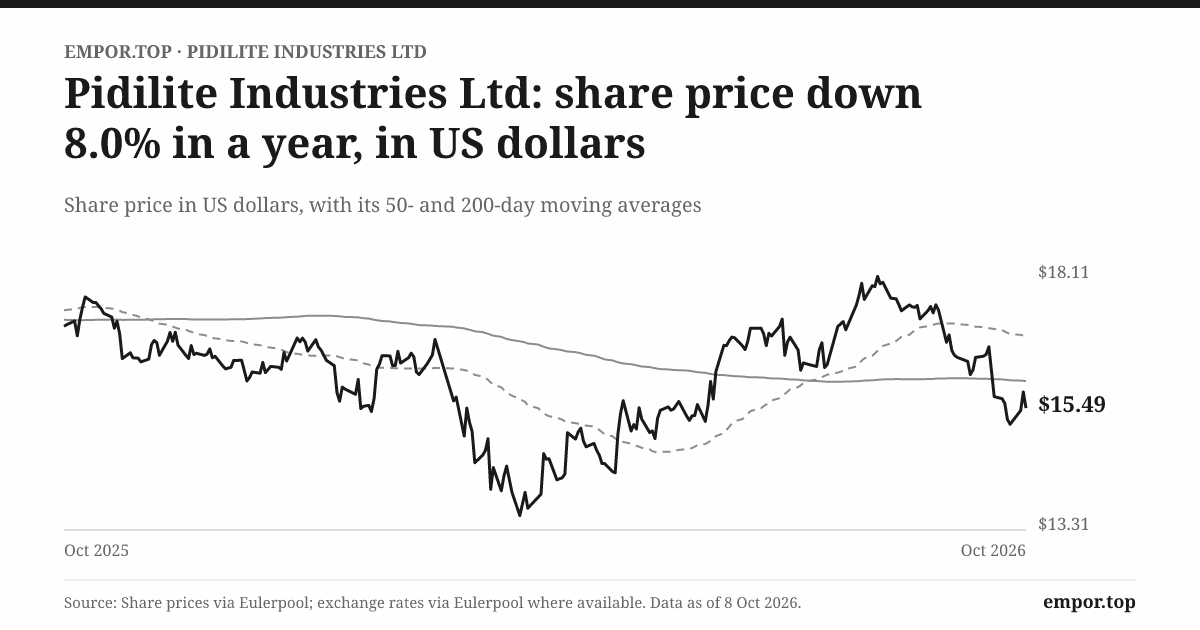
The scale that gap has produced is hard to overstate. On October 8, 2026 the stock market valued Pidilite at about ₹152,555 crore, roughly $15.8 billion, which is more than many of the world's diversified chemical groups that sell far greater tonnages.1 Consolidated revenue in the year to March 2026 came to about $1.7 billion, or well over ₹14,000 crore, and the products reach hundreds of thousands of retail counters across urban and small-town India.[^3] Fevicol is less a brand than the word Indians use for glue, and the company's white-adhesive franchise is widely estimated to hold the large majority of the organised market.[^1]
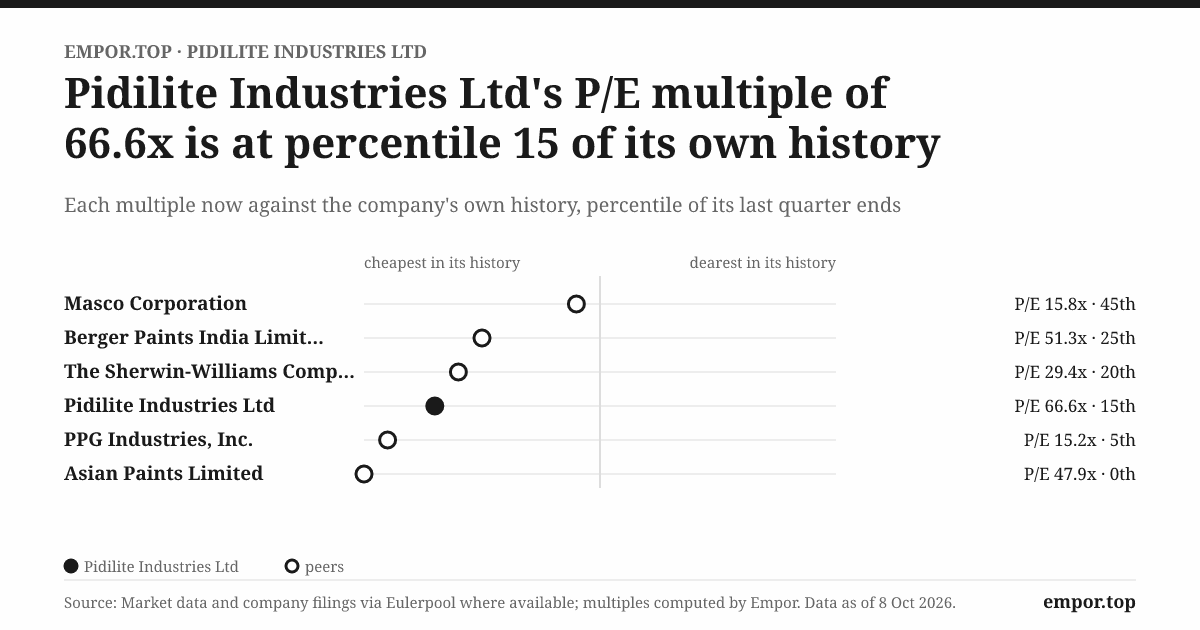
The quality of those earnings matters as much as their size. Over the twelve fiscal years from FY2015 to FY2026, Pidilite reported cumulative net profit of about ₹15,000 crore and generated about ₹16,900 crore of cash from operations, so it collected more cash than it booked in profit.[^3] Many Indian growth companies report profits that sit in receivables and inventory. Pidilite's profits arrive as cash. Investors pay for that: the shares traded at about 67 times trailing earnings on the story's date, a multiple more usually seen in luxury goods or software than in a business whose main raw material comes from a petrochemical plant.1
That multiple is the puzzle this story sets out to solve. It rests on four questions. The first is chemistry. Fevicol is made from vinyl acetate monomer, an imported petrochemical whose price can more than double within a year, so can volume growth keep outrunning those swings? The second is competition: Asian Paints, India's most formidable distribution machine, has moved into Pidilite's categories. The third is capital. Brazil, the Middle East and the industrial chemicals division have earned far less than the domestic consumer business, and the question is whether they will keep pulling down returns. The fourth is succession. Sudhanshu Vats became managing director in April 2025, and the question is whether he will keep the discipline Bharat Puri ran for a decade.[^4]
To answer them, the story starts where Pidilite started: a warehouse near Jacob Circle in Mumbai, a law graduate who would not practise law, and a smell Indian carpenters had lived with for generations.
 Subscribe on LinkedIn
II. The Peon in the Warehouse: Balvant Parekh's Radical Insight
Balvant Parekh was born in 1925 in Mahuva, a small coastal town in Gujarat's Saurashtra region, into a family of modest means.2 He went to Mumbai to study law, but the freedom movement got to him first, and as a young man he joined the Quit India agitation instead of his classes.2 He did finish his law degree, then made the decision that shaped the rest of his life: he would not practise. He later explained that advocacy seemed to demand bending the truth, and he could not bring himself to do it.2 A law graduate with no practice, a new wife and no money had few options in post-Independence Bombay. He took a job at a dyeing and printing press, then as a peon in a timber merchant's office, and for a time the couple lived in a warehouse because they could not afford a flat.2
The timber merchant's office mattered more than it seemed. Parekh spent his days around wood and the men who worked it, and he saw how Indian carpenters joined furniture. The standard method was saresh, a glue made by boiling animal hides, bones and other slaughterhouse waste. It had to be heated over a fire on site and applied while scalding hot. It stank, it set unpredictably, and it gave the craftsman almost no time to adjust a joint.[^1] A carpenter who wanted a strong bond had to tend a pot of melting animal fat for hours. In the late 1940s and early 1950s this was simply how things were done. Almost no one imagined an alternative.
Parekh's way out came through trade rather than invention. In 1954 he and his brother Sushil became partners in Fedco, a firm that represented the German chemical giant Hoechst in India and dealt in dyes, pigments and industrial chemicals.2 Packing imported dyes in Jacob Circle taught Parekh two things. The first was that synthetic polymers were transforming industry in Europe, and that polyvinyl acetate emulsions in particular, milky white liquids that dried into a hard, clear bond, were replacing animal glues there. The second was that India had essentially no domestic production of such adhesives. The opportunity was not to discover a new molecule. It was to bring an existing one to a country that had never had it in a form that suited it.
In 1959 the brothers incorporated Parekh Dyechem Industries and began making a white synthetic resin adhesive. They called it Fevicol.2 The commonly told origin of the name joins "Fevi", a nod to their German partners, to "col", from the German kollen, to stick, the root behind the German word for glue.2 The product ran on one idea: it was ready to use. No fire, no boiling, no smell. A carpenter opened the jar, spread the cream and clamped the joint. Fevicol was also formulated for Indian conditions, for heavy humidity, local timbers and the way Indian workshops actually ran, rather than copied from a European recipe.[^1]
The myth says Fevicol was a hit from the first jar. The record says otherwise. Synthetic glue was alien. Hardware dealers and timber merchants did not want to stock a product nobody asked for, and the carpenters who would have asked were traditional, often unschooled, and understandably wary of trusting their livelihood to a white cream from a factory.[^1] A carpenter's skill with saresh was part of his craft. A new glue threatened to make that skill worthless, and a failed joint could cost him a customer. The obstacle was not price or availability. It was trust, held by a few hundred thousand individual craftsmen who did not read advertisements and did not take advice from strangers.
That is where Parekh's real insight lies, and it is a marketing insight rather than a chemical one. He worked out that his customer was not the furniture-factory owner or the homeowner who paid the bill. It was the man holding the chisel. Win him, and he would carry the brand into every home he worked in. Lose him, and no amount of retail stocking would help. The company renamed itself Pidilite Industries in 1969, but by then the essential strategy had already been decided.3 Fevicol would grow not by advertising to buyers but by recruiting, one workshop at a time, an army of the people who specify the product.
III. The Carpenter Club: Building Distribution Through Influencers
The scene that defined Pidilite's first two decades was not a television commercial. It was a tea stall. Imagine a small Gujarati town in the 1970s: a Pidilite field representative gathers a dozen local carpenters, orders a round of chai, and puts two pieces of wood on the bench, one bonded with Fevicol and one with the old glue. He invites the strongest man present to pull them apart. That kind of hands-on demonstration, repeated in town after town, was the company's real advertising for years, because in the 1960s and 1970s print and radio barely reached the people Pidilite needed to convince.[^1]
The logic behind the tea stall was straightforward. A carpenter would not believe a newspaper. He would believe what he saw with his own hands, and he would believe another carpenter. So Pidilite's sales force spent its time on construction sites and in workshops, showing tradesmen how much time and mess the product saved, how much stronger a joint could be, and how a ready-to-use cream let a man finish more jobs in a week. Every carpenter persuaded became a small source of influence: when a homeowner asked what glue to buy, he named Fevicol, and the homeowner bought it.
Pidilite then handed the carpenter a tool that strengthened the habit. The company began publishing design catalogues, the Fevicol furniture books, full of pictures of modern sofas, beds, wardrobes and living-room units.[^1] For a craftsman whose customers often could not describe what they wanted, the book was a sales aid: he could open it in a client's living room, let the family pick a design, and win the job. Each page carried the Fevicol name, so the brand travelled into the home at the exact moment the purchase was being decided. A competitor could match the glue's chemistry. It could not easily match a publication the carpenter used to earn his living.
Over time the loose network became an institution. The Fevicol Champions Club gathered the most skilled and influential carpenters into a formal community, with meetings, training on new techniques and products, and welfare benefits for members and their families, which reports describe as including insurance and support for children's education.[^1] For a profession that was largely unorganised and offered little security, this was meaningful. It also tied the craftsmen's sense of status and community to a brand. The company built similar programmes for plumbers, masons and waterproofing applicators as it moved into other categories.[^7]
The effect on the retail counter followed. In a plywood or hardware shop, the dealer does not choose the brand. The carpenter walks in and asks for Fevicol by name, and a dealer who offers a cheaper substitute risks looking as if he is pushing a product because it pays him a better margin. That reverses the usual power dynamic between a manufacturer and its trade. Most consumer brands pay heavily for shelf space and dealer loyalty. Pidilite's distributors and retailers stock its products because their customers walk in asking for them, and the company's network today runs through thousands of distributors into hundreds of thousands of outlets.[^3]
The numbers show the result in a place outsiders rarely look: receivables. In FY2015 Pidilite's customers paid in about 46 days on average. The figure rose to about 71 days during the pandemic year of FY2021, when the whole trade was under strain, and then settled back at about 55 days by FY2026.[^3] For a company selling through a fragmented web of small traders, that is unusually tight, and the company's allowance for bad debts has stayed small.[^3] Dealers accept firm credit terms because Pidilite products are what bring tradesmen into their shops, and losing access to them would cost more than the credit is worth. Brand pull, in other words, shows up as working-capital discipline.
There is a caution here that every investor should keep. An influencer network is powerful because it is human, which also means it has to be maintained constantly and could be copied by anyone willing to spend years and money on it. The tea stall built the moat. Whether the moat survives competitors with even larger budgets is the question that runs through the rest of this story. First, though, Pidilite had to find out whether the trick worked a second time.
IV. The Piggyback Playbook: M-Seal, Fevikwik, and Dr. Fixit
Around the turn of the century, Pidilite bought a small brand from Mahindra & Mahindra that most investors had never heard of: M-Seal, an epoxy putty used to plug leaks in pipes and joints.[^1] In the Mahindra portfolio it had been a minor product. In Pidilite's hands it became a household fixture. The company presented it to consumers as the thing to grab when a pipe starts dripping at midnight: knead two compounds together, press the putty over the crack, and it sets hard, even on wet surfaces. Then Pidilite put it through the plumbing and hardware shops its network already reached and in front of plumbers, who play much the same role in their trade that carpenters play in theirs. M-Seal went on to dominate its niche in India.[^1]
M-Seal mattered because it proved the Fevicol method was a playbook rather than a fluke. The formula had four steps. Take a compound that already exists in industry. Repackage it in small, cheap consumer units. Teach the tradesman who uses it, through the same demonstrations and clubs. Then build mass awareness with advertising memorable enough that the homeowner learns the brand name too. Each step cost relatively little because the distribution and the relationships were already paid for. Each new product shared trucks, salesmen and counters with the ones before it.
Fevikwik, launched in the late 1980s, showed the packaging half of the formula.[^1] Instant cyanoacrylate glues had a well-known flaw: buy a tube to fix one broken sandal strap, and the rest of the glue hardened in the tube before you needed it again. Pidilite's answer was a tiny single-use pack sold for a few rupees, small enough to hang in strips at a village general store next to shampoo sachets. It turned an occasional industrial product into an impulse purchase, using the same small-unit logic that let Indian consumer-goods companies reach households with little spare cash.
Dr. Fixit, which grew into the company's waterproofing and construction-chemicals brand from the early 2000s, was the bigger bet.[^1] Waterproofing in India had been a specialist engineering job, sold to builders through technical contracts. Leaking roofs and damp walls, on the other hand, are a near-universal complaint in a monsoon country. Pidilite turned waterproofing into a retail product: compounds a mason could mix into cement or paint onto a terrace, sold from a hardware counter, with a friendly expert-doctor character on television explaining why seepage should be treated before it ruined a house. The company backed the brand with applicator training and site support, so that the mason, not just the homeowner, learned to ask for it.4
Advertising lifted all of it into popular culture. Pidilite's long relationship with Ogilvy produced Fevicol films that many Indians can still describe: an overcrowded bus in the countryside whose passengers stay on despite every bump, an egg that will not break, a sofa handed down through generations, each a joke about a bond that never fails.[^1] The humour made a dull category memorable, and the advertising did something the tea stall could not: it told the homeowner that this name meant safety. When the carpenter recommended Fevicol, the customer already trusted it. The two channels supported each other.
By the mid-2020s the consumer and bazaar business, the products sold through the retail trade to tradesmen and households, made up roughly four-fifths of Pidilite's revenue.[^3] The business-to-business division, which sells industrial adhesives, pigments and resins to manufacturers, made up the rest. That mix is the clearest sign of what kind of company Pidilite became. It is formally a chemical manufacturer, but most of its money comes from branded products that behave more like toothpaste than like commodity resins.
The playbook has a limit, and it needs saying here rather than later. Every product that worked shared three features: low cost relative to the job, high consequence if it fails, and a tradesman who chooses it. Where one of those was missing, the formula worked far less well. And all of those products, Fevicol above all, depend on raw materials Pidilite does not control, which is where the moat met its most persistent enemy.
V. The Vinyl Acetate Monomer Trap: Surviving the Petrochemical Cycle
Early 2022 was a bad time to be a glue maker. Crude oil prices spiked as the war in Ukraine began, petrochemical supply chains that had barely recovered from the pandemic seized up again, and the price of vinyl acetate monomer, the building block of Fevicol, which India imports largely in dollars, surged. Over the cycle, VAM prices have swung between roughly $800 and $2,200 a tonne.5 For Pidilite, whose main products are mostly VAM with water and additives, a move like that is not a nuisance. It strikes straight at gross margin.
The chemistry makes the risk plain. Polyvinyl acetate emulsion, the white cream in a Fevicol tub, is made by polymerising VAM in water. India has no domestic VAM supply of meaningful scale, so Pidilite buys on world markets, and its cost rises with crude, with the rupee and with each plant outage in China, Taiwan or the United States.5 Pidilite's biggest structural vulnerability is not a competitor. It is a single molecule whose price it cannot set.
The common claim about Pidilite is that its brand makes it immune to such shocks: the carpenter does not care about price, so the company simply passes costs on. The record says something more limited. In FY2021, before the squeeze, operating margin was about 36 percent. Over FY2022 and FY2023 it fell to about 28 percent, and net margin dropped from about 15.5 percent to under 11 percent.[^3] Net profit barely grew across those two years even though revenue rose by more than half.[^3] Pidilite did raise prices, repeatedly. But it raised them in steps over several quarters, and its margins took the hit in the meantime.
The lag is partly a choice. Pidilite's management has repeatedly said that it prefers to pass on input inflation gradually, protecting volume and its share of the market rather than defending margin quarter by quarter.[^7] The strategic logic is tough on competitors: smaller regional glue makers without bulk buying or cash reserves suffer much more when VAM spikes, and a market leader that holds prices down for a while can let that pain thin the field. It is a sensible strategy for a dominant player. But it is a choice to absorb the shock, not proof of immunity, and the shareholder pays for it in the meantime.
What came next is the other half of the cycle. As VAM prices eased from their peaks, margins recovered sharply: operating margin climbed back to around 34 to 36 percent in FY2024 and FY2025, and net profit grew by more than a third in FY2024 alone.[^3] Pidilite then did something that confuses anyone looking only at the headline revenue line. It cut prices, handing part of the raw-material gain back to buyers to support volume.[^7] That is why revenue grew only about 7 percent a year from FY2023 to FY2026, even as management reported double-digit underlying volume growth in several quarters and net profit compounded at more than 24 percent a year.[^3] Volumes were rising strongly. Prices per unit were falling.
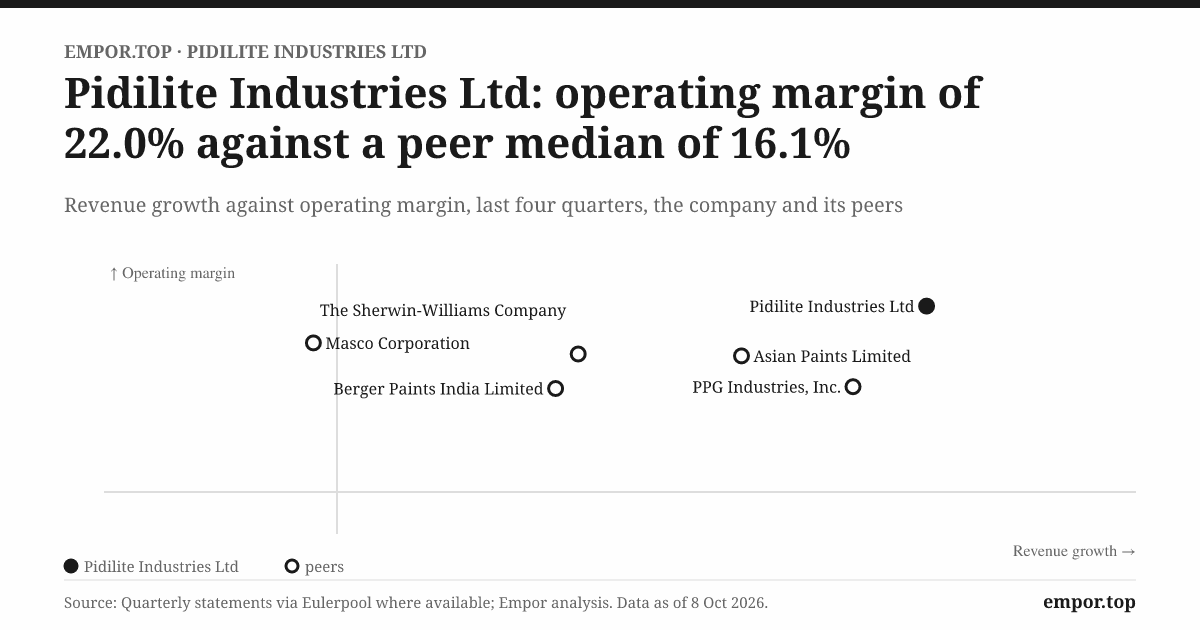
A careful reader should also understand what the latest figures do and do not show. On the reported numbers, operating margin appears to drop from about 36 percent in FY2025 to about 22 percent in FY2026, and the quarterly series shows the drop happening suddenly from the September 2025 quarter onward.[^3] That would be a squeeze worse than 2022, except that every other profit line points the other way: profit before tax rose, net margin rose to about 17 percent, the highest of the twelve years, and EBITDA reached a new high.[^3] A real squeeze cannot raise net margin. The step change looks like a change in how costs are classified in the operating line, not an economic collapse, and the margins investors should watch are gross margin and EBITDA margin, which Pidilite reports every quarter.6 The real VAM squeeze in recent memory was the one in FY2022 and FY2023, and the company came through it.
Did the price increases drive tradesmen to cheaper brands? The evidence points against any lasting damage. No single customer is anywhere near a tenth of sales, so no buyer can push back on price, and volumes recovered quickly once pricing steadied.5 The verdict is a narrower version of the popular one: Pidilite's pricing power is real over a cycle of two to four quarters, but not quarter by quarter. A VAM spike will compress its margins again. The question is how much and for how long. If cash conversion and the balance sheet absorb those shocks, they matter less, and that leads to the money.
VI. The Capital Allocation Balance Sheet: Profit into Cash
Imagine an analyst at one of Pidilite's investor meetings asking a pointed question. The company's core business earns returns on capital in the high twenties, about 28.5 percent in FY2026, measured on capital employed.[^3] Yet it sits on more than ₹4,200 crore of cash and investments earning bond-fund yields in the mid single digits.[^3] Why keep money in a fund earning perhaps seven percent when the business earns four times that? The answer, and the tension inside it, says a lot about the Parekh family's idea of a well-run company.
Start with where the cash came from. Over FY2015 to FY2026, Pidilite generated about ₹16,900 crore from operations, more than its cumulative net profit.[^3] Part of that surplus is simple depreciation added back. Most of it reflects working-capital discipline: the cash conversion cycle, the days between paying suppliers and collecting from customers, shortened from about 88 days in FY2015 to about 64 days in FY2026, mainly because inventories became leaner.[^3] A business that ties up less money as it grows can fund its own expansion without borrowing, and Pidilite has.
The reinvestment has been steady rather than dramatic. Capital spending has typically run at a few percent of sales, spent on new plants, regional hubs and automated packaging lines, and net fixed assets roughly doubled in dollar terms over the twelve years.[^3] There was no single huge factory that went wrong, no greenfield petrochemical plant to secure VAM, no grand vertical integration. After capex, the company produced about ₹12,500 crore of free cash flow over the period.[^3]
Shareholders received a little under half of that, about ₹5,900 crore, in dividends.[^3] Payouts have varied: the median year paid out about 37 percent of profit, FY2020 paid out nearly three-quarters, and FY2026 paid about 62 percent.[^3] There was also a buyback: in 2018 Pidilite repurchased five million shares at ₹1,000 each, about ₹500 crore.7 The company has issued bonus shares three times, most recently a one-for-one issue in September 2025, which changes the share count but not anyone's economic stake.7 Over the past decade there has been no dilutive equity raise, and promoters have pledged none of their shares.7
So where did the rest go? About ₹3,800 crore of it went into growing the cash and investment pile, from about ₹400 crore at the end of FY2014 to about ₹4,200 crore at the end of FY2026.[^3] Some went into acquisitions and investments. The pile itself sits in high-quality debt funds, certificates of deposit and bank deposits, not in equities or speculative paper.5 Borrowings, mostly lease liabilities and working-capital lines, came to about $47 million against roughly $505 million in cash and investments, so the company has substantial net cash.[^3] CRISIL rates its debt AAA, its highest grade, and cites this near-absence of debt as a key strength.5
Governance is equally clean on the points that usually trouble investors in Indian family companies. The listed company owns the Fevicol, Fevikwik, M-Seal and Dr. Fixit trademarks itself, so there is no royalty flowing to a promoter-owned entity, a common leakage in Indian consumer companies controlled by multinationals or families.[^3] Related-party dealings are mostly with Pidilite's own subsidiaries and charitable trusts.[^3] There are tax disputes, as at most large Indian manufacturers: in February 2025, for example, the Mumbai South CGST commissionerate imposed a penalty of about ₹16 crore relating to FY2017-18, which the company is contesting.8 Disputes of that size are small against annual profits of more than ₹2,500 crore.
The activist's challenge remains. A cash pile that grew roughly tenfold, earning well below what the business earns, dilutes return on equity, and Pidilite's ROE has drifted from the high twenties to the low twenties over the decade.[^3] The family's answer, implicitly, is that a cash cushion lets it absorb VAM spikes, fund opportunistic acquisitions and never depend on banks. That is a defensible view, but it carries a cost, and it raises an obvious follow-up: the money the company did spend outside its core, how well has that spending done?
VII. The International Drain and B2B Friction
Somewhere in Pidilite's quarterly reviews, the executive committee gets to the overseas pages. They tend to make for short, uncomfortable reading. Pulvitec do Brasil, a Brazilian adhesives maker Pidilite bought in the 2000s, and the company's Middle East and other overseas units have been mentioned in CRISIL's rating reports for years, always under the same heading: subdued profitability that weighs on the group.5 Two decades after Pidilite first went abroad, its overseas business is still a footnote to the Indian one.
The record across those years is the strongest test of a common belief about Pidilite: that its moat is a transferable capability, a playbook it can run anywhere. The company has tried in Brazil, the Gulf, Egypt, Thailand, Bangladesh, Sri Lanka and the United States.3 Some units, in neighbouring South Asian markets with trade structures like India's, have done reasonably well. But none of the larger efforts reproduced anything like the Indian economics, and the rating agency's repeated warning about weak returns from international subsidiaries is the clearest outside verdict on them.5
The reasons are structural, not just executional. In developed markets, adhesives are sold through large DIY chains and big-box retailers that control the shelf and negotiate hard on price, and home improvement is often done by homeowners rather than hired craftsmen. The influencer whom Pidilite wins in India barely exists there. In other emerging markets, multinationals such as Henkel, Sika and Bostik arrived decades earlier and own the relationships with contractors. Pidilite's moat is not a recipe. It is the result of sixty years of tea stalls in a specific country, and it does not travel.
The domestic business-to-business division raises a different version of the same question. It sells industrial adhesives, textile and leather chemicals, pigments and resins to manufacturers, and accounts for roughly a fifth of revenue.[^3] Here the buyer is a factory purchasing manager with a spreadsheet, not a carpenter guarding his reputation, so the economics look like a normal chemical business: lower margins, more cyclicality and more bargaining power for the customer. Pidilite's segment disclosures consistently show the B2B business earning thinner margins than consumer and bazaar.[^3] It is a respectable business, but it is not a monopoly.
Then come the bets outside chemistry altogether. Pidilite has invested in home-interiors platforms such as HomeLane, reasoning that whoever controls the modular-kitchen and wardrobe project also influences the adhesive inside it.[^1] It has bought businesses to fill gaps, from tile adhesives to construction chemicals, and in 2023 it agreed to buy the Indian rights to the Araldite epoxy brand from Huntsman.6 Some of these purchases extend the core playbook neatly. Others are strategic options whose returns the company does not break out, which makes them hard for outsiders to judge.
The headline figures need the same caution here as the margin figures did. Measured on invested capital, returns appear to fall from about 52 percent in FY2025 to about 34 percent in FY2026, but that figure rests on the same operating-profit line that changed definition in that year, while return on capital employed actually rose.[^3] The more lasting story is the long drift: invested-capital returns ran in the fifties and sixties in the late 2010s and sat lower through the 2020s as the asset base, acquisitions and the treasury grew faster than operating profit.[^3] So the verdict on expansion beyond the Indian consumer core is that it has diluted returns without building pricing power anywhere else. The evidence that would change that verdict is simple: a segment disclosure showing the overseas units earning their cost of capital. And at home, the true test of the moat was coming from someone with even deeper pockets.
VIII. The Paint Giants Strike Back: Defending the Moat
India's paint dealers will tell you that in the early 2020s, a new kind of product began to appear next to the tinting machines. Asian Paints, the country's largest paint company and a distribution machine of its own, had built its SmartCare waterproofing range into a serious business and then moved into adhesives, offering dealers attractive terms to stock the full line.4 The logic in Asian Paints' boardroom was easy to follow. Pidilite's categories were growing, the margins were rich, and Asian Paints already sold to the people who finish Indian homes. On paper it looked like the most dangerous challenger Pidilite had ever faced.
The competition came from several directions at once. Berger and Kansai Nerolac pushed their own waterproofing products. Astral, a pipe maker with a strong plumbing network, built an adhesives business. Multinationals including Sika fought for construction chemicals in big projects.4 For Pidilite, whose growth had depended on carrying the Fevicol playbook into adjacent categories, competition in those adjacent categories was the obvious threat. Its lead in white adhesives was decades old. In waterproofing and tile adhesives it was younger, and so less secure.
The paint companies' theory had a weakness, and it lies in the channel. Paint is sold through paint shops, where dealers mix colours on tinting machines. White wood adhesive is mostly bought at plywood, timber and hardware counters, where the carpenter buys his boards. Asian Paints' dealer network gave it a head start in waterproofing, which painters apply near the end of a job, but much less in wood adhesives, where the carpenter walks into a store Asian Paints barely serves and asks for the product he has used all his life.4 Owning the paint dealer and owning the carpenter turned out to be different things.
The applicator's psychology adds a second barrier. A mason or waterproofing contractor who uses an untested compound bears the full downside if it leaks: the homeowner calls him, not the manufacturer, and he loses the next three referrals. If he uses Dr. Fixit and the terrace still leaks, he can blame the building, because he chose the brand everyone recognises. This is the old saying that nobody gets fired for buying IBM, applied to a man with a trowel. A higher dealer margin does nothing for the applicator, which is why a dealer-led push struggles against an applicator-led brand.
Pidilite also attacked in return. It has pushed into wood finishes, tile adhesives under the Roff brand, and, in a small way, paints under Haisha, using its carpenter and mason networks to sell products closer to the paint companies' territory.[^7] There is an asymmetry worth noting: a glue company that already owns the craftsman can move up toward paint more easily than a paint company can move down to the craftsman. Whether Pidilite's paint venture becomes more than an irritant to the incumbents is unproven, and it should be treated as an option rather than a pillar of the case.
The honest scorecard is mixed rather than triumphant. There is no evidence that Pidilite lost meaningful share in its core adhesives categories, and its consumer volumes kept growing strongly through the period when Asian Paints was pushing hardest.6 Waterproofing is a tougher fight: the competition is real, the category is still being built, and it is the part of the portfolio where Pidilite's dominance is least certain.4 The cost of defence shows up less in price cuts than in spending: more feet on the ground, more applicator schemes, more advertising. The thing to watch is whether advertising and trade spending rise as a share of sales over the next few years. So the moat has held where it is oldest, but the frontier still has to be defended, and it will be led by a new general.
IX. Professionalization and Succession: From Bharat Puri to Sudhanshu Vats
In April 2025, Pidilite's shareholders received an announcement that would make investors nervous at most Indian family companies. Bharat Puri, managing director for a decade, was stepping down from his executive role, and Sudhanshu Vats would take over as managing director from April 10.[^4] There was no boardroom drama, no surprise exit, no activist pressure. Puri moved to a non-executive seat on the board, and Vats, who had been groomed for the job inside the company, stepped up.[^13] For a family business, it was an unusually orderly handover.
The story behind that handover goes back to the founder. Balvant Parekh led Pidilite until the family's second generation took over, with Madhukar Parekh, his son, as chairman and the steady hand for decades.2 The family's most consequential decision came in 2015, when it appointed an outsider, Bharat Puri, as managing director.3 Puri had spent most of his career at Cadbury and Mondelez running consumer businesses across Asia, which made him a confectionery man in a glue company. The hire was a statement: the family had decided Pidilite was a consumer-goods company that happened to make chemicals, and wanted it run like one.
The Puri decade largely bore that out. He brought the analytical machinery of a multinational consumer company, with sharper data on distribution, segmented marketing, and a push into smaller towns that Pidilite called "Rurban", the semi-urban and rural India where many of its categories were barely present.[^1] Revenue grew at about 10 percent a year and net profit at about 12 percent over his tenure, despite a pandemic and a severe VAM shock.[^3] Puri was well paid, at about ₹17.5 crore in FY2024, within the statutory limits for directors' pay.7 Those growth rates were respectable rather than spectacular, but the business he handed over was bigger, more diversified and better run than the one he inherited.
Vats arrived with a different résumé. He had worked at Hindustan Unilever before building a career in media, eventually running Viacom18, the television and entertainment group, before joining Pidilite.[^13] His media years matter: he knows how to build mass brands and how to manage creative businesses, both relevant for a company whose advertising is part of its moat. His first full year, FY2026, showed record net profit, the bonus issue and the highest dividend payout in six years.[^3] It is too early, though, to tell what mark he will leave on strategy.
Governance through the transition has been calm. The promoter family holds about 70 percent of the shares and has not sold meaningfully in the market.7 The board has prominent independent directors, and shareholder resolutions at the company's annual meetings have generally passed with very large majorities.7 Family members sit on the board but the operating business is run by professional managers, a separation many Indian family companies talk about and few practise.
The real test of a new chief executive, though, is capital, not continuity. The temptation facing Vats is obvious: a large cash pile, a share price that has de-rated, and pressure to reignite top-line growth. That combination often pushes managements toward large acquisitions. The settling evidence will be whether payouts stay generous and capex stays within its historical range under his leadership, or whether money starts to move into lower-return businesses far from the core. Judging that requires knowing what the core is worth, which means looking at the moat as a strategist would.
X. Hamilton Helmer's 7 Powers & Porter's 5 Forces: The Adhesives Fortress
Imagine a business school case discussion. A slide shows two companies that make similar chemistry: one of the world's largest adhesives makers trading at a mid-teens earnings multiple, and Pidilite trading at about 67 times.1 The professor asks the class why the same molecules earn such different rents. The answer is not in the chemistry. It is in the structural advantages Hamilton Helmer calls "powers", the conditions that let a company earn persistent returns above its cost of capital.
Branding is the most obvious power, and in Pidilite's case it is unusually deep. Helmer's definition is a brand that earns a higher price simply because of what buyers believe about it, and Fevicol fits it closely: in a category where failure is costly and quality is hard to judge in advance, the name stands for safety, and it has become the generic word for glue.[^1] Branding power also grows slowly, which is why it is so hard to attack. Asian Paints can match the chemistry and the dealer margins tomorrow. It cannot buy sixty years of carpenters' memories.
The second power is what Helmer calls a cornered resource, and here the case needs care. The carpenter and applicator networks, the Fevicol Champions Club and its siblings, are proprietary in the sense that Pidilite built them and maintains them, but no contract stops a carpenter from attending a rival's meeting. The resource is cornered by habit and relationship, not by law. It is strong, but softer than a patent or a mining licence, and it has to be renewed constantly. Linked to it are switching costs, and here the asymmetry from the opening scene does the work: the economic saving from switching is a few percent of a small line item, while the risk to the tradesman's reputation is large.
The weaker powers deserve brief mention. Network economies are modest: the design books and clubs create social reinforcement, but a carpenter does not get more value from Fevicol because another carpenter uses it. Scale economies are real but secondary: bulk VAM buying and nationwide logistics let Pidilite make and ship a jar more cheaply than a regional rival, which matters most during a VAM spike. Counter-positioning is negligible against traditional glue makers but applies to pure industrial chemical companies, whose business models do not support the heavy consumer advertising and field forces Pidilite runs.
Porter's five forces tell the same story from the industry's side. The threat of new entrants is low, because reaching hundreds of thousands of counters and the tradesmen behind them takes decades. Buyer power is negligible, because no single customer comes close to a tenth of sales and retail buyers are scattered across the country.5 Supplier power is the outlier and the main vulnerability, since VAM supply is concentrated and its price set globally, as the 2022 squeeze showed.5 Substitutes are a minor threat, because nails and screws complement adhesives in furniture rather than replace them. Rivalry is real at the bottom of the market, where regional players compete on price, and getting more serious in waterproofing, but in core adhesives it is disciplined.
The valuation shows how the market prices those powers. At about 67 times trailing earnings, Pidilite trades well below its own five-year median of about 85 times, at roughly ten times sales and about 37 times EV to EBITDA.1 Against its closest Indian peers in building materials, it sits close to Astral and above Asian Paints, which traded in the high forties to low fifties on earnings at the time.9 The premium says the market believes the moat is real and long-lived. The de-rating from 85 to 67 says it has grown less sure about how fast the business can grow. Both judgements are reasonable, and the bull and bear cases turn on which one proves right. First, though, the lessons the story has earned.
XI. Playbook: Business & Investing Lessons
A young brand manager at a home-improvement company pitches a slick digital campaign: targeted video ads, influencer partnerships, a direct-to-consumer storefront. An older executive listens and asks one question. Who chooses the product? Not the homeowner scrolling on her phone. It is the mason on the job, and he does not see those ads. Buying tea for fifty contractors in a dusty town, the executive says, still beats the algorithm. That conversation sums up Pidilite's first lesson.
The first lesson is to market to the person who carries the risk, not the person who signs the cheque. Fevicol's whole franchise rests on the carpenter in the opening scene, who stands to lose a referral and to save a few rupees. When the specifier carries all the downside of failure and none of the upside of a discount, he becomes the least price-sensitive buyer in the economy. Pidilite's lesson in one line: win the man with the chisel and the wallet follows.
The second lesson is that the most valuable product in a project is often the smallest. Pidilite has thrived by selling the cheapest component whose failure ruins everything around it. The rule of thumb: when your product is two percent of the budget and one hundred percent of the disaster, you set the price. Founders hunting for pricing power should look for categories where their share of the bill is small and their share of the blame is total.
The third lesson concerns where not to go. Two decades of overseas expansion produced rating-agency warnings rather than new monopolies, because the moat was never a formula. It was a relationship with Indian craftsmen built over decades. The lesson for allocators: a moat dug in mud does not ship in containers. Before paying a premium for a company's international option, ask whether the thing that makes it win at home exists anywhere else.
The fourth lesson is that commodities can become brands. Polyvinyl acetate is one of the most ordinary industrial chemicals in the world, and Pidilite sold it at consumer-goods multiples. What a patent protects expires. What a carpenter remembers does not. The investor's version: when a company earns branded returns on a commodity input, find the human habit that makes it possible, and track it, because that habit is the asset.
The fifth lesson is about families. The Parekhs kept control, kept their trademarks in the listed company, and handed day-to-day management to professionals, first Puri and then Vats. The line for Indian family businesses: step back from the desk, never from the share register. Of the five lessons, it is the one the next decade will test hardest, because the inheritance is now a cash pile, a contested frontier and a stock priced for perfection.
XII. Analysis & Bear vs. Bull Case
Picture an investment committee in a Mumbai high-rise, three screens showing Pidilite, Asian Paints and Astral, a junior analyst making the case to buy and a senior partner pushing back. Both have the same facts: a company with one of the strongest consumer franchises in Indian business, pristine cash conversion and almost no debt, trading at about 67 times earnings, an earnings yield of about 1.5 percent and a ratio of price to growth near 2.75.1 The debate is not about whether Pidilite is a good business. It is about what the price already assumes.
The bull case begins with India's homes. Urbanisation, rising incomes and a renovation cycle in an enormous existing housing stock keep demand growing for furniture, modular kitchens, tiles and waterproofing, all of which use Pidilite products. Penetration in the newer categories is still low: waterproofing and tile adhesives remain far from universal in small-town India, which gives Dr. Fixit and Roff a long runway if the playbook keeps working.[^1] Bulls add that the 2022 squeeze showed the company can absorb a severe input shock, recover its margins and keep growing volumes, and that a balance sheet with substantial net cash removes most of the downside risks that sink cyclical companies.5 Finally, they point out that a multiple well below its five-year median is about as close to a discount as this stock has offered in years.1
The bear case starts with the top line. Revenue grew only about 7 percent a year from FY2023 to FY2026, and even if price cuts explain part of that, the bears ask whether core white adhesives in urban India are nearing saturation.[^3] They argue that VAM will spike again, and the next squeeze will meet a market with less patience. They point to competition in waterproofing and tile adhesives that is better funded than any rival Pidilite has faced, which could force higher spending on advertising and trade schemes.4 And they note that at an earnings yield of 1.5 percent, the stock leaves almost no room for error: a stumble in growth, a messy acquisition or a weak first year of strategy under Vats could reset the multiple far more than earnings.
Weighing the two, the evidence supports a narrower conclusion than either side's best version. The moat is intact in core adhesives and still being contested in waterproofing. Pricing power is real over a cycle but not in every quarter. Capital allocation is clean but conservative, with an expensive cash pile and a weak record abroad. A 67-times multiple does not require heroic growth, but it does require the volume engine to keep running at roughly the pace it has, and it gives no credit for any rerating. Returns from here are therefore likely to track the business's underlying growth rather than benefit from a higher multiple.
Three numbers will tell investors which side is right. The first is underlying volume growth in the domestic consumer business, which Pidilite reports every quarter and which has recently run in the high single to low double digits. It is the purest measure of whether the tea-stall moat is still pulling in new customers.6 The second is gross margin and EBITDA margin through the VAM cycle; recent quarters put EBITDA margin in the low-to-mid twenties, and the test is whether that holds when VAM next spikes.6 The third is the return on capital outside the domestic consumer business, where the company's own segment disclosures will show whether the overseas units and the industrial division stop diluting the whole. None of these is a forecast. They are the instruments to watch.
XIII. Epilogue
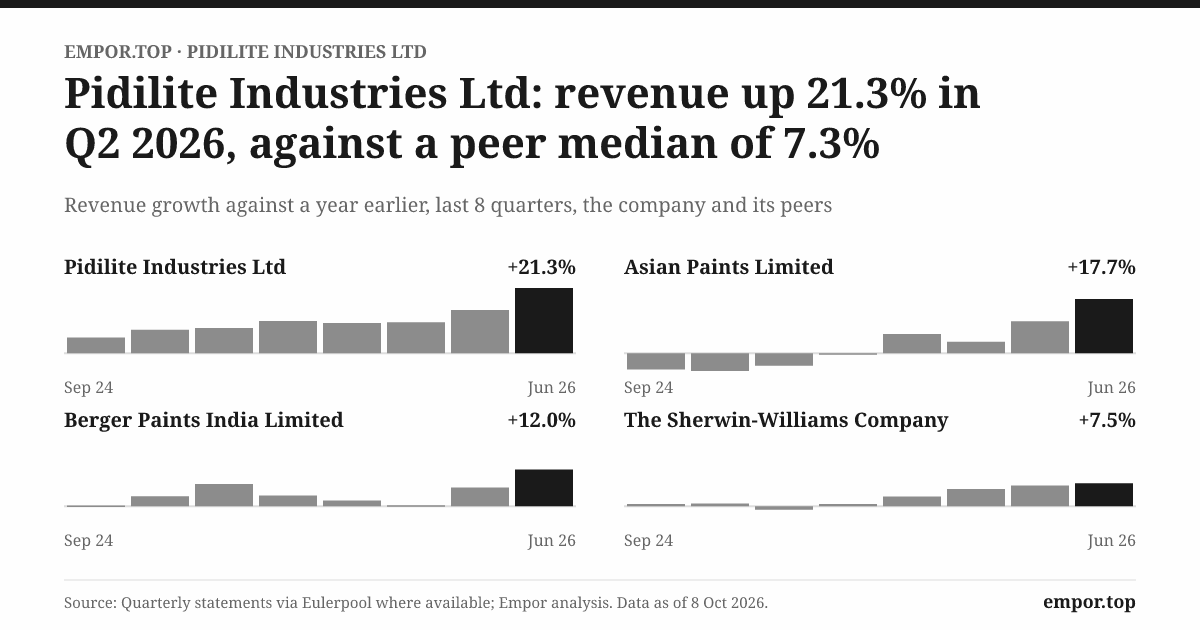
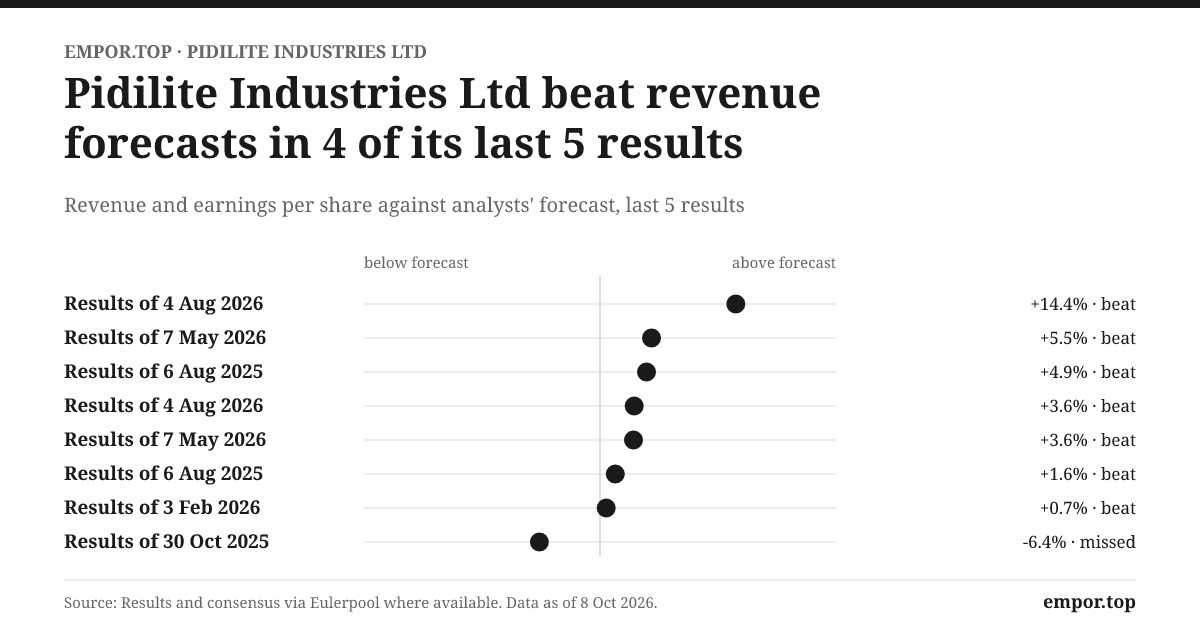
On the evening of October 8, 2026, Pidilite stands roughly where its story has led: a market value of about ₹152,555 crore, a share price around 12 percent below its 52-week high, about ₹4,200 crore of cash and investments, and a managing director well into his second year.1 The June 2026 quarter was strong, with revenue up about a fifth and net profit up about 30 percent from a year earlier, suggesting the price cuts have run their course and volume is again showing up in the top line.6 FY2026 paid out about 62 percent of profit in dividends, the most generous payout in years.[^3]
The next tests come quickly. The next quarterly results will show whether the June surge was a sustainable return to double-digit revenue growth or a one-off boost from a favourable comparison. If growth stays above ten percent with stable margins, the central question about VAM and volume will have its best answer in years. If it falls back toward mid-single digits, the bears' case about saturation will gain ground, and the multiple will feel it.
The competitive scorecard comes with each construction season. Investors should watch whether Asian Paints and the others report growing waterproofing and adhesive businesses alongside rising Pidilite volumes, which would suggest a growing market with room for several players, or whether one's gain is clearly the other's loss. In waterproofing, which is still a young category, the next few monsoons will matter more than any single quarter.
The capital question is the quietest and possibly the most important. Vats will decide over the next few years what to do with a cash pile that grows every quarter. Higher dividends, buybacks and domestic manufacturing investment would confirm that the culture survived the handover. A large acquisition overseas or in a commodity business would test it. The rating agencies will keep reporting on the international subsidiaries, and the segment notes in the next annual report will show whether those units are finally earning their keep.5
What remains is the tension that has run through this whole story: a company whose moat is human, exposed to a molecule it cannot control and rivals it cannot ignore, priced as if both risks are manageable. Tomorrow morning, in workshops from Ludhiana to Coimbatore, millions of craftsmen will reach for the blue-and-white tub, as they have for decades. The question for the next ten years is not whether they keep doing it. It is whether they keep doing it at a pace that justifies what investors are paying for the habit.
XIV. Outro
Step into a newly finished Mumbai apartment. The teak dining table stands solid, the tiles sit flush, the bathroom ceiling is dry after the first monsoon, and there is not a single drop of glue anywhere in sight. Everything that holds the home together is hidden, and the family that lives there may never know a carpenter, a mason and a plumber each chose a Pidilite product on their behalf.
Sixty-seven years after Parekh Dyechem was incorporated, the company still runs on that hidden choice. Balvant Parekh walked away from the law because he would not bend the truth, and then built a business on the simplest kind of truth a craftsman knows: a joint either holds or it does not. Competitors can copy the formulation, undercut the price and buy the shelf. What they cannot easily buy is six decades of trust, earned one cup of chai at a time. Pidilite did not build a chemical company that learned to market. It built a bond of trust with India's craftsmen that happens to come in a jar.
References
-
NSE Equity Stock Information and Filings: PIDILITIND — National Stock Exchange of India, 2026-10-08 ↩↩↩↩↩↩↩
-
How Balvant Parekh Built Fevicol into an Iconic Indian Brand — Forbes India, 2019-10-24 ↩↩↩↩↩↩↩↩
-
Pidilite Industries Limited Investor Relations Overview — Pidilite Industries, 2026-10-08 ↩↩↩
-
Asian Paints vs Pidilite: The Battle for India's Waterproofing Market — Moneycontrol, 2023-06-21 ↩↩↩↩↩↩
-
CRISIL Rating Rationale: Pidilite Industries Limited Reaffirmed AAA/Stable/A1+ — CRISIL Ratings, 2025-09-02 ↩↩↩↩↩↩↩↩↩↩↩
-
Corporate Announcements, Board Meetings and Financial Results — BSE India, 2026-07-06 ↩↩↩↩↩↩
-
Pidilite Industries Shareholding Patterns and Corporate Actions — Trendlyne, 2025-09-23 ↩↩↩↩↩↩
-
Tax Demand and Regulatory Dispute Disclosures: Mumbai South CGST Order — A2Z Taxcorp, 2025-02-20 ↩
-
Valuation Multiples and Peer Comparison: Pidilite, Astral, and Asian Paints — Alphave, 2026-10-08 ↩
 LinkedIn
 WhatsApp
 Reddit
 Hacker News
 Email
 Kindle
 RSS Feed
 Spotify
 Apple Podcasts
 Amazon Music
 Audible
 YouTube