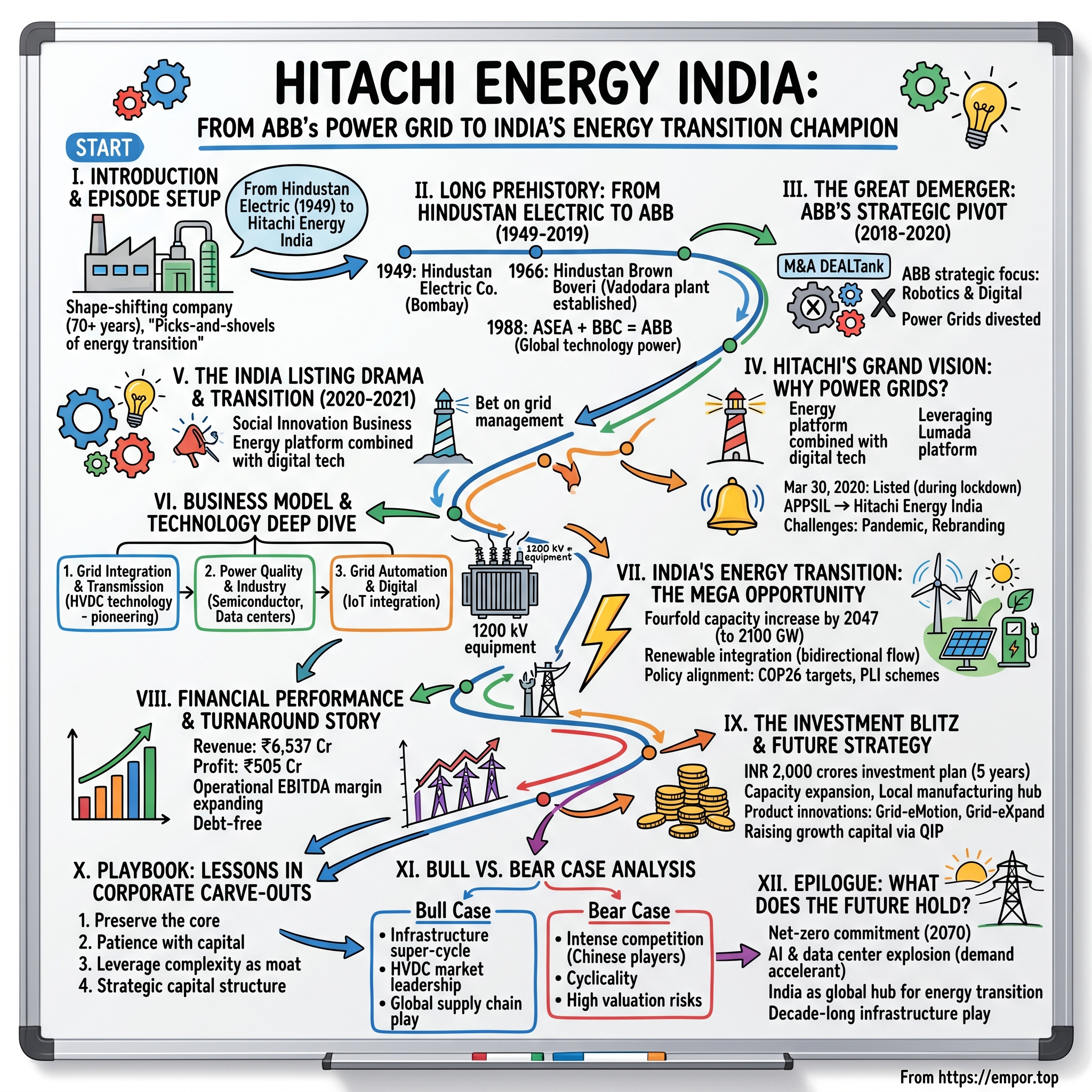
Hitachi Energy India: Riding the Grid Supercycle — From ABB's Orphan to India's Most Expensive Industrial Stock
I. Introduction & Episode Setup
A Very Expensive Metal Box
There is a stretch of industrial land on the outskirts of Vadodara, Gujarat, where the same manufacturing complex has wound copper around laminated steel cores since 1962. The work is unglamorous. A large power transformer is essentially a heavy, expensive metal box that steps the voltage of electricity up or down so power can travel long distances without wasting energy as heat. Building one takes months of manufacturing, weeks of testing, and decades of accumulated failure data to refine design safety.
Yet in August 2026, the company that owns that Vadodara complex — Hitachi Energy India Limited, trading under the ticker POWERINDIA — commanded a market capitalization of roughly ₹1.58 lakh crore ($18–19 billion) at a share price near ₹35,450.1 A year earlier, the stock traded as low as ₹16,104.1 The shares have compounded at approximately 74% over one year and 103% annually over three.1 Its trailing price-to-earnings multiple sits around 133x on Screener's calculation and higher under certain trailing-twelve-month conventions, against a book value of ₹1,161 per share — evaluating to more than thirty times book value for a business that makes metal boxes.1
Underneath the elevated valuation multiple, operating performance in fiscal year 2026 expanded significantly. Full-year revenue reached ₹8,147.7 crore, up 27.6% year over year, while profit after tax rose 157.3% to ₹987.8 crore. The order backlog as of March 31, 2026, expanded to ₹29,555.3 crore, up 53.5%.2 By June 30, 2026, the backlog reached a company record of ₹32,222.1 crore, supported by quarterly order intake of ₹5,096.5 crore.3 The balance sheet carries essentially no net debt.1 CRISIL rates the company's long-term bank facilities AAA/Stable.4
The Question Behind the Multiple
The strategic question is not whether the underlying enterprise is sound, but whether the business justifies its current valuation — and whether the composition of growth matches headline perceptions. Buried inside the same FY26 earnings release that highlighted the 53.5% backlog expansion was full-year new order inflow of ₹18,456.5 crore, compared to ₹18,174 crore the year before.25 That represents order inflow growth of roughly 1.6%. Revenue expanded nearly seventeen times faster than new order bookings. An order backlog typically expands for two distinct reasons: accelerating new order wins or slower project delivery. The arithmetic of FY26 indicates that a substantial portion of the backlog expansion stemmed from execution pacing rather than fresh order momentum.
Dissecting these operational mechanics clarifies the broader corporate trajectory. The following sections trace this full arc: a seventy-six-year lineage spanning two European engineering conglomerates; a carve-out priced at an $11 billion enterprise value that landed the Indian arm on the exchanges during the market collapse in March 2020; a specialized technology position in high-voltage direct current transmission; a national grid expansion that represents one of the largest infrastructure programmes in the democratic world; a capital expenditure plan funded by an equity raise that management has deployed deliberately; and a valuation that prices in a decade of flawless execution. Three themes guide this analysis: how to manage a corporate carve-out without weakening the engineering core, how industrial grid equipment became strategic infrastructure, and how investors should evaluate an industrial stock priced for perfection.
The analysis begins at the manufacturing site: Vadodara.
 Subscribe on LinkedIn
II. Origins, Compressed: From Hindustan Electric to ABB (1949-2019)
Seventy-Six Years in One Paragraph, and One Factory That Matters
The company's origin was strictly pragmatic. In 1949, two years after independence, Hindustan Electric Company was established to manufacture electrical equipment for a nation with negligible power generation capacity. The company later became Hindustan Brown Boveri, a joint venture reflecting the entry of Swiss engineering house Brown, Boveri & Cie — the firm whose initials remain embedded in the "BB" of ABB.
The Vadodara facility opened in 1962. That date remains the single most important milestone of this early era, serving as the anchor for the manufacturing complex around which the company is currently deploying a ₹4,000 crore capital expenditure program.6 Sixty-four years of continuous transformer production on one site has created a deep testing infrastructure, an established regional supplier network, and decades of empirical failure-mode data under local operating conditions — such as insulation stress at 45°C ambient temperatures during monsoon humidity. That operational history represents an institutional capability that new entrants cannot quickly replicate.
Corporate consolidation followed. In 1988, Sweden's ASEA merged with Switzerland's Brown, Boveri & Cie to form ABB, a Zurich-headquartered engineering conglomerate. The Indian operation was integrated into ABB India, turning the local transformer and grid equipment operations into a division within a multi-layered global enterprise.
What Four Decades Inside a Conglomerate Actually Built
Four decades inside a European engineering conglomerate built three structural capabilities that define the company's competitive position today.
First, an HVDC engineering pedigree. ASEA commissioned the world's first commercial high-voltage direct current link in 1954, connecting the Swedish mainland to Gotland. That capability passed to ABB, which introduced the technology to India. When CRISIL published its rating rationale in March 2025, it noted that the company had brought Hitachi-patented HVDC technology to India — highlighting that the core intellectual property is licensed from the parent company rather than developed locally.4 This distinction is critical to understanding the business model: the Indian listed entity operates as a localized manufacturing and execution platform sitting on top of intellectual property it does not own.
Second, deep manufacturing localization enforced by historical import restrictions. For decades, India's strict trade regime made domestic manufacturing mandatory for foreign industrial suppliers. Unlike sectors where protectionism resulted in inefficiency, this requirement compelled ABB to build comprehensive domestic manufacturing infrastructure. The resulting physical footprint would require significant capital and close to a decade for a new market entrant to replicate.
Third, an extensive track record of pre-qualification references and certified testing. High-voltage grid equipment is not purchased on spec sheets alone; utilities require short-circuit withstand tests, type-test certifications, and years of fault-free field operation before awarding contracts. Because a failed transformer can take down an entire substation and a converter station fault can destabilize a regional grid, procurement authorities face asymmetric downside risk. Consequently, utilities strictly require proven track records, creating a formidable barrier to entry. In strategy terms, this represents a combination of a cornered resource and process power — operational know-how and institutional trust accumulated over decades that money alone cannot buy.
By 2018, the power grids division sat within ABB as a technically formidable but capital-intensive unit that group leadership viewed as non-core. ABB sought to reposition itself around higher-margin, shorter-cycle robotics and factory automation. Power grids offered the opposite profile: long project cycles, heavy working capital requirements, lumpy revenue recognition, and exposure to state utilities with troubled balance sheets.
That strategic mismatch created the opportunity for a buyer with a longer investment horizon to step in.
III. The Carve-Out: How ABB's Power Grids Became Hitachi Energy (2018-2021)
The $11 Billion Question
On December 17, 2018, Hitachi, Ltd. and ABB signed an agreement under which Hitachi would acquire an 80.1% stake in ABB's Power Grids division.7 The headline price for that majority stake was approximately $6.85 billion, against a transaction enterprise value of $11 billion for 100% of the business.7 The deal closed and the joint venture — initially branded Hitachi ABB Power Grids — launched on July 1, 2020.8 ABB retained the remaining 19.9% stake for a transitional period before Hitachi assumed full ownership, and the global business was rebranded as Hitachi Energy in October 2021.
Whether $11 billion represented a bargain or an overpayment is the central benchmark question of the transaction.
The bear case at the time was straightforward. ABB was shedding a business it viewed as structurally low-margin, capital-intensive, and tied to the procurement cycles of financially stressed public utilities. Hitachi was paying roughly one times revenue and a high single-digit multiple of EBITDA for scale in a slow-growth industrial category — a transaction structure that historically risked value destruction by inheriting capital intensity without securing pricing power. Parallel moves by industrial peers reinforced this skepticism: Siemens carved out its energy division into Siemens Energy in 2020, while General Electric was unwinding its transmission and distribution exposure. Three major industrial conglomerates had independently concluded that grid infrastructure equipment was an unattractive balance-sheet asset.
The bull case, which aged considerably better, rested on assets Hitachi could not have built organically: an established global installed base, a premier HVDC franchise, and relationships with nearly every major transmission utility worldwide. Hitachi was not acquiring a high-growth asset in 2018; it was securing a strategic position for an expected grid reconstruction driven by global decarbonization.
Six years later, the performance of the Indian business provides clear vindication, albeit with a geographic qualification. Because Hitachi acquired a global entity, the Indian arm's re-rating alone does not prove the entire $11 billion valuation was justified. Yet for the Indian subsidiary, where revenue expanded from ₹3,420 crore in FY20 to ₹8,148 crore in FY26 while net profit rose from ₹100 crore to ₹988 crore, the initial valuation appears well justified.1
Listing Into the Worst Week in a Decade
The mechanics of the Indian separation presented their own distinct challenges. The power grids division was demerged from ABB India effective December 1, 2019, forming an independent legal entity.9 During the nine-month period from April to December 2019, the unit generated revenue of ₹3,231 crore and a profit before tax of ₹221 crore, supported by approximately 4,500 employees across five manufacturing locations, twelve branch offices, and an R&D center.9 The company's shares listed on the BSE and NSE on March 30, 2020, under the name ABB Power Products and Systems India Limited.9
The timing of the market debut was unprecedented. India had entered a nationwide COVID-19 lockdown five days earlier, amidst the sharpest global equity market selloff in decades. Project execution halted, supply chains froze, and a newly listed capital goods business reliant on site installation faced extreme operational disruption. It served as an immediate real-world stress test for the newly independent entity.
The company's survival through that period demonstrated that its core engineering and operational capabilities had transferred intact during the carve-out. Demergers frequently encounter friction when shared corporate services separate, key talent departs, or IT transitions stall execution. Hitachi Energy India avoided these pitfalls because the carved-out operation was not an administrative layer, but an integrated industrial entity with dedicated manufacturing facilities, testing infrastructure, and technical personnel.
The Float Nobody Talks About
The most durable structural outcome of the carve-out is the resulting shareholding distribution. The controlling promoter is Hitachi Energy Ltd, Switzerland — a long-term strategic parent rather than a financial sponsor seeking a near-term exit. As of recent disclosures, the promoter holds 71.31% of the equity, while foreign institutional investors hold 12.44%, domestic institutions hold 6.32%, and retail shareholders hold approximately 9.9%.1 With less than 30% of total shares in public hands, the capital structure creates distinct dynamics. While a committed parent supports long-term capital allocation and balance-sheet stability, a limited free float acts as a price amplifier when institutional demand accelerates for Indian grid infrastructure exposure.
This dynamic raises the fundamental question: what underlying operational drivers are supporting this market demand?
IV. What Hitachi Energy India Actually Sells
HVDC, Explained Without the Engineering Degree
Picture a converter station. It is a building the size of a small stadium, filled with towers of stacked silicon wafers the diameter of dinner plates, each one switching thousands of amperes on and off thousands of times a second. Outside sit transformers the size of houses. The purpose of this entire cathedral of engineering is to take alternating current off the grid, convert it to direct current, push it hundreds or thousands of kilometres down a line with far lower losses than AC would suffer, and then convert it back at the other end.
That is HVDC — high-voltage direct current — and it is the technology that makes the Indian energy transition physically possible. India's best solar resource is in the Rajasthan and Gujarat deserts. India's demand is in Uttar Pradesh, Maharashtra, and the southern industrial belt. Those are separated by up to a thousand kilometres. Over that distance, conventional AC transmission bleeds too much energy and becomes unstable. DC does not. Think of AC over long distances as trying to push water through a hose that keeps sloshing back and forth; DC is a straight, one-way pipe. The catch is that the pumps at either end — the converter stations — are extraordinarily complex and expensive, and only a handful of firms on earth can build them.
Hitachi Energy India reports through three segments: Grid Automation, Grid Integration, and Transformers. HVDC is not one of them. It is a technology that cuts across all three — the converter transformers sit in Transformers, the control and protection systems in Grid Automation, the system integration in Grid Integration — and it is what carries the brand premium.
Testing the Leadership Claim
The company's claim to HVDC leadership in India is worth testing rather than accepting. The honest way to test it is by named projects.
In November 2024, a consortium of Hitachi Energy India and Bharat Heavy Electricals Limited was selected by Power Grid Corporation of India for a ±800 kV, 6,000 MW bi-pole HVDC link running roughly 1,200 kilometres from the Khavda pooling station in Gujarat to Nagpur in Maharashtra.10 In April 2025, the same consortium was named for a second ±800 kV, 6 GW system running 950 kilometres from Bhadla in Rajasthan to Fatehpur in Uttar Pradesh, for Rajasthan Part I Power Transmission Limited, a subsidiary of Adani Energy Solutions.11 Hitachi Energy's scope on Bhadla–Fatehpur covered converter transformers, AC/DC control and protection, thyristor valves, and the 765 kV/400 kV grid connections.11 It was the first HVDC project awarded to a private-sector entity under India's tariff-based competitive bidding framework — a structural milestone as much as a commercial one, because it opened HVDC procurement to private transmission developers rather than leaving it to the state utility monopoly.12
And in April 2026, the proof point that matters most, because it is finished rather than promised: Hitachi Energy and Adani Energy Solutions commissioned a 1,000 MW voltage-source-converter HVDC infeed linking Kudus to Aarey, inside Mumbai — increasing power imported into the city from outside by roughly 50% and serving a metropolitan area of more than 20 million people.13 Space in Mumbai is scarce enough that the link runs underground. Delivering a city-centre HVDC infeed in one of the densest urban environments on the planet is not something a new entrant does.
So the leadership claim holds up on evidence, with one qualification: the technology is Hitachi's globally, and the Indian entity is the licensee, manufacturer and executor. Its edge is real but it is an execution-and-manufacturing edge sitting on top of borrowed IP.
Nineteen Factories and a Qualification Wall
The manufacturing footprint is the other half of the moat. The company operates around nineteen factories across eight locations, including Vadodara and Halol in Gujarat, Chengalpattu near Chennai, and Mysuru.14 Construction on a twentieth unit, at Karjan near Vadodara, began in June 2026.3 Why is this a barrier rather than just a lot of buildings? Because a utility buying a 765 kV transformer is buying forty years of uninterrupted service. It will not take that risk on an unproven supplier. Qualification requires type tests at accredited high-voltage laboratories, a track record of delivered units, and often a demonstrated local presence for service. The cycle from "new entrant" to "approved vendor for a national transmission utility" runs many years and consumes capital the entire time.
The Steel Bottleneck That Decides Who Ships
Then there is the input that quietly decides who ships and who does not: CRGO steel.
Cold-rolled grain-oriented electrical steel is the material every transformer core is made from. Its crystal grains are aligned so that magnetic flux flows along one axis with minimal loss. Without it, transformers run hot, waste energy, and fail. There is no substitute. And India makes almost none of it. Domestic production covers only about 10–12% of national demand; in FY24, India needed roughly 400,000 tonnes and produced about 50,000 tonnes domestically.15 Analysis by the Global Trade Research Initiative flagged a shortfall of around 30% as a genuine threat to India's power sector expansion plans.15 The immediate cause was not geology but paperwork: delayed Bureau of Indian Standards licence renewals for foreign suppliers from Japan, South Korea and China created import uncertainty on top of a structural deficit, and industry bodies have argued that no meaningful domestic capacity exists until 2027.16
This is simultaneously a moat and a risk, which is what makes it interesting. A large, well-capitalised, globally-connected manufacturer with a Japanese parent has better access to Japanese and Korean CRGO mills, better long-term contracts, and more leverage in a shortage than a mid-sized Indian transformer maker does. In a shortage, scale and relationships win. But the same shortage caps how fast anyone — including this company — can convert a record backlog into shipped product, and it hands input-cost leverage to a small number of foreign suppliers. CRISIL explicitly names susceptibility to raw material volatility as a rating weakness.4
One last piece of the sales picture, and it cuts against the popular framing. Roughly half the order book is product orders rather than long-cycle projects, with projects around two-fifths and services a small single-digit remainder.17 The headlines make this sound like a giant EPC project house. It is closer to a hybrid: a transactional hardware business with a project overlay. That matters for margin behaviour — product businesses reprice faster and carry less execution risk than multi-year turnkey projects — and it partly explains the margin expansion we will get to shortly.
The company's position, then, is defensible. The question is against whom.
V. Industry Structure & Competitive Landscape
Three Tiers and a Wildcard
India's transmission equipment market functions across three distinct tiers, with competitive dynamics that vary sharply at each level.
At the top sit three HVDC-capable multinationals: Hitachi Energy India, Siemens Energy India, and GE Vernova T&D India. All three are Indian-listed subsidiaries of foreign parent companies, and all three operate using licensed converter technologies. Sell-side estimates place Hitachi Energy India at roughly one-tenth of India's total transmission and distribution equipment market, with Siemens Energy India and GE Vernova T&D India each holding about half that share.18 Rather than dominating a fragmented broader market, these three firms occupy a concentrated position in its highest-value, technology-intensive segment.
The combined order backlog across these top-tier players highlights the scale of committed industry work. Hitachi Energy India reported an order backlog of ₹29,555.3 crore as of March 31, 2026.2 GE Vernova T&D India held approximately ₹21,460 crore in backlog at the same date, adjusting slightly to ₹20,930 crore by June 30, 2026.19 Together, these two entities alone accounted for more than ₹50,000 crore in committed forward execution, even before including Siemens Energy India, which became the largest listed pure-play T&D company in India by market capitalization following its separate listing in 2025.
Hitachi Energy India does not win every major contract. On December 20, 2025, GE Vernova T&D India secured a contract to supply a 2,500-megawatt, ±500 kV voltage-source-converter HVDC terminal station—comprising two 1,250-megawatt units—to evacuate renewable power from the Khavda 3 pooling station to South Olpad for a subsidiary of Adani Energy Solutions, with phased completion targeted by 2030.20 Representing the highest-rated VSC-based HVDC system planned in India to date, GE Vernova's win demonstrates that major private developers like Adani deliberately maintain multiple qualified suppliers to prevent pricing power from concentrating with a single vendor.
Five Forces, Honestly Applied
Applying Porter's five forces framework to the sector reveals a competitive environment more nuanced than elevated market valuation multiples suggest.
Buyer power is high. The customer base is concentrated among state-owned entities like Power Grid Corporation of India, state transmission utilities, and a small group of private infrastructure developers led by Adani Energy Solutions. Because most procurement is conducted through competitive reverse auctions, pricing power remains constrained. In its rating assessment, CRISIL explicitly highlighted intense competition under competitive bidding frameworks as a structural rating weakness.4
Supplier power is elevated. Equipment manufacturers face input constraints and price exposure in critical materials, particularly cold-rolled grain-oriented electrical steel, as well as specialized high-voltage bushings, insulation systems, and power semiconductors.
Barriers to entry remain high. Multi-year utility qualification cycles, accredited high-voltage laboratory testing requirements, capital intensity, and mandatory field-operation track records protect incumbent multinationals from rapid new entrant disruption.
Substitution risk is minimal. Moving gigawatt-scale electricity over long distances requires physical copper, steel, and silicon. While distributed generation and battery storage alter localized distribution flows, they do not eliminate the need for bulk high-voltage transmission.
Rivalry is intensifying. Major manufacturers are expanding domestic production capacity simultaneously. Synchronous expansion across the industry creates the risk of future overcapacity if grid infrastructure capital expenditure slows.
Below the multinational tier lies a substantial secondary group of manufacturers. State-owned Bharat Heavy Electricals occupies a unique dual role as both a consortium partner alongside Hitachi Energy India on major HVDC links and a direct competitor in standard utility tenders, accumulating technical execution experience in the process.1011 Larsen & Toubro's power transmission and distribution division competes at the EPC layer. Meanwhile, domestic manufacturers including CG Power, Transformers & Rectifiers India, and Voltamp Transformers focus on the mid- and low-voltage transformer segments, where technical entry barriers are lower and price competition is intense.
June 24, 2026: A Government Order Changes the Bidder List
A regulatory shift in mid-2026 introduced new competitive variables to public sector procurement. On June 24, 2026, the Ministry of Finance issued an order granting a two-year exemption from India's Public Procurement Order restrictions to four Chinese-owned equipment manufacturers operating domestic manufacturing plants: TBEA Energy India (a subsidiary of TBEA), Nanjing Electric India, New Northeast Electric India, and Taikai Electric India.21 Issued following a request from the Ministry of Power, the exemption allows these entities to bid directly in public sector tenders for critical transmission hardware, including power transformers, circuit breakers, gas-insulated switchgear, bushings, and insulators.21 Brokerage analysis noted that TBEA Energy India possessed substantial domestic manufacturing capacity—approximately 20,000 MVA as of December 2025—and established private-sector customer relationships, positioning it to participate actively in public utility tenders compared to the other three exempted firms, whose domestic manufacturing footprints remain small.22
When addressed during the Q1 FY27 earnings call, management stated that new market participants were welcome provided competition remained fair, indicating no immediate threat to business operations.17 While high-voltage direct current converter technology remains shielded by high technical complexity and strict qualification requirements, standard power transformers and switchgear—which account for roughly half of Hitachi Energy India's order book—face potential pricing pressure if local Chinese-owned capacity competes aggressively on price in public sector auctions.
Brokerage research emphasizes that the four exempted firms do not represent a uniform competitive bloc. TBEA Energy India possesses established domestic manufacturing scale and an existing customer reference base, whereas the remaining three entities maintain limited localized production compared to established domestic original equipment manufacturers.22 The primary operational factor to monitor in FY27 is whether price competition from localized Chinese capacity compresses marginal bid margins across standard transformer and switchgear tenders.
These competitive dynamics coincide with a concentrated equity ownership structure. Foreign institutional investors hold 12.44% of the company's equity, domestic institutions hold 6.32%, and the public free float remains under 10%, with the promoter holding the remainder.1 In a stock with limited public float, institutional order flows exert a disproportionate mechanical influence on price movements, amplifying both upward re-ratings and downward adjustments.
However, these competitive dynamics take place against the backdrop of a broader national grid expansion.
VI. India's Grid Supercycle: The Demand Story
Rebuilding a Grid the Size of Europe
In the summer of 2026, India's peak electricity demand reached levels unimaginable a decade earlier, driven by expanding air-conditioning adoption, surging industrial load, and the steady electrification of economic activity.23 The grid largely held. However, the core structural challenge is not merely peak demand, but the geographic imbalance between where India generates renewable power and where it consumes electricity.
The scale of the required grid expansion is immense. The International Energy Agency estimates that meeting global climate and energy security goals requires adding or refurbishing more than 80 million kilometres of power lines by 2040—effectively rebuilding the world's existing grid network—and projects that India's power system will surpass the European Union's in size within that timeframe.24 Domestically, industry estimates project a transmission capital requirement of roughly ₹7.93 trillion ($83 billion) to integrate more than 900 gigawatts of renewable capacity by 2035.6
That expansion trajectory comes with a critical qualification often omitted from bullish investment narratives: it relies heavily on government procurement. Power Grid Corporation of India is a public sector enterprise, state transmission utilities are government-owned, and private infrastructure developers operate within regulated, tariff-based competitive bidding frameworks. Central policies, including production-linked incentive schemes, the National Infrastructure Pipeline, and scheduled transmission auctions, dictate the pace of project awards.
This public-sector dependency presents both opportunities and risks. On one hand, published transmission master plans provide multi-year revenue visibility rare in capital goods. On the other, project timing remains vulnerable to budget cycles, tender postponements, regulatory approvals, and land acquisition delays—factors outside corporate control. During the first-quarter FY27 earnings call, management addressed analyst questions regarding delayed transmission and railway project awards, describing transmission softness as temporary while acknowledging that railway orders were running behind schedule, with expectations of recovery in the second half of the fiscal year.17 This slippage illustrates why quarterly order intake exhibits volatility that quarterly revenue delivery masks.
The Data Centre Leg: Real, Early, and Not Yet a Revenue Line
Emerging demand drivers warrant careful sizing rather than uncritical extrapolation.
Data centres represent a major new growth vector. The expansion of artificial intelligence applications consumes electricity at power densities far exceeding traditional commercial real estate, with every megawatt of IT load demanding specialized transformers, switchgear, power quality systems, uninterruptible power supplies, and digital controls. Management has steadily expanded its view of this addressable market. While the company previously estimated that 10% to 15% of total data centre capital expenditure fell within its scope, Managing Director and CEO N. Venu stated in May 2026 that the target had expanded to 30% of total data centre spend as product offerings extended from grid connection to server-rack power distribution.25 The company also indicated it was exploring acquisitions in data centres, digital technologies, and power consulting to strengthen its capabilities.25
This segment exhibits two distinct characteristics. First, customer adoption is visible in order intake: first-quarter FY27 bookings included multiple hyperscaler orders and a 42.5 MVA data centre power system contract in Hyderabad for a major Indian conglomerate, making data centres the largest single contributor to quarterly order intake, ahead of industrial and renewable energy clients.17 Second, despite rapid booking growth, data centre equipment is not yet reported as a separate financial revenue line. An expanded addressable market ambition reflects a target rather than realized sales, positioning the segment as promising early-stage optionality rather than a primary valuation anchor.
Other emerging product lines remain modest in financial scale. Flash-charging systems for electric bus fleets under the Grid-eMotion brand and Grid-enSure grid-stabilization products remain in early commercial deployment. More significantly, the company secured its inaugural battery energy storage system order in the first quarter of FY27—a 165-megawatt, 330-megawatt-hour installation in Andhra Pradesh—covering engineering design, system automation, power conversion, grid connection, and software, while excluding battery cell supply.17 Addressing segment profitability, management noted that the underlying technology needs time to mature and anticipated that operating margins would eventually align with core business averages.17 This candid assessment confirms that early battery storage projects initially carry lower margins than established high-voltage product lines.
Against this backdrop of expanding structural demand and evolving order composition, the financial execution over recent fiscal years takes on clearer context.
VII. The Inflection: The FY24-FY27 Financial Turnaround
Start With How Bad It Was
Understanding the company's equity re-rating requires examining its low baseline in fiscal year 2023.
In the year ended March 31, 2023, the company generated ₹4,469 crore in revenue and ₹94 crore in net profit—a net margin near 2%, down from ₹203 crore in the preceding 15-month transition period.1 Return on equity sat in the mid-to-high single digits. Squeezed between commodity inflation, fixed-price legacy contracts, and price-sensitive state utilities, the business exhibited the low-margin, capital-intensive profile that prompted ABB to carve it out.
The operational inflection followed rapidly. Annual revenue expanded from ₹4,469 crore in FY23 to ₹5,237 crore in FY24, ₹6,385 crore in FY25, and ₹8,148 crore in FY26.1 Over the same period, net profit rose from ₹94 crore to ₹164 crore, ₹384 crore, and ultimately ₹988 crore.1 Net profit expanded more than tenfold while top-line revenue grew 82.3%. That divergence highlights the primary driver of the turnaround: operating leverage and favorable product mix, supported by volume growth.
The transformation altered the underlying margin structure. In FY24, the operating margin stood at 4.7% and the profit-after-tax margin at 3.1%.4 By the first quarter of FY27, the operational EBITDA margin expanded to 16.0%—up roughly 450 basis points year over year from 11.5%—while the profit-before-tax margin rose to 15.6% from 12.0%.17 Gross margin stabilized sequentially at around 40%.17 A three-year transition from a 5% operating margin to a 16% operational EBITDA margin reflects a combination of structural cost discipline, selective bidding in a favorable demand environment, and a higher proportion of product sales alongside complex HVDC contracts.
Return metrics responded accordingly. Return on equity, which dipped into the single digits in FY23 and experienced temporary dilution following a capital raise in FY25, reached approximately 22% on recent trailing figures, with return on capital employed reaching roughly 29%.1 Additionally, the balance sheet shifted to a net-debt-free position, improving from a debt-to-net-worth ratio of 0.11x in FY24.4 For a business historically bound by heavy working capital requirements, this balance-sheet transition represents a meaningful structural shift.
Quarterly operating results illustrate the trajectory. In the second quarter of FY26, revenue increased 23.3% year over year to ₹1,915.2 crore, generating operational EBITDA of ₹291.6 crore at a 15.2% margin and driving net profit up more than fourfold.26 The fourth quarter of FY26 registered accelerated execution: revenue rose 46.2% to ₹2,754.1 crore, profit before tax reached ₹443.4 crore, and profit after tax climbed 79.7% to ₹330.5 crore, supported by an operational EBITDA margin of 16.4%.2 The board recommended a dividend of ₹8 per share.2 That performance carried into the first quarter of FY27, reported on August 7, 2026, where revenue reached ₹2,493.7 crore—up 68.6% from ₹1,478.9 crore in the prior-year period—while profit before tax rose 120.2% and profit after tax increased 123.5% to ₹294.2 crore.3 Operating results absorbed an unrealized foreign exchange loss of ₹36.37 crore, underscoring that export sales, which account for roughly 25% of total revenue, introduce periodic currency volatility into quarterly earnings.17
The Number Nobody Quoted
A critical operational detail warrants careful examination.
Full-year order inflow reached ₹18,456.5 crore in FY26,2 compared to ₹18,174 crore in FY25.5 That represents order booking growth of 1.6%—essentially flat—during a fiscal year when top-line revenue expanded 27.6% and the reported order backlog grew 53.5%.
The underlying mechanics clarify this discrepancy. Booking ₹18,457 crore in new orders while recognizing ₹8,148 crore in revenue naturally expanded the backlog by approximately ₹10,300 crore. The backlog expanded because annual order intake significantly exceeded annual conversion capacity, rather than because new order momentum accelerated in FY26. The 53.5% backlog growth rate was further amplified by a smaller starting baseline. In effect, FY25 marked the period when major multi-year HVDC consortium awards entered the order book, while FY26 marked the start of their physical conversion into revenue.
This accounting arithmetic carries three distinct operational implications. First, interpreting headline backlog expansion solely as an indicator of accelerating real-time demand misinterprets the underlying booking timeline. Second, the cumulative order book provides multi-year revenue visibility—equivalent to roughly four years of FY26 revenue—shifting the primary operational constraint from order acquisition to factory execution and capacity deployment. Third, recent quarterly bookings become the critical indicator of forward momentum. First-quarter FY27 order intake reached ₹5,096.5 crore—more than double the prior-year quarter, up 26.1% year over year and roughly 40% sequentially after adjusting for major HVDC awards—indicating renewed booking momentum beyond baseline backlog conversion.317 While a single quarter does not establish a long-term trend, it demonstrates active order inflow.
Working capital performance provides further evidence of operational discipline. The cash conversion cycle transitioned from absorbing cash in FY24 and FY25 to generating net cash by FY26. In an industrial business characterized by long project delivery cycles, customer advance payments, and strict supplier payment terms, positive cash generation serves as a reliable metric of working-capital control. Coupled with a net-debt-free balance sheet and CRISIL's reaffirmation of a AAA/Stable rating on ₹6,000 crore of bank facilities, the company strengthened its financial foundation alongside its margin expansion.4
Evaluating the sustainability of margin expansion remains central to the investment thesis. The expansion from a 4.7% operating margin to a 16.0% operational EBITDA margin within three years stems from three distinct drivers: favorable product mix toward high-voltage equipment and exports, operating leverage across fixed manufacturing assets as revenue grew 82.3%, and temporary pricing power resulting from industry-wide capacity constraints. While mix improvements offer structural stability and operating leverage persists alongside revenue growth, pricing leverage remains vulnerable to long-term competitive bidding and capacity additions. Because financial disclosures do not disaggregate the relative contribution of each driver, determining the exact proportion of cyclical versus structural margin expansion remains an open analytical question.
This financial turnaround sets the stage for how the company allocates its expanded cash flows toward capital expenditure.
VIII. Capital Deployment: The Capex Blitz and the QIP
Buying the Constraint
In June 2026, earth-moving equipment arrived at a site in Karjan, on the outskirts of Vadodara, to begin constructing the company's twentieth manufacturing unit.3 The board approved ₹2,000 crore for the greenfield large power transformer facility, bringing the cumulative capital expenditure commitment across the Vadodara–Halol complex to roughly ₹4,000 crore.26 Management targets commissioning around the fourth quarter of calendar 2028.17
The strategic logic aligns directly with market demand. The facility will produce large power transformers for high-voltage transmission, HVDC systems, power generation, data centers, and heavy industry—the specific segments where the order book is concentrated and where India's import dependence remains highest.6 If the primary constraint on converting backlog into revenue is factory capacity rather than order volume, expanding physical capacity represents a targeted operational response.
Capital expansion extends beyond Gujarat. In July 2026, the company signed a memorandum of understanding with the Government of Tamil Nadu committing ₹1,000 crore over three to five years, split between expanding its Global Technology and Innovation Centre at Porur in Chennai and adding a new manufacturing line at its existing Chengalpattu facility.27 The Chengalpattu line will produce semiconductor-based HVAC-to-HVDC conversion equipment—the core power electronics operating at the center of a converter station—with the state government projecting the creation of roughly 1,000 high-skilled technology jobs.27 Manufacturing converter-grade power electronics domestically rather than relying on imports deepens localization within the segment where the company's licensed technology advantage is concentrated. Separately, board approvals target increasing total transformer capacity toward 60 to 70 GVA over a two-to-three-year horizon.
₹2,521 Crore Raised, ₹470 Crore Spent
However, the timing and execution of capital raising reveal operational friction.
Between March 10 and March 13, 2025, the company completed a qualified institutional placement, raising ₹2,520.82 crore gross, or ₹2,476.29 crore net after issue expenses.28 The transaction represented primary equity issuance rather than a promoter share sale: the promoter's stake declined from 75% to 71.31% through share dilution, increasing the public shareholding to 28.69%.28 Rating agency CRISIL noted at the time that approximately ₹1,513 crore of the proceeds was earmarked to fund a ₹2,000 crore capital expenditure program over four to five years, with the remaining balance allocated to working capital and general corporate requirements.4
By March 31, 2026—one year after completing the equity raise—the company had deployed ₹469.66 crore of the net proceeds toward its stated objectives, with disclosures confirming no deviation from the intended allocation.29 That deployment accounts for less than 19% of the total raised capital after twelve months.
This capital deployment pace supports two distinct analytical interpretations.
The favorable interpretation views the timeline as characteristic of disciplined industrial project execution. Greenfield manufacturing facilities require land acquisition, regulatory clearances, architectural design, and long-lead equipment orders before substantial capital outlays occur. Groundbreaking at the Karjan site occurred in June 2026, three months into FY27. Consequently, the primary capital expenditure commitments lie ahead, making phased deployment for a plant scheduled to commission in late 2028 a reflection of operational sequence rather than execution delay. Adherence to stated allocation terms also maintains corporate governance standards, avoiding the reallocation of proceeds seen in other capital goods issuances.
A more critical interpretation focuses on capital sequencing. The company raised ₹2,521 crore in March 2025 during a sharp equity market re-rating when capital was highly accessible, yet deployed minimal funds over the subsequent twelve months. Issuing equity when market conditions are favorable rather than when capital outlays require it dilutes minority shareholders and depresses return on equity during the holding period, as occurred in FY25. Furthermore, an enterprise generating positive operational cash flow, maintaining a net-debt-free balance sheet, and holding a AAA rating alongside ₹900 crore in unencumbered cash and ₹952 crore in unused bank credit lines as of its rating review possessed alternative non-dilutive financing options for a multi-year capex program.4
Both perspectives contain elements of operational reality. The key determinant will be behavioral: whether capital deployment accelerates to match the physical construction timeline and whether management provides clear forward guidance on fund utilization. Through the Q4 FY26 and Q1 FY27 reporting periods, disclosure regarding proceed utilization remained compliant but lacked detailed forward commentary during investor briefings.
Ultimately, capital allocation efficiency depends on leadership judgment and execution.
IX. Management & Governance: N Venu and the Hitachi Playbook
The Man Who Has Been There Since Before There Was a Company
Nuguri Venu—known as N Venu—has led the Indian power grids operation through multiple corporate transitions: from its demerger from ABB India and its March 2020 public listing during the pandemic market downturn, through its rebranding to Hitachi Energy, to its FY23 margin trough and subsequent FY26 financial turnaround. Executive continuity across these structural shifts is uncommon among Indian subsidiaries of foreign multinationals, where local leadership typically rotates every three to four years on global assignment cycles.
In May 2025, Hitachi expanded Venu's mandate, appointing him Managing Director of Hitachi India—the broader group entity spanning operations beyond energy—and Region Head for South Asia effective June 2, 2025, while retaining his position as Managing Director and CEO of the listed energy entity.30[^31] On one hand, this expanded responsibility represents a vote of confidence from Tokyo in an executive with a proven operational track record. On the other hand, it broadens executive scope for a leader overseeing an enterprise managing a record ₹32,222.1 crore order backlog, creating a potential constraint on attention allocation.
Transcripts of investor briefings reflect an operational leadership approach focused on factory commissioning, project execution, and localized capacity planning. On the first-quarter FY27 earnings call, Venu characterized the company's positioning as having "preempted this surge," citing "a long-term strategy across all our businesses to best address the surge in these opportunities, in this electricity era."3 Capital commitments were established prior to the acceleration in order bookings. On the same call, when addressing delayed transmission and railway project awards, Venu acknowledged that project awards were not progressing according to schedule, deferring expectations for recovery to the second half of the fiscal year.17 This direct acknowledgment aligns with prior management disclosures that emerging segments like battery energy storage carry lower initial margins until underlying technologies mature.17
Cash Pay, a Zurich Board, and What They Signal
Evaluating the company's governance framework reveals three structural features that warrant analytical consideration.
First, compensation structure. For the fiscal year ended March 31, 2025, the chief executive's total compensation totaled approximately ₹11.8 crore (₹118 million), consisting entirely of base salary with no equity-based incentives.31 Cash-only compensation at a majority-owned subsidiary avoids incentives to manage short-term equity pricing in a market with a public float below 30%. However, it also means executive remuneration did not directly align with equity appreciation during the stock's re-rating. This structure is evolving: the company submitted resolutions for its seventh annual general meeting, scheduled for August 28, 2026, seeking shareholder approval for employee participation in the Hitachi group's global stock purchase and restricted stock unit plans.32
Second, board composition reflects strong parent oversight. Board seats are primarily held by nominees of Hitachi Energy Ltd, Switzerland, including executives who remain full-time employees of the parent company.33 While typical for a 71.31%-owned subsidiary, this structure means key corporate decisions—including technology licensing terms, royalty rates, related-party transactions, capital raise timing, and dividend policy—are determined by a board centered in Zurich. Although a strategic industrial parent's interests generally align with long-term enterprise value, public shareholders operate as minority partners in a global subsidiary.
Third, execution credibility versus disclosure granularity. Management has demonstrated operational delivery by expanding revenue, restoring operational EBITDA margins to 16.0%, achieving a net-debt-free balance sheet, and advancing funded capital expansion projects. However, disclosure discipline faces ongoing evaluation. Key monitoring points include whether new order intake maintains its Q1 FY27 momentum and whether qualified institutional placement proceeds deploy in step with construction timelines.
The Activist Stress Test
While high promoter ownership of 71.31% precludes activist intervention, examining potential governance vulnerabilities provides a useful framework for evaluating operational and valuation risk.
A short-thesis analysis would focus first on related-party architecture. Operating under licensed parent technology embeds transfer pricing and royalty arrangements within the cost structure. Because these agreements are set between affiliated entities and approved by a parent-dominated board, reported local profit margins remain sensitive to global transfer-pricing policies—a relevant factor for a business trading at an elevated valuation multiple.
Second, disclosure granularity remains limited across business lines. Financial reporting across Grid Automation, Grid Integration, and Transformers does not separate high-margin high-voltage direct current equipment from standard power hardware. Similarly, expanding data center orders are not broken out as a discrete revenue line, limiting external visibility into product-mix durability.
Finally, executive alignment remains an ongoing governance theme. With executive pay historically structured in cash during a period of substantial equity re-rating, management incentives have remained decoupled from public share price performance. The pending shareholder resolutions regarding group equity plans would align executive compensation more closely with equity performance, making adoption a key governance milestone.32
Addressing these disclosure areas remains relevant as the market evaluates whether operational performance justifies current valuation multiples.
X. Valuation Reckoning: Priced for Perfection?
A Different Asset Class
The stock's 52-week trading range spans from ₹16,104 to ₹38,800.1 Market capitalization expanded from roughly ₹90,000 crore to approximately ₹1.58 lakh crore.1 While the enterprise roughly doubled its profit in FY26, equity markets simultaneously doubled the valuation multiple applied to those earnings.
Screener calculates a trailing price-to-earnings ratio of about 133x at current price levels.1 On a trailing-twelve-month basis incorporating recent quarterly results, metrics across financial data providers range between 150x and 165x depending on the earnings window applied, with forward estimates hovering between 100x and 110x.34 The price-to-book ratio stands at 30.5x.1 For context, forward multiples across the broader industrial products sector sit in the low twenties. On that comparison, the company's valuation represents a distinct asset class pricing dynamic rather than an incremental sector premium.
What Has to Be True
Sustaining such a valuation multiple requires a demanding set of operational assumptions. At approximately 100x forward earnings alongside an order backlog of ₹32,222 crore, current market pricing reflects expectations far beyond existing bookings. That backlog represents roughly four years of current revenue and several thousand crore in cumulative profit at current margins. Consequently, valuation relies on subsequent multi-year growth: sustained expansion in national grid expenditure, successful conversion of expanded capacity into market share, operating margins holding in the mid-to-high teens rather than mean-reverting, material financial contribution from data center equipment, and minimal price-based market share loss to competitors such as Siemens Energy, GE Vernova, or TBEA.
While each individual assumption is plausible, requiring all to materialize concurrently creates a strict execution requirement. High valuation multiples are mechanically sensitive to long-term projections: at 130x earnings, a substantial portion of discounted cash flow value relies on terminal cash flows extending past a decade. This valuation structure makes the stock acutely sensitive to shifts in long-term growth assumptions and discount rates. Mechanically, a 100-basis-point increase in long-term bond yields impacts equity valuation more severely at 130x earnings than at a standard industrial multiple of 20x, independent of underlying business performance.
Potential triggers for valuation multiple compression do not require operational failure. Standard industrial execution risks could alter market expectations: a quarterly moderation in order intake back toward the FY26 baseline rather than the accelerated Q1 FY27 pace; minor commissioning delays at the Karjan greenfield facility past late 2028, which would defer projected capacity additions; margin contraction from 16% toward historical low-teen levels as competitive bidding intensifies and project execution expands; or raw material cost spikes in electrical steel that compress gross margins across fixed-price contracts. In a high-multiple environment, minor operational delays leave little room for error.
Conversely, the bull case rests on structural supply-demand imbalances. Enterprises operating with capacity constraints within supply-short sectors can sustain elevated returns during extended capital cycles, particularly when broader markets underestimate the duration of infrastructure expansion. Generating a return on capital employed near 29% alongside a net-cash balance sheet indicates that incremental capital deployment yields returns well above the cost of capital. If annual revenue expands at 25% to 30% over five years while maintaining mid-teens operating margins, implied forward multiples shift significantly relative to current trailing metrics.
Both perspectives highlight distinct aspects of the investment thesis: the enterprise exhibits strong operational fundamentals, while current market pricing leaves minimal tolerance for execution delays or macro headwinds. Evaluating the company requires distinguishing between underlying business quality and equity valuation. The final section compares these opposing investment thesis frameworks directly.
XI. Bull vs. Bear Case
Bull Case
The technology position is real and verifiable. A commissioned 1,000-megawatt city-centre HVDC infeed in Mumbai, two ±800 kV, 6 GW HVDC consortium awards for the Khavda–Nagpur and Bhadla–Fatehpur corridors, and a manufacturing footprint of nineteen operational factories with a twentieth under construction confirm the company's high-voltage execution capability.131011 Within Hamilton Helmer's 7 Powers framework, the company's moat rests on three pillars: cornered resource (licensed converter technology from a global parent that is one of four primary worldwide HVDC suppliers), process power (decades of accumulated manufacturing know-how and empirical field-failure data under local operating conditions), and switching costs (utilities standardized on its control and protection architecture face high friction to change vendors). Modest economies of scale exist, while network effects are absent, establishing a defensible competitive position for an industrial manufacturer.
The balance sheet funds the expansion strategy. A net-debt-free balance sheet, a AAA credit rating, a return on capital employed near 29%, and fully funded capital expansion programs—including ₹4,000 crore in Gujarat and ₹1,000 crore in Tamil Nadu—ensure that ongoing manufacturing capacity additions do not depend on favorable equity market conditions.14627
The demand curve is structural rather than cyclical. India's transmission infrastructure expansion represents a multi-decade, policy-anchored program extending to 2035 and beyond rather than a single capex cycle, offering long-term top-line visibility rarely seen in capital goods sectors.6
Data centers represent a credible new growth vector. Expanding the addressable market ambition from 10–15% of data center capital expenditure up to 30% through grid-to-rack power solutions is backed by active hyperscaler order bookings rather than promotional guidance.2517
Execution credibility is supported by operational delivery. Leadership has consistently converted order backlog into delivered revenue, evidenced by 68.6% top-line growth in the first quarter of FY27, demonstrating that reported order books reflect executable physical delivery rather than stagnant commitments.3
Bear Case
The valuation multiple leaves minimal margin for error. Trading at a trailing price-to-earnings multiple above 130x and a forward multiple near 100x—compared to a broader industrial sector median in the low twenties—current market pricing requires flawless earnings compounding over multiple years to sustain equity levels.134
The order backlog expansion masks flat new order growth. Full-year FY26 order intake of ₹18,456.5 crore compared to ₹18,174 crore in FY25 represents roughly 1.6% growth.25 The reported 53.5% order backlog expansion resulted from conversion pacing rather than accelerating demand, making backlog expansion an imprecise proxy for fresh order momentum.
Competitive intensity is accelerating across major product lines. GE Vernova T&D secured the largest VSC-based HVDC contract in Indian history in December 2025,20 Siemens Energy India commands a larger market capitalization as a listed pure-play, and four Chinese-owned manufacturers received a two-year regulatory exemption to bid on public transmission tenders, with TBEA Energy India operating 20,000 MVA of domestic capacity.2122 A concentrated buyer base combined with tariff-based competitive bidding and expanding qualified supplier capacity increases long-term pricing pressure across standard transformers and switchgear.
Raw material dependence on electrical steel creates a structural bottleneck. With domestic production meeting only 10% to 12% of national demand and no meaningful local capacity expected before 2027, the transformer manufacturing sector remains exposed to import supply chains, Bureau of Indian Standards licensing renewals, and foreign supplier pricing leverage.1516
Governance metrics require ongoing observation. Executive compensation structured entirely in cash during a period of substantial equity re-rating,31 a board dominated by parent nominees,33 and deployment of less than 19% of qualified institutional placement proceeds twelve months after completion form a pattern that warrants ongoing investor monitoring.29
Large-scale project execution carries persistent risk. Executing multi-year, gigawatt-scale HVDC links within consortium structures maintains ongoing operational exposure to fixed-price raw material inflation, supply chain bottlenecks, and delivery schedule penalties.
The Spine: Why It Wins, What Breaks It
Why the business maintains its edge: In a supply-constrained market where utility vendor qualification requires years of field operation, competitive success depends on certified manufacturing capacity and technical track records. Hitachi Energy India possesses greater localized capacity and pre-qualification history than almost any domestic competitor, while expanding its physical footprint faster than new entrants can accumulate utility references.
What threatens the investment thesis: The primary operational risk is not a collapse in grid demand, but the standard mechanics of industrial capacity cycles. If multiple well-capitalized multinationals and localized equipment makers simultaneously expand manufacturing capacity to satisfy a policy-driven demand curve, the supply deficit supporting 16.0% operational EBITDA margins will normalize. Operating margins would then revert toward the historical single-digit and low-double-digit levels that characterized the sector's prior history. While current operating metrics display no signs of margin compression, industrial market cycles suggest eventual margin normalization. The core investment debate centers on how long current supply-demand tightness can persist—a duration that public equity markets currently price as indefinitely extended.
XII. Risk Radar
The principal operational risks facing Hitachi Energy India stem less from broad macroeconomic shifts than from the mechanical realities of manufacturing and delivering high-voltage grid equipment.
Execution risk carries the largest financial exposure. The company's multi-year ±800 kV HVDC projects involve complex consortium structures where a commissioning delay at a converter station can disrupt an entire transmission corridor's schedule. On the first-quarter FY27 earnings call, management acknowledged that transmission and railway awards had slipped during the quarter, pushing revenue expectations to the second half of the fiscal year.17 Such schedule shifts directly affect revenue recognition, lengthen working capital cycles, and potentially trigger contractual liquidated damages.
Input-cost and supply-chain constraints remain structural. Domestic electrical steel production covers only 10% to 12% of national demand, leaving manufacturers reliant on foreign suppliers where Bureau of Indian Standards license renewals periodically introduce import uncertainty.1516 Without electrical steel, transformer production halts regardless of order backlog scale. Price volatility in copper and aluminum further pressures fixed-price contracts, a factor CRISIL explicitly cited as a structural rating weakness.4
Competitive and geopolitical dynamics introduce procurement uncertainty. The June 2026 two-year Public Procurement Order exemption for four Chinese-owned equipment manufacturers expanded the bidder pool for public utility transformer and switchgear tenders—a segment representing approximately half of the company's order book.21 Beyond direct pricing competition, integrating foreign-owned components into critical grid infrastructure introduces supply-chain security considerations and policy shifts that lie entirely outside corporate control.
Cybersecurity exposure scales alongside digital expansion. As the product portfolio shifts toward automated grid management platforms and digital substations, transmission control layers increasingly rely on software systems. Potential cyber vulnerabilities in utility control infrastructure carry national security, regulatory, and reputational ramifications that standard capital goods financial models do not capture, creating a low-probability but high-consequence exposure within high-growth product lines.
Valuation metrics amplify sensitivity to cost-of-capital shifts. At elevated earnings multiples, the stock exhibits heightened sensitivity to changes in domestic bond yields and long-term growth projections. Under these pricing conditions, multiple compression can occur even if operational performance aligns with management targets, while any unexpected execution shortfall would magnify equity downward adjustments.
Regulatory processes and award calendars dictate order cadence. Transmission tender schedules, land acquisition approvals, policy incentives, and state utility financial health directly govern order placement timelines. The flat full-year FY26 order intake illustrated how administrative delays can obscure underlying grid demand, creating short-term quarterly lumpiness in order bookings.
Currency fluctuations introduce quarterly earnings volatility. With exports accounting for approximately 25% of revenue and order backlog, foreign exchange movements generate translation variations—such as the ₹36.37 crore unrealized foreign exchange loss recorded in the first quarter of FY27—that can temporarily distort underlying operational trends.17
These operational risk factors highlight a fundamental characteristic of high-voltage infrastructure suppliers: the primary exposures stem from broader industry structures and regulatory frameworks rather than company-specific operational deficiencies.
XIII. Playbook: Lessons From a Carve-Out That Worked
Four Transferable Lessons
Corporate separations usually fail in one of two ways: either the carved-out unit turns out to have relied heavily on the parent's shared infrastructure and cannot stand alone, or the separation process triggers an exodus of the core engineering talent that made the unit valuable. Neither failure occurred here, yielding four transferable lessons for industrial carve-outs.
Engineering continuity beat branding continuity. Over six years, this business operated under four distinct names: ABB India's power business, ABB Power Products and Systems India, Hitachi ABB Power Grids, and finally Hitachi Energy India. Customers purchasing 765 kV transformers are not brand-loyal in a consumer sense; they are qualification-loyal. What endured across all four name changes were the factories, test bays, type certificates, and technical personnel. Only the letterhead changed. For investors evaluating a corporate carve-out, the diagnostic question is which of those two categories contains the enterprise's true value.
Timing risk is survivable when the asset is real. Public listing on March 30, 2020, into a nationwide pandemic lockdown, represented severe public market timing risk.9 Six years later, the entity trades at a substantial multiple of its initial listing value. The lesson is not that market timing is irrelevant—it imposed immediate capital and optical costs on early shareholders—but that for an asset with deep industrial capabilities, entry timing remains a primary concern for short-term traders and a secondary concern for long-term owners.
The identity of the parent shapes capital allocation more than governance codes do. A financial sponsor holding a 71% stake in 2026 would face strong pressure to monetize: executing a secondary sale into equity strength, pursuing a leveraged recapitalization, or declaring a large special dividend. A strategic industrial parent approved ₹4,000 crore in Gujarat capital expenditure, ₹1,000 crore in Tamil Nadu expansion, and a primary equity raise that diluted its own holding from 75% to 71.31% without selling a single share.28 Minority shareholders in a majority-controlled subsidiary surrender governance leverage; in return, when the parent is strategic and patient, they gain a capital allocation strategy oriented around long-term capacity rather than near-term exit liquidity. The value of that tradeoff depends entirely on the parent's strategic orientation.
A good business is not the same thing as a good stock, and this case makes the distinction unusually vivid. Key operational metrics across the enterprise have expanded: operating margins, return metrics, balance-sheet strength, order backlog, physical capacity, and high-voltage technology position. Yet these operational improvements have been reflected in a share price that expanded faster than underlying earnings. An investor who identified the operational turnaround in 2023 realized substantial equity gains. An investor evaluating the stock today makes a fundamentally different assessment: not whether the underlying business remains strong, but whether future execution will exceed the performance already priced into the equity. Conflating operational quality with investment return remains a frequent source of analytical error.
That distinction provides the necessary perspective for evaluating the road ahead.
XIV. Epilogue: What to Watch
Three KPIs, Not Ten
Evaluating Hitachi Energy India's forward outlook reduces to three fundamental key performance indicators.
First, order inflow growth takes priority over backlog expansion. While company reporting highlights both metrics, equity market narratives frequently focus on total backlog expansion. Fiscal year 2026 illustrated the limitation of relying solely on backlog figures, which expanded 53.5% alongside order inflow growth of just 1.6%.25 Order inflow serves as a direct indicator of fresh customer demand and competitive win rates, whereas backlog reflects unfulfilled past commitments. The first quarter of FY27 registered a reacceleration, generating ₹5,096.5 crore in new order intake.3 The critical test for FY27 is whether full-year order bookings match the growth trajectory of top-line revenue. If order intake compounds in tandem with revenue, top-line expansion gains durable support; if booking growth flattens while revenue conversion runs down the existing backlog, forward revenue momentum faces a clear limit.
Second, operational EBITDA margin performance as new manufacturing capacity comes online. An operational EBITDA margin of 16.0% in the first quarter of FY27—up from 11.5% in the prior-year period—drove net profit growth above top-line revenue expansion.17 Forward margin dynamics depend on two opposing forces. Manufacturing scale and a higher proportion of high-voltage direct current equipment support stable or expanding margins. Conversely, new facility bring-up introduces fixed overheads and depreciation ahead of full utilization, while competitive bidding pressure intensifies and lower-margin product lines such as battery energy storage enter the execution mix, as management acknowledged.17 Determining whether mid-teens margins represent a durable structural floor or a cyclical peak remains the central test of whether the equity market's re-rating is sustainable.
Third, capital expenditure execution against announced schedules. Targeted commissioning for the Karjan transformer facility in the fourth quarter of calendar 2028 and the multi-year expansion in Tamil Nadu serve as the primary mechanisms for converting order backlog into revenue past FY28.1727 These timelines represent physical operational milestones. While a twelve-month execution delay would not impair core enterprise viability, it would defer the capacity-driven earnings step-up that current valuation multiples already discount.
The Secondary Watchlist
Beyond these three metrics, several secondary indicators warrant ongoing observation. First is whether data center demand transitions from an addressable market target into a separately disclosed financial revenue line, alongside the evaluation of potential acquisitions in data centers, digital technologies, and power consulting regarding valuation and integration risk.25 Second is whether qualified institutional placement capital deployment accelerates to align with physical facility construction schedules.29 Third is whether shareholder approval of global stock purchase and restricted stock unit resolutions at the August 2026 annual general meeting introduces equity-based compensation for local management.32 Finally, tracking whether the four Chinese-owned equipment manufacturers granted two-year procurement exemptions in June 2026 exert price pressure across transformer and switchgear tenders will indicate competitive shift in standard utility bidding.21
Two distinct scenarios illustrate the company's five-year outlook. In a favorable trajectory, project execution aligns with national grid targets, margin expansion holds, and elevated valuation multiples prove to have reflected early access to an industrial compounding asset. In an alternative scenario, grid infrastructure demand remains solid and factory execution stays competent, yet operating margins normalize by two to three hundred basis points and order intake growth moderates to the low teens—resulting in equity multiple contraction because market pricing had discounted flawless multi-year performance. In August 2026, both outcomes remain consistent with an enterprise executing effectively on its core operational mandate.
The long-standing transformer manufacturing complex in Vadodara will continue winding copper around laminated steel cores regardless of public market valuation adjustments.
References
-
Hitachi Energy India Ltd share price, financials and key ratios — Screener.in ↩↩↩↩↩↩↩↩↩↩↩↩↩↩↩↩↩↩
-
Hitachi Energy India Limited announces Q4 FY26 results — Hitachi Energy, 2026-05-25 ↩↩↩↩↩↩↩↩↩
-
Hitachi Energy India Limited announces Q1 FY27 results — Hitachi Energy, 2026-08-07 ↩↩↩↩↩↩↩↩
-
Rating rationale — Hitachi Energy India Limited, CRISIL Ratings, 2025-03-24 ↩↩↩↩↩↩↩↩↩↩↩
-
Hitachi Energy India to invest ₹20 billion in Vadodara transformer factory — Mercom India ↩↩↩↩
-
Hitachi Energy India to invest ₹20 billion in Vadodara transformer factory (Karjan facility details) — Mercom India ↩↩↩↩↩↩
-
Outline of the Acquisition of ABB's Power Grids Business — Hitachi, Ltd., 2018-12-17 ↩↩
-
Hitachi Completes Acquisition of ABB's Power Grids Business — Hitachi, Ltd., 2020-07-01 ↩
-
ABB's Power Grids business announces listing of Indian arm on BSE and NSE — Hitachi Energy, 2020-03-30 ↩↩↩↩
-
PGCIL selects BHEL-Hitachi Energy consortium for mega HVDC order — T&D India ↩↩↩
-
Hitachi Energy selected for 950-km HVDC transmission system to deliver 6 GW of renewable energy in India — Hitachi Energy, 2025-04-03 ↩↩↩↩
-
BHEL-Hitachi Energy India secures transmission project from Adani Energy Solutions — Business Standard, 2025-02-10 ↩
-
Hitachi and Adani switch on HVDC city center infeed for more than 20 million people in Mumbai — Hitachi Energy, 2026 ↩↩
-
Hitachi Energy targets 30% share of India's total data centre spending — Business Standard, 2026-05-29 ↩
-
CRGO steel shortage could impact India's power sector expansion plans: GTRI — Business Standard, 2024-10-28 ↩↩↩↩
-
No Domestic CRGO Steel Till 2027; Industry Appeals For Allowing Imports — KNN India ↩↩↩
-
Earnings call transcript: Hitachi Energy India posts record backlog in Q1 FY27 — Investing.com, 2026-08 ↩↩↩↩↩↩↩↩↩↩↩↩↩↩↩↩↩↩↩
-
T&D enters multi-year growth phase; Siemens Energy, CG Power top picks — Business Standard, 2026-04-22 ↩
-
GE Vernova T&D India reports ₹1,137-crore order booking in Q1 FY27 — T&D India ↩
-
GE Vernova T&D India lands KPS III HVDC contract from Adani Group — T&D India, 2025-12 ↩↩
-
Government names four Chinese entities for 2-year power procurement exemption — Business Upturn, 2026 ↩↩↩↩↩
-
Capital Goods Sector Update: Relaxation for Chinese firms raises competition concerns — PL Capital via Investment Guru India, 2026 ↩↩↩
-
India's power grid race: Can supply keep pace with surging demand? — Business Standard, 2026-05-02 ↩
-
Executive summary — Electricity Grids and Secure Energy Transitions, International Energy Agency ↩
-
Hitachi Energy targets 30% share of India's total data centre spending — Business Standard, 2026-05-29 ↩↩↩↩
-
Hitachi Energy India Limited announces Q2 FY26 results — Hitachi Energy, 2025-11 ↩
-
Hitachi Energy to invest ₹1,000 crore in Tamil Nadu — Deccan Herald, 2026-07 ↩↩↩↩
-
Hitachi Energy India Limited — QIP allotment and shareholding disclosure, BSE corporate filings ↩↩↩
-
Hitachi Energy India Q4 FY26: ₹469 crore of QIP proceeds utilised; no deviation reported — Whalesbook, 2026-05 ↩↩↩
-
Hitachi India names N Venu as Managing Director with effect from June 2 — Business Standard, 2025-05-29 ↩
-
Hitachi Energy India Limited — management and CEO compensation profile, Simply Wall St ↩↩
-
Hitachi Energy India schedules 7th AGM on August 28 for dividend approval and ESPP resolutions — ScanX ↩↩↩
-
POWERINDIA forward P/E ratio and valuation context — GuruFocus ↩↩
 LinkedIn
 WhatsApp
 Reddit
 Hacker News
 Email
Email Kindle
 RSS Feed
 Spotify
 Apple Podcasts
 Amazon Music
 Audible
 YouTube