Solar Industries India: The Explosives Monopoly Betting on War
I. Cold Open & Roadmap
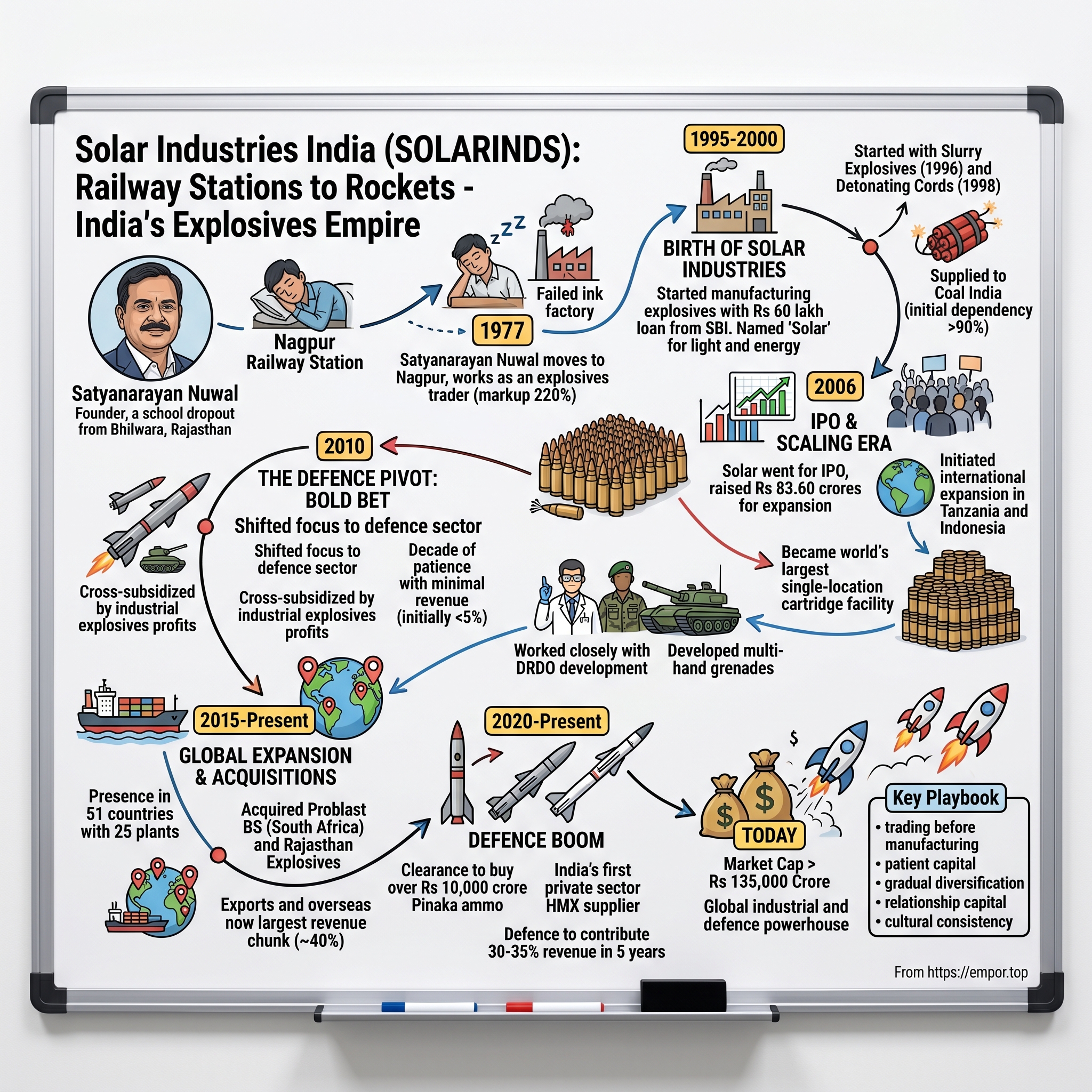
In 1977, a young man from Bhilwara in Rajasthan arrived in Chandrapur, a coal and cement town in eastern Maharashtra, with a failed fountain-pen-ink business behind him and no clear plan ahead. He had left school after Class 10 because his father, a patwari — a village land-records clerk — could no longer fund his education. On nights when he could not afford a room, he slept at the local railway station.1
Nearly five decades later, on 25 May 2026, that founder stood in the Durbar Hall of Rashtrapati Bhavan as President Droupadi Murmu conferred on him the Padma Shri in trade and industry.[^2] Satyanarayan Nuwal had built Solar Industries India — a company that by August 2026 commanded a market capitalisation of roughly ₹1.73 lakh crore, with its stock trading around ₹20,245 on the National Stock Exchange.2 That represents a valuation above $19 billion for a company that began by manufacturing ammonium-nitrate cartridges designed to shatter rock in coal mines.
The central tension of this business sits between two distinct identities.
Industrial explosives is an unglamorous, commodity-adjacent sector: heavily licensed, strictly regulated for safety, logistically constrained, and dependent on a state-owned coal monopoly that aggressively negotiates pricing. Historically, businesses in this category trade at 10 to 20 times earnings. Yet in August 2026, Solar Industries traded at roughly 91 times trailing consolidated earnings on Screener's calculation, around 103 times on other metrics, and nearly 27 times book value.23
Investors are not paying those multiples for civil explosives alone. They are pricing in a second business embedded inside the parent: Solar Defence and Aerospace Limited. This subsidiary manufactures rocket ammunition for the Indian Army's Pinaka multi-barrel launchers, loitering munitions that strike and detonate on target, military propellants, warheads, and the Bhargavastra counter-drone system. In FY26, the defence division generated ₹2,634 crore in revenue — accounting for 27% of group turnover, up from 18% the previous year and from negligible amounts five years prior.45
The core analytical question is not whether Solar Industries is an efficient enterprise. By traditional operating metrics, it clearly is: return on equity reached 32.6% in the most recent fiscal year, return on capital employed stood at 38.1%, five-year net profit grew at a compound annual rate of about 45%, and the standalone debt-to-equity ratio was just 0.07.26 The essential question is narrower: has the market's re-rating of Solar as a defence prime contractor — rather than an industrial explosives manufacturer with a defence segment — been justified by execution, or does it rest on optimistic market assumptions?
This analysis traces that evolution across several key stages: the initial pivot from trading to manufacturing; how the firm secured a dominant position in Indian civil explosives; the fifteen-year, low-revenue defence investment underwritten by the core commercial business; the sharp acceleration in the order book following February 2025; the often-overlooked export division; the controlling family's 73% stake and capital allocation track record; a stress-test of the company's competitive moat; industrial safety and operational risks; and a comparison of the bull and bear investment cases.
Two operational realities frame this analysis.
First, the core product is controlled energetic materials. Every rupee of revenue depends on compounds engineered to release massive kinetic energy in fractions of a second. This fundamental physical reality determines the company's regulatory oversight, specialized logistics, labor protocols, insurance structure, market competition, and operational risk. Modeling Solar simply as a specialty chemical manufacturer misses the operational friction inherent in handling high explosives.
Second, Solar has transformed its corporate identity roughly once every decade: operating as a trading house until the mid-1990s, a cartridge manufacturer through the mid-2000s, an integrated bulk-explosives and export business during the 2010s, and now a defence supplier. Each expansion was funded organically by the cash flows of the preceding business. This pattern reflects either disciplined long-term capital allocation or a recurring shift in corporate positioning — an execution record that market participants evaluate differently depending on their strategic perspective.
The story begins with a small enterprise renting third-party explosives magazines in Maharashtra.
 Subscribe on LinkedIn
II. Origins, Compressed: Trader to Manufacturer (1977-1995)
Satyanarayan Nuwal did not begin his business career by manufacturing energetic materials. He began by renting storage capacity.
In Chandrapur, Nuwal rented an explosives magazine — the licensed, isolated, heavily regulated bunker in which commercial explosives must legally be stored — from a local licence-holder named Abdul Sattar Allah Bhai, for ₹1,000 a month.1 That single transaction captured the industry's defining barrier to entry. Commercial explosives cannot be stored in standard warehouses or transported on ordinary trucks; buying, holding, moving, or selling them requires extensive approvals from the Petroleum and Explosives Safety Organisation and local civil administrations. Nuwal had not simply rented a facility; he had secured access to a regulatory licence.
For nearly two decades, he operated purely as a trader. He mapped which mine managers required specific cartridge volumes before scheduled blasts, tracked approval timelines across district collectors' offices, and monitored inventory across multinational suppliers. By 1984, he became a consignment agent for Imperial Chemical Industries, and through the late 1980s and early 1990s built his business into one of India's largest explosives dealerships.1 Other ventures during this period faltered, including a leasing firm, a transport company, and the fountain-pen-ink unit started in 1970 when he was eighteen.17
Eighteen years of distribution provided three commercial assets that capital alone could not purchase: an established client roster of mining operators who trusted his delivery timelines, deep working knowledge of a complex regulatory environment, and an accurate map of profit pools across the value chain. As a distributor, he watched primary manufacturers capture the main operating spread while dealers competed for fixed commissions.
As a consignment agent for ICI in 1980s India, the multinational retained the product, brand, and proprietary technology, while Nuwal managed last-mile operations: magazine management, local logistics, customer credit, and administrative filings. Although a distribution agency remains structurally vulnerable to principal replacement, it offers a clear operational vantage point. A dealer observes which customer segments face supply gaps, where product margins expand, where incumbents lag, and how costs split between primary manufacturing and regulatory compliance. When Nuwal eventually invested in manufacturing, he built facilities designed around an established client base.
By the mid-1990s, distribution margins were compressing under dealer competition, while manufacturers had little structural incentive to protect agent spreads. Shifting into manufacturing became a strategic necessity for long-term margins.
Macroeconomic conditions favored the transition. Following India's 1991 economic liberalization, domestic entrepreneurs could realistically compete with multinational incumbents in licensed industrial sectors. Simultaneously, Coal India Limited expanded production, and the mining industry increasingly adopted opencast techniques over underground mining. Opencast extraction requires moving heavy overburden to expose coal seams, significantly increasing explosives consumption per unit of output.
In 1995, Nuwal raised roughly ₹60 lakh — equivalent to 6 million rupees — through personal savings and a loan from the State Bank of India to build a small production unit in Nagpur. Production began in 1996.1 That capital outlay provided a single facility producing packaged cartridge explosives.
The selection of Nagpur provided a distinct logistical advantage. Positioned near India's geographical center, the plant sat within economical trucking range of major coalfields across eastern Maharashtra, Chhattisgarh, Madhya Pradesh, and Telangana. In an industry where freight distance imposes tight cost limits, locating production adjacent to key coal basins established a lasting logistical efficiency.
Manufacturing capability enabled direct contracting with Coal India Limited, the state-owned enterprise that was, and remains, the single largest buyer of commercial explosives in the country.8 Coal India became the company's anchor customer, helping propel Solar into India's dominant explosives manufacturer over the following decade.1
The central strategic question was how a regional supplier built around a single monopsonist customer could avoid commodity price compression and scale into a broader industrial platform. That transition took shape over the next fifteen years.
III. The Core Business: Building India's Explosives Monopoly (1995-2010)
The transport economics of high explosives differ fundamentally from standard industrial commodities. A shipment of cement is constrained primarily by fuel and transit time. By contrast, a truck carrying commercial explosives requires specialized vehicle licensing, designated route clearances, security escorts, mandated speed limits, and strict operating hours, while destination magazines face tight storage caps.
This regulatory friction creates the defining operational rule of the industrial explosives industry: explosives manufacturing cannot be centralized. A producer cannot supply an entire subcontinent from a single mega-plant, because long-distance safety and compliance costs erase manufacturing economies of scale. The underlying economics instead compel a distributed network: production units stationed near mining hubs, licensed storage magazines adjacent to plants, and regulatory permits for every node.
This dynamic forms an entry barrier rooted less in chemical formulation than in administrative navigation. While the chemistry of emulsion explosives is widely understood, securing dozens of site licenses, magazine permits, transport clearances, and safety approvals across multiple Indian states requires years of regulatory navigation. The primary moat is regulatory patience — a capability Satyanarayan Nuwal had developed during eighteen years as an explosives distributor before breaking ground on his first manufacturing plant.
Solar's strategic expansion between 1995 and 2010 followed three distinct vectors.
Backward vertical integration. The primary raw material in commercial explosives is technical-grade ammonium nitrate, which serves as the principal oxidizer in blasting agents. Indian explosives manufacturers have historically relied on third-party chemical suppliers, including Deepak Fertilisers and Petrochemicals, which supplies Solar alongside competitors such as IDL Explosives, GOCL Corporation, and Salvo Explosives.8 By bringing ammonium nitrate production in-house, Solar stabilized its input costs against raw material price spikes and established a cost structure lower than unintegrated peers. In a market dominated by a state-owned monopsonist conducting reverse auctions, maintaining the lowest delivered cost is essential to winning volume contracts, making input integration a core competitive advantage.
Regional scale optimization. Rather than building small, scattered units, Solar concentrated primary manufacturing capacity at its flagship Nagpur complex — which the company described as the world's largest single-location packaged-explosives facility — before establishing regional satellite plants near major mining clusters. By the time sell-side equity analysts initiated coverage on the company, Solar had established itself as India's largest manufacturer of industrial explosives and initiating systems, boasting an annual capacity of approximately 330,000 tonnes and generating roughly 70% of India's total exports in the category.9
Value-chain elevation. Solar shifted its core product mix from packaged cartridge explosives to bulk, site-mixed delivery systems. Cartridge explosives are manufactured off-site, packaged, transported, and manually loaded into boreholes. Bulk site-mixed systems transport chemically inert precursor materials in specialized bulk-mixing trucks directly to the mine face, blending and pumping the energetic mixture directly into boreholes. This approach eliminates the transportation of active high explosives on public roads. For mine operators, bulk delivery offers accelerated loading, uniform blast fragmentation, and lower excavation costs per tonne. For the supplier, operating specialized trucks and on-site technical crews transforms a simple material sale into an integrated service offering.
Commercially, this transition altered customer dynamics. Standard packaged cartridges function as discrete commodities subject to annual price undercutting in open tenders. In contrast, bulk delivery operates like a long-term service contract. The supplier's mobile processing units and field personnel are integrated into the mine's daily operational workflow, making supplier replacement logistically complex. While profit margins may not expand dramatically, revenue visibility improves and account retention becomes far less vulnerable to pure price competition.
Alongside bulk explosives, Solar developed a proprietary line of initiating systems, including detonators, delay elements, and shock tubes. In commercial blasting, bulk explosives remain inert until triggered; technical differentiation relies on blast sequencing. Modern opencast mining uses millisecond-delay sequences across hundreds of boreholes to control rock fragmentation, shape muckpiles, and suppress ground vibrations near surrounding infrastructure. Because precision timing represents the highest-value technical component of commercial blasting, initiating systems yield higher profit margins per rupee of revenue than bulk explosives. Consequently, Solar's export strength in both bulk explosives and initiating systems reflects its higher-margin product capability.9
In 2006, Solar completed its initial public offering on the National Stock Exchange and BSE, securing equity capital to expand its multi-state plant footprint.10 In the industrial explosives sector, geographic expansion directly builds competitive moats by establishing localized supply centers close to customer operations.
Beyond capital raising, the listing imposed public disclosure obligations, governance oversight, and audited financial reporting on what had been a family-run enterprise. For a company operating in a hazardous, highly regulated industry, public status established an audited operational and financial track record. That reporting transparency later proved essential when Solar sought major defense contracts from the Ministry of Defence, where financial solvency and governance compliance are strict prerequisites for defense procurement.
Where that leaves the competitive landscape. Published industry estimates indicate Solar holds approximately 30% of India's industrial explosives market, though some industry sources estimate its share closer to 24%.9 The remaining market is split among IDL Explosives, GOCL Corporation, Deepak Fertilisers-affiliated entities, Dyno Nobel India, and Orica Mining Services India, alongside smaller domestic players such as Premier Explosives and Keltech Energies. While Solar's geographic network exceeds that of any individual rival, a market share of 24% to 30% provides cost leadership in regional tenders without granting monopoly pricing power over a monopsonist buyer like Coal India.
Furthermore, in a market with a single dominant state purchaser, a leading supplier's market share is constrained by public procurement policies. Coal India deliberately distributes its purchasing orders across multiple vendors to preserve supply security, maintain competitive pricing tension, and avoid operational reliance on a single supplier. Consequently, Solar's domestic market share sits near the functional upper limit allowable under state procurement guidelines. This operational ceiling made international exports and defense diversification essential strategic imperatives rather than optional growth avenues.
The concentration problem — and its resolution. During its early expansion, Solar derived over 90% of its revenue from Coal India.11 Relying on a single price-sensitive state entity exposed the company to severe monopsony risk, as the buyer intentionally allocated orders across multiple producers to limit supplier leverage.
Solar systematically reduced this customer concentration across three successive phases: expanding into non-coal mining and infrastructure, growing international exports, and developing a military defense portfolio. By FY26, Coal India accounted for 9% of consolidated revenue (₹924 crore), down from 13% (₹960 crore) in FY25.4 Absolute revenue from Coal India remained essentially flat year-over-year, while its relative share fell sharply as overall group revenue expanded. Management confirmed that domestic mining markets generated no net growth during FY26.4 Rather than expanding its core coal explosives volume, Solar reduced its customer concentration by scaling its export and defense divisions.
That strategic shift set the stage for a defense expansion that market participants had not anticipated during the company's early years.
IV. The Defence Pivot: The 15-Year Bet Nobody Priced In (2010-2023)
In 2010, Solar Industries — then a mid-cap explosives manufacturer with a market capitalization in the low thousands of crores and roughly 90% dependent on Coal India — began allocating capital toward military-grade high-energy materials.1
High-energy materials refer to HMX and RDX-class military compounds. The distinction between commercial and defense energetic materials is fundamental: the ammonium-nitrate emulsions used to break coal seams are engineered to push, delivering a sustained force that fractures rock without pulverizing it. Military high explosives are engineered to shatter. They detonate at significantly higher velocities, producing the high brisance — or shattering force — required to fragment a warhead casing or drive a shaped-charge jet through armor. Manufacturing these compounds requires different chemistry, tighter process controls, rigorous testing regimes, and a regulatory approval that the Indian government had never previously granted to a private firm.
Commercial explosives are to military high explosives what a diesel generator is to a jet engine: both convert stored chemical energy into work, but while one is built for cost efficiency and wide operational tolerances, the other demands extreme precision under unforgiving standards. Crystallizing HMX to a specific particle size and purity presents a process-control challenge far more complex than mixing commercial emulsions — and, as a September 2025 industrial incident later demonstrated, the crystallization step is where operational risks peak.
The second discipline Solar pursued was military propellants. While high explosives detonate instantaneously, propellants deflagrate — burning in a controlled, progressive manner to generate the sustained gas pressure needed to launch a rocket or artillery shell. Engineering a rocket motor hinges on burn-rate control: if the propellant burns too quickly, the motor casing bursts; if it burns too slowly, the projectile falls short of its target. Managing this interaction requires combining chemical formulation with precision mechanical engineering, explaining why qualifying these capabilities required years of development rather than months.
In 2010, Solar became the first private Indian company licensed to manufacture explosives for defense warheads.1 An industrial license for ammunition production followed in 2015.1
This entry carried substantial financial demands. Between 2010 and approximately 2020, the defense initiative absorbed capital across research and development, pilot facilities, test ranges, qualification trials, and quality systems, while generating minimal revenue. Defense procurement in India differs sharply from commercial channels. A supplier typically develops a product jointly with a Defence Research and Development Organisation (DRDO) laboratory holding the underlying design, then submits it for multi-year user trials with the armed forces. Subsequent Ministry of Defence tenders may face administrative delays, budget shifts, or restrictions favoring state-owned defense public sector undertakings. Entering this procurement ecosystem in 2010 required committing to a decade of upfront expense without any guaranteed purchase contracts.
The financial engine behind the expansion. Solar funded this decade-long, negative-return initiative through the steady cash flows generated by its commercial explosives division, which produced high returns on capital with minimal incremental reinvestment needs. This structure represents a classic long-fuse corporate bet: a cash-generative core business underwriting a high-upside option. However, such strategies also carry risk, as stable core earnings can allow management to fund underperforming projects longer than independent capital markets would tolerate. In Solar's case, financial discipline remained intact; returns on capital in the core explosives business held firm throughout the funding decade.
The operational breakthrough. According to Manish Nuwal, Managing Director and CEO, the decisive opening occurred following the Uri and Pathankot security incidents, when Solar collaborated with DRDO to produce a multi-mode hand grenade — a low-unit-value product that nevertheless demonstrated the firm could take a state laboratory design through qualification into mass production.11 From that initial footprint, the defense portfolio expanded to include propellants for the Pinaka rocket system, components for the Akash and BrahMos missile programs, warheads, ammunition filling, pyrotechnics, fuses, and integrated systems.11
The military grenade project held strategic significance beyond its direct revenue impact. Steering a government design through user trials, environmental testing, lot acceptance protocols, and repeatable series manufacturing established an institutional qualification. This process required military-grade quality management, auditable defense documentation, and lot-to-lot manufacturing consistency across hundreds of thousands of units. Establishing these capabilities on an initial product significantly reduced the friction of qualifying subsequent defense systems, enabling Solar to transition a decade of development expenditure into an established position within a procurement framework that historically resisted new private entrants.
The partnership with DRDO carries structural implications for Solar's defense valuation. DRDO focuses on research and development rather than large-scale production, supplying qualified designs and transfer-of-technology packages to designated manufacturers. Historically, these transfers were reserved for the Ordnance Factory Board and state-owned defense enterprises; policy reforms opening these technologies to private contractors enabled Solar's investment to yield commercial contracts. Nevertheless, intellectual property rights remain with the state, technology transfers can be awarded to competing firms, and the Indian government remains the sole domestic buyer.
Reflecting on this development period, Manish Nuwal characterized the defense expansion as "a strategic investment," noting that "I think we understand technology a lot better today."11 This measured assessment highlights the technical learning curve required to establish defense manufacturing credentials over a ten-year period.
Operational safety and downside risk. High-energy manufacturing carries inherent operational hazards. On 17 December 2023, an explosion occurred during packing operations at the cast booster plant in Solar's Bazargaon facility near Nagpur, killing nine workers and injuring three among the twelve present in the building.12 Official investigations had not established the cause at the time of the incident.12
Cast boosters are standard initiating charges produced through routine manual packing processes. This incident underscores that industrial risk is fundamentally linked to the business model. Solar's high returns on capital are partially sustained by severe regulatory and operational barriers that limit competition in handling volatile materials. Consequently, evaluating the firm's entry barriers requires accounting for catastrophic operational risk alongside financial returns.
Corporate restructuring. In February 2025, Solar renamed its defense subsidiary, Economic Explosives Limited, to Solar Defence and Aerospace Limited. This change reflected a formal positioning shift toward primary defense contracting for government buyers and credit rating agencies. Following the restructuring, credit rating agency ICRA began issuing standalone credit rating rationales for Solar Defence and Aerospace Limited.13 Operating through this subsidiary, the group expanded into advanced hardware, including the Nagastra loitering munition and the Bhargavastra counter-drone platform.[^2]
By late 2023, Solar had established a licensed, trial-tested defense manufacturing capability aligned with DRDO designs, though defense revenues remained minimal. The subsequent inflow of defense orders transformed this long-term investment into a major growth driver.
V. Inflection: The Order Book Goes Vertical (2023-2026)
On 6 February 2025, the Ministry of Defence signed a contract worth ₹10,200 crore for two variants of the Pinaka multi-barrel rocket launcher weapon system, split between Solar Industries India and the state-owned Munitions India Limited.14 The contract covered the Pinaka Area Denial Munition and the Pinaka Enhanced variant. Then-Army Chief General Upendra Dwivedi described the package as roughly ₹5,700 crore for explosive ammunition and ₹4,500 crore for the Pinaka weapon-system ammunition, and noted the products were 96% indigenous, with the residual 4% being a fuse expected to be domestically manufactured within one to two years.14
Solar's share of that award was the largest artillery-ammunition contract ever given to a private Indian company, to be executed across roughly eight to twelve years.
And on the same day, the stock fell 6.5%.
This is one of the more instructive market moments in the company's history, so it is worth slowing down. On 6 February 2025, Solar reported a 55.2% year-on-year rise in third-quarter net profit.15 It also disclosed, on the earnings call, that it would fall short of its FY25 revenue guidance, cutting expected sales volume growth to 8-10% from 15% earlier.16 The shares closed down 6.5% at ₹9,020 on the BSE against a previous close of ₹9,647.75.16 Management attributed the shortfall to a domestic market slowdown.16
A landmark defence contract and a 55% profit increase were not enough to offset a guidance trim. That tells you precisely how the stock was already being priced: not on current earnings, but on the assumed slope of future ones. At a multiple in the high double digits, the marginal buyer is buying a growth rate, and any signal that the rate is decelerating gets punished immediately regardless of what else happened that day.
Worth noting for perspective: that ₹9,020 close in February 2025 compares to roughly ₹20,245 in August 2026.2 The market's verdict on that particular selloff, eighteen months later, was that it had been wrong.
The bolt-on that tested the licence thesis. In April 2023, Solar announced the acquisition of Rajasthan Explosives and Chemicals through its wholly-owned subsidiary Emul Tek; the National Company Law Tribunal approved the scheme of amalgamation in September 2024, with the transferor company subsequently dissolved.17 The purchase price was not disclosed in the public announcements.17 The strategic logic is straightforward and consistent with everything above: buying an existing licensed explosives manufacturer buys the one thing you cannot manufacture, which is time through the permitting process. Whether it was bought well is not assessable from public disclosure, which is itself a mild governance observation — a company that argues its licence stack is a moat should be willing to tell shareholders what it paid to add to it.
The African services move. In July 2024, Solar's South African subsidiary Solar Mining Services acquired a 73.99% stake in Problast BS (Pty) Ltd, a company providing complete blasting solutions — drilling, blasting and loading — for open-cast mining in South Africa.18 Problast reported revenue of ₹276 crore in FY22 and ₹346 crore in FY23. The cost of the acquisition was not disclosed.18
This is the deal that deserves the most scrutiny, and not because it is large — on revenue it is roughly 3-4% of Solar's FY26 top line. It deserves scrutiny because of what it represents. Solar's entire historical edge has been in manufacturing and licence accumulation. Problast is a services business in a foreign jurisdiction, with a different cost structure, different labour dynamics, and different margin profile. Buying downstream services to pull through your own product is a defensible strategy — Orica and Enaex both do it — but it is also the classic first step of scope creep, and the absence of a disclosed purchase price makes it impossible for an outside investor to judge whether capital discipline held. The honest position is: strategically coherent, financially unverifiable.
Then the numbers caught up with the narrative. Solar closed FY26, the year ended 31 March 2026, with consolidated revenue of ₹9,838 crore, up 30% year on year; EBITDA of ₹2,750 crore, up 35%, with margin expanding to 27.95% from 26.94%; and profit after tax of ₹1,737 crore, up 35%.45 The fourth quarter was stronger than the year: net sales of ₹3,053 crore, up 41%, EBITDA up 59% to ₹870 crore at a 28.5% margin, and PAT up 61% to ₹556 crore.45 The board declared a dividend of ₹11 per share against ₹10 previously.5
Strip out the arithmetic and what the FY26 print says is this: the mix shift is now doing the work that volume used to do. Domestic mining did not grow. Coal India revenue was flat in rupees. Yet group revenue rose 30% and margins expanded roughly a hundred basis points. That combination is only possible if the incremental rupee of sales carries a higher margin than the average rupee — which is exactly what a shift toward defence and international sales would produce.
Defence revenue nearly doubled to ₹2,634 crore from ₹1,355 crore, moving from 18% to 27% of sales, with the fourth quarter alone up 134% to ₹1,008 crore.45 The order book stood at ₹21,300 crore, of which roughly ₹18,000 crore was defence — Pinaka the dominant single component — and roughly ₹3,000 crore non-defence.4
Management guided to FY27 revenue of ₹14,000 crore at broadly current margins, with defence revenue crossing ₹4,500 crore, against capital expenditure of ₹2,050 crore versus ₹1,556 crore spent in FY26.4
The product pipeline disclosed alongside those results is where the next few years of the defence story actually sit. Bhargavastra, the counter-drone system, was described as being in final development.4 The 155mm complete round — the standard artillery shell of virtually every modern army, and a product where being able to supply the complete round rather than a component is the difference between being a subcontractor and being a prime — was in final trial stages.4 A medium-calibre ammunition facility had been commissioned with qualification supplies underway, and further loitering-munition variants were in the pipeline.4 Management also indicated it expected non-defence domestic and international revenue combined to grow more than 30% in FY27, with roughly 30% export growth, volume growth around 10% and value growth around 15%.4
Read as a portfolio, that pipeline says something specific: Solar is trying to move from selling energetic materials into somebody else's weapon to selling the entire weapon. Nagastra and Bhargavastra are complete systems with their own electronics, guidance and command-and-control integration — a different business from filling a warhead, with different competitors, different margins and considerably higher technical risk. Whether the company can win as a systems integrator rather than a materials supplier is genuinely unproven, and it is the single largest open question in the medium-term thesis.
The first quarter of FY27 delivered against that guidance rather than merely restating it. On 13 August 2026, Solar reported quarterly net sales of ₹3,668 crore, up about 70%, with revenue from operations of ₹3,888.20 crore against ₹2,154.45 crore a year earlier, and consolidated net profit of ₹666.37 crore against ₹357.62 crore — an increase of roughly 89%.319 Standalone operating margin was 27.72% and the standalone debt-equity ratio 0.07.19 Defence grew 123% year on year and international explosives 65%.20 Order book stood at ₹21,350 crore, and management reiterated the ₹14,000 crore FY27 target, with about ₹450 crore of the ₹2,050 crore capex already deployed in the quarter, including commissioning of a plant at Dhule in western India, expansion at Dholpur in the north, and a new facility planned in Odisha.20
There is one honest caveat on that quarter. Roughly 70-80% growth against a base quarter is spectacular, and it is also flattered by the base: Q1 FY26 profit of about ₹358 crore was a comparatively soft quarter. Reading a single print as the new run-rate would be a mistake. What can be said with more confidence is that the FY27 revenue target implies about 42% growth on FY26, and the first quarter did not fall behind that pace.
The order book converts, on the evidence so far, at an accelerating rate. Whether it keeps converting is the whole investment question — and the answer depends heavily on a business the defence narrative tends to overshadow.
VI. Global Footprint: Exports as the Third Leg
While public attention over recent years has focused heavily on defence contracting, Solar Industries' financial disclosures present a different primary growth engine. In FY26, the largest single revenue contributor was neither domestic mining nor defence. International operations generated ₹3,815 crore — a 32% increase year-on-year — accounting for 39% of total group turnover.4
That international footprint represents a sustained, low-profile expansion over more than a decade. Overseas revenue rose from approximately ₹400 crore in 2015 to ₹3,800 crore in FY26 — roughly a ninefold increase over eleven years.4 Even before its defence pivot gained momentum, Solar generated approximately 70% of India's total exports of industrial explosives and initiating systems.9
This global presence is built on localized manufacturing rather than centralized export shipping. Solar maintains operating or planned manufacturing hubs across South Africa, Zambia, Tanzania, Zimbabwe, Nigeria, Ghana, Turkey, Kazakhstan, Thailand, and Indonesia, with additional facilities expected in Sierra Leone during FY27 and Australia targeted thereafter.4 Management has characterized this international strategy as a multi-country production network established through local capital investment rather than pure trading distribution.21
Why this represents model replication rather than strategic diversification. The operational barriers that protected Solar's domestic market share apply across international mining jurisdictions. Regulatory mandates restrict the manufacture, storage, and transport of hazardous energetic materials globally, making long-distance freight economically inefficient. Consequently, localized production facilities with regional regulatory clearances hold a distinct advantage near major mineral deposits. Solar's overseas expansion replicates its domestic strategy market by market: securing local operating permits, establishing production units adjacent to key mining basins, integrating raw material inputs where feasible, and transitioning clients from packaged cartridges to site-mixed bulk delivery and on-site blasting services. The acquisition of South Africa's Problast fits directly into the final stage of that operational sequence.
Accordingly, the international division functions as a geographic extension of Solar's core commercial business rather than an unrelated venture. The expansion relies on regulatory and logistical entry barriers rebuilt across new jurisdictions rather than proprietary chemical differentiation. In markets such as Zambia, Solar's competitive edge stems from localized plant investment and an operational tolerance for frontier jurisdictions that larger global competitors often deem too constrained or high-risk to justify capital deployment.
This dynamic illustrates a structural counter-positioning strategy. Major Western incumbents evaluating manufacturing facilities in developing markets often apply strict hurdle rates that incorporate elevated political risk premiums, compliance overhead, expatriate staffing costs, and corporate governance exposures — frequently concluding that smaller regional markets do not warrant capital allocation. By contrast, an Indian producer benefiting from lower overhead costs and operational familiarity with complex regulatory environments evaluates the return profile differently. This operational footprint provides a tangible initial advantage in underserved markets, though it remains vulnerable should major global producers choose to allocate capital to those regions.
Calibrating the global market position. Despite rapid international growth, Solar's overseas scale warrants objective context against global incumbents such as Australia's Orica and Chile's Enaex. While Solar's ₹3,815 crore in international revenue reflects strong expansion, it remains substantially smaller than the revenue generated by established global market leaders. Solar functions primarily as an expanding regional supplier across Africa and an emerging competitor in selected Asian markets, capturing volumes in regions where global majors have not established exclusive control.
Beyond top-line contribution, international operations alter group financial dynamics in ways that aggregate revenue figures obscure. Overseas units serve fragmented private mining clients rather than a single state monopsonist conducting reverse auctions, resulting in pricing terms that are generally more favorable than domestic coal supply contracts. This favorable market structure likely contributed to the expansion of group EBITDA margins in FY26 despite flat domestic mining volumes. However, because Solar does not disclose segment profitability by geographic region, this margin driver remains an analytical inference rather than a confirmed metric — presenting a notable gap in financial transparency given that international sales now represent the company's largest geographic segment.
Operating across diverse international jurisdictions introduces distinct operational and financial risks. Maintaining manufacturing assets in countries such as Nigeria, Zimbabwe, Zambia, Ghana, Turkey, and Kazakhstan exposes the group to foreign exchange volatility, sovereign political risk, regulatory shifts, and capital repatriation constraints. While Solar has operated across several of these regions without publicly disclosed material losses — demonstrating established operational capability — geographic exposure remains an ongoing structural risk.
For investors, the international division provides structural diversification. By serving a broad customer base of private and state-owned mining enterprises across multiple countries, overseas revenues are largely insulated from the procurement cycles of any single national government. In an enterprise where headline growth is increasingly linked to domestic defence spending, this international revenue stream offers an important buffer against sovereign budget shifts.
Because both the commercial explosives business and its expanding international operations remain under the direction of the founding family, evaluating the firm's long-term prospects requires an examination of the controlling family's capital allocation track record and governance history.
VII. Current Management: Incentives, Ownership, and Capital Allocation Record
The management transition at Solar Industries has proceeded smoothly, a notable pattern among family-controlled Indian industrial groups.
Satyanarayan Nuwal, now Non-Executive Chairman, serves as the primary representative of the group's defense initiatives. He has described his motivation explicitly: "It is my passion to build up our defence business. It is also our moral responsibility to the country."1 From an analytical standpoint, national duty and return on incremental capital do not always follow identical priorities. When those objectives diverge, capital allocation choices dictate shareholder returns.
Managing Director and Chief Executive Officer Manish Nuwal, who joined the enterprise in the mid-1990s as it transitioned from trading to manufacturing, has overseen operational scaling throughout his career.11 His public communications lean toward technical milestones rather than promotional claims. Describing the company's defense entry, he noted: "We did the right things and participated in many development programmes."11 Management has tracked its multi-year strategic targets consistently. In early 2025, Manish Nuwal noted that defense revenue had expanded from 5% of group sales three years earlier to 20%, outlining a target of 30% to 35% within four to five years.11 By FY26, defense reached 27% of revenue, and full-year guidance of more than ₹4,500 crore on targeted revenue of ₹14,000 crore for FY27 implies a defense share exceeding 32%.4 Achieving these mix targets ahead of schedule underscores execution discipline.
Executive Directors Suresh Menon and Milind Deshmukh support senior leadership, though strategic direction remains firmly centered with the founding family.
This leadership structure splits key responsibilities: Satyanarayan Nuwal provides regulatory history and institutional access built over five decades, complemented by the prestige of his Padma Shri award in a sector governed by discretionary procurement. Manish Nuwal manages daily operations, including capacity planning, capital deployment, and quarterly execution against guidance. In a business reliant on both government approvals and manufacturing execution, this division of leadership provides operational efficiency.
However, it also presents a key person risk. Institutional access relies heavily on senior relationships built by a chairman in his mid-seventies, without explicit public disclosures detailing how those networks are being institutionalized across broader management ranks.
Ownership. The promoter group held 73.15% of the equity as of the most recent disclosure.2 This concentration aligns family wealth directly with share price performance.
While high insider ownership reduces the risk of value-destroying acquisitions, it does not guarantee that management decisions will match the preferences of diversified public shareholders—such as prioritizing dividend distributions over capital reinvestment, or exiting legacy operations. At a 73% stake, minority shareholders possess minimal governance leverage. Furthermore, the absence of broad-based performance-linked stock option plans leaves executive incentives tied primarily to the family's equity holding.
Capital allocation record. Four key decisions illustrate management's historical track record:
First, the long-term defense research and development program was funded entirely through internal operating cash flows, avoiding equity dilution or balance-sheet leverage while preserving core return metrics.
Second, the acquisition of Rajasthan Explosives added licensed capacity in a tightly regulated market, though the lack of transaction details prevents a full financial assessment.17
Third, the purchase of a controlling stake in Problast expanded downstream mining services in South Africa, aligning with product distribution goals but leaving asset-level returns undisclosed.18
Fourth, dividend policy reflects a clear preference for capital retention. The dividend of ₹11 per share declared for FY26—up from ₹10 the prior year—yielded approximately 0.06% against a share price near ₹20,000.25 Reinvesting cash flows remains mathematically rational while return on capital employed stands at 38.1%.2 However, if returns on incremental capital moderate, high retention rates risk impairing capital efficiency over time.
Guidance track record. Management's forecasting accuracy faced a setback in February 2025, when full-year volume growth guidance was reduced from 15% to a range of 8% to 10%, cited as a response to a domestic market slowdown.16 Performance subsequently stabilized. In FY26, group revenue rose 30% and net profit grew 35%, while the FY27 revenue target of ₹14,000 crore—first outlined in May 2026 and confirmed in August 2026—remains supported by first-quarter execution.420 This improvement reflects a structural shift toward contract-backed defense and international orders, which offer greater revenue visibility than spot commercial explosives sales.
Operational safety disclosures. A key area of concern remains the disclosure protocol surrounding industrial safety. Following a fatal explosion in September 2025, the company reported to stock exchanges that safety systems activated and workers were evacuated according to standard emergency procedures prior to the blast.22 However, public disclosures have offered limited detail regarding root-cause analysis, systemic operational changes, or dedicated safety capital expenditure, nor has industrial safety been featured prominently in regular investor communications.
Two fatal events within twenty-one months during a period of rapid manufacturing expansion highlight the operational risks inherent in handling energetic materials. Demonstrating that process safety infrastructure scales in step with production volumes remains an essential benchmark for evaluating the durability of the company's operating model.
VIII. Moats, Porter's Five Forces, and the "Why It Wins" Case
Evaluating Solar Industries through Michael Porter's Five Forces framework produces strikingly divergent conclusions depending on which half of the enterprise is being examined.
Barriers to entry — civil explosives: high, and evidenced. The strongest evidence for Solar's regulatory moat is not merely the existence of a stringent licensing regime, but the persistence of its market position. Solar has held roughly a 30% share of a fragmented market for over a decade, even while the industry's largest customer actively sought greater supplier competition.9 Coal India has every incentive to cultivate alternative vendors, yet it has not succeeded in dislodging Solar from the top position. In India's industrial explosives sector, permits are slow to obtain, politically sensitive, site-specific, and revocable. A well-funded entrant equipped with a chemical engineering team and greenfield ambitions faces years of administrative processing before generating its first rupee of revenue — whereas Solar can expand capacity rapidly by acquiring existing licence holders, as it demonstrated with its purchase of Rajasthan Explosives.
Supplier power — moderate, and partially neutralised. Technical-grade ammonium nitrate represents the primary raw material input and the principal source of margin volatility. Solar's backward integration reduces its cost exposure relative to smaller competitors that rely on merchant chemical suppliers such as Deepak Fertilisers.8 However, this neutralisation is partial rather than complete: management flagged commodity inflation creating margin pressure in FY26 despite contract escalation clauses.4 Contractual escalation mechanisms transfer most, but not all, input price swings onto customers, and they operate with a time lag.
Buyer power — historically severe, now materially reduced. This represents the clearest documented operational improvement in the company over the past decade. The journey from over 90% Coal India dependence to 9% is not a narrative claim; it is a disclosed revenue mix.411 A supplier reliant on a single monopsonist buyer commands minimal pricing power. A supplier distributing across Indian mining, domestic infrastructure, international mining operators in approximately a dozen countries, and the Ministry of Defence commands far greater leverage. However, a key qualification remains: the company's newest growth driver is also a government entity, and the Pinaka order alone represents a large share of the ₹18,000 crore defence backlog.4 Customer concentration did not vanish; it shifted counterparties.
Substitutes — low in civil, and a live question in defence. No alternative technology matches the cost efficiency of high explosives for breaking rock at scale. Mechanical excavation exists as an alternative, but it is substantially more expensive for large-scale mining operations.
Rivalry and new entrants in defence — this is where the moat thins, and it deserves the most honest treatment. The competitive landscape in Indian defense ammunition includes state-owned enterprises such as Munitions India Limited (Solar's manufacturing partner on the Pinaka contract), Bharat Dynamics, and well-capitalized private players including Bharat Forge, Zen Technologies, and Premier Explosives, all competing for the same domestic defense procurement budget. Solar's advantages in this segment are real, but they differ fundamentally from its civil explosives moat: an initial explosive licence granted in 2010 and an industrial licence in 2015 that provided a genuine first-mover position;1 ten years of accumulated qualification history with DRDO and the armed services; and specialized manufacturing infrastructure for energetic materials that would require years for a rival to replicate.
What the company lacks is clear proprietary intellectual property. The Pinaka rocket system is a DRDO-designed platform. The multi-mode hand grenade was a DRDO co-development.11 Much of Solar's defense portfolio relies on technology transferred from a state research laboratory that can, in principle, license the same designs to competing producers. The central question for an investor is not whether a competitor can manufacture HMX — given time and capital, one certainly can. It is how long that lead time remains, and how effectively Solar uses its head start. Qualification cycles in Indian defense procurement typically require several years per product line, proven series-production suppliers accumulate an operational track record that procurement officials weight heavily, and Solar remains the only private entity with the capital and facilities deployed at this scale. That represents a significant operational lead — one measured in years, rather than an unassailable structural barrier.
Through Hamilton Helmer's 7 Powers, the picture sharpens:
Scale economies — strong in civil explosives, at the regional rather than national level. The world's largest single-location packaged-explosives facility and roughly 330,000 tonnes of annual capacity produce real unit-cost advantages against subscale domestic rivals.9 Weaker globally, where Orica and Enaex operate at greater scale.
Process power — the strongest claim in the file, and the most under-appreciated. Three decades of accumulated know-how in handling materials that kill people when mishandled is not codified in a patent and cannot be bought. It sits in operating procedures, plant layouts, trained crews and institutional memory. Note the uncomfortable corollary: the fatal incidents of 2023 and 2025 are, on this framing, a partial failure of the exact power being claimed.
Cornered resource — arguably yes, in the form of the licence stack and site approvals. This is the closest thing Solar has to an asset a competitor simply cannot obtain on any reasonable timeline.
Switching costs — modest. Bulk on-site blasting services embed the supplier in the customer's mine plan and create real friction. Cartridge supply does not.
Branding — negligible. Coal India does not pay a premium for a brand.
Counter-positioning — absent. Solar does nothing that an incumbent is structurally unable to copy for fear of cannibalising its own business.
Network economies — absent entirely.
Myth versus reality
Four consensus statements about Solar Industries circulate widely enough to be evaluated directly against the disclosed financial and operational record.
Myth: Solar is a defence company. Reality: as of FY26, defence accounted for 27% of consolidated revenue, while international explosives represented 39%.4 Solar remains an industrial explosives enterprise featuring a rapidly growing defense division that management expects will reach roughly one-third of total sales in FY27. This distinction matters because the two divisions serve different customer bases, operate on distinct economic cycles, and face separate competitive sets. Applying a defense pure-play valuation multiple to a business that remains majority commercial misprices the underlying asset.
Myth: Solar has a monopoly in Indian explosives. Reality: Solar holds roughly a 30% share of a fragmented market on the most favorable published estimates, with industry sources placing its share closer to 24%.9 While the company is the market leader, it is not a monopolist — a reality demonstrated in the competitive pricing dynamics of every Coal India procurement tender.
Myth: the Coal India dependence problem has been solved. Reality: customer concentration has been transformed rather than eliminated. Coal India's share fell to 9% of total revenue in FY26, but approximately ₹18,000 crore of the group's ₹21,300 crore order book is concentrated in defense, dominated by a single program and contracted to a single sovereign buyer.4 Solar exchanged a commercial monopsonist for a sovereign counterpart. A sovereign buyer provides reliable credit terms and longer planning horizons, but it does not represent a diversified customer base.
Myth: the defence business is protected by proprietary technology. Reality: the core military systems in the current order book originate substantially from DRDO development programmes with technology transferred to production agencies.11 Solar's competitive defense moat is administrative, operational, and time-based rather than rooted in proprietary intellectual property. While this operational lead delivers substantial value today, it does not constitute an unassailable technical position.
So why does this company win from here? The evidence-backed investment thesis is specific: Solar maintains a strong licensing and geographic position across Indian and African civil explosives that generates robust cash flows requiring minimal external capital, and it channeled those earnings into a decade-long head start in private-sector Indian defense manufacturing that is now delivering order-backed revenue at roughly double its prior-year rate. Both operational pillars are verifiable in disclosed financial reporting.
What would break the case? The key risk is equally clear: the defense advantage depends heavily on early entry and institutional relationships with a single sovereign customer whose core technology is licensed rather than owned. If competitors compress the qualification timeline faster than anticipated, or if defense indigenization spending expands more slowly than the manufacturing capacity built to serve it, the high growth expectations embedded in a valuation multiple near 90 times earnings face significant downside risk — even if the core business remains operationally sound.
IX. Risk Radar
At 12:33 on the morning of 4 September 2025, in the crystallisation building at Solar's Chakdoh unit near Nagpur, an energetic material being crystallised detonated. One worker was killed and eight were injured.22 The company's disclosure stated that safety systems had activated and personnel in the area had been evacuated according to emergency procedure before the explosion.22 The shares fell about 3% on the news.23
Twenty-one months earlier, nine workers died in the cast booster plant at Bazargaon.12
Safety and operational risk heads this analysis and should be evaluated mechanically rather than emotionally. The operational friction transfers to financial risk through four primary channels. First, a serious incident can halt production at a specific unit, and because explosives capacity is licensed site by site, output cannot simply be shifted to another facility. Second, it can trigger regulatory intervention from the Petroleum and Explosives Safety Organisation or state labour authorities, up to and including licence suspension—which in this industry represents an existential risk rather than a routine fine. Third, it can damage relations with the Ministry of Defence, a customer for whom supplier reliability is a national security requirement rather than a commercial preference. Fourth, it incurs direct costs in compensation, remediation, and insurance. A single fatal incident in a hazardous industry is an operational failure; two fatal events at the same complex during a period of rapid capacity expansion raise broader questions about process safety systems.
Execution risk on the order book represents the primary operational variable likely to affect valuation over the medium term. Executing roughly ₹18,000 crore of defence backlog over an eight- to twelve-year timeline requires the company to build, commission, and qualify substantial new production capacity while meeting strict delivery schedules.4 The capital expenditure plan of ₹2,050 crore for FY27—compared to ₹1,556 crore in FY26 and roughly ₹2,700 crore across the prior two fiscal years combined—reflects a marked increase in construction intensity.45 Management is commissioning facilities at Dhule, expanding capacity at Dholpur, and planning a new plant in Odisha, while simultaneously managing a medium-calibre ammunition facility undergoing qualification supplies, a 155mm complete round in final trial stages, and the Bhargavastra system in final development.420 Each project represents a potential operational bottleneck. Furthermore, defence procurement carries payment-cycle risks, as government contracts pay against project milestones that can shift over time.
The balance sheet reflects this infrastructure expansion. Total debt rose to ₹1,468 crore in FY26 from ₹946 crore the prior year, moving the company from a net cash position of ₹276 crore in FY25 to net debt of ₹867 crore.4 While a net debt-to-equity ratio of 0.13 and a net debt-to-EBITDA ratio of 0.32 remain modest by traditional credit standards, the directional shift indicates a transition from self-funded organic cash generation toward debt-assisted expansion.4 Additionally, management noted a deliberate inventory build in the fourth quarter of FY26—attributed to geopolitical uncertainty—that extended working capital days, with normalization targeted within two quarters.4 Whether this buildup reflects prudent supply-chain positioning or temporary operational inefficiency will become clear over subsequent reporting periods.
Valuation and re-rating risk stems directly from current market expectations. Trading at roughly 91 to 103 times trailing earnings and nearly 27 times book value, the stock price reflects assumptions of sustained high-double-digit growth.23 With defence accounting for 27% of consolidated revenue, the strategic transformation remains underway rather than complete.4 The market reaction in February 2025 illustrated how sensitive the stock's valuation multiple remains to guidance adjustments, when the shares fell 6.5% in a single session following a growth target revision, despite a 55% increase in quarterly net profit and a major contract award.1516 In high-multiple equities, valuation compression can occur swiftly regardless of underlying operational stability. Furthermore, high comparison bases established by strong FY26 performance make maintaining relative growth rates increasingly challenging.
Customer and geopolitical concentration remains a structural exposure that strategic diversification has altered rather than eliminated. While Coal India's share of revenue has fallen substantially, the replacement growth engine depends heavily on Indian government defence procurement—which is subject to sovereign budget allocations, policy shifts, political cycles, and the execution pace of national indigenisation initiatives. Concurrently, international sales carry sovereign and operating risks across African markets, Turkey, and Central Asia, while the domestic defence portfolio remains linked to India's broader security environment.
Input-cost and margin risk arises from raw material volatility. Technical-grade ammonium nitrate pricing tracks international natural gas and ammonia markets. Although Solar's major commercial contracts include price-escalation clauses and in-house chemical production offers partial insulation, management noted that input-cost inflation created margin pressure during FY26.4 Because price escalation mechanisms adjust on a time lag, sharp raw-material price increases can compress operating margins temporarily before price adjustments take effect. On multi-year defence contracts extending over eight to twelve years, long-term profitability depends on the structure of contractual escalation provisions.
Concentration within the defence backlog adds a secondary layer of risk. The Pinaka rocket program accounts for the largest individual share of the ₹18,000 crore defence order book.4 Single-program concentration creates vulnerability to budget reallocations, technical modification requests, or trial delays that can pause delivery schedules across an entire contract line. Expanding the defence portfolio across additional platforms and international defense clients represents an ongoing operational imperative.
Regulatory risk operates across three distinct compliance domains: environmental standards for chemical manufacturing and effluent management; industrial safety regulations for hazardous materials; and national-security controls governing defence production, dual-use exports, and material traceability. Regulatory frameworks across any of these areas can tighten independently, with defence licensing carrying discretionary oversight distinct from commercial permitting.
A specific regulatory condition involves the dual-use status of ammonium nitrate, which serves both as a commercial blasting agent and as an oxidiser in illicit explosive compounds. Global security incidents frequently lead governments to mandate stricter tracking, storage, and transport controls. While stringent compliance requirements reinforce entry barriers for established producers, they also permanently elevate administrative compliance costs.
Key-person and technical talent risk centers on specialized human capital. Manufacturing military-grade propellants and high explosives requires qualified chemical engineers, propellant specialists, and systems integration experts capable of meeting defense standards. As competing domestic industrial groups expand their defence manufacturing divisions, competition for specialized engineering talent within India's defense ecosystem intensifies, creating potential pressure on technical payroll costs.
Finally, technological disruption presents a nuanced risk profile. Standard commercial explosives and energetic materials remain physically essential for mining and rock excavation, leaving the core chemical business insulated from rapid technological obsolescence. However, in advanced defense segments such as loitering munitions and counter-drone systems, product performance relies on sensor integration, software, and autonomous targeting systems—fields where Solar competes against specialized electronics and defense technology firms.
Taken together, these operational and market risks divide the investment thesis into two distinct perspectives.
X. Bull vs. Bear
The bull case
A structural, multi-decade tailwind with a credible scaled supplier. India's defence indigenisation programme is policy, not sentiment, and it is backed by concrete procurement contracts — the ₹10,200 crore Pinaka award being the clearest example, featuring 96% indigenous content.14 Solar was the first private-sector company to establish a footprint in this segment in 2010, and it possesses the capital, licences, and manufacturing scale needed to execute major defense orders.1 The delivery of 480 Nagastra loitering munitions to the Indian Army, alongside a follow-on contract for 450 Nagastra-1R units, demonstrates that the firm can advance from development to series production of complete platforms rather than operating solely as an explosives supplier.24 Concurrently, the Bhargavastra counter-drone system — designed to fire a salvo of 64 guided micro-missiles — addresses an urgent capability requirement across modern armed forces.25
The core is a high-return annuity that funds the transformation. A return on equity of 32.6% and a return on capital employed of 38.1% represent exceptional operational metrics for an industrial manufacturer, achieved while maintaining minimal financial leverage.2 The commercial explosives division does not depend on the defense business for financial viability. This operational asymmetry — a cash-generative core business underwriting a high-upside growth initiative — enabled the company to sustain a decade of defense development expenses without impairing balance-sheet stability.
Order-book visibility that Indian industrials rarely offer. An order backlog of ₹21,350 crore against FY26 consolidated revenue of ₹9,838 crore provides more than two years of revenue cover, primarily contracted under multi-year defense programs.420 For an enterprise targeting ₹14,000 crore in FY27 revenue, this backlog offers substantial forward visibility.
Diversification that is demonstrated, not promised. With Coal India accounting for 9% of revenue, international sales at 39%, and defense at 27%, Solar's revenue model exhibits a fundamentally different risk profile from its historical dependence on a single state-owned buyer.411
The bear case
The valuation prices a decade of flawless execution. Trading at roughly 90 to 100 times trailing earnings, current valuation multiples leave narrow margin for operational delays or execution setbacks.23 Because defense contracts are scheduled across eight to twelve years, performance remains exposed to potential qualification delays, administrative budget reallocations, facility commissioning bottlenecks, and milestone payment shifts. The stock's sharp single-day decline following a guidance revision in early 2025 highlights market sensitivity to growth decelerations.16
The safety record reflects operational risks. Industrial accidents resulting in nine fatalities in December 2023 and one in September 2025 at the primary Nagpur complex occurred during a period of rapid manufacturing expansion.1222 These events highlight ongoing process-safety challenges in high-energy manufacturing. Public disclosures and investor communications have provided limited detailed reporting on root-cause findings or safety-related capital allocations.
The defence moat is thinner than the multiple implies. Solar's market position rests primarily on early entry, institutional relationships with procurement authorities, and technology licensed from government laboratories rather than proprietary intellectual property. These elements represent a competitive lead that can erode as capital flows into domestic defense manufacturing. Established industrial groups including Bharat Forge, Zen Technologies, and Premier Explosives, alongside state-owned entities such as Munitions India Limited, are actively competing for domestic defense allocations. Notably, Munitions India Limited acts simultaneously as Solar's joint contract partner and direct commercial competitor.
Capital allocation is drifting toward opacity. Following decades of organic expansion, the company completed a domestic plant acquisition and a cross-border services transaction within fifteen months without disclosing transaction values.1718 Combined with rising total debt, expanding capital expenditure, an inventory buildup, a dividend yield of 0.06%, and 73% promoter equity control, the current governance profile places significant reliance on management trust.245 While historical performance supports investor confidence, disclosure levels remain low relative to the company's market capitalization.
The activist's memo
If a skeptical institutional investor evaluated Solar Industries in August 2026, the critique would center on five operational and governance considerations:
One: the disclosure gap is notable. For a company commanding a market capitalization of roughly ₹1.7 lakh crore, omitting purchase prices for recent acquisitions, segment profitability for geographic and defense divisions, and detailed industrial safety metrics represents a reporting standard below that of major global peers.21718 Consequently, external investors must evaluate acquisition economics, margin trajectories, and operational risk management with limited public data.
Two: working-capital trends warrant monitoring. Inventory expanded in the fourth quarter of FY26 as management built buffer stock against geopolitical volatility, with normalization targeted within two quarters.4 Defense contracts also involve milestone-based payment schedules that can extend receivable timelines. The combination of rapid revenue growth, extending working-capital cycles, and a transition to a net debt position marks a shift from historical cash generation dynamics.4
Three: capital deployment precedes schedule confirmation. A capital expenditure allocation of ₹2,050 crore for FY27, following ₹1,556 crore in FY26, expands manufacturing capacity against an eight- to twelve-year backlog where aggregate demand is contracted but annual delivery schedules remain flexible.45 If delivery timelines shift, fixed operating overhead from newly commissioned facilities could compress margins.
Four: contract structures feature public-sector overlap. Munitions India Limited shares the Pinaka contract while competing for follow-on defense orders.14 Consequently, Solar's largest defense program is co-executed with a state-owned enterprise whose parent ministry acts as the ultimate customer.
Five: valuation multiples leave limited room for operational friction. At approximately 90 to 100 times trailing earnings, current market pricing reflects aggressive long-term growth assumptions.23
The counter to each point rests on execution performance. Management achieved strong FY26 financial results, reiterated its FY27 revenue targets, reported initial Q1 FY27 expansion ahead of guidance, accelerated its defense mix shift ahead of its original timeline, and maintained high returns on capital.41120 Sustained operational execution remains the primary support for current valuation levels.
The honest synthesis. The bull and bear cases focus on different aspects of the enterprise. The bull thesis emphasizes operational performance, highlighting a high-return industrial core successfully funding expansion into defense contracting. The bear thesis focuses on valuation and transparency, noting that current earnings multiples discount flawless long-term execution while reporting standards provide limited visibility into operational safety and acquisition economics. Both perspectives reflect verifiable aspects of the company's financial and market position as of August 2026.
XI. Playbook: What This Business Teaches
Patient capital works — but only when the core stays honest. Solar's defence programme absorbed a decade of spending against essentially no revenue, and it succeeded. The underlying driver was not merely management vision, but the nature of the funding source: a high-return-on-capital explosives business with modest reinvestment needs that never had to be compromised to keep the bet alive. There was no equity dilution, no high-risk balance-sheet leverage, and no starving of core operations. The broader lesson is that long-duration strategic bets are underwritten by the quality of the funding business rather than executive conviction alone. Unsuccessful corporate diversifications are frequently funded by conviction; successful ones are funded by surplus cash flow that the core enterprise genuinely does not require.
Regulatory friction is a moat, and it hides in unglamorous places. Investors systematically search for moats in software, where the vocabulary of network effects and switching costs is familiar, while under-assessing industries where the primary barrier is a repository of regulatory permissions. Commercial explosives, hazardous chemical handling, medical waste management, radioactive materials, and port operations are sectors where entry hinges on state authorizations that are slow to obtain and revocable upon non-compliance. That barrier does not appear in product feature comparisons or technology assessments; it manifests as a stable market share sustained over a decade while the primary customer actively seeks supplier competition.
Concentration risk does not disappear with growth — it changes shape. This dynamic represents a crucial analytical takeaway from Solar's trajectory. The company reduced its dependence on Coal India from over 90% of group revenue to 9%, representing a substantial operational pivot.411 However, the growth engine that replaced it relies heavily on the Indian government's defence budget, with roughly ₹18,000 crore of a ₹21,300 crore order book tied to a single buyer and dominated by a single weapon program.4 Concluding that the business has de-risked without examining counterparty shifts mistakes a change of customer for an absolute reduction in exposure. Any evaluation of a corporate diversification strategy requires identifying the nature of the new concentration risk.
Ownership alignment is a starting point for diligence, not a substitute for it. A 73% promoter stake ensures that the controlling family faces substantial financial downside if the enterprise falters.2 However, high insider ownership does not guarantee detailed disclosures of acquisition purchase prices, transparent root-cause reporting on industrial safety events, or capital return policies tailored to public shareholders. The two acquisitions without disclosed purchase prices illustrate this dynamic: while no governance failure has been alleged, public investors cannot independently evaluate capital deployment efficiency.1718 Strong insider alignment reduces the likelihood of value destruction through self-dealing, but it can increase exposure to unhedged managerial conviction.
Optionality is worth what the funding source is worth. Throughout the 2010s, Solar's defence division functioned as corporate optionality — an unpriced, unproven initiative embedded within a mature industrial manufacturer. Long-dated options can carry valuation risks when used to justify multiples unsupported by near-term earnings. Solar's option proved valuable because of its low carrying cost: it was financed from internal cash flows without equity dilution, debt covenants, or core operational strain. An option held indefinitely at minimal carrying cost holds far greater value than one requiring frequent capital infusions. Evaluating corporate optionality requires analyzing carrying costs alongside potential long-term returns.
Narratives lag operational changes, then overshoot them. Solar's defence initiative carried minimal market valuation through the 2010s, when it absorbed capital without generating material sales. By 2026, market pricing increasingly reflected the defence segment, trading at earnings multiples that assume sustained multi-year compounding. While operational transformation proceeded gradually over a decade, market narrative shifted rapidly. Investors evaluating the company early in its transition faced extended periods of flat valuation, whereas investors entering in 2026 are paying for a multi-decade transition that remains in progress.
Finally, a lesson about hazard and return. Solar's return on capital employed of 38% stems in part from operational entry barriers that include managing processes involving volatile high-energy materials. This operational reality directly influences economic returns. Investing in hazardous chemical manufacturing requires recognizing that financial returns partially reflect compensation for low-probability, high-consequence operational risks that standard quarterly financial metrics do not capture.
XII. Epilogue: What to Watch
The next twelve to twenty-four months will be unusually informative. For the first time, Solar Industries' defence narrative shifts from proving development capabilities to delivering against strict dispatch schedules.
Near-term catalysts. Pinaka execution remains central: maintaining sustained deliveries under the eight-to-twelve-year contract as the production scale-up runs through FY27.26 Beyond Pinaka, key operational milestones center on converting the development pipeline into firm order flow—moving the 155mm complete round from final trials into procurement, advancing the medium-calibre ammunition facility from qualification supplies to series production, completing trials for the Bhargavastra counter-drone platform, and securing follow-on loitering-munition awards after initial Nagastra deliveries.42024 Non-Pinaka defence wins have continued, highlighted by a ₹1,746 crore order secured in late December 2025.27 Concurrently, financial performance will reveal whether operating margins hold near the guided 28% level for FY27 as defence scales, given that military hardware carries a distinct cost structure from commercial bulk explosives.4
The KPIs that actually matter. Three performance metrics will determine the group's operational trajectory:
First, defence revenue as a percentage of consolidated sales. This metric tracks the pace of the group's strategic re-rating, having expanded from 5% to 18% and reaching 27% in FY26, with FY27 guidance pointing above 32%.411 A slowdown in this expansion would signal friction in the growth thesis.
Second, order-book-to-revenue conversion. The ₹21,350 crore backlog provides forward visibility, but conversion speed validates execution. Tracking reported order book depletion against quarterly revenue will reveal whether contract wins translate smoothly into output or hit production bottlenecks.
Third, consolidated EBITDA margin. Operating margin expanded to roughly 28% in FY26 due to a favorable product mix.4 Maintaining this margin profile as defence hardware scales, capital-intensive new plants ramp, and raw-material costs fluctuate will test whether defence manufacturing delivers structurally higher returns at volume.
Two secondary signals warrant close monitoring. The first is credit evaluation: ICRA's standalone ratings for Solar Defence and Aerospace Limited offer an independent assessment of the subsidiary's cash generation and operational execution.13 The second is M&A discipline. Completing two acquisitions within fifteen months without disclosing transaction values marks a shift from historic organic expansion; additional deals without price transparency would indicate a changing capital deployment strategy.
Process safety disclosures. Beyond financial metrics, addressing safety protocols represents a key operational priority. Providing detailed root-cause analyses, separating safety capital expenditure from general growth capex, and publishing standardized process-safety metrics alongside production figures would enhance governance transparency. In an industry where safety compliance and licensing govern operating continuity, keeping safety infrastructure aligned with manufacturing expansion remains essential.
Over five decades, Solar Industries transitioned from a regional trading operation into India's dominant commercial explosives manufacturer, followed by a fifteen-year investment in private-sector defence manufacturing. The immediate operational test centers on execution: whether the enterprise can scale annual revenue toward ₹14,000 crore while managing volatile chemical processing, milestone-based government procurement, and elevated market expectations.
The initial execution record remains favorable, though long-term performance across the expanded order book remains to be demonstrated.
References
-
Satyanarayan Nuwal: From sleeping on railway platforms to building the Rs 35,800 crore Solar Industries — Forbes India ↩↩↩↩↩↩↩↩↩↩↩↩
-
Solar Industries India Ltd — Screener.in financial data page ↩↩↩↩↩↩↩↩↩↩↩↩↩↩
-
Solar Industries India Share Price Today — Live NSE/BSE, ICICI Direct ↩↩↩↩↩
-
Solar Industries ends FY26 with record revenue and a defence-led order book — Multibagg Market Pulse, 2026 ↩↩↩↩↩↩↩↩↩↩↩↩↩↩↩↩↩↩↩↩↩↩↩↩↩↩↩↩↩↩↩↩↩↩↩↩↩↩↩↩↩↩↩↩
-
Solar Industries India reports record Rs 9,838 crore revenue in FY26 — Business Upturn, 2026 ↩↩↩↩↩↩↩↩↩
-
Solar Industries India Annual Report FY 2024-25 — Solar Group Investor Relations ↩
-
Meet Satyanarayan Nuwal, who got married at 19, spent nights at railway station — India.com ↩
-
Indian Industrial Explosives Market Trends and Leading Players — Ken Research ↩↩↩
-
Solar Industries Ltd — Initiating Coverage, HDFC Securities Institutional Research ↩↩↩↩↩↩↩
-
Solar Industries India Ltd — BSE Annual Reports & Filings (Scrip Code 532725) ↩
-
How Manish Satyanarayan Nuwal is turning Solar Industries into a serious defence player — Business Today, 2025-04-02 ↩↩↩↩↩↩↩↩↩↩↩↩↩↩
-
Maharashtra: 9 killed, 3 injured in blast at Solar Industries' Nagpur factory — Business Today, 2023-12-17 ↩↩↩↩
-
Solar Defence and Aerospace Limited: Rating Rationale — ICRA ↩↩
-
Defence ministry to sign Rs 10,200 cr Pinaka rocket deal with Solar, MIL — Business Standard, 2025-02-06 ↩↩↩↩
-
Solar Industries shares tumble 6% despite 55% rise in Q3 profit, here's why — Business Today, 2025-02-06 ↩↩
-
Solar Industries shares crack 6.5% on BSE on weak FY25 revenue guidance — Business Standard, 2025-02-06 ↩↩↩↩↩↩
-
Solar Industries receives NCLT nod to merge arm with Rajasthan Explosives and Chemicals — Upstox ↩↩↩↩↩↩
-
Solar Industries acquires majority stake in South African firm Problast BS — ICICI Direct, 2024 ↩↩↩↩↩↩
-
Solar Industries India Q1 FY27 Results: Revenue Rises to ₹3,888.20 Crore — Kotak Neo, 2026-08-13 ↩↩
-
Solar Industries sets ₹14,000 crore FY27 guidance after record Q1 — ScanX, 2026-08 ↩↩↩↩↩↩↩
-
Solar Group expands African footprint through strategic investments and enhanced regional capability — IOL Business Report, 2026-07-09 ↩
-
Solar Industries India reports explosion at its unit in Chakdoh, Nagpur — Business Standard, 2025-09-04 ↩↩↩↩
-
Solar Industries shares slip on explosion in Nagpur factory — Business Today, 2025-09-04 ↩
-
Army Drone Deal: India Orders 450 Nagastra-1R Units — Indian Defence News, 2025-06 ↩↩
-
Solar Defence Unveils 'Bhargavastra' Counter-Swarm Drone System — Bharat Shakti ↩
-
Solar Industries India Limited enters defence production scale-up as Pinaka dispatches begin Q4 FY26 — Machinist India, 2026-02 ↩
-
Solar Industries India rises after bagging Rs 1,746 cr order — Business Standard, 2025-12-31 ↩
 LinkedIn
 WhatsApp
 Reddit
 Hacker News
 Email
Email Kindle
 RSS Feed
 Spotify
 Apple Podcasts
 Amazon Music
 Audible
 YouTube