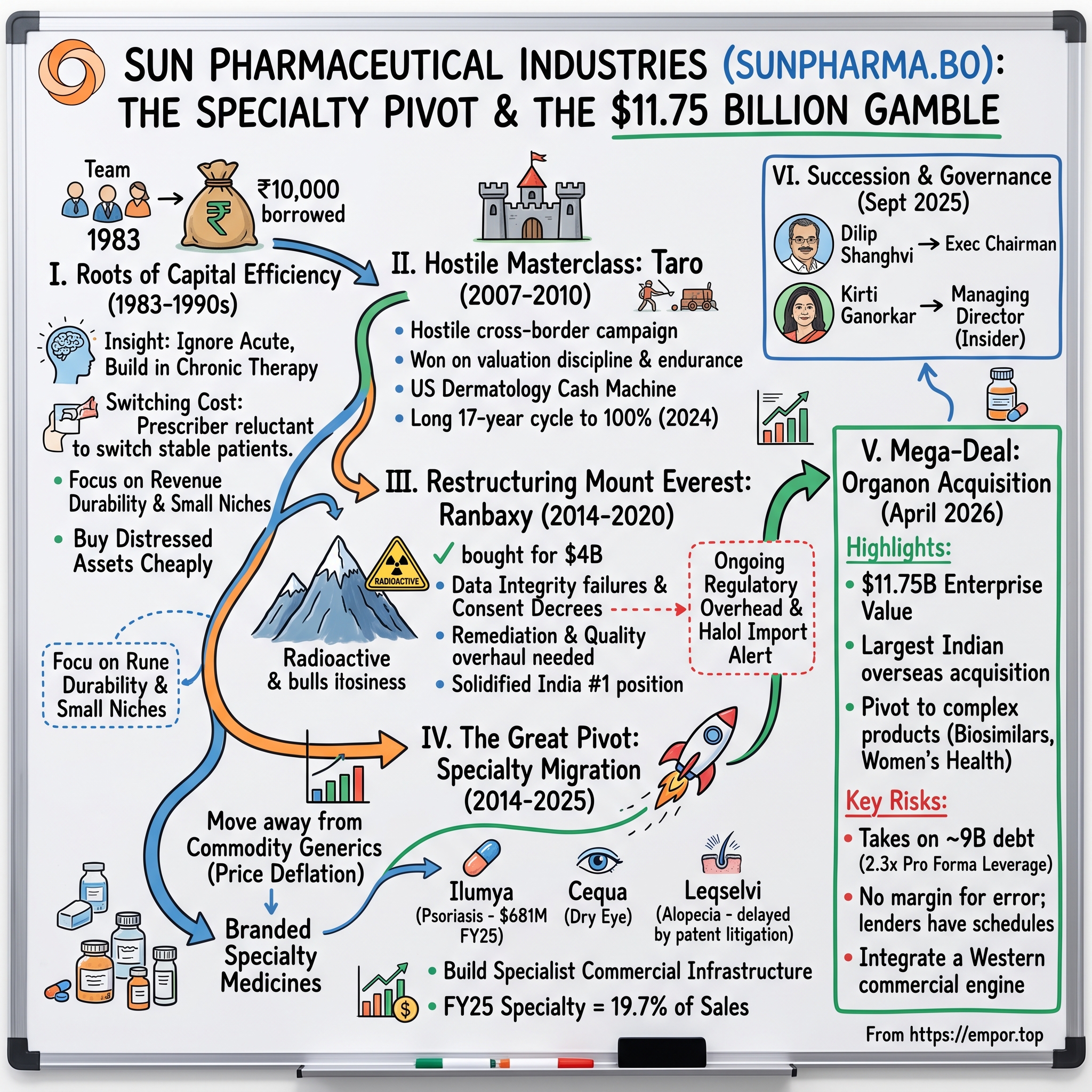
Sun Pharmaceutical Industries: The Specialty Pivot and the $11.75 Billion Gamble
I. Introduction & Episode Roadmap
On the evening of May 22, 2025, on a routine quarterly earnings call, an analyst from Citigroup's Indian research desk asked Dilip Shanghvi a question that sounded like housekeeping and was actually the most important question anyone would ask Sun Pharma that year. The company, the analyst noted, was sitting on roughly $3 billion of cash and generating more than a billion dollars of free cash flow annually. Every acquisition Sun had made in recent years had cost less than a single year's cash generation. So what, exactly, was the cash for? Would there someday be a very large acquisition?
Shanghvi's answer was characteristically undramatic. Sun would keep looking at acquisitions that create value, he said, and any business it bought should be one Sun could run "significantly better than the current owners," or where there were "significant potential synergies. Otherwise it will not justify the acquisition premium."3 Then he added a sentence that, in hindsight, reads like a man thinking out loud about something already underway: "with our Ranbaxy experience, we will also look at our ability to manage. Because anything that we do, should then be able to manage and manage it well. But size is not something which would kind of put" — and the transcript moves on.3
Eleven months later, on April 26, 2026, Sun Pharma signed a definitive agreement to acquire Organon & Co., the US-listed women's health and biosimilars company spun out of Merck, in an all-cash transaction valuing it at an enterprise value of $11.75 billion.1 It was the largest overseas acquisition ever attempted by an Indian pharmaceutical company, and it would take a business that had spent four decades being conspicuously, almost stubbornly debt-free and lever it to roughly 2.3 times net debt to EBITDA on day one.1
That is the tension this story is built around. Because the company writing that cheque started in 1983 in Vapi, a small industrial town in Gujarat, with five psychiatry products, a couple of marketing men, and seed capital of about ₹10,000 borrowed from the founder's father.5 Between those two points sits one of the more remarkable capital-allocation records in global pharmaceuticals — and a strategy that has, over the last decade, quietly inverted itself.
The Sun Pharma that investors learned to admire was a distressed-asset buyer. It bought things nobody else wanted, at prices nobody else would accept, and fixed them. It waged a three-year hostile siege for a broken Israeli dermatology company. It bought Ranbaxy — a business under a US Department of Justice consent decree with multiple plants barred from exporting to America — from a Japanese owner desperate to get out. The playbook was patient, unglamorous, and enormously profitable: buy the hair shirt, do the unpleasant remediation work, harvest the cash flows.
The Sun Pharma of 2026 is doing something close to the opposite. It is paying a 24% premium for a large, clean, Western asset with an $8.6 billion debt stack attached, in a competitive process, funded substantially with borrowed money.124 Management would say the strategy hasn't changed — that this is simply the "significant potential synergies" branch of the same framework. A skeptic would say a value buyer who starts paying premiums for scale has, whatever the language, become a different kind of company, and should be underwritten as one.
Here is the roadmap. We start with Shanghvi's founding insight — the decision to ignore the crowded acute-illness market Indian pharma was fighting over and build instead in chronic therapies, a choice about revenue durability that shaped everything after. We move to Taro, the three-year hostile campaign that taught Sun it could win wars of attrition and handed it a US dermatology cash machine. Then Ranbaxy, the deal that made Sun India's undisputed number one and simultaneously imported a regulatory infection that has still not fully cleared. Then the pivot that matters most for the next decade: the migration out of commodity generics — a business whose economics broke permanently in the mid-2010s — into branded Global Specialty medicines, which reached $1,216 million in FY25 and just under 20% of sales.2 Then Organon. Then the September 2025 succession that ended Dilip Shanghvi's 42-year run as managing director. And finally the hard analytical work: where the moats actually are, where they are thinner than advertised, and the small number of things worth watching from here.
 Subscribe on LinkedIn
II. Dilip Shanghvi & The Roots of Capital Efficiency (1983–1990s)
To understand Sun Pharma you have to start behind the counter of a wholesale drug distributorship in Kolkata, where a young Dilip Shanghvi spent his formative years watching his father, Shantilal, move other companies' medicines.5 This is an underrated apprenticeship. A distributor doesn't see pharmaceuticals as science; he sees them as inventory. He learns which products move slowly and which move every month like clockwork, which brands doctors ask for by name and which get substituted at the counter, which manufacturers can be squeezed on price and which cannot. Shanghvi absorbed, before he ever manufactured a tablet, the single most valuable piece of commercial intelligence in the industry: not all prescriptions are created equal.
In 1983 he acted on it. With about ₹10,000 borrowed from his father, he set up in Vapi, Gujarat, with five products and a tiny team.56 What made the venture interesting was not its scale, which was negligible, but its deliberate refusal to compete where everyone else was competing.
Indian pharmaceuticals in the early 1980s was a brawl over acute therapy — antibiotics, anti-infectives, analgesics, vitamins. The logic was obvious: India had enormous infectious disease burden, volumes were huge, and every domestic manufacturer and multinational subsidiary piled in. The logic was also, from a business-model standpoint, terrible. An acute prescription is a one-time event. A patient takes a course of antibiotics for five days and is gone. Every month you must find new patients, and because a dozen manufacturers make chemically identical products, the only lever left is price and the only durable winner is whoever has the lowest cost. It is a volume treadmill.
Shanghvi went the other way, into chronic therapy: psychiatry first, then neurology and cardiology.6 Consider what that choice actually buys you. A patient started on an antipsychotic, an anti-epileptic, or a cardiac medication frequently stays on it for years — often for life. One prescription becomes a decade-long annuity. The revenue base compounds rather than resetting, because this year's patients don't churn out; they accumulate underneath next year's additions.
But the deeper insight was about who decides. In branded generics — India's dominant model, where chemically identical molecules are sold under company brand names — the prescribing physician chooses the brand, and the patient simply fills what is written. In acute illness, the relationship is fleeting and substitution at the pharmacy counter is easy. In chronic psychiatry or epilepsy, it is emphatically not. A physician who has stabilised a patient on a specific brand — right dose, tolerable side effects, no relapse — becomes extremely reluctant to switch, because the downside of a destabilised patient is severe and the saving is trivial. That reluctance is a switching cost, and it doesn't sit with the patient or the pharmacist. It sits with the prescriber.
This is the mechanism to hold onto, because it recurs throughout Sun's history in different costumes: the company has consistently sought positions where the person choosing the product is not the person paying for it, and where the chooser has strong clinical reasons not to change. Chronic therapy in India in the 1980s was the first expression of it. Branded specialty dermatology in the United States four decades later is the same idea in a far more expensive suit.
There was a further advantage, less romantic but arguably as important. Chronic specialties in that era were small markets — too small for large multinationals to bother with, requiring specialist sales forces calling on psychiatrists and neurologists rather than armies of representatives blanketing general practitioners. Sun could build genuine leadership in narrow categories without a giant competitor noticing. And a specialist sales force calling on a few thousand high-value prescribers is a fundamentally more capital-efficient machine than a mass-market one.
The manufacturing philosophy matched. Rather than building greenfield capacity — slow, expensive, and a magnet for the licensing bureaucracy of pre-liberalisation India — Sun developed an appetite for buying underperforming and distressed plants cheaply and turning them around. This is where the phrase "capital efficiency" earns its keep: for a given rupee of invested capital, Sun consistently secured more productive capacity than a competitor building from scratch, because it bought assets at a discount to replacement cost and supplied the missing ingredient, which was operating competence rather than money.
By the 1990s the shape of the enterprise was set: high-margin chronic niches, prescriber-anchored brands, cheaply acquired manufacturing, and profits recycled into the next acquisition rather than distributed. The habit of buying other people's problems at a discount had become the company's defining muscle. The question was how far it could be pushed — and whether it would work when the distressed asset was on another continent, in another legal system, and actively fighting back.
III. The Hostile Masterclass: The Battle for Taro (2007–2010; 2024 Privatization)
In May 2007, Sun Pharma agreed to acquire Taro Pharmaceutical Industries, an Israeli-headquartered, NYSE-listed maker of generic dermatology products, in a deal valued at roughly $454 million.7 Taro looked like the classic Sun target wearing a foreign flag. It was in genuine distress — unable to file audited accounts on time, straining under a liquidity crunch, its share price a fraction of former levels. It also owned something Sun badly wanted and could not easily build: sophisticated topical manufacturing capability — the specialised, genuinely difficult art of making creams, ointments and gels — in Canada and Israel, plus an established position in the US generic dermatology market.
Then Taro's performance began to improve, and the founding Levitt family decided they no longer wished to sell. In May 2008, Taro purported to terminate the merger agreement.7 Sun's response set the tone for everything that followed: it refused to accept the termination and refused to go away.
What made this different from an ordinary busted deal was the terrain. Israeli corporate law contains a mechanism called the Special Tender Offer, which governs how an acquirer may cross certain control thresholds and is designed to protect minority shareholders. Taro's management used it as a shield, litigating in the Tel Aviv District Court to force Sun to comply with procedures that would slow or block its advance.7 Simultaneously the fight ran through US securities filings and shareholder litigation. Sun found itself waging a multi-jurisdictional legal campaign across two foreign legal systems, in languages and procedural traditions foreign to an Indian pharmaceutical company that had never done anything remotely like it.
Most acquirers, at this point, do one of two things: walk away, or raise the price enough to make the resistance go away. Shanghvi did neither, and the refusal is the most instructive thing about the episode. Sun kept its valuation discipline while extending its time horizon almost indefinitely — grinding through courts, accumulating shares in the open market and through tender offers, and simply outlasting the other side. The strategy only works if you are genuinely willing to spend years getting nowhere, and if your capital is patient enough not to demand a resolution. Sun's ownership structure — a founder-controlled company with no pressure to show a quick return on a stranded investment — made that patience affordable in a way it would not have been for a private-equity buyer or a professionally managed multinational with an M&A team judged on annual completions.
The siege broke in September 2010. Sun closed a tender offer that lifted its economic interest in Taro to 48.7% and, critically, its voting power to 65.8%, and installed a new board on September 20, 2010.8 Sun had won operational control without ever having paid the full-control price the 2007 agreement contemplated.
The economics that followed vindicated the patience emphatically. Sun had effectively acquired advanced topical manufacturing infrastructure at a fraction of what building it would have cost — and in dermatology, that infrastructure is the barrier. Making a simple tablet is straightforward; making a stable, uniformly dispersed topical cream whose active ingredient penetrates skin in a reproducible way, and proving bioequivalence to a regulator, is a genuine technical discipline with a long learning curve. Taro's plants, know-how, and US regulatory approvals gave Sun immediate credibility in a segment where competition was thinner and margins consequently fatter than in ordinary oral generics. Taro became a cash engine, and the dermatology beachhead it provided is precisely where Sun would later plant its specialty flag.
The story had a long tail. For fourteen years Taro remained a partially owned, separately listed subsidiary — an arrangement that constrained Sun's freedom to move cash and integrate operations, and one that periodically generated friction with minority holders who felt squeezed by a controlling shareholder. Sun closed that chapter on June 24, 2024, completing a merger that bought out the remaining minority at $43.00 per share in cash — 8,086,818 shares representing 21.52% of Taro, roughly $347.7 million — and delisting Taro from the NYSE.9
For investors, the Taro arc carries two lessons that pull in different directions. The favourable one is that Sun demonstrated genuine, rare capability: it won a hostile cross-border battle against entrenched founders in an unfamiliar legal system, on price discipline and endurance rather than money. The cautionary one is that it took seventeen years from first agreement to clean full ownership. That is an extraordinarily long capital-deployment cycle. It worked because the underlying asset was cheap enough to absorb the delay — a luxury that a buyer paying a premium for a large asset on a financed timetable does not have. Which is exactly the pressure Sun would create for itself later.
The Taro campaign proved Sun could buy something broken and foreign and make it work. Four years later it would attempt the same trick at ten times the complexity, on an asset that wasn't merely distressed but actively radioactive.
IV. The Restructuring Mount Everest: The Ranbaxy Bet (2014–2020)
In April 2014, Sun Pharma announced it would acquire Ranbaxy Laboratories from 第一三共 Daiichi Sankyo in an all-stock transaction: 0.8 Sun shares for each Ranbaxy share, about $3.2 billion in equity value, plus roughly $800 million of assumed debt, for a total enterprise value of approximately $4 billion.10
To grasp how strange this was, you have to understand what Ranbaxy had become. It had once been India's most celebrated pharmaceutical company, the pioneer that proved Indian generics could compete in the West. Daiichi Sankyo had bought control in 2008 in a transaction widely read as validation of Indian pharma's arrival. And then it disintegrated.
In May 2013, Ranbaxy pleaded guilty to felony charges and agreed to pay $500 million — $150 million in criminal fines and forfeiture plus $350 million in civil settlements — to resolve allegations including manufacturing violations and false statements to the FDA.11 It was, at the time, the largest such settlement involving a generic drug manufacturer. The conduct at issue was not a paperwork lapse. It went to data integrity — the trustworthiness of the underlying test results a manufacturer submits to regulators.
This deserves plain-language explanation, because it is the crux of everything that follows. When a pharmaceutical plant makes a batch, it runs tests: is the drug pure, does it dissolve correctly, does it contain what the label says? Regulators do not re-test every batch; they cannot. The entire global system rests on an assumption that the manufacturer's records are complete and truthful, including records of tests that produced unfavourable results. Data integrity failures — discarding bad results, retesting until a passing number appears, backdating records — attack that assumption directly. And once a regulator concludes it cannot trust a facility's records, the problem is unbounded: every product from that site becomes suspect, because there is no way to know what else was hidden. That is why the FDA's response is so blunt. A consent decree was entered in January 2012, and successive regulatory actions barred product from key Indian sites — the 2013 guilty plea covered Dewas and Paonta Sahib, while Mohali was placed under import alert in 2013 and Toansa was brought under the consent decree via FDA action in January 2014.1112
So Sun was buying a company whose principal manufacturing base was largely locked out of its most valuable market, whose brand had been publicly disgraced, and whose owner had lost the appetite and the credibility to fix it. The seller's desperation was the buyer's opportunity, and Sun paid accordingly — a price that looked cheap against the revenue base but was, in truth, a bet that Sun's operational culture could be transplanted into a demoralised organisation faster than the liabilities compounded.
The deal closed on March 25, 2015.13 The strategic payoff on the India side was immediate and durable. Combining the two largest domestic branded-generic franchises made Sun the clear number one in the Indian pharmaceutical market by a wide margin, with a portfolio spanning chronic and acute categories and a field force of enormous reach.13 India is the asset that has justified the transaction ever since: a market where Sun's prescriber-anchored brands hold pricing power, where volume growth tracks rising incomes and insurance penetration, and where — a decade later — India formulation sales reached ₹169,230 million in FY25, growing 13.7% year on year, comfortably ahead of the broader market.2 Ranbaxy also delivered a genuinely useful emerging-markets footprint, particularly across Russia and CIS, South Africa, and other territories where branded generics command better economics than in the US.13
The cost side is where the honest accounting gets uncomfortable. Remediating manufacturing facilities with data-integrity findings is not a matter of new equipment. It requires rebuilding quality systems, retraining staff, replacing leadership, re-validating processes, and then persuading a sceptical regulator — through repeated inspections over years — that the culture has actually changed. Sun spent years on it, and management attention is a finite resource: every hour senior leadership spent on remediation was an hour not spent on the specialty pivot that was simultaneously becoming existential.
Worse, and this is the part investors most often underrate, the problem did not stay contained. Sun's own legacy facilities came under intensified FDA scrutiny in the years following, most prominently Halol in Gujarat — a plant that was Sun's, not Ranbaxy's, and which nonetheless became a chronic regulatory sore.2229 Whether this reflects genuine contagion of practice, a stretched quality organisation absorbing a damaged one, or simply an agency looking harder at a much larger Indian manufacturer, the practical consequence is the same: a decade after the acquisition, Sun still carries an unresolved US compliance overhang.
The most revealing commentary on Ranbaxy came from Shanghvi himself, unprompted, in that May 2025 exchange about large acquisitions: any future deal would be tested against "our ability to manage."3 That is a man who has internalised a lesson. The Ranbaxy price was excellent. The Ranbaxy integration was harder than he expected, and he has said so in the plainest terms available to a chief executive — by making manageability an explicit criterion for the next one. Investors evaluating the Organon transaction should weigh that sentence heavily, in both directions.
While Sun was absorbing Ranbaxy, the ground beneath its largest export market was giving way — and no amount of remediation was going to fix that, because the problem wasn't compliance. It was the business model itself.
V. The Great Pivot: Transitioning from Commodity Generics to Global Specialty (2014–2025)
For roughly three decades, the US generic drug business was one of the great value creators available to Indian manufacturers. The formula was elegant: reverse-engineer an off-patent molecule, prove bioequivalence, win FDA approval, manufacture at Indian cost, sell into the world's richest healthcare market. Gross margins were high, capital requirements moderate, and the tailwind — branded drugs losing exclusivity — seemed inexhaustible.
Then the buyers organised, and the model broke.
Here is what happened, in plain terms. Historically, a generic manufacturer sold to a fragmented universe of drug wholesalers, retail pharmacy chains, and hospital groups. Fragmented buyers have limited leverage. Beginning in the early 2010s, those buyers consolidated their purchasing into a handful of enormous joint ventures and alliances — Red Oak Sourcing (CVS), ClarusONE (McKesson and Walmart), and Walgreens Boots Alliance Development — until roughly 90% or more of US generic drug purchasing ran through three negotiating entities.21
Consider what that does to the negotiation. A manufacturer with a generic tablet faces three possible customers. Losing one is not losing a customer; it is losing a third of the addressable market at a stroke. Meanwhile that buyer can play four or five manufacturers of the identical molecule against each other in a single conversation. Pricing power did not merely shift — it inverted. Commodity generics entered a regime of persistent annual price deflation, and the erosion compounds: a product declining at a double-digit rate loses roughly half its value in five years without losing a single unit of volume. Growth requires running hard just to stand still, launching new approvals fast enough to offset the melting base.
This is the structural reality Sun has been managing around for a decade, and it shows up directly in the numbers. In FY25, Sun's total US formulation sales were $1,921 million, up just 3.6%.2 But the composition is the story: on the earnings call, North America head Abhay Gandhi attributed the growth entirely to specialty products — Ilumya, Cequa, Winlevi and Odomzo — "offset by a decline in generics for the full year."3 In the fourth quarter, US sales actually fell 2.5%, with specialty growth unable to offset generic decline.23 Asked directly whether generic pricing pressure had worsened, Gandhi declined to generalise, saying it was product-specific and that "there is not much which has changed as far as overall industry dynamics is concerned."3 That is a candid answer, and its meaning is not reassuring: the pressure is not a passing storm, it is the weather.
Sun's response was to stop competing on cost in a market where cost competition had become value-destructive, and instead go where the buyer consolidation has far less bite — branded, patent-protected specialty medicines sold to specialist physicians.
Ilumya (tildrakizumab) is the flagship and the template. In September 2014, Sun licensed it from Merck for an upfront payment of $80 million plus milestones and tiered royalties, taking on responsibility for funding and running the Phase III registration programme itself.14 Understanding why this was clever requires understanding what the drug is. Plaque psoriasis is an autoimmune condition in which the immune system attacks the skin. Tildrakizumab is a monoclonal antibody — a large, precisely engineered protein — that blocks a specific immune signalling molecule, interleukin-23, upstream of the inflammatory cascade. If older treatments were a sledgehammer against the immune system, this class is a key cut for one lock.
Structurally, the deal was an option purchase. Merck had done the discovery work and taken the biology risk; what remained was expensive late-stage clinical development and commercialisation — capital and execution risk, not scientific risk. For $80 million upfront, Sun bought the right to spend a great deal more money on a molecule whose mechanism was already validated. And unlike a generic, a successful branded biologic sells at branded prices to dermatologists on the strength of clinical data and relationships, not to three purchasing consortia on the strength of price.
It worked. Ilumya reached $580 million in global sales in FY24, up 21.7%, and $681 million in FY25, up 17%.153 Cequa in dry eye disease and Winlevi in acne followed, extending the model into ophthalmology and further into dermatology.303 The strategic asset being built here is not any single molecule; it is the specialist commercial infrastructure — a US sales organisation calling on dermatologists and ophthalmologists, with the payer-access teams and patient support programmes that branded medicines require. Once built, that channel carries additional products at low incremental cost, which is precisely why Sun kept acquiring things to put through it.
Concert Pharmaceuticals was the most consequential such purchase. Announced January 19, 2023, Sun agreed to acquire Concert for $8.00 per share in cash — about $576 million — plus a contingent value right of up to $3.50 per share tied to sales milestones.16 The asset was deuruxolitinib, an oral JAK inhibitor for severe alopecia areata, a condition causing profound autoimmune hair loss with, at the time, very few effective options.
What happened next is the single best illustration of why specialty pharmaceuticals is not simply "generics with better margins." The FDA approved the drug as Leqselvi in July 2024.17 Sun could not sell it. Incyte Corporation, which markets the related JAK inhibitor ruxolitinib, sued for patent infringement, and around November 1, 2024 a New Jersey district court granted a preliminary injunction blocking the launch outright.18 A company that had paid over half a billion dollars and cleared the FDA was stopped at the final gate by a competitor's patent.
Sun appealed and won: the Federal Circuit vacated the injunction, with its written opinion issued May 7, 2025.19 But the litigation remained live, and management was strikingly frank about the consequences. Asked on the May 2025 call whether launching into ongoing litigation meant risking damages if Sun ultimately lost, Gandhi answered simply: "Yes, that's true."3 Asked whether a launch delayed three to four quarters changed the product's prospects, he acknowledged the time to expected peak sales "will move a little," while arguing increased investment could partly compensate.3 Both answers are concrete and non-evasive — a point in management's favour on the credibility ledger, since the easy path would have been to wave the question away.
The matter resolved in July 2025 through a settlement with Incyte involving a limited non-exclusive licence, an upfront payment and future royalties, and Leqselvi finally launched in the US on July 16, 2025 — roughly a year after approval.20 A year of exclusivity runway, gone, plus an unquantified permanent royalty burden.
Where all this leaves the portfolio, as of the last full year reported before the Organon announcement: FY25 consolidated sales of ₹520,412 million, up 9.0%, with EBITDA of ₹152,717 million at a 29.0% margin and reported net profit of ₹109,290 million.2 Global Specialty reached $1,216 million, up 17.1%, accounting for 19.7% of sales.2 India contributed the ₹169,230 million already noted; emerging markets $1,114 million, up 7.0%; rest of world $847 million, up 4.5%.2 R&D ran at 6.4% of sales in the fourth quarter, with specialty absorbing 36% of the total, and management guided FY26 R&D to 6–8% of sales alongside roughly $100 million of additional spending on commercialising new specialty products.3
Read those numbers as a portfolio and a clear picture emerges. Two engines are working — India branded generics compounding in the low-to-mid teens, and Global Specialty compounding in the high teens — while a third, US commodity generics, is in structural decline and acting as a drag. The pivot is real and measurable: specialty went from nothing to a fifth of a $6 billion company in roughly a decade, which is genuine execution, not a slide-deck aspiration.
But two caveats belong alongside it. First, at just under 20% of revenue, specialty was still not large enough to set the trajectory of the whole company; consolidated growth of 9% reflects a fast minority pulling a slower majority.2 Second, specialty growth is expensive and legally hazardous in ways generics never were — the Leqselvi episode cost a year and a royalty stream, and management was guiding to higher R&D and $100 million of incremental commercial spend simply to keep the engine accelerating.3 Getting to a majority-specialty company organically would take many more years and a great deal more capital.
Which is one way of explaining what Sun did next.
VI. The Transformational Mega-Deal: The Organon Acquisition (April 2026)
On April 26, 2026, Sun Pharma announced it had signed a definitive agreement to acquire Organon & Co. for $14.00 per share in cash, an enterprise value of $11.75 billion, in what was the largest overseas acquisition ever undertaken by an Indian pharmaceutical company.126 The price represented a premium of roughly 24% to Organon's undisturbed share price, and the transaction is expected to close in early 2027, subject to regulatory clearances and approval by Organon shareholders.1
Organon is itself a child of corporate restructuring: spun out of Merck in 2021 to house products past their growth prime — established brands, women's health franchises, and an emerging biosimilars business. In the year ended December 2025 it generated revenue of $6.2 billion with adjusted EBITDA of $1.9 billion, roughly a 31% margin, against $8.6 billion of debt and $574 million of cash.1 Its portfolio spans around 70 products sold across roughly 140 countries, anchored by women's health — the long-acting contraceptive implant Nexplanon is the best-known asset — plus general medicines and a biosimilars platform.1
Combined, the two businesses represent about $12.4 billion of revenue, placing Sun among the top 25 pharmaceutical companies globally and, on management's framing, among the top 10 in biosimilars.125
Biosimilars deserve a moment, because they are central to the strategic logic. A conventional generic copies a small chemical molecule — reproducible exactly, cheap to prove equivalent. A biologic like Ilumya is a large protein grown in living cells, and no one can copy it exactly; the best achievable is highly similar, which requires its own manufacturing platform, analytical work, and clinical comparability studies. Entry costs run into hundreds of millions per product rather than a few million. The consequence is that biosimilars behave less like commodity generics and more like a mid-barrier oligopoly: fewer competitors, slower price erosion, but real scale requirements. For a company whose small-molecule generic business is being ground down by three US buyers, buying an established position in the harder-to-enter version of the same game is a coherent response — and one Sun could not plausibly build from scratch in under a decade.
Now the financing, which is where the risk lives. Sun stated the transaction would be funded through a combination of available cash and committed bank financing from Citigroup Global Markets Asia, JPMorgan Chase Bank, and MUFG Bank.1 The company did not disclose the split between cash and debt facilities; figures circulating in market commentary have suggested roughly $2.0–2.5 billion of balance-sheet cash against committed facilities of $9.25–9.75 billion, but those specific amounts are not confirmed in the primary transaction materials and should be treated as estimates.1 What Sun did disclose is the outcome that matters: pro forma net debt to EBITDA of approximately 2.3 times at closing.1
To appreciate the magnitude of that shift, recall where Sun started. At March 31, 2025, the company held cash and short-term investments of roughly ₹250 billion against total debt of only ₹23.6 billion — a net cash position of about ₹90 billion. This was a business that had spent its entire existence being able to say yes or no to any opportunity on its own terms. At 2.3 times leverage it becomes, for the first time, a company with lenders, covenants, refinancing calendars, and a credit rating that constrains behaviour.
Three tests will determine whether this was a good use of $11.75 billion.
Can Sun run Organon better than Merck's spin-out management did? This is Shanghvi's own stated criterion.3 The honest answer is that the evidence is mixed and mostly unavailable. Organon is not a broken asset — a 31% EBITDA margin business generating over $1 billion of standalone free cash flow in 2025 is functioning perfectly well.131 That cuts both ways: less turnaround upside to capture, but also far less integration risk than Ranbaxy. Sun's demonstrated edge has been fixing damaged operations and running low-cost manufacturing, and neither obviously applies to a competent Western commercial organisation. The synergy case rests more on manufacturing cost, procurement scale, and pushing Organon's portfolio through emerging-market channels where Sun is strong and Organon is not.
Is the deleveraging path credible? The combined entity's cash generation is substantial, and Organon's contribution alone exceeded $1 billion in 2025.131 Sun has not published a specific combined free-cash-flow target, and figures suggesting roughly $2.5 billion annually are not confirmed in the primary materials. The genuine risk is not that cash flow disappears; it is that it arrives more slowly than assumed while a fixed debt schedule does not. Organon's portfolio contains established brands that decline over time by design — that is why Merck spun them out — so the cash flows funding the paydown are partly melting assets. Leverage falls only if repayment outruns erosion.
What does it cost the rest of the company? Interest expense on roughly $9 billion-plus of borrowing is a large annual claim on cash that previously had no claimant. Sun has committed to R&D at 6–8% of sales and to funding specialty commercialisation aggressively.3 If combined cash flow disappoints, the tension between servicing debt and funding the specialty pipeline becomes real, and the pipeline is the discretionary item.
There is also a question of strategic identity that a sceptical investor is entitled to press. For forty years the discipline was: buy what others are fleeing, pay below intrinsic value, accept a long timeline. Organon inverts every element — a premium, a competitive process, a defined closing timetable, and borrowed money. Management would argue it satisfies the "significant potential synergies" limb of the framework Shanghvi articulated a year earlier.3 That is a defensible reading. But it is worth being clear-eyed: a deal that increases scale, accelerates the specialty-and-biosimilars mix shift, and is funded with leverage is a fundamentally different risk proposition from the ones that built the company's reputation. The bull and bear cases from here are not about whether Sun is a good operator; they are about whether a good operator has taken on more balance-sheet risk than its historical style suggests it should.
Executing all of this falls to a management team that, notably, is no longer the one that built the company.
VII. Leadership Succession, Corporate Governance, & The September 2025 Handoff
On June 13, 2025 — eleven months before the Organon announcement — Sun Pharma disclosed the most significant leadership change in its history.4 Dilip Shanghvi would step down as Managing Director, a role he had held since founding the company in 1983, and become Executive Chairman. Kirti Ganorkar would become Managing Director effective September 1, 2025, with the entire business and all functions reporting to him, subject to shareholder approval.4
Founder transitions in Indian promoter-controlled companies are notoriously fraught, and the two common failure modes are opposite: the founder never actually leaves, hollowing out the successor's authority; or the founder leaves abruptly and the institution loses its judgment. Sun's design attempts to avoid both, though whether it does is not yet demonstrable.
Kirti Ganorkar is the deliberate choice of an insider. A chemical engineer with an MBA, he joined Sun in 1996 and has spent his entire career there, running the India business since June 2019.4 That is a meaningful credential, because India is the profit engine and it performed conspicuously well on his watch — the 13.7% FY25 growth cited earlier came out of his organisation.2 On the earnings call, his own framing of the India strategy was blunt and repeated: "we want to grow higher than the market."3 Simple, measurable, and falsifiable, which is the kind of target worth having.
The appointment signals continuity rather than reinvention. A board seeking a strategic break hires an outsider; a board promoting a 29-year veteran who ran the largest business is buying institutional memory and cultural continuity. The corresponding risk is equally clear: Ganorkar's proven excellence is in the Indian branded-generic market, a business he knows intimately. The defining challenge of his tenure is integrating a $6 billion Western business with a large debt stack — a problem with almost no overlap with the one he mastered.
Dilip Shanghvi's new role is explicitly not retirement. As Executive Chairman he continues to chair the board while focusing on strengthening the specialty portfolio and long-term strategy.4 The Organon transaction, signed under his chairmanship and carrying his quoted endorsement,1 makes plain where the ultimate capital-allocation authority still sits. For investors this is genuinely double-edged. The reassurance is that the person with the best track record of allocating this company's capital remains in charge of doing so. The governance concern is that a new Managing Director inherits, in his first year, the largest and most consequential transaction in company history — one he did not originate and cannot unwind. Accountability for the outcome is structurally blurred.
Aalok Shanghvi, Dilip's son, was appointed Whole-time Director and Chief Operating Officer and additionally entrusted with the North America business.4 Sun did not pretend this was anything other than what it is: a founding family placing the next generation in an executive line role. The choice of North America as his remit is notable — it is simultaneously the most troubled part of the portfolio, given generic erosion and unresolved FDA matters, and the most strategically important, given that specialty and now Organon both run through it.
Reporting to Aalok, Richard "Rick" Ascroft joined as CEO of North America, succeeding Abhay Gandhi.4 Ascroft arrived from 武田薬品工業 Takeda, where he was Senior Vice President and Business Unit Head for US Plasma-Derived Therapies.4 The hire fits the strategy: a commercial executive from branded, specialty-adjacent US pharmaceuticals rather than a generics operator. Sun is staffing the US organisation for the business it wants rather than the one it has.
On ownership, the promoter and promoter group hold approximately 54.48% of Sun Pharma, consolidated principally through Shanghvi Finance Private Limited, which came to hold about 40.00% of the company directly following a 2018 scheme of amalgamation that merged several promoter entities into it.2728
A controlling stake above 50% is genuinely double-edged, and the honest treatment says so. The advantage is real: management can pursue a strategy whose payoff is measured in decades without fear of activists, hostile bids, or the quarterly earnings treadmill. The Taro campaign is the proof — no professionally managed company with dispersed ownership would have tolerated a seventeen-year path to full control. The disadvantage is equally real: at 54.48%, minority shareholders have no mechanism to compel a change of course. If the Organon integration disappoints, there is no activist campaign, no proxy fight, no board coup. Minority investors' only lever is exit. That is not an argument against owning the company; it is an argument for weighting management quality and capital-allocation history very heavily, because those are effectively the only protections available. Sun's record supports doing so — but the record was built with a debt-free balance sheet, and it is precisely the loss of that cushion that changes the risk.
Governance and leadership set who decides. What they decide against is a competitive structure that has been shifting under the company for a decade.
VIII. The Strategic Playbook: 7 Powers & Porter's 5 Forces Analysis
Strip away the narrative and Sun Pharma is not one business but four, with radically different competitive economics stapled together on a single income statement. Applying strategic frameworks company-wide produces mush; applying them segment by segment is where the insight lives.
Hamilton Helmer's 7 Powers
Cornered Resource is the clearest power Sun holds, and it lives almost entirely in specialty. Patents on Ilumya, Cequa and Winlevi, and now the biosimilar and women's health portfolio arriving with Organon, are legally protected positions competitors cannot replicate at any price for a defined period. But a cornered resource has an expiry date stamped on it, and the Leqselvi episode showed that possession of a patent is not the same as freedom to sell — a competitor's overlapping patent estate blocked a fully approved product for a year and ultimately extracted a royalty.181920 Patent power is real, finite, and contestable.
Switching Costs are the most durable power and, importantly, they are prescriber-level rather than customer-level. The mechanism established in Sun's Indian chronic franchises — a physician's reluctance to destabilise a working patient — reappears in US specialty dermatology and ophthalmology, reinforced there by an additional layer of friction: payer authorisation. A patient stabilised on a biologic whose insurer has already approved it represents a switching decision involving clinical risk, administrative burden, and reimbursement uncertainty. That is a meaningful moat, and it explains why specialty revenue has proved far more resilient than generic revenue. The limitation is that it protects the installed base rather than new patient starts, which are competed for on data and price with every launch.
Scale Economies are genuine but frequently overstated in Sun's case. The company's global API and formulation footprint gives it a structurally low cost of goods, visible in FY25's 29.0% EBITDA margin.2 For a specialty product, being able to manufacture at Indian cost while pricing at US branded levels is a real advantage over a pure-play Western innovator. But scale in manufacturing does not confer scale in the activities that actually determine specialty success — clinical development, payer negotiation, and specialist sales force effectiveness — where Sun competes against companies many times its size. And scale has a shadow side visible in the regulatory record: a very large manufacturing network is a very large surface area for inspection failure.
Process Power — hard-won organisational know-how — is Sun's least discussed and possibly most real advantage: the demonstrated ability to buy underperforming assets and improve them. Taro proved it. Ranbaxy proved it, expensively. Whether it applies to Organon, which is not underperforming, is precisely the open question.
Powers Sun conspicuously lacks are worth naming. There is no Network Economy — a drug does not become more valuable because other patients use it. There is no Branding power in the consumer sense; prescribers respond to clinical data, not brand affinity. And there is no Counter-Positioning, which is telling: Sun has no business model incumbents cannot copy. It has better execution and lower costs, which is a different and less defensible thing.
Porter's Five Forces
Threat of new entrants varies enormously by segment. In commodity generics it is high — that is the whole problem; approvals are achievable by any competent manufacturer, and Chinese and Indian competitors keep arriving. In specialty biologics it is low: entry requires years of trials, hundreds of millions in capital, and a specialist sales infrastructure. Biosimilars sit in between, which is exactly why the Organon platform has strategic value.
Bargaining power of buyers is the force that has most damaged Sun's economics, and its asymmetry across segments is the single most important structural fact about the company. In US generics it is close to absolute, for the three-consortium reason already established. In US specialty it is materially lower — pharmacy benefit managers and insurers negotiate hard, but a differentiated on-patent biologic with clinical data behind it is not interchangeable, so the negotiation is over rebate levels rather than survival. In India it is lowest of all: buying decisions sit with hundreds of thousands of individual prescribers, which is the most fragmented buyer base in the portfolio and the reason India carries the best pricing power Sun has. The strategic logic of the last decade is simply the pursuit of segments where this force is weakest.
Two qualifications belong here. Indian pricing power is not unconstrained — the National Pharmaceutical Pricing Authority caps prices on scheduled essential medicines, a persistent regulatory ceiling. And in the US, policy risk around drug pricing is live and unquantified. Asked on the May 2025 call what proportion of the US business would be affected by proposed most-favoured-nation drug pricing rules, Shanghvi refused to speculate: "there is no clarity only. Whether it will apply to Medicare, Medicaid or it will apply to Commercial. So when there is no clarity, how can we give any idea?"3 That is an honest answer, and it is also an admission that a material portion of the company's highest-margin revenue sits under a policy question nobody can currently size.
Bargaining power of suppliers is low and deliberately so — Sun's backward integration into APIs means it largely is its own supplier, insulating it from the input-cost and availability shocks that periodically hit competitors dependent on third-party Chinese API sources.
Threat of substitutes is low in the near term for on-patent specialty products but rises sharply at patent expiry, when a biologic faces biosimilar competition. Sun is now on both sides of that trade — defending Ilumya against future entrants while, through Organon, becoming an attacker of others' biologics.
Competitive rivalry is where the strategic picture is most sobering, and it is best seen through Ilumya. In psoriasis biologics Sun competes against AbbVie's Skyrizi and Johnson & Johnson's Tremfya — products backed by R&D and commercial budgets that dwarf Sun's entire R&D spend. Analysts pressed management directly on this: with Humira and Stelara biosimilars arriving at full force in FY27–28, what happens to Ilumya three years out? Gandhi's answer was measured — an evolving situation, continuously evaluated, with modelling suggesting "there will be an impact, but we think it will be a small impact," and the product continuing as a growth driver aided by new indications.3 It is a reasonable answer. It is also, unmistakably, an acknowledgement that Sun's flagship specialty asset faces a competitive squeeze from cheaper biosimilar alternatives in an adjacent class, from a position of significant resource disadvantage. Investors should treat "small impact" as a management estimate to be tested against reported Ilumya growth rates, not as an established fact.
The composite picture: Sun occupies genuinely defensible ground in Indian branded generics and a narrower, more contested but higher-value position in US specialty, while its legacy US generic business sits in one of the least attractive competitive structures in healthcare. The strategy is to shift weight from the third to the second as fast as capital allows. Organon accelerates that shift. It also introduces a set of risks the company has never carried before.
IX. Investor Risk Radar & Skeptical-Investor Stress Test
If a sceptical long-short investor built a short thesis on Sun Pharma, it would not rest on business quality — the India franchise and specialty portfolio are genuinely good. It would rest on three things that can be assessed independently of the narrative.
1. The USFDA compliance tax
The most persistent, least glamorous risk is that Sun does not fully control access to its most profitable market.
Halol, in Gujarat, has been the emblematic case. The FDA placed the facility under import alert in December 2022, blocking products made there from entering the US, and followed with a warning letter dated October 16, 2023 — a document that formally records the agency's view that the site's quality systems were inadequate.2229 Dadra received its own warning letter dated June 18, 2024, citing ineffective quality systems and inadequate investigation of out-of-specification results.23 Sun has publicly described remediation efforts across affected sites; the current classification status of individual facilities is not comprehensively disclosed in the primary materials reviewed here, and investors should treat specific site-status claims cautiously and verify them against FDA's own published records.
The financial mechanism is what matters. An import alert does not merely stop shipments from a plant; it strands the approvals attached to it. Products approved to be made at Halol cannot be sold in the US from Halol, which means either transferring manufacturing to a compliant site — itself requiring regulatory filings and time — or forgoing the revenue. New approvals tied to an affected site can be held up as well. The cost is therefore not a fine; it is deferred and sometimes permanently forfeited revenue, plus the remediation expense, plus the opportunity cost of quality and senior leadership attention.
The uncomfortable pattern for a long-term holder is duration. These are not isolated events. Sun has been managing FDA compliance problems more or less continuously since the Ranbaxy acquisition — over a decade. A bull will say this is the unavoidable cost of operating one of the world's largest manufacturing networks under the scrutiny that comes with it. A bear will say a decade is long enough that recurring compliance failure should be modelled as a structural cost of the business rather than a series of one-offs. The bear has the stronger empirical case; the burden of proof sits with management to break the pattern.
2. The debt burden and refinancing risk
This is the newest risk and the one with the least historical precedent to guide judgment. Sun has no institutional experience operating at 2.3 times leverage.1 Every capability the company has demonstrated — patient hostile takeovers, multi-year turnarounds, absorbing years of remediation without strategic panic — was made possible by a balance sheet that gave it the option to wait.
The specific vulnerability is a timing mismatch. Debt service is contractual and fixed. The cash flows meant to retire it are not: Organon's established-brands revenue erodes by design, and Sun's own US generic business is in structural decline. If the combined free cash flow underperforms while interest costs stay elevated, the adjustment falls on discretionary spending — which means R&D and specialty commercialisation, the very things the company has committed to funding at 6–8% of sales plus roughly $100 million of incremental launch investment.3 Cutting them to service debt would be strategically self-defeating and is exactly the scenario a bear underwrites. It is worth noting that no credit-rating action on the post-transaction capital structure is reflected in the primary sources reviewed here; the financing terms beyond the identity of the lead banks and the 2.3x pro forma leverage were not disclosed.1
There is also straightforward execution risk in the transaction itself: it requires regulatory clearances across multiple jurisdictions and Organon shareholder approval, and is not expected to close until early 2027.1 That is a long window during which financing markets, and Organon's own trading performance, can move.
3. Specialty launch and litigation friction
The Leqselvi sequence — half a billion dollars deployed, FDA approval secured, launch blocked for roughly a year by a competitor's patent, resolved only via settlement carrying an upfront payment and ongoing royalties — is not an anomaly.16181920 It is the standard hazard of branded pharmaceuticals, and Sun is systematically increasing its exposure to it.
The distinction from Sun's historical business is important. In generics, litigation risk is well understood and largely symmetrical — everyone challenges everyone. In specialty, a single adverse ruling can strand an entire acquisition's value at precisely the moment the asset should begin returning capital. The return on invested capital is not merely reduced; its timing becomes unpredictable, which matters enormously more when the capital deployed was borrowed.
The activist's questions
An activist looking at this company would not attack the strategy. They would ask about accountability and disclosure. Why does a company disclose pro forma leverage of 2.3x but not the split between cash and committed facilities funding the largest deal in its history?1 Why is segment disclosure sufficient to show that specialty grew 17.1% but insufficient to see the profitability of specialty versus the declining generic base separately?2 What is the actual, dated remediation timeline for each affected facility, and what has management committed to publicly that can be checked later? And — the question a controlling shareholder structure makes unavoidable — if the Organon integration disappoints in 2028, what is the mechanism by which anyone other than the promoter family can do anything about it?
These are not accusations. They are the reasonable questions of an investor being asked to underwrite a strategic change funded with leverage, on the strength of a track record built without it.
X. Bull vs. Bear Case & Key KPIs to Track
The bull case
The bull case starts with an observation that is easy to lose in the drama of the Organon deal: two of Sun's three engines are working well, and the third is the one being deliberately shrunk.
India remains an exceptional asset. Growth of 13.7% in FY25, ahead of the market, from the largest branded portfolio in the country, in a market where the buyer base is atomised and prescriber loyalty is durable.2 India's pharmaceutical demand is driven by rising incomes, expanding insurance coverage, and an epidemiological shift toward exactly the chronic conditions Sun oriented itself around in 1983. This is a business with visible compounding and modest capital intensity, and it funds everything else.
Specialty has crossed from experiment to engine. Reaching $1,216 million and 19.7% of sales, growing 17.1%, with a built-out US specialist commercial infrastructure, is a decade of execution that most generic peers attempted and few achieved.2 Ilumya's growth to $681 million came against far better-resourced competitors.3 The infrastructure now exists to carry additional products at low incremental cost — which is the real asset.
Organon, if it works, changes the company's category. Combined revenue of about $12.4 billion, a top-25 global position, and a top-10 biosimilars platform would move Sun from a large generics company with a specialty ambition to a genuinely diversified global pharmaceutical business.1 Organon arrives with 31% EBITDA margins and over $1 billion of standalone free cash flow — this is not a rescue operation.131 If deleveraging proceeds and manufacturing synergies materialise, Sun will have acquired scale in the higher-barrier segments of the industry at a moment when its legacy business needed replacing.
Management has earned some benefit of the doubt. Across four decades the capital-allocation record is strong: Taro was a triumph of discipline, Ranbaxy was strategically correct even where operationally painful, and the specialty build was funded internally. On calls, management gives concrete answers to hostile questions — including conceding damages exposure and launch delays outright.3 That is not the behaviour of a team managing a narrative.
The bear case
The integration stumble. Sun has never operated a business of Organon's scale and geography, never operated at this leverage, and is doing both simultaneously under a Managing Director in his second year who spent his career in Indian branded generics.4 Shanghvi's own criterion — "our ability to manage" — is the exact dimension in question.3 The synergy case depends heavily on manufacturing and procurement advantages whose applicability to a Western commercial organisation is asserted rather than demonstrated.
Regulatory contagion. If import alerts and warning letters persist or spread, the US business is capped regardless of portfolio strategy, and — critically — the debt paydown depends on US cash flows.2223 A decade of recurring findings is the strongest available evidence, and it does not favour management's side.
Specialty competitive erosion. Ilumya faces intensifying pressure as Humira and Stelara biosimilars reach full force, a risk management characterises as a "small impact" but cannot yet demonstrate.3 Leqselvi launched a year late into a market with established competitors and carries a royalty burden.20 Winlevi and Cequa operate in categories where competition is real. Specialty growth is not guaranteed; it is bought each year with rising R&D and launch spending.3
The value-buyer paradox. The company built its reputation on refusing to overpay and being willing to wait. Organon is a premium-priced, financed, calendar-driven transaction. Even if it is the right deal, it removes the optionality that made Sun's historical style possible. A leveraged Sun cannot wait seventeen years for anything.
The KPIs that actually matter
Three, and only three, are worth tracking closely.
1. Global Specialty revenue growth. This is the direct measure of whether the pivot is working. It is disclosed quarterly and annually in dollars with year-on-year growth, and FY25's $1,216 million at 17.1% is the baseline.2 The reason this matters more than consolidated revenue is that consolidated growth blends a rising engine with a declining one and tells you little. Watch whether specialty sustains mid-to-high teens growth while management is spending an incremental $100 million to support it — decelerating growth alongside rising commercial investment would be the clearest early signal that the moat is thinner than claimed.3
2. Net debt to EBITDA. The single most important number for the next three years, starting from approximately 2.3x at closing.1 This is where the entire Organon thesis is adjudicated. Falling leverage means combined cash generation is real and the erosion in established brands is manageable. Flat or rising leverage would indicate that cash flows are melting as fast as debt is repaid — and would put the R&D and specialty commitments directly at risk.
3. USFDA facility classification status. Less quantitative but decisive, because it gates everything else. Resolution of the outstanding import alert and warning-letter matters would unlock stranded approvals and remove the compliance discount the market has applied for a decade.2223 Continued adverse findings would confirm the bear's structural reading. This is verifiable directly from FDA's published inspection classifications and warning letter database rather than from company commentary — which is precisely why it is useful.
Notably absent from this list: consolidated revenue growth, guided at mid-to-high single digits for FY26.3 It is too blended to be diagnostic. The whole analytical question about Sun Pharma is about mix and balance sheet, and the headline growth rate obscures both.
XI. Epilogue & Outro
There is a symmetry to this story that is almost too neat. A distributor's son starts a company in 1983 with borrowed money and five psychiatry products, betting that medicines patients take forever are better businesses than medicines they take for a week. Forty-three years later, that company commits $11.75 billion to acquire an American corporation with a portfolio built around women's health and biosimilars, and takes on more debt in a single transaction than it had accumulated in its entire prior existence.
What connects the two points is not a strategy — the strategies are nearly opposite — but a disposition. Sun Pharma has consistently been willing to do difficult, unfashionable, slow things: fight for three years for a company that didn't want to be bought, buy a business the industry considered contaminated, spend a decade and a great deal of capital building a specialty franchise from a single in-licensed molecule when the easier path was to keep filing generic applications. Each of those looked questionable at the time and defensible in retrospect.
The Organon transaction is different in a way that should be stated precisely rather than dramatised. It is not obviously a bad deal; a business generating 31% EBITDA margins and over a billion dollars of free cash flow, bought at a 24% premium, is a perfectly ordinary corporate purchase.1 What has changed is the margin for error. Every previous Sun bet was underwritten by a balance sheet that permitted the company to be wrong for a long time without consequence. Taro took seventeen years to complete. Ranbaxy's remediation ran for the better part of a decade. In both cases, being slow was survivable because nothing external was demanding speed.
Now something is. Lenders have schedules. That is the real transformation of April 2026 — not the scale, not the geography, but the conversion of Sun Pharma from a company that could always afford to wait into one that cannot. The specialty pivot must keep compounding while a debt stack is retired, while a decade-old regulatory overhang is finally cleared, and while a new Managing Director learns a business unlike the one he mastered, under a founder-chairman who signed the deal but has handed over the operating controls.
Whether Dilip Shanghvi's final act cements Sun Pharma as a permanent global titan or stands as a cautionary study in cross-border leverage will not be settled by the closing in early 2027.1 It will be settled in the years after, in three unglamorous data series: how fast specialty revenue compounds, how fast leverage comes down, and whether the FDA finally signs off. Everything else is narrative.
References
-
Sun Pharma signs Definitive Agreement to Acquire Organon — Organon & Co., 2026-04-26 ↩↩↩↩↩↩↩↩↩↩↩↩↩↩↩↩↩↩↩↩↩↩↩
-
Sun Pharma reports Q4 and full year results for FY25 — Sun Pharmaceutical Industries, 2025-05-22 ↩↩↩↩↩↩↩↩↩↩↩↩↩↩
-
Sun Pharma Q4 FY25 Earnings Call Transcript — Sun Pharmaceutical Industries, 2025-05-22 ↩↩↩↩↩↩↩↩↩↩↩↩↩↩↩↩↩↩↩↩↩↩↩↩↩↩
-
Sun Pharma appoints Kirti Ganorkar as Managing Director — Sun Pharmaceutical Industries, 2025-06-13 ↩↩↩↩↩↩↩↩
-
The Winning Formula: Dilip Shanghvi and Sun Pharma — Business Today, 2023-07-07 ↩↩
-
Taro Pharmaceutical Industries terminates merger agreement with Sun Pharmaceutical Industries — FierceBiotech ↩↩↩
-
Sun Pharma Completes Tender Offer for Taro Shares — U.S. Securities and Exchange Commission filing, 2010-09 ↩
-
Sun Pharma Completes Taro Merger — Sun Pharmaceutical Industries, 2024-06-24 ↩
-
Sun Pharma to acquire Ranbaxy — Sun Pharmaceutical Industries, 2014-04 ↩
-
Generic Drug Manufacturer Ranbaxy Pleads Guilty and Agrees to Pay $500 Million — U.S. Department of Health and Human Services, Office of Inspector General, 2013-05-13 ↩↩
-
Regulatory Actions Against Ranbaxy and Sun Pharma — U.S. Food and Drug Administration ↩
-
Sun Pharma Announces Closure of Merger Deal with Ranbaxy — Sun Pharmaceutical Industries, 2015-03-25 ↩↩↩
-
Sun Pharma and Merck & Co., Inc. Enter Into Licensing Agreement for Tildrakizumab — Merck, 2014-09 ↩
-
Managing Director's Message and Management Discussion & Analysis, Annual Report 2023-24 — Sun Pharmaceutical Industries ↩
-
Sun Pharma to Acquire Concert Pharmaceuticals — U.S. Securities and Exchange Commission filing, 2023-01-19 ↩↩
-
Chasing Pfizer and Lilly, Sun Pharma wins nod for third FDA-approved alopecia areata med Leqselvi — Fierce Pharma, 2024-07 ↩
-
Incyte blocks US launch of Sun Pharma's alopecia drug — pharmaphorum, 2024-11 ↩↩↩
-
Incyte Corp. v. Sun Pharmaceutical Industries, Opinion No. 25-1162 — U.S. Court of Appeals for the Federal Circuit, 2025-05-07 ↩↩↩
-
Sun Pharma launches Leqselvi in US after patent settlement with Incyte Corp — Business Standard, 2025-07-14 ↩↩↩↩
-
The Big Three Generic Drug Mega-Buyers — Drug Channels, 2019-01 ↩
-
Warning Letter, Sun Pharmaceutical Industries Ltd. (636199) — U.S. Food and Drug Administration, 2023-10-16 ↩↩↩↩
-
Warning Letter, Sun Pharmaceutical Industries Limited (677337) — U.S. Food and Drug Administration, 2024-06-18 ↩↩↩
-
Organon & Co. Form DEFA14A — U.S. Securities and Exchange Commission, 2026 ↩
-
Sun Pharma strikes biopharma's largest deal of '26 with $11.75B buyout of Organon — Fierce Pharma, 2026-04-27 ↩
-
Indian drugmaker Sun Pharma to buy US firm Organon in $11.75 billion deal — CNBC, 2026-04-27 ↩
-
Intimation regarding inter-se change in shareholding of promoter group pursuant to Scheme of Amalgamation — Sun Pharmaceutical Industries ↩
-
Sun Pharmaceutical Industries Ltd — Latest Shareholding Pattern, Trendlyne ↩
-
Sun Pharma's Halol facility placed under USFDA import alert — Reuters, 2022-12-08 ↩↩
-
Sun Pharma, Cassiopea expand license and supply agreement for Winlevi — Drug Store News ↩
-
Scale and efficiency: Organon's acquisition will benefit Sun Pharma — Business Standard, 2026-04-28 ↩↩↩
 LinkedIn
 WhatsApp
 Reddit
 Hacker News
 Email
Email Kindle
 RSS Feed
 Spotify
 Apple Podcasts
 Amazon Music
 Audible
 YouTube