Tata Consumer Products: The FMCG Titan Built on Salt, Tea, and Leverage
I. The LBO That Rewrote Indian Corporate Ambition
In February 2000, a team from an Indian tea company sat across the table from the owners of one of Britain's best-loved brands and agreed to pay £271 million for it.1 The buyer was Tata Tea, a plantation business from Kolkata and Munnar that grew, packed and sold black tea. The target was Tetley, the company that had put tea into bags for a nation that measured its afternoons in cups. Tetley was the bigger company. By the account that circulated at the time, the price was several times Tata Tea's own net worth, and Indian newspapers reached for the obvious headline: David had bought Goliath.1
The man at the centre of it was R.K. Krishna Kumar, a long-serving Tata executive who had spent years running the tea business and who had the patience of someone used to waiting for monsoons. He did not pay for Tetley out of Tata Tea's balance sheet. He built a separate vehicle in Britain, loaded it with debt that Tetley's own cash flows would have to repay, and kept the Indian parent's exposure ring-fenced.1 It was a leveraged buyout, the kind of deal American private-equity firms did every week, executed by a company from a country where such deals were almost unheard of. For Indian business, the symbolism was enormous. British planters had built the Assam and Darjeeling estates in the nineteenth century to break China's grip on tea, and the profits had flowed to London. Half a century after independence, the cup had turned.
Then came the less cinematic part. Owning the second-largest tea brand in the world did not make Tata Tea a great compounder. For roughly two decades, the international beverage empire that grew around Tetley generated cash and headlines but little growth, and the shares did not behave like those of a premium consumer company. What finally changed the story was not another bold overseas deal but a domestic reorganisation in 2020, when the Tata Group folded Tata Salt and its pulses and spices business into the tea company and renamed it Tata Consumer Products.4
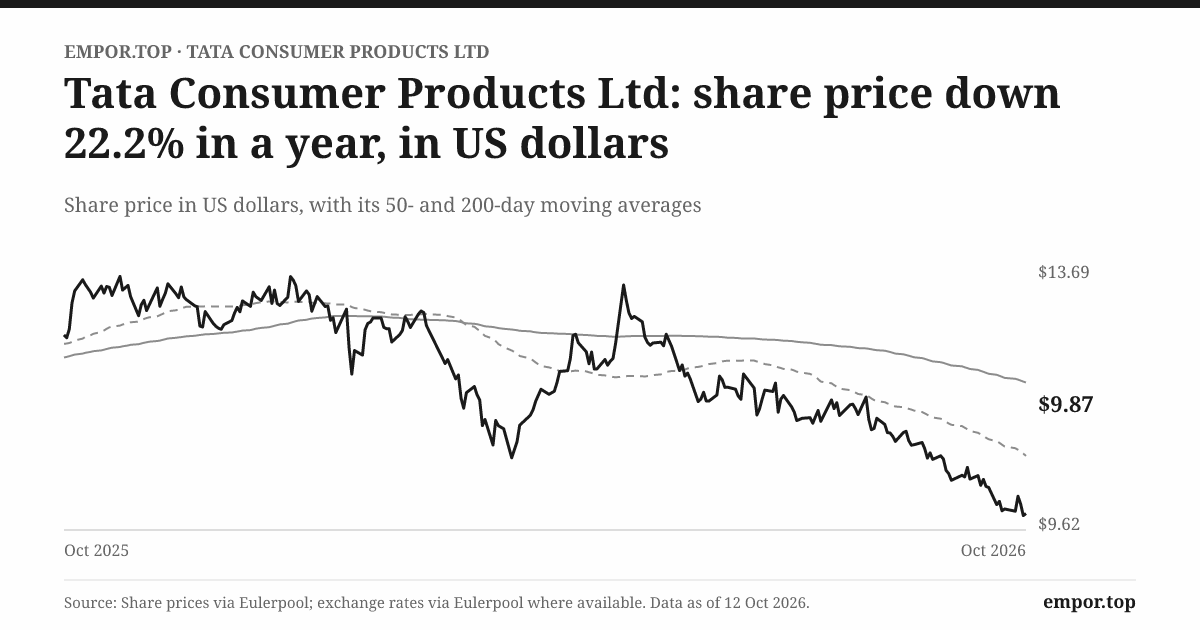
Tonight that company is worth about ₹93,500 crore, roughly $9.8 billion, on the National Stock Exchange.14 It sells salt, tea, coffee, pulses, spices, Ching's Secret noodles and sauces, Organic India's herbal teas, and runs a coffee-shop joint venture with Starbucks. Over the twelve years to March 2026, it turned every rupee of reported profit into about ₹1.56 of operating cash, a ratio that tells you this is a business where suppliers and the trade fund much of the growth.23
Three questions run through the rest of this story. The first is whether the expensive food and wellness brands it bought in 2024 can lift margins without permanently lowering the return the company earns on its capital. The second is whether Tetley in Britain and Eight O'Clock Coffee in America are dependable hard-currency cash machines or an anchor on the valuation. The third is whether the company's most underrated advantage, the way it gets paid before it pays, survives the rise of ten-minute delivery apps that are rewriting how Indian households buy groceries.
To answer them, the story has to start where the money originally came from: tea bushes on hillsides, and the slow realisation that owning them was a trap.
 Subscribe on LinkedIn
II. Breaking the Commodity Curse: From Estate to Brand (1962–1999)
Picture the High Range of Kerala in the 1970s, where the Kannan Devan hills fold into one another in endless rows of clipped green bushes. Thousands of workers lived on the estates, in housing the planter was required to provide, sent their children to schools the planter ran, and were treated in hospitals the planter funded. Every rupee of that cost was fixed. What the tea fetched was not. It went to auction in Kochi or Kolkata, where brokers set the price week by week according to rain, crop size and what the big blenders were willing to pay.
That was the business Tata Tea's ancestor was born into. The company was incorporated in 1962, and in 1964 the Tatas formed a partnership with James Finlay & Company, the Glasgow trading house that had run tea estates in India since the colonial era, initially to make instant tea.2 The joint enterprise, Tata-Finlay, inherited a world of plantations: dozens of estates across the south and the north-east producing tens of millions of kilograms of tea a year.2 It was a large operation by any measure, and it was structurally weak in a way that size could not fix.
The weakness was simple. A plantation is a factory with a roof made of weather. Its labour costs are set by statute and collective bargaining, so they rise every year whatever happens to prices. Its output depends on rainfall. Its selling price depends on an auction where the buyer, often a giant blender, holds the pricing power. In good years the estates made money and in bad years they bled it, and over a full cycle the returns on all that land and labour looked like those of a farm, because that is what it was.
In 1983, the Tatas did two things that would only make sense together thirty-seven years later. The first was that Tata Tea took full control of the venture from James Finlay and began selling its own tea in packets directly to Indian households.2 Most Indians at the time bought loose tea scooped from a sack at the corner shop. A sealed polypack with a brand on it promised something loose tea could not: that what was inside was what it said it was, and would taste the same next month. Brands like Kannan Devan in the south and, later, Chakra Gold and Agni were built for regional palates.2 The economic logic was that a packet captured the margin the auction gave away. The brand, not the bush, would decide the price.
The second move happened at a chemicals plant on the Gujarat coast. At Mithapur, Tata Chemicals, which made soda ash from seawater, launched Tata Salt in 1983 as India's first branded, packaged, iodised, vacuum-evaporated salt.11 India had a serious iodine-deficiency problem, which causes goitre and impairs child development, and loose salt was often contaminated or inconsistently iodised. Tata Salt solved a public-health problem with a consumer product, and wrapped it in the Tata name, which in Indian kitchens carried a reputation for honesty that money could not easily buy. The slogan the brand used for years, that it was the salt of the country, was marketing, but it described something real: the product became a default.
For almost four decades those two consumer businesses lived apart. Tata Salt sat inside a heavy chemicals company, next to soda ash furnaces and fertiliser plants, its high-margin, low-capital cash flows invisible to investors who priced Tata Chemicals as a cyclical industrial. Tata Tea, meanwhile, kept its plantations alongside its brands and kept discovering that the brands paid for the estates' bad years.
Investors should take one lesson from this period, and it shapes everything that follows. The value in this group was never in the land. It was in the packet: the promise of purity, the consistent taste, and the shelf space in hundreds of thousands of small shops. The company had learned that at home. Its next move would test whether it could buy that advantage abroad.
III. The Tetley Coup and the Limits of International Scale (2000–2019)
Krishna Kumar had looked at Tetley before. In the mid-1990s, when it changed hands, the price climbed beyond what Tata Tea was prepared to pay, and he walked away.1 Tetley went instead to a management-led buyout backed by financial investors, who would need to sell eventually. Private-equity owners have clocks; strategic buyers have patience. When the owners came looking for an exit in 1999, the Indian company was waiting.
The structure of the 2000 deal is the part worth slowing down for. Tata Tea did not borrow £271 million against its Indian business. It set up a British acquisition company, Tata Tea (Great Britain), injected a modest slice of equity, and raised the rest through senior bank debt and mezzanine financing, a more expensive layer of debt that sits between the banks and the shareholders.1 The lenders' security was Tetley itself, its brands and its cash flows. Think of it as buying a house with a mortgage secured on the house, where the rent from the tenants pays the mortgage. If Tetley had stumbled, the banks would have had a claim on Tetley, not on the plantations in Munnar. It was a cross-border leveraged buyout by an Indian company at a time when the phrase barely existed in India, and it became a template for the wave of Indian overseas acquisitions that followed, including Tata Steel's purchase of Corus and Tata Motors' purchase of Jaguar Land Rover.
What did Tata Tea actually get? A brand that was a leader in Britain and Canada, a global tea-buying and blending operation, and a passport into the supermarket aisles of the developed world. The group built on that base. In 2006 it bought Eight O'Clock Coffee, an old American supermarket coffee brand.2 It added smaller businesses in Eastern Europe and elsewhere, and in 2012 it formed a 50:50 joint venture with Starbucks to open coffee shops in India.2 In 2010 the company renamed itself Tata Global Beverages, a name that announced the ambition: to be a global liquid-refreshment company, a kind of Indian answer to the multinational drinks groups.2
The consensus story told in Indian business media was that the Tetley deal was a triumph. The financial record tells a narrower story. Tetley was a fine brand in a shrinking category. Western consumers, especially younger ones, were drifting from bagged black tea toward coffee pods, specialty coffee shops, energy drinks, cold ready-to-drink beverages and herbal infusions. Black tea in Britain was a staple in slow decline, sold through four or five supermarket chains that held most of the bargaining power and used private-label tea to keep brand prices in check.
The consequence shows up in the accounts. In the five years to March 2019, the company's consolidated revenue barely moved, staying at roughly $1.0 billion to $1.3 billion in dollar terms, and in rupees it grew only in low single digits.3 In the year to March 2016, a year of restructuring and write-downs, it reported a small net loss.3 Return on equity in that era ran in the mid-single digits, which is a poor return for a consumer brand owner and well below what an Indian investor could earn in a bank deposit.3 The international business produced steady cash, but steady cash from a non-growing business is worth a modest multiple, and that is how the market priced it.
Management's answer, over these years, was to lighten the agricultural load. The large plantation holdings in the south were transferred to Kanan Devan Hills Plantations, an employee-participation company launched in 2005, and the north-east estates went into Amalgamated Plantations, both of which the company held as minority associates rather than consolidating.2 That removed the weather from the income statement. It did not add growth.
So the verdict on Tetley depends on what question is asked. Did the deal pay for itself and prove that an Indian company could finance and run a large Western brand? Yes. Did it build a compounding business? The record over the following two decades says no. The debt was repaid, the brand survived, and the company that owned it became an asset-heavy multinational with pedestrian returns. That lesson sets up the next scene, because the way out came from an unexpected place: the salt pans at Mithapur that the tea company had never owned.
IV. The Chandra Blueprint: The 2020 Great Consolidation
N. Chandrasekaran became chairman of Tata Sons in 2017 after running Tata Consultancy Services, and he brought an engineer's dislike of clutter. The Tata Group he inherited was a sprawl of overlapping listed companies, some competing with each other, several carrying businesses that belonged somewhere else. His mandate, repeated in many speeches, was simplification: fewer, bigger, clearer companies.5
Few pieces of the group were as obviously misfiled as Tata Salt. Inside Tata Chemicals, salt, pulses and spices were a consumer business generating dependable cash with little capital, trapped alongside soda ash and chemical plants whose profits rose and fell with global commodity cycles. Investors priced the whole company like a chemicals maker, so the salt business earned none of the premium the Indian market pays for consumer staples. Meanwhile, next door, Tata Global Beverages had an Indian sales network for tea that could carry far more products than it did.
The fix was announced in 2019 and took effect in February 2020, after approval by the National Company Law Tribunal. Through a court-sanctioned scheme of arrangement, Tata Chemicals demerged its consumer products business into Tata Global Beverages, and Tata Chemicals' shareholders received 114 shares of the beverage company for every 100 Tata Chemicals shares they held.4 A demerger by scheme is, in plain terms, a tax-efficient way to lift one business out of a company and hand it, along with new shares, directly to the original owners. No cash changed hands. Tata Chemicals shareholders ended up owning both the chemicals business and a stake in the newly combined consumer company. The beverage company was renamed Tata Consumer Products Limited, and the change of name was the strategy in one line: it was no longer a drinks company with a pantry on the side, but a pantry company that also sold drinks.4
The effect on reported revenue was immediate. In the year to March 2020, consolidated revenue jumped by about a third, the first time in years the top line moved meaningfully.3 Part of that was arithmetic, the salt business arriving in the books, but the merger also changed what the company could do. One sales force could now put salt, tea and pulses in front of the same shopkeeper on the same visit, and salt, bought by almost every household every few weeks, became a reason for distributors to stock the rest of the range.
To run the new company, the group brought in an outsider. Sunil D'Souza took over as managing director and chief executive in April 2020, after leading Whirlpool's Indian business and spending years earlier in his career at PepsiCo.5 He arrived in the first weeks of India's pandemic lockdown, which turned out to be a strange but useful test: households hoarded salt, tea and pulses, and a company that had just finished merging found its core products among the few things selling everywhere. D'Souza's reputation, as profiled in Mint, was that of a distribution operator rather than a deal-maker, someone obsessed with outlet counts, the efficiency of the sales force and the cost of getting a packet to a shop.5 Chandrasekaran's brief to him, by the same account, was to cut overhead, merge the scattered subsidiaries and build an Indian FMCG company rather than a holding company of brands.5
Governance stayed conservative through the change. Tata Sons, together with group entities, holds roughly a third of the company, about 33.8% in mid-2024, and none of those shares are pledged.128 Deloitte Haskins & Sells has given clean audit opinions.2 The company pays Tata Sons a brand subscription for the right to use the Tata name, an arrangement common across the group and capped at a small fraction of turnover.2
The fair verdict is that the consolidation turned a stagnant overseas beverage holding company into something investors could reasonably call an Indian consumer staples business. The less flattering footnote is that the transformation was mostly a reshuffling of assets the group already owned. Merging salt into tea created a better company to own; it did not, by itself, prove that the new company could grow faster than the businesses it combined. That proof had to come from the engine room, the network that gets a ₹28 packet of salt onto millions of shelves.
V. The Engine Room: Salt Moats, Tea Duopolies, and Distribution Reach
At Mithapur on the Saurashtra coast, seawater is pumped into shallow pans, concentrated by the sun, then purified and vacuum-evaporated into the fine white crystals that fill the packet. The plant belongs to Tata Chemicals, not to Tata Consumer Products. That is the first thing an investor should understand about the salt business: the listed company owns the brand, the packet and the route to market, while the factory sits with a sister company, supplied under a long-term arrangement.11 Tata Chemicals' own reports show the salt it supplies runs to well over a million tonnes a year, making the consumer company its single biggest related-party customer by value.11
Why does that arrangement work? Because in salt, the profit does not live in the factory. Salt is cheap to make. A family spends a trivial share of its monthly budget on it, and nobody switches brands to save a rupee on something used every day in every meal and associated with their children's health. That is the economic heart of the brand: when a product is a tiny line in the household budget and trust in its purity matters, price increases pass through with little loss of volume. Tata Salt has held a leading share of India's branded salt market for decades, a position the company describes as more than a third of the category.2 Competitors exist, regional and national, but none has the reach or the name.
Tea is a different fight. Indian packet tea is close to a duopoly between Tata and Hindustan Unilever, whose Brooke Bond, Red Label and Taj Mahal brands are equally entrenched. The battlefield is regional: north Indians want a strong, dark brew that stands up to milk and sugar; southerners want different blends; individual states have favourite brands. Tata Tea Premium is pitched at the north, Chakra Gold and Kannan Devan at the south, Gemini in Andhra Pradesh and Telangana.2 Thousands of small regional packers compete at the bottom of the market on price. The big two fight on blending, advertising, and above all on who is stocked at the counter.
And that is where D'Souza spent his first years. When he arrived, the company reached about 1.3 million shops directly.5 By building out its distributor network, pushing into rural markets and giving its sales force digital tools, it pushed total reach to more than 4 million outlets, according to the company.15 An Indian FMCG company's distribution map is a little like a railway network: expensive to build, slow to replicate, and far more valuable for each extra train you can run on it. Every new product the company adds can ride on the same visits by the same salespeople to the same shops.
The quiet evidence of discipline is in the receivables. In the year to March 2016, customers took about 68 days to pay; by March 2026, it was down to about 31 days.3 The company tightened distributor credit, moved to direct billing and asked for bank guarantees, and it has no single customer accounting for 10% or more of revenue.2 Bad-debt provisions are small relative to the receivables book.2 That matters because in Indian consumer goods, the distributor who demands extended credit is often the distributor who controls the relationship. Shrinking debtor days is a sign the company, not its trade partners, holds the power.
Is this moat as strong as it looks? Test it against the mechanism that would break it. In salt, the threat would be a cheaper national rival or a retailer's private label gaining share without a price war; the long record of share leadership argues against that, though the company's market-share figure is its own claim. In tea, the claim is weaker: Unilever matches Tata brand for brand, and regional packers repeatedly undercut both when auction prices fall. The fair conclusion is that salt is a true franchise, tea is a well-defended duopoly position rather than a monopoly, and distribution reach is a real but replicable advantage, one that Hindustan Unilever and ITC already possess at greater scale.
That was the platform. The question in 2023 was what to put on it, and the answer turned out to cost ₹7,000 crore.
VI. Capital Allocation and the ₹7,000 Crore Inorganic Pivot (2021–2024)
On January 12, 2024, Tata Consumer Products announced two acquisitions in a single day. It would buy Capital Foods, the maker of Ching's Secret, at an enterprise value of ₹5,100 crore, and Organic India, a herbal tea and wellness brand backed by Fabindia, at ₹1,900 crore.6 Together they came to about ₹7,000 crore, roughly $840 million, the largest spending spree in the company's history since Tetley.6
The road there had started small. In 2021 the company bought Kottaram Agro Foods, maker of Soulfull millet cereals, and took over the Tata SmartFoodz ready-to-eat business from the group, small bets to test whether its network could sell foods beyond staples.2 In early 2024 it also completed the amalgamation of Tata Coffee into itself, part of Chandrasekaran's simplification agenda.2
Ching's Secret is a remarkable Indian brand. It sells what Indians call desi-Chinese food, the fiery, garlicky Indo-Chinese cooking of street stalls and restaurants: Schezwan chutney, instant noodles, soy and chilli sauces. Smith & Jones, from the same company, sells ginger-garlic pastes and cooking sauces. These are products with much higher gross margins than packet tea, sold mostly in urban India and in the north and west, with plenty of room to grow if they can reach the south and east.6 Organic India, meanwhile, brought herbal and tulsi teas and ayurvedic supplements, a premium health-and-wellness flanker with an export business.6 Management's pitch was that both brands could ride the company's 4-million-outlet network and earn far more than they could alone.7
The price was steep. On the company's own numbers, Capital Foods was valued at a high multiple of its annual sales, the kind of price the Indian market reserves for scarce, fast-growing consumer brands.67 The financing came in two steps. First, short-term borrowing: commercial paper and bridge loans, which pushed total borrowings at March 2024 to roughly double their level a year earlier.3 Then, in August 2024, a rights issue: existing shareholders were offered one new share for every 26 they held, at ₹818 each, raising about ₹2,998 crore, which was used to repay the bridge debt.8 Tata Sons subscribed to its full entitlement.8
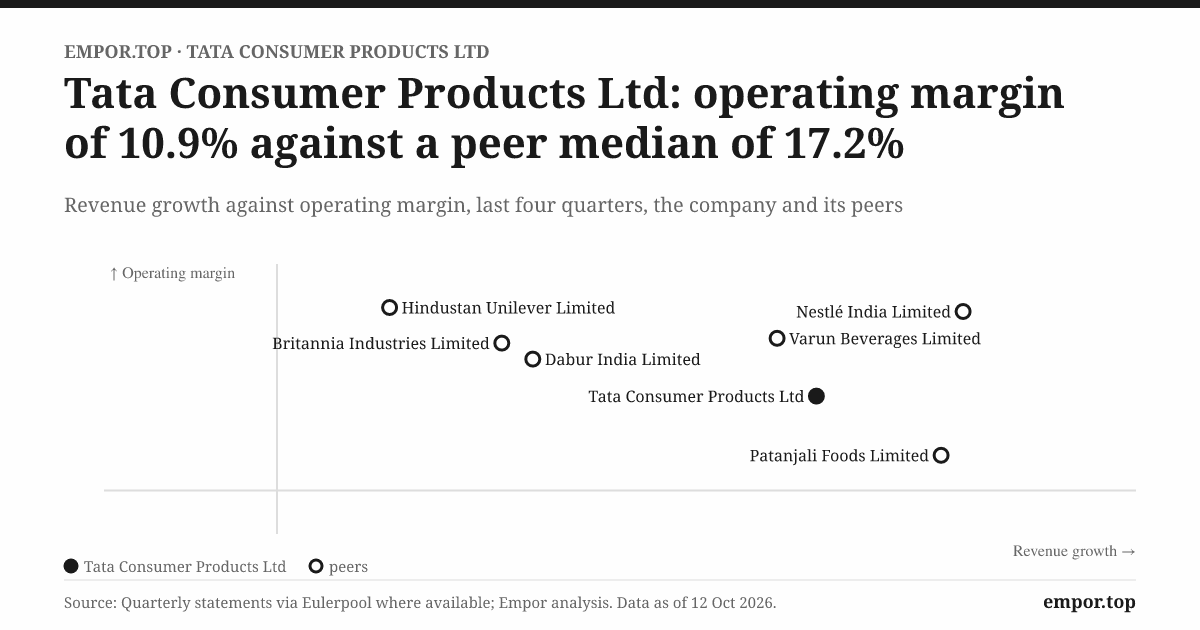
Here is where the record needs careful reading, because the headline numbers mislead. Return on invested capital appears to collapse from about 23% in the year to March 2025 to about 8% in the year to March 2026, and return on capital employed from about 22% to under 8%.3 The tempting story is that goodwill from the acquisitions swamped returns. But the deals closed in early 2024, so that goodwill was already on the balance sheet in the earlier years when returns looked healthy. Look underneath. EBITDA, the cash profit before depreciation and amortisation, kept rising steadily through FY2026, from about $291 million to about $323 million.3 What changed was the reported operating-profit line, which drops from roughly a third of revenue to about a tenth, a far bigger move than any plausible change in the business. Quarterly results show the shift happening abruptly between June and September 2025, while profit before tax rose.3 That pattern points to a change in how costs are classified in the reported data, not to an operating collapse.
The honest conclusion is narrower but still uncomfortable. The underlying returns were never as high as the earlier 20%-plus readings suggested. Return on equity, which is harder to distort, has sat around 6% to 7% for years, including after the acquisitions, while the company's equity base was swollen first by the 2020 merger and then by the rights issue.3 Those are thin returns for an Indian consumer company and well below what peers such as Hindustan Unilever and Nestlé India earn. The acquisitions did not cause that problem; they extended it by adding more capital that must now earn its keep.
The record of earlier deployments sharpens the test. Tetley paid back its debt but never lifted group returns. Eight O'Clock Coffee has been a modest business. The Starbucks joint venture took years to approach profitability. So the claim that the 2024 deals are value-accretive remains unproven. The hurdle is concrete: Ching's and Organic India must grow fast enough, at high enough margins, to pull consolidated returns on capital back toward the mid-teens. The cash engine that will have to fund that wait is the next part of the story.
VII. The Cash Flywheel and Working Capital Paradox
In most manufacturing companies, growth eats cash. You buy raw materials, hold inventory, ship to customers and wait to be paid, and the faster you grow, the more money is tied up in that gap. Tata Consumer Products has spent a decade making that gap disappear.
The best single number for this is the cash conversion cycle, the days between paying for raw materials and collecting from customers. In the year to March 2015 it was about 144 days, nearly five months. By March 2026 it was about 22 days.3 Three things changed. Inventory days fell, especially in the latest year, as the company held less tea and finished stock. Debtor days fell from the high fifties to about 31, the distributor discipline described earlier. And payable days stretched from roughly two months to between 100 and 125 days in recent years, meaning suppliers now wait more than three months for payment.3 Put together, the broader measure of working capital has turned negative: at March 2026 it was about minus ten days of revenue, against plus 58 days in FY2015.3 In plain terms, the company's suppliers and trade partners are financing its operations.
That is how a company with modest returns on equity can still be a strong cash generator. Over the twelve years from FY2015 to FY2026, operating cash flow added up to about ₹14,000 crore against reported net profit of about ₹9,000 crore.3 The gap is made up of depreciation and amortisation, which are accounting charges rather than cash, and of the steady release of working capital. Capital spending is light, roughly 1.5% to 2% of revenue in recent years, because much of the packing is outsourced.2 So free cash flow over the period came to about ₹10,700 crore.
Where did it go? About ₹4,800 crore went to shareholders as dividends, with the company paying out a median of just under half its profit each year.3 Cash and short-term investments rose from about ₹700 crore to about ₹4,300 crore.3 Together with other liquid investments, the company held around $710 million of liquid assets at March 2026, more than twice its borrowings of about $320 million.3 Even after spending ₹7,000 crore on acquisitions, it carries net cash.
Treat the payables number with one caveat. A company that stretches suppliers to 125 days is using its bargaining power; it is also creating a dependency. If suppliers push back, or regulators tighten rules on payment terms to small businesses, which India has done in recent years for micro and small enterprises, some of that free financing could unwind. The dip in payable days from 125 to 100 in the latest year is worth watching for exactly that reason.3
The bigger threat is a change in who the customer is. India's quick-commerce apps, Blinkit, Zepto and Swiggy Instamart, promise groceries in ten minutes from dark stores scattered through city neighbourhoods. They have grown at extraordinary speed in large cities, and for brand owners they are double-edged. They give premium products like Ching's sauces and Organic India teas a direct path to affluent urban shoppers. But they also demand listing fees, promotional spending and inventory spread across many small warehouses, and, being large and concentrated, they can negotiate harder than a kirana owner in Kanpur.13 The Ken reported in 2024 that Indian FMCG companies, Tata Consumer among them, were racing to adapt their supply chains to these platforms.13
The verdict is that the cash flywheel is real and among the company's most impressive achievements, built on discipline that is visible in a decade of numbers. But it was built for a world of distributors and small shops. Whether it survives the shift to a handful of powerful digital platforms is the open question, and the company does not separately disclose working capital by channel. That brings the analysis to the larger question underneath all of this: where, in a business that sells salt and tea, does lasting advantage actually live?
VIII. Moat Analysis: 7 Powers & 5 Forces in the Indian Kitchen
Walk into a small grocery shop in Kanpur and watch two purchases. A woman asks for Tata Salt by name. If the shopkeeper offers a cheaper packet, she shakes her head. A few minutes later, a man asks for tea, and when the brand he usually buys is missing, he takes whichever packet is at the front of the counter. The difference between those two moments is the difference between a franchise and a good business.
Hamilton Helmer's framework of seven powers asks where a company earns returns its rivals cannot compete away. The first power that applies here is scale. The company buys and moves salt and tea in volumes that let it spread freight, packaging and advertising costs over hundreds of millions of packets, so its cost to deliver one unit to a shop is lower than any regional rival's. That is a genuine advantage, but it is shared: Hindustan Unilever and ITC operate at similar or greater scale across Indian retail.
The second is brand power, and it is strongest in salt. The Tata name in a kitchen stands for purity and honesty, built over a century of group reputation and four decades of iodised salt. Consumers will pay a small premium for it, and they do not experiment with a product associated with their children's health. In tea, brand power exists but is contested; Red Label carries similar loyalty.
The third, often claimed, is a cornered resource in distribution and in the Mithapur supply. The supply relationship is real but it belongs to a sister company and runs on commercial terms.11 The 4-million-outlet reach is valuable, but cornered implies rivals cannot get it, and Hindustan Unilever's network is larger. The honest version is that distribution is a scale advantage that raises the cost of entry, not a resource only Tata has.
What the company does not have is switching costs. A household can change tea brands, sauce brands or pulses brands at zero cost on any given day. Network effects and process power also do little work here. So the moat depends on continual spending, on advertising, trade promotions and sales staff, to keep consumers asking for the brand and shopkeepers stocking it.
Michael Porter's five forces fill in the rest. Buyer power is low to moderate: individual consumers have none, distributors are fragmented, and the company has no customer above 10% of revenue, but supermarket chains in Britain and quick-commerce platforms in India are concentrated and increasingly assertive.213 Supplier power is mixed: salt is effectively secured through the Tata Chemicals arrangement, while tea and coffee are bought at auction or on global markets where a poor harvest can lift prices sharply.2 Substitutes for salt and tea are weak in India. New entrants face high costs in national distribution, but direct-to-consumer brands and regional packers keep attacking the most profitable niches. Rivalry is intense, with Unilever in tea, ITC in spices and packaged foods, and Nestlé India in noodles and sauces, where Maggi competes directly with Ching's.
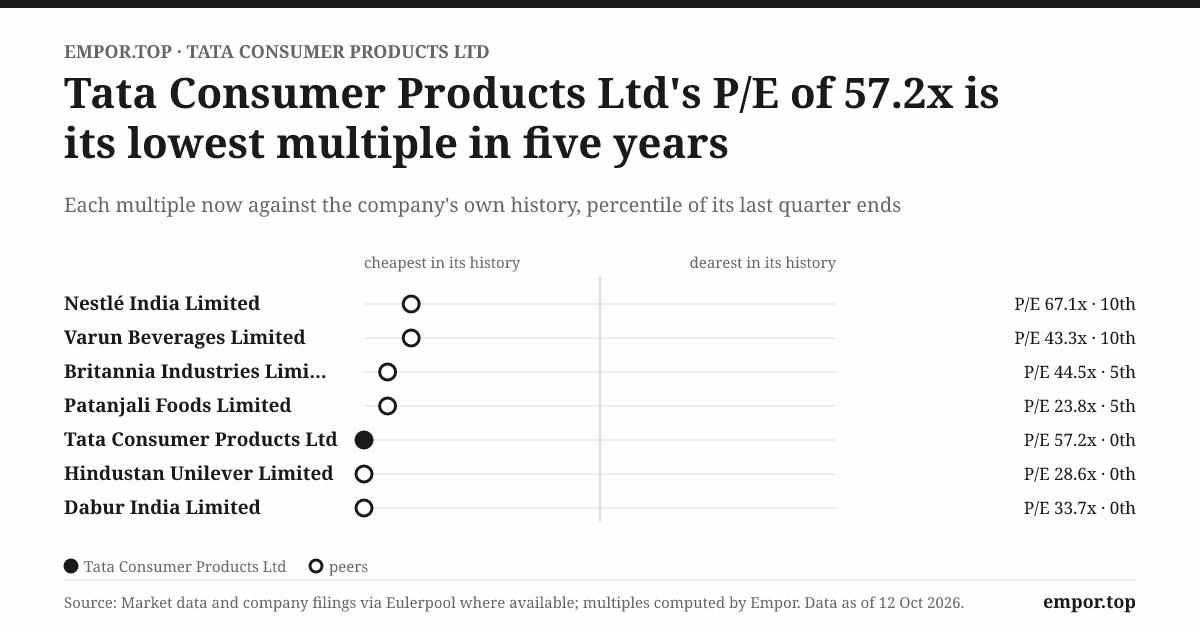
How does the market price this? At about 57 times trailing earnings and 30 times EV to EBITDA, the stock trades below its own five-year median earnings multiple of about 79 times, and near the range of large Indian consumer peers.14 That is still a valuation that assumes many years of above-average growth from a company earning single-digit returns on equity. The price is a bet that the powers described here will turn into higher returns, not a reflection of returns already earned.
The verdict, then: genuine brand power in salt, real scale in distribution, a defended duopoly in tea, and no switching costs anywhere. That combination supports stable cash flow, but it does not by itself guarantee high returns on new capital. Which places a lot of weight on the people deciding how to spend it.
IX. Management, Governance, and Capital Allocation Scorecard
Indian annual general meetings rarely produce drama at Tata companies, and Tata Consumer Products has been no exception. Resolutions on board appointments and executive pay have passed with dissent typically in the low single digits, reflecting a register dominated by Tata Sons and long-term institutions.12 Promoters hold about a third of the company, foreign institutions roughly a fifth, domestic institutions another sixth or so, and the public the rest.12 Sunil D'Souza was reappointed for a further five-year term, keeping him in the role to 2030.3
His pay has grown with the company. Reported remuneration rose from about ₹10 crore in FY2024 to about ₹16 crore in FY2026, partly tied to measures such as shareholder returns and return on capital.23 Against net profit of roughly ₹1,600 crore in FY2026, that is comfortably inside statutory limits, and modest by the standards of multinational consumer peers in India. N. Chandrasekaran, as non-executive chairman, keeps strategy anchored to the group's priorities, and the board includes independent directors with consumer-industry backgrounds.2
The credit agencies are the cleanest outside check. ICRA and CRISIL rate the company's long-term borrowing at AAA with a stable outlook, the highest grade available in India, and its commercial paper at the top short-term grade.910 Their reasoning echoes the strengths described already, leading positions in tea and salt, strong cash generation and the backing of the Tata Group, while flagging commodity-price exposure, the integration risk of the new acquisitions and weak demand in Western tea.910
Now the skeptic's cross-examination. A long/short investor would raise three points. The first is the rights issue. The company had a AAA balance sheet and could have refinanced the bridge debt with cheap long-term borrowing. It chose to issue about ₹3,000 crore of new shares instead, which kept the balance sheet pristine but spread earnings over more shares at a time when returns were already low.8 That is conservative, but conservatism has a cost, and shareholders who did not take up their rights were diluted.
The second is the return record. Management has delivered what it promised operationally: more outlets, lower debtor days, faster revenue growth since the merger. But return on equity has not moved meaningfully above single digits in the D'Souza era, and the largest capital decision of his tenure has yet to prove it can earn its cost.3 Good operators are not automatically good capital allocators, and the jury is still out.
The third is the legal overhang. The company carried roughly ₹1,450 crore of contingent liabilities at March 2024, mostly disputed income-tax and indirect-tax demands at various appellate stages.2 Management considers outflows unlikely and the auditor did not qualify its opinion, but these disputes are old and unresolved, and an adverse ruling would hit profit in the year it lands.2
The scorecard, weighed fairly, is strong on governance, strong on operations and credit quality, and incomplete on capital allocation. Which is exactly why the lessons from this company's long history are worth drawing out now.
X. Playbook: Business & Investing Lessons
Line up the big decisions of this company's sixty years and a pattern emerges. The 1983 polypack. The 2000 Tetley buyout. The 2020 merger with Tata Salt. The 2024 bet on Ching's and Organic India. Each was a move away from owning things and toward owning trust.
The first lesson is about the hillside. For two decades the company owned the bushes, the workers' housing and the estate hospitals, and every downturn in the auction showed it that owning the means of production in an agricultural commodity is a way to rent your returns to the weather. The packet changed that, and the eventual transfer of the estates into minority-held associates finished the job. Founders in any commodity-adjacent business should remember the shape of it: the margin migrates to whoever the end customer trusts, so move toward that customer before a bad harvest forces you to. Own the brand on the kitchen counter, not the bushes on the hill.
The second lesson is about borrowed scale. The Tetley deal was brilliantly financed, and the debt was repaid out of Tetley's own cash. But buying a large brand in a shrinking market bought volume, not growth, and for two decades the group's returns showed it. Investors applauding a bold overseas acquisition should ask the duller question first: is the category growing? You can borrow your way into global volume, but you cannot borrow your way into organic growth.
The third lesson is Tata Salt's. A loose commodity sold from a sack became a branded, medically meaningful, sealed product, and that change in packaging and promise created pricing power that has lasted forty years. The lesson travels well beyond salt: in low-ticket staples, consumers buy certainty, not price. When a product costs pennies to buy, trust is worth far more than the lowest price.
The fourth lesson is sequencing. The company did not buy Ching's in 2018, when its Indian network was smaller and its corporate structure a tangle. It first merged, simplified and spent four years pushing its reach from about 1.3 million to more than 4 million outlets, and only then wrote the big cheque. Whether the price was right is still open, as the returns record makes clear. But the order was right. Plugging acquired brands into an existing distribution superhighway creates instant synergy; buying brands without a pipeline is just collecting logos.
The lessons point to a company that learned its craft slowly. Whether it has learned enough to justify the price the market puts on it is a different question.
XI. The Stress Test: Bear vs. Bull Case
Imagine two fund managers in a Mumbai conference room arguing about the same stock. At about ₹955 a share, it sits near the bottom of its 52-week range and almost a quarter below its high.14 One sees a quality consumer franchise at its cheapest multiple in years. The other sees a company with single-digit returns on equity trading at 57 times earnings.
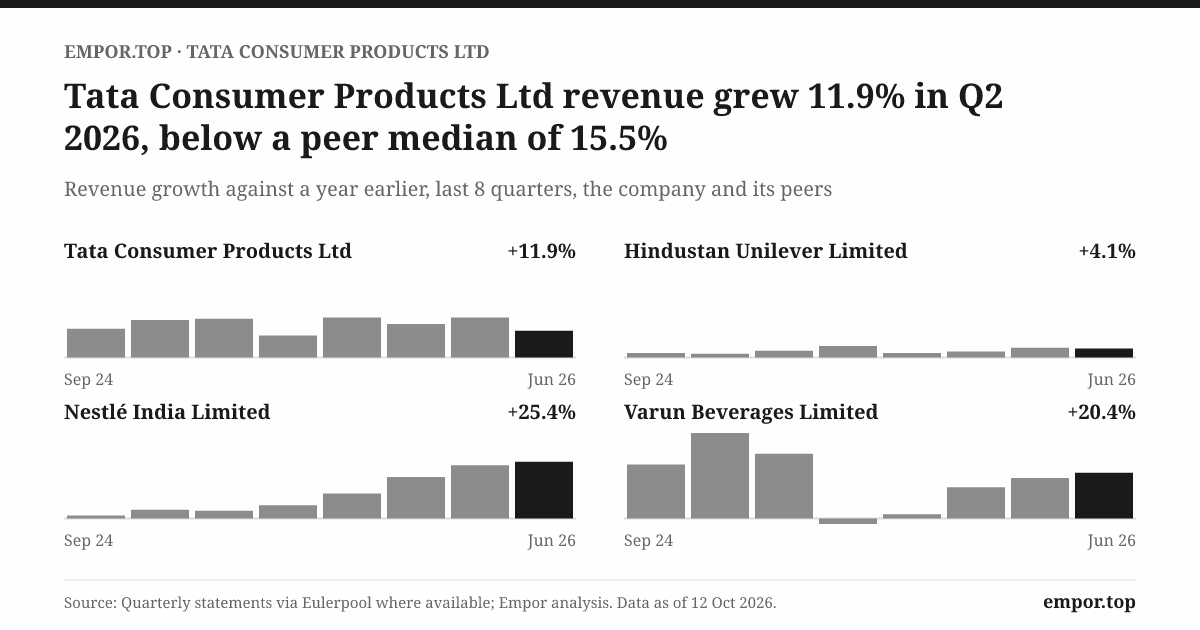
The bull begins with India. Hundreds of millions of households are still moving from loose, unbranded staples to packaged ones, in pulses, spices, dry fruits and ready-to-cook foods, and Tata Sampann sits squarely in that conversion. Revenue has grown at about 14% a year over the last three years, above the company's ten-year rate of about 12%, and it grew about 15% in each of the last two fiscal years.3 The bull's second point is mix. Ching's and Organic India carry much higher gross margins than tea, so as they grow, blended margins should rise toward those of peers like Nestlé India and Britannia. The third is valuation relative to history: the stock trades well below its five-year median multiple, and well below Nestlé India's. The fourth is optionality, from the Starbucks joint venture and from ready-to-drink beverages, out-of-home businesses that could become meaningful in a richer India.
The bear starts with returns. Return on equity of about 7% is the reality behind the narrative, and it has barely moved in a decade despite the merger, the outlet expansion and the acquisitions.3 Hindustan Unilever, after its own large merger, earns substantially more. The bear's second point is the West. Tetley and Eight O'Clock remain a large share of revenue in markets that are not growing, and the company's own credit raters flag weak demand there.9 The third is commodities. In periods when tea auction prices spike, as they did in 2024 after poor harvests in Assam, or when global coffee prices rally, gross margins compress before price increases can catch up.15 The fourth is the channel shift to quick commerce, which threatens both trade terms and the working-capital advantage. And the bear notes that the high PEG ratio of about nine says the price already assumes a great deal of future earnings growth.14
How should these be weighed? The bull's growth argument is supported by evidence: revenue has accelerated and recent quarterly growth has stayed in the mid-teens.3 The bull's margin argument is plausible but unproven, because the acquired brands are still small relative to the group and integration costs and advertising spending have absorbed much of the benefit so far. The bear's returns argument is the strongest single point, because it is the one the company's own long record most clearly supports. The resolution depends on whether rising profits from foods can lift returns on a capital base that the company has deliberately kept heavy with cash and equity.
Three numbers will settle it. First, consolidated return on capital employed, which on a consistent basis needs to recover toward the mid-teens; its latest reading is under 8%, down sharply, though partly because of how the latest operating profit is reported.3 Second, growth in the India foods business, which management needs to keep at roughly 20% a year for the mix argument to work. Third, working capital days, now at about minus ten, which should stay at or below zero as quick commerce grows.3 Two of the three are currently moving in the right direction. The third, returns, is the one that matters most.
XII. Epilogue: The Next Inflection Points
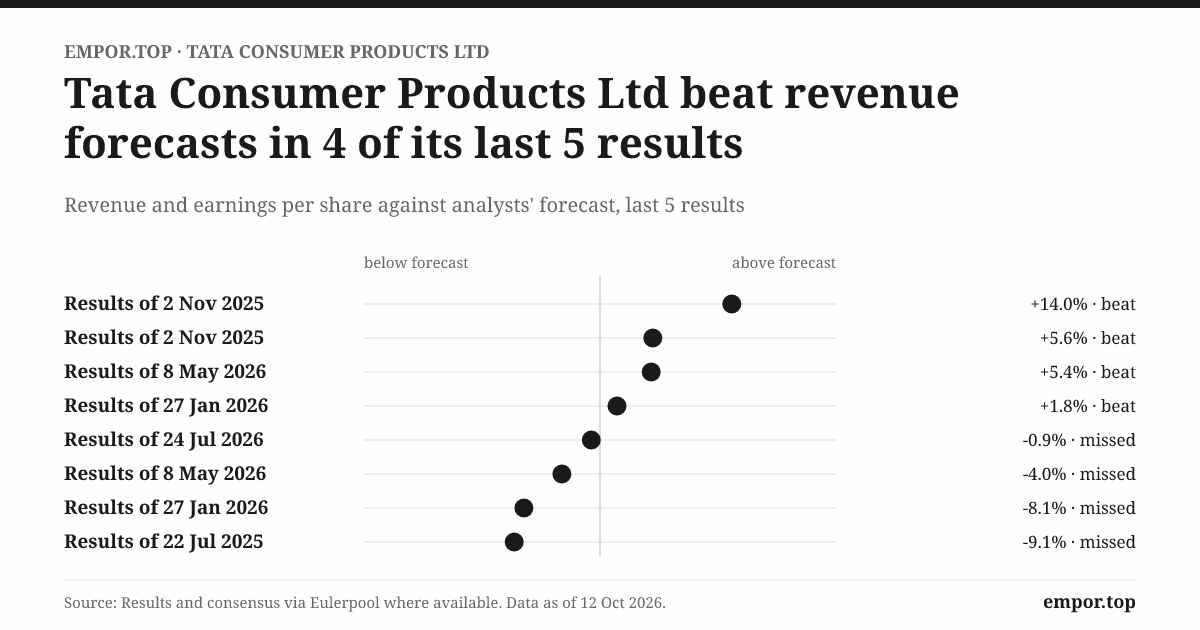
Tonight the company stands at an awkward point. Its revenue is about $2.3 billion a year and growing in the mid-teens.3 Its net profit in the latest quarter rose by more than a quarter on the year before.3 Its balance sheet holds net cash and carries a AAA rating. And yet its share price has fallen to near a 52-week low, because the market has stopped paying in advance for the promise and is waiting for returns to prove it.14
The next eight quarters contain the moments that will decide the story. The first is Ching's moving south and east. If the brand can win in Tamil Nadu, Kerala and West Bengal, markets where Indo-Chinese cooking is popular but the brand is less known, without heavy discounting, the acquisition logic will hold. If growth stalls, or comes only with margin-eroding spending, the ₹5,100 crore price will look like a premium paid for a regional brand. The second is the international business. Can premium teas, specialty coffee and cold-brew products stabilise Tetley and Eight O'Clock, or will they keep shrinking slowly, as they have for two decades? The third is the quick-commerce test, visible each quarter in whether working capital stays negative as more sales flow through powerful digital platforms.
Each outcome maps onto one of the central questions. If foods grow and margins rise, the company becomes the Indian consumer compounder the market once priced it as. If the West keeps sliding and foods stall, it remains a good tea and salt business carrying an expensive pantry. If quick commerce erodes trade terms, the cash engine that funded everything begins to slow.
The tension underneath is cultural as much as financial. For most of its history this company was a holding company of brands, each with its own country, team and habits. To justify its valuation it has to become something else: one integrated, execution-obsessed consumer business that moves at the speed of modern Indian retail. Sunil D'Souza has built the distribution machine. The next two years will show whether it can carry the weight that was loaded onto it in 2024.
XIII. Outro
Somewhere in Mumbai this morning, water came to a boil on a gas stove. Someone measured tea leaves from a red packet, added milk and sugar, and stirred. A few minutes later a pinch of salt went into the dough for the day's rotis. Neither purchase took any thought, and that is the whole point.
The company behind both began as a manager of colonial tea estates, financed the boldest overseas buyout of its era, spent two decades learning that buying the world's tea did not make it grow, and found its future in a salt pan it never owned. Tata Consumer Products didn't win by discovering new markets. It won by turning life's two cheapest essentials, salt and tea, into an unshakeable national habit. Whether it can now earn a premium return on that habit is the question still brewing.
References
-
Tata Tea acquires Tetley: How David bought Goliath — The Economic Times, 2000-03-01 ↩↩↩↩↩
-
Integrated Annual Report 2023-24 — Tata Consumer Products Limited, 2024-06-10 ↩↩↩↩↩↩↩↩↩↩↩↩↩↩↩↩↩↩↩↩↩↩↩↩
-
Financial Information: Annual Reports Portal — Tata Consumer Products Limited, 2026-10-12 ↩↩↩↩↩↩↩↩↩↩↩↩↩↩↩↩↩↩↩↩↩↩↩↩↩↩↩↩↩
-
Scheme of Arrangement between Tata Chemicals and Tata Global Beverages — National Company Law Tribunal, 2020-02-07 ↩↩↩
-
How Sunil D'Souza is transforming Tata Consumer Products into an FMCG powerhouse — Mint, 2023-11-14 ↩↩↩↩↩
-
Investor Presentation: Strategic Acquisitions of Capital Foods and Organic India — Tata Consumer Products Limited, 2024-01-12 ↩↩↩↩↩
-
Tata Consumer bets big on Capital Foods and Organic India to drive pantry expansion — CNBC TV18, 2024-01-15 ↩↩
-
Letter of Offer: Rights Issue of Equity Shares — Securities and Exchange Board of India (SEBI), 2024-08-09 ↩↩↩↩
-
Rating Rationale: Tata Consumer Products Limited — ICRA Limited, 2024-04-18 ↩↩↩
-
Rating Rationale: Tata Consumer Products Limited — CRISIL Ratings Limited, 2024-05-22 ↩↩
-
Integrated Annual Report 2024-25 — Tata Chemicals Limited, 2025-06-15 ↩↩↩↩
-
Corporate Governance Report & Scrutinizer Report AGM 2024 — BSE India / Tata Consumer Products, 2024-07-15 ↩↩↩
-
The Ken: Tata Consumer's race against quick commerce and FMCG giants — The Ken, 2024-05-30 ↩↩↩
-
Reuters Company Profile: Tata Consumer Products Limited (TATACONSUM.NS) — Reuters, 2026-10-12 ↩↩↩↩↩
-
Investor Presentation: Q4 & FY24 Financial Results — Tata Consumer Products Limited, 2024-04-23 ↩↩
 LinkedIn
 WhatsApp
 Reddit
 Hacker News
 Email
 Kindle
 RSS Feed
 Spotify
 Apple Podcasts
 Amazon Music
 Audible
 YouTube