Tata Steel: The Dual Empires of Jamshedpur and Port Talbot
I. Episode Introduction & The Paradox of Two Steels
On the evening of January 31, 2007, a small group of bankers, lawyers and executives sat in a London conference room under rules written by the UK Takeover Panel. The Panel had done something it rarely does: it had forced two of the world's most determined industrial bidders into a formal auction, a sealed procedure with fixed rounds and a hard stop. On one side sat Tata Steel, a 100-year-old Indian company that had never made an acquisition of consequence outside Asia. On the other sat Companhia Siderúrgica Nacional, the Brazilian steelmaker that had crashed a friendly deal three months earlier.
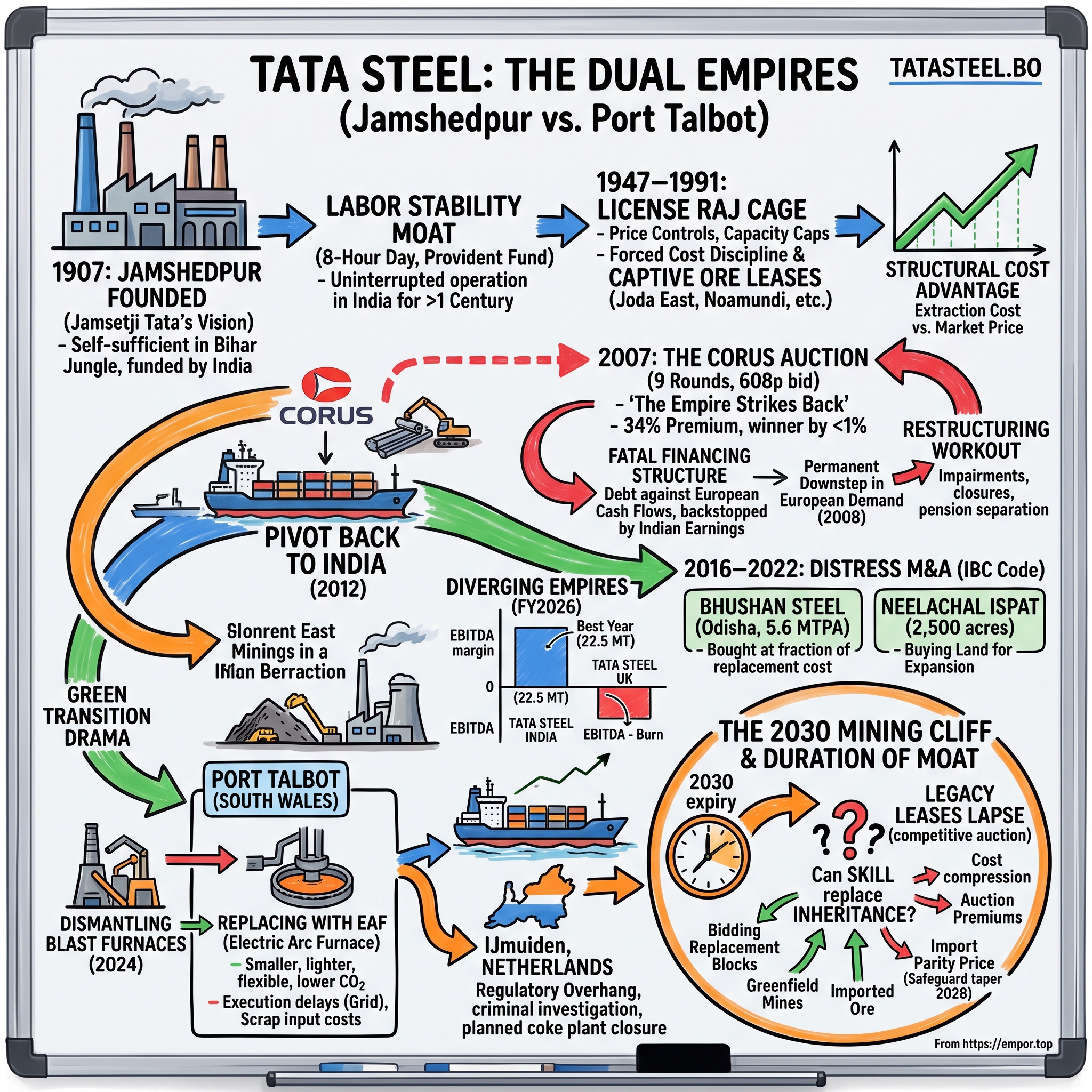
Nine rounds later, Tata Steel had won Corus Group plc with a final bid of 608 pence per share, beating CSN's 603 pence by a margin of roughly one percent.1 The winning price was almost 34% above Tata's own opening offer of 455 pence made the previous October, valuing Corus at approximately £6.2 billion.12 In India the reaction was euphoric. Newspapers ran front pages about the empire striking back — the colonised buying the coloniser's steel industry, a company born in a British-ruled Bihar jungle now owning what had once been British Steel.
It was, in retrospect, one of the most expensive victories in Indian corporate history.
What followed was not a story of integration and synergy. It was a fifteen-year workout. The European business Tata bought at the top of a commodity super-cycle spent most of the next decade and a half consuming capital rather than producing it, while the Indian business that funded the purchase quietly became one of the most profitable steel operations on earth. Two empires under one holding company, running in opposite directions.
That divergence is still the central fact of Tata Steel in 2026, though the gap has narrowed. In the financial year ended March 31, 2026, the company reported consolidated revenue of ₹2,32,140 crore and EBITDA of ₹34,848 crore, up 35% year-on-year, with profit after tax of ₹10,886 crore.3 Of that consolidated EBITDA, the India business generated ₹34,272 crore — which is to say, essentially all of it, at a 24% margin, while the rest of the group in aggregate contributed nothing net.3 Tata Steel UK lost £217 million at the EBITDA line; the Netherlands business earned €267 million.3 India delivered approximately 22.5 million tonnes, its best year ever, at an EBITDA of ₹15,213 per tonne.3
Hold those two numbers next to each other: an Indian operation clearing roughly $172 of EBITDA per tonne in a year of soft global steel prices, and a British operation burning a couple of hundred million pounds. That is not a cyclical spread. That is a structural one, and understanding why is the substance of this story.
The Indian advantage rests on something almost no other large steelmaker in the world possesses: legacy mining leases granted in a different regulatory era, giving Tata Steel India effective self-sufficiency in iron ore at extraction cost rather than market price. The European disadvantage rests on the inverse — buying every input at seaborne market prices, in the world's most expensive energy market, under the world's strictest carbon regime, with blast furnaces built for a demand curve that broke in 2008 and never healed.
But this is not a simple story of "India good, Europe bad," and any investor who stops there will miss what actually matters from here. The Indian moat has an expiry date printed on it: the legacy mining leases at Joda East, Noamundi, Katamati and Khondbond run out in 2030 and go to competitive auction.4 The European problem is being solved, but by demolition rather than repair, and the demolition itself carries execution risk, political risk and — in the Netherlands — criminal liability risk.
Here is the road we'll travel. We'll start in a jungle clearing in 1907, where a dying industrialist's bet against the British Empire's contempt created a company town that still supplies a fifth of the group's steel. We'll pass through four decades of the License Raj, where price controls and capacity caps accidentally forged the cost discipline that defines the company today. We'll sit inside the Corus auction and dissect precisely how the capital structure — not the price — was the fatal error. We'll watch management pivot home and use India's new bankruptcy code to buy distressed capacity at a fraction of replacement cost. We'll go inside the unit economics of captive ore. We'll stand at Port Talbot as the blast furnaces come down. And we'll stress-test the whole thing: what breaks this company, and what has to be true for the current strategy to work.
 Subscribe on LinkedIn
II. The Legacy of Jamshedpur: Jamsetji's Vision and Colonial Skeptics
The story opens with an insult.
Sometime in the first years of the twentieth century, Sir Frederick Upcott — chief commissioner of the Great Indian Peninsular Railway, a man whose railways consumed enormous quantities of imported British rail — was asked what he thought of the notion that Indians might make steel. His answer became the founding legend of Indian heavy industry: he would, he said, undertake to "eat every pound of steel rail" the Tatas succeeded in making.5
It was not an unreasonable position. In 1900, integrated steelmaking was among the most capital-intensive, technically demanding industrial processes on the planet. It required simultaneous access to iron ore, coking coal, limestone, fluxes, water and rail transport, plus metallurgical expertise that existed almost nowhere outside Britain, Germany and the United States. India had none of that industrial base. It had a colonial administration with no interest in creating a domestic competitor to Sheffield.
Jamsetji Nusserwanji Tata was in his sixties when he began this. He had made his money in cotton mills and had built the Taj Mahal Palace hotel in Bombay, but steel was his obsession — not as a business so much as a political statement. His conviction was that political independence without industrial capacity was theatre, that a country that could not make its own rails and girders could not really govern itself. He hired American geologists, sent prospecting parties into the forests of central India, and financed the search personally.
He died in 1904, three years before anyone found the right site.
The breakthrough came at Sakchi, a village in what was then Bihar and is now Jharkhand, near the confluence of the Subarnarekha and Kharkai rivers. The location solved every constraint at once. There was iron ore in the Singhbhum hills nearby. There was coal in the Jharia fields to the north. There was limestone, water from two rivers, and — crucially — a railway line within reach. Dorabji Tata, Jamsetji's son, incorporated the Tata Iron and Steel Company on August 26, 1907, and did something no Indian company had attempted: he raised the capital domestically.6 The share issue was subscribed by roughly 8,000 Indian investors, from maharajas to clerks, in a matter of weeks. British capital markets had shown no interest; India funded its own steel industry out of its own pocket.
Pig iron came out of the furnaces in 1911. Steel followed in 1912.6 Upcott's dietary commitment went uncollected.
The war that changed everything
The vindication arrived with the First World War. British steel production was consumed by the war effort in Europe, and the Mesopotamian campaign — the imperial push into what is now Iraq — needed rail, and needed it from somewhere east of Suez. Tisco supplied it. The company that the Raj had regarded as a curiosity became a strategic asset, supplying rails and steel to the imperial war machine at a moment when no alternative existed.
In 1919, Viceroy Lord Chelmsford renamed Sakchi to Jamshedpur in honour of the founder, and the railway station at Kalimati became Tatanagar.5 It remains, more than a century later, one of the very few company towns in the world still functioning as one — Tata Steel still runs the water, the power distribution, the hospitals and much of the civic administration.
The moat nobody models
Here is the part of the early history that matters most to a 2026 investor, and it isn't the furnaces.
Tata Steel introduced an eight-hour working day in 1912 — decades before it became statutory in India, and ahead of most of the industrialised West.5 Free medical care followed in 1915. Maternity benefits came in 1928, more than thirty years before Indian law required them. Provident fund, accident compensation, subsidised housing, schools: the company built a welfare state inside a jungle before the Indian state existed to build one.
Some of this was genuine Parsi paternalism. Some of it was ruthless practicality — you cannot staff a greenfield steel plant in a malarial forest without giving people a reason to move there and stay. The motive matters less than the compounding result. Tata Steel's Jamshedpur works has run for over a century without the sort of catastrophic industrial conflict that has repeatedly shut down steel plants in Europe, Latin America and the Indian public sector.
For a business where a blast furnace campaign runs continuously for fifteen to twenty years and an unplanned shutdown can destroy the furnace lining, labour stability is not a soft factor. It is an operating asset that shows up in utilisation rates and therefore in fixed-cost absorption. It is also, notably, an asset that did not transfer with the Corus purchase — and the contrast between how Tata Steel manages labour in Jamshedpur and how it has had to manage labour in Port Talbot is one of the quieter lessons of the last two decades.
The founding generation built a company designed to survive things. It was about to need that design badly, because the country it had helped create was about to spend forty years trying to make it irrelevant.
III. Survival in the Cage: The License Raj & The Efficiency Shield (1947–1991)
Independence arrived in 1947, and with it a governing philosophy that regarded a large private steel company as, at best, a transitional embarrassment.
The Industrial Policy Resolutions of 1948 and 1956 placed iron and steel among the industries reserved for state development. The logic was Fabian and Soviet by turns: commanding heights of the economy in public hands, private capital tolerated where it already existed but not encouraged to grow. Hindustan Steel — later the Steel Authority of India Limited, SAIL — was built out with public money and foreign technical partnerships, throwing up integrated plants at Bhilai with Soviet help, Rourkela with German, Durgapur with British.
Tisco was allowed to live. But "allowed to live" is precisely the right phrase, and the constraints were suffocating.
Capacity expansion required a licence, and licences were rationed. Steel prices were set by government through a retention price mechanism that fixed what producers could charge, effectively converting steelmaking from a business into a regulated utility with none of a utility's guaranteed return. Foreign exchange for imported technology required clearance from a bureaucracy that treated dollars as a scarce national resource to be doled out, not deployed. New equipment, new processes, new grades — everything ran through Delhi.
J.R.D. Tata, who chaired the group from 1938 to 1991, spent much of his career managing this relationship. He was an aviator by temperament — he flew the first commercial airmail flight in India, and he had the pilot's habit of methodical checklist thinking. He was also, by all accounts, a man who found the licensing system morally offensive and said so, repeatedly, in public, while simultaneously working within it because there was no alternative. The nationalisation threat was real and recurrent; it never quite happened, partly because Tisco's operating performance was visibly better than the public sector's, which made expropriation politically awkward.
How a cage produced a cost advantage
Here is the counterintuitive part, and it is central to everything that follows.
When you cannot grow volume and cannot raise price, the only variable you control is cost. For four decades, Tisco's engineers had exactly one lever, and they pulled it obsessively.
The most consequential expression of that was raw material integration. Under the pre-liberalisation mineral regime, mining leases were granted administratively — you applied, you demonstrated captive need, and if the state agreed, you got a long-tenure lease at a royalty rate set by statute. Tisco secured and repeatedly renewed leases over world-class deposits: Noamundi in Jharkhand, and Joda East, Katamati and Khondbond in Odisha. These were not marginal deposits. They were high-grade haematite bodies located within economic rail distance of the plants.
At the time this looked like housekeeping. In hindsight it was the single most valuable capital allocation decision in the company's history — and it was made not through strategic genius but because a caged company had nothing else to do with its attention. Those four leases today underpin combined approved iron ore capacity of roughly 51 million tonnes a year.4
The second expression was metallurgical improvisation. Indian coking coal is bad. It carries high ash content, which means more slag, more flux, more fuel and lower furnace productivity. Indian iron ore is the opposite problem — it is rich, but a large fraction of it comes out as fines, too powdery to charge directly into a blast furnace, which needs lumpy burden so gas can flow through it.
Think of a blast furnace as an enormous chemical percolator: you need the coffee grounds coarse enough for the water to pass through. Feed it powder and it chokes. Tisco's engineers spent decades on sintering — agglomerating fines into porous clinkers of usable size — and on coal washing and blending, mixing high-ash domestic coal with imported coal in ratios tuned to keep furnace chemistry stable. This was unglamorous, incremental process engineering. It also created institutional knowledge about running world-class furnaces on second-rate inputs, which is exactly the skill set that lets Tata Steel today run at high productivity on a burden mix that would give a European furnace operator a nervous breakdown.
What the reader should take from forty years of stagnation
The License Raj cost Tata Steel two generations of growth. By 1991, when the reforms came, the company was producing a couple of million tonnes a year at a time when Korean and Japanese peers were producing ten times that. The opportunity cost was enormous and unrecoverable.
But the cage also produced two durable assets — captive ore leases and a culture that treats cost as the primary competitive weapon — that no amount of capital could have bought later. When liberalisation arrived and the retention price system was dismantled, Tata Steel found itself holding a raw material position that new entrants simply could not replicate, because the administrative allotment regime that granted it had been abolished.
Freed at last, and sitting on structurally cheap ore, management did what a century of constraint had taught them not to do. They went abroad.
IV. The Great Hubris: The Corus Acquisition and the Winner's Curse (2006–2008)
To understand 2007, you have to understand what the world felt like in 2006.
China was consuming raw materials at a rate that broke every historical model. Iron ore contract prices, which had drifted sideways for two decades, were being renegotiated upward by 70% in a single year. Steel mills that had spent the 1990s in bankruptcy were printing money. And a generation of Indian industrialists, newly unshackled and suddenly credit-worthy in global markets, had concluded that the era of the Western industrial conglomerate was ending and theirs was beginning.
Lakshmi Mittal had just completed the hostile takeover of Arcelor, creating the world's largest steel company under Indian ownership. The template was set. In Mumbai boardrooms, the question was no longer whether to buy abroad but what.
Ratan Tata was chairman of Tata Sons, and he was in the middle of the most acquisitive phase of the group's history — Tetley had been bought in 2000, Jaguar Land Rover would follow in 2008. His stated logic was consistent and defensible in the abstract: Indian companies had to become global or they would eventually be bought by companies that were. Scale was survival.
Why Corus
Corus Group plc was itself a merger artefact — British Steel and Koninklijke Hoogovens of the Netherlands had combined in 1999, producing a company with excellent assets and an unhappy internal politics. It ranked among the world's largest steelmakers, with genuinely world-class flat-steel capability: IJmuiden in the Netherlands was and remains one of the most technically capable integrated works in Europe, supplying automotive and packaging customers who pay premiums for consistency.
Corus's fatal characteristic was that it owned almost no raw materials. It bought iron ore and coking coal on the seaborne market at whatever price the Chinese bid cycle produced. In an era of rising input costs, that meant its margin was structurally squeezed from below.
Tata Steel's pitch to itself was elegant: marry cheap Indian ore and low-cost Indian slab production to Corus's high-end European finishing capacity and customer relationships. Ship semi-finished steel from Jamshedpur to Europe, roll it into automotive-grade product, capture the spread. On a whiteboard, it worked.
The auction
Tata Steel opened in October 2006 with a recommended cash offer of 455 pence per share.2 The Corus board accepted. It looked done.
Then in November, CSN — Companhia Siderúrgica Nacional, controlled by Benjamin Steinbruch, and itself sitting on the enormous Casa de Pedra iron ore deposit — came over the top at 475 pence. CSN's strategic rationale was nearly identical to Tata's: use captive Brazilian ore to feed European mills.
What followed was three months of escalation. Tata went to 500 pence. CSN went to 515. By late January the UK Takeover Panel had seen enough and invoked its auction procedure, a mechanism designed to force finality on stalemated competing offers. On January 31, 2007, the two bidders went into a fixed-round process. Nine rounds later, Tata's 608 pence beat CSN's 603.1
The revised offer valued Corus at approximately £6.2 billion of equity.2 Including assumed debt, the enterprise value ran to roughly $12 billion. Against Tata Steel's own market capitalisation at the time, this was a minnow swallowing a whale — Corus produced roughly four times as much steel as Tata Steel did.
Here is a detail worth sitting with: five pence per share separated victory from defeat. Tata Steel won by less than one percent. In an auction structure, the winner is by definition the bidder with the most optimistic assumptions, and the margin of victory tells you nothing about whether the price was right. It tells you only that one party stopped and the other did not.
The real mistake was not the price
Plenty of commentary has framed Corus as an overpayment, and at 608 pence against an opening 455 it clearly was relative to Tata's own initial view of value. But steel is cyclical, and a company that had held mining leases for eighty years could arguably afford to be patient about a cyclical asset.
The unrecoverable error was the financing.
The acquisition was funded overwhelmingly with debt — roughly $7 billion of it — structured into the European acquisition vehicle rather than at the Indian parent. The intended logic was ring-fencing: the debt would sit against European cash flows, insulating the Indian business. In practice, the market never accepted the separation. Rating agencies, lenders and equity investors consolidated the group and priced the Indian business as the ultimate credit support, because it was.
So Tata Steel had created a structure where European operating cash flow had to service European debt, backstopped by Indian earnings. The whole edifice required one thing: that European steel demand stay roughly where it was.
2008
The acquisition closed in April 2007.7 Within eighteen months, Lehman Brothers had failed, European construction and automotive demand had fallen off a cliff, and Corus's order book collapsed.
The critical fact — the one that turns a bad cycle into a strategic catastrophe — is that European steel demand never returned to pre-crisis levels. It was not a trough. It was a permanent downward step. European steel consumption entered a plateau at a structurally lower level, and every blast furnace on the continent was suddenly oversized for its market.
Tata Steel spent the next fifteen years in a running restructuring: impairments, plant closures, the sale of the long products business, the attempted merger with thyssenkrupp that European competition authorities blocked, the British Steel pension scheme separation, repeated rounds of headcount reduction. Billions of dollars of book value were written off. The Indian business — the crown jewel that was supposed to be protected by the ring-fence — spent a decade and a half funding the consequences.
The strategic lesson for investors is not "don't buy cyclical assets at the top." It is narrower and more useful: an acquisition financed with debt against the target's cash flows is a bet not on the asset but on the target's demand curve holding. If the demand curve is structural rather than cyclical, no amount of operational excellence recovers the position. Tata Steel's management was operationally competent in Europe throughout. It did not matter.
By 2012 the conclusion was inescapable, and to management's credit, they reached it. The capital had to come home.
V. The Pivot Back to India & Distress-Era M&A (2012–2022)
In the flat coastal scrubland of Jajpur district, Odisha, about 200 kilometres from Jamshedpur, there is a plant that looks nothing like Jamshedpur.
Jamshedpur is a hundred-year accretion — furnaces added in different decades, mills threaded between older mills, a plant layout that reflects the history of its own expansion. Kalinganagar was drawn on a clean sheet. Wide bays, straight material flows, heavy automation, control rooms with a fraction of the headcount an equivalent older plant would carry. It is what Tata Steel builds when it is not building around anything.
Phase I, at 3 million tonnes per annum, was commissioned in 2015 after a long and genuinely difficult land acquisition process — the site had seen fatal protests in 2006, and the project carried real social cost. Once running, it did what greenfield plants are supposed to do: it lowered the marginal cost of Indian production and improved the group's product mix at the high end.
The strategic decision underneath it was the important one. Management stopped growth capital expenditure in Europe and redirected it to India. This sounds obvious in hindsight. It was not obvious at the time, because writing off European growth was tantamount to admitting that the Corus thesis had failed — and organisations are notoriously bad at that admission.
The bankruptcy code changes the game
Then, in 2016, India passed the Insolvency and Bankruptcy Code, and the domestic steel industry's structure changed overnight.
For decades, Indian corporate distress had no functioning resolution mechanism. Promoters of failed companies retained control indefinitely while banks carried non-performing loans they could not enforce against. The result was a large tranche of Indian steel capacity — built during the 2005-2012 boom with borrowed money — sitting in operational limbo: assets that existed, produced steel, and could never be transferred.
The IBC created a time-bound process that could actually take assets away from their owners. In 2017 the Reserve Bank of India directed banks to push a list of the largest defaulters into the new process. Several were steel companies. What followed was the largest transfer of industrial assets in modern Indian history, and it happened at a moment when the buyers with balance sheet capacity were few.
Tata Steel's target was Bhushan Steel: roughly 5.6 million tonnes of capacity in Odisha, with genuinely valuable downstream assets — cold rolling and coating lines serving automotive and appliance customers, which is exactly the high-margin end of flat steel.
Tata Steel bid ₹35,200 crore in cash, plus payment to operational creditors, and won.8 The acquisition completed in May 2018 through subsidiary Bamnipal Steel, which took a controlling 72.65% stake; creditors retained equity, and public sector bank bad loans were reduced by roughly ₹35,000 crore in the process.89
Evaluate that price properly. Greenfield integrated steel capacity in India costs on the order of ₹6,000–8,000 crore per million tonnes to build, before you account for the five-to-eight years of land acquisition, environmental clearance and construction. Tata Steel bought 5.6 million tonnes of operating capacity, already commissioned, already permitted, with downstream finishing lines attached, for a total consideration in that same ballpark — and with no execution lag. The asset was producing within the quarter.
The subsequent operating record is the part that validates the deal rather than merely the price. Under Tata Steel's operation, renamed Tata Steel BSL and later merged into the parent, capacity utilisation and margins improved materially. That is a genuine data point on operational capability: the same physical assets, under different management, produced substantially different economics. It is one of the cleaner natural experiments in Indian industrial management.
Neelachal: buying land disguised as a steel plant
In 2022, Tata Steel paid ₹12,100 crore for Neelachal Ispat Nigam Limited, a state-owned producer that had been shut down since 2020 and was bleeding cash before that.
On the face of it, this was odd. NINL's operating capacity was about 1 million tonnes of long products, and it did not work.
The purchase was not really about the furnaces. NINL sat on approximately 2,500 acres of contiguous industrial land immediately adjacent to Kalinganagar, plus iron ore reserves. In India, the binding constraint on steel capacity is almost never capital or technology. It is land — specifically, contiguous industrial land with clear title, existing environmental clearance and no unresolved displacement claims. Acquiring 2,500 adjacent acres through the open market in coastal Odisha is, for practical purposes, impossible on any timeline a corporate planner can work with.
Tata Steel bought the physical footprint for its next two decades of expansion, and got a steel plant thrown in. Management has since guided to expanding NINL from roughly 1 MTPA toward 5.5 MTPA, with first steel from the expansion expected around 2029-2030.1011
The pattern across this decade is consistent and it says something specific about the company's revealed strategy: after Corus, Tata Steel stopped buying market position and started buying physical constraints — permitted capacity, cleared land, ore bodies. These are the things that cannot be manufactured with capital in an Indian regulatory context, and they are precisely the things Corus did not have.
Which brings us to the constraint that matters most, and to the question of exactly how much of Tata Steel India's profitability is skill and how much is inheritance.
VI. Inside the Machine: The Moat of Captive Ore and Competitor Battlegrounds
Every steel company's income statement is, underneath, an argument about raw materials.
To make one tonne of crude steel through the blast furnace route you need roughly 1.6 tonnes of iron ore and around 0.7 tonnes of coking coal, plus limestone, fluxes and a great deal of energy. Raw materials are typically the majority of cash cost. Which means that in a commodity industry where everyone sells at broadly the same price, the entire competitive game is who pays what for ore and coal.
Tata Steel India buys its iron ore from itself.
The four legacy leases — Noamundi, Joda East, Katamati, Khondbond — carry approved capacity of roughly 51 million tonnes per year between them, which is more than sufficient for the company's Indian crude steel production of 23.43 million tonnes in FY2026.43 The internal transfer cost is the cost of digging, crushing, screening and railing the ore, plus statutory royalties and the district mineral fund levy. It is not a market price, because there is no transaction.
The company does not disclose a per-tonne mining cash cost, so precise figures here are estimates rather than facts. But the structure is clear enough: a company that pays extraction cost plus royalty for its ore, in a period when seaborne iron ore trades at multiples of extraction cost, holds a cost position that a competitor buying ore from NMDC or winning it in a state auction cannot match. The magnitude of that advantage varies with the ore price — it widens in booms and narrows in busts, which means it is a variable moat, not a fixed one, and it is at its most valuable precisely when the industry is most profitable.
You can see the shape of it in the FY2026 results. In a year management repeatedly described as one of subdued steel prices, Tata Steel India still cleared ₹15,213 of EBITDA per tonne at a 24% margin — a margin the company itself characterised as consistent with its historical average, achieved in a soft pricing year.312 That is the signature of a cost position rather than a price position.
The other half of the raw material equation is not so comfortable
Coking coal is the mirror image. India has very little good coking coal, and Tata Steel imports the bulk of its requirement, predominantly from Australia and increasingly from other seaborne sources. That exposes the company to a volatile, weather-disrupted, geopolitically sensitive market where a cyclone in Queensland can move prices hundreds of dollars per tonne within weeks.
On the FY2026 fourth-quarter call, management flagged coal cost inflation compounded by rupee depreciation as a live pressure, along with West Asian disruptions affecting propane supply and freight.12 This is the honest counterweight to the ore story: Tata Steel is structurally long one critical input and structurally short the other. The net position is still strongly advantaged, but it is not the invulnerable fortress that the iron ore narrative alone would suggest.
The competitive board
JSW Steel is the scale leader and the sharpest competitor. Consolidated crude steel capacity stands at roughly 35.7 million tonnes, with domestic capacity around 34.2 MTPA and a plan to reach 48.9 MTPA over roughly four years.13 JSW's founding advantage was the opposite of Tata's: it built at the coast, near ports, optimised for imported raw materials and speed of execution. It has grown faster than Tata Steel for two decades. What it does not have is a legacy captive ore position on Tata's terms — it acquired ore through the post-2015 auction regime, which means paying substantial premiums over benchmark prices for the right to mine. In a high ore price environment, that gap shows up directly in relative margins.
SAIL carries something in the range of 20 million tonnes of capacity and a raw material position that is, on paper, comparable to Tata's. It has not converted that into comparable profitability. The gap is organisational: public sector employment norms, slower capital project execution, and a decision-making structure accountable to a ministry. SAIL is the control experiment that isolates how much of Tata Steel's performance is ore and how much is management. The answer appears to be: both matter, and the combination is rarer than either.
ArcelorMittal Nippon Steel India is the well-capitalised outsider, expanding its Hazira complex aggressively with two of the world's largest steel groups behind it. It is the competitor least constrained by capital and most constrained by Indian permitting reality.
And behind all of them sits the import wall. India imposed a safeguard duty on certain flat steel imports effective April 21, 2025, initially at 12%, and subsequently extended the protection on a tapering schedule running through April 2028.1415 The duty was a direct response to import volumes at a nine-year high, overwhelmingly from China, Korea and Japan.14 Moody's characterised it as credit-positive for Indian producers.14
Investors should read that duty precisely: a meaningful slice of current Indian steel profitability is a policy artefact with an expiry date. It is real cash flow today. It is not a moat.
How Tata actually wins volume
Two channels distinguish Tata Steel from a pure commodity producer.
The first is automotive. High-strength and advanced high-strength automotive sheet is the closest thing flat steel has to a specialty product. Every grade has to be qualified with the carmaker — metallurgical testing, forming trials, tooling adjustments, crash validation. That process takes quarters to years, and once a grade is qualified into a vehicle platform, switching suppliers mid-cycle is expensive and slow. This is a genuine switching cost, and it is why the Kalinganagar continuous annealing and galvanising lines securing customer approvals — which management highlighted in FY2026 — matters more than the tonnage implies.311 Approvals are the asset; the tonnage follows.
The second is retail branding, which in a commodity industry sounds like a contradiction. Tata Tiscon sells TMT reinforcement bar to individual home builders through a dealer network — more than 6,500 dealers as of the brand's twentieth anniversary in 2021, when it was the largest business-to-consumer brand in Tata Steel's portfolio with roughly ₹7,000 crore of revenue and a stated 14% share of the branded rebar market.16
Why does this work? Because a person building a house buys rebar once in their life, cannot test the tensile strength of what they are buying, and is putting it inside concrete where it will be invisible and unfixable for fifty years. That is a textbook information asymmetry, and brands exist precisely to resolve information asymmetries. The buyer is not paying for better steel so much as for the ability to stop worrying. Tata Steel does not disclose a per-tonne realised premium for Tiscon over unbranded rebar, so claims about the exact spread should be treated as estimates.
The strategic value is less about the premium than about the volatility. Retail demand is fragmented, sticky and not correlated to the industrial capex cycle. It is ballast.
So: a cost-advantaged upstream, a differentiated downstream, and a policy shield. That is a genuinely strong Indian franchise. The question that has consumed management for a decade is what to do about the other half of the company.
VII. The Green Transition Drama: Dismantling the Blast Furnaces of Port Talbot
Port Talbot sits on the South Wales coast, and for seventy years it defined the place. At its peak the works employed tens of thousands. The town exists because the steelworks does. When you drive the M4 past it at night, the plant is the landscape.
In September 2024, the last of the plant's two blast furnaces was shut down.
This was not a cyclical curtailment. It was the end of primary steelmaking in Port Talbot — the end of turning iron ore into iron in Wales, a capability the region had held since the industrial revolution. Roughly 2,800 jobs went with it, and the political and union reaction was as bitter as you would expect.
The arithmetic that forced it
Strip the emotion out and the case was not close.
Tata Steel UK bought all its iron ore and coking coal on the seaborne market. It paid among the highest industrial electricity and gas prices in the developed world. It operated under the UK Emissions Trading Scheme, with the EU's Carbon Border Adjustment Mechanism arriving to price carbon in traded goods. And it ran blast furnaces approaching the end of their campaign life, which meant an imminent relining bill running to hundreds of millions of pounds for the privilege of continuing to lose money in a more carbon-taxed decade.
The UK business lost £217 million at the EBITDA level in FY2026 — and that was an improvement, roughly half the prior year's loss.3 There was no version of the existing configuration that got to breakeven. Every pound of loss was, in the final analysis, funded by Jamshedpur.
Under Chairman N. Chandrasekaran and CEO T.V. Narendran, the group's position hardened into something close to an ultimatum: the European businesses had to become self-funding. Indian cash flow would no longer be an open-ended subsidy.
What replaces it
Tata Steel is investing £1.25 billion in a 3 million tonne electric arc furnace at Port Talbot, supported by a £500 million grant from the UK government — meaning the company funds roughly £750 million.17[^18]
The technology shift is worth explaining plainly, because it changes the business model, not just the emissions profile.
A blast furnace is chemistry. You put in iron ore — iron bonded to oxygen — and coke, and the carbon strips the oxygen away, producing molten iron and, unavoidably, carbon dioxide. The CO₂ is not a side effect of inefficiency; it is the reaction. You cannot engineer it out.
An electric arc furnace is physics. It passes an enormous electrical current through graphite electrodes to strike an arc that melts scrap steel that is already steel. No ore, no coke, no reduction reaction. Emissions collapse — Tata Steel UK expects a reduction of around 5 million tonnes of CO₂ per year at the site — because the carbon now depends on the electricity grid rather than on the process.17
The economics change with it. An EAF is far less capital-intensive per tonne, can be ramped up and down with demand rather than running flat out for fifteen years, and swaps exposure to seaborne ore and coal for exposure to domestic scrap prices and industrial electricity tariffs. The UK is a net scrap exporter, which means the feedstock is available locally. That is the strategic case: a smaller, lighter, more flexible business that can plausibly earn its cost of capital in a high-carbon-price economy, rather than a large one that structurally cannot.
The metallurgical trade-off is real and under-discussed. Scrap carries residual elements — copper from wiring, tin, nickel — that cannot be removed by melting. For the most demanding automotive exposed-panel grades, that residual burden is a genuine constraint. Tata Steel intends to manage it through scrap sorting, careful charge mix, and dilution with clean iron units. Whether the Port Talbot EAF can consistently hit the top automotive grades that the blast furnaces served is, at this point, an open technical question rather than a settled one.
The gap years, and the delays
Between furnace shutdown in 2024 and EAF commissioning, Port Talbot's downstream rolling and coating lines still need substrate. Tata Steel has been importing semi-finished steel — from India and from third parties — to keep those lines and their customers supplied.
This is the transition made concrete: the UK business became, temporarily, a finishing operation attached to somebody else's upstream. It preserves customer relationships and downstream margin while eliminating the fixed cost of primary steelmaking. It also, incidentally, gives Indian slab a captive European outlet, which is a diluted version of the original Corus logic actually working.
Construction is underway, with commissioning and operational readiness targeted around the end of 2027.18[^20] But the timeline has slipped, and the reason is instructive: on the FY2026 fourth-quarter call, management disclosed National Grid connection delays running six to eight months beyond the initial estimate.12 An electric arc furnace of this scale needs a grid connection comparable to a small city's, and that connection is not in Tata Steel's control. Reports in Wales have put the potential slippage at up to eight months.19
Management's response has been that trials can begin once partial power is available and the ramp can be compressed afterward.12 That is a reasonable plan. It is also exactly the kind of plan that gets tested by reality, and every month of delay is another month of UK losses funded from Odisha.
The Netherlands is now the harder problem
While attention was on Wales, the Dutch business became the more acute risk.
IJmuiden had a good FY2026 — EBITDA of €267 million, close to triple the prior year — and it is technically the better asset.3 But its coke and gas plants have been under heightened environmental supervision by Dutch authorities since 2023, with a penalty regime imposed in late 2024, and the company has been served notice of intent to revoke the relevant permits, forcing consideration of accelerated closure.20 Dutch prosecutors have opened a criminal investigation into the IJmuiden site relating to pollution and reporting failures.21 The original decarbonisation letter of intent with the Dutch government had contemplated closing the first coke and gas plant around 2037; that timeline is no longer credible.20
Investors should note what came next in the disclosure chain, because it is the sort of thing that appears in an audit report before it appears in a headline: the auditors flagged a material uncertainty in relation to the potential coke and gas plant closures, and management was questioned on it repeatedly by analysts.12 Management's position was that the operations would remain EBITDA-positive even after closure, potentially by sourcing coke from India instead.12
That may prove correct. But an auditor's material uncertainty paragraph and an open criminal file are the two most concrete forms of regulatory overhang a manufacturer can carry, and analysts on that call pressed specifically on whether the regulatory environment warranted reassessing Dutch investment altogether.12 Management defended continued engagement with authorities on a "safe, planned, controlled" closure pathway. Whether that is engagement or delay is a judgement call that the next two years will resolve.
So Europe is no longer a single problem. It is a Welsh execution problem and a Dutch regulatory problem, and only one of them is on a defined path.
VIII. Assessment of Management & Capital Allocation
You can learn a lot about a management team from what they say when the numbers are good.
The FY2026 results were, by any measure, good: EBITDA up 35%, margin expansion of 320 basis points, free cash flow of ₹10,738 crore, operating cash flow of ₹29,254 crore, and a proposed dividend of ₹4 per share.312 A management team inclined toward promotion would have led with the growth story. What Tata Steel's leadership led with, on the call and in the release, was cost — a transformation programme delivering roughly ₹10,868 crore of benefits across geographies at 95% compliance against targets.312
That emphasis is consistent with the prior year, when the equivalent programmes — Shikhar25 and Project LEAP — were credited with roughly ₹6,600 crore of cost takeout, of which about ₹2,800 crore came from India.22 Narrative consistency across cycles is one of the few reliable signals of a management team that means what it says. Here the language has been stable for several years, and the reported outcomes have escalated rather than quietly disappeared.
The two men
N. Chandrasekaran chairs both Tata Sons and Tata Steel. He came out of Tata Consultancy Services, which he ran for seven years and grew into one of the world's largest IT services firms — a business with no inventory, no furnaces and enormous free cash conversion. Handed a sprawling industrial group in 2017, he applied a software executive's instinct for portfolio simplification: fewer entities, clearer accountability, and a hard line against cross-subsidy between businesses. Within Tata Steel, that translated into the two commitments that define the current era — a real limit on European funding, and a debt reduction discipline. On the growth side he has been publicly committed to reaching 40 MTPA of Indian capacity by 2030, and at the 119th AGM described the company as already planning the phase beyond that.101123
T.V. Narendran has been CEO and Managing Director since 2013 and joined the company in 1988. He is, in the fullest sense, a Tata lifer — he ran the South East Asian business, then the Indian operations, then inherited the whole thing including the European wreckage at the point of maximum difficulty. His public register is unusually measured for a steel CEO. He is willing to say a market is bad, that a timeline has slipped, and that a decision was wrong, which distinguishes him from a peer group that tends toward the declarative.
The Bhushan Steel turnaround is the clearest entry on his execution record. The Port Talbot decision is the hardest — closing primary steelmaking in a company town, in a foreign country, against fierce union and political opposition, without triggering the kind of conflict that would have destroyed the transition entirely.
His FY2026 remuneration was ₹20.66 crore, comprising fixed pay of ₹5.66 crore and a performance-linked commission of ₹15 crore.24 Note the structure: roughly three-quarters of the package was variable and tied to performance. That is genuine alignment by Indian large-cap standards — but it also means the commission is where the governance question lives. An incentive weighted this heavily toward the variable component is only as good as the metrics behind it, and the specific weightings applied in a given year sit in the remuneration disclosures rather than in the results release.
The capital allocation record, read honestly
The debit side is Corus, and it is enormous — a decade and a half of impairments, restructuring charges and foregone Indian growth. No amount of subsequent execution erases it, and any assessment of this management team that skips over it is not an assessment.
The credit side has three entries. First, the redirection of capital: FY2027 capital expenditure is guided at ₹20,000 crore with more than 60% deployed in India.12 Second, distressed acquisition at prices well below replacement cost, with the operating follow-through to prove it was not just cheap buying. Third, deleveraging with visible progress — net debt of ₹80,144 crore at March 31, 2026, down about ₹2,285 crore year-on-year, with net debt to EBITDA improving to 2.3x from 3.2x a year earlier, and group liquidity of ₹45,237 crore including ₹11,573 crore of cash.322
That leverage improvement deserves a caveat. Most of the move from 3.2x to 2.3x came from the denominator — EBITDA rose 35% while net debt fell only about 3%. Deleveraging driven by earnings recovery rather than debt repayment is real but fragile; it reverses on its own in a down cycle. The absolute debt reduction, in a year of strong cash generation and a ₹4 dividend, was modest.
The open question is the growth-versus-discipline tension. On the FY2026 call, analysts pushed management on why brownfield expansion is not being pursued more aggressively given cash generation and stated optionality to reach 45-50 million tonnes in India.12 Management's answer was deliberate pacing. This is the correct instinct from a team that once bet the company on scale at the top of a cycle — but the same instinct, applied for another five years, is how a company loses share to JSW. There is no obviously right answer here. There is only the observation that the current posture is legibly a reaction to 2007, and reactions to past mistakes are not always calibrated to present conditions.
Which is the right frame for asking the harder question: how durable is any of this?
IX. Hamilton Helmer's 7 Powers & Porter's 5 Forces Analysis
Frameworks are only useful if they are applied honestly, including where they return unflattering answers. Applied to Tata Steel India, they return a mixed verdict.
Hamilton Helmer's 7 Powers
Cornered Resource — high today, dated. The captive iron ore leases are the textbook case: a resource obtained on terms unavailable to anyone else, conferring a differential cost position that competitors cannot replicate at any price. Helmer's test is whether the resource is available to the firm on attractive terms and whether it produces material differential returns. Both are satisfied. The critical qualification, developed in the next section, is that this power has a legal expiry date in 2030 — an unusual feature for a cornered resource, and one the framework does not naturally accommodate.
Scale Economies — genuine but shared. Jamshedpur and Kalinganagar are large concentrated hubs, and Kalinganagar's expansion from 3 to 8 MTPA took group capacity to 26.1 MTPA.11 Fixed cost per tonne falls with density. But JSW operates at similar or greater scale, so this is table stakes among Indian majors rather than an advantage over them. It is only decisive against sub-scale regional producers.
Brand — moderate, and narrower than it appears. Tiscon commands real consumer recognition in a category where the buyer cannot verify quality.16 The power is real but confined to the retail rebar channel, which is a minority of volume. It does not price institutional flat steel.
Switching Costs — bimodal. Effectively zero for commodity long products, where a contractor buys on landed price. Materially high in qualified automotive grades, where re-qualification costs the customer time and engineering resource. The strategic implication is that Tata Steel's mix shift toward automotive and high-value downstream is not just a margin story — it is a switching-cost accumulation story, and it is the one lever management can pull that structurally reduces commodity exposure.
Process Power — moderate and eroding. A century of coke blending and sintering optimisation on poor domestic inputs is real accumulated capability. But process knowledge in metallurgy diffuses through equipment vendors, consultants and hiring. This is a lead, not a lock.
Network Economies — absent. Steel has no demand-side network effect. A buyer gains nothing from other buyers using the same mill.
Counter-Positioning — absent. Tata Steel is not doing anything that incumbents cannot copy because copying would damage their existing business. If anything, the Port Talbot EAF conversion is the reverse: Tata Steel is the incumbent being counter-positioned by scrap-based mini-mills, which have lower capital intensity and lower carbon exposure and are eating the low end of the market that integrated mills used to own.
Net read: one strong power with a countdown timer, one moderate power that is growing (automotive switching costs), and several that are real but shared with peers. This is a well-defended cyclical business, not a compounder with a permanent structural edge.
Porter's Five Forces — the Indian steel landscape
Threat of new entrants: very low. Roughly ₹6,000–8,000 crore of capital per million tonnes of greenfield capacity is only the beginning. The real barriers are land acquisition in a country with dense land use and contested title, environmental clearance, and access to mineral blocks that no longer exist unallocated. Note that Tata Steel's own recent expansion has come through buying distressed assets and adjacent land rather than greenfield construction — the company itself is behaving as if greenfield entry is prohibitive.
Supplier power: split. Effectively neutralised in iron ore through 2030. High in coking coal, where a concentrated set of Australian producers serves a global market and pricing responds violently to weather and geopolitics. Rising in electricity, particularly for the European EAF transition, where grid connection has already proven to be a supplier constraint expressed as a delay rather than a price.12
Buyer power: moderate and channel-dependent. Automotive OEMs are consolidated, sophisticated and run aggressive procurement — but qualification lock-in blunts them. Infrastructure and construction buyers are fragmented and price-taking. The retail channel is the weakest buyer bloc and therefore the most profitable.
Threat of substitutes: low. There is no economic substitute for structural steel in high-rise construction, bridges or heavy machinery. Aluminium and composites take share in specific automotive applications on weight grounds, but at multiples of the cost per unit of strength. The more realistic substitution risk is not material but route: scrap-based EAF steel substituting for blast furnace steel, which erodes the value of ore-based integration itself. That is precisely the transition Tata Steel is funding in Wales while defending the opposite model in India.
Rivalry: high. JSW, SAIL, AMNS and JSPL are all expanding into the same domestic demand growth. The disciplining mechanism is import parity pricing: domestic prices track the landed cost of imports, which is why the safeguard duty matters so much to current margins and why its 2028 taper is a dated risk, not a permanent floor.1415
The frameworks converge on the same conclusion. Tata Steel India's advantage is concentrated in one input, protected by one policy, and dated by one statute. That is a lot resting on things the company does not control.
X. The Skeptical Investor's Stress Test: The 2030 Mining Cliff & Bull vs. Bear Case
The 2030 mining cliff
Here is the single most important thing an investor in Tata Steel needs to understand, and it does not appear in any quarter's results.
The Mines and Minerals (Development and Regulation) Amendment Act of 2015 abolished the discretionary allotment of mineral concessions in India and replaced it with competitive auction.[^27] Existing captive leases granted under the old regime were extended, but on a clock. For Tata Steel, that clock runs out in March 2030, when the leases at Joda East, Noamundi, Katamati and Khondbond expire — the four mines that account for the bulk of its iron ore production and, by the company's own framing, its distinctive cost competitiveness.4
Roughly 51 million tonnes per year of approved capacity goes back into the pool.4
The mechanism of the risk is straightforward. Under the auction regime, bidders compete by offering a premium — a percentage of the value of mineral produced, payable to the state, on top of royalty and district mineral fund contributions. Winning premiums in Indian iron ore auctions have at times been extraordinarily high, in some cases exceeding the notional value of the ore itself. If Tata Steel has to re-win its own mines at auction premiums approaching what JSW has paid for auctioned blocks, then the very thing that separates the two companies' cost curves converges toward zero.
Put plainly: a large portion of Tata Steel India's structural margin advantage is a legal artefact scheduled to lapse in under four years.
What management is doing about it. The company has been explicit that it is preparing rather than hoping. The stated approach combines bidding for replacement blocks, developing greenfield mines already secured through auction — Kalamang and Gandalpada among them — optimising output from other mines held under the erstwhile allotment regime, and building third-party supply relationships including with NMDC and Odisha Mining Corporation.425 Tata Steel has also trialled imported Canadian iron ore as a long-term sourcing option, which tells you the company is treating post-2030 supply as a portfolio problem rather than a renewal formality.26
How a skeptic should read this. Diversification of sourcing is not the same as preservation of cost advantage. Every mitigation listed — auctioned blocks, third-party purchase, imported ore — involves paying closer to market price than the legacy leases do. The mitigations address volume security, which is a genuine and serious risk. They do not obviously address cost advantage, which is the part that shows up in EBITDA per tonne. Investors should watch for management to be asked, and to answer specifically, what the expected post-2030 landed cost of iron ore per tonne looks like against today's. Until that number is discussed openly, the 2030 transition is under-disclosed relative to its importance.
It is also worth noticing the timing collision. The 40 MTPA target lands around 2030.1023 A company adding roughly 14 million tonnes of steel capacity — and therefore over 20 million tonnes of incremental annual ore demand — into the same window in which its ore leases expire is running two large risks through the same gate at the same time.
The bear case
Chinese overcapacity and the end of the safeguard. Chinese steel demand has been weak alongside a prolonged property downturn, and Chinese mills export the surplus. India is the most attractive growing market within reach. The safeguard duty currently blunts this, but it tapers and expires in April 2028.15 A skeptic would argue that a meaningful slice of FY2026's margin expansion was policy, not performance, and that the policy has a published end date preceding the mining cliff by two years.
Coking coal. Tata Steel India's coking coal self-sufficiency is limited, and the FY2026 call flagged coal inflation compounded by currency as an active headwind.12 A supply shock — Queensland weather, a shipping disruption, a trade dispute — flows straight into cash cost with a one-quarter lag and cannot be hedged away at scale.
Execution risk in Europe, on two fronts. Port Talbot's grid connection has already slipped six to eight months, and the EAF's ability to serve top automotive grades on a scrap-based charge remains unproven at this site.12 The Netherlands carries an auditor-flagged material uncertainty and an active criminal investigation.1221 A bear would note that Tata Steel has now been promising a European solution for over a decade, and that the current plan requires two difficult transitions to land more or less simultaneously in jurisdictions where the company has limited political leverage.
The capital cycle itself. FY2027 capex is guided at ₹20,000 crore.12 Indian steel majors are collectively adding capacity into a demand forecast that assumes sustained infrastructure spending. If that spending decelerates — a fiscal consolidation, an election-cycle pause — the industry discovers it has built for a demand curve that did not arrive. Tata Steel has run this exact experiment before, in Europe.
The bull case
Indian demand is genuinely structural. India's per-capita steel consumption remains far below the global average, and the gap is a function of housing stock, transport infrastructure and industrial base that are all being built out. Indian steel demand grew over 8% year-on-year in the first quarter of FY2026 while production rose 3% — a demand-ahead-of-supply configuration that supports domestic pricing.27 This is the one leg of the thesis that does not depend on Tata Steel doing anything clever.
Volume growth with fixed costs already paid. Kalinganagar's Phase II expansion is commissioned and running, taking site capacity from 3 to 8 MTPA and group capacity to 26.1 MTPA.11 Management guided to more than 2 million tonnes of volume growth in FY2027.12 Incremental tonnes through an already-built asset carry very high contribution margin. Add the FY2027 price realisation guidance management gave — approximately ₹6,000 per tonne higher in India and £80 per tonne in the UK in the first quarter — and the operating leverage is substantial if it holds.12
European de-risking is real, whatever its cost. Halving the UK EBITDA loss to £217 million and nearly tripling Netherlands EBITDA to €267 million represents genuine improvement, not just a better cycle.3 If the EAF lands and the Dutch situation resolves without a forced write-off, Tata Steel becomes something it has not been since 2007: a company whose consolidated earnings are not systematically dragged below its Indian earnings.
The activist's questions
A skeptical concentrated investor would put three questions to this board, and none of them have satisfying public answers yet.
First: why is Europe still owned at all? The consistent argument for retention is customer relationships and an outlet for Indian substrate. The consistent counter-argument is that fifteen years of capital, management attention and reputational cost have gone into an asset base that has yet to demonstrate a full-cycle return. A separation — sale, spin, or run-off — has been discussed by the market for years and executed never.
Second: what is the actual post-2030 iron ore cost? Not the sourcing plan. The cost.
Third: is deleveraging a policy or a residual? Net debt fell about 3% in a year of 35% EBITDA growth and ₹10,738 crore of free cash flow.312 With a ₹20,000 crore capex programme ahead, the company is choosing growth over balance sheet repair. That may well be correct given Indian demand. But it should be stated as a choice, because a leverage ratio that improved mostly through earnings will deteriorate mostly through earnings.
XI. Epilogue & Outro
There is a symmetry to this story that is almost too neat.
In 1907, a company was founded in an Indian forest to prove that India could make steel, funded by Indian savers because British capital would not come. In 2007, that company borrowed billions from global markets to buy the descendant of British Steel, and nearly broke itself doing it. In 2024, it shut down the blast furnaces at Port Talbot and began importing Indian substrate to keep the Welsh mills running.
The empire came home.
What Tata Steel is in 2026 is a company that has made one of the largest strategic errors in Indian corporate history and then spent fifteen years methodically working it off, without a rights issue that destroyed shareholders, without losing the Indian franchise, and without the management churn that usually accompanies a workout of this size. The FY2026 numbers — record Indian deliveries, a 24% Indian EBITDA margin in a weak pricing year, leverage back to 2.3x — represent the point at which the company stopped bleeding and started compounding again.3
But an investor should be precise about what has been proven and what has not. What has been proven is that this management team can operate assets well, buy distressed capacity intelligently, and execute a politically brutal restructuring without destroying the business. What has not been proven is that the Indian cost advantage survives 2030, that the European transition lands on time and on spec, or that the current margin structure persists once the safeguard duty tapers away. The company's greatest strength — an ore position inherited from a regulatory era that no longer exists — is also its largest dated liability.
The next four years will settle it. Three things will tell you which way it is going, and they can be tracked from public disclosure without any modelling.
India EBITDA per tonne. This is the purest single reading of whether the cost advantage is intact. It was ₹15,213 in FY2026.3 Watch its trajectory through the safeguard duty taper, and watch it obsessively through the 2030 lease transition. If it holds through both, the moat was skill as well as inheritance. If it compresses toward peers, it was mostly inheritance.
Net debt to EBITDA. Currently 2.3x against a stated through-cycle comfort zone in the high-2s.3 The question is not the level but the composition — whether debt actually falls in absolute terms during the ₹20,000 crore capex cycle, or whether the ratio is simply riding the earnings cycle up and will ride it back down.
Kalinganagar and the volume ramp. Phase II is built. Group capacity is 26.1 MTPA against a 40 MTPA ambition.1123 Whether the newly commissioned capacity actually converts into shipped, high-margin tonnes on the guided schedule is the cleanest available test of whether Tata Steel can execute a decade-long expansion — a test it failed, expensively, the last time it tried to grow.
References
-
Tata Steel Outbids CSN in Corus Auction — CNBC, 2007-01-31 ↩↩↩
-
Revised Acquisition of Corus by Tata Steel — Tata Steel Newsroom, 2007 ↩↩↩
-
Tata Steel reports Consolidated EBITDA of Rs 34,848 crores and Profit after Tax of Rs 10,886 crores for the twelve months ended March 31, 2026 — Tata Steel, 2026-05-15 ↩↩↩↩↩↩↩↩↩↩↩↩↩↩↩↩↩
-
Tata Steel to bid for iron ore mines ahead of expiry of leases in 2030 — Business Standard, 2023-08-06 ↩↩↩↩↩↩
-
Tata Steel's history is inextricably linked to India — Business Today, 2011-06-23 ↩↩
-
Tata Steel Completes Acquisition of Steelmaker Corus — CNBC, 2007-04-03 ↩
-
Tata Steel to pay Rs 35,200 cr cash for Bhushan Steel, becomes highest bidder — Business Standard, 2018-04-02 ↩↩
-
Bhushan Steel's buyout to reduce PSB NPAs by Rs 35,000 cr — Business Standard, 2018-05-21 ↩
-
Tata Steel eyes 40 mtpa production by 2030 with Rs 10,000 Cr annual capex plan — Manufacturing Today India ↩↩↩
-
Tata Steel AGM: Netherlands EBITDA Doubles, Kalinganagar Expands to 26.1 MTPA — ScanX, 2026 ↩↩↩↩↩↩
-
Earnings call transcript: Tata Steel Q4 FY2026 — Investing.com, 2026-05 ↩↩↩↩↩↩↩↩↩↩↩↩↩↩↩↩↩↩↩
-
JSW Steel Q1 FY27 Crude Steel Production rises 3% YoY to 6.59 million tonnes — Business Upturn, 2026-07 ↩
-
Tata Steel, SAIL, JSL gain up to 3% after govt imposes safeguard duty — Business Standard, 2025-04-22 ↩↩↩↩
-
Centre imposes steel safeguard duty for 3 years; up to 12% on imports — Business Standard, 2025-12-31 ↩↩↩
-
Tata Tiscon completes 20 years in India as a leader in TMT Rebar — Tata Steel, 2021 ↩↩
-
Tata Steel will proceed with its £1.25 billion investment to build a state-of-the-art electric arc furnace in Port Talbot — Tata Steel UK ↩↩
-
Tata Steel UK advances Port Talbot electric arc furnace transformation — SteelOrbis, 2026 ↩
-
Port Talbot's £1.25bn furnace could be delayed by up to eight months over power hold-up — Swansea Bay News ↩
-
Tata Steel Netherlands faces coke, gas plant closures — EUROMETAL ↩↩
-
The Dutch Public Prosecutor's Office has opened a criminal investigation against Tata Steel IJmuiden — GMK Center ↩↩
-
Tata Steel reports Consolidated EBITDA of Rs 25,802 crores for FY2025 — Tata Steel, 2025-05 ↩↩
-
Tata Steel looking beyond 40 MTPA; planning next phase of growth, says Chandrasekaran — The Statesman, 2026 ↩↩↩
-
Tata Steel CEO T.V. Narendran's remuneration rises to Rs 20.66 crore on strong FY26 performance — The Jharkhand Story, 2026 ↩
-
Tata Steel Partners with NMDC and OMC to Ensure Future Iron Ore Supply — Construction World ↩
-
Tata Steel starts trialling Canadian iron ore as part of long-term sourcing option — BigMint ↩
-
India's steel production, consumption grow strongly in Q1 FY2026; output rises 3%, demand up over 8% — DD India, 2026-07 ↩
 LinkedIn
 WhatsApp
 Reddit
 Hacker News
 Email
Email Kindle
 RSS Feed
 Spotify
 Apple Podcasts
 Amazon Music
 Audible
 YouTube