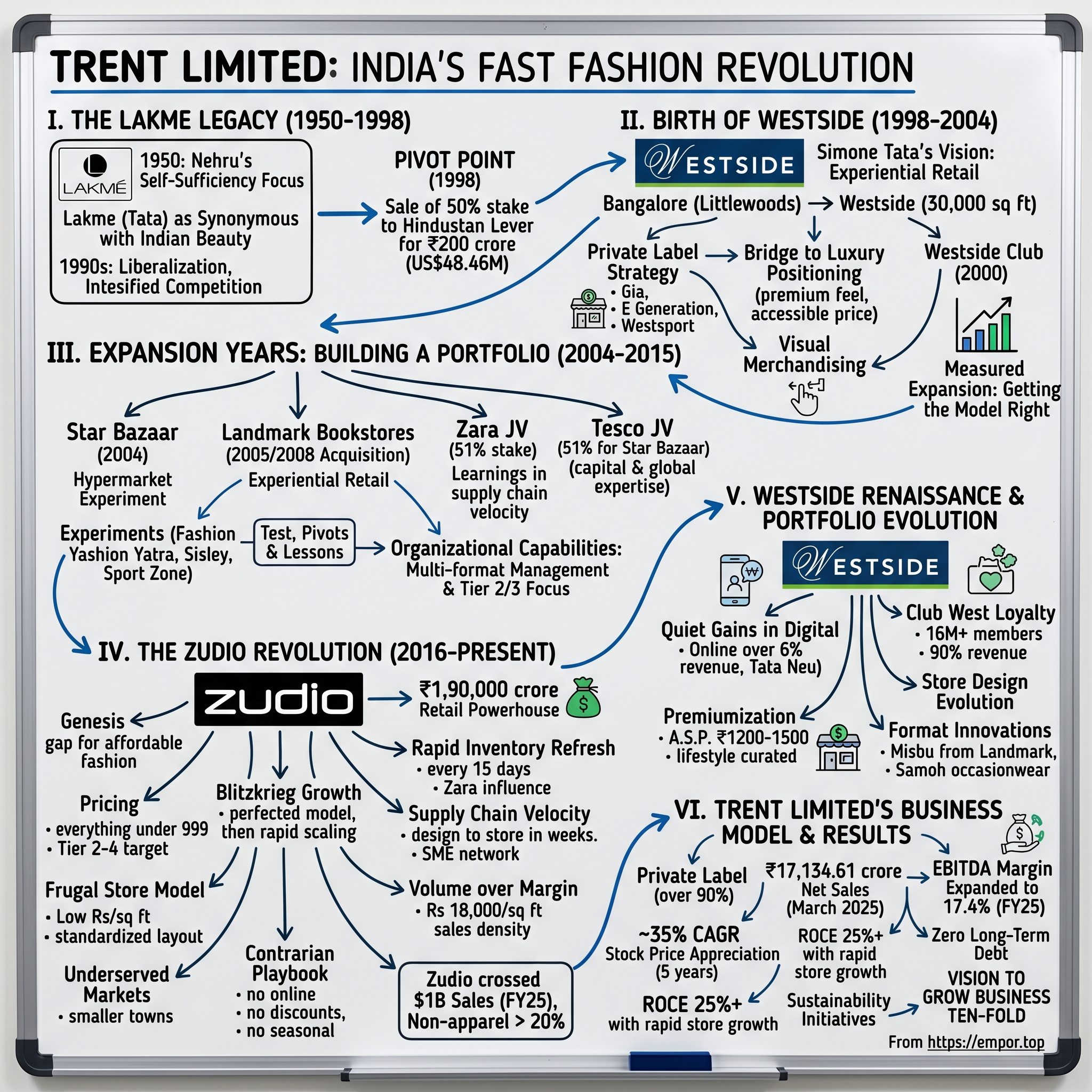
Trent Limited: Cracking India's Value-Fashion Code
I. Introduction & Cold Open
Inside a Zudio store in Sangrur, Punjab, Balangir, Odisha, or Amalner in interior Maharashtra, what stands out immediately is what is absent. There are no seasonal banners advertising 50% discounts. There are no QR codes encouraging customers to download an app for lower prices, nor are there counters for online order pickups. Instead, the stores feature a stark black-and-white storefront—sometimes displaying the brand name in local script above the English lettering—housing two to three floors of merchandise. Racks of T-shirts, dresses, sneakers, and cosmetics are priced almost entirely under ₹999, with most customers paying full sticker price at checkout. Extended across a network that reached 982 outlets in 321 cities by the end of June 2026, the model represents one of the most expansive retail formats established in India this century.1
That operational expansion frames a sharp valuation tension.
By mid-2026, Trent Limited commanded a market capitalization of roughly ₹1.56 lakh crore—approximately $18 billion—and traded at a trailing price-to-earnings multiple in the mid-80s.4 Consolidated annual revenue had recently crossed ₹20,000 crore.2 Yet the stock had lost approximately 42% of its market value during calendar year 2025, marking its first annual decline in twelve years following gains of about 126% in 2023 and 133% in 2024.5 On July 7, 2026, the shares dropped more than 10% in a single trading session after quarterly revenue expanded by 19%, missing consensus sell-side estimates of 23%.11 While core operations remained intact, the growth rate had ceased accelerating—a shift sufficient to re-rate a stock priced for continuous high-level compounding.
The core strategic question, then, is not whether Zudio is a viable operational model; its footprint and revenue scale confirm its market presence. Rather, the essential inquiry is subtler: is Zudio a generational retail format whose economics hold as it densifies, or did the market simply extrapolate four extraordinary years off a small base and price in a market share that has not yet arrived? When downgrading the stock in July 2025, Goldman Sachs highlighted the underlying market share arithmetic: Zudio's share of India's apparel market grew from roughly 1.1% in FY24 to 1.5% in FY25—notable expansion, yet still modest relative to aggressive market valuations.7
Parallel to the financial story is a critical leadership transition. Trent originated in 1998 through the redeployment of proceeds from the divestment of Tata's cosmetics business under Simone Tata. Her son, Noel Tata, became its first Managing Director in 1999, and in June 2026 he announced that the 74th Annual General Meeting would be his final one as Chairman.17 Trent's modern development has largely unfolded during his leadership, which is scheduled to conclude in November 2026 without a successor named as of August 2026.
This analysis examines how a retailer operating without primary e-commerce channels, promotional discounting, traditional seasonal cycles, or third-party brands became Tata Group's most valuable growth engine outside Jaguar Land Rover—and evaluates what the market's 2025–2026 re-rating signifies for its long-term trajectory.
 Subscribe on LinkedIn
II. Origins: From Lakmé to Westside
In 1996, Simone Tata—who had built Lakmé into India's first prominent domestic cosmetics brand—agreed to a 50:50 joint venture between Lakmé and Hindustan Lever. Two years later, in 1998, the Tata Group sold its half of that venture outright for ₹200 crore.20
The strategic logic was unsentimental: India's economy had opened, bringing global cosmetics houses equipped with R&D budgets and marketing scale an Indian brand could not match. Rather than defend a category vulnerable to multinational entry, Simone Tata redeployed capital into a sector where local knowledge provided a distinct competitive advantage: retail.
The proceeds funded the acquisition of a single Bengaluru store from British retailer Littlewoods International. Combined with Lakmé's export business, the entity became Tata Retail Enterprise, then Trent.20 The initial store was relaunched as Westside.
Westside's core strategic choice emerged from early market constraints. In 1998, India lacked both an organized apparel supply chain and established national brands worth stocking. Rather than operating as a department store renting floor space to third-party labels—the model Shoppers Stop and later Lifestyle pursued—Westside developed proprietary in-house brands, controlling product execution end to end across design, sourcing, pricing, and markdowns. Building fully owned brands out of necessity established an operating doctrine that continues to govern Trent.
Noel Tata assumed the role of Managing Director in 1999, steering the business as an operationally focused leader who prioritized disciplined format execution over rapid expansion. Over his 27 years associated with the business, Trent's share price rose from about ₹68 to roughly ₹3,217 — a return on the order of 4,600%.17 The vast majority of that value creation materialized in the final decade.
The 1998–2015 period served primarily as an operational platform-building phase. Over those seventeen years, Westside developed three capabilities that later enabled Zudio's rapid scaling: designing private-label apparel for Indian preferences and price points; managing an inventory-turnover supply chain that operated without markdown dependency; and establishing standardized store opening, staffing, and merchandising protocols across new markets. While these capabilities generated modest immediate market recognition, they created the structural foundation for Trent's subsequent growth.
This extended incubation period highlights the role of patient capital in retail strategy. Backed by a Tata holding company that owned a third of the equity, Trent operated without constant quarterly market pressure. That patient capital served as a structural advantage, yet it also created a distinct transition challenge as public markets began judging the company on short-term quarterly trajectories rather than multi-decade horizons.
Before scaling Zudio, however, Trent spent a decade testing a multi-format retail strategy.
III. Building the Multi-Format Platform (2004–2015)
By 2010, Trent operated a diverse collection of retail formats: a proprietary fashion chain in Westside, a hypermarket network, a bookstore chain, and—through a joint venture with Inditex—Zara stores in Delhi and Mumbai. The company functioned less as a single-concept retailer and more as a portfolio of options testing how Indian consumer spending might evolve.
The hypermarket segment marked Trent's initial major diversification. The company opened its first Star Bazaar in Ahmedabad in 2004, pursuing the premise that organized food and grocery would account for the largest share of Indian retail spending.21 However, grocery retailing demanded scale, high store density, and thin operating margins—categories where competitors like Reliance Retail and Avenue Supermarts (DMart) expanded aggressively. In 2014, Trent restructured the business by selling a 50% stake in Star to Tesco Plc for approximately £85 million, establishing Trent Hypermarket Private Limited as a 50:50 joint venture.21 Under this structure, Star's top-line revenues are excluded from Trent's consolidated financial statements, with only Trent's share of net results recognized under the equity method.2
A similar experimental logic guided the acquisition of Landmark, a bookstore and music chain. Trent acquired a 76% stake in 2005 and bought the remaining equity by 2008.21 As digital media and e-commerce shifted consumer buying habits away from physical books and CDs, management elected to repurpose the retail footprint rather than write off the assets entirely. Landmark was subsequently restructured into Misbu, a small-format beauty and accessories chain targeting younger consumers, thereby preserving existing real estate leases, store personnel, and operating licenses.22
Between 2009 and 2011, Trent entered into a partnership with Inditex to introduce Zara and, later, Massimo Dutti to India, taking a 49% minority stake in each joint venture.23 While the partnership provided direct exposure to international fast-fashion operations, Trent management maintained a clear distinction regarding the asset's role. In 2018, the company explicitly disclosed that its investment in the Zara joint venture was financial rather than long-term strategic.15
Although the Zara venture proved profitable and prestigious, it fell outside Trent's core operating doctrine. As a minority partner, Trent did not set product design, pricing architecture, or store expansion schedules. For a company that prioritized complete supply-chain and brand ownership, the joint venture functioned primarily as an investment asset rather than an extensible operational framework.
This multi-format era established three core operational principles that guided Trent's subsequent strategy. First, management favored running parallel, controlled experiments over committing capital to an unproven single format. Second, the company demonstrated a willingness to reallocate capital, sell stakes, or repurpose underperforming formats rather than maintaining non-viable retail concepts. Third, Trent systematically avoided expanding businesses where it lacked end-to-end operational control.
For investors, the 2004–2015 period yielded modest financial results but established essential organizational capabilities. Revenue growth remained moderate and returns on capital were constrained, as none of the experimental formats achieved major scale. However, the period built critical optionality and retail execution experience. In August 2016, Trent applied those cumulative learnings to launch its next growth initiative.
IV. The Zudio Inflection (2016–2024)
The first Zudio store opened in Bengaluru in 2016.1 Launched without public fanfare, the initial location operated as a format test designed to address a persistent dilemma encountered at Westside: how to serve aspirational shoppers who frequented the stores but found the price points out of reach.
The gap in the market
In 2016, Indian apparel retail was sharply divided. At the upper end, shopping malls housed international brands and domestic premium labels—aspirational, well-merchandised, and structured for the top decile of household income. At the lower end lay the unorganized market: independent shops, street markets, and unbranded garments offering low prices, but lacking fitting rooms, return policies, or standardized sizing. Between these extremes sat an expanding demographic: young consumers in Tier-2 and Tier-3 cities earning under ₹5 lakh annually who sought contemporary fashion trends at accessible price points.12
Zudio's value proposition addressed that mid-market segment directly: offer contemporary apparel inside bright, air-conditioned retail stores with most inventory priced below ₹999. Rather than operating as a discounted offshoot of Westside, Zudio was designed as a distinct retail concept engineered specifically for its target price point.
Engineered economics, not scaled-down premium
Zudio differed structurally from Westside across every key operational parameter.
First, real estate sizing was reduced significantly. While Westside stores typically occupy 20,000 to 30,000 square feet, Zudio locations average 7,000 to 12,000 square feet.2 This smaller footprint made locations in high-street districts and smaller towns economically viable, reduced fit-out expenses and commissioning timelines, lowered required sales density thresholds, and enabled entry into markets incapable of supporting a larger retail store.
Second, capital expenditure per store was kept low—requiring a modest capital deployment per new location. As a result, a parent company generating roughly ₹2,000 crore in annual operating earnings before interest, taxes, depreciation, and amortization (EBITDA) could finance hundreds of store additions annually from internal cash generation, avoiding debt or equity dilution.2 Trent has consistently maintained that it reinvests internal cash flows into new store openings, portfolio management, and supply-chain infrastructure rather than relying on external financing.1
Third, management preserved company-operated control. Trent's explicit policy is to maintain direct operational control of stores and ownership of inventory, utilizing franchise agreements selectively and primarily for real estate access.1 While franchising might have accelerated expansion at lower upfront cost, it would have ceded control over merchandise inventory and the customer experience—two elements central to the format's operating model.
The rollout, and what it actually looked like
Following initial validation, Trent scaled the store footprint across India.
The network expanded rapidly. Zudio ended the first quarter of fiscal 2023 with 243 stores. By the end of the first quarter of fiscal 2024, the count reached 388, expanding to 559 a year later, 766 near the end of fiscal 2025, and 982 locations by June 30, 2026.1 This quadrupled the store base over four years, representing an annualized growth rate above 40%. Trent added 244 Zudio stores in fiscal 2025 and 212 in fiscal 2026—including four international locations in the United Arab Emirates—while closing or consolidating 14 underperforming units.23
Revenue expanded alongside store additions. Zudio crossed $1 billion in annual sales during fiscal 2025—a milestone Chairman Noel Tata highlighted in reporting results, noting that Indian consumers increasingly demanded "an aspirational product proposition, attractive pricing and importantly ready accessibility."3 By fiscal 2025, sell-side analysts estimated that Zudio generated approximately 49% of Trent's apparel revenue, with Westside and Zudio combined accounting for nearly 99% of total clothing sales.24
However, an important reporting caveat exists: Trent does not publish an audited brand-level revenue split. The 49% contribution figure remains an external analyst estimate rather than an official corporate disclosure. Investors modeling Zudio's performance are evaluating estimates for a segment the parent company does not break out separately in financial filings.
Why the physical-first model is a moat, not a gap
A central element of Zudio's strategy is its decision to forgo e-commerce sales.
The underlying unit economics of low-priced online apparel in India present clear challenges. Fulfilling an order for a ₹399 T-shirt requires picking, packaging, shipping, and managing return rates that in domestic apparel e-commerce frequently average between 25% and 40%. Each return involves reverse logistics, quality inspection, repackaging, and potential markdowns. For low-ticket items, logistics expenses can absorb the majority of gross margins. While e-commerce functions effectively for high-ticket categories where delivery fees represent a minor fraction of order value, sub-₹999 apparel online operates with unfavorable unit economics without third-party subsidies.
Zudio avoids online fulfillment entirely. Customers select, fit, and purchase items directly in physical stores. This structure preserves gross margins, eliminates reverse logistics costs, and leverages store density as a physical distribution channel. As outlet density increases within a metropolitan area, physical proximity functions as an alternative to delivery infrastructure. Management has stated that building store density in key regions provides "proximity and the ability to service our customers readily."3
A full-price selling strategy operates on similar operational mechanics. By avoiding seasonal clearance sales, the retailer conditions shoppers to purchase at full sticker price, maintaining stable gross margins and enabling low baseline pricing. Trent has regularly noted that gross margin profiles for both Westside and Zudio have remained consistent over reporting periods.2 However, operating without markdown sales increases the cost of inventory miscalculations, requiring precise demand forecasting and supply control. To support this inventory management model during rapid expansion, Trent completed an enterprise-wide radio-frequency identification (RFID) deployment across its fashion portfolio by fiscal 2025, enabling item-level tracking across distribution hubs and retail stores to maintain stock accuracy during periods of 40%-plus volume growth.3
The reality check that belongs right here
Despite Zudio's rapid scaling, its absolute market share remains modest relative to the broader industry. By the end of fiscal 2025, Zudio accounted for approximately 1.5% of India's estimated $103 billion apparel market, up from 1.1% the prior year.7 In July 2025, Goldman Sachs highlighted this disparity when downgrading the stock, noting that its earlier valuation models assumed Zudio would achieve a 5% market share by 2035—a trajectory unsupported by current expansion metrics.6
This operational context underlines the tension between percentage growth and total market share. While Zudio's percentage expansion was notable, its total market presence remained small due to a low starting base in a fragmented retail market. High percentage growth off a 1% market share reflects participation in a large addressable market rather than market dominance. The valuation adjustment in 2025 and 2026 reflected public markets recalibrating expectations as high growth rates off a small base yielded to the arithmetic of market share expansion.
That market recalibration was accompanied by specific operational metrics, which emerged first in underlying store performance data.
V. Business Model Deep Dive: Why the Anti-Playbook Works
A central premise in Trent's investor presentations emphasizes a straightforward operational loop: the company designs its clothes, operates its stores, sets its prices, and avoids promotional discounting. Beneath that simple framing lies a tightly integrated operating model designed for low-cost retail execution.
Vertical control as the load-bearing wall
That model relies on a private-label architecture. Westside alone carries more than 20 in-house brands—including Nuon, ETA, Wardrobe, Utsa, Studiowest, Bombay Paisley, Zuba, and Gia Curves—with each label targeting a specific wardrobe occasion or demographic.1 Zudio applies the same structure at a lower price tier, while proprietary private-label goods account for approximately 74% of revenue in the Star grocery segment.1
While traditional department stores operate primarily as real estate hosts that rent floor space to third-party brands and capture a margin cut, Trent functions simultaneously as brand creator, buyer, and retailer. Integrating these roles eliminates the wholesale margin layer, generating the pricing flexibility required for an apparel portfolio priced mostly under ₹999.
However, full vertical control transfers inventory risk entirely to the retailer. When a garment line underperforms, Trent cannot return unsold merchandise to external vendors or deploy clearance markdowns to liquidate stock. Management relies instead on rapid inventory turnover and provisioning discipline, explicitly attributing its inventory provisioning standards to why full-year financial results reflect underlying performance more accurately than any single quarter.2 For a non-discounting retailer, quarterly financial optics remain closely tied to conservative inventory provisioning.
The three deliberate absences
Each of Trent's operational omissions represents a strategic trade-off.
No primary e-commerce channel. While Westside operates an online platform integrated with Tata Neu—which management reported grew by 25% in the fourth quarter of fiscal 2026—e-commerce generated just over 6% of Westside's sales, with Westside representing the smaller of Trent's two fashion drivers.2 This strategy exchanges broader digital reach for gross margin stability. If regional logistics costs decline significantly or quick-commerce platforms make low-ticket apparel delivery profitable, a physical-only retail model could face competitive pressure.
No traditional seasonal collections. By substituting quarterly fashion campaigns with continuous, smaller inventory releases, Trent reduces forecasting risk and excess stock. The trade-off is a less prominent fashion narrative, omitting the seasonal promotional campaigns typical of traditional apparel retailers.
No promotional discounting. Competing on everyday value rather than event-driven clearance sales stabilizes gross margins and revenue trends, though it produces less flattering quarterly sales spikes compared to promotional peers.
Capital efficiency is the actual headline
Trent's financial model exhibits notable capital efficiency. Return on equity reached approximately 28%, while return on capital employed stood at 28.3% on a trailing reported basis.4 Sustaining returns near 30% while opening more than 200 stores annually—an expansion pace that typically dilutes returns due to upfront store commissioning costs—remains unusual in physical retail.
This capital efficiency stems from a combination of low capital expenditure per location, rapid store commissioning, company-operated formats without franchise margin leakage, high inventory turnover from full-price selling, and leased real estate. Global peers such as Fast Retailing, the parent of Uniqlo, and Inditex operate with higher per-store capital requirements and broader international supply chains. Trent's model prioritizes lower capital intensity per rupee of revenue tailored to its target domestic market.
However, two accounting factors influence these reported return metrics. Under Indian Accounting Standard (Ind AS) 116, lease accounting reclassifies rent expenses from operating costs into depreciation and interest, altering reported EBITDA and total asset figures. Trent explicitly notes that, excluding Ind AS 116 adjustments, underlying occupancy costs track revenue proportionally, while the initial depreciation from newly opened locations leads management to highlight operating EBITDA as the primary metric for underlying performance.1 Additionally, rapid store additions can temporarily elevate trailing return metrics because recent revenues are measured against a growing capital base that has not yet reached full operational maturity.
Porter and Helmer, applied honestly
Evaluated through Michael Porter's Five Forces framework, Trent operates within a nuanced competitive structure. Buyer power is high because consumer switching costs in value fashion are negligible. Supplier power remains low and fragmented across India's decentralized garment manufacturing base, allowing a buyer of Trent's volume to secure favorable purchasing terms. Substitutes are widespread, ranging from local unorganized markets to competing value chains. Rivalry among existing retailers is active but supported by expanding market demand. The critical force remains new entrants—specifically well-capitalized corporate entities. While store network density, sourcing scale, and format execution create entry barriers, these reflect capital deployment and operational learning rather than technological or regulatory protection.
Applying Hamilton Helmer's 7 Powers framework highlights distinct strategic advantages and limitations. Process power represents a clear asset: the repeatable playbook for site selection, store fit-out, merchandising, and staffing across hundreds of Zudio outlets constitutes specialized operational knowledge. Scale economies provide further efficiency across sourcing and logistics spread across 18 million square feet of total retail space.1 Conversely, branding power remains limited for Zudio specifically. Customer loyalty is driven primarily by the price-to-value proposition rather than brand equity. Trent's corporate disclosures reflect this framing, noting that management views its competitive moat as something to build upon and deepen over time by strengthening brand relevance—framing brand equity as an ongoing objective rather than an established competitive lock.1
This distinction between operational execution and brand lock-in underpins the ongoing debate over Trent's valuation. Evaluating that trajectory requires examining the performance and scale of the company's remaining retail formats.
VI. The Rest of the Portfolio: Sized to Their Actual Weight
While Zudio serves as Trent's primary growth engine, the remainder of its portfolio spans established retail brands and minor experimental formats. Understanding the distinct scale and financial contribution of these secondary assets helps clarify the company's consolidated operating trajectory.
Westside: still real, structurally smaller
Far from being a declining legacy asset, Westside has maintained steady store expansion. The format expanded from 248 locations at the end of fiscal 2025 to 300 by the end of fiscal 2026—opening 60 new stores while consolidating eight—and reached 301 outlets across 97 cities and more than 7.15 million square feet by June 2026.21 This marked Westside's fastest pace of retail footprint growth in several years, occurring alongside the rapid expansion of Zudio.
Unlike Zudio, Westside benefits from extensive customer transaction data and established repeat purchasing patterns. The WestStyleClub loyalty program reached 16.4 million members in fiscal 2025—a 38% year-over-year increase, driven by 5.5 million new member additions in that year alone.25 For a mid-to-premium retail chain reliant on recurring shopper visits, this member network serves as a strategic merchandising asset, providing customer purchasing insights that inform private-label design, inventory planning, and price positioning.
Westside also serves as the platform for Trent's emerging product categories and primary e-commerce interface. Non-apparel segments—including beauty and personal care, innerwear, and footwear—contributed more than 21% of standalone revenues by the first quarter of fiscal 2027, up from over 20% a year earlier.13 This incremental shift in product mix enhances economics, as beauty and innerwear carry higher repeat-purchase frequencies and favorable margin profiles that elevate average transaction values without necessitating additional retail floor space.
Structurally, although Westside continues to expand, its relative contribution to Trent's total revenue continues to decline because Zudio is scaling at a significantly faster rate. Consequently, while Westside remains financially stable, its standalone operational performance exerts a diminishing influence on consolidated top-line metrics.
Star: the second engine that never was
Meanwhile, Trent's food and grocery format, Star, operated 86 stores across 12 cities by June 2026, generating quarterly revenue of ₹885 crore.1 Relative to the expansive footprints of grocery competitors such as Reliance Retail and Avenue Supermarts (DMart), Star's network remains modest in scale, concentrated across a limited number of urban catchments.
In reporting fiscal 2026 results, management explicitly addressed this execution lag. Chairman Noel Tata noted that the expansion program for Star stores "has been slower vis-à-vis our expectations," adding that the company intended to accelerate store rollouts and make targeted commitments to retail real estate to secure locations in high-density urban areas.2 This disclosure provided a candid assessment of format performance alongside a defined operational strategy to address real estate constraints.
Two accounting and operational factors govern Star's impact on parent company finances. First, because Star operates under a 50:50 joint venture with Tesco, its top-line sales are excluded from Trent's consolidated revenue statements, with only Trent's share of net earnings recognized under the equity accounting method.2 As a result, Trent's reported consolidated revenues reflect its fashion operations. Second, Trent's private-label strategy has been applied directly to grocery: proprietary in-house brands account for approximately 74% of Star's total revenue, while its Smartle label generates roughly 75% of general merchandise sales.1 Although the operating doctrine of vertical brand control has been replicated in grocery, the format has yet to achieve comparable scale.
The Inditex exit: capital discipline in real time
A notable strategic realignment in Trent's portfolio involved reducing its equity stakes in its joint ventures with Inditex.
In March 2025, Inditex increased its ownership in Massimo Dutti India from 51% to 80% by purchasing a 29% stake from Trent, reducing Trent's holding to 20%.13 Later that year, the Zara India joint venture executed a similar restructuring, with Trent reducing its equity interest from 49% to approximately 35% as Inditex moved to raise its stake toward 80% through a share buyback valued at ₹15,421.85 per share.14
This divestment aligned with Trent's 2018 disclosure characterizing its investment in the Zara joint venture as financial rather than long-term strategic.15 While both Zara and Massimo Dutti generated steady profits and prestige, they operated outside Trent's direct operational control. Reducing equity in minority partnerships reallocated managerial focus and capital toward fully controlled, higher-return domestic formats—most notably the rapid nationwide expansion of Zudio.
From a valuation perspective, reducing exposure to a global fast-fashion operator coincided with a broader deceleration in Trent's consolidated growth rate. However, a minority stake in a compact, 22-store luxury footprint provided limited financial scale for Trent relative to redeploying resources into high-volume, fully owned retail formats.
The optionality bucket, sized honestly
Trent's emerging growth concepts include specialized retail formats such as Misbu, Samoh, Utsa, the Burnt Toast lifestyle concept introduced in 2025, and Zudio's international stores—together totaling 29 outlets across alternative lifestyle concepts alongside seven Zudio locations in the United Arab Emirates as of June 2026.1 The company's initial international Zudio store launched in Dubai in September 2024.16
In financial terms, these early-stage formats contribute marginally to current earnings. Corporate disclosures describe these initiatives as being at "varying stages of evolution," noting "positive traction, improving viability."1 These concepts demonstrate the continuation of Trent's experimental retail model, testing whether core formats like Zudio can adapt to international markets operating without established domestic supply-chain networks.
Underlying Trent's segment reporting is a notable disclosure limitation. The company publishes consolidated financial statements and total store counts, but does not disclose audited revenue, operating margin, or return-on-capital metrics broken out individually for Westside, Zudio, or Star. As a result, external brand-level performance models rely primarily on analyst estimates rather than corporate reporting. This reporting structure limits investor visibility into format-specific metrics, a constraint that becomes increasingly relevant when consolidated revenue growth moderates.
VII. Current Management & Capital Allocation
There is a particular kind of executive who runs a retailer well and communicates about it badly, and Trent's recent history is a case study in both halves of that sentence.
The finance man in the merchant's chair
P. Venkatesalu joined Tata Administrative Services—the group's leadership pipeline—in 2001, worked in Tata Sons' group finance team, and moved to Trent as Chief Financial Officer in May 2008. He joined the board in 2015, became Executive Director and Chief Executive Officer, and was appointed Managing Director effective October 6, 2024.26 Shareholders reappointed him as Managing Director at the 74th AGM in June 2026.18
Eighteen years inside a single company's finance function before running it is an unusual profile for a fashion retailer, and that financial orientation shows up in the operating record in ways that are mostly favorable. Over five comparable June quarters—from FY23 to Q1 FY27—operating EBIT margin expanded from 9.3% to 7.8%, 10.8%, 11.5%, and ultimately 12.9%, with profit after tax margins moving from 6.2% to 9.4%.1 Costs were made variable where possible—occupancy and business-associate fees carry variable payout structures—so that operating leverage works in both directions.1
That financial orientation manifests less favorably in how the company communicates. Trent's investor communication is precise, heavily qualified, and cautious about disclosing specific operational metrics. When top-line growth moderated, management shifted messaging toward "comparative micro-markets" rather than same-store sales, "revenue density" rather than revenue per square foot, and noted that newer locations "tend to mature over a two-to-three year period."1 While each framing is operationally defensible, collectively they made it harder for investors to verify store-level trends at the exact moment verification mattered most.
The chairman's exit
On June 23, 2026, at Trent's 74th AGM, Noel Tata announced it would be his last as Chairman.18 Turning 70 in November 2026, his retirement aligns with Tata group policy under the Companies Act, 2013.17
This transition represents a major structural shift rather than a routine retirement. Since October 2024, Noel Tata has simultaneously chaired Tata Trusts—the philanthropic entity holding a controlling interest in Tata Sons—placing the head of Trent at the helm of the ultimate owner of Trent's largest shareholder.17 While no public evidence suggests any conflict of interest was mishandled, such concentrated overlapping roles require active independent board oversight. That structural overlap unwinds in November 2026, yet no successor has been named as of August 2026.
For a company whose entire modern strategy—format incubation, private-label ownership, and disciplined joint-venture divestment—traces directly to the Chairman's judgment, leadership succession remains a first-order strategic question.
Ownership and how management gets paid
Promoters held 37.01% of Trent as of June 2026, with domestic institutions at 23.07%, foreign institutions at 15.14%, and public shareholders at 24.57%.4 Tata Sons is the dominant promoter holder, and there are no pledged promoter shares.
Executive incentive structures shifted materially in 2026. Shareholders approved the Trent Limited Employee Stock Option Plan 2026, covering 888,700 equity shares—about 0.25% of issued capital as of March 31, 2026.27 The Nomination and Remuneration Committee subsequently granted 1,113,500 options on June 19, 2026, at an exercise price of ₹2,652 per share, with a further 20,000 options granted on August 6, 2026, at the same price.19
The timing of these grants highlights a dual dynamic. Setting option exercise prices at ₹2,652 during a stock drawdown aligns executive incentives with share price recovery. However, granting options after a period of underperformance can also be interpreted as resetting performance benchmarks downward. Investors will monitor the specific execution hurdles, as management indicated option vesting remains subject to performance conditions with a one-year exercise window post-vesting.19
Capital allocation: conservative to a fault?
For decades, Trent maintained a conservative capital-allocation model: retaining earnings, funding store expansion through internal accruals, paying token dividends, and avoiding leverage. In 2026, that policy adjusted at the margin. The board approved Trent's first-ever bonus issue—one share for every two held, with the record date set at June 4, 2026, after being revised from May 29—alongside a dividend of ₹6 per share for FY26.282
While a bonus issue creates no economic value, management intended the action to signal operational confidence, framing it around "the compelling outlook over the medium term, the market opportunities, and the salience of the platform."2 Concurrently, maintaining a modest dividend payout demonstrates that leadership continues to prioritize reinvesting capital into high-return store openings over returning substantial cash to shareholders.
This conservative balance sheet posture draws contrasting strategic interpretations. Critics argue that a business earning returns on capital near 30% with negligible debt underutilizes leverage, resulting in a lower return on equity than the company could support. Conversely, the counter-argument holds that for an inventory-heavy, full-price discretionary retailer, combining high operating leverage with financial leverage increases vulnerability. From this perspective, preserving balance sheet flexibility to expand retail footprint during a consumption slowdown represents the primary return.
The credibility test
This capital deployment framework faces a clear execution test. At the 2023 shareholders' meeting, Noel Tata articulated a "10X" revenue vision. By June 2026, he reported that the company had achieved more than 2.5 times growth in revenue and profitability since then, expressing confidence in reaching the full milestone in the "not-so-distant future," and noted Trent serves only around 2% of India's addressable retail market.2918
Set against that ambition, management highlighted a five-year compound annual revenue growth rate of 39% in FY25, framing FY25 top-line growth of 39% as validation.3 However, standalone revenue growth moderated to 18% in FY26, followed by 19% growth in Q1 FY27.21 Top-line growth stepped down from the high-30% range to the high-teens over roughly two years.
Corporate disclosures offered a mix of granular operational data and broader macroeconomic framing to explain this deceleration. On the operational side, the Q1 FY27 disclosure provided concrete detail: over 80% of new Zudio stores in the quarter opened in Tier II and Tier III cities and peripheral micro-markets; like-for-like growth for the fashion portfolio was in the low single digits; and newer markets take two to three years to mature.1
Conversely, management also attributed performance headwinds to external factors—including geopolitical instability, oil-price inflation, and Middle East supply-chain disruptions—while asserting that Trent had "not witnessed any material shifts in the competitive intensity in the recent past."1 That claim came in a quarter when Reliance Retail and Aditya Birla Group were expanding competing value-fashion formats aggressively. Furthermore, transitioning from reporting same-store growth to "comparative micro-market" metrics retired the indicator that reflected moderating store-level sales growth.
This reporting approach combines genuine operational disclosure with framing that shifts attention away from decelerating metrics, presenting investors with a key test of management transparency.
VIII. Financials & the 2025–2026 Growth Scare
The morning of April 7, 2025 is the moment the story turned.
Trent had published a routine quarterly business update. Standalone revenue for the March quarter had grown 28% year on year to ₹4,334 crore. By any normal standard for a retailer of that size, 28% is a triumph. The stock fell 19.23% intraday, to ₹4,491.75.8
Why? Because 28% was well below Trent's own five-year compound growth rate of about 36%, and the entire valuation rested on that rate persisting.8 Nothing had gone wrong. Something had merely stopped going extraordinarily right, and at 100-plus times earnings, that is the same thing.
The run-up
To understand the fall you have to understand what preceded it. FY25 was, on the operating numbers, one of the best years an Indian retailer has ever had: standalone revenues up 39% to ₹17,624 crore, profit before tax up 56% to ₹2,077 crore, a five-year revenue CAGR of 39%, over 40% volume growth, and 284 gross store openings across Westside and Zudio.3 The share price had gone up about 126% in 2023 and 133% in 2024, hitting an all-time high of ₹8,345.85 on October 14, 2024.5
The lesson in reading past the headline
Three weeks after the April crash, Trent reported full Q4 FY25 results, and the headline was brutal: consolidated net profit down 54.8%.9
That number was almost entirely an artefact. In the prior-year quarter, Trent had reassessed lease terms under Ind AS 116 and booked an exceptional gain of ₹543 crore, ₹406 crore net of tax.3 The comparison base was inflated by a one-off accounting item. Underneath it, the actual operating performance had improved: revenue from operations rose 27.9%, and operating EBIT margin expanded to 9.3% from 8.3%.93
This is a genuinely useful investing lesson, and it applies in both directions. A headline profit "collapse" driven by a prior-year accounting gain tells you nothing about the business. Equally, a headline profit surge driven by the same mechanism tells you nothing either. Trent's own presentations define operating EBITDA and operating EBIT as excluding lease-related Ind AS impacts, exceptional items and non-operating income — and those are the lines to read.1
The evidence that actually mattered
The real signal was buried in a metric Trent does not headline: revenue per square foot.
Independent analysis through the first two quarters of FY26 put Zudio's revenue per square foot down roughly 13% year on year, with area addition growing far faster than revenue.30 In plain terms: Trent kept opening stores, and each square foot of retail space was generating less revenue than the year before.
There are two possible explanations, and distinguishing between them is the central analytical question in this company. The benign one is mix: new stores in smaller towns naturally start at lower sales densities and take two to three years to mature, so a company adding 200 stores a year in Tier II and Tier III markets will mechanically show falling average density even if every individual store is performing to plan. Trent makes exactly this argument.1 The adverse one is cannibalisation: new stores opening close to existing ones in already-penetrated cities, splitting the same demand across more square footage. Goldman Sachs made exactly this argument, attributing the moderation in sales throughput to Zudio adding significant retail area in towns that already had numerous stores.7
Both are almost certainly happening. The question is the ratio — and Trent's decision to report "comparative micro-market" growth instead of comparable-store performance makes that ratio unusually hard for an outsider to compute.
The downgrade cycle
The sell side turned in sequence, and the sequence is the evidence.
Macquarie initiated coverage in late March 2025 with an Outperform rating and a target implying roughly 30–32% upside, calling Trent India's leading fashion retailer in the value-to-mid-premium space with best-in-class retailing metrics in Asia.31 That was the peak of the bullish consensus.
Then: Nuvama cut to Hold in early July 2025 on a slower growth outlook.32 Goldman Sachs downgraded from Buy to Neutral on July 23, 2025, cutting its target by 21% and reducing FY26–28 sales estimates by 5–9% and EPS by 8–13%.76 By November 2025, after Q2 FY26 revenue growth of 17% to ₹4,724 crore — the slowest quarterly pace since March 2021, with operating EBIT margin slipping to 10.2% from 11.0% — Citi downgraded to Sell with a sharply lower target, and Jefferies held at Hold with a reduced target.33
Notably, Goldman's downgrade came with a caveat that the bears rarely quote: even after the cuts, Trent remained the fastest-growing business in that bank's consumer discretionary coverage, with projected FY25–28 sales and EBITDA growth around 24% and 25%.7 The downgrade was about price relative to growth, not about the business breaking.
Where it landed
Calendar 2025 closed with Trent down about 42% — its first annual decline in twelve years, the previous one being a 3.5% dip in 2013.5
And FY26, reported in April 2026, was actually a good year. Standalone revenue rose 18% to ₹19,701 crore with operating EBITDA up 27% to ₹2,687 crore; consolidated revenue crossed ₹20,074 crore with operating EBITDA of ₹2,702 crore; Q4 operating EBIT margin expanded to 11.5% from 9.7%; and the network reached 1,286 stores across 321 cities and 17.7 million square feet.2 Profitability grew faster than revenue — the signature of a business getting more efficient as it scales. FY26 also carried a small exceptional loss of about ₹25.79 crore from India's new Labour Codes, effective November 21, 2025.34
Then Q1 FY27 landed on July 7, 2026 as a business update, and the pattern repeated: standalone revenue up 19% against Citi's estimate of 23%, and the stock fell as much as 10.7% to ₹2,986 — a price that must be read post-bonus, since the 1:2 issue had gone ex in June.1110 The full results on August 6, 2026 showed consolidated revenue of ₹5,755 crore, up 18%, with PAT of ₹518 crore, up 22%, and standalone operating EBIT margin at a record 12.9%.351
The composite picture is a business converting slower revenue growth into faster profit growth, and a market that has decided revenue growth is the variable it is paying for. That is an unresolved thread, not a closed chapter — and its resolution depends heavily on what the competition does next.
IX. Competitive Landscape & Industry Structure
India’s apparel market reached approximately $102.8 billion, with value fashion accounting for roughly 57% of the total and expanding at a compound annual rate of nearly 13% between 2020 and 2025—more than twice the growth rate of the overall market.12 Four distinct categories of competitors are contesting this high-growth segment.
The one that actually matters: Reliance's Yousta
Reliance Retail launched Yousta as a direct sub-₹999 competitor to Zudio, targeting Gen Z shoppers with weekly inventory refreshes and technology-enabled store layouts. As of September 2025, Yousta operated more than 55 stores across 27 cities, outlining plans to expand to over 1,000 locations within two to three years.12
While a network of 55 stores poses little immediate operational threat to Zudio’s 982 outlets, Yousta’s primary advantage lies in the parent company's balance sheet. Every operational barrier protecting Zudio—network density, purchasing scale, supply-chain infrastructure, and format expertise—is fundamentally a function of capital and time. Reliance commands considerable capital reserves and can compress expansion timelines by acquiring prime retail real estate. Furthermore, Reliance possesses existing grocery and telecommunications retail footprints that provide established landlord relationships across Tier-2 and Tier-3 cities—the exact regional markets Zudio is actively expanding into.
The primary competitive risk is not price discounting, as sub-₹999 value apparel offers limited margin room for further reductions, but rather site competition and rent inflation. Bidding wars between two well-capitalized retailers for prime high-street locations in regional market centers inevitably elevate occupancy costs for both players. This real estate competition represents the principal mechanism through which Reliance’s financial backing could compress Trent’s profit margins.
The structural response: Aditya Birla Fashion & Retail
Aditya Birla Fashion and Retail Limited (ABFRL) adjusted its corporate structure after falling behind in value retail. In 2025, ABFRL executed a vertical demerger, separating its western-wear brands into an independently listed entity, Aditya Birla Lifestyle Brands—a reorganization analysts viewed as a structural realignment to address underperformance in value fashion. Its dedicated value format, Style Up, operated 46 stores as of September 2025, when ABFRL announced its rebranding to OWND!, a Gen Z-focused label backed by an expansion target of more than 400 stores.12
Rebranding a modest 46-store footprint while committing to a 400-store expansion reflects a retailer attempting to regain lost ground. Whether OWND! develops into a viable third national chain or remains a capital-intensive experiment remains an open question in the Indian retail sector.
The long tail
Beneath the leading retail conglomerates operates a fragmented group of established value chains: V-Mart Retail, with over 500 stores, FY25 revenue of ₹3,254 crore, and a target sales density of roughly ₹8,200 per square foot; Vishal Mega Mart, operating 645 large-format value stores across 414 cities; V2 Retail; Baazar Style, focused on eastern India; Citykart; Shoppers Stop’s InTune; and Max Fashion, with over 510 stores repositioning around "democratised fashion."12
The key operating metric across this tier is sales density. Industry surveys indicated Zudio achieved between ₹16,300 and ₹18,000 per square foot—approximately double V-Mart’s target and well ahead of most of the field.12 This sales-density premium underpins Zudio’s superior unit economics. However, as Zudio’s sales density moderates, its financial performance risks converging with the broader market.
The global entrants
Global fast-fashion retailers such as Uniqlo and H&M have maintained an Indian presence for years without directly challenging the value-fashion segment. This separation stems from structural differences rather than operational execution: international models rely on globally standardized merchandise and cost structures optimized for higher transaction values. A store format developed for metropolitan international markets does not compete directly for the same price-sensitive consumer as Zudio. Trent’s advantage in this context lies in format localization and price alignment.
The nuance the cannibalisation story flattens
A key point often overlooked in pessimistic market commentary is that within a value-fashion market expanding at 13% annually with low organized retail penetration, Trent, Reliance, and ABFRL can expand concurrently without immediately taking market share from one another. Trent management underscored this dynamic, characterizing the competitive landscape as "asymmetrical" across scale, size and distribution channels.1 Similarly, Chairman Noel Tata observed at the AGM that India’s retail landscape makes it unlikely for any single brand to dominate the lifestyle segment.29
While this perspective highlights market opportunity, it also carries strategic implications: a market sufficiently broad to support multiple expanding players is equally one where no individual retailer easily establishes long-term pricing power—a tension central to evaluating Trent's long-term valuation.
X. Bull Case, Bear Case & the Skeptical-Investor Stress Test
Evaluating Trent's long-term outlook requires testing the fundamental investment theses against empirical operating data rather than market sentiment.
Why Trent wins from here
The optimistic case for Trent rests on five primary pillars, each supported by historical execution:
The market is genuinely under-penetrated. Organised value fashion is growing at roughly double the overall apparel market's rate, and Trent's own estimate is that it serves around 2% of India's addressable retail market.1218 Market runway remains substantial.
The rollout playbook is proven at scale. Operating over 1,300 large-format stores across 330 cities demonstrates an aggressive expansion model executed without severe operational bottlenecks or major inventory write-downs.1 While many retail chains struggle upon reaching several hundred locations, Trent has demonstrated structural scalability beyond 1,000 outlets.
Capital efficiency is real and differentiated. Generating returns on equity and capital employed in the high-20% range while funding aggressive store expansion entirely through internal cash generation represents a distinct operational advantage.4
Tata backing without heavy related-party drag. The business benefits from a stable promoter block, zero pledged shares, and integration with group initiatives like Tata Neu, without relying on intra-group revenue dependencies that complicate conglomerate subsidiaries.4
Margins are still expanding. Operating EBIT margin has expanded meaningfully across comparable quarters even as top-line revenue growth slowed.1 A company generating margin expansion during a revenue deceleration demonstrates operational leverage rather than eroding pricing power.
What could break the case
Revenue per square foot is falling, presenting empirical risk. A roughly 13% year-on-year decline in Zudio's revenue density through the first half of fiscal 2026 marks the primary vulnerability in the bear thesis.30 This trend reflects either an evolving geographic mix as new markets mature or structural cannibalization from store densification. Trent's disclosure choices obscure the exact breakdown, creating analytical risk for investors.
Market share remains modest relative to past valuations. Zudio accounted for approximately 1.5% of the apparel market at the end of fiscal 2025.7 The valuation contraction reflected the stock pricing in a projected 5% market share by 2035 well before operational execution achieved that scale.6
Brand equity provides limited protection. Zudio's customer base is anchored in price accessibility rather than brand loyalty. In a retail segment where capitalized competitors can match price points and trend responsiveness, limited brand lock-in leaves market share vulnerable to competition.
Competitive capital depth poses a structural challenge. Competitors with substantial capital reserves can bid up prime retail locations, driving up occupancy costs across key regional markets.
Reporting shifts invite market scrutiny. Delivering consecutive first-quarter revenue figures below consensus, combined with replacing comparable-store sales metrics with broader regional market definitions, has increased investor scrutiny surrounding management guidance.
The activist stress test
While Trent faces no active shareholder campaign, the 2025–2026 market re-rating imposed comparable discipline. Examining the business through an activist investor lens highlights five critical governance and operational questions:
On disclosure: Publish audited brand-level revenue and margin performance for Westside, Zudio, and Star, and restore standardized comparable-store sales metrics alongside regional micro-market reporting. A retailer confident in its unit economics does not require changing reporting definitions during a growth moderation.
On capital allocation: Explain why a company generating high-20% returns on capital maintains a virtually unleveraged balance sheet, and clarify why a maiden bonus issue and modest dividend represent the optimal capital deployment relative to a formal buyback or accelerated capital investment strategy.
On portfolio complexity: Star has operated below scale for over two decades. While management acknowledged this lag and committed to securing prime retail real estate, investors require specific execution timelines rather than stated intent.2
On accountability: Option grants issued under the 2026 employee stock plan at an exercise price of ₹2,652 require fully disclosed performance hurdles to ensure executive incentives align with long-term value creation rather than re-baselined share prices.19
On governance: Announce a clear succession plan for the chairmanship and outline formal board oversight protocols to manage the structural overlap between Tata Trusts and Trent leadership ahead of November 2026.
Management has addressed several of these areas directly, acknowledging Star's execution constraints, detailing Q1 FY27 market mix dynamics, and executing a disciplined equity reduction in the Inditex joint ventures. These steps reflect a company adapting its reporting and governance practices to meet heightened institutional scrutiny.
The risk radar, only where it bites
Three material risks directly threaten operational performance. Consumption slowdown: As a discretionary retailer serving cost-conscious consumers, Trent remains exposed to broader spending softness, which management characterized as "calibrated" consumer traction prioritizing essential value.1 Input-cost inflation: Operating a stable-price model without promotional markdowns leaves gross margins directly exposed to fluctuations in cotton and freight costs, which management seeks to mitigate through sourcing adjustments and price calibration.1 Execution risk in densification: Adding locations within heavily penetrated metropolitan markets presents fundamentally higher cannibalization risks than expanding into unserved regional centers.
Conversely, certain frequently cited risks carry less operational weight: digital disruption poses limited immediate threat given the unfavorable unit economics of low-ticket apparel delivery, while refinancing risk remains immaterial for a virtually debt-free balance sheet.
The two or three numbers that decide this
Evaluating Trent's ongoing operational performance relies primarily on three key metrics:
1. Revenue per square foot (or revenue density) for Zudio. This metric provides the clearest signal distinguishing benign market-maturation trends from structural store cannibalization.
2. Like-for-like growth across the fashion portfolio. Defined by Trent as revenue growth from stores operational for over 18 months,1 this metric slowed to low single digits in Q1 FY27 and serves as the primary indicator to watch for an operational inflection.1
3. Operating EBIT margin. Serving as management's primary profitability measure by excluding lease-accounting adjustments under Ind AS 116, sustained margin performance validates whether operating leverage remains intact amid moderating top-line growth.
XI. Lessons & the Playbook
Strip away the share-price drama and what remains is a set of transferable operating lessons, most of which run counter to conventional retail wisdom.
Build for the demographic that exists, not the one analysts model. The default mental model of the Indian consumer in sell-side research is often a metropolitan household with disposable income and active e-commerce habits. Zudio was engineered for a customer in a district town earning under ₹5 lakh annually who seeks Instagram-inspired fashion at prices payable in cash. Over 80% of Zudio's new stores in the June 2026 quarter opened in Tier II and Tier III cities and peripheral micro-markets.1 The format was designed backward from that customer's wallet—store dimensions, capital expenditure, price ceilings, and merchandise assortments were all derived from that baseline.
Strategic absence is a real strategy—with an expiry date that demands monitoring. Choosing not to build primary e-commerce channels, run seasonal campaigns, or offer promotional discounts is not passive conservatism; each decision actively protects the margin structure that makes the sub-₹999 price point viable. Yet these remain conditional advantages rather than permanent moats. They hold only as long as the unit economics of delivering a ₹399 garment online remain unfavorable. Operational discipline requires monitoring those underlying economic conditions rather than clinging dogmatically to format rules.
Repurpose before liquidating. Reallocating Landmark's real estate, store personnel, and operating licenses into Misbu rather than writing off the chain entirely illustrates a broader principle: an underperforming format can still house a viable operational framework.
Divest uncontrolled assets, even when profitable. The reduction of Trent's equity stake in its Inditex joint ventures offers a clear lesson in capital allocation: a profitable, high-status asset was trimmed because it did not drive primary long-term compounding. Executing such divestments is often difficult for executive teams. At Trent, the move was feasible because leadership had explicitly categorized the investment as financial rather than strategic seven years earlier, removing emotional attachment well before execution.
Distinguish an operational deceleration from a valuation reset. This distinction represents the central market lesson of 2025–2026. In fiscal 2026, Trent's operating business expanded revenue by 18%, broadened margins, and opened nearly 300 stores.2 Yet during calendar 2025, the stock fell 42%.5 These two dynamics are not contradictory: equities priced for continuous high-30s percentage growth experience severe multiple compression when top-line growth normalizes to the high teens, even as absolute earnings expand.
The corollary is equally significant: a valuation reset does not prove the bearish thesis correct; it indicates that public markets repriced an acknowledged growth risk. The core operational question—whether store densification erodes unit economics—remains unresolved, and the stock's re-rating neither confirms nor disproves it.
Corporate disclosure is a strategic asset in reverse. Management's decisions to omit audited brand-level financials and to replace comparable-store sales metrics with broader regional micro-market figures may have had operational logic. However, those choices reduced the company's capacity to counter market skepticism with empirical evidence. Detailed reporting enables management to defend unit economics with data; limited disclosure leaves leadership relying on strategic narrative—an approach that founders when metrics like revenue per square foot face downward pressure.
XII. Epilogue
As of August 2026, Trent sits at a critical transition point.
The most recent quarter delivered record operating margins alongside below-consensus revenue growth.111 The stock trades far below its October 2024 peak even after adjusting for the bonus issue, maintaining a valuation multiple that still embeds substantial growth expectations.4 Meanwhile, the company executed its first bonus issue, granted new stock options at an exercise price well below former highs, and faces the conclusion of a 27-year chairmanship in three months with no successor announced.1917
Three core questions will determine how this corporate trajectory reads by 2029.
Can Zudio's unit economics hold as density rises? Management argues that newer regional markets require two to three years to mature and that revenue density across comparable micro-markets continues to improve.1 That claim carries a clear, testable horizon. If store cohorts from fiscal 2024 and 2025 mature into steady productivity while new locations open, the geographic-mix explanation holds. Conversely, if mature cohorts plateau while average productivity continues to decline, the store-cannibalization thesis is validated.
Who succeeds Noel Tata, and will capital allocation shift? Trent's defining features—patient format incubation, willingness to monetize joint-venture stakes, and resistance to low-margin e-commerce—reflect executive doctrine rather than institutional mandate. A successor who alters expansion velocity, expands digital sales channels, or introduces financial leverage would fundamentally change the company's operating profile.
Does Yousta capture market share, or does the addressable market continue expanding? Within a value-fashion segment compounding at nearly 13% annually, both Trent and Reliance Retail retain room to expand.12 The key performance indicator to track is not comparative store counts, but Zudio's sales density in regional markets where Yousta establishes a direct physical presence.
Validating the optimistic outlook requires concrete operational evidence: like-for-like growth re-accelerating from low single digits into high single digits; revenue per square foot stabilizing and expanding as recent store cohorts mature; operating EBIT margins remaining above fiscal 2027 levels; and a leadership succession that maintains capital-allocation discipline.
Conversely, validating the cautious perspective relies on equally measurable outcomes: revenue per square foot declining for a third consecutive year; like-for-like sales growth remaining in low single digits amid continued store additions; operating margins contracting under rising occupancy costs in contested markets; and an expanding divergence between retail footprint expansion and revenue growth.
The company emerging from this transition will be evaluated on a different framework than the one that drove its initial growth. For a decade, Trent's mandate was to prove a value-fashion format could scale nationwide. Having demonstrated that capability, the company must now prove the format's unit economics endure its own expansion—that the thousandth Zudio outlet maintains productivity comparable to the hundredth, in regional centers where competition is established.
That resolution cannot be provided by strategic narrative alone; it will be tracked quarter by quarter through revenue per square foot.
References
-
Trent Limited — Investor Presentation, Performance Highlights Q1 FY27 (PDF), 2026-08-06 ↩↩↩↩↩↩↩↩↩↩↩↩↩↩↩↩↩↩↩↩↩↩↩↩↩↩↩↩↩↩↩↩↩↩↩
-
Trent announces Q4 and FY26 results — Press Release (PDF), 2026-04-22 ↩↩↩↩↩↩↩↩↩↩↩↩↩↩↩↩↩
-
Trent announces Q4 and FY25 results — "Portfolio of 1043 fashion stores" (PDF), 2025-04-29.pdf) ↩↩↩↩↩↩↩↩↩
-
Trent Ltd — Screener.in consolidated financials, shareholding and ratios ↩↩↩↩↩↩
-
Trent share price tanks 42% in 2025, set for first calendar-year decline in 12 years — Business Standard, 2025-12-03 ↩↩↩↩
-
Trent gets downgrade call from global brokerage, target price cut — Business Today, 2025-07-24 ↩↩↩
-
Goldman Sachs downgrades Trent to Neutral on Zudio cannibalization concerns — Investing.com, 2025-07-23 ↩↩↩↩↩↩
-
Trent share price crashes 19% after revenue growth moderation in Q4FY25 — Business Standard, 2025-04-07 ↩↩
-
Trent Q4FY25 results: Net profit falls 54.8%, revenue rises 27.9% — Business Standard, 2025-04-29 ↩↩
-
India fashion retailer Trent tumbles 11% as revenue growth disappoints — CNBC, 2026-07-07 ↩
-
Trent share price falls 10% after Q1 revenue growth — India Infoline, 2026-07-07 ↩↩↩
-
India's Value Fashion Juggernaut Is Just Getting Started — Apparel Resources, 2025-09-04 ↩↩↩↩↩↩↩↩
-
Inditex to raise stake in Zara India joint venture with Trent to 80% — Apparel Resources, 2025 ↩
-
Tata's Trent pares stake in Zara India, Massimo Dutti to boost own retail brands — Storyboard18, 2025 ↩
-
Investment in Zara JV "financial, not long-term strategic" — Business Standard, 2018-07-05 ↩↩
-
Zudio goes global, opens first store in Dubai — IndiaRetailing, 2024-09-02 ↩
-
Noel Tata to retire as Trent Chairman — a look at the retail empire he built — Business Today, 2026-06-24 ↩↩↩↩↩
-
Trent Limited passes all resolutions at 74th AGM — ScanX, 2026-06-23 ↩↩↩↩
-
Trent grants 11.13 lakh stock options under ESOP 2026 — ScanX, 2026-06-19 ↩↩↩↩
-
Simone Tata: The pioneer who built India's first beauty brand — Business Standard, 2025-12-05 ↩↩
-
Trent jumps on formation of JV with Tesco — Business Standard, 2014-03-22 ↩↩↩
-
Trent Ltd sees jump in net profit in FY25, Zudio revenues top $1 billion — Exchange4media, 2025 ↩
-
Trent: Upgrade to BUY on Zudio expansion and SSSG revival — HDFC Sky, 2026 ↩
-
Trent shareholders approve bonus shares and ESOP 2026 — ScanX, 2026-05-27 ↩
-
Trent revises record date for bonus issue — ICICI Direct, 2026 ↩
-
Trent eyes 10X revenue growth, plans global expansion for Westside and Zudio — Entrepreneur India, 2026-06-08 ↩↩
-
Zudio: The story of rapid growth, stagnation and mixed investor sentiment — Anoushka Narang, 2025 ↩↩
-
Macquarie initiates 'Outperform' rating on Trent, sees 30% upside — Business Standard, 2025-03-28 ↩
-
Nuvama downgrades Trent to Hold on slower growth outlook — Business Standard, 2025-07-04 ↩
-
Trent shares fall 6% on slowest quarterly revenue growth since 2021 in Q2 — Moneycontrol via TradingView, 2025-11 ↩
-
Trent Limited files Integrated Annual Report for FY2025-26 — ScanX, 2026 ↩
-
Trent share price in focus after Q1 FY27 earnings: total income up 17.5% YoY — Angel One, 2026-08-06 ↩
 LinkedIn
 WhatsApp
 Reddit
 Hacker News
 Email
Email Kindle
 RSS Feed
 Spotify
 Apple Podcasts
 Amazon Music
 Audible
 YouTube