Vedanta Limited: What Was Left After the Great Split?
I. The Company That Changed Shape Overnight
On May 1, 2026, the company that Indian investors had known for more than a decade as Vedanta quietly stopped existing in its old form. For years it had been one of the most sprawling listed businesses in Asia. It smelted aluminium in Odisha and Chhattisgarh, pumped crude from the Rajasthan desert, ran thermal power plants that sold electricity to state utilities, made steel and mined iron ore, and through a subsidiary in Rajasthan dug zinc, lead and silver out of some of the richest deposits on earth. That morning the composite scheme of arrangement took effect, and four of those businesses (aluminium, oil and gas, power, and iron and steel) left the listed company to become companies of their own.1 A shareholder who had owned one Vedanta share now owned a claim on five listed businesses instead of one.
The pitch for the split was simple enough to fit on a slide. A conglomerate that does everything is hard to value, because every investor who likes zinc has to accept oil, every investor who likes aluminium has to accept a coal-fired power plant, and nobody can tell which business is funding which. Separate them, the argument went, and each one will find its natural owner and its natural multiple.8 That is a reasonable theory. It is also the theory behind most demergers, and plenty of those have produced five cheap companies where there had been one.
What stayed behind in Vedanta Limited is the subject of this story. The residual company holds the controlling stake in Hindustan Zinc, the zinc operations in Southern Africa grouped as Zinc International, the copper business, and a handful of smaller and newer ventures.1 On CRISIL's adjusted post-demerger basis, that perimeter produced operating income of about ₹78,672 crore in FY2026.2 Above it sits the same parent as before. The promoter group, led by Vedanta Resources Limited and ultimately by the family trust of Anil Agarwal, owned about 55% of the listed company at the end of September 2026.3
Three questions decide whether the split was worth it. The first is operational: can the zinc business keep earning well through the swings of a commodity cycle that no single producer controls? The second is about money: when that business generates cash, does it stay to fund the company's own future, or does it flow upward to a parent with large debts of its own? The third is about perception: can a cleaner structure change how the market values a company whose discount has, for years, been about governance as much as geology?
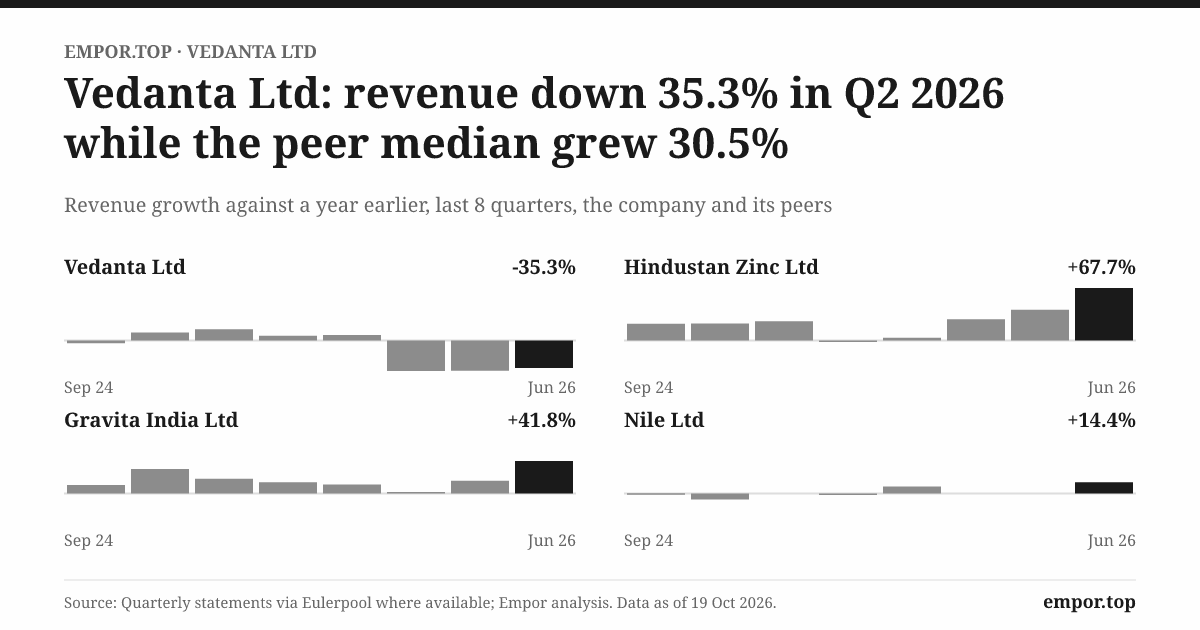
Before any of those questions can be answered, the numbers need a warning label. FY2026 is the year in which the old company and the new one overlap. The reported consolidated revenue for the year was roughly half the previous year's, and the reported borrowings fell by more than half as well.1 A careless reader would see a collapse in sales and a heroic deleveraging. Neither is true in the ordinary sense. Most of the revenue left with the demerged businesses, and much of the debt left with them too. The quarterly record makes the point: the December 2025 and March 2026 quarters already show revenue down by almost two-fifths from a year earlier, because the businesses on their way out were being reported separately before the scheme legally took effect.1
So the honest starting position is a paradox. The split makes Vedanta Limited easier to describe than at any time in the past fifteen years, and harder to compare with its own history. Every growth rate, debt ratio and margin trend that crosses FY2026 compares two different companies. The first real test of the new Vedanta is not whether the headline numbers improved. It is what the residual business earns on its own, and who decides where its cash goes. To understand why that second question carries so much weight, the story has to go back to how this company came to own a state zinc monopoly in the first place.
 Subscribe on LinkedIn
II. From Scrap to the State's Mines
Anil Agarwal's founding legend is one he has told many times. He left Patna as a young man and arrived in Bombay in the 1970s with very little, and built his first business trading scrap metal, buying cable and wire from companies that no longer needed it and selling it on.13 Scrap trading teaches a particular kind of lesson. Metal is metal; the buyer does not care where it came from, only what it weighs and what the London price is that day. Profit comes from buying the input cheaply and being efficient in between. That lesson, about the gap between what an asset costs and what its output fetches, would shape everything Agarwal built afterward.
From scrap he moved into processing. Sterlite Industries began making copper rods and cables, and by the 1990s it had become a copper smelter, importing concentrate and refining it into cathode.13 That was a respectable industrial business, but it was not the kind of business that makes a fortune, because a custom smelter lives on the thin processing fees miners pay to have their ore refined. The real money in metals sits upstream, in owning the mine.
India's liberalisation after 1991 opened that door. For decades, the state had owned the country's most important mineral assets through public-sector companies, and in the late 1990s and early 2000s the government decided to sell controlling stakes in several of them. Agarwal moved faster and harder than almost anyone. In 2001 Sterlite won 51% of Bharat Aluminium Company, BALCO, a state aluminium producer in Chhattisgarh.13 The sale was bitterly contested, with critics arguing the state had sold too cheaply and the workforce striking against the new owner. Agarwal held on.
The next year brought the deal that this story keeps returning to. In 2002 the group bought a controlling stake in Hindustan Zinc, the state's zinc and lead producer in Rajasthan, and then bought more from the market and the government, building its holding to roughly 65%.13 At the time, HZL was a sleepy public-sector company with good mines and indifferent operations. Under private control it became something else: a business that invested in deeper mines, larger smelters and captive power, and steadily drove down its cost of producing a tonne of metal.5 The government kept a large minority stake, which would matter enormously two decades later.
These privatisations set the template. Buy operating assets the state could not or would not run aggressively, invest heavily in capacity and efficiency, and turn them into subsidiaries that generate cash. That template gave Vedanta the asset at the centre of its current economics. Whether the group paid a bargain price is a question people still argue about, but there is no published like-for-like comparison of those acquisition multiples against other mining deals of the era, so the fairer measure is what the deals produced. On that measure, HZL in particular delivered decades of cash flows that dwarfed whatever was paid for it.
Ambition did not stop at metals. In 2011, the group, acting through its London-listed parent, completed the purchase of a controlling stake in Cairn India, the operator of the Rajasthan oil fields, in a deal valued at about $8.7 billion at the parent-group level.13 This is where the entity boundary matters. Cairn was not bought by today's residual Vedanta Limited. It was bought above it, financed with debt that sat largely at the parent, and only later folded into the listed company. Sterlite and Sesa Goa combined into Sesa Sterlite in 2013, the company renamed itself Vedanta Limited, and in 2017 Cairn India merged into it.13 Through that chain, the listed company inherited not only an oil business but also the liabilities and disputes that came with it, including arguments with the government over production-sharing terms.4
The Cairn deal tells you something about the group's temperament. Here was a metals company willing to buy its way into oil at the top of a commodity cycle, using leverage at the holding company, and then using the listed company's balance sheet and minority shareholders to absorb the result. A year later, in 2018, the group added Electrosteel Steels through the insolvency process.14 Each deal made the listed company bigger and more complicated. Each also made it harder to see where the cash came from and where it went.
Now the demerger has sent oil, steel, aluminium and power back out of the door. What remains is, to a striking degree, the business that the 2002 privatisation delivered. That makes the obvious next question the most important one in the story: what exactly makes Hindustan Zinc such a remarkable asset, and how long can it last?
III. The Cash Machine Was Zinc
Picture the Rampura Agucha mine in Rajasthan, a vast hole that has gone underground as the open pit reached its limits, feeding ore to concentrators and then to smelters at Chanderiya, Dariba and Debari. At the end of FY2025, Hindustan Zinc reported record domestic sales.5 It also reported something that sounds like a monopoly: by its own estimate, it held about 77% of India's primary zinc market.5 Yet every tonne it sold was priced off a number set thousands of miles away, on the London Metal Exchange. That tension, between dominating a national market and having no say over the price, is the key to understanding the asset.
Start with how zinc actually gets made, because the economics live in the steps. Ore comes out of the mine containing a few percent zinc and lead, plus small amounts of silver. A concentrator grinds it and separates the useful minerals into a concentrate that is far richer in metal. A smelter then turns concentrate into refined zinc and lead ingots, and the silver comes out as a valuable by-product. An integrated producer like HZL owns every step. A non-integrated smelter elsewhere in the world must buy concentrate from a miner and is paid a treatment charge for processing it, a fee that rises when concentrate is plentiful and collapses when it is scarce. A pure miner, by contrast, receives the metal price minus those treatment charges.5
Integration changes who keeps the margin. When HZL sells refined zinc, it captures the full LME price plus whatever premium Indian buyers pay for local supply, and it pays no treatment charge to anyone, because it is effectively paying itself.5 Its costs are the costs of mining ore, running mills and smelters, and powering them, much of which it does with captive power plants and, increasingly, renewable energy.5 Silver adds a further twist. Because silver comes out of the same ore, every ounce sold lowers the effective cost of the zinc. In years when silver prices are strong, HZL's silver business behaves like a second profit centre attached to the first.
Here is the clue that matters most. In FY2025 HZL reported a zinc cost of production of about $1,052 per tonne, a figure the company describes as placing it among the lowest-cost producers in the world.5 To feel what that means, compare it with the price. Zinc on the LME has traded for most of the past few years at well over twice that cost per tonne, which means HZL keeps a wide margin even at prices that squeeze higher-cost smelters elsewhere. When the price falls, the producers at the top of the cost curve lose money and cut output first. HZL, sitting near the bottom, stays profitable. That is the real advantage: not the ability to set prices, but the ability to survive prices that hurt everyone else.
Why does a domestic market share of about 77% not translate into pricing power? Because zinc is perhaps the most fungible thing an Indian galvaniser buys. A steel company coating sheet against rust can import ingots from Korea, Australia or China if HZL's prices drift above import parity. HZL's domestic premium is effectively capped at the cost of shipping, duties and the inconvenience of importing. Its market share reflects being the cheapest reliable local supplier, not a captive customer base.5 It is also a company-reported figure, as are most of HZL's comparisons with peers, and company-reported peer cost rankings depend on choices about which costs and by-product credits to include. They are directionally useful, not audited league tables.
So the moat is real but narrow. It is a cost and asset-positioning advantage built on rich ore bodies, integration and scale. The question is how it could break, and the answer lies underground. The open-pit era at Rampura Agucha is over, and the business now depends on underground mining, which is slower, deeper and more expensive to expand. Ore grades tend to drift down as the best parts of a deposit are mined first. Power is one of the largest cost lines, so a spike in coal prices or a delay in renewable supply flows straight into cost per tonne. And no amount of efficiency protects against a fall in zinc and silver prices, because every tonne of revenue is benchmarked to them.5
Management's answer to the depletion question is the reserve record. HZL reported that its reserves had grown about three times since FY2020, and it described a resource base supporting more than 25 years of mine life.6 That is impressive, and it addresses the most common worry about a mining company: that it is slowly eating itself. But the language needs care. A resource is metal that geologists believe is in the ground; a reserve is the portion that can be economically mined under current plans; and neither is production or cash. Turning resources into cash requires shafts, mills, people and capital, and it requires metal prices that make the extraction worthwhile. The 25-year figure is a statement about geology and plans, not a promise of 25 years of today's margins.
The record of mined and refined metal volumes is where that distinction gets tested each year. HZL has been running at roughly a million tonnes a year of mined metal and has repeatedly announced ambitions to grow toward much higher capacity.6 The things to track are whether mined output keeps pace with smelting capacity, whether cost per tonne holds near the FY2025 level as mines go deeper, and whether reserves keep being replenished faster than they are consumed. Those three readings, more than any announcement, reveal whether the advantage is widening or slowly eroding.
There is also a newer layer of ambition. HZL has launched EcoZen, a low-carbon zinc brand made with renewable power, and has talked about zinc-based batteries as a future opportunity.6 Both are sensible bets on where demand may go. Neither is yet a material revenue line, and a product launch is not a business. For now, the zinc machine earns its money the old-fashioned way: by digging rich ore cheaply and selling it at a global price.
That machine is the reason residual Vedanta is worth discussing at all. It is also the reason the rest of the story is about who controls its output. Before getting there, though, the story has to pass through the other half of the company's metals ambitions, the one that went badly wrong.
IV. The Smelter That Could Not Reopen
In late May 2018, protests against the copper smelter at Thoothukudi, also known as Tuticorin, on the coast of Tamil Nadu reached a terrible climax. Residents had campaigned for years against pollution from the plant and against a planned expansion. Police opened fire on protesters, and people were killed. Within days, the Tamil Nadu government ordered the smelter permanently shut.7 It has not produced copper since.
At its peak, Tuticorin was one of the largest copper smelters in India, with capacity of about 400,000 tonnes a year, and it supplied a large share of the country's refined copper.4 Its closure did not just remove a profit stream from Vedanta. It changed India's copper trade, turning the country from a meaningful exporter of refined copper into a larger importer. For Vedanta, it turned a working asset into a legal campaign.
That campaign lasted almost six years. Vedanta challenged the closure before the National Green Tribunal, the Madras High Court and finally the Supreme Court, arguing that the plant could be run in compliance with environmental rules.7 In February 2024 the Supreme Court dismissed the company's appeal, upholding the closure and pointing to repeated environmental violations and the plant's impact on the surrounding community.7 With that ruling, the most obvious route to reopening closed.
It is tempting to treat Tuticorin as an option on India's copper boom. The country's copper demand is growing with grid investment, electric vehicles and construction, and India remains short of domestic smelting capacity.4 A bull might argue that a 400,000-tonne plant sitting idle in a copper-hungry country must eventually find a way back. But demand does not reverse a court judgment. The plant was not closed because copper was cheap; it was closed because the state and the courts concluded that its operator had not earned the right to run it. A rise in the copper price does nothing to change that legal position. Any revival thesis needs a credible regulatory path, which does not currently exist, and disclosed economics for the investment a revived plant would require.
The accounting deserves a clear-eyed look. The plant remains on the books under care and maintenance, which means the company keeps spending money to preserve equipment it cannot use.1 Vedanta has disclosed impairment testing on the asset, and any further write-down would reflect the narrowing of realistic outcomes after the Supreme Court ruling.1 Alongside it sit the company's broader contingent liabilities, claims for income tax, customs duties, GST and state mineral cesses that the company disputes and has not recognised as debts.4 These are not liabilities in the accounting sense, because the company expects to win or settle them, but they are claims that could become cash outflows if appellate forums rule the other way. The auditor's report on the FY2024 accounts listed disputed statutory dues pending across multiple forums.4 Investors should treat those disclosures as a range of possibilities rather than a number to subtract.
What the residual company actually runs in copper today is smaller and different. It still operates downstream copper rod and refining activity in Silvassa in western India, and it has explored copper opportunities elsewhere.1 Those operations are evidence of what Vedanta does in copper now. They are not evidence that the old smelter can return.
So copper is a business with a large national market and a hole where its biggest asset used to be. It cost the company years of legal fees, management attention and lost profit, and it left a lesson about operating licences that the zinc business, in a far more favourable regulatory relationship, has not had to learn the hard way. With copper sidelined, the residual company depends even more on zinc. And that raises the question that has followed Vedanta through every phase of its history: where did all the zinc cash go?
V. The Cash Went Somewhere
Lay twelve years of Vedanta's accounts side by side, from FY2015 to FY2026, and one comparison jumps out. Over that span, the company reported cumulative net profit of about ₹67,381 crore. Over the same period, it generated about ₹3,20,470 crore of cash from operations, almost five times as much.14 That gap is the first clue. The second is where the cash ended up.
The gap between profit and operating cash is not a mystery, and it is not free money. Mining and oil companies charge large amounts of depreciation and depletion against profit every year, reflecting the slow using up of mines, wells and plant. Those charges reduce profit but involve no cash leaving the business that year, because the cash was spent when the assets were built or bought. On top of that, Vedanta booked large impairments, especially on oil and gas assets after the crude price crash of 2014–15, which drove the company to heavy reported losses in FY2015 and FY2016.13 Impairments, too, reduce profit without touching cash. A business with large non-cash charges will always show operating cash well above net profit. That spread pays for the replacement of the assets being used up, which is why it should not be mistaken for surplus.
The proper next step is to subtract what the business spent to stay in business and grow. After capital expenditure, Vedanta generated about ₹1,88,758 crore of free cash flow over the twelve years. Out of that, it paid about ₹1,28,650 crore in dividends, roughly two-thirds of everything left after investment.14 Meanwhile, the company's cash and short-term investments fell from about ₹45,386 crore at the end of FY2014 to about ₹16,067 crore at the end of FY2026.1 So the company paid out most of its free cash and also ran down its savings. The difference was covered by borrowing, by asset sales and, eventually, by issuing new shares.
That pattern shows up sharply in the payout ratio, dividends paid as a share of net profit. Across the decade to FY2026, the median payout was about 100%, meaning that in a typical year Vedanta paid out everything it earned. In FY2024 the payout reached an extraordinary 438%, more than four times the year's profit, as the company kept distributing cash in a year when earnings were weak.14 In FY2026 the payout was a more conventional 76%.1 A payout above earnings can be funded for a while, from cash already in the bank or from new debt. It cannot be funded forever. For an investor looking at Vedanta's dividend yield, the history says to ask not how generous the dividend is, but what is paying for it.
The reason for the generosity is not hidden. Vedanta Limited's largest shareholder, Vedanta Resources, is a holding company with substantial debts of its own and few operating assets outside its stake in the listed company.[^12] Its main sources of cash to service those debts are dividends from Vedanta Limited, plus brand and management fees that the listed company pays for the use of the Vedanta name and for strategic services.[^12] Every dividend Vedanta Limited pays sends a little over half the money to the parent, because the parent owns a little over half the shares. Large dividends, in other words, are the most direct way for the parent to meet its obligations.
The cash also comes from below. Hindustan Zinc pays its own large dividends, and Vedanta Limited receives a share proportionate to its stake, with the government and public shareholders of HZL receiving the rest.5 That makes the cash chain three layers deep: HZL earns cash, pays a dividend to Vedanta Limited and its other shareholders, and Vedanta Limited then pays a dividend to the parent and its own minority shareholders. Each layer leaks a portion to outside shareholders. To move a rupee from HZL's mines to the parent, the system has to distribute considerably more than a rupee in total.
It is important to keep the parent's debt in its place. Vedanta Resources' bonds and loans are not liabilities of Vedanta Limited, and they do not appear on its balance sheet.[^12] What the listed company bears is the pressure those debts create, because the parent controls the board that decides dividends and approves fees. The distinction matters for creditors, who have no claim on the listed company for the parent's debts. It matters less for minority shareholders, who depend on the board deciding how much cash stays inside the business.
One more caveat applies to the twelve-year totals. They span several business perimeters: the oil business, the aluminium business, steel, power and zinc all contributed to the cash flows and all received capital. The totals show the group's historical habit of distributing heavily, not the future dividend capacity of a residual company built around zinc. The new perimeter will have to establish its own pattern.
What the record does show, unmistakably, is a choice. Vedanta's businesses generated a great deal of cash, and the controlling shareholder chose to take much of it out. That choice is legal and in some years was arguably sensible. But it means the question of independence, whether the residual company can make decisions about its own cash that are not driven by the parent's needs, sits at the centre of the investment case. And in 2023, that question was put to a very public test.
VI. The Parent Still Has a Claim on the Story
In early 2023, Vedanta proposed a deal that seemed, on paper, like a tidy piece of portfolio management. Hindustan Zinc would buy the parent group's international zinc assets, held through a Mauritius company called THL Zinc, for about $3 billion, paid from HZL's cash.4 The assets were zinc mines and projects in South Africa and Namibia, in the same business as HZL. Management could argue that consolidating zinc under one roof made strategic sense.
The government of India, which still owned a large minority stake in HZL, saw it differently. The cash being spent belonged in part to HZL's minority shareholders, including the state. The seller was a related party, a business ultimately owned by the same promoter family. And the transaction would have moved a large amount of money from a cash-rich subsidiary up into a group that needed liquidity. The government objected publicly and said it would explore legal options to stop the deal.4 The proposal was dropped.
That episode is the most revealing single event in recent Vedanta history. It showed that related-party capital allocation can meet resistance when a powerful minority shareholder is in the room. It also showed what management was willing to propose. The question for today's investors is whether the same pressures still exist, and whether anyone with comparable weight is still in a position to resist them.
Fees are the quieter channel. In FY2024, Vedanta Limited's brand and management fees paid to the parent amounted to about ₹2,413 crore, up from about ₹1,701 crore the year before.4 The statutory auditor treated related-party transactions, including these fees, as a key audit matter, meaning it regarded them as an area requiring particular scrutiny.4 The company describes the fees as payment for the use of the Vedanta brand and for strategic and management services. Critics see them as a recurring transfer of cash from listed minority shareholders to the parent, independent of dividends. Both descriptions can be true at once: the fee may pay for something real, and it may also be a channel that the parent's financial needs make more important.
Ownership defines how much leverage the parent has. At the end of September 2026, the promoter group held about 55% of Vedanta Limited.3 That figure was once considerably higher, close to 70% before a series of dilutions, the largest being the July 2024 qualified institutional placement, in which the company issued about 19.3 crore new shares at ₹440 each to raise ₹8,500 crore for debt reduction.15 A majority stake still gives the promoter control of ordinary resolutions and the board, though Indian rules require related-party transactions above certain thresholds to be approved by shareholders without the promoter voting, which gives minority investors a real voice on exactly the transactions that matter most.10
The encumbrance of the promoter's shares has historically been one of the most cited worries about Vedanta. Over the years, almost all of the promoter's holding was pledged or subject to non-disposal undertakings in favour of lenders to the parent.15 Those two categories are not the same. A pledge gives the lender a security interest it can enforce; a non-disposal undertaking is a promise not to sell the shares, which restricts the promoter without handing a lender the right to seize them. Exchange-filed shareholding patterns disclose the current split, and investors should read the latest filing rather than relying on the historical description, because encumbrances change as parent loans are refinanced.3
The parent's debt explains why all of this matters. In January 2024 Vedanta Resources completed a restructuring of about $3.2 billion of bonds, pushing maturities out to 2027 and 2028 in exchange for higher coupons, with the restructured bonds carrying a rate of 13.875%.[^12] That is the coupon of a borrower that lenders regard as risky. A holding company paying close to 14% on its debt needs a steady inflow of cash, and its principal source is the listed company it controls. The restructuring bought time. It did not remove the need.
Leadership has stayed in the family. Anil Agarwal remains chairman of Vedanta Limited in a non-executive capacity, and his brother Navin Agarwal is executive vice chairman.4 Navin Agarwal's reported remuneration for FY2025 was about ₹24 crore, and long-term incentive awards from the parent were also disclosed.4 Absolute pay at that level is not unusual for a company of Vedanta's size. The more useful test is alignment. Over the five years to October 2026, the stock's shareholder returns were punctuated by deep falls, including a peak-to-trough decline of about 52%, while the company paid very large dividends that disproportionately served the parent's needs.1 Incentive awards from the parent tie executives' rewards in part to the parent's welfare, which is not necessarily the same as the listed company's.
The management bench beneath the family has been unsettled at times. In October 2023, the chief financial officer resigned after only five months, and the company brought back a former CFO to replace her.12 One turnover is not a pattern, but rapid changes in the finance function at a company with a complex parent debt situation are worth noting.
The capital allocation record, taken as a whole, points in two directions. On one side are the blocked THL Zinc proposal, the payouts above earnings and the fees. On the other side are genuine corrective actions. The 2024 QIP raised equity to cut debt, and the same summer Vedanta sold about 3% of HZL through an offer for sale at a floor price of ₹486 a share, raising roughly ₹3,400 crore.12 Both moves reduced leverage. Both also diluted something: the QIP diluted existing Vedanta shareholders, and the HZL sale gave up a slice of the company's best asset. Deleveraging by selling the crown jewels and issuing shares is responsible behaviour under pressure, but it is behaviour under pressure.
On recent calls, the questions that cut deepest are the ones about HZL distributions, fees to the parent, the use of demerger and fundraising proceeds, and the parent's refinancing needs. Management's prepared remarks tend to emphasise operating records and the logic of the demerger, while analysts' follow-ups return to cash flow and the parent.9 The gap between those two agendas is itself informative. It shows what investors believe the real risk to be.
The residual company's independence from the parent, then, is a hypothesis rather than a fact. The demerger did not change who owns the controlling stake, who sits on the board, or what the parent owes. What it did change is the shape of the reporting, and the first post-split results offer the first chance to see whether that shape matters.
VII. The Demerger's First Report Card
The first quarter of FY2027, the three months to June 2026, arrived with a new cast. The aluminium, oil and gas, power, and iron and steel businesses now report on their own, as separate listed companies, and the residual Vedanta reports what is left.16 For the first time in years, an analyst could look at a single set of accounts and see something close to a zinc company with a copper footnote.
The scheme moved the four businesses, along with the assets and debts allocated to them, into the resulting companies, and gave Vedanta Limited's shareholders shares in each in proportion to their holdings.1 The residual company kept HZL, Zinc International, copper and the smaller ventures, and it kept a share of the debt.1 How that debt was divided matters a great deal, because a demerger can easily leave a residual company carrying more than its fair share of liabilities, or carrying guarantees for borrowings that now belong to someone else.
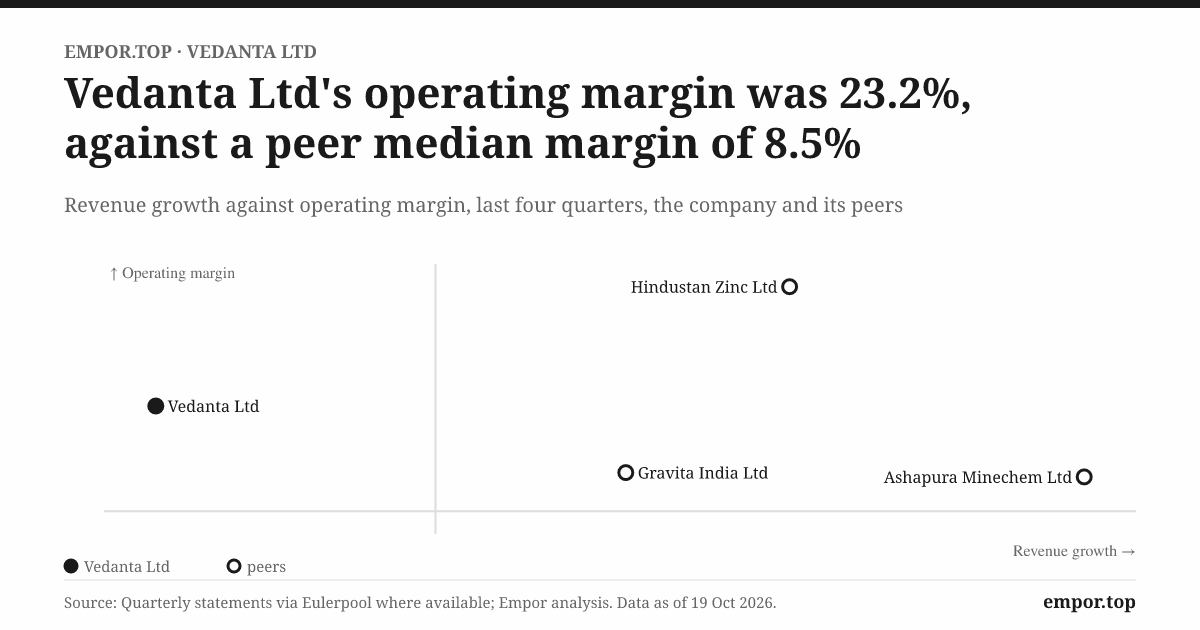
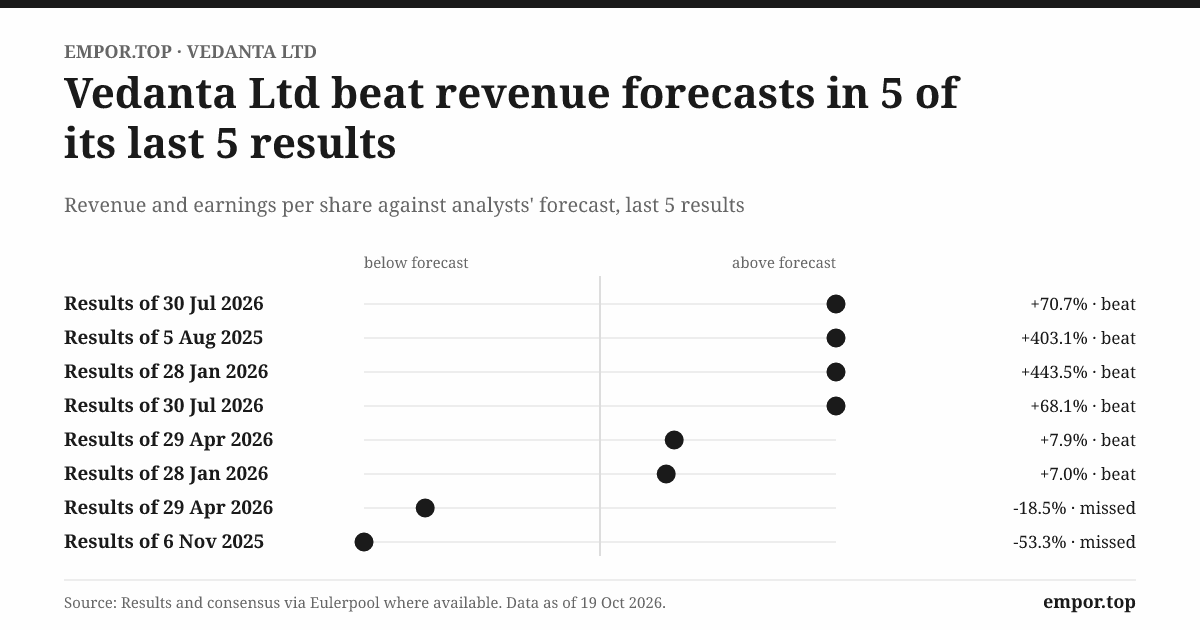
The early numbers look like a different company. In the June 2026 quarter, revenue was about $2.6 billion, roughly a third lower than a year earlier, which reflects the change of perimeter rather than a collapse in demand.1 Net profit attributable to shareholders was about $579 million, up sharply from a year earlier, and operating margin was about 30%.1 That combination, lower sales and higher profit, makes sense once you remember what left. The departed businesses included lower-margin operations like power, alongside large but cyclical ones like aluminium. A company that keeps the zinc and sheds the rest should show higher margins on smaller revenue.
But that is exactly why careful comparisons matter. CRISIL's adjusted figures put FY2026 operating income for the residual perimeter at about ₹78,672 crore, while the comparable FY2025 figure reflects the old, larger perimeter and cannot be read as a like-for-like base.2 Any statement that profit "rose" or debt "fell" across the demerger year has to say which perimeter it is measuring. On the balance sheet, reported borrowings fell from about $8.9 billion to about $3.7 billion between March 2025 and March 2026, cutting the debt-to-equity ratio from about 1.8 to about 0.8.1 Most of that change reflects debt that moved with the demerged businesses, not debt that was repaid.
The rating agencies have been somewhat encouraged. CRISIL rates Vedanta Limited's long-term debt at AA+ with a stable outlook, citing reduced leverage after the demerger and the strength of HZL, which generates the overwhelming majority of the residual company's operating profit.211 It also lists the constraints plainly: exposure to commodity prices and the parent's reliance on cash from the group's operating companies.2 In other words, the agency judges the residual company's own credit to be strong while flagging the same parent risk this story keeps returning to.
Management's value-unlocking case rests on several promises: each company would have its own focused management, standalone reporting, its own debt and its own access to capital, and investors would be free to own only the businesses they want.8 The first test is whether each resulting company can fund its own capital spending without support from the others. The second is whether guarantees and cross-holdings have truly been unwound, or whether the residual company still stands behind debts that left with the other entities. The third is whether shareholder entitlements were delivered cleanly. The scheme's mechanics have been executed; the economic separation needs a full year of reporting to judge.
The first post-demerger call is where the analysts' focus became visible. The questions that matter concern how concentrated the residual company's profit is in HZL, how much debt remains at the Vedanta Limited level after the allocation, how much cash the residual company receives from HZL compared with what it spends, and what, for a minority shareholder, has actually changed.9 The honest answer to the last question is that the structure is clearer while the owner is the same.
That leaves the demerger with a mixed first report card. It has made the assets and liabilities more legible, and it has given the market a cleaner view of the zinc business. It has not yet shown that the residual company deserves a higher valuation. That judgment depends on the next set of comparable results, on how cash is allocated, and on what the related-party disclosures look like across five separate companies. Meanwhile, the market has already rendered a verdict of its own, expressed in a number that looks almost absurd.
VIII. What the Low Multiple Is Discounting
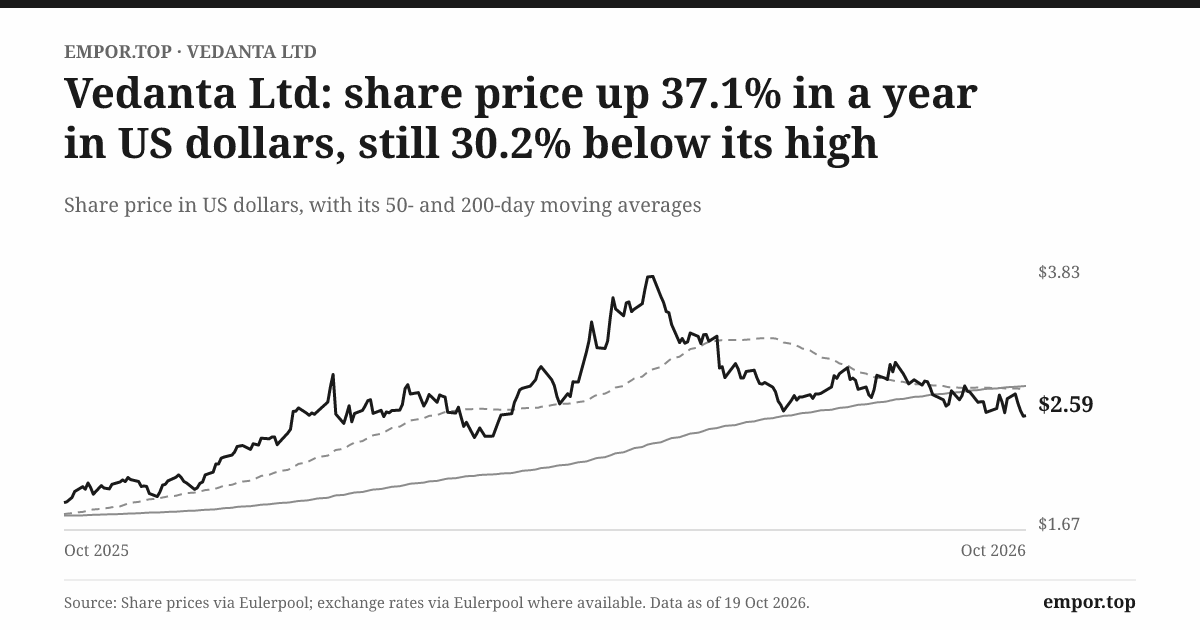
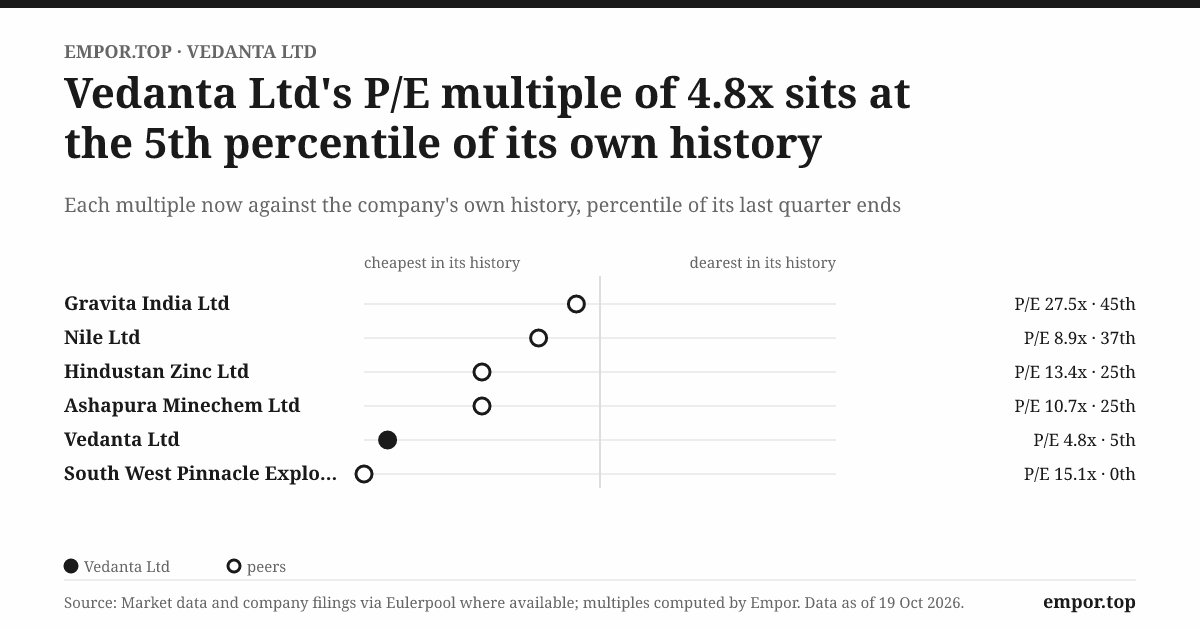
On October 19, 2026, Vedanta's shares closed at about ₹246, giving the company a market value of roughly ₹95,400 crore.1 At that price, the stock traded at about 4.8 times trailing earnings. Its own median over the past five years was about 12.2 times.1 On enterprise value to EBITDA, the multiple was about 2.4 times, and the dividend yield was about 6.5%.1 For a company whose main asset is described as one of the lowest-cost zinc producers on earth, those are startling numbers. Either the market is badly wrong, or it is pricing something the earnings multiple does not show.
Start with the arithmetic of a low P/E. A multiple of 4.8 implies an earnings yield of about 21%: for every ₹100 of market value, the company earned about ₹21 over the past twelve months. A low multiple can mean a stock is cheap. It can also mean earnings are temporarily high, that a large part of them belongs to someone else, or that the market doubts it will ever see the cash. All three possibilities apply to Vedanta in some degree.
The first is the earnings base itself. Trailing earnings straddle the demerger. They include periods in which some of the demerged businesses were still accounted for inside the company, as well as gains and accounting effects tied to the separation.1 A P/E calculated on a profit figure that may not recur is not a reliable guide to the residual company's steady earning power. Until a full year of post-demerger earnings exists, the multiple is computed on a moving target.
The second is the share of earnings that actually belongs to Vedanta's shareholders. Vedanta Limited consolidates HZL, but it owns only part of it. The rest of HZL's profit belongs to the government and HZL's public shareholders. Reported net profit attributable to Vedanta's shareholders strips out that minority share, but the enterprise value and EBITDA multiples can be distorted by how minority interests are treated. That is one reason a direct comparison with HZL itself is so revealing. HZL trades at a substantially higher multiple than its parent, in the range of the mid-teens on earnings.5 Domestic metals peer Hindalco and global diversified miners such as BHP and Rio Tinto trade in the low double digits on earnings.4 Those comparisons should be made on the same valuation date and with consistent measures, and the businesses differ greatly in scale and mix, but the gap is too large to be explained by mix alone.
That is the third factor, and the most important: the holding-company and governance discount. A dollar of HZL earnings is worth more held directly through HZL shares, where the government sits alongside you as a minority shareholder, than held through Vedanta, where it must pass through a second layer of decisions controlled by a parent with expensive debts. The market appears to be pricing the risk that cash will be extracted through fees, dividends shaped by the parent's needs, or related-party transactions, rather than reinvested or distributed fairly. It is also pricing commodity risk; a zinc price downturn would compress earnings quickly.
The dividend yield needs the same scrutiny. A yield of 6.5% looks attractive, and the trailing free cash flow yield of about 6.3% is close to it.1 That near-match is the clue: on trailing numbers, the company is paying out roughly what it generates after capital expenditure, leaving little cushion for growth investment or debt reduction. Whether that remains true on the new perimeter depends on what HZL pays up to Vedanta, what Vedanta spends on its own projects, and how much cash it retains. Post-demerger net debt, HZL dividends received and cash retained are the three numbers that will show whether the yield is supported or stretched.
There is a further warning about the strong-looking operating ratios. The reported cash conversion is high, and receivables collapsed to about six days of revenue in FY2026, compared with more than forty a decade earlier.1 Metals sales on advance payment or letter-of-credit terms convert to cash very quickly, so some of that improvement is genuine. But the historical ratios include businesses that are no longer in the listed company, and some of the improvement simply reflects the departure of the power business, whose state-utility customers were notorious for paying late.4 The residual company's receivables are probably cleaner than the old conglomerate's, but the historical series cannot prove it.
So the low multiple is not obviously a mistake. It reflects a mix of uncertain earnings, layered ownership, commodity exposure and a parent whose needs shape the cash flows. To call Vedanta cheap, an investor has to believe that one or more of those discounts will narrow. That is a question about the durability of the zinc business and the behaviour of the people who control it, which is where the bull and bear cases finally meet.
IX. Analysis & Bear vs. Bull Case
The bull and the bear are looking at the same mine. The bull sees HZL's cost position, its reserve life and its dominant domestic share, and concludes that the market is undervaluing one of the best mining assets in Asia because it cannot see past the parent. The bear agrees about the mine and asks two harder questions: will those earnings stay inside the listed company, and will they survive the next downturn in zinc?
Begin with the structure of the industry, because it sets the limits of any advantage. Global metal prices set the ceiling: no zinc producer, however large, sets the LME price. Industrial buyers can source from importers if domestic prices rise too far, so buyer power is constrained less by the number of buyers than by the fungibility of the product and the availability of imports. Suppliers matter mainly through energy, since power is a major cost and the price of coal or renewable supply flows directly into cost per tonne; HZL's captive power reduces but does not eliminate that exposure.5 New entrants face high barriers, because a new zinc mine takes years and large amounts of capital to develop, and rich deposits are rare. Substitutes are limited for galvanising steel, but recycling of zinc and lead supplies a growing share of demand over the long run. Competitive rivalry plays out globally through costs and output, not through pricing among a few domestic sellers.
Run the same evidence through Hamilton Helmer's seven powers and only one power clearly applies. HZL has a cornered resource in its Rajasthan ore bodies, which are rich, large and controlled through long-term mining rights, and it has scale economies through integration and large smelters.5 Those combine into a low-cost position. It lacks the other powers: there are no network effects, no meaningful switching costs for buyers, no brand power that commands a premium beyond modest regional premiums, no counter-positioning against incumbents, and no process power that competitors cannot replicate over time. That is the definition of a commodity moat. It is a cost advantage, not a price umbrella, and it protects margins rather than revenues.
The bull case starts with that cost advantage and adds three things. First, the mine life: a reported resource base supporting more than 25 years of production means the asset is not about to run out.6 Second, the production record: HZL has delivered steady mined and refined output for years, through both strong and weak price environments.5 Third, the clarity of the new structure: if investors can value the residual company as a zinc holding company, the gap between Vedanta's multiple and HZL's may narrow, especially if the company demonstrates restraint on fees and related-party dealings. CRISIL's improved view of the company's credit gives the bull some external support.2
The bear case has four pillars. Metal prices can reverse, and a residual company that is now overwhelmingly dependent on zinc and silver has lost the diversification the old conglomerate offered. A downturn would hit earnings without any offsetting business. The exceptional HZL position does not remove the parent's cash demands, and with restructured bonds maturing in 2027 and 2028 at a high coupon, the pressure on the listed company to distribute cash will not ease soon.[^12] Tuticorin remains closed, a sunk cost with continuing carrying expenses and no visible path to reopening.7 And the structural discount may simply be rational: a minority shareholder in Vedanta owns a slice of a slice of HZL, with a controlling shareholder in between whose interests are not identical to theirs.
The most important falsification test concerns management's credibility, and the company's own record is the evidence. Against the claim that the group is a disciplined capital allocator stand payouts far above earnings in several years, rising related-party fees, the blocked THL Zinc proposal, the failed delisting attempt in 2020 that would have bought out minorities at a price the market rejected, the dilutive 2024 share issue and the long, unsuccessful campaign to reopen Tuticorin.1215 In favour of the claim stand the QIP, the HZL stake sale and the reduction in debt, which show a willingness to correct course. Weighing them, the record narrows the claim rather than rejecting it entirely. Management has shown it can deleverage under pressure; it has not shown that it puts minority shareholders' interests first when they conflict with the parent's. The corrective actions are evidence of responsiveness, not proof that the governance risks are resolved.
The moat claim, tested the same way, survives in a narrower form. HZL's cost position has held through several cycles, including the commodity crash that devastated the group's oil business in 2015–16.13 What would falsify it is not a lower zinc price, which hurts everyone, but a rise in HZL's cost per tonne relative to global peers, a failure to replace reserves, or a sustained loss of domestic share to imports. None of those has happened on the evidence to date.
Three measures will tell an investor whether the bull or bear is winning. The first is HZL's cost of production per tonne, last reported at about $1,052 for FY2025, alongside mined and refined output; holding that cost as the mines go deeper is the single best evidence that the advantage endures.5 The second is the cash Vedanta Limited receives from HZL, set against its own capital spending and debt service; if HZL dividends merely flow through to the parent while Vedanta borrows for its own needs, the structure is extracting rather than compounding. The third is net debt at the Vedanta Limited level including any guarantees given to group entities, which shows whether the demerger truly separated the residual company's obligations from everyone else's.2
The current evidence supports an operating advantage. It does not support a guaranteed rerating. That distinction, between owning a great asset and owning it on good terms, is the lesson that runs through the whole of this company's history.
X. Playbook: Business & Investing Lessons
The first lesson begins in 2002, when a scrap trader turned smelter bought a stake in a state-owned zinc company that few people outside Rajasthan thought much about. Agarwal did not buy a brand or a technology. He bought ore in the ground and the chance to mine it better than the state had. Two decades of investment in deeper mines, integrated smelters and captive power then turned that ore into one of the lowest-cost zinc operations in the world. Buy the mine, then earn the cost curve. In commodities, the purchase price matters less than what the owner does afterward to move the asset down the curve, and the privatisation was only the start of the value HZL created.
The second lesson comes from the moment in 2023 when the government stood in the way of a $3 billion related-party purchase. HZL's cash looked like the group's cash, until a minority shareholder with enough weight insisted it was not. Cash is only yours if you decide where it goes. For investors in promoter-led groups, the question is never only how much cash a business generates; it is who sits at the table when that cash is allocated, and whether minority protections have real teeth. The THL Zinc episode showed that they can, when the minority shareholder is the state. Most minority shareholders are not.
The third lesson belongs to the demerger. On May 1, 2026, the organisation chart became far easier to read: five companies, each with a single business, each with its own accounts. The ownership chart barely changed. The same parent sits above all five, with the same debts and the same ability to charge fees and shape dividends. A cleaner chart is not a cleaner incentive. Structural simplification can reveal value, but it cannot by itself change who benefits from it. Investors should judge a restructuring by the cash flows and governance that follow it, not by the elegance of the diagram.
The fourth lesson is written in the London Metal Exchange price that sets the value of every tonne of HZL's zinc. A 77% share of the Indian market sounds like a monopoly, but buyers can always import, and the price is set globally. A commodity moat is a cost advantage, not a price umbrella. The only durable protection for a producer of a fungible metal is to sit at the bottom of the cost curve and stay there, which means tracking costs, grades and reserves through every cycle, rather than celebrating market share in a good one.
Vedanta's strongest lesson binds these together. A valuable operating asset and a well-aligned listed-company structure are separate things, and owning the first does not guarantee the second. The group built the first with real skill. The demerger and the related-party record leave the second still to be proven.
XI. Epilogue
Tonight, Vedanta Limited stands at the start of its first clean year. The demerger is done. The resulting companies trade on their own. The residual company is, in substance, a holding company for a world-class zinc business, a smaller international zinc operation, a copper business with a closed smelter, and a set of early ventures. Its shares trade at a fraction of their historical multiple, and its controlling shareholder owns a little over half the company.3 The next twelve months will supply the evidence that the past fifteen years could not.
The first moments to watch are the results themselves. The coming quarters, and then the full FY2027 accounts, will show revenue and profit on a comparable perimeter for the first time. They will show how much cash HZL distributed, how much reached Vedanta Limited, how much Vedanta spent on its own capital projects and how much it paid out. They will also show whether net debt at the residual company is falling on its own, whether guarantees to group entities have been unwound, and whether the dividend is covered by free cash flow after investment. If the residual company retains enough cash to fund its own growth while paying a sustainable dividend, the argument for a narrower discount strengthens. If HZL's distributions simply pass through to the parent while the residual company borrows, the old pattern will have survived the split.
The second set of moments involves the related-party disclosures. The FY2027 annual reports of all five companies will show, for the first time, how brand and management fees are spread across the separated businesses. If the total paid to the parent rises because five companies now each pay a fee, the demerger will have multiplied the channels rather than closed them. Independent shareholder votes on related-party transactions, and the scale of any dissent, will show how minority investors respond.
The third set of moments is underground. HZL's mine productivity, cost per tonne and reserve additions will determine whether the operating advantage at the heart of the bull case endures. A rising cost per tonne as mines go deeper would be the most damaging single signal for the long-term case, even if zinc prices are strong.
The fourth involves the two overhangs that the demerger did not touch. Tuticorin will remain closed unless a credible regulatory path or a board decision changes its status, whether that means a sale, a liquidation or an impairment. And Vedanta Resources will approach the 2027 and 2028 maturities on its restructured bonds. The terms on which the parent refinances, and how much cash it needs from the listed company to do so, will shape Vedanta's dividend decisions more than any operating result. Those are the parent's obligations, not the listed company's, but they are the most important external force on the listed company's cash.
The decisive evidence will not be the demerger announcement. It will be the cash and control record that follows it.
XII. Outro
Return to Rajasthan, to the zinc mines the Indian state once ran as a public-sector enterprise. A privatisation bet in 2002 turned them into a private cash engine, one of the cheapest producers of a metal the world needs. That engine funded acquisitions in oil and steel, paid for dividends that far exceeded earnings, carried a parent through a debt crisis and, in 2023, very nearly paid for its own parent's foreign mines before the state stepped in. Now it sits at the heart of a much smaller listed company, which owns most of it, while the same family owns most of that company.
Vedanta's story has always been the tension between owning a world-class cash-generating asset and deciding who gets to claim its cash. The split has made the asset easier to see. The next accounts will answer the only question that matters: how much of that cash does the residual Vedanta keep, invest and give back to everyone who owns it?
References
-
Integrated Report and Annual Accounts FY2025–26 — Vedanta Limited ↩↩↩↩↩↩↩↩↩↩↩↩↩↩↩↩↩↩↩↩↩↩↩↩
-
Rating Rationale, October 16, 2026 — CRISIL Ratings, 2026-10-16 ↩↩↩↩↩↩
-
Integrated Report and Annual Accounts FY2024–25 — Vedanta Limited ↩↩↩↩↩↩↩↩↩↩↩↩↩↩↩↩
-
Integrated Annual Report FY2025 — Hindustan Zinc ↩↩↩↩↩↩↩↩↩↩↩↩↩↩↩
-
Q&A with CEO and Whole-time Director, FY2025 — Hindustan Zinc ↩↩↩↩
-
Investor Presentations and Strategy Archive — Vedanta Limited ↩↩
-
Rating Rationale, July 16, 2026 — CRISIL Ratings, 2026-07-16 ↩
-
Vedanta Limited Integrated Report FY2018–19 — U.S. Securities and Exchange Commission ↩↩↩↩↩↩↩↩
-
Vedanta Limited Resolution Plan for Electrosteel Steels — U.S. Securities and Exchange Commission ↩
 LinkedIn
 WhatsApp
 Reddit
 Hacker News
 Email
 Kindle
 RSS Feed
 Spotify
 Apple Podcasts
 Amazon Music
 Audible
 YouTube