Vishal Mega Mart: Bharat's Value Retailer, and the Founder Who Came Back to Compete
I. Cold Open & Episode Roadmap
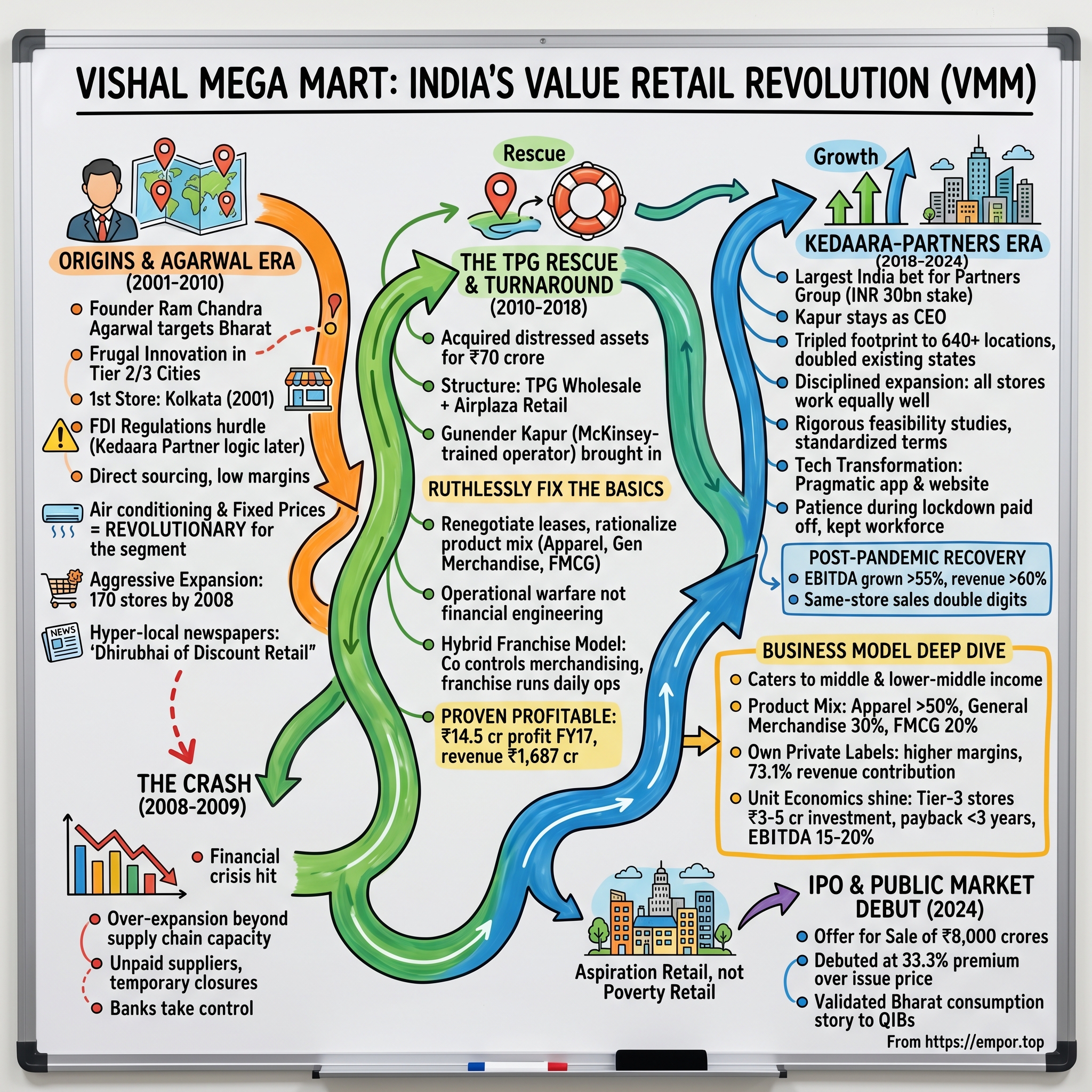
In the summer of 2010, a retailer named Ram Chandra Agarwal signed away the brand he had spent a decade building. Vishal Retail — at its peak one of the most recognisable names in Indian value retail, with stores stretching from Delhi's outer colonies to small towns in Bihar and Odisha — went to a consortium of TPG Capital and the Shriram Group for roughly ₹70 crore.2 Not ₹700 crore. Not ₹7,000 crore. Seventy. It was the price of a few dozen apartments in Gurgaon, paid for a national retail chain, because the chain came attached to a debt load its founder could no longer service.
Sixteen years later, the same brand trades on the National Stock Exchange with a market capitalisation of roughly ₹50,000 crore.1 It operates 819 stores across 559 cities and 30 states, sells more than ₹12,900 crore of goods a year, and earns a net profit larger than the entire enterprise value it changed hands for in 2010.1214
That arc alone would make a decent story. But the more interesting part is what happened to the man who sold.
Agarwal did not retire, did not write a memoir, did not become a motivational speaker. He started again — a small apparel chain called V2 Retail, built on the same insight that had made Vishal work in the first place: that India's aspirational, price-sensitive shopper wanted fashion, not just discounts. By the financial year ended March 2026, V2 Retail was running 325 stores and had grown revenue 63% to ₹3,067 crore.19 The founder who was forced out is now the fastest-growing founder-led competitor to the company he founded.
Meanwhile, the asset he sold passed through two very different sets of private-equity hands. TPG spent eight years doing distressed-asset surgery. Kedaara Capital and Partners Group spent six years doing growth-capital scaling. In December 2024 they took it public in one of the largest offer-for-sale IPOs India had seen — an offering in which the company itself received nothing.6 Since then, the sponsors have been selling: two enormous block trades in twenty months, both priced below the prevailing market, taking their stake from roughly three-quarters of the company to about forty percent.911
So there are really four questions this story has to answer, and they do not all point the same way.
First: what actually got fixed between 2010 and 2018, and was it a one-time repair or a repeatable operating system? Second: did Kedaara and Partners Group buy growth cheaply in 2018, or pay up for a de-risked asset and then get lucky with India's consumption cycle? Third: is the business Vishal Mega Mart runs today — hypermarkets in tier-2 and tier-3 India, three-quarters of sales in private label — genuinely defensible, or a playbook that Zudio, V2 Retail and Reliance Retail can and are copying? And fourth: when a private-equity sponsor sells a third of a company at a discount to the market price while the operating numbers are still compounding at twenty percent, what exactly is it telling you?
We will go through the origin and the collapse, the two-stage turnaround, the business model and the competitive field, the IPO and the ownership unwind, the financials, the quick-commerce experiment, and the bull and bear cases. The company's operating record since listing has been good. The stock has not been. Those two facts sitting side by side are the reason this is worth an hour.
 Subscribe on LinkedIn
II. Origins and Collapse: Ram Chandra Agarwal's Vishal Retail (2001-2010)
Start with a photocopy shop in Kolkata.
Ram Chandra Agarwal, who had polio as a child and walked with difficulty for the rest of his life, began in the most unglamorous corner of Indian small business — reprographics, then a garment store — before moving to Delhi and opening the first Vishal outlet.2 The founding proposition was not complicated, and its simplicity is exactly why it worked: middle-class and lower-middle-class Indian families wanted the experience of a department store — air conditioning, trial rooms, shelves you could browse without a shopkeeper hovering — at prices that matched the neighbourhood cloth market.
That was a genuinely new idea in India in 2001. Organised retail barely existed outside a handful of metro malls. The alternative for a family in Kanpur or Ranchi was the local bazaar, where price discovery meant haggling and quality was whatever the shopkeeper said it was. Vishal offered a fixed price, a fitting room, and a brand name. Agarwal was, in the vocabulary that would only arrive years later, building for Bharat before anyone used the word.
The expansion that ate the company
Through the 2000s, Vishal Retail opened stores at a pace that looked, from the outside, like conviction. It was leverage. The chain scaled toward roughly 200 outlets, and every one of them consumed capital twice over — once for fit-out and inventory, and again for the working capital that a wide, slow-moving assortment demands. Apparel retail is a business where you buy the season before you sell it. Get the buy wrong and the cash does not come back; it sits on the shelf as unsold stock while the interest clock runs.
There was a second, subtler failure. Vishal also built its own manufacturing and distribution infrastructure — vertical integration in a business that had not yet earned the scale to justify it. Fixed costs went up while store-level productivity did not. The chain was growing its top line and destroying its unit economics at the same time, which is the single most common way retailers die.
2008: the tide goes out
The global financial crisis did not create Vishal's problem. It revealed it. Credit tightened, consumer demand wobbled, and a company that had been rolling over short-term debt to fund long-cycle inventory discovered there was no roll-over available. Losses mounted into the hundreds of crores, and by 2009 the company was in restructuring talks with a bank consortium.2
What followed was the slow, public, humiliating process of an Indian corporate debt restructuring. Lenders and promoters met, missed deadlines, and met again.27 Competing bidders circled — the Future Group among them — and in August 2010 the lenders and Agarwal settled on a consortium of TPG Capital and Shriram Group, which agreed to take the wholesale and retail businesses.27 The headline consideration for the brand and business was about ₹70 crore.23
It is worth pausing on what that number means. It was not a valuation of the business's earning power. It was a valuation of what was left after the debt was accounted for — a distressed sale in which the buyer's real payment was assuming and restructuring the liabilities. Agarwal did not sell a company; he handed over the keys to a company that the banks effectively already owned.
Why the prologue matters
It would be easy to file this as founder hubris and move on. That would miss the point. Every question that follows in this story — about store-addition discipline, about working capital, about whether a retailer expanding at 100-plus stores a year into progressively smaller towns knows what its marginal store actually earns — is a question that Vishal Retail failed once already.
The company that exists today has different owners, different management, a different capital structure, and a fundamentally different operating model. But it sells the same goods to the same customer in many of the same towns. The test is whether the discipline is structural or merely a function of the current cycle. That test begins with the people who bought the wreckage.
III. The TPG Turnaround: Private Equity Learns Retail (2010-2018)
Picture the diligence file that TPG's India team was reading in 2010. Roughly 200 stores. Many of them in locations chosen for availability rather than footfall. An assortment sprawling across categories with no coherent buying logic. Manufacturing assets the company could not fill. And a customer base that, remarkably, still liked the brand.
That last point is the reason a distressed buyer showed up at all. The Vishal name retained equity with exactly the consumer that no organised retailer had figured out how to serve profitably. TPG's bet, led in India by Puneet Bhatia, was that the brand was worth more than the business — and that the business could be rebuilt underneath it.3
Subtraction before addition
The first move was not growth. It was amputation. The chain was cut roughly in half, from about 200 stores to about 100, closing locations whose economics could not be salvaged.3 For a private equity firm this is the least glamorous form of value creation and often the most reliable: you do not need the remaining stores to get better if you simply stop funding the ones that lose money.
Alongside the closures came a new management team, headed by Gunender Kapur, a Unilever veteran who had also run Reliance Retail.3 The choice signalled the diagnosis. TPG did not hire a turnaround specialist or a restructuring accountant. It hired a consumer-goods operator — someone whose instinct would be about assortment, sourcing, pricing architecture and supply chain rather than about balance-sheet engineering. Given that the balance sheet had already been dealt with in the transaction, this was the right sequencing.
Under Kapur, the fixes were unglamorous and cumulative: a streamlined apparel strategy, rationalised sourcing and distribution, and compliance and control systems that a company in freefall had let lapse.3
The structural move: franchisor, not operator
The most consequential decision of the TPG era was architectural. Rather than owning and operating every store, the business was reorganised so that the Vishal entity acted as franchisor and wholesale supplier to hypermarket operators trading under the Vishal brand.5
Think of it as separating the recipe from the restaurant. The company controlled what got made, what got branded, what got priced and how it got distributed — the parts of retail where scale actually compounds. The franchisee carried the store lease, the fit-out capital and the local staffing — the parts where scale does not help and capital gets trapped.
For a business emerging from a debt crisis, this was close to ideal. Growth could resume without the company having to raise and risk the capital that killed it the first time. It also imposed an external discipline that internal budgeting rarely achieves: a franchisee putting up their own money interrogates a location's economics far more aggressively than a regional manager chasing a store-opening target.
The proof
By fiscal 2016, the restructured company was earning roughly ₹33 crore in profit; by fiscal 2017 revenue had reached about ₹1,341 crore, and provisional fiscal 2018 figures showed revenue of roughly ₹2,252 crore.3 Over the three years to fiscal 2018, revenue compounded at about 24% a year.3 By the time TPG marketed the asset, it operated more than 230 franchised hypermarkets, with over 60% of them in towns of fewer than a million people.5
The analytical point is not the growth rate. It is the sequence. Profitability arrived before the growth capital did. TPG demonstrated that the model produced positive unit economics at a modest scale, and only then handed it to a buyer whose job was to multiply the store count. Distressed investors who skip this step — who assume scale will fix economics — generally discover that scale multiplies whatever economics you already have, including the bad kind.
Why sell in 2018
Because the work TPG was equipped to do was finished. A distressed-asset investor's edge lies in buying broken things cheaply and fixing them; it does not lie in funding an eight-year national rollout into tier-3 India. The asset had been de-risked, which by definition meant it no longer offered distressed returns. Selling to a growth-capital buyer was the logical handoff — and the price the market was willing to pay for a fixed business would prove to be a great deal higher than ₹70 crore.
That handoff — and the question of whether the buyers paid a fair price for it — is where the modern company begins.
IV. Kedaara Capital and Partners Group: Scaling for an Exit (2018-2024)
On May 21, 2018, Partners Group and Kedaara Capital announced they had agreed to acquire Vishal Mega Mart from TPG.5 The consideration was approximately ₹50 billion — around US$735 million at the time — with Partners Group contributing roughly ₹30 billion of it.4
The structure mattered as much as the price. The acquisition was made through Samayat Services LLP, a special-purpose vehicle, and was arranged so that Kedaara — a domestic manager — held control, satisfying India's regulatory framework for foreign investment in multi-brand retail.4 Partners Group, the Swiss firm, was the larger economic investor without being the controlling one. This is a common shape in Indian consumer deals and it becomes relevant later, because the entity that has been selling shares on the exchange since listing is Samayat, not the two firms individually.
Did they overpay?
Set the numbers against each other honestly. TPG paid roughly ₹70 crore in 2010 for a business in default. Eight years later the same business changed hands for roughly ₹5,000 crore — a seventy-fold increase in enterprise value against revenue that had grown from a distressed base to about ₹2,252 crore on a provisional fiscal 2018 basis.3
That implies a price of roughly two-plus times trailing revenue for an Indian value retailer. For context, this was a period when Indian consumer and retail assets commanded aggressive multiples on the argument that organised retail penetration had decades of runway. On revenue multiple alone, the 2018 price was not obviously cheap; on the quality of what was being bought — a franchisor-model business with proven unit economics, an established brand, and a customer segment nobody else was serving well — it looks more defensible.
The more useful framing is this: TPG captured the return from repairing the asset, and Kedaara and Partners Group bought the right to capture the return from replicating it. Those are different returns with different risk profiles. The 2018 buyers were underwriting execution risk on a rollout, not recovery risk on a distressed balance sheet. Whether they paid too much depended entirely on whether the rollout worked.
The rollout
It worked. Over the holding period, the store footprint roughly tripled, reaching approximately 640 locations by the time of the listing.4 In the final two years of the hold, revenue grew more than 60% and EBITDA more than 55%.4
Three things drove that. The first was geographic: pushing deeper into tier-2, tier-3 and tier-4 towns where the competition remained the unorganised bazaar rather than another chain. The second was the private-label build-out, which we will treat properly in the next section because it is the central economic mechanism of the business. The third was infrastructure — a hub-and-spoke distribution network and, later, an app and digital layer that turned a chain of stores into something that could at least attempt omnichannel.
Nishant Sharma, Kedaara's co-founder, had described the thesis at acquisition in terms of replicability — a model offering "an aspirational assortment at compelling value" that could be scaled.526 Manas Tandon of Partners Group credited the existing team with having "executed a stellar transformation."5 Both men would later sit on the board of the listed company.30
Note what those quotes concede: the buyers were explicit that the transformation had already happened. They were buying an operating system, not building one. That is a cleaner, lower-risk deal — and it also means the credit for the model's design belongs to the prior regime.
Six years, and what "patient" means
The hold ran from 2018 to the December 2024 listing — six years, spanning a demonetisation hangover, the GST transition's aftershocks, and a pandemic that shut Indian retail for months. That is a genuinely long hold by Indian private equity standards, and it is fair to call it patient capital.
It is also fair to note that patience and fund life are not the same thing. A six-year hold ending with an IPO in a hot market, followed by rapid secondary selling, is the standard shape of a successful private-equity exit. The right question is not whether the sponsors were patient — they demonstrably were, through a pandemic — but whether the listing was timed for the company's needs or the sponsors'.
The answer to that is unusually clear, because of one structural fact about the IPO that we will unpack later: the company did not receive a single rupee from it.
V. Business Model and Industry Structure: Winning Bharat
Walk into a Vishal Mega Mart in a town like Bhilwara or Kharagpur and the first thing you notice is that it does not look like a supermarket. It looks like a small department store that happens to sell groceries. Racks of shirts and kurtas dominate the sightlines. Somewhere behind them are pressure cookers, school bags, plastic storage bins. The food and staples aisle is real but not the point.
That layout is the business model made physical, and it is worth spelling out because it separates Vishal Mega Mart from almost every company it gets compared to.
The P&L is an apparel business wearing a grocery store's clothes
In the quarter ended June 2026, apparel contributed ₹1,765.5 crore, or 47.4% of revenue. General merchandise contributed ₹937.5 crore (25.2%) and FMCG ₹1,016.7 crore (27.3%).12
Apparel is close to half the top line and considerably more than half the gross profit, because clothing carries structurally higher margins than packaged food. This has two consequences that run in opposite directions.
The upside: apparel is where a retailer can differentiate. Nobody chooses a store because of its Maggi noodles — the pack is identical everywhere and the price is printed on it. A shirt is different. Fit, fabric, colour and design are judgement calls, and a retailer that makes those calls well earns a margin for it.
The downside: apparel is also where Vishal Mega Mart is most exposed. It is the category with the most credible, best-capitalised challenger in Indian retail. More on that shortly.
Private label: the actual engine
Roughly 75.2% of revenue came from the company's own brands in the June 2026 quarter.12 For a retailer this is an extraordinarily high figure, and understanding why it matters requires stepping through the mechanics rather than asserting "margin advantage."
When a retailer sells a branded product, it is a middleman. The brand owner has already captured most of the value — through advertising, through consumer preference, through the price it charges the retailer. The retailer's cut is whatever the brand permits, and because the same product is available at the shop across the road, competition compresses that cut toward the minimum.
When a retailer sells its own brand, it collects the manufacturer's margin and the retailer's margin, and — more importantly — it controls the specification. If cotton prices rise, it can adjust the blend, the weight, the trim, or the price point. A retailer selling somebody else's branded shirt has none of those levers; it can only absorb the increase or pass it on.
This is not theoretical for Vishal Mega Mart. On the fiscal 2026 call, management flagged fabric inflation running at 10-11% and pressure from petroleum-derivative inputs, and said it intended to maintain "at least the same level of discount over market leader brands" using promotional design and multi-buy offers.14 On the June 2026 quarter call, the framing hardened: the price gap to market-leading brands, the CEO said, "has to be slightly higher than earlier, or at least the same."12
That is a specific, testable claim about strategy: hold the relative price advantage even as costs rise, and fund it out of vertical integration rather than out of margin. The evidence so far supports it. Gross margin in the June 2026 quarter was 28.7%, up from 28.4% a year earlier — and management attributed the improvement to lower promotional intensity rather than to price increases.1213
That distinction matters. Margin gained by raising prices in an inflationary period is borrowed from future volume. Margin gained by needing fewer discounts is evidence that the merchandise is selling on its own merits. The company's own explanation, in this instance, is the more conservative one — which is a small but real mark in favour of management's candour.
Where the stores are, and who shops in them
At the end of June 2026, the network stood at 819 stores across 559 cities in 30 states, covering about 1.38 crore square feet.12 The tier distribution is the differentiator: 423 stores in tier-3 locations, 192 in tier-2 and 204 in tier-1.12 Roughly three-quarters of the estate sits outside India's largest cities. Regionally, the south contributes 39.5% of revenue, the west 28.5%, the north 23.4% and the east 8.6% — a broader spread than the north-and-east concentration the chain carried in its earlier life.12
The customer relationship is measured through a loyalty programme with 17.5 crore enrolled customers, growing 16% year on year, which management says accounts for roughly 95% of revenue.12 Treat the enrolment figure with appropriate scepticism — enrolment at the till is close to frictionless and the number counts registrations, not active shoppers. The 95% attach rate is the more meaningful statistic, because it means the company can actually see what its customers buy and how often, which is the foundation of any assortment or private-label decision.
The competitive field, honestly drawn
Vishal Mega Mart is routinely bracketed with DMart. The comparison is mostly wrong.
Avenue Supermarts (DMart) ended fiscal 2026 with 500 stores and consolidated revenue of ₹68,821 crore — more than five times Vishal Mega Mart's top line from fewer than two-thirds the number of stores.18 Its model is food-and-grocery led, ownership-heavy on real estate, tilted toward larger cities, and built on operating at a gross margin around 14% while turning inventory ferociously.18 Vishal Mega Mart runs gross margins roughly double that on roughly one-fifth the revenue per store. These are different businesses that happen to share a customer's wallet.
Trent's Zudio is the real one. Trent ended fiscal 2026 with 963 Zudio stores after adding a net 198 in a single year, with group revenue of ₹19,701 crore, up 18%.17 A year earlier, Trent had already disclosed Zudio crossing US$1 billion of standalone revenue — a scale milestone that arrived faster than almost any Indian retail format has managed.[^18] Zudio is value fashion, Tata-backed, aimed squarely at the same aspirational young shopper in the same tier-2 and tier-3 towns, and it is adding stores faster than Vishal Mega Mart is. It attacks the category that generates nearly half of Vishal Mega Mart's revenue and more than half its gross profit. If there is a single competitive fact that a Vishal Mega Mart investor should hold in mind, it is that number: 198 net new Zudio stores in twelve months.
V2 Retail — the founder's company — is smaller but growing faster in percentage terms: 325 stores at March 2026, revenue up 63% to ₹3,067 crore, net profit up 125% to ₹162 crore, same-store sales growth of about 8.6% for the year, and a plan to add 170-200 stores in fiscal 2027.19 It is roughly a quarter of Vishal Mega Mart's size and expanding its footprint at more than twice the rate.
Reliance Retail operates at a scale that dwarfs all of them across formats, and remains the structural wildcard in any Indian retail analysis. And behind all of it sits the genuinely dominant competitor: the unorganised kirana and bazaar trade, which still takes the large majority of Indian retail spending. That is simultaneously the bull case's addressable market and a reminder that the incumbent Vishal Mega Mart is actually taking share from is a shopkeeper, not a chain.
Five forces, applied
Rivalry: intense and intensifying. Three well-funded chains are adding stores into overlapping catchments. Zudio alone added more stores in fiscal 2026 than Vishal Mega Mart's entire net addition for the year.
Buyer power: high, at the individual level. The customer is price-sensitive by definition and faces near-zero switching costs. There is no contract, no subscription, no data lock-in. Loyalty here means habit and proximity, not captivity.
Supplier power: genuinely mitigated. This is where private label earns its keep. A retailer buying finished branded goods faces suppliers with pricing power; a retailer specifying its own goods to contract manufacturers faces a fragmented, competitive supply base. Three-quarters of the assortment sits on the favourable side of that line.
Threat of new entrants: moderate at the format level, high at the category level. Opening a hypermarket chain from scratch is capital-intensive and slow. But an existing retailer extending into value apparel — which is precisely what Trent did — faces a far lower barrier.
Substitutes: real and evolving. Quick commerce substitutes for the top-up grocery trip. E-commerce substitutes for the considered apparel purchase. Neither yet substitutes for the weekend family shopping trip to a 17,000-square-foot store, which is a leisure activity as much as a transaction. But the substitution boundary has moved once already and can move again.
So what is the moat, really?
Strip out the rhetoric and three candidate advantages remain. Test each.
Private-label depth at 75% of revenue. This is real, measurable and hard to replicate quickly, because it requires a sourcing organisation, design capability and — critically — enough store volume to justify dedicated production runs. It is also the mechanism visibly supporting gross margin through an inflationary period. Strongest of the three.
Tier-2/3 density. Being first into a small town with a large-format store is worth something: the best real estate, the local brand association, and a catchment that may not support two such stores. But it is a positional advantage, not a structural one, and it erodes every time a competitor decides the town is worth entering after all. Zudio's rollout is precisely that decision, taken 198 times in one year.
The franchise-light heritage. Genuinely useful historically, and it explains the low capital intensity. But the model has been evolving toward a more conventional integrated retailer as the company scaled and listed, and the capital-efficiency benefit shows up in returns rather than in defensibility. A competitor can adopt the same structure.
The honest summary: Vishal Mega Mart has a strong operating position and one durable-looking advantage, not an unassailable moat. The evidence for pricing power is decent; the evidence for switching costs is essentially nil. Anyone underwriting this business on the assumption that its tier-2/3 position is a permanent barrier is underwriting the wrong thing.
Which raises the question of who is making those judgement calls now — and how long they have been making them.
VI. Current Management: Gunender Kapur's Post-IPO Mandate
Here is a detail that most coverage of this company misses.
When Partners Group and Kedaara announced their acquisition in May 2018, the executive quoted welcoming them was Gunender Kapur, CEO and Managing Director.5 When TPG rebuilt the company after 2010, the leadership team it installed was headed by Gunender Kapur.3 And the person who has served as Managing Director and CEO of the listed company since June 2024 is Gunender Kapur.12
The ownership of Vishal Mega Mart has changed three times in sixteen years. The person running it has not.
The operator
Kapur is an engineer by training — Birla Institute of Technology and Science — with an MBA from the University of Delhi. He spent his formative years at Unilever, rising to Vice Chairman and Chief Executive of Unilever Nigeria in 2006, before returning to India as President and Chief Executive of Reliance Retail.3
That combination is unusual and it explains a lot about how the company is run. Unilever is a school of brand-building, distribution depth and rural reach — the discipline of getting a ₹10 sachet to a village shop profitably. Reliance Retail is a school of scale, real estate and format experimentation. Vishal Mega Mart's core mechanism — own the brand, control the specification, distribute deep into small towns, price against the national brand — reads like a synthesis of both.
His public register is notably flat. There are no visionary manifestos, no ten-year moonshots. The recurring phrase across calls is about making aspirations affordable, and the substance behind it tends to be operational: fabric inflation percentages, minimum-wage changes by state, inventory-count frequency.
Reading the calls against each other
The most useful test of a management team is not what it says in any one quarter but whether the story holds across quarters.
On the fiscal 2026 full-year call, Kapur attributed strong same-store sales partly to a broad consumption uptick and to income-tax rationalisation putting money in consumers' pockets, while flagging fabric cost inflation of 10-11% and geopolitical uncertainty as headwinds — and stated the company would not slow store expansion.14
On the June 2026 quarter call, the framing was consistent: a challenging environment with elevated inflation, particularly in May, offset by merchandise and execution.13 The company did not slow expansion — it opened 27 stores gross, closing three.1235 The pricing philosophy was restated in stronger terms rather than softened.
On the December 2025 quarter call, when revenue growth decelerated from 22.5% to 17%, management attributed it to festive timing — Durga Puja falling in the prior quarter this year — and to a delayed onset of winter, while noting winter merchandise still grew double digits.21 Crucially, they provided the adjusted comparison rather than only the headline: same-store sales growth of 9.6% for the quarter and 10.3% for the nine months on a like-for-like basis.21
That is the behaviour worth crediting. A management team that explains a slowdown by handing you the adjusted number, and whose adjusted number is still consistent with its stated double-digit ambition, is doing the job. It is a low bar, but plenty of newly listed Indian companies fail to clear it.
Where the answers get concrete — and where they do not
On the June 2026 quarter call, analysts pressed on three things and got specific answers on all three.
On gross margin sustainability, management said the improvement came from reduced promotional intensity, not pricing, and that 28.7% was maintainable if the cost structure held.13 On employee costs — up 13% per square foot — they identified the cause as statutory minimum-wage increases across Haryana, Uttar Pradesh, Telangana and Karnataka, and explicitly characterised it as a structural change rather than a one-off.13 Calling a cost increase permanent when you could have called it transitory is a small act of discipline.
On competition, the answer was thinner. Management said it had observed no new competitors and no significant acceleration from existing ones.13 Set against Trent's disclosed 198 net Zudio additions in fiscal 2026, that reads as a claim about the company's own catchments rather than about the market.17 It may well be true at store level. But it is the one place where the answer is assertion rather than data, and it happens to concern the single largest identifiable threat to the largest category in the P&L. An investor should want that answered with overlap statistics, not reassurance.
Two other disclosures from the same call are worth holding. RFID is being rolled out starting with Delhi NCR, expected to take over a year, with the goal of moving inventory counts from overnight exercises to weekly ones — better shrink control and better data.13 And management has identified roughly 3,000 small-format opportunities nationally, with 16 such stores already operating, alongside a stated long-term potential of some 8,200 stores.1213
That 8,200 figure deserves a flag. It is a total-addressable-market construction, not a plan. At the current run rate of roughly 100 net additions a year, reaching it would take the better part of a lifetime. Treat it as a statement about where the ceiling is not, rather than where the company is going.
The alignment gap
The unresolved issue with this management team is compensation and ownership alignment. Kapur's personal shareholding and the structure of any equity incentives are not disclosed in the materials reviewed here. For a company whose controlling shareholder is steadily selling down — and where, in time, no single shareholder may control the board — the terms on which management holds equity become a first-order governance question rather than a footnote.
There is also the plain fact that this is a two-year-old public company. Kapur has sixteen years of operating history at Vishal Mega Mart, which is a genuine asset. But a public-market track record is a different thing: it is built by setting expectations, missing some, and explaining the misses. He has not yet had to do the third.
Which brings us to the shareholders who have been heading for the exit.
VII. The IPO and the Ownership Question
Reports as early as March 2024 had trailed a roughly US$1 billion offering at a valuation near US$5 billion, so the size was not a surprise; the structure was the story.34 On December 11, 2024, the Vishal Mega Mart initial public offering opened with a price band of ₹74 to ₹78 per share and a target size of roughly ₹8,000 crore.633 It closed on December 13 subscribed 27.28 times.7 Allotment was finalised on December 16 and the shares listed on December 18 — at ₹104 on the NSE, a 33% premium to the issue price, and ₹110 on the BSE.6
At that valuation the business was worth somewhere in the US$4.1-4.3 billion range depending on the reference price used, and Partners Group and Kedaara together realised about US$944 million — Partners Group's largest exit in India to that point, achieved by selling around 23% of its position while retaining a holding then worth roughly US$3 billion.425
The detail that defines everything after
The offering was structured as a pure offer for sale, as the prospectus filed with the Securities and Exchange Board of India set out.24 Every rupee raised went to the selling shareholders. The company received nothing.
This is not unusual for a private-equity-backed Indian listing, and it is not, by itself, a criticism. A business generating positive free cash flow with a modest balance sheet does not need equity capital to fund a store rollout; raising it anyway would have diluted existing holders for no purpose.
But it does establish the honest character of the event. This was a liquidity event for the sponsors, executed at a moment when Indian retail multiples were generous and retail investor appetite for large IPOs was intense. It was not a capital-raise for growth. Every subsequent question about the sponsors' selling should be read against that starting point: the intention to monetise was disclosed in the structure from day one.
The unwind
What has happened since has been faster and larger than a typical staged exit.
On June 17, 2025, Samayat Services LLP sold approximately 19.36% of the company through bulk deals at an average of about ₹115 per share — close to an 8% discount to the previous close of ₹124.90 — for roughly ₹10,220 crore.1110 SBI Mutual Fund, HDFC Mutual Fund and Kotak Mahindra Mutual Fund were among the buyers, and the stock recorded its sharpest single-day fall to that point.1128 Vanguard picked up about 1.1% for ₹655 crore in the days that followed.29 Samayat's holding fell from 73.75% to 54.38%.11
On February 27, 2026, Samayat did it again — 65.25 crore shares, 13.96% of the company, at ₹117 to ₹117.03 per share, for ₹7,635.55 crore.89 The buyer list read like a roll call of long-only institutional capital: the Government of Singapore took 2.72%, HDFC Mutual Fund 2.01%, the Monetary Authority of Singapore 1.57%.9 The stock fell 7.59% to close at ₹117.85.9 Samayat's stake dropped from 54.09% to 40.13%.9
By the quarter ended June 2026, the shareholding register showed promoters at 40.09%, domestic institutions at 34.80%, foreign institutions at 20.43%, and public shareholders at 4.68%.1
Look at that register carefully. In eighteen months, Vishal Mega Mart went from a private-equity portfolio company with a listed stub to an institutionally owned company with a large minority sponsor. More than half the equity now sits with Indian and foreign institutions.
The nuance that kills the easy explanation
There is a comfortable story available here: that these sales were forced by regulation. India requires listed companies to maintain a minimum public shareholding of 25%, and sponsors routinely sell down to comply.
That story does not apply. After the December 2024 listing the public float already exceeded the 25% threshold. Neither the June 2025 block nor the February 2026 block was necessary to satisfy the rule. These were discretionary sales.
The stress test
So what were they? Two readings, and the evidence does not cleanly settle between them.
The benign reading: this is what a successful private-equity exit looks like. Funds have finite lives and limited partners who want cash, not marks. Selling a third of a position over eighteen months into deep institutional demand — GIC, MAS, three of India's largest mutual fund houses — is textbook execution. Block trades always price at a discount; that is the compensation a buyer demands for absorbing size in one trade. And a sponsor that still owns 40% of the company after all that selling retains enormous economic exposure to being wrong.
The uncomfortable reading: look at the prices. The stock reached an all-time high in July 2025 and its 52-week high has been ₹157.60.3223 Both blocks cleared at ₹115 to ₹117.119 The February 2026 trade came at a visible discount and knocked nearly 8% off the stock in a session.9 A seller who believed the multiple was going higher had the option of waiting, of dribbling out through the market, or of selling smaller clips. This seller chose size and speed, twice, and accepted the discount both times.
There is a third factor that matters more than either reading: overhang mechanics. A remaining 40% stake in the hands of a known seller is a standing supply of stock that every institutional buyer must price in. Until that position is either sold down or contractually locked up, the market rationally applies a discount for the shares it knows are coming. This is a real and persistent drag on the multiple that has nothing to do with the operating business — and it partly explains why a stock that has never missed earnings has fallen roughly 30% from its 52-week high to about ₹108.123
The governance question underneath
As economic ownership drops toward 40%, control becomes a live question. The board currently comprises Neha Bansal as independent non-executive Chairperson, Gunender Kapur as MD and CEO, and Manas Tandon, Nishant Sharma and Sanjeev Aga as non-executive directors — with Tandon and Sharma the Partners Group and Kedaara representatives respectively.30 Samayat Services LLP and Kedaara Capital Fund II LLP remain classified as promoters.9
So for now, sponsor board representation persists even as sponsor economics shrink. That arrangement is normal and probably fine. But it does not survive indefinitely. If Samayat continues selling, the company arrives at a state common in developed markets and rare in India: a large listed retailer with no controlling shareholder, a professional CEO, and a board whose composition is a live question rather than a settled one.
Investors should watch for three specific disclosures: further block deals, any change in board composition following them, and any application to reclassify the promoters as ordinary public shareholders. That last one, if it comes, would be the formal end of the private-equity chapter.
None of which has yet shown up in the operating numbers — which is precisely the tension worth examining next.
VIII. Financial Performance and Unit Economics
Set the market noise aside and read the income statement cold. It is a remarkably steady document.
Revenue went from ₹8,912 crore in fiscal 2024 to ₹10,716 crore in fiscal 2025 to ₹12,906 crore in fiscal 2026 — 20% growth, then 20.4%.114 Net profit went ₹462 crore, ₹632 crore, ₹839 crore, growing faster than revenue in both years.1 Operating EBITDA in fiscal 2026 was ₹1,321 crore, up 27.8%.14
The intervening quarters told the same story. In the December 2025 quarter the company earned ₹312.9 crore, up 19.1% on ₹3,670 crore of revenue.2221 The June 2026 quarter continued the pattern: revenue ₹3,727 crore, up 18.7%; operating EBITDA ₹387 crore, up 19.3%; profit after tax ₹258.8 crore, up 25.6%, with PAT margin improving 30 basis points to 6.9%.1215 For scale, the network had stood at 717 stores a year earlier, at the end of the June 2025 quarter — roughly a hundred stores added in twelve months.16
The consistency of the gap between revenue growth and profit growth is the thing to notice. Profit has grown faster than revenue for three consecutive years. In retail, that happens for one of two reasons: gross margin expansion or operating leverage. Here it has been both — gross margin drifting up on private-label mix and lower promotional intensity, and fixed costs spread across a larger base.
Same-store sales: the number that separates real growth from arithmetic
Any retailer can grow revenue by opening stores. That tells you the company can sign leases, not that customers want what it sells. Same-store sales growth — the change in revenue at locations open for a comparable period — is where the truth lives.
Vishal Mega Mart delivered 11% for fiscal 2026, 10.3% adjusted across the first nine months of that year, 9.6% adjusted in the December 2025 quarter, and 10% in the June 2026 quarter.142112
Sustained double-digit same-store growth in a business whose customer is explicitly value-seeking, in an inflationary period, is a genuinely good result. It says the incremental store is not cannibalising the existing one, and that footfall or basket size — or both — are still rising in mature locations. It also, importantly, means that roughly half of total growth is coming from stores that already existed.
Two caveats keep this honest. First, part of same-store growth in an inflationary period is simply price. Second, management itself attributed some of fiscal 2026's strength to income-tax rationalisation putting cash in consumers' hands — a policy tailwind, not an operating achievement.14 Credit the number, but do not treat it as pure share gain.
The balance sheet: capital-light by design
This is the least discussed and arguably most attractive part of the story.
Borrowings stood at ₹1,988 crore at the end of fiscal 2026 against operating EBITDA of ₹1,321 crore, and the company generated ₹1,299 crore of free cash flow in the year.114 Whatever the precise leverage definition, this is a company whose annual cash generation approaches its total debt — not one whose growth is financed by borrowing.
The reason traces directly back to the model. A value retailer selling largely its own brands operates a favourable working-capital cycle: it takes credit from contract manufacturers and converts inventory into cash at the till. And the store format — leased space, functional fit-outs, no owned real estate — keeps capital expenditure per square foot low relative to the revenue it generates.
That combination is what allows roughly 100 store openings a year to be funded substantially from operations. It is also the single most durable inheritance from the TPG-era restructuring: the discipline that the 2001-2010 company lacked is now embedded in the structure rather than dependent on judgement.
Returns, and the number that does not fit
Return on equity was 12.2% in the most recent year against a three-year average of 10.4%; return on capital employed was 14.8%.1 Improving, and moving in the right direction as operating leverage builds.
But hold that next to the price. At roughly ₹108 per share and a market capitalisation of about ₹50,476 crore, the stock trades at a trailing price-to-earnings ratio of roughly 57 and about 6.8 times book value.1 The company pays no dividend, retaining everything for expansion.1
Sell-side and quantitative screens have flagged exactly this tension, with at least one ratings service cutting its stance on valuation and price-action grounds despite the operating record.31 A business earning low-teens returns on equity and trading at nearly seven times book is being priced for many years of continued compounding. That is not a contradiction — high-growth, capital-light retailers legitimately trade above their current returns because the returns on incremental capital are what matter, and those are higher than the blended figure. But it does mean the valuation is doing work that the current profitability does not yet justify on its own.
What this actually tells you
The most important analytical conclusion of this section is that the stock's decline has not been an earnings story. Fiscal 2026 revenue, EBITDA and profit all grew faster than fiscal 2025. Same-store sales stayed double-digit. Margins expanded. The December 2025 quarter's optical slowdown was explained and adjusted, and the explanation held up in the following quarters.2112
The share price has fallen roughly 30% from its high anyway.231 What changed was the multiple and the supply of stock, not the business. For a long-term investor that is the useful separation: this is a valuation and ownership-structure situation layered on top of an operating business that is, so far, doing what it said it would.
The obvious question is what could change the operating trajectory. One candidate the company talks about constantly deserves a careful, deflationary look.
IX. Quick Commerce: Real Optionality, Not Yet the Story
In 2023, if you had asked what would disrupt Indian retail, the answer would have been quick commerce — ten-minute delivery, dark stores, venture capital burning to own the top-up grocery trip. Vishal Mega Mart's response was notably unfashionable: it did not build dark stores. It turned the stores it already had into fulfilment nodes.
By the June 2026 quarter, the service ran from 767 stores across 520 cities, with registered users at 1.41 crore, up 44% year on year — versus 723 stores, 485 cities and about 12 million users just two quarters earlier.122021 Delivery is fulfilled from store inventory, typically within 30 minutes.20
The structural elegance is obvious once you see it. A pure-play quick-commerce operator must build and stock a dark store, which is a warehouse that generates no walk-in revenue and must be paid for entirely by delivery orders. Vishal Mega Mart's version costs almost nothing incremental: the lease, the inventory and the staff already exist and are already paid for by the offline business. Delivery is a marginal-cost overlay on a fixed-cost asset.
The size, stated plainly
Quick commerce contributes between 2% and 9% of revenue at enabled stores, with most clustering around 5% and the best reaching 9-10%.1220 Applied to the current quarterly revenue base, that implies a channel running in the region of ₹150-200 crore a quarter — the company does not disclose quick-commerce revenue as a separate line, so any precise figure is an estimate rather than a reported number.
Which is to say: it is immaterial to today's profit and loss, and anyone valuing Vishal Mega Mart on its quick-commerce potential is valuing something that does not yet exist at scale.
Why it is still worth watching
Two disclosed facts make this more than a defensive gesture.
The average order value is approximately ₹800, which slightly exceeds what a typical offline shopper spends.20 That is counterintuitive — convenience channels usually produce smaller baskets — and if it holds as the channel scales, it suggests customers are using it for planned shopping rather than emergency top-ups.
More striking: roughly 20% of quick-commerce customers had never shopped at a Vishal Mega Mart store.1320 One in five is genuinely incremental. That reframes the channel from a cannibalisation risk into a customer-acquisition tool — reaching people for whom the store is inconveniently far, or who simply never thought to go.
The category composition of the quick-commerce basket is not separately disclosed, which is a meaningful gap. A channel dominated by low-margin FMCG has very different economics from one carrying apparel, and without that split an investor cannot assess whether incremental quick-commerce revenue is accretive or dilutive to margin.
The proportionate conclusion: this is cheap, sensible optionality that defends against a real structural shift in Indian shopping behaviour, and it has produced two encouraging data points. It is not the investment case, it should not be paid for as though it were, and the disclosure is not yet good enough to underwrite it.
Which leaves the central argument — whether this business wins from here — to be settled on the core.
X. Bear Case vs. Bull Case
Two competent investors can look at Vishal Mega Mart today and reach opposite conclusions without either being unreasonable. Here is the strongest version of each.
Bear Case
The multiple is the position. At roughly 57 times trailing earnings against a return on equity in the low teens, the stock requires many years of uninterrupted execution simply to justify today's price.1 Even DMart — the sector's traditional premium comparable — has faced margin pressure, with consolidated EBITDA margin around 7.5% and profit growth in fiscal 2026 slowing to well below its revenue growth.18 If the market re-rates Indian organised retail as a whole, Vishal Mega Mart's multiple has further to fall than most.
The sponsor keeps selling, and keeps discounting. Two blocks in twenty months, both around ₹115-117, both well below the 52-week high, the second knocking nearly 8% off the stock in a day.11923 Whatever the intent, the pattern establishes a reference price at which the best-informed shareholder is willing to transact, and leaves a 40% position hanging over the register.
Zudio is a category-specific attack on the profit centre. Trent added a net 198 Zudio stores in fiscal 2026, reaching 963.17 Value fashion is nearly half of Vishal Mega Mart's revenue and more than half its gross profit. Management's response — that it sees no meaningful competitive acceleration — is an assertion the disclosed data does not corroborate.1317
The founder is competing. V2 Retail grew revenue 63% and profit 125% in fiscal 2026 and plans 170-200 new stores in fiscal 2027, run by the man who created the original playbook.19 Its same-store growth of about 8.6% trails Vishal Mega Mart's, so it is not yet winning on productivity — but it is adding stores faster and it knows exactly which towns work.
Rapid expansion into thinner catchments. 105 stores added in fiscal 2026 alone.14 Every retailer that has died did so by continuing to open stores after the marginal location stopped earning its cost of capital. Store-level economics are not disclosed at a granularity that lets an outsider check this.
The customer is the most fragile in India. A lower-income base facing food or fuel inflation cuts discretionary apparel first — the exact category that carries the margin. Management already flagged fuel prices as a demand risk.14
Two years of public track record. No misses yet also means no evidence of how this team handles one.
And the activist question nobody has asked yet. Zero dividend, zero disclosed buyback, and a stated 8,200-store ambition amount to a commitment to reinvest all cash into store growth indefinitely.112 That is defensible while incremental returns are high. The moment same-store growth breaks below high single digits while store additions continue at 100-plus a year, the capital allocation policy becomes the argument — and there is no controlling shareholder left to defend it.
Bull Case
The operating record since listing is clean. Three years of profit growing faster than revenue, margins expanding, same-store growth in double digits, and a decelerating quarter that was explained with adjusted numbers rather than excuses.11421
The model funds itself. Free cash flow of ₹1,299 crore in fiscal 2026 against borrowings of ₹1,988 crore, with roughly 100 new stores a year financed substantially from operations.1 Growth that does not require capital is worth a premium multiple in a sector where growth usually does.
Private label is a real margin mechanism, not a slogan. 75.2% of revenue from own brands, with gross margin expanding while absorbing 10-11% fabric inflation, and management attributing the expansion to reduced promotion rather than price increases.121413
The addressable market is not the problem. Unorganised retail still takes the majority of spending in the towns Vishal Mega Mart serves. Its 819 stores across 559 cities barely scratch a country of several thousand towns.12
Quick commerce is free optionality. Built on existing assets, already delivering one-in-five new customers, with an above-average order value.2013
The playbook has now worked under two different owners. TPG's operational repair and the Kedaara-Partners Group scale-up were different disciplines executed by different people on the same asset, both successfully.34 That is at least weak evidence that the model itself travels — though the common thread through both, worth naming, is the same CEO.
Applying Helmer's 7 Powers
Hamilton Helmer's framework asks which of seven specific advantages a business actually possesses. Run the list.
Scale economies: partial, and real where it counts. Private-label production runs, distribution density and advertising all get cheaper per unit as store count rises. But DMart is five times larger by revenue and Reliance Retail larger still, so Vishal Mega Mart is not the scale player in Indian retail — it is the scale player in its specific format-and-geography niche.18
Network economies: absent. No customer benefits from another customer shopping there. The loyalty programme is a data asset, not a network.
Counter-positioning: historically strong, now spent. The franchisor-plus-private-label model in small-town India was genuinely something incumbents were structurally reluctant to copy — until Zudio demonstrated that a large branded retailer could go down-market without damaging itself. Once a competitor is willing to imitate, counter-positioning stops being a power.
Switching costs: essentially none. This is the honest weak point. Nothing stops a shopper walking into the Zudio that opens across the road.
Branding: moderate and improving. The Vishal name has recognition across small-town India built over two decades, and the private-label brands carry their own recall. But value retail brands command trust, not price premiums — which is a weaker form of the power.
Cornered resource: no. No exclusive supply, no proprietary technology, no irreplaceable talent beyond a capable management team.
Process power: possibly the most underrated. The combination of designing, sourcing, distributing and merchandising 75% own-brand assortment across 819 stores in 559 cities is an organisational capability built over more than a decade. Process power is slow to build and slow to copy — Toyota's production system is the canonical example. Whether Vishal Mega Mart's sourcing-and-merchandising machine qualifies is testable through one metric: whether gross margin holds while competitors' compress.
Net read: two moderate powers — scale economies within its niche, and possible process power — plus a brand of the weaker kind. Not nothing, but not a fortress. The five-forces analysis and the 7 Powers audit converge on the same conclusion, which is a good sign the conclusion is right: this is an operationally excellent company with a modest structural moat, priced as though the moat were substantial.
That gap between operating quality and structural protection is where the specific risks live.
XI. Risks to Watch
The risks that matter for this business are not the ones that appear in generic risk sections. Cybersecurity, climate transition and geopolitical supply chains are all real in the abstract and largely peripheral here. Five things could actually change the outcome, and each works through a specific mechanism.
Valuation compression amplified by supply. The mechanism is arithmetic, not sentiment. A stock at roughly 57 times earnings requires the earnings to compound for years for the price to be justified.1 A single disappointing quarter re-rates it violently. Layer on a known seller holding roughly 40% of the equity, and the risk becomes reflexive: the multiple compresses, the sponsor's remaining stake becomes worth less, and the incentive to sell into any strength grows.9 The stock can therefore go on drifting even if the operating results stay good — as it has for much of 2026.
Competitive intensity in the profit centre. The mechanism is share of wallet in overlapping catchments. When a Zudio opens in a town where Vishal Mega Mart's apparel section carries the store's gross profit, the effect appears first as slower footfall, then as higher promotional intensity to hold traffic, then as gross margin compression. Note the sequence — margin is the last place it shows up, which means the same-store sales number is the early-warning indicator, not the margin line. With 963 Zudio stores and roughly 200 being added a year, overlap is increasing mechanically.17
Execution risk in the rollout. The mechanism is catchment quality. The first 800 stores went into the best available locations. The next 800 go into progressively smaller towns with thinner purchasing power and, in many cases, an existing competitor. Maintaining roughly 10% same-store growth while adding 100-plus stores a year requires either that new markets are as good as old ones or that mature stores keep improving. Both cannot be assumed indefinitely, and the company does not disclose store-level payback data that would let an outsider verify it.
Consumer demand shock. The mechanism is discretionary substitution. Vishal Mega Mart's customer buys staples out of necessity and apparel out of aspiration. A food or fuel inflation spike, or a labour-market shock in the informal economy, does not reduce staples purchases — it reduces the apparel basket, which is where the margin is. Management has already named fuel prices and fabric costs as live pressures.14 This is the risk with the shortest fuse and the least warning.
Governance drift. The mechanism is a gap between economics and control. Sponsor-nominated directors currently sit on a board whose associated economic stake keeps shrinking.309 If selling continues, the company becomes a large listed retailer with no controlling shareholder — a structure that is normal in the US and UK but rare in India, and one that shifts real power to institutional shareholders who have never had to exercise it here. That is not automatically bad. It is simply unresolved, and the resolution has not been disclosed.
One accounting note worth flagging for completeness: the reported borrowings figure for a modern Indian retailer includes lease liabilities under Ind AS 116, which capitalises operating leases onto the balance sheet.1 For a company that leases essentially all of its 1.38 crore square feet, this materially affects both the debt figure and reported EBITDA relative to pre-2019 accounting.12 It is not an aggressive judgement — it is the mandated treatment — but comparisons to historical retail leverage ratios are not like-for-like.
Step back from the specific risks, and the more interesting question is what this whole sequence teaches about the asset class it came from.
XII. Playbook: Lessons from a Two-Stage Private Equity Turnaround
Vishal Mega Mart is one of the cleanest natural experiments in Indian private equity: the same asset, the same brand, largely the same CEO, run under two completely different investment theses, fourteen years apart. What generalises?
Distressed and growth are different professions
TPG in 2010 bought a company whose primary problem was that it owed money it could not pay. The value creation levers were negotiation with lenders, closure of loss-making assets, and installation of controls. Success meant stopping things — halving the store count was the signature move.3
Kedaara and Partners Group in 2018 bought a company whose primary problem was that it was too small. The levers were capital deployment, geographic expansion and category depth. Success meant starting things — tripling the footprint.4
The general lesson is that these require opposite temperaments, and firms that try to do both on the same asset usually do one of them badly. The Vishal Mega Mart sequence worked partly because each owner did the thing it was good at and then sold to someone good at the next thing. The handoff was the strategy.
Asset-light structures as a de-risking device
The franchisor-and-wholesaler architecture is the most portable idea in this story.5 It let a company with no balance sheet capacity resume growth using someone else's capital, while imposing an external test on every new location. When the sponsors later wanted to scale aggressively with real capital behind them, the model had already proven which store formats and which town profiles worked.
The generalisable principle: use an asset-light structure to discover the unit economics, then apply capital once the discovery is complete. Most failed retail rollouts invert this — deploying capital to find out whether the economics work, which is an expensive way to run an experiment. Vishal Retail's own 2001-2010 history is the cautionary version.
What patience actually looked like
Fourteen years of private ownership across two sponsors, spanning a debt restructuring, a demonetisation, a GST transition and a pandemic. That is not a story anyone tells in a fund-raising deck because the middle of it is unglamorous.
But note the qualification the exit imposes on the word. Both sponsors were patient right up to the moment liquidity became available, and then moved quickly — an IPO in which the company received nothing, followed by two large discounted blocks within twenty months.6119 Patient capital in private markets and patient capital in public markets are not the same commitment, and a public investor who assumes a private-equity sponsor's holding period behaviour will carry over post-listing is making an unsupported assumption.
The founder problem
The subplot deserves a serious reading rather than a sentimental one. When a distressed seller has decades of category knowledge, forced exit does not remove the competitor — it relocates them. Agarwal sold the brand and the assets; he did not sell the operating knowledge of which towns support a value-apparel store, what the customer buys in which season, or how to source at a price point.2 Within a few years he was deploying that knowledge against the buyer, and V2 Retail's fiscal 2026 growth rate is the evidence that it was worth something.19
The practical implication for anyone underwriting a distressed acquisition: the intangible asset you did not buy is the founder's head, and non-compete arrangements have finite lives while category expertise does not.
Private label as the emerging-market retail lever
The most repeatable financial insight is the private-label build-out. In a developed market with entrenched national brands and consumers loyal to them, moving three-quarters of revenue to own brands is nearly impossible. In an emerging market where much of the competing assortment is unbranded bazaar goods, the retailer's own brand is often an upgrade in perceived quality, not a downgrade.
That inversion is why the same strategy that reads as defensive in the West reads as offensive in India. It is also why competitors are running it — and why the advantage compresses over time as everyone adopts it.
Which is exactly why the specific things to monitor from here are narrower than the general story suggests.
XIII. What to Watch Going Forward
Most companies generate more metrics than any investor can usefully track. For Vishal Mega Mart, three matter more than everything else combined.
Same-store sales growth. This is the single most informative number the company publishes. It strips out the arithmetic of store openings and answers the only question that matters competitively: are existing stores winning or losing? It is also the earliest place that Zudio or V2 Retail pressure would appear — before it shows up in gross margin, before it shows up in total revenue, which store additions can mask for years. The recent record has been 11% for fiscal 2026 and 10% in the June 2026 quarter, and management has consistently framed double digits as the ambition.1412 A sustained drift into the mid-single digits, particularly if store additions continue at pace, would be the signal that the competitive dynamic has turned.
Own-brand share of revenue, read together with gross margin. These two must be read as a pair, because the whole thesis is that private-label depth converts into pricing power. Own brands at 75.2% with gross margin at 28.7% is the current reading.12 The informative scenario is divergence: if private-label share keeps rising while gross margin flattens or falls, it means the company is having to give the margin back to hold volume — which would be evidence that the pricing power is being competed away rather than compounded.
The pace and pricing of further Samayat Services sales. This is not an operating metric, but for the next several years it may be the largest single driver of the share price. What to watch is not merely whether more shares are sold but at what discount and into what demand. A tightening discount would suggest the market is absorbing supply comfortably; a widening one would suggest the opposite. Related disclosures worth tracking: any board composition change following a sale, and any promoter reclassification application.
Beyond the three, two secondary items are worth a periodic look. Store economics discipline as the network pushes past 800 locations — specifically whether the company begins disclosing store-level payback or productivity data, which would itself be a signal of confidence. And whether quick commerce gets broken out with real granularity, particularly its category mix and contribution margin, as it scales past the point where "2 to 9% of store revenue" is an adequate description.
Finally, one qualitative thing: management's language on competition. The current position — that no meaningful competitive acceleration is visible — is the least data-supported claim in the company's public communication, set against a rival adding roughly 200 stores a year into the same towns.1317 Whether that language shifts, and whether the shift comes before or after the same-store sales number does, will say a great deal about how candidly this management team communicates when the news is harder than it has been so far.
References
-
Vishal Mega Mart Ltd — Financials and shareholding (Screener.in) ↩↩↩↩↩↩↩↩↩↩↩↩↩↩↩↩
-
Meet Vishal Mega Mart's founder Ram Chandra Agarwal — DNA India ↩↩↩↩↩
-
Vishal Mega Mart's incredible comeback — Forbes India, 2019 ↩↩↩↩↩↩↩↩↩↩↩↩
-
Partners Group secures its largest ever India exit via Vishal Mega Mart IPO — ION Analytics/Mergermarket ↩↩↩↩↩↩↩
-
Partners Group and Kedaara Capital to acquire Vishal Mega Mart — Partners Group press release, 2018-05-21 ↩↩↩↩↩↩↩
-
Vishal Mega Mart IPO — dates, price band, structure and listing — Chittorgarh ↩↩↩↩
-
Vishal Mega Mart IPO sees huge response, subscribed 27.28 times at close — Business Standard, 2024-12-13 ↩
-
Vishal Mega Mart promoter entity sells 14% stake for ₹7,635 crore — Business Standard, 2026-02-27 ↩
-
Kedaara Capital, Partners Group offload 14% stake in Vishal Mega Mart for ₹7,635 crore via bulk deal — Free Press Journal, 2026-02-28 ↩↩↩↩↩↩↩↩↩↩↩↩
-
CAM advises Samayat Services on ₹10,220 crore stake sale of Vishal Mega Mart — Bar and Bench ↩
-
Samayat Services LLP sells 19.36% stake in Vishal Mega Mart — HDFC Sky, 2025-06 ↩↩↩↩↩↩↩
-
Vishal Mega Mart Q1 FY27 slides: profit surges 25.6% on margin gains — Investing.com, 2026-07-23 ↩↩↩↩↩↩↩↩↩↩↩↩↩↩↩↩↩↩↩↩↩↩↩
-
Vishal Mega Mart earnings call transcript — Investing.com ↩↩↩↩↩↩↩↩↩↩↩↩
-
Vishal Mega Mart Ltd (NSE:VMM) Full Year FY26 Earnings Call Highlights — Investing.com, 2026-05 ↩↩↩↩↩↩↩↩↩↩↩↩↩↩
-
Vishal Mega Mart Q1 net profit rises 26% to ₹259 crore, revenue up 19% — Business Standard, 2026-07-23 ↩
-
Vishal Mega Mart posts over 37% YoY rise in Q1 PAT; store count rises to 717 — Business Standard, 2025-08-14 ↩
-
Trent reports ₹19,701 crore FY26 revenue with 18% growth and expands store network — Free Press Journal ↩↩↩↩↩↩
-
Avenue Supermarts FY26 results: revenue rises 15.9% to ₹66,968 crore — ScanX ↩↩↩↩
-
V2 Retail Limited reports 59% YoY growth in Q4 FY26 with aggressive network expansion — ScanX ↩↩↩↩
-
Vishal Mega Mart doubles down on quick commerce amid retail shift — Inc42 ↩↩↩↩↩↩
-
Q3 FY26 Vishal Mega Mart Ltd earnings call transcript — GuruFocus, 2026-01 ↩↩↩↩↩↩↩
-
Vishal Mega Mart Q3 FY26 results: profit rises 19% on store expansion and festive demand — Angel One, 2026-01 ↩
-
Vishal Mega Mart (NSE: VMM) share price, 52-week range and valuation — Tickertape ↩↩↩↩
-
Vishal Mega Mart Limited — Prospectus (SEBI filing, Dec 2024) ↩
-
Vishal Mega Mart rides the coattails of Zudio and DMart to a $4.1 billion listing — The Ken ↩
-
Kedaara Capital and Partners Group to acquire Vishal Mega Mart — Kedaara Capital press release, 2018 ↩
-
Vishal plumps for TPG over Future — Business Standard, 2010-08-12 ↩↩
-
Vishal Mega Mart shares see record drop as 20% stake changes hands — Business Standard, 2025-06-17 ↩
-
Vanguard Group buys 1.1% stake in Vishal Mega Mart for ₹655 crore — Business Standard, 2025-06-20 ↩
-
Vishal Mega Mart downgraded to Sell amid technical weakness and valuation concerns — MarketsMojo ↩
-
Vishal Mega Mart shares jump 5%, hit all-time high amid heavy volumes — Business Standard, 2025-07-14 ↩
-
Vishal Mega Mart — Abridged Prospectus (J.P. Morgan India IPO) ↩
-
Vishal Mega Mart planning $1 bn IPO valuing supermarket chain at $5 bn — Business Standard, 2024-03-12 ↩
-
Vishal Mega Mart reports 26% rise in profit, adds 27 new stores in Q1 — Apparel Resources, 2026-07 ↩
 LinkedIn
 WhatsApp
 Reddit
 Hacker News
 Email
Email Kindle
 RSS Feed
 Spotify
 Apple Podcasts
 Amazon Music
 Audible
 YouTube