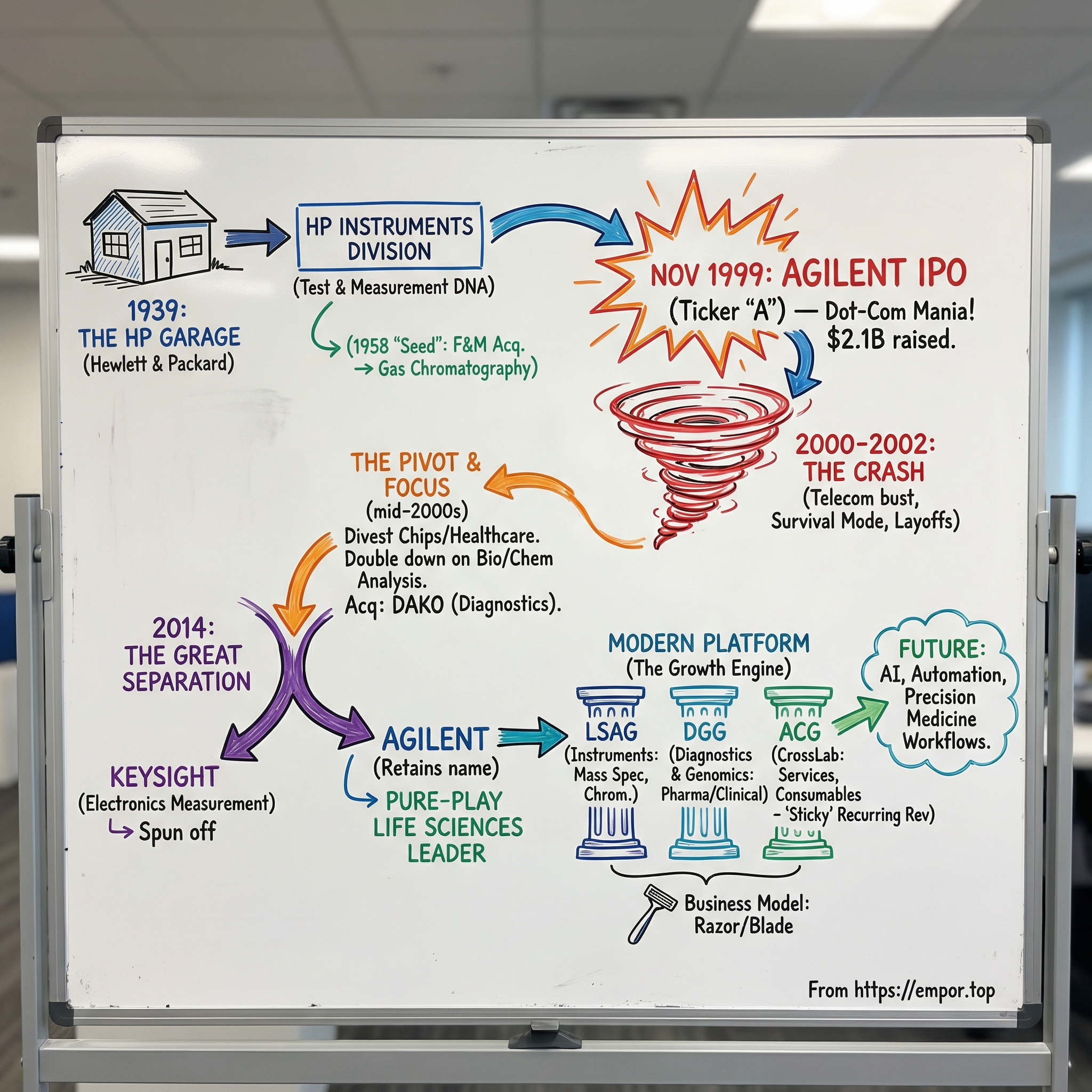
Agilent Technologies: From HP's Instruments Division to Life Sciences Leader
I. Introduction & Episode Setup
On the morning of November 18, 1999, a company that had existed as an independent legal entity for roughly six months claimed one of the most recognized single-letter tickers on the New York Stock Exchange: A. The initial public offering priced at $30 a share.1 The net proceeds — about $2.1 billion — did not remain with the newly public company; they were received in November 1999 and immediately distributed to Hewlett-Packard as a dividend.2
That detail underscores the true nature of the transaction. What was then the largest technology IPO in Silicon Valley history was not a capital raise for growth, but a partial corporate divestiture. HP sold 15.9% of the subsidiary to public investors, retained 84.1%, absorbed the cash proceeds, and spent the next seven months preparing to distribute the remaining shares to its own shareholders.2 The business being unbundled was HP's foundational enterprise: the test, measurement, and analytical instruments unit tracing directly back to the audio oscillator Bill Hewlett and Dave Packard built in a Palo Alto garage.
Nearly twenty-seven years later, almost none of the original IPO portfolio remains inside Agilent Technologies. The healthcare division was sold to Philips. The semiconductor unit was divested to KKR and Silver Lake, renamed Avago, and eventually acquired Broadcom. The electronic measurement business — the historic core of HP — was spun off in 2014 as Keysight Technologies. What remains is a focused life sciences enterprise selling the instruments, consumables, software, and services that laboratories require to identify and quantify molecular components in samples and satisfy regulatory compliance standards.
In fiscal 2025, that business generated $6.95 billion in revenue — representing a 6.7% reported increase and 4.9% growth on a core basis — with GAAP earnings per share of $4.57 and non-GAAP earnings per share of $5.59.3 Trading around $154 per share, Agilent holds a market capitalization in the mid-$40 billion range.4 By revenue, it ranks as the fourth-largest Western analytical instrument maker and maintains solid operational metrics across its major segments.
While Agilent has demonstrated operational strength, the central question for investors is: how much of the current performance is structural, and how much is cyclical? Agilent is two years into an enterprise-wide restructuring initiative known as Ignite, one year into a streamlined three-segment operating structure, and in the midst of an instrument replacement cycle that management views as a multi-year tailwind. Core growth accelerated for six consecutive quarters into the end of fiscal 2025.5 Operating margins are expanding, and management has raised forward guidance. While these indicators reflect execution improvements, they also mirror a broader cyclical recovery following a two-year industry destocking period.
Evaluating Agilent requires determining why the company can sustain growth from here and what evidence will confirm whether its operational momentum is durable. Key elements of this analysis include how a corporate predecessor unbundled itself across three separate transactions; why selling a semiconductor business for $2.66 billion initially appeared advantageous before becoming one of tech history's most expensive divestitures; how the recurring "razor-and-blade" model functions when the razor is a $400,000 mass spectrometer and the blade is a chromatography column; and why instrument servicing — often overlooked — represents one of the company's most defensible revenue streams.
The trajectory begins in a Palo Alto garage.
 Subscribe on LinkedIn
II. The HP Legacy & Silicon Valley DNA (1939–1999)
The founding artifact was not a computer; it was an instrument.
In 1938, in a rented garage on Addison Avenue in Palo Alto, Bill Hewlett and Dave Packard built the Model 200A audio oscillator—an instrument designed to generate precise audio-frequency signals for testing sound equipment. Their design used a light bulb as a temperature-dependent resistor to stabilize the output, allowing them to manufacture the unit at a fraction of competitors' costs. Walt Disney Studios purchased a batch of the oscillators to test sound systems for Fantasia, and Hewlett and Packard formalized their partnership as Hewlett-Packard in 1939.[^6]
What mattered most for the company's trajectory was not the garage narrative, but its foundational product category. HP began as a measurement company. Its early customers were engineers who required precise, reliable metrics—whether frequencies, voltages, or waveforms—and paid a premium for consistent accuracy. That model created a business structurally distinct from high-volume hardware or consumer electronics: a trust-based enterprise built on long-term equipment reliability.
In the mid-1960s, HP extended that measurement focus from electronics to chemistry, acquiring gas chromatography maker F&M Scientific to form the foundation of its chemical analysis division.[^6] That core analytical process remains central to Agilent's business six decades later. A gas chromatograph vaporizes a sample and pushes it through a coated column. Because different compounds interact with the coating at varying rates, they exit the column sequentially, separating a complex mixture into an ordered series of components. A detector at the outlet measures the timing and quantity of each emerging compound. Pairing the chromatograph with a mass spectrometer—which measures the mass-to-charge ratio of molecular fragments—allows laboratory technicians to determine both the concentration and the exact identity of each compound. Liquid chromatography applies the same separation principle using a liquid solvent, enabling the analysis of larger, fragile molecules common in modern pharmaceuticals.
Most of what Agilent sells today stems from this underlying workflow: separate, identify, quantify, and document.
Through the 1970s and 1980s, HP built an extensive electronic measurement business—producing oscilloscopes, signal generators, and automated test equipment—alongside a medical diagnostics unit focused on patient monitoring and electrocardiographs. HP operated these divisions under the "HP Way," a management framework defined by divisional autonomy, sustained research and development investment, and an engineering culture focused on product durability.
By the late 1990s, however, HP's computing, storage, and printing operations generated the vast majority of enterprise revenue and dominated corporate strategy. Though profitable and steady, the measurement businesses grew at single-digit rates and struggled to compete for capital against divisions selling servers and printers. This dynamic illustrated a classic conglomerate challenge: steady, lower-growth divisions inside a broader technology enterprise often face under-investment and diminished executive focus as capital and talent flow toward faster-growing segments.
That capital imbalance explains the structural setup of the eventual spin-off. When Agilent reported fiscal 2001 results as an independent enterprise, its chemical analysis unit—the descendant of F&M Scientific—generated $1.1 billion in revenue out of $8.4 billion for the entire company.2 Representing just 13% of overall sales during an industry downturn, it was the only operating segment to deliver positive growth.
While HP's historical engineering discipline survived Agilent's eventual separation, its broad product portfolio did not. Holding both factors in mind provides the framework for understanding the company's subsequent transformation.
III. The Great Spin-Off & IPO Chaos (1999–2000)
In March 1999, Hewlett-Packard's board announced a structural break with tech industry precedent: it would split the company in half.[^6] The computing and imaging business would retain the HP name, while the measurement divisions—test and measurement, semiconductor products, healthcare solutions, and chemical analysis—were carved out into a standalone entity. Incorporated in Delaware in May 1999,2 the subsidiary was named Agilent later that summer, a moniker derived from agility to signal that HP's historical core was not a legacy drag.
The separation followed a two-stage divestiture model that later became standard corporate practice: first, sell a minority stake to public investors to establish market pricing and liquidity; second, distribute the remaining equity tax-free to the parent company's shareholders. Agilent's initial public offering covered 15.9% of its common stock in November 1999, and HP distributed the remaining 84.1% on June 2, 2000, through a stock dividend of 0.3814 Agilent shares for each HP share held.21 Investors purchasing shares at the $30 offer price saw the stock trade up sharply on its first day—traditionally a sign of an underpriced offering, though because the net proceeds flowed directly to HP, any foregone capital affected the parent rather than Agilent.12
Ned Barnholt, a 30-year HP veteran who had headed the test and measurement organization, was appointed chief executive officer. He assumed leadership of a complex portfolio: four business units serving distinct end-markets, bound together primarily by shared engineering heritage and corporate lineage rather than operational synergies.
The financial composition of the enterprise during fiscal 2001—its first full year operating as an independent public company—illustrated this structural concentration: test and measurement generated $5.4 billion in revenue, semiconductor products contributed $1.9 billion, and chemical analysis accounted for $1.1 billion, while healthcare solutions was already being carved out for divestiture.2 Approximately two-thirds of Agilent's revenue depended on capital equipment sales to telecom and semiconductor customers, two of the most rapidly expanding markets during the late-1990s tech boom.
This alignment created a tension between investor narrative and underlying business fundamentals. Wall Street marketed and priced Agilent as a pure-play tech growth stock positioned to capitalize on the telecommunications and semiconductor buildout, unburdened by HP's mature printing division. Operationally, however, Agilent remained a cyclical industrial instrument maker heavily exposed to capital spending swings. The chemical analysis unit—the business that would ultimately define Agilent's long-term future—was a minor element of the initial equity story.
For investors, the episode offers a clear lesson in spin-off dynamics: when a parent company divests a division during an industry peak, it monetizes elevated market valuations while transferring both cyclical exposure and an inflated fixed-cost structure to the new entity. While the corporate separation achieved its goal of granting the measurement businesses dedicated management and independent capital allocation, the timing primarily served HP's balance sheet.
Shortly after the separation was complete, the telecommunications order book collapsed.
IV. The Dot-Com Crash & The Great Divestiture Spree (2001–2005)
Fiscal 2001 was, in CEO Ned Barnholt's own description in that year's annual report, a very difficult year — and the metrics behind that assessment explain Agilent's strategic direction over the subsequent decade.
Total orders dropped 39% compared to fiscal 2000, driven by a 43% decline in test and measurement orders and a 49% contraction in semiconductor products orders. Those figures reflected approximately $1 billion in cancelled orders — placed primarily during the 2000 demand surge when customers hoarded capacity, and later cancelled by either customers or Agilent when delivery timelines stretched beyond six months.2 Full-year revenue dropped to $8.4 billion, generating a $406 million loss from continuing operations.2
Management's operational response escalated through three distinct stages as the severity of the collapse became clear. Early in the year, assuming a brief downturn, Agilent trimmed contract labor, travel, and discretionary spending. In April 2001, as orders continued to drop, executive leadership instituted a company-wide 10% pay cut. By late July, acknowledging that demand had shifted structurally lower, Agilent announced 4,000 layoffs alongside a two-week corporate shutdown, followed in November by an additional 4,000 job cuts.2 These announcements came after roughly 3,000 workers had already departed during the second half of the fiscal year.2
This restructuring highlights three broader dynamics. First, management misjudged the duration of the downturn twice before rightsizing the business — a common pattern when corporate leadership treats cyclical shocks as temporary. Second, implementing broad pay cuts prior to mass layoffs reflected the consensus-driven ethics of the HP Way, distributing financial pain across the workforce before eliminating positions. Third, and most crucially, the downturn forced immediate portfolio decisions that a stable operating environment likely would have delayed.
The healthcare business was the first asset divested. Royal Philips agreed to acquire Agilent's Healthcare Solutions Group — which encompassed patient monitoring, cardiac care, and clinical diagnostic systems — receiving U.S. antitrust clearance on June 1, 2001, following an expedited approval in Europe.6 The transaction generated a $646 million gain from discontinued operations in fiscal 2001, allowing Agilent to report positive net income despite its severe loss from continuing operations.2 While divesting assets to offset operating losses provided only temporary relief, it bought the company critical time to address its cost structure.
A more decisive portfolio restructuring followed four years later during a leadership transition. In August 2005, Agilent announced a major capital realignment package: the sale of its Semiconductor Products Group to Kohlberg Kravis Roberts and Silver Lake Partners for $2.66 billion in cash, the sale of its stake in the Lumileds LED joint venture to Philips for approximately $1 billion, and a $4 billion share repurchase authorization.7 Incoming CEO Bill Sullivan framed the semiconductor sale around corporate focus, maintaining that the division could better achieve its strategic potential as an independent enterprise.7 Private equity owners subsequently rebranded the standalone business as Avago Technologies.
Viewed from 2026, the long-term trajectory of that divested semiconductor business remains remarkable. Avago completed an initial public offering, used its free cash flow to consolidate the analog and radio-frequency chip sector, acquired Broadcom Corporation in 2016 while adopting its corporate name, and grew into a global semiconductor powerhouse. Agilent had divested the foundation of that enterprise for $2.66 billion.
Yet evaluating that divestiture requires distinguishing between execution capabilities. Avago's subsequent expansion depended on aggressive financial leverage, disciplined product-line pruning, and serial M&A execution — an operational playbook poorly suited to a public company rooted in HP's engineering-consensus culture. Agilent's decision reflected a realistic assessment of its own operational style rather than a failure of vision. The more relevant measure of success is how effectively Agilent redeployed the proceeds into its remaining core businesses.
Ultimately, the 2001–2005 crisis established a defining cultural characteristic for Agilent: a strategic willingness to divest legacy assets. While traditional industrial conglomerates often view divestitures as an admission of operational failure, Agilent — born from a corporate separation itself — adopted active portfolio pruning as a standard management tool. That operational instinct was soon directed toward the largest business remaining on its balance sheet.
V. Life Sciences Transformation & The Keysight Split (2006–2014)
Bill Sullivan, who became CEO in 2005, spent his earlier career within HP and Agilent's semiconductor and components divisions. Despite lacking a background in life sciences, he spent the following decade systematically redirecting capital away from legacy hardware operations toward higher-compounding analytical and diagnostic markets.
The strategic rationale was straightforward. Electronic measurement targeted customers building communications infrastructure—an audience whose capital expenditure swung dramatically alongside technology investment cycles. By contrast, chemical analysis and life sciences served pharmaceutical quality control laboratories, environmental testing facilities, and clinical pathology departments. Demand in those end-markets was dictated by regulatory compliance, patient volumes, and drug development pipelines. While electronic measurement customers bought equipment primarily during periods of economic expansion, analytical and life sciences customers purchased tools required by law and ongoing operational workflows. For an enterprise emerging from a severe cyclical downturn, non-cyclical, regulation-driven demand offered long-term structural stability.
Buying the pathology franchise
The anchor transaction of this strategic pivot occurred in 2012, when Agilent acquired Danish cancer diagnostics company Dako for $2.2 billion in cash.8 As Agilent's largest acquisition to date, the deal drew skepticism from investors concerned by the high valuation multiple and the integration risks of an analytical equipment manufacturer expanding into clinical diagnostics.
Operationally, Dako provided Agilent with an established position in clinical laboratories through immunohistochemistry (IHC)—a diagnostic technique where pathologists treat tissue samples with antibodies that bind to target proteins, revealing molecular markers under a microscope. In oncology, decisions regarding targeted cancer therapies frequently depend on these IHC assays. Because specific antibody reagents are proprietary, clinically validated, and often specified directly within regulatory drug approvals as companion diagnostics, they create durable product lock-in.
This regulatory integration formed the core of the business model. A companion diagnostic designated in a drug's formal approval cannot be easily substituted by a hospital laboratory. Once Agilent's assay was validated alongside a pharmaceutical partner's clinical trial, reagent demand endured for the commercial lifecycle of the drug, transferring switching costs to the pharmaceutical developer.
Furthermore, Dako possessed an installed base of automated staining instruments across pathology laboratories that mirrored Agilent's core business model. Much like gas and liquid chromatographs, the instrument placement established a long-term revenue stream driven by recurring consumable and reagent sales, expanding Agilent's razor-and-blade economics into clinical healthcare.
The second unbundling
In September 2013, Agilent announced a fundamental corporate restructuring: it would split into two independent public companies.
The operational divergence between the divisions had made co-existence increasingly impractical. Electronic measurement and life sciences shared a corporate umbrella and treasury operations but differed across end-market customers, sales cycles, capital requirements, and investor profiles. Hardware engineers purchasing signal analyzers and pathologists acquiring staining platforms operated under entirely distinct procurement needs, creating competing capital allocation priorities for executive leadership.
On November 1, 2014, Agilent completed the separation of its electronic measurement business into Keysight Technologies, distributed to Agilent shareholders at one Keysight share for every two Agilent shares held.91 The remaining entity under ticker A emerged as a roughly $4 billion life sciences, diagnostics, and applied markets company—achieving a single, focused corporate identity.
While market commentators often attribute such corporate splits to eliminating a conglomerate valuation discount, the primary operational benefit was direct peer comparison and accountability. Following the separation, Agilent could no longer attribute quarterly underperformance to cyclical telecommunications spending. Instead, it was evaluated directly against pure-play life sciences and analytical instrumentation peers—including Thermo Fisher Scientific, Danaher, Waters, and Bruker—raising performance benchmarks and sharpening operational focus.
Viewed in broader context, the transaction marked Agilent's third major structural unbundling in fifteen years. While each separation addressed specific operational mismatches, the pattern highlighted a corporate history of assembling business portfolios that eventually required divestiture to unlock value.
The enterprise that emerged in late 2014 was smaller, focused, and positioned to demonstrate whether operational specialization could drive sustained long-term growth.
VI. Modern Platform Building & M&A Capital Deployment (2015–2024)
When Mike McMullen assumed the role of chief executive in 2015 following the Keysight spin-off, he inherited an enterprise needing an integrated strategy: transition Agilent from selling standalone hardware into delivering integrated laboratory workflows.
Commercially, the distinction is significant. Selling a standalone mass spectrometer is a transactional event—a purchase order, a competitive bidding process, a price negotiation, followed by years without major customer interaction. Delivering a complete workflow embeds the instrument alongside chromatography columns, sample-preparation chemistry, regulatory-compliant software, validated testing methods, and long-term service contracts guaranteeing operational uptime. Rather than acquiring hardware, the customer secures a turnkey laboratory outcome. For Agilent, this model generates predictable, recurring revenue streams and builds customer relationships that renew without recurring price wars.
Over the subsequent decade, Agilent pursued a targeted acquisition strategy designed to assemble the missing components of this workflow ecosystem.
Seahorse Bioscience (2015) cost $235 million against roughly $49 million of expected revenue—a multiple just under five times sales.10 Seahorse developed specialized analyzers that measure cellular metabolism in real time: tracking live cells as they consume oxygen and acidify their surroundings to reveal underlying mitochondrial function. The technology provided Agilent a high-margin foothold in cancer research, immunology, and metabolic disease—research niches where it previously had minimal presence.
Cobalt Light Systems (2017) cost £40 million for a 52-person business in Oxfordshire.11 Cobalt’s proprietary technology enabled Raman spectroscopy—reading a molecule's vibrational fingerprint using lasers—through opaque containers. This permitted pharmaceutical manufacturers to verify raw materials inside sealed drums without opening them and security screeners to inspect liquid contents safely.
BioTek Instruments (2019) represented the largest expansion at $1.165 billion, adding microplate readers, cellular imaging tools, and laboratory automation.12 Microplates—plastic trays featuring dozens or hundreds of micro-wells—allow laboratories to conduct high-throughput parallel experiments. BioTek's detection instruments served as a volume workhorse across drug discovery and life sciences research, generating steady consumable demand and pairing naturally with Agilent's cell analysis suite.
The one that did not work
Not every acquisition expanded the workflow seamlessly. In March 2021, Agilent agreed to acquire Seattle-based Resolution Bioscience for $550 million in upfront cash plus potential contingent consideration.13
The strategic premise relied on the decentralization of oncology genomic testing. Management bet that instead of shipping tissue samples to specialized central reference laboratories, hospital pathology departments would perform next-generation sequencing in-house using standardized diagnostic kits supplied by Agilent. Given Agilent's established pathology presence through Dako, the cross-selling opportunity appeared logical.
However, the anticipated market shift failed to materialize. Clinical laboratories continued delegating complex genomic profiling to centralized testing providers that possessed superior scale, specialized bioinformatics infrastructure, and established reimbursement channels. With local kit adoption lagging, Agilent recognized impairment charges against the business, initiated a complete wind-down, and sold the remaining assets to Exact Sciences in September 2023.1415
The failed acquisition offers two contrasting operational takeaways. On one hand, it represented a peak-cycle valuation error. Negotiated during a period of loose biotech financing, the deal priced in an unproven shift in customer behavior rather than established commercial demand—a recurring risk when instrument manufacturers pursue emerging clinical markets. On the other hand, executive leadership demonstrated discipline by liquidating the asset within two years of closing. Rather than committing ongoing capital to a misaligned thesis, Agilent absorbed the write-down, sold off the remaining technology, and redirected corporate focus.
The trough
By fiscal 2024, the broader analytical instruments sector faced a sharp cyclical contraction. Following elevated post-pandemic equipment purchases, pharmaceutical and biotechnology clients entered a prolonged inventory destocking period, curbing capital expenditure and delaying instrument replacements.
The cyclical downturn drove Agilent's fiscal 2024 performance to an industry trough: annual revenue fell 4.7% on both a reported and core basis to $6.51 billion, while non-GAAP earnings per share declined 3% to $5.29.16
During this operational trough, Agilent made two pivotal strategic moves. In July 2024, the company agreed to acquire Canadian contract development and manufacturing organization BIOVECTRA, completing the transaction on September 20, 2024—a deal management expected to be five cents dilutive to non-GAAP earnings per share in its first full year while reaching a double-digit return on invested capital by year five.17 Concurrently, Agilent named a new chief executive officer to lead the enterprise.18
Acquiring a contract manufacturing business during an instrument demand trough presented a calculated strategic shift, expanding Agilent beyond analytical measurement and into biopharmaceutical production services. Whether the transaction represents disciplined counter-cyclical capital allocation or an operational distraction from core laboratory workflows remains a central question for the company's current trajectory.
VII. The Current Era: CEO Padraig McDonnell & The "Ignite" Transformation (2024–Present)
Padraig McDonnell is not the kind of executive who typically gets handed a $40 billion instrument company. He is an Irish-born, twenty-five-year Agilent veteran whose career ran through the service and commercial organization — the CrossLab group, then the instrument business — rather than through R&D or corporate development.18 He was announced as the next president and CEO in February 2024.18
That background shapes everything about how the company now talks about itself. Ask a product-organization CEO what the company's advantage is and you will hear about technology. Ask a service-organization CEO and you will hear about the field engineer who is inside the customer's lab every week. McDonnell has consistently argued the second — and, more usefully for analysis, has put numbers behind it. On the fiscal 2025 fourth-quarter call, management disclosed that insights from the service team accounted for 30% of all sales leads, with an order conversion rate more than double the rest of the funnel.5 On the following quarter's call, the company sized its enterprise services business — embedded on-site staff, connected monitoring — at roughly 10% of total services revenue, growing at a low-double-digit compound rate, with agreements at nearly all of the top 20 biopharma companies and 18 competitive displacements won over three years.19
Those are the kind of specifics that can be tracked and, if they stop being repeated, noticed.
Ignite: what it actually is
On December 17, 2024, Agilent held an investor day and laid out a transformation it called Ignite.20 Two things changed.
First, the organizational structure. The old product-centric segments were replaced, effective fiscal 2025, with three market-facing groups: the Life Sciences and Diagnostics Markets Group at roughly $2.5 billion of revenue, covering liquid chromatography, LC mass spectrometry, the nucleic acid CDMO operations, cell analysis, genomics, pathology, and companion diagnostics; the Applied Markets Group at roughly $1.3 billion, covering gas chromatography, GC mass spectrometry, spectroscopy, vacuum, and certified pre-owned instruments; and the Agilent CrossLab Group at roughly $2.7 billion, covering consumables, services, software, and lab automation — with a single unified commercial organization sitting across all three.21
Second, the operating targets. Management committed to 5–7% annual core revenue growth, 50–100+ basis points of annual operating margin expansion, and double-digit EPS growth over a three-to-five-year horizon, explicitly assuming normalized market growth of 4–6% and explicitly excluding future M&A.21
Set those targets against the market backdrop the company itself presented — an $80 billion opportunity growing 4–6%, with pharma and biopharma at $25 billion growing 5–7% and clinical diagnostics at $20 billion growing 5–7% — and the arithmetic is clear.21 Agilent is promising to grow at or slightly above its markets while expanding margins. That is a share-gain-plus-productivity story, not a market-growth story. It can only be validated by watching whether Agilent's growth exceeds peers' over several quarters, and by whether margin expansion survives a soft revenue quarter.
What has actually been delivered
Fiscal 2025 was the first year under the new structure, and it beat the initial plan. Revenue reached $6.95 billion, up 4.9% core; fourth-quarter revenue of $1.86 billion grew 7.2% core, which management described as the sixth consecutive quarter of core growth acceleration; non-GAAP EPS was $5.59, up 6%; operating cash flow was $1.559 billion.35 Against guidance issued a year earlier of 2.5–3.5% core growth, the company delivered well above the top end.16
On the operating side, management quantified Ignite's first-year output: more than $150 million in annualized savings, a doubling of pricing realization versus fiscal 2024, procurement savings from globalizing vendor contracts, and a cross-functional tariff task force stood up in response to the 2025 trade actions.5 These are company-defined, unaudited figures — worth treating as directional rather than verified — but the pricing claim is at least partially visible in reported margins.
Fiscal 2026 guidance started conservative: 4–6% core growth, 75 basis points of margin expansion, non-GAAP EPS of $5.86–$6.00, with management flagging that a step-up in the tax rate to 14.5% under new global minimum tax rules consumed about three percentage points of EPS growth.5 Management also removed most anticipated benefit from China's equipment-renewal stimulus from the guide — a notable act of prudence given how many peers had built it in.5
The year then played out in a way that is genuinely informative. The first quarter was mediocre and honestly explained: a January winter storm shut the Memphis logistics hub for three days during the busiest shipping week of the quarter, costing roughly $10 million of revenue; core growth was 4.4% and operating margin 24.6%.19 The second quarter was the opposite: revenue of $1.83 billion, 6.3% core growth — 80 basis points above the top of guidance — operating margin of 26.4%, up 130 basis points, and EPS of $1.49, up 14% and seven cents above the high end.2223 Full-year guidance moved up to 4.5–6% core growth, 85 basis points of margin expansion, and EPS of $6.00–$6.10.22
The margin detail worth isolating: strategic pricing contributed approximately 200 basis points in the second quarter, and management said the tariff task force had achieved full mitigation of the incremental tariffs that began in late spring through a combination of manufacturing moves and targeted price increases.23 Two hundred basis points of price in an instrument market that spent the 2010s barely pricing at all is the single most economically significant number in the Ignite program. It is also the one most exposed to competitive response.
What analysts pushed on
The live version of the story is more textured than the prepared remarks. On the second-quarter call, Evercore's Vijay Kumar opened by probing whether instrument strength was masking weakness in cell analysis, and pressed the CFO on whether the implied fourth-quarter margin ramp was credible.24 Jefferies' Tycho Peterson pushed on the durability of double-digit spectroscopy growth tied to semiconductor fabs. TD Cowen's Dan Brennan asked, in effect, whether an exceptional diagnostics quarter was repeatable. Bank of America's Michael Ryskin went at China directly.24
The answers were unusually specific, which is itself evidence. On the replacement cycle, McDonnell quantified the tailwind — roughly 200–300 basis points of lift to liquid chromatography growth and about 100 basis points from the longer-lived gas chromatography fleet, where a typical instrument lasts around a decade.24 On China, he described a stable business running around $300 million a quarter, down 9% in the quarter on Lunar New Year timing and a tough comparison against pre-tariff stocking, with the government stimulus now expected to book orders late in the fiscal year and convert to revenue in fiscal 2027.24 On U.S. academic and government exposure, he put it at roughly 3–4% of sales.24 The CFO listed remaining upside and downside swing factors explicitly — small and mid-cap biotech recovery, academic stabilization, Middle East normalization, potential tariff refunds — and stated that none were embedded in guidance.24
That is a management team giving analysts the components to build their own model rather than a narrative to accept. It is not proof of good judgment, but it is the behaviour pattern that makes future misses diagnosable.
The growth engines nobody underwrote
Two parts of the portfolio deserve separate attention because they are not what an investor buys an instrument company for.
The first is the nucleic acid CDMO business — historically the Nucleic Acid Solutions Division, now folded into what Agilent rebranded in 2026 as its Advanced Therapeutics division. This is a genuinely different business: Agilent manufactures the actual therapeutic molecules for pharmaceutical clients. Specifically, oligonucleotides — short synthetic strands of genetic material used in siRNA and antisense drugs that switch off a disease-causing gene rather than blocking the protein it produces. Making them at commercial scale is chemically demanding and heavily regulated, and there are few qualified suppliers. Agilent committed $725 million to expanding its Frederick, Colorado facility to serve that demand.25 Combined with BIOVECTRA, management framed the CDMO franchise as a $1 billion-plus revenue opportunity by 2030.21
In the second quarter of fiscal 2026 the division grew high single digits, with management maintaining a mid-teens full-year growth expectation and confirming mechanical completion of the "Train C" production line, targeted to begin generating revenue in spring 2027.2324 Group president Simon May told analysts the company had strong visibility for the back half and line of sight to demand for the bulk of fiscal 2027 — while acknowledging that production schedules further out remain uncertain.24
The honest framing: this is the highest-growth, highest-capital-intensity, and highest-concentration business Agilent owns. It carries client concentration and modality concentration — if a major siRNA or GLP-1 program is delayed, batch timing moves and quarterly revenue moves with it. Management's own disclosure that fourth-quarter growth faces a tough comparison is a small illustration of how lumpy it is.24 It is also worth noting BIOVECTRA's first year: management had pointed to roughly $35 million and the business delivered around $22 million, with McDonnell characterizing the year as in line with what the company had expected internally.26 Analysts noticed the gap.
The second engine is PFAS testing. Per- and polyfluoroalkyl substances — "forever chemicals" — are synthetic compounds that resist breaking down and accumulate in water, soil, food, and people. Detecting them at parts-per-trillion concentrations requires exactly the triple-quadrupole mass spectrometry Agilent sells. Regulation, not customer enthusiasm, drives the purchase. Agilent's PFAS business grew high single digits in the fourth quarter of fiscal 2025 and nearly 40% for the full year against progressively harder comparisons, and the company launched a dedicated chromatography column designed to separate short- and long-chain PFAS in a single run in response to new European rules.519
And then there is the business that came out of nowhere. The Raman technology bought for £40 million in 2017 turned into a U.S. Transportation Security Administration contract — $9 million booked in the first quarter of fiscal 2026, of which $5 million was recognized in the second — for bulk alarm resolution systems deployed at airport checkpoints in U.S. FIFA World Cup host cities, contributing to forensics growth above 50% in the quarter.1924 Nine years is a long gestation. It is also a reminder that small technology acquisitions in this industry occasionally pay off in markets no one modelled.
The question that follows is whether any of this rests on advantages a competitor cannot replicate.
VIII. Business Model, Industry Structure & Moat Analysis
Inside the quality-control laboratory of a large pharmaceutical manufacturing site, rows of liquid chromatographs run standardized tests on identical schedules for years. Every batch of drug product shipped from the facility must undergo testing for identity, purity, and trace impurities. The analytical method for each test is strictly defined, validated, and filed with regulatory authorities. The instrument model, control software, column specifications, and operating parameters are embedded directly into that formal filing.
That regulatory reality underpins Agilent's commercial model.
The razor and the blade, honestly described
The instrument serves as the entry point. A liquid chromatograph or mass spectrometer represents a capital expenditure—competitively bid and sold at solid, though not extraordinary, gross margins. The ongoing core business lies in what follows: replacement chromatography columns, single-use sample vials, preparation reagents, diagnostic assays for staining platforms, and recurring service contracts that maintain instrument qualification. Once installed, these tools remain active in customer laboratories for years, with gas chromatographs commonly operating for a decade.24
Agilent's financial structure mirrors this recurring dynamic. At its 2024 investor day, management disclosed that non-instrument sales rose from 46% of total revenue in fiscal 2014 to 64% in fiscal 2024, driving 80% of overall revenue growth across that ten-year span. By fiscal 2024, analytical lab services generated $1.6 billion after compounding at 10% annually from fiscal 2020; consumables reached $0.9 billion with an 8% compound annual growth rate; and the nucleic acid CDMO business contributed $0.3 billion, compounding at 19%. Meanwhile, service-contract attach rates expanded by roughly 400 basis points over the same period.21
Myth versus reality. While market consensus often categorizes Agilent as a hardware maker vulnerable to pharmaceutical capital cycles, roughly two-thirds of its revenue now stems from post-installation consumables, services, and software. The business is not entirely immune to economic swings—reduced instrument placements eventually temper consumable demand two to three years later—but the recurring base buffers revenue shocks. That stabilization explains why the fiscal 2024 industry downturn reduced Agilent's top line by roughly 5%, a far milder contraction than the 30%-plus drop experienced during the 2001 tech crash.162
The competitive board
Agilent operates within a highly consolidated oligopoly.
Thermo Fisher Scientific functions as the industry scale leader, operating at several times Agilent's total revenue. Thermo Fisher competes directly in mass spectrometry and chromatography while managing expansive bioprocessing, clinical diagnostic, and contract manufacturing divisions. Danaher deploys its operational framework across Cytiva, Beckman Coulter, and Leica, overlapping with Agilent in cell analysis and pathology. Bruker and Revvity hold targeted positions in specialized laboratory markets.
The competitive landscape shifted significantly in early 2026. Waters Corporation—historically focused on liquid chromatography and mass spectrometry as Agilent's primary technology rival—completed a combination with Becton Dickinson's Biosciences and Diagnostic Solutions units on February 9, 2026, in a Reverse Morris Trust structure that left Waters shareholders with 60.8% of the combined company and BD shareholders with 39.2%.27 The deal roughly doubled Waters' reported addressable market and expanded a direct competitor into flow cytometry and clinical diagnostics—the exact adjacencies Agilent built through Dako, BioTek, and subsequent acquisitions.
Agilent responded by expanding its depth in cancer pathology. In March 2026, the company agreed to acquire Biocare Medical for $950 million in cash, closing the transaction on June 25.2829 Biocare generated over $90 million in 2025 revenue, delivering double-digit top-line and profit growth since 2021, while contributing a catalog of over 300 specialized antibodies across immunohistochemistry, in situ hybridization, and fluorescence in situ hybridization assays.28 Priced at approximately ten times trailing revenue, the acquisition carried a premium valuation. Management projected immediate accretion to Agilent's core revenue growth, operating margin profile, and non-instrument revenue mix, with non-GAAP earnings accretion expected within twelve months of closing.2829
Seven Powers, tested
Switching costs serve as Agilent's central competitive advantage. In regulated environments governed by frameworks such as FDA 21 CFR Part 11 or China's National Medical Products Administration (NMPA) guidelines, analytical testing methods are tied to specific instrument hardware, operating software, and column chemistry. Changing instrument vendors requires re-validating analytical methods, submitting amended regulatory filings, and retraining laboratory staff. The primary friction is not the capital cost of the replacement machine, but the administrative burden and operational risk of regulatory re-qualification. Consequently, quality-control laboratories routinely pay a premium to upgrade to an incumbent vendor's next-generation system rather than risk switching suppliers—enabling Agilent to capture strategic price increases.
Process power resides in specialized manufacturing and engineering techniques. The precise chemical packing of chromatography columns, the thermal control of ion sources in mass spectrometers, and the micro-tolerances of high-pressure fluidic valves represent decades of accumulated trade secrets. Because these capabilities stem from proprietary manufacturing practices rather than public patent disclosures, competitors face significant technical hurdles in replicating their performance.
Cornered resources consist of proprietary antibody clones used in clinical pathology and companion diagnostics. The economic value of these reagents, expanded through the Biocare acquisition, stems from their formal inclusion in drug regulatory approvals, establishing long-term commercial lock-in.
Counter-positioning manifests in the CrossLab enterprise service model, which maintains and services third-party hardware alongside Agilent's own installed base. While hardware-centric competitors can deploy multi-vendor servicing, doing so requires dispatching service technicians to support rival equipment—a model that can conflict with traditional sales organizations focused solely on defending proprietary hardware. Agilent's expanding enterprise services footprint and reported competitive displacements support the commercial traction of this strategy,19 though competing multi-vendor offerings from peers like Thermo Fisher demonstrate that the advantage is not exclusive.
Porter's five forces, applied to a laboratory
Buyer power remains low in regulated pharmaceutical quality control, where re-validation costs outweigh hardware savings, but stays moderate to high among academic and government institutions that depend on competitive grants and tight budgets. New entrant threat is very low due to high barriers to entry, including complex instrument engineering, proprietary column chemistry, global field-service infrastructure, and established regulatory tracking. Substitution risk is minimal for physical analytical chemistry—software cannot replace the physical separation and measurement of molecular samples—though technical shifts remain a factor, as illustrated by the centralization of genomic testing that disrupted Agilent's earlier oncology initiative. Supplier power is moderate and increasing across specialized subcomponents, including precision optics, advanced detectors, memory chips, and helium supplies.2324 Rivalry among major analytical instrument makers is intense but disciplined, emphasizing workflow automation, software integration, and system uptime over price discounting. That discipline supported recent industry pricing gains, making any erosion in pricing power a key indicator of shifting competitive dynamics.
Agilent operates within an attractive industry structure supported by defensible switching costs and structural pricing power. How these operational drivers translate into long-term financial performance forms the basis for evaluating the business.
IX. Financial Anatomy & Capital Allocation
Financially, Agilent operates by converting mid-single-digit top-line expansion into high-single-digit earnings growth while returning a conservative portion of cash flow to shareholders. The key to evaluating the business lies in its underlying margin dynamics and accounting mechanics.
Consider the revenue trajectory. Top-line sales grew from $6.51 billion in fiscal 2024 to $6.95 billion in fiscal 2025, with management projecting $7.39 billion to $7.49 billion for fiscal 2026.16322 Organic volume drove roughly two-thirds of that two-year increase, with foreign currency translation and acquisitions contributing the remainder.
Gross margin has hovered in the mid-50s—reaching 55.0% in the second quarter of fiscal 2026, up 90 basis points year over year, after printing 53.7% in the first quarter when trade tariffs presented an active headwind.2319 Non-GAAP operating margin expanded from 24.6% in the first quarter to 26.4% in the second quarter, with management guiding for additional expansion in the fourth quarter.1923 While this back-half margin ramp follows Agilent's typical seasonal pattern, investors should note management's disclosure that roughly 53% of full-year operating profit is generated in the second half of the fiscal year.24 Relying on a steep back-half acceleration leaves forward financial targets vulnerable to late-year demand disruptions.
Capital efficiency metrics also warrant close examination. Management references return on invested capital in its executive compensation framework and long-range targets, but headline ROIC varies dramatically depending on whether goodwill and intangibles accumulated from two decades of acquisitions are included. On a GAAP basis, Agilent generated fiscal 2025 net income of $1.303 billion on $9.2 billion of invested capital, producing a solid yet unremarkable return profile alongside a return on equity of roughly 19%.315 The gap between GAAP returns and the elevated ROIC metrics cited by industry observers reflects the significant volume of acquired intangible assets sitting on the balance sheet—the very assets exposed to future write-downs, as demonstrated in the Resolution Bioscience episode.
This dynamic highlights the primary accounting gap in Agilent's reporting. In fiscal 2025, non-GAAP earnings of $5.59 per share exceeded GAAP earnings of $4.57 per share by $1.02 per share.3 Amortization of acquisition-related intangibles and ongoing restructuring charges accounted for most of that difference. While excluding non-cash amortization is standard practice across the life sciences sector, these charges reflect the real economic cost of a serial acquisition strategy. Consequently, free cash flow conversion offers a more reliable metric than adjusted earnings for evaluating whether acquired assets generate adequate returns over time.
Where the capital goes
Research and development spending totaled approximately $455 million in fiscal 2025, or 6.5% of revenue—a modest decline from the 7%-plus intensity maintained in fiscal 2024 when top-line sales were lower.15 Management emphasized that savings realized from the Ignite transformation are being reinvested into R&D, digital channels, and artificial intelligence, noting that resource re-allocation helped accelerate the commercial launch of a new triple-quadrupole ICP-MS system by a full quarter.23 However, whether R&D spending expands back toward 7% of revenue as top-line growth accelerates remains an important test for a company claiming to drive market share gains through product innovation.
Capital expenditures remain elevated relative to analytical instrument peers due to the ongoing expansion of the nucleic acid manufacturing infrastructure. Management initially budgeted roughly $500 million in capital spending for fiscal 2026 before trimming the target to approximately $450 million by mid-year.523
Acquisitions represent Agilent's primary discretionary deployment of capital, highlighted by the $915 million purchase of BIOVECTRA in September 2024 and the $950 million acquisition of Biocare Medical in June 2026.1728 Balance-sheet leverage remained conservative following both transactions, with net debt standing at 0.7 times EBITDA at the end of the second quarter of fiscal 2026, preserving substantial financial flexibility.23
Shareholder returns take a secondary position in capital deployment. In fiscal 2025, Agilent allocated $425 million to share repurchases and $282 million to dividend payments out of $1.559 billion in operating cash flow, while approving a 3% dividend increase.35 Diluted share count declined from 291 million in fiscal 2024 to 284 million in fiscal 2025 and is projected to remain roughly flat at 283 million through fiscal 2026.1523
This capital allocation pattern demonstrates that Agilent is prioritizing external M&A and manufacturing capacity over aggressive share repurchases, even while emphasizing capital discipline to investors. These priorities are not inherently contradictory, but they mean management's discipline will be judged by the operational integration of Biocare and capacity utilization at the Frederick facility rather than balance-sheet engineering. Allocating nearly $2 billion to acquisitions over two years while repurchasing $425 million in stock reflects a clear managerial conviction that operational expansion offers higher long-term returns than buying back equity.
X. Risk Radar & Skeptical Investor Stress Test
Every instrument company's risk register looks similar until examining which risks possess clear operational mechanisms. Key structural vulnerabilities include:
-
Biopharma capital spending remains the swing factor. Roughly half of Agilent's revenue depends on pharmaceutical and biotech customers. Large-cap pharmaceutical spending has recovered—pharma revenue grew 6% in the second quarter of fiscal 2026, marking the fifth consecutive quarter of mid-single-digit to low-double-digit expansion, while biotech expanded in low double digits. However, management noted that small- and mid-cap biotech, the segment most sensitive to funding conditions, is showing early signs of recovery that have not yet converted into revenue.2324 If interest rates or biotech financing conditions tighten again, instrument orders are among the first capital expenses deferred, a pull-back that eventually depresses consumable sales two years down the line.
-
China is a structural question, not a quarterly one. Agilent's China business generates roughly $300 million quarterly and fell 9% in the second quarter of fiscal 2026, leaving first-half performance roughly flat.24 Management projects full-year regional performance to remain flat before returning to mid-to-high single-digit growth over the long term, citing its large installed base and alignment with national five-year-plan priorities in artificial intelligence, healthcare, and environmental regulation.24 The counter-thesis centers on intensifying competition from domestic Chinese instrument makers, government procurement policies favoring local suppliers, and delays in stimulus support: the government's 以旧换新 (trade-in) equipment-renewal program, originally expected to drive a replacement wave, has slipped to fiscal 2027 in Agilent's own guidance.245 While management describes the regional market as stable, stability at a lower baseline still represents a clear step-down from historical expansion rates.
-
Academic and government funding is a small but visible drag. As Agilent's smallest end market, academic and government clients generate roughly 7% to 8% of annual revenue, with U.S. institutions accounting for 3% to 4% of total sales. The segment contracted 10% in the fourth quarter of fiscal 2025 and fell 5% in the second quarter of fiscal 2026,524 with management forecasting no immediate rebound. The operational mechanism is direct: when grant funding tightens, laboratories prioritize maintaining existing equipment over purchasing new hardware, shifting customer spending from high-margin capital equipment toward lower-value maintenance services.
-
Ignite is an execution risk, not just an opportunity. Reorganizing a global commercial organization into three market-facing groups while concurrently integrating two acquisitions and implementing portfolio-wide price increases creates significant operational complexity. The primary risk is rarely operational collapse; rather, it manifests as customer friction, account confusion, and sales-force distraction that can erode near-term revenue momentum.
-
Supply chain and geopolitics have become operating variables again. Management has cited several operating headwinds absorbed within current guidance, including logistics disruptions from Middle East conflict, component shortages, inflationary pressures, and rising memory-chip costs.2324 Restricted supplies of helium—a key consumable input for gas chromatography—represent an operational constraint that Agilent has addressed by engineering helium-conserving instruments.23
-
Goodwill and intangibles are the balance-sheet risk. Two decades of acquisitions have left intangible assets accounting for a substantial portion of the balance sheet, a financial vulnerability demonstrated by the write-down of Resolution Bioscience.15 The purchase of Biocare Medical at roughly ten times trailing revenue further increases this balance-sheet exposure.
The activist's brief
A skeptical investor with a short thesis or an activist campaign would construct a case around four primary arguments:
-
“The growth is cyclical recovery, not operational execution.” Agilent's core growth accelerated from negative territory in fiscal 2024 to nearly 5% in fiscal 2025, coinciding with a broader rebound across the life sciences tools sector following inventory destocking. Distinguishing company-specific market-share gains from general industry recovery requires sustained peer comparisons rather than executive assertions. The specific counter-evidence Agilent provides includes low-double-digit growth in liquid chromatography and LC-mass spectrometry during a quarter when the broader chemical and industrial market was soft, alongside CEO Padraig McDonnell's reference to favorable internal market-share metrics.24 While encouraging, these metrics rely on proprietary data that external market participants cannot independently verify.
-
“Ignite savings represent management estimates rather than audited figures.” The claimed $150 million-plus in annualized savings and strategic pricing gains remain company-defined metrics.523 In defense, management can point to audited gross and operating margins that expanded in alignment with those targets. The key open question is how much of that margin expansion stems from temporary pricing power that peers may eventually match, as opposed to permanent structural cost reductions.
-
“The organizational reset obscured multi-year baseline performance.” Restructuring reportable segments in fiscal 2025 complicated multi-year financial comparisons just as a new chief executive introduced a fresh strategic narrative. Even if commercially sound, the realignment presents a legitimate challenge for historical trend analysis.
-
“Capital deployment has shifted from disciplined targeting to aggressive dealmaking.” Agilent committed nearly $2 billion to two acquisitions within two years, including BIOVECTRA, which underperformed the first-year revenue figure management had highlighted.261728 Executive leadership responds that the Ignite program established a repeatable integration playbook, citing the onboarding of BIOVECTRA as evidence.5 However, process-driven integration claims can only be validated over full multi-year operating cycles.
Beyond the activist case, two prominent skeptical arguments frequently dominate investment discussions, each requiring examination against empirical performance:
-
“Chromatography and mass spectrometry represent mature, single-digit growth markets.” That assessment aligns with data: Agilent's internal market sizing projects applied markets growing 2% to 4% annually.21 However, the company's long-term expansion model relies not on market acceleration, but on structural mix shift. High-margin, faster-growing segments—including therapeutic contract manufacturing, clinical diagnostics, and recurring services—account for an increasing share of total sales each year. The clear metric to monitor is relative growth: if non-instrument revenue ceases to outpace hardware sales, the structural mix thesis breaks down.
-
“Thermo Fisher Scientific's scale will squeeze Agilent out of major pharmaceutical accounts.” In analytical instrumentation, corporate scale provides purchasing leverage and portfolio breadth, but rarely causes immediate customer displacement. Procurement decisions in regulated laboratories are made site by site based on validated analytical protocols rather than central corporate directives. Agilent's multi-vendor service contracts across nearly all top-20 biopharma companies demonstrate that it maintains strong positioning within facilities where competitors also sell hardware.19 The primary competitive threat is not outright displacement, but margin compression, as larger competitors leverage bundled product offerings to compete on total cost of ownership.
XI. Bear vs. Bull Case
Strip away the narrative and the disagreement about Agilent comes down to a single question: is a mid-single-digit grower with expanding margins and a slowly improving revenue mix worth owning through a full cycle, or is it a company whose best quarters are behind the current replacement wave?
The bear case
The bear argument begins with the replacement cycle itself, because it is doing more work in the numbers than the narrative admits. Management has quantified it: roughly 200 to 300 basis points of lift to liquid chromatography growth and about 100 basis points from gas chromatography.24 Those are large contributions relative to a 4.5% to 6% core growth guide. A replacement cycle is by definition finite — fleets that were under-purchased for three years get refreshed, and then they do not need refreshing again for the better part of a decade. When it ends, the underlying growth rate is exposed, closer to low single digits in applied markets and mid-single digits in pharma.
The China argument compounds this. A market running at roughly $300 million a quarter, flat for two consecutive years and declining in the most recent one, with domestic competitors improving and stimulus benefits repeatedly pushed out, is not a growth engine — it is a large business being defended.245 If the long-term mid-to-high single-digit growth assumption management carries proves optimistic, several hundred basis points of consolidated growth simply do not appear.
Third, funding-dependent end markets remain impaired. Academic and government spending has been in decline for two years with no forecast recovery, while small- and mid-cap biotech remains an unconverted hope rather than a delivered result.524
Fourth, execution risks linger. The Ignite reorganization is unfinished, two acquisitions are mid-integration, and the fiscal 2026 guidance relies on a heavier-than-usual second-half profit weighting.24 Any of those can produce a disappointing quarter, and in a stock priced for consistency, disappointment costs more than the earnings miss itself.
Finally, there is the pricing question. Approximately 200 basis points of strategic price realization is exceptional for this industry, and the bear reading is that it reflects a temporary window created by tariff-driven cost pass-through and post-shortage customer tolerance rather than a permanent increase in pricing power.23 If competitors respond and pricing normalizes toward historical levels, a meaningful share of the margin expansion story disappears without any change in underlying volume demand.
The bull case
The bull argument does not require the replacement cycle to last forever. It requires the product mix to keep shifting.
The mechanical claim is that each instrument placed today creates a decade of consumables and service revenue tomorrow, and that Agilent is placing instruments faster than it is losing installed base — evidenced by an instrument book-to-bill at or above one for nine consecutive quarters through the second quarter of fiscal 2026.23 If that holds, the recurring revenue base grows regardless of what happens to hardware growth rates, and the recurring base is where the margin lives — the CrossLab group ran at a 32.0% operating margin in the second quarter, compared with 22.0% for the life sciences and diagnostics group and 23.3% for applied markets.22
The second pillar is secular rather than cyclical demand. Regulation drives PFAS testing whether or not laboratories want to buy instruments. Cancer testing volumes rise with demographics. Oligonucleotide therapeutics are moving from clinical trials to commercial scale, and commercial-scale manufacturing capacity is scarce. Semiconductor capacity expansion drives demand for atomic spectroscopy tools that verify ultra-high-purity chemicals — a market where management put semiconductors at roughly 30% of the chemicals and advanced materials segment.24
The third pillar is operating efficiency. If Ignite's pricing capability and cost-structure changes prove durable rather than transitional, then a company that historically converted 4% to 5% revenue growth into 6% to 7% EPS growth can convert it into low-double-digit EPS growth instead. Two quarters of margin expansion above plan and two guidance raises represent the beginning of empirical evidence, not the end of it.2219
The fourth is strategic optionality. Net leverage under one turn, unused share buyback capacity, and a demonstrated willingness to both acquire and divest give Agilent more strategic room than most peers at a moment when the competitive landscape is reshuffling around it.2327
The three numbers that settle the argument
Most of the debate resolves into three observable metrics. An investor tracking this company does not need a forty-line financial model; they need these three indicators.
One: instrument book-to-bill, together with core instrument growth. This is the leading indicator for everything else. Orders precede revenue, revenue precedes installed base, and installed base precedes consumables and service. A book-to-bill that slips below one for two consecutive quarters would signal that the replacement cycle is rolling over well before it appears in reported top-line revenue.23
Two: the growth rate of non-instrument revenue — services and consumables — relative to total revenue. This is the mix test, and it is the single cleanest measure of whether the razor-and-blade thesis is compounding or stalling. Non-instrument revenue reached 64% of total revenue in fiscal 2024 and contributed the overwhelming majority of the prior decade's growth.21 If that share stops rising, the durability argument weakens regardless of how strong any individual quarter looks.
Three: non-GAAP operating margin expansion in basis points, measured against the 50–100+ basis point annual commitment.21 This is the direct scoreboard for the Ignite program. The specific test is not whether the target is met in a strong revenue year — it should be — but whether it survives a quarter when revenue comes in light. Structural cost improvements hold up in a weak quarter; pricing leverage and volume expansion do not.
Everything else — China stimulus timing, the biotech funding cycle, or a single CDMO batch schedule — is noise around those three core signals.
XII. Playbook: Key Business & Investing Lessons
Four lessons travel beyond this company.
1. Corporate unbundling works when it forces accountability, not when it chases a multiple. The HP-to-Agilent-to-Keysight sequence is one of the cleanest natural experiments in serial separation available to investors. Each split put a management team in front of a peer group that understood its business, changing the questions the board had to answer and the metrics executives were paid on. The value came from focus and comparability, not from financial engineering. The corollary is a warning: a company that has to unbundle repeatedly is telling investors something about its historical ability to assemble a coherent portfolio. Serial separation is a remedy, and remedies imply an underlying condition.
2. The speed of admitting a mistake is a capital-allocation skill in itself. The Resolution Bioscience episode cost real money, and the thesis behind it — that clinical genomic testing would decentralize into kits — was a reasonable bet that reality declined to validate.1314 What distinguished the outcome was the elapsed time between recognizing the thesis was broken and acting on it. Most organizations delay because the write-down is a public admission and the internal advocates remain employed. When evaluating an acquisitive company, the useful question is not "how many deals worked?" but "how quickly were the failures killed?" The corollary applies here too: a fast kill is virtuous only once. Repeated fast kills mean the underwriting was flawed.
3. Servicing a competitor's equipment is one of the few genuine counter-positions left in industrial businesses. The multi-vendor service model gives Agilent something no product-led competitor can easily match: continuous physical presence in laboratories where rival hardware dominates, and the operational data that comes with it. The strategic value is informational — knowing which instruments in a customer's fleet are failing, aging, or underused yields the highest-quality sales leads in the industry, which is precisely what the disclosed 30% of leads at double the conversion rate describes.5 The reason competitors struggle to copy it is not technical; it is that asking field engineers to maintain a rival's installed base cuts against every instinct of a product-centric organization.
4. Moving up the value stack means accepting different economics, not just higher margins. Agilent's shift from instruments toward consumables, software, and therapeutic manufacturing is usually described as a march toward higher-quality revenue. That is only partly true. The CDMO business — the furthest step up that stack — is also the most capital-intensive, most concentrated, and lumpiest asset the company owns, requiring hundreds of millions of dollars in facilities built years ahead of the demand they serve.2521 "Higher-quality revenue" is not a synonym for "lower risk." Each step up the value stack trades one form of volatility for another, and investors should price that trade rather than simply applaud the direction.
XIII. Epilogue
Nearly twenty-seven years after Hewlett-Packard carved out its founding business, almost none of the initial portfolio remains within Agilent. The telecommunications testing unit that once anchored the initial public offering is an independent company. The semiconductor division forms part of a global chip giant. The medical systems group belongs to Philips. What endured was the smallest element of the original carve-out: the chemical analysis business that generated just 13% of revenue during the 2001 tech crash.2
That history reflects less an act of prescient long-term planning than an ongoing willingness to re-evaluate portfolio composition. When forced by market shifts, executive leadership repeatedly confronted the core capital allocation question: which of these businesses warrants reinvestment at current market prices? By consistently divesting non-core operations, Agilent narrowed its focus while building a higher-margin core.
The laboratory environment Agilent serves is now evolving in ways that will test its operational agility once again. Connected instruments and predictive maintenance leverage usage analytics to convert routine service contracts into integrated operating platforms. Laboratory automation has shifted from an operational luxury to a labor necessity amid industry-wide technician shortages; Agilent's investment in a dedicated innovation center in China to develop digital and automation capabilities directly targets that constraint.23
Concurrently, artificial intelligence presents both internal operational gains and external commercial expectations. Internally, management reports that AI tools generate the vast majority of engineering drawings and have compressed development cycles for gas chromatography platforms.523 Externally, management projects that AI-driven drug discovery will eventually accelerate therapeutic approvals, increasing downstream demand for regulated quality-control testing. While internal productivity gains can be tracked directly through operating margins, the commercial benefit from AI-accelerated drug development remains an unproven industry thesis.
For investors, three primary indicators will determine whether Agilent's current positioning remains durable. First, new manufacturing capacity at the Colorado facility must achieve steady utilization: the "Train C" expansion is scheduled to begin generating revenue in spring 2027, but underlying therapeutic demand is contracted on a short-term basis rather than multi-year commitments.24 Second, ongoing operating margin expansion must demonstrate resilience during periods of revenue softness. Third, instrument order trends must confirm sustained equipment replacements rather than deferred maintenance.
The enterprise that began in a Palo Alto garage measuring audio frequencies now analyzes molecular structures across pharmaceuticals, environmental water supplies, and clinical pathology. While the instrument technology has transformed, the underlying business model remains unchanged: provide high-precision measurements that customers depend on, and supply the reagents, software, and services required to maintain that trust over time.
References
-
Agilent Technologies, Inc. — Shareholder Resources and Investor FAQ — Agilent Technologies ↩↩↩↩
-
Agilent Technologies 2001 Annual Report and Financial Statements — Agilent Technologies, 2001 ↩↩↩↩↩↩↩↩↩↩↩↩↩↩
-
Agilent Reports Fourth-Quarter Fiscal Year 2025 Financial Results — Agilent Technologies, 2025-11-24 ↩↩↩↩↩↩
-
Agilent Technologies Inc. Company Profile and Stock Quote — Bloomberg ↩
-
Agilent Technologies Fourth Quarter Fiscal 2025 Conference Call Prepared Remarks — Agilent Technologies, 2025-11-24 ↩↩↩↩↩↩↩↩↩↩↩↩↩↩↩↩↩
-
Philips and Agilent Announce Clearance of Antitrust Review by U.S. Department of Justice — Agilent Technologies, 2001-06-01 ↩
-
Philips acquires Lumileds as Agilent cashes in on semiconductor group — Compound Semiconductor, 2005 ↩↩
-
Agilent Completes Acquisition of Dako for $2.2 Billion — Agilent Technologies, 2012-06-21 ↩
-
Agilent Technologies Completes Spin-Off of Keysight Technologies — Agilent Technologies, 2014-11-01 ↩
-
Agilent Technologies to Acquire Seahorse Bioscience, Industry Leader in Tools for Measuring Cell Metabolism — Agilent Technologies, 2015-09-09 ↩
-
Agilent Technologies Acquires Raman Spectroscopy Innovator, Cobalt Light Systems — Agilent Technologies, 2017-07-07 ↩
-
Agilent Completes Acquisition of BioTek Instruments — Agilent Technologies, 2019-08-26 ↩
-
Agilent to Acquire Resolution Bioscience — Agilent Technologies, 2021-03-02 ↩↩
-
Exact Sciences Acquires Resolution Bioscience Assets from Agilent — Agilent Technologies, 2023-09-14 ↩↩
-
SEC EDGAR Filing Archives: Agilent Technologies, Inc. (CIK 0001090872) — U.S. Securities and Exchange Commission ↩↩↩↩↩
-
Agilent Reports Fourth-Quarter Fiscal Year 2024 Financial Results — Agilent Technologies, 2024-11-25 ↩↩↩↩
-
Agilent Completes Acquisition of BIOVECTRA — Agilent Technologies, 2024-09-20 ↩↩↩
-
Agilent Technologies Names Padraig McDonnell as Next President and CEO — Agilent Technologies, 2024-02-21 ↩↩↩
-
Agilent Technologies First Quarter Fiscal 2026 Conference Call Prepared Remarks — Agilent Technologies, 2026-02-25 ↩↩↩↩↩↩↩↩↩
-
Agilent Outlines 'Ignite' Transformation Strategy at 2024 Analyst and Investor Day — Agilent Technologies, 2024-12-17 ↩
-
2024 Analyst and Investor Day Presentation — Agilent Technologies, 2024-12-17 ↩↩↩↩↩↩↩↩↩
-
Agilent Reports Second-Quarter Fiscal Year 2026 Financial Results — Agilent Technologies, 2026-05-27 ↩↩↩↩↩
-
Agilent Technologies Second Quarter Fiscal 2026 Conference Call Prepared Remarks — Agilent Technologies, 2026-05-27 ↩↩↩↩↩↩↩↩↩↩↩↩↩↩↩↩↩↩↩↩
-
Agilent (A) Q2 2026 Earnings Call Transcript — The Motley Fool, 2026-05-27 ↩↩↩↩↩↩↩↩↩↩↩↩↩↩↩↩↩↩↩↩↩↩↩↩↩↩
-
Agilent Expands Nucleic Acid Manufacturing Facility in Colorado — Agilent Technologies, 2023-02-15 ↩↩
-
Agilent (A) Q4 2025 Earnings Call Transcript — The Motley Fool, 2025-11-24 ↩↩
-
Waters Completes Combination with BD's Biosciences & Diagnostic Solutions Businesses — Waters Corporation, 2026-02-09 ↩↩
-
Agilent to Acquire Biocare Medical, a Global Leader in Clinical and Research Pathology Solutions — Agilent Technologies, 2026-03-09 ↩↩↩↩↩
-
Agilent Completes Acquisition of Biocare Medical — Agilent Technologies, 2026-06-25 ↩↩
 LinkedIn
 WhatsApp
 Reddit
 Hacker News
 Email
Email Kindle
 RSS Feed
 Spotify
 Apple Podcasts
 Amazon Music
 Audible
 YouTube