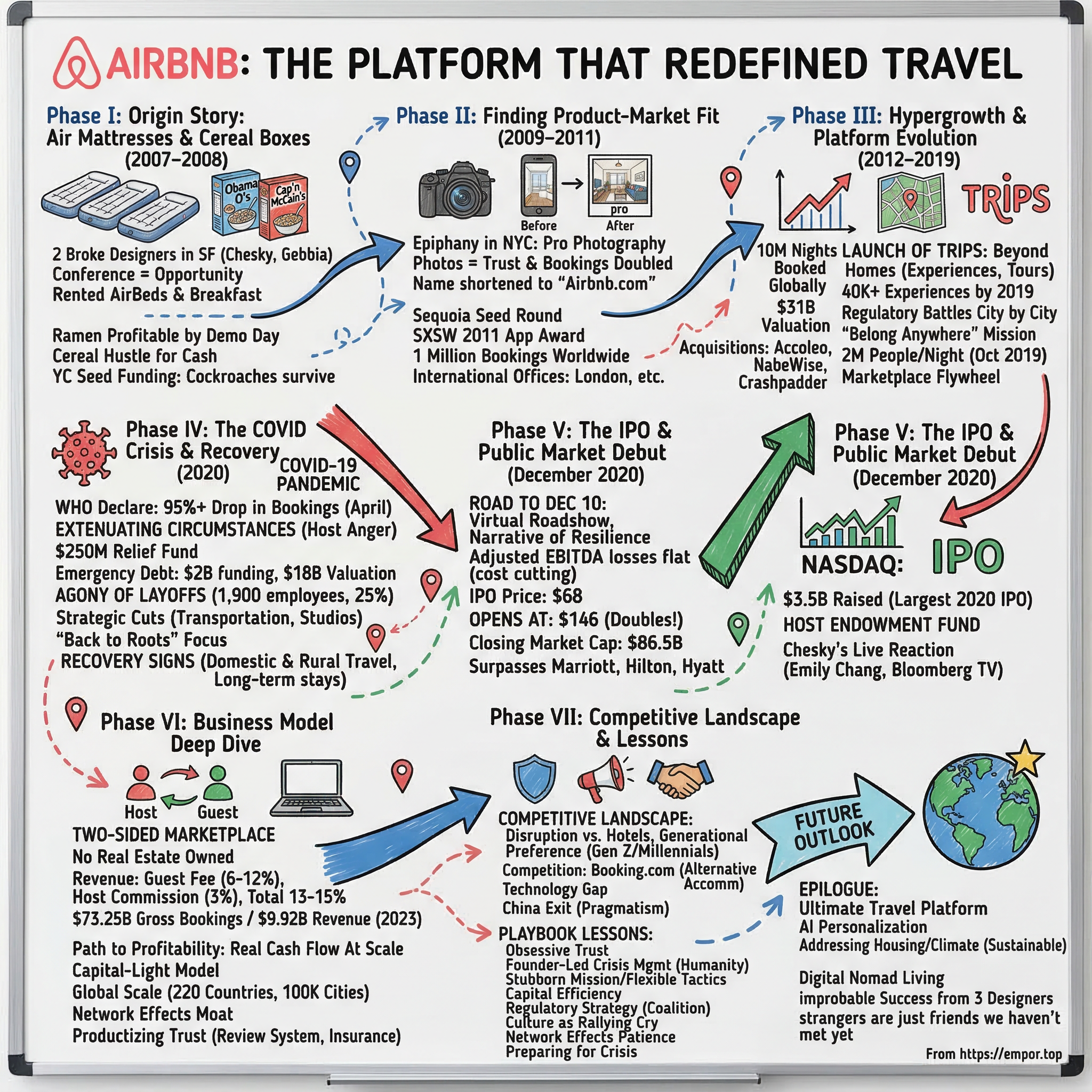
Airbnb: The Platform that Redefined Travel
I. Introduction & Episode Roadmap
On August 6, 2026, Chief Executive Officer Brian Chesky opened Airbnb’s second-quarter earnings call with a stark assertion: "AI is the best thing to ever happen to Airbnb."1 Rather than pointing to the internet, smartphones, or the post-2008 realignment of hotel pricing power, Chesky credited artificial intelligence—the technology many consumer marketplaces spent three years defensively framing as a threat to search-driven business models.
While management presents a bold thesis, the underlying financial performance requires careful examination. In the quarter ending June 2026, Airbnb generated $3.6 billion in revenue, up 17% year-over-year, supported by a 16% rise in gross booking value to $27.2 billion. Booked nights and experiences grew 10%, accelerating from the previous quarter. Net income reached $816 million, while adjusted EBITDA hit $1.3 billion at a 35% margin. Quarterly free cash flow came in at $1.3 billion, bringing trailing twelve-month free cash flow to $4.8 billion at a 37% margin.2 Operating without physical inventory or property assets, Airbnb continues to generate software-like profit margins on a global hospitality model.
That profitability marks a striking contrast to where the public market story began. On December 10, 2020, amid global pandemic travel disruptions, Airbnb priced its initial public offering at $68 per share, selling 51.3 million Class A shares to raise roughly $3.5 billion.3 The stock opened the following morning at $146 and closed at $144.71, giving the company a first-day market capitalization above $86 billion—a 113% first-day gain that reflected substantial initial mispricing.4 By late August 2026, the stock traded near $192 with a market capitalization of roughly $114 billion. That modest valuation growth reflects earnings expansion and share buybacks rather than multiple expansion.
This gap between strong operational metrics and conservative market returns forms the central tension of Airbnb's story. While the company operates an efficient marketplace, its core product of short-term residential rentals faces mounting legislative restrictions across key metropolitan markets. Meanwhile, its take rate faces practical limits, and its 2026 growth reacceleration relies on emerging initiatives—including hotel listings, ancillary services, and AI-driven search—that remain in early stages of deployment.
The analysis ahead examines five core themes. First, the trust engine: how founders without hospitality experience built sufficient consumer confidence in peer-to-peer lodging to unlock brand-new market liquidity. Second, the 2020 crash and functional rebuild, during which management restructured the organization, reduced performance marketing toward zero, and established that organic demand drove the vast majority of user traffic. Third, capital allocation: shifting away from a mixed acquisition record toward aggressive share repurchases as the primary deployment of cash. Fourth, the competitive landscape: navigating rivalries with Booking Holdings, Expedia's Vrbo, legacy hotel chains, and regional platforms. And fifth, the regulatory stress test: examining how major urban markets like New York and Barcelona have restricted short-term rental business models.
Understanding these dynamics requires returning to the company's origins: a San Francisco apartment on Rausch Street where an unpaid rent bill triggered the initial concept.
 Subscribe on LinkedIn
II. The Air Mattress & Cereal Box Origins (2007–2008)
The Rausch Street problem
When a major design conference arrived in San Francisco in October 2007, local hotels quickly sold out. Brian Chesky and Joe Gebbia, both Rhode Island School of Design graduates, were sharing an apartment on Rausch Street and struggling to pay rent. To cover the shortfall, they pulled three air mattresses from a closet, launched a basic website, and offered floor space with breakfast to attendees unable to secure hotel rooms.5 Three guests booked the space. The business began not as a strategic market insight, but as a practical solution to a short-term cash flow problem using existing space.
What transformed this initiative into a enterprise was the addition of technical infrastructure. Chesky and Gebbia recruited Nathan Blecharczyk, a Harvard-trained engineer, to build a comprehensive software platform. The requirement went beyond a simple listings directory; the business needed integrated payment processing, identity verification, user messaging, and dispute resolution.
Blecharczyk had commercially developed software since his teens, using the earnings to fund his computer science degree at Harvard, before joining full-time in February 2008 as the sole founder capable of engineering the technical architecture.6 The resulting division of labor established defined roles across the executive team: Chesky directed brand strategy and customer relations, Gebbia managed design and product experience, and Blecharczyk built the core platform infrastructure. Aligning technical capability directly with product design helped the marketplace avoid the integration failures common to early-stage platforms.
Early adoption remained minimal despite multiple attempts to launch the service. At the South by Southwest festival in March 2008, the site generated just two bookings, one of which was made by Chesky himself.6 Operating without institutional capital or meaningful revenue, the founders financed operations through personal credit cards, with Chesky later noting he accumulated approximately $25,000 in card debt during this period.7 Initial investor interest was negligible.
The cereal that bought time
This capital constraint prompted an unconventional fundraising effort ahead of the August 2008 Democratic National Convention in Denver. With venture investors declining to back a platform centered on hosting strangers, the founders focused on the "breakfast" element of Air Bed & Breakfast. They designed and assembled limited-edition political cereal boxes—Obama O's and Cap'n McCain's—selling them at $40 per box to raise tens of thousands of dollars in non-dilutive capital.8
While the cereal sales provided short-term runway rather than a long-term business model, the initiative signaled execution capacity to investors. When Y Combinator co-founder Paul Graham interviewed the team for the accelerator's Winter 2009 batch, he initially expressed skepticism regarding consumer demand for peer-to-peer lodging. The cereal campaign altered his assessment, reasoning that founders capable of selling $4 cereal boxes for $40 could potentially persuade consumers to trust strangers in peer-to-peer accommodation.8
Beyond startup lore, the episode highlighted Airbnb's core operational challenge in 2008: establishing belief—the mutual trust required for strangers to complete transactions without a traditional institutional intermediary. Graham's acceptance effectively underwrote the founders' capacity to build trust in an unproven category, a capability that eventually formed the foundation of the platform.
Acceptance into Y Combinator provided structured mentorship, initial funding, and operating milestones, but establishing a viable liquidity pool required direct field intervention. To build a functioning marketplace, the founders traveled to New York to work directly with hosts on the ground.
III. Finding Product-Market Fit & The NYC Playbook (2009–2011)
The photography campaign
In the summer of 2009, Airbnb's New York listings were struggling to convert, and the founders could not determine the cause from San Francisco. Chesky and Gebbia rented a camera and began visiting host apartments in person. They replaced dim, poorly framed phone photos with professional photography, rewrote listing descriptions, and coached hosts on how to present a home.6 Bookings in the market roughly doubled. The intervention became a canonical case study in Y Combinator's "do things that don't scale" doctrine, demonstrating how direct operational intervention could resolve structural marketplace friction.
The photography initiative solved an information asymmetry problem rather than a standard marketing bottleneck. Hotel guests rely on established corporate brands to standardize quality across locations; a guest booking a private spare bedroom lacks that institutional benchmark. A blurry photograph represented unquantifiable risk. Professional images converted an uncertain listing into an assessable transaction, establishing a template Airbnb applied to subsequent trust features.
The business model evolved alongside the product. Whole-apartment rentals rapidly replaced original air mattress listings as the platform's primary growth driver. By March 2009, the company reached approximately 10,000 users and 2,500 listings, shortening its name from AirBed & Breakfast to Airbnb.6 Shortly after, Sequoia Capital led a $600,000 seed round at a reported $2.4 million valuation—a small fraction of the company's eventual public valuation. Greylock and SV Angel followed with a $7.2 million Series A in 2010.6
Building the trust architecture
In 2011, a host's San Francisco apartment was ransacked by a guest, an incident that quickly gained public attention. Airbnb's initial response was slow and defensive, highlighting that the platform had built a peer-to-peer marketplace without formal mechanisms to remediate losses when user trust failed.
To restore host confidence, Airbnb re-engineered its safety framework. The company introduced double-blind mutual reviews, where feedback is held until both parties submit to eliminate retaliatory ratings, alongside verified identity checks, social network integration, and a $50,000 Host Guarantee. Over the following decade, that policy expanded into $1 million of host damage protection under the AirCover brand, alongside guest-side rebooking and refund guarantees.[^9]
By absorbing tail risk directly onto its balance sheet, Airbnb converted host protection into a competitive moat. The capital required to underwrite high-value property claims created a fixed cost that smaller competitors could not easily replicate without exposing their balance sheets to concentrated losses.
Pre-empting the clones
The company also faced aggressive international expansion by competitors. In 2011, Germany's Samwer brothers launched Wimdu, a well-funded European clone, and offered to sell the entity to Airbnb. Rather than purchase the venture, Airbnb acquired a smaller German rival, Accoleo, using it as an operational base to launch European operations in Hamburg and London ahead of the 2012 Olympics.6 The decision established an operational strategy favoring internal buildouts and targeted talent acquisitions over purchasing established rivals.
With basic trust mechanisms established and European expansion underway, Airbnb's core operational constraint shifted from establishing user credibility to managing geographic scale—and addressing the regulatory scrutiny of municipal governments monitoring short-term rental activity in local housing markets.
IV. Hypergrowth, Capital Deployment, & Regulatory Warfare (2012–2019)
By the mid-2010s, Airbnb had transitioned from an early-stage platform into a dominant global marketplace. Its private valuation rose from roughly $1 billion in 2012 to approximately $31 billion by 2016, a benchmark that later framed public market expectations.7 The company's 2014 "Belong Anywhere" rebrand, featuring the new Bélo logo, shifted consumer positioning from low-cost accommodation toward localized travel experiences—a higher-margin value proposition that proved difficult for rivals to replicate.6
Evaluating the acquisition record
During this expansion phase, Airbnb attempted to enter adjacent travel categories through corporate acquisitions. However, the financial and operational returns from this M&A strategy proved modest.
Luxury Retreats, acquired in 2017 for a reported $200 million to $300 million in undisclosed terms, aimed to raise average daily rates by expanding into professionally managed villa rentals.9 Yet luxury villa supply was fragmented, service-intensive, and operationally incompatible with Airbnb's self-service model. The brand was eventually integrated into Airbnb Luxe without becoming a material driver of earnings.
A larger transaction occurred in March 2019 with the acquisition of HotelTonight, aimed at adding last-minute boutique hotel inventory ahead of the planned initial public offering.10 Initial media reports estimated the transaction at approximately $400 million, largely in pre-IPO equity.11 Airbnb's financial disclosures later recorded total purchase consideration of $441.4 million, funded primarily through cash and 3.2 million Class A shares.12 When global travel collapsed nine months later during the pandemic, hotel inventory suffered severe downturns, delaying the financial return on the investment.
Smaller transactions—including Tilt for social payments, Accomable for accessible listings, Trip4real for local tours, and Urbandoor for corporate stays—served primarily as talent and capability acquisitions, yielding minimal financial impact.
This acquisition record prompted a shift in management's capital allocation strategy. Although Airbnb maintains a formal capital deployment hierarchy prioritizing organic investment, followed by acquisitions or partnerships, and lastly shareholder returns, actual capital deployment has favored share repurchases while M&A activity has remained nominal. On the company's second-quarter 2026 earnings call, Chief Executive Officer Brian Chesky described M&A as "opportunistic," emphasizing that "our bias is always to grow organically and to look secondarily at acquisitions."1
Airbnb Experiences, launched in 2016 to offer local tours and activities, represented another effort to expand into adjacent services.13 Envisioned as a step toward managing the complete travel itinerary, the category faced operational constraints due to host capacity limits. Consequently, Experiences remained financially immaterial for nearly a decade, showing only modest traction by 2026 off a small base.
Municipal regulatory challenges
Alongside its corporate expansion, Airbnb encountered growing friction with municipal governments. Major metropolitan markets—including San Francisco, New York, Paris, Barcelona, Berlin, and Amsterdam—enacted restrictions, asserting that short-term rentals reduced long-term housing supply, inflated residential rents, and evaded local occupancy taxes and safety standards. Airbnb responded by establishing a political and public policy division to mobilize hosts, negotiate tax collection agreements, and challenge restrictive ordinances in court.
For investors, municipal regulation represents a distinct operational risk. While traditional hotel operators view regulation primarily as a compliance cost, short-term rental platforms face jurisdictional challenges that directly question the legality of their core supply. This regulatory exposure remains a primary structural risk for the business—a vulnerability that was soon shadowed by the unprecedented collapse of global travel in early 2020.
V. The 2020 COVID Collapse & Chesky's Turnaround Playbook
In March 2020, the onset of the COVID-19 pandemic brought global travel to a virtual standstill. Airbnb’s bookings across major metropolitan markets collapsed by roughly 80% within eight weeks, with demand in certain travel corridors approaching total elimination. After a decade of expanding its marketplace to align global travel demand with host inventory, the company faced a sudden collapse in core platform activity.
Management's initial emergency response strained relationships with its host community. Airbnb unilaterally overrode individual host cancellation terms and invoked its extenuating circumstances policy to issue full refunds to guests for stays hosts had already anticipated as revenue.38 The decision underscored a fundamental marketplace dynamic: during severe disruptions, platforms prioritize demand preservation over supply protection. To repair host relations, Airbnb committed up to $250 million to cover 25% of what hosts would have earned under their standard cancellation policies for reservations booked before March 14, 2020; by late September 2020, the company had distributed approximately $204 million in compensation.38
To bolster liquidity, Airbnb secured emergency financing in April 2020. Private equity firms Silver Lake and Sixth Street Partners provided $1 billion in debt and equity warrants struck at an $18 billion valuation—a 42% discount from Airbnb's $31 billion private valuation peak in 2016—with an effective interest rate exceeding 10%.1415 A second $1 billion debt facility followed from institutional lenders shortly thereafter. The high interest rates and equity dilution reflected market concern over the company's near-term viability during the height of travel shutdowns.
On May 5, 2020, Airbnb reduced its workforce by roughly 1,900 employees, representing 25% of its total staff.16 Alongside the layoffs, management suspended non-core initiatives, including transportation integration, original content creation at Airbnb Studios, real estate development projects, and standalone hotel onboarding. The company refocused operational resources entirely on its core product: residential peer-to-peer home rentals.
The organizational rebuild. Chesky subsequently restructured Airbnb from a divisional architecture into a unified functional organization. Rather than maintaining independent business units with separate product, engineering, and marketing resources, the company centralized operations under single functional heads aligned to a shared product roadmap overseen directly by the CEO.17 Airbnb also replaced continuous software deployments with synchronized biannual feature updates, designated as Summer and Winter Releases.
While a functional structure ensures strategic alignment across product development, it presents operational trade-offs. Centralizing decision-making improves brand consistency but creates execution bottlenecks, as key product choices require executive approval. Management acknowledges that this model depends on intensive CEO involvement in daily product management, introducing a key-person operational risk.
The marketing discovery. During the crisis, Airbnb drastically curtailed performance marketing and paid search spending to conserve cash. Despite the reduction, platform traffic remained resilient. In May 2021, management disclosed that approximately 90% of Airbnb's user traffic arrived through direct or unpaid channels, enabling the company to maintain near-2019 traffic levels while cutting total marketing expenditure in half; during the first quarter of 2021, sales and marketing expenses declined 28% year-over-year.18
This high proportion of organic traffic highlights a key distinction between Airbnb and online travel agency peers such as Booking Holdings and Expedia. While traditional aggregators rely heavily on paid search auctions to acquire consumer intent, Airbnb benefits from strong brand recognition that drives direct user navigation. In 2019, Airbnb allocated $1.62 billion to sales and marketing against $4.81 billion in revenue, representing roughly 34% of revenue. By 2025, sales and marketing expenditure totaled $2.59 billion against $12.24 billion in revenue—dropping to 21% of revenue. This 13-percentage-point margin expansion represents a major driver of Airbnb's post-pandemic profitability.
However, organic customer acquisition does not eliminate marketing capital requirements. Airbnb continues to allocate over $2.5 billion annually to marketing, primarily dedicated to global brand campaigns where return on investment is less directly trackable than performance search auctions. Additionally, management has not regularly updated the 90% direct-traffic metric since 2021, making it a historical baseline rather than an ongoing operational key performance indicator.
By the third quarter of 2020, driven by a surge in domestic and drive-to travel alongside a reduced operating cost structure, Airbnb returned to quarterly profitability while traditional hotel operators continued to experience losses. Six weeks later, on December 10, 2020, the company launched its initial public offering.
VI. The Landmark IPO & Capital Structure
The December 2020 listing took place under unusual capital market conditions. In the calendar year of its public debut, Airbnb incurred a net loss of $4.58 billion on $3.38 billion in revenue—a loss expanded by stock-based compensation charges and impairments tied to the offering—yet the stock was priced above its raised target range and doubled on its first day of trading.19 Beyond the initial market valuation, the primary analytical significance of the listing lies in the capital structure management established during the transaction.
Twenty votes per share
Airbnb established a multi-class stock structure upon going public, creating four distinct share classes. Class B shares carry 20 votes per share and remain concentrated among the co-founders. As of April 2026, Chesky controlled roughly 32% of total voting power through combined Class A and Class B holdings, while a voting agreement dated December 4, 2020 binds Chesky and Blecharczyk for beneficial ownership purposes.20 Consequently, the founders retain effective corporate control while holding a minority economic stake.
This governance structure introduces dual implications for public shareholders. On one hand, concentrated founder control protected management during the 2020 restructuring, allowing leadership to eliminate non-core product lines, sharply curtail marketing expenditures, and reorganize operations around a functional hierarchy—decisions that an external executive subject to quarterly market pressures might have struggled to execute. On the other hand, the multi-class framework limits standard shareholder accountability mechanisms. If execution deteriorates, public investors have no practical mechanism to compel managerial changes or launch an activist campaign, resulting in a persistent governance discount.
The host equity experiment
A second structural decision was the creation of the Host Endowment Fund. In November 2020, Airbnb issued 9.2 million shares of non-voting Class H common stock to a wholly owned subsidiary, earmarked to fund grants and initiatives for its host community.21 Class H shares carry no voting rights and automatically convert to Class A shares upon sale outside the entity. While linking host incentives to equity upside carries strategic logic, the arrangement leaves voting control over the share block with corporate management rather than the host community. Through mid-2026, the fund's practical contribution to host economics has remained modest.
Paying off the rescue
A third structural priority was rapid balance-sheet deleveraging. Utilizing IPO proceeds and the cash flow recovery of 2021 and 2022, Airbnb paid off the high-interest debt secured from Silver Lake and Sixth Street during the 2020 crisis ahead of schedule. By the end of 2025, corporate liquidity—comprising cash, cash equivalents, short-term investments, and restricted cash—reached $11.0 billion, alongside $7.0 billion in funds held on behalf of guests.2 By June 30, 2026, corporate liquidity expanded to $12.1 billion, while funds held on behalf of guests reached a seasonal peak of $12.2 billion.22
This substantial sum of guest funds represents a foundational element of Airbnb's financial model, generating interest income on unearned booking balances prior to host payout.
VII. Core Business Deep Dive & Financial Engine
The float
The mechanics of this guest fund float form the core of Airbnb's financial model. When a guest books a stay in March for a July visit, Airbnb collects payment immediately while holding the funds until roughly 24 hours after check-in. For up to four months, the platform operates on customer capital.
This structural negative working capital explains why Airbnb generated $4.6 billion in free cash flow in 2025 against $2.5 billion in net income.2 Every incremental booking funds operations before incurring delivery costs. Operating without physical inventory, real estate assets, or major capital expenditures, Airbnb's cash flow statement reflects free cash flow virtually identical to operating cash flow. In expansion periods, the float grows alongside booking volume; conversely, during demand contractions, the float unwinds rapidly—a dynamic that drove cash burn during the 2020 travel decline.
How the revenue is actually earned. Gross booking value (GBV) represents total nights and experiences booked multiplied by the average daily rate, including fees and taxes. Revenue reflects the portion Airbnb retains. Historically, service charges were split between a host fee of approximately 3% and a guest fee of 10% to 14% added to the nightly rate. In October 2025, Airbnb began migrating hosts to a single 15.5% service fee absorbed entirely by the host, who adjusts displayed nightly rates accordingly.2 By mid-2026, roughly half of active listings had transitioned to the single fee structure, with the remaining listings scheduled for migration by the end of the year.1
The transition addresses structural pricing distortions. Under the split-fee model, property managers listing across Airbnb, Booking.com, and Vrbo set identical base rates, but Airbnb's additional guest fee made properties appear more expensive at checkout. Transitioning to a single host fee eliminates this display disparity. Chief Financial Officer Ellie Mertz stated the shift puts "downward pressure on pricing to allow us, one, to offer more value to guests, but also ensure that we are priced competitively relative to other platforms."1 The policy serves as a price-competitiveness adjustment presented as fee simplification, addressing historical price-perception disadvantages against traditional online travel agencies.
Concurrently, deferred payment options alter working capital dynamics. The platform's Reserve Now, Pay Later feature—allowing guests to secure bookings without immediate upfront charges—represented over 20% of global GBV by the second quarter of 2026 and contributed to increased booking volume, longer lead times, and higher conversion among first-time bookers.221 However, deferring cash collection closer to check-in reduces immediate float accumulation. Mertz noted that unearned fees would have expanded year-over-year in the second quarter absent the deferral program.1 Management is effectively exchanging a portion of its cash float advantage for higher booking volume and improved competitive positioning—a trade-off that tempers historical free-cash-flow conversion ratios.
The take rate. The implied take rate—calculated as revenue divided by gross booking value—stood at 13.6% in the fourth quarter of 2025, down from 14.1% a year earlier, before stabilizing at 13.2% in the second quarter of 2026.222 Management attributed these fluctuations to foreign exchange headwinds and timing differences between bookings and stays, reinforced by payment deferrals under Reserve Now, Pay Later. For full-year 2026, leadership projected a flat take rate, with Mertz noting the metric would have been "slightly higher" were it not for promotional incentives introducing new services.1
Operational metrics indicate that Airbnb's take rate has remained within a tight historical corridor, with management offering no commitments to structural expansion. This stabilization suggests an effective monetization ceiling. Host resistance to fee increases, guest sensitivity to total checkout costs, and a single-fee migration designed to enhance price competitiveness all limit near-term pricing power. Consequently, models relying on take-rate expansion as a primary revenue catalyst assume monetization leverage that operational execution does not support.
Margins and their composition. In full-year 2025, Airbnb generated $12.24 billion in revenue, $4.3 billion in adjusted EBITDA at a 35% margin, $2.51 billion in net income at a 21% margin, and $4.6 billion in free cash flow at a 38% margin.2 For 2026, management raised full-year adjusted EBITDA margin guidance to at least 35.5% while projecting revenue growth in the mid-teens.1
Evaluating earnings quality requires examining key accounting exclusions and historical tax effects. Adjusted EBITDA excludes stock-based compensation, which totaled $1.59 billion in 2025—representing roughly 13% of revenue and 37% of net income.2 Stock-based compensation represents an ongoing operational expense, particularly as Airbnb bids for technical talent against leading artificial intelligence laboratories. Furthermore, full-year 2023 net income of $4.79 billion was distorted by a non-recurring $2.9 billion deferred tax asset valuation allowance release, rendering historical net margin comparisons non-standard.
Statutory tax changes provide a non-operational tailwind to cash conversion. Airbnb's 2025 effective tax rate reached 20%, incorporating a one-time $213 million valuation allowance against corporate alternative minimum tax credits, partially offset by a $60 million reserve release. Management guided long-term effective tax rates down to the mid-to-high teens beginning in 2026, following the passage of federal tax legislation on July 4.2 This legislative adjustment expands after-tax cash flow without requiring underlying operating margin improvement.
Geography. In 2025, North America generated $5.20 billion in revenue, Europe, the Middle East, and Africa (EMEA) contributed $4.73 billion, Latin America delivered $1.16 billion, and Asia Pacific accounted for $1.16 billion.23 North America and EMEA represent over 80% of total revenue, operating as mature markets characterized by high average daily rates (ADRs) and moderate expansion rates. Growth concentrates in emerging regions: Latin America experienced nights booked growth in the high teens in the fourth quarter of 2025 and roughly 20% in the second quarter of 2026, while Asia Pacific grew in the mid-to-high teens, supported by a 50% year-over-year increase in Indian outbound nights and a 60% gain in first-time bookers.222 Management consistently highlights Brazil, Japan, and India as primary expansion targets.
Geographic expansion faces a structural mix limitation. The fastest-growing markets remain the smallest in absolute terms and generate lower average daily rates. Expansion in emerging regions has a limited immediate impact on consolidated revenue compared to minor growth changes in mature markets. Consequently, management's disclosure that booking growth accelerated in the United States, France, the United Kingdom, and Australia during the second quarter of 2026 provided greater financial impact than high percentage gains in smaller international regions.1
Capital allocation. Since launching its share repurchase program in the third quarter of 2022, Airbnb has deployed over $16 billion across share buybacks and employee tax withholdings, reducing its fully diluted share count by approximately 10%.22 In 2025, the company repurchased $3.8 billion of common stock, absorbing over 80% of annual free cash flow. As of June 30, 2026, $3.4 billion remained under authorization.
Evaluating capital return efficacy requires accounting for share issuance. Deploying $16 billion over four years achieved a 10% net share reduction primarily because annual stock-based compensation of approximately $1.5 billion continuously increases share supply. As a result, repurchases serve dual functions: absorbing equity dilution from executive compensation and reducing total share count. Because dilution offsets a substantial share of repurchases, the net equity reduction yield remains significantly below gross capital deployment figures.
These cash generation and capital deployment dynamics focus attention on long-term expansion sustainability—specifically, whether Airbnb can sustain core growth while navigating expanding competitive and regulatory challenges.
VIII. Competitive Landscape & Industry Structure
Consider an Amsterdam apartment that a family of five seeks to reserve for a week in July. Booking.com will display the listing. Vrbo will display it as well. Increasingly, Google will present it directly in search results. The fundamental competitive question is not whether rivals possess alternative accommodation inventory—they do, in substantial volume—but where the traveler starts the search.
Benchmarking the field
Booking Holdings represents Airbnb's largest and most formidable competitor, generating $26.9 billion in 2025 revenue—more than double Airbnb's top line—while expanding its alternative accommodation inventory beyond 8 million listings and growing room nights at double-digit rates.2425 Booking's advantages stem from dominant European hotel distribution, a refined merchandising infrastructure spanning flights and attractions, and a zero-guest-fee model that charges hosts a commission of roughly 15% or higher while presenting a transparent price at checkout.
The operational distinctions between the two platforms are structural rather than promotional. Booking's supply skews toward professionally managed properties, whereas Airbnb emphasizes individual hosts and unique residential spaces—such as a single-family home with a yard that traditional hotel chains cannot replicate. Furthermore, Booking relies predominantly on purchased demand, whereas Airbnb relies on owned brand equity. Purchased demand is capital-intensive but offers predictable, immediate scalability; owned demand carries lower direct acquisition costs but requires long-term brand building and remains vulnerable to public perception risks, where guest dissatisfaction over cleaning fees or safety incidents cannot be easily mitigated through search-engine bidding.
Expedia Group, operating through Vrbo, maintains strong positioning in North American suburban and vacation-home rentals, though it has struggled to build comparable urban single-room inventory or international brand liquidity.26 Notably, Expedia's 2026 acquisition of car rental technology provider CarTrawler—which also serves as Airbnb's partner for its vehicle rental initiative—placed a direct competitor inside Airbnb's supply chain. During the second-quarter 2026 earnings call, Chief Executive Officer Brian Chesky expressed confidence that the partnership would persist, asserting that the transaction would not alter Airbnb's approach to corporate M&A.1 However, relying on supply-chain partners controlled by direct competitors highlights a structural vulnerability in Airbnb's broader service expansion strategy.
Traditional hotels—such as Marriott, Hilton, and Hyatt—compete through standardized accommodations, loyalty programs, corporate travel contracts, and consistent service delivery. Because these hotel groups operate or franchise physical real estate, their asset-heavy model provides operational stability but limits inventory agility. A hotel chain cannot rapidly add residential villas in Tuscany to its inventory. This constraint reflects classic counter-positioning: hotel brands cannot replicate Airbnb's peer-to-peer structure without undercutting the franchise economics supporting their primary business.
Rather than competing directly against boutique property operators, Airbnb began integrating hotel listings into its platform. Launching a pilot program in the fourth quarter of 2025 across New York, Los Angeles, Madrid, and San Francisco, Airbnb partnered directly with boutique and independent hotels—focusing strategically on metropolitan markets where regulation constrains residential home supply.2 By the second quarter of 2026, the initiative expanded to roughly 20 cities, with hotel booking nights growing approximately three times faster than residential home bookings off a single-digit percentage base, while Chesky reported that roughly 35% of first-time hotel bookers returned to book a home rental on the platform.1
If verified over time, this metric indicates that hotel listings serve less as a product diversification play and more as a conversion mechanism designed to capture user traffic that might otherwise leave the platform. However, because management disclosed this figure without detailed underlying methodology and on a relatively small volume base, the conversion effect remains an operational claim to monitor rather than a proven structural driver.
The Asian retreat
Asia represents Airbnb's most explicit strategic retreat. In May 2022, Airbnb closed its domestic mainland China listings business—which had accounted for roughly 1% of total revenue—after years of losing market share to local rivals 途家 Tujia and 小猪 Xiaozhu, shifting its regional focus exclusively to outbound Chinese travel.27 Across the broader Asia-Pacific region, Airbnb competes against Trip.com Group's dominant Chinese distribution network and Meituan's super-app ecosystem, which bundles hotel inventory alongside food delivery and local services. Although Airbnb's Asia-Pacific revenue grew at a high percentage rate through 2026, the region remains its smallest geographic contributor in absolute dollar terms. Exiting domestic China reflected rational capital allocation, but it also underscored the limits of Airbnb's brand-led model in markets where consumer adoption is driven by integrated multi-service applications.
Myth vs. reality. Three consensus beliefs about Airbnb's competitive position deserve correction.
Myth: Airbnb does not spend on marketing. Reality: The company allocated $2.59 billion to sales and marketing in 2025, representing roughly 21% of total revenue.23 The shift following the 2020 restructuring altered marketing composition—prioritizing brand campaigns over paid search auctions—rather than eliminating marketing capital requirements. Furthermore, brand advertising is harder to evaluate for direct return on investment, and management has not updated its 90% direct-traffic metric since 2021.
Myth: Hotels represent Airbnb's primary competitive threat. Reality: Traditional hotel chains have never been Airbnb's primary operational hurdle. The main competitive challenge comes from Booking Holdings, which has assembled an alternative accommodation supply base larger than 8 million listings while charging guests no service fees at the point of price comparison.25
Myth: Municipal regulation is a manageable cost of doing business. Reality: In metropolitan markets where restrictions have been enforced most aggressively, regulation has removed roughly 80% to 90% of active listings rather than simply taxing transactions.33 In these jurisdictions, regulatory intervention functions as a market exit rather than an operational tax line.
Google represents a persistent structural threat to platform distribution. Google Travel can disintermediate top-of-funnel search intent by answering booking queries directly before users navigate to third-party travel platforms. Airbnb's primary counter-strength is that a majority of its users navigate via native mobile applications rather than web search engines: in the second quarter of 2026, nights booked on the app grew 23% year-over-year to reach 64% of total bookings, up from 59% a year earlier.1
This expanding mobile app share provides tangible evidence of brand affinity and user retention. However, the emergence of AI-driven conversational assistants introduces a more complex distribution challenge. If consumers increasingly delegate travel planning and execution to autonomous AI agents, platform value will shift toward entities controlling inventory fulfillment and booking API access rather than consumer brand recognition. While Brian Chesky previously acknowledged publicly that artificial intelligence represented "the only existential risk to this company," management now contends that AI deployment will enhance marketplace efficiency.1 Whether AI tools act as a competitive moat or a disintermediation vector remains an unproven operational thesis that will ultimately be determined by user adoption rather than executive assertion.
IX. Management, Governance, & "Founder Mode" Execution
Brian Chesky: the designer in the chair
Brian Chesky leads Airbnb as a designer operating a $114 billion enterprise. The company operates without a conventional Chief Product Officer; instead, the product organization reports directly through an operational structure Chesky personally arbitrates. He reviews interface details, names internal product initiatives—such as Project Y for conversion optimization and Project Hawaii for its predecessor pipeline—and discusses technical updates on earnings calls using the detailed vocabulary of a product manager.1 This centralized approach concentrates product authority with the chief executive, maintaining design consistency while creating key-person operational exposure.
Following the 2020 commitment to permanently reduce cost structures and refocus on the core platform, management maintained sales and marketing expenses near 21% of revenue—down from 34% in 2019—while holding adjusted EBITDA margins above 35% and avoiding the re-expansion of non-core ventures. This multi-year record demonstrates disciplined execution against stated cost targets, though financial disclosure has narrowed in other areas. Airbnb no longer regularly quantifies the 90% direct-traffic share cited during its initial recovery, while emerging growth vectors—including boutique hotel listings, ancillary services, and local experiences—are reported using qualitative descriptions such as a "single-digit percentage of nights" or "growing three times faster" rather than absolute dollar metrics. Additionally, a pattern of conservative financial guidance consistently exceeded by reported results limits the visibility of management's internal operational baseline.
The bench around him
Nathan Blecharczyk, co-founder and Chief Strategy Officer, directs host strategy and municipal regulatory affairs—a critical portfolio that governs local supply legality across key international markets. Assigning a founder-level executive to lead regulatory negotiations reflects the strategic importance of preserving inventory liquidity against municipal restrictions.
Ellie Mertz became Chief Financial Officer on March 1, 2024,28 succeeding Dave Stephenson, who moved to Chief Business Officer effective January 1, 2024.29 Mertz, who advanced through Airbnb's finance leadership following a decade at Netflix, has maintained a measured approach to public disclosures. When asked during the second-quarter 2026 earnings call by Goldman Sachs analyst Eric Sheridan regarding long-term incremental margins, Mertz declined to provide specific 2027 targets, emphasizing the company's history of balancing investment cycles with margin expansion and noting "a relative floor in our ability to continue to invest."1
Joe Gebbia, co-founder and board member, has not held an operating role at Airbnb since July 2022. Gebbia directs prefabricated housing venture Samara, serves on Tesla's board of directors, and in August 2025 was appointed as the U.S. government's first Chief Design Officer to lead the National Design Studio, following prior work with the Department of Government Efficiency.3031 After Airbnb publicly distanced itself from his political activities in 2025, his external role highlighted a governance consideration, as high-profile political appointments for sitting directors can create reputational complexity for a global brand negotiating across diverse municipal jurisdictions.
Management's operational alignment is reflected in its 2026 guidance adjustments. In February 2026, leadership outlined four strategic priorities—improving core services, expanding geographically, introducing new offerings, and integrating artificial intelligence—while projecting full-year revenue growth of "at least low double digits" with stable adjusted EBITDA margins.2 By May, management raised revenue guidance to the low-to-mid teens, and by August increased projections to at least mid-teens growth while raising the adjusted EBITDA margin floor to 35.5%.137 Throughout these upward financial revisions, the four underlying strategic pillars remained consistent.
To strengthen engineering execution, Airbnb hired Ahmed Abdalla as Chief Technology Officer from Meta, where he previously led development for the Llama open-source model effort. Chesky stated the appointment shifted Airbnb "from a company that was a middle-of-the-pack company for AI to a leader in AI, at least amongst companies that are not frontier labs or hyperscalers."1 While executive assertions regarding AI capabilities require ongoing market verification, internal operational metrics indicate increased development throughput: management reported that concept-to-launch deployment times for major features decreased by up to 60%, while the volume of features released in the first half of 2026 increased nearly 80% year-over-year.1 Whether this accelerated development pace yields proportional financial returns remains tied to long-term booking expansion and conversion gains.
X. Future Optionality & Hidden Growth Engines
The horizons, in management's own sequence
During Airbnb's second-quarter 2026 earnings call, Chief Executive Officer Brian Chesky outlined a structured timeline for the company's future growth initiatives, organizing expansion strategy across distinct operational horizons.1
The immediate focus remains the core residential rental marketplace, where management views dynamic pricing as its primary near-term growth catalyst. Because Airbnb relies on independent hosts who often set static rates for complex, date-sensitive inventory, property pricing frequently lags real-time market demand. Chesky described an upcoming AI-driven pricing tool as a larger growth driver than the Reserve Now, Pay Later payment feature, envisioning automated revenue management for Airbnb's 5.5 million hosts. By integrating local hotel pricing, event calendars, and booking lead times into automated host recommendations, the platform aims to lower average nightly prices to drive higher overall occupancy and booking volume—a strategy that aligns with its migration toward a single host fee structure.
To address potential contradictions between rising average daily rates (ADRs) and stated affordability goals, Chief Financial Officer Ellie Mertz highlighted growth in bedroom nights, asserting that higher average rates reflect a mix shift toward larger property bookings rather than price inflation on single rooms, with bedroom night growth outpacing overall nights booked.1 However, because Airbnb does not publicly disclose detailed bedroom-night metrics, this explanation remains difficult to verify independently.
The second operational horizon centers on boutique hotel integration and international expansion, which management projects could generate billions of dollars in incremental revenue. Chesky characterized boutique hotels as an adjacent category that leverages existing platform architecture, noting that traditional hotel resistance to listing on Airbnb eased faster than initially anticipated once formal partnerships were established.
The third, longer-term horizon involves ancillary services and local experiences, which remain in early stages of monetization. Launched in May 2025 and expanded through 2026, services include grocery delivery, vehicle rentals, airport transportation, luggage storage, and resort day passes. Built primarily through partnership models, these services allow Airbnb to collect lead-generation fees without incurring direct fulfillment costs; vehicle rentals represent the largest partner category by transaction value, with rental durations often exceeding average stay lengths. Concurrently, listings for Airbnb Experiences grew nearly 80% year-over-year in the second quarter of 2026, while management disclosed that nearly half of Experience bookings in the fourth quarter of 2025 were made independently of home reservations—suggesting the category functions as a standalone customer acquisition channel.2
Meanwhile, long-term stays of 28 days or more represent a decelerating segment of the business. Through 2025 and into mid-2026, booking growth for short-term stays and large whole-home rentals—particularly properties with four or more bedrooms—consistently outpaced extended rentals.222 Consequently, the extended-stay remote work adoption that fueled growth during the immediate post-pandemic period has subsided as a primary expansion driver.
What is not in the plan
Despite structural parallels to high-margin ad networks operated by Amazon and Booking.com, Airbnb has yet to launch an advertising platform for sponsored host listings. During the second-quarter 2026 call, when asked whether AI-driven search development was delaying an advertising product, management detailed its AI strategy without offering a timeline or commitment for ad monetization.1 As a result, financial models incorporating sponsored listing revenue reflect hypothetical expansion rather than an active corporate roadmap.
Finally, Airbnb began testing AI-powered search in August 2026 across a limited user sample, introducing natural-language query inputs, conversational search results, AI-generated property highlights, and interactive listing pages.1 Management noted that altering search habits for infrequent travel bookers will require extended consumer adoption timelines. Economically, Airbnb benefits from high average order values, meaning computational inference costs represent a minor expense relative to potential conversion gains—particularly as the company relies on third-party infrastructure rather than capital-intensive GPU procurement. Operationally, AI deployment is already generating measurable efficiency in customer service: an automated support assistant operating in over 50 languages resolves nearly 45% of customer inquiries without human intervention, contributing to a 16% year-over-year reduction in support costs per booking.1
While customer support automation provides immediate, quantifiable cost reductions, AI-driven top-line growth remains prospective. Evaluating Airbnb's long-term trajectory requires distinguishing between these demonstrated operational efficiencies and future growth initiatives that remain under early deployment.
XI. Strategic Frameworks: Helmer's 7 Powers & Porter's 5 Forces
Seven Powers, scored honestly
Stripping away narrative positioning reveals that Airbnb's competitive advantage relies on a small set of durable business mechanisms. Hamilton Helmer's Seven Powers framework provides a rigorous lens for evaluating which of these advantages can withstand a well-capitalized competitor.
Brand represents the company's most formidable power. "Airbnb" functions globally as both a noun and a verb, supported by clear operational metrics: 64% of nights booked occurred through its mobile app in mid-2026, while sales and marketing expenses fell from 34% of revenue pre-pandemic to 21%. While competitors can purchase traffic through paid search auctions, they cannot easily replicate the consumer habit of opening a dedicated travel app directly.
Network effects are genuine but more geographically conditional than standard marketplace theory suggests. Airbnb operates a cross-border network, where demand from international travelers drives host acquisition in major tourist destinations, creating a global liquidity pool that competitors cannot easily duplicate market by market. However, the network effect faces local constraints: a traveler seeking accommodation in a specific neighborhood during a precise week requires immediate local supply. A regional competitor with concentrated inventory in a single market can compete effectively without matching Airbnb's global footprint, as Vrbo demonstrates in North American vacation-home markets. Consequently, Airbnb's network effect serves as a strong global defense but a weaker local barrier.
Counter-positioning remains effective against traditional hotel chains, whose asset-light franchise business models prevent them from adopting peer-to-peer home rentals without undermining existing owner relationships. However, counter-positioning offers no protection against online travel agencies like Booking Holdings, which faces no structural conflict and has built an alternative accommodation portfolio of over 8 million listings alongside its core hotel business.25
Scale economies provide modest advantages compared to other digital platforms. Fixed expenditures for platform infrastructure, safety tools, and artificial intelligence development amortize across more than $90 billion in annual gross booking value.2 However, Booking Holdings generates higher overall revenue, and the marginal cost of processing an additional digital booking is negligible across the travel industry. Airbnb's primary scale advantage lies in its risk-underwriting capabilities, such as offering $1 million in host damage protection, which requires substantial transaction volume to absorb property claims without impacting corporate margins.
Switching costs represent the platform's weakest structural defense. While independent hosts face friction when leaving—since review histories, Superhost status, and search rankings cannot be transferred—multi-homing remains standard practice among professional property managers. Property management software allows commercial hosts to list units simultaneously on Airbnb, Booking.com, and Vrbo. Meanwhile, guests face zero switching costs between platforms, relying on price and convenience rather than platform loyalty. As a result, host retention is only partial, while guest retention depends almost entirely on brand strength.
Five forces, and the one that actually binds
Evaluating Airbnb under Porter's Five Forces highlights operational vulnerabilities that headline revenue growth can obscure.
Supplier power (hosts) is low on an individual basis but significant in the aggregate. Across more than 5.5 million hosts, no single provider possesses pricing leverage.22 However, commercial property managers controlling large unit portfolios command greater influence, and Airbnb's transition to a single 15.5% host fee structure required strategic communication to avoid host backlash over nightly rate adjustments.
Buyer power (guests) remains moderate to high. Consumers can compare pricing across competing platforms instantly, and Airbnb's migration to a single fee model reflected recognition that guest-side fee additions created price disadvantages against traditional booking sites.
Threat of substitutes is high across multiple travel categories, including traditional hotel chains, vacation-home aggregators such as Vrbo, Booking's alternative accommodations, and long-term residential leases. Furthermore, in municipal markets enforcing strict short-term rental bans, substitution leads to demand destruction rather than booking diversion.
Barriers to entry represent Airbnb's strongest competitive protection under Porter's framework. Launching a viable competitor requires establishing simultaneous global supply and demand, multi-currency payment processing across more than 220 countries, automated identity and trust infrastructure, host damage guarantees, and years of accumulated user reviews. Capital expenditure alone cannot rapidly recreate these network assets, as demonstrated by early competition from venture-backed clones in 2011.
Competitive rivalry is intense, particularly in European markets where Booking Holdings commands dominant market share and Airbnb operates as a challenger—reversing the competitive hierarchy observed in North America.
Synthesizing these frameworks indicates that Airbnb's economic moat rests primarily on exceptional brand equity, a cross-border network effect that is strongest regionally, and structural counter-positioning against legacy hotel operators. With limited switching costs for guests and modest scale economies in software processing, the platform's competitive advantage is robust yet exposed to structural risks—most notably municipal regulatory intervention rather than direct corporate rivalry.
XII. Skeptical / Activist Stress Test & Current Risk Radar
The regulatory wall
A skeptical case against Airbnb begins not with commercial competition, but with municipal maps and legislative dockets across major global cities.
New York City serves as the clearest illustration of this regulatory risk. Local Law 18 took effect in September 2023, requiring short-term rental hosts to register with the Mayor's Office of Special Enforcement, restricting stays under 30 days to primary residents physically present during the stay, and capping total guests at two.32 The impact was severe: active listings collapsed by 80% to 90%, falling from tens of thousands of units to roughly 3,000 registered properties.33 Airbnb has lobbied continuously for relief, formally petitioning the city for reconsideration in September 2024 and supporting city council legislation to ease the rules.34 Through mid-2026, however, the stringent restrictions remain largely intact.
Barcelona represents an even more direct challenge, substituting strict regulation with a complete phase-out. In June 2024, Mayor Jaume Collboni announced plans to eliminate all 10,000-plus tourist apartment licenses by 2028 by refusing to issue new permits or renew existing ones, citing housing affordability.35 After Spain's Constitutional Court upheld the measure in 2025, the city moved toward effectively removing short-term residential rentals from its housing supply.
Across the European Union, unified data-sharing rules and national registration requirements—such as Italy's mandatory identification code system—have brought transparency to host operations. This shift from an unmonitored market to a strictly enforced compliance environment naturally restricts total supply.
Financial exposure has already materialized. In December 2023, Airbnb's Irish subsidiary settled an audited host income tax withholding dispute with the Italian Revenue Agency for €576 million without admitting liability, leaving subsequent tax years unresolved.36 The magnitude of the settlement creates a potential precedent for tax authorities in other European jurisdictions.
Management contends that regulatory friction is an ongoing operational challenge rather than an existential threat, noting that Airbnb operates across more than 220 countries and regions while generating the majority of its revenue in just five key markets.12 This geographic footprint offers runway to expand in less restricted areas, while integrating boutique hotel listings in constrained urban centers provides an immediate alternative revenue stream.
However, critical investors counter that restricted metropolitan areas represent some of the platform's highest average daily rates and most profitable transaction corridors. Replacing residential room nights in cities like New York with boutique hotel bookings forces Airbnb to compete directly against Booking Holdings and Expedia on traditional hotel inventory, forfeiting its primary structural differentiation. Furthermore, the political pressure linking short-term rentals to local housing costs continues to gain momentum across international markets.
Where an activist would push
A second area of potential activist scrutiny involves growth quality and executive compensation. Nights and experiences booked grew 8% in 2025 and roughly 10% in the first half of 2026—solid operational expansion, but well below historical hypergrowth rates.222 At the same time, stock-based compensation reached $1.59 billion in 2025, up 13% year-over-year, absorbing most of the company's share repurchases simply to prevent net dilution.2 This dynamic raises questions about why a platform generating over 35% adjusted EBITDA margins allocates 13% of revenue to stock compensation without explicit ties to per-share growth metrics. Although management projected that stock-based compensation and headcount growth would decelerate in 2026, second-quarter stock compensation rose to $487 million from $424 million a year earlier, indicating that moderation remains an ongoing test.222
A third concern centers on disclosure asymmetry. Management frequently highlights selective performance indicators—noting that hotel bookings are growing three times faster than residential stays, that 35% of first-time hotel bookers subsequently reserve a home, that bedroom-night growth is accelerating, and that artificial intelligence has shortened feature deployment times by 60%. However, none of these figures are standard, audit-tracked financial metrics. While customary in corporate reporting, this pattern illustrates how narrative positioning can shift toward non-standard metrics as core growth rates normalize.
The live risk radar
Evaluating Airbnb's overall risk radar reveals three material factors and one secondary concern. First, municipal and national regulatory enforcement remains a primary structural risk to inventory growth. Second, consumer discretionary exposure persists; travel remains a highly deferrable expense, as demonstrated in early 2026 when geopolitical conflict in the Middle East drove booking cancellations that created an estimated 100 basis point drag on second-quarter night growth—a headwind that ultimately proved less severe than anticipated.371 Third, platform quality and trust require continuous management, evidenced by the removal of over 550,000 low-quality listings since the deployment of updated host quality controls in 2023.2
Conversely, capital structure risk remains minimal. With $12.1 billion in corporate liquidity, manageable convertible debt obligations, and $4.8 billion in trailing twelve-month free cash flow, Airbnb operates with exceptional balance-sheet strength, making debt refinancing or solvency concerns immaterial.22
XIII. Playbook: Key Lessons for Founders & Investors
Solve the belief problem before the scale problem. Airbnb's early launch attempts stalled not because the basic software was deficient, but because users lacked confidence that transactions between strangers were safe. Professional photography, double-blind reviews, identity verification, and property damage guarantees were not secondary features—they constituted the core product. In any marketplace where transactions carry physical or financial risk, trust infrastructure is the primary asset and everything else is interface.
Manual founder intervention is a diagnostic tool, not just an operational tactic. The 2009 New York photography campaign is often cited as a canonical example of doing things that don't scale. A more analytical reading reveals its primary value was diagnostic: by visiting host apartments in person, the founders discovered that listing presentation, rather than total supply volume, was the core conversion bottleneck—an insight invisible on an operational dashboard. Unscalable manual work matters less for immediate transaction lift than for revealing structural friction.
Distinguish owned demand from rented demand, and know which one you have. When Airbnb sharply reduced performance marketing expenditures during the 2020 crisis, platform traffic remained resilient. That involuntary experiment demonstrated that a decade of brand equity building had produced an asset previously expensed as an ongoing operating cost. Most marketplace operators avoid testing demand elasticity by cutting paid search because they cannot tolerate potential volume declines. For investors, the takeaway is clear: a marketing expenditure that can be reduced without sacrificing volume is not an operational burden—it is evidence of an established brand moat.
Crisis provides the primary catalyst for operational simplification. Management eliminated transportation integrations, content production, and corporate real estate development during the same eight-week window in 2020 when it reduced staff by 25%. Downbeat economic conditions create institutional alignment for restructuring that is difficult to achieve during periods of growth. The ongoing analytical test is whether cost discipline persists after cash generation recovers—a standard Airbnb has maintained by keeping those secondary initiatives dormant through 2026.
Organizational architecture is a strategic choice with a shelf life. Airbnb's centralized functional model succeeds because a product-focused chief executive oversees operations directly across a single core marketplace product. This structure is neither a universal template nor a permanent blueprint. Investors evaluating functional organizations must recognize that the architecture represents a direct dependency on a specific executive, creating inherent key-person and succession risks.
Platform adjacencies succeed when they leverage existing infrastructure and struggle when they require unproven capabilities. Early efforts such as Luxury Retreats and Airbnb Experiences required developing specialized operational capabilities—including concierge management and complex host scheduling—and delivered modest financial returns for years. By contrast, boutique hotel listings leverage Airbnb's established search, payments, identity verification, and dispute resolution architecture with minimal modification. When evaluating platform expansion, the decisive analytical question is not market size, but the degree to which new initiatives reuse existing technical and operational infrastructure.
Capital allocation discipline is demonstrated through action rather than strategic rhetoric. Airbnb's corporate acquisition record between 2017 and 2019 delivered modest financial returns, prompting leadership to pivot away from large-scale M&A toward aggressive share repurchases funded by organic cash flow. Acknowledging underperforming acquisition strategies and redirecting capital toward buybacks offers a more reliable gauge of management discipline than speculative corporate development roadmaps.
XIV. Bull vs. Bear Case & What to Watch
Why Airbnb wins from here
The bull case centers on the reacceleration of Airbnb's core marketplace following multi-year maturity concerns. In the second quarter of 2026, booked nights and experiences grew 10% year-over-year, supported by improving demand across mature markets in the United States, France, the United Kingdom, and Australia. First-time booker growth reached 11%—the highest rate in four years, led by younger travelers—prompting management to raise full-year revenue growth guidance to at least the mid-teens and adjusted EBITDA margins to at least 35.5%.1 For investors, sustaining acceleration across established markets represents a more valuable operational catalyst than relying solely on higher-percentage gains in smaller international territories.
Beyond the core platform, several growth initiatives offer strategic upside. Boutique hotel listings are expanding at roughly three times the rate of residential stays off a single-digit base, with management reporting pull-through conversion into home rentals. Ancillary services operate under asset-light partnership models with minimal incremental capital cost, while listings for local experiences nearly doubled year-over-year. International expansion markets grew nights at roughly twice the rate of core regions through 2025, driven by gains in India, Brazil, and Japan.2 Lower corporate tax rates offer a statutory cash flow tailwind beginning in 2026. Furthermore, operational deployment of artificial intelligence has delivered a 16% reduction in customer support costs per booking alongside a reported 60% compression in feature development timelines.1 Supporting this momentum, $4.8 billion in trailing twelve-month free cash flow funds a share repurchase program that has reduced diluted share count by 10%.22
If even a portion of these hotel, ancillary service, and AI search initiatives land successfully, Airbnb can transition from a single-category home-sharing platform into a broad travel marketplace backed by direct consumer brand equity that competitors cannot easily purchase.
What breaks the case
The bear case does not contend that Airbnb is a weak business, but rather that its operational strengths are already priced into the stock while its long-term expansion faces structural constraints.
Municipal regulation represents the primary risk. The severe supply contractions enforced in Barcelona and New York demonstrate how local housing concerns can compress listing inventory, creating a regulatory precedent that other housing-constrained cities may emulate. Second, monetization options are limited; by actively lowering nightly display prices through single-fee migration and automated pricing tools, management has capped take-rate expansion, requiring revenue growth to rely almost entirely on booking volume. Third, average daily rate growth relies heavily on currency fluctuations and mix shifts; excluding foreign exchange impacts, underlying nightly price appreciation remains in the low single digits.2 Fourth, Booking Holdings operates an alternative accommodation business with over 8 million listings that presents zero guest fees at initial search comparison. Fifth, annual stock-based compensation exceeding $1.5 billion dilutes the net per-share benefit of share repurchases to roughly half their headline dollar value. Finally, the shift toward conversational AI search could shift travel planning to autonomous agent interfaces, disintermediating Airbnb's direct brand relationship—a threat leadership has explicitly acknowledged.
A dual-class capital structure reinforces these operational risks by concentrating voting authority with the founders, leaving public shareholders without governance mechanisms to compel strategic adjustments if execution stumbles. With the equity valued for uninterrupted performance, the business offers limited structural downside protection if primary growth vectors slow.
What to actually track
The three KPIs that matter most.
First, nights and experiences booked growth, evaluated quarterly and broken down by geographic region. This metric serves as the clearest measure of underlying demand, insulated from foreign exchange fluctuations and pricing adjustments. Because Airbnb is suppressing display rates through fee simplification and automated pricing tools, volume represents the true test of strategic execution. Investors should monitor whether North America and Europe, the Middle East, and Africa—which together account for over 80% of revenue—can sustain booking momentum, as emerging market growth alone cannot move consolidated financial results.
Second, implied take rate, calculated as revenue divided by gross booking value and evaluated against management's flat full-year guidance. This metric measures whether Airbnb retains pricing power or faces a structural ceiling. If the take rate stabilizes or expands while booking volume holds, the platform's monetization model is validated. If the take rate trends downward while management cites foreign exchange headwinds and booking timing delays, it indicates that fee adjustments serve as a competitive necessity rather than a monetization lever.
Third, free cash flow per diluted share. Evaluating per-share free cash flow accounts for equity dilution from stock-based compensation, capturing whether capital returns actively compound value for shareholders. With over $16 billion deployed to achieve a 10% net reduction in share count, per-share free cash flow reveals the practical distinction between gross capital deployment and net shareholder value creation.
XV. Epilogue & Long-Term Outlook
Airbnb's evolution features a notable strategic irony. In 2007, its founders rented air mattresses to travelers because local hotels were fully booked. By 2026, the company is actively onboarding boutique hotel inventory, with Chief Executive Officer Brian Chesky arguing that hotel listings strengthen its core residential marketplace. The initial disruptor has increasingly taken on the role of a traditional distributor.
Rather than altering its foundational model, this shift reflects the core asset Airbnb built: an infrastructure designed to manage trust and eliminate uncertainty in peer-to-peer transactions. With over 5.5 million hosts and 2.5 billion cumulative guest arrivals, the specific category of accommodation becomes secondary to the underlying trust network.22 Management's long-term product roadmap envisions expanding beyond short-term travel into residential living and broader platform connections. Yet transitioning from short stays into residential housing presents the highest potential addressable market while facing the sharpest political and regulatory resistance.
Ultimately, Airbnb operates a highly cash-generative business model bound by a distinct structural constraint. The company possesses strong global brand equity, an efficient cost structure rebuilt following the 2020 downturn, negative working capital dynamics that generate substantial organic cash flow, and a track record of operational execution against cost targets. At the same time, its core product faces expanding regulatory restrictions across key metropolitan markets—precisely the high-density travel hubs that drive significant average daily rates.
The company's long-term trajectory depends on whether international expansion, hotel inventory, ancillary services, and AI-driven search features can generate enough incremental volume to offset inventory losses from municipal regulation. Management raised full-year 2026 guidance twice based on early traction across these initiatives. Results from the second quarter of 2026 demonstrate operational acceleration, though long-term adoption across new service categories remains in its initial stages.
Eighteen years after its founding, Airbnb has evolved far beyond its origins. Yet the central question established on Rausch Street—how effectively a digital platform can build trust between strangers, and to what extent municipal authorities will allow that marketplace to operate—remains the fundamental core of the investment thesis.
References
-
Airbnb (ABNB) Q2 2026 Earnings Call Transcript — The Motley Fool, 2026-08-13 ↩↩↩↩↩↩↩↩↩↩↩↩↩↩↩↩↩↩↩↩↩↩↩↩↩↩↩
-
Airbnb Q4 2025 Shareholder Letter — Airbnb, Inc., 2026-02-12 ↩↩↩↩↩↩↩↩↩↩↩↩↩↩↩↩↩↩↩↩↩
-
Airbnb Announces Pricing of Initial Public Offering — Airbnb Investor Relations, 2020-12-09 ↩
-
Airbnb IPO: ABNB starts trading on the Nasdaq — CNBC, 2020-12-10 ↩
-
How Airbnb went from renting air beds for $10 to a $30 billion hospitality behemoth — TechCrunch, 2018-08-12 ↩↩↩↩↩↩↩
-
Airbnb CEO says he wooed first investor with boxes of cereal — CNBC, 2023-04-18 ↩↩
-
Airbnb Acquires Vacation Rental Company Luxury Retreats, Officially Moves Into Luxury — Skift, 2017-02-16 ↩
-
Airbnb to Acquire HotelTonight — Airbnb Newsroom, 2019-03-07 ↩
-
Airbnb Is Paying $400 Million For HotelTonight, Half in Pre-IPO Stock — Skift, 2019-03-08 ↩
-
Airbnb, Inc. Form S-1 Registration Statement — SEC EDGAR, 2020-11-16 ↩
-
Airbnb Raises $1 Billion in Debt and Equity Warrants from Silver Lake, Sixth Street — Bloomberg, 2020-04-06 ↩
-
Silver Lake, Sixth Street Partners Invest $1 Billion in Airbnb — Airbnb Newsroom, 2020-04-06 ↩
-
Airbnb cuts nearly 2,000 employees due to coronavirus pandemic — Fortune, 2020-05-05 ↩
-
Airbnb CEO Brian Chesky on Founder Mode — The Verge (Decoder), 2024-10-18 ↩
-
Airbnb hails early results from shift to brand building over performance marketing — Marketing Week, 2021-05 ↩
-
Airbnb, Inc. SEC EDGAR Filings Profile (CIK 0001559720) — U.S. Securities and Exchange Commission ↩
-
Airbnb Q2 2026 Shareholder Letter — Airbnb, Inc., 2026-08-06 ↩↩↩↩↩↩↩↩↩↩↩↩
-
Airbnb, Inc. Form 10-K Annual Report (FY2025) — SEC EDGAR, 2026-02-13 ↩↩
-
Booking Holdings Investor Relations — Booking Holdings Inc. ↩
-
Booking Holdings Inc. Form 10-K for FY2025 — SEC EDGAR, 2026-02 ↩↩↩
-
Airbnb is closing its domestic business in China — CNBC, 2022-05-23 ↩
-
Airbnb CFO Dave Stephenson moves to new role as company reaches 'inflection point' — CNBC, 2023-12-05 ↩
-
Airbnb Co-Founder Joe Gebbia to Be Named U.S. Chief Design Officer — Skift, 2025-08-21 ↩
-
Tesla Welcomes Joe Gebbia as New Independent Director to its Board — Tesla, 2022 ↩
-
Short-Term Rental Registration Law (Local Law 18) — NYC Mayor's Office of Special Enforcement ↩
-
Airbnb asks NYC to roll back short-term rental law as listings plummet over 80% — Fortune, 2024-09-04 ↩↩
-
Airbnb Asks New York City to Reconsider Short-Term Rental Rules — Reuters, 2024-09-17 ↩
-
Barcelona Announces Plan To Ban Tourist Rental Apartments By 2028 — Forbes, 2024-06-21 ↩
-
Airbnb, Inc. Form 10-K Annual Report (FY2024) — SEC EDGAR, 2025-02-14 ↩
-
Airbnb Q1 2026 Shareholder Letter — Airbnb, Inc., 2026-05-07 ↩↩
 LinkedIn
 WhatsApp
 Reddit
 Hacker News
 Email
Email Kindle
 RSS Feed
 Spotify
 Apple Podcasts
 Amazon Music
 Audible
 YouTube