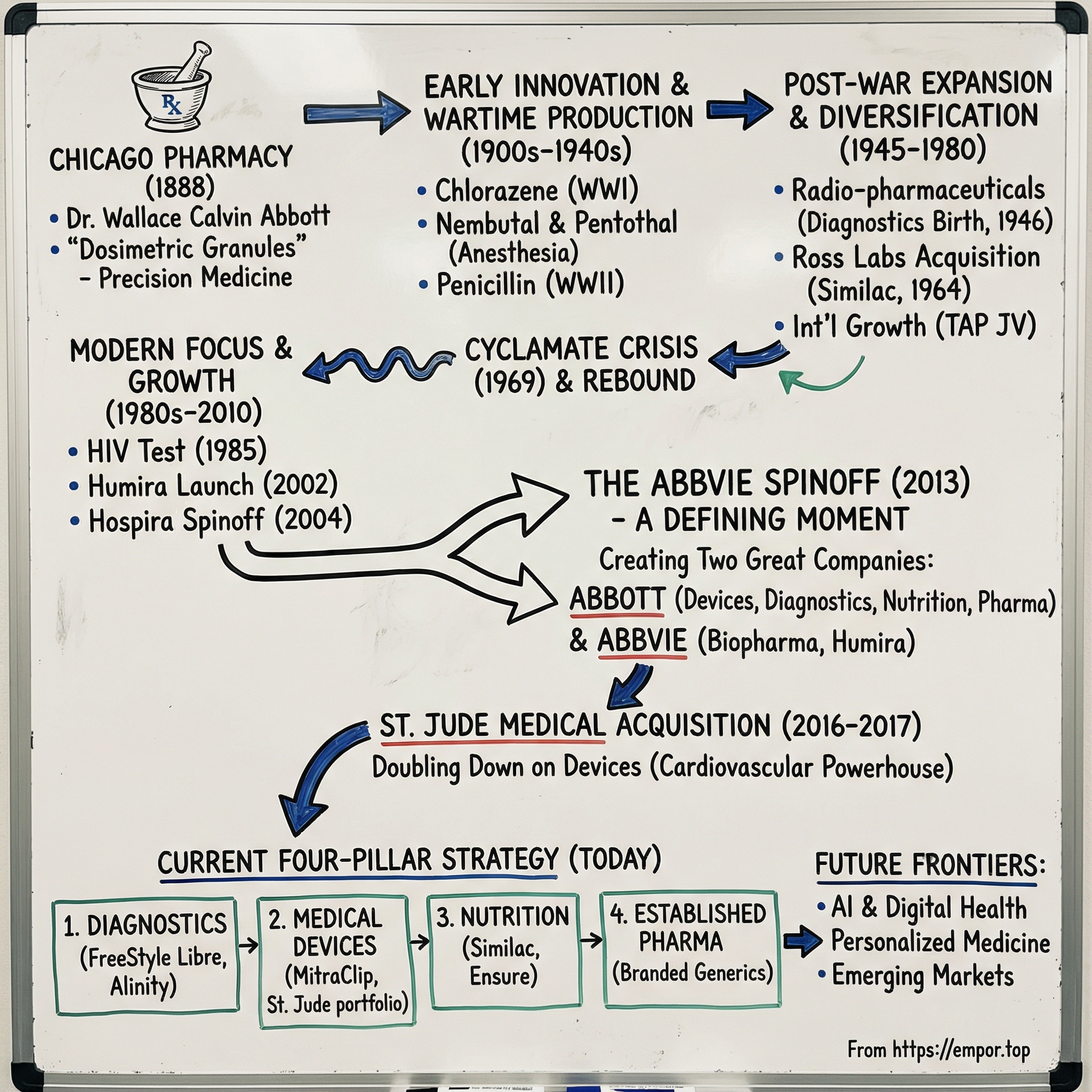
Abbott Laboratories: The Healthcare Conglomerate That Defied Extinction
I. Cold Open & The Conglomerate Imperative
On January 22, 2026, Abbott Laboratories reported full-year results showing sales of $44.3 billion, adjusted earnings per share growth of 10 percent, and a twelfth consecutive quarter of double-digit growth in its medical device business.1 Despite those figures, the stock fell roughly 7 percent that day, touching a 52-week low.2 Three months later, on April 16, management trimmed full-year earnings guidance to absorb integration costs from a $21 billion acquisition, sending the stock down again.3 By mid-May, a company that had increased its annual dividend every year since 1972 was trading at $81.97—the bottom of a 52-week range that had peaked at $137.49.4
On July 16, 2026, Abbott reported second-quarter earnings that exceeded analyst consensus by three cents per share and raised its full-year outlook. The stock rose 10.6 percent in a single session, its largest single-day gain in more than two decades.5 By late August 2026, Abbott carried a market capitalization of roughly $202 billion, nearing its level from the start of the year.4
That nine-month cycle—a 40 percent drawdown followed by a near-total recovery without fundamental changes to core operations—illustrates how public markets evaluate Abbott. The stock rarely re-rates on individual product discoveries. Instead, Abbott operates as a combination of four distinct healthcare businesses, with market sentiment shifting depending on which segment is driving current performance.
By 2026 standards, this multi-industry structure is unusual. Over the preceding decade, public markets systematically encouraged the division of industrial and healthcare conglomerates. General Electric split into three separate companies, Johnson & Johnson spun off its consumer health division, and Siemens separated its healthcare and energy units. The underlying financial logic held that because investors can diversify across sectors independently, corporate bundling of high-growth technology units with mature consumer products creates a valuation discount.
Abbott has maintained its conglomerate structure, managing Medical Devices, Diagnostics, Nutrition, and an established-pharmaceutical division that sells branded generics exclusively outside the United States.6 The company runs four separate customer bases, regulatory frameworks, and sales organizations, retaining this diversified model despite having previously executed a major corporate split.
This structural strategy presents a key analytical question. Proponents view Abbott not as a passive conglomerate, but as an actively managed portfolio that invents, acquires, scales, and divests assets—pointing to the 2013 spin-off of AbbVie as primary evidence. Skeptics argue that Abbott divests transparent, easy-to-value units while retaining complex divisions that obscure underlying growth variations. Financial metrics lend support to both perspectives. The analysis that follows evaluates which reading aligns better with operational data.
That overarching dynamic frames a broader question: how did a 19th-century Chicago pharmacy—founded by a physician formulating alkaloid pills in the back room of a drugstore—grow into the world's largest supplier of continuous glucose monitors, a major cardiovascular device maker, the manufacturer of Similac and Ensure, and, as of March 2026, the owner of the leading at-home colorectal cancer screening test in the United States?
That historical trajectory includes critical operational markers: early dosing innovations that standardized drug manufacturing; two world wars that expanded production capacity; mid-century expansion into infant nutrition and diagnostics; a major corporate spin-off in 2013; a $25 billion medical device acquisition; a contested $5.3 billion diagnostics transaction; a continuous glucose sensor adding roughly $1 billion in annual revenue for three consecutive years; a Michigan plant shutdown that triggered a national infant formula shortage and resulted in $670 million in litigation settlements in August 2026; and ongoing capital allocation decisions under current leadership.
Understanding Abbott's present structure requires examining its history, where early emphasis on manufacturing precision established the operational focus that continues to define the company.
 Subscribe on LinkedIn
II. The Wallace Abbott Era & Granule Revolution (1888–1940s)
In 1888, medicine faced a measurement problem. A physician prescribing a plant-derived remedy—such as belladonna, digitalis, or opium—relied on fluid extracts and tinctures whose potency varied by harvest, solvent, storage, and season. The same prescription, filled twice, could be inert or lethal. Doctors compensated by prescribing conservatively, which often rendered treatments ineffective.
Wallace Calvin Abbott, a Chicago physician in his early thirties running the People's Drug Store on the North Side, addressed this inconsistency directly. Following the work of Belgian dosimetrist Adolphe Burggraeve, Abbott extracted active alkaloids—the chemical compounds responsible for therapeutic effects—and pressed them into small, precisely measured pills he called dosimetric granules.7 The underlying innovation was not chemical discovery, but standardization: physicians purchasing Abbott's granules received guaranteed, uniform dosages.
First-year sales totaled roughly $2,000.7 Adoption spread through physician recommendations based on reproducible clinical results. Abbott sold shares to fellow practitioners and incorporated the business in 1900 as the Abbott Alkaloidal Company, later renaming it Abbott Laboratories in 1915 to reflect its transition from a pharmacy-backed practice to a commercial manufacturer.7
World War I served as an operational catalyst. Prior to 1914, American medicine relied heavily on German synthetic chemistry, but wartime blockades halted imports. Abbott, having spent two decades developing process controls for active compounds, moved into the gap to manufacture domestic alternatives, including procaine as a Novocain substitute, and barbital.7 That pivot established a pattern that endured for the next century: Abbott rarely focused on discovering novel molecules, concentrating instead on manufacturing existing compounds at scale, to exact specification, under tight supply conditions. Manufacturing capabilities compound differently than research breakthroughs—building more slowly, but proving harder for competitors to erode.
The company listed on the Chicago Stock Exchange in 1929, just ahead of the market crash.7 It navigated the Great Depression largely on the strength of its anesthesia portfolio. In 1936, Abbott chemists Ernest Volwiler and Donalee Tabern developed sodium pentothal, a fast-acting intravenous anesthetic that served as the standard induction agent in global operating rooms for decades, earning both researchers entry into the U.S. National Inventors Hall of Fame.7
World War II produced the defining industrial expansion of Abbott's early era. Although penicillin was discovered in 1928 and characterized at Oxford in 1940, global supply in 1941 remained severely limited. When the U.S. government formed a pharmaceutical consortium to scale production, Abbott joined the effort.7 With the underlying science established, the bottleneck centered on mass fermentation, sterility, and yield—the exact operational challenges Abbott had refined over fifty years.
For investors, the founding era demonstrates Abbott's core competitive advantage: process reliability in high-stakes environments where quality is verifiable by professional buyers. That operational discipline persists in 2026, as Abbott manufactures hundreds of millions of disposable glucose sensors annually to precise tolerances required for safe insulin dosing. While product lines evolved over a century, the underlying manufacturing competence remained intact.
What changed after 1945 was the company's willingness to expand beyond physician-only markets.
III. Post-War Diversification & The Consumer Pivot (1950s–1990s)
Postwar Abbott functioned as a mid-sized ethical drug manufacturer built around an anesthesia portfolio and a solid antibiotic business. In 1952, it launched Erythrocin, its brand of erythromycin, which became one of the workhorse antibiotics of the second half of the century.7 Had the company remained exclusively a drug maker, it likely would have been acquired and absorbed by a larger competitor during the industry consolidation of the 1980s.
Instead, three strategic decisions broadened Abbott's operational base, though each initially appeared to move the company away from core pharmaceutical development.
The first was an early commitment to diagnostics. In 1945, Abbott entered radioactive pharmaceuticals, producing isotopes used to visualize and measure biological processes rather than to treat disease.7 Although no commercial market existed at the time, the initiative anchored Abbott in the discipline of biological measurement. By 1973, that effort had expanded into a dedicated Diagnostics Division.7 The underlying commercial logic was straightforward: unlike therapeutics, which aim to cure an illness, diagnostics generate recurring revenue, as every test consumed creates demand for another. That division's most notable early breakthrough arrived in 1985 with the first FDA-licensed blood test for HIV, an assay that made screening the American blood supply possible.7
The second decision established Abbott's nutrition business. In 1964, Abbott merged with M&R Dietetic Laboratories of Columbus, Ohio, maker of the milk-based infant formula Similac; the unit was later renamed Ross Laboratories.7 Acquiring an infant formula producer diverged from conventional pharmaceutical strategy, but it aligned with long-term cash-flow stability. Infant formula is chosen on pediatrician recommendations and frequently anchored to the brand introduced at birth in hospitals. Because brand switching carries high emotional and clinical resistance, formula provided durable, multi-generational demand insensitive to broader economic downturns, balancing the volatile financial cycles of drug development. Ross applied this recurring revenue model to older demographics in 1973 with the launch of Ensure, an adult nutritional supplement aimed at patients unable to maintain adequate diet and intake.7
The third pillar was international partnership. In 1977, Abbott formed TAP Pharmaceuticals, a 50-50 joint venture with Takeda Pharmaceutical, to commercialize Japanese-discovered compounds in the United States.7 TAP became one of the most profitable partnerships in the pharmaceutical industry, driven by prostate cancer therapy Lupron and heartburn drug Prevacid. The arrangement established an operational model Abbott would repeat: capturing distribution economics without bearing initial discovery risk. A decade later, Abbott formed a similar partnership with Taisho Pharmaceutical to commercialize the antibiotic clarithromycin as Biaxin.
Counterbalancing these successes was a major consumer product failure that reshaped Abbott's corporate risk posture. Under president Edward Ledder, Abbott expanded heavily into consumer goods in the late 1960s, led by the artificial sweetener Sucaryl. By 1969, cyclamate-based products accounted for roughly a third of Abbott's consumer product revenues—about $50 million.8 When the FDA banned cyclamates on safety grounds, the U.S. market for the sweetener collapsed in 1970.8 Abbott challenged the ruling, arguing that the underlying safety evidence was insufficient, but the ban remained in effect.
The lesson Abbott drew was not to abandon consumer markets—the company subsequently expanded Similac and Ensure. Rather, management recognized that relying on a single molecule under a single regulatory regime created systemic vulnerability that could eliminate a product line overnight, regardless of brand equity. That experience reinforced Abbott's multi-divisional structure and entrenched an institutional resistance to corporate simplification.
One additional transaction from this period proved disproportionately important over the long term. In 1996, Abbott acquired MediSense, a Massachusetts-based manufacturer of electrochemical blood glucose test strips for diabetics, for $867 million.8 Positioned at the time as a standard diagnostics addition, the purchase gave Abbott a footprint in a category then dominated by manual finger-stick monitors. That same year, Robert Ford, who would later become chief executive officer, joined Abbott's diabetes care unit. Neither the acquisition nor the hire appeared transformative at the time.
By the late 1990s, Abbott operated as a diversified healthcare company spanning pharmaceuticals, medical devices, diagnostics, nutrition, and hospital products. However, it was also cultivating a single pharmaceutical asset whose eventual commercial scale would threaten to overshadow the rest of the enterprise.
IV. The Spinoff Masterclass: Splitting AbbVie and Redefining Abbott (2011–2013)
That asset was Humira.
Abbott had not discovered adalimumab. The antibody arrived with the pharmaceutical acquisition of BASF's Knoll Pharmaceuticals business and won approval in 2002, eventually becoming the most successful product Abbott ever sold.9 By the late 2000s, Humira was on track to become the world's best-selling prescription drug. Yet owning it presented a strategic dilemma.
Public markets evaluate pharmaceutical earnings differently than medical device earnings. Branded pharmaceutical cash flows carry terminal risk from patent expirations, forcing investors to capitalize those earnings at lower valuation multiples anchored to unforecastable R&D pipelines. By contrast, earnings from medical devices, diagnostics, and consumer health decay slowly, defended by manufacturing scale, clinical integration, and installed equipment bases rather than patent filing dates. As a result, non-pharmaceutical healthcare businesses command higher valuation multiples.
In 2011, Abbott reported both under a single corporate umbrella, resulting in a blended valuation multiple that satisfied neither investor base. Pharmaceutical investors resisted holding mature consumer nutrition lines, while device investors hesitated to underwrite the looming Humira patent cliff. Chief Executive Officer Miles White, who had spent a decade assembling the conglomerate portfolio, concluded that the corporate structure itself had become a valuation drag.
On October 19, 2011, Abbott announced a plan to separate into two independent public companies.10 One entity—retaining the Abbott name—would hold the diversified medical products portfolio spanning devices, diagnostics, nutrition, and international branded generics, generating roughly $22 billion in annual revenue. The second entity would take the research-based pharmaceutical portfolio, accounting for about $18 billion in annual revenue anchored by Humira, Lupron, Synagis, and Kaletra, to be named later.10 The pharmaceutical business was named AbbVie, and the tax-free spinoff was completed on January 1, 2013, with Abbott shareholders receiving one share of AbbVie for each Abbott share held.
The separation fundamentally reshaped capital allocation incentives. AbbVie, facing eventual patent expiration on Humira, reinvested its cash flows into acquiring and developing successor therapies—most notably Allergan, Skyrizi, and Rinvoq. Abbott, unburdened by patent-cliff exposure, was able to focus reinvestment on compounding durable growth across steady, high-margin categories. Neither strategy could have been executed as efficiently within a shared balance sheet, where competing shareholder priorities would have constrained capital deployment.
The long-term financial results reflected that strategic alignment. At the time of the announcement in 2011, Abbott's combined market capitalization stood at approximately $80 billion. By late August 2026, Abbott alone carried an equity market value of about $202 billion, and AbbVie about $469 billion.411 The split generated nearly $670 billion in combined equity value from an $80 billion base, while Abbott shareholders collected 14 consecutive years of dividend increases. Although broader market gains and AbbVie's pipeline expansion accounted for much of that creation, maintaining the combined entity likely would have constrained overall market valuation.
However, the spinoff solved a valuation discount rather than an immediate growth problem. Abbott exited 2013 as a $22 billion company with four balanced segments and no single-product concentration—a defensible business model, but one starting from a smaller top-line base. Over the first three years following the split, Abbott's organic growth remained modest.
Accelerating that growth required Abbott to deploy capital aggressively through major public acquisitions.
V. The M&A Playbook: St. Jude Medical & Alere (2016–2017)
By 2015, post-AbbVie Abbott faced a clear structural gap in its product portfolio. While its cardiovascular business possessed strong stent lines and a differentiated asset in MitraClip—a transcatheter device that repairs a leaking mitral valve without open-chest surgery—the company lacked presence in cardiac rhythm management and electrophysiology, which uses catheter-based procedures to treat arrhythmias. Competitors such as Medtronic and Boston Scientific offered comprehensive cardiovascular suites to hospital service lines. In a procurement market where healthcare systems increasingly favored broad portfolios over single products, Abbott's partial coverage limited its commercial reach.
The $25 billion swing
On April 28, 2016, Abbott agreed to acquire St. Jude Medical for approximately $25 billion including debt, representing a headline value of about $85 per St. Jude share in cash and stock.12 Market reaction was cool, sending Abbott's shares lower upon announcement. Investors questioned the substantial premium paid for St. Jude's mature defibrillator franchise, as well as recent cybersecurity concerns involving its implanted devices, creating a broad consensus that Abbott had paid a full price for scale it could have built more cheaply.
To satisfy regulatory requirements, the Federal Trade Commission mandated divestitures to prevent market concentration, requiring Abbott to sell St. Jude's vascular closure unit and Abbott's steerable sheath business to Terumo.[^13] The transaction closed on January 4, 2017.[^14]
Over the subsequent decade, the strategic evaluation of the deal shifted. St. Jude provided Abbott with critical capabilities it could not rapidly build internally: an electrophysiology franchise, a heart failure business centered on implantable hemodynamic monitoring, a neuromodulation unit, and an established cardiovascular sales organization with standing relationships across major cardiac centers globally. Integrating MitraClip into this expanded distribution channel created a structural heart business with broad market reach. By 2025, Abbott's electrophysiology unit generated $2.76 billion of sales and grew 13.4 percent on a comparable basis in the second quarter of 2026; structural heart generated $2.52 billion in 2025.113 Neither business line existed at that scale prior to the acquisition.
The transaction illustrated a broader operational pattern: rather than pursuing cost cuts alone, Abbott acquired an established distribution network and fed its proprietary product pipeline through those existing sales channels.
The deal Abbott tried to escape
The concurrent acquisition of Alere highlighted management's approach to transaction risk when an acquisition encounters unexpected headwinds prior to closing.
In February 2016, Abbott agreed to acquire point-of-care diagnostics manufacturer Alere for $56 per share, valuing the transaction at roughly $5.8 billion. In the months following the announcement, Alere delayed its annual regulatory filing, disclosed federal investigations, and recalled a cardiac testing product. Abbott moved to terminate the agreement, prompting Alere to file suit in Delaware Chancery Court to force the transaction through, while Abbott counter-sued to dissolve it. The two public companies engaged in open litigation over the binding nature of the agreement for more than a year.
In April 2017, the parties resolved the dispute through an amended merger agreement priced at $51.00 per share in cash—a price reduction of approximately $500 million—and dismissed both lawsuits.14 Abbott completed the acquisition on October 3, 2017.[^17]
The renegotiation demonstrated rare capital allocation discipline. Corporate acquirers seldom litigate publicly to lower an agreed purchase price due to execution timelines and reputational concerns. By pursuing litigation, Abbott reduced the transaction cost by roughly nine percent.
The ultimate operational return exceeded the purchase price reduction. Alere provided Abbott with a decentralized, point-of-care testing infrastructure—enabling diagnostic assays outside central laboratories in clinics, pharmacies, and field sites—alongside high-volume manufacturing capacity. In 2020, Abbott leveraged that manufacturing footprint to launch its rapid COVID-19 test lines, including BinaxNOW, Panbio, and ID NOW. Diagnostic sales related to COVID-19 reached approximately $7.7 billion in 2021, up from minimal levels two years earlier.15
While the surge in diagnostic revenue represented a temporary response to a global health emergency—with Abbott's COVID-19 testing sales contracting to $297 million by 2025—the transaction demonstrated the company's ability to rapidly scale acquired manufacturing infrastructure during demand spikes.1
Abbott subsequently turned toward expanding another proprietary diagnostic platform—a continuous glucose sensor roughly the size of two stacked coins.
VI. The Diabetes Megahit: FreeStyle Libre & Consumer Biowearables
The clinical problem FreeStyle Libre addressed stems from the mechanics of diabetes management.
Without functioning blood sugar regulation, sustained high glucose damages kidneys, eyes, nerves, and cardiovascular systems over years, while sudden drops can cause confusion, unconsciousness, or death within minutes. For a century, monitoring required patients to prick a fingertip with a lancet, squeeze out blood, and test it on a strip several times a day. The process was painful, intrusive, and yielded only isolated static readings for a biological metric that fluctuates continuously. Because compliance was difficult to sustain, most patients struggled to maintain consistent tracking over a lifetime.
Continuous glucose monitoring replaced manual blood sampling with an automated sensor. Applied to the back of the upper arm, a device roughly the size of two stacked coins uses a thin filament resting in interstitial fluid just beneath the skin to continuously measure glucose and stream real-time readings to a smartphone. Instead of isolated data points, patients receive a dynamic visual curve showing how diet, exercise, stress, and sleep affect glucose levels—shifting diabetes management from periodic spot-checks to continuous tracking.
Abbott's version, FreeStyle Libre, won FDA approval in September 2017 as a replacement for routine finger-stick testing—notable because it required no finger-stick calibrations—followed by a 14-day sensor in July 2018.1617 The technology traced back directly to the electrochemical glucose-sensing capabilities Abbott acquired through MediSense two decades earlier.
The strategic choice that decided the market
The decisive element of Abbott's commercial strategy lay not in the hardware design alone, but in its underlying pricing and manufacturing choices.
Dexcom, the pure-play medical technology firm that pioneered continuous glucose monitoring, initially targeted intensive insulin users—primarily Type 1 patients requiring real-time alerts, predictive alarms, and integration with automated insulin pumps. Because the clinical risks were acute, patients and insurers absorbed premium pricing for feature-heavy sensors distributed largely through specialized durable medical equipment channels requiring extensive authorization.
Abbott pursued a contrasting strategy. It designed FreeStyle Libre for high-volume, automated production on custom fabrication lines capable of manufacturing hundreds of millions of units annually. By lowering production costs, Abbott priced the device significantly below Dexcom's platform, targeting the broader population of non-intensive Type 2 diabetes patients. Lower price points allowed Abbott to sell through standard retail pharmacies and secure broad coverage from European national health systems, shifting the reimbursement model from selective coverage for severe cases to population-wide access.
This approach created a structural barrier for the market leader. Dexcom could not match Abbott's pricing without discounting its core line of premium sensors and eroding existing profit margins.
The commercial impact was substantial. Abbott's Diabetes Care division generated $7.998 billion in sales in 2025, with continuous glucose monitors accounting for over $7.5 billion—marking three consecutive years of annual CGM revenue growth exceeding $1 billion.118 In the second quarter of 2026, Diabetes Care sales reached $2.188 billion, an increase of 9.0 percent on a comparable basis.13
What the growth rate is really telling you
That 9.0 percent quarterly growth rate represents a deceleration from the 17 percent CGM expansion Abbott reported for full-year 2025.18 Market analysts divide on the implication. One perspective attributes the slower percentage gain to an expanding revenue base, while another views it as evidence of price compression in a maturing category. Revenue metrics alone do not resolve the distinction, as evaluating unit volume growth relative to revenue gains is required to confirm whether average selling prices are declining.
During the second-quarter 2026 earnings call, management argued that growth was constrained by insurance coverage rather than end-user demand. Chief Executive Officer Robert Ford estimated the global addressable market at "75 to 80 million people around the world that could realistically be on a CGM," compared to approximately 15 million active users, and noted that Abbott was in reimbursement discussions with about a dozen countries, with expanded U.S. Medicare coverage for non-insulin Type 2 patients as the largest single unlock.19 Whether future reimbursement approvals restore double-digit growth will test whether market expansion remains policy-constrained or price-sensitive.
Competitive dynamics reflect a split market leadership. Dexcom maintains a higher share of total revenue in the United States and leads among intensive insulin users, whereas Abbott leads in global unit volume due to lower pricing and retail pharmacy distribution.20 The global continuous glucose monitoring market reached an estimated $13.4 billion in 2025 and is projected to grow at mid-teens annual rates.20 While both companies currently expand within an underpenetrated market, long-term returns will depend on maintaining growth rates as market adoption matures.
The consumer frontier: Lingo, Rio, and the dual-analyte bet
In June 2024, the FDA cleared two over-the-counter sensors based on the Libre platform: Libre Rio, designed for adults with Type 2 diabetes not taking insulin, and Lingo, targeted at non-diabetic consumers tracking metabolic responses to diet and exercise.21 Both products bypass prescription requirements, clinical diagnoses, and third-party reimbursement.
The strategy leverages Abbott's low manufacturing cost to capture direct-to-consumer cash sales, a market Dexcom also entered with its Stelo sensor. However, consumer wellness biowearables represent growth optionality rather than established revenue streams. Historically, consumer health wearables experience high initial adoption followed by low long-term retention, and clinical evidence demonstrating durable health outcomes from continuous glucose tracking in non-diabetic populations remains limited. Abbott does not report Lingo sales separately, indicating the unit currently represents a small fraction of overall revenue.
A more clinically significant development is dual-analyte sensing. In the second quarter of 2026, Abbott received CE Mark approval in Europe for Libre Duo, a biowearable that measures both glucose and ketones from a single sensor.13 Elevated ketones alongside high blood sugar indicate diabetic ketoacidosis, a severe medical emergency. Commercially, multi-analyte sensors offer higher product differentiation, helping insulate the franchise against single-analyte price erosion.
Abbott's diabetes business enters the late 2020s with a leading global unit market share, low manufacturing costs, and moderating revenue growth. Its trajectory will depend on expanding international reimbursement and developing multi-analyte platforms. Even as Abbott's largest growth driver, Diabetes Care accounts for roughly 18 percent of total corporate revenue, leaving the broader enterprise dependent on performance across its remaining divisions.
VII. Modern Abbott: Segment Breakdown & Economic Engines
Strip away its history, and Abbott in 2026 functions as four distinct operations with minimal commercial overlap. A hospital laboratory director, an interventional cardiologist, a new parent, and a pharmacist in Bogotá represent entirely separate customer bases, regulatory environments, and purchasing channels. Abbott serves each simultaneously.
Full-year 2025 results show sales of $44.328 billion distributed across these four units: Medical Devices generated $21.387 billion, Diagnostics brought in $8.937 billion, Nutrition contributed $8.451 billion, and Established Pharmaceutical Products accounted for $5.536 billion.1 Medical Devices now represents nearly half of total sales—a significant structural departure from the roughly balanced four-way split that characterized the company immediately following the 2013 AbbVie spinoff.
Medical Devices: the growth engine, and where it actually comes from
Medical Devices grew 11.9 percent organically in 2025 and expanded 8.4 percent on a comparable basis in the second quarter of 2026.113 Outside of Diabetes Care, the division relies primarily on cardiovascular product lines acquired or expanded through the St. Jude acquisition: Vascular ($2.995 billion in 2025), Electrophysiology ($2.764 billion), Rhythm Management ($2.649 billion), Structural Heart ($2.523 billion), Heart Failure ($1.448 billion), and Neuromodulation ($1.010 billion).1
Two of these lines illustrate the operational dynamics driving the segment.
Structural heart therapies involve repairing cardiac valves and walls via minimally invasive catheterization rather than open-heart surgery. Abbott's portfolio includes MitraClip for mitral valve repair, TriClip for tricuspid repair, and Navitor for transcatheter aortic valve replacement. Commercial success in this category yields high margins but presents steep entry barriers. Because specialized interventionalists develop deep procedural familiarity with specific tools, switching providers introduces retraining costs and clinical risks. While this creates strong customer retention for established products, it equally limits Abbott's ability to displace incumbents in adjacent categories. Structural Heart grew 5.7 percent on a comparable basis in the second quarter of 2026, making it the slowest-growing line within the device division.13
Electrophysiology focuses on mapping and ablating cardiac tissue responsible for abnormal rhythms, primarily atrial fibrillation. While thermal radiofrequency energy historically dominated the field, treatment has shifted toward pulsed field ablation (PFA), which uses targeted electrical pulses to disrupt cardiac cells while minimizing injury to surrounding tissue and adjacent nerves. Abbott's Volt PFA system secured FDA approval on December 22, 2025, backed by the VOLT-AF trial involving 392 patients across 40 clinical centers.2223 Although Abbott entered the U.S. PFA market after early competitors, its Electrophysiology unit grew 13.4 percent on a comparable basis in the second quarter of 2026.13 Management launched a next-generation Volt catheter in May 2026, targeting a full commercial release in the third quarter of 2026.19
Diagnostics: the razor-and-blade base, now with a cancer franchise attached
The Diagnostics segment remains frequently misunderstood by investors, in part because pandemic-driven testing demand temporarily distorted baseline financial performance for three years.
At the foundation of the business is the Alinity family of automated laboratory analyzers, which perform immunoassay, clinical chemistry, hematology, and molecular diagnostics. Abbott places these high-throughput systems under multi-year contracts and generates recurring revenue by selling proprietary reagents designed exclusively for each platform. Switching analyzer suppliers requires laboratories to requalify diagnostic assays, revalidate clinical baselines, retrain personnel, and manage potential data discrepancies—switching costs that result in exceptionally high customer retention. Core Laboratory generated $5.360 billion in sales in 2025 and grew 3.2 percent on a comparable basis in the second quarter of 2026.113
That modest growth rate stems largely from policy shifts in China, where centralized volume-based procurement programs sharply reduced diagnostic tender pricing. Abbott's Chinese core laboratory sales experienced quarterly contractions between 15 and 30 percent before leveling off. On the first-quarter 2026 earnings call, Chief Executive Officer Robert Ford stated that the company had "stabilized China," describing sales as flat following the drawdown.24 That result matched management's earlier guidance on the fourth-quarter 2025 call, when Ford moderated expectations: "I'm not expecting big growth out of it. All I need for it is to be pretty stable."18 Excluding China, management noted that core laboratory organic growth tracked between 7 and 8 percent.18 While the ex-China figures clarify regional underlying performance, consolidated results remain the binding metric for evaluating segment growth.
The segment's structure expanded significantly on March 23, 2026, when Abbott completed its acquisition of Exact Sciences, creator of the Cologuard non-invasive screening test. The newly formed Cancer Diagnostics line contributed $919 million in sales during the second quarter of 2026 and grew 13.3 percent on a comparable basis, supported by mid-teens volume expansion in Cologuard.2513 The acquisition created a wide divergence in reported metrics: total Diagnostics sales rose 42.3 percent in the quarter, whereas organic comparable growth stood at 2.9 percent.13
Cologuard detects colorectal cancer biomarkers using at-home stool sample collection. The product addresses clinical capacity constraints; on the second-quarter 2026 call, Ford noted that wait times for screening colonoscopies range "between three to nine months depending on the state," positioning home testing as an efficient initial screening tier rather than a direct replacement for endoscopic procedures.24 Meanwhile, the remaining Diagnostic units—Rapid Diagnostics ($2.454 billion in 2025 sales) and Molecular ($517 million)—continued to adjust to declining post-pandemic testing demand, contracting 8.0 percent on a comparable basis in the second quarter of 2026.113
Nutrition: the ballast that stopped working
Nutrition generated $8.451 billion in 2025 but delivered just 1.2 percent organic growth, followed by contractions of 7.7 percent in the first quarter of 2026 and 3.6 percent in the second.12613 For a division historically prized for defensive, recession-resistant cash flow, consecutive quarterly declines represented a clear operational setback.
Management attributed the weakness to internal pricing decisions rather than macroeconomic headwinds. On the fourth-quarter 2025 earnings call, Ford acknowledged that aggressive post-inflation price increases had impaired volume growth: "Higher prices have resulted in what I see as suppressing demand and lowering volume growth," he noted, adding that "it's not a sustainable path."18 To recover market share, Abbott implemented targeted price adjustments and increased promotional support in late 2025. By the second quarter of 2026, U.S. retail consumption of Ensure expanded by double digits compared to the late-2025 exit rate, contributing roughly $125 million in sequential revenue improvement for the division.19
While these gains indicate initial progress, sustained volume recovery remains necessary to confirm that demand elasticity has returned without permanently impairing segment margins.
Established Pharmaceutical Products: the business nobody models
The Established Pharmaceutical Products (EPD) division sells off-patent, branded generic medications exclusively in emerging markets, maintaining no presence in the United States.6 The division generated $5.536 billion in 2025, growing 7.4 percent organically before accelerating to 8.7 percent comparable growth in the second quarter of 2026, driven by a 10.7 percent increase in its key emerging markets segment.113
EPD operates under commercial dynamics distinct from Western pharmaceutical markets. Across Latin America, India, and Southeast Asia, healthcare spending relies heavily on out-of-pocket consumer payments, and prescribing choices depend primarily on physician brand trust rather than institutional formulary oversight. Under these conditions, off-patent molecules marketed under recognized brand names and backed by established local distribution networks maintain premium pricing. Commercial protection stems from brand equity and sales infrastructure rather than patent exclusivity.
Despite its steady cash generation and high-single-digit expansion, EPD receives lower valuation multiples from public markets—setting up the central debate over whether Abbott's multi-industry conglomerate model continues to maximize overall shareholder value.
VIII. Current Management, Capital Allocation & Credibility Audit
Robert Ford assumed the role of chief executive officer at Abbott Laboratories on March 31, 2020, taking leadership during the opening weeks of the COVID-19 pandemic as U.S. hospitals began postponing elective procedures.
Ford spent his executive career within Abbott after joining its diabetes care business in 1996. He later managed diagnostics operations in Brazil, served as senior vice president overseeing diabetes care from 2014—during the development and commercial launch of FreeStyle Libre—and was appointed president and chief operating officer in October 2018 before being named chief executive officer-designate in November 2019.27 He assumed the role of chairman in December 2021.
The leadership transition followed a 21-year tenure under Miles White, who had overseen the AbbVie spinoff. Selecting an operational executive from the medical device side rather than a finance or pharmaceutical background signaled a strategic commitment to expanding Abbott's device and diagnostics portfolio.28
Six years into Ford's tenure, management's execution can be evaluated across three key operational and capital allocation decisions.
Episode one: the guidance record
Abbott entered 2025 forecasting organic sales growth of 7.5 to 8.5 percent and adjusted diluted earnings per share of $5.05 to $5.25.29 The company completed the year with organic sales growth of 5.5 percent—or 6.7 percent excluding COVID-19 testing—and adjusted earnings per share of $5.15.1 While Abbott met the midpoint of its earnings target, organic top-line growth fell roughly two percentage points short of initial expectations.
This top-line miss offers critical context for the market reaction on January 22, 2026. Abbott preserved its earnings target by expanding operating margins even as revenue growth lagged, demonstrating cost control but raising questions regarding the sustainability of margin expansion if revenue growth continues to slow.
Management attributed the reduced top-line growth to specific operational factors rather than broader macroeconomic pressures. Ford ascribed the lowered 2026 revenue outlook primarily to performance within a single division, stating, "The half-point change on the top line is really the change in the near-term outlook of our nutrition business."18 Evaluating whether Nutrition recovers to restore consolidated organic growth toward target levels provides a direct test of management's guidance credibility.
Guidance adjustments in 2026 reflected ongoing operational recalibration. Management initially set full-year adjusted earnings guidance at $5.55 to $5.80 per share, then lowered the range in April to $5.38 to $5.58 to absorb $0.20 of per-share dilution from the Exact Sciences acquisition, before raising the outlook in July to $5.45 to $5.60 while maintaining its organic sales growth targets.2613 Explaining the conservative initial outlook in April, Ford pointed to uncertain demand for seasonal respiratory diagnostics, noting, "I am only going to find that out just before Thanksgiving. So I thought prudent not to forecast that we are going to make it up in Q4."24
Episode two: the biggest cheque in a decade
On November 20, 2025, Abbott agreed to acquire Exact Sciences for $105 per share in cash, valuing the transaction at approximately $21 billion in equity value and $23 billion in enterprise value.3031 Following the announcement, Exact Sciences shares rose while Abbott stock declined roughly 2 percent.31 Exact Sciences had generated $3.25 billion in 2025 revenue, an 18 percent annual increase, comprising $2.53 billion from its screening unit—primarily Cologuard—and $717 million from precision oncology, while generating $357 million in free cash flow.32
At roughly seven times annual revenue for an asset expanding in the high teens with modest free cash flow generation, the acquisition price requires sustained top-line growth to yield an acceptable return on invested capital.
The transaction significantly altered Abbott's capital structure. At year-end 2025, Abbott held $15.1 billion in total debt against $8.5 billion in cash, with $24.0 billion in goodwill and $5.5 billion in intangible assets. By June 30, 2026, following the close of the transaction, total debt increased to approximately $32.6 billion, goodwill expanded to $35.2 billion, and intangibles reached $17.2 billion.6 Management projected leverage at roughly 2.7 times net debt to EBITDA at closing.18
This balance-sheet transformation carries three primary implications. First, adding over $17 billion in goodwill and intangible assets increases ongoing amortization expenses, widening the gap between reported GAAP earnings and adjusted figures. This accounting treatment explains why Abbott's trailing GAAP price-to-earnings ratio of roughly 38 diverges significantly from the approximately 21-times multiple based on the midpoint of management's 2026 adjusted earnings guidance.413 Evaluating company performance solely on adjusted metrics obscures the ongoing capital cost of major acquisitions.
Second, the transaction absorbed a substantial portion of Abbott's balance sheet capacity, reversing nearly a decade of post-St. Jude debt reduction and limiting immediate flexibility for further large-scale acquisitions.
Third, Exact Sciences represents the first major external growth platform initiated under Ford's tenure. Initial operational integration proceeded without immediate disruption; Cologuard revenue expanded in the mid-teens during its first full quarter under Abbott, and Ford stated that the integration was "going very well" and that he was "very impressed by the team."19 However, maintaining long-term growth will require Abbott to manage a direct-to-consumer, payer-reimbursed diagnostic service model distinct from its historical core business lines.
Episode three: Sturgis, and what accountability actually cost
In February 2022, following consumer reports of bacterial contamination, Abbott initiated a voluntary recall of select powdered infant formulas and halted production at its Sturgis, Michigan manufacturing facility. Given the concentration of domestic formula production, closing the Sturgis plant created a nationwide supply shortage. Following regulatory intervention, Abbott signed a consent decree with the FDA on May 16, 2022, establishing a framework of regulatory oversight required to resume operations.[^36]33
After initial corporate responses drew criticism from federal regulators and lawmakers, Abbott agreed to consent terms, dedicated capital toward upgrading facility safety systems, and launched a commercial effort to restore hospital and retail distribution. Although Abbott does not publish specific U.S. infant formula market share figures, management reported that Similac maintained its position as the leading infant formula brand used in U.S. hospitals and that pediatric nutrition revenues partially recovered market share following the facility's reopening.1
The operational shutdown was accompanied by substantial legal liabilities that represent an ongoing financial overhang across two distinct litigation tracks.
The first track involved shareholder derivative and securities lawsuits alleging board oversight failures and misleading public disclosures regarding plant compliance. After a federal court denied Abbott's motion to dismiss in August 2024, the parties reached a settlement approved on June 4, 2026. Terms required Abbott to commit $40 million in targeted capital expenditures at the Sturgis facility over five years and implement corporate governance reforms governing product safety escalations, executive reviews, and board oversight.34 While the $40 million capital commitment represents a small fraction of Abbott's $9.57 billion in 2025 operating cash flow, the mandated governance changes reflected formal adjustments to safety oversight prompted by shareholder litigation.6
The second track comprised specialized product liability lawsuits involving premature infant formulas and human-milk fortifiers used in hospital neonatal units. Plaintiffs alleged these products increased the risk of necrotizing enterocolitis (NEC) in preterm infants. A Missouri state jury awarded $495 million in damages in July 2024, a verdict affirmed on appeal in May 2026, while an Illinois jury awarded $70 million in compensatory and punitive damages across four families in April 2026.35 On August 20, 2026, Abbott agreed to resolve the Missouri verdict alongside claims involving approximately 2,000 infants for $670 million without admitting liability, dismissing its appeal.3635
The resolution balances complex clinical and financial considerations. Scientifically, a 2024 review by U.S. regulatory agencies and an NIH-convened panel concluded that existing medical evidence attributes elevated NEC risks primarily to the absence of human breast milk rather than formula administration.35 Financially, the $670 million settlement is manageable against Abbott's annual cash flow generation. However, approximately 825 cases remained pending in federal multidistrict litigation as of August 2026, as the settlement addressed specific plaintiff groups rather than the complete litigation docket.35 By agreeing to a substantial payout after securing favorable summary judgment rulings in select cases, management acted to limit exposure to unpredictable jury verdicts, though residual litigation risk persists.
The steady state
Beyond major corporate transactions and legal settlements, Abbott's underlying capital allocation remains consistent. In 2025, the company allocated $2.96 billion to research and development—representing roughly 6.7 percent of total sales—a level aligned with medical device and diagnostics operations focused on iterative design improvements and clinical studies rather than early-stage drug discovery. During the same period, Abbott generated $9.57 billion in operating cash flow, funded $2.17 billion in capital expenditures, distributed $4.12 billion in dividends, and repurchased $893 million in common stock.6 In December 2025, the board approved a 6.8 percent increase in the quarterly dividend to $0.63 per share, marking the company's 54th consecutive annual dividend increase and its 408th consecutive quarterly payout since 1924.37
Maintaining 54 consecutive years of dividend growth establishes a structural cash commitment of approximately $4 billion annually before discretionary capital allocation. Combined with $32.6 billion in total debt following the Exact Sciences transaction, this dividend priority restricts future capital flexibility—defining the core strategic tradeoff between steady capital returns and growth reinvestment across Abbott's diversified portfolio.
IX. Strategy & Competition: Hamilton Helmer's 7 Powers & Porter's 5 Forces
Describing Abbott Laboratories as a diversified healthcare company defines its corporate structure rather than its competitive advantage. The central strategic question is which of its four operating divisions possess structural barriers capable of defending market share against well-capitalized competitors.
Hamilton Helmer's 7 Powers, applied honestly
Scale economies — strong, and concentrated in one place. The automated sensor fabrication lines behind FreeStyle Libre represent Abbott's clearest scale advantage. Manufacturing hundreds of millions of disposable electrochemical sensors annually to medical tolerances, at a unit cost that enables mass-market pharmacy pricing, requires substantial fixed capital that only massive volume can amortize. A new entrant must invest in manufacturing capacity before securing a customer base. Crucially, this advantage does not transfer across segments: Libre's manufacturing scale provides no cost efficiency in infant formula or cardiovascular devices.
Switching costs — strong in two segments, weak in two. High switching costs protect Core Laboratory Diagnostics, where replacing analyzer platforms requires extensive assay requalification and clinical validation, and Cardiovascular Devices, where interventionalists develop procedural familiarity with specific delivery systems. Conversely, retail nutrition carries virtually no switching costs at the shelf, as demonstrated when consumers substituted competing brands during the 2022 Sturgis shutdown. In Established Pharmaceutical Products, switching barriers rest on prescribing habits rather than technical locks.
Cornered resource — moderate, and eroding on schedule. Sensor chemistry and applicator patents protect Libre's design, but patent exclusivity is finite. International competitors, including Chinese continuous glucose monitor manufacturers such as Sinocare, are expanding production capacity aimed directly at the category. Patent protection offers only temporary defense for a high-volume disposable biosensor.
Counter-positioning — historically decisive, now largely spent. Pricing FreeStyle Libre for mass retail pharmacy distribution counter-positioned Abbott against Dexcom's high-priced durable medical equipment model. However, Dexcom subsequently launched its own over-the-counter sensor, while Abbott expanded into premium dual-analyte platforms. Both manufacturers now compete across overlapping consumer and clinical channels, neutralizing Abbott's initial structural mismatch.
Process power — the most underrated item on this list. Decades spent manufacturing sterile biologics, nutritional formulations, and biosensors have generated specialized institutional knowledge that cannot be easily replicated. Yet process power requires constant operational execution. As the Sturgis plant shutdown demonstrated, operational breakdowns in pediatric nutrition carry severe reputational, regulatory, and financial consequences.
Network effects — weak, despite the marketing. LibreView, Abbott's cloud platform connecting sensor data to healthcare providers, provides clinical workflow convenience but lacks classic two-sided network dynamics. Adding new sensor users does not enhance utility for existing users. While Abbott's cumulative data repository may eventually train proprietary diagnostic algorithms, the platform currently functions as a workflow tool rather than a self-reinforcing network.
Branding — strong in nutrition and EPD, largely irrelevant elsewhere. Brands like Similac and Ensure command retail consumer trust, while Established Pharmaceutical Products relies entirely on physician and patient brand loyalty in out-of-pocket emerging markets. By contrast, institutional hospital procurement committees evaluate medical devices and diagnostics based on clinical data, procedural outcome metrics, and contractual pricing rather than brand affinity.
Synthesizing these dynamics reveals that Abbott possesses several formidable structural advantages—sensor manufacturing scale, laboratory switching costs, and deep operational process knowledge—attached to divisions that operate largely independently. Rather than forming an integrated, mutually reinforcing enterprise, Abbott functions as a portfolio of individually defensible healthcare businesses.
Porter's Five Forces
Threat of new entrants: low, but not uniformly. Extensive clinical trial requirements, regulatory clearance pathways, and strict manufacturing validation create multi-year barriers to entry in medical devices and diagnostics. In nutrition, technological barriers are lower, but regulatory oversight and brand reputation create entry hurdles—though the 2022 domestic shortage increased policy interest in expanding supplier diversity.
Bargaining power of buyers: moderate to high, and rising. Hospital group purchasing organizations, national health authorities, and centralized volume-based procurement initiatives in China actively pressure selling prices. China's core laboratory tender cuts illustrate the margin impact when institutional buyers consolidate purchasing power. High pricing power remains confined to novel, highly differentiated devices.
Bargaining power of suppliers: low. Raw material inputs—including specialized chemicals, electronic components, and agricultural commodities—are sourced globally across broad supplier bases, granting Abbott significant purchasing leverage.
Threat of substitutes: moderate, and the most debated force. The expansion of GLP-1 receptor agonists represents a potential long-term substitute risk across healthcare sectors. Sustained, broad-based weight loss could decrease the incidence or severity of Type 2 diabetes and metabolic disorders, potentially moderating long-term demand growth for glucose monitors, structural heart interventions, and clinical nutrition products.
Competitive rivalry: high, and segment-specific. Abbott competes against specialized market leaders in each distinct business unit: Dexcom in continuous glucose monitoring; Medtronic and Boston Scientific in electrophysiology and rhythm management; Edwards Lifesciences in structural heart therapies; Roche and Danaher in laboratory diagnostics; and Reckitt and Nestlé in pediatric nutrition. Maintaining secondary or tertiary positions across multiple major markets provides portfolio diversification, but leaves Abbott competing against focused category specialists across every operating division.
That structural reality forms the foundational argument for investors advocating further corporate separation.
X. Activist & Skeptical Investor Stress Test: The Conglomerate Discount Debate
An activist investor case against Abbott's conglomerate structure begins with a distinct operational contrast: the medical device business now accounts for nearly half of total revenue and expands at double-digit rates, yet remains housed alongside a contracting nutrition segment and an emerging-market branded generics division.
Skeptics argue that a pure-play cardiovascular and diabetes device company of Abbott's scale—spanning its continuous glucose monitoring franchise, electrophysiology portfolio, and structural heart platform—would command a premium valuation as one of the world's largest standalone medtech enterprises. Instead, it is paired with Nutrition, which contracted in the first half of 2026, and Established Pharmaceutical Products (EPD), whose solid growth is subject to foreign currency fluctuations and shifting international drug pricing regulations. The core critique is not that these divisions lack quality, but that they attract incompatible investor bases.
That tension suggests two potential restructuring paths.
The first and more straightforward approach is spinning off Established Pharmaceutical Products. As a self-contained unit with no U.S. market exposure to complicate tax or regulatory treatments, EPD operates its own commercial infrastructure. Having previously executed the 2013 AbbVie spinoff, Abbott possesses a clear template for a tax-efficient separation.
The second, more fundamental option involves splitting Abbott into two distinct entities: a medtech company housing Medical Devices and Diagnostics, and a consumer healthcare company combining Nutrition and EPD. This division creates operational symmetry—pairing hospital- and clinician-facing businesses in one entity, and consumer- and cash-pay physician-facing lines in the other—yielding two focused businesses with transparent financial profiles.
Management's defense of the conglomerate model relies on two main arguments.
The first is portfolio balance, which holds that the four divisions cushion the enterprise against sector-specific shocks. The 2020 to 2022 period offers a clear test case: when elective procedures declined and reduced device revenue during the pandemic, diagnostic testing sales surged; as testing demand later subsided, device growth reaccelerated. Operational results support this mechanism, as Abbott's total revenue increased from $34.6 billion in 2020 to $43.1 billion in 2021 while the underlying product mix shifted dramatically.6
However, a critical analysis narrows the scope of that benefit. Portfolio diversification smooths reported earnings, but investors can achieve asset diversification independently without paying a corporate overhead premium. The primary operational advantage of portfolio balance lies in capital stability and continuity: maintaining counter-cyclical cash flows allows Abbott to fund research and capital expenditures through industry downturns without disruption, while absorbing events such as a $670 million legal settlement or a plant closure without emergency financing. While this financial buffer provides stability, critics argue it may not offset the valuation discount applied to the combined enterprise.
The second, more structural argument centers on shared commercial infrastructure. EPD maintains established sales, regulatory, and distribution networks across India, Latin America, and Southeast Asia. Rather than building separate regional organizations, Abbott leverages this existing footprint to deploy its diagnostics and medical device platforms in developing markets. Specifically, EPD's growth acceleration to nearly 11 percent in key emerging markets in the second quarter of 2026 coincided with expanded regional placements of Alinity laboratory systems.13 Unlike general portfolio smoothing, shared market access represents a direct operational synergy, though evaluating whether these cost efficiencies exceed the valuation discount remains difficult from external disclosures.
A third issue involves reporting transparency. Abbott provides detailed revenue metrics by division, but offers less granular disclosure regarding segment-level profitability, capital consumption, and return on invested capital. Following an acquisition that added more than $17 billion in goodwill and intangible assets to the balance sheet, this financial opacity complicates independent valuation. When investors cannot precisely verify individual segment returns, they typically apply a conglomerate discount to the entire business.
The principal constraint on any near-term breakup proposal is operational timing. Abbott recently committed $23 billion to acquire Exact Sciences, increasing leverage to approximately 2.7 times net debt to EBITDA while initiating a major integration effort. Management is unlikely to pursue structural separation while executing the largest acquisition of Chief Executive Officer Robert Ford's tenure. Over the next two years, the central strategic focus will not be structural division, but whether the integration of Exact Sciences delivers sufficient growth to justify maintaining the diversified model.
XI. Bear vs. Bull Case & Risk Radar
Why Abbott wins from here
The bull case rests on four pillars of varying strength.
The strongest is the cardiovascular device pipeline. Abbott commands a complete electrophysiology portfolio across radiofrequency and pulsed-field ablation. On the fourth-quarter 2025 earnings call, Chief Executive Officer Robert Ford argued, "I don't think there is a company right now better positioned in terms of portfolio completeness than what we have"—a claim verifiable through reported segment growth.18 That positioning showed in the results: electrophysiology generated 13.4 percent comparable growth in a quarter when structural heart grew 5.7 percent, demonstrating that portfolio breadth is driving specific segment performance.13
The second is the reimbursement runway for continuous glucose monitors. If national health systems extend coverage to non-insulin-using Type 2 patients at the scale management projects, Abbott's low manufacturing costs position it as the primary volume beneficiary. This represents the company's highest-conviction growth opportunity, though expansion depends on third-party policy decisions beyond Abbott's direct control.
The third pillar is emerging-market demographics. Expanding middle-class healthcare demand across India, Southeast Asia, and Latin America provides long-term tailwinds for both Established Pharmaceutical Products and adult nutrition, backed by decades of established local distribution infrastructure.
The fourth pillar—cash generation—is the most predictable. Generating roughly $9.6 billion in annual operating cash flow against approximately $2.2 billion in capital expenditures provides sufficient liquidity to fund the dividend, service debt, and retain financial flexibility.6
What breaks the case
GLP-1 substitution. The expansion of GLP-1 receptor agonists presents a potential long-term risk to medtech valuations. If therapies such as semaglutide and tirzepatide achieve sustained population-level obesity reduction over a ten- to twenty-year horizon, fewer patients may progress to Type 2 diabetes or develop secondary structural heart conditions, moderating long-term demand for continuous glucose sensors and cardiac interventions.
Abbott's counter-evidence warrants careful evaluation. Management cited internal data indicating that continuous glucose monitor users prescribed GLP-1 medications interact with sensors at higher rates than other FreeStyle Libre users, suggesting the therapies act as complementary management tools in the near term.38 Separately, management argued that muscle-mass loss associated with GLP-1 regimens creates demand for targeted nutritional products, prompting Abbott to reformulate adult nutrition lines with higher protein and lower sugar content.1938
These observations require context. Abbott's internal data reflects short-term usage patterns among patients already actively monitoring their metabolic health, offering limited evidence regarding twenty-year disease incidence rates that shape long-term terminal value. While near-term adoption metrics favor Abbott, the multi-decade structural impact remains unresolved.
CGM price compression. The deceleration in continuous glucose monitoring growth to 9.0 percent in the second quarter of 2026, compared to 17 percent for full-year 2025, represents a key analytical metric.1318 If the moderation reflects product mix and an expanding baseline, top-line trajectory remains sound. However, if price erosion driven by over-the-counter competition, payer negotiations, or lower-cost international entrants accounts for the change, the platform's growth profile may mature sooner than projected. Because Abbott does not disclose unit shipment volumes or average selling prices, external evaluation of price realization remains constrained—a reporting gap that introduces analytical uncertainty.
Manufacturing and regulatory concentration. The 2022 Sturgis facility shutdown demonstrated how single-plant disruptions can impair a product category and create multi-year legal exposure. The associated consent decree represents an active compliance obligation, while infant formula litigation remains partially open. Similarly, sensor production remains concentrated across specialized manufacturing sites, creating single-point-of-failure risks alongside unit-cost efficiencies.
Emerging market currency and policy. Emerging-market generic revenues remain exposed to foreign exchange fluctuations, as highlighted by the gap between reported and comparable growth rates. Additionally, centralized procurement initiatives in international markets, such as Chinese diagnostic tender cuts, demonstrate how rapidly government policy can reset pricing across an entire division.
Integration execution. The Exact Sciences transaction requires Abbott to manage a direct-to-consumer, reimbursed diagnostic service model in the United States—an operating framework distinct from its traditional commercial channels—while integrating $23 billion in enterprise value and servicing $32.6 billion in debt.
The three things actually worth tracking
Evaluating Abbott's execution across its four divisions focuses on three key operating metrics.
First: annual incremental dollar growth in CGM sales. Absolute dollar additions provide a clearer signal than percentage rates. Abbott added more than $1 billion in continuous glucose monitoring revenue in each of the past three years.18 A fourth consecutive year of roughly $1 billion in incremental sales would confirm that unit volume expansion continues to offset pricing pressure. A material slowdown in absolute dollar additions would indicate margin compression regardless of baseline percentage growth rates.
Second: Cancer Diagnostics comparable growth. Performance in the newly established cancer diagnostics segment serves as the benchmark for management's capital allocation strategy. Exact Sciences was acquired at approximately seven times sales based on high-teens revenue growth. Sustained double-digit expansion under Abbott ownership would justify the acquisition multiple, whereas deceleration into single digits would indicate a premium paid for a maturing asset alongside increased balance-sheet leverage.
Third: Nutrition organic volume recovery. Division performance provides a direct test of management guidance. After identifying post-inflation price increases as the primary driver of demand suppression, management projected volume recovery in the second half of 2026. Resumption of organic growth on this timeline would validate management's operational recalibration, whereas continued contraction would suggest structural demand challenges.
XII. Playbook: Business & Investing Lessons
Portfolio velocity, not portfolio accumulation. The classic failure mode of conglomerates is inertia—holding onto legacy divisions because divesting them is operationally awkward. Abbott's history shows a different approach. The company spun off its hospital products division as Hospira in 2004, distributing one Hospira share for every ten Abbott shares held—a transaction that transferred roughly $2.5 billion in annual sales and 14,000 employees to an independent public company—and separated AbbVie nine years later.39 In both cases, the divested businesses were substantial, profitable, and defensible, yet management concluded they belonged under separate corporate ownership. The broader lesson is that capital discipline depends less on what an enterprise buys than on what it is willing to exit while the asset retains high market value.
The mass market usually beats the premium niche when manufacturing is the constraint. In continuous glucose monitoring, market leadership went not to the sensor with the most features, but to the device engineered for automated, low-cost mass production. By driving unit costs down, Abbott secured broad pharmacy coverage and unlocked a patient population an order of magnitude larger than the intensive-insulin niche targeted by higher-priced competitors. When a category's binding constraint is manufacturing cost rather than feature performance, the producer that industrializes first captures volume—and in high-scale manufacturing, unit volume itself becomes the moat.
Litigating against an acquisition target provides a rare signal of capital discipline. Corporate acquirers seldom challenge signed merger agreements due to public execution risks and reputational fallout. Abbott's willingness to litigate against Alere in Delaware Chancery Court and secure a roughly $500 million purchase price reduction represents a rare, concrete data point on deal discipline. That episode stands in contrast to the $23 billion acquisition of Exact Sciences, a transaction executed at a steep revenue multiple. Evaluating management's capital allocation requires weighing both decisions rather than focusing on either in isolation.
Diversification smooths financial results, but it does not generate shareholder value on its own. The primary corporate justifications for operating a multi-industry structure are shared commercial infrastructure that avoids redundant overhead, and balance-sheet buffer that sustains research and capital investments during operational shocks without requiring emergency capital. Outside of those specific operational synergies, portfolio diversification is a function public equity investors can perform independently. Presenting diversification as an intrinsic benefit often reflects managerial risk aversion rather than capital efficiency for owners.
Crisis recovery is an operational challenge rather than a public relations exercise. Abbott's initial, defensive response to the Sturgis facility contamination exacerbated public and regulatory friction. Rebuilding commercial standing required executing a formal consent decree, investing capital to upgrade plant infrastructure, and undergoing years of systematic market share recovery across retail and hospital channels. The operational sequence is critical: process remediation and capital commitment came first, and reputational recovery followed as a direct result. Companies that invert that sequence—prioritizing public relations messaging over operational fixes—inevitably incur higher financial and reputational costs.
XIII. Epilogue: The Next Century of Healthcare Infrastructure
The strategic thread running from 1888 to 2026 is not defined by a single product line, but by an operational posture: Abbott has consistently bet that long-term financial returns in healthcare accrue to the manufacturer of reliable, repeatable physical consumables that medical systems require every day.
That operational focus now intersects a fundamental shift in clinical practice. For most of modern medical history, healthcare has functioned episodically and reactively: a patient feels unwell, visits a provider, receives a single measurement, and undergoes treatment based on a static snapshot. Continuous sensing alters that sequence. An arm-mounted sensor measuring glucose every minute over fourteen days generates a continuous biological trajectory rather than an isolated data point—allowing potential complications to be extrapolated before clinical symptoms emerge.
Abbott's positioning in that transition is already visible. The platform's expansion into dual-analyte sensing—combining glucose and ketone monitoring in a single wearable device that secured European regulatory clearance in 2026—represents an initial step toward multi-marker biowearables.13 Logical extensions include monitoring lactate for athletic and critical-care applications, followed by specific protein biomarkers. Each added analyte increases product differentiation, transforming continuous sensors from specialized diabetes accessories into broad-based physiological instruments.
The role of machine learning within this framework is narrower and more practical than industry rhetoric implies. Abbott holds extensive longitudinal datasets—years of continuous glucose curves across millions of patients, alongside decades of laboratory results processed by its Alinity analyzers. The near-term commercial application centers on marginal pattern recognition: identifying subtle overnight curve shifts that precede clinical events, or detecting diagnostic trends across historical lab results that appear normal in isolation. While clinically valuable, such predictive capabilities represent development targets subject to regulatory approval. Because Abbott has disclosed no material revenue contribution from predictive analytics, investment models should not underwrite immediate financial returns from software alone.
What remains concrete are the underlying structural economics. If healthcare continues to shift toward continuous monitoring, economic value will accrue to manufacturers capable of producing disposable sensors at high volume and low unit cost, while maintaining integration with established clinical workflows. Those dual requirements reflect the core capabilities Abbott has refined over a century—progressing from dosimetric granules, anesthetics, and antibiotics to diagnostic reagents, laboratory systems, and biosensors.
Whether these operational strengths make Abbott an attractive investment at any specific share price remains a separate question for capital allocators. What the historical record establishes is a consistent strategic pattern: an ability to repeatedly evolve its product portfolio while preserving the precision manufacturing capabilities that define its competitive foundation. In an industry where financial value frequently depends on drug patents with fixed expiration dates, Abbott's focus on scalable healthcare infrastructure has provided a durable position.
XIV. Recent News & Catalysts
The eight months from January to August 2026 delivered more genuinely new information about Abbott Laboratories than any comparable period since the 2013 AbbVie separation.
The 2025 close and the 2026 reset. Full-year 2025 results delivered $44.3 billion in sales, 5.5 percent organic growth—or 6.7 percent excluding COVID-19 testing—and adjusted earnings per share of $5.15, marking a year in which earnings targets were met while top-line revenue lagged initial guidance.1 The market's reaction was swift, driving shares down roughly 7 percent as investors reassessed top-line momentum.2
The Exact Sciences transaction. The $21 billion acquisition closed on March 23, 2026, with Exact Sciences operating as a wholly owned subsidiary following the cessation of Nasdaq trading on March 20.25 Its first full quarter under Abbott ownership generated $919 million in Cancer Diagnostics sales, driven by mid-teens volume expansion in Cologuard.13 Chief Executive Officer Robert Ford stated that Abbott intends to offer both stool- and blood-based colorectal screening platforms, positioning blood tests to engage unscreened populations rather than replace non-invasive stool tests.19 While commercially aligned, the dual-platform strategy remains in its early execution phase.
First-quarter operational pressure. Results for the first quarter of 2026 marked a low point for market sentiment, as organic sales in Nutrition contracted 7.7 percent,26 Diagnostics growth moderated below 2 percent, and management lowered full-year adjusted earnings guidance to absorb dilution from the Exact Sciences transaction.40
Second-quarter operational recovery. Performance rebounded in the second quarter of 2026, with sales reaching $12.593 billion, comparable organic growth accelerating to 4.8 percent, and adjusted earnings per share hitting $1.31, prompting management to raise its full-year earnings outlook.13 Abbott shares surged 10.6 percent following the release—the stock's largest single-day gain in over two decades—reflecting a sharp reversal in market sentiment.5
Product and regulatory milestones. Product expansion across Medical Devices and Diagnostics continued through mid-2026. U.S. approval of the Volt pulsed-field ablation system in December 2025 filled a key gap in Abbott's electrophysiology suite,22 followed by the European launch of a next-generation catheter in May 2026 preceding its broader commercial rollout.19 Additionally, Libre Duo secured European CE Mark clearance during the second quarter, while Abbott completed an FDA submission for its Amulet 360 left atrial appendage occluder.13
Resolution of major legal liabilities. On August 20, 2026, Abbott agreed to settle an affirmed Missouri trial verdict and approximately 2,000 pending necrotizing enterocolitis claims for $670 million36 without admitting liability, significantly reducing near-term litigation risk even as roughly 825 cases remain in federal multidistrict litigation.35 Earlier in the summer, shareholder derivative litigation resolved on June 4, 2026, establishing enhanced board oversight protocols and requiring $40 million in targeted capital expenditures at the Sturgis facility over five years.34
Ongoing infant formula recalibration. While Abbott does not publish specific U.S. infant formula market share figures, pediatric nutrition volume remains below its pre-2022 trajectory.1 Consolidated Nutrition revenues contracted through the first half of 2026 before targeted price adjustments and promotional investments initiated a sequential volume improvement in the second quarter.13
Collectively, the events of 2026 clarify Abbott's operational baseline while raising a pivotal strategic question. The resolution of major product liabilities demonstrates that litigation costs, while substantial, remain manageable against annual cash flows, while consistent device segment expansion confirms the strength of the core medtech franchise. The critical variable for the coming quarters is whether the integration of Exact Sciences expands Abbott's long-term growth trajectory or primarily increases balance-sheet leverage.
References
-
Abbott Reports Fourth-Quarter and Full-Year 2025 Results; Issues 2026 Financial Outlook — Abbott, 2026-01-22 ↩↩↩↩↩↩↩↩↩↩↩↩↩↩↩
-
Abbott Stock Slides 7% After Q4 Results And 2026 Outlook Disappoint Investors — Nasdaq, 2026-01-22 ↩↩
-
Abbott Labs Annual Guidance Cut Overshadows Earnings Beat, Stock Cracks — Sahm Capital, 2026-04-16 ↩
-
Abbott Laboratories (ABT) Stock Price and Key Metrics — StockAnalysis, 2026-08-24 ↩↩↩↩
-
Abbott Laboratories (ABT) Shares Surge Over 10% After Strong Q2 Earnings — GuruFocus, 2026-07-16 ↩↩
-
Abbott Laboratories SEC EDGAR Filings, Forms 10-K and 10-Q — U.S. Securities and Exchange Commission ↩↩↩↩↩↩↩
-
Abbott Laboratories — Encyclopedia.com, International Directory of Company Histories ↩↩↩↩↩↩↩↩↩↩↩↩↩↩
-
History of Abbott Laboratories — FundingUniverse, International Directory of Company Histories ↩↩↩
-
Abbott to Separate into Two Leading Companies in Diversified Medical Products and Research-Based Pharmaceuticals, Form 8-K Exhibit 99.1 — U.S. Securities and Exchange Commission, 2011-10-19 ↩↩
-
AbbVie Inc. (ABBV) Stock Price and Key Metrics — StockAnalysis, 2026-08-24 ↩
-
Abbott Buys St. Jude Medical in $25 Billion Medical Device Deal — Reuters, 2016-04-28 ↩
-
Abbott Reports Second-Quarter 2026 Results and Raises Full-Year EPS Guidance — Abbott, 2026-07-16 ↩↩↩↩↩↩↩↩↩↩↩↩↩↩↩↩↩↩↩↩↩↩
-
Alere Inc. Schedule TO-T, Offer to Purchase at $51.00 Per Share Under the Amended Merger Agreement — U.S. Securities and Exchange Commission, 2017 ↩
-
Abbott weathers 2021's COVID-testing roller coaster ride with $7.7B in annual sales — Fierce Biotech ↩
-
FDA approves Abbott's FreeStyle Libre glucose monitoring system — Medical Device Network, 2017-09-28 ↩
-
Abbott's FreeStyle Libre 14 Day Flash Glucose Monitoring System Now Approved in U.S. — Abbott, 2018-07-27 ↩
-
Abbott (ABT) Q4 2025 Earnings Call Transcript — The Motley Fool, 2026-01-22 ↩↩↩↩↩↩↩↩↩↩
-
Earnings call transcript: Abbott beats Q2 2026 estimates and lifts outlook — Investing.com, 2026-07-16 ↩↩↩↩↩↩↩
-
Inside Dexcom's strategy to stay ahead in the $13.6bn CGM market — Medical Device Network ↩↩
-
Abbott Receives U.S. FDA Clearance for Two New Over-the-Counter Continuous Glucose Monitoring Systems — Abbott, 2024-06-10 ↩
-
Abbott's Volt Pulsed Field Ablation System Receives FDA Approval to Treat Patients with Atrial Fibrillation — Abbott, 2025-12-22 ↩↩
-
Abbott receives FDA approval for Volt PFA system — MedTech Dive, 2025-12-22 ↩
-
Abbott (ABT) Q1 2026 Earnings Call Transcript — The Motley Fool, 2026-04-16 ↩↩↩
-
Abbott completes acquisition of Exact Sciences — Abbott, 2026-03-23 ↩↩
-
Abbott Reports First-Quarter 2026 Results; Updates Guidance to Reflect Acquisition of Exact Sciences — PR Newswire, 2026-04-16 ↩↩↩
-
Abbott Announces Robert B. Ford to Succeed Miles D. White as Chief Executive Officer on March 31, 2020 — Abbott, 2019-11-13 ↩
-
Longtime Abbott chief Miles White, designer of AbbVie spinoff, bows out of CEO job — Fierce Pharma ↩
-
Abbott Reports Fourth-Quarter and Full-Year 2024 Results; Issues 2025 Financial Outlook — Abbott, 2025-01-22 ↩
-
Abbott to acquire Exact Sciences, a leader in large and fast-growing cancer screening and precision oncology diagnostics segments — PR Newswire, 2025-11-20 ↩
-
Abbott bolsters diagnostics portfolio with up to $23 billion buyout of Exact Sciences — CNBC, 2025-11-20 ↩↩
-
Exact Sciences Announces Record Fourth Quarter and Full Year 2025 Results — Exact Sciences ↩
-
Abbott Enters into Consent Decree with U.S. Food and Drug Administration for its Sturgis, Mich., Plant — Abbott, 2022-05-16 ↩
-
In re Abbott Laboratories Infant Formula Shareholder Derivative Litigation — Cohen Milstein Sellers & Toll ↩↩
-
Abbott to Pay $670 Million to Settle Some Preterm Infant Formula Cases — Claims Journal, 2026-08-21 ↩↩↩↩↩
-
Abbott Laboratories Form 8-K Reporting Infant Formula Litigation Settlement — StockTitan, 2026-08 ↩↩
-
Abbott increases quarterly dividend for 54th consecutive year — Abbott, 2025-12-12 ↩
-
Abbott CEO: GLP-1 Concerns in Medtech Are Overblown — MD+DI ↩↩
-
Hospira, Inc. Form 10-Q, Spin-off from Abbott Laboratories — U.S. Securities and Exchange Commission, 2004 ↩
-
Abbott shares sag as global diagnostic, nutrition business sales declines drag on earnings — Fierce Biotech, 2026-04-16 ↩
 LinkedIn
 WhatsApp
 Reddit
 Hacker News
 Email
Email Kindle
 RSS Feed
 Spotify
 Apple Podcasts
 Amazon Music
 Audible
 YouTube