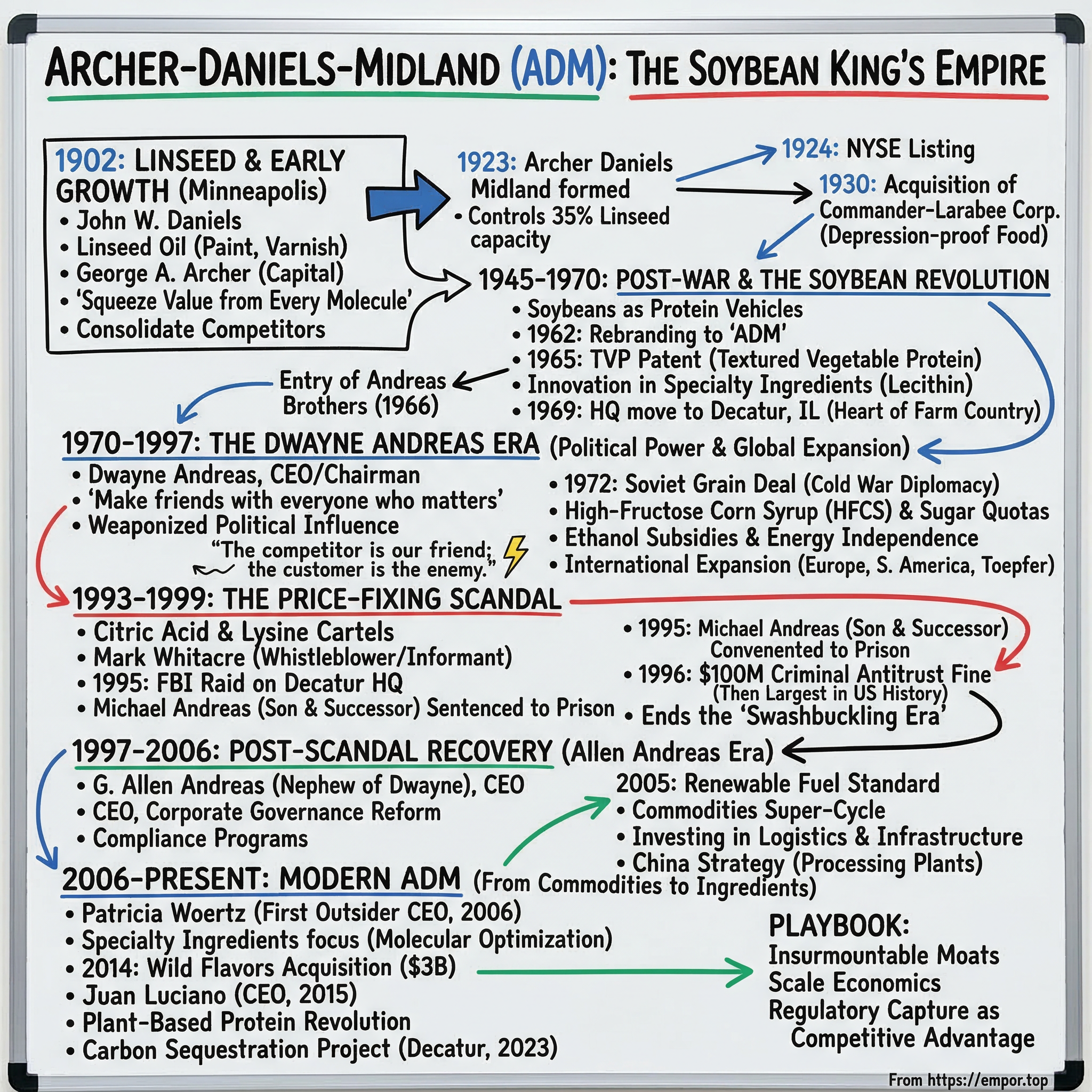
Archer-Daniels-Midland: Scale, Scandal, and the Supermarket to the World
I. Introduction & Episode Roadmap
There is a stretch of the Illinois prairie, about three hours southwest of Chicago, where the horizon is interrupted by something that does not look like farmland at all. Steam plumes rise from a complex of towers, silos, fermentation tanks, and rail spurs sprawling across the eastern edge of Decatur, Illinois — a company town in the most literal sense, where the smell in the air changes depending on which unit is running. Corn goes in. Sweeteners, starches, ethanol, industrial alcohol, amino acids, and carbon dioxide come out. Some of that carbon dioxide is then compressed and pumped nearly a mile and a half underground into a bed of sandstone that has rested there since the Cambrian era.
This physical heart of Archer-Daniels-Midland offers a stark contrast to the story the company has spent a decade trying to tell about itself.
ADM ranks among the largest agricultural processors in the world. In 2025, it generated $80.3 billion in revenue, with soybeans accounting for 17%, corn 13%, and soybean meal 11% — three commodities generating 41% of the top line.1 The company purchases crops from thousands of farmers, moves them by truck, barge, railcar, and ocean vessel, crushes and mills them, and sells the outputs into food, feed, fuel, and industrial markets across roughly 200 countries. Its storage capacity alone exceeds 17 million metric tons across owned and leased procurement facilities, the overwhelming majority of it in North America.1 As of late August 2026, the equity market value stands at roughly $37 billion.
The central tension of the ADM story is the gap between that physical reality and the corporate narrative built on top of it. How does a Minneapolis linseed crusher founded in 1902 become the self-styled "supermarket to the world," an architect of American farm policy, and a primary defendant in the largest criminal antitrust case of its era — only to find itself back in federal crosshairs three decades later, not for fixing prices with competitors, but for moving profit between its own divisions to make a favored unit appear to grow?
That second scandal makes ADM worth a close look. In January 2026, the Securities and Exchange Commission settled charges against ADM and two former senior executives, and filed a litigated action against a third, for what it described as materially inflating the performance of the company's Nutrition segment.2 ADM paid a $40 million civil penalty without admitting or denying the findings. The Department of Justice closed its parallel criminal investigation without bringing charges.3 The episode cost ADM a chief financial officer, two years of investor trust, and significantly more in strategic credibility than in cash penalties.
The roadmap for this analysis:
- The foundation and the political godfather. A linseed roll-up becomes a soybean empire, then becomes, under Dwayne Andreas, a dominant political force in American agriculture — until an FBI wire recording captured executives dividing up the world market for a feed additive.
- The strategic pivot. Juan Luciano's decade-long, $6 billion-plus attempt to convert a commodity processor into a specialty ingredients compounder, and what public markets were asked to believe.
- The accounting crisis. How intersegment transfer pricing became the mechanism by which a growth story was manufactured, and how it unraveled.
- Anatomy of the business. Where the profit actually comes from: crush spreads, corn milling, ethanol, and a Nutrition segment that has consistently underperformed expectations.
- Optionality and the playbook. Carbon capture, clean-fuel tax credits, and an analysis of whether any of ADM's competitive advantages are durable.
The history begins with linseed oil.
 Subscribe on LinkedIn
II. History Sprint: Linseed, Soybeans, & The Dwayne Andreas Era (1902–1999)
In July 1902, ground was broken in Minneapolis on the first mill of the Daniels Linseed Company. George A. Archer and John W. Daniels were crushing flaxseed to make linseed oil — a product sold mainly to paint and varnish makers. The business made roughly $30,000 in profit in its first half-year and $72,000 in its first full fiscal year, and by its tenth anniversary had tripled production capacity.4
Those numbers encode the core economic logic of the company that followed. A crusher does not invent anything. It buys a commodity, applies mechanical and chemical processing, and sells the outputs. Its profit is the spread — the difference between input costs and output prices, less the cost of operating the plant. That spread is thin, volatile, and set by broader market forces. The only two levers a crusher has ever had are scale (spreading fixed costs over more tons) and utilization (keeping the plant running year-round). ADM's founders understood this in 1902, and it remains the necessary frame for reading the company's 2026 income statement.
The roll-up
The name arrived by acquisition. In 1923 the company bought Midland Linseed Products and rechristened itself Archer-Daniels-Midland, becoming the world's largest producer of linseed oil. The stock began trading on the New York Stock Exchange in December 1924, a listing it has held ever since.
From there the strategy was consolidation. Through the Great Depression and the postwar decades, ADM absorbed grain elevators, flour mills, and processing plants — fragmented, capital-intensive, family-owned assets that individually earned little and collectively earned substantial cash flow. This was a roll-up in the modern private-equity sense, executed decades before the term gained currency, and it was rational for the exact reason the founders' economics implied: in a business where the margin per bushel is set by the market, the winner is whoever handles the most bushels at the lowest cost per bushel.
The strategic pivot that defined ADM's trajectory came with the soybean. Soybeans were, in the postwar American agricultural economy, a pivotal crop: nitrogen-fixing, high in protein, and yielding two salable products from a single crush — oil for food and meal for animal feed. As American livestock production industrialized, demand for soybean meal compounded. ADM positioned itself directly in front of that growth. In 1965 the company patented a process for textured vegetable protein, the extruded soy product that became one of the first commercial meat analogues, which ADM later trademarked as TVP. In 1969 it moved its headquarters to Decatur, Illinois — placing management inside the primary corn and soybean belt rather than in Minneapolis. That decision served as a clear statement of identity: ADM was not a consumer-facing food company; it was an industrial processor operating alongside its raw materials.
Dwayne Andreas and the politics of the bushel
Dwayne Andreas took the helm as chief executive in 1970 and ran ADM for twenty-seven years. He was a central figure in American business whose core insight was political rather than agronomic or financial.
Andreas grasped what few industrial leaders of his era recognized: in agriculture, the federal government is not merely an external regulator. The government represents a major component of the market itself. Farm subsidies, sugar import quotas, ethanol tax credits, blending mandates, export credits, and food aid programs do not simply influence prices — they create and sustain entire product categories. A sugar quota that keeps imported cane sugar expensive acts, functionally, as a subsidy for high-fructose corn syrup. An ethanol tax credit acts, functionally, as a subsidy for corn dry milling. ADM became the largest producer of both.
Consequently, Andreas cultivated political relationships across both major parties over decades. He was a prominent presence in Washington and a key negotiator with Soviet-era leaders at a time when American grain sales to the USSR served as instruments of foreign policy. The result was an operating environment in which two of ADM's most profitable product lines depended directly on federal policy frameworks.
For investors, this remains a central lesson of the Andreas era: in agribusiness, policy is not a risk factor bolted onto the model — it is a line item inside it. This analysis will return to this logic when examining renewable volume obligations and the 45Z clean fuel credit, which perform precisely the same work for ADM's earnings today that the ethanol blender's credit did in 1985.
The Andreas era also established ADM's global footprint — European and South American crushing capacity, alongside an international grain trading network that turned the domestic processor into a major participant in global commodity flows. By the early 1990s, ADM was promoting itself as the "supermarket to the world" in national television advertising targeted at political talk shows rather than retail grocery shoppers — corporate branding directed at policy makers who voted on agricultural legislation.
The tape
Then came the wire.
Between 1992 and 1995, ADM executives met repeatedly with counterparts from Japanese and Korean producers to fix the world price of lysine — an amino acid added to animal feed to accelerate weight gain in swine and poultry. Lysine was an unglamorous commodity product, but it was produced by a concentrated group of global suppliers, creating the structural conditions for cartel behavior.
One of ADM's own executives, Mark Whitacre, president of the company's BioProducts Division, was secretly cooperating with the FBI and recording the meetings. The audio tapes documented explicit price-fixing and volume-allocation agreements. Federal agents raided ADM's Decatur headquarters in mid-1995.
In October 1996, ADM pleaded guilty and was sentenced to pay a $100 million criminal fine — at the time, the largest criminal antitrust fine ever imposed — for its role in two international conspiracies to fix prices and allocate sales in the lysine and citric acid markets.5 In December of that year, a federal grand jury in Chicago indicted three former ADM executives: Michael D. Andreas, executive vice president and Dwayne's son; Terrance S. Wilson, former head of the Corn Processing Division; and Whitacre, whose standing as a key witness was compromised by his admission that he had embezzled millions of dollars from ADM while wearing a wire. A Japanese executive from 味の素 Ajinomoto was indicted alongside them. The named corporate co-conspirators were ADM, Ajinomoto, 協和発酵 Kyowa Hakko Kogyo, and Sewon America; 제일제당 Cheil Jedang of Seoul agreed to plead guilty and pay a $1.25 million fine the same day.5
Michael Andreas went to prison. Dwayne Andreas stepped back from the chief executive role in 1997. The company that had spent decades building political influence in Washington became a primary case study used by federal prosecutors to demonstrate enforcement of criminal antitrust laws.
Why the 1990s matter in 2026
Drawing a direct parallel between the 1990s lysine cartel and the recent Nutrition accounting scandal would oversimplify two distinct corporate events. The lysine case involved a criminal price-fixing conspiracy with external competitors to extract profits from customers. The accounting settlement involved internal profit reallocations between reporting segments that did not alter total consolidated earnings.
However, both episodes stem from a shared organizational pattern. In both instances, ADM established aggressive growth targets for a specific division, leading unit leadership to manipulate market or financial outcomes rather than achieving them through underlying operational performance. The 1990s collusion relied on agreements with external competitors; the 2020s accounting adjustments relied on transfer pricing between internal divisions. While the mechanics differed, the underlying pressure remained consistent.
That pressure would re-emerge three decades later under a new strategic initiative. Understanding how it resurfaced requires examining why ADM's leadership decided, around 2014, that remaining strictly a commodity processor was no longer sufficient.
III. The Strategic Transformation: The $6B Nutrition Bet (2014–2023)
Consider the position of ADM's chief executive in the early 2010s. The business was enormous, essential, and — from the perspective of equity markets — deeply unloved.
The reason was structural. Commodity processing is capital-intensive: crush plants, wet mills, elevators, barges, and terminals require continuous maintenance regardless of whether margins are fat or thin. It is cyclical: profitability depends on crush spreads and corn basis, which hinge on weather across three hemispheres, Chinese buying patterns, biofuel policy, and geopolitical shocks. And it is low-margin: on $80 billion of 2025 revenue, ADM generated $5.0 billion in gross profit — a gross margin of about 6.3%.1 Equity markets recognized these structural limits and priced the company accordingly, applying the low valuation multiples typical of cyclical commodity processors.
Enter Juan Luciano
Juan R. Luciano arrived at ADM in 2011 as chief operating officer, became chief executive in January 2015, and assumed the chairman role in 2016. He was not an agriculture lifer. He joined from Dow Chemical, where he ran the performance division — a business centered on taking commodity chemical inputs and converting them into specialty formulations sold on performance and service rather than price per ton.
That background shaped the strategic pivot. Luciano's thesis held that ADM's primary valuation drag was not operational performance but product mix. If the company could build a large, growing, high-margin ingredients business — spanning flavors, colors, specialty proteins, probiotics, and animal nutrition premixes — three outcomes would follow: earnings would become less cyclical, return on invested capital would rise, and the stock would re-rate as Wall Street valued the company as a specialty ingredients producer rather than a grain processor.
That valuation logic was central to the strategy. Management pitched shareholders not simply on earning higher profits, but on securing a higher-quality earnings stream that warranted a premium valuation multiple. Peers in the flavors and ingredients sector historically traded at multiples far above those of commodity processors. Closing even part of that valuation gap promised to generate more shareholder value than years of incremental operational gains in crop crushing.
Yet strategies built on multiple expansion carry inherent risks: once narrative transformation becomes the primary corporate objective, the reported financial metrics supporting that story acquire immense internal sensitivity.
The M&A spree
ADM built the new division largely through acquisition.
The foundational transaction arrived on July 7, 2014, before Luciano officially became CEO: an all-cash acquisition of WILD Flavors GmbH at an enterprise value of approximately €2.3 billion — comprising €2.2 billion to shareholders Dr. Hans-Peter Wild and funds affiliated with KKR, plus roughly €0.1 billion in assumed net debt.6 WILD served more than 3,000 customers and had projected 2014 net revenue of about €1 billion. Then-Chairman and CEO Patricia Woertz framed natural flavors and ingredients as a major long-term consumer trend, while management projected that the combination would create a flavor and specialty ingredients business approaching $2.5 billion in annual sales.6
The deal metrics reflected an aggressive valuation: roughly €2.3 billion in enterprise value for approximately €1 billion in revenue. Paying that premium assumed durable specialty economics and sustained top-line growth at a time when food-ingredient valuations were elevated across the sector. It represented a steep price for a specialized asset.
Five years later, ADM expanded into animal nutrition. On February 1, 2019, the company completed its €1.544 billion acquisition of Neovia, a French animal nutrition group operating across premixes, complete feed, aquaculture, and pet food. Luciano called it the company's largest deal since WILD Flavors in 2014, declaring that it created a global leader in animal nutrition and met ADM's return objectives.7 The combined animal nutrition business was projected to generate approximately $3.5 billion in sales.7
A succession of targeted acquisitions followed: probiotics producer Deerland, plant-protein manufacturer Sojaprotein, pet-treat maker Crosswind, specialty plants in China and the United States, alongside several joint ventures and minority investments.7 Total capital deployed into building the Nutrition segment surpassed $6 billion.
While the strategic rationale was coherent, the core execution question remained: had ADM acquired these assets at prices capable of generating returns above its cost of capital? Financial results would soon supply the answer.
The supercycle that hid everything
Then global commodity markets experienced a historic boom.
Beginning in 2021 and accelerating after Russia's invasion of Ukraine in February 2022, agricultural supply chains experienced severe disruptions. Global trade flows shifted, energy costs surged, vegetable oil demand from renewable diesel producers expanded, and crush margins reached record levels. ADM delivered the most profitable results in its history in 2022: revenue reached $101.8 billion, net earnings attributable to ADM stood at $4.34 billion, adjusted earnings per share reached $7.85, adjusted segment operating profit rose to $6.6 billion, and trailing four-quarter adjusted return on invested capital hit 13.6%.8 The company returned $2.3 billion to shareholders that year and increased its dividend for the 50th consecutive year.8
A closer look at those figures reveals a stark divergence from management's narrative. In 2022 — the peak financial year when the strategic pivot was supposed to demonstrate its value — Nutrition contributed $736 million of ADM's $6,549 million in total reported segment operating profit, or roughly 11%.8 The division that had absorbed more than $6 billion in acquisition capital generated only about one dollar in nine of operating profit, even during a favorable operating environment for specialty ingredients.
Meanwhile, Ag Services and Oilseeds — the core commodity processing business — generated $4.0 billion in segment operating profit that same year.
This outcome highlighted the central irony of ADM's transformation decade. The legacy commodity engine management sought to de-emphasize funded the diversification effort and then generated an earnings windfall large enough to mask the acquired segment's underlying returns. A 13.6% ROIC appeared to validate the strategic pivot, but it primarily reflected exceptional crush spreads.
The commodity supercycle bought management time, but it also built high expectations. ADM had told investors that Nutrition would compound operating profit at 15% to 20% annually.2 When commodity markets eventually normalized, that growth commitment remained.
IV. The Accounting Crisis: Transfer Pricing & The SEC Settlement
On the morning of Sunday, January 21, 2024, ADM issued a press release that contained no earnings, no guidance, and no strategic updates. It announced that Ismael Roig, a twenty-year company veteran, had been appointed interim chief financial officer, effective immediately, and that the board had placed chief financial officer Vikram Luthar on administrative leave pending an investigation by outside counsel and the audit committee "regarding certain accounting practices and procedures with respect to ADM's Nutrition reporting segment, including as related to certain intersegment transactions."9
The company disclosed that the investigation was initiated in response to a voluntary document request from the SEC, forcing ADM to delay its fourth-quarter and full-year 2023 earnings release, its conference call, and the filing of its annual report.9
Lead director Terry Crews stated that the board took the matters seriously, while CEO Juan Luciano praised Roig's executive caliber.9 Neither statement addressed the immediate question confronting shareholders: what had prompted the investigation into the CFO?
The equity market responded immediately. When trading opened on Monday, January 22, 2024, ADM shares fell roughly 24% in a single session, erasing approximately a quarter of the company's market capitalization on heavy trading volume.10
What actually happened
Understanding the mechanics requires examining a mechanism that sounds like routine accounting but forms the structural core of segment reporting: intersegment transfer pricing.
ADM is a vertically integrated company. Its Ag Services and Oilseeds division crushes soybeans, sending a portion of the resulting protein products to the Nutrition division for processing into specialty ingredients. Its Carbohydrate Solutions division mills corn, transferring dextrose and starch to Nutrition as fermentation feedstock. These are internal transactions involving funds moving between operating units.
For consolidated financial statements, internal sales cancel out and have no impact on total corporate earnings. But for segment reporting—the disclosures investors rely on to evaluate business unit performance—the price assigned to internal transfers determines which segment records the operating profit. Charging Nutrition an artificially low internal price for soy protein elevates Nutrition's margins while depressing Ag Services' reported profitability, leaving consolidated corporate profit unchanged.
The dynamic operates like a household where three adult children maintain separate ledgers. If one child purchases groceries at a discount while billing the difference to the other two, overall family spending remains identical—yet evaluating each child's financial management from individual ledgers would yield flawed conclusions. This mechanism explains why the transfers mattered: investors evaluated ADM's operating segments independently, and Nutrition's reported margin trajectory served as the central proof point for the transformation thesis.
The SEC's enforcement findings, published on January 27, 2026, detailed the scope of the adjustments. The Commission alleged that Luthar directed adjustments to Nutrition's transactions with other ADM segments when the division fell short of its operating profit targets for fiscal 2021 and 2022. The adjustments included retroactive rebates and price changes "not customarily available to ADM's third-party customers" that constituted "essentially one-sided transfers of operating profit to Nutrition," designed to simulate the 15% to 20% annual operating profit growth projected to investors.2
The settled order found that former Nutrition president Vince Macciocchi and Luthar led the effort to structure the adjustments for 2021 and 2022, and that former CFO Ray Young approved improper adjustments for 2019 and 2021. The SEC noted that the adjustments "were targeted to specific dollar amounts to hit Nutrition's operating profit goals or mask a shortfall" and were unavailable to external customers.2 In its enforcement summary, the Commission concluded that other ADM segments had effectively functioned as a piggybank for the Nutrition unit.3
The significance of the finding lies in the sequence of events. The adjustments were not mistaken forecasts or boundary judgments under accounting standards; according to regulatory findings, management selected the target result first and structured internal transactions backward to produce it.
The restatement
In November 2024, following a second delay that affected its third-quarter filing, ADM completed its restatement, amending its fiscal 2023 Form 10-K and its first- and second-quarter 2024 Form 10-Qs.11 The company emphasized that the restatement "had no impact on ADM's consolidated balance sheet, earnings, or cash flows."11
The amended annual report disclosed the multi-year segment impact. Nutrition segment operating profit was revised downward for six consecutive years from 2018 through 2023: falling from $339 million to $312 million in 2018, $418 million to $391 million in 2019, $574 million to $558 million in 2020, $691 million to $632 million in 2021, $736 million to $668 million in 2022, and $458 million to $427 million in 2023.12 The cumulative reduction of $228 million was offset almost entirely by upward revisions to Carbohydrate Solutions, alongside a minor adjustment to Ag Services and Oilseeds.12
Two conclusions emerge from these disclosures. First, because the revisions spanned six straight years, the reallocations represented an established operating practice rather than an isolated incident. Second, in 2021, Nutrition's originally reported operating profit growth of 20% over 2020 dropped to roughly 13% after restatement. That gap marked the precise boundary between fulfilling management's 15% to 20% growth guidance and missing it.
ADM also disclosed a material weakness in internal controls over financial reporting regarding segment disclosures, specifically citing inadequate controls around measuring intersegment sales under ASC 606.112 The company subsequently reported that the material weakness was fully remediated as of June 30, 2025, following formal testing of the new controls through year-end.1
The resolution, and what it cost
On January 27, 2026, the SEC announced settled charges against ADM, Macciocchi, and Young, along with a litigated action against Luthar in the U.S. District Court for the Northern District of Illinois.2 ADM agreed to pay a $40 million civil penalty without admitting or denying the findings; Macciocchi agreed to disgorgement and prejudgment interest of $404,343, a $125,000 penalty, and a three-year officer and director bar; Young agreed to disgorgement and prejudgment interest of $575,610 and a $75,000 penalty.2 The order established a Fair Fund to distribute the penalties to affected investors.
The Commission credited ADM's cooperation and remediation efforts, which included an internal investigation, voluntary reporting, analysis from an outside accounting expert, enhanced internal controls over intersegment transactions, revised corporate policies, and testing of the new control framework.2 Enforcement director Margaret A. Ryan noted that the SEC engaged "market participants constructively to ensure the right outcomes are achieved in a timely and fair manner."2
The complaint against Luthar alleges antifraud violations, aiding and abetting ADM's reporting and books-and-records failures, internal control violations, and failure to reimburse executive compensation under Section 304 of the Sarbanes-Oxley Act.2 That action remains in litigation, and Luthar has not been found liable.
Separately, the Department of Justice closed its parallel criminal investigation without bringing charges.3 Civil litigation risks persist. A putative securities fraud class action filed in January 2024 survived motions to dismiss in March 2025 and remains active.1 Multiple shareholder derivative actions have been consolidated in Delaware federal court and the Delaware Court of Chancery, alongside a separate litigation-demand action and a books-and-records lawsuit filed in July 2025.1 ADM disclosed that it cannot reasonably estimate potential losses from the class action, leaving an ongoing financial exposure.1
The governance question the settlement did not answer
Evaluating the resolution requires contrasting the regulator's findings with the board's internal conclusions.
ADM's 2025 proxy statement disclosed that, following the restatement, the Compensation and Succession Committee evaluated whether any incentive compensation required recovery under the company's clawback policy. The committee concluded that no recovery was warranted "because the restated amounts did not impact the achievement of any financial reporting measure used in determining incentive-based compensation of the covered executives" during the lookback period.13
Comparing that conclusion with the SEC's enforcement findings reveals a structural disconnect. The regulator alleged that division-level profit targets motivated the improper adjustments, whereas the board concluded that corrected segment figures had no effect on the metrics governing executive pay. While both assertions are consistent with the structure of ADM's incentive plans—which relied on enterprise-level EBITDA and consolidated return on invested capital—they highlight a governance contradiction. If division-level profitability carried sufficient operational weight to prompt financial manipulation, its exclusion from compensation metrics raises questions about alignment and oversight.
The board applied negative discretion by reducing the 2024 annual cash incentive payout percentage and the shares earned on 2022 performance share units for selected named executives in relevant leadership roles, while stating that no named executive officer was found to have engaged in improper conduct.13 Annual incentive payouts landed in a 35% to 65% range and long-term incentive payouts in a 56% to 112% range.13
Luthar's exit terms also reflected notable leniency given the scope of the federal inquiry. Under a transition agreement, he remained a non-executive employee on full base salary until his resignation took effect on September 30, 2024, receiving a $743,419 annual cash incentive award for 2023 along with stock distributions from his 2021 performance share units.14 ADM did not disclose whether these terms stemmed from prior contractual obligations, legal positioning, or board discretion, but the structure drew scrutiny from corporate governance analysts.
New financial leadership
The leadership transition concluded on July 10, 2024, when ADM announced the appointment of Monish Patolawala as executive vice president and chief financial officer, effective August 1.15 Patolawala joined from 3M, where he served as chief financial officer, following more than two decades at General Electric—including leading finance for GE Healthcare from 2015 to 2020 and overseeing operational transformation across GE in 2019 and 2020.
Patolawala's background signaled an intentional shift in corporate governance. Executive finance at GE during that era prioritized strict operating cadence and granular segment oversight, carrying lessons from instances where reporting narratives decoupled from segment economics. Placing an executive with that background at ADM directly following a transfer-pricing inquiry signaled a pivot toward financial discipline.
Whether the leadership change alters operational culture rather than institutional optics remains a multi-year test, dependent on how ADM allocates capital across its divisions and demonstrates the underlying profitability of its core processing operations.
V. Core Segment Deep Dive: Revenue, Profitability, & Industry Structure
Walk out of the Decatur complex and follow the corn and soybeans backward, and you end up at a grain elevator in a town of eight hundred people, where a farmer in a pickup is watching a scale readout and deciding whether to sell today or store until March. Follow them forward and you end up on a barge on the Mississippi, or a unit train, or a Panamax vessel loading at an export terminal. Almost everything that matters about ADM's economics happens somewhere along that path.
Here is the map, using 2025 as the base year.
1. Ag Services and Oilseeds
This is the core business. In 2025, Ag Services and Oilseeds generated $61.6 billion in revenue—77% of ADM's total—and $1,614 million in segment operating profit, or roughly half of the company's $3,242 million total.16 In the second quarter of 2026, it produced $867 million of the $1,450 million total, or 60%.17
The segment consists of four distinct units:
Origination (Ag Services). ADM buys crops from farmers through its elevator network, stores them, and transports them. Economics here depend on basis—the local difference between a cash price at an elevator and the futures price at an exchange—and on arbitrage across geography and time. As a merchant business, it earns returns by locating grain, managing transit costs, and hedging price risk in between. The unit generated $636 million in operating profit in 2025, down 11%, constrained by weak North American soybean exports and farmers holding grain back from depressed markets.16 When farmers hold inventory in storage bins, ADM merchandisers have fewer bushels to trade.
Crushing. This operation experiences the sharpest margin swings in the portfolio. ADM purchases soybeans, canola, and soft seeds, processing them into vegetable oil and protein meal. Operating profit reflects the crush margin—the combined value of the oil and meal, minus seed procurement and processing costs. Industry participants monitor a "board crush" calculated from futures prices for beans, meal, and oil as the primary market benchmark.
Crushing profitability exhibits extreme volatility. The unit earned $844 million in 2024 before falling 81% to $159 million in 2025.16 In the second quarter of 2026 alone, crushing generated $363 million, compared to $33 million in the prior-year period.17 Operating identical processing assets with identical raw materials, segment results shift entirely based on market spreads.
Refined Products and Other. Crude vegetable oil undergoes secondary processing into cooking oils, shortenings, biodiesel, and industrial inputs. Margins depend on consumer food demand and biofuel market conditions. The subsegment earned $529 million in 2025, down 4%, which management attributed to softer food demand and delayed policy clarity surrounding U.S. biofuels.16
Wilmar. ADM maintains a 22.5% equity interest in Wilmar International, the Singapore-listed Asian agribusiness group, recording its earnings share within this segment—amounting to $290 million in 2025.116 This equity holding represents a material contributor, generating roughly one-fifth of Ag Services and Oilseeds' operating profit in 2025 from a non-controlled minority asset.
The logistics moat. ADM owns or leases trucks, trailers, railcars, river barges, towboats, and ocean vessels, alongside 147 bulk storage warehouses and terminals.1 Owned and leased procurement facilities provide over 17 million metric tons of storage capacity, with more than 13 million metric tons located in North America.1 Global processing capacity reaches approximately 284,000 metric tons per day across owned and leased facilities.1
This physical infrastructure forms a structural barrier because grain is heavy, low-value per ton, and time-sensitive. Transportation costs from an Iowa farm to an overseas feed mill represent a substantial portion of total delivered value, determined by proximity to elevators, rail connections, river barge access, and export terminal water depth. Reconstructing ADM's Mississippi River transport corridor would require decades, significant capital investment, and regulatory approvals that are largely unobtainable today.
However, logistics scale provides cost efficiency per ton rather than pricing power over customers. Because delivered agricultural commodities are standardized, network efficiency protects operating margins without enabling premium pricing above prevailing market rates.
2. Carbohydrate Solutions
The corn processing segment generated $10.7 billion in revenue and $1,211 million in segment operating profit in 2025—representing 13% of revenue and 37% of segment profit, making it ADM's highest-margin major operating unit.116
The segment operates through two divisions. Starches and Sweeteners manages corn and wheat wet milling, producing high-fructose corn syrup, starches, syrups, dextrose, wheat flour, citric acid, and wet-mill ethanol.1 Vantage Corn Processors operates dry-mill ethanol facilities.
Segment economics depend on corn basis, natural gas expenditures for energy-intensive wet milling, industrial starch demand, and federal biofuel mandates. Segment operating profit declined 12% in 2025, with Starches and Sweeteners falling 21% due to weaker global demand and elevated European corn costs, partially offset by ethanol strength.16 Additionally, year-over-year earnings reflected a $75 million reduction in insurance proceeds related to Decatur plant claims, which dropped from $84 million in 2024 to $9 million in 2025.16
Market conditions shifted in early 2026. In March 2026, the EPA finalized 2026 and 2027 renewable volume obligations under the Renewable Fuel Standard.17 Established blending mandates, combined with elevated global energy prices and lower corn input costs, improved ethanol economics relative to gasoline blendstocks. Carbohydrate Solutions operating profit rose 22% year over year in the second quarter of 2026 to $411 million, as Vantage Corn Processors gained $52 million and Starches and Sweeteners rose 7%, despite ongoing margin pressure in domestic liquid sweeteners.17
The sustained weakness in North American liquid sweeteners highlights a structural headwind within the division. Domestic consumption of high-fructose corn syrup faces long-term declines as beverage formulation shifts away from sugar-sweetened products, leaving segment performance increasingly reliant on regulatory biofuel frameworks.
3. Nutrition
The specialty ingredients segment represented the center of ADM's decade-long strategic reallocation.
In 2025, Nutrition generated $7.5 billion in revenue—9% of ADM's total—and $417 million in segment operating profit, accounting for 13% of corporate operating profit.116 Human Nutrition (flavors, colors, specialty proteins, texturants, probiotics, and health ingredients) reported $4.2 billion in revenue and $319 million in profit; Animal Nutrition (premixes, complete feed, pet food ingredients, and aquaculture) recorded $3.3 billion in revenue and $98 million in profit.116
Financial metrics show that Nutrition's 2025 segment operating margin stood at approximately 5.6%, compared to 11.3% for Carbohydrate Solutions. The specialty segment acquired to elevate consolidated margins generated roughly half the operating margin of the legacy corn milling business.
Historical comparisons further outline performance relative to initial targets. On a restated basis, Nutrition generated $632 million in operating profit in 2021 and $668 million in 2022.12 The $417 million earned in 2025 remains below levels recorded four years prior, following more than $6 billion in acquisition capital deployed.16
Operational adjustments yielded partial recovery in recent quarters. Segment operating profit increased 8% in 2025, supported by a 66% earnings gain in Animal Nutrition following product mix adjustments, portfolio rationalization, and cost reductions.16 Second-quarter 2026 segment operating profit rose 51% year over year to $172 million, driven by a 51% increase in Human Nutrition from Flavors expansion and operational normalization at Decatur East, alongside a 50% increase in Animal Nutrition.17 During the August 2026 investor call, management highlighted approximately 20% year-over-year Flavors growth in Asia Pacific and outlined a long-term $80 million to $100 million operating profit opportunity in natural colors, addressing a target market of roughly $1 billion as food formulators replace synthetic dyes.18
While regulatory shifts supporting natural colors present an addressable market expansion, management's projected profit contribution equates to roughly one quarter of typical earnings variation within crop crushing.
As of August 2026, Nutrition functions as a stabilizing segment undergoing operational repair, though returns remain below the initial capital costs required to assemble the division. The commercial case for the segment relies on incremental margin restoration rather than valuation multiple expansion across the broader enterprise.
The ABCD oligopoly
ADM operates within a concentrated global grain market historically led by four primary international trading houses: ADM, Bunge, Cargill, and Louis Dreyfus Company.
Market structure adjusted on July 2, 2025, when Bunge Global completed its acquisition of Viterra, establishing a combined entity with over 50,000 employees and approximately $100 billion in annual revenue—surpassing ADM in total sales while expanding origination assets across Canada, Australia, and the Black Sea region.19 Cargill operates as a private enterprise with the largest estimated market share among the group, while Louis Dreyfus remains privately held with a focus on merchant trading.
The Bunge-Viterra merger altered competitive scale dynamics. Rather than immediately shifting market share, the transaction established a larger peer entity with integrated global origination capabilities, distributing scale advantages across a more concentrated set of market participants.
VI. Hidden Optionality & Future Growth Vectors: BioSolutions & Carbon Capture
Beneath the Decatur complex, about 7,000 feet underground, lies the Mount Simon Sandstone—a Cambrian formation of clean, silicate-dominated rock with high porosity and permeability, capped by geological seals that have stored natural gas for nearly fifty years.20 For long-term carbon sequestration, the formation offers ideal geological characteristics.
ADM has conducted carbon storage operations there since 2011 in partnership with the U.S. Department of Energy, the Illinois State Geological Survey, and other entities. Under its EPA Class VI injection permit, cumulative carbon dioxide injection into the Mt. Simon saline reservoir surpassed 2.8 million tonnes, consisting of fermentation byproduct from the adjacent ethanol plant compressed into a supercritical fluid and pumped underground.20
Filing this initiative purely under corporate sustainability misses its core commercial logic. The project functions less as an environmental statement and more as an economic mechanism.
Why buried carbon is worth money
Fermentation ethanol produces a stream of nearly pure carbon dioxide as a byproduct, making it one of the lowest-cost carbon streams to capture in the industrial economy because it does not require complex solvent separation from industrial flue gas.
That purity aligns directly with federal clean-fuel policy. Under the Inflation Reduction Act's Section 45Z Clean Fuel Production Credit—effective for fuel produced and sold between January 1, 2025, and December 31, 2029, replacing the prior blender's tax credit—the credit value scales inversely with the carbon intensity of the fuel.1 Reducing the lifecycle carbon intensity of ethanol increases its per-gallon credit value, and capturing and permanently sequestering fermentation carbon dioxide serves as the primary operational lever to achieve that reduction. Section 45Q provides a separate credit for the underground sequestration itself.
Consequently, the geology under Decatur functions as a policy-linked financial asset. Low-carbon ethanol also creates entry into the sustainable aviation fuel market, where the alcohol-to-jet production pathway requires low-carbon feedstock—a market segment ADM aims to supply as a raw material vendor rather than a finished fuel producer.
Financial disclosures from 2026 demonstrate how policy mechanics flow to the bottom line. ADM recorded no significant 45Z credits in 2025 and advised investors that it anticipated expanded benefits in subsequent periods following statutory adjustments under the One Big Beautiful Bill Act.1 During its August 2026 earnings call, management increased its projected 2026 net 45Z benefit to approximately $250 million—up from a prior estimate of roughly $150 million—and reported sequestering 337,000 tonnes of carbon dioxide in the second quarter, compared with 300,000 tonnes in the first quarter.18 To put that $250 million projection into perspective, it matches the approximate annual operating profit generated by the entire Human Nutrition subsegment in 2025.
Under the prior regulatory regime, the legacy blender's tax credit provided ADM with $316 million in financial benefits in 2024 alone.1 While the underlying statutory mechanism has shifted, the earnings scale remains comparable, underscoring that policy framework support continues to represent a significant component of ADM's profitability.
The part the sustainability slides leave out
However, carbon capture operations introduce distinct operational and regulatory vulnerabilities.
In 2024, ADM's Decatur sequestration facility encountered compliance issues. The EPA alleged that the company breached its Class VI permit conditions by failing to properly monitor an injection well, allowing injected fluid to migrate into an unauthorized geological zone roughly 5,000 feet below the surface. On August 13, 2025, the agency issued a final administrative order requiring corrective measures, including the execution of emergency and remedial response protocols associated with monitoring-well integrity failures. The EPA noted that public health was not endangered and confirmed ADM had submitted reports detailing the root cause of the well failures and the extraction of migrated fluids.21 Injection operations were suspended for approximately one year.
This suspension highlights three critical considerations for evaluating the business model. First, carbon capture and storage involves material operational risks: well integrity can fail, fluids can migrate, and regulators can halt operations. Second, sequestration-related revenue depends on uninterrupted, compliant execution, as a suspended injection facility cannot monetize tax credits. Third, earnings tied to 45Q and 45Z credits are simultaneously policy-dependent and permit-dependent, exposing cash flows to both statutory shifts and facility-level operational risks.
BioSolutions
An adjacent growth initiative centers on industrial fermentation—utilizing corn-derived sugars as feedstock to manufacture chemicals traditionally synthesized from petroleum, alongside a broader range of bio-based materials. ADM has pursued this strategy primarily through commercial partnerships. During the August 2026 earnings call, management highlighted early-stage precision fermentation projects with partners including EVERY and Bond, while explicitly declining to provide specific operating profit metrics for the business.18 CEO Juan Luciano noted that the projects confirm technical feasibility and demonstrate substantial long-term potential while cautioning that commercial scaling remains subject to customer demand forecasts.18
Management's decision to withhold quantitative financial guidance reflects both practical constraint and financial discipline. Refusing to project earnings for early-stage ventures avoids setting unverified targets—an approach particularly relevant following the regulatory settlement over segment disclosures—while confirming that BioSolutions does not currently represent a material contributor to enterprise earnings.
Sizing it honestly
Placing these optionality initiatives in proper financial context requires weighing their potential against ADM's core business scale. Combined, carbon capture, 45Z credit monetization, sustainable aviation fuel feedstock supply, and industrial fermentation currently account for a few hundred million dollars in annual net benefits—a modest sum for an enterprise whose segment operating profit fluctuated by nearly $1 billion year over year in a single quarter of 2026.17
The primary strategic importance of these initiatives lies not in immediate top-line expansion, but in risk mitigation. They provide ADM with a structural buffer against the long-term decline in domestic liquid sweetener demand. As high-fructose corn syrup consumption contracts, low-carbon ethanol, sequestration tax credits, and bio-based chemical feedstocks serve to maintain high processing utilization across the company's capital-intensive wet mills. In a high-fixed-cost processing business, maintaining plant utilization is critical to protecting unit margins, making Decatur's geological assets valuable primarily as a mechanism to prevent existing processing capacity from becoming stranded.
VII. Management Credibility, Governance, & Capital Allocation Audit
The fairest way to assess a management team is not to grade its strategy in isolation, but to compare what leadership promised against what occurred over a long enough window that cyclical luck washes out. The eleven-year tenure of Chief Executive Officer Juan Luciano offers a substantial track record for evaluation.
Juan Luciano: the record
The case for Luciano's operational stewardship is substantial. He inherited an enterprise with a mediocre operating culture and modernized it: processing plant reliability improved, the global asset network became more flexible, and the trading and logistics organization grew materially more adept at moving volume around market disruptions. Results in 2026 demonstrate the payoff of these operational changes — management repeatedly attributed the second-quarter earnings surge not merely to the broader margin environment, but to strategically leveraging ADM's global asset network across a complex operating landscape. Specific operational data supports that assessment: South American results benefited from the grain export terminal in Barcarena, Brazil returning to full operations, while global oilseed volumes rose roughly 5% year over year, driven in part by improved asset utilization.17
He also prioritized industrial safety, with ADM reporting its lowest recorded injury rate in 2025.16 In heavy processing industries, safety performance serves as a reliable proxy for underlying operational discipline.
The counter-case rests on three primary factors:
First, the capital allocation record. ADM deployed more than $6 billion into building the Nutrition segment. Yet that division generated $417 million in segment operating profit in 2025, falling below its restated 2021 performance.1612 Regardless of the hurdle rate applied, that capital deployment has failed to deliver returns above the cost of capital. Enterprise-level metrics confirm this compression: trailing four-quarter adjusted return on invested capital declined from 13.6% at year-end 2022 to 8.3% at year-end 2024.813 While part of this contraction reflects cyclical commodity weakness and collapsing crush spreads, deploying peak-cycle cash flow into full-priced acquisitions only to see overall returns compress points to a capital allocation issue rather than purely external market headwinds.
Second, the governance failure. The intersegment accounting adjustments occurred on Luciano's watch within the segment that served as his flagship strategic initiative — driven, according to regulatory findings, by internal targets communicated to investors. Although regulatory settlements did not name Luciano directly, accountability extends beyond direct rule violations to the operating environment in which those practices emerged. Promising public markets a 15% to 20% annual segment growth rate in a business whose underlying addressable markets were not growing at that pace created structural internal pressure.
Third, narrative consistency. Executive commentary shifted noticeably across the commodity cycle. In January 2023, near the peak of the cycle, management highlighted an "outstanding year" driven by strategic execution that "positioned us well." By February 2026, during an earnings trough, explanations focused on a "dynamic global trade landscape," "external headwinds," and maintaining resilience "in the areas within our control."816 By August 2026, as earnings recovered, commentary pointed to "robust" results, "broad-based growth across all three segments," and higher full-year guidance.17
While each statement accurately reflects its specific operating period, attributing favorable outcomes to strategic execution while framing downturns as environmental factors creates a mild credibility tax. Nevertheless, ADM provides transparent line-item detail in its quarterly reporting, clearly isolating mark-to-market adjustments, insurance proceeds, and regulatory policy impacts rather than burying them.
Monish Patolawala: the early evidence
Two years into his role, Chief Financial Officer Monish Patolawala's impact appears in three primary areas.
First, Patolawala held capital expenditure guidance steady at $1.3 billion to $1.5 billion for 2026 even as earnings guidance was raised twice — demonstrating capex discipline during an up-cycle.1617 Second, he expanded the corporate cost-reduction program, which management now targets at $500 million to $750 million in aggregate savings over three to five years starting in 2025, up from the "in excess of $500 million" goal announced in February 2025.118 The supporting initiatives center on operational efficiency: reducing accounts payable transaction costs by approximately 25% since early 2026 through a streamlined finance model, alongside consolidating global technology platforms and resetting vendor contracts.18
Third, the capital return strategy reflects notable restraint. ADM repurchased $2.3 billion of its common stock in 2024 but conducted zero repurchases in 2025.116 With net leverage standing at 1.6 times as of June 30, 2026, against a full-year target of approximately 2.0 times, Patolawala noted that the company is evaluating an opportunistic return to share repurchases later in the year.18
This sequence — heavy share buybacks during record earnings years, a complete pause during a down-cycle, and a cautious re-entry as earnings recover — contrasts with countercyclical capital allocation. Repurchasing shares at peak valuations while pausing at trough prices can impair long-term value. Whether future buybacks are executed based on share price valuation or target leverage ratios will provide a clear test of capital discipline.
The dividend, and what it signals
ADM declared a quarterly dividend of 52.0 cents per share in February 2026, representing a 2% increase over the prior 51.0-cent payout. This marked the company's 53rd consecutive year of dividend growth and extended its history of uninterrupted dividend payments past 94 years.16 The company distributed $987 million in dividends in 2025 out of $5.45 billion in operating cash flow.1
The extended growth streak functions as a meaningful governance constraint, limiting management's ability to overextend the balance sheet. However, the pacing of the increase reveals shifting financial priorities. The 2% increase follows prior annual raises of 11% and 12.5%.138 A modest single-digit adjustment maintains the historical streak while conserving cash flow. Investors should view the smaller increase as a conservative liquidity choice rather than a signal of aggressive expansion.
Second-layer diligence
Three balance-sheet items warrant ongoing monitoring:
Goodwill headroom in Animal Nutrition. ADM reported $4.8 billion in total goodwill as of December 31, 2025.1 Disclosures within the annual report's critical audit matters indicate that the Animal Nutrition reporting unit accounts for $958 million of that goodwill, operating with narrow valuation headroom: a 1.75 percentage point increase in the discount rate would result in approximately a $29 million impairment, while a 1.50 percentage point reduction in forecasted EBITDA margins would yield roughly a $69 million impairment.1 Disclosing sensitivity thresholds of this magnitude signals that both management and external auditors regard the carrying value of these acquired assets as sensitive to operational underperformance.
Impairment run-rate. Combined asset impairments, exit costs, and restructuring charges totaled $473 million in 2025, $545 million in 2024, and $342 million in 2023 — including $179 million in goodwill and intangible impairments in 2025 and $201 million in 2023.1 Accumulating nearly $1.4 billion in total write-downs over three years represents a substantial cumulative adjustment to prior capital deployment.
Portfolio pruning. Asset adjustments throughout 2025 indicate a gradual narrowing of operating scope: closing the Tres Corações processing plant in Brazil in July 2025, establishing a cottonseed joint venture with PYCO Industries in September 2025, and entering agreements for a North American animal feed joint venture with Alltech alongside an additional cottonseed venture with Planters Cotton Oil Mill.1 Transitioning wholly owned operating assets into joint ventures allows an enterprise to reduce capital exposure without executing outright asset sales.
VIII. Playbook: Business & Investing Lessons
Five lessons travel well beyond agribusiness.
1. Narrative re-rating creates its own gravity — and its own accidents. When a company's stated goal is to change how the market categorizes it, the reported figures supporting that new category become strategically precious in a way ordinary results are not. Nutrition's operating margin was not just a metric at ADM; it served as primary evidence in an argument about the company's valuation. Once a metric carries that weight, the incentive to protect it grows well beyond the incentive attached to underlying cash flow. Investors should treat any long-running corporate campaign to reposition a commodity processor as a higher-margin specialty business as a signal to inspect segment disclosures with unusual care — particularly where intercompany flows are large.
2. Physical infrastructure is a real moat, but a specific kind. The river elevators, barge fleet, rail hubs, and export terminals genuinely cannot be replicated; permitting alone would defeat a new entrant. But that moat lowers operating cost per ton rather than conferring pricing power, because the underlying crop output remains fungible. The appropriate mental model is not a toll road but the lowest-cost position in a commodity market — a structure that protects margins during industry downturns while offering little additional leverage during upturns, when expanding spreads lift all processors.
3. Transfer pricing is where strategic disappointment goes to hide. Any time a company reports operating segments with large intercompany sales and one division carries a disproportionate share of the growth story, the intersegment pricing policy warrants close examination. It is among the most subjective components of segment reporting, making it a natural location for an underperforming unit to be quietly subsidized. The warning sign is not necessarily outright fraud; it is a segment whose reported margins improve steadily even as its end markets stagnate.
4. Windfalls are not skill, and peak-cycle cash is dangerous. ADM's earnings from 2021 through 2023 were largely driven by global supply chain disruptions. Cash generated during such periods is best returned to shareholders, held on the balance sheet, or invested in low-risk debottlenecking of existing assets — not deployed into high-multiple acquisitions in adjacent sectors. The August 2026 disclosure that ADM identified ten U.S. crush plants for brownfield capacity expansion at roughly a quarter of greenfield capital intensity — beginning with an initial four-plant phase for approximately $100 million — represents a more disciplined use of cyclical cash than another ingredients deal, precisely because it is incremental, reversible, and aligned with core operational capabilities.18
5. In this industry, policy is an operating variable. The finalized renewable volume obligations in March 2026 provided a larger boost to ADM's 2026 earnings than any internal management initiative.17 The 45Z clean fuel credit represents an estimated $250 million benefit in 2026,18 while the prior blender's tax credit generated $316 million in 2024.1 Any valuation model that excludes legislative and regulatory frameworks fails to capture ADM's core financial drivers. This dynamic has persisted since the Dwayne Andreas era, representing the most durable operational continuity in the company's history.
IX. Strategic Analysis: 7 Powers, Porter's 5 Forces, & Bull vs. Bear Case
Strip away a century of narrative and ask the primary question that ultimately matters: does ADM possess a durable competitive advantage, or is it a very large, well-run participant in markets that will not let any operator earn excess returns for long?
Hamilton Helmer's 7 Powers, applied honestly
Scale economies — the real one. Scale represents ADM's primary competitive advantage, operating through a straightforward mechanism. A crush plant or wet mill carries substantial fixed costs—processing vessels, extractors, dryers, boilers, and maintenance crews—that remain largely static regardless of volume. Increasing throughput across an existing asset lowers the fixed cost per bushel. ADM's processing capacity of roughly 284,000 metric tons per day across four continents enables it to process raw materials at a lower unit cost than regional crushers.1 Combining processing scale with procurement reach—purchasing from thousands of growers, elevators, and merchants without relying on any single counterparty—compounds this cost advantage.1 The resulting efficiency is structural and defensible.
The limitation is that scale economies represent a shared advantage within a global oligopoly. Cargill, the merged Bunge-Viterra entity, and Louis Dreyfus possess comparable operational reach. Scale shields ADM from smaller regional processors, but it does not provide an advantage against the other three primary grain houses where competitive pressure concentrates.
Cornered resource — high, and underrated. ADM's logistics network along the Mississippi River corridor represents its most irreplaceable physical asset. River terminals, barge-loading infrastructure, rail-connected elevators assembled over a century, and deep-water export capacity across North and South America form an infrastructure network that cannot be easily replicated. The Decatur complex—combining wet milling, ethanol production, protein processing, and the Mount Simon carbon sequestration well—serves as a unique operational hub.
Applying the strict strategic test, however, requires that a cornered resource generate superior economic returns rather than simply being difficult to copy. ADM's network lowers logistics and delivered costs per ton, but it does not create customer pricing power, because physical agricultural commodities remain fully fungible.
Process power — moderate, and difficult to isolate. ADM's global trading operations optimize crop flows by matching origination regions with end markets, hedging basis and freight exposure, and arbitraging regional price differences over time. Results from the second quarter of 2026 highlight this capability: Ag Services operating profit rose 159% year over year, a surge management attributed to active network optimization across complex trade flows rather than a passive windfall.17 Operational recovery at the Barcarena terminal in Brazil and increased Brazilian farmer selling further supported the quarterly gain.17
However, single-quarter trading results must be evaluated carefully. Distinguishing execution skill from market timing remains difficult, as ADM's disclosures indicate that approximately $100 million of the segment's quarterly operating profit stemmed from net positive mark-to-market and timing adjustments.17 Because mark-to-market gains reflect timing shifts that can reverse in subsequent periods, evaluating long-term trading capability based on a single strong quarter remains premature.
Counter-positioning — essentially absent. ADM lacks a business model that competitors are disincentivized to copy out of fear of cannibalizing existing revenues. While the combination of ethanol production and carbon sequestration creates a localized advantage in low-carbon feedstocks that rivals without favorable geology cannot easily match, this represents a specific operational niche rather than a broader structural hedge.
Switching costs — low in core processing, moderate in Nutrition. Commercial feed mills purchasing soybean meal face zero switching costs between suppliers. Conversely, beverage manufacturers that integrate specific flavor systems into product formulations incur meaningful costs—including reformulations, sensory testing, and regulatory approvals—if they change suppliers. Customer integration represents the most compelling strategic defense for the Nutrition segment, though management historically emphasized top-line growth rates over formulation stickiness when presenting the unit to investors.
Branding and network economies — not applicable. Because ADM primarily sells standardized commodities and industrial ingredients to corporate buyers, neither brand equity nor network effects apply.
Porter's Five Forces
Rivalry: high, and intensifying. Four global market participants with comparable capabilities compete for raw crop supplies using similar infrastructure in markets where end products are standardized. The completion of the Bunge-Viterra merger intensified competitive dynamics by creating an entity generating approximately $100 billion in annual revenue with an expanded global origination network.19 In this sector, peer consolidation concentrates competitive pressure among remaining global players rather than easing it.
Supplier power: low to moderate. ADM procures raw materials from thousands of growers, elevators, and grain merchants under spot or short-term agreements, maintaining no reliance on any individual supplier.1 While individual producers possess virtually no pricing power, farm operators exercise collective timing power over inventory. Performance in 2025 demonstrated that when producers store grain to await higher prices, ADM's origination volumes and merchandising opportunities contract directly.16 Suppliers cannot dictate commodity price levels, but their collective selling decisions dictate physical grain flows.
Buyer power: moderate to high. Large consumer packaged goods manufacturers and commercial livestock producers buy in high volumes and maintain relationships with multiple qualified processors. In bulk commodity markets like ethanol and soybean meal, market clearing prices determine transaction terms. The primary exception occurs in specialty ingredients, where product formulation requirements grant ADM greater commercial leverage.
Threat of substitutes: low in core protein, moderate in fuel. Soybean meal has no economically viable substitute at scale for livestock feed, as alternative proteins remain cost-prohibitive. Conversely, fuel ethanol faces long-term substitution risks from transportation electrification and immediate exposure to regulatory shifts, as dry-mill economics depend directly on federal biofuel blending mandates. The earnings rebound in Carbohydrate Solutions during the second quarter of 2026 illustrates the direct financial sensitivity of corn processing to EPA rulemaking decisions.17
Threat of new entrants: extremely low. Constructing a competing global origination and processing network requires tens of billions of dollars in capital, extensive regulatory approvals, and decades of site assembly. Because capital returns in commodity processing do not justify greenfield replication, entry barriers remain formidable, preserving the global oligopoly structure.
Synthesizing these forces shows that ADM occupies a highly protected industry position—shielded by massive barriers to entry—while competing intensely against three equally entrenched global peers in markets where processors lack individual pricing power. Historically, this structural combination yields moderate baseline returns through commodity troughs punctuated by high profitability during supply-chain disruptions.
Myth versus reality
Myth: ADM has transformed into a specialty food ingredients company. Reality: In 2025, the Nutrition segment generated 9% of total revenue and 13% of segment operating profit.116 By contrast, Ag Services and Oilseeds combined with Carbohydrate Solutions produced approximately 87% of segment profit. After twelve years of strategic reallocation and more than $6 billion in acquisition spending, ADM remains fundamentally a crop crusher and grain miller, with corporate presentations reflecting greater strategic change than the underlying financial statements.
Myth: The accounting scandal was a minor technicality because consolidated financial results remained unchanged. Reality: While the restatement did not alter consolidated net income, balance sheet metrics, or cash flows,11 the conclusion overlooks how equity markets price diversified processors. Investors assign valuation multiples based on earnings mix, quality, and segment growth trajectories. Reallocating operating profit between reporting units directly affected the core evidence supporting the high-margin transformation thesis. The SEC's enforcement findings established that intersegment transfer price adjustments were structured specifically to simulate achievement of publicly communicated segment growth targets.2
Myth: The 2026 earnings surge confirms that the strategic transformation has succeeded. Reality: Financial recovery in early 2026 primarily reflected expanding crush spreads and improved ethanol margins following regulatory clarity on federal biofuel policies. ADM's initial 2026 guidance framed this sensitivity explicitly, linking the lower bound of earnings forecasts to flat crush margins and policy delays, while tying the upper bound to policy resolution and margin expansion.16 While internal operational enhancements—including facility utilization gains, cost-reduction programs, and incremental margin recovery in Nutrition—contributed to performance, macroeconomic conditions and regulatory decisions drove the majority of the earnings increase.
The bull case
The investment case for ADM does not depend on adopting management's transformation narrative, but rather on evaluating three underlying structural factors.
First, ADM controls physical infrastructure essential to long-term global grain trade. Population growth, expanding protein consumption in emerging economies, and the feedstock requirements of livestock production drive steady demand for crop processing and transportation. ADM remains one of only four global entities possessing the logistics and processing scale required to service these global agricultural flows.
Second, market valuations may reflect trough-cycle earnings rather than baseline mid-cycle earning power. ADM generated $3.43 in adjusted earnings per share in 2025 before raising its 2026 full-year guidance to a range of $5.15 to $5.60 per share following two quarterly upward revisions.1617 If normalized earning power sits well above 2025 trough levels, current equity valuations may understate the productive capacity of the asset base. This earnings recovery is paired with balance-sheet flexibility, as net leverage stood at 1.6 times, annual capital expenditures remained capped at $1.3 billion to $1.5 billion, and finance leadership evaluated opportunistic share repurchases.18
Third, policy-linked growth initiatives provide unpriced optionality. The 45Z clean fuel credit, carbon sequestration infrastructure at Decatur, and low-carbon ethanol capacity offer upside exposure to energy transition demand without requiring major additional capital outlays.
The bear case
The bear case highlights structural headwinds, beginning with global processing capacity.
Crush margin normalization. Extensive soybean crushing capacity additions across North and South America—built largely to supply projected renewable diesel feedstock demand—risk oversupplying protein meal and vegetable oil markets. When processing capacity growth outpaces end-market consumption, crush spreads compress rapidly, as commodity processors cannot dictate product pricing. ADM's 2025 financial results, which featured an 81% decline in crushing operating profit, demonstrate this margin sensitivity.16 If expanded global processing capacity maintains persistent pressure on spreads, 2025 performance may represent a structural baseline rather than a cyclical trough.
The governance discount. Regulatory findings regarding segment reporting impair institutional investor confidence and weigh on equity valuation multiples. While ADM remediated its material weakness in internal controls and settled SEC administrative charges, outstanding legal exposures persist. A securities fraud class action survived a motion to dismiss, and consolidated shareholder derivative lawsuits remain pending, with ADM disclosing an inability to estimate potential liabilities.1 Historical governance issues frequently depress valuation multiples over extended periods.
Policy reversal and regulatory exposure. Earnings gains achieved in early 2026 remain vulnerable to administrative decisions. Renewable volume obligations are determined through EPA rulemaking, small refinery exemptions can reduce blending mandates, and statutory provisions for the 45Z credit expire after 2029 under existing legislation.1 Furthermore, sequestration-derived tax benefits remain subject to operational compliance, as evidenced by the temporary shutdown of injection operations at Decatur following regulatory enforcement.21
Trade policy and export vulnerability. ADM's origination and logistics infrastructure depends heavily on exporting North American crops to overseas buyers, particularly China. Retaliatory trade measures or tariff shifts redirect global purchasing to South American suppliers, compressing U.S. origination margins and asset utilization. Results from 2025 reflected these trade disruptions, with weak North American soybean export volumes dragging down Ag Services profitability.16
Unresolved returns on capital in Nutrition. More than $6 billion deployed into Nutrition acquisitions continues to generate segment operating margins below 6%, while $958 million in Animal Nutrition goodwill operates with narrow valuation headroom.1 Sustained underperformance risks future asset impairments, and recent operational recovery has not yet demonstrated that the capital deployed will earn returns above ADM's cost of capital.
X. Investor Stress Test & 1–3 Critical KPIs
Imagine an activist investor building a position in ADM in late 2026. With the stock recovering from its lows, the regulatory overhang partially cleared, and the balance sheet under-leveraged, what would an activist presentation argue?
The activist case: sell Nutrition
The thesis writes itself—and presents a formidable challenge to corporate leadership.
Nutrition absorbed more than $6 billion in acquisition capital, yet delivered 2025 operating profit below its restated 2021 level.1216 Its intercompany transfers triggered a federal investigation, a financial restatement, a material weakness in internal controls, class-action lawsuits, and derivative litigation. The division carries goodwill with disclosed sensitivity so narrow that modest shifts in discount rates or margin assumptions would trigger impairments.1 In return, it contributes roughly one-eighth of segment operating profit while consuming a disproportionate share of executive attention, disclosure complexity, and reputational risk.
The activist proposition: separate the unit. Sell Human Nutrition to a strategic buyer in flavors and ingredients, where those assets could command a higher valuation inside a dedicated platform than within a grain processor. Joint-venture or divest Animal Nutrition—a process ADM effectively initiated through its agreements with Alltech and regional cottonseed partners.1 Use the proceeds to pay down debt and repurchase shares while valuations reflect trough commodity earnings. The outcome would yield a leaner enterprise: a global origination, processing, and logistics operator with a clean segment structure and no intersegment transfer pricing large enough to obscure performance.
The counterargument is equally pragmatic. Divesting a business during a cyclical trough crystallizes capital losses rather than recovering them, while recent operational momentum—driven by Flavors growth, Animal Nutrition margin recovery, and emerging natural colors demand—suggests the asset could command a higher valuation over a longer horizon.17 Downstream ingredient capabilities also offer a genuine, if modest, strategic bridge to upstream protein and starch processing.
Ultimately, this remains an active strategic dilemma rather than a resolved debate. Management has yet to articulate a clear, measurable threshold for how long the Nutrition segment has to achieve acceptable returns before structural separation is considered—an omission that remains the strongest argument in an activist presentation.
What analysts actually pushed on
ADM's August 4, 2026 earnings call provides a clear view of how Wall Street evaluates the company's operational recovery, with questions focusing on capital discipline, cyclical sustainability, and regulatory visibility.
On capital allocation, UBS analyst Manav Gupta pressed leadership on the return profile of the company's newly announced crushing expansion. Chief Executive Officer Juan Luciano detailed a brownfield strategy designed at roughly a quarter of greenfield capital intensity, beginning with a four-plant U.S. phase totaling approximately $100 million.18 The specific figure offers a transparent benchmark for tracking future capital deployment and volume growth.
Addressing cyclical earnings sustainability, analyst Heather Jones asked whether second-quarter momentum had peaked. Luciano indicated that Ag Services operating profit would likely step slightly lower in the third quarter before potentially recovering in the fourth if export programs expand.18 Barclays analyst Ben Theurer questioned the variables separating the lower and upper bounds of full-year guidance; Luciano cited operational execution, biofuel margin persistence, and Nutrition momentum, while noting external variables such as weather and ongoing conflict in Ukraine.18
Stephens analyst Pooran Sharma requested specific crush margin assumptions underlying guidance. Management disclosed that North American crush capacity was roughly 90% covered for the third quarter and 30% for the fourth, with global coverage near 70% for the third quarter.18 Chief Financial Officer Monish Patolawala added that realized cash margins carry greater financial weight than published board crush prices—a distinction emphasizing that exchange-traded benchmarks serve as operational proxies rather than exact realized economics.18
On regulatory tax credits, BMO analyst Andrew Strelzik inquired whether the revised $250 million 45Z credit estimate was finalized. Luciano described improving monthly visibility while highlighting regulatory complexities regarding carbon intensity verification and prevailing wage compliance.18 Morgan Stanley analyst Steven Haynes asked management to quantify the addressable market for precision fermentation, which Luciano declined to project.18
Overall, management's responses demonstrated measured specificity, contrasting with the communication challenges during the 2024 accounting inquiry. When presented with opportunities for speculative forecasts, leadership maintained conservative framing. Notably absent, however, was detailed analyst scrutiny regarding long-term returns on invested capital within Nutrition. Wall Street focused on near-term division growth rather than whether the $6 billion in deployed capital will achieve its underlying cost of capital.
The three KPIs that matter
Evaluating ADM's fundamental performance narrows to three core metrics.
1. Global board crush margins, measured in dollars per bushel. This spread accounts for the majority of ADM's earnings variance and remains observable in real time through futures contracts for soybeans, soybean meal, and soybean oil. Widening crush spreads expand profitability in the company's primary operating unit, while compressed spreads restrict earnings. The multi-year swing in crushing operating profit—dropping from $844 million in 2024 to $159 million in 2025 before rebounding in 2026—was driven primarily by this single spread.1617 Tracking quarterly crush spreads alongside management's disclosed hedging coverage indicates how much operating profit is locked in for upcoming periods.
2. Trailing four-quarter adjusted return on invested capital relative to weighted average cost of capital. ADM discloses adjusted ROIC directly, offering a transparent benchmark for evaluating strategic capital allocation. The metric declined from 13.6% at year-end 2022 to 8.3% at year-end 2024.813 This trajectory reflects whether a decade of diversification generated long-term economic value. If adjusted ROIC rebounds toward low-double-digit levels under mid-cycle market conditions, the Nutrition capital deployment remains economically viable. If ROIC settles near the company's cost of capital across a full commodity cycle, the strategic transformation will have fallen short of its primary objective: expanding enterprise returns on capital.
3. Free cash flow conversion and capital return discipline. Measured as operating cash flow less capital expenditures, alongside the proportion returned via dividends and share repurchases. In 2025, ADM generated $5.45 billion in operating cash flow—boosted by a $2.8 billion working capital release as commodity prices dropped—against $1.25 billion in capital expenditures and $987 million in dividend distributions, with zero share repurchases.1 Because working capital fluctuations can distort single-year results in commodity processing, multi-year cash flow trends provide a clearer indicator of financial health. This metric will also test financial discipline under new leadership, showing whether future share buybacks are guided by fundamental valuation rather than leverage targets.
XI. Epilogue & What to Watch
The Mississippi River has carried American grain to world markets for more than two centuries. The barges are larger now and the elevators automated, but the underlying mechanics—purchasing crops from farmers, storing, transporting, processing, and selling them to buyers of protein, starch, or fuel—remain essentially unchanged since George Archer and John Daniels began crushing flaxseed in Minneapolis.
What has repeatedly shifted is the corporate narrative built on top of that physical foundation.
Three structural forces now reshape the agricultural landscape across management cycles. First, global grain trade is realigning as South America solidifies its position as the primary exporter of soybeans and an expanding share of corn, shifting trade gravity away from the U.S. Gulf toward Brazilian ports. Second, geopolitics has elevated food supply chains into explicit instruments of statecraft—a dynamic that presents both risk and opportunity for an international arbitrage operator, as trade disruptions create localized trading gains while impairing physical volumes. Third, the energy transition continues to convert agricultural feedstocks into liquid fuels, creating either the largest long-term demand catalyst in the sector's history or a policy-dependent incentive structure subject to future legislative changes.
For investors, the primary variables to monitor over the coming years remain clear and specific: whether crush spreads normalize as new processing capacity in North and South America ramps up; whether renewable volume obligations and 45Z clean fuel tax credits withstand political scrutiny through their statutory expiration after 2029; whether Nutrition's operating profit recovers to its pre-scandal 2021 levels, and how leadership responds if it falls short; whether carbon sequestration operations in Decatur proceed without further regulatory halts; whether share repurchases resume with price-sensitive valuation discipline rather than mechanical balance-sheet targeting; and whether pending securities class-action and derivative litigation resolves without substantial financial exposure.
The broader lesson of ADM's century-long trajectory centers on where economic power actually resides. For more than a decade, management sought to convince public markets that the company's future lay in high-margin flavors, colors, probiotics, and premixes—deploying over $6 billion to support that transformation thesis. Yet the financial recovery of 2026 was driven not by specialty ingredients, but by soybeans, corn, ethanol, favorable crush spreads, and federal biofuel policy—the same core drivers that have governed ADM's earnings since Dwayne Andreas recognized that the most influential force in agribusiness is federal farm legislation.
The physical assets endure. The spreads cycle. The corporate narrative changes every decade. Investors who evaluate ADM through that framework will read the company accurately, regardless of what the next corporate presentation claims.
References
-
Archer-Daniels-Midland Company Annual Report on Form 10-K for fiscal year 2025 — U.S. Securities and Exchange Commission, 2026-02-17 ↩↩↩↩↩↩↩↩↩↩↩↩↩↩↩↩↩↩↩↩↩↩↩↩↩↩↩↩↩↩↩↩↩↩↩↩↩
-
SEC Charges ADM and Three Former Executives with Accounting and Disclosure Fraud — U.S. Securities and Exchange Commission, 2026-01-27 ↩↩↩↩↩↩↩↩↩↩
-
ADM to pay $40M to settle SEC accounting fraud probe — Food Dive, 2026-01-27 ↩↩↩
-
Former Top ADM Executives, Japanese Executive, Indicted in Lysine Price Fixing Conspiracy — U.S. Department of Justice, Antitrust Division, 1996-12-03 ↩↩
-
ADM Expands Food-Ingredient Offering with Acquisition of WILD Flavors — ADM, 2014-07-07 ↩↩
-
With Completion of Neovia Acquisition, ADM Creates Premier Global Leader in Animal Nutrition — ADM, 2019-02-01 ↩↩↩
-
ADM Reports Fourth Quarter Earnings per Share of $1.84, $1.93 on an Adjusted Basis (Form 8-K, Exhibit 99.1) — Archer-Daniels-Midland Company via SEC EDGAR, 2023-01-26 ↩↩↩↩↩↩↩
-
ADM Appoints Ismael Roig Interim Chief Financial Officer; Vikram Luthar Placed on Administrative Leave (Form 8-K, Exhibit 99.1) — Archer-Daniels-Midland Company via SEC EDGAR, 2024-01-21 ↩↩↩
-
ADM shares plunge as CFO takes forced leave amid accounting probe — CFO Dive, 2024-01-22 ↩
-
Archer-Daniels-Midland Company Amended Annual Report on Form 10-K/A for fiscal year 2023 — U.S. Securities and Exchange Commission, 2024-11-18 ↩↩↩↩↩↩
-
Archer-Daniels-Midland Company 2025 Proxy Statement (Form DEF 14A) — U.S. Securities and Exchange Commission, 2025-03-25 ↩↩↩↩↩↩
-
ADM's suspended CFO to resign amid accounting scandal — CFO Dive, 2024-04 ↩
-
Archer-Daniels-Midland Company Form 8-K: Appointment of Monish Patolawala as Executive Vice President and Chief Financial Officer — U.S. Securities and Exchange Commission, 2024-07-10 ↩
-
ADM Reports Fourth Quarter and Full-year 2025 Results; Provides 2026 Guidance (Form 8-K, Exhibit 99.1) — Archer-Daniels-Midland Company via SEC EDGAR, 2026-02-03 ↩↩↩↩↩↩↩↩↩↩↩↩↩↩↩↩↩↩↩↩↩↩↩↩↩↩
-
ADM Reports Second Quarter 2026 Results (Form 8-K, Exhibit 99.1) — Archer-Daniels-Midland Company via SEC EDGAR, 2026-08-04 ↩↩↩↩↩↩↩↩↩↩↩↩↩↩↩↩↩
-
ADM (ADM) Q2 2026 Earnings Call Transcript — The Motley Fool, 2026-08-11 ↩↩↩↩↩↩↩↩↩↩↩↩↩↩↩↩↩
-
Bunge and Viterra Complete Merger to Create Premier Global Agribusiness Solutions Company (Form 8-K, Exhibit 99.1) — Bunge Global SA via SEC EDGAR, 2025-07-02 ↩↩
-
NETL Project Partner Demonstrates Over 2.8 Million Tonnes of CO2 Capture From Ethanol Production and its Deep Geologic Storage in Mount Simon Sandstone — National Energy Technology Laboratory, U.S. Department of Energy ↩↩
-
EPA Orders Archer Daniels Midland to Ensure Environmental Compliance of Carbon Sequestration Well in Decatur, Illinois — U.S. Environmental Protection Agency, 2025-08-13 ↩↩
 LinkedIn
 WhatsApp
 Reddit
 Hacker News
 Email
Email Kindle
 RSS Feed
 Spotify
 Apple Podcasts
 Amazon Music
 Audible
 YouTube