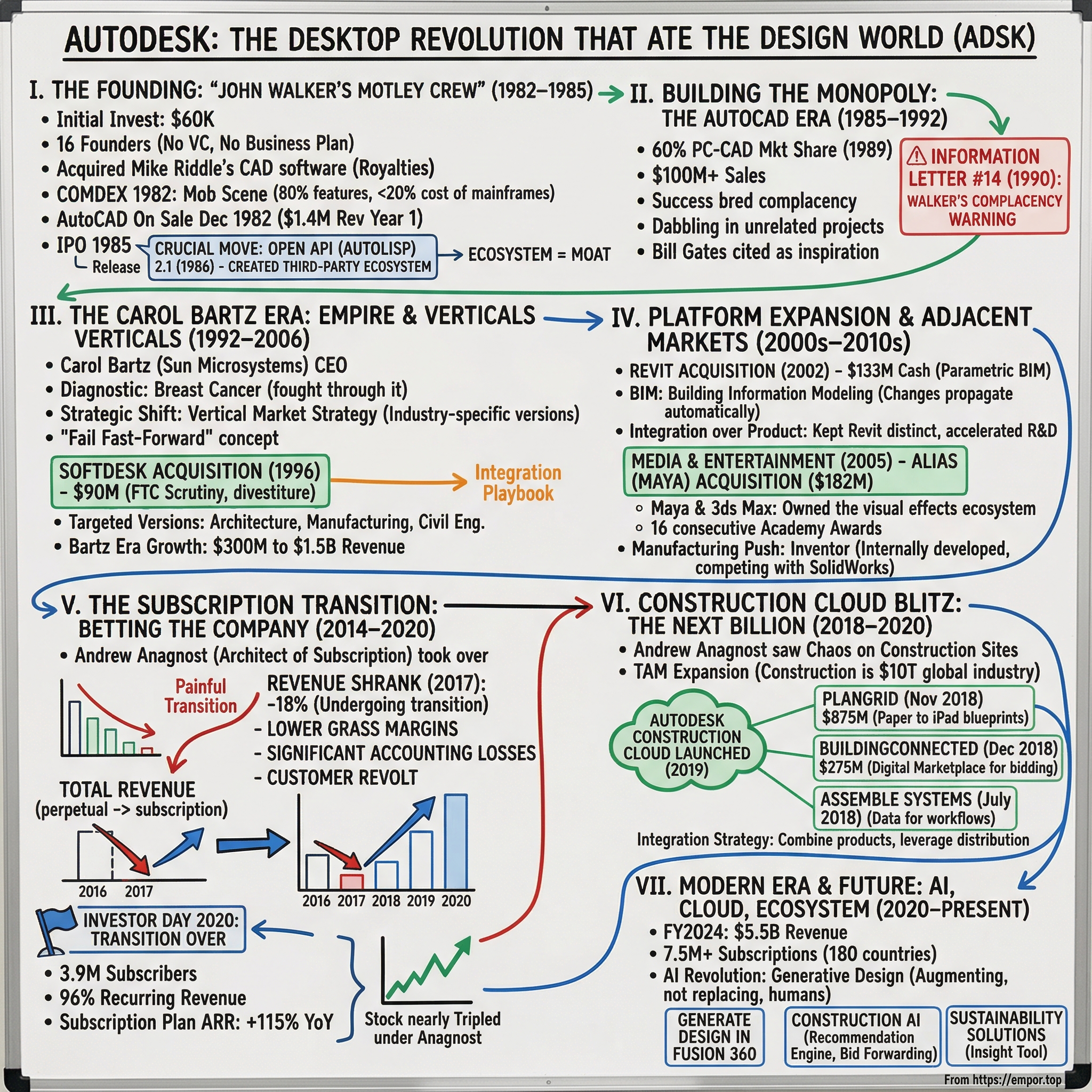
Autodesk: The Monopolist of the Built Environment
I. Introduction & Episode Roadmap
There is a peculiar class of enterprise that most people never interact with directly, yet cannot escape. Walk into an office tower built over the past two decades, and the structural steel above was likely modeled in Revit. Drive down a resurfaced highway, and its alignment was drawn in Civil 3D. Watch a Hollywood blockbuster, and the digital creature on screen was rigged in Maya. Autodesk does not erect physical structures or produce films. It sells the digital drawing boards on which much of the physical world is designed—and collects recurring subscription rent on those tools every year.
By the close of fiscal year 2026 on January 31, 2026, those subscription fees generated $7.21 billion in revenue—an 18% increase year over year. Billings reached $7.77 billion, while free cash flow rose 54% in a single year to $2.41 billion.1 Gross margin stood at roughly 91%, reflecting the high profitability of software distribution. The company's remaining performance obligations—contracted revenue not yet recognized—reached $8.30 billion, representing more than a full year of future sales already secured under contract.1
Yet public markets have stopped short of treating Autodesk as an unassailable compounder. In late August 2026, the stock traded near $254, yielding a market capitalization of approximately $54 billion. Over the preceding 52 weeks, however, the share price swung between $185.50 and $329.09—a wide range for a company generating more than 90% recurring revenue. The volatility signals that investors remain sharply divided over Autodesk's trajectory.
The central question is the nature of that contest. How did a company founded in April 1982 by a group of programmers pooling personal savings become the de facto operating system for the physical world? And can the competitive moats that built that position—chiefly proprietary file formats and a dominant grip on professional training—endure as software migrates to the cloud, generative AI tools emerge, and investors digest a two-year stretch marked by questions over management's accounting transparency?
The story unfolds across five distinct chapters. It begins with the founding era, examined specifically through the choice that shaped the business: opening AutoCAD to third-party developers in the mid-1980s, creating an ecosystem moat that competitors have failed to breach.
The analysis then evaluates three modern inflections that defined the company's current structure: the $133 million acquisition of Revit in 2002, the high-stakes decision to eliminate perpetual licenses in favor of subscriptions between 2014 and 2016, and the multibillion-dollar acquisition spree in construction technology that began in 2018. The third section analyzes Autodesk's current segment economics, shedding light on its fastest-growing yet least-disclosed business lines.
Fourth comes an examination of corporate governance, including the 2024 accounting investigation, the subsequent replacement of the chief financial officer, and the activist shareholder campaign that followed. The final section applies strategic frameworks—including Hamilton Helmer's 7 Powers and Michael Porter's Five Forces—to outline the bull and bear investment theses and isolate the key metrics that determine whether Autodesk is compounding value or coasting on past scale.
Four analytical themes recur throughout: proprietary file formats as instruments of market power; the financial friction of crossing the enterprise software "valley of death" during subscription transitions; the structural difficulty of establishing true two-sided network effects in fragmented industries like construction; and the central challenge facing legacy tech leaders—rearchitecting desktop applications built in the 1990s for a cloud-native computing environment.
One critical framing note precedes the history. In the twelve months leading to August 2026, Autodesk executed three moves that departed sharply from its historical pattern: investing $200 million in a private artificial intelligence research lab, cutting 7% of its workforce in a single restructuring, and committing $3.6 billion—the largest acquisition in its history—to acquire a facility maintenance software vendor unfamiliar to most of its core user base. Whether these strategic capital allocations reflect a confident platform expanding its domain or an incumbent purchasing inorganic growth as core product lines mature remains the central question.
 Subscribe on LinkedIn
II. Foundation & Architectural DNA (1982–2000): The Open-API Playbook
In the winter of 1981, a Marin County programmer named John Walker circulated a working paper among colleagues. The original vision was not a dedicated computer-aided design enterprise, but a software cooperative—a loose group of engineers who would each contribute a program, pool the financial risk, and market whichever tools gained traction. The archive of that period, later published by Walker as The Autodesk File, reads less like a traditional business plan than a technical mailing list of memos, equity distribution debates, and progress reports written after hours.3
The business incorporated in 1982, and one program in the initial portfolio quickly overshadowed the rest.5 Engineer Michael Riddle had written a minicomputer drafting application named Interact. Walker’s team licensed the software not with upfront cash, which they lacked, but in exchange for a royalty stream that would eventually total an estimated $10 million.4 That structure proved to be a decisive piece of early financial engineering: a capital-constrained founding team secured the core technology behind its future growth by funding the purchase out of unearned forward revenue.
AutoCAD launched commercially in 1983.5 At the time, computer-aided design required proprietary, high-cost hardware workstations bundled with vendor-dominated training and maintenance agreements. AutoCAD instead ran on standard IBM personal computers. While less powerful than workstation rivals, it brought digital drafting within financial reach of small architectural and engineering practices.
This low-end market entry established a strategic pattern that shaped the company's expansion. Autodesk initially succeeded not through superior raw performance, but by capturing underserved customers ignored by incumbents. Subsequent strategic shifts—eliminating perpetual licenses, pricing Fusion aggressively against established industrial software, or releasing lower-cost construction tools—reflected that core premise: expanding the addressable user base generated greater long-term value than maximizing per-seat extraction from existing clients.
Autodesk completed its initial public offering in 1985, followed by a secondary offering in mid-1987 priced at $24 per share.4 Walker stepped down from executive management within a year of the IPO to return to software engineering, underscoring an early corporate culture focused heavily on product development over formal management structure.5 The shift from manual drafting tables to PC-based design accelerated rapidly across the industry.
The decision that built the moat
Autodesk's primary competitive advantage stemmed less from standalone software features than from its open architecture. Beginning in the mid-1980s, AutoCAD included an embedded programming language, AutoLISP, enabling users to automate routine tasks, such as generating structural details or piping schedules. By 1990, the company formalized this capability into the AutoCAD Development System, and by 1994, more than 2,000 third-party developers were building specialized vertical applications on top of the core platform.4
Commercially, that developer base functioned as an external sales force and an ecosystem lock-in. Each third-party tool and internal custom script increased switching costs for design firms. Even when competitors introduced software with superior feature sets, customer migration remained rare because switching required discarding years of custom scripts, workflow templates, plug-ins, and institutional training.
This developer ecosystem reinforced a second structural advantage: the .dwg file format. As AutoCAD achieved broad distribution, .dwg became the default exchange standard among architects, structural engineers, trade contractors, and municipal planning departments. Consequently, the proprietary format transitioned from a technical detail into industry infrastructure, forcing competing software vendors to market their compatibility with Autodesk's format rather than establishing independent standards.
This dynamic differed from a true two-sided network effect, as additional users did not directly enhance product utility for others. Instead, it established an industry standard supported by an ecosystem. Customer retention grew as design firms accumulated proprietary workflows and counterparties expected drawings in .dwg format. Unlike platform networks that depend on rapid viral adoption, established file standards create durable friction against competitive displacement through accumulated workflow reliance.
For investors, this history illustrates that Autodesk's early defensibility rested on becoming the underlying platform for professional workflows rather than maintaining feature leadership. While product features can be replicated by competitors, ingrained industry standards and institutional habits offer much higher resistance to displacement.
Carol Bartz and the industrialisation of a hobby
By the early 1990s, Autodesk faced operational challenges typical of engineering-led startups: strong product adoption paired with fragmented strategic focus. In April 1992, the board hired Carol Bartz, a senior executive from Sun Microsystems, as chief executive officer.4 Bartz imposed rigorous operational discipline, moving away from the company's early informal governance. She established a public financial target to reach $1 billion in annual revenue by 1999, at a time when Autodesk generated approximately $400 million in revenue and relied on AutoCAD for roughly 85% of sales.4
Bartz’s core strategy reorganized computer-aided design into specialized vertical markets. Recognizing that architects, civil engineers, and mechanical designers required distinct toolsets, Autodesk developed targeted vertical products that carried higher price points and deepened customer switching costs. Selective acquisitions supplemented internal product development, highlighted by the 1997 acquisition of Softdesk, whose civil engineering software formed the foundation of Autodesk's infrastructure segment.7 Under this verticalization strategy, annual revenue expanded to $1.83 billion by fiscal 2007, the year following her departure as CEO.4
The Bartz administration also formalized Autodesk’s reliance on an indirect distribution model. Rather than expanding an expensive internal salesforce to reach fragmented architecture and engineering firms globally, Autodesk built a network of specialized third-party resellers. These partners managed customer training, software customization, and license renewals, allowing Autodesk to scale distribution efficiently. While this partner channel provided operating leverage for two decades, it later created structural friction when Autodesk sought to transition to direct customer relationships and cloud management.
In addition, Autodesk established an academic licensing program during this era, distributing software to universities and students at nominal or zero cost. This strategy created a self-reinforcing talent loop: graduating engineers entered the workforce proficient in Autodesk tools, prompting employers to standardize on the software to match available workforce skills.
This academic pipeline required minimal incremental expenditure due to near-zero marginal software distribution costs. Autodesk continued expanding educational partnerships in fiscal 2026, including an initiative with the Vellore Institute of Technology in India where students deployed Fusion and Revit on active design projects.[^3] Early training integration created a long-term adoption barrier for competitors, though it remains exposed to potential disruption from accessible, browser-based design alternatives targeting the same student demographic.
Ultimately, the foundational era established both Autodesk's core competitive strengths and its long-term operational challenges. The platform ecosystem, proprietary file standard, and reseller distribution model drove multi-decade dominance, but also left the company with a legacy desktop architecture, an indirect go-to-market structure, and an entrenched customer base accustomed to perpetual software ownership.
III. The Modern Inflections: Revit, Subscription Transformation, & Construction Blitz (2002–2021)
Inflection 1: The best $133 million ever spent in enterprise software
In 1997, a team of parametric CAD engineers founded Revit Technology Corporation in Massachusetts around a radical premise. Instead of drawing a building as separate 2D lines across multiple disconnected sheets—plans, sections, and elevations that required manual updating whenever design parameters changed—what if an architect built a single database of intelligent digital objects? Under this architecture, every drawing became a dynamic view of that underlying model; moving a window in a floor plan automatically shifted the window in every elevation.
Autodesk completed the acquisition of Revit on April 1, 2002, for $133 million in cash.6 Chief Executive Carol Bartz framed the deal at the time as a targeted tool to win fast-track and design-build projects best suited for model-based design.6 That modest positioning belied what became one of the highest-return acquisitions in enterprise software history.
Two factors drove the deal's ultimate success. First, Building Information Modeling—or BIM, as the model-based approach became known—solved a critical physical problem on construction sites. Traditional projects frequently suffered from coordination errors where trade drawings conflicted, such as ductwork intersecting structural beams, which went unnoticed until construction began. A unified 2D/3D database made those spatial collisions visible before crews poured concrete. Recognizing these efficiency gains, public procurement bodies across the United Kingdom, Europe, Singapore, and other jurisdictions progressively mandated BIM deliverables on public infrastructure projects over the next two decades. Regulatory mandates effectively turned the dominant BIM platform into an industry tollbooth.
Second, Revit's proprietary .rvt file format mirrored the defensive role that .dwg played in 2D drafting, with even stronger switching costs. While a .dwg file is a graphic drawing where bad translation primarily affects line weights, a .rvt file is a structured database of architectural intent. Exporting a .rvt file into a competitor's format destroys structural data and object relationships rather than mere formatting, raising the friction of customer migration by an order of magnitude.
The financial return illustrates the power of a platform acquisition. Autodesk purchased Revit for roughly the price of a mid-sized software vendor in 2002. By fiscal year 2026, the Architecture, Engineering, and Construction (AEC) segment built upon that parametric engine generated $3.58 billion of revenue in fiscal 2026, growing 22% year over year.2 That performance established a high internal benchmark against which Autodesk's subsequent corporate acquisitions would be measured.
Inflection 2: The valley of death, chosen voluntarily
In 2014, Autodesk management under CEO Carl Bass initiated a high-risk business model transformation, announcing the end of perpetual software licenses. From January 31, 2016, new seats of Autodesk software could no longer be bought outright — only rented.[^8]
Bass, a co-founder of an acquired marine design software company and an accomplished machinist, held a long-standing conviction that the future of design software lay in bridging the gap between digital design and physical manufacturing. Subscription pricing served as the financial prerequisite for continuous cloud service delivery, as software vendors could not support iterative cloud features for customers who had made a single upfront purchase years earlier.
The financial mechanics of the subscription shift created severe short-term revenue compression. Under perpetual licensing, Autodesk recognized roughly $4,000 upfront per seat. Under a subscription model, the same customer paid approximately $1,500 annually, recognized over time. While the customer yielded higher lifetime value after several years, first-year recognized revenue dropped sharply, causing reported top-line results to contract despite steady customer retention.
As a result, revenue fell from roughly $2.5 billion in the fiscal year ended January 2015 to about $2.0 billion two years later — a decline of nearly a fifth — and kept sagging.7 In the fiscal year ended January 31, 2019, Autodesk reported revenue of $2.57 billion and a GAAP operating loss of $25 million, producing a net loss for the year.7 Despite gross margins near 90%, the business operated at a loss on a GAAP basis during the transition trough. Concurrently, the company cut roughly a tenth of its workforce in a 2016 restructuring and absorbed sustained friction from resellers whose economics were built on selling large up-front licenses.
Investor anxiety focused not only on depressed income statements, but also on management's emphasis on alternative performance metrics—such as billings, deferred revenue, and annualized recurring revenue—which diverged from GAAP revenue and depended on contract terms. That structural tension over non-GAAP subscription metrics resurfaced, badly, in 2024.27
The transition also disrupted Autodesk's indirect distribution network. Resellers had built business models around large upfront transactions as merchants of record. Subscriptions reduced average deal sizes, spread cash flows across multi-year periods, and pulled direct customer relationships closer to Autodesk. Shrinking channel margins created operational friction that sat quietly in the business model for nearly a decade before Autodesk confronted it directly in the 2020s.
Despite implementation friction, the strategic outcome reshaped Autodesk's economics. Recurring subscription revenue replaced volatile upgrade cycles that had previously tied annual performance to user willingness to purchase new desktop releases. Furthermore, cloud licensing reduced software piracy—historically prevalent in CAD due to cracked perpetual licenses—converting non-paying users in emerging markets into subscription customers. The recurring contract structure also established direct communication channels with end users, enabling broader cross-selling opportunities.
Andrew Anagnost, who took over as CEO in 2017 after leading product marketing, inherited the second half of that transition. Anagnost viewed completing the subscription transformation not as a final destination, but as the prerequisite for expanding Autodesk's addressable market into field operations.
Inflection 3: From the studio to the jobsite
Anagnost’s strategy targeted the physical execution of construction. While Autodesk dominated architectural design, design fees accounted for roughly 5% of total building expenditures, leaving the remaining 95% spent on jobsite execution by general contractors, subcontractors, and building owners who often relied on paper drawings, spreadsheets, and text messages. Connecting Revit models to field workflows offered a path to multiply Autodesk's addressable market.
Autodesk began acquiring construction technology vendors in late 2018. PlanGrid, which put construction blueprints on an iPad and had become the default field app on many American jobsites, was acquired for $875 million.8 PlanGrid allowed field foremen to view and mark up current drawings on site, addressing construction delays caused by crews building from superseded revisions.
Weeks later Autodesk agreed to buy BuildingConnected, a bid-management network connecting general contractors to subcontractors, for $275 million.9 Assemble Systems, which turned models into quantities and cost data, came in the same period. In February 2021 Autodesk agreed to pay approximately $1 billion for Innovyze, a water infrastructure modelling company — an expansion sideways into the operation of municipal systems rather than their construction, and, in retrospect, the first hint of the operations strategy that would dominate 2026.10
These were folded, from November 2019, into a single stack marketed as Autodesk Construction Cloud.11 Tuck-ins continued after the boom: in fiscal 2025 the company added Payapps, a construction payments and compliance platform, and PIX, a media production collaboration tool, for a combined figure disclosed in its filings.7
Evaluating the financial return on this construction strategy reveals a nuanced picture. On the Q1 fiscal 2027 call in May 2026, Anagnost put the scorecard on the record: roughly $1.8 billion of acquisition capital deployed into construction over five years, producing a business worth close to $600 million of revenue over the trailing twelve months and growing north of 20%.[^3]
Generating $600 million in annual revenue from $1.8 billion in deployed capital—a three-times revenue multiple after five to seven years for an asset growing above 20%—represents a respectable outcome. While outperforming average software M&A returns, it falls well short of the returns generated by Revit. Although these deals occurred at peak-cycle valuations, they prevented Autodesk's design models from terminating at the site trailer, securing the company's position within broader jobsite software budgets.
This leads directly to the modern configuration of the business—and to a company that, having spent a decade rebuilding how it charges, is now rebuilding what it sells.
IV. Current Strategy & Business Segment Economics
On the fourth-quarter fiscal 2026 earnings call in February 2026, Chief Executive Officer Andrew Anagnost repeatedly emphasized a central keyword: convergence.[^3] Management's thesis holds that design, construction, and operations are collapsing into a unified data stream—and that whichever software provider controls that pipeline will dominate the industry's next decade. Beneath the corporate narrative, however, Autodesk operates as four distinct revenue lines alongside one sizable, unbundled strategic bet.
The four engines
Architecture, engineering, construction and operations represents the company's primary growth driver, generating $3.58 billion in fiscal 2026—up 22% year over year and accounting for nearly half of total revenue.2 The segment encompasses Revit, Civil 3D, water infrastructure assets, and the construction portfolio marketed under the Forma banner. In practice, Revit models buildings as structured databases rather than flat drawings, Civil 3D applies object-based modeling to civil infrastructure and earthworks, and the Forma suite extends those models to job sites to manage drawings, quantity takeoffs, schedules, requests for information, and payment applications.
A significant portion of the segment's fiscal 2026 growth stemmed from hyperscale data center and industrial construction, which offset weakness in traditional commercial real estate.[^3] While this enterprise demand provided an immediate top-line tailwind, it also introduced customer concentration risk. Management argued that ongoing labor and capacity shortages in construction will allow contractors to redeploy resources to delayed infrastructure work if data center demand moderates—a logical thesis, though one that remains untested in an economic downturn.
AutoCAD and AutoCAD LT generated $1.79 billion, up 14% year over year.2 The mature product line functions as a high-margin cash engine, requiring modest incremental development spending while maintaining sticky renewal rates across legacy users. However, its double-digit expansion in fiscal 2026 was inflated by structural changes in Autodesk's billing model rather than net new user adoption.
Manufacturing reached $1.38 billion, growing 16%.2 While Inventor and Vault serve traditional mid-market mechanical design, Fusion represents Autodesk's cloud-native platform combining design, simulation, and computer-aided manufacturing in a single browser-based environment. Unlike Autodesk's dominant architectural positions, Fusion operates as a competitive challenger, competing against high-cost legacy industrial software through lower pricing and unified workflows.
Media and entertainment recorded $332 million in revenue, up 5%.2 Although small relative to core segments, products such as Maya, 3ds Max, Flame, and the Flow coordination platform maintain deep adoption across film and gaming production. Strategically, the division serves as a testing ground for Autodesk's spatial artificial intelligence research, allowing generative 3D models to be deployed in creative settings where strict structural and regulatory compliance standards do not apply.
The mechanics of how customers pay have evolved alongside product capabilities. In fiscal 2026, consumption-based arrangements accounted for approximately 17% of total revenue, comprising 15% from multi-year enterprise business agreements and 2% from Flex token-based licensing.[^3] This revenue mix has remained flat for two consecutive years. The composition is notable because Autodesk's long-term monetization strategy for generative AI relies on expanding usage-based pricing. Management contends that its underlying billing infrastructure positions it ahead of software peers in managing hybrid subscription-consumption models,[^3] though that operational capability has yet to translate into a higher consumption share of revenue.
Geographic performance showed broad consistency in fiscal 2026, with revenue increasing 17% in the Americas, 21% in Europe, the Middle East, and Africa, and 11% in Asia-Pacific.2 Such uniform growth across regions experiencing divergent macroeconomic and construction environments indicates that top-line expansion was driven primarily by internal commercial execution—including pricing and subscription enforcement—rather than regional construction cycles.
The part that is not in the segments
Autodesk does not break out Forma for Construction—the rebranded Autodesk Construction Cloud—as a distinct reporting segment. Management disclosed that the unit reached approximately $600 million in trailing twelve-month revenue while growing above 20% only in response to analyst inquiries regarding historic acquisition performance.[^3] Similarly, the company created Autodesk Operations Solutions to house factory and digital twin operations, placing MaintainX into this new division following the close of the transaction on August 3, 2026.22
The MaintainX transaction marks a significant escalation in capital deployment. Announced on May 28, 2026, and completed for $3.6 billion in cash, the transaction stands as the largest acquisition in Autodesk's history, financed through existing cash reserves and new debt issuance.21[^3] MaintainX provides mobile workflow software for plant technicians to track equipment maintenance and manage spare parts. Prior to the acquisition, the company was projected to surpass $135 million in annualized recurring revenue during calendar year 2026, representing a growth rate exceeding 50%.21
The purchase price represented approximately 27 times trailing recurring revenue, or roughly 18 times forward sales, at a time when public enterprise software valuations had compressed. Addressing analyst questions regarding the valuation, Chief Financial Officer Janesh Moorjani stated that the high multiple would contract rapidly as the unit scaled, arguing that facility operations represents a broader total addressable market than construction while providing proprietary asset-performance data.[^3] Anagnost added that the acquisition expands Autodesk's target market by $40 billion and extends customer engagements across the entire operational lifespan of physical assets.[^3]
Evaluating the acquisition requires balancing strategic utility against financial risk. Conceptually, the logic aligns with long-term platform development: while CAD models define structural specifications, maintenance logs capture operational reality, including component wear, failure frequencies, and environmental stress. Securing real-world performance data provides essential training inputs for future AI applications evaluating physical infrastructure.
Financially, however, the $3.6 billion commitment equates to roughly one and a half years of free cash flow and introduces debt to a balance sheet that historically operated with minimal leverage. Furthermore, MaintainX contributes less than 2% of total revenue while carrying lower gross margins than Autodesk's core software business. Management maintains that it is executing the same expansion strategy utilized in construction under leadership from senior executive Steve Hooper.[^3] Yet that construction initiative yielded solid rather than extraordinary capital returns.
In response to analyst concerns regarding recent industry failures in large-scale software acquisitions, Anagnost asserted that capturing an operational data layer must precede the deployment of autonomous AI agents.[^3] While logically consistent, that strategic thesis will require years of execution before investors can evaluate its return on capital.
The financial model, and a caveat about the growth rate
Autodesk's core financial profile retains exceptional operating efficiency. In fiscal 2026, gross margin reached approximately 91%, free cash flow expanded to $2.41 billion (a 33% margin), and research and development spending rose to $1.64 billion, representing 23% of revenue.1 Net revenue retention held above 110% in constant currency,2 while current remaining performance obligations increased 23% year over year, outpacing overall revenue growth as a positive forward indicator.1
Capital allocation adheres to a structured policy prioritizing internal R&D, followed by selective M&A and returning approximately half of free cash flow to shareholders via share repurchases over time.[^3] During fiscal 2026, share repurchases totaled $1.4 billion—slightly exceeding half of free cash flow due to automated grid buying during market pullbacks—resulting in a net reduction in common share count.[^3] Concurrently, stock-based compensation was projected to drop below 10% of revenue in fiscal 2027, continuing a multi-year downward trend.[^3]
Accounting adjustments versus underlying demand. Headline metrics in fiscal 2026 suggested that revenue growth had reaccelerated into the high teens. However, a significant portion of this increase resulted from Autodesk's transition to a direct transaction model, under which the company invoices end customers directly and pays channel partners a commission, rather than selling software to resellers at a wholesale discount. While economically neutral, this accounting shift grosses up reported top-line revenue.
Management disclosed the impact in detail: during the fourth quarter of fiscal 2026, the transaction model added approximately $137 million to revenue and $185 million to billings, while the full-year fiscal 2027 accounting tailwind was projected to decline from 3.5 percentage points in the first quarter to 1.5 percentage points.[^3] Excluding the transaction model transition, fourth-quarter constant-currency revenue grew by 14% rather than the reported 19%.[^3]
While fully transparent in financial filings, the accounting adjustment inflates headline growth rates. Excluding the model change, Autodesk operates as a steady business expanding organically in the mid-teens while expanding operating margins. The following section examines whether emerging competitive forces and governance challenges will allow that trajectory to persist.
V. Competitive Landscape & Industry Structure
Consider a software procurement meeting at a major general contractor. The design team advocates for Revit because it is the industry standard among partner architects. The infrastructure group insists on Bentley for bridge engineering. Project managers, already operating on Procore, resist switching daily workflows. Meanwhile, the chief financial officer seeks vendor consolidation onto a single invoice. Each position reflects rational operational incentives. That meeting encapsulates the competitive landscape.
The computer-aided design and engineering software sector does not operate as a single winner-take-all market. Instead, it comprises adjacent vertical domains, each dominated by an entrenched leader and defended by proprietary file formats, specialized user training, and regulatory habit. Autodesk remains the largest overall player—holding dominant positions in architectural design and general drafting, a strong position in construction management, and a challenger status in mechanical manufacturing.
The infrastructure specialist
Bentley Systems serves as the clearest test of whether Autodesk's platform breadth can overcome deep domain specialization. Bentley reported total revenue of $1.50 billion for 2025—an 11% increase—supported by annualized recurring revenue of $1.46 billion, a 109% net retention rate, and an operating margin of 24.1%.24 Management guided 2026 revenue to between $1.69 billion and $1.72 billion.24
That financial profile offers an important strategic signal. Operating at roughly one-fifth of Autodesk's revenue scale, Bentley has sustained double-digit growth and high customer retention despite two decades of direct competition from a larger rival. Its core strength resides in heavy civil infrastructure—bridges, rail, power transmission networks, and water utilities—where asset owners operate physical infrastructure over multi-decade lifecycles requiring long-term data continuity. Autodesk's capital allocation in the sector, including the acquisition of Innovyze, has so far expanded the overall market rather than displacing Bentley's core footprint. For investors, this demonstrates that platform breadth does not automatically yield market share gains in deeply specialized technical domains.
Nemetschek presents a similar dynamic in Europe. Its Graphisoft division maintains user loyalty through ArchiCAD—particularly within German-speaking markets—while parent Nemetschek has assembled a federation of architecture, engineering, and construction software brands. Though smaller than Bentley and geographically concentrated, Nemetschek's persistence demonstrates that Autodesk's .rvt format is not universally dominant across international markets.
The manufacturing incumbents
In mechanical design and manufacturing, Autodesk operates as an aggressive challenger. Dassault Systèmes—matching Autodesk in overall revenue scale—dominates automotive and aerospace design with CATIA while holding the mid-market volume tier with SolidWorks, wrapping both in enterprise product lifecycle management software. PTC occupies a comparable position with Creo and Windchill, while also offering Onshape, a cloud-native CAD platform.
Autodesk's response, Fusion, represents a classic counter-positioning strategy. Fusion integrates design, simulation, and computer-aided manufacturing into a single cloud-based suite at a price point that legacy incumbents cannot easily replicate without undercutting their existing high-margin licensing models. Management reported accelerating Fusion growth in fiscal 2026, citing specific competitive wins, including a visual display fabricator replacing a legacy design tool after an extended evaluation, and a diversified manufacturer migrating more than 900 users off legacy systems.[^3] While customer anecdotes do not substitute for comprehensive market share data, the manufacturing segment's 16% revenue growth indicates competitive traction against slower-growing incumbents.
The jobsite fight
Procore represents Autodesk's sharpest competitive battleground, as it marks an operational layer where Autodesk built its presence primarily through acquisitions rather than organic development. In calendar year 2025, Procore generated $1.32 billion in revenue, up 15%, while posting a GAAP operating margin of negative 9%, a non-GAAP operating margin of 14%, free cash flow of $215 million, and 2,710 enterprise customers generating over $100,000 in annual recurring revenue—a 16% expansion.25 The company is led by Chief Executive Officer Ajei Gopal.25
By comparison, Autodesk's construction technology business generated approximately $600 million in revenue over the trailing twelve months, while growing above 20%.[^3] Procore maintains twice the revenue scale in field execution and operates profitably on a free-cash-flow basis. Conversely, Autodesk is growing faster from a smaller base and possesses broader cross-selling capabilities across design and preconstruction. Procore remains the preferred system of record for general contractors' project management, while Autodesk controls the design-to-preconstruction handoff; each provider is currently expanding into the other's core market.
Autodesk's commercial countermeasure includes pushing into the mid-market. The company launched Forma Build Essentials, a streamlined offering targeted at small and mid-sized contractors, priced approximately in the mid-teens percentage below its standard product tier—a move CEO Andrew Anagnost characterized on the Q1 fiscal 2027 earnings call as market expansion rather than price competition.[^3] Whether that distinction holds remains to be seen, as discounting within a competitor's core market frequently triggers defensive price adjustments.
Nevertheless, Autodesk produced concrete competitive evidence during fiscal 2026. Management disclosed winning back a major U.S. utility from a rival platform, securing three ENR Top 400 contractors for its construction stack in a single quarter (including one direct competitive replacement), and landing Prestige Group, a top-three Indian developer, as a core design-to-delivery customer following a competitive tender.[^3] While individual vendor wins are anecdotal, consecutive wins across multiple quarters point toward growing customer interest in vendor consolidation.
The entrants nobody has beaten yet
The enterprise software sector frequently points to Figma as a case study in market disruption. Figma's browser-native design tool and real-time collaboration model captured market share from Adobe's desktop-based applications, leading to Adobe's attempted $20 billion acquisition before regulatory opposition canceled the transaction. The potential parallel for Autodesk is clear, though unproven in heavy engineering.
Two structural barriers make professional CAD more resilient to browser-based disruption than digital UI/UX design. First, structural engineering models carry real-world safety liability: incorrect geometric calculations or misapplied load tolerances carry legal and physical consequences, establishing a high trust barrier for unproven software entrants. Second, file complexity presents a technical hurdle: a complex Building Information Model is an interconnected database of hundreds of thousands of dynamic parametric objects. Running those complex models inside a web browser at high performance remains a formidable engineering challenge that has slowed emerging startups.
A more immediate competitive threat exists at the conceptual design phase. Artificial intelligence applications capable of generating architectural massing options, site layouts, and structural schemes based on program constraints threaten to capture the early workflow before an Autodesk design file is generated. Autodesk's strategic defense involves embedding generative AI features directly into its product stack. On the Q1 fiscal 2027 earnings call, management announced the upcoming release of a Building Layout Explorer, powered by proprietary AI models, within the Forma design suite.[^3] Integrating disruptive capabilities directly into legacy platforms represents the standard incumbent defense, though its ultimate effectiveness depends on execution speed.
Why Autodesk wins from here, and what would break it
The bullish thesis for Autodesk rests on three verifiable competitive advantages:
1. Platform consolidation: Enterprise clients are actively bundling software spend across the design-to-construction lifecycle, favoring vendors capable of providing an end-to-end suite.[^3]
2. Standardized file formats: Proprietary formats like .dwg and .rvt remain entrenched as the default communication standards across the architecture, engineering, and construction ecosystem.
3. Expansion within existing accounts: Net revenue retention above 110% in constant currency demonstrates that existing clients systematically expand their contract values over time.2
Conversely, the bear case isolates three operational vulnerabilities: 1. Accumulated technical debt: Core products like Revit and AutoCAD rely on desktop architectures established decades ago. Meanwhile, Forma—the intended cloud-native successor—remains an ongoing transition rather than a completed replacement. Responding to analyst inquiries on the Q4 fiscal 2026 call, Anagnost acknowledged that because construction projects span multiple years, customers frequently maintain legacy software versions, requiring Autodesk to bridge desktop and cloud platforms indefinitely.[^3] That realistic timeline confirms that software replatforming remains a multi-year effort. 2. Channel friction: Autodesk has spent three years transitioning its reseller network from independent merchants of record to commissioned sales agents. In fiscal 2027, the company modified partner compensation to incentivize net-new business over renewal commissions.[^3] On the Q1 fiscal 2027 call, Wall Street analysts noted partner channel friction, which management acknowledged while framing the lower new subscription volume as a planned transition outcome.[^3] Regardless of management framing, altering reseller incentives creates operational execution risk across primary distribution channels. 3. Customer price fatigue: A subscriber base subjected to compounding price increases over a decade develops greater incentive to test alternative software options, creating an opening for cloud-native or AI-first competitors. While no challenger has achieved critical mass across professional AEC workflows, customer price sensitivity represents an ongoing vulnerability.
Autodesk enters the second half of the decade with a dominant market position, but its long-term compounding power depends on flawless operational execution. Crucially, as events in 2024 demonstrated, market dominance matters little to investors if questions arise regarding the underlying transparency of corporate financial reporting.
VI. Governance, Management Credibility, & The Starboard Activist Battle
On February 29, 2024, Autodesk reported its fourth-quarter financial results. In the days that followed, internal disclosures reached executive management that were serious enough to be escalated to the audit committee and the board of directors. The company then took a step public corporations rarely take voluntarily: it delayed filing its annual report and announced an internal accounting investigation.
Published on May 31, 2024, the investigation's findings were narrower than Wall Street's worst fears, yet more damaging than management's initial framing suggested.12 The audit committee examined free cash flow and non-GAAP operating margin practices across fiscal 2022, 2023, and 2024. It found that Autodesk used multi-year upfront billing arrangements to meet free cash flow targets, offering incentives for customers to accept those terms or renew early. In fiscal 2023, enterprise upfront billings substantially exceeded historical levels, helping the company hit a lowered annual free cash flow goal. Furthermore, the committee concluded that certain discretionary spending, collections, and accounts payable decisions were informed by their anticipated effects on externally communicated free cash flow and non-GAAP operating margin targets.12 Ultimately, no restatement or adjustment of any financial statement was required.1213
That distinction is critical. The investigation found no fictitious transactions. Instead, it revealed the systematic use of operational timing levers—accelerating cash receipts, delaying vendor payments, and structuring multi-year contracts—to ensure management-defined metrics met public targets. Because executive compensation and the broader subscription-transition story relied directly on those non-GAAP figures, the findings struck at the core of management's narrative credibility.
Leadership changes followed immediately. Deborah Clifford, chief financial officer since 2021, was reassigned to the newly created role of chief strategy officer on May 31, 2024, while board member Elizabeth "Betsy" Rafael stepped off the audit committee to serve as interim CFO while remaining a director.12 Autodesk voluntarily notified the Securities and Exchange Commission, while the U.S. Attorney's Office for the Northern District of California opened an inquiry. Those regulatory investigations remain an unresolved legal overhang, with no public resolution disclosed to date. In December 2024, former Elastic executive Janesh Moorjani assumed the permanent CFO role.
Management first addressed analysts on a delayed first-quarter earnings call in June 2024, offering constrained commentary while regulatory inquiries remained open and providing minimal detail on how internal incentive structures led to the practice.14 By the fourth-quarter call in February 2025, with Moorjani in place, management pivoted from defending past accounting to announcing a 9% workforce reduction alongside full-year guidance.17 The strategic narrative shifted from addressing past disclosures to restructuring future operations, leaving the underlying compensation incentives largely unexamined in public.
The activist arrives
Where management saw a closed investigation, activist hedge fund Starboard Value saw an operational opportunity. In June 2024, Starboard disclosed a stake of approximately $500 million in Autodesk.15 Starboard argued that the accounting investigation was a symptom of broader corporate governance and operational issues. The fund highlighted that Autodesk's operating margins lagged enterprise software peers despite gross margins above 90%, criticized bloated sales and marketing expenditures, and faulted the board's handling of disclosure events.
The campaign escalated into potential director nominations before the parties reached a settlement on April 24, 2025. Autodesk appointed two independent directors—former Oracle CFO Jeff Epstein and former Deloitte technology audit partner Christie Simons—averting a proxy contest.16 Adding an audit partner and an enterprise CFO sent a direct signal aimed at restoring board-level financial oversight.
Starboard did not uncover hidden corporate assets or force a structural breakup. Instead, the activist campaign raised the cost of maintaining the status quo, accelerating operational changes management was already evaluating—including margin expansion, sales channel restructuring, and disciplined cost control. Without activist pressure, it is unlikely Autodesk would have compressed two major restructurings totaling a 16% workforce reduction into an eleven-month window.
Starboard exited its position entirely during the first quarter of 2026, as disclosed in its May 2026 13F filing. While an activist exit can indicate that an investment thesis has played out, it can also reflect capital reallocation toward higher-conviction opportunities.
What remained clear was the operational impact during the campaign: two substantial restructurings within eleven months. On February 27, 2025, Autodesk eliminated approximately 1,350 roles—about 9% of its workforce—focused primarily on go-to-market, platform, and corporate functions.18 On January 22, 2026, the company announced a second round cutting roughly 1,000 employees, or 7% of headcount, targeting customer-facing sales positions and incurring pre-tax restructuring charges of $135 million to $160 million.19
Chief Executive Officer Andrew Anagnost informed employees that the job cuts were not driven by macroeconomic conditions or AI replacement, stating that restructuring "will not become an annual process."19 Notably, the second workforce reduction yielded modest net margin expansion; management guided to roughly 75 basis points of margin improvement from the 7% headcount reduction, as cost savings were reinvested into artificial intelligence research, platform development, and industry cloud infrastructure.[^3] Whether that capital allocation represents disciplined reinvestment or defensive spending remains an open question for shareholders.
Assessing credibility on behaviour, not rhetoric
Evaluating management's execution post-investigation requires weighing three distinct factors.
First, operational guidance has demonstrated consistent accuracy. Autodesk exceeded the high end of its financial targets across billings, revenue, non-GAAP operating margin, earnings per share, and free cash flow throughout fiscal 2026, repeating that performance in the first quarter of fiscal 2027 while raising full-year expectations.1[^3] Furthermore, CFO Janesh Moorjani has detailed specific conservative assumptions embedded in company forecasts—such as potential sales-restructuring friction—and clarified when temporary buffers for executive transitions were removed for fiscal 2027.[^3] Providing explicit visibility into guidance assumptions contrasts sharply with the opaque timing adjustments identified during the accounting investigation.
Second, reporting transparency has diminished in key areas. For fiscal 2027, Autodesk discontinued reporting its direct-versus-indirect revenue split and ceased disclosing total annual subscription counts.2 Management attributed the change to the widespread adoption of its direct agency model. However, eliminating metrics that previously allowed independent verification of subscriber growth and channel transition health reduces disclosure clarity shortly after a major accounting inquiry.
Third, core structural incentives remain unadjusted. The SEC and U.S. Attorney investigations remain open without public resolution, while executive compensation continues to rely on non-GAAP performance metrics—including a target of 41% non-GAAP operating margin by fiscal 2029, announced at the company's October 13, 2025 investor day.20 Because those non-GAAP targets were the primary driver of past timing adjustments, aligning long-term incentives with similar metrics requires ongoing investor scrutiny to ensure operational gains reflect genuine business growth rather than metric management.
VII. Strategic Analysis: Helmer's 7 Powers & Porter's 5 Forces
A thought experiment clarifies Autodesk's strategic position better than any static framework: if a competitor released a computer-aided design program tomorrow that was twice as fast, half the price, and functionally identical, how much market share would it capture over five years? The answer varies sharply by domain—very little in architecture, some in manufacturing, and potentially a significant share among students and early-stage startups. Explaining why this divergence occurs isolates the company's structural competitive moats.
Helmer's powers, ranked by strength
Switching costs — the dominant power. These operate across four distinct layers, creating a compounding defensive stack. At the individual level, a Revit modeler accumulates years of muscle memory, custom keyboard shortcuts, and component libraries. At the firm level, practices accumulate proprietary design templates, drafting standards, and custom automation—a legacy that began with AutoLISP in the 1980s and continues through modern Dynamo scripts and API integrations. At the project level, a live building model cannot be migrated mid-construction without introducing unacceptable risk for project managers. Finally, at the industry level, Autodesk's proprietary formats serve as default interchange standards, meaning switching vendors degrades data handoffs across consultants, contractors, and regulatory bodies. Quantitative evidence underscores this defense: constant-currency net revenue retention above 110% demonstrates that existing clients not only renew, but expand contract values over time.2
Network effects — real, but secondary and bounded. The genuine two-sided network in Autodesk's portfolio resides in bid management through BuildingConnected, where general contractors post projects and subcontractors submit bids. Each party's participation increases platform value for the other, justifying why the acquisition carried strategic importance beyond its immediate purchase price. However, most of Autodesk's broader business relies on de facto file standards rather than true network effects in Hamilton Helmer's framework. Conflating format standardization with network dynamics overstates the defensibility of core design tools while underestimating the contestability of field operations.
Process power — an underrated geometric foundation. Underneath core desktop applications sits ShapeManager, Autodesk's proprietary geometry kernel designed to calculate complex surface intersections, verify solid geometry, and manage parametric adjustments across decades of accumulated technical edge cases. In the artificial intelligence era, management has positioned this kernel as a core strategic asset, asserting that generative AI models propose design options while deterministic geometry engines validate them against real physical and constructability constraints.[^3]26
Counter-positioning — an incumbent vulnerability. Browser-native startups unburdened by legacy desktop revenues or reseller channel commitments can build real-time collaborative architectures and price aggressively. Autodesk cannot match those models instantly without cannibalizing its high-margin desktop subscription revenue, explaining why cloud initiatives like Forma coexist alongside Revit rather than replacing it outright.
To counter this exposure, Autodesk deploys targeted offerings like Fusion in manufacturing and Forma Build Essentials for smaller contractors, while supplementing internal R&D with external capital allocation. The company's $200 million investment in World Labs in February 2026—accompanied by a strategic advisory role alongside spatial-AI researcher Fei-Fei Li—reflects an incumbent securing external access to frontier AI research.23 Li's framing of her research—that functional AI must comprehend physical spaces rather than merely process text—highlights a critical capability Autodesk is working to integrate.23
Cornered resource — an unproven strategic claim. Management asserts that Autodesk holds a scarce asset in its vast repository of high-fidelity 3D design data combined with surrounding workflow context—encompassing design intent, spatial constraints, and regulatory approvals. Chief Executive Officer Andrew Anagnost has repeatedly argued that few software vendors possess this combination of domain data, operational context, and specialized 3D artificial intelligence expertise.[^3]26
This claim faces two material constraints. First, data ownership remains with customers; Autodesk maintains a policy of transparency and opt-out rights, which management notes has supported productive enterprise dialogues, but which nevertheless limits unrestricted data access.[^3] Second, it remains an open empirical question whether domain-specific data provides a durable advantage over rapidly improving general-purpose frontier AI models.
Scale economies and branding — supportive, but non-decisive. An annual research and development budget exceeding $1.6 billion provides scale advantages in training domain-specific models, while established brand equity reduces procurement friction among risk-averse corporate buyers. However, neither factor constitutes a standalone moat.
Porter, applied
Buyer power: low for small firms, moderate for enterprise accounts. Small architectural practices possess virtually no bargaining leverage, as they must maintain compatibility with client and consultant workflows. Conversely, major enterprise accounts negotiating multi-year agreements exercise meaningful leverage. Autodesk has managed this balance by deliberately reducing multi-year contract discounting, accepting shorter commitment terms and slower unbilled backlog growth in exchange for higher long-term price realization.[^3]
Threat of substitutes: low in regulated design, moderate in conceptual phases. Where regulatory authorities require compliant BIM deliverables, substitution risk remains negligible. However, in early-stage conceptual design, sketching, and visualization, substitutes proliferate rapidly—precisely where AI-native tools exhibit their greatest strengths. Consequently, substitution risk concentrates at the initial ideation stage rather than core design documentation.
Rivalry: high in manufacturing and jobsite management, low in architectural CAD. Autodesk faces intense competition against entrenched incumbents in mechanical design and specialized providers in field execution, while benefiting from strong structural inertia in core architectural computer-aided design.
Supplier power and new entrants: the frontier AI dependency. Key suppliers include technical talent and frontier AI foundation model providers. Anagnost has stated that Autodesk does not intend to build foundation models independently, but aims to ensure its domain-specific models enhance third-party frontier architectures.[^3] This positioning assumes that specialized domain data remains the scarce ingredient; if general-purpose frontier models render domain-specific training redundant, the company's defensive moat will narrow.
These strategic frameworks converge on a clear conclusion: Autodesk's competitive defenses remain exceptionally robust in the middle of the design and documentation workflow, but grow progressively more vulnerable at the early conceptual stage and during on-site field execution. That structural reality determines which operational metrics will govern the company's future compounding power.
VIII. Key Investment Metrics, Bull vs. Bear Case, & Risk Radar
An investor evaluating Autodesk in mid-2026 faces an overabundance of financial metrics rather than a scarcity of data. The company publishes billings, revenue, constant-currency figures, transaction-model-adjusted variants, multiple operating margins, remaining performance obligations in two formats, and free cash flow distorted by restructuring outflows and a temporary U.S. federal cash tax holiday under the One Big Beautiful Bill Act.[^3] Filtering through the noise isolates three critical signals.
The three metrics that matter
One: Constant-currency billings growth excluding the transaction model. This metric serves as the clearest proxy for organic customer demand by removing both currency fluctuations and the accounting gross-up that inflated fiscal 2026 top-line figures. It also provides the earliest indicator of whether the January 2026 sales restructuring disrupted new business generation. Management acknowledged that operational friction impacts billings before flowing into revenue, forecasting a gradual recovery through fiscal 2027 rather than an immediate rebound.[^3] Investors should focus on this underlying rate rather than headline billings.
Two: Non-GAAP operating margin progression toward fiscal 2029 targets. Management committed publicly to reaching a 41% non-GAAP operating margin by fiscal 2029, up from 38% in fiscal 2026.201 Expanding operating margin by three percentage points over three years—while absorbing the dilutive impact of acquisitions and reinvesting restructuring savings—represents a disciplined target. This margin trajectory tests whether sales channel restructuring produces genuine operating leverage or merely shifts expenses. Expanding margins after eliminating 16% of the workforce across two restructurings remains essential to demonstrating cost discipline.
Three: Performance of the operations business. Following the $3.6 billion MaintainX acquisition, shareholder capital is heavily committed to Autodesk Operations Solutions. CFO Janesh Moorjani committed to detailing MaintainX's operational performance in the initial quarters following the deal's close, though management declined to guarantee permanent standalone segment reporting.[^3] Investors require ongoing disclosure to evaluate returns on this capital deployment; as seen with Autodesk's earlier construction acquisitions, underlying returns remained opaque for years until specific disclosures were requested on earnings calls.
Metrics excluded from core focus: Discontinued metrics—such as total subscription counts—and reported revenue growth, which remains distorted by direct-billing accounting shifts through fiscal 2027, are excluded from primary evaluation. Similarly, remaining performance obligation (RPO) growth in isolation can be misleading. On the Q1 fiscal 2027 earnings call, management explained that RPO growth moderated partly because Autodesk reduced multi-year contract discounting. This decision shortened contract durations and reduced unbilled backlog while improving long-term price realization—a structural contractual shift rather than a weakening demand signal.[^3] This dynamic serves as a reminder that contract structure can influence backlog figures, echoing the timing levers highlighted in 2024.
The bull case
The optimistic thesis for Autodesk relies on three distinct structural mechanisms rather than broader construction market expansion:
Entrenched structural position: Building Information Modeling mandates enforced by public procurement authorities across major international markets position Autodesk's proprietary formats as a standard requirement for major building projects. Because complex infrastructure projects require coordinated digital models, Autodesk collects software fees across design and engineering workflows.
Operating leverage potential: Sales and marketing expenditures totaled $2.37 billion in fiscal 2026—representing nearly a third of total revenue—an elevated level for a software business with high customer renewal rates.1 The transition to direct customer invoicing and the subsequent sales force restructuring were designed to reduce renewal administrative overhead and reallocate resources toward new customer acquisition, creating a pathway for margin expansion if execution targets are met.
Targeted AI monetization: Rather than funding high-cost foundation model training from scratch, Autodesk's strategy layers proprietary domain engines and geometric kernels on top of third-party frontier models, monetizing through a combination of subscriptions, consumption tokens, and project-based fees. Initial adoption metrics indicate functional usage: the AutoConstrain feature in Fusion generated over 3.8 million geometric constraints by the fourth quarter of fiscal 2026, up from 2.6 million in the preceding quarter, maintaining user acceptance rates near two-thirds.[^3] Additionally, management noted early consumption revenue from enterprise clients utilizing high-volume API automation.[^3] While these figures confirm product engagement, management has not yet broken out standalone AI revenue.
The bear case
The cautious thesis highlights four primary vulnerabilities:
Cyclical exposure and demand concentration: Approximately half of Autodesk's revenue depends on the architecture, engineering, and construction sectors. Top-line expansion in fiscal 2026 was supported significantly by hyperscale data center construction—a cyclical capital expenditure boom rather than a permanent demand floor. Management's contention that contractors will easily shift capacity to delayed commercial or civil projects if data center spending slows remains unproven in an economic downturn.
Valuation and governance discount: The stock's wide 52-week trading range—spanning $185.50 to $329.09—reflects ongoing market caution. Skepticism following the 2024 accounting investigation, combined with open SEC and U.S. Attorney inquiries and reduced disclosure metrics, continues to weigh on Autodesk's valuation multiple relative to software peers. Restoring valuation premium requires a sustained record of transparent financial reporting.
Competitive constraints in construction execution: If Procore maintains its position as the primary system of record for general contractors while sustaining double-digit growth and positive cash flow, Autodesk's construction software portfolio risks remaining restricted to design and preconstruction workflows—limiting the total addressable market targeted by its $1.8 billion acquisition campaign.
Seat-count disruption from AI automation: A structural risk involves whether AI-driven productivity gains reduce overall software seat requirements. On the fourth-quarter fiscal 2026 earnings call, KeyBanc analyst Jason Celino asked management how AI efficiency affects seat monetization. CEO Andrew Anagnost responded that global construction faces structural labor and capacity shortages, arguing that productivity gains will allow firms to execute more projects rather than cut software seats, while pricing shifts over time from seat licenses to consumption and project-level value.[^3] While logically consistent, this thesis assumes high elasticity of demand for construction design that has not been verified at scale. Furthermore, discontinuing total subscription count disclosures starting in fiscal 2027 reduces visibility into seat adoption trends.2
Capital allocation friction: Skeptical investors also point to capital deployment consistency. Shortly after committing to cost discipline and a 41% non-GAAP operating margin target, Autodesk committed $3.6 billion—partly funded through new debt—to acquire MaintainX at approximately 27 times recurring revenue. Management justified the acquisition as essential for capturing operational data to train future AI models. However, expanding into lower-margin operational software introduces integration risks and increases balance sheet leverage, following an earlier construction M&A strategy that yielded solid rather than exceptional capital returns.
Risk radar
Evaluating Autodesk's key operational risks highlights five core mechanisms:
Technology disruption: If generative AI systems develop the capability to generate constructible, code-compliant 3D models directly from prompt specifications, market value will shift from design seat licenses to physical validation platforms. Autodesk relies on its geometry kernels and domain data to defend this transition, but faces risk if general frontier models acquire spatial design reasoning faster than anticipated.
Channel friction: Partner incentive structures were modified for fiscal 2027 to prioritize new customer acquisition over subscription renewals. Although management implemented guardrails to manage transaction timing, operational friction within the reseller network risks slowing new sales execution.[^3]
Go-to-market restructuring execution: Implementing two workforce reductions within eleven months—with the second directly impacting sales teams—creates organizational friction. The European phase of the restructuring progressed more slowly due to local statutory consultation requirements, creating disclosed regional timing delays.[^3]
Financing and integration risks: Funding the MaintainX acquisition through cash and debt introduces interest costs and leverage management to a balance sheet that historically operated with minimal debt, alongside the operational challenge of maintaining high growth within an acquired business.
Regulatory inquiries: Unresolved investigations by the SEC and the U.S. Attorney's Office present ongoing legal uncertainty, with no public timeline or quantified financial impact disclosed.
Immaterial factors—such as direct supply chain exposure or general inflation—are excluded, as software distribution faces negligible marginal delivery costs. Similarly, cybersecurity remains an operational baseline rather than a disclosed material differentiator.
IX. Playbook: Business & Investing Lessons
Strip away four decades of product releases, and Autodesk offers core lessons that generalize well beyond enterprise software—each paired with a counter-example from the company's own history.
Lesson one: Give away the extension points, keep the substrate. The decision to allow customers to program AutoCAD themselves in the mid-1980s cost Autodesk nothing and yielded an ecosystem of thousands of independent developers whose businesses depended on the standard surviving.4 The broader principle is not merely building an open API, but recognizing that the most durable lock-in comes from work customers perform for free on top of a product, creating proprietary workflows with no value elsewhere. The counter-example: openness at the extension layer compounds only if the core substrate remains closed. Autodesk never opened its underlying file formats, ensuring that every strategic advantage it holds today traces back to that asymmetry.
Lesson two: The valley of death is survivable only if the balance sheet and board can stomach the trough. Autodesk's revenue contracted by nearly a fifth and GAAP profitability turned negative during its subscription conversion, yet the business persisted.7 It survived because gross margins exceeded 90%, the balance sheet carried minimal debt, and customers faced steep switching costs. Enterprise management teams lacking those three conditions should exercise caution before attempting a similar transition. The shift also introduced a subtle long-term cost: management-defined non-GAAP metrics replaced GAAP as the public scoreboard, and in 2024 the audit committee concluded that those metrics had been operationally managed.12 Business-model transformations alter not just the income statement, but executive compensation incentives as well.
Lesson three: Own the exchange format, not just the features. Feature parity in computer-aided design arrived long ago; competitors have repeatedly introduced technically superior tools in specialized domains. Those feature advantages rarely triggered mass customer migration because the file format serves as the default unit of exchange across organizations. Whoever defines the industry handoff captures disproportionate economic value. However, format control secures primarily the middle of the workflow—documentation and construction detailing. It offers weaker defense at the initial ideation stage, where designers sketch and where AI-native entrants are focusing their tools.
Lesson four: Point solutions gain enterprise value through integration, but capital returns must be judged realistically. Autodesk acquired field tools, bidding networks, quantity engines, payment platforms, and water modeling applications that possessed modest strategic leverage independently. Integrated into a unified software stack sold under a single brand, they generated approximately $600 million in annual revenue growing above 20%.[^3] Operational integration—rather than initial acquisition—created the platform's value. Yet the return on capital deployed reached roughly three times revenue over five to seven years, representing a solid rather than extraordinary M&A outcome. As Autodesk executes a similar operational software strategy at four times the scale and a higher entry valuation, investors should benchmark management's execution against past construction M&A performance rather than the extraordinary returns of the Revit acquisition.
A fifth lesson: The non-GAAP metrics taught to investors become the targets management is tempted to optimize. Autodesk spent a decade encouraging equity markets to look past GAAP revenue toward billings, recurring revenue, and free cash flow to reflect underlying business health during its subscription shift. While analytically sound at the time, shifting focus to custom metrics created operational incentives to influence performance through collection timing, vendor payments, and contract structures—levers the audit committee ultimately found had been utilized.12
The broader lesson for investors is not that non-GAAP metrics lack utility, but that reliance on management-defined numbers requires auditing who is compensated on those metrics and which operational levers can move them without altering underlying economic reality. For Autodesk, those levers involved contract duration and payment schedules; in other enterprises, the mechanisms differ, but the structural risk remains identical.
The meta-lesson: Time horizons dictate corporate strategy. Every one of Autodesk's durable competitive advantages required five to twenty years to manifest fully in financial results, whereas governance crises and market drawdowns arrived in single quarters. This temporal asymmetry defines long-term investing in software franchises undergoing platform transitions.
The practical implication is straightforward: evaluating a disappointing quarterly report requires determining whether short-term noise damaged slow-forming competitive moats—which is rarely the case. Conversely, evaluating governance failures requires immediate scrutiny, because market trust accumulates slowly over decades but can erode in a single disclosure.
X. Epilogue & Strategic Outlook
By late August 2026, Autodesk stands at a critical juncture. The business-model transformation initiated in 2014 is, by management's account, complete, with the January 2026 restructuring framed as the culmination of its go-to-market program.[^3]19 Financially, the company displays strong operational fundamentals: record cash generation, contracted backlog outstripping revenue growth, expanding operating margins, and a declining share count driven by repurchases that absorbed roughly half of free cash flow and totaled $1.4 billion in fiscal 2026 alone.1[^3] Yet the stock trades well below its prior-year high, and management has committed $3.6 billion to the largest acquisition in corporate history, targeting a facility maintenance sector adjacent to its core design software portfolio.
Part of the divergence between reported financial performance and valuation reflects mechanical accounting adjustments rather than underlying demand shifts. As the revenue tailwind from the direct transaction-model shift fades through fiscal 2027, reported top-line growth will decelerate even if organic customer demand remains steady. Investors tracking underlying demand will see operational continuity, while those focused on headline figures will perceive deceleration. This mechanical distortion will resolve as comparisons normalize by fiscal 2028.
Three operational variables will determine whether that market tension resolves positively over the next 12 to 24 months.
First is whether the go-to-market restructuring stabilizes on schedule. Management assured investors that new-subscription softness in the first half of fiscal 2027 was expected, renewal rates remained firm, and sales productivity would recover gradually.[^3] Upcoming second-quarter earnings will offer an initial test of that thesis, with the European restructuring phase—delayed by statutory labor consultation requirements—presenting a key execution hurdle. If constant-currency billings growth fails to stabilize through the second half of the fiscal year, the market narrative will shift from temporary sales friction to weakening structural demand.
Second is the integration of MaintainX. The business was folded into the Autodesk Operations Solutions division in August 2026 under Steve Hooper, the executive who previously oversaw Fusion's expansion.[^3]22 Key progress indicators include whether Autodesk provides transparent standalone metrics for the unit, whether MaintainX sustains its 50%-plus growth rate within a larger corporate organization, and whether the asset-performance data loop yields functional software integrations rather than promotional concepts. Crucially, management explicitly committed to absorbing the acquisition's margin dilution within its existing fiscal 2027 and fiscal 2029 operating margin targets.[^3]
Third is whether artificial intelligence features generate incremental revenue rather than non-monetized product engagement. Autodesk has outlined a clear multi-tiered architecture—combining proprietary 3D geometry foundation models, assistant layers linked to frontier LLMs, and deterministic constraint engines—while providing minimal financial detail regarding direct AI monetization.[^3]26 Management has signaled plans to detail commercialization progress at its upcoming autumn user conference. A critical strategic distinction exists between productivity enhancements that defend existing seat licenses and new consumption or project-level pricing models that expand the overall revenue base. Only the latter alters Autodesk's long-term growth trajectory, and that expanded monetization model represents management's explicit target.
Underlying these three factors is an unstated governance test: whether CEO Andrew Anagnost's commitment that restructuring "will not become an annual process" holds as the company pursues its fiscal 2029 operating margin goal.1920 Expanding non-GAAP operating margin by three percentage points over three years can be achieved either through organic revenue growth outscaling expenses or through additional headcount reductions. The path management selects will provide a clear signal of operational discipline versus short-term cost management well before fiscal 2029.
Beyond quarterly execution lies a broader strategic question. Autodesk's historical core was established by dominating the authoring seat for physical design. Its current strategy—spanning workflow convergence, industry clouds, facility operations, and agentic AI—rests on the premise that authoring seats will yield economic value to unified data platforms that connect initial concepts through construction and multi-decade asset operations. While this strategy aligns with broader digital transformation trends in the built environment, it also acknowledges that traditional desktop design moats may offer less relative protection in future software cycles.
Enterprise leaders rarely control when legacy business models face structural change; their primary choice is whether to construct successor platforms while core operations continue to generate $2.41 billion in annual free cash flow. Autodesk has elected to execute that transition preemptively. The empirical evidence to date—measurable margin expansion, enterprise software consolidation wins, a construction strategy delivering steady capital returns, and a governance profile in recovery—supports neither the narrative of an unassailable software monopoly nor that of a stagnant incumbent. Autodesk remains a high-margin enterprise business navigating a complex platform transition in full public view.
References
-
Autodesk, Inc. Announces Fiscal 2026 Fourth Quarter Results — PR Newswire, 2026-02-26 ↩↩↩↩↩↩↩↩
-
Autodesk Q4 FY26 slides: strong earnings beat, 54% cash flow surge — Investing.com, 2026-02-26 ↩↩↩↩↩↩↩↩↩↩↩
-
Autodesk Completes Acquisition of Revit Technology Corporation — Buildings, 2002-04-01 ↩↩
-
Financials & SEC Filings Archive — Autodesk Investor Relations ↩↩↩↩↩
-
Autodesk to Acquire PlanGrid for $875 Million — The Wall Street Journal, 2018-11-20 ↩
-
Autodesk to Buy BuildingConnected for $275 Million — The Wall Street Journal, 2018-12-20 ↩
-
Autodesk to Buy Water Infrastructure Software Firm Innovyze for $1 Billion — Bloomberg, 2021-02-24 ↩
-
Autodesk Launches Autodesk Construction Cloud — Autodesk Newsroom, 2019-11-19 ↩
-
Autodesk reports results of Audit Committee investigation; provides preliminary results for first quarter fiscal 2025 and business outlook — Autodesk News, 2024-05-31 ↩↩↩↩↩↩
-
Autodesk Finds No Accounting Restatement Needed After Internal Probe — Bloomberg, 2024-05-31 ↩
-
Autodesk (ADSK) Q1 2025 Earnings Call Transcript — The Motley Fool, 2024-06-11 ↩
-
Starboard Value Takes $500 Million Stake in Autodesk — Reuters, 2024-06-16 ↩
-
Autodesk and Starboard Reach Settlement, Appoint Two New Directors — Reuters, 2025-04-24 ↩
-
Autodesk (ADSK) Q4 2025 Earnings Call Transcript — The Motley Fool, 2025-02-27 ↩
-
Our message to employees about organizational changes — Autodesk News, 2025-02-27 ↩
-
Organizational update to our employees: Our path forward and workforce changes — Autodesk News, 2026-01-22 ↩↩↩↩
-
2025 Autodesk Investor Day recap: top three things to know — Autodesk News, 2025-10-13 ↩↩↩
-
Autodesk to acquire MaintainX, advancing unified platform in operations — Autodesk News, 2026-05-28 ↩↩
-
Welcoming MaintainX to Autodesk: The next chapter in connected operations — Autodesk News, 2026-08-03 ↩↩
-
Autodesk invests $200 million in World Labs, secures strategic advisor role — Autodesk News, 2026-02-18 ↩↩
-
Bentley Systems Announces Fourth Quarter and Full Year 2025 Results and 2026 Financial Outlook — Bentley Systems, 2026-02-26 ↩↩
-
Procore Announces Fourth Quarter and Full Year 2025 Financial Results — Procore Technologies, 2026-02-12 ↩↩
-
Autodesk AI Vision and Strategy Overview — Autodesk, Inc. ↩↩↩
-
Understanding SaaS Transitions: Lessons from Enterprise Software Giants — Financial Times ↩
 LinkedIn
 WhatsApp
 Reddit
 Hacker News
 Email
Email Kindle
 RSS Feed
 Spotify
 Apple Podcasts
 Amazon Music
 Audible
 YouTube