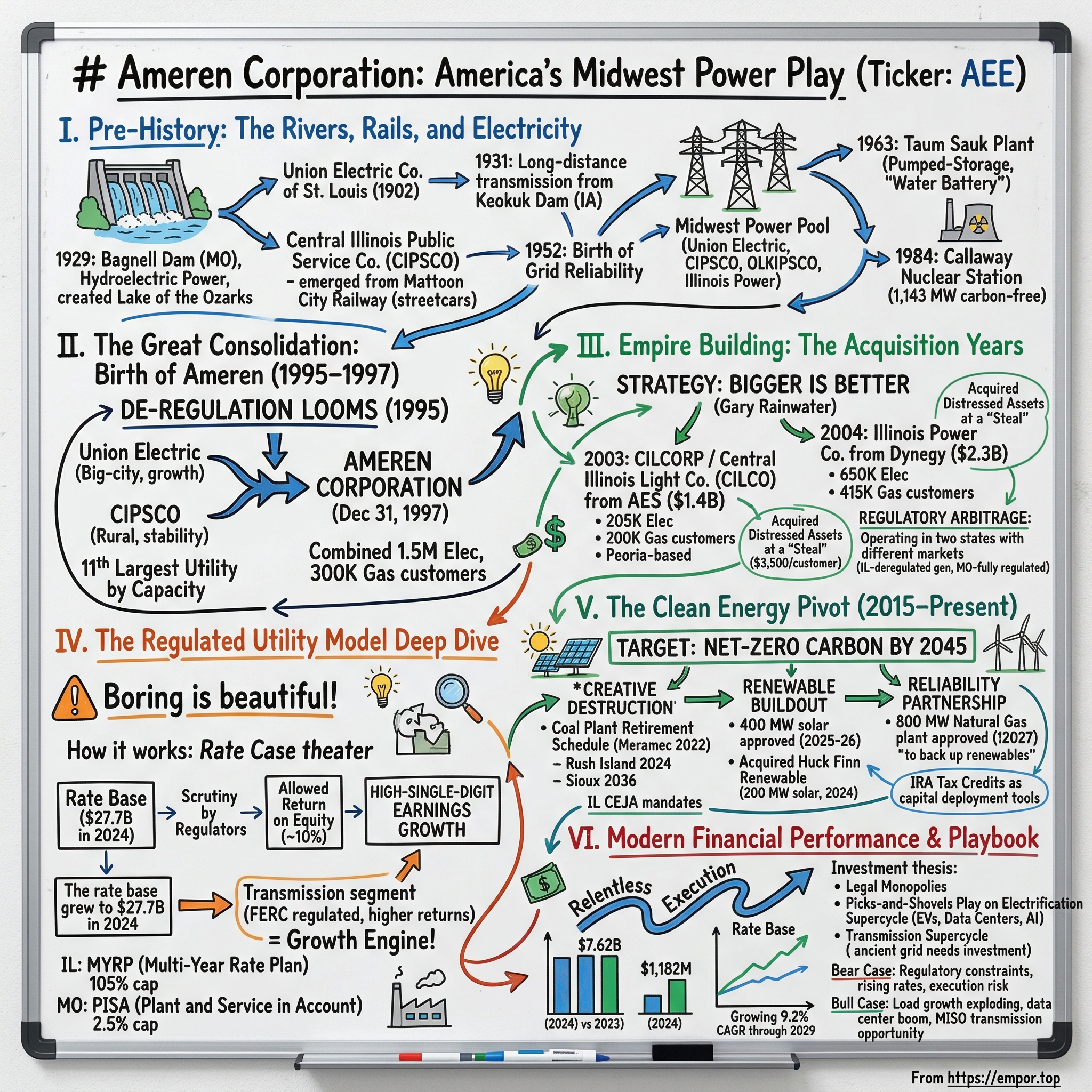
Ameren Corporation: America's Midwest Power Play
I. Cold Open & Episode Setup
In the early hours of a February morning in 2026, a handful of signatures changed the arithmetic of a 124-year-old electric utility. Ameren Missouri executed energy service agreements covering 2.2 gigawatts of new electricity demand—roughly the capacity of two large nuclear reactors—with counterparties it was contractually forbidden from naming.1 Three months later, one of those counterparties publically identified itself: Google announced a $15 billion infrastructure commitment in Missouri, anchored by a data center campus in New Florence, a Montgomery County town of fewer than 800 residents about seventy miles west of St. Louis.2
That deal highlights Ameren's position in 2026. The company's origins trace back to streetcars in Mattoon, Illinois, and a hydroelectric dam on the Osage River. It spent the 2000s pursuing expansion in unregulated power markets, followed by a decade spent executing traditional utility work—burying lines, replacing aging poles, and filing rate cases. Sitting at the intersection of the Midwest power grid, the utility now controls a key resource in the current industrial cycle: firm, deliverable electricity.
Ameren Corporation trades on the NYSE under the ticker AEE. Formed by merger on December 31, 1997, it is headquartered in St. Louis, Missouri.3 The company serves roughly 2.5 million electric customers and 900,000 natural gas customers across a 64,000-square-mile territory spanning eastern Missouri and central and southern Illinois.1 Since 2013, Ameren has operated as a fully rate-regulated utility, having exited merchant generation, commodity trading, and international assets.
The regulated utility financial framework relies on a straightforward mechanism. A rate-regulated utility does not generate profits by expanding sales volume at a margin. Instead, it earns returns through capital deployment into approved infrastructure. Regulators establish a revenue requirement—the total revenue permitted—comprising operating costs, depreciation, taxes, and an authorized return on the depreciated value of assets placed into service. That collective asset base forms the rate base. Rate base expansion drives earnings growth, provided regulators approve the expenditures and customer rates absorb the costs. Capital expenditure operates as the underlying growth engine rather than a traditional cost center.
Ameren has pointed this business structure toward the largest load expansion American electric utilities have faced in decades. Management's five-year plan, presented on its fourth-quarter 2025 earnings call in February 2026, projects $31.8 billion in infrastructure investment between 2026 and 2030—a 21% increase over the prior year's five-year outlook. This plan is designed to expand the rate base from $28.8 billion at the end of 2025 to $47.7 billion by 2030, representing a compound annual growth rate of 10.6%.1 Beneath that near-term forecast sits a ten-year pipeline of identified infrastructure opportunities exceeding $70 billion.1
Despite that projected 10.6% asset growth, management's earnings guidance targets 6% to 8% compound annual EPS growth over the same period.1 The gap between 10.6% rate base expansion and 6% to 8% earnings-per-share growth highlights the central financial trade-off in Ameren's strategy: roughly three to four percentage points of annual asset growth do not translate directly into per-share earnings. On the February earnings call, chief financial officer guidance noted that equity issuance and share dilution account for primary differences.1 The key question for investors is whether the incoming load surge from data centers and industrial electrification will alter this dilution dynamic.
This episode traces how Ameren reached this position. It begins with the Missouri and Illinois predecessor companies and their foundational hydro and nuclear assets. It moves through the 1997 merger, the deregulation-era expansion, the merchant generation downturn, and the 2013 divestiture that refocused the corporate structure. It analyzes the regulated business model across four distinct state and federal regulatory frameworks, examines the high-return transmission division, and details how data center demand is reshaping the Missouri generation fleet. Finally, it evaluates management's capital plan, balance sheet strategy, and the primary bull and bear investment theses.
It begins, as most American utility stories do, with a river.
 Subscribe on LinkedIn
II. Pre-History & The Foundation of Midwest Infrastructure
Stand on Bagnell Dam today and the view features jet skis and lakeside condominiums. In 1929, it was a hard limestone bluff along the Osage River—a stream that flooded violently while generating no electricity. Union Electric's decision to dam the river reflected the defining bet of the early power era: massive capital deployment, a decades-long payback period, and a physical asset structured to earn returns for a century. Bagnell Dam was completed in the early 1930s, impounding the Osage River to create the Lake of the Ozarks—an accidental resort economy built alongside a utility balance sheet.4 Union Electric even established a separate light and power entity in 1931 to serve residents settling along the new shoreline.4
The corporate origins are older and messier. Union Electric traced back to a May 1902 consolidation in St. Louis that merged three competing local electric suppliers—Imperial Electric Light, Heat and Power; Citizens Electric Lighting and Power; and Missouri Edison Electric—into a single franchise.4 That pattern of competing electric companies collapsing into a single provider repeated across major American cities in the same decade. Electricity proved to be a natural monopoly discovered through financial friction: duplicate wire networks over the same streets divided demand and degraded capital returns. The regulated monopoly compact—a single provider granted an exclusive service territory with an obligation to serve, in exchange for commission-regulated rates—emerged as the negotiated solution, establishing the core framework Ameren operates under today.
On the Illinois side, the corporate ancestor was humbler still. Central Illinois Public Service Company grew out of the Mattoon City Railway Company, founded in 1902 to operate streetcars.4 Traction companies of that era frequently built generating stations to power transit lines, realized they held idle capacity during off-peak hours, and began selling electricity to adjacent towns. While streetcar systems eventually faded, the power business expanded into CIPSCO, serving central and southern Illinois's agricultural and industrial towns. Two distinct customer bases—urban St. Louis on one side of the Mississippi River and dispersed rural Illinois on the other—developed independently a hundred miles apart, remaining separate for ninety-five years.
The mid-century technical milestones illustrate what vertical integration meant in practice. In 1963, Union Electric completed Taum Sauk, a pumped-storage hydroelectric plant in the St. François Mountains. Its mechanical concept was straightforward: pump water uphill to an elevated reservoir using cheap overnight power, then release it downhill through turbines to generate electricity during peak afternoon demand. In 1963, pumped storage represented the primary grid-scale energy storage technology available. Ameren is currently constructing 1,020 megawatts of lithium-ion battery capacity to perform a similar balancing role electrochemically—a reminder that while multi-hour energy storage is a long-standing operational requirement, the underlying technology has shifted from mechanical to chemical systems.5
Then came Callaway. Union Electric's single-unit nuclear plant in Callaway County entered commercial service in the mid-1980s, adding over a gigawatt of carbon-free baseload capacity to the Missouri system. Callaway reflected a classic 1970s utility investment—capital-intensive, subject to construction delays, expensive, and heavily contested during development. Four decades later, it stands as Ameren's most critical generation asset because it provides continuous, around-the-clock power, offering firm capacity that variable generation sources such as solar cannot match directly.
Taum Sauk also brought the utility's most severe operational failure. Before dawn on December 14, 2005, the upper reservoir overtopped, causing a catastrophic embankment failure. More than one billion gallons of water tore down Profit Mountain into the East Fork of the Black River, obliterating much of Johnson's Shut-Ins State Park and sweeping the park superintendent's house—with his family inside—roughly a quarter-mile.6 Investigators attributed the collapse to a combination of design and construction flaws, an instrumentation programming error, and human error.6 Ameren ultimately committed hundreds of millions of dollars to site restoration, the state park remained closed for five years, and the upper reservoir was rebuilt using roller-compacted concrete rather than rockfill.7
That failure illustrates a recurring theme in utility operations. Taum Sauk was neither a market risk nor a regulatory dispute; it was an operational failure—stemming from sensor placement, procedural oversight, and engineering judgment—that generated hundreds of millions of dollars in losses alongside prolonged reputational damage. Highly capitalized utilities face substantial operational risks that stem directly from physical asset failures rather than financial modeling variables. Financial evaluations based strictly on rate-base growth projections can understate these operational vulnerabilities.
The post-war decades provided an exceptionally favorable operating environment for electric utilities. Electricity demand roughly doubled every ten years, while larger, more thermally efficient power plants continuously reduced unit generation costs as systems expanded—a period when economies of scale and load growth aligned. Under cost-of-service ratemaking, utilities deployed capital, earned returns on expanded asset bases, and delivered declining real power prices to ratepayers. That operating equilibrium collapsed in the 1970s under the combined pressure of fuel price shocks, rapid inflation, new environmental compliance mandates, and substantial nuclear construction cost overruns. The industry spent the subsequent two decades managing financial strain, setting the stage for the power sector restructuring and deregulation movements of the 1990s.
By the mid-1990s, Union Electric and CIPSCO operated as traditional, low-growth utilities dependent on stable dividend payouts. However, federal and state policy discussions began advocating for electricity market restructuring—aiming to unbundle generation from transmission and distribution assets to introduce wholesale market competition. Faced with regulatory uncertainty and potential margin pressures, corporate scale offered strategic defense. Consequently, two utilities operating in adjacent territories across the Mississippi River began evaluating a corporate combination.
III. The Great Merger & The Merchant Power Trap
In 1995, Union Electric and CIPSCO proposed a combination built on the prevailing utility strategy of the decade: acquiring scale ahead of market deregulation. Shareholders approved the transaction, which required two and a half years of state and federal regulatory reviews before closing on December 31, 1997, in a deal valued at roughly $1.3 billion.4 The newly created holding company took the name Ameren—a portmanteau of "America" and "energy"—and began trading on the NYSE under the ticker AEE.4
The explicit rationale focused on economies of scale: consolidating back-office operations, executive overhead, and fuel procurement. The unstated logic was defensive. With restructuring looming in Illinois, management sought a larger balance sheet to absorb potential earnings volatility if generation assets were exposed to market prices.
What followed over the next decade was rapid asset expansion. In January 2003, Ameren completed the acquisition of CILCORP and its utility subsidiary, Central Illinois Light Company, from AES Corporation—a developer that was retreating after expanding aggressively during the initial deregulation boom.8 Central Illinois Light brought a compact Peoria-area service territory with a dividend record extending back to the 1920s, adding stable regulated cash flows to the holding company.
The subsequent acquisition proved far larger and more complex. On September 30, 2004, Ameren completed the purchase of Illinois Power Company from Dynegy in a transaction valued at $2.3 billion—consisting of roughly $1.8 billion in assumed debt and preferred stock, with the balance paid in cash.9 The transaction structure reflected its underlying economics: Ameren did not primarily commit new equity capital, but instead absorbed substantial liabilities. Dynegy, facing acute financial distress, needed to divest utility assets, while Ameren sought greater scale in Illinois. The deal doubled Ameren's customer footprint in Illinois, but it also imported legacy debt, environmental liabilities, and an Illinois regulatory environment historically less supportive than Missouri's.
Counterparty overlap added further irony to the transaction history. Dynegy sold a regulated utility to Ameren in 2004, and nine years later would acquire Ameren's merchant power business—a transfer that marked a pivotal reorientation of Ameren's corporate strategy.
This expansion era illustrated a recurring risk in the electric utility sector: expanding into unregulated merchant generation. Restructuring created merchant power plants that operated without the revenue protections of the traditional regulatory compact. Utility managers, whose core operational strength lay in cost-of-service regulation, acquired merchant generation assets, often from distressed sellers and financed heavily with debt near peak commodity cycles. Because upfront equity checks appeared modest, these acquisitions were positioned as disciplined expansion. In practice, they introduced substantial financial leverage without rate recovery guarantees. Ameren's Illinois Power purchase and its merchant fleet expansion both reflected this structural miscalculation.
By the mid-2000s, Ameren had organized its unregulated coal assets under Ameren Energy Resources, centered around Ameren Energy Generating Company (Genco), along with associated marketing and generation affiliates.10 Unlike regulated utilities, these merchant plants sold power into wholesale markets at prevailing spot prices without guaranteed returns. During the mid-2000s, high power prices and low coal costs generated strong cash flows, leading market analysts to reward the segment's upside potential.
That operating environment deteriorated rapidly under two simultaneous pressures. The 2008 financial crisis suppressed industrial electricity demand across the Midwest. Concurrently, the expansion of horizontal drilling and hydraulic fracturing unlocked vast natural gas supplies, driving down natural gas prices and the marginal cost of power generation. Because natural gas units frequently set clearing prices in wholesale electricity markets, low gas prices depressed overall wholesale power prices. Merchant coal plants, burdened by fixed operating costs, maintenance requirements, and environmental compliance obligations, shifted from high-margin cash generators into persistent loss centers. Without access to rate recovery mechanisms, the merchant business exposed Ameren directly to commodity market downside.
Ameren responded with a complete structural exit. In March 2013, the company announced a strategic decision to divest its merchant operations and focus exclusively on rate-regulated utilities.11 The transaction closed on December 2, 2013, with Ameren transferring Ameren Energy Resources—including Genco, an 80% stake in Electric Energy Inc., AmerenEnergy Resources Generating Company, and Ameren Energy Marketing—to Dynegy subsidiary Illinois Power Holdings.10 Concurrently, Ameren sold three Illinois merchant gas-fired facilities to a Rockland Capital affiliate: a 478-megawatt combined-cycle plant at Grand Tower, a 460-megawatt simple-cycle plant at Elgin, and a 228-megawatt simple-cycle plant at Gibson City.10
The divestiture produced substantial non-cash accounting losses. Ameren received minimal equity consideration for the merchant business, effectively transferring the assets in exchange for the buyer assuming environmental liabilities, pension obligations, and debt. In financial terms, the write-downs formally recognized previous value destruction.
Strategically, however, the exit transformed Ameren's financial profile into a fully rate-regulated utility with predictable cash flows and a lower cost of capital. On its February 2026 earnings call, management highlighted that since the 2013 divestiture, weather-normalized adjusted earnings per share have compounded at approximately 7.4% annually, dividends per share have increased 78% through 2025, and total shareholder return has exceeded 300%, outperforming broader utility indices.1 While these metrics reflect management's reporting methodology, the structural shift remains clear: Ameren's modern business model rests entirely on regulated utility operations established after the 2013 exit.
That historical pivot frames the central strategic question facing Ameren today. Management's multi-year $31.8 billion capital program represents a major expansion of rate base infrastructure. Investors must evaluate whether this capital deployment reflects a disciplined investment strategy backed by regulated cost recovery, or a renewed period of aggressive capital accumulation in pursuit of asset scale.
IV. The Regulated Utility Engine: Rate-Setting, Rate Base, & Segment Economics
Evaluating that strategy requires examining the financial architecture behind the utility model—an engine comprising four distinct regulated operating segments under separate state and federal regulatory rulebooks. The structural differences among these frameworks drive Ameren's earnings trajectory as much as its physical operations.
The core mechanism relies on a standard revenue requirement calculation. Regulators establish the total revenue a utility may collect by summing four components: the authorized return on its rate base, prudently incurred operating expenses, asset depreciation, and taxes. Rate base represents the depreciated net book value of physical plant serving customers, while the allowed return reflects a commission-set percentage applied to the equity portion of the capital structure. Dividing the total revenue requirement by projected billing volumes yields customer rates.
This equation creates three primary financial dynamics. First, capital deployment serves as the primary engine for earnings growth, as every approved dollar of net plant permanently expands the asset base earning a return. Second, controlling operating expenses does not directly expand profit margins when rates are set, since those costs are passed through to customers; instead, cost control helps cushion bill impacts, preserving regulatory support for future capital programs. Third, utilities face regulatory lag—the delay between incurring capital expenditures in year one and recovering them in rates during subsequent years. During that interval, unrecovered investments yield no return. Managing and reducing regulatory lag is therefore a central focus of utility capital strategy.
Ameren Missouri represents the company's largest operating segment and its only vertically integrated utility, owning generation, transmission, and distribution assets subject to regulation by the Missouri Public Service Commission.12 The segment generated $157 million in second-quarter 2026 earnings, compared to $150 million in the prior-year period.13 Operational returns in Missouri depend heavily on Plant-in-Service Accounting (PISA), a statutory rule allowing the utility to defer and subsequently recover 85% of the depreciation expense and return on qualifying capital investments made between formal rate cases. This mechanism mitigates regulatory lag by converting potential earnings attrition into a timing adjustment. In June 2026, Ameren Missouri filed for a $343 million annual electric base rate increase based on a requested 10.25% return on equity, a 52% equity capital structure, and a $16.7 billion rate base for a test year ended March 31, 2026.1415 If approved as filed, the proposal would increase a typical residential bill by roughly $13 per month, with a final commission decision expected in mid-2027.
Ameren Illinois Electric Distribution operates as a distribution-only wires business under the jurisdiction of the Illinois Commerce Commission, following the multi-year rate plan framework established by the state's Climate and Equitable Jobs Act.16 The segment earned $70 million in the second quarter of 2026, up from $64 million in the year-ago quarter.13 Historically, this segment has operated in a more contentious state regulatory environment—a dynamic examined in the subsequent section.
Ameren Illinois Natural Gas serves approximately 900,000 customers and represents the smallest segment by earnings, contributing $9 million in second-quarter 2026 earnings compared to $10 million in the prior-year period.13 Gas distribution earnings are inherently seasonal and concentrated in winter periods, making quarterly comparisons in spring less reflective of annual performance. More significantly, the Illinois commission approved a $79 million annual base rate increase in November 2025, authorizing a 9.6% return on equity and a 50% equity capital ratio while expanding average rate base from roughly $2.85 billion to $3.2 billion.1
Ameren Transmission operates under Federal Energy Regulatory Commission (FERC) oversight rather than state regulation. The segment posted $96 million in second-quarter 2026 earnings, up from $86 million in the prior-year period, delivering profit growth comparable to the much larger Missouri segment.13 FERC transmission tariffs utilize forward-looking formula rates that adjust annually to reflect actual capital additions and operational expenses, substantially eliminating regulatory lag. FERC has also historically authorized equity returns above average state commission allowances, making transmission capital deployment a key driver of corporate returns.
Compared to regional peers—including Evergy, WEC Energy Group, CMS Energy, NiSource, CenterPoint, and Exelon—Ameren's projected 10.6% compound annual rate base growth places it among the most aggressive capital deployment programs in the Midwest utility sector. However, rate base expansion enhances shareholder value only to the extent that regulators approve the underlying investments, customer bills absorb the resulting rate increases, and the utility earns near its authorized returns.
This operating profile creates a distinct structural risk position relative to pure distribution utilities. Wires-only operators like Exelon or CenterPoint focus primarily on distribution infrastructure replacement and annual rate adjustments. By contrast, vertically integrated utilities like Ameren Missouri maintain a statutory obligation to generate or procure power. That mandate requires multi-decade capital commitments to generation facilities based on long-term demand and fuel forecasts. Consequently, generation investments account for a substantial portion of Ameren's capital budget. While vertical integration positions the utility to capture large-scale industrial and data center load expansions, it also exposes the company to heightened long-term demand and capital execution risks.
Myth versus reality. The common market characterization of regulated utilities as defensive "bond proxies"—held primarily for yield in low-growth environments—does not match Ameren's current operating stance. Deploying $31.8 billion in capital into a footprint where largest-segment sales are projected to grow roughly 60% over four years shifts the risk profile toward large-scale infrastructure execution, counterparty exposure, and construction management.5 Conversely, investors evaluating the company strictly through a high-growth technology lens face regulatory constraints: authorized returns on equity remain capped by state and federal commissions regardless of surging electricity demand.
Executing this growth strategy ultimately depends on the decisions of the regulatory commissions governing Ameren's primary operating jurisdictions.
V. Regulatory Friction, Clean Energy Pivot, & Legal Settlements
On December 19, 2024, the Illinois Commerce Commission handed down an order that told Ameren, in effect, that its plans for the state were roughly four times larger than the state was willing to pay for. Out of $333 million in proposed grid investments, the Commission approved $83 million — a cut of about 75% — and set the allowed return on equity at 8.715%, well below the 9.27% the company had requested, while trimming the overall rate increase to $309 million.1617[^18] It was the second consecutive December in which Illinois regulators had rejected or gutted the utility's grid plan; the ICC had already thrown out the initial versions of both Ameren's and ComEd's plans in December 2023.[^19]
An 8.715% allowed ROE is not a rounding error. It sits close to what many analysts would estimate as a utility's actual cost of equity in a higher-rate environment, meaning the spread between what Ameren is permitted to earn and what its shareholders require was compressed nearly to nothing. When a regulator sets a return at or below cost of capital, incremental investment stops creating shareholder value even when it is fully approved. That is a far more serious problem than a spending cut, and it is why the Illinois orders dominated analyst questioning through 2024 and 2025.
The picture since has been more mixed than the 2024 headline suggests, and the honest reading is stabilization rather than vindication. Alongside the November 2025 gas order at 9.6%, in December 2025 the ICC approved a $48 million reconciliation adjustment to the 2024 revenue requirement under the multi-year rate plan, with new rates effective January 2026 — though it did strike roughly $11 million from what the company had sought.118 Both orders tracked the administrative law judges' recommendations closely, which matters: it suggests decisions were being made on the record rather than politically.1 Asked directly about Illinois on the February 2026 call, Marty Lyons said the environment felt like it was "stabilizing, and in some cases, improving," while conceding that "I'm not saying those concerns have completely dissipated in the investment community."1 That is a more candid formulation than utility CEOs usually offer, and it is the right frame: the evidence supports "less hostile," not "constructive."
The real test is pending. In January 2026, Ameren Illinois filed its required multi-year grid plan covering 2028 through 2031, seeking roughly $2.75 billion in electric distribution investment, with an ICC decision expected in December 2026.15 Management says it built the filing around feedback from commissioners and stakeholders.1 Whether the ICC agrees will be the clearest available signal on whether Illinois is a place where Ameren can deploy capital at acceptable returns, or a jurisdiction it maintains rather than grows. The five-year plan implicitly hedges: of $31.8 billion, only about $3.6 billion is allocated to Illinois electric distribution and $1.9 billion to Illinois gas, against $21.3 billion for Ameren Missouri and $5.0 billion for transmission.51 Capital, as ever, flows where it is welcome.
Missouri went the other direction, decisively. Governor Mike Kehoe signed Senate Bill 4 into law on April 9, 2025, and it rewrote the state's utility economics in Ameren's favor.2 The law extended PISA's sunset to December 31, 2035 with a possible further extension to 2040 subject to commission approval, expanded PISA to cover natural gas generation, and — most consequentially — permitted utilities to recover construction work in progress for natural gas generating facilities, meaning customers begin paying for a plant while it is being built rather than after it enters service.19 Before SB 4, CWIP recovery was unavailable for any generation in Missouri.19 SB 4 also required large utilities to create tariffs ensuring that customers with 100 megawatts or more of peak demand cannot shift costs onto other customer classes.2
It is worth being clear-eyed here: Ameren lobbied for this law, and critics have said so publicly.20 CWIP is genuinely a double-edged instrument. It lowers financing costs on a multi-year project because the utility is not capitalizing interest for five years, which can reduce total customer cost — Ameren's argument.21 It also, as consumer advocate John Coffman of the Consumers Council of Missouri put it, removes some of the discipline that comes from having to finish a project before getting paid for it.21 Both things are true simultaneously. What is not in dispute is that SB 4 materially de-risked Ameren's generation build for shareholders and shifted timing risk toward ratepayers.
Meanwhile, the company's coal era was ending — partly by plan, partly by court order. Ameren retired Meramec in 2022. Rush Island, a two-unit plant south of St. Louis that had operated for years without the pollution controls that a federal court found the Clean Air Act required, shut in October 2024 rather than accept a retrofit.22 The underlying litigation had run thirteen years: the government proved that Rush Island's uncontrolled operation had released well over 250,000 tons of excess sulfur dioxide, a district court found violations, and the Eighth Circuit affirmed.[^25] Because the plant closed before remedies could be imposed on it, the court instead ordered mitigation. On December 17, 2024, the U.S. District Court for the Eastern District of Missouri entered an order requiring $61 million in mitigation spending: $25 million for a HEPA air purifier program offering vouchers to as many as 125,000 residential households, prioritized by lowest median income, and $36 million for roughly 80 electric school buses and associated charging infrastructure.22[^25]
For investors, the Rush Island outcome removed a genuine overhang — an unquantified liability with an unpredictable remedy, resolved at a defined and modest cost relative to Ameren's balance sheet. It is also a case study in a specific corporate failure mode. Ameren's position throughout was that its work at Rush Island was routine maintenance not triggering New Source Review permitting. It lost that argument at trial and on appeal, and thirteen years of litigation ended with the plant dead and a nine-figure combined cost. Aggressive interpretation of environmental permitting rules is an accounting judgment dressed as an engineering one, and it can compound expensively.
What replaces the coal is where the story turns. Ameren has committed to net-zero carbon emissions by 2045, with interim reductions of 60% by 2030 and 85% by 2040 against a 2005 baseline, and the Sioux plant scheduled for retirement in 2036. But the fleet plan now leans heavily on gas — a shift management frames as reliability, and critics frame as backsliding. That tension, and the demand surge driving it, is the subject of the next two sections.
VI. The Hidden Growth Engine: Transmission Supercycle & Data Center Surge
On December 12, 2024, the MISO board approved something the American grid had not seen in decades: a $21.9 billion long-range transmission portfolio, Tranche 2.1, comprising 24 projects and 323 facilities and anchored by a 3,631-mile, 765-kilovolt backbone across the Midwest.2324 MISO's own analysis projected $23 billion to $72 billion in net benefits over twenty years.23 Ameren was subsequently selected to build projects representing approximately $1.3 billion of that portfolio, carrying power into distribution grids in Missouri, Illinois, and neighboring states.25
To understand why this matters disproportionately, you need to understand what MISO is and why transmission is different. The Midcontinent Independent System Operator is the traffic controller for a grid stretching from Manitoba to Louisiana. It does not own wires; it decides where power flows and, increasingly, where new wires are needed. Long-Range Transmission Planning is MISO's process for identifying regionally beneficial lines whose costs are then spread across the region's utilities and their customers.26
Here is the economic asymmetry. A distribution investment — a new pole, a smart switch — is approved by a state commission, earns a state-set ROE, and typically waits for the next rate case to enter rates. A FERC-jurisdictional transmission investment earns a federally set return under a formula rate that updates annually with actual costs. Same company, same crews, same steel and copper — meaningfully better return and meaningfully less lag, purely because of which regulator has jurisdiction. Over a long enough horizon, a rational utility management shifts capital toward the highest-return, lowest-lag bucket available. That is not a criticism; it is what capital allocation means. But investors should recognize it as the mechanism it is: regulatory arbitrage within a single corporate structure.
Ameren has been methodical about pursuing it. As of the February 2026 call, the company was executing its assigned Tranche 1 and Tranche 2.1 projects, had submitted joint bids in January 2026 for two competitive Illinois projects with MISO selections expected in summer 2026, and was evaluating two further bidding opportunities with mid-2026 deadlines.1 Notably, management excludes competitive projects from both the five-year capital plan and the ten-year pipeline until they are actually awarded.1 That is a conservative disclosure choice and a real one — it means the $31.8 billion plan understates the transmission opportunity rather than inflating it.
Now the demand side, which is where 2026 diverges from every prior year in this company's history.
The reason hyperscalers are looking at rural Missouri is not glamorous. It is land, fiber, water, a central position on the continental grid, low seismic and hurricane risk, and — above all — the possibility of getting interconnected this decade rather than next. Interconnection queue position has become the scarcest asset in American infrastructure. In much of Virginia, Texas, and Arizona, the answer to "when can you energize five hundred megawatts" is measured in many years. Ameren's territory can, in some cases, answer faster.
The commercial architecture matters more than the megawatts. In November 2025, the Missouri PSC approved a large-load rate structure requiring customers requesting 75 megawatts or more to pay a base rate of approximately 6.2 cents per kilowatt-hour and to sign an energy service agreement carrying a twelve-year service commitment after ramp, a minimum demand charge equal to 80% of contracted capacity, collateral equal to two years of minimum monthly bills, termination provisions, and exit fees.12 Translated: the data center pays whether or not it uses the power, posts security against default, and cannot walk away cheaply. This is take-or-pay contracting imported into a regulated tariff, and it exists because the political risk of a stranded gas plant landing on residential bills was the one thing that could have stopped the whole enterprise.
Then came execution. In February 2026, Ameren Missouri signed ESAs totaling 2.2 gigawatts.127 By the second quarter of 2026, executed electric service agreements had reached 2.8 gigawatts, and Google and Amazon had broken ground on projects representing a combined $25 billion of investment.5 Google's commitment, announced May 20, 2026, includes contracting for more than a gigawatt of new Missouri generation capacity and a capacity commitment framework with Ameren supporting over 500 MW of additional capacity, with Google covering 100% of the power it uses and infrastructure costs directly driven by its operations.2 Ameren has also received approximately $46 million in non-refundable payments from developers in Missouri and Illinois to fund transmission upgrades under construction agreements.1 Non-refundable is the operative word: it is the cheapest available evidence that these projects are real, because it is money developers cannot get back.
The pipeline behind the signed deals: 3.4 gigawatts of Missouri projects with transmission interconnection construction agreements — inclusive of the ESAs — and 850 megawatts in downstate Illinois.1 Management now expects Ameren Missouri sales to grow roughly 60% from 2025 levels by the end of 2029.5 For a utility that had been guiding to low-single-digit sales growth for a generation, that is a regime change, not an acceleration.
Run this through Hamilton Helmer's 7 Powers and the picture is unusually clean on some axes and weak on others. Cornered Resource is the strongest: exclusive state-granted service territories, established transmission rights-of-way that would be effectively impossible to assemble today, and interconnection queue positions that function as scarce, non-replicable options. Scale Economies are real but bounded — spreading fixed grid and IT costs across 3.4 million connections helps, though utility scale curves flatten quickly. Switching Costs are absolute in the literal sense: a customer cannot choose a different set of wires. But note that this is a legal condition, not an earned advantage, and it comes bundled with an obligation to serve and a regulator setting the price. Counter-Positioning is the weakest claim; Ameren's regulated structure is not a novel model incumbents cannot copy, it is the industry-standard model. What Ameren has is not a moat it built but a moat it was granted — and the rent it extracts from that moat is capped by commissions.
Porter's Five Forces confirms the shape. Barriers to entry are near-absolute — legal monopoly, certificates of convenience and necessity, and capital requirements measured in tens of billions. Buyer power is low for the residential and small commercial base but rising meaningfully at the top end: a hyperscaler negotiating gigawatts has real leverage, choice of state, and the option of building behind-the-meter generation. The 12-year, 80%-minimum ESA structure is precisely a response to that leverage. Supplier power is currently high and is the most underrated risk in the story: high-voltage transformers, switchgear, and turbines carry multi-year lead times, and Ameren has responded by pre-procuring turbines and transformers and securing production slots for three turbines for a future combined cycle plant.1 Substitutes remain limited — rooftop solar and home batteries reduce consumption without eliminating grid dependence. Rivalry is nonexistent inside the service territory and genuinely competitive only in MISO's competitive transmission bidding, where Ameren wins some and loses some.
Myth versus reality, two. The popular version of the data center story is that utilities in the path of AI demand have been handed free money — captive customers with unlimited budgets and no alternatives. The reality is more constrained in both directions. Hyperscalers are not price-takers; they are among the most sophisticated energy procurement organizations on earth, they run competitive processes across multiple states, and they retain the option to self-generate. Google's Missouri commitment explicitly involves contracting for its own new generation capacity rather than simply buying from the grid.2 At the same time, the utility does not capture the value of scarce power in the way an unregulated generator would. If electricity in central Missouri became dramatically more valuable tomorrow, Ameren could not raise the price to capture it — its return is still whatever the commission allows on the assets it built. The AI boom does not make a regulated utility more profitable per dollar invested. It makes more dollars investable. Those are very different propositions, and conflating them is the most common analytical error in the current utility narrative.
The synthesis: Ameren's advantages are durable but not earned, capped but not fragile. What has changed in 2026 is not the moat's quality — it is the volume of profitable investment the moat can absorb. Whether management deploys that capital well is a question about people.
VII. Management, Capital Allocation, & Skeptical Investor Stress Test
Martin J. Lyons Jr. is not a charismatic CEO, and Ameren has never needed one. An accountant by training, he joined Ameren in 2001, served as chief financial officer through the merchant divestiture and its aftermath, added chief operating officer responsibilities, and became president and CEO in January 2022 before assuming the chairman's role. That background is particularly relevant: the defining trauma of Ameren's modern history was a balance sheet crisis, and Lyons was the finance executive who resolved it.
His public communication remains consistent to the point of monotony—repeating the same three-pillar framework of investing in rate-regulated infrastructure, advocating for constructive regulatory and legislative frameworks, and optimizing operations on call after call.1 This narrative consistency across years of filings and earnings calls offers an observable proxy for disciplined execution over improvisation.
The finance leadership shifted at the start of 2026. Announced in October 2025, Leonard "Lenny" Singh—who spent over thirty years at Consolidated Edison across electric, gas, and steam operations before joining Ameren in 2022 as chairman and president of Ameren Illinois—became executive vice president and CFO effective January 1, 2026.28 Michael Moehn, the long-serving CFO, transitioned into a newly created role as group president of Ameren Utilities, overseeing the Missouri, Illinois, and transmission operating companies.28 This executive shift offers two interpretations. The operational view holds that with a $31.8 billion capital program to execute, Ameren assigned its most experienced operating executive to oversee delivery. The skeptical view notes that an incoming CFO with an operational background assumed leadership just as the company initiated the largest financing program in its history. Singh's first major public appearance on the February 2026 earnings call was measured and routine, reflecting a standard transition without offering early indication of performance under market stress.
The capital plan requires rigorous evaluation. Of the $31.8 billion planned from 2026 through 2030, Ameren Missouri accounts for $21.3 billion—roughly two-thirds—while transmission receives $5.0 billion, Illinois electric distribution receives $3.6 billion, and Illinois gas receives $1.9 billion.5 The Missouri allocation centers on generation, targeting 5,645 megawatts of new capacity comprising approximately 2,900 megawatts of natural gas, 975 megawatts of solar, and 1,020 megawatts of battery storage.5 Early project milestones have begun: the 50-megawatt Vandalia solar facility entered service in December 2025; the Bowling Green and Split Rail solar centers, totaling 350 megawatts, entered final testing in January 2026; a dual-fuel conversion at the Audrain Energy Center was scheduled to add 700 megawatts of winter peak capacity; and in February 2026, the Missouri PSC approved the certificate of convenience and necessity for the 800-megawatt Big Hollow gas facility and an accompanying 400-megawatt battery installation, both targeted for 2028.1
The segment's largest project remains pending. In July 2026, Ameren Missouri requested regulatory approval for a 2,100-megawatt natural gas plant at West Alton—located on the site of the retiring Sioux coal plant and targeted for 2031—while seeking CWIP treatment under SB 4 to collect customer revenues during construction.2129 Public filings redacted the total project cost.21 Opposition emerged promptly: the Sierra Club challenged the facility as an expensive, long-term fossil fuel commitment, Renew Missouri opposed continued gas reliance, and consumer advocates criticized the CWIP mechanism for requiring residential ratepayers to finance capacity driven primarily by data center demand.2130 Ameren countered that its 2.8 gigawatts of executed service agreements already exceed the plant's proposed capacity.21
That disclosure redaction warrants analytical attention. A rate-regulated monopoly seeking customer rate recovery for a major generating facility without publicly disclosing the estimated construction cost creates a notable transparency gap, even if such confidentiality is standard practice during competitive procurement processes.
Funding. Ameren expects to issue approximately $4 billion in common equity from 2026 through 2030, averaging about $800 million annually. The company satisfied its 2026 equity requirements using $600 million in forward sale agreements structured to settle near year-end, while planning above-average equity issuance in 2027 and 2028 to match peak generation construction.1 By the second quarter of 2026, Ameren had arranged approximately $1.2 billion in forward sales year-to-date, expecting to issue roughly 6.4 million shares by year-end 2026.5 Debt issuance of approximately $2.85 billion was planned for 2026.1 Management has identified parent-level hybrid securities—which receive 50% equity credit from Moody's and S&P—as a potential supplement to common equity.1 When asked whether hybrid securities would enhance per-share earnings, Lyons offered a cautious assessment, noting they might be slightly accretive in the short term, but may be more of a neutral over time.1 Meanwhile, the company raised its annualized dividend by 5.6% in February 2026 to $3.00 per share—marking its thirteenth consecutive annual increase—maintaining a payout ratio of roughly 56% within its 50% to 60% target range.1
Now the stress test—the questions a skeptical investor or activist would press.
First, the dilution gap. While rate base is projected to compound at 10.6% annually, earnings per share growth is targeted at 6% to 8%. When questioned on the February 2026 call regarding the source of this disparity, Lyons confirmed that planned equity issuance and resulting share dilution represent the primary difference, with residual regulatory lag accounting for the rest.1 This financial structure has clear implications for equity holders: issuing approximately $4 billion in new equity dilutes existing ownership, transferring a portion of overall asset growth away from current shareholders. Consequently, rate base expansion serves as an incomplete metric for per-share value creation.
Second, ESA cancellation risk. Although data center developers in other regions have occasionally canceled large-scale projects, Lyons noted on the February call that while he would not characterize himself as having concerns, significant execution milestones—including formal announcements, groundbreakings, and facility construction—remain ahead, while counterparty terms and ramp rates are confidential.1 Moehn added that the large-load tariff incorporates minimum monthly billing requirements, termination fees, and credit support protecting other customers.1 While these contractual mechanisms shield residential and commercial ratepayers from stranded asset costs, shareholders remain exposed if capital investments proceed for load that materializes slower than projected. Second-quarter 2026 groundbreakings by Google and Amazon mitigated near-term execution risk, though specific ramp curves remain undisclosed.5
Third, affordability and political durability. Ameren Missouri's pending rate case would increase a typical residential customer bill by approximately $13 per month, and analysts expect SB 4 cost-recovery mechanisms to keep pushing Missouri bills higher.1431 Ameren has sought to offset bill impacts through cost discipline, with Lyons citing a five-year operation and maintenance expense CAGR of 2.8%—below broader inflation rates—alongside $20 million in recurring annual savings from delivery process improvements and a 25% productivity gain from field scheduling changes.1 However, operational efficiencies may prove insufficient to offset substantial capital-driven rate increases over time. Political risk for regulated utilities often manifests when rising customer bills prompt legislative action to modify regulatory standards, as demonstrated by the passage of SB 4 itself.
Fourth, supply chain constraints. Extended lead times for high-voltage transformers and natural gas turbines mean equipment delays can push back in-service dates, deferring rate base additions and authorized earnings. While Ameren's advance procurement strategy mitigates schedule risk, it commits capital to long-lead equipment prior to receiving final regulatory approvals.
Fifth, portfolio complexity. In contrast to holding companies that expanded into non-regulated ventures, Ameren operates exclusively rate-regulated utilities in contiguous Midwest service territories, with distinct segment reporting that allows clear tracking of capital deployment and earned returns. The parent company net loss line—$18 million in the second quarter of 2026, improved from $35 million in the prior-year period—reflects corporate holding company financing costs rather than a hidden business.13 As a result, the corporate structure presents limited opportunity for break-up or divestiture catalysts, keeping investment focus centered on capital execution and equity dilution.
Sixth, governance and incentive structures. Executive compensation is linked to earnings per share growth alongside safety, grid reliability, and clean energy transition metrics. While weighting compensation toward per-share earnings aligns management incentives with shareholder returns rather than gross rate base expansion, it can also create incentives to utilize short-term financing structures, such as hybrid securities with partial equity credit, to minimize immediate share issuance. Lyons's refusal to claim hybrids are durably accretive reflects a disciplined stance regarding an instrument a CEO's own scorecard would benefit from.1
VIII. Earnings Call Analysis & Primary Evidence
The most revealing aspect of Ameren's recent earnings calls is the shift in analyst focus. Throughout 2024 and early 2025, the Illinois Commerce Commission's grid plan rejection dominated discussion, with questions centering on appeal strategy, allowed return on equity, and whether Illinois remained an investable jurisdiction. By the fourth-quarter 2025 earnings call in February 2026, Illinois was demoted to the final question of the session, raised by KeyBanc analyst Sophie Karp almost as housekeeping.1 Questions beforehand focused almost exclusively on data center demand, generation capacity additions, and capital financing. That reallocation of analyst attention marks a broader market repricing, shifting Ameren's narrative from an Illinois regulatory risk story to a Midwest load-growth story.
Whether that repricing is fully justified remains an open question, with conference call transcripts providing evidence for both views.
On guidance discipline. Jefferies analyst Julien Dumoulin-Smith opened the February 2026 call by asking why the newly executed 2.2 gigawatts of energy service agreements was not reflected in financial guidance. CEO Marty Lyons responded that the 6% to 8% compound annual earnings-per-share growth framework rests on a baseline assumption of 1.2 gigawatts of new load by 2030, consistent with the utility's preferred resource plan, and that the 2.2 gigawatts of executed agreements "certainly represents upside"—offering, depending on customer ramp schedules, "the potential to even achieve above that" range.1 This approach reflects a preference for maintaining a conservative baseline while preserving upside optionality, avoiding premature guidance increases before ramp schedules solidify. The five-year capital plan assumes 6.2% compound annual sales growth from 2026 through 2030 on that 1.2-gigawatt base.1
That setup creates a verifiable test for management credibility. If the energy service agreements materialize and ramp as anticipated, guidance should eventually be revised upward rather than merely reaffirmed. Lyons acknowledged as much on the call, noting that management would not "rule out an update as part of a quarterly conference call," as "things are moving at a faster pace than they historically have."1 Ameren subsequently indicated it would provide updated sales, capital investment, financing, and long-term growth forecasts on its third-quarter 2026 call.[^35] That upcoming call will serve as a key milestone to evaluate whether the conservative baseline set in February reflected genuine operational prudence or a temporary buffer.
On the quarters themselves. Ameren reported 2025 adjusted earnings of $5.03 per share, an 8.6% increase from $4.63 per share in 2024, and affirmed 2026 earnings guidance of $5.25 to $5.45 per share.1 Notably, that adjusted figure excludes an $86 million income tax benefit—equal to $0.32 per share—recorded across the transmission, Illinois gas, and Illinois electric distribution segments following IRS guidance issued to another taxpayer and related FERC and state commission orders regarding net operating loss carryforwards.1 Excluding a sizable non-recurring tax benefit from core adjusted earnings aligns with conservative accounting standards, preventing temporary adjustments from distorting underlying operational trends.
Performance in the first half of 2026 tracked ahead of that baseline. First-quarter earnings per share rose 19.6% year-over-year to $1.28.27 Second-quarter earnings per share reached $1.13, up 11.9% from $1.01 in the prior-year period, bringing six-month earnings per share to $2.41 compared to $2.08 in 2025.513 Revenue of $2.09 billion fell short of the $2.27 billion consensus estimate, reflecting the reality that top-line utility revenue is heavily influenced by weather patterns and fuel pass-through mechanisms, providing limited insight into underlying earnings power.32 Second-quarter earnings drivers reflected core utility economics: higher returns on expanding infrastructure investments and a June 2025 rate increase adding approximately $0.04 per share were partially offset by roughly $0.11 per share in higher operating expenses from reliability-focused tree trimming and plant maintenance, along with increased interest costs.135 Management reaffirmed full-year 2026 guidance and projected results at or above the midpoint.32
Those elevated operating expenses represent deliberate maintenance spending rather than cost overruns. Vegetation management and plant maintenance directly mitigate outage risks. Ameren reported first-quartile SAIFI and second-quartile SAIDI reliability benchmarking in 2025 despite experiencing roughly 30% more severe storms than its ten-year average, with grid infrastructure investments preventing over 56 million minutes of potential customer outages—more than double the prior year.1 Maintaining system reliability during a period of rapid load growth represents an operational necessity rather than discretionary spending.
On the messaging shift. Comparing Ameren's corporate communications in 2026 with its messaging five years earlier reveals a distinct shift in emphasis. Executive vocabulary has shifted from a primary focus on decarbonization toward "resource adequacy, reliability, affordability and supporting local economic growth."1 While the target of net-zero carbon emissions by 2045 remains intact, the operational generation plan now targets approximately 70% of capacity from on-demand resources and 30% from intermittent resources by 2040, and the single largest project in the capital pipeline is a 2,100-megawatt natural gas facility.121 Management attributes this mix to grid physics, pointing out that data centers require continuous power regardless of weather conditions. Conversely, environmental advocates argue that the utility is using data center load growth to justify building fossil fuel assets it long intended to add.30 Both perspectives interpret the same underlying operational pivot. For investors, the notable detail is the absence of an explicit acknowledgment of this strategic shift, as long-term targets are restated while the underlying generation mix is reframed as continuity.
On evasiveness versus candor. The February 2026 call highlighted management's Q&A style under detailed analyst scrutiny. When asked by Wells Fargo regarding the gap between rate base growth and earnings-per-share expansion, Lyons requested that the question be repeated before addressing the dilution dynamic directly.1 When asked by JP Morgan analyst Diana Niles about investment patterns beyond 2030, Lyons noted that large-scale generation spending creates a "lumpy" capital profile and directed analysts to public filings—specifically the Missouri Smart Energy Plan and the Illinois grid plan—rather than offering unverified long-term figures.1 Asked by UBS analyst Bill Appicelli whether the 3.4-gigawatt load pipeline included the 2.2 gigawatts of executed energy service agreements, Lyons confirmed its inclusion and noted that the remaining projects were in "various stages of development," with some advanced and others not.1 These responses reflect a management team that answers within its verified visibility. Based on recent conference calls, the primary question facing Ameren is not disclosure transparency, but whether an executive team that has historically managed steady utility operations can successfully execute an infrastructure expansion of this magnitude.
IX. Material Risk Radar & Key Performance Indicators
Every utility risk disclosure reads the same, which is why most of them are useless. The exercise worth doing is narrower: which risks, for this company, at this moment, could actually break the investment case?
Regulatory and legislative reversal is the first and largest. Not because it is likely, but because it is load-bearing. Two specific mechanisms carry disproportionate weight. Plant-in-Service Accounting, now extended to 2035, is what makes Missouri's requested 10.25% return on equity achievable in practice rather than theory by shrinking regulatory lag on a $16.7 billion and rapidly growing Missouri rate base.1419 Construction work in progress recovery for gas generation is what makes a 2,100-megawatt plant financeable without creating a multi-year earnings drag.21 Both mechanisms emerged from a single legislative session and could, in principle, be modified by another. The trigger would not be ideological; it would be arithmetic. If Missouri customer bills rise noticeably, legislators who voted for Senate Bill 4 in 2025 will face constituents in 2027 and 2029. Meanwhile in Illinois, the December 2026 grid plan order will determine whether roughly $2.75 billion of proposed distribution investment earns an acceptable return or faces another steep reduction.5[^18]
Load materialization risk is the second, and it represents the primary exposure the market is currently pricing. Executed energy service agreements and active groundbreakings by Google and Amazon provide tangible backing.52 The $46 million in non-refundable developer payments reflects direct financial commitments.1 However, three critical details remain undisclosed: the identity of counterparties across the full 2.8 gigawatts, the specific ramp curves, and the exact point at which minimum-demand obligations become binding—an issue Chief Executive Officer Marty Lyons declined to detail on confidentiality grounds.1 Ameren is committing tens of billions of dollars in generation and transmission infrastructure against demand schedules that shareholders cannot independently audit. If data center capital expenditures slow before plants come online in 2028 and 2031, tariff structures protect retail customers from stranded asset costs, but Ameren would face regulatory prudence reviews on capacity built for unrealized demand. That scenario represents a tail risk that remains material.
Cost of capital is the third. A company planning to issue roughly $4 billion in equity through 2030 and $2.85 billion in debt in 2026 alone is acutely exposed to interest rates and share price valuation.1 The underlying mechanics are direct: issuing equity at lower market multiples funds the capital program with a higher share count, permanently widening the gap between rate base expansion and per-share earnings growth. This dynamic makes equity dilution a central determinant of shareholder returns. The parent-level hybrid securities strategy provides a partial hedge, though management has remained non-committal regarding how much common equity these instruments might displace.1
Supply chain and execution risk is fourth, representing a operational factor that utility valuations frequently underprice. Heavy electrical equipment—including natural gas turbines, high-voltage transformers, and switchgear—carries multi-year lead times across the industry. Ameren has pre-procured turbines and transformers for near-term projects, executed gas supply and labor contracts for simple-cycle facilities, and secured production slots for three turbines designated for a future combined-cycle plant.1 While these steps offer meaningful risk mitigation, they do not eliminate execution exposure as the company manages a 5,645-megawatt generation buildout at a scale it has not undertaken in decades.
Physical and weather risk is fifth and permanent. Ameren's service territory sits at the confluence of the Mississippi and Missouri rivers—a geographic corridor prone to tornadoes, derechos, ice storms, and seasonal flooding. Although the system performed reliably during a 2025 storm season that ran roughly 30% above ten-year average severity levels, severe weather drives unrecoverable operations and maintenance expenses and preserves exposure to severe physical asset failures, as demonstrated by the 2005 Taum Sauk collapse.16
Evaluating these operational and financial vulnerabilities requires tracking key performance indicators that isolate core execution metrics from general industry noise. Three specific indicators carry the primary analytical signal.
One: the spread between rate base growth and per-share earnings growth. The critical metric is the differential rather than either figure in isolation. Rate base is projected to compound at 10.6% annually through 2030, while adjusted earnings per share are targeted to grow at 6% to 8%, with management expecting performance near the upper end of that range.1 If this growth gap narrows over time, incoming load expansion is offsetting regulatory lag and earned-return shortfalls faster than equity issuance dilutes per-share results—the scenario Lyons highlighted as achievable as data center power demand fully materializes.1 If the gap widens, infrastructure spending is being financed on terms that dilute existing equity value. This relationship encapsulates the combined effects of share dilution, regulatory lag, and demand realization into a single observable metric.
Two: earned return on equity versus allowed return on equity across operating jurisdictions. Ameren functions under four distinct regulatory frameworks with diverging financial parameters. Missouri has requested a 10.25% return on equity; Illinois electric distribution operates under an authorized 8.715% return; Illinois gas received an authorized return of 9.6% in late 2025; and Federal Energy Regulatory Commission transmission formula rates sit above state allowances with annual true-up mechanisms.14[^18]1 The margin between authorized return ceilings and actual earned returns serves as the clearest measure of capital deployment efficiency. Evaluating this spread at the individual segment level prevents strong returns in Missouri from obscuring structural return compression in Illinois.
Three: the conversion rate of contracted large-load megawatts into billed megawatt-hours. Signed energy service agreements represent contractual commitments, but the 2.8 gigawatts under contract, the 3.4-gigawatt Missouri pipeline, and the 850 megawatts in Illinois generate earnings only as physical power is delivered.51 The pace at which contracted capacity converts into energized load dictates whether the projected 60% sales increase in Missouri by 2029 is realized, confirming whether the underlying generation additions were accurately calibrated to long-term demand.5
X. Playbook: Bear vs. Bull Case & Business Lessons
Set the two cases against each other honestly, because both are supportable from the same set of facts.
The bear case begins with the observation that Ameren is making a very large, very concentrated, very long-duration bet on a demand forecast produced during the most speculative capital expenditure boom in modern technology history. Roughly two-thirds of a $31.8 billion plan flows into a single jurisdiction, much of it into generation sized for hyperscaler load whose ramp schedules shareholders cannot see.51 The plants come online in 2028 and 2031. Nobody knows what AI infrastructure demand looks like then. The tariff protects ratepayers if the load fails to arrive; nothing similarly protects shareholders from a prudence review on stranded capacity.
The dilution argument is the bear case's most durable leg because it does not depend on anything going wrong. Even in the good scenario, roughly $4 billion of equity issuance is why 10.6% rate base growth becomes 6%–8% EPS growth — management said so plainly.1 An investor buying the rate base story and receiving the EPS reality has, in effect, funded a growth plan whose benefits are shared with every new shareholder who arrives during the build.
Illinois remains an open sore rather than a healed wound. An 8.715% allowed ROE on electric distribution is close enough to cost of equity that incremental Illinois investment may create little value even when approved, and the ICC's willingness to cut a grid plan by 75% is a demonstrated behavior, not a hypothetical one.[^18]16 The December 2026 order will either confirm the stabilization thesis or reopen the question entirely.
And affordability is the slow-burning risk that eventually touches everything. A $343 million Missouri rate request adding roughly $13 to monthly bills, a legislative framework designed to accelerate cost recovery, and a gas plant whose cost is redacted from public filings together create a political surface area that did not exist five years ago.142131 Regulated utilities do not usually fail on economics. They fail when the political consensus that grants them their monopoly frays.
The bull case is that Ameren has been handed a rare and specific opportunity: a step-change in demand arriving in a jurisdiction that has just passed legislation making it profitable to serve, with contractual protections that make the political trade sustainable. For thirty years, American utilities grew rate base into flat or declining sales, which meant every dollar of investment raised bills. Growing sales change that calculus fundamentally — new load spreads fixed costs across more kilowatt-hours, which is the only mechanism by which a utility can invest heavily and moderate rate increases. Lyons made exactly this point on the February call, saying the goal was for large-load customers to pay their full cost of service and that "over time, as these sales increase, that there would actually be benefits for the remainder of our customers."1 If that holds, the affordability risk in the bear case inverts into the affordability solution.
The transmission business compounds the argument. MISO's Tranche 2.1 portfolio is a multi-decade regional build, Ameren has been awarded roughly $1.3 billion of it, and competitive awards are excluded from the published capital plan until won — meaning disclosed guidance systematically understates that opportunity.251 FERC formula rates deliver higher returns with near-zero lag, and the demand for interregional transfer capacity is being driven by the same load growth driving the generation build. It is the rare case where two growth vectors reinforce rather than compete for capital.
Missouri's framework is the third leg. PISA extended to 2035, expanded to gas generation, with CWIP available for gas plants, converts what would historically have been a decade of regulatory lag into something close to real-time recovery.19 For a company deploying $21.3 billion in one state, the difference between recovering capital promptly and recovering it after multi-year delays is the difference between the top and bottom of the guidance range.5
And the execution evidence, so far, is on management's side. Adjusted EPS grew 8.6% in 2025; first-half 2026 EPS grew faster than guidance implies; the dividend has risen for thirteen consecutive years; O&M has grown well below inflation; reliability metrics benchmark in the top half of the industry through an above-average storm year; and the company held its guidance conservative rather than capitalizing signed contracts immediately.15 None of that guarantees the next five years. All of it is more than most utilities can show.
The lessons worth extracting are three.
The 2013 exit is the template for recognizing a broken business model. Ameren's merchant generation losses were not the result of bad plants or bad operators. They were the result of a structural change — cheap shale gas resetting the marginal cost of electricity — that no amount of operational excellence could offset. Management's willingness to exit for effectively no net cash consideration, absorb the write-downs, and accept a smaller, safer company was the single highest-value decision in Ameren's modern history.10 The general principle: when the mechanism that generated your returns has structurally changed, the value of exiting fast exceeds the value of anything you can do while staying.
Jurisdictional capital allocation is a real and underrated corporate skill. A multi-jurisdiction utility is not one business — it is a portfolio of regulatory contracts with different returns, different lag, and different political durability. Ameren's response to Illinois was not to fight harder; it was to redirect the marginal dollar toward FERC transmission and Missouri generation while maintaining Illinois at a lower growth rate.1 That is portfolio management, and it works precisely because the alternative — abandoning a jurisdiction — is unavailable to a regulated monopoly.
Regulated compounding is real, and its ceiling is set by the equity market. The regulated model offers something almost nothing else in public equities offers: multi-year visibility into the earnings base. But the return to shareholders is bounded by the cost of the capital used to grow it. A utility growing rate base at 10.6% while issuing equity to fund it is not compounding at 10.6% for its owners, and no amount of narrative about grid modernization changes that arithmetic. The interesting utilities are the ones where growing demand lets the rate base grow faster than the share count — which is precisely the transition Ameren is currently attempting.
XI. Lessons & Epilogue
There is a symmetry in Ameren's history that is almost too neat. In 1929, Union Electric dammed the Osage River because St. Louis needed more power than it could generate and the only way to get it was to build something enormous, expensive, and permanent. In 2026, Ameren Missouri requested permission to build a 2,100-megawatt gas plant on the site of a retiring coal station, because a handful of technology companies need more power than the existing grid can supply.21 The underlying technology changed completely; the capital cycle did not change at all.
That continuity highlights the first lesson of long-cycle infrastructure: physical assets outlive the political and economic arguments surrounding their construction. Bagnell Dam has produced power through the Great Depression, a world war, deregulation, re-regulation, and the ongoing energy transition. Callaway was bitterly contested in the 1970s and is now the company's most strategically valuable generating asset, for reasons unanticipated in 1974. Rush Island was defended through thirteen years of litigation right up until the moment it was retired.22 Executives committing tens of billions of dollars over multi-decade horizons are making bets on political and technological regimes that will unfold long after their retirements.
The second lesson concerns the regulatory compact itself. Ameren's service monopoly is not a competitive market outcome. It is a political settlement, subject to ongoing renewal, in which the public grants territorial exclusivity and rate recovery in exchange for reliable service and regulated rates. Every component of the company's current growth program runs directly through that compact: Senate Bill 4 reflected a legislative choice to accelerate cost recovery;19 the large-load tariff represented a commission decision on how to allocate hyperscaler infrastructure costs;2 and the Illinois grid plan reductions reflected a regulatory decision to limit customer rate impacts.[^18] Investors evaluating utilities through a conventional market lens risk misjudging the business model, because the ultimate binding constraint is political consent rather than market competition.
For that reason, customer bill affordability represents the primary long-term variable to monitor. Ameren's five-year capital plan assumes customers in Missouri and Illinois will absorb higher utility bills on the rationale that infrastructure spending enhances grid reliability while data centers cover their incremental service costs. Management has presented supporting evidence—including protective tariff structures, non-refundable developer payments, below-inflation operating expense growth, and strong reliability benchmarks.1 Maintaining regulatory support, however, requires continuous execution as rate bases expand and customer bills increase.
Ameren's position in August 2026 reflects a distinct balance of strategic advantages and execution requirements. The utility holds a durable structural foundation—including exclusive service franchises, established rights-of-way, and strategic grid positions—and is initiating its largest capital deployment program to date. This expansion targets a substantial, contractually backed load forecast, financed through an equity program that will absorb a portion of underlying asset growth. Management has demonstrated operational discipline and conservative guidance since the 2013 merchant exit. The primary strategic test now shifts to physical delivery: constructing 5,645 megawatts of generation, completing multi-gigawatt grid interconnections on schedule, and converting rate base expansion into per-share earnings growth.
References
-
Ameren Corporation Fourth Quarter 2025 Earnings Conference Call Transcript — Ameren Corporation, 2026-02-12 ↩↩↩↩↩↩↩↩↩↩↩↩↩↩↩↩↩↩↩↩↩↩↩↩↩↩↩↩↩↩↩↩↩↩↩↩↩↩↩↩↩↩↩↩↩↩↩↩↩↩↩↩↩↩↩↩↩↩↩↩↩↩
-
Google Pledges Power, Ratepayer Protections in $15B Missouri Data Center Expansion — POWER Magazine, 2026 ↩↩↩↩↩↩↩↩
-
Ameren Corporation Investor Relations Hub — Ameren Investor Relations ↩
-
Ameren Q2 2026 slides: data center deals fuel growth, earnings top view — Investing.com, 2026 ↩↩↩↩↩↩↩↩↩↩↩↩↩↩↩↩↩↩↩
-
Taum Sauk Dam Failure, December 2005 — Association of State Dam Safety Officials ↩↩↩
-
Ten-year anniversary of reservoir breach that flooded Johnson's Shut-Ins State Park — St. Louis Public Radio, 2015-12-13 ↩
-
Ameren Corporation (CIK 0001002910) Filings — SEC EDGAR Database ↩
-
Ameren Completes Purchase of Illinois Power Company — Ameren Corporation, 2004-10-01 ↩
-
Ameren Corporation Completes Divestiture of Ameren Energy Resources Company — Ameren Corporation, 2013-12-02 ↩↩↩↩
-
Ameren to Divest Merchant Generation Business; Focus on Rate-Regulated Operations — Ameren Corporation, 2013-03-14 ↩
-
Missouri Public Service Commission Case & Tariff Tracking System — MoPSC ↩
-
Ameren Announces Second Quarter 2026 Results — StockTitan, 2026-07-30 ↩↩↩↩↩↩↩
-
Ameren Missouri seeks a 10% rate hike in 2027 — St. Louis Public Radio, 2026-06-30 ↩↩↩↩↩
-
Union Electric Co. 8-K: Ameren Missouri seeks $343M electric rate increase — StockTitan, 2026 ↩
-
ICC Final Order on Ameren Illinois Grid Plan & Multi-Year Rate Plan — Illinois Commerce Commission, 2024-12-19 ↩↩↩
-
ICC approves amended Ameren Illinois grid plan — Illinois Business Journal, 2025-01-10 ↩
-
Illinois Commerce Commission Official E-Docket System — ICC ↩
-
Senate Bill 4 Explained — Missouri Coalition for the Environment ↩↩↩↩↩
-
Ameren justifies new gas plant with law that it lobbied for — Energy and Policy Institute, 2026 ↩
-
Ameren Missouri asks to build new natural gas plant — and have customers pay up front — St. Louis Public Radio, 2026-07-27 ↩↩↩↩↩↩↩↩↩↩
-
Ameren Missouri to Shut Down Rush Island Coal Plant, Pay $61M Settlement — Utility Dive, 2024-12-18 ↩↩↩
-
MISO board approves $22B regional transmission plan with 765-kV backbone — Utility Dive, 2024-12-13 ↩↩
-
Transforming the Grid: MISO's $21.8 Billion Tranche 2.1 Transmission Portfolio — Midcontinent Independent System Operator ↩
-
Major power company picked to build $1.3 billion critical grid infrastructure projects — Renewable Energy World ↩↩
-
MISO Long-Range Transmission Planning (LRTP) — Midcontinent Independent System Operator ↩
-
Ameren Q1 2026 Earnings Call: EPS $1.28, 2.2 GW Hyperscaler ESAs — BigGo Finance, 2026-05-06 ↩↩
-
Ameren Corporation announces leadership changes — Ameren Investor Relations, 2025-10-14 ↩↩
-
Ameren requests approval for 2,100 megawatt gas facility — Jefferson City News-Tribune, 2026-07-29 ↩
-
Ameren Missouri Bets Big on Expensive New Gas — Sierra Club, 2026-07 ↩↩
-
Experts warn Missouri utility bills will continue to rise as legislation takes effect — The Beacon, 2026-03-04 ↩↩
-
Earnings call transcript: Ameren tops Q2 2026 profit view, revenue misses — Investing.com, 2026-07-31 ↩↩
 LinkedIn
 WhatsApp
 Reddit
 Hacker News
 Email
Email Kindle
 RSS Feed
 Spotify
 Apple Podcasts
 Amazon Music
 Audible
 YouTube