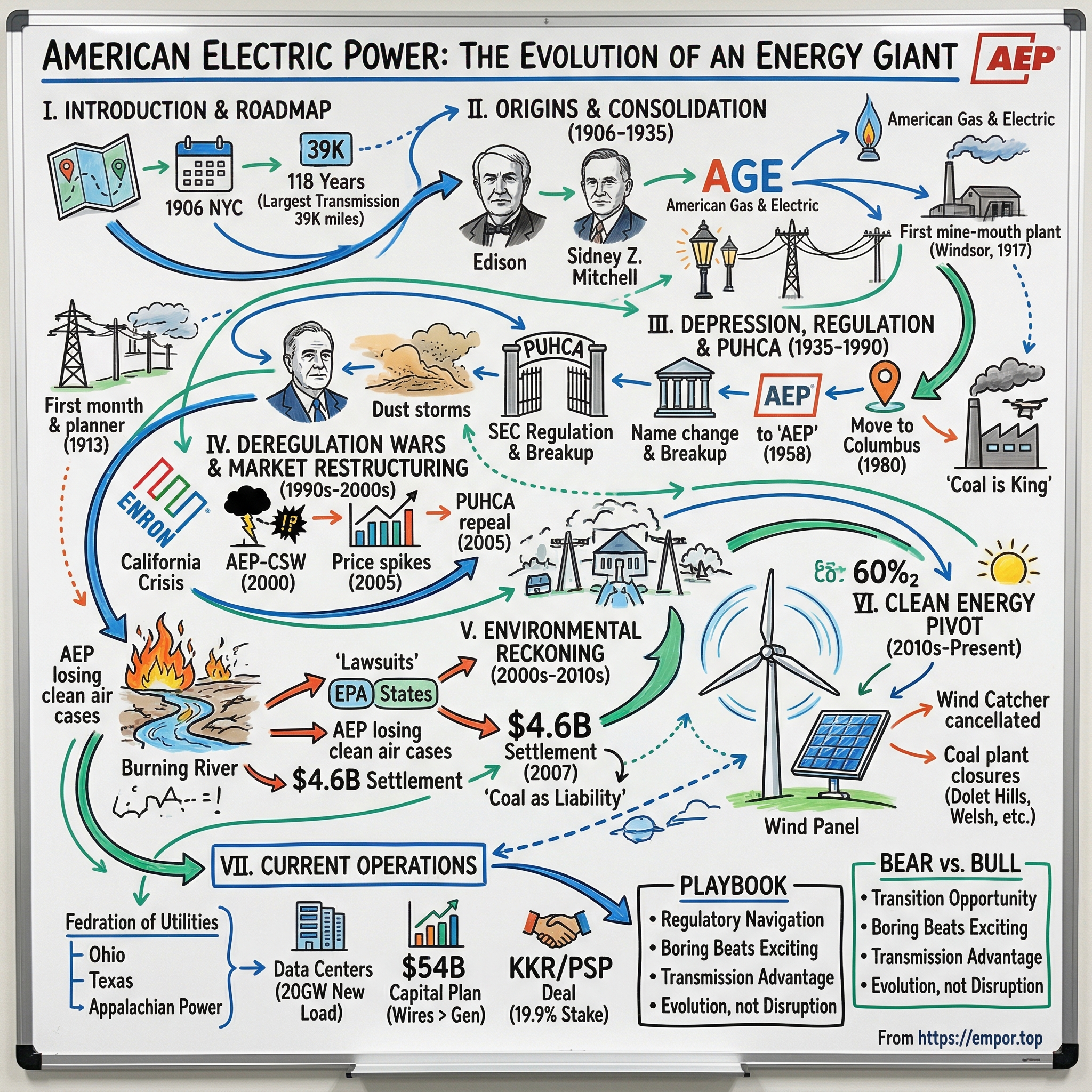
American Electric Power: The Infrastructure Engine of the AI Era
I. Introduction & Episode Roadmap
There is a particular sound that a 765-kilovolt transmission line makes on a humid summer afternoon — a low, continuous crackle called corona discharge, the noise of air itself being ionized by the electric field around the conductors. Stand under one of these lattice towers in rural Indiana or the hills of West Virginia and you are standing under an artifact of mid-century American ambition: a machine designed in the 1960s to move enormous quantities of coal-fired electricity hundreds of miles, built by a company that had already spent sixty years convinced that the highest-value asset in the power business was not the generator but the wire.
That conviction now looks less like a legacy and more like a lottery ticket. American Electric Power operates the nation's largest electric transmission system — roughly 40,000 line miles of high-voltage backbone, plus more than 252,000 miles of distribution lines serving 5.6 million customers across 11 states, run by about 18,000 employees, alongside approximately 33,000 megawatts of owned and contracted generating capacity.1 For most of the past four decades that footprint was a slow-growth annuity: a regulated dividend stock that investors bought for its yield and forgot about.
It is not being forgotten now. As of the second quarter of 2026, AEP had 69 gigawatts of contracted new customer load queued through 2030, backed by executed electric service agreements and letters of agreement, and a five-year capital plan of $78 billion — a figure that stood at just $38 billion four years earlier.12 For context, 69 gigawatts is roughly twice the company's entire existing generating fleet. A utility that took a century to build 33 gigawatts of capacity has signed paperwork to connect twice that much new demand in five years.
The central question this article tries to answer is not whether that demand is real — the signed contracts and the collateral posted against them suggest a great deal of it is. The question is harder and more interesting: how did a 1906 Midwest utility holding trust survive the 1935 breakup of the utility trusts, a decade of deregulation wars, the largest environmental enforcement settlement in American history, a botched pivot into unregulated renewables, and an activist-driven boardroom coup — and emerge, almost by accident of geography, as one of the most consequential pieces of infrastructure in the American technology buildout?
Three threads run through the story. The first is a regime shift in what a utility is for. AEP spent a generation as a defensive holding, a bond proxy with a rate case attached. It is now being underwritten by investors as an execution story, where the variable that matters is not the dividend but whether management can deploy tens of billions of dollars of capital on schedule and earn a fair return on it. That is a different risk profile, and it deserves different scrutiny.
The second is the economics of the wire itself. High-voltage transmission in the United States is regulated by the Federal Energy Regulatory Commission under formula rates that adjust annually, which means transmission investment earns close to its authorized return with minimal delay. State-regulated generation and distribution, by contrast, earn what state commissions allow, when they allow it — and AEP's own disclosures show that gap is wide. As of March 31, 2026, AEP's transmission-only subsidiaries were earning between 9.6% and 11.1%, while Appalachian Power was earning 7.2% and Kentucky Power just 4.2%.3 Same company, same balance sheet, wildly different returns depending on who sets the rate.
The third is the trilemma that now defines the sector: reliability, affordability, and decarbonization, with a fourth variable — hyperscaler demand — pulling hard against the second. Every gigawatt AEP connects for a data center requires generation and wires that someone must pay for. AEP's answer has been to write contracts that force the data centers to pay, whether or not they ever draw the power. Whether those contracts hold up under legal challenge, political pressure, and a decade of technology change is the single most important open question in the investment case.
The route from a New York holding company incorporated in 1906 to a company whose largest customers are Amazon, Microsoft, Google and Meta runs through Sidney Z. Mitchell's roll-up of small Midwestern utilities, the 1935 Public Utility Holding Company Act, a $4.5 billion merger that stretched the system to the Texas Gulf Coast, a failed attempt to become a renewables developer, a boardroom intervention by Carl Icahn, and the arrival of a Berkshire-trained operator named Bill Fehrman. It starts, as these stories usually do, with a man who worked for Thomas Edison.
 Subscribe on LinkedIn
II. Origins, Consolidation, & The PUHCA Reckoning (1906–1990)
In the first decade of the twentieth century, American electricity was a chaos of small monopolies. A town got its power from a generator down the street, owned by the local streetcar company or an entrepreneur with a boiler and some copper. Voltages varied. Frequencies varied. If the plant broke, the town went dark. The men who understood the physics understood something else too: electricity generated cheaply in one place and moved a long distance to another place would eventually beat electricity generated expensively next door. The whole industry became a race to see who could build the wires first.
Sidney Z. Mitchell was one of the men who understood this. A Naval Academy graduate who had gone to work for Thomas Edison and then built Edison's Pacific Northwest interests into a utility empire, Mitchell had a salesman's instinct for the financing side of the business — how to assemble scattered assets under a holding company and refinance them at scale. American Gas and Electric Company was incorporated in New York on December 20, 1906, with Mitchell as chairman, Henry L. Doherty as president until 1910, and Richard E. Breed and Harrison Williams on the board.45 Its opening move was a purchase: in January 1907, AG&E acquired the assets of the Electric Company of America for approximately $6.28 million, picking up roughly two dozen small utilities scattered across Pennsylvania, New Jersey, New York, West Virginia, Illinois, Indiana and Ohio.5
What distinguished AG&E from the dozens of other holding companies assembled in the same period was not the buying — everyone was buying — but what it did with the assets afterward. Rather than running each acquired utility as a standalone island, AG&E wired them together. In 1911 it built the first interconnected system, a 33,000-volt line linking Marion and Muncie, Indiana.4 The logic was simple and, at the time, radical: if two towns share generating capacity, the combined system needs less reserve margin than the two separately, because their peak demands do not arrive at the same instant. Interconnection is, in effect, an insurance pool for electrons.
Then came 1917, a year that set the company's technological DNA. AG&E completed the nation's first major mine-mouth power plant — the Windsor Plant near Wheeling, West Virginia, built directly on top of the coal it burned so that the fuel never had to be shipped — and simultaneously completed the nation's first long-distance high-voltage transmission line, rated at 138 kilovolts.4 Put those two innovations together and you have the entire industrial logic of the twentieth-century Midwest: burn the coal where it comes out of the ground, and ship the energy as electricity rather than shipping the coal. It was cheaper, and it made the wire the strategic asset.
The holding companies of the 1920s, however, had discovered a different kind of leverage. Pyramid structures — holding companies owning holding companies owning operating utilities — allowed a small equity investment at the top to control enormous assets at the bottom, and to extract fees from the captive operating companies along the way. When the structures collapsed in the Depression, Congress responded with the Public Utility Holding Company Act of 1935, which gave the Securities and Exchange Commission the power to dismantle utility holding companies that were not geographically integrated.
This was an existential moment, and it is where AG&E's engineering choices paid an unexpected dividend. The Act's "death sentence" clause targeted sprawling, unconnected empires. AG&E's Midwestern core was neither sprawling nor unconnected — it was, physically and electrically, a single machine spanning a contiguous multi-state footprint. The company shed peripheral properties but kept the integrated heart. The lesson worth extracting is not that regulation is survivable but that physical coherence is a regulatory asset. A century later, the same principle explains why AEP can move generation built in one part of its footprint to serve a data center in another: the machine is still one machine.
The postwar decades were about scale in a single dimension — bigger units, higher voltages, cheaper coal power. The company built the world's first 345-kV transmission line in 1953 and the world's first 765-kV line in 1969, a voltage class that remains the highest in commercial use in North America and one where AEP retains genuine, hard-won engineering depth.4 In 1973 it commissioned the world's largest coal-fired generating unit, a 1,300-megawatt behemoth at the Amos Plant in West Virginia.4 The company renamed itself American Electric Power along the way and, in the early 1980s, moved its headquarters from New York City to Columbus, Ohio — a symbolic relocation from the financial capital to the industrial territory it actually served.4
That coal fleet was, for half a century, the earnings engine. Cheap Appalachian and Illinois Basin coal, burned in enormous units, sold into regulated rate bases with reliable returns: it was one of the great business models of the American century. It was also, in the language of a later era, an accumulating liability. Every megawatt of coal capacity AEP built in the 1960s and 1970s became a megawatt of environmental compliance cost in the 1990s, a stranded-asset question in the 2010s, and a retirement-schedule negotiation in the 2020s. The company that had won the twentieth century by burning coal near the mine would spend the twenty-first century figuring out how to stop.
The bill for that came due twice. The first invoice arrived from Congress and the markets, in the form of deregulation.
III. The Deregulation Wars, CSW Mega-Merger, & Unbundling (1990–2010)
For ninety years the deal between a utility and its state had been beautifully simple: you get a monopoly, we get to set your prices, and in exchange you build whatever the state needs and earn a regulated return on it. In the 1990s a coalition of large industrial customers, economists, and independent power producers decided that half of that deal was obsolete. Generation, they argued, was a competitive business — anyone could build a gas turbine. Only the wires were a natural monopoly.
The Energy Policy Act of 1992 opened wholesale power markets to independent generators, and FERC Order 888 in 1996 forced utilities to open their transmission systems to competitors on equal terms — functionally separating the wires business from the generation business. States then took the logic further. Ohio, Texas, Virginia, West Virginia and Arkansas all moved to restructure their retail markets, meaning that in roughly half of AEP's eventual eleven-state footprint, the company would no longer own generation in the traditional regulated sense.
It is worth pausing on what this did to AEP's identity. A vertically integrated utility earns a return on everything: the mine-mouth plant, the high-voltage line, the pole outside your house. Restructuring split that into pieces with very different risk profiles — and, crucially, made the wires the safe piece. AEP's response was to get much, much bigger.
On December 22, 1997, AEP and Central and South West Corporation announced a tax-free stock-for-stock merger, with each CSW share converting into 0.6 shares of AEP.6 CSW brought Texas, Oklahoma, Arkansas and Louisiana — a footprint in ERCOT, the electrically isolated Texas grid, and in what became the Southwest Power Pool. The strategic reasoning was of its moment: in a deregulating industry, scale in trading and generation was supposed to be the winning position, and a combined company spanning eleven states from Michigan to the Gulf Coast would have unmatched reach.
The deal took nearly two and a half years to clear, closing on June 15, 2000, at a value of roughly $4.5 billion — some $2.1 billion below where the market had valued it when it was announced, as utility shares and the merger's perceived logic both deflated during the wait.7 That erosion is itself the first analytical lesson: in a heavily regulated industry, deal value leaks during the approval period, and the acquirer bears that leakage. AEP got the eleven-state footprint it wanted, but it paid for it in years of integration friction, state-by-state unbundling proceedings, and a corporate structure that would take another two decades to fully rationalize.
Then the theory of the case fell apart. The California electricity crisis of 2000 and 2001 — rolling blackouts, wholesale prices at multiples of historical norms, market manipulation by traders — did not merely embarrass deregulation; it killed the political appetite for it. Enron's collapse in December 2001 finished the job, taking with it the credibility of the merchant energy trading model that half the industry had been chasing. States that had not yet restructured stopped. Utilities that had built large trading operations discovered that their credit ratings, and therefore their cost of capital, depended on not looking like Enron.
AEP's response over the following years was defensive and, in retrospect, correct: ring-fence the regulated operating companies from the trading business, shrink the merchant exposure, and rebuild around rate-regulated assets. The company did not exit market activity entirely — a Generation & Marketing segment still handles marketing, risk management and retail activities in ERCOT, MISO, PJM and SPP, along with competitive generation in PJM — but the ambition to be a national merchant player was abandoned.1
The second invoice arrived on October 9, 2007, and it was enormous. The United States, eight states and thirteen citizen groups announced a settlement with AEP resolving a New Source Review lawsuit originally filed in 1999, alleging that the company had modified old coal plants to run harder without installing modern pollution controls. AEP agreed to cut 813,000 tons of air pollutants annually at an estimated cost of more than $4.6 billion, to pay a $15 million civil penalty, and to spend $60 million on mitigation projects across sixteen coal plants in Indiana, Kentucky, Ohio, Virginia and West Virginia.8 It was, by the measure of injunctive relief, the largest environmental enforcement settlement in American history at the time.8
The headline number that mattered was not the $15 million fine. Fines are rounding errors for a company of this size. The number that mattered was the $4.6 billion of required capital spending on scrubbers and controls — money that would extend the life of coal plants whose economics were about to be undermined by cheap shale gas. AEP was being compelled to invest heavily in an asset class that the market was in the process of obsoleting. That is the precise definition of a stranded-asset risk, and it framed the company's generation strategy for the next fifteen years.
One more piece of the old order fell in this period. The Energy Policy Act of 2005 repealed the Public Utility Holding Company Act of 1935, ending the regime that had shaped AEP's corporate structure since the Depression and giving utilities freedom to simplify their holding structures and, in principle, to diversify.
That freedom turned out to be a mixed blessing. Freed from a seventy-year-old constraint and watching NextEra Energy earn a growth multiple by building unregulated renewables at scale, AEP's management spent the following decade trying to be something other than a regulated wires company. It did not go well.
IV. The Failed Unregulated Pivot & Capital Misallocations (2010–2023)
Every regulated utility executive of the 2010s had the same chart taped to the inside of their skull. On one axis, regulated utilities trading at a modest multiple of earnings. On the other, NextEra Energy — a Florida utility with a giant unregulated renewables developer bolted onto it — trading at a premium that looked, to a utility CEO, like free money. The inference was irresistible: build a merchant renewables arm, get re-rated, everybody wins.
The inference was mostly wrong, and AEP spent about a decade learning why. Unregulated renewable development is a fundamentally different business from operating a regulated utility. It is a development business: you win sites, sign power purchase agreements, manage construction risk, monetize tax credits, and recycle capital. The winners in that business have low costs of capital, deep development pipelines, tax-equity relationships, and a tolerance for project-level risk. A regulated utility has an expensive balance sheet designed for predictable rate-base returns, and a management culture optimized for rate cases rather than for competitive bidding. Bolting one onto the other tends to produce the worst of both — the risk of a developer with the cost structure of a utility.
Two transactions in the early 2020s made the failure explicit.
The first was Kentucky Power. In October 2021 AEP agreed to sell Kentucky Power Company and AEP Kentucky Transmission Company to Liberty Utilities, a subsidiary of Algonquin Power & Utilities, at an enterprise value of approximately $2.85 billion.9 The strategic logic was clean: Kentucky Power was a small, coal-heavy, low-return operating company in a jurisdiction where AEP struggled to earn its allowed return, and selling it would recycle capital into higher-return transmission. As markets deteriorated in 2022, the price was renegotiated down to roughly $2.646 billion.9
Then FERC said no. In December 2022 the Commission denied the transaction without prejudice, finding that the applicants had failed to demonstrate the deal would not adversely affect rates — with the treatment of transmission costs and the loss of AEP-pool benefits at the heart of the objection.9 AEP and Liberty refiled in February 2023; the Kentucky Public Service Commission and other intervenors urged rejection; and in April 2023 the parties mutually terminated the agreement, having concluded that the conditions to closing could not be satisfied.10
The episode is a useful corrective to a common assumption. Investors often treat utility portfolio pruning as a straightforward capital-allocation lever — sell the low-return jurisdiction, redeploy the proceeds. Kentucky Power demonstrated that in a regulated industry the seller does not control the exit. FERC's mandate is to protect ratepayers, not to optimize a holding company's return on capital, and a divestiture that improves the parent's blended ROE while raising costs for the customers left behind is exactly the sort of transaction the Commission exists to block. Two years of management attention, transaction costs, and strategic uncertainty produced nothing except a reminder that AEP's portfolio is less liquid than it looks.
The second transaction was the renewables retreat. On August 16, 2023, AEP completed the sale of its 1,365-megawatt unregulated contracted renewables portfolio — 14 projects across 11 states, comprising roughly 1,200 MW of wind and 165 MW of solar — to IRG Acquisition Holdings, a partnership of Invenergy, CDPQ and funds managed by Blackstone Infrastructure, at an enterprise value of $1.5 billion including project debt, netting AEP approximately $1.2 billion in cash after taxes and fees.11 Then-CEO Julie Sloat framed it as part of a strategy "to streamline and de-risk the business and focus on our regulated operations."11
The framing was accurate as far as it went, but the substance was a concession. AEP had spent years building a merchant renewables platform in pursuit of a valuation re-rating that never arrived, and then sold it — at a price that, against the historical invested capital and the strategic hopes attached to it, was not a triumph — in order to strengthen a balance sheet that had been stretched by the attempt. The proceeds went toward the regulated capital plan and parent-level debt reduction.
Set the two episodes side by side and the pattern is clear. AEP's attempt to look like a growth company through unregulated development destroyed value; its attempt to fix its returns through divestiture was blocked by the regulator. What was left was the thing the company had been trying to escape — the regulated wires and generation business — and the uncomfortable question of whether management was capable of running it well. By late 2023, AEP's earned regulated return on equity had been running meaningfully below what its commissions allowed, its shares had lagged utility peers, and its strategy had produced two consecutive public reversals.
That combination — underperformance, a weak return profile, and a strategic narrative that had visibly failed — is precisely the scent that draws an activist investor. In early 2024, one arrived.
V. Activist Intervention, Boardroom Coup, & The Fehrman Era (2023–Present)
Carl Icahn has been doing this for fifty years, and the mechanics rarely change: identify a company where the gap between what the assets could earn and what they do earn is wide and visible, take a position, and apply pressure at the board level until someone moves. What made AEP an unusual target was that regulated utilities are supposed to be activist-proof. You cannot break them up without FERC's permission, you cannot lever them without the rating agencies' permission, and you cannot raise prices without eleven state commissions' permission. The lever available at AEP was not financial engineering. It was accountability.
On February 12, 2024, AEP announced an agreement with Icahn Capital under which Hunter C. Gary, a senior managing director at Icahn Enterprises, and Henry "Hank" P. Linginfelter, a veteran gas utility executive, joined the board effective immediately.12 The arrangement was striking for its asymmetry: by Public Citizen's account, Icahn held roughly 1% of AEP's voting shares, and the two designees were seated without the right to vote at board meetings until federal regulatory approvals were obtained.13
Eight days later, the board acted. On February 20, 2024, directors determined to remove Julia A. Sloat from her roles as chair, president and chief executive officer — an "involuntary termination" after roughly thirteen months in the job — and installed Ben Fowke, the former Xcel Energy chief executive, as interim CEO while a search proceeded.1314 Public Citizen filed a protest at FERC arguing that the sequence amounted to a change in control executed before the required Federal Power Act Section 203 authorization was granted, and that the interests of 5.6 million captive customers had been subordinated to a minority shareholder's agenda.13 FERC subsequently allowed the Icahn designees to serve.
Whatever one thinks of the governance optics — and the optics were genuinely poor, with a 1% holder's non-voting nominees present in the room when a sitting CEO was removed — the underlying critique was not baseless. AEP had a returns problem and an execution problem, and the board had been slow to address either. The activist did not invent the gap between allowed and earned returns; the company's own regulatory disclosures had been publishing it for years.
The replacement mattered more than the removal. On June 26, 2024, AEP named Bill Fehrman as president and chief executive officer, effective August 1, 2024 — the ninth CEO in the company's 118-year history.15 Fehrman was, by background, almost a caricature of the operator archetype: a civil engineering graduate of the University of Nebraska with an MBA from Regis University, he had run the Nebraska Public Power District, then PacifiCorp Energy, then MidAmerican Energy from 2007 to 2018, then Berkshire Hathaway Energy from 2018 to 2023, and most recently Centuri Holdings, the utility infrastructure services company he helped take public.15
The Berkshire Hathaway Energy pedigree is the part worth dwelling on, because it carries a specific operating philosophy rather than merely a famous name. Berkshire's utility businesses, run under Greg Abel and Warren Buffett's capital allocation framework, were built on a few durable habits: retain earnings and reinvest rather than pay them out, spend aggressively on transmission and generation where the regulatory compact supports it, keep an extremely close and non-adversarial relationship with state regulators, and treat operational discipline as the source of the returns rather than clever financial structuring. Fehrman spent sixteen years inside that culture. Almost everything AEP has done since August 2024 is legible as an attempt to import it.
The mandate was straightforward and, unusually for a utility CEO transition, explicitly quantitative: stop the strategic wandering, close the gap between allowed and earned returns, and convert the company into a regulated infrastructure compounder growing operating earnings at a defined rate. By the second quarter of 2026 Fehrman was framing his tenure around four themes — financial performance, affordability, growth capture, and regulatory and operational outcomes — and describing the first two years as building "positive momentum."2
The evidence for that claim is mixed in the way real evidence usually is. On the positive side, the regulatory scoreboard has genuinely improved. In the second quarter of 2026 alone, AEP Ohio secured an authorized ROE of 9.84%, up from 9.7%, alongside a distribution base rate decrease; Public Service Company of Oklahoma settled a rate case that trimmed its authorized ROE from 9.5% to 9.375% but added an enhanced transmission cost rider that management expects to improve the earned return materially; Appalachian Power completed a $1.4 billion securitization in Virginia that let it file its smallest base rate increase request in nearly thirty years; and SWEPCO reached a settlement in principle in Texas.12 Trading a lower headline ROE for a cost-recovery tracker is a trade a returns-focused operator makes and a headline-focused one does not — the tracker reduces the lag between spending money and collecting it, which is where regulated utilities actually lose their returns.
On the financing side, the company has shown a willingness to use instruments the old AEP avoided. In January 2025 it agreed to sell a 19.9% non-controlling interest in two transmission-only subsidiaries — AEP Ohio Transmission and AEP Indiana Michigan Transmission — to a 50/50 partnership of KKR and PSP Investments for $2.82 billion, closing on June 5, 2025.16 Selling a minority stake in your best assets is not obviously shareholder-friendly, and it deserves the scrutiny it got. The defense is arithmetic: the interest sold represented roughly 5% of AEP's transmission rate base at a multiple far above where AEP's own shares traded, which makes it cheaper equity than issuing stock. The cost is equally real — it permanently gives away a slice of the earnings stream from the highest-return part of the company, and it is precisely the sort of transaction that looks clever when capital is scarce and expensive in hindsight when it is not.
Then there is the compensation question, which is where the story gets uncomfortable. For 2025, Fehrman received total compensation of $36.6 million — $1.5 million in base salary, a $1.15 million bonus, and roughly $26.1 million in long-term incentive awards — making him, by one analysis, the highest-paid utility chief executive in the country that year, a 176% increase over the prior year.17 This landed in the same period that AEP Ohio disconnected service more than 173,000 times between June 2024 and May 2025, a statistic ratepayer advocates have used to considerable effect.17
The defensible reading is that the package is overwhelmingly equity, vests over years, and ties the CEO's outcome to rate-base growth and realized returns — which is exactly the alignment shareholders should want from someone being asked to deploy $78 billion. The uncomfortable reading is that a regulated monopoly's political capital is a finite resource, and spending it on an outlier pay package while asking eleven state commissions to approve unprecedented capital programs and novel tariffs is a genuine strategic risk, not merely an optics problem. Both readings are true simultaneously. Investors should file executive pay here not under governance box-ticking but under regulatory risk.
Management credibility, judged the way it should be judged — against prior promises — is currently trending favorably but from a low base. The company that terminated the Kentucky Power sale and dumped its renewables platform is the same company now telling investors to underwrite a five-year plan more than double the size of the one it published four years ago. Fehrman has so far done the two things that build credibility: raised guidance on the strength of results rather than accounting adjustments, and pre-funded the equity requirement rather than leaving it as an open question. On the Q2 2026 call, CFO Trevor Mihalik pointed to a $3 billion marketed equity transaction, to be settled under forward contracts by May 2028, as addressing all anticipated marketed equity needs for the current five-year plan.2 Removing the largest identifiable overhang in a capital-intensive growth story — the risk of repeated dilutive issuance — before investors demand it is the behavior of management that has learned something.
What has not yet been tested is what happens when something goes wrong. AEP has not had a major project failure, cost overrun, or contract default under the current plan. The quality of a management team is revealed by how it explains a miss, and this one has not had to.
Which brings us to the reason the plan is so large in the first place.
VI. The AI & Data Center Explosion: Grid Monopoly in the Hot Zones
Somewhere in New Albany, Ohio — a former farming township northeast of Columbus — there is a stretch of road where the corn stops and the concrete begins, and it goes on for miles. Windowless buildings the size of aircraft carriers, ringed by substations, cooled by equipment that hums at a frequency you feel more than hear. This is what a gigawatt of demand looks like when it lands on a distribution system originally designed for suburban houses and light manufacturing.
AEP's good fortune — and it is substantially fortune, not foresight — is that its 11-state footprint happens to sit on top of two of the most attractive data center corridors in North America. Central Ohio, inside the PJM market, has become one of the densest hyperscale clusters in the country, drawn by cheap land, water, fiber, and historically low industrial power rates. And AEP Texas serves swathes of the ERCOT grid, which offers something no other American market does: an interconnection process that can be measured in months rather than years, in a state whose politics are enthusiastically pro-development.
The numbers that result are difficult to internalize. Through the second quarter of 2026, AEP reported 69 gigawatts of contracted load additions through 2030, up 6 GW in the quarter, of which 45 GW sits in Texas, 12 GW in Ohio, and the remaining 12 GW is spread across Oklahoma, Indiana, Kentucky, Louisiana and Virginia.12 That trajectory has been steep and consistent: 28 GW as of October 2025, 56 GW by the fourth-quarter 2025 report, 63 GW at the first quarter of 2026, 69 GW at the second.182 Management's characterization is that the vast majority of these projects are being advanced by well-capitalized hyperscalers and large industrial customers.2
The obvious question — and the one a skeptical investor should press hardest — is whether a "contracted" gigawatt is a real gigawatt. Announced data center demand across the American grid vastly exceeds what will physically be built; developers routinely file interconnection requests at multiple utilities for the same project, creating phantom demand that shows up in everyone's queue. AEP's answer is a filtration process: the load it counts is supported by fully executed electric service agreements or letters of agreement requiring customers to secure land, complete interconnection studies, submit detailed load forecasts, and fund the associated infrastructure.2
The most convincing evidence is not the paperwork but the cash. In July 2026, AEP submitted 45 gigawatts of Texas projects into ERCOT's newly created "Batch Zero" process — a framework specifically designed to separate committed projects from speculative ones — and disclosed that it had collected nearly $2 billion in cash or collateral over the preceding month, representing the full required credit support for all 45 GW.2 Developers posting two billion dollars of real money is a materially stronger signal than developers signing letters. It does not guarantee the projects get built on schedule, but it establishes that the counterparties are serious and that AEP is not carrying the option value for free.
Mihalik was also careful, on that call, to say something that cuts against the promotional reading: the $78 billion capital plan "does not anticipate this magnitude of load growth," and ERCOT's review process, generation availability and transmission timelines "may impact the timing of certain interconnections."2 In other words, the 69 GW is not in the numbers, and the company is treating slippage as a timing question rather than a demand question. That is either appropriate conservatism or a convenient framing that makes delays unfalsifiable; the honest answer is that investors will only be able to distinguish between the two by watching whether the capital plan actually converts into installed rate base on schedule.
The plan itself is the second half of the story. AEP's 2026–2030 capital program of $78 billion is expected to produce a rate base compound growth rate of nearly 11%, with roughly $33 billion — about 42% — directed at transmission.19 Beyond that base plan, management has identified over $10 billion of line-of-sight investment not yet included: a fuel cell project in Wyoming for a hyperscaler offtaker, the Piketon transmission opportunity in southern Ohio, and incremental generation.1
The generation piece deserves attention because it represents a genuine strategic reversal. A company that spent a decade trying to shrink its generation exposure has spent the past two years buying turbines. As of the second quarter of 2026, AEP had secured approximately 13 gigawatts of gas-fired turbine capacity for deployment through 2031, with options on up to 10 GW more through 2035, procured through relationships with GE Vernova and Mitsubishi.12 Fehrman's framing on the call was blunt: generation "is a scarce resource and will become increasingly more valuable."2 Mihalik added the quieter point — that the later tranche "dovetails well into our existing plants that are aging and will be retiring," meaning the turbines serve double duty as coal replacement.2 Roughly half of the 13 GW sits inside the existing $78 billion plan; the rest becomes a tailwind for the 2027–2031 plan due at the third-quarter 2026 call.2
The economics here are worth explaining plainly, because they are the crux of the bull case. A regulated utility does not earn money by selling electricity; it earns a regulator-approved return on the capital it has invested and not yet depreciated — its rate base. Growing earnings therefore requires growing the rate base, which requires spending money the regulator agrees was prudent. For thirty years, the constraint on utility earnings growth was demand: flat load meant no justification for major new investment. AI data centers removed that constraint. AEP's turbine procurement is a bet that scarcity of long-lead equipment is itself a competitive advantage — that in a market where every utility wants turbines, the one that locked up delivery slots two years early gets to serve customers others cannot. That advantage is real but time-limited; manufacturers are expanding capacity, and a queue position is not a moat.
The harder problem is political. If hyperscalers drive a $78 billion buildout and the cost lands in everyone's rates, the backlash is guaranteed and the regulatory compact breaks. AEP's response was to write a different kind of contract, and it did so first in Ohio.
On July 9, 2025, the Public Utilities Commission of Ohio approved a stipulation — supported by AEP Ohio, PUCO staff, the Ohio Consumers' Counsel, the Ohio Energy Group, the Ohio Manufacturers' Association Energy Group and Industrial Energy Users-Ohio — establishing a data center specific tariff.2021 Its core mechanism is a minimum demand charge: data center customers above 25 MW must pay for at least 85% of their subscribed monthly capacity regardless of how much electricity they actually consume, over a term of up to 12 years structured as a four-year ramp followed by an eight-year minimum commitment, with exit fees for early termination and financial assurance requirements to cover failed projects.2021
In plain language, this is a take-or-pay contract of the sort common in pipelines and LNG, imported into retail electricity. The data center is buying the option to draw power, and it pays for the option whether or not it exercises it. That transfers the risk of a cancelled or shrunken project from ratepayers to the developer — which is precisely why it was contested, and precisely why it matters. AEP has since replicated the model, reporting five states with approved large load tariffs by mid-2026 including Virginia, with three more filings pending.1
The financial consequence AEP emphasizes is a claimed benefit rather than a cost: management projects up to $16 billion in fixed cost offsets for residential customers at its vertically integrated utilities over the life of the executed take-or-pay agreements, on the theory that adding enormous new load spreads existing fixed costs across a much larger base.1 Some of this has begun to appear in actual proceedings — a residential distribution rate decrease in Ohio, and a planned base rate decrease filing at Indiana Michigan Power, which Fehrman attributed directly to attracting large load customers like Google and Microsoft.2 Add to that roughly $5 billion in Department of Energy loan guarantees secured across the portfolio, including up to $3.3 billion for AEP Texas covering approximately 2,800 miles of transmission projects, which the company estimates will deliver nearly $1.4 billion in total customer benefits through lower financing costs.12
Investors should treat the $16 billion figure with care. It is a management-calculated projection spread over the full life of contracts running more than a decade, using a methodology AEP describes only in general terms, and it is being deployed as an affordability argument in regulatory proceedings. That does not make it wrong — the underlying mechanism of fixed-cost spreading is sound and the rate decreases are observable, verifiable events. It does mean the number is an advocacy artifact as much as an accounting one.
And the tariff is not settled law. The Ohio Manufacturers' Association appealed PUCO's approval to the Ohio Supreme Court in November 2025, arguing the framework is discriminatory and that the demand assumptions underpinning it were speculative and unsupported by evidence; briefing concluded in March 2026, with oral argument pending as of this writing.2223 A reversal would not destroy the demand, but it would remove the risk-transfer mechanism that makes the demand safe for shareholders — which is a materially different investment case.
The last front is structural, and it is the one Fehrman has been most vocal about. PJM, the regional transmission organization covering AEP's Ohio, Indiana, Michigan, Virginia and West Virginia territories, has become the sector's chokepoint. Its capacity auction for the 2026–2027 delivery year cleared at $329.17 per megawatt-day — the cap of the FERC-approved price collar and a record, after the prior year's $269.92 — with the grid operator falling short of its reliability requirement as retirements outpaced new supply.24 On AEP's first-quarter 2026 call, management identified three problems with serving new load in PJM: governance, the speed of interconnection, and resource adequacy.2 By the second quarter, Fehrman reported that the "pace and intensity of productive conversations with PJM has significantly increased" and expressed optimism following a July 23 technical conference, while insisting any framework must "appropriately assign costs to those who are causing them."2
Analysts have pushed on what happens if it does not resolve. Julien Dumoulin-Smith of Jefferies asked directly about non-utility avenues, behind-the-meter bridging, and whether AEP would acquire existing generation to rate-base it. Fehrman's answer was revealing about the company's actual strategy: he emphasized that AEP is "always on the hunt for good quality assets" to supplement the vertically integrated utilities, and that PJM's structure lets AEP site generation wherever it can be built and deliver the power to where hyperscalers want to be — increasingly rural areas.2 He also confirmed AEP is doing "significant evaluation" of a separate generation company structure, a vehicle several peers are exploring to serve large loads outside the traditional certificate process.2 On new nuclear, the posture was notably guarded: any project would require "robust capital protection measures," strong balance sheet and credit safeguards, and clear regulatory and policy support before proceeding.2
That answer — enthusiastic about gas and transmission, structurally curious, deliberately cold on nuclear capex — is the clearest available signal of how this management team thinks about risk. The next section examines whether the underlying business economics justify the confidence.
VII. Core Business Economics, Segments, & Competitive Landscape
If you want to understand a regulated utility, ignore the income statement for a moment and look instead at a document most investors never open: the quarterly rate base and return-on-equity disclosure. AEP publishes one, and it is the single most revealing artifact the company produces, because it strips away the consolidated averages and shows what each piece of the empire actually earns.
As of March 31, 2026, the picture was startlingly uneven.3 Indiana Michigan Power — a vertically integrated utility with roughly $6.9 billion of rate base, a nuclear plant, and a heavy dose of new data center load — was earning an operating ROE of 12.6% against authorized returns in the mid-nine percent range. Appalachian Power, with about $14.2 billion of rate base across Virginia and West Virginia, was earning 7.2% against authorizations of 9.75%. Public Service Company of Oklahoma earned 7.2%; SWEPCO earned 7.9%; Kingsport Power in Tennessee earned 6.6%. And Kentucky Power — the asset AEP tried and failed to sell — earned 4.2% on $2.2 billion of rate base against an authorized 9.75%.
The two delivery-only utilities sat in between: AEP Ohio at 9.5% on roughly $8.9 billion of rate base, AEP Texas at 9.2% on $13.6 billion. And the transmission-only subsidiaries — the transcos — earned 9.6% to 11.1% against approved formula-rate returns of 9.85% to 10.50%, with AEP Oklahoma Transco at 11.1% and the Appalachian, Kentucky and Indiana Michigan transcos all above 10%.
Read that spread carefully, because it is the entire investment thesis in one table. The consolidated regulated earned ROE was 9.2% in the second quarter of 2026, with management targeting 9.5% by 2030 through structural rate-making improvements — a unified tracking mechanism in Texas, Senate Bill 998 in Oklahoma, and a forward-looking test year in Ohio beginning in 2028.2 That consolidated figure conceals a business where the wires earn what they are supposed to and the state-regulated generation businesses, in several jurisdictions, earn barely more than the cost of debt.
Why? Regulatory lag. A vertically integrated utility spends capital today, then files a rate case, then waits — often using a historical test year that reflects costs from a period already past — and by the time new rates take effect it has spent more money that is not yet in rates. In a high-capex environment, the utility is permanently chasing its own tail. FERC formula rates for transmission solve this by design: the rate updates annually with a true-up, so investment enters rates almost as it is made. That structural difference, not superior operations, is why AEP Transmission Holdco is the company's most reliable earnings engine.
The segment structure follows this logic. AEP Transmission Holdco comprises transmission-only subsidiaries and joint ventures; it delivered operating earnings of $225 million in the second quarter of 2026 and $434 million year to date — the year-over-year decline reflecting the 2025 minority interest sale rather than operational weakness.1 Transmission & Distribution Utilities — AEP Ohio and AEP Texas — earned $239 million in the quarter, and are the pure delivery monopolies most directly leveraged to data center interconnections; they own no generation, so they capture load growth without generation risk. Vertically Integrated Utilities — Appalachian Power, Indiana Michigan Power, Kentucky Power, Kingsport, PSO, SWEPCO and Wheeling Power — contributed $302 million, and carry the coal fleet, the state rate cases, and the environmental compliance obligations. Generation & Marketing, the residual competitive business in ERCOT, MISO, PJM and SPP, added $91 million.1
For the full year 2025, AEP reported GAAP earnings of $6.70 per share on revenue of $21.876 billion, with operating earnings of $5.97 per share.18 Through the first half of 2026, operating earnings were $3.01 per share against $2.98 a year earlier, on revenue of $11.465 billion versus $10.550 billion — modest earnings growth on strong revenue growth, reflecting the transmission stake sale, tax timing, and higher operations and maintenance spending on reliability.1 The dividend has been held at 95 cents per share quarterly through 2026.25
That last point is worth flagging for income-oriented investors, because it marks the regime shift explicitly. AEP has raised its dividend for many consecutive years, but a company deploying $78 billion over five years is going to prioritize retained earnings and balance sheet metrics — Mihalik has repeatedly anchored on a targeted funds-from-operations-to-debt ratio of 14% to 15% — over dividend growth.2 The stock has been re-priced as a growth utility, and growth utilities pay out less. Anyone holding AEP primarily for dividend escalation is holding the previous version of the company.
Against peers, AEP occupies a specific and somewhat unusual position. NextEra Energy remains the sector's growth benchmark, built on Florida Power & Light plus the largest renewables development platform in the country — the model AEP tried and failed to copy. Duke Energy and Southern Company are comparable in scale and both have their own data center exposure, with Southern's Georgia territory arguably the most concentrated in the sector. Dominion Energy owns the single densest data center market on earth in Northern Virginia. Exelon, like AEP's T&D utilities, is a pure delivery business with no generation risk at all.
What differentiates AEP is not being the best positioned in any one of these dimensions but the combination: the largest transmission franchise in the country, meaningful positions in both PJM and ERCOT — the two markets where hyperscaler demand is most intense and where the market rules are most different — and enough vertically integrated territory to build and rate-base generation where states permit it. Diversity across eleven jurisdictions cuts both ways. It means no single commission can break the company. It also means eleven separate political conversations, eleven sets of rate cases, and a corporate overhead structure that a single-state utility does not carry.
Run the moat analysis honestly and the picture is strong but not unqualified. In Hamilton Helmer's framework, AEP's clearest power is a cornered resource: 40,000 miles of high-voltage right-of-way assembled over 120 years, which no competitor could replicate at any price because the binding constraint is not capital but land assembly, easements, and permitting through eleven states. Adjacent to that is genuine process power in 765-kV engineering — a voltage class AEP pioneered and where its accumulated design and construction expertise is a real, if narrow, advantage, and one management explicitly invoked in describing the Piketon opportunity.2 Scale economies are real in procurement, financing and turbine access, and Fehrman leans on them constantly. Switching costs are effectively infinite in the delivery business — a franchise monopoly means the customer has no alternative wire — though this is better described as regulatory protection than as an earned advantage.
What AEP does not have is pricing power in the ordinary sense. It cannot raise prices; it can only ask permission. Every dollar of return is granted by a commission that can withdraw it. That inverts the usual moat logic: AEP's protection from competition is total, and its protection from its regulators is nil.
Porter's five forces makes the same point from a different angle. Rivalry among competitors is essentially absent within the franchise territories. Threat of new entrants is nil for delivery, though not for generation, where independent power producers and behind-the-meter arrangements compete for the same hyperscaler load. Threat of substitutes is low-to-moderate: rooftop solar, batteries and on-site generation nibble at the edges, and some hyperscalers are exploring behind-the-meter power to bypass the interconnection queue entirely, but a multi-hundred-megawatt facility requiring continuous availability cannot realistically self-supply at scale today. Buyer power is rising — this is the genuinely new force. A hyperscaler contracting for several gigawatts is not a captive residential ratepayer; it can choose a different state, a different utility, or a different continent, and it has the balance sheet and sophistication to negotiate hard. That is exactly why the take-or-pay tariff structure matters so much: it is the mechanism by which AEP converts a powerful buyer into a committed one.
Supplier power, meanwhile, has become acute. Turbine manufacturers, transformer producers and high-voltage equipment suppliers have gone from courting utilities to rationing them. AEP's early turbine procurement is a direct response, and its success there is one of the better pieces of evidence that the current management team is operating with more urgency than its predecessors.
But the dominant force — the one that overwhelms all five in this industry — is the regulator. Eleven state commissions plus FERC determine allowed returns, approve or reject capital, set recovery timelines, and can, as Kentucky Power demonstrated, veto a strategic transaction outright. AEP's competitive position is durable. Its returns are discretionary.
VIII. Playbook: Business & Strategic Lessons
Strip away the specifics of coal, kilovolts and commissions, and AEP's 120-year history yields a set of transferable lessons about capital-intensive, regulated businesses — several of which the company learned by getting them wrong first.
Own the bottleneck, not the commodity. The single most durable insight in AEP's history is the one Sidney Mitchell's engineers stumbled into in 1917: in a network industry, the connective tissue is worth more than the nodes. Generation is a commodity — anyone with capital can build a plant, and the market repeatedly proved it during the merchant era. High-voltage transmission is not, because its scarcity is created by land, permits and time rather than by money. The financial expression of that difference is visible in AEP's own return disclosures. This lesson generalizes well beyond utilities: in any network business, ask whether you own the pipes or the things flowing through them.
Regulatory structure is a business model choice, not a compliance detail. The gap between FERC formula rates and state historical-test-year ratemaking is worth hundreds of basis points of realized return on identical capital. Much of AEP's recent regulatory strategy has been the unglamorous work of importing formula-rate-like mechanisms into state jurisdictions — trackers, riders, forward-looking test years, securitization. Investors chronically underweight this, because it produces no press releases and shows up only slowly in earned ROE. It is nonetheless where a meaningful share of the next five years of earnings improvement has to come from.
Do not buy a multiple. The decade AEP spent trying to build an unregulated renewables business to earn NextEra's valuation is a case study in the most common strategic error in mature industries: mistaking a competitor's valuation for a competitor's capability. NextEra's multiple reflected a development organization, tax-equity relationships and a cost of capital that AEP did not have and could not quickly acquire. The exit at $1.5 billion, after years of invested capital and management attention, was the tuition payment. When a company explains a diversification in terms of what it will do to the multiple rather than what it will do to returns on capital, that is a signal worth taking seriously.
In regulated industries, the exit is not yours to control. The Kentucky Power termination cost AEP eighteen months and produced nothing, because FERC's obligation runs to ratepayers rather than to the seller's portfolio optimization. Any thesis that depends on a regulated company divesting an underperforming asset should be discounted for the possibility that the regulator simply refuses. The corollary is that fixing the asset in place — as AEP is now attempting in Kentucky through rate design rather than divestiture — is often the only available path.
Activism works in regulated industries, but only through accountability. Icahn could not break AEP up, lever it, or force a sale. What a 1% position bought was a board seat and, within eight days, a CEO change. That is the entire lever available in a regulated monopoly, and it turned out to be sufficient. For investors, the read-through is that in industries where financial engineering is blocked, activist value creation is essentially a bet on management replacement — which means the quality of the replacement is the whole trade.
Make the beneficiary of growth pay for growth. The take-or-pay tariff structure is the most genuinely novel thing AEP has done in decades, and its logic is exportable to any infrastructure business facing a demand surge from a small number of large, well-capitalized customers: do not socialize the cost of serving concentrated new demand across a diffuse existing customer base, because the political backlash will eventually take back whatever returns you earned. Fehrman's phrasing — "growth helps pay for growth" — is a slogan, but the contractual mechanism behind it is real, and it is being contested precisely because it works.1
Affordability is a strategic variable, not a public relations one. The utilities that have historically destroyed the most shareholder value did so by winning rate cases until the political system revolted. AEP's current pursuit of rate decreases in Ohio and Indiana, its use of Department of Energy loan guarantees to lower financing costs, and its securitization in Virginia are all, in effect, purchases of regulatory goodwill — spending margin today to preserve the right to invest tomorrow. Whether that trade is being made at the right price is debatable. That it is the correct trade to be making is not.
The counterweight to all of this is the risk that the plan does not survive contact with reality. That is the subject of the stress test.
IX. Bear vs. Bull Case & Investor Stress Test
Any honest assessment of AEP today has to start by acknowledging that the bull and bear cases are not arguments about different facts. They are arguments about the same facts, weighted differently — chiefly, about whether a contracted gigawatt converts into installed rate base at an acceptable return, and about who ultimately pays.
The case for AEP from here. The demand is unusually well documented for a utility growth story. It is not a management forecast of electrification trends; it is 69 gigawatts of signed agreements with named counterparties, nearly $2 billion of collateral posted in Texas alone, and a queue that has grown every quarter for roughly two years.2 Behind it sits the physical asset that cannot be replicated — the transmission franchise — and a capital plan whose largest single component, at roughly $33 billion, goes into the FERC formula-rate structure where returns are most reliably earned.19
The financing risk, historically the thing that ruins utility growth stories, has been substantially addressed in advance. The $3 billion forward equity settlement removes the marketed equity requirement for the current plan, and the KKR/PSP transaction demonstrated access to institutional capital at valuations well above the public market's.216 The regulatory scoreboard has improved measurably across Ohio, Oklahoma, Virginia and Texas, and the take-or-pay tariff framework — now approved in five states — transfers project-abandonment risk to counterparties whose credit is, in most cases, better than AEP's own.1
And there is real optionality that is not yet in the plan: over $10 billion of line-of-sight projects, roughly half of the 13 GW of secured turbines, the Piketon transmission opportunity, and a 2027–2031 capital plan that management has all but pre-announced will be larger.2 The pattern of a five-year plan that has gone from $38 billion to $78 billion in four years, with each update raising rather than lowering the figure, is the kind of consistency that earns a growth multiple.
What could break it. Start with the regulatory reflex, because it is the most likely failure mode. Electricity bills are rising across the country, capacity costs in PJM have hit their price cap two years running, and the political attribution of those increases to data centers is already well established.24 AEP's tariff structure is designed to defuse exactly this — but it is under appeal at the Ohio Supreme Court, where the Ohio Manufacturers' Association argues the framework is discriminatory and rests on speculative demand assumptions.2223 If courts or legislatures unwind the risk-transfer mechanism, AEP still gets the load, but it also gets the stranded-cost exposure, and the entire risk profile of the buildout changes. The rules governing this business are actively in flux, and legislative intervention is a live possibility in more than one jurisdiction.
Second, the returns gap is not yet closed. A consolidated earned ROE of 9.2% with a 2030 target of 9.5% means the company is currently under-earning its authorizations, and the path to closing that gap depends on regulatory mechanisms that have been agreed in some jurisdictions and not others.2 Appalachian Power at 7.2% and Kentucky Power at 4.2% represent billions of dollars of rate base earning returns that would embarrass a corporate bond.3 An activist or short seller would put it bluntly: AEP is asking investors to fund an enormous expansion of a rate base on which it has demonstrably struggled to earn its allowed return.
Third, capital intensity and the cost of capital. A $78 billion program, funded substantially with debt while maintaining a 14–15% FFO-to-debt ratio, is a leveraged bet on interest rates staying manageable. Utilities are among the most rate-sensitive equities precisely because their earnings are a spread between an authorized return set years ago and a financing cost set daily. Marketed equity for this plan is covered; the next plan's is not. And because commissions set allowed ROEs with a lag, a sustained increase in rates compresses realized returns before authorized ones adjust.
Fourth, the coal legacy. AEP has committed to retiring the first 1,300 MW unit at Rockport in 2028 under a consent decree, and has plotted a path to operate the John Amos, Mountaineer and Mitchell plants in West Virginia through 2040 with more than $600 million of environmental compliance investment.2627 That path depends on environmental rules, coal economics and state politics all cooperating for fourteen years. The optimistic reading is that in a capacity-short PJM, old coal units have suddenly become valuable again. The pessimistic reading is that AEP is investing new capital into assets with a finite and politically determined life, and that West Virginia ratepayers will eventually be asked to absorb whatever is left unrecovered.
Fifth, supply chain and execution. The company's turbine procurement is impressive, but high-voltage transformers, breakers, conductor and skilled line crews are all constrained. A capital plan is a schedule, and schedules slip. Notably, Fehrman has actively resisted giving investors standardized cost metrics — when asked about cost per line mile of transmission or cost per kilowatt of generation, he said he has "kept our team from looking at it in that way" because of project variability.2 That is a defensible engineering answer. It is also a disclosure gap, and a skeptical investor is entitled to note that a company deploying $78 billion is declining to publish the unit economics of the deployment.
Sixth, and most fundamental: concentration in a single demand thesis. Nearly 90% of the incremental load is data centers, and the majority of the Texas exposure sits with a handful of hyperscalers whose capital spending plans are set in Seattle, Redmond, Mountain View and Menlo Park, not Columbus. If the economics of AI infrastructure disappoint — if model efficiency improves faster than demand, if training consolidates onto fewer, larger sites, if the capex cycle simply turns — those contracts become a legal question rather than an operating one. Take-or-pay provisions are worth exactly as much as the counterparty's willingness to honor them and the utility's willingness to sue its largest customers. AEP has never tested that.
The stress test an activist would run today is not about the growth. It is about disclosure and accountability. Why does the company not publish gigawatt-to-EPS sensitivity when peers do — a question Shar Pourreza of Wells Fargo asked directly on the second-quarter call?2 Why does a plan management describes as industry-leading remain framed as "greater than 9%" rather than something more precise, a framing Dumoulin-Smith pressed on and Fehrman answered, half-jokingly, with "plus, plus"?2 Why is the highest-paid utility CEO in the country running a company whose earned ROE trails its authorizations? None of these are disqualifying. All of them are the kind of question that gets loud if execution slips.
The KPIs that actually matter. Three metrics, tracked over time, will settle most of the debate above.
The first is realized rate base growth versus the ~11% plan — not capital committed, not projects announced, but rate base actually placed in service and reflected in rates. This is the mechanism by which the capital plan becomes earnings, and it is where slippage first appears.
The second is consolidated regulated earned ROE against the 9.5% target, ideally read alongside the operating-company-level disclosures rather than the consolidated figure alone. If the transcos stay above 10% while Appalachian Power and Kentucky Power stay in the sevens and fours, the company is growing its lowest-returning businesses, and the consolidated number will drift rather than climb.
The third is the conversion rate from contracted load to energized load. AEP publishes contracted gigawatts every quarter; what matters is how many megawatts actually come online, on the promised schedule, and whether the take-or-pay revenue is being collected from customers who are ramping more slowly than planned. That is the number that will distinguish a genuine industrial buildout from a queue full of options.
X. Epilogue: The Grid of the Next Century
There is an unresolved tension at the center of this story, and it is not really about American Electric Power at all.
The American regulated utility model was designed in the early twentieth century to solve a specific problem: how to get a capital-intensive natural monopoly to build infrastructure for the public without gouging the public. The answer — a state commission that grants a franchise, approves the spending, and sets a return — has worked, imperfectly, for a hundred years. It is a slow system by design. Rate cases take a year. Certificates of need take longer. Deliberation is the point.
Artificial intelligence infrastructure operates on a different clock entirely. A hyperscaler decides in a quarter, breaks ground in two, and wants power in eighteen months. The mismatch between a regulatory process built for deliberation and a customer base built for speed is the defining structural problem of the American power sector in the late 2020s, and AEP sits directly on the fault line.
What makes the company the most interesting test case is not that it is the best positioned — Dominion has denser demand, NextEra has better returns, Southern has a more concentrated opportunity. It is that AEP contains the full range of the experiment inside one holding company. It has a pure FERC-regulated wires business that operates at national-market speed, delivery-only utilities in two of the fastest-moving states in the country, vertically integrated utilities in Appalachian jurisdictions where coal politics still bind, and exposure to both PJM's dysfunction and ERCOT's velocity. Whatever the answer turns out to be, some version of it is running inside AEP right now.
The optimistic version is that the regulated model adapts — that take-or-pay tariffs, formula rates, forward-looking test years, securitization and federal loan guarantees together constitute a genuine modernization, and that a century-old compact turns out to be more flexible than anyone expected. The evidence for that version is real: five states have approved large load tariffs, rates have actually decreased in some AEP jurisdictions, and the company has secured billions in below-market federal financing.
The pessimistic version is that the pressure exceeds the system's tolerance. Bills rise, voters notice, legislatures intervene, courts unwind the tariffs, hyperscalers go behind the meter to escape the queue, and the utility is left holding assets built for demand that found another way. Every element of that scenario is currently visible somewhere in AEP's footprint, in early form.
Sidney Mitchell's original insight — that the wire between two places is worth more than either place — has survived the trust-busting of 1935, the deregulation of the 1990s, the environmental reckoning of 2007, and a decade of strategic drift. It is now being tested by a customer base that did not exist five years ago and a technology whose energy appetite nobody can forecast with confidence. What investors will be watching over the next several years is narrow and specific: does the concrete get poured, does the steel go up, does the rate base grow as promised, and does the money actually come back through the meter. Everything else is commentary.
XI. Recent News
Bill Fehrman's elevation to chairman in addition to president and chief executive officer consolidated leadership under the Berkshire Hathaway Energy operating philosophy he brought with him in August 2024, and by the second quarter of 2026 he was pointing to expanded management depth and new board additions with expertise tied to the long-term strategic plan.215
The five-year capital plan was raised twice within roughly six months — from $72 billion at the fourth-quarter 2025 report to $78 billion at the first quarter of 2026 — with the increase attributed to load growth and transmission opportunities, and management has signaled a further expansion when the 2027–2031 plan is introduced on the third-quarter 2026 call, driven substantially by generation investment.18192
Contracted load additions reached 69 gigawatts through 2030 as of July 30, 2026, and AEP Texas submitted 45 gigawatts into ERCOT's Batch Zero process with nearly $2 billion of cash and collateral in hand, with eligibility determinations expected in early August 2026.12
AEP Ohio's data center tariff, approved by PUCO in July 2025 and establishing minimum-take obligations of up to twelve years for large loads, remained under appeal at the Ohio Supreme Court through 2026 following the Ohio Manufacturers' Association's November 2025 challenge, with briefing completed in March 2026.202223
On the affordability front, AEP Texas secured a Department of Energy loan guarantee of up to $3.3 billion in July 2026 for approximately 2,800 miles of transmission projects, bringing AEP's total DOE loan support to roughly $5 billion and expected customer benefits, combined with nearly $400 million of grants, to approximately $1.4 billion.12
Full-year 2026 operating earnings guidance was raised to $6.25 to $6.55 per share from $6.15 to $6.45, and the company reaffirmed a 7% to 9% annual operating earnings growth rate with an expected compound annual growth rate above 9% through 2030.1
XII. Links & Resources
Primary investor materials for AEP are published through the company's investor relations site, including quarterly earnings releases, the rate base and return-on-equity disclosures that underpin much of the segment analysis above, and the annual and quarterly reports filed with the Securities and Exchange Commission under CIK 0000004904. Regulatory proceedings referenced in this article are dockets of the Public Utilities Commission of Ohio, the Federal Energy Regulatory Commission, and the state commissions of Texas, Virginia, West Virginia, Oklahoma, Indiana, Michigan, Arkansas, Louisiana, Kentucky and Tennessee. Market structure developments are documented by PJM Interconnection, the Southwest Power Pool, and the Electric Reliability Council of Texas. The specific documents used in this article are listed below.
References
-
AEP Reports Second-Quarter 2026 Earnings, Raises Full-Year Guidance (Form 8-K Exhibit 99.1) — American Electric Power / SEC EDGAR, 2026-07-30 ↩↩↩↩↩↩↩↩↩↩↩↩↩↩↩↩↩↩
-
AEP (AEP) Q2 2026 Earnings Call Transcript — The Motley Fool, 2026-07-30 ↩↩↩↩↩↩↩↩↩↩↩↩↩↩↩↩↩↩↩↩↩↩↩↩↩↩↩↩↩↩↩↩↩↩↩
-
Rate Base and ROEs as of 03/31/2026 — American Electric Power Investor Materials, 2026 ↩↩↩
-
AEP to mark 100 years of operation with ceremonial bell ringing at NYSE — American Electric Power, 2006 ↩↩↩↩↩↩
-
History of American Electric Power Company, Inc. — International Directory of Company Histories / FundingUniverse ↩↩
-
CSW Stock & Dividends (merger exchange ratio and announcement date) — American Electric Power Investors ↩
-
AEP completes CSW acquisition — Oil & Gas Journal, 2000-06-15 ↩
-
U.S. Announces Largest Single Environmental Settlement in History — U.S. Department of Justice, 2007-10-09 ↩↩
-
American Electric Power Co Inc Form 10-K for FY2023 (Kentucky Power sale terms and FERC denial) — SEC EDGAR, 2024 ↩↩↩
-
AEP, Liberty Utilities terminate $2.65B Kentucky Power deal, partly over 'evolving macro environment' — Utility Dive, 2023-04-17 ↩
-
AEP Completes Sale of Unregulated Renewables Assets — American Electric Power, 2023-08-16 ↩↩
-
AEP Appoints Two New Directors — American Electric Power, 2024-02-12 ↩
-
Protest of Carl Icahn's Hostile Takeover of AEP — Public Citizen, 2024 ↩↩↩
-
AEP Board Bumps CEO Sloat, Names Former Xcel Boss as Interim Leader — T&D World, 2024-02-26 ↩
-
AEP Names Industry Veteran Bill Fehrman as President and Chief Executive Officer — American Electric Power, 2024-06-26 ↩↩↩
-
AEP Closes on Transmission Investment Strategic Partnership with KKR and PSP Investments — American Electric Power, 2025-06-05 ↩↩
-
Utility CEO pay surges amid higher profits, customer struggles — Energy and Policy Institute, 2026 ↩↩
-
AEP Reports Fourth Quarter and Full-Year 2025 Results, Reaffirms Long-Term Growth Outlook — American Electric Power, 2026 ↩↩↩
-
AEP Reports First-Quarter 2026 Earnings, Reaffirms Guidance and Increases Five-Year Capital Plan — American Electric Power, 2026-05-05 ↩↩↩
-
AEP Ohio Proposal on Data Centers to Protect Ohio Consumers Adopted by PUCO — American Electric Power, 2025-07-09 ↩↩↩
-
Regulator Approves AEP Ohio's Landmark Data Center Tariff — POWER Magazine, 2025 ↩↩
-
Regulating the Surge: Legal Analysis of AEP Ohio's New Data Center Tariff and PUCO's Approval — Kohrman Jackson Krantz, 2025-11-14 ↩↩↩
-
OMA to Appeal PUCO Data Center Ruling to Ohio Supreme Court — Ohio Energy Ratings, 2025 ↩↩↩
-
PJM capacity prices hit record high as grid operator falls short of reliability target — Utility Dive, 2025-07-22 ↩↩
-
AEP Declares Quarterly Dividend on Common Stock — PR Newswire, 2026-07-20 ↩
-
AEP commits to retire large Indiana coal unit by 2028 — Utility Dive, 2019 ↩
-
Regulators Rattle AEP's Plans to Operate 4.2-GW of Coal Power Through 2040 — POWER Magazine, 2023 ↩
 LinkedIn
 WhatsApp
 Reddit
 Hacker News
 Email
Email Kindle
 RSS Feed
 Spotify
 Apple Podcasts
 Amazon Music
 Audible
 YouTube