American International Group (AIG): From Financial Crisis Catalyst to Pure-Play Underwriting Powerhouse
I. Introduction & Cold Open
On the evening of September 16, 2008, in a conference room at the Federal Reserve Bank of New York, officials did something the United States central bank had never done in its 94-year history: agree to lend up to $85 billion to a private insurance company.1 Lehman Brothers had filed for bankruptcy roughly 36 hours earlier, and the commercial paper market was seizing. American International Group — an insurer covering Ohio factories, North Sea oil rigs, and billionaire art collections — was hours from collapse due to a London derivatives desk that most of its own board could not explain.
The emergency loan carried steep terms: three-month LIBOR plus 850 basis points, alongside a 2% commitment fee on the entire facility.1 In exchange, the government took a 79.9% equity stake. Over the following months, the Fed created two special-purpose vehicles — Maiden Lane II and Maiden Lane III — to purchase the toxic mortgage securities and collateralized debt obligations weighing down AIG's balance sheet, using $19.5 billion and $24.3 billion of Fed loans, respectively.1 By the time the full rescue package was structured, the combined Treasury and Federal Reserve commitment to keep AIG solvent totaled roughly $182 billion: about $70 billion from Treasury through TARP and $112 billion from the New York Fed.2
Here is the part of the story often overlooked: the rescue succeeded. In December 2012, Treasury sold its final 234 million AIG shares for about $7.6 billion, closing out the government's combined position at a positive return of $22.7 billion — $5.0 billion to Treasury and $17.7 billion to the Federal Reserve.2 In narrow accounting terms, the most notorious bailout in modern financial history proved profitable for taxpayers.
That is where the familiar crisis narrative ends and the strategic turnaround begins.
The present-day twist. Fast-forward to the second quarter of 2026. AIG reported $7.5 billion of net premiums written, an 89.0% combined ratio, and adjusted after-tax income of $1.1 billion.3 On May 7, 2026, it sold its remaining 25 million shares of Corebridge Financial for roughly $710 million — closing out a multi-year separation of the life and retirement business that once represented more than half the company.3 The life and retirement arm is gone. The property-catastrophe reinsurance book is gone. The high-net-worth homeowners underwriting platform has been restructured into a joint venture. What remains is a global property and casualty insurer with roughly 22,100 employees across about 45 countries, serving clients in over 200 countries and jurisdictions through owned operations and network partners.5
This transformation occurred with minimal corporate drama. A company that once required the full backing of the U.S. government spent eight years systematically unwinding legacy operations to reconstruct a focused property and casualty insurer.
The thesis, and the question. The strategic thesis is straightforward: AIG's leadership dismantled a global empire built on unhedged financial risk and acquisitive sprawl, replacing it with a technical underwriting operation. Management set out its target framework at its March 2025 Investor Day, aiming for a Core Operating return on equity of 10% to 13% and a General Insurance expense ratio below 30% by 2027.23 AIG has reached those operational thresholds, reporting a Core Operating ROE of 11.1% for full-year 2025 and 11.1% again in the second quarter of 2026.43
However, maintaining target returns during a hard insurance market proves less than it appears. The central question for long-term investors is whether these improvements are structural — reflecting a repeatable edge in risk selection, distribution, and cost efficiency — or cyclical, driven by eight years of rising commercial property and casualty pricing that is now slowing. On the second-quarter 2026 conference call, CEO Eric Andersen described a market that "has transitioned from an extended phase of broad positive pricing into a more selective environment."3 International renewal pricing fell 6% in the quarter, while global energy insurance pricing dropped 15%.25 That is how a softening pricing cycle begins.
The roadmap. This story moves through four distinct phases: the original Shanghai trading-house roots and the global licensing network built by C.V. Starr and Hank Greenberg; the rise of AIG Financial Products and the subsequent government rescue; the difficult post-repayment decade when underlying operational deficiencies provoked activist investor intervention; and the modern rebuild defined by technical underwriting, portfolio simplification, the Corebridge divestment, and early application of generative artificial intelligence to commercial underwriting workflows.
What emerges is a company that is smaller, simpler, and better rated than the institution that nearly brought down the financial system in 2008. The central debate is whether this restructured insurer can sustain its profitability across a softening market cycle.
 Subscribe on LinkedIn
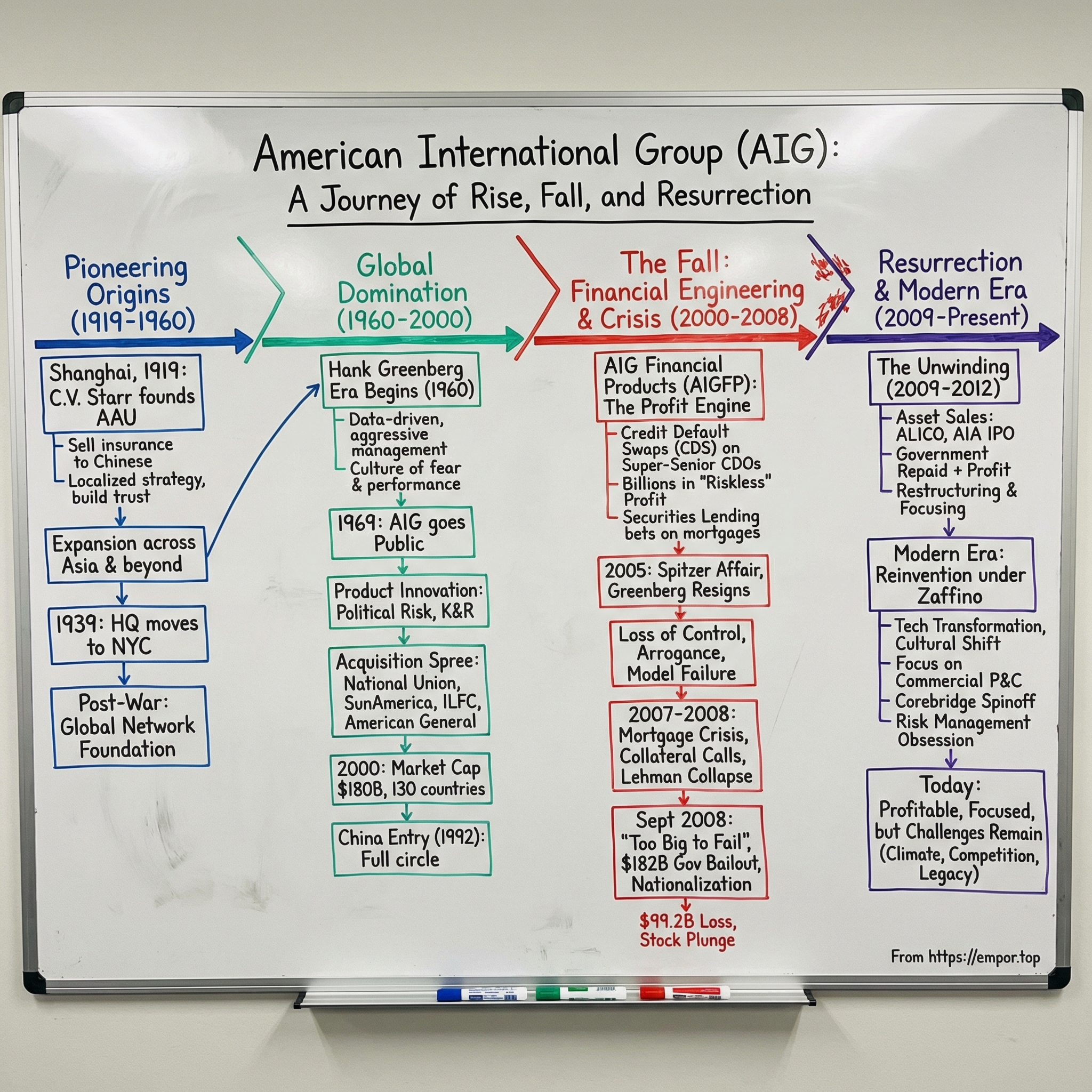
II. Shanghai to Empire: Starr, Greenberg, and Financial Engineering (1919–2005)
In 1919, a 27-year-old Californian named Cornelius Vander Starr opened a general insurance agency in Shanghai called American Asiatic Underwriters.6 He had no substantial capital, no underwriting franchise, and no established competitive standing. What he possessed was a structural insight that defined the company for the next century: profitable insurance underwriting relies not on covering risk where competitors aggregate, but on becoming the sole reputable carrier in underserved markets.
Starr expanded with disciplined consistency. A life insurance operation followed within two years. In 1926, he opened a New York office under the American International Underwriters banner — an expansion moving from Asia to America rather than the reverse.6 Starr entered Cuba in 1937, establishing a foothold in Latin America. When Japan's military advance made Shanghai untenable, he moved the headquarters to New York in 1939. By 1946, the firm was writing policies in occupied Japan and Germany — markets other American insurers viewed as uninsurable.6 Australia followed in 1957.
This expansion established AIG's most enduring asset: an international network of local licenses and regulatory authorizations accumulated over decades in jurisdictions where securing approval today requires extensive time and political capital.
The Greenberg machine
Maurice "Hank" Greenberg was an executive whose leadership style was inseparable from the company's trajectory. A decorated combat veteran of two wars, he managed AIG with a command structure, demanding operational visibility, strict accountability, and clear financial metrics. He joined Starr's organization in the early 1960s. The modern corporate structure was formalized when American International Group, Inc. was incorporated in Delaware in 1967, began trading publicly in 1969, and listed on the New York Stock Exchange in 1984.6
For nearly four decades under Greenberg, AIG compounded capital at rates that made it a core holding in institutional portfolios. The growth model rested on two pillars: a focus on specialized commercial lines where AIG could dictate terms — such as environmental liability, directors and officers coverage, kidnap and ransom, and political risk — and centralized underwriting discipline enforced by Greenberg directly.
This centralized structure created a hidden vulnerability: AIG's underwriting standards were not institutionalized within automated risk systems or governance committees, but depended primarily on one executive's personal oversight.
Empire building, and the price of it
By the 1990s, maintaining AIG's growth trajectory required increasingly large acquisitions. In 1990, AIG acquired aircraft lessor International Lease Finance Corporation — a capital-intensive, balance-sheet-heavy business separate from core insurance underwriting. SunAmerica followed in 1999, and American General arrived in 2001 through a roughly $23 billion transaction that established AIG as a major force in U.S. life insurance and retirement products.16
The rationale was scale and earnings diversification. The cost was that AIG became a conglomerate with divergent capital requirements, regulatory regimes, accounting standards, and risk profiles. A single holding company simultaneously operated a global commercial property and casualty underwriter, a domestic annuity provider, an aircraft lessor, and a financial derivatives operation. The individual units shared no distribution channels, customer relationships, or claims infrastructure; their primary connection was a shared holding company credit rating.
That credit rating eventually became the group's central point of failure.
The fatal pivot
AIG Financial Products was established in 1987 as a joint venture staffed by former Drexel Burnham traders. Its business model relied on rating arbitrage: leveraging AIG's AAA credit rating to sell guarantees and trade financial instruments. The unit expanded into structured finance, municipal guaranteed investment contracts, and credit default swaps.
A credit default swap functions like an insurance policy against bond defaults, but because it is regulated as a derivative rather than insurance, the seller is not legally required to hold statutory capital reserves. AIG Financial Products collected upfront premium income in exchange for promising to make counterparties whole if specified mortgage debt pools defaulted. The division wrote protection primarily on "super senior" tranches of collateralized debt obligations — the highest-ranking debt layers designed to absorb losses only after lower tranches were wiped out. Internal risk models treated the probability of loss on these tranches as near zero.
By the end of 2007, the derivatives portfolio reached a total notional value of $527 billion, including roughly $78 billion in multi-sector collateralized debt obligations containing direct subprime mortgage exposure.7 Against that exposure, AIG held about $96 billion in total corporate equity.7 The company had written contingent obligations exceeding five times its net worth, leaving the position essentially unhedged because hedging costs would have eliminated the profitability of the trade.
Concurrently, AIG's life insurance subsidiaries ran a large securities lending program, lending portfolio bonds for cash collateral that was then reinvested. By its peak in the third quarter of 2007, the program expanded from under $30 billion in 2003 into a far larger book, with roughly 65% of the cash collateral reinvested in residential mortgage-backed securities.7 This created a classic liquidity mismatch: short-term, callable cash liabilities funding long-dated, illiquid mortgage paper.
Neither the credit default swap exposure nor the securities lending risk appeared in the insurance operating companies' underwriting metrics, remaining invisible to investors monitoring standard combined ratios.
The 2005 exit
The end of Greenberg's tenure stemmed not from derivatives, but from accounting enforcement. An investigation by New York Attorney General Eliot Spitzer into AIG's reinsurance transactions produced allegations that two deals — one with General Reinsurance and another known internally as Capco — materially misrepresented the firm's loss reserves and underwriting results between 2000 and 2004.8 Greenberg resigned in March 2005 after nearly 40 years leading the company. AIG settled with federal and state authorities in 2006 for $1.6 billion.8 The personal civil case against Greenberg continued for another 11 years, resolving in February 2017 when he agreed to pay $9 million while admitting he had initiated, participated in, and approved the transactions.8
Operationally, AIG abruptly lost the sole executive who maintained an integrated view of the enterprise's risk map — precisely as the derivatives portfolio reached peak size and the U.S. housing market reached its peak. Successors inherited an organization whose structural complexity had been managed through central command rather than institutional risk architecture, leaving AIG vulnerable to the market collapse that followed three years later.
III. The 2008 Cataclysm, Taxpayer Bailout, and the Lost Decade (2007–2016)
The mechanism that destroyed AIG was not, in the end, the credit losses. It was the collateral.
Every credit default swap AIGFP had written contained clauses requiring the company to post cash collateral if either the value of the underlying securities fell or AIG's own credit rating was downgraded. The counterparty documentation was granular about it: Goldman Sachs had 44 transactions with AIG worth about $17 billion notional, with a collateral threshold of 4% "as long as AIGFP is rated in the AA/Aa category," stepping up sharply on downgrade.7 Dozens of banks held similar terms.
This was the fatal design of the structure. AIG had sold protection because it held a AAA rating. The contracts were priced on that rating and contained provisions demanding billions in cash the instant the rating slipped — at precisely the moment AIG was least able to raise liquidity.
Through 2008, both liquidity pressures hit simultaneously. The life subsidiaries lost approximately $21 billion on securities lending as borrowers demanded their cash back and the mortgage paper bought with it could not be sold at anything like carrying value.7 The financial services division lost $28.6 billion on the credit default swap book.7 In September 2008, with rating agencies downgrading the company, AIG faced collateral calls it could not meet.
The rescue, and the resentment
The Fed's intervention on September 16 was framed publicly as buying time — the facility was designed, in the central bank's own description, to "provide the company with the time and flexibility to execute a plan that would allow it to restructure to maximize its value."1 In practice, it functioned as a controlled demolition.
Public anger mounted quickly, shared by the officials authorizing the rescue. Testifying before the Senate Budget Committee on March 3, 2009, Federal Reserve Chairman Ben Bernanke said that "if there's a single episode in this entire 18 months that has made me more angry, I can't think of one (other than) AIG," describing the Fed's objective as being to "break the company up, to get it into a saleable position and to try to defang it."9 The statement reflected a regulator aiming to liquidate an institution rather than preserve it.
The great unwinding
Between 2009 and 2012, AIG sold off key business units to meet its obligations. The premier asset was AIA Group, the pan-Asian life insurer descended directly from Starr's original Shanghai operations. In October 2010, AIA priced approximately 7.03 billion shares at HK$19.68, representing about 58.4% of the company, generating roughly $17.8 billion in gross proceeds to the AIG-controlled vehicle before the over-allotment.10 At the time, it stood as the largest insurance IPO ever completed.
Simultaneously, AIG agreed to sell American Life Insurance Company — ALICO, a business founded in 1921 operating in more than fifty countries — to MetLife for about $15.5 billion, comprising $6.8 billion in cash and roughly $8.7 billion in equity.11 The transaction closed in November 2010.
Consider the strategic impact of those divestitures. AIG's most valuable assets in 2010 were the international life franchises built across four decades. They were liquidated to repay borrowings incurred by a derivatives desk that had operated for twenty-one years and generated a fraction of that long-term value. While the federal rescue was repaid with a net return for taxpayers, shareholders funded that outcome by shedding the company's highest-margin operations.
The lost decade
The conventional crisis narrative treats December 2012 — the U.S. Treasury's final exit — as the resolution. In reality, it marked the point when public markets confronted what remained: a struggling property and casualty insurer.
For years afterward, AIG's General Insurance business failed to maintain underwriting profitability. The company had aggressively chased volume to defend market share as key underwriting talent departed, accumulating unrecognized losses. In the fourth quarter of 2015, AIG recorded a $3.6 billion reserve charge after prior-year policies — particularly in workers' compensation and commercial casualty lines — proved severely under-reserved. Charges of that magnitude reflected years of cumulative underpricing finally reaching the financial statements.
Activists moved quickly. On October 28, 2015, activist investor Carl Icahn published an open letter to then-CEO Peter Hancock framing the turnaround challenge. "The company continues to severely underperform its peers and is now facing an increasingly onerous regulatory burden which will only further erode its competitive position," Icahn wrote. He demanded tax-free separations of the life and mortgage insurance subsidiaries to create three independent public companies, each small enough to escape the Systemically Important Financial Institution designation and its capital requirements, plus "a much needed cost control program to close the gap with peers." His verdict on the delay: "you have shown no sign of urgency and have chosen a 'wait and see…for years' strategy void of decisive leadership."12
Hedge fund manager John Paulson joined the activist effort, and both subsequently secured seats on AIG's board of directors.
The core issue facing investors was that activist proposals targeted corporate structure rather than underwriting quality. Splitting an underpriced property and casualty book into an independent entity does not restore underwriting discipline. While management defended conglomerate scale and activists sought break-up value, neither strategy addressed the fundamental necessity of pricing insurance risk accurately.
By 2017, with board pressure intensifying and underwriting performance lagging, AIG required leadership focused specifically on technical underwriting. It went looking for an underwriter.
IV. The Underwriting Renaissance: The Portfolio Transformation (2017–2023)
On May 15, 2017, AIG announced that Brian Duperreault would become President and CEO, effective the previous day, with Peter Hancock resigning concurrently.13 Chairman Douglas Steenland's public rationale reads, in retrospect, like a checklist of everything the prior era had lacked: "Brian has spent his entire career in insurance. He worked for AIG for 21 years at the start of his career, so he knows this company well. He was the CEO of ACE, one of our main competitors. He ran Marsh & McLennan Companies, one of AIG's largest broker partners."13
Duperreault was sixty-nine. He had left AIG in 1994 for ACE, built it into a serious competitor, run the world's largest insurance broker, and then founded Hamilton Insurance Group to apply data science to underwriting. He returned to a company where, by his own account in that release, he intended to build on AIG's "nearly 100-year heritage."
Six weeks later came the crucial operational appointment. On July 5, 2017, AIG named Peter Zaffino as executive vice president and global chief operating officer, effective August 1.14 Zaffino was fifty, had run Marsh since 2011, and had chaired Marsh & McLennan's Risk and Insurance Services segment since 2015.14 He and Duperreault had worked together during the Marsh turnaround following the Spitzer-era bid-rigging scandal — a shared experience of rebuilding a damaged franchise that would prove directly transferable.14
The pairing was deliberate: a respected industry statesman to restore credibility with brokers and regulators, and an operator with a reputation for granular, unsentimental portfolio management to restructure the book.
Fixing the architecture
What Zaffino inherited was not a company with a few bad accounts, but an institution with a structurally flawed risk architecture. AIG was deploying massive gross limits on individual property risks — writing large lines on single accounts — and relying on a modest reinsurance program to absorb the exposure. When major catastrophe events occurred, the resulting losses landed almost entirely on AIG's balance sheet.
The rebuild rested on three interconnected pillars.
First, limit reduction. AIG systematically reduced the maximum exposure it would take on any single property risk. While line-size reduction is an unglamorous lever in commercial insurance, halving line sizes on peak accounts cuts catastrophic exposure in half when major losses occur.
Second, reinsurance restructuring. AIG significantly expanded its reinsurance coverage, structuring policies to cap both single-event and aggregate annual losses. That framework remains in place: the 2026 property catastrophe program provides global aggregate and per-occurrence protection, calibrated by regional attachment thresholds — including a $500 million retention for the North America Commercial portfolio, $200 million for North America Personal Lines, and $200 million for Japan.5 In 2026, AIG maintained its $500 million North America Commercial retention while purchasing an additional $500 million of vertical limit above it.5 Absorbing current premium costs to purchase higher limits at the same retention reflects a deliberate choice to trade current earnings for protection against severe tail events.
Third, and most consequential, addressing legacy reserves. In the first quarter of 2017, AIG entered an adverse development reinsurance agreement with Berkshire Hathaway's National Indemnity Company (NICO), transferring 80% of the reserve risk on substantially all U.S. commercial long-tail exposures for accident years 2015 and prior. AIG paid approximately $10.2 billion in consideration. In return, NICO covers 80% of subject losses paid after January 1, 2016 in excess of a $25 billion net paid loss threshold, up to an aggregate $25 billion limit, secured by a collateral trust and a Berkshire parental guarantee.5
The ultimate value of AIG's legacy book is evident in the subsequent loss data. By December 31, 2025, covered losses above the attachment point reached $16.5 billion, of which $13.2 billion was ceded to NICO.5 Having paid roughly $10.2 billion for the coverage, AIG transferred $13.2 billion in losses, securing a net financial benefit that validated the transaction. Crucially, the size of those payouts also confirmed that the pre-2016 casualty book was severely under-reserved when written. That protection, however, applies strictly to accident years 2015 and prior, leaving all policies written since fully exposed.
The legacy cleanup continued with Fortitude Re. Carlyle took an initial 19.9% stake in November 2018; in June 2020, Carlyle and Japan's T&D Holdings completed the acquisition of a 76.6% interest in Fortitude Group Holdings, with AIG receiving approximately $2.2 billion in total proceeds, including a $1.8 billion purchase price.17 The transaction offloaded long-tail obligations, with Fortitude reinsuring roughly $30 billion of reserves from AIG's legacy life and retirement run-off lines and about $4 billion from legacy General Insurance run-off.17 AIG retained a residual 3.5% equity stake.17
Then, in September 2017, the Financial Stability Oversight Council rescinded AIG's SIFI designation — the outcome Icahn had demanded two years earlier. Duperreault's statement credited "the substantial and successful de-risking that AIG's employees have achieved since 2008."15 The regulatory overhang that had driven the activist push evaporated, removing the primary rationale for a corporate breakup.
The M&A round trip
The Validus transaction serves as a clear case study in AIG's evolving capital discipline, as management acquired the entity and resold the majority of its operations within six years.
AIG completed the $5.56 billion all-cash acquisition of Validus Holdings on July 18, 2018, roughly eight months into Duperreault's tenure — marking the company's largest acquisition since American General in 2001.16 The deal brought five distinct platforms: Validus Re, a reinsurance business; AlphaCat, an insurance-linked securities manager; Talbot, a Lloyd's syndicate that restored AIG's presence at Lloyd's after its 2016 exit; Western World, a small-commercial excess and surplus underwriter; and Crop Risk Services.16 At the announcement, Duperreault noted that Validus "brings us skills we don't have."16
Five years later, AIG reversed course. On May 22, 2023, it agreed to sell Validus Re to RenaissanceRe for $3.0 billion,18 closing the transaction on November 1, 2023, and transferring Validus Reinsurance Ltd., AlphaCat, and the renewal rights to Talbot's assumed reinsurance treaty unit.19 AIG retained Talbot's primary insurance operations and Western World.1619
This strategic reversal yields a nuanced lesson. AIG acquired a conglomerate bundle, retained the specialty primary underwriting units that aligned with its core strategy, and divested property catastrophe reinsurance — a segment whose earnings volatility conflicted with management's low-variance financial targets. Selling assumed property reinsurance at the peak of a hardening market represented favorable execution timing. However, the underlying talent, Lloyd's access, and E&S distribution likely could have been acquired for less than $5.56 billion. The willingness to acquire a mixed portfolio and subsequently carve it up reflected familiar conglomerate tendencies, though modern management acted quickly to divest the incompatible business rather than retaining it for decades.
Unbundling the life company
The most significant structural transformation was the separation of the Life & Retirement business, announced in 2020 and executed over six years. Corebridge Financial's shares began trading on the NYSE on September 15, 2022, with the initial public offering closing on September 19 and generating approximately $1.7 billion in gross proceeds for AIG.20 AIG then executed a phased sell-down through secondary offerings and block sales, reducing its equity stake to 10.1% by the fourth quarter of 2025 and generating roughly $1 billion in that quarter alone.4
The strategic rationale for the separation was straightforward: life and retirement operations rely on interest-rate spreads and carry distinct capital dynamics from short-tail property underwriting, making joint ownership a source of internal capital friction. However, the extended divestment created substantial financial reporting noise. Mark-to-market adjustments on AIG's retained Corebridge stake repeatedly caused net income swings that obscured core property and casualty underwriting performance. For full-year 2024, AIG reported a net loss of $2.17 per diluted share — driven by a $3.6 billion loss from discontinued operations upon deconsolidating Corebridge — compared to adjusted after-tax income of $4.95 per share.45 For four years, investors had to look past volatile statutory reporting to gauge underlying insurance earnings.
By the end of 2023, the operational footprint of modern AIG was established. The remaining task was to demonstrate that this simplified structure could consistently deliver target returns — and to transition leadership.
V. Current Management, Strategy & Leadership Execution (2024–2026+)
On January 6, 2026, AIG announced that Peter Zaffino intended to step back from the chief executive role by mid-year and become Executive Chair, and that Eric Andersen would join as President and CEO-elect effective February 16.21 The corporate release framed Zaffino's retirement as CEO as the culmination of "successfully leading the company's transformation and strategic repositioning as a leading global property and casualty insurer."21
Zaffino took over as CEO in March 2021 and led the insurer through five consecutive years of underwriting profitability through 2025. This reversed years of heavy underwriting losses and enabled AIG to return more than $19 billion to shareholders via buybacks and dividends over his final three years.21 In 2025, AIG surpassed $2 billion in annual underwriting income for the first time since 2008.26
The leadership transition proceeded on schedule. On April 27, 2026, the board confirmed that effective June 1, Andersen would become President and CEO and join the board, with Zaffino becoming Executive Chair.22 Andersen emphasized continuity, noting that discussions with clients since joining in February had "reinforced my excitement in working alongside our talented colleagues to build on AIG's strong momentum and deliver on the strategic priorities the Company announced at our 2025 Investor Day."22
Who is Eric Andersen, and why him?
Andersen was 60 at the time of his appointment and had spent his career at insurance broker Aon, serving as President of Aon plc from 2020 to 2025 before becoming Senior Advisor to its chief executive. Moving directly from a major brokerage to head a global insurance carrier is an uncommon path, highlighting the board's strategic priorities.
Commercial insurance distribution is deeply intermediated. Carriers do not sell directly to end corporate clients; they rely on major brokers like Aon, Marsh, and WTW, which direct global risk submissions to underwriters. By recruiting Aon's former president, AIG signaled that its primary growth constraint is submission flow—securing early access to high-quality risks—rather than core underwriting capacity.
Andersen's public commentary aligns with this focus. On AIG's second-quarter 2026 earnings call, when asked about growth needed to hit return targets, he stated that profitability is "always the North Star," pointing to selective organic growth supplemented by strategic transactions.25 When discussing artificial intelligence, he highlighted broker-level performance analytics to refine distribution rather than simple headcount reduction.25 Responding to Wells Fargo analyst Elyse Greenspan regarding whether 13% first-half growth aligned with guidance, Andersen reaffirmed a commitment to strict underwriting standards over "blind growth."25
The transition also introduces a dynamic governance structure. Having an Executive Chair who designed the turnaround working alongside a newly appointed outside CEO creates an effective partnership when aligned, but requires ongoing monitoring should strategic differences emerge.
What management is actually paid to deliver
At its March 2025 Investor Day, management established clear financial targets: compounding operating earnings per share by 20% or more annually from 2025 through 2027, delivering a Core Operating return on equity of 10% to 13%, keeping the General Insurance expense ratio below 30%, and growing dividends per share by 10% or more annually through 2026.23
Notably missing from this scorecard is any top-line premium volume target—a stark contrast to the pre-2017 focus on market share. Management's performance is tied directly to return on equity, cost efficiency, and per-share earnings—metrics that reward disciplined underwriting over raw volume expansion.
Results through mid-2026 reflect steady execution against these benchmarks. Full-year 2025 adjusted after-tax income rose 43% to $7.09 per diluted share, supported by a General Insurance combined ratio of 90.1% and an accident-year combined ratio of 88.3%.4 Underwriting income expanded 22% to reach $2.3 billion.4 Furthermore, quarterly dividends increased by double digits for the fourth consecutive year, reaching $0.50 per share starting in the second quarter of 2026.24
Myth vs. reality
Three common market narratives about AIG warrant close examination against regulatory filings.
Myth: AIG is now a growth company. Reality: reported top-line expansion relies heavily on structural deals rather than organic volume. In full-year 2025, net premiums written of $23.7 billion fell 1% on a reported basis and rose just 2% on a comparable basis.4 While first-quarter 2026 premium growth surged by 24%, that increase stemmed primarily from restructured reinsurance terms, the acquisition of Everest renewal rights, and a quota-share agreement with Convex Group, rather than organic expansion.24 Responding to RBC analyst Rowland Mayor regarding Convex's contribution, Andersen acknowledged that organic growth is tracking in the low-to-mid single digits, with the remainder coming from strategic transactions.25 Acquiring premium under attractive terms can be sound capital allocation, but headline growth figures overestimate organic business momentum.
Myth: the accident year combined ratio keeps improving. Reality: group-level accident-year performance has remained essentially flat for three years. The accident-year combined ratio registered at 88.2% in 2024 and 88.3% in 2025—a slight deterioration.4 While the metric improved by 30 basis points to 88.1% in the second quarter of 2026, that gain was driven by lower expense ratios rather than reduced loss ratios.3 Performance varies significantly across business segments: North America Commercial's accident-year combined ratio rose 50 basis points year over year in the second quarter due to higher acquisition costs and loss ratios, whereas Global Personal improved by 490 basis points following restructured high-net-worth commission arrangements.3 Underwriting margins are being sustained through portfolio mix and cost efficiency rather than structural improvements in loss selection.
Myth: the balance sheet is de-risked. Reality: balance sheet risk is drastically lower than during the 2008 financial crisis, prompting credit rating upgrades. S&P raised the financial strength ratings of AIG's core insurance subsidiaries to AA- from A+, while Moody's upgraded subsidiary ratings to A1 from A2—marking AIG's first rating upgrades from Moody's since 1990 and from S&P since 2013.29 Nevertheless, financial leverage remains notable. As of June 30, 2026, AIG carried $9 billion in total debt, representing a total debt-to-adjusted-capital ratio of 17.6%.3 Additionally, management recently committed approximately $2.7 billion to minority equity stakes in a private specialty insurer and an alternative asset manager.28 That capital allocation profile introduces investment complexity beyond that of a pure-play insurance underwriter.
Capital allocation: the real test
AIG has consistently prioritized shareholder capital returns. During 2025, the company returned $6.8 billion to shareholders through $5.8 billion in share repurchases—retiring approximately 73 million shares—and roughly $1.0 billion in dividends.4 Total common shares outstanding dropped from 606.1 million at year-end 2024 to 538.2 million by year-end 2025,4 declining further to 524.7 million by June 30, 2026.3 This 11% annual reduction in share count significantly boosted per-share earnings performance.
However, capital deployment shifted noticeably in 2026 from share buybacks toward strategic investments and acquisitions. In rapid succession, AIG agreed to acquire renewal rights to Everest Group's global retail commercial portfolio, covering roughly $2 billion in gross premiums written while leaving all unearned liabilities and claims administration with Everest.32 AIG also acquired a 35% equity stake in Convex Group for approximately $2.1 billion alongside Onex, while purchasing a 9.9% equity stake in Onex itself for roughly $646 million.28 In addition, AIG partnered with Amwins and Blackstone to launch Lloyd's Syndicate 2479,5 and agreed to acquire Everest's Colombian insurance subsidiary in a deal slated to close in early 2027.33
On the fourth-quarter 2025 earnings call, Zaffino addressed this pivot directly, stating management anticipated these transactions would prove "more accretive in 2026 and 2027 than share repurchases."26 The partnership with Convex includes a whole-account quota-share agreement reinsuring 7.5% of Convex's underwriting portfolio in 2026, scaling to 10.0% in 2027 and 12.5% in 2028—generating premium volume and underwriting profits without taking on full entity consolidation.
This active dealmaking raises strategic questions for investors. After spending several years advocating corporate simplification and a focus on core property and casualty operations, management committed capital across diverse entities within a 12-month span. These commitments include a 35% equity-method stake in a Bermuda specialty insurer, a 9.9% investment in a Canadian asset manager, a cornerstone transfer of up to $1.5 billion from AIG's portfolio into a CVC private equity secondaries platform, and an intention to allocate up to $2 billion to CVC-managed funds.5 While management contends these deals are capital-efficient and preserve balance sheet integrity, verifying whether this strategy delivers superior risk-adjusted returns will require several years of reported results.
This tension between management's simplification narrative and its recent portfolio investments represents a pivotal strategic metric for AIG. Assessing whether the strategy succeeds requires a close look at what the core underwriting franchise generates.
VI. Core Business Deep-Dive: Segments, Economics, and Market Structure
Behind its complex corporate history, modern AIG operates through three core underwriting segments alongside a corporate holding structure.
North America Commercial serves as the primary profit engine. In 2025, the segment wrote $8.8 billion in net premiums, up 4%, while producing $1.1 billion in underwriting income—more than doubling its prior-year total—on an 86.8% combined ratio.4 Operations run through historical underwriting entities that predate the modern group, including National Union Fire Insurance Company of Pittsburgh, American Home Assurance, Lexington Insurance, Western World, and the Glatfelter program business.5 Based on 2024 premium mix, excess and surplus lines writer Lexington accounted for 29% of the segment, retail casualty and financial lines represented 42%, and the remaining volume spanned retail property and program or captive solutions.23
International Commercial wrote $8.7 billion in net premiums in 2025 at an 86.9% combined ratio, generating $1.1 billion in underwriting income.4 This unit represents the direct descendant of Starr's global licensing network, comprising AIG Europe, AIG Asia Pacific, Talbot at Lloyd's, and operating units across Latin America and Asia.5 Its portfolio spans marine, energy, aviation, political risk, trade credit, casualty, and financial lines.5
Global Personal wrote $6.3 billion in net premiums in 2025 while running a 99.0% combined ratio, essentially breaking even on underwriting.4 The segment covers accident and health, personal auto and homeowners in selected markets, extended warranty, device protection, and high-net-worth personal insurance.5 Recent results show operational improvement: in the second quarter of 2026, the segment delivered a 92.9% combined ratio and $114 million in underwriting income, compared with $25 million in the prior-year period.3
Other Operations captures parent-company investment income, corporate overhead, and holding company interest expense, posting an adjusted pre-tax loss of $142 million in the second quarter of 2026.3
Together, the two commercial segments generated approximately $2.26 billion of AIG's $2.33 billion in 2025 General Insurance underwriting income—roughly 97%.4 Personal lines provide global scale, operational data, and investable float, but currently generate minimal underwriting profit.
How the economics actually work
Commercial insurance profitability rests on two distinct operational drivers: underwriting performance and investment returns.
The primary measure of underwriting performance is the combined ratio, which sums the loss ratio—claims and claim-handling expenses relative to earned premium—and the expense ratio, reflecting broker commissions and general administrative costs. A combined ratio below 100% indicates that policy underwriting is profitable before considering investment returns. In 2025, AIG recorded a 59.0% loss ratio and a 31.1% expense ratio, resulting in a 90.1% combined ratio.4
Industry analysts frequently evaluate an adjusted accident-year combined ratio, which excludes property catastrophe losses and prior-year reserve development. Because catastrophe events are volatile and reserve adjustments reflect past policy years, removing both items isolates current-year risk pricing. While this metric provides a clear view of ongoing underwriting discipline, excluding these unpredictable factors also presents management's performance in the most favorable light.
The second driver of profitability is investment returns earned on insurance float—the capital accumulated from premiums collected before claims are settled. At year-end 2025, AIG held $93.0 billion in total investments,5 generating $4.2 billion in net investment income for the full year. Of that total, $3.4 billion was attributed to General Insurance, a 12% increase driven by reinvesting maturing bonds into higher-yielding fixed-income securities.4
In total financial impact, AIG's underwriting generated roughly $2.3 billion in 2025, while its General Insurance investment portfolio generated approximately $3.4 billion. Investment income exceeding underwriting income is standard across commercial insurance, underscoring why interest rate shifts heavily influence carrier equity valuations. Notably, General Insurance net investment income was flat year over year in the second quarter of 2026,3 indicating that the benefit from higher reinvestment yields is stabilizing.
The three numbers that matter
Evaluating AIG's operational trajectory requires tracking three primary indicators.
First: the adjusted accident-year combined ratio for Global Commercial. This metric indicates whether AIG is pricing commercial risk above its expected loss costs. An upward trend into the high-80s during a period of softening market pricing would indicate pressure on underwriting margins.
Second: organic net premiums written growth isolated from strategic transactions. Reported premium figures currently blend organic underwriting with external transactions, including the Everest portfolio transfer, the Convex quota-share agreement, and restructured reinsurance programs. Isolating organic premium growth demonstrates whether the core franchise is expanding through market demand.
Third: prior-year reserve development in U.S. Excess Casualty and European Casualty and Financial Lines. These long-tail casualty portfolios are particularly sensitive to social inflation and rising litigation costs. Reserve trends in these books provide an early indicator of long-term balance sheet stability.
The competitive set
AIG competes against a consolidated group of global commercial carriers, including Chubb, Travelers, Zurich Insurance Group, AXA XL, Berkshire Hathaway Specialty Insurance, W. R. Berkley, and CNA Financial.
Comparative financial metrics highlight the performance gap between AIG and top-performing peers. Chubb reported a full-year 2025 property and casualty combined ratio of 85.7%—an all-time low—alongside a current accident-year combined ratio excluding catastrophes of 80.4%, core operating income of $9.95 billion, and a core operating ROE of 13.7%.30 Travelers delivered full-year 2025 core income of $6.3 billion, up 26%, generating a core return on equity of 19.4%.31
Compared with AIG's 90.1% combined ratio and 11.1% Core Operating ROE,4 this performance differential remains significant. On comparable commercial exposures, Chubb operates with roughly four and a half percentage points higher underwriting margin and achieves a higher return on equity, while Travelers benefits from a domestic focus and higher personal lines weighting to generate nearly double AIG's return on equity.
Bullish investors view this margin differential as potential upside, arguing that AIG has room for further operational improvement. Conversely, cautious analysts emphasize that the gap persisted throughout an exceptionally strong commercial pricing cycle, when margin expansion should have accelerated. While both viewpoints reflect disclosed financial results, the data demonstrates that AIG has not yet achieved financial parity with top-tier peer operators.
Where AIG maintains a distinct competitive advantage is global distribution and licensing. The capability to issue admitted local policies across more than 200 countries and jurisdictions for unified multinational programs5 is matched by only a small group of global insurers. Whether that international distribution infrastructure yields sustained pricing power is examined in Section VIII. First, the analysis turns to the two business areas driving AIG's fastest premium growth.
VII. Hidden & Growth Engine: E&S Market, Lexington Insurance, and AI Automation
Consider a wholesale broker handling a challenging risk submission: a mid-sized logistics company with warehouses in wildfire-prone California regions, a recent history of fleet losses, and a request for $50 million in property coverage. Admitted carriers in the state must adhere to filed rates and approved policy forms, making them unable to price such elevated risk appropriately. Consequently, the submission moves to the excess and surplus (E&S) market—the non-admitted market where specialized carriers set custom rates and terms.
This non-admitted sector has experienced a sustained expansion. According to data presented at AIG's 2025 Investor Day, U.S. non-admitted direct premiums written nearly tripled from roughly $50 billion in 2018 to approximately $135 billion in 2024, nearly doubling the segment's share of total commercial insurance premiums from about 7% to roughly 13%.23
This growth reflects structural shifts rather than standard underwriting cycles. First, intensifying climate volatility makes catastrophe-exposed property difficult to price under rigid, slowly updated regulatory filings. Second, social inflation—driven by litigation funding, larger jury verdicts, and aggressive plaintiff tactics—makes commercial casualty risks harder to cover under standardized forms. When the regulated market cannot adapt its pricing or terms quickly enough, business flows to non-admitted carriers.
Lexington
Lexington Insurance Company serves as AIG's primary E&S platform and ranks among the largest non-admitted underwriters in the United States. Its recent trajectory illustrates how AIG has capitalized on market demand while narrowing its risk selection. Between 2018 and 2024, Lexington's gross premiums written nearly doubled from about $1.7 billion to roughly $3.1 billion, while annual submission volume from brokers expanded tenfold, rising from approximately 30,000 to about 300,000 risks.23
Examining these two metrics together reveals the core strategy: while submission volume expanded tenfold, gross premiums only doubled. As a result, Lexington declines the vast majority of submissions it receives.
This gap demonstrates strict quantitative selectivity. Evaluating 300,000 risks while binding only a fraction of them allows underwriters to pick optimal risks rather than taking broad market exposure. In specialty insurance, capital is rarely the limiting factor, as capacity quickly enters attractive markets. The true bottleneck is processing capacity—the ability to evaluate vast numbers of submissions to select profitable accounts, a workflow historically constrained by human underwriter bandwidth.
Addressing this processing bottleneck became a central focus of AIG's operational strategy.
AIG Assist
Underwriting complex commercial accounts requires extensive data processing before risk analysis can begin. A single broker submission often arrives with unstructured broker emails, location spreadsheets, engineering assessments, loss run histories in varying formats, and supplemental questionnaires. Extracting and organizing this information manually consumes substantial time before an underwriter can evaluate the underlying risk.
AIG Assist automates this initial ingestion phase. Utilizing large language models, the tool's patent-pending Auto Extract feature extracts structured data from documents, websites, and correspondence, highlighting primary risk characteristics for the underwriter. Rather than making automated binding decisions, the system reduces data-entry overhead so underwriters can evaluate accounts more quickly.
By late 2025, AIG had processed 370,000 submissions through the platform toward a target of 500,000 by 2030, initially deploying the system within Lexington before expanding across additional commercial lines.27 On the fourth-quarter 2025 earnings call, management detailed plans to extend Underwriting by AIG Assist to seven additional lines of business and construct an orchestration layer to coordinate multiple artificial intelligence agents across operational workflows.26
The financial goal is operating leverage: allowing underwriters to evaluate a broader submission volume without increasing operational headcount, thereby lowering the expense ratio as net premiums grow. Recent disclosures track this progression: the General Insurance expense ratio declined from 32.0% in 2024 to 31.1% in 2025,4 improving further to 30.8% in the second quarter of 2026 and bringing the trailing twelve-month ratio to 30.7% toward management's sub-30% target for 2027.25
Executive leadership underscored these early gains. In February 2026, Zaffino noted that deployment outcomes had transitioned from aspirational to beyond management's initial projections, highlighting an unexpected ability to handle significant submission growth without adding operational headcount.27
Two critical caveats temper this automation narrative. First, high submission processing rates represent operational inputs rather than underwriting performance. The true test is whether accounts bound under automated workflows maintain profitability over multi-year policy periods, an outcome that will only register in loss reserves over time. Accelerating quote throughput without maintaining risk selection discipline increases the risk of future adverse development. Second, AIG's regulatory filings outline operational risks: the 2025 Form 10-K warns that generative AI tools could generate biased, inaccurate, or unanticipated outputs due to model or data flaws, and notes that evolving regulatory restrictions on AI deployment could materially impact underwriting and claims operations.5
Incoming CEO Eric Andersen took a more measured tone on the second-quarter 2026 conference call, focusing on broker insights and employee efficiency rather than headcount reductions.25 Whether this reflects prudent management framing or signals that long-term expense reductions will prove harder to capture remains an open question for investors.
The high-net-worth restructuring
The final element of AIG's portfolio transformation involved shedding volatile personal lines risks. AIG's Private Client Group insured high-value homes, artwork, and collections. While profitable during low-catastrophe periods, the business carried severe concentration risk from severe weather events and wildfires in Florida and California.
Management signaled plans to reduce this exposure in late 2021, citing escalating catastrophe loss frequency and severity, and by mid-2022 AIG withdrew from the admitted personal property homeowners market in several high-risk states.34 In April 2023, AIG finalized a partnership with Stone Point Capital to create Private Client Select Insurance Services, an independent managing general agency that assumed the Private Client Group brand and operations.34
Managing general agencies operate under distinct economics compared to primary carriers. Rather than retaining underwriting risk on its own balance sheet, an MGA services accounts and earns fee income while transferring primary loss exposure to third-party capital providers. By converting a capital-intensive underwriting portfolio into a fee-and-participation structure, AIG reduced balance sheet volatility and secured more favorable commission arrangements. This structural shift contributed directly to Global Personal's accident-year combined ratio improvements, which expanded by 340 basis points in the fourth quarter of 20254 and 490 basis points in the second quarter of 2026.3
The restructuring highlights how transferring catastrophe-exposed risks off the balance sheet can improve segment returns without sacrificing distribution relationships.
VIII. Strategic Moats: Porter's 5 Forces & Helmer's 7 Powers
Building a durable moat in commercial insurance is notoriously difficult. The product is a legal contract, capital is fungible and mobile, and any pricing advantage attracts imitators within a single renewal cycle. Evaluating a carrier's competitive advantage requires scrutinizing the underlying structural mechanisms.
Applying Hamilton Helmer's 7 Powers framework to AIG produces a mixed verdict: two powers appear legitimate, two are weaker than advertised, and three are essentially absent.
Scale economies: real, and narrower than claimed
The most genuine structural moat is AIG's global network. A German industrial manufacturer with operations across thirty countries requires a unified global liability program. Because insurance is regulated nationally, local laws often mandate admitted policies issued by locally licensed carriers with on-the-ground claims handling, local premium taxes, and regulatory filings. Only a small group of global carriers—primarily AIG, Chubb, Zurich, and AXA XL—can assemble that infrastructure.
AIG's reach across more than 200 countries and jurisdictions5 cannot be replicated by a new entrant at any price. The primary barrier is not capital, but decades of accumulated licenses and regulatory relationships. This represents a durable structural advantage.
However, scale economies in underwriting risk are far weaker. Operating at scale does not guarantee superior loss ratios, as Chubb's stronger combined ratio at comparable scale30 and W. R. Berkley's long track record at a fraction of AIG's size demonstrate. On the second-quarter 2026 earnings call, Barclays analyst Alex Scott highlighted AIG's premium leverage gap relative to peers, noting that AIG writes less premium per dollar of equity than competitors. Chief Executive Eric Andersen responded by emphasizing a "rock-solid balance sheet" and the appeal of share repurchases at a modest premium to tangible book value.25 While logical, that rationale acknowledges that AIG is not yet converting its capital base into premium volume as efficiently as its peer group.
Process power: the most credible claim, and the least proven
Helmer's process power defines an advantage embedded in complex organizational routines that competitors cannot easily copy because doing so requires altering operational habits across thousands of employees.
If AIG possesses process power, it stems from combining its restructured underwriting architecture with its AI-driven submission-processing engine. The supporting evidence is measurable: submission volume at Lexington expanded tenfold while gross written premiums roughly doubled,23 and the General Insurance expense ratio continues moving toward management's sub-30% target.25
The counter-evidence, however, remains substantial. Competitors are deploying similar automated tools, underlying language model technology is widely available, and superior risk selection has not yet translated into better loss ratios. AIG's adjusted accident-year loss ratio actually rose one percentage point in 2025, from 56.2% to 57.2%.4 Recent margin expansion has been driven by expense reductions rather than lower loss costs. Process power that lowers operational expenses is valuable, but process power that enhances risk selection would be transformative; to date, empirical evidence supports only the former.
Cornered resource and switching costs: partly real
Lexington's relationships with major wholesale brokers—such as Ryan Specialty, Amwins, and CRC—resemble a cornered resource. When a wholesale broker needs to place a complex or distressed risk, Lexington is consistently among the few carriers evaluated. The launch of Lloyd's Syndicate 2479 in partnership with Amwins and Blackstone5 deepens that relationship on a structural level rather than through transactional deal flow.
Switching costs for large multinational commercial programs are moderate rather than high. A corporate risk manager faces real friction when changing carriers—reissuing local policies across dozens of jurisdictions, transferring open claims files, and establishing new engineering protocols. Yet policy renewals occur annually, and commercial brokers are incentivized to test the market. Switching costs slow client churn, but they do not eliminate it. This dynamic was evident in the second quarter of 2026, when AIG's deliberate contraction of Lexington property exposure resulted in a nine-percentage-point drop in client retention.25 Business departed when AIG raised pricing—a disciplined underwriting decision that also underscores the limits of carrier pricing power.
Branding, counter-positioning, and network economies are essentially absent. AIG's corporate brand still carries residual friction from the 2008 financial crisis, and commercial insurance offers no meaningful network effects.
Porter's five forces
Buyer power: high, and rising. The effective buyers in commercial insurance are major brokers. Intermediaries like Aon, Marsh, and WTW aggregate vast commercial demand and run competitive placement processes to compress carrier margins. AIG's decision to appoint former Aon President Eric Andersen as CEO21 tacitly acknowledges that managing broker relationships is a primary strategic priority. While excess and surplus positioning partially mitigates this pressure by offering non-admitted flexibility, the 6% decline in AIG's international renewal pricing in the second quarter of 202625 illustrates buyer power in practice.
Threat of new entrants: low at the top, high at the margin. Replicating AIG's 200-jurisdiction network is nearly impossible for a startup. However, fresh capital enters specialty underwriting regularly. Convex Group illustrates this dynamic: founded in 2019 by Stephen Catlin and Paul Brand with $1.7 billion in initial capital, Convex expanded gross premiums at a 25% compound annual rate over three years toward an expected $6 billion in 2025 while earning an average 18% return on equity.28 A skilled underwriting team backed by capital can rapidly gain market share. AIG's response—acquiring a 35% stake in Convex rather than competing head-to-head—reflects a pragmatic assessment of that competitive threat.
Supplier power (reinsurance): moderate and structurally reduced. Following the sale of Validus Re, AIG operates primarily as a buyer rather than a seller of reinsurance, making reinsurers key suppliers. Executive Chair Peter Zaffino noted that January 1, 2026 property catastrophe renewals yielded "enhanced terms and favorable pricing,"4 aligning with broader softening in property reinsurance. However, supplier power remains higher in commercial casualty reinsurance, where market capacity is tighter.
Substitutes: low but non-zero. Large corporations can self-insure through single-parent or group captives. AIG hedges against this risk by operating its own captive management solutions division.23
Rivalry: high and intensifying. Well-capitalized peers—including Chubb, Travelers, Berkshire Hathaway Specialty, W. R. Berkley, and Lloyd's syndicates—compete aggressively for specialty lines. As generative AI and automated submission tools become standard across the industry, early efficiency advantages will likely be competed away over time.
A measured synthesis indicates that AIG possesses one strong structural moat—its global licensing network—and one plausible operational edge in AI-enabled submission processing. Other competitive dimensions reflect industry parity or structural headwinds. While this foundation supports a resilient commercial insurer, it does not constitute an unassailable franchise, as the operational performance gap relative to top-tier peers demonstrates.
IX. Skeptical Investor Stress Test & Current Risk Radar
To stress-test AIG's transformation, an investor examining the 2025 Form 10-K would focus on the areas where operational and financial risks remain active.
The casualty reserve question
The primary balance-sheet exposure appears on page 60 in the prior-year loss development table.
Headline figures present a reassuring picture: AIG reported total favorable prior-year development of $548 million in 2025, $368 million in 2024, and $391 million in 2023.5 Three consecutive years of net reserve releases suggest conservative overall balance-sheet positioning.
Disaggregating those figures by line of business reveals a sharper divergence. Within North America Commercial, U.S. Workers' Compensation released $172 million in reserves in 2025, $261 million in 2024, and $190 million in 2023—providing a consistent buffer of favorable development.5 Conversely, U.S. Excess Casualty generated adverse development of $85 million in 2025 and $228 million in 2024.5 In International Commercial, UK and European Casualty and Financial Lines recorded adverse development of $216 million in 2025, $170 million in 2024, and $165 million in 2023—marking three straight years of reserve strengthening.5
This pattern highlights an underlying split: favorable development stems primarily from short-tail property lines and workers' compensation, a line benefiting across the industry from long-term declines in claim frequency. Meanwhile, adverse development clusters in long-tail liability lines heavily impacted by social inflation. Net group releases remain positive only because favorable adjustments in short-tail lines currently exceed reserve additions in long-tail liability.
That dynamic persisted into 2026. Second-quarter favorable development of $145 million was anchored by $177 million in releases from U.S. Workers' Compensation, which offset continued reserve strengthening in U.S. Excess Casualty.25 CFO Keith Walsh noted that 2023 excess casualty reserves were strengthened by $74 million to align prudence levels with 2024 and 2025 standards.25 The adjustment indicates that initial 2023 casualty loss picks were less conservative than subsequent years, prompting management to raise prior reserves retroactively.
Two structural factors heighten this exposure. First, the Berkshire Hathaway adverse development cover applies exclusively to accident years 2015 and prior.5 Policies written between 2016 and 2023—a period spanning the soft commercial pricing cycle before current technical underwriting standards were fully established—carry no external reserve protection. Second, AIG's regulatory filings state that for U.S. Excess Casualty, actual loss costs could reasonably vary by five percentage points above or below the estimated loss trend.5 Given a net reserve base of $3.2 billion in that specific line,5 a five-percentage-point deviation in loss trends over a multi-year payout tail represents a substantial financial swing.
On the fourth-quarter 2025 earnings call, management stated that AIG had included additional margin in casualty loss picks to cushion against macroeconomic uncertainties and social inflation, framing reserves as a position of strength.26 By the second quarter of 2026, CEO Eric Andersen offered a more cautious assessment, noting that loss trends showed no signs of moderating and confirming that pricing models were not assuming any near-term moderation.25 That cautious stance aligns with current market conditions while confirming that long-tail casualty risk remains active.
The softening cycle
The second area of exposure involves pricing momentum across commercial lines. AIG rebuilt its underwriting margins during an eight-year period of rising commercial rates, but that pricing cycle is fragmenting.
Second-quarter 2026 rate movements illustrate this divergence: North America retail casualty rates rose 10% and excess casualty rates increased 14%, both pacing above loss cost trends. However, international renewal pricing fell 6%, global energy rates dropped 15%, and financial lines declined 4%.25 Consequently, the accident-year combined ratio deteriorated by 50 basis points in North America Commercial and by 230 basis points in International Commercial, driven by rate pressure and higher acquisition costs.3
Management has argued that market dynamics vary widely across segments. On the fourth-quarter 2025 call, Commercial Insurance CEO Jon Hancock emphasized that rate pressure is not uniform across all geographies or lines simultaneously.26 While accurate, the key question for investors is whether selective portfolio management can offset broader rate softening over multiple years or merely slows margin compression.
When premium rate increases fall below underlying loss cost inflation, accident-year loss ratios expand. In casualty insurance, that margin erosion often takes several years to become visible in reported reserves.
Catastrophe volatility
While selling Validus Re eliminated assumed reinsurance property catastrophe exposure, primary catastrophe exposure remains part of the portfolio. Second-quarter 2026 catastrophe losses totaled $210 million—adding 3.4 percentage points to the loss ratio—including $75 million in net losses tied to Middle East geopolitical conflict.3 In the first quarter of 2025, severe California wildfires contributed to catastrophe losses equal to 9.1 percentage points of the loss ratio.24
These results show that while modern reinsurance structures have raised AIG's baseline earnings stability, annual underwriting results remain subject to property catastrophes and geopolitical risks. In the second quarter of 2026, AIG's political violence pricing rose 9%, reversing an 8% decline in the prior quarter, as CEO Eric Andersen observed that global energy market pricing did not fully reflect heightened Middle East exposures or recent industry losses.25 A chief executive noting rate inadequacy in active underwriting lines highlights the persistence of competitive pricing pressure.
The rest of the risk radar
Investment portfolio credit risk. Net realized investment losses increased in 2025, driven by impairments on real estate funds that were liquidated on December 23, 2025.5 Those write-downs contributed to a full-year net realized loss of $966 million, excluding Fortitude Re funds-withheld adjustments.5 The realized loss demonstrates how commercial real estate stress can impact net income despite clean underwriting performance. Furthermore, AIG delegates the majority of its portfolio to third-party asset managers who are compensated based on managed asset volume rather than investment performance—a structural alignment gap disclosed in filings.5
Reinsurance cost and availability. While property catastrophe reinsurance pricing has moderated, casualty reinsurance capacity remains constrained. If casualty excess-of-loss protection grows more expensive, AIG must either absorb higher retention levels or pay elevated reinsurance premiums.
Execution risk in leadership transition. Eric Andersen assumes executive authority over an operating model designed by Executive Chair Peter Zaffino. The primary operational risk is that technical underwriting discipline enforced under founder-level oversight could soften under new leadership focused on broker distribution.
Accounting presentation changes. Loss reserves represent the single largest estimate on AIG's balance sheet and are designated as a critical accounting estimate.5 In addition, AIG introduced two financial reporting adjustments during 2025 and early 2026: excluding run-off business results from adjusted pre-tax income in the third quarter of 2025, and reallocating intangible amortization from Other Operations into General Insurance in the first quarter of 2026, with prior period results recast.35 While properly disclosed, these adjustments complicate multi-year segment ratio comparisons, including tracking progress toward management's 2027 expense ratio target.
X. Playbook: Lessons from the Rise, Fall, and Resurrection
Stripping AIG's century of operations down to transferable lessons yields five core principles.
1. Never let a rating substitute for a reserve. AIG Financial Products' business model relied on monetizing AIG's credit rating. The unit collected fee income for writing tail risk without setting aside capital reserves, as derivatives accounting did not mandate them. This principle extends far beyond insurance: whenever a business generates steady income by selling protection against a rare event, the central risk is what happens when that event coincides with a drain on the seller's liquidity. AIG wrote $527 billion of notional protection against an equity base of $96 billion,7 embedded with contract terms—specifically rating downgrades—that triggered massive collateral calls precisely when liquidity was thinnest.
2. Complexity has a carrying cost that is invisible until it isn't. A conglomerate operating an aircraft leasing firm, an annuity provider, a global commercial underwriter, and a financial derivatives desk justified its structure through diversification. In practice, it created an institution too complex for its board, regulators, or credit rating agencies to evaluate accurately. Dismantling that enterprise required nearly two decades, marked by key divestitures: selling the Fortitude Re stake in 2020,17 divesting Validus Re in 2023,19 and completing the final exit from Corebridge Financial in 2026.3 Portfolio simplification carries real costs in foregone earnings, leadership focus, and execution discounts, but the alternative is managing an enterprise whose overall risk footprint cannot be tracked.
3. In long-tail insurance, growth without rate discipline is a loan against future earnings. The 2015 reserve charge was not an unforeseen shock, but the deferred realization of underpriced policies written years earlier. Long-tail casualty insurance exhibits a deceptive dynamic: unprofitable business appears highly lucrative for up to five years because premium collection is immediate while claims emerge over a prolonged horizon. When a commercial insurer's premium growth significantly outpaces market averages without a clear structural catalyst, its underlying loss reserve assumptions warrant strict scrutiny.
4. Buying a bundle and selling the mismatched piece is a legitimate strategy — if you do it fast. AIG's acquisition of Validus Holdings for $5.56 billion in 2018, followed by the sale of Validus Re for $3.0 billion in 2023 while retaining Talbot and Western World,1618 presents a distinct operational model compared with holding American General for two decades. Recognizing an incompatible business segment and executing a divestment within five years rather than holding it for decades reflects a faster institutional response to portfolio alignment.
5. AI's first insurance dividend is throughput, not judgment. A key operational metric in AIG's disclosures is non-financial: Lexington expanding its annual submission volume tenfold while roughly doubling gross written premiums.23 Generative artificial intelligence is not replacing underwriting decisions; it accelerates data extraction so that existing staff can evaluate a larger pool of risk submissions. This expanded throughput can statistically improve risk selection while reducing expense ratios over time. However, whether policies bound under higher submission throughput maintain underwriting profitability will only become clear as loss reserves mature. Evaluating artificial intelligence productivity in judgment-heavy financial operations requires assessing ultimate underwriting loss ratios rather than front-end processing volume.
A broader conclusion emerges beyond formal corporate communications: an institution can serve simultaneously as a cautionary tale and a case study. AIG demonstrated how unhedged financial risk can endanger a global financial enterprise, while its subsequent transformation shows that an overburdened institution can stabilize its core operations by systematically shrinking its footprint.
XI. Investment Thesis: Bull & Bear Case
The question for a long-term owner is narrow: does AIG earn a return above its cost of capital through a full cycle, and is the current level of profitability the floor or the ceiling?
Why AIG wins from here
The pure-play argument has a clear mechanism. With the Corebridge exit complete, AIG's reported results now reflect a single business.3 The four years of earnings volatility caused by mark-to-market swings on that minority stake — which generated a reported net loss for 2024 despite solid adjusted income4 — have ended. Cleaner financial reporting does not create intrinsic value, but it eliminates a primary valuation drag.
Capital returns carry compounding power at a reduced share count. Retiring roughly 11% of outstanding shares in 20254 enables flat absolute net earnings to generate double-digit growth on a per-share basis. By June 30, 2026, book value per share reached $77.39, up 4% year over year, while adjusted tangible book value reached $72.18.3 Chief Executive Eric Andersen's rationale — that share buybacks remain attractive at a modest premium to tangible book value25 — remains sound as long as that valuation premium remains narrow.
The excess and surplus expansion reflects structural demand. Lexington's premium growth is driven primarily by an ongoing migration of complex commercial risks into non-admitted channels rather than short-term rate increases.23 This demand shift is likely to persist even as admitted pricing softens, because the underlying catalysts — climate volatility and social inflation — stem from structural rather than cyclical forces.
Automation yields measurable expense leverage. Reducing the General Insurance expense ratio from 32.0% in 2024 to 30.7% on a trailing basis by mid-2026425 provides momentum toward management's sub-30% target for 2027. Dropping below that milestone would capture nearly two percentage points of combined ratio improvement compared with 2024 levels, creating a structural margin cushion that does not rely on favorable market pricing.
Credit rating upgrades expand market access. In commercial insurance, financial strength ratings determine eligibility for major corporate accounts. Moving to AA- from Standard & Poor's and A1 from Moody's — representing AIG's first upgrades from those agencies in 13 and 36 years, respectively29 — broadens the addressable market for large, rating-sensitive multinational programs.
What breaks the case
Casualty reserve deterioration poses the primary balance-sheet risk. Filings disclose three consecutive years of adverse reserve development in European casualty and financial lines, alongside adverse development in U.S. excess casualty in both 2024 and 2025.5 Overall reserve releases have remained net positive only because favorable development in U.S. workers' compensation has offset casualty additions. If favorable workers' compensation trends normalize while casualty trends deteriorate further, aggregate group reserve development could turn negative.
Softening market pricing threatens underwriting margins. International rate reductions alongside a higher international accident-year combined ratio325 signal that tailwinds from commercial pricing are fading. AIG has operated a selective portfolio strategy — expanding in casualty lines where rate gains outpace loss trends while trimming property exposure — but this approach offers diminishing protection if commercial rate softening spreads across segments.
Premium expansion relies heavily on external transactions. With organic growth tracking in the low-to-mid single digits,25 reported top-line expansion relies primarily on external deals, including the Everest portfolio transfer, the Convex quota-share agreement, and restructured reinsurance programs.24 Acquired volume carries integration risks, and the Convex arrangement ties capital to third-party underwriting performance through both a quota-share treaty and a 35% equity investment.28
An operational performance gap relative to top peers remains. Chubb's full-year 2025 combined ratio of 85.7% and core operating return on equity of 13.7%, paired with Travelers' core return on equity of 19.4%,3031 compare with AIG's 90.1% combined ratio and 11.1% Core Operating ROE.4 That margin gap persisted through the strongest commercial pricing environment in two decades, indicating that structural underwriting differences endure.
Leadership transitions introduce governance complexity. The structural turnaround was designed and executed by an operating chief with rigorous portfolio control. With executive authority transitioning to a new chief executive while the predecessor becomes Executive Chair, maintaining underwriting consistency across leadership roles remains a key test.
The synthesis
The structural and competitive analysis points to the same conclusion from a strategic perspective: AIG maintains one established structural moat in its global licensing network alongside an emerging operational tool in its automated underwriting platform. Across other business dimensions, the carrier operates near industry parity, where competitive dynamics tend to press returns toward the cost of capital.
This distinction clarifies the investment debate: the core question is whether eight years of portfolio restructuring represent a permanent recalibration of AIG's underlying earnings power or the peak of an exceptionally strong market cycle. The evidence supporting a structural reset includes tangible milestones: lower expense ratios, credit rating upgrades, a reduced share count, lower catastrophe volatility, and an expanding excess and surplus franchise. Conversely, the evidence supporting a cyclical interpretation is equally documented: flat group accident-year loss ratios, a persistent margin gap relative to top-tier peers, localized casualty reserve pressure, softening international rates, and increasing reliance on acquired premium.
Both perspectives rely on reported regulatory disclosures. Which dynamic prevails over the coming three-year period remains the central unresolved question for AIG investors in mid-2026.
XII. Transcripts & Earnings Call Guidance for the Writer
For analysts tracking AIG quarter by quarter, the primary corporate disclosures provide far more signal than market commentary. Five key sources contain the core evidence.
The second-quarter 2026 earnings call, held August 7, 2026, marked Andersen's first as chief executive and serves as the most revealing document currently available.25 Three exchanges warrant close attention. Meyer Shields of KBW asked directly whether social inflation was moderating, and Andersen declined to claim improvement—a notable refusal given the incentive to offer reassurance. Brian Meredith of UBS probed the shift in business mix, prompting Chief Financial Officer Keith Walsh to explain that reducing property exposure increases casualty weighting and elevates the loss ratio, leaving overall margins dependent on personal insurance gains and expense discipline. This exchange provided a clear acknowledgment that reported margin stability stems partly from portfolio composition. Finally, Alex Scott of Barclays highlighted AIG's premium leverage gap relative to peers, which management addressed by citing balance sheet strength rather than detailing a strategy to close the gap.
The fourth-quarter 2025 earnings call, held February 10, 2026, represented Zaffino's final call as CEO and the fullest articulation of management's strategic transaction thesis.264 The call outlined the specific economics management anticipates from acquiring Everest's renewal rights: roughly $1.8 billion in renewable premiums against a purchase price of approximately $270 million, with 75% retention achieved by January and an expected ten-percentage-point combined ratio benefit. Management also explicitly prioritized strategic acquisitions over share buybacks for earnings accretion across 2026 and 2027. That commitment provides a dated, measurable benchmark to evaluate future capital allocation efficiency.
The March 2025 Investor Day presentation serves as the foundational performance scorecard.23 Management's progress claims rely on four core financial targets: annual compound operating earnings per share growth of 20% or more, a Core Operating return on equity of 10% to 13%, a General Insurance expense ratio below 30%, and annual dividend per share growth of 10% or more through 2026. Notably, market commentary citing a 12% to 14% return-on-equity target misstates the published framework, which established the Core Operating return on equity target at 10% to 13%. Exact alignment with these published metrics remains essential for assessing management's execution.
The 2025 Form 10-K provides the definitive empirical evidence to verify strategic claims.5 Four specific disclosures carry critical analytical weight: the prior-year loss development table broken down by line of business, the loss-trend sensitivity disclosures for U.S. Excess Casualty, the roll-forward of the NICO adverse development cover, and the structural parameters of the property catastrophe reinsurance program. These regulatory disclosures offer far greater decision-relevant detail than management's earnings call commentary.
Finally, historical earnings calls illuminate long-term execution consistency. Comparing the fourth-quarter 2017 and first-quarter 2018 calls—where Zaffino detailed his initial diagnosis of AIG's underwriting flaws along with plans to reduce gross limits and expand reinsurance—against current operating metrics documents an eight-year restructuring arc. Similarly, reviewing the third-quarter 2023 call, during which management framed the Validus Re divestment as capital-accretive and volatility-reducing, tests whether that transaction fulfilled its strategic promises.
Monitoring AIG's ongoing trajectory requires focusing on three specific indicators. First, does organic net premiums written growth—isolated from acquired portfolios and quota-share arrangements—accelerate or slow? Second, can the Global Commercial accident-year combined ratio remain in the high-80s as international pricing softens? Third, will prior-year reserve development in long-tail casualty lines require further reserve additions, and will favorable releases in workers' compensation continue to offset them? The answers to these three questions will determine whether AIG's restructuring represents a permanent operational transformation or the high-water mark of a hardening underwriting cycle.
References
-
American International Group (AIG), Maiden Lane II and III — Board of Governors of the Federal Reserve System ↩↩↩↩
-
AIG Delivers Strong Second Quarter Results and Exceptional First Half of the Year — American International Group, 2026-08-06 ↩↩↩↩↩↩↩↩↩↩↩↩↩↩↩↩↩↩↩
-
AIG Reports Excellent Fourth Quarter and Full Year 2025 Results — American International Group, 2026-02-10 ↩↩↩↩↩↩↩↩↩↩↩↩↩↩↩↩↩↩↩↩↩↩↩↩↩
-
American International Group, Inc. Form 10-K for the year ended December 31, 2025 — SEC EDGAR ↩↩↩↩↩↩↩↩↩↩↩↩↩↩↩↩↩↩↩↩↩↩↩↩↩↩↩↩↩↩↩
-
AIG in Hindsight (NBER Working Paper 21108) — Robert L. McDonald and Anna Paulson, National Bureau of Economic Research ↩↩↩↩↩↩↩
-
A.G. Schneiderman Announces Settlement Of Martin Act Case Against Former AIG CEO Maurice R. Greenberg And Former AIG CFO Howard I. Smith — New York State Office of the Attorney General, 2017-02-10 ↩↩↩
-
American International Group, Inc. Form 8-K on AIA Group offering pricing — SEC EDGAR, 2010-10-22 ↩
-
AIG Sells Alico Unit to MetLife for $15.5 Billion — Insurance Journal, 2010-03-08 ↩
-
Open Letter to Peter Hancock, Chief Executive Officer of AIG — Carl Icahn, 2015-10-28 ↩
-
AIG Appoints Brian Duperreault President and Chief Executive Officer (Form 8-K Exhibit 99.1) — SEC EDGAR, 2017-05-15 ↩↩
-
Marsh CEO Zaffino Joins AIG as Global Chief Operating Officer — Insurance Journal, 2017-07-05 ↩↩↩
-
AIG Issues Statement on Financial Stability Oversight Council Decision to Remove SIFI Designation (Form 8-K Exhibit 99.1) — SEC EDGAR, 2017-09-29 ↩
-
AIG Completes $5.5 Billion Acquisition of Validus — Insurance Journal, 2018-07-18 ↩↩↩↩↩↩
-
Carlyle, T&D Holdings Complete Acquisition of 76% Interest in Fortitude Group From AIG — Insurance Journal, 2020-06-03 ↩↩↩↩
-
AIG to Sell Validus Re to RenaissanceRe for $3.0 Billion — Business Wire, 2023-05-22 ↩↩
-
RenaissanceRe Completes Acquisition of Validus Re (Form 8-K Exhibit 99.1) — SEC EDGAR, 2023-11-01 ↩↩↩
-
AIG Announces Closing of Corebridge Financial, Inc. Initial Public Offering (Form 8-K Exhibit 99.2) — SEC EDGAR, 2022-09-19 ↩
-
Peter Zaffino to Transition to Executive Chair of AIG's Board of Directors by Mid-2026; Eric Andersen to Join AIG as President and CEO-Elect (Form 8-K Exhibit 99.1) — SEC EDGAR, 2026-01-06 ↩↩↩↩
-
AIG Completes Its Planned CEO Transition Plan (Form 8-K Exhibit 99.1) — SEC EDGAR, 2026-04-27 ↩↩
-
AIG 2025 Investor Day Presentation — American International Group, 2025-03 ↩↩↩↩↩↩↩↩↩↩
-
AIG Reports Excellent First Quarter 2026 Results — American International Group, 2026-04-30 ↩↩↩↩
-
AIG (AIG) Q2 2026 Earnings Call Transcript — The Motley Fool, 2026-08-13 ↩↩↩↩↩↩↩↩↩↩↩↩↩↩↩↩↩↩↩↩↩
-
Earnings call transcript: AIG beats Q4 2025 earnings expectations — Investing.com, 2026-02 ↩↩↩↩↩↩
-
AIG's Zaffino: Outcomes From AI Use Went From 'Aspirational' to 'Beyond Expectations' — Insurance Journal, 2026-02-13 ↩↩
-
AIG Joins Private Equity Firm Onex to Acquire Re/Insurer Convex Group — Insurance Journal, 2025-10-30 ↩↩↩↩
-
AIG Achieves Financial Strength Rating Upgrades from S&P Global and Moody's — AIG Newsroom ↩↩
-
Chubb Reports Fourth Quarter and Full Year 2025 Results — WorkCompWire, 2026-02 ↩↩↩
-
Travelers Reports Fourth Quarter and Full Year 2025 Results — WorkCompWire, 2026-01 ↩↩
-
AIG to Acquire Renewal Rights of Everest's Retail Commercial Business Worth $2B — Insurance Journal, 2025-11-17 ↩
-
AIG Agrees to Acquire Everest's Colombian Operations — Insurance Journal, 2026-05-19 ↩
-
AIG, Stone Point Finalize Deal to Start MGA for High Net Worth Business — Insurance Journal, 2023-04-27 ↩↩
 LinkedIn
 WhatsApp
 Reddit
 Hacker News
 Email
Email Kindle
 RSS Feed
 Spotify
 Apple Podcasts
 Amazon Music
 Audible
 YouTube