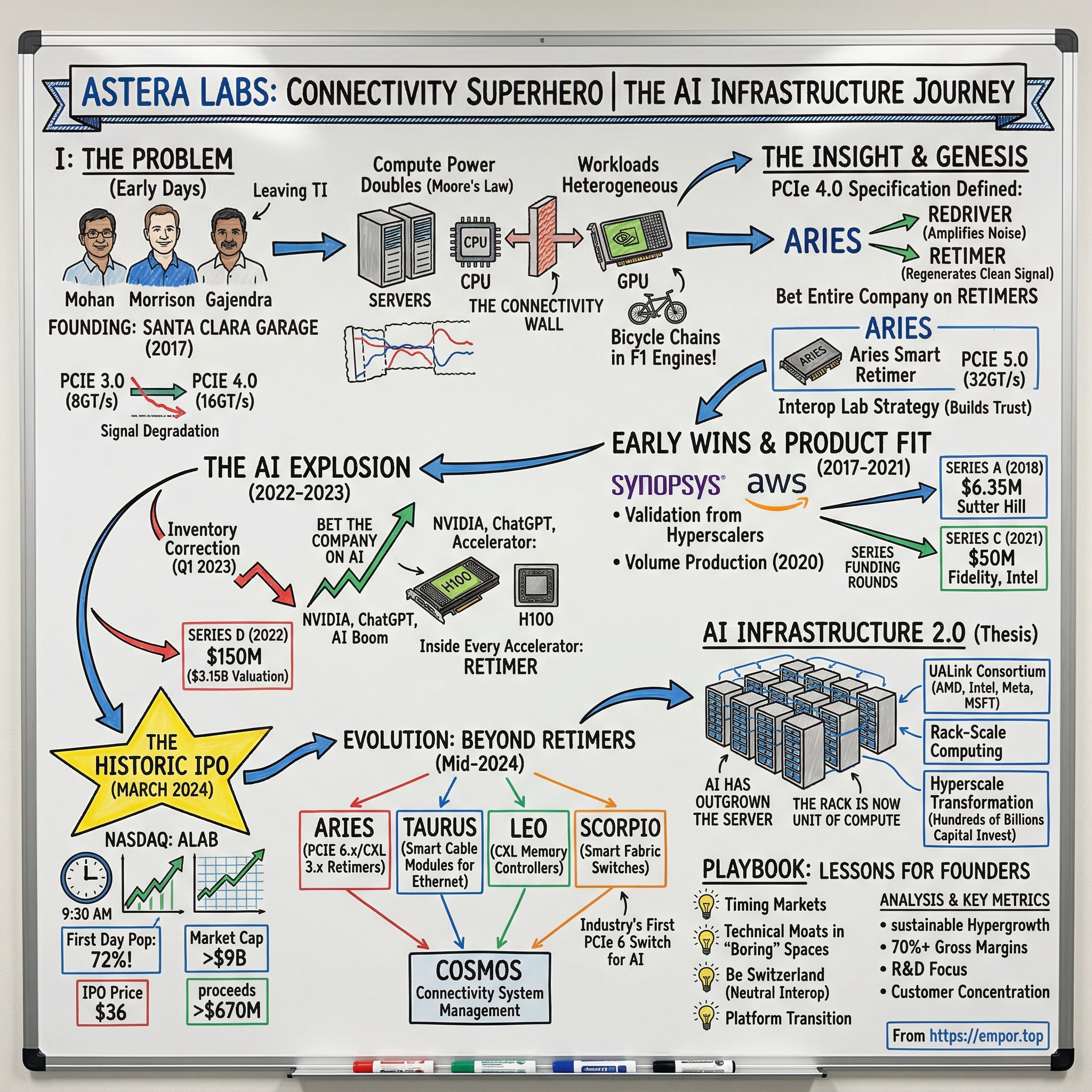
Astera Labs: The Connectivity Superhero Powering AI Infrastructure
I. Introduction & Episode Roadmap
In the summer of 2017, three engineers walked out of Texas Instruments' high-speed interface group and into a garage in Santa Clara County. They were not chasing artificial intelligence. Nobody outside a handful of research labs was. What they were chasing was something far less glamorous and, as it turned out, far more durable: the physics problem of pushing electrical signals down a copper trace on a circuit board faster than the copper wanted to carry them.
Nine years later, that problem has a market capitalization. Astera Labs closed its second quarter of 2026 with revenue of $392.4 million — more than double the same quarter a year earlier — and guided the September quarter to as much as $560 million, representing roughly 40% sequential growth in a single three-month span.1 The company that shipped $35 million of product in 2021 is now annualizing above $2 billion. Its founders became billionaires on paper. And the product they sell is, at its core, a chip whose entire job is to make a signal that has degraded into noise look pristine again.
This is a story about a bottleneck. For fifty years, the semiconductor industry organized itself around a single scarce resource: compute. Faster transistors, more cores, bigger caches. The interconnect — the wires between the chips — was plumbing. Necessary, unglamorous, and cheap. What broke that hierarchy was not a single invention but an architectural regime change.
Modern AI training and inference do not run on a single chip. They run on a rack, and increasingly on a row of racks, where dozens or hundreds of accelerators must behave as though they were one enormous processor. The moment compute escaped the server chassis, the wires stopped being plumbing and became the central system.
That is the thesis worth stress-testing across the following analysis. Astera Labs is a clear beneficiary of an architectural shift. It is also a company where a single end customer supplied more than 70% of 2025 revenue,3 where the stock has swung between roughly $98 and $499 in twelve months,18 and where the two largest merchant semiconductor franchises on earth have every commercial incentive to take the category away. Both realities exist simultaneously, requiring a balanced examination of the tradeoffs rather than taking a side.
Here is the route. The narrative begins in the garage, with the specific technical bet three former TI managers made about a specification revision most of the industry treated as a footnote. It traces the years of unglamorous qualification work that turned a chip into a design win at the largest cloud provider in the world, followed by the 2022 downturn that forced the company to shelve an IPO and raise private capital instead — a decision that looked like a retreat at the time but proved strategic in retrospect.
Next is the March 2024 listing, one of the most opportune semiconductor debuts of the AI era, followed by a breakdown of the business: four hardware families, one software layer, and the distinct economics underlying each. The analysis evaluates management's track record across nine quarters of public disclosures — measuring what was promised and delivered against what quietly slipped. It then maps the competitive landscape, tests key analytical frameworks, and concludes with an evaluation of the bull and bear cases, including risks management rarely addresses on earnings calls.
One theme runs underneath all of it, and it is worth naming early because the company itself emphasizes it constantly: neutrality. Astera Labs does not build a GPU. It does not build a CPU. It does not build a hyperscaler's custom accelerator. It sells connectivity to everyone who does — NVIDIA, AMD, Intel, Arm, and the internal silicon teams at Amazon, Microsoft, Google, and Meta alike. Management calls the philosophy "AI Your Way."2 Whether that neutrality is a durable structural advantage or simply the posture of a company too small to threaten anyone yet is the central question this story examines.
 Subscribe on LinkedIn
II. The Founding Story: From TI to the Garage (2017)
Consider the corporate organization the three founders left behind. Texas Instruments' high-speed interface business was stable, profitable, and embedded within one of the most disciplined analog semiconductor operations in the industry.
Jitendra Mohan had spent more than two decades in that sector — starting at National Semiconductor in 1996 before moving to TI after its 2011 acquisition, where he served as a product line general manager until October 2017.4 Sanjay Gajendra had followed a parallel trajectory across the same two companies, becoming a product line general manager at TI in 2014.4 Casey Morrison, the third co-founder, had led systems and applications engineering — the bridge between chip architecture and a customer's physical motherboard.5
Nearly a decade of shared history at National Semiconductor and TI provided an established working relationship. Rather than negotiating roles post-incorporation, the team inherited an existing division of labor: Mohan focused on technology strategy and execution, Gajendra on commercial relationships and operations, and Morrison on product definition and standards bodies.
From inside TI, the founders identified a growing architectural mismatch. Computing workloads were decentralizing from general-purpose CPUs toward specialized accelerators, requiring data to move faster and across greater physical distances on the board. Yet server motherboards still relied heavily on FR4 — a glass-reinforced epoxy laminate that is inexpensive and easy to manufacture, but inherently lossy at high frequencies.
To understand the challenge intuitively, consider a copper trace as a garden hose and an electrical signal as a pulse of water. At lower pressure, a standard hose functions smoothly. Double the pressure, however, and the hose flexes, the pulse distorts, and the output at the far end no longer matches the input. In high-speed signal transmission, every doubling of the signaling rate roughly halves the distance a clean signal can travel.
The legacy industry solution was the redriver — an analog amplifier that boosts signal amplitude across the board. The flaw in amplifying a degraded signal, however, is that it also amplifies the noise, resulting in a louder but still corrupted transmission. The alternative, formalized in the PCI Express 4.0 specification completed by the PCI-SIG standards body in 2017, was the retimer. A retimer is a mixed-signal IC that does not merely amplify a signal; it recovers the underlying digital bits, re-clocks them, and retransmits a clean copy. Where a redriver acts like a megaphone, a retimer functions like an attentive transcriptionist who reconstructs and re-speaks a garbled sentence.
PCIe 4.0 doubled the per-lane signaling rate to 16 gigatransfers per second. That shift marked the critical inflection point. At eight gigatransfers per second, careful circuit layout could often preserve signal integrity. At 16 gigatransfers per second — and even more so at the 32 gigatransfers per second required by PCIe 5.0 — layout adjustments alone proved insufficient. The founders' primary insight was not simply that retimers would be required, as the standard already anticipated them. Their bet centered on category economics: that retimers would transition from occasional patches on troubled board layouts into mandatory, high-volume infrastructure across data center architectures. While incumbents viewed the component as an accessory, Astera treated it as foundational infrastructure.
That distinction defined the company's operating strategy. Selling retimers as optional accessories meant marketing commodity components to arbitrary buyers. Treating them as critical infrastructure meant solving a broader engineering challenge: guaranteeing that the silicon would interoperate reliably inside a customer's customized system architecture.
A distinct cultural factor also shaped the company. Texas Instruments and National Semiconductor specialized in analog and mixed-signal design, which operates under different principles than pure digital design. Digital architecture relies heavily on high-level abstractions and automated design tools. Analog design remains a specialized craft dependent on physical transistor behavior and accumulated engineering experience, where subtle failure modes are rarely captured in standard manuals. The founders were not merely launching a product; they were deploying a deep domain expertise built over decades.
After leaving TI in 2017, the trio incorporated in Santa Clara County and, according to company accounts, secured their initial venture funding within minutes of their pitch.4 Beyond highlighting the fundraising environment of the era, the quick backing reflected an investor base that already recognized that data center connectivity limits were becoming a primary bottleneck.
The founding team also made a structural decision regarding its engineering pipeline. Astera adopted a cloud-first design methodology, running physical verification and simulation workloads on elastic cloud compute in partnership with electronic design automation vendors, rather than building out fixed on-premises server farms.
Astera continues to cite this infrastructure model in its disclosures as a key operational efficiency, asserting that it allows a lean engineering team to iterate faster than traditional headcount metrics would suggest.3 For an early-stage company competing against established semiconductor giants, renting scalable compute capacity by the hour allowed Astera to shorten product development cycles.
Looking back, the company's core thesis has remained remarkably consistent. Astera did not need to pivot or redefine its core focus. It identified a compounding physical constraint — signal degradation escalating with every protocol generation — and built products directly along that trajectory. The subsequent surge in AI spending accelerated an existing structural trend. That trajectory sets up the key question for the company's growth: given that signal integrity challenges were widely understood across the industry, how did a startup capture leadership in the category ahead of established semiconductor incumbents?
III. Retimer Genesis & The Hyperscaler Crucible (2017–2021)
The answer begins with an unglamorous reality of the PCI Express ecosystem: passing compliance testing and functioning in production are entirely different hurdles.
A retimer is deceptively complex. It must be protocol-aware across the entire PCIe stack—understanding link training, participating in auto-negotiation, and handling dynamic equalization as operating conditions shift, all while adding negligible latency and drawing minimal power. It sits invisibly in the middle of a link that endpoints perceive as a direct connection, and it can never be the single point of failure. When a GPU drops its PCIe link mid-training run, it does not degrade gracefully; it crashes the entire workload.
Astera's initial product family, Aries, targeted PCIe 4.0 and subsequently PCIe 5.0. Yet the most consequential engineering decision was not located in the datapath. It was the choice to instrument the chip—embedding diagnostic capabilities directly into the silicon so that when a link malfunctioned inside a data center housing tens of thousands of servers, operators could pinpoint the cause. Where traditional component suppliers provided a chip alongside a static datasheet, Astera provided silicon capable of self-diagnosis.
Commercially, that distinction was critical. In a cluster of a hundred thousand servers, interconnect links rarely fail outright; they degrade. A marginal connection repeatedly retries, logs correctable errors, and silently throttles throughput long before triggering system alarms. Scaled across an AI training cluster synchronizing hundreds of accelerators, a single degraded link acts as a tax on total compute performance. An operator with real-time visibility into link health can proactively route around trouble spots, whereas one without it debugs blindly. Astera's instrumented silicon effectively converted an invisible failure mode into actionable system diagnostics.
The commercial expression of that philosophy was the Cloud-Scale Interoperability Lab—arguably the most vital asset the company developed. While PCIe standards define theoretical specifications, real-world execution depends on complex interactions among specific CPUs, BIOS revisions, motherboard stackups, operating systems, and NVMe firmware.
A retimer that operates seamlessly in one hardware configuration can fail in another, taking weeks of engineering effort to isolate. Astera addressed this by industrializing compatibility testing: evaluating its silicon against an extensive matrix of real-world hardware and software permutations, then delivering verified interoperability reports directly to customers.
That approach fundamentally altered hyperscaler procurement decisions. A cloud provider evaluating a retimer does not simply weigh unit economics; it evaluates execution risk. Selecting an unverified component means absorbing the debugging burden across platforms deployed in volumes measured in hundreds of thousands of units. Astera's commercial proposition was that it had already absorbed and eliminated that burden.
The company's Form 10-K explicitly identifies this capability as a principal competitive factor—the ability to provide a complete platform "coupled with software and interoperability reports that ensure ease of integration and customer adoption."3 What appears on the surface to be a customer support function operates in practice as a significant barrier to entry.
This testing regime generated a powerful secondary advantage. Every qualification cycle yielded system data that accelerated subsequent design iterations. Astera was not merely expanding test coverage; it was building an empirical model of real-world system failures, which continuously informed next-generation silicon design and firmware edge-case handling. While competitors could reverse-engineer the physical chip, replicating years of proprietary failure data proved far more difficult—creating a compounding operational moat.
Amazon served as the critical anchor customer. The relationship was formalized through an explicit equity structure: in October 2022, Astera issued Amazon.com NV Investment Holdings a warrant to purchase up to 1,484,230 shares at an exercise price of $20.34, with the overwhelming majority of those shares vesting only upon the achievement of specified tranches of global payments by Amazon and its affiliates to Astera.3 In October 2023, the agreement was amended and a further warrant for up to 831,945 shares was issued on the same terms.3 Behind the accounting mechanics, the incentive was straightforward: Amazon received equity upside directly tied to its purchasing volume. This arrangement functioned simultaneously as a commercial alignment tool and a structural price concession, with the associated cost recorded as a reduction of revenue rather than as an expense.3
For investors, this structure carries two implications. On one hand, it represents validation; the world's largest cloud provider rarely constructs multi-year performance warrant agreements with easily replaceable suppliers. On the other hand, it indicates that reported revenue figures reflect an ongoing contra-revenue drag—a dynamic that expanded as commercial terms were subsequently enlarged.
The timing aligned neatly with broader shifts inside Amazon Web Services. During the late 2010s, AWS was aggressively redesigning its server fleet around proprietary silicon—specifically the Nitro offload engine for virtualization, storage, and networking, alongside Graviton ARM processors designed to replace traditional x86 CPUs.
A cloud architect building custom motherboards from the ground up has both the flexibility and the necessity to solve underlying signal integrity challenges, unencumbered by legacy vendor relationships. For a startup offering superior retimer technology without a track record, an anchor customer actively overhauling its infrastructure presented the ideal entry point. Astera walked through that door before the broader AI deployment made the retimer category obvious to the rest of the semiconductor industry.
Venture funding followed technical validation. In September 2021, Astera raised $50 million in a Series C led by Fidelity Management & Research at a $950 million valuation, with Intel Capital and existing backer Sutter Hill Ventures participating.6 For a company that would generate $35 million of revenue that year,7 a near-billion-dollar valuation reflected aggressive market pricing by 2021 standards. Crucially, securing lead investment from Fidelity—a major institutional asset manager rather than a traditional venture fund—signaled that public market preparation was already underway.
That initial timeline, however, did not survive contact with the macroeconomic downturn of 2022.
IV. Navigating the Cloud Crisis to the ChatGPT Explosion (2022–2023)
For Astera Labs, 2022 brought a fundamental strategic test: whether to press forward with a public listing or delay it.
The company had secured lead interest from crossover investor Fidelity, built a growing revenue base, and benefited from an 18-month bull market for semiconductor offerings. But as interest rates rose and valuation multiples compressed, cloud providers that had over-purchased during the pandemic began liquidating inventory rather than placing new orders. Co-founder Sanjay Gajendra later described the dilemma in plain terms: "The market was starting to slow down, and we had two options, either still go out and have our IPO or raise a round."7
Management opted to raise private capital. In November 2022, Astera closed a $150 million Series D funding round led by Fidelity at a valuation of roughly $3.2 billion—more than triple its valuation fourteen months prior—with Sutter Hill Ventures participating.7 The company also expanded its board of directors, adding Alexis Black Bjorlin, then head of infrastructure at Meta, and Michael Hurlston, chief executive of Synaptics.7 The governance additions brought executive experience directly tied to large-scale data center purchasing decisions.
Avoiding a public listing preserved operational flexibility. Public markets in a downturn often pressure fabless semiconductor firms to reduce research and development expenses, which directly impacts product pipelines two to three years out. Backed by private capital, Astera sustained R&D investments in next-generation PCIe 6.0 and Compute Express Link (CXL) architectures even as current demand waned. Full-year 2022 revenue arrived at $79.9 million, missing internal projections of roughly $100 million.710
As the inventory correction subsided, the commercial landscape shifted rapidly.
The public debut of ChatGPT in November 2022 initiated an industry-wide expansion in artificial intelligence infrastructure. That transition altered the fundamental unit of data center computation. Conventional enterprise servers rely on one or two central processors connected to a modest number of peripheral devices over short circuit traces. In contrast, AI training clusters distribute workloads across dense clusters of eight or more specialized accelerators mounted on large baseboards.
These accelerated systems require complex, high-bandwidth communication paths between host processors, network interfaces, and adjacent accelerators. Because physical distances are longer, components are packed more tightly, and signaling speeds are higher, signal degradation multiplies across the entire chassis. Consequently, an AI server requires significantly higher interconnect semiconductor content per box than traditional server designs to maintain signal integrity, expanding the potential socket count for retimers.
This structural shift became evident in Astera's financial results. Full-year 2023 revenue reached $115.8 million, up from $79.9 million in 2022.10 The annual total, however, masked a steep intra-year acceleration. By the first quarter of 2024, quarterly revenue reached $65.3 million—a 269% year-over-year surge that implies first-quarter 2023 revenue had hovered in the high teens.11 Astera exited 2023 operating at roughly triple its annualized entry rate.
These financial dynamics point to two distinct analytical takeaways. First, management's decision to maintain research spending through a cyclical downturn positioned the company to capture the immediate demand for high-speed connectivity when AI spending accelerated. Second, Astera's revenue remains tightly bound to hyperscaler capital expenditure cycles, which fluctuate more rapidly than semiconductor product development timelines. The same customer spending volatility that caused stagnant growth in early 2023 drove the 269% surge a year later.
By late 2023, the capital raised during the 2022 market contraction had transformed from a protective reserve into a launchpad. As public equity markets opened to AI hardware providers, Astera prepared for an initial public offering in a market receptive to compute infrastructure silicon.
V. The Wall Street Debut: Timing the AI Infrastructure Supercycle (March 2024)
There is a version of this IPO story that reads like a victory lap. The actual mechanics of March 20, 2024, however, reveal as much about public market dynamics as about the company itself.
Astera filed publicly in February 2024, initially setting a marketing range in the high $20s. Heavy institutional demand forced two upward revisions, raising the target band to $32–$34 before the deal ultimately priced on March 19 at $36.00 per share—above the elevated range.8 The offering totaled 19,800,000 shares, with 16,788,903 sold by the company and 3,011,097 by selling stockholders, generating gross proceeds to Astera of approximately $604.4 million before an over-allotment option covering a further 2,970,000 shares.8 Morgan Stanley and J.P. Morgan served as lead book-running managers, joined by Barclays, Deutsche Bank Securities, Evercore ISI, and Jefferies.8
When trading opened the following morning on Nasdaq, aftermarket demand immediately drove rapid price discovery. Shares rose as much as 76% intraday before closing their debut session at $62.03—a 72% gain over the offer price that valued the company at roughly $9.46 billion.9 Across both primary and secondary stock sales, the offering raised approximately $713 million.9
While a 72% first-day pop is conventionally framed as a triumphant debut, it represents roughly $500 million in value transferred from the company and its pre-IPO shareholders to initial allocators. That outcome reflects standard bookbuilding dynamics during a market expansion rather than a misstep unique to Astera, but a neutral reading requires acknowledging the underlying mechanics: underwriters priced a scarce asset conservatively, and the aftermarket repriced it within ninety minutes.
Market enthusiasm rested on three main drivers, arranged in descending order of structural durability.
First was pure-play exposure. In early 2024, public market investors seeking direct participation in AI hardware infrastructure faced a narrow set of choices, most of which carried legacy enterprise, consumer, or cyclical storage operations. Astera offered focused revenue tied directly to cloud and AI connectivity.
Second was financial architecture. Astera generated a 75.7% GAAP gross margin and a 39.2% non-GAAP operating margin on $852.5 million in revenue for 2025.12 Producing software-like gross margins on physical hardware stems directly from its fabless business model and mission-critical system placement: buyers facing platform failure risk evaluate retimers on system reliability rather than component cost. Combining fabless economics with essential infrastructure placement created a financial profile that public markets valued highly.
The third driver—and the most volatile—was narrative timing. The debut coincided with the peak of investor enthusiasm for AI infrastructure enablers. While that positioning propelled the stock during its initial public market debut, it has not yet been tested by a genuine downturn in hyperscaler capital spending.
Management's capital deployment following the IPO proved notably cautious. Rather than embarking on aggressive acquisitions, the company accumulated liquidity. Astera closed the second quarter of 2026 holding $1.25 billion in cash, cash equivalents, and marketable securities with zero debt, against total assets of $1.93 billion.1 For a business that generated $162.3 million in operating cash flow across the first six months of 2026 alone,1 maintaining such liquidity reflects a conservative balance sheet stance—securing operational flexibility while raising broader questions regarding long-term capital allocation strategy. That question re-emerges later in the analysis of capital allocation.
Operational reality immediately following the listing was more complex than early stock performance suggested. Full-year 2024 revenue climbed 242% to $396.3 million,10 yet Astera reported a GAAP net loss of $83.4 million for the year. That deficit was driven overwhelmingly by $88.9 million in stock-based compensation triggered by IPO-related restricted stock unit vesting, on top of $145.7 million in ongoing stock compensation.10 Core operational cash generation remained intact despite GAAP accounting losses.
That gap closed in 2025, when GAAP net income reached $219.1 million.12 Nonetheless, the post-IPO accounting transition served as a reminder that the distance between GAAP and non-GAAP results in Astera's financial disclosures reflects tangible stock dilution rather than a minor accounting detail.
That financial backdrop sets up the core operational question: the underlying product portfolio generating these economics.
VI. Product Portfolio Architecture & Segment Economics
For most of its life, Astera Labs was a retimer company with ambitions. In the third quarter of 2026, by management's own guidance, it stopped being one.1 Understanding why that matters requires walking through the portfolio in the order the company built it, because each product family is a different business with a different competitive exposure and a different margin.
Aries: the franchise that paid for everything else. Aries is the smart PCIe and CXL retimer family — the direct descendant of the original 2017 insight. It sits between accelerators and CPUs, between accelerators and switches, and along storage paths, and its job is to make a link that should not work at a given length work reliably. For the company's first several years it was effectively the entire business.
The interesting thing about Aries in 2026 is that it refused to fade. It delivered record quarterly revenue in the June 2026 quarter and remained the largest single product line at that point,12 driven by three stacking effects: the generational transition from PCIe 5.0 at 32 GT/s to PCIe 6.0 at 64 GT/s, which carries a higher average selling price; a rising attach rate, because faster signaling means more links need help; and larger accelerator clusters, which means more links per system.
Gajendra's framing on the August call was that "the retimer is a socket that somewhat keeps on giving," and that the genuine surprise had been the longevity of the PCIe 5.0 generation, extended by a new wave of inference deployments.2
That last point deserves emphasis because it runs against a common assumption. Investors often model a retimer franchise as a series of discrete generational hand-offs, where the old generation dies as the new one ramps. Astera's experience has been additive rather than substitutive: Gen 5 volumes persisted into new inference use cases while Gen 6 ramped alongside. Whether that persists through the Gen 7 transition is unknown, but the pattern to date argues for a longer tail than a pure replacement model would suggest.
Scorpio: the switch invasion. Scorpio is where the company changed weight class. A retimer repairs a link. A switch decides where data goes — it is the fabric itself, and it is a fundamentally more strategic socket. Astera ships two lines: the P-Series for general PCIe switching across head nodes, storage, networking and modular systems, and the X-Series purpose-built for scale-up connectivity, which is the dense mesh of links that lets many accelerators behave as one.
The trajectory has been fast even by this company's standards. Scorpio P-Series crossed 15% of full-year 2025 revenue against an original target of 10%, and management stated it remained the only PCIe 6 fabric shipping in volume globally.12 The X-Series shipped pre-production quantities in the fourth quarter of 2025,12 began initial production volumes in the first quarter of 2026,13 and entered volume production in the second quarter — with the flagship 320-lane device driving a ramp that management expects to make Scorpio the company's largest product family in the third quarter of 2026, one quarter earlier than previously guided.1
The economics are what make this a different business rather than a bigger one. Sanjay Gajendra told analysts in August 2026 that Scorpio X-Series content alone is expected to grow "well beyond $1,000 per XPU" in future platform generations, against total company content per accelerator he characterized as already in the multiple thousands of dollars — versus the $50 to $100 per accelerator range the business occupied at IPO.2 A twenty-fold increase in dollar content per unit of compute, achieved in roughly two years, is the single most important operating fact in this story.
A word on what "radix" means, since it is the term that governs the economics. Radix is simply the number of ports on a switch. A low-radix switch connects a handful of devices; a high-radix switch connects many. The reason it matters is topology: if your switch can only connect sixteen accelerators, then a cluster of sixty-four requires multiple layers of switching, and every extra hop adds latency and consumes power.
A single 320-lane device can flatten that hierarchy — more accelerators reachable in one hop, less latency, fewer components. Higher radix is worth more per unit for exactly the same reason a bigger bridge is worth more than two small ones: it eliminates the traffic that would otherwise have to be managed.
Layered on top of raw port count are the features management describes as the intelligence layer. In-network compute means the switch performs part of the mathematical reduction that accelerators would otherwise have to exchange data to complete — the fabric doing arithmetic rather than merely forwarding. Hypercast is a hardware-accelerated way of distributing the same data to many destinations at once instead of sending it repeatedly.
Management claims these deliver up to a 2x improvement in collective operations for large-scale training and inference.2 Whether that specific multiple holds across workloads is not independently verifiable, but the direction is architecturally sound and it explains why the company can argue that switch pricing is a function of capability rather than lane count alone.
There is a margin nuance the company has been reasonably candid about. Chief Financial Officer Desmond Lynch told analysts that Scorpio carries "a wide range of margins, really driven by use case and lane count utilization," averaging broadly in line with corporate gross margin, and that as the portfolio broadens he expects gross margin to "continue to trend towards a long-term target of 70%."2 Read that carefully: the company is guiding its own margin structure down from the mid-seventies toward seventy as switches and modules take share of the mix. That is the honest cost of moving up the value chain, and it is disclosed rather than buried.
Taurus: the cable business hiding inside a chip company. Taurus addresses Ethernet rather than PCIe, and it is sold differently — largely as smart cable modules that partners assemble into active electrical cables, rather than as bare silicon. The logic is division of labor: Astera supplies the intelligence and the software hooks; cable specialists supply the cable. It is a deliberately lower-margin, higher-volume vector than Aries.
Taurus is also the clearest case study in timeline slippage, which we examine in detail later. In the second quarter of 2026, the company shipped pre-production volumes of 100 gigabit-per-lane modules supporting 800G links,2 and expanded the portfolio into 200G-per-lane retimers and redrivers for next-generation Ethernet and UALink — parts management says are the industry's first to enable "smart swap," letting a designer substitute a low-power redriver for a longer-reach retimer without redesigning the board.1 Astera projects that expansion roughly doubles the Taurus opportunity to more than $4 billion by 2030.2
The strategic significance of Taurus is that it is the company's beachhead outside PCIe. Aries, Scorpio and Leo all live in the PCI Express and CXL world. Taurus lives in Ethernet, which is the protocol that connects servers to the rest of the data centre — a far larger installed base with a far more entrenched competitive set. Success there would mean Astera is not merely the leading vendor in an adjacent niche but a general-purpose connectivity supplier. Failure would mean the company remains, structurally, a PCIe specialist with an Ethernet side business.
Leo: the option that took four years to become interesting. Leo is the CXL memory controller family, and its purpose is to attack stranded memory — the DRAM sitting idle in one server while another is starved. Astera announced Leo controllers supporting CXL 2.0 with up to 2TB of capacity per controller, enabling deployment within Microsoft Azure M-series virtual machines, which the company described as the industry's first announced deployment of CXL-attached memory.12
CXL has been the perennial "next year" story in this business since before the IPO. What changed in 2026 is the reason for the interest. Management now describes three distinct pulls: hyperscalers seeking alternatives to expensive and supply-constrained DRAM; accelerator-attached memory for key-value cache offload in inference workloads; and traditional memory-intensive enterprise applications.2 The company closed a new standard-Leo design win at a U.S. hyperscaler in the June quarter and expects volume shipments of both standard and custom Leo controllers across two U.S. hyperscalers in 2027.2 That is more concrete than anything said about CXL in the prior three years — but note the tense. It is still a 2027 story.
COSMOS: the layer that is supposed to make the rest sticky. COSMOS is the software suite that runs across every product family and integrates into customers' operational stacks. Originally it provided fleet-scale telemetry, diagnostics and link management — the ability to see, across tens of thousands of nodes, which links are degrading before they fail.
In 2026 its role changed materially. The in-network compute and Hypercast capabilities in the 320-lane Scorpio X are hardware features, but they are exposed and orchestrated through COSMOS, and Mohan described the consequence directly: "previously COSMOS was mainly responsible for optimization, telemetry, diagnostics, now we are becoming part of the orchestration layer. The XPUs are talking directly to our COSMOS platform to run the workloads."2
This is the switching-cost argument in its strongest form, and it deserves both credit and scrutiny. The credit: a component that a customer's workload scheduler talks to directly is far harder to swap than a component that merely sits in a datapath.
The scrutiny: this deepening is roughly two quarters old, it has not been tested by a competitor offering a materially cheaper alternative, and Astera has never disclosed a dollar of standalone software revenue. COSMOS is a moat asserted, not yet a moat measured. The measurable version would be a customer choosing Astera on a subsequent platform despite a cheaper qualified alternative — and that evidence, by its nature, arrives late.
Taken together, the portfolio has done something unusual: it has diversified without diluting. Revenue from PCIe 6.0 products across both the fabric and signal-conditioning lines exceeded 50% of total company revenue in the June 2026 quarter, up from roughly one-third three months earlier.12 Astera is no longer a single-product company. Whether it has become a multi-customer company is a different question, and a harder one.
VII. Management, Governance & Capital Allocation
Beyond quarterly earnings releases, corporate proxy statements provide critical insight into insider alignment, institutional ownership, and governance structures.
As of March 1, 2026, Chief Executive Officer Jitendra Mohan beneficially owned 7,789,805 shares, or 4.5% of the company, while President Sanjay Gajendra held 7,433,347 shares, or 4.3%.16 All current executive officers, nominees, and directors as a group held 10.4%.16 Chief Product Officer Casey Morrison, the third co-founder, did not appear in the beneficial ownership table because his holdings fell below separate reporting thresholds.
Among outside institutional investors, entities affiliated with FMR LLC held 13.7%, Vanguard held 7.0%, and BlackRock held 6.1%.16 Fidelity remained the company's largest shareholder years after leading its Series C and D crossover rounds, providing notable equity continuity for a stock subject to high public-market volatility.
Founder stakes of 4% to 5% create meaningful financial alignment without granting voting control. That structure ensures that a permanent decline in equity value would dwarf executive cash compensation while leaving the company open to shareholder engagement or potential acquisition proposals.
By October 2025, when each founder was estimated to be worth roughly $1.6 billion to $1.7 billion, Mohan and Gajendra had each sold more than $200 million in stock since the initial public offering.4 While post-IPO founder diversification is standard practice after years of illiquidity, sales of this magnitude remain a relevant metric when evaluating executive confidence alongside public operational guidance.
The primary leadership change following the IPO was a chief financial officer transition. On February 4, 2026, Michael Tate—who led the company through its public listing and first two years of reporting—notified the board of his retirement effective March 2, 2026, remaining as Strategic Advisor to the CEO until September 1, 2026.15 Regulatory filings noted that there were no disagreements and that the retirement was unrelated to the company's operations, policies, or practices.15 His successor, Desmond Lynch, arrived from Rambus, where he had served as CFO since August 2022 following senior finance roles at Knowles, Renesas, IDT, and Atmel; his compensation package comprised a $500,000 base salary, a 95% target bonus, and $6 million in restricted stock units.15
While finance leadership transitions at high-growth technology companies can draw scrutiny, disclosures indicate an orderly succession. The transition coincided with record quarterly financial results, included a six-month advisor overlap, and brought in an executive from an adjacent connectivity-IP company. In his initial earnings calls, Lynch provided detailed commentary on gross margin dynamics, volunteering that gross margin is expected to drift toward a long-term target of 70% as product mix evolves.2
Astera's capital allocation strategy relies primarily on low-capital-intensity fabless operations. The company contracts wafer fabrication exclusively to TSMC, while outsourcing packaging, assembly, and testing to Advanced Semiconductor Engineering and Amkor Technology.3 That structure maintains low capital intensity: purchases of property and equipment totaled $28.1 million in the first half of 2026 against $162.3 million of operating cash flow,1 allowing the company to direct cash into engineering headcount and silicon tape-outs.
The company ended 2025 with 756 full-time employees globally, including 527 in North America, 208 in Asia, and 21 in Europe.3 Research and development expenditure expanded from $73.4 million in 2023 to $200.8 million in 2024, reaching $304.0 million in 2025.1210
However, the posture of relying entirely on internal development shifted in late 2025. On November 10, 2025, the company completed its acquisition of aiXscale Photonics GmbH, a specialist in fiber-chip coupling technologies, for $31.1 million in cash, of which $14.5 million was allocated to an in-process research and development intangible asset and the balance largely to goodwill.314 Two further asset acquisitions followed in 2026: a developer of data center acceleration solutions on February 9, and a second transaction on May 29, with substantially all of the purchase price in both transactions allocated to goodwill.1 Cash paid for business combinations in the first half of 2026 totaled $69.2 million, and goodwill on the balance sheet rose from $19.0 million at year-end 2025 to $91.6 million by June 30, 2026.1 Alongside these acquisitions, Astera opened an Israel design centre led by Guy Azrad, focused on next-generation scale-up fabrics and memory bottlenecks.12
These transactions reflect targeted technology acquisitions in silicon photonics, optical packaging, and acceleration designed to shorten product development timelines rather than consolidate market share. Expending roughly $100 million across these deals represents a measured deployment against a $1.25 billion cash position, but it establishes that management will use selective M&A when speed demands it.
On corporate governance, the proxy statement notes that since the beginning of fiscal 2025, there were no known related-person transactions requiring audit committee review.16 For a business where a key customer maintains warrant agreements and founders hold substantial equity, a clean related-party record provides important oversight verification.
The board of directors is composed primarily of semiconductor and cloud infrastructure executives rather than financial generalists, aligning governance oversight with the company's technical and commercial execution priorities.
The central strategic question facing capital allocation is the management of Astera's cash balance. With $1.25 billion in cash, cash equivalents, and marketable securities, zero debt, and positive operating cash flow, management has abstained from share repurchases, dividends, or large-scale acquisitions. While substantial cash reserves provide operational flexibility during demand fluctuations, maintaining an un-deployed cash balance risks lowering returns on equity over time if revenue growth normalizes.
VIII. Industry Structure & Competitive Dynamics: David vs. Goliath
In its annual report, Astera Labs lists its competitors across semiconductor markets: Broadcom, Marvell Technology, Microchip Technology, Montage Technology, Parade Technologies, and Rambus.3 Two of those rivals represent some of the largest and most disciplined capital allocators in the chip industry.
Consider the structural asymmetry. Broadcom has built a massive franchise through aggressive acquisitions and strict operational focus on high-margin products, commanding a market capitalization in the hundreds of billions alongside dominant market shares in data center Ethernet switching, custom accelerator ASICs, and PCIe switching. Marvell brings deep optical DSP and interconnect capabilities, similarly assembled through acquisitions such as Cavium and Inphi. By comparison, Astera operates with a market capitalization in the high tens of billions and a workforce of 756 employees.318 Its annual research and development budget represents a small fraction of Broadcom's spending power.
Yet Astera's category footprint is substantial. Independent market analysis published around the time of its initial public offering estimated that Astera's chips were included in more than 80% of deployed AI servers—a remarkable penetration rate for a seven-year-old startup.17 The central question raised by that analysis remains relevant in 2026: whether Astera has established a durable first-mover advantage or remains vulnerable to displacement by larger incumbents.
An examination of incumbent strategies highlights four primary competitive vectors.
The bundling attack. Broadcom supplies the core Ethernet switch silicon powering major data center networks. If Broadcom chooses to package retimers and PCIe switches alongside its Ethernet products—effectively discounting connectivity silicon to protect and extend its switch relationships—Astera lacks a broader product portfolio to counter the offer. It operates as a focused supplier that must sell its components on a standalone basis. While there is no public indication that bundling has compressed Astera's pricing to date—with average selling prices expanding due to the transition to PCIe 6.0 and higher-radix switches2—the absence of immediate price pressure reflects incumbent focus on other priorities rather than structural immunity.
The integration attack. A second threat stems from accelerator design. If GPU or custom accelerator designers integrate retimer functionality directly onto the main compute die or inside the package substrate, the requirement for a standalone retimer socket disappears. While on-die integration improves signal strength at the chip boundary, it does not overcome signal degradation across multi-inch circuit board traces, preserving the need for external retiming on physically expansive, high-speed motherboards. However, if system architectures shift toward denser, tightly integrated rack configurations, the physical distance across copper traces could shrink, reducing external retimer requirements.
The neutrality defense. Astera's counter-strategy relies on commercial neutrality. Because Broadcom designs custom AI accelerators for hyperscalers, it competes directly with its customers' internal silicon teams and with merchant GPU suppliers. Astera does not manufacture GPUs, CPUs, or custom compute engines, allowing it to supply connectivity across competing hardware platforms without threatening its customers' core products. The company has leaned into this positioning, demonstrating joint system architectures for AMD Instinct platforms at AMD's 2026 developer event, showcasing NVIDIA MGX reference designs at Computex 2026, and expanding its Taiwan engineering operations and interoperability lab to coordinate directly with AMD, Arm, Intel, and NVIDIA.1
The clearest test of this neutral posture is Astera's NVLink Fusion development. While NVIDIA's NVLink scale-up fabric remains proprietary, Astera is developing custom connectivity silicon designed to allow non-NVIDIA accelerators to interface with NVLink-based clusters in hybrid rack setups, in partnership with NVIDIA and an anchor hyperscaler, with revenue expected in 2027.13 Simultaneously building UALink switches—the open scale-up standard positioned as the primary alternative to NVLink—alongside NVLink Fusion bridges highlights a strategy of supporting multiple competing standards. When asked about emerging competitive announcements in scale-up fabrics, Gajendra maintained that the company would "not get distracted by any competitive press releases."13
The customer-as-competitor problem. A subtle variation of the integration threat involves proprietary rack fabrics. NVIDIA's NVLink ecosystem is vertically integrated, supplying accelerators, switching hardware, and fabric software within a unified rack architecture. If hyperscalers increasingly adopt fully integrated, single-vendor rack solutions, the addressable market for merchant connectivity components contracts. Conversely, cloud providers developing proprietary accelerators maintain a strong incentive to support open interconnect standards such as UALink to avoid single-vendor lock-in. Astera's long-term total addressable market depends heavily on the continued adoption of multi-vendor, open architectures across cloud infrastructure.
The new entrants. Competition is also emerging at lower price points. Credo Technology competes in active electrical cable modules, while Parade Technologies and Montage Technology offer retimers for standard enterprise servers where integrated software layers carry less strategic weight. While low-cost entrants pose little immediate threat at the performance frontier, they could apply margin pressure on mature product lines as PCIe 5.0 components transition into high-volume commodity inference deployments.
Astera's competitive moat rests primarily on execution velocity and specialized focus rather than permanent structural barriers. The company maintains leadership by delivering production-ready silicon into next-generation architectures ahead of larger rivals with competing design priorities, while accumulating proprietary interoperability data and software capabilities that require years to replicate. These advantages are tangible, but they are not permanent. As Astera's annualized revenue exceeds $2 billion with gross margins near 70%, the commercial incentive for well-funded incumbents to target the category increases each quarter.
IX. Strategic Frameworks: 7 Powers & Porter's 5 Forces
Analytical frameworks provide value only when they can render a negative verdict. Evaluated rigorously, several frameworks yield clear structural limitations for Astera Labs.
Cornered Resource — real, but not unique. The company's strongest claim to a cornered resource is its accumulated interoperability database, compiled over nine years to cover thousands of validated permutations across CPUs, accelerators, motherboards, and operating systems. Paired with specialized mixed-signal physical-layer design expertise, this asset represents Astera's closest equivalent to an irreplaceable capability. The qualification is that established rivals such as Broadcom and Marvell maintain their own extensive testing infrastructure and mixed-signal engineering teams. Astera's distinct advantage lies in dedicating its resources exclusively to data center connectivity—a matter of organizational focus rather than sole technical possession.
Switching Costs — strengthening, and now measurable in principle. Multi-quarter platform development cycles create natural inertia, as cloud providers rarely replace a qualified retimer or switch mid-generation. The more significant development is the extension of the COSMOS software suite into the orchestration layer, where accelerator software stacks interface directly with Astera's platform for workload performance rather than relying on it strictly for telemetry and diagnostics.2 The ultimate test will occur during upcoming platform design cycles: whether hyperscalers re-select Astera when lower-cost qualified alternatives become available. Until tested across multiple hardware generations, this power remains an assertion rather than a proven structural barrier.
Counter-Positioning — moderate, and asymmetric. Classic counter-positioning occurs when an incumbent cannot respond to a newcomer without disrupting its core business model. That dynamic applies only partially here. Broadcom can supply retimers without cannibalizing existing revenue streams. Instead, incumbent constraints stem primarily from resource allocation and organizational focus, as larger competitors direct top engineering talent toward broader product franchises. While this grants Astera a tactical window, it reflects a strategic choice by incumbents rather than a structural trap.
Process Power — the strongest of the set. Astera has consistently delivered production-ready silicon for next-generation protocol specifications ahead of competitors. Management reported being the sole supplier shipping PCIe 6 fabric switches in volume globally as of its 2025 financial results,12 having delivered millions of PCIe 6 ports by early 2026,13 and pulling forward the volume ramp for its flagship Scorpio X switch by a full quarter ahead of prior guidance.1 Executing reliably across evolving technical standards represents the company's most empirically supported competitive power.
Scale Economies — weak. Although Astera spreads fixed research and tape-out costs over expanding shipment volumes, its scale remains modest compared to multi-billion-dollar semiconductor incumbents. Gross margins reflect favorable pricing and product mix rather than superior purchasing leverage or manufacturing scale.
Turning to industry structure:
Threat of new entrants: low. High-speed mixed-signal analog design at 64 and 128 gigatransfers per second requires rare domain expertise. Building the physical validation infrastructure necessary to achieve hyperscaler qualification requires years of operational refinement and substantial capital. While a well-capitalized startup could enter the category, it could not do so rapidly.
Supplier power: moderate to high, and structurally uncomfortable. Astera relies entirely on TSMC as its single-source foundry for wafer fabrication, explicitly noting in disclosures that it has not qualified alternative manufacturing partners.3 Packaging, assembly, and testing are similarly concentrated with Advanced Semiconductor Engineering and Amkor Technology. Company risk disclosures emphasize this geographic concentration in Taiwan, citing exposure to natural disasters and geopolitical friction.3 Although management stated it has diversified back-end operations and secured supply commitments through the end of 2026, it acknowledged that the business continues to navigate localized supply constraints alongside the broader industry.13 Consequently, the company remains exposed to leading-edge foundry capacity allocations dictated by external market demand.
Buyer power: high, and getting higher. Customer concentration represents the most direct structural vulnerability facing the business. In 2025, a single end customer generated more than 70% of total revenue, while the top three customers accounted for roughly 86%.3 These cloud operators maintain immense procurement leverage, develop proprietary silicon internally, and have previously extracted equity warrants as a condition for volume purchasing commitments.
Threat of substitutes: moderate, and dated in the long run. Optical interconnects represent the long-term technological substitute for copper signals at elevated data rates. Rather than resisting this transition, Astera has sought to participate in it, outlining a three-phase optical strategy that includes volume shipments of high-density fiber-attached couplers starting in 2027, near-packaged optics chipsets in 2027, and fully co-packaged optical Scorpio switches from 2028 onward.2 Management contends that the optical transition will expand dollar content per link.2 While technically plausible, this pivot shifts the company's competitive moat from copper signal management into a direct execution race against specialized photonics suppliers.
Rivalry: high and structurally intensifying. Competitive intensity among merchant silicon suppliers remains elevated. To date, rivalry in high-speed interconnects has manifested primarily through feature velocity rather than price discounting. Should competition transition to direct price erosion, Astera's gross margins—which currently hover near 70%—would face immediate pressure.
X. Stress Test & Risk Radar: Skeptical Investor Analysis
Evaluating Astera Labs requires stress-testing management's narrative against empirical disclosures. A skeptical investor examining the company's financial records and public communications would press on several key vulnerabilities.
Before examining those vulnerabilities, four common assumptions warrant correction based on SEC filings and earnings disclosures.
First, framing Astera strictly as a retimer vendor overlooks its product evolution. Guided by management, switch silicon surpassed signal conditioning as the company's largest product line in the third quarter of 2026.1 Viewing Astera solely as a single-socket retimer supplier misinterprets its business model and misidentifies its primary competitors, positioning the company directly against Broadcom's established PCIe switching franchise.
Second, the company is not customer-diversified across cloud providers. While Astera sells to major U.S. hyperscalers and merchant accelerator vendors, a single end customer accounted for the clear majority of 2025 revenue, widening customer concentration year-over-year.310 Expanding product lines is distinct from broadening the customer base.
Third, Astera is no longer a purely organic operator. Having completed three acquisitions since late 2025—one photonics business and two asset purchases—goodwill on the balance sheet has grown accordingly.31 Although these transactions remain small relative to the company's cash reserves, capital allocation policy has evolved.
Fourth, mid-seventies gross margins do not represent a permanent structural baseline. Management projects a long-term target of 70%, reflecting product mix shifts toward switches and modules, alongside non-cash contra-revenue charges tied to a customer warrant.213 While gross margins remain strong, their trajectory is downward.
The financial disclosures highlight several areas of operational vulnerability:
Customer Concentration Risk: Customer concentration intensified rather than moderated. In 2024, no single end customer accounted for more than 40% of revenue, and the top three combined represented approximately 80%.10 In 2025, one end customer generated over 70% of total revenue, with the top three representing approximately 86%.3 This expansion occurred while management repeatedly emphasized customer diversification.
The neutral explanation reflects rapid volume scaling at a single client. Geographic billing patterns confirm this concentration: revenue recognized through Singapore entities leaped nearly tenfold—from $29.1 million in 2024 to $277.0 million in 2025—while Taiwan-recognized revenue was roughly flat at $247.4 million and China grew to $256.3 million.3 These figures reflect manufacturing and supply-chain routing, consistent with a single massive platform deployment.
A more critical perspective notes that Astera's financial performance in 2025 and 2026 remained tied primarily to one customer's buildout cycle. When asked about customer concentration during the August 2026 earnings call, management reframed the issue around product diversification across Aries, Scorpio, Taurus, and Leo without addressing customer mix.2 President Sanjay Gajendra added that "even with the lead hyperscaler we have, there are multiple platforms where we are designed in."2 Design wins across multiple platforms at one customer reduce single-product risk, but they do not substitute for customer diversification.
Timeline Slippages: Product roadmaps for Taurus and CXL have experienced repeated delays. On its initial earnings call as a public company in May 2024, management projected that the industry transition from 400G to 800G Ethernet would "take place later in 2025," producing broad demand for active electrical cables and strong Taurus growth.11 By the second quarter of 2026, the company shipped pre-production volumes of the 100G-per-lane modules that support 800G links.2
Similarly, CXL memory pooling was presented as a core growth pillar during the IPO. Volume deployment across two U.S. hyperscalers is now a 2027 event.2 Because outperformance in Aries and Scorpio obscured these delays in top-line revenue, management did not frame them as misses, nor did analysts press the issue.
This pattern suggests that management's projections have been reliable for core signal conditioning and switching technology, but overly optimistic for products dependent on broader ecosystem adoption. Consequently, investors should treat forward revenue expectations for optics, UALink, and CXL as optional upside rather than guaranteed baselines.
Financial reporting also limits visibility into individual product performance. Astera reports financial results as a single operating segment. Although management disclosed on earnings calls that Scorpio exceeded 15% of 2025 revenue and was expected to become the largest family in the third quarter of 2026 because management said so on calls,122 these details are not broken out in segment reporting, leaving product diversification claims unverified by audited line-item disclosures.
Warrant Accounting Impact: Reported gross margins reflect ongoing customer equity concessions. On February 5, 2026, Astera entered a new warrant agreement with Amazon.com NV Investment Holdings covering up to 3,262,299 shares at an exercise price of $142.82.3 Warrant-related contra revenue in the first half of 2026 was $12.3 million, against $2.1 million in the prior-year period,1 with Chief Financial Officer Desmond Lynch guiding that the new agreement would carry an estimated 200 basis point non-cash gross margin impact in the June quarter.13 Reported revenue and gross margins are reduced by these volume-linked equity costs.
Operating Expense Growth: Non-GAAP operating expenses rose from $123.9 million in the first quarter of 2026 to $135.8 million in the second, with third-quarter guidance of $156 million to $160 million.131 This represents roughly 26% expense growth across two quarters, driven by investments in the Israel design center, recent acquisitions, and roadmap execution across optical, UALink, and custom silicon.
Although revenue expansion supported non-GAAP operating margins of 39.1% in the June quarter with 43% guided for September,1 the expense base is calibrated for future revenue levels. If top-line growth decelerates while expenditure continues, operating margin compression would occur quickly.
Working Capital Expansion: Working capital requirements expanded significantly in mid-2026. Accounts receivable rose from $83.2 million at the end of 2025 to $192.5 million at June 30, 2026, and inventory from $59.0 million to $113.8 million.1 Receivables growth reflects back-loaded quarterly shipments and hyperscaler payment terms, while inventory expansion aligns with preparation for guided sequential revenue growth of roughly 40%. Nonetheless, this represents the first period in which Astera has committed substantial capital to working capital, creating inventory risk if demand shifts unexpectedly.
Valuation and Market Expectations: Valuation multiples leave little margin for operational error. Following August 2026 financial results, the stock declined 12% despite exceeding earnings estimates and raising guidance, as market focus shifted to elevated valuation multiples, expense growth, and competitive risks; the stock was trading at a forward price-to-sales multiple many times its sector average even after the decline.19 Equity prices have traded between roughly $98 and $499 over the trailing twelve months,18 reflecting sensitive market re-ratings in response to broader AI infrastructure sentiment.
Systemic Risk Factors: Primary operational risks center on cyclical hyperscaler capital expenditure patterns, where spending pauses can rapidly reduce component demand. Supply chain concentration remains anchored to TSMC in Taiwan, presenting unhedgeable manufacturing risk. Long-term structural threats include accelerator vendors integrating retimer capabilities onto main compute dies, alongside potential optical displacement of copper interconnects. Finally, because Astera has operated exclusively during an AI infrastructure expansion since listing, management's communication strategy during a prolonged industry contraction remains untested.
XI. Playbook: Key Lessons for Founders, Executives & Investors
Pick the bottleneck the market has not yet noticed, then wait for it. In 2017, retimers were viewed as niche board-level fixes within CPU-centric architectures. Astera spent five years developing physical-layer intellectual property for a constraint that was then worth only a few hundred million dollars industry-wide. When artificial intelligence shifted the primary system bottleneck from individual chips to the rack level, the company did not need to alter its core thesis—it simply needed to scale. The broader lesson is that high-return technology bets often target physical constraints that are predictable but not yet commercially urgent. Physics operates on a fixed schedule long before capital markets price it in.
The product is not the chip; it is the guarantee. The Cloud-Scale Interoperability Lab might sound like a standard support facility, but operational evidence shows it functions as a primary competitive moat. While compliance with an open standard remains a theoretical assertion, validated performance across thousands of hardware permutations offers concrete risk mitigation for cloud providers deploying infrastructure at scale. For suppliers of mission-critical hardware, true defensibility often relies less on raw silicon specifications and more on the empirical verification required to de-risk customer integration.
Software makes hardware sticky, but only when it enters the workflow. For years, the COSMOS software suite functioned primarily as a telemetry tool—providing useful diagnostics, but remaining largely peripheral to daily operations. It developed structural defensibility only when custom accelerators began interfacing with it directly to orchestrate workloads. This distinction is critical when evaluating software moats in hardware businesses: monitoring software builds familiarity, whereas orchestration software creates operational dependency.
Neutrality is a strategy with a shelf life. Astera's focus on connectivity rather than proprietary compute engines allows it to design silicon into competing accelerator platforms. However, commercial neutrality remains effective primarily while a firm is too small to threaten major ecosystem partners. As semiconductor franchises expand, neutral positions face pressure from customers seeking custom, exclusive architectures. The long-term test of Astera's neutral posture will arrive when a major hyperscaler asks it to develop silicon that directly competes with an established partner's core product line.
Take capital when it is offered, not when it is required. The decision in November 2022 to postpone an initial public offering and raise private funding preserved research expenditures through a market contraction, laying the groundwork for the PCIe 6.0 product suite. Sustaining research investments through an industry downturn positions capital-efficient companies to capture market share during subsequent recoveries. For investors, evaluating how management allocates resources during demand contractions provides a clear indicator of core strategic priorities.
Separate structural expansion from cyclical tailwinds. Rapid revenue growth often obscures distinct underlying dynamics. Astera's financial expansion reflects three separate forces: a secular increase in connectivity content per unit of compute, cyclical fluctuations in hyperscaler capital expenditures, and market share shifts within a narrow competitive field. While higher content per accelerator represents a structural trend, hyperscaler capital spending cycles remain inherently volatile. Conflating temporary expenditure surges with permanent structural demand introduces significant analytical risk.
XII. Valuation & Investment Case: The Bull vs. Bear Spine
Evaluating the investment thesis requires framing the bull and bear cases not as a checklist of positives and negatives, but as two competing explanations of the exact same underlying evidence.
The bull case rests on the premise that Astera Labs is in the early stages of a content-per-compute expansion with years of runway remaining. The primary growth driver is not simple unit volume, but dollar content per accelerator. That figure has expanded from $50 to $100 per accelerator at the time of the initial public offering to multiple thousands of dollars today, with Scorpio X-Series content alone projected to exceed $1,000 per accelerator in future platform generations.2 Multiple independent vectors support that trajectory: higher attach rates as signaling speeds increase, higher average selling prices during the transition to PCIe 6.0 and eventually 7.0, switch content layering on top of signal conditioning, optical packaging layering on top of copper, and custom silicon layering on top of standard product families.
The financial performance backing the bull thesis shows rapid scaling. Annual revenue expanded from $115.8 million in 2023 to $396.3 million in 2024 and $852.5 million in 2025, before reaching $700.8 million in the first half of 2026 alone.10121 Non-GAAP operating margin expanded alongside top-line growth, reaching 39.1% in the June 2026 quarter with management guiding to approximately 43% for September — demonstrating tangible operating leverage rather than revenue purchased through unsustainable spending.1 The operations are self-funding, with zero debt and $1.25 billion in liquidity.1 Meanwhile, the total addressable market is expanding faster than current revenue, with management projecting the merchant scale-up switching market at $20 billion annually by 2030 and sizing the expanded Taurus market opportunity at over $4 billion by that same year.122
Beyond core product lines, the company holds multiple growth options: UALink-enabled switches scheduled for 2027, optical engines targeted for 2027 through 2028, custom NVLink Fusion connectivity silicon planned for 2027, and CXL memory controllers expected to achieve volume deployment across two U.S. hyperscalers.2 None of these options contribute materially to current revenue, meaning success in any single area would extend the company's growth trajectory.
The bear case counters that Astera Labs is a highly valued, concentrated supplier tied to a cyclical capital expenditure cycle, defended by competitive moats that have yet to face direct pressure. Filings from the company substantiate each element of this concern.
Customer concentration remains severe and intensified in recent periods, with a single end customer generating over 70% of 2025 revenue and the top three representing 86%.3 The buyers represent some of the most powerful procurement entities globally, having already extracted commercial concessions through equity warrant agreements. Furthermore, the competitive landscape features established semiconductor incumbents with the financial scale to challenge the category aggressively should they choose to prioritize it.
Gross margin is guided to trend down toward 70% from the mid-seventies as product mix shifts toward switches and active cable modules.2 Non-GAAP operating expenses grew roughly 26% over two quarters, creating a higher cost base that requires continuous revenue expansion to sustain operating margins.131 Execution timelines on ecosystem-dependent products, such as Taurus 800G modules and CXL controllers, have slipped relative to management's original public targets.112 Ultimately, top-line demand relies on hyperscaler capital budgets, which management frames around external industry forecasts pointing to trillion-dollar aggregate spending by 2027 — an optimistic projection rather than a binding purchasing contract.2
Where the two cases intersect is on the fundamental question of whether content expansion can outpace buyer leverage. Astera's primary defense against customer concentration is not revenue diversification, which has worsened, but technical indispensability. If the company continues increasing dollar content per accelerator faster than cloud providers can internalize or commoditize interconnect functions, high customer concentration remains manageable. If content growth slows, a design shift by a single lead customer could eliminate the majority of the revenue base.
Applying analytical frameworks to this dynamic yields a nuanced picture. Astera's strongest strategic advantage is Process Power, demonstrated by its history of delivering production silicon ahead of specification transitions. Its most rapidly developing advantage is Switching Costs, driven by the COSMOS software suite integrating into workload orchestration layers. Conversely, its weakest dimension remains Scale Economies relative to mega-cap semiconductor peers.
Under Porter's five forces model, the business operates in an industry structure defined by high entry barriers and high buyer power. Historically, this combination yields elevated margins during initial technology rollouts, followed by margin compression as protocols mature and buyers gain leverage. The key variable governing Astera's margin trajectory is whether interconnect standards continue evolving rapidly enough to prevent technology maturity.
Key Performance Indicators to Track:
First, dollar content per accelerator — the core metric indicating whether Astera is outperforming overall market growth. While discussed qualitatively on earnings calls, it serves as the ultimate test of the platform expansion strategy.
Second, the lead customer's share of total revenue, reported annually in Form 10-K filings and updated in quarterly disclosures. Tracking this metric provides empirical verification of whether customer diversification is progressing or remaining a narrative goal.
Third, non-GAAP gross margin relative to management's 70% long-term target. Gross margin provides an early signal of competitive intensity. A sustained decline below 70% ahead of schedule would indicate either an accelerated shift toward lower-margin modules or emerging price competition.
III. Epilogue: The AI Infrastructure 2.0 Horizon
Inside a data center in 2026, much of the physical volume is occupied not by compute silicon, but by cabling. Copper, bundled, routed, and dressed, connects accelerators to accelerators and racks to racks in complex topologies that would have been impractical on a 2017 server floor. Every one of those links operates within a strict signal integrity budget, and each advancing hardware generation tightens those constraints further.
The technical roadmap is defined by industry standards bodies. PCIe 6.0 operates at 64 gigatransfers per second per lane, while PCIe 7.0 doubles that rate to 128 gigatransfers per second, with Astera stating it expects to have solutions ready to meet customer timelines.2 Meanwhile, UALink—the open scale-up fabric standard—published its 2.0 specification in April 2026, incorporating in-network compute, manageability, and 200-gigabit-per-lane signaling, with Astera targeting UALink-enabled Scorpio X switches in 2027.132 As signaling rates continue to rise, copper will eventually reach physical limits, necessitating a transition to optical interconnects—a shift that prompted Astera's acquisition of university spin-off aiXscale Photonics.
While the technical progression is clear, the long-term market structure remains uncertain. Three distinct scenarios could unfold:
In the first, Astera successfully leverages its content expansion into a multi-protocol, multi-media platform, becoming the primary merchant fabric supplier for non-proprietary AI ecosystems—a position that would support a durable franchise with high operating margins.
In the second, established incumbents such as Broadcom and Marvell direct their full capital and distribution scale toward high-speed interconnects, compressing connectivity into a commodity component market with tighter economics.
In the third, system architectures evolve to eliminate standalone sockets—whether through direct on-die silicon integration or denser rack topologies—shifting the physical bottleneck away from Astera's primary product footprint.
The company's founding premise explains why the platform expansion scenario remains credible. In 2017, the founders left Texas Instruments based on the insight that data transmission constraints between chips would eventually limit system performance as significantly as compute capacity itself. They were not predicting the timing of the artificial intelligence boom; they were extrapolating a physical constraint defined by advancing PCIe specifications. While favorable market timing accelerated demand for interconnect hardware, Astera's position at the center of that market resulted from years of targeted silicon development and validation.
Whether Astera can replicate its initial growth over the next decade depends on its navigation of incumbent competition, customer procurement power, and hyperscaler capital expenditure cycles. The physical requirement—preserving signal integrity across high-speed links—remains absolute. Translating that physical necessity into a lasting commercial franchise remains the central strategic challenge.
References
-
Astera Labs Reports Second Quarter 2026 Financial Results (Form 8-K, Exhibit 99.1) — Astera Labs, Inc. / SEC EDGAR, 2026-08-04 ↩↩↩↩↩↩↩↩↩↩↩↩↩↩↩↩↩↩↩↩↩↩↩
-
Astera Labs (ALAB) Q2 2026 Earnings Call Transcript — The Motley Fool, 2026-08-11 ↩↩↩↩↩↩↩↩↩↩↩↩↩↩↩↩↩↩↩↩↩↩↩↩↩↩↩↩↩↩↩
-
Astera Labs, Inc. Annual Report on Form 10-K for the fiscal year ended December 31, 2025 — SEC EDGAR, 2026-02-20 ↩↩↩↩↩↩↩↩↩↩↩↩↩↩↩↩↩↩↩↩
-
Two Cofounders Of Astera Labs Just Became The AI Infrastructure Boom's Latest New Billionaires — Forbes, 2025-10-10 ↩↩↩↩
-
Casey Morrison, Chief Product Officer and Co-Founder — Astera Labs, Inc. ↩
-
Astera Labs Secures $50M in Series-C Funding at a $950M Valuation to Accelerate Product and Customer Momentum — Business Wire, 2021-09-27 ↩
-
After Shelving IPO, Semiconductor Startup Astera Labs Climbs To $3.2 Billion Valuation In New Fidelity-Led Funding Round — Forbes, 2022-11-17 ↩↩↩↩↩
-
Astera Labs Announces Pricing of Initial Public Offering — Astera Labs, Inc., 2024-03-19 ↩↩↩
-
Astera Labs Stock (ALAB) Jumps After IPO Snapped Up on AI Demand — Bloomberg, 2024-03-20 ↩↩
-
Astera Labs, Inc. Annual Report on Form 10-K for the fiscal year ended December 31, 2024 — SEC EDGAR, 2025-02-14 ↩↩↩↩↩↩↩↩
-
Astera Labs Q1 2024 Earnings Call — Astera Labs Investor Relations, 2024-05-07 ↩↩↩
-
Astera Labs Reports Fourth Quarter and Full Year 2025 Financial Results (Form 8-K, Exhibit 99.1) — Astera Labs, Inc. / SEC EDGAR, 2026-02-10 ↩↩↩↩↩↩↩↩↩↩↩
-
Astera Labs (ALAB) Q1 2026 Earnings Transcript — The Motley Fool, 2026-05-05 ↩↩↩↩↩↩↩↩↩↩
-
Astera Labs Completes Acquisition of aiXscale Photonics — Astera Labs, Inc. ↩
-
Astera Labs, Inc. Current Report on Form 8-K (Item 5.02 — CFO retirement and appointment) — SEC EDGAR, 2026-02-10 ↩↩↩
-
Astera Labs, Inc. Definitive Proxy Statement (Schedule 14A) — SEC EDGAR, 2026-04-23 ↩↩↩↩
-
Astera Labs IPO — The Next Connectivity Superhero or Steamrolled By Competition? — SemiAnalysis, 2024-03 ↩
-
Astera Labs, Inc. Common Stock (ALAB) Market Activity — Nasdaq ↩↩↩
-
Should Investors Hold on to Astera Labs Stock Post Q2 Earnings? — Zacks Equity Research via Yahoo Finance, 2026-08 ↩
 LinkedIn
 WhatsApp
 Reddit
 Hacker News
 Email
Email Kindle
 RSS Feed
 Spotify
 Apple Podcasts
 Amazon Music
 Audible
 YouTube