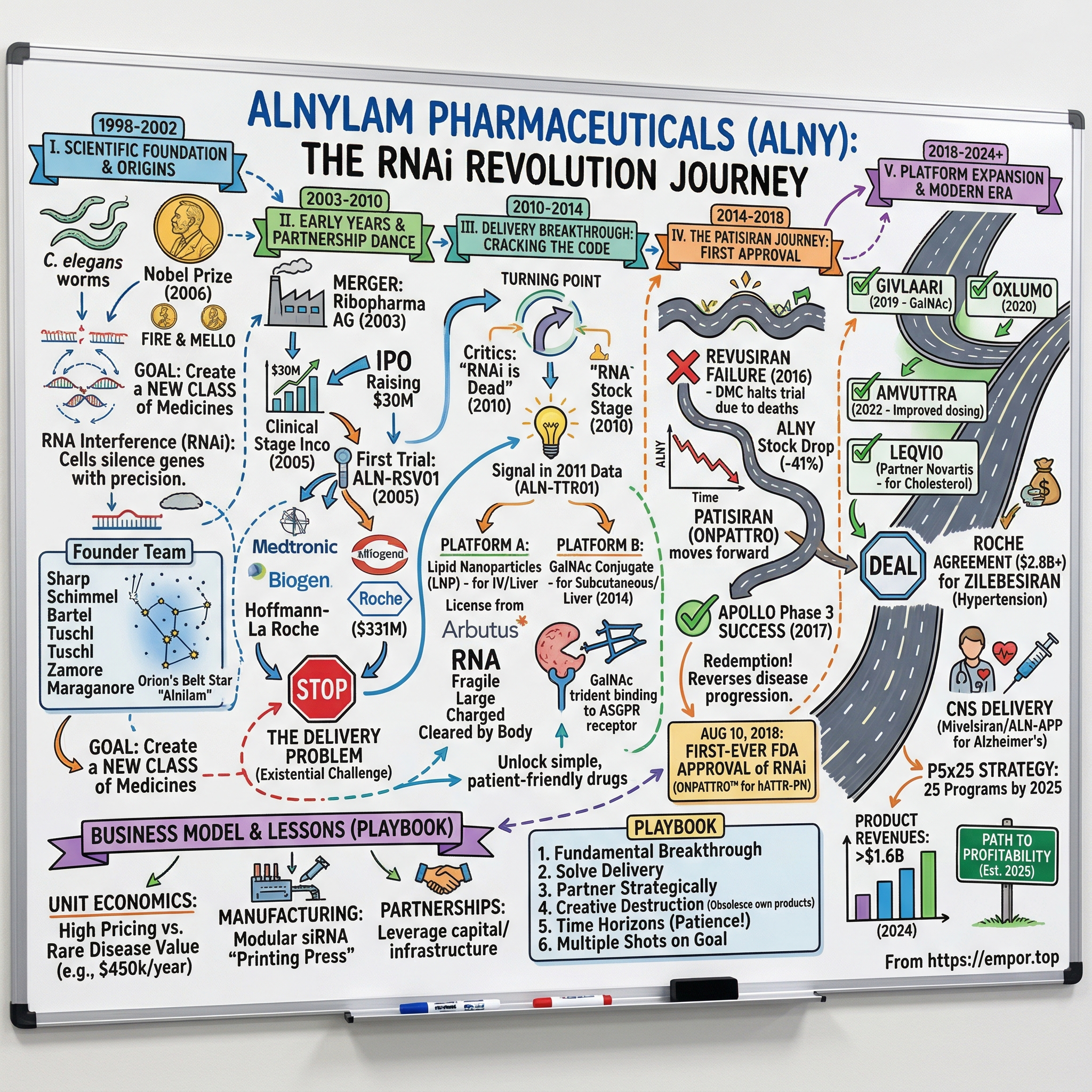
Alnylam Pharmaceuticals: The RNAi Revolution and the $30 Billion Platform
I. Introduction & Episode Setup
On the morning of July 30, 2026, Alnylam Pharmaceuticals reported the highest-performing financial quarter in its 24-year history. AMVUTTRA, its quarterly injection for a rare and fatal heart disease, generated over $1 billion in a single three-month period — representing an annualized run rate above $4 billion just 15 months into its commercial launch.1 Total product revenue grew 74% year over year, non-GAAP operating income tripled, and the company closed the quarter with $3.3 billion in cash generated from operations rather than external financing.
By the closing bell, the stock had fallen roughly 28%.2
The sharp sell-off stemmed from a detail buried in the same press release: management lowered its full-year revenue guidance by $200 million. The chief financial officer acknowledged the misstep, stating, "we didn't get it right with our original guidance. We own that."1 Just three months earlier, during the first-quarter earnings call, executives had reiterated that guidance and expressed confidence in their targets.3 Within days, shareholder rights law firms announced securities investigations.4
That collision — record commercial sales paired with a sudden loss of investor confidence — frames the broader Alnylam narrative, illustrating a cycle of scientific breakthrough and market volatility the company has experienced roughly every seven years since its founding.
The underlying scientific foundation represents a landmark translation of modern molecular biology into clinical therapeutics. In 1998, researchers Andrew Fire and Craig Mello published evidence demonstrating that double-stranded RNA could silence a specific gene in a nematode worm — a discovery awarded the 2006 Nobel Prize in Physiology or Medicine.5 Alnylam was founded to commercialize that biological mechanism into a fourth major drug modality, alongside small molecules, biologics, and cell and gene therapies. Commercialization required 16 years and billions of dollars in accumulated losses before securing regulatory approval. Over that period, the company navigated the withdrawal of a key partner during the 2008 financial crisis, a Phase 3 trial halted after patient deaths, and a decade spent solving a central scientific obstacle: delivering a fragile, negatively charged RNA molecule into a targeted human cell.
Those efforts eventually yielded commercial results. In 2025, Alnylam recorded $2.99 billion in net product revenue — up 81% year over year — alongside $314 million in GAAP net income, marking its first full year of profitability.6 Six medicines invented by Alnylam are currently approved globally, four of which the company markets directly.3
The market's sharp reaction to a $200 million guidance reduction underscores how the core investment thesis has shifted. For 16 years, the central question was scientific: does RNAi work? Since 2024, the question has become commercial: how many patients with a common cardiac condition will receive a targeted injection priced near half a million dollars annually when two lower-cost oral therapies exist? The initial scientific question had a binary answer. The commercial question is continuous, competitive, and supported by less than two years of market evidence.
Three central themes define the analysis that follows.
The first is targeted delivery. Alnylam's durable advantage was not the foundational discovery of RNA interference, which was published science in the public domain. Instead, its operational advantage stemmed from proprietary chemistry using a sugar molecule called GalNAc, which enables subcutaneous administration directly to liver cells. Whether this delivery technology constitutes a permanent competitive moat or a temporal lead that competitors and alternative modalities will eventually close remains the core platform question.
The second is market competition within the transthyretin amyloidosis (ATTR) landscape. Alnylam's flagship therapy competes against Pfizer's tafamidis franchise, which generated $6.4 billion in 20257; BridgeBio's Attruby, which launched shortly before AMVUTTRA's cardiac approval and is expanding market share8; and, until recently, an antisense candidate from Ionis and AstraZeneca whose cardiovascular outcomes trial failed in July 2026.9 While Alnylam argues its platform is scientifically differentiated, current market valuations reflect lingering commercial skepticism.
The third is the operational evolution required when a platform company transitions from research to commercial scale. Alnylam is now a commercial enterprise managing field sales forces, payer contract negotiations, distribution channels, and inventory logistics. The capabilities that drove its early survival — patient capital, scientific conviction, and resilience through extended research cycles — differ from the operational discipline required in commercial execution. The July guidance reduction illustrated that the company's financial forecasting capabilities remain in development.
This analysis focuses primarily on the past five years, where the company's capital deployment and commercial risk are concentrated. However, Alnylam's foundational history remains essential context: it illuminates corporate behavior and explains why management responds to market volatility by re-centering investor attention on long-term platform development.
 Subscribe on LinkedIn
II. The Scientific Genesis & Founding Vision (1998–2002)
The underlying mechanism of RNA interference emerged from a surprising biological observation. In 1998, researchers Andrew Fire and Craig Mello sought to silence specific genes in Caenorhabditis elegans, a millimeter-long soil worm. They discovered that double-stranded RNA muted targeted genes far more effectively than single-stranded RNA. Cells recognized these double-stranded fragments and used them to identify and destroy matching messenger RNA sequences. The Nobel committee's citation eight years later described the phenomenon as a fundamental mechanism for controlling the flow of genetic information.5
The biological logic carries direct commercial implications. A gene serves as an organism's master blueprint, while messenger RNA acts as the working copy transferred to cellular machinery where proteins are assembled. Traditional therapeutics—such as small molecules and monoclonal antibodies—attempt to block or neutralize proteins after they are manufactured. RNA interference acts upstream, destroying the messenger RNA before protein synthesis occurs. It is the molecular equivalent of stopping a printing press rather than intercepting distributed copies.
For diseases caused by a toxic or mutated protein produced primarily in a single organ, destroying genetic instructions at the source offers a more comprehensive intervention than downstream neutralization. That target profile ultimately led Alnylam to focus on transthyretin amyloidosis.
Alnylam incorporated in Cambridge, Massachusetts, in 2002. Its scientific co-founders included Phillip Sharp, a Nobel laureate for his discovery of split genes; Paul Schimmel of the Scripps Research Institute; David Bartel of the Whitehead Institute; Thomas Tuschl, then at the Max Planck Institute; and Phillip Zamore of the University of Massachusetts. Venture investors Christoph Westphal and John Kennedy Clarke organized the founding round and recruited John Maraganore—a veteran drug developer from Biogen and Millennium Pharmaceuticals—as founding chief executive officer.10
Maraganore's appointment established commercial discipline alongside academic research. He would lead Alnylam for 19 years, focusing corporate strategy on patent protection, strategic partnerships, and platform progression.
Sharp's involvement provided immediate credibility with venture investors, establishing that a mechanism discovered in nematodes could form the basis of a therapeutic platform. Tuschl developed the core chemistry—the specific structural rules governing synthetic small interfering RNA (siRNA) molecules capable of functioning inside human cells. Maraganore brought operational persistence, maintaining long-term product roadmaps even through severe market downturns.
The company drew its name from Alnilam, the central star in Orion's Belt—a fixed navigational reference point during a prolonged era of technical uncertainty.
The most strategic decision of Alnylam's founding period was legal rather than scientific. Because Fire and Mello's original discovery was published science, the biological mechanism itself could not be patented. However, the specific architecture of synthetic siRNA molecules suitable for human therapeutics—including strand length, end overhangs, and chemical modifications—could be protected. Tuschl's research defined much of that architecture, prompting Alnylam to secure exclusive worldwide licenses for the foundational Tuschl patent portfolio from MIT, the Max Planck Institute, and the Whitehead Institute.
This legal strategy established a recurring operational template: securing intellectual property control points before industry consensus recognized their importance, then allowing time and competitors' early setbacks to enhance their strategic value. In 2002, that strategy focused on molecular structural patents; in 2014, it led to acquiring a competitor's entire RNAi patent estate during a period of sector distress.
Whether this approach created a permanent competitive moat remains an open strategic question. Structural patents filed around 2000 have largely expired. The company's enduring protection relies less on foundational patents and more on accumulated manufacturing expertise, proprietary chemical modifications, and trade secrets.
In 2002, however, those long-term assets lay far in the future. Alnylam possessed a distinguished scientific advisory board, an exclusive license portfolio, no clinical candidates, and a delivery challenge that threatened the company's survival.
III. The Delivery Abyss & Cash Burn Crisis (2003–2010)
The fundamental challenge was biological: an siRNA molecule injected into the human bloodstream acts, from the body's perspective, like foreign debris.
Enzymes known as nucleases degrade the molecule within minutes. Anything that survives is small enough to be filtered directly out by the kidneys. Whatever remains must then cross a fatty cell membrane despite carrying a strong negative charge—akin to pushing matching magnetic poles together. Even if a molecule penetrates the cell, the innate immune system, which evolved to detect foreign double-stranded RNA as a viral signature, can trigger a severe inflammatory response.
Every one of those failure modes had to be solved simultaneously. For most of the 2000s, none of them were.
The financing history of that decade reflects a series of structured moves to extend corporate runway. In 2003, Alnylam merged with German firm Ribopharma AG, acquiring its shares for $1.5 million in cash and roughly 1.55 million shares while assuming $7.1 million in debt; the combined entity subsequently raised $24.6 million from private investors.11 The merger secured European scientific talent and a second patent lineage.
Alnylam's initial public offering in May 2004 raised modest capital, selling 5 million shares at $6.00 apiece for $30 million in gross proceeds, netting approximately $27.9 million before expenses.12 For scale, that total represents less than three days of AMVUTTRA sales in 2026. Demand was so narrow that existing shareholders indicated interest in purchasing up to a quarter of the offered shares themselves.
Strategic partnerships provided additional operational runway. Medtronic partnered with Alnylam in 2005 to evaluate local delivery devices, and Biogen Idec entered a collaboration in 2006. On July 9, 2007, Roche executed a major licensing transaction, paying $331 million for non-exclusive access to Alnylam's RNAi intellectual property across oncology, respiratory, metabolic, and targeted liver diseases. The agreement included upfront cash, the purchase of roughly 1.975 million Alnylam shares, and the acquisition of Alnylam's European research site in Kulmbach, Germany, with an option for Roche to add up to 18 additional therapeutic areas at $50 million each.13
That transaction structure reflected market sentiment at the peak of the first RNAi valuation bubble. Roche was not acquiring a clinical-stage drug candidate, but an option on an unproven therapeutic platform—valuing the theoretical potential of RNAi at more than a quarter-billion dollars before a single candidate demonstrated efficacy in human trials.
Behind the transaction headlines, scientific progress remained slow. The overwhelming majority of Alnylam's early research budget targeted delivery chemistry rather than gene identification, which was comparatively straightforward. Researchers systematically tested and discarded viral vectors, cationic polymers, cyclodextrin nanoparticles, and dozens of liposome formulations. Years of continuous experimentation yielded repeated failures across candidate chemical delivery systems.
The sector encountered a major setback in 2010. Novartis declined to expand its RNAi collaboration with Alnylam, and Roche shortly thereafter terminated its internal RNAi research program entirely.14 Two of the world's largest pharmaceutical companies evaluated the platform, spent substantial capital, and determined that RNAi therapeutics were unviable within their strategic planning horizons.
Equity markets responded accordingly. Alnylam's shares declined sharply, forcing management to reduce headcount. Industry consensus consolidated around a single view: RNAi was an elegant biological mechanism without a viable clinical delivery system.
From an operational perspective, Alnylam's survival during this downturn illustrates structural capital allocation rather than simple corporate perseverance. Large pharmaceutical partners like Roche and Novartis managed broad product portfolios; RNAi was a high-risk line item competing for capital against oncology assets with nearer-term cash flows. For Alnylam, RNAi represented its sole strategic purpose. Led by a chief executive officer whose corporate strategy was tied entirely to the modality, Alnylam lacked the option to reallocate capital into alternative fields. Single-modality biotech firms frequently persist through market downturns because they cannot diversify away from them—though that same structural rigidity leads many single-focus peers into insolvency.
What ultimately set Alnylam apart was that, just as commercial partners withdrew, the underlying delivery chemistry finally began to yield positive technical results.
IV. Cracking the Delivery Code: LNP to GalNAc (2010–2015)
The initial technical breakthrough involved lipid nanoparticles (LNPs), which resolved cellular entry by encapsulating fragile siRNA within ionizable lipid spheres. Neutral in the bloodstream, these particles avoided early degradation and clearance before entering target cells. Once inside an acidic endosomal compartment, the lipids became positively charged, destabilizing the membrane and releasing their RNA cargo into the cytoplasm. Alnylam licensed this foundational delivery technology from Canadian developers operating as Tekmira and Protiva—entities that later recombined as Arbutus Biopharma.
The mechanism carried an important biological characteristic: once circulating, LNPs accumulated naturally in liver tissue. For a company seeking its initial clinical proof of concept, hepatic accumulation provided a natural targeting mechanism rather than a restrictive bottleneck.
In 2011, an early-phase clinical trial yielded a pivotal milestone: measurable, mechanism-specific gene knockdown in a human subject. Thirteen years after Fire and Mello demonstrated gene silencing in nematode worms, RNA interference had demonstrated therapeutic activity in humans.
Despite that milestone, LNPs presented substantial commercial and clinical limitations. Administration required hours-long intravenous infusions in a clinical setting, preceded by steroid premedication to mitigate severe infusion-related reactions. In addition, repeated dosing introduced a continuous burden of synthetic lipid exposure. While LNPs validated the therapeutic concept, they offered an inefficient commercial delivery vehicle.
The definitive commercial delivery solution emerged from targeted sugar chemistry.
Hepatocytes express high concentrations of asialoglycoprotein receptors (ASGPR) on their cellular membranes. These receptors function primarily to internalize circulating glycoproteins displaying N-acetylgalactosamine (GalNAc) sugars, rapidly recycling back to the cell surface to sustain cellular uptake.
Alnylam's scientific team leveraged this biological mechanism by replacing lipid encapsulation with molecular targeting. By chemically conjugating a tri-antennary GalNAc ligand directly to the siRNA strand, researchers created a molecule that liver cells actively bound and internalized, bypassing the need for complex lipid formulations or specialized infusion facilities.
This chemical shift transformed the platform's commercial economics. GalNAc conjugates allowed simple subcutaneous administration during brief outpatient visits, eliminating the systemic toxicity profile of lipid nanoparticles. Coupled with backbone modifications—marketed as Enhanced Stabilization Chemistry—the design extended therapeutic duration from weeks to months.
Extended dosing intervals altered the competitive landscape. Whereas frequent intravenous infusions force therapeutics to compete solely on clinical efficacy, quarterly or semi-annual injections allow drugs to compete on patient compliance and convenience. Administration by healthcare providers also ensures treatment adherence, contrasting sharply with daily oral regimens that rely on consistent patient compliance.
With a viable delivery platform established, Alnylam executed two transactions in January 2014 that defined its capital allocation strategy.
First, the company issued a roughly 12% equity stake to Sanofi's Genzyme unit for $700 million, at approximately $80 per share, while granting Genzyme co-development and regional commercialization rights for rare-disease targets.15 Executed at a valuation reflecting the recent GalNAc delivery breakthrough, the transaction provided substantial capital to fund clinical trials without severe equity dilution.
The following day, Alnylam acquired Sirna Therapeutics from Merck for $175 million—comprising $25 million in cash and $150 million in Alnylam stock—securing Merck's full portfolio of RNAi patents, preclinical candidates, and delivery technologies.16
Merck had originally acquired Sirna for $1.1 billion in 2006 during the initial peak of RNAi sector valuations. Eight years later, Alnylam acquired those same assets for approximately 16 cents on the dollar, funding the majority of the purchase with equity that had appreciated following its own delivery breakthrough.
Beyond financial arbitrage, the transaction served a legal function. Sirna's patent portfolio posed the primary freedom-to-operate threat to Alnylam's platform. Acquiring the estate eliminated its most significant potential patent litigation risk while consolidating intellectual property control over the modality.
Within forty-eight hours, Alnylam moved from a cash-constrained research firm to the primary owner of the commercial RNAi patent landscape. However, the company still lacked an approved commercial therapy—and its initial Phase 3 trials would soon test the resilience of the platform.
V. Trial Drama, Revusiran Failure, & Redemption with ONPATTRO (2016–2018)
When selecting its initial clinical target, Alnylam chose transthyretin (TTR)—a protein produced almost exclusively in the liver. This biological profile directly matched the company's hepatic delivery capabilities. In hereditary transthyretin-mediated amyloidosis (hATTR), genetic mutations cause TTR proteins to misfold and deposit as amyloid fibrils in peripheral nerves and heart muscle, resulting in a progressive and fatal disease with few treatment options at the time. Because hATTR is monogenic, the disease presented a clear causal link, while circulating TTR blood levels provided an immediate quantitative biomarker to verify target gene knockdown in early clinical studies.
Alnylam pursued two parallel clinical candidates. Patisiran utilized lipid nanoparticle delivery for intravenous administration, while revusiran represented the first-generation GalNAc conjugate—designed as a subcutaneous injection for the cardiac presentation of the disease.
On October 5, 2016, Alnylam discontinued revusiran entirely.17 The Phase 3 ENDEAVOUR study's independent data monitoring committee reviewed unblinded data following reports of new or worsening peripheral neuropathy in an open-label extension and concluded that the risk-benefit profile no longer justified continued dosing. Eighteen of the 206 patients in the study died, with a higher mortality rate in the treatment arm than on placebo.18 Management stated that none of the deaths were determined to be drug-related, while acknowledging that the company did not have a clear explanation for the finding.19
The combined lack of causal attribution and biological explanation triggered severe market panic, driving the stock down more than 45% in a single morning.19
Management promptly terminated revusiran rather than attempting a dose reduction or patient subpopulation restriction. Subsequent internal investigations indicated that the toxicity stemmed from revusiran's specific high-dose requirements under first-generation GalNAc chemistry, rather than an inherent flaw in the broader RNA interference mechanism or GalNAc conjugation platform.
That chemical diagnosis was later validated by vutrisiran, a next-generation GalNAc conjugate incorporating enhanced stabilization chemistry. Vutrisiran achieved deeper target knockdown at a fraction of revusiran's dose, establishing a clean safety profile across thousands of patient-years.
On August 10, 2018, the U.S. Food and Drug Administration approved ONPATTRO (patisiran) for the polyneuropathy of hereditary transthyretin-mediated amyloidosis—marking the first RNA interference therapeutic approved anywhere in the world.[^20] The approval arrived sixteen years after Alnylam's founding and two decades after the initial discovery of RNA interference.
Regulatory approval introduced new commercial challenges. Alnylam set ONPATTRO's annual list price at roughly $450,000, expecting a net price of approximately $345,000 after discounts and mandatory rebates. To secure reimbursement, the company introduced outcomes-based contracts, patient assistance programs, and a commitment not to raise price beyond inflation absent new evidence of value.20 Nevertheless, the Institute for Clinical and Economic Review, an independent U.S. cost-effectiveness organization, concluded that the list price far exceeded conventional value thresholds and would need to fall by 90–95% to meet them.21
Beyond pricing structures, commercial execution required significant diagnostic infrastructure. Because hATTR was frequently misdiagnosed as idiopathic neuropathy or unexplained heart failure, patients often spent years without appropriate care. Alnylam built a specialized field sales force, an international reimbursement team, and a free genetic testing program called Alnylam Act to identify undiagnosed patients. While a first-in-class drug provides a temporary market lead, establishing a patient identification and diagnostic pipeline created a durable commercial foundation for subsequent pipeline indications.
VI. Platform Scale & The GalNAc Product Avalanche (2019–2022)
While ONPATTRO's regulatory approval validated the underlying mechanism of RNA interference, Alnylam still needed to demonstrate that its GalNAc delivery platform could systematically generate commercial therapeutics.
That broader validation arrived in rapid succession. In 2019, the FDA approved GIVLAARI (givosiran) for acute hepatic porphyria, a rare genetic disorder where a liver enzyme defect triggers severe abdominal pain and neurological damage. In 2020, regulatory authorities approved OXLUMO (lumasiran) for primary hyperoxaluria type 1, a genetic condition in which hepatic oxalate overproduction causes progressive renal failure.
These indications shared core biological characteristics with transthyretin amyloidosis: each was a monogenic disease driven by a protein synthesized in the liver, featuring a measurable circulating biomarker to quantify target gene knockdown. Management selected targets that matched GalNAc's tissue distribution profile. While capitalizing on this delivery mechanism enabled Alnylam to rapidly build a rare-disease pipeline, it also established the platform's boundary: for nearly a decade, causal proteins outside the liver remained beyond the company's delivery capabilities.
Beyond rare monogenic conditions, Alnylam applied its platform to inclisiran, an RNAi candidate targeting PCSK9 to lower LDL cholesterol—its first mass-market cardiovascular program. Recognizing that commercializing a primary-care therapy required distribution infrastructure far beyond its rare-disease field force, Alnylam out-licensed global rights to The Medicines Company, which advanced clinical development before being acquired by Novartis for $9.7 billion. In exchange, Alnylam retained tiered royalties ranging from 10% to 20% on global net sales.22
The licensing agreement enabled Alnylam to capture the economics of a broad-population asset while avoiding the fixed costs of a primary-care commercial organization. Marketed by Novartis as Leqvio, the drug achieved blockbuster status in 2025 by generating $1.2 billion in net sales, representing a 57% increase year over year.23 Driven by Leqvio's commercial expansion, Alnylam's royalty revenues rose 79% year over year in the second quarter of 2026.1
To fund its expanding late-stage pipeline during the market volatility of the COVID-19 pandemic, Alnylam executed a major capital-markets transaction. In April 2020, Blackstone and Alnylam announced a $2 billion strategic financing collaboration comprising a credit facility, an equity investment, development funding, and the sale of 50% of Alnylam's future Leqvio royalty stream.24
The transaction monetized a long-dated, passive royalty stream—over which Alnylam held no commercial operational control—into immediate cash reserves without diluting shareholders at depressed equity valuations. By underwriting the specific cash flows of a single pharmaceutical asset, Blackstone provided capital at an attractive implied valuation relative to prevailing equity markets.
However, that upfront liquidity created a permanent structural cost: half of all future Leqvio royalties flow directly to Blackstone. As Leqvio sales expand toward multi-billion-dollar levels, the foregone royalty revenue represents a substantial long-term expense. Royalty monetization provides low-cost capital if an asset underperforms, but becomes expensive financing if the drug succeeds. In this instance, Alnylam traded upside in a successful commercial asset to fund the Phase 3 development of its next generation of internal candidates.
In June 2022, the FDA approved AMVUTTRA (vutrisiran) for the treatment of hATTR polyneuropathy. Built with Enhanced Stabilization Chemistry, vutrisiran required one subcutaneous injection every three months, compared to ONPATTRO's three-week intravenous infusion schedule.
Patients and physicians transitioned rapidly to the new formulation. Despite comparable clinical efficacy, replacing seventeen annual infusion-suite visits with four outpatient injections created a decisive administration advantage. This commercial adoption demonstrated that dosing convenience strongly drives selection within rare neurology. Management would later cite this switching pattern as evidence for AMVUTTRA's commercial prospects in transthyretin cardiomyopathy, where Alnylam's quarterly injection competes against daily oral therapies. However, patient adoption in cardiology practices may follow different dynamics, as daily oral regimens eliminate clinical visits altogether.
While addressing small patient populations, Alnylam's specialized rare-disease portfolio established important operational scale. In 2025, GIVLAARI and OXLUMO generated a combined $499 million in revenue, growing 21% and 15% year over year, respectively.6 Though constrained by niche target markets, these high-margin therapies provided recurring cash flow, confirmed platform repeatability, and absorbed the fixed overhead of a global commercial and reimbursement infrastructure that the company would subsequently leverage for larger cardiovascular indications.
By the end of 2022, Alnylam possessed four marketed therapeutics, a high-value royalty stream on a fifth, and a clinically validated delivery platform. However, after accumulating billions of dollars in historical development losses, the company required a significantly larger commercial market to achieve sustained corporate profitability.
VII. The HELIOS-B Breakthrough & The ATTR-CM Cardiac Moonshot (2022–2025)
Here is the arithmetic that reframed the company.
Hereditary ATTR with polyneuropathy is a rare disease in the classical sense—on the order of 50,000 patients worldwide, most of them undiagnosed. It supports a profitable business at extreme prices, but offers limited room for expansion.
ATTR cardiomyopathy is a different universe. The same protein misfolds and deposits in heart muscle, stiffening the organ until it cannot fill properly. Most cases are not inherited; they are "wild-type," meaning the normal protein simply destabilizes with age. For decades, clinicians misdiagnosed this condition as hypertensive heart disease or diastolic heart failure in elderly patients. As cardiac imaging improved and clinical awareness spread, researchers realized that a meaningful fraction of heart failure with preserved ejection fraction in older men was in fact amyloidosis. Alnylam estimates that roughly 200,000 patients in the United States alone suffer from ATTR cardiomyopathy, with more than 80% still untreated.1
Pfizer had already proved the commercial thesis. Tafamidis—a small molecule that stabilizes the transthyretin protein to prevent misfolding rather than destroying it—generated $6.4 billion globally in 2025, up 17% year over year.7 That figure demonstrates the market potential of a rare-disease-priced drug when the underlying condition proves far more prevalent than originally believed.
Alnylam's strategy rested on a mechanistic distinction. While oral stabilizers attempt to hold the protein structure together, a gene silencer removes roughly 90% of circulating protein at the source. Under the hypothesis that amyloid deposition correlates directly with the volume of misfold-prone protein, gene silencing offered a theoretically superior intervention.
The HELIOS-B trial tested that hypothesis. Enrolling 655 patients with ATTR cardiomyopathy across a 36-month period, the study permitted participants on background tafamidis to maintain their regimen, enabling researchers to evaluate vutrisiran both as monotherapy and as an add-on treatment. On June 24, 2024, Alnylam reported that HELIOS-B met its primary endpoint, demonstrating statistically significant reductions in all-cause mortality and recurrent cardiovascular events of 28% in the overall trial population and 33% in the monotherapy cohort, while achieving every secondary endpoint across both groups.25 All-cause mortality alone declined by 36% in the overall population and 35% in the monotherapy group.25 The study also documented measurable improvements in six-minute walk distance and patient-reported quality-of-life metrics.26
The FDA approved the cardiomyopathy indication on March 20, 2025, establishing AMVUTTRA as the first RNAi therapeutic cleared to reduce cardiovascular death, hospitalization, and urgent heart failure visits in ATTR cardiomyopathy, as well as the only drug in the United States approved for both cardiac and neuropathic forms of the disease.27
Alnylam then executed a bold pricing strategy: maintaining AMVUTTRA's list price flat across indications at approximately $119,000 per quarterly injection, or roughly $476,000 annually—nearly double the annual list prices of Pfizer's tafamidis at approximately $268,000 and BridgeBio's Attruby at $244,500.28
Pricing at a 75% to 95% premium over two oral competitors reflects management's confidence in clinical differentiation. However, it also introduces a key commercial vulnerability, requiring every payer negotiation and prescribing decision to justify substantial incremental cost.
For four quarters, commercial execution appeared to validate the strategy. Total product revenue rose from $2.2 billion in 2024 to $2.99 billion in 2025—an 81% increase—driven by TTR franchise sales that more than doubled to $2.49 billion.6 The expansion delivered Alnylam's first full year of GAAP profitability at $314 million.6 By the second quarter of 2026, quarterly TTR revenues cleared $1.03 billion, up 89% year over year, supported by a 114% expansion in U.S. sales.1 Real-world patient adherence surpassed 90%, representing a high persistence rate compared to traditional chronic oral therapies.3
However, the underlying composition of that revenue growth soon reshaped the investment narrative.
During the second-quarter 2026 earnings call, executives disclosed that a disproportionate share of early commercial adoption had been driven by second-line switches—patients progressing on oral stabilizers who had been awaiting an alternative mechanism. That initial demand represented a finite pool of existing patients rather than a sustainable ongoing flow. As that conversion phase matured, new treatment starts shifted heavily toward treatment-naive patients, who accounted for roughly 80% of new initiations.1 Consequently, management reduced full-year TTR revenue guidance by $200 million at the midpoint to $4.2–4.5 billion—a range that still represents 75% annual growth, yet fell short of market expectations.1
The sharp equity sell-off reflected concerns over what this mix shift implied. Converting second-line patients represents a temporary capture of an established market pool. By contrast, capturing treatment-naive patients requires an ongoing commercial contest against two less expensive daily pills for newly diagnosed individuals. Alnylam's expansion now depends on winning first-line share and broadening the overall diagnosed population—explaining why management has increasingly highlighted AI-driven diagnostic collaborations with entities such as Viz.ai, Komodo Health, a major California health system, and the American Heart Association.13
Myth versus reality
Three central narratives have emerged around the franchise over the past two years, each requiring critical evaluation.
Myth: HELIOS-B proved that silencers outperform stabilizers. The trial design does not support that conclusion. HELIOS-B was a placebo-controlled study rather than a head-to-head comparison against tafamidis. While it established that adding vutrisiran improves clinical outcomes relative to placebo—including in patients receiving background stabilizer therapy—it provided no comparative evidence regarding initial therapy choice in treatment-naive patients. As Alnylam's chief R&D officer noted during the second-quarter 2026 earnings call, "there's no head-to-head data, of course, we know between these different classes of medicines."1 Prescribers evaluating first-line options must rely on cross-trial inferences rather than direct comparative trials.
Myth: The July 2026 guidance reduction indicates falling product demand. Empirical sales data contradicts this interpretation. Underlying U.S. demand grew by $129 million during the quarter—more than double the demand growth recorded in the preceding quarter—though net reported revenue was tempered by approximately $21 million in inventory drawdowns alongside modest net price erosion.1 The guidance adjustment reflected changes in the long-term sustainability of specific demand segments rather than an absolute decline in patient volume.
Myth: Ionis and AstraZeneca's eplontersen failure is purely beneficial for Alnylam. Management stated that the competitor's setback increased corporate confidence by removing a potential branded rival from the market.1 From a commercial perspective, that assessment holds. Scientifically, however, the outcome presents a more complex signal: the sole randomized trial testing the addition of an antisense silencer to background stabilizer therapy failed to demonstrate clinical benefit in that combination group, raising questions for combination approaches across the field.
The competitive landscape centers on four key assets:
Pfizer (tafamidis) represents the established incumbent with the largest patient base and a daily oral regimen. Following April 2026 patent settlements with three generic manufacturers, U.S. exclusivity for the franchise extends to June 1, 2031.29 Although Alnylam management characterized the extended exclusivity as favorable by delaying low-cost generic entry in first-line settings,1 the outcome also ensures that Pfizer will maintain full commercial resources behind its branded asset for five additional years.
BridgeBio (Attruby) is a next-generation oral stabilizer that received approval shortly before AMVUTTRA's cardiac indication. The drug generated $362 million in 2025, followed by $181 million in the first quarter of 2026 and $222 million in the second quarter, with company disclosures highlighting adoption among treatment-naive patients.830 This uptake in frontline settings directly challenges the assumption that injectable silencers will naturally dominate initial treatment.
Ionis / AstraZeneca (eplontersen) exited the cardiac segment in July 2026 after the Phase 3 CARDIO-TTRansform trial missed its primary endpoint. Notably, patients receiving background stabilizer therapy showed no treatment effect, whereas the monotherapy subgroup demonstrated nominally significant clinical benefit.9
Intellia (in vivo CRISPR) represents a long-term prospective threat. Intellia is developing a one-time gene-editing therapy designed to permanently eliminate hepatic TTR production. If clinical trials establish its safety and efficacy, a single-dose curative approach could alter the economic structure of the ATTR market, though commercial impact remains a late-decade prospect.
The clinical failure of eplontersen highlights a central debate surrounding combination therapy that impacts Alnylam directly. While removing a branded competitor provides immediate commercial space,1 the lack of efficacy in eplontersen's combination arm creates scrutiny for Alnylam's ongoing Phase 3 TRITON-CM trial, which similarly evaluates vutrisiran in a patient population largely receiving background stabilizers.
Alnylam's scientific leadership argued that the CARDIO-TTRansform outcome reflected molecule-specific and trial-specific factors rather than a broader class failure. Chief R&D officer Pushkal Garg presented a three-part rebuttal: first, that CARDIO-TTRansform enrolled a sicker patient cohort containing 17% NYHA Class III patients compared to roughly half that proportion in HELIOS-B; second, that antisense oligonucleotides produce slower and less pronounced target knockdown than RNAi, citing internal modeling of published data indicating that only 67% of eplontersen patients achieve the 80% knockdown threshold linked to clinical benefit, compared to 82% to 84% for vutrisiran; and third, that Alnylam documented consistent combination benefits across two separate trials, showing a 41% reduction in all-cause mortality among stabilizer-treated patients in HELIOS-B and an estimated 44% reduction in APOLLO-B.1
While this detailed defense addresses key mechanistic distinctions, management acknowledged that its knockdown comparisons relied in part on predictive modeling rather than direct head-to-head clinical measurements, with Garg noting that the estimates "should be interpreted with appropriate caution."1 Complete data from CARDIO-TTRansform, scheduled for presentation at the European Society of Cardiology Congress in August 2026, will provide further empirical clarity on combination dynamics.
For investors, the commercial dynamics of Alnylam's cardiac franchise remain clearly defined: AMVUTTRA represents a high-growth asset operating in an expanding therapeutic market, priced at a premium that requires ongoing clinical and commercial justification. The key determinant of future valuation has shifted from establishing clinical proof of concept to measuring the share of first-line prescriptions an injectable therapy can secure against oral alternatives, alongside the pace of expansion in the diagnosed patient population.
VIII. Modern Management & Capital Allocation Architecture
In October 2021, John Maraganore announced he would step down at the end of the year after nineteen years as Alnylam's founding chief executive.31 The company's president and chief operating officer, Yvonne Greenstreet, succeeded him as CEO.
The executive transition was well telegraphed, though shares fell on the announcement because Maraganore had long embodied the RNAi thesis for investors, guiding the firm through early partner withdrawals, clinical setbacks, and the first regulatory approval.
Greenstreet brought a distinct background to the role. A physician by training, she held senior executive positions at Pfizer and GSK, managed the private investment firm Highgate, and joined Alnylam in 2016 as chief operating officer before becoming president in 2020.32 Her career reflects an operational focus suited to scaling a commercial enterprise rather than managing early-stage discovery.
The finance leadership mirrors that emphasis on commercial execution. Chief Financial Officer Jeff Poulton, a former Shire executive, oversaw the financial transition as Alnylam moved from an annual cash burn of $858 million in 2020 to GAAP net income of $314 million in 2025.6 Poulton led the Blackstone royalty transaction, maintained capital discipline through late-stage trials without dilutive equity raises during market downturns, and structured the financial disclosures accompanying recent commercial launches.
In January 2026, management outlined "Alnylam 2030," a long-term strategic plan built around market leadership in ATTR, sustainable innovation, and disciplined growth. The targets specify a compound annual revenue growth rate exceeding 25% through 2030, alongside a non-GAAP operating margin of roughly 30%.33 Under this architecture, R&D spending is targeted at approximately 30% of revenue, with plans to extend RNAi delivery to at least ten tissue types, advance over 40 clinical programs by 2030, and introduce at least two non-TTR medicines with blockbuster potential.3
Establishing explicit five-year financial benchmarks offers clear governance standards, though it also heightens execution risk—a dynamic highlighted by subsequent guidance adjustments within seven months of the announcement.
The credibility question. Management's operational record reflects both execution discipline and notable forecasting challenges.
On execution, the historical pattern demonstrates institutional discipline. Following safety signals in the revusiran trial, leadership promptly halted the study and disclosed the independent committee's findings. Under Greenstreet, the company achieved its target of full-year GAAP profitability, delivered positive HELIOS-B trial results, and transitioned from cash consumption to operational cash generation without requiring dilutive equity raises after reaching commercial scale.
Conversely, the 2026 revenue guidance adjustments revealed forecasting vulnerabilities.
In February 2026, the company issued full-year TTR revenue guidance of $4.4 billion to $4.7 billion.6 During the first-quarter earnings call on April 30, 2026—after reporting sequential TTR revenue growth of $52 million—executives reaffirmed that range, acknowledging that meeting the target would require significantly higher quarter-over-quarter revenue growth across the remainder of the year.3 On the same call, commercial leadership characterized normalizing second-line patient demand as an expected and healthy transition.3 Three months later, management cited that same second-line normalization as the primary driver behind a $200 million reduction in full-year guidance.1
This sequence highlights an operational disconnect: management recognized the shift in second-line patient adoption during the first quarter yet maintained full-year targets that relied on accelerating growth. Alternatively, forecasting early demand dynamics in a newly expanded market presents inherent complexity as initial patient backlogs clear. In either case, the shift revealed limits in early commercial visibility.
When announcing the guidance reduction, management addressed the shortfall directly, stating, "we didn't get it right" and "we own that," without attributing the variance to external factors, macro conditions, or reimbursement hurdles.1 This direct accountability stands in contrast to corporate responses that deflect operational missteps.
A similar tension appeared in clinical communications. During the April 2026 call, R&D leadership expressed strong confidence that Ionis and AstraZeneca's CARDIO-TTRansform study would yield positive combination results, pointing to HELIOS-B as evidence that RNA silencing works alongside background stabilizers.3 Ten weeks later, CARDIO-TTRansform failed to meet its primary endpoint, showing no treatment effect in the combination cohort.9 Management subsequently argued that the failure reflected candidate-specific limitations rather than a class-wide issue—a distinction supported by mechanistic differences, but one that contrasts with earlier broad claims regarding combination efficacy.
Compensation and alignment. Executive compensation reflects the company's expansion into a commercial enterprise. Maraganore received $10.2 million in total compensation during his final year as CEO, while Greenstreet received $8.6 million in her first year, according to regulatory filings.34 Detailed incentive metric weightings are disclosed in annual proxy statements, though specific 2025 performance payout mechanics are not detailed in quarterly financial reports. As 2026 marks the first year Alnylam achieved profitability while simultaneously reducing annual revenue guidance, board decisions regarding executive incentive payouts will offer a clear measure of governance alignment.
The activist lens. Institutional investors and analysts focus on four central operational questions:
First, R&D capital allocation. Non-GAAP R&D expense increased 38% year over year in the second quarter of 2026 to $377 million, driven by three simultaneous Phase 3 trials: the ZENITH study in hypertension, alongside TRITON-CM and TRITON-PN for nucresiran.1 Maintaining R&D spending near 30% of revenue represents a substantial absolute commitment on a $5 billion revenue base. For example, management expanded enrollment in TRITON-CM from 1,250 to approximately 1,750 patients using a pre-specified protocol option.3 While this investment supports pipeline expansion, it increases operational expenditures during a period of revised revenue expectations and follows a trial failure in a comparable competitive asset.
Second, the clinical path for nucresiran. Designed as a next-generation TTR silencer, nucresiran demonstrated over 95% target protein knockdown with twice-yearly dosing in Phase 1 trials.35 The therapy offers potential patent life extension beyond AMVUTTRA's commercial window. However, the Phase 3 TRITON-CM trial incorporates a patient population substantially treated with background stabilizers—the specific design where eplontersen failed to show efficacy. Management indicated it may adjust the trial structure through pre-specified protocol modifications, such as refining enrollment criteria or statistical plans, while maintaining a targeted launch timeline around 2030.1 While pre-specified trial modifications are standard regulatory options, mid-study adjustments in high-stakes Phase 3 programs draw scrutiny from institutional investors.
Third, Inflation Reduction Act (IRA) provisions. AMVUTTRA avoided Medicare price negotiations in the initial cycles, as it was not selected for the 2028 negotiation list, benefiting from an orphan drug exemption covering therapies designated for a single rare disease.36 However, preserving this exemption requires that the asset does not secure approval for additional indications beyond its orphan designation, creating a structural constraint on expanding the drug's label into broader patient populations.37
Fourth, gross margin dynamics. Second-quarter gross margin declined from 79% to 75% year over year, primarily reflecting escalating tiered royalty obligations owed to Sanofi on global AMVUTTRA sales—a structural feature of the 2018 restructuring in which Alnylam reacquired full global TTR rights while granting Sanofi sales royalties.138 Because these royalty rates step up with higher volume thresholds, gross margins face structural downward pressure as sales expand.3 Combined with anticipated mid-single-digit annual net price erosion in the U.S. market,1 maintaining operating margin expansion requires volume growth to outpace both royalty escalation and net price compression.
The overhang. Following the July 30 guidance announcement and share decline, several plaintiffs' law firms initiated securities class-action investigations regarding management's prior financial disclosures.4 While such solicitations routinely follow sharp equity adjustments and do not signify legal findings or underlying liability, they represent an administrative distraction and potential litigation expense as commercial expansion continues.
IX. Strategic Position & Hamilton Helmer's 7 Powers Analysis
Behind the corporate narrative lies a structural question: what prevents competitors from replicating Alnylam's position?
Process Power — strong, and the most defensible asset Alnylam possesses. Two decades of specialized development yielded proprietary knowledge on modifying nucleotide backbones to survive circulating nucleases without triggering immune responses, conjugating sugar clusters for liver uptake, and extending therapeutic duration from weeks to months. Much of this expertise remains unpatented, residing in trade secrets, internal protocols, and unpublished experimentation. This advantage is reflected in chemical measurements: vutrisiran achieved a median TTR reduction of roughly 91%, with about 82% of patients crossing the deep-knockdown threshold, compared to a modeled 67% for a competing chemistry.1 Whether that mechanistic gap consistently translates into superior clinical outcomes remains an open question, but the delivery differential is grounded in measured chemistry rather than marketing. However, this process power is tissue-specific; while Alnylam's delivery advantage in the liver is established, expanding to the brain, eye, or lung remains unproven.
Cornered Resource — real, but eroding. The foundational structural patents from the early 2000s have largely expired. What remains is a dense estate covering specific chemical modifications, conjugate designs, and target sequences, supplemented by the Sirna portfolio acquired in 2014. This IP network functions as a thicket rather than an absolute barrier—raising the time and capital required for entry without preventing independent approaches, as demonstrated by Ionis's development path.
Switching Costs — moderate, and often overstated. Real-world data indicates high patient retention, with adherence above 90% and one-year persistence exceeding 85%,3 contrasting with typical drop-off rates for chronic oral therapies. A patient stabilized on a quarterly physician-administered injection with documented organ stabilization faces high practical switching barriers. However, these switching costs bind at the patient level after treatment initiation rather than at the prescriber level before it. Consequently, as the finite pool of second-line switch candidates cleared, winning treatment-naive patients became the primary growth driver.
Scale Economies — moderate. Global commercial operations and manufacturing infrastructure amortize across five approved therapies and a broad pipeline. However, escalating royalty obligations and net-price compression put downward pressure on gross margins as revenue scales. Operating leverage accrues in SG&A efficiency rather than cost of goods sold.
Counter-Positioning — historical, and largely spent. During the 2000s, Alnylam operated with structural counter-positioning: established pharmaceutical firms could not justify a decade of unproven delivery research, whereas single-modality Alnylam had to persevere to survive. That asymmetry ended once RNA interference demonstrated clinical efficacy. Competitors including Novartis, Roche, AstraZeneca, and Regeneron maintain active positions in or adjacent to the field. Counter-positioning explains how Alnylam survived its initial development phase, but offers no ongoing strategic barrier today.
Network Economies and Branding — absent. Neither network effects nor consumer brand equity provide structural protection in prescription RNA therapeutics.
Evaluating the company through Porter's Five Forces highlights additional strategic pressures:
Threat of new entrants into general RNA interference remains low due to steep capital requirements, technical complexity, and proprietary delivery know-how. However, threat of entry into transthyretin amyloidosis has proven high: within two years of the HELIOS-B trial, the ATTR-CM landscape attracted a second oral stabilizer, an antisense program, and an in vivo gene-editing candidate.
Rivalry within the ATTR market is intense and increasingly driven by price competition at the list level.
Buyer power is moderate and rising. Management reported strong commercial access with over 90% first-line coverage and minimal out-of-pocket costs,3 while acknowledging that certain Medicare Advantage plans restrict combination therapy,1 contributing to ongoing net price erosion.
Substitutes represent the primary competitive challenge. Two oral stabilizers priced at approximately half of AMVUTTRA's list price target a cardiology prescriber base that is substantially larger and less specialized than the rare-disease neurology networks where Alnylam initially established its commercial footprint.
In summary, Alnylam holds a genuine, chemistry-based process advantage that competitors have not fully matched, operating in a market where two lower-cost oral substitutes exist and where its clinical value proposition must be established with each newly diagnosed patient. The platform represents a competitive commercial enterprise, but not an unassailable monopoly.
X. Playbook: Key Lessons for Founders, Executives & Investors
1. In a new modality, delivery is the moat — not the target. The RNAi mechanism was published science and recognized by the Nobel Committee, leaving it accessible to the entire industry. What competitors could not easily replicate was the accumulated chemistry required to deliver fragile molecules safely into targeted human cells. The broader business lesson: in any emerging technology, a durable competitive advantage rests where tacit operational knowledge is deepest and public documentation is thinnest. Executives and investors should evaluate where proprietary trade secrets reside rather than relying solely on published patents.
2. Surviving a trough requires structure, not just conviction. When Roche and Novartis exited RNAi around 2010, they made rational portfolio decisions. Alnylam survived because RNAi was its sole strategic focus, its leadership's credibility was tied directly to the platform, and it possessed partner capital and intellectual property to sell. The investable lesson is clear: conviction is easier to sustain when a firm lacks alternative options, and single-modality survivors dominate historical narratives primarily because failed peers disappear from view.
3. Buy the distressed asset with the appreciated currency. Alnylam acquired Sirna for $175 million—roughly 16 cents on the dollar relative to what Merck had paid eight years prior—funding the purchase primarily with its own stock after its GalNAc delivery breakthrough sparked an equity re-rating. In a single transaction, Alnylam eliminated its primary patent adversary. The strategic template: acquiring distressed assets from large pharmaceutical firms exiting a sector while a specialist's own equity valuation is expanding.
4. Use rare disease to de-risk the vehicle, then attack the prevalent market. Targeting monogenic diseases with clear biomarkers enables rapid learning through small clinical trials. However, transitioning to broader markets is not automatic: rare-disease commercial execution relies on specialized academic centers, whereas prevalent-disease expansion requires broad reach across community practices. Alnylam management has acknowledged that expanding beyond early adopters into community cardiology represents its primary commercial challenge, with roughly a third of TTR prescribers having any AMVUTTRA experience.1 Platform capabilities transfer to new indications far more readily than commercial go-to-market infrastructure.
5. Royalty monetization is cheap capital when you are desperate and expensive capital when you are right. The Blackstone financing structure provided essential risk management during the market volatility of April 2020, though it grows increasingly expensive as Leqvio sales compound. Structured royalty sales must be judged by what the capital enabled rather than headline terms. For Alnylam, monetizing half its Leqvio royalty stream funded the late-stage trials that established its multi-billion-dollar cardiac franchise—making the trade strategically sound even as foregone royalties multiply.
6. Two corollaries for investors. First, financial guidance from a company scaling its initial mass-market launch warrants a wider margin of error than guidance from a mature commercial enterprise, regardless of executive confidence. Second, when a competitor's clinical trial fails, analysts must evaluate whether the setback merely removes a rival or signals broader mechanistic limits—outcomes that frequently overlap, even when markets price only the immediate competitive relief.
XI. Investment Thesis, Bull vs Bear Case & Key KPIs
The core investment debate around Alnylam centers on a concise set of commercial and clinical variables.
Why Alnylam wins from here. The mechanistic argument holds that ATTR cardiomyopathy stems from a liver-produced protein, making 90% upstream silencing fundamentally more complete than stabilizing circulating proteins. The HELIOS-B trial provides hard outcomes evidence, meeting its primary endpoint and every secondary endpoint across both the overall and monotherapy cohorts.25 AMVUTTRA's label allows administration with or without a background stabilizer, while real-world data demonstrates patient adherence exceeding 90%.3 Crucially, the addressable U.S. market of roughly 200,000 patients—over 80% of whom remain untreated—is expanding at approximately 40% annually.1 In a rapidly growing, underdiagnosed market, Alnylam can lose relative market share yet still achieve substantial revenue expansion. Combined with nucresiran's potential for 95% protein knockdown via twice-yearly dosing, zilebesiran's hypertension opportunity co-funded by Roche, and a legacy rare-disease portfolio generating roughly $500 million in steady, high-margin annual revenue,6 the corporate target of 25%-plus compound annual revenue growth alongside 30% operating margins by 2030 remains arithmetically plausible.
What breaks the case. The primary commercial risk is that lower-cost oral stabilizers maintain their lead in frontline treatment. BridgeBio's Attruby expanded revenue from $181 million to $222 million sequentially in the first half of 2026, driven largely by treatment-naive patients—the exact segment Alnylam prioritizes.30 Prescribers evaluating a newly diagnosed patient may prefer a daily oral pill priced near $245,000 annually over a $476,000 quarterly injection requiring clinical administration. Alnylam's commercial disclosures acknowledge this barrier: only about one-third of TTR prescribers have administered AMVUTTRA, and uncommitted physicians frequently report limited understanding of the clinical distinctions between gene silencers and protein stabilizers.1 Overcoming this perception gap requires intensive physician education, a process that is both costly and gradual.
A second strategic risk is that the combination therapy thesis fails to materialize clinically. The Phase 3 trial for eplontersen yielded no treatment benefit when added to background stabilizer therapy—the only randomized outcomes data evaluating combination silencer-stabilizer treatment in a dedicated trial.9 Alnylam's counter-evidence, including a 41% mortality reduction in HELIOS-B's stabilizer-treated subgroup alongside comparable estimates from APOLLO-B, relies on exploratory subgroups that were not statistically powered to evaluate combination efficacy.1 If full data from competing trials indicates a broader class limitation rather than an asset-specific failure, the probability of success for Alnylam's Phase 3 TRITON-CM trial declines, threatening the franchise's post-2030 growth horizon.
Third, structural margin pressures limit profitability. Tiered royalty obligations owed to Sanofi step up alongside sales volume, which—combined with expected mid-single-digit annual net price erosion in the U.S.—compounds pressure on gross margins.1 Generating operating leverage requires strict administrative cost control even as R&D spending expanded 38% year over year.
Fourth, management's forecasting credibility remains impaired. Having reaffirmed full-year financial guidance in April 2026 shortly before announcing a $200 million reduction in July, leadership faces investor skepticism. This valuation discount now weighs on market confidence in the company's 2030 financial targets.
Fifth, long-term technological disruption poses a prospective threat. In vivo CRISPR gene-editing candidates aim to permanently eliminate hepatic TTR production with a single treatment. While RNA interference retains a key safety advantage through reversible dosing, a proven single-dose curative therapy could alter the long-term economics of chronic treatments late in the decade.
Finally, legal and regulatory constraints persist. Alnylam's patent infringement suits against Moderna and Pfizer/BioNTech regarding lipid nanoparticle technology resulted in non-infringement rulings, which remain under appeal.39 However, this litigation carries limited commercial relevance because ONPATTRO—Alnylam's sole lipid nanoparticle therapy—saw revenues decline 32% to $173 million in 2025 as patients transitioned to subcutaneous formulations.6 A more consequential constraint is the Inflation Reduction Act's orphan drug exemption, which protects AMVUTTRA's pricing structure today but restricts future label expansions into broader indications.37
The one thing to watch above all. The key insight from the July 2026 market reaction was that revenue composition matters more than headline sales figures. A company can report strong top-line growth for several quarters while the underlying mix of new patient initiations deteriorates. Evaluating Alnylam's trajectory requires tracking specific operational indicators rather than aggregate revenue numbers.
KPI 1 — First-line share of new ATTR-CM patient starts and active AMVUTTRA prescribers. This represents the central leading indicator for commercial durability. The finite pool of second-line switch candidates has largely cleared. Future growth depends on securing newly diagnosed patients against cheaper oral alternatives while expanding the prescriber base beyond the one-third of TTR physicians who currently use the drug. Alnylam reported adding over 1,700 new prescribers since the cardiac launch and noted that treatment-naive patients account for roughly 80% of category growth.1 Quarterly trends in first-line market share and active prescriber counts will signal commercial trajectory long before they materialize in financial results.
KPI 2 — Non-GAAP operating margin progression toward the 30% target alongside disciplined R&D spending. This metric evaluates whether management can fund three concurrent Phase 3 programs and a 40-program pipeline while converting revenue into bottom-line profit. It provides an empirical test of financial discipline and corporate guidance.
KPI 3 — TRITON-CM trial design and protocol integrity. Investors should monitor whether Alnylam modifies enrollment criteria or statistical plans following full competitor trial disclosures, evaluating whether any protocol adjustments are executed transparently and pre-specified. This program determines whether the TTR franchise can extend beyond AMVUTTRA's commercial window. Management has stated that protocol changes may not be required while identifying available regulatory levers.1 The company's actual execution and disclosure strategy will offer clear evidence regarding both clinical conviction and corporate governance.
Quarterly sales relative to consensus estimates remain secondary. As second-quarter 2026 results demonstrated, top-line financial beats can coexist with shifts in customer adoption mix that carry far greater long-term significance.
XII. Extrahepatic Frontiers & Looking Forward to 2030
Everything described so far occurred in a single organ.
That is the structural reality underlying Alnylam's 24-year history: the GalNAc delivery platform relies on receptors expressed almost exclusively on liver cells. Five approved therapeutics, a blockbuster royalty stream, and a multi-billion-dollar commercial franchise rest entirely on a sugar targeting hepatocytes.
The company's next phase centers on expanding beyond the liver.
To target the central nervous system, Alnylam developed lipophilic conjugates—attaching a lipid tail rather than a sugar—enabling siRNA administered into cerebrospinal fluid to distribute throughout the brain and spinal cord. Its clinical portfolio in central nervous system disorders includes mivelsiran, which targets amyloid precursor protein for cerebral amyloid angiopathy and Alzheimer's disease, with a Phase 2 trial in Down syndrome-associated Alzheimer's initiated in early 2026. A second candidate, ALN-HTT02, targets Huntington's disease, with initial Phase 1 results scheduled for presentation in October 2026.1 Beyond the nervous system, additional research programs target adipose tissue for obesity and bleeding disorders, where ALN-6400 entered Phase 2 testing for hereditary hemorrhagic telangiectasia—a rare condition with no approved therapies and an estimated 70,000 addressable U.S. patients.1
These efforts feed into the "Alnylam 2030" roadmap, which establishes explicit operational targets: expanding RNAi delivery to at least ten tissue types, building a pipeline of over 40 clinical programs, and introducing at least two non-TTR medicines with blockbuster potential by the end of the decade.3
Evaluating these targets requires distinguishing between validated delivery mechanisms and early-stage research. The platform's initial success relied on unique hepatic biology: the liver filters circulating blood, expresses high concentrations of target receptors, and serves as the primary site of synthesis for numerous disease-causing proteins. Demonstrating 90% target knockdown in hepatocytes does not ensure equivalent silencing efficacy or safety in neurons, retinal cells, or lung tissue. Delivering RNA therapeutics beyond the liver presents distinct chemical and biological challenges, and clinical proof of concept remains unproven. Phase 1 and Phase 2 trial readouts expected through late 2026 and 2027 will provide the initial clinical test of these extrahepatic approaches.
A parallel initiative involves management's efforts to incorporate artificial intelligence across research and commercial workflows. In 2026, Alnylam announced collaborations with Inceptive to apply machine learning to RNA design, alongside diagnostic partnerships with Viz.ai, Komodo Health, and a major California health system to identify undiagnosed ATTR patients within routine clinical workflows.1
The research-stage applications remain unproven, as machine learning models have yet to demonstrate a consistent track record of accelerating oligonucleotide candidate selection into clinical trials. By contrast, the diagnostic initiative directly addresses a primary commercial bottleneck. With more than 80% of ATTR cardiomyopathy patients remaining undiagnosed, revenue expansion depends heavily on patient identification rather than manufacturing capacity or payer access. Implementing algorithms that analyze echocardiograms and health records to flag potential amyloidosis operates as a commercial patient-identification tool, offering a direct mechanism to expand the diagnosed market pool.
This duality brings the Alnylam narrative back to its founding premise. The company spent 16 years translating a mechanism discovered in nematode worms into approved therapeutics. Today, it operates a commercial business approaching $5 billion in annual revenue whose valuation depends on competing for market share in cardiology, while simultaneously funding a research pipeline designed to replicate its delivery success across four new tissue types.
These dual initiatives represent two distinct enterprises within a single corporate entity. The commercial organization is evaluated quarterly on prescriber adoption, net price realization, and first-line market share—metrics that drove a sharp valuation correction in July 2026. The research enterprise operates on a multi-year horizon, allocating capital toward long-term platform expansion. Balancing an operating enterprise that requires near-term commercial execution with a research pipeline that requires years of patient capital remains the defining structural feature of Alnylam's investment thesis—reflecting the same core tension that has characterized the firm since its founding.
References
-
Alnylam Pharmaceuticals Q2 2026 earnings call transcript (July 30, 2026) — Investing.com, 2026-07-30 ↩↩↩↩↩↩↩↩↩↩↩↩↩↩↩↩↩↩↩↩↩↩↩↩↩↩↩↩↩↩↩↩↩
-
Alnylam cuts Amvuttra sales guidance as demand shifts, hurting stock — Endpoints News, 2026-07-30 ↩
-
Alnylam Pharmaceuticals, Inc. (ALNY) Q1 2026 Earnings Call Transcript — Seeking Alpha, 2026-04-30 ↩↩↩↩↩↩↩↩↩↩↩↩↩↩
-
Securities Fraud Investigation Into Alnylam Pharmaceuticals, Inc. (ALNY) Announced — Business Wire, 2026-07-30 ↩↩
-
The Nobel Prize in Physiology or Medicine 2006 — RNA interference — NobelPrize.org, 2006-10-02 ↩↩
-
Alnylam Pharmaceuticals Reports Fourth Quarter and Full Year 2025 Financial Results — Alnylam Pharmaceuticals, 2026-02-12 ↩↩↩↩↩↩↩↩
-
Pfizer protects $6.4bn heart disease blockbuster from generics, for now — Pharmaceutical Technology, 2026 ↩↩
-
BridgeBio Reports Fourth Quarter and Full Year 2025 Financial Results and Commercial Updates — BridgeBio Pharma, 2026 ↩↩
-
Update on CARDIO-TTRansform Phase 3 trial of eplontersen in adults with transthyretin-mediated amyloid cardiomyopathy — Ionis Pharmaceuticals, 2026-07-09 ↩↩↩↩
-
Alnylam's 20-Year Journey of Discovery — Oligonucleotide Therapeutics Society ↩
-
RNAi Companies Ribopharma, Alnylam Merge, Raise $24.6M — BioWorld, 2003 ↩
-
Alnylam Pharmaceuticals, Inc. Form 424B4 initial public offering prospectus — SEC EDGAR, 2004-05-27 ↩
-
Roche and Alnylam Enter into Major Alliance in RNAi Therapeutics — Alnylam Pharmaceuticals Form 8-K exhibit, SEC EDGAR, 2007-07-09 ↩
-
Alnylam Pharmaceuticals, Inc. Form 10-K for fiscal year 2010 — SEC EDGAR, 2011 ↩
-
Alnylam gets $700m Sanofi investment, buys Sirna from Merck — Citeline / Scrip, 2014-01 ↩
-
Alnylam pays $175m to buy Sirna Therapeutics — Boston.com, 2014-01-13 ↩
-
Alnylam Pharmaceuticals Discontinues Revusiran Development — Alnylam Pharmaceuticals, 2016-10-05 ↩
-
After 18 Deaths in Phase III, Alnylam Halts Revusiran Development — GEN, 2016-10 ↩
-
Alnylam abandons RNA drug after patient deaths — BioPharma Dive, 2016-10-06 ↩↩
-
Alnylam vows value-based pricing, financial help with $450K Onpattro launch — Fierce Pharma, 2018-08 ↩
-
Amyloidosis assessment — Institute for Clinical and Economic Review, 2018 ↩
-
Alnylam Comments on FDA Approval of Leqvio, the First siRNA (RNAi Therapeutic) Approved to Reduce LDL-C — Alnylam Pharmaceuticals, 2021-12 ↩
-
Novartis Fourth Quarter and Full Year 2025 Condensed Financial Report — Novartis, 2026 ↩
-
Blackstone and Alnylam Announce Landmark $2 Billion Strategic Financing Collaboration — Blackstone Inc., 2020-04-13 ↩
-
Alnylam Reports Positive Topline Results from HELIOS-B Phase 3 Study of Vutrisiran — Alnylam Pharmaceuticals, 2024-06-24 ↩↩↩
-
Alnylam heart disease drug meets main goal in late-stage study — Reuters, 2024-06-24 ↩
-
Alnylam Announces FDA Approval of AMVUTTRA (vutrisiran) for ATTR Amyloidosis with Cardiomyopathy — Alnylam Pharmaceuticals, 2025-03-20 ↩
-
Alnylam prices heart drug at premium to rivals — BioPharma Dive, 2025-03 ↩
-
Pfizer Reaches Three Settlement Agreements for VYNDAMAX — Pfizer, 2026-04-28 ↩
-
BridgeBio Reports Second Quarter 2026 Financial Results and Corporate Updates — BridgeBio Pharma, 2026-08-10 ↩↩
-
Alnylam's longtime CEO to depart, new leader named — STAT News, 2021-10-28 ↩
-
Alnylam founding CEO Maraganore steps down after pioneering RNA interference therapy — Fierce Pharma, 2021-10-28 ↩
-
Alnylam Launches "Alnylam 2030" Strategy to Drive Next Era of Growth and Patient Impact — Business Wire, 2026-01-11 ↩
-
Alnylam founder John Maraganore snags $10.2M pay in his farewell year, as new CEO Yvonne Greenstreet grabs $8.6M — Fierce Pharma, 2022 ↩
-
Alnylam Announces Interim Phase 1 Data of Nucresiran (ALN-TTRsc04) Showing Rapid Knockdown of TTR Sustained at Six Months — Alnylam Pharmaceuticals, 2024-11-17 ↩
-
Selected Drugs and Negotiated Prices — Medicare Drug Price Negotiation Program — Centers for Medicare & Medicaid Services ↩
-
Alnylam is doing what the IRA is telling it to do — RA Capital / RApport ↩↩
-
Alnylam and Sanofi Enter into Strategic Restructuring of RNAi Therapeutics Rare Disease Alliance — Alnylam Pharmaceuticals, 2018-01-07 ↩
-
Quo Vadis mRNA Vaccine Technology? The State of the IP Lawsuits — McDonnell Boehnen Hulbert & Berghoff ↩
 LinkedIn
 WhatsApp
 Reddit
 Hacker News
 Email
Email Kindle
 RSS Feed
 Spotify
 Apple Podcasts
 Amazon Music
 Audible
 YouTube